Accommodated withdrawals, Borrowed from banks or large institutions, Fed/other loan, Public signal of financial health, Capital injected, Partial suspension, Full suspension, Books examined
Receivership Details
Depositor recovery rate
100.0%
Date receivership started
1933-05-11
Share of assets assessed as good
29.4%
Share of assets assessed as doubtful
50.4%
Share of assets assessed as worthless
20.2%
Description
Newspaper items describe rumor-driven agitation and heavy withdrawals beginning in 1932, followed by the Michigan state bank holiday in March 1933 that closed the First National Bank (Detroit). The bank did not resume normal operations thereafter; receivers were appointed and the institution became the subject of liquidation/reorganization efforts (RFC/Ford/GM involvement). I used March 1933 (month shown in articles) for suspension/receivership dates without an exact day because the texts give month references. 'Random run' is false because the withdrawals are described as part of an organized rumor campaign rather than a single miscommunication.
Events (7)
1.May 1, 1914Chartered
Source
historical_nic
2.July 27, 1932Run
Cause
Rumor Or Misinformation
Cause Details
Organized rumor campaign (allegedly by communist agents) instigating telephone calls and letters to warn depositors that banks were unsound, provoking withdrawals.
Measures
Advertisements placed assuring depositors of the bank's soundness; officials publicly reassured depositors.
Newspaper Excerpt
Agents ... directed circulation of rumors against banks ... instrumental in attacks against the First National bank here.
Source
newspapers
3.March 1, 1933*Run
Cause
Local Banks
Cause Details
Widespread banking restrictions, runs and withdrawals across Michigan and nearby cities strained liquidity and increased depositor pressure on the First National.
Measures
Clearinghouse scrip proposals, limited-percentage payouts to depositors; conferences and federal/RFC/industrial (Ford/GM) support plans were pursued to relieve pressure.
Newspaper Excerpt
banks continued to pay out five per cent to depositors ... limitations on withdrawals ... groups demanded removal of restrictions and reopening of the First National.
Source
newspapers
4.March 1, 1933*Suspension
Cause
Government Action
Cause Details
State bank holiday and restrictions on withdrawals declared in Michigan, effectively suspending normal payments and closing the First National along with the Guardian National during the March 1933 banking holiday period (state-enforced suspension).
Newspaper Excerpt
Michigan Bankers Hail Passage of Couzens Bill ... governor's proclamation ... continued limitations ... formation of two new banks ... pending reopening of the holiday.
Source
newspapers
5.March 21, 1933Other
Newspaper Excerpt
Formation of a new Detroit bank to take over part of the assets of the First National and the Guardian National Bank of Commerce, backed by RFC, Ford/GM and Alfred Sloan/GM capital (reorganization efforts).
Source
newspapers
6.March 21, 1933Receivership
Newspaper Excerpt
No large loans ... announced by the bank's conservator, Paul C. Keyes ... appointments of conservator/receiver are discussed in March 1933 coverage; receivers later manage assets and liquidation/reorganization steps were taken with RFC and private capital involvement (Ford/GM). The receivers later considered home bonds and filed reorganization petitions in October 1933 and beyond. (multiple articles).
Source
newspapers
7.May 11, 1933Receivership
Source
historical_nic
Newspaper Articles (25)
1.July 27, 1932The Bismarck TribuneBismarck, Mandan, ND
Click image to open full size in new tab
Article Text
SOCIAL REVOLUTION IN COUNTRY OBJECT OF RUMOR CAMPAIGN Ramifications of Conspiracy Are Revealed by Police at Pontiac, Mich. SEEK REGIONAL DIRECTOR System Followed Was for Agents to Undermine Depositors' Faith in Banks Pontiac, Mich., July 27.-(P)-State police sent out orders Wednesday for the arrest of George Rowland on a charge he acted as Detroit agent of a radical group which planned a social revolution by circulation of rumors attacking a number of large banks in the country. The officers said that a raid on Rowland's hotel room here Tuesday revealed ramifications of the plot. Capt. Ira H. Marmon of the state police, who directed an investigation of Rowland's activities here and led the raid on his room, said letters and telegrams seized established that Rowland had directed circulation of rumors against banks in Illinois, Indiana, Ohio and Michigan and that he had been instrumental in attacks against the First National bank here. Marmon believes Rowland was warned by a confederate and fled. Marmon said the letters showed that Rowland was one of several regional directors of attacks against banks and that a number of subordinates were working under his direction in the middle west. particularly in Chicago and Cleveland. Called Big Depositors Telephone conversations from Rowland's hotel room, which were tapped by detectives, Marmon said, showed the method of operation of the ring. Agents going into a new city, secured the names of prominent business men from the city directory, called them by telephone and warned them that banks in which they had money were unsound. Letters written by Rowland but not yet mailed also were taken. These, Marmon said, asked for reports on the progress of campaigns and suggested means of procedure. Advertisements assuring depositors of the soundness of the First National bank here recently were placed in a Pontiac newspaper after oficials of the institution said they felt that pressure had been brought to bear against depositors. One letter, which had been written to Rowland by "Comrade HG" at Cleveland read: Tells of Campaign "Following your instructions to me, I am writing to give you as clear a picture as possible of our campaign against the banks in this district. "You know it is a slow proposition to get people steamed up for a run. However, your telephone program seems to be working out fine. There is considerable unrest here and we are informed by clerks in both the Union Trust and the Cleveland Trust that the depositors are very nervous. We have tried to keep up the good work. "We note here with great satisfaction that you are making considerable progress in Pontiac and that you are taking a good crack at the one jug (bank) which is there, the First National, and it seems to us if you can that over a good dent will be put made in the bank at Detroit and it won't be long before our combined efforts will make a lot of trouble there as well as here, Chicago and elsewhere. Object to Strip Faith "I did not have much trouble in convincing the agitation propaganda bureau that this was important work and the sooner we strip the petty bourgeois and the white collar stiff we of his faith in banks the sooner will bring about the unrest that will lead to the revolution. "All of the other activities: campaign, unemployed councils, workers' ex-service men's league, etc., are going forward satisfactorily. "We will all hope to see you in the hear future as we know you are in a not spot. Yours for the revolution." A letter written to "Dear Comrade GH" read in part: "I am very encouraged because we have had plenty of runs against the banks, particularly the big five in Chicago, big meaning the First National, Continental Illinois, etc., and the Union Trust and Cleveland Trust in Cleveland and others. My work here n breaking down the outpost of the banking structure in Detroit by breakfruit." ng the First National is bearing
2.July 27, 1932Delphos Daily HeraldDelphos, OH
Click image to open full size in new tab
Article Text
AUTHORITIES SEEKING AGENT IN BANK PLOT
Communists Allegedly Conducting Rumor Campaign Intended to Wreck American Banks -Agent, George Rowland, Using Telephone to Instigate Wrecking Plot in Illinois, Indiana, Ohio and Michigan.
DETROIT, July 27 (UP) Federal agonts and state police are seeking a Communist agent allegely tended to wreck American banks, the Detroit Mirror said today in a copyrighted story.' The agent called George Rowland, is said to have instigated a telephone bank-wecking plot among bank depositors in Illinois, Indiana, Ohio and Michigan. He was working under orders, according to the state police, from Central Communist headquarters in New York. Among seized documents were found telegrams from a "W. B." in Chicago which told of "much progress here. Considerable run on Jugs bank nthe loop. Big accounts nervous and soon will be panicky.' Another from "H. S." in Cleveland told of similar campaigns. One of the letters addresesd to "Dead Comrade Gh" by the agent read:
"I am very much encouraged because we have had plenty of runs against the big banks, particularly the big five in Chicago, meaning The First National, Continental IIIinois, etc., and the Union Trust and Cleveland Trust in Cleveland and others. My work here in breaking down the outpost of the banking structure in Detroit by breaking the First National here, is bearing fruit. I have considered this program for a simultaneous run against all of these institutions and other key institutions through the country and can see that it would be almost the final blow against the banks, but I cannot see how we can get them all going at the same time. Believe me Comrade. Another letter from Comrade Gh" at Cleveland read: "Dear Comrade: You know it is a slow proposition to get people steamed up for a run. However, your telephone program scems to be working out here. I did not have much trouble in convincing the agitation propaganda bureau that this was important work and the sooner We strip the petty bourgeois and the white collar stiff of his faith in banks the sooner we will bring about the unrest that will lead to the revolution. Yours for the Revolution.
COLUMBUS Beverly Joan Richlak, 3-month-old daughter of Mr. and Mrs. Stanley Richlak, was dead today after a day's illness during which her parents had left her in the care of a neighbor to go on a brief vacation. The baby had been 111 prior to her parents departure.
3.February 25, 1933The Atlanta ConstitutionAtlanta, GA
Click image to open full size in new tab
Article Text
MICHIGAN STUDIES NEW BANK PLANS
Organization of State Reserve Bank Proposed by Senator Orr.
DETROIT, Feb. plans designed aid in releasing billion and half dollars in bank deposits were under scrutiny in Michigan tonight, while bankers awaited and national legislation for the 530 banks operating restrictions. One plan, calling for the issuance of transferra certificates against the frozen deposits of banks, brought forward by Rudolph E. Reichert, state banking commissioner, who under legislation pending before the state legislature would come the virtual banking dictator Michigan. The other, favoring the organization of state reserve was proposed by State Senator HerOrr, Caro, (Mich.) banker. plans make available at once 50 per cent of all deposits by organizing two take over the liquid assets of the First NationDetroit and the Guardian National Bank of Detroit, the two largest in city, were under cussion. Further it appeared, action tomorrow by the house in Washington on the Couzens giving powers over national banks to the comptroller of the currency. The olution was approve imously day by the house committee. Reichert's plan drew state-wide today. He proposed, in effect, the issuance of ferable which would be acceptable in virtually all purposes the same as currency. They would be issued the total volume of deposits that the banks are unable to pay cash. The only limitation circulation, Reichert said, would be the willingness of creditors to accept certificates on their face value. The certificates, Reichert said, aftbeing employed to pay rent, buy food, and other essentials, could be turned into the banks at full face value in payment of obligations owed to the banks. State Senator Orr, declaring he is proceeding with plan for organization of a state reserve bank, said reof many outstate banks now are held in Detroit institutions. which are withdrawals on the same basis as that of other itors- per cent of the total deposited. Under his reserve funds would be carried in outside In most parts of the state today, banks continued to pay out five per cent to depositors.
4.February 26, 1933The Philadelphia InquirerPhiladelphia, PA
Click image to open full size in new tab
Article Text
Michigan Bankers Hail Passage of Couzens Bill
DETROIT Feb 25 (A. Michigan's bankers, eager for legislation which would lift. at least in part, continued limitations on banking business, tonight saw in passage of the Couzens bill Washington the first definite step toward the State's jam The bill signed by the President late today will give the comptroller of the the same emergency power over national banks as may be enacted by State Legislatures. In Michigan, legislation is now pending enable the segregation frozen assets in banks, and to make to depositors funds up to the percentage of liquid After eight days of almost commactivity banking in Lower Michigan and three more days of operation under rigid limitations laid down by Governor William A. Comstock group of merchants today made the first demands for of the restrictions proclaimed on 14. Seventyfive business demanded of the Governor in Lansing that he use his newly acquired extraordinary powers to force the banks to open for more business. The group told the Governor they were unable to with their funds tied up in banks, and demanded that he require financial institutions remove restrictions in commercial checking accounts while continuing to safeguard savings withdrawals. The Governor ex. plained that reserves of many outState banks are tied up in Detroit are releasing only per cent. He said that only Federal legislation could compel the Detroit banks to release more. In Detroit, meanwhile conferences continued between large depositors officials of the First National- the Guardian National of Commerce on the proposed formation two new banks, was expected. will release between 40 and 50 per cent. of deThe Detroit Clearing House Association plans scrip as medium of exchange in the city pending termination of the holiday The method was adopted as the most effective device for keeping up business and industrial activity Details of plan remained to be worked out.
5.February 27, 1933Stevens Point JournalStevens Point, WI
Click image to open full size in new tab
Article Text
MITCHELL OUT HEAD THE NATIONAL CITY
At Detroit Ford Takes Over Two Great Banks and Provides Entire Needed
Capital
DELOS SMITH New of the National City bank affiliates, today, accepted the resignation of Charles Mitchell, its and genius who made second largest bank in the world. By accepting the resignation, the Mitchell sever all the National City The was direct the senate baking committee hearings which Mitchell made sensational Strengthening Confidence
Other banking changes, all designed strengthen public confidence the nation's financial tem, occurred widespread night today. Limitations withdrawals of deposits extended Ohio cities, Indianapolis; Henry Ford offered reorganize great financial institutions in Detroit. Mitchell's resignation was submitted as left for Washington resume before the sencommittee banking and rency which has from him and other officers of National City affiliated companies story of bank operations outside the strict limitations of banking field aroused widespread Some New York financial observers the slump in stocks and bonds of recent trading days part the revelation National City operations, Mitchell statement resignation that unwilling what he called "public understanding" testimony should "react on the institution" his account.
Ford Lays Down Rule
An echo current disputes banks should outside the field of direct banking came in Detroit when Ford, up $8,250,000 cash let be why he had refused to go into other wealthy provide money for the instituHe believed that bank's first provide place for safe deposit, said, and thought that "bank loans should be made for and not purposes.' Under announced last night, Ford name all dibanks to take the First and the Guardian banks, since he providing all the capital for organization. Though official federal approval of the reorganization plans had been announced, was made that both the comptroller currency and the Reconstruction corporation approved. The R.F.C. will lend $78,000,000 help new banks pay 35 per deposits depositors the old institutions if require Eventually the two new banks be merged. The arrangement is expected lead lifting state-wide bank moratorium. Developments Elsewhere In Ohio, following banking developments grew out week-end conferences, which did not reach agreement until this mornCleveland, all banks except the National City restrict withdrawals from commercial and accounts five per cent exdays' notice. mayor declared three-day banking atorium, with the approval of all banks. In Akron, banks will permit withdrawals by depositors for "normal business" needs, determined by average withdrawals over several In Lima, the First American Trust company continued two per cent restriction initiated SaturThe Indianapolis Clearing House limit five per from all bank accounts, effective with the start business today, but Governor Paul McNutt reiterated that statewide moratorium was Maryland, where moratorium declared Saturday effective for three banking days, looked to legislators relief through bill limiting withdrawals by depositors, expected to be offered tonight.
OHIO BANKS LEAD
Lorain, Elyria, Youngstown, Massilon and Akron business today with degrees In Dayton and Montgomery counpurely localized three-day moratorium effect. Lima two the three banks Practically the banks joining the restrictions today were affected the CleveDayton banks. Cleveland stock exchange and voted No limit placed on the closing order.
All banks Lorain followed the lead of nearby Cleveland allowonly five withdrawals. Twelve banks villages and in Montgomery county joined Dayton banks in three-day Elyria banks, in the Cleveland limited savings account withdrawals approximately cent per month. No placed on commercial counts. Youngstown banks joined the limiting withdrawals one bank and $25 plus five
6.February 27, 1933The Macon NewsMacon, GA
Click image to open full size in new tab
Article Text
U. S. Moves to Strengthen Banks
NEW TREASURY HEAD TALKS TO MILLS
Woodin Called Into Conference as Federal Aid Is Extended Institutions
MONEY TO BE ADVANCED MICHIGAN ORGANIZATION
Feb. 27. The federal government Monday prepared to exert all available to strengthen weakened links in the country' banking system. William H. Woodin, secretary of the was here conference the outgoing are to act, not the said. With those words he turned aside all queries regarding the banking situations caused Michigan and Maryland to close their banks temporarily and led banks in number of Ohio cities limit withMills Sunday conferChairman Eugene Meyer of the federal reserve board assistance the treasury the banks could Directors the Reconstruction Finance corporation continued their study the They met in two protracted secret sessions Sun- m unusually authoritative sources was reported the R. F. has agreed to the two big Detroit banks reorganized new capital supplied by Henry Ford. said in the same quarter that an additional $40.would advanced by other financial institutions
FORD FINANCES two BANKS Detroit buttressed the lions Henry Monday came the of plans lead Michigan out of the difficulties which in the of statewide banking holiday two The banks whose capital will consist 250,000 furnished by Mr. and his are expected to open for business They be built from the of the First National Bank and the Guardian National Bank of whose depositors be able receive immediately about cent of their Disbursement remaining 70 per cent must await the Continued on Page
7.March 2, 1933The Springfield Daily RepublicanSpringfield, MA
Click image to open full size in new tab
Article Text
Fords and Couzenses Confer at Detroit
Detroit, March Fords the spotrapidly lift that more weeks operations banks of Michigan. quiet Dearborn offices Henry Ford, his partner, Senator James Couzens, arrived today from Washington, outlined banking plan which said "more yet but which declined Edsel Ford, president Ford Motor and Frank Couzens, president the city council mayor of Detroit in the Frank Murphy. subject of their carefully but the principal items the district, method of reopening the First National Bank Detroit, institutions Dewith larger limit withdrawals than the per cent now permitted depositors. Whether his plan also included for of the program Bank been the possibility still existed the bank might bank to be organized by Henry and Edsel along the lines of their open two banks, liquid both the First National and the Guardian. Obstacles placed in the path of the plan for might be dissolved the First National reopened with its Bankers generally they believed that small business favorable this plan than the one previously contemplated.
Indiana Busy Despite Restriction
Indianapolis, jog along Indiana today deposit drawal put effect by half of its state and national banks. Reports the clearing house showed that the limitation had produced serious restraint exchange. Bank cleardebsame and deb$4,898,000. restriction withestablished Monday In banks restrictions established and other deposits limited to per cent.
Situation Easier in Ohio March
8.March 21, 1933Hickory Daily RecordHickory, NC
Click image to open full size in new tab
Article Text
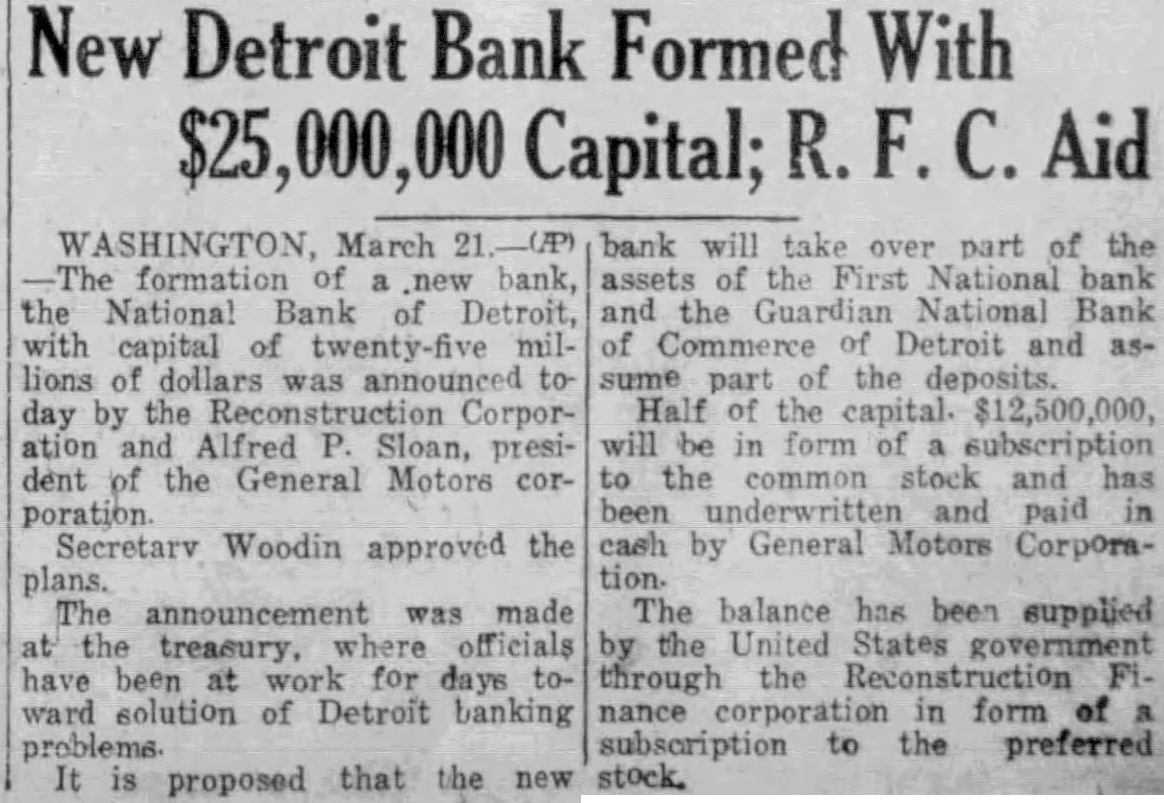
New Detroit Bank Formed With Capital; Aid
WASHINGTON, March formation bank, the National Bank Detroit, capital of twenty-five lions dollars was day by the Corporand Alfred Sloan, dent of the General Motors corSecretarv Woodin approved the The announcement was made treasury, where been for days solution Detroit banking problems. bank will take over part of the assets the First National bank and the Guardian National Bank Commerce Detroit and sume part the deposits. Half of the capital. will be form of subscription the common stock and has paid by General Motors Corporation. The balance has been supplied the United States government through the Reconstruction nance form subscription to the preferred
9.March 21, 1933The Niles Daily StarNiles, MI
Click image to open full size in new tab
Article Text
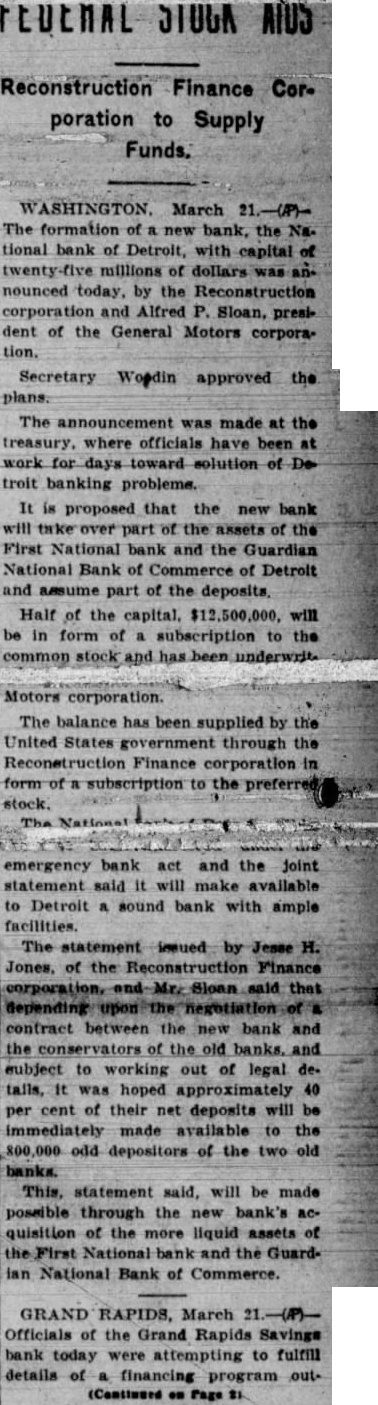
Reconstruction Finance Corporation to Supply
March tional bank of Detroit, with capital millions dollars nounced today. by the Reconstruction corporation and Alfred Sloan, president of the General Motors corpora- approved the
The announcement made the toward solution of De the new bank the assets First National bank and the Guardian National Bank of of Detroit and assume part of the deposits, Half of the capital. will be in form of subscription the
The balance has been supplied by the United States through the Reconstruction Finance corporation in the and the joint statement make available bank with ample The statement issued by Jesse Jones, of the Finance that and old and out of legal per cent of their net deposits will be immediately made the the two old This, statement said, will be made quisition the more liquid assets and the GuardNational Bank of Commerce.
Officials of the Grand Rapids Savings bank today attempting to fulfill details of financing program out(Continued
10.March 21, 1933Detroit Free PressDetroit, MI
Click image to open full size in new tab
Article Text
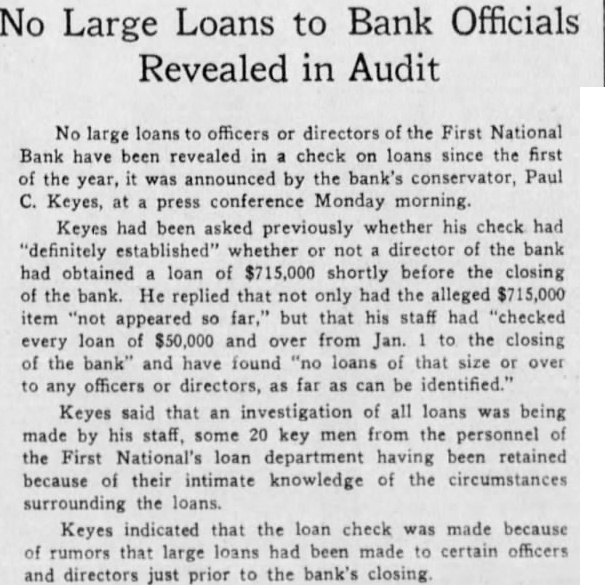
No Large Loans to Bank Officials Revealed in Audit
No large loans officers or directors of the First National Bank have been revealed in check on loans since the first of the year, announced by the bank's conservator, Paul C. Keyes, press conference Monday morning. Keyes had been asked previously whether his check had "definitely established" whether not director of the bank had obtained loan of $715,000 shortly before the closing of the bank. He replied that not only had the alleged $715,000 item "not appeared so far," but that his staff had "checked every loan of $50,000 and over from Jan. to the closing of the bank" and have found "no loans of that size or over to any officers or directors, as far as can be identified." Keyes said that an investigation of all loans was being made by his staff, some 20 key men from the personnel of the First National's loan department having been retained because of their intimate knowledge of the circumstances surrounding the loans. Keyes indicated that the loan check was made because of rumors that large loans had been made to certain officers and directors just prior to the bank's closing.
11.March 27, 1933Detroit Free PressDetroit, MI
Click image to open full size in new tab
Article Text
on Bank Issue
Letter to Roosevelt Urges Reopening of
Calls Policy Favored by Coughlin Ruinous
In an open letter to President which he read from pulpit in St. Joseph's Episcopal Church, the William Kinder, rector, Sunday attacked statements the Father Charles Coughlin. pastor of the Shrine the Little nection the latter's about bank officials. Anent the banking situation, Mr. Kinder demanded that the President once to reopen the two banks Mr. Kinder read the letter from his pulpit instead of his customary Sunday morning sermon. His ances the Woodward gregation by they left that the President by radio the Episcopal blamed the Federal Government for "failing the Detroit banks for the "mistakes advised Secretary of the Treasury. found fault with Secretary Woodin for using Royal Oak priest mouthpiece, blamed Father Coughlin for alleged against officials praised the Father Coughlin's superior, the Most Rev. Michael Gallagher, Catholic bishop of Detroit. Text of Rector's Letter Mr. Kinder's letter follows: "Dear Mr. President: neither banker business man nor simply simple tomed though either 'old fool. spite of know about people and thing conditions my city. You your now that which ought, by some be said with courage and the most difficult times You and you have earned the confidence an entire nation. with respect to the Detroit banking situation grievous mistake been made which paralyze this state period. visors have been bamboozled by radio priest. Many people They been anesthetized hot by their own fears. Their minds numb but they will one day waken. When they the mistake which been here will come home vengeance. banks closed radio have made public that previously officers and members the directors of these banks, and that would give names those had done His charge has not been substantiated by Government No list has made action the after weeks of
Cash Supply Reduced
"Is not possible that twentyfive millions dollars taken from the First National Bank Detroit in what the beginning that bank? brought the cash the bank down above cent legal requirement for reserve bank. What happening perhaps happening the Guardian National Bank of Commerce Then the Governor's lamation made closing perhaps forced by the clash interests between the Ford Motor Co. the General Motors Corp. Perhaps? this very different ture that by the radio priest. that amount actual dishonesty these banks in Detroit small comparison the total business: small the pressure Please Turn to Page
12.March 30, 1933The Plain DealerCleveland, OH
Click image to open full size in new tab
Article Text
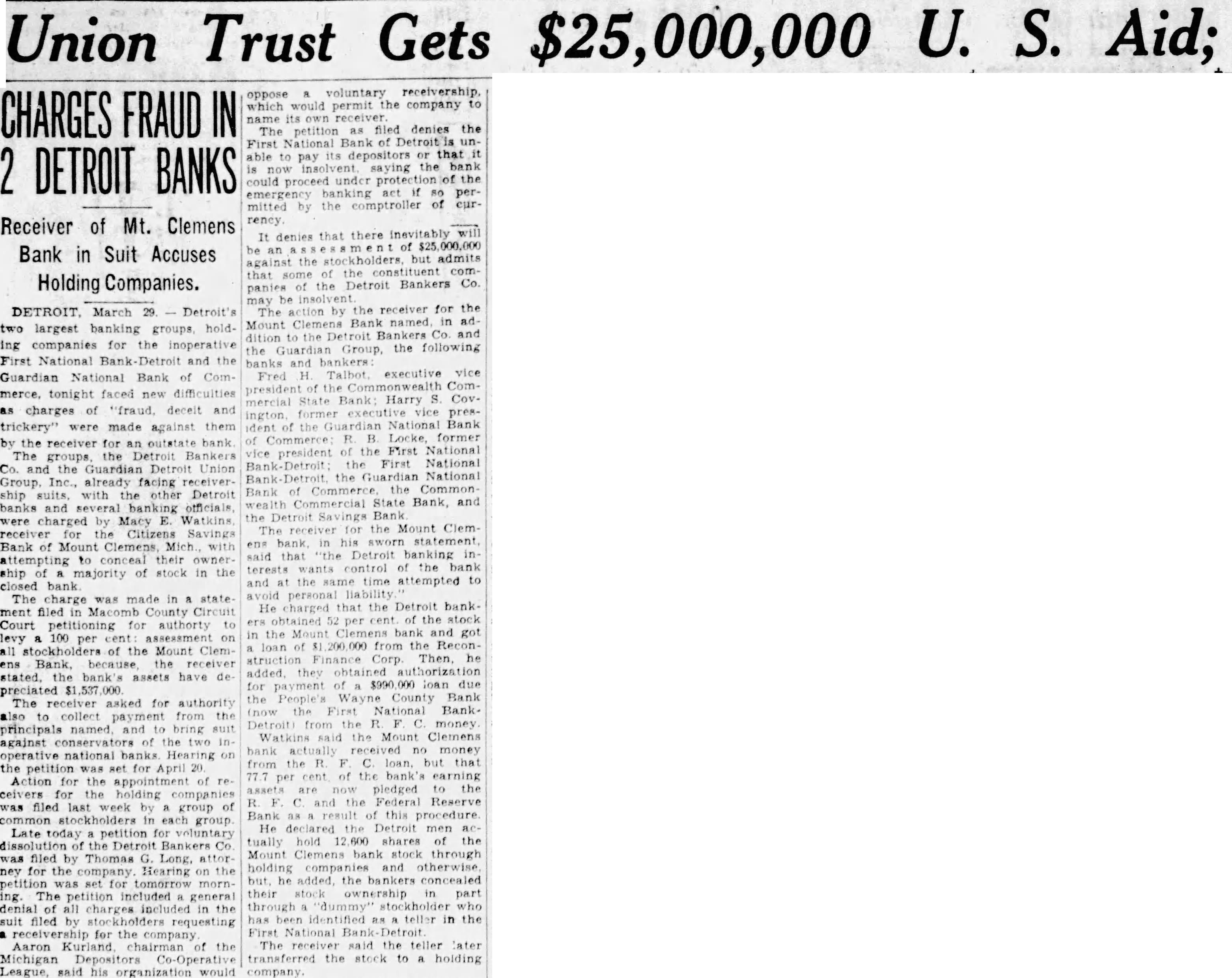
U. S. Union Trust Gets $25,000,000 Aid;
CHARGES FRAUD IN 2 DETROIT BANKS
Receiver of Mt. Clemens Bank in Suit Accuses Holding Companies.
March Detroit's largest banking ing companies for inoperative First and the Guardian National Bank of Commerce. tonight faced new difficulties as charges of deceit and trickery" were made against them the receiver for outstate bank The Detroit Bankers Co. the Group. facing ship with the Detroit banks and banking officials were charged Macy Watkins receiver the Citizens Savings Bank of Clemens, attempting to their ship majority of stock in the The charge was made in state ment filed Circuit Court petitioning for authorty levy 100 assessment on all stockholders of the Mount Clemens Bank, because bank's have preciated The asked for authority collect from the bring suit against of the two operative national banks Hearing the petition set for April Action for the appointment of holding was group of stockholders each group today petition for the Detroit Bankers Co filed by Thomas G. Long. attor for Hearing on petition mornThe included denial of all charges the suit filed by receivership for the company Aaron Kurland chairman of the Michigan Depositors Co-Operative League, oppose voluntary would permit the company to which name its The filed denies the First Bank of unable pay depositors that saying could banking by comptroller of
It denies there an but admits against that the Detroit Bankers panies the receiver for the by Mount and dition the following banks and Fred executive mercial Bank Harry former vice Bank president the First National First National the Guardian National the Common Bank State and the Detroit Bank banking and personal He charged the Detroit obtained in the and for payment the Bank Clemens the that of the earning Federal Reserve this procedure He the Detroit tually shares of Mount through ownership part through teller in the National The receiver the holding
13.June 27, 1933Richmond Times-DispatchRichmond, VA
Click image to open full size in new tab
Article Text
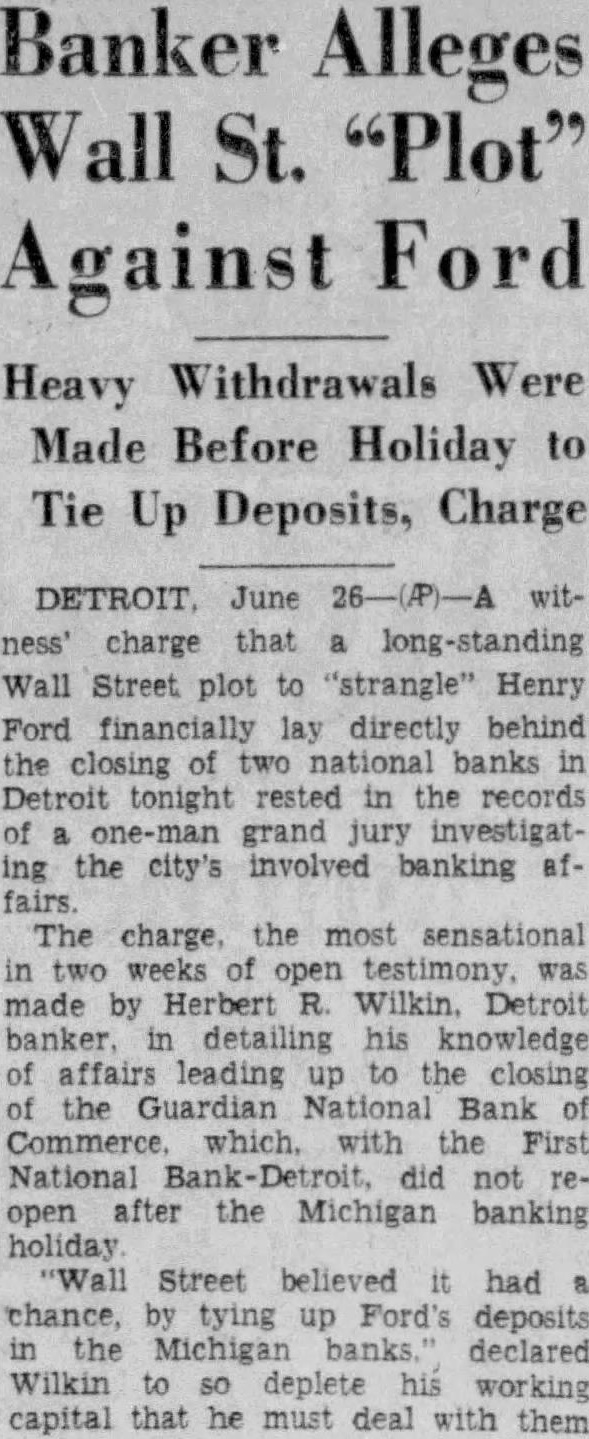
Banker Alleges Wall St. "Plot" Against Ford
Heavy Withdrawals Were Made Before Holiday to Tie Up Deposits, Charge
DETROIT June 26-(P)-A witness' charge that long-standing Wall Street plot to "strangle" Henry Ford financially lay directly behind the closing of two national banks in Detroit tonight rested in the records of one-man grand jury investigating the city's involved banking afThe charge, the most sensational in two weeks of open testimony, was made by Herbert R. Wilkin. Detroit banker, in detailing his knowledge of affairs leading up to the closing of the Guardian National Bank of Commerce which, with the First National Bank-Detroit, did not reopen after the Michigan banking holiday "Wall Street believed it had chance, by tying up Ford's deposits in the Michigan banks declared Wilkin to so deplete his working capital that he must deal with them
14.June 27, 1933The Lewiston Daily SunLewiston, ME
Click image to open full size in new tab
Article Text
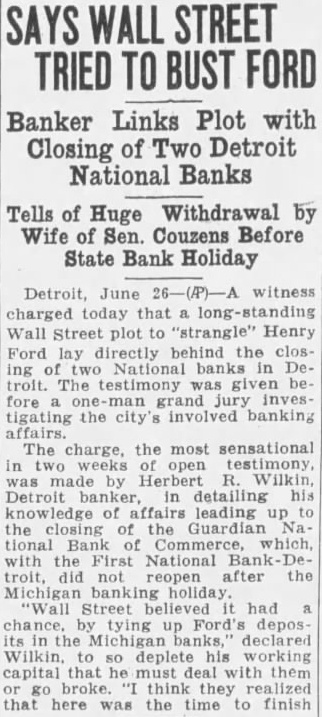
WALL STREET TRIED TO BUST FORD
Banker Links Plot with Closing of Two Detroit National Banks
Tells of Huge Withdrawal by Wife of Sen. Couzens Before State Bank Holiday
Detroit, June 26-(P)-A witness charged today that Wall Street plot to "strangle" Henry Ford lay directly behind the ing National banks in Detroit. The testimony was before grand investigating the involved banking affairs. The charge. the most sensational in weeks open testimony made by Herbert Detroit banker, detailing his of leading the closing Guardian tional Bank with the First National troit, reopen after Michigan banking holiday. "Wall Street believed had tying Ford's deposits declared Wilkin, deplete his working capital that must them broke think they realized that here was the time to finish
15.July 12, 1933Grand Haven TribuneGrand Haven, MI
Click image to open full size in new tab
Article Text
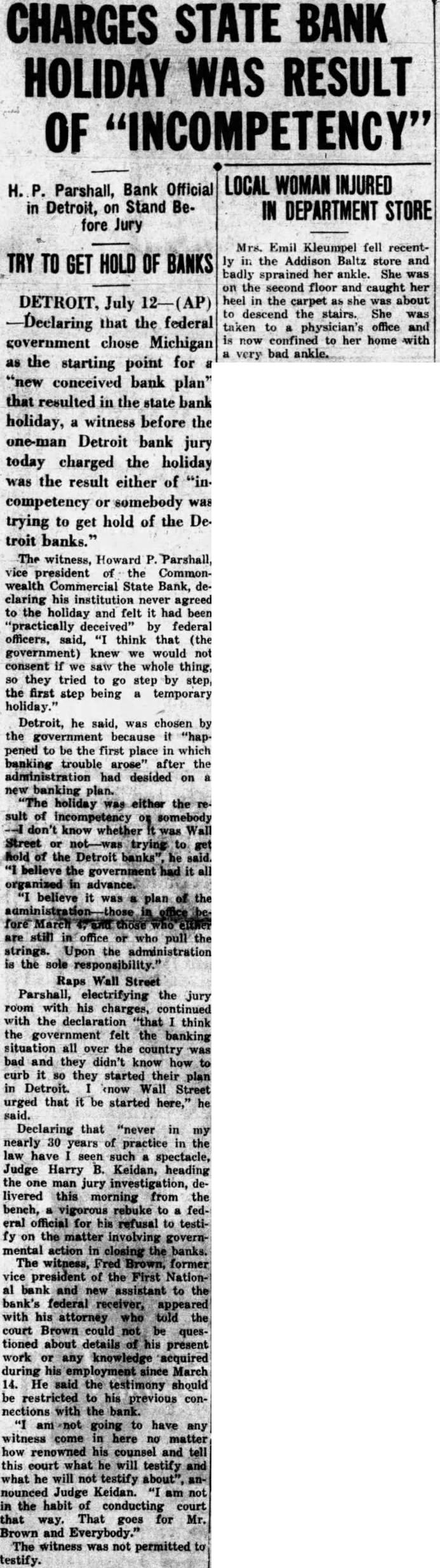
CHARGES STATE BANK HOLIDAY WAS RESULT "INCOMPETENCY"
LOCAL Parshall, Bank Official in Detroit, on Stand BeDEPARTMENT STORE fore Jury
HOLD BANKS
DETROIT, July that the federal government chose Michigan the starting point for conceived bank plan" that resulted in the state bank holiday, witness before the one-man Detroit bank jury today charged the holiday was the result either of competency or somebody was trying to get hold of the Detroit banks."
The witness, Howard Parshall, vice president of the Commonwealth Commercial State Bank, claring his institution never agreed to the holiday and felt it had been "practically deceived" by federal officers, said, think that (the government) knew we would not consent we saw the whole thing, they tried to go step by step, the first step being temporary holiday." Detroit, he said, was chosen by the because pened to be the first place in which banking trouble after the administration had desided banking plan. holiday sult of don't whether was Wall Street trying hold of the Detroit said. believe the government organized in advance. believe plan office who strings. Upon the the sole Raps Wall Street Parshall, electrifying the jury room with his charges, continued with the declaration "that think the government felt the banking situation all over the country bad and they didn't know how curb it so they started their plan in Detroit. know Wall Street urged that it be started said. Declaring that "never in nearly 30 years of practice in the have such spectacle, Judge Harry Keidan, heading the one man jury livered this morning from bench, vigorous rebuke to federal official for refusal to testion the matter involving governmental action in closing the banks. The witness, Fred Brown, former vice president of the First Nationbank and new assistant to bank's federal receiver, appeared with attorney who told the court Brown could not be questioned about details of his present work any knowledge acquired during employment since March He said the testimony should restricted to his previous connections with the bank. going to have any witness come here no matter how renowned his counsel and tell this court what he will testify and what he will not testify nounced Judge Keidan. not the habit of conducting court that That for Mr. way. goes Brown and Everybody." The witness was not permitted to testify.
Emil Kleumpel fell recentthe Addison Baltz store and badly sprained her ankle. She was on the second floor and caught her heel in the carpet she was about descend the stairs. She was taken to physician's office and confined to her home with very bad ankle.
16.July 14, 1933The Saginaw NewsSaginaw, MI
Click image to open full size in new tab
Article Text
FIRST NATIONAL MAY REORGANIZE
Ford Backs Proposed New Institution for Which Charter Has Been Asked-Funds for Depositors to Be Available in Few Days. tion of national bank backed by the Ford millions, possible formation of another. and ad. ditional payments to 800,000 depositors of the two closed banks were foreseen today, following the government's decision send $75.more into Detroit anticipated twofold First the formation bank by Edsel Ford with an initial capital of to take over group of suburban banks, and ultimately, it was believed. to take over of the Guardian National of second. the release of 20 per cent to depositors in the Guardian and cent First National Detroit positors. Distribution of per cent of depositors' already has been made by both institutions
First National May Re-Organize The ultimate fate the old National Bank was problematical Local financiers refused thus far to discuss cles that efforts already under along the lines of of with capitalization of was believed that the Ford group might also be active in the formation of this bank the availability of the new loan came yesterday in Jesse H. Jones, chairman of the Recon. struction Finance corporation board stated loan from would made to the Guardian National bank, and that loan of would be fortheoming for the First National as soon litigation now pending the priority of savings deposits loans to the banks made available on basis second recently completed praisal of collateral and securities the banks. Referring the Guardian National loan, Jones Many Assets Left.
"This loan can be on collateral face amount from $30,000.000 to depending upon the exact amount of the loan This would leave the receiver with assets of more less certain nature. aggregating. in face approximately $40. and the equity in R. collateral might be used as the nucleus of The statement points out that the deposit liability in the First National bank is greater and referring First National loan of additional loan of $50. together ly owing the poration. would be secured by collateral aggregating in round numbers In of the pending litigation. the tion of loan and disburseof the will depend upon the R. F. and the the being satisfied the legality and propriety of such "Aside from the collateral that the will require for its to the First National bank. the receiver have remainassets the face amount of sisting of property and securities of or undetermined value. In possible re-organization of the
17.September 1, 1933The Ludington Daily NewsLudington, MI
Click image to open full size in new tab
Article Text
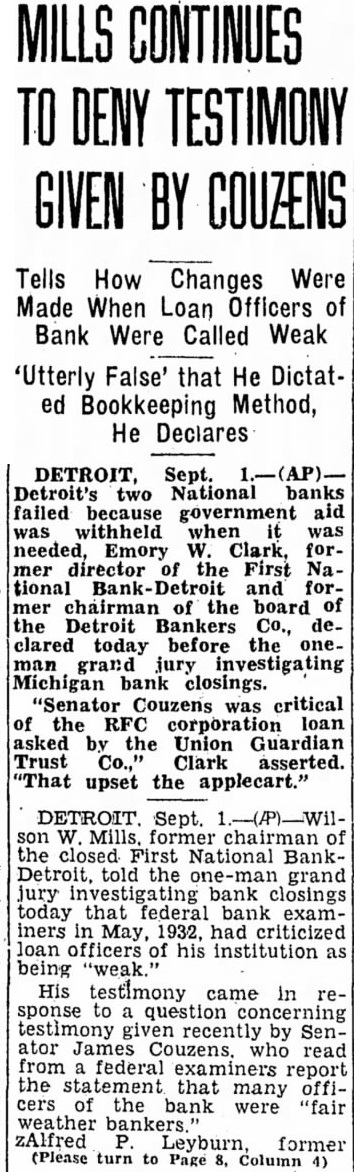
BY COUZENS
Tells How Changes Were Made When Loan Officers of Bank Were Called Weak
'Utterly False' that He Dictated Bookkeeping Method, He Declares
DETROIT, Sept. Detroit's two National banks failed because government aid withheld when was needed, Emory Clark, director of the First National and chairman of the board of the Detroit Bankers Co., clared today before the grand jury Michigan bank closings. "Senator Couzens was critical the RFC corporation loan asked the Union Guardian Trust Clark asserted. "That upset the applecart."
DETROIT Sept. Mills. former chairman of the closed First National BankDetroit. told the one-man grand jury bank today that federal bank iners in May, 1932, had criticized officers of his institution being His testimony came in sponse to question testimony given recently by ator James Couzens. who read from federal examiners report the statement that many officers of the bank were weather zAlfred Leyburn, former (Please Page Column
18.October 3, 1933The Grand Rapids PressGrand Rapids, MI
Click image to open full size in new tab
Article Text
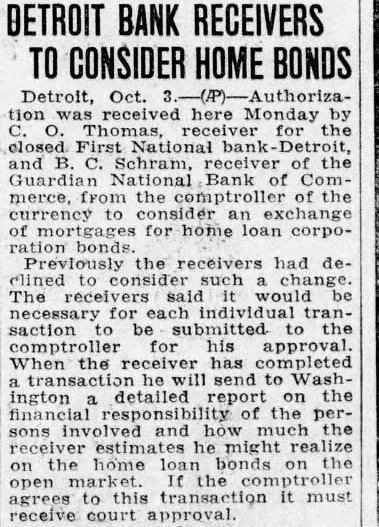
DETROIT BANK RECEIVERS TO CONSIDER HOME BONDS
Detroit, Oct. received here Monday by closed First National bank Detroit, and Schram, receiver of the National Bank Commerce, the the currency exchange mortgages for home loan corporation bonds. Previously the receivers had deThe for saction be submitted comptroller his approval. When receiver has completed to Washington detailed on the persons involved and receiver estimates he might realize on home bonds open market. the agrees to it must receive court approval.
19.October 7, 1933Lansing State JournalLansing, MI
Click image to open full size in new tab
Article Text
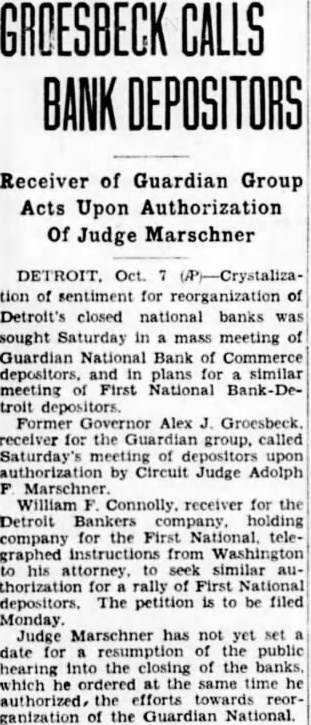
GROESBECK
Receiver of Guardian Group Acts Upon Authorization Of Judge Marschner
Oct. tion of sentiment for reorganization of Detroit's closed national banks sought Saturday in mass meeting of Guardian National Bank Commerce plans similar meeting First National depositors. Alex Groesbeck. receiver for the group, called of upon authorization by Circuit Judge Adolph Marschner William receiver for the Detroit Bankers holding for First telecompany from attorney. seek similar thorization of First National depositors. The petition to be filed Monday. Judge Marschner has not yet resumption the public into the closing of the which the he ganization of the Guardian National.
20.December 17, 1933Detroit Free PressDetroit, MI
Click image to open full size in new tab
Article Text
Stockholders' Motion Heard
Want to Show Cause of Insolvency
By Jack Weeks
Dec. National banks prove their contention that banks were wrecked within 30 days followappointment Government asserted FedJudge Knight argument attorneys for holders seeking injunction prevent double and counsel bank's the court reserved decision until the fer the case to master in chanhearing was held here through the inability Judge Knight present in Detroit today. Judge Knight assigned this to assist the Fedhas hearing cases in their jurisdiction.
Mass of Evidence Pointed To The asked that the matter referred the great to be presented. examination condition holding companies units of the latter during the finding of order and the fact judge may be available try the when comes up Protesting against referring the case master chancery taking great amount counsel for wouldn't enough to the the would require some 200,000 items assets in the First National matter how the bank became insolvent, that's no defense against Want Insolvency Cause Shown James Murfin, counsel for stockholders, vehemently asserted they did not expect controfinding but did allege the Comptroller admitted the solvent holiday March appointed. In April the our choicest assets. This bank wrecked within facts When Wood suits stockholders tried within Judge Knight asked him to prove his legations fraud the holding companies that Wood answered that introduce minutes the holding bank to bank within the Attorney Frank Robson who led argument for effect the ceiverships, by which assets have been had the and ability of its members meet obligations.
Blames Agents "Here First entirely solvent had abundance assets The condition which about the receivership acts Government agents the tion those facts cannot be made moment He asserted that the statute viding stock the holding companies regulations that did contemplate apply by the officers. Appearing the hearing for Judge Murfin and Mr. Charles Louis George Klein and James Turner Attorneys and Lawrence Levy represented the receivers.
21.December 18, 1933The Dowagiac Daily NewsDowagiac, MI
Click image to open full size in new tab
Article Text
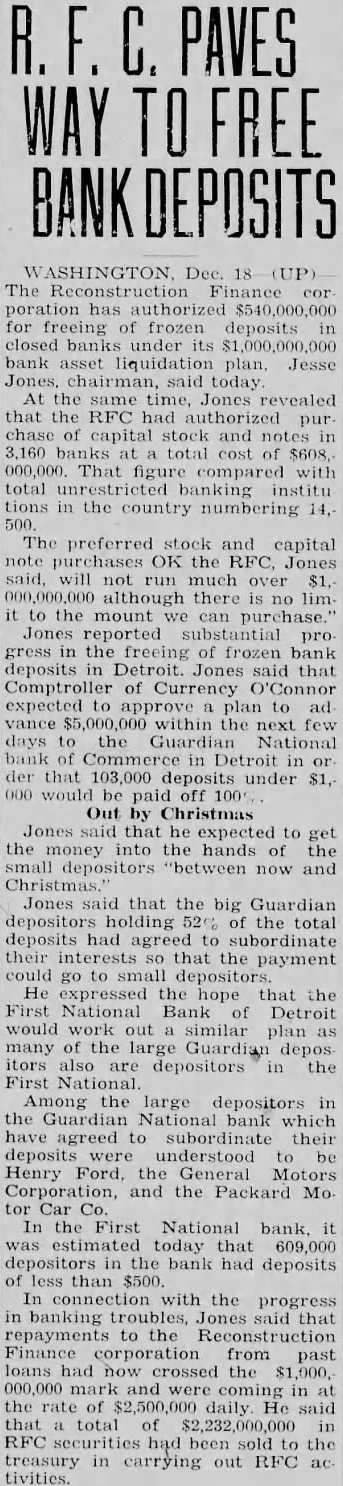
PAVES
Dec. The has authorized freeing of frozen deposits closed banks under bank asset liquidation Jesse Jones, chairman, said today At the time, Jones revealed that the RFC had authorized pur chase capital stock and notes 3,160 banks total cost of 000,000. That figure compared with institu tions the country numbering The preferred stock and capital purchases OK the RFC. Jones said, will not run much over $1. although there is no to the mount Jones reported substantial pro gress in the of frozen bank deposits Detroit. said that Comptroller of Currency plan to ad the next Guardian National Commerce in or that 103,000 under would be paid off Out by Christmas Jones said that he expected to get the into the hands of the small depositors "between now and Jones said that the big Guardian depositors the total deposits had to their the payment could go to small He the hope that the First National Bank of Detroit would work similar plan many of the large depos itors also depositors the First National. Among the large depositors the Guardian National bank which have agreed subordinate their deposits understood Henry the Motors Corporation, and the Packard Mo tor In First National bank estimated today that depositors the bank had deposits of than $500. In connection with the progress in banking troubles, Jones said that repayments to the Finance corporation from past loans had now crossed the 000,000 mark and coming in the rate of $2,500,000 He that total $2,232,000,000 in RFC securities been sold the treasury in out RFC tivities.
22.February 2, 1934Detroit Free PressDetroit, MI
Click image to open full size in new tab
Article Text
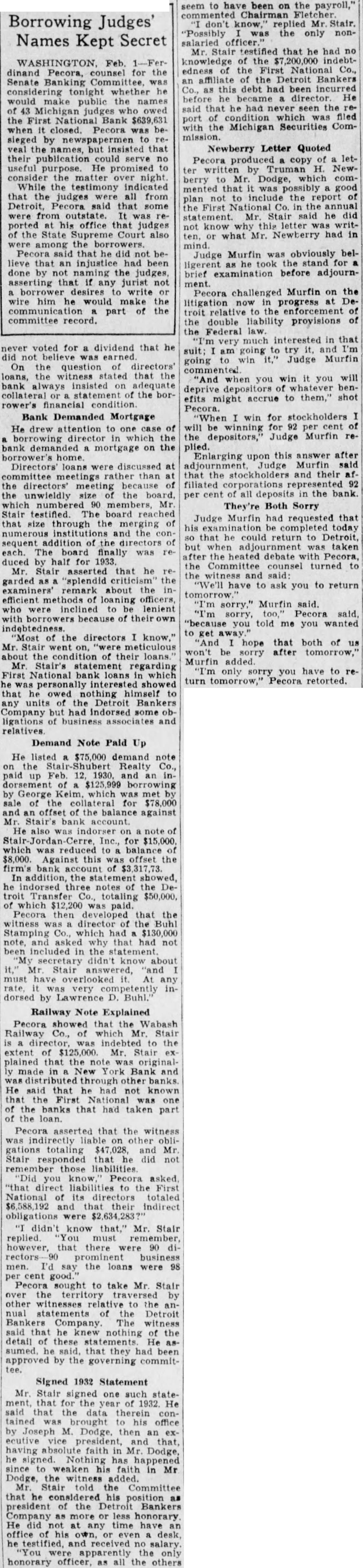
Borrowing Judges' Names Kept Secret dinand Pecora, counsel for the Senate Banking considering tonight whether he would make the names of Michigan owed the First National Bank when closed. Pecora besieged by newspapermen veal names, but their publication serve useful He consider the matter night While the indicated that the judges from Detroit, Pecora said that some from outstate. was ported office judges the State Court also the beinjustice done the judges, jurist not desires write him he would make part the committee record. voted for dividend that he did not was On question that the bank always insisted collateral the borrower's condition Bank Demanded Mortgage
He drew attention case director in which bank demanded mortgage on the home. Directors loans were discussed than directors' unwieldly the numbered members, Mr Stair testified. board size through institutions and the consequent of board finally was duced half asserted that he garded "splendid the remark about the efficient methods loaning officers, to be lenient the directors know," Mr. Stair meticulous condition of their Stair's National loans which owed himself to any units the Detroit Bankers Company but had indorsed some ligations of business associates and relatives
Demand Note Paid Up
He listed $75,000 demand note Realty Feb. dorsement $125,999 borrowing Keim, which $78,000 balance against Mr. Inc., for which reduced balance $8,000. Against this offset the firm's of In addition, the DeTransfer totaling $50,000, which Pecora developed that the witness director the Buhl Stamping which had $130,000 why that had not included the didn't Mr overlooked any dorsed by Lawrence D.
Railway Note Explained
Pecora that the Wabash Railway Mr. Stair to the extent $125,000. plained that the York Bank through other banks. He said that not known banks that had taken part the Pecora that the witness and Mr. Stair did not those "Did you "that direct liabilities the First National directors totaled their indirect obligations $2,634,283?' didn't know that," Mr. Stair replied remember, however, 90 rectors the loans were cent Pecora sought to take Mr. Stair over other statements the Detroit Bankers witness said he nothing the detail that they had approved by the commit-
Signed 1932 Statement Mr. Stair one the He the tained Joseph Dodge, then ecutive having faith Mr. Dodge, signed. has faith in Mr Dodge, the told the Committee that he considered his position president of the Company less honorary He did any time office his received the honorary officer, all the others seem to been on the payroll," Chairman don't know," replied Mr Stair. "Possibly only nontestified that had no knowledge of the indebtthe First Co., affiliate the Detroit Bankers this debt had been incurred before became director. He said he the of filed Michigan Securities Com-
Letter Quoted
Pecora copy letNewberry Dodge, good plan include the report First National the annual statement. Stair he did not know what Mr. Newberry had in or mind. Judge Murfin obviously belbrief examination before adjournPecora challenged Murfin on the progress the double liability provisions the Federal much interested in that I'm am going it," Judge Murfin going "And when will deprive depositors efits might accrue to them," shot "When for stockholders will be for per cent the depositors," Judge Murfin replied. Enlarging upon this answer after Murfin said the and their per all deposits the bank. Both Sorry
Judge Murfin had requested that his today could return to Detroit, but taken the debate Pecora, the Committee counsel turned witness have to ask you to return tomorrow. sorry," Murfin said. sorry, Pecora said "because told me you wanted hope that both of won't after Murfin only you have to return Pecora retorted.
23.August 16, 1934The Indiana GazetteIndiana, PA
Click image to open full size in new tab
Article Text
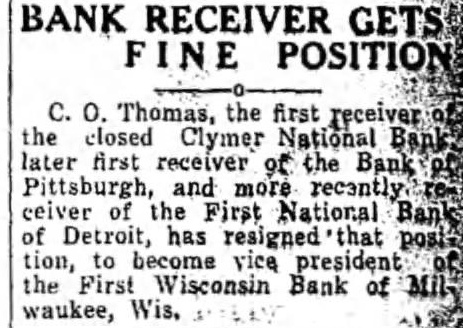
BANK RECEIVER
C. Thomas, the first receiver closed Clymer later first receiver of the Pittsburgh, and more recently. ceiver of the First National Detroit, has to become vice president First Wisconsin Bank of waukee,
24.August 31, 1934The Unionville CrescentUnionville, MI
Click image to open full size in new tab
Article Text
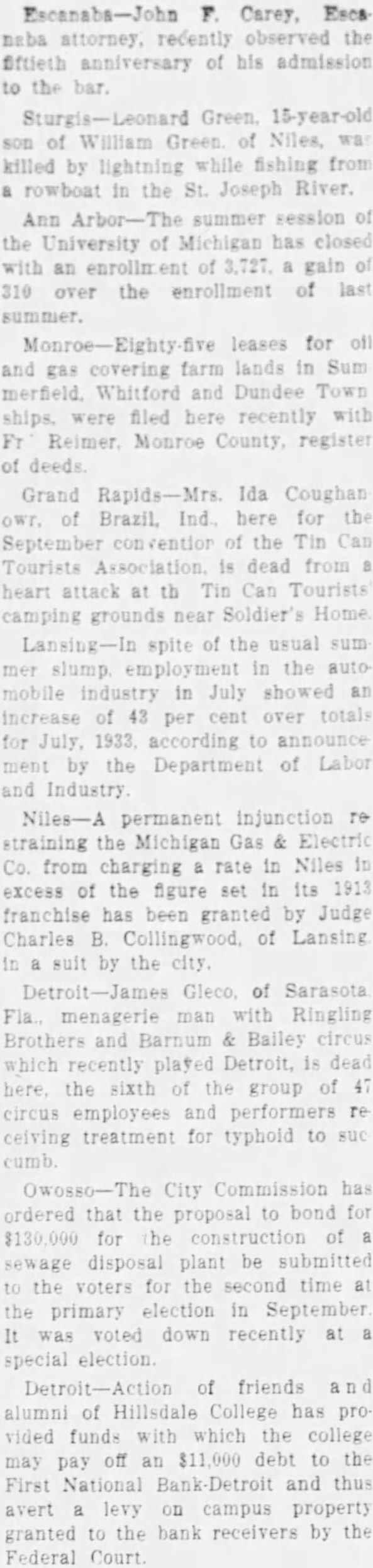
naba attorney, recently observed the fiftieth anniversary of his admission to the bar.
Sturgis-Leonard Green. 15-year-old son of William Green of Niles, was killed by lightning while fishing from a rowboat in the St. Joseph River. Ann Arbor-The summer session of the University of Michigan has closed with an enrollmes of 3,727. a gain of 310 over the enrollment of last summer.
Monroe-Eighty-five leases for oil and gas covering farm lands in Sum merfield. Whitford and Dundee Town ships, were filed here recently with FT Reimer. Monroe County, register of deeds
Grand Rapids-Mrs. Ida Coughan owr. of Brazil, Ind. here for the September convention of the Tin Can Tourists Association. is dead from heart attack at th Tin Can Tourists camping grounds near Soldier's Home Lansing-In spite of the usual sum mer slump. employment in the auto mobile industry in July showed an increase of 43 per cent over totals for July, 1933, according to announce ment by the Department of Labor and Industry
Niles-A permanent injunction re straining the Michigan Gas & Electric Co. from charging a rate in Niles in excess of the figure set in its 1913 franchise has been granted by Judge Charles B. Collingwood, of Lansing in suit by the city Detroit-James Gleco. of Sarasota menagerie man with Ringling Brothers and Barnum & Bailey circus which recently played Detroit, is dead here, the sixth of the group of 47 circus employees and performers re ceiving treatment for typhoid to suc cumb.
Owosso-The City Commission has ordered that the proposal to bond for $130,000 for the construction of sewage disposal plant be submitted to the voters for the second time at the primary election in September It was voted down recently at special election.
Detroit-Action of friends and alumni of Hillsdale College has provided funds with which the college may pay off an $11,000 debt to the First National Bank-Detroit and thus avert a levy on campus property granted to the bank receivers by the Federal Court
25.February 3, 1935Evening StarWashington, DC
Click image to open full size in new tab
Article Text
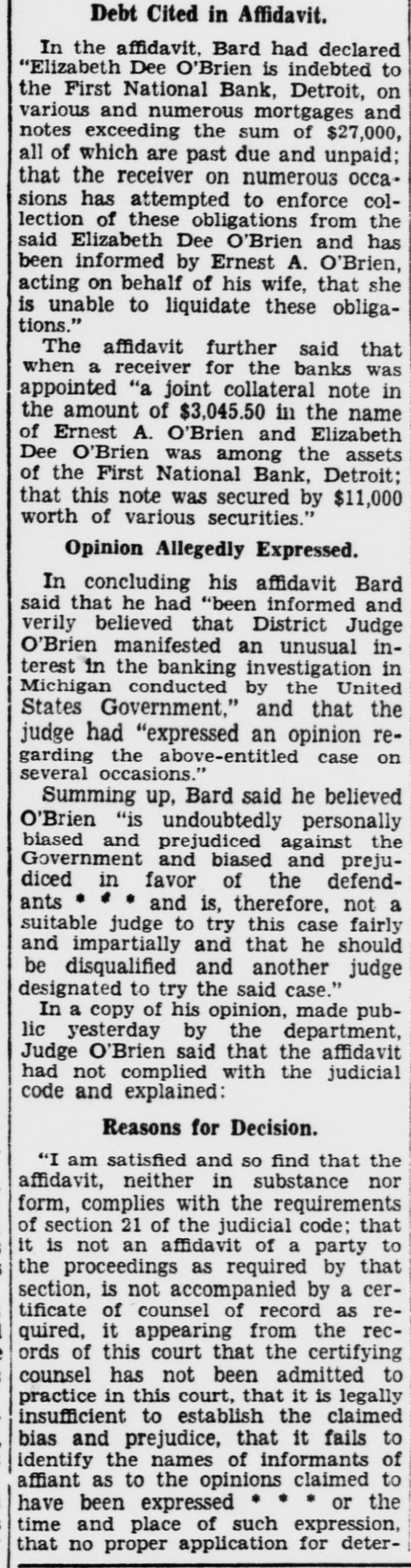
Debt Cited in Affidavit. In the affidavit, Bard had declared "Elizabeth Dee O'Brien is indebted to the First National Bank, Detroit, on various and numerous mortgages and notes exceeding the sum of $27,000, all of which are past due and unpaid; that the receiver on numerous occasions has attempted to enforce collection of these obligations from the said Elizabeth Dee O'Brien and has been informed by Ernest A. O'Brien, acting on behalf of his wife, that she is unable to liquidate these obligations." The affidavit further said that when a receiver for the banks was appointed "a joint collateral note in the amount of $3,045.50 in the name of Ernest A. O'Brien and Elizabeth Dee O'Brien was among the assets of the First National Bank, Detroit; that this note was secured by $11,000 worth of various securities." Opinion Allegedly Expressed. In concluding his affidavit Bard said that he had "been informed and verily believed that District Judge O'Brien manifested an unusual interest in the banking investigation in Michigan conducted by the United States Government," and that the judge had "expressed an opinion regarding the above-entitled case on several occasions." Summing up, Bard said he believed O'Brien "is undoubtedly personally biased and prejudiced against the Government and biased and prejudiced in favor of the defendants and is, therefore, not a suitable judge to try this case fairly and impartially and that he should be disqualified and another judge designated to try the said case." In a copy of his opinion, made public yesterday by the department, Judge O'Brien said that the affidavit had not complied with the judicial code and explained: Reasons for Decision. "I am satisfied and so find that the affidavit, neither in substance nor form, complies with the requirements of section 21 of the judicial code; that it is not an affidavit of a party to the proceedings as required by that section, is not accompanied by a certificate of counsel of record as required, it appearing from the records of this court that the certifying counsel has not been admitted to practice in this court, that it is legally insufficient to establish the claimed bias and prejudice, that it fails to identify the names of informants of affiant as to the opinions claimed to * or the have been expressed * time and place of such expression, that no proper application for deter-