9353. First National Bank (Sedalia, MO)

Bank Information

Episode Type
Suspension โ†’ Closure
Bank Type
national
Bank ID
1627
Charter Number
1627
Start Date
May 4, 1894
Location
Sedalia, Missouri (38.704, -93.228)

Metadata

Model
gpt-5-mini
Short Digest
982d2bd6c776c872

Response Measures

None

Receivership Details

Depositor recovery rate
18.0%
Date receivership started
1894-05-10
Date receivership terminated
1909-06-30
OCC cause of failure
Fraud
Share of assets assessed as good
28.2%
Share of assets assessed as doubtful
13.9%
Share of assets assessed as worthless
57.9%

Description

The First National Bank of Sedalia suspended payments on May 4, 1894 after circulation of a 'fake' or false telegram undermined its standing. A receiver (W. A. Latimer) was appointed within about a week and the bank remained in receivership and effectively defunct (assessments, litigation, indictments), so this is a suspension that ended in closure/receivership rather than a mere temporary suspension or reopening. Newspaper accounts attribute the suspension to a false telegram and resulting loss of business; no clear independent depositor run is described in the articles.

Events (4)

1. January 2, 1866 Chartered
Source
historical_nic
2. May 4, 1894 Suspension
Cause
Rumor Or Misinformation
Cause Details
Publication months earlier of a 'fake' or false telegram reporting the bank had failed, which caused other banks to become suspicious and impaired the bank's standing.
Newspaper Excerpt
The First National Bank of this city ... failed to open its doors for business today. A notice, signed by the officers and directors, was on the door notifying depositors of the suspension.
Source
newspapers
3. May 10, 1894 Receivership
Source
historical_nic
4. May 11, 1894 Receivership
Newspaper Excerpt
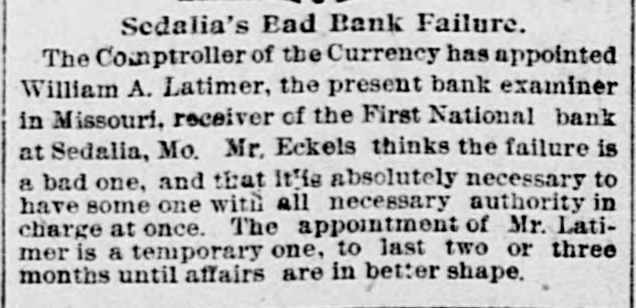
The Comptroller of the Currency has appointed William A. Latimer, the present bank examiner in Missouri, receiver of the First National bank at Sedalia, Mo.
Source
newspapers

Newspaper Articles (25)

Article from The Indianapolis Journal, May 5, 1894

Click image to open full size in new tab

Article Text

Bank Closed by a "Fake" Telegram. SEDALIA, Mo., May 4.-The First National Bank of this city, one of the oldest financial institutions in central Missouri, falled to open its doors for business today. A notice, signed by the officers and directors, was on the door notifying depositors of the suspension. The bank has a capital of $250,000 and was supposed to have a reserve fund of $25,000. The cause of the suspension is attributed to a loss of business brought about by the publication in a St. Louis paper, several months ago, of a "fake" telegram from this city stat. ing that the bank had failed. Other banks became suspicious and the standing of the First National Bank became impaired. It is the general belief that all the depositors will be paid in full.


Article from The Times, May 5, 1894

Click image to open full size in new tab

Article Text

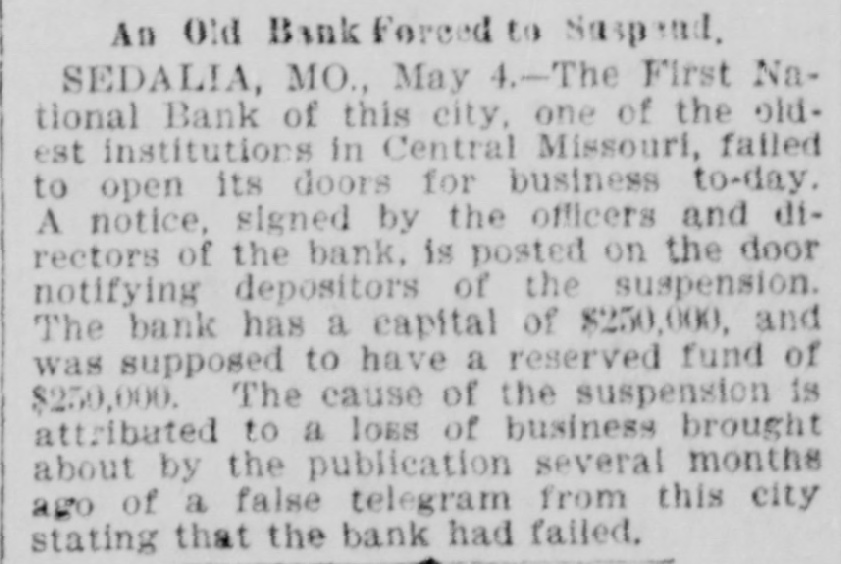
An Old Bank Forced to Suspond, SEDALIA, MO., May 4.-The First National Bank of this city, one of the oldest institutions in Central Missouri, failed to open its doors for business to-day. A notice, signed by the officers and directors of the bank, is posted on the door notifying depositors of the suspension. The bank has a capital of $250,000, and was supposed to have a reserved fund of $250,000. The cause of the suspension is attributed to a loss of business brought about by the publication several months ago of a false telegram from this city stating that the bank had failed.


Article from Wheeling Register, May 5, 1894

Click image to open full size in new tab

Article Text

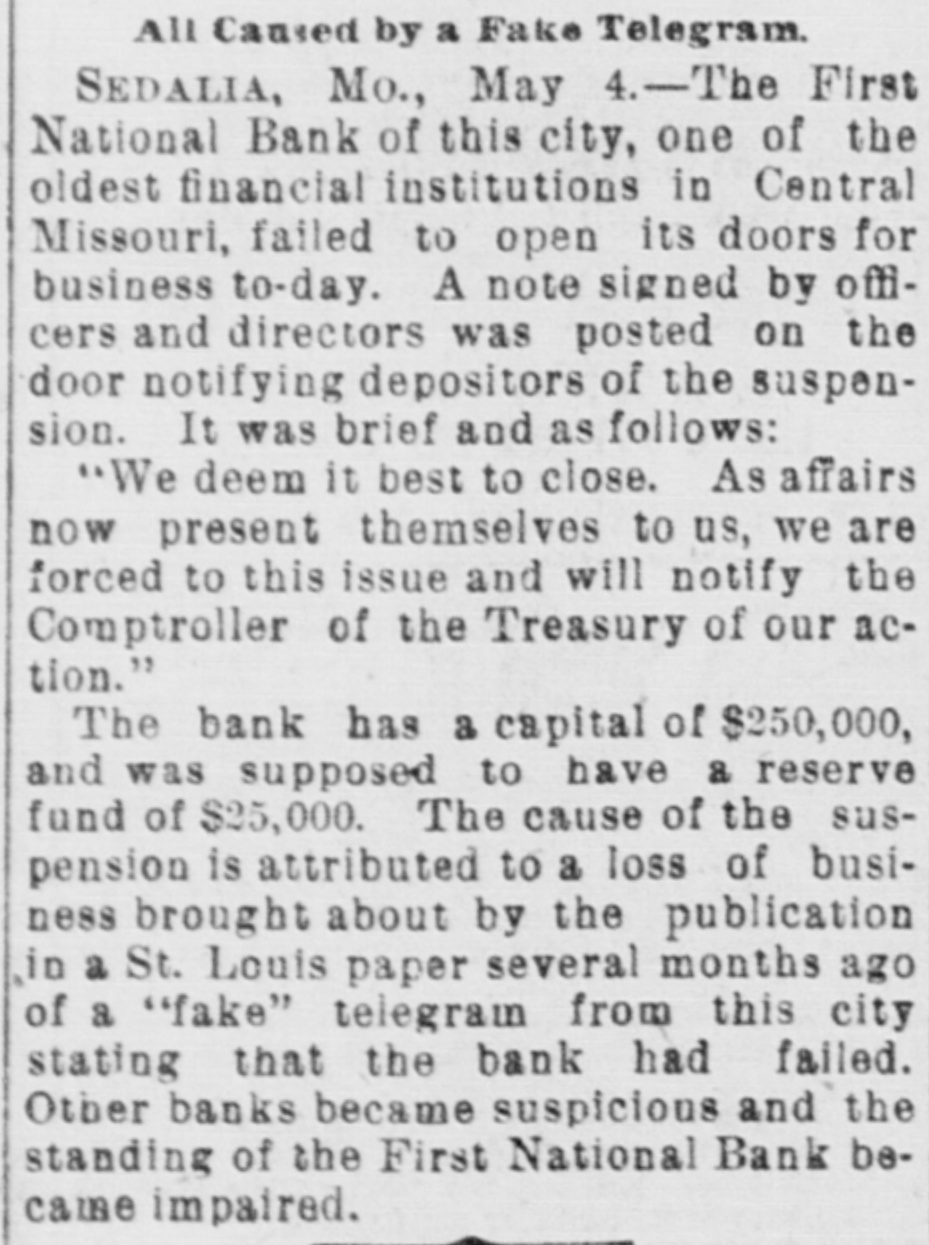
All Caused by a Fake Telegram. SEDALIA, Mo., May 4.-The First National Bank of this city, one of the oldest financial institutions in Central Missouri, failed to open its doors for business to-day. A note signed by officers and directors was posted on the door notifying depositors of the suspension. It was brief and as follows: "We deem it best to close. As affairs now present themselves to us, we are forced to this issue and will notify the Comptroller of the Treasury of our action." The bank has a capital of $250,000, and was supposed to have a reserve fund of $25,000. The cause of the suspension is attributed to a loss of business brought about by the publication in a St. Louis paper several months ago of a "fake" telegram from this city stating that the bank had failed. Other banks became suspicious and the standing of the First National Bank because impaired.


Article from Asheville Daily Citizen, May 5, 1894

Click image to open full size in new tab

Article Text

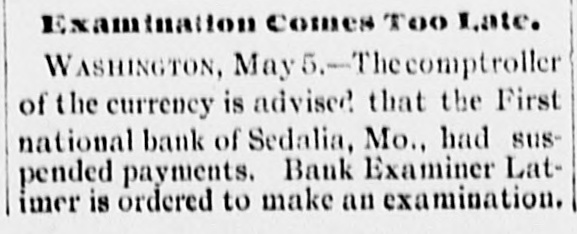
Examinailon comes Too Late. WASHINGTON, May 5.-Thecomptroller of the currency is advised that the First national bank of Sedalia, Mo., had suspended payments. Bank Examiner Latimer is ordered to make an examination.


Article from Rock Island Argus, May 5, 1894

Click image to open full size in new tab

Article Text

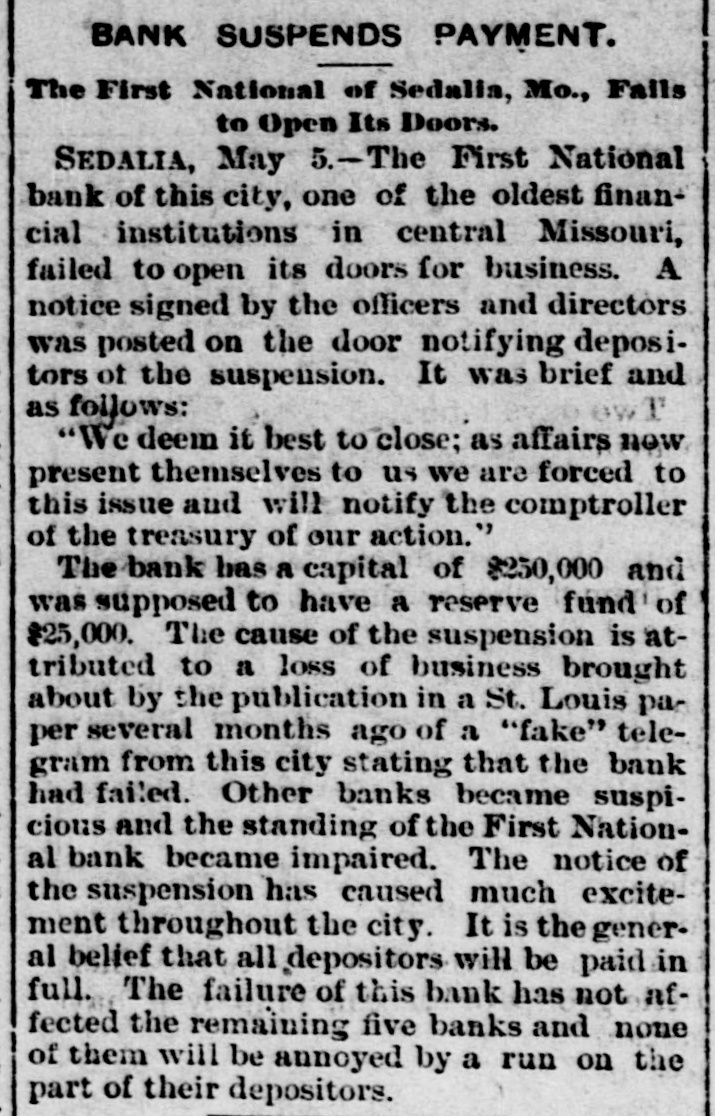
BANK SUSPENDS PAYMENT. The First National of Sedalia, Mo., Falls to Open Its Doors. SEDALIA, May 5.-The First National bank of this city, one of the oldest financial institutions in central Missouri, failed to open its doors for business. A notice signed by the officers and directors was posted on the door notifying depositors of the suspension. It was brief and as follows: T "We deem it best to close; as affairs now present themselves to us we are forced to this issue and will notify the comptroller of the treasury of our action." The bank has a capital of $250,000 and was supposed to have a reserve fund of $25,000. The cause of the suspension is attributed to a loss of business brought about by the publication in a St. Louis par per several months ago of a "fake" telegram from this city stating that the bank had failed. Other banks became suspicious and the standing of the First National bank became impaired. The notice of the suspension has caused much excitement throughout the city. It is the general belief that all depositors will be paid in full. The failure of this bank has not nffected the remaining five banks and none of them will be annoyed by a run on the part of their depositors.


Article from Morning Journal and Courier, May 5, 1894

Click image to open full size in new tab

Article Text

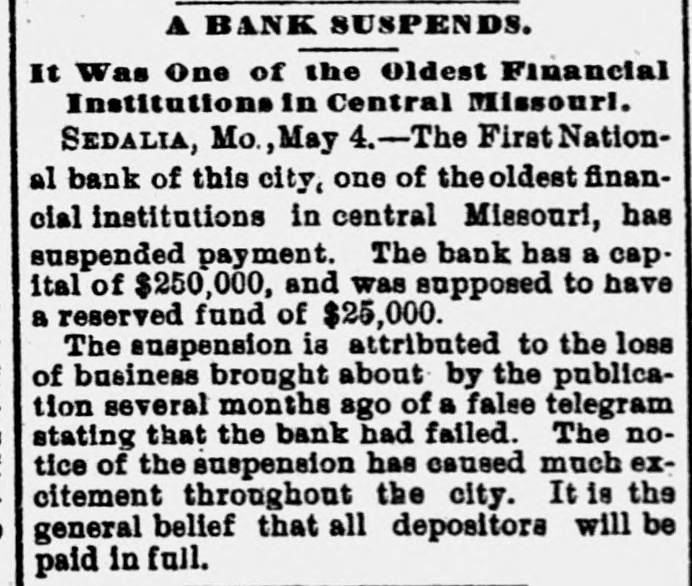
A BANK SUSPENDS. It Was One of the Oldest Financial Institutions in Central Missouri. SEDALIA, Mo., May 4.-The First National bank of this city, one of the oldest financial institutions in central Missouri, has suspended payment. The bank has a cap. ital of $250,000, and was supposed to have a reserved fund of $25,000. The suspension is attributed to the loss of business brought about by the publication several months ago of a false telegram stating that the bank had failed. The notice of the suspension has caused much excitement throughout the city. It is the general belief that all depositors will be paid in full.


Article from The Roanoke Times, May 5, 1894

Click image to open full size in new tab

Article Text

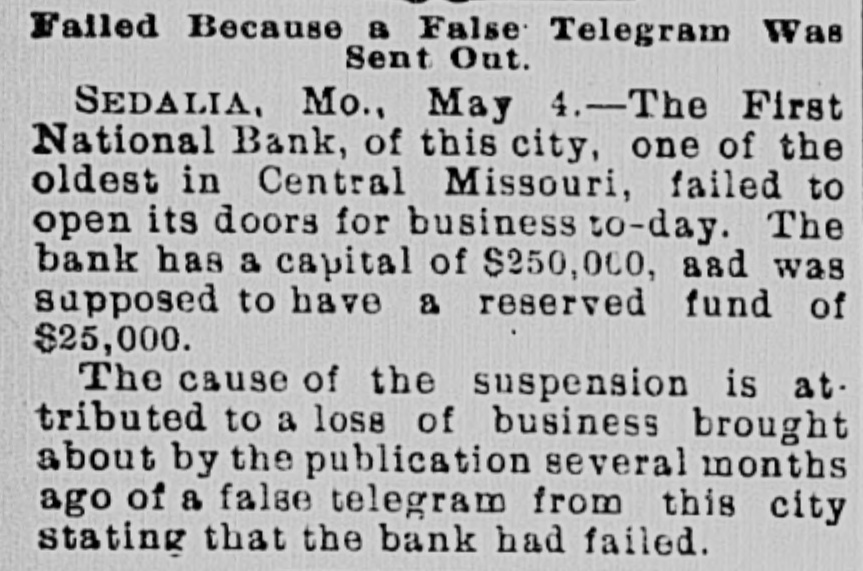
Failed Because a False Telegram Was Sent Out. SEDALIA, Mo., May 4.-The First National Bank, of this city, one of the oldest in Central Missouri, failed to open its doors for business to-day. The bank has a capital of $250,000, and was supposed to have a reserved fund of $25,000. The cause of the suspension is at. tributed to a loss of business brought about by the publication several months ago of a false telegram from this city stating that the bank had failed.


Article from Semi-Weekly Interior Journal, May 11, 1894

Click image to open full size in new tab

Article Text

NEWSY NOTES. -Peyton N. Clark was elected president of the Louisville Commercial Club. -Fire at Lexington destroyed the tobacco warehouse of N. Quisinberry & t Co. Loss $15.000. -Mr. George K. Duckworth, one of the leading men of Cincinnati, died there Tuesday evening. -The National convention of the Brotherhood of Locomotive Engineess is in session at St. Paul. -Two of his sons killed Bud Hixon in Tennessee, for telling that they were running an illicit distillery. -A four years' drouth in Zapata county, Texas, has reduced the people to starvation, and they ask for food. -On the strength of a prophecy of an earthquake, the people of many Greek district deserted their homes and fled to the hills. -The State National Bank at Wichita, Kansas, has suspended, leaving a large number of depositors in a bad fin ancial condition. -It is charged that the employee of the Northern Pacific are allowing the commonwealers to ride in freight cars without molestation. -A Russian village of Vohynia caught fire and the people moved their effects into the open air, whence they were carried away by a cyclone. -Mr. Henry Watterson, who is now on the Pacific Coast on a lecture tour, has been elected president of the West ern Society of New York. -The supreme court of South Carolina decides that there is no authority vested in any power under the law to grant liquor licenses in the State. -Mobile and Ohio engineers have accepted a cut of 8 per cent. in their wages, agreeing that the cut shall go into effect May 8 and remain in force until Dec. 1. -Miss Lillian A. Ashley, of Boston, filed suit against "Lucky" Baldwin, the millionaire turfman, of Los Angeles, Cal., for $75,000 damages for alleged seduction. -The pick-pocket who worked the crowd at the Breckinridge speaking at Lexington, tried it on the Paris crowd gathered for the same purpose, and got nabbed. -Policeman Frank Ball shot and probably mortally wounded James Davis, a painter at Middlesboro. Davis was drunk and disorderly and had been arrested, when he resisted. -Coxey's camp at Washington must break. The district health officers have decided it to be a nuisance and dangerous to health. The district commissioners have given Coxey and his followers 48 hours to abate the nuisance. -A heavy defalcation has been discovered in the accounts of Cashier Thompson, of the suspended First National Bank of Sedalia, Mo., and he has fled to escape arrest. The property of those who owe the bank is being attached by the bank examiner. I -After hearing Gen. Coxey, the House committee on Labor, by a vote of 7 to 2, decided to report a resolution for a joint investigation by a. special committee of the Senate and House to investigate Coxey movement and the depressed condition of the country generally. -A terrific earthquake took place in Venezuela on April 28. The cities of Merida, La Guinillas, Chiguara and San Juan, situated in the northwest of the republic, in the region of the Andes, are to reported as having been totally destroyed by a fierce shock and 10,000 people perished. B -The State Board of Equalization's completed labors shows the grand equalized total of all property in the State to be $571,283,802, or a raise of $10,733,496 P over the assessed valuation. The grand equalized total shows a decrease of $25,an tic 715,274 as compared with last year, due to the collapse of several Eastern Kenfu tucky booms and the general depreciation in the value of personal property.


Article from The Washington Times, May 11, 1894

Click image to open full size in new tab

Article Text

Sedalia's Bad Bank Failure. The Comptroller of the Currency has appointed William A. Latimer, the present bank examiner in Missouri, receiver of the First National bank at Sedalia, Mo. Mr. Eckels thinks the failure is a bad one, and that it'is absolutely necessary to have some one with all necessary authority in charge at once. The appointment of Mr. Latimer is a temporary one, to last two or three months until affairs are in better shape.


Article from The Progressive Farmer, May 15, 1894

Click image to open full size in new tab

Article Text

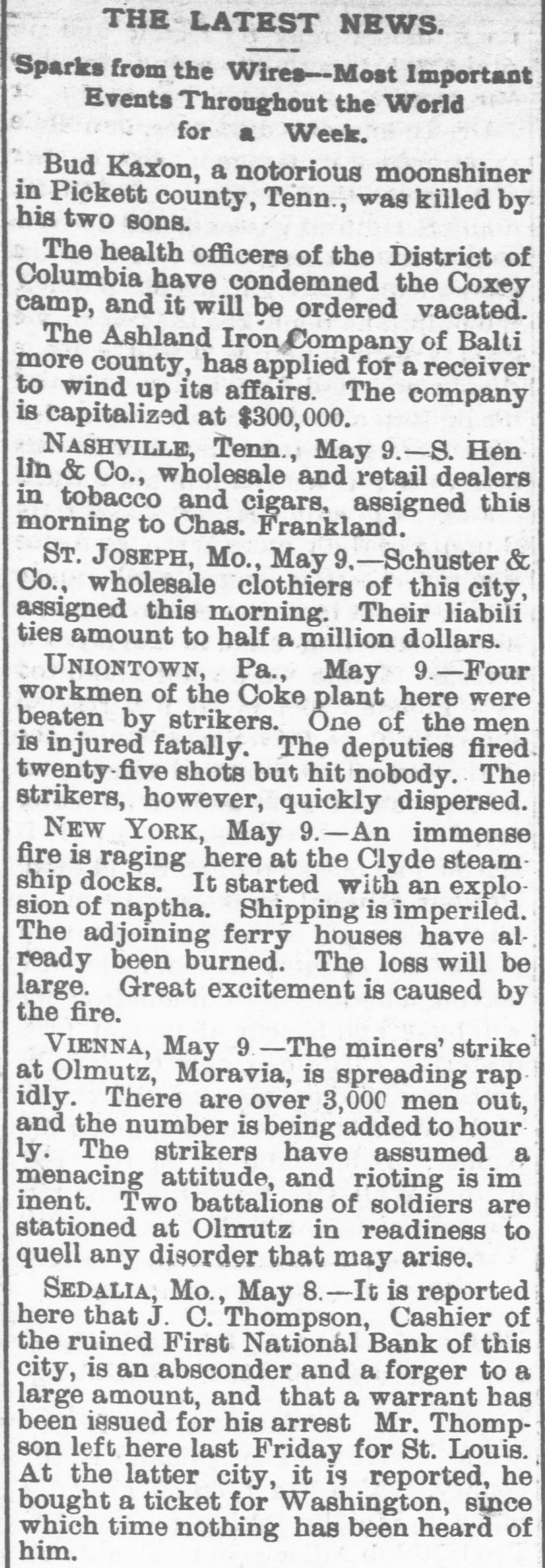
THE LATEST NEWS. Sparks from the Wires--Most Important Events Throughout the World for a Week. Bud Kaxon, a notorious moonshiner in Pickett county, Tenn., was killed by his two sons. The health officers of the District of Columbia have condemned the Coxey camp, and it will be ordered vacated. The Ashland Iron Company of Balti more county, has applied for a receiver to wind up its affairs. The company is capitalized at $300,000. NASHVILLE, Tenn., May 9.-S. Hen lin & Co., wholesale and retail dealers in tobacco and cigars, assigned this morning to Chas. Frankland. ST. JOSEPH, Mo., May 9.-Schuster & Co., wholesale clothiers of this city, assigned this morning. Their liabili ties amount to half a million dollars. UNIONTOWN, Pa., May 9.-Four workmen of the Coke plant here were beaten by strikers. One of the men is injured fatally. The deputies fired twenty-five shots but hit nobody. The strikers, however, quickly dispersed. NEW YORK, May 9.-An immense fire is raging here at the Clyde steamship docks. It started with an explosion of naptha. Shipping is imperiled. The adjoining ferry houses have already been burned. The loss will be large. Great excitement is caused by the fire. VIENNA, May 9 -The miners' strike at Olmutz, Moravia, is spreading rap idly. There are over 3,000 men out, and the number is being added to hour ly. The strikers have assumed a menacing attitude, and rioting is im inent. Two battalions of soldiers are stationed at Olmutz in readiness to quell any disorder that may arise. Sedalia, Mo., May 8.-It is reported here that J. C. Thompson, Cashier of the ruined First National Bank of this city, is an absconder and a forger to a large amount, and that a warrant has been issued for his arrest Mr. Thompson left here last Friday for St. Louis. At the latter city, it is reported, he bought a ticket for Washington, since which time nothing has been heard of him.


Article from Iron County Register, May 17, 1894

Click image to open full size in new tab

Article Text

MISSOURI STATE NEWS. The First National of Sedalla. SEDALIA. May 8.-W. A. Latimer, na tional bank examiner, has charge o: the First national bank, which sus pended May 4. It is said that he found less than $1,000 in cash Mr. Latime has been busy day and night investi gating the bank's condition, but when seen last night and interrogated about the rumor that Cashier J. C. Thomp son was a fugitive, he would neither affirm nor deny the report. He admit ted, however, that he had wired con siderable important information to Comptroller Eckles regarding the bank's condition, and also consid erable regarding Mr. Thompson personally, but beyond that he would say nothing. It is known tha Mr. Thompson has lost heavily in the past three or four years in real estate deals in Kansas City and California and the belief is fast gaining ground that depositors will realize very little out of the bank's assets. Mr. Thomp son has for years been one of the lead ing citizens of Sedalia, a pillar in the Episcopal church and there was never a public enterprise that he did not con tribute to it both his time and means His residence property has been adver tised at sheriff's sale to satisfy a judg ment in favor of the First national bank of Jefferson City; and this, it is be lieved. is but the beginning of much litigation. A few years ago the First national did the largest banking busi ness in the city, but when the rumor came a year ago that it was in a shaky condition many of its theaviest depositors changed to other banks, but up to the very last it had a goodly num ber who stood by it and were positive that the stringency of the times was the sole cause of the trouble. A RECEIVER APPOINTED. SEDALIA, May 11.-Bank Examine: Latimer has been appointed receiver the First national, having resigned temporarily as examiner. It is be lieved that Cashier Thompson has flec to Mexico. and the statement is made that he commenced crooked work in the bank two years ago. Thompsor has many friends, who express sym pathy for him, and they would have raised thousands of dollars to have prevented the crash. TURNS OVER EVERY DOLLAR. SEDALIA, May 11.-Cyrus Newkirk president of the suspended bank, has given a bill of sale on every dollar's worth of property owned by him, here and elsewhere, in behalf of the bank's depositors. HOT AFTER THOMPSON. SEDALIA, May 12.-Reliable information coming from a government official has been received from Washington to the effect that the treasury department is taking extraordinary measures to secure the arrest of Cashier Thompson. It is stated that the total of the misappropriation by Thompson can not be estimated with any accuracy; in fact a guess might easily be $100,000 away from the actual figures. LOOKS LIKE A CLEAN SWEEP. As the examination continues the condition of affairs grows worse. The investigation thus far, while far from being complete, warrants the statement that the bank examiner will be compeled at an early date to order an assessment of 100 per cent. on the cap ital stock. That means a levy of $250, 000, a sum which, as large as it is, may not be sufficient to repay depositors dollar for dollar. Republican State Convention. The Republican state central committee met at Excelsior Springs and decided to call the state convention for August 15, at Excelsior Springs. The basis of representation was one delegate for each 250 votes cast for Maj. Warner in 1892, and one for every fraction of 125. It is estimated that this ratio will give the state convention about 1,200 delegates. The date and mode of electing the delegates to the state convention was left discretionary with the county committees, provided that all delegates must be elected not later than August 11. A Coal Famine Imminent. It was stated on the 9th that the question of coal supply for St. Louis had reached a critical stage, caused by the miners' strike. There was estimated to be about a ten-days' supply on hand, and after that is exhausted, and the miners were still idle, many of the large industries would be compeled to shut down. The street railway companies had about a week's supply, the water-works about enough to run for two weeks, and the price of coal had jumped from 7 cents to 15 cents per bushel, with little to be had at those figures, Heavy Failure in St. Joseph. A. N. Schuster & Co., wholesale clothing. St. Joseph, have assigned; liabilities, estimated, $500,000. Mr. Schuster's real estate possessions in St. Joseph, aggregating $1,000,000, were placed in the hands of the assignee. The firm did a business of over $1,000,000 annually, and was until a short time ago considered one of the most substantial in the west. ST. JOSEPH, May 11.-The liabilities in the Schuster failure are placed at $500,000 and the assets at $800,000. From Washington. NEW POSTMASTERS. Edge Hill. Reynolds county. J.S. Eaton, vice David Latham. resigned. Leopolis. Livingston county, Arsenius Fable F. DeSales. vice resigned. Overton. Cooper county, W. F. Allen, vice H. H. Woolridge resigned. Valley Forge. St. Francois county, D. F. Giessing, vice Fred Giessing, resigned. W. H. Emerson. Hon. W. H. Emerson, ex-representative from Pettis county in the legislature, died at his home in Lamonte the other morning, aged over 50 years. A Great Strawberry Festival. The Daughters of the Confederacy have concluded


Article from Iron County Register, May 31, 1894

Click image to open full size in new tab

Article Text

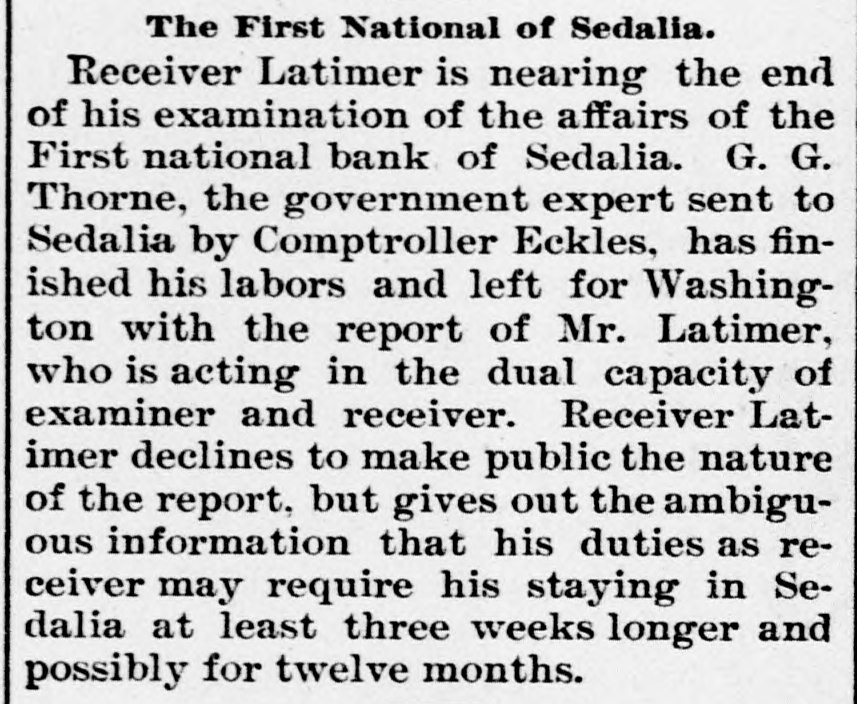
# THE FIRST NATIONAL OF SEDALIA. Receiver Latimer is nearing the end of his examination of the affairs of the First national bank of Sedalia. G. G. Thorne, the government expert sent to Sedalia by Comptroller Eckles, has finished his labors and left for Washington with the report of Mr. Latimer, who is acting in the dual capacity of examiner and receiver. Receiver Latimer declines to make public the nature of the report, but gives out the ambiguous information that his duties as receiver may require his staying in Sedalia at least three weeks longer and possibly for twelve months.


Article from St. Paul Daily Globe, June 15, 1894

Click image to open full size in new tab

Article Text

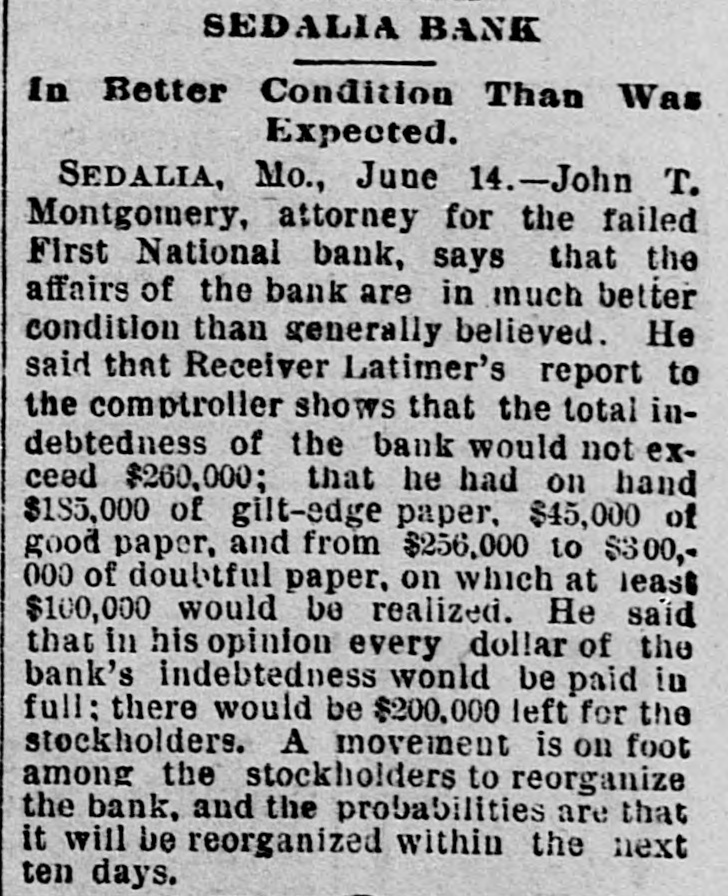
SEDALIA BANK In Better Condition Than Was Expected. SEDALIA, Mo., June 14.-John T. Montgomery, attorney for the failed First National bank, says that the affairs of the bank are in much better condition than generally believed. He said that Receiver Latimer's report to the comptroller shows that the total indebtedness of the bank would not exceed $260,000; that he had on hand $185,000 of gilt-edge paper, $45,000 of good paper, and from $256,000 to $300,000 of doubtful paper, on which at least $100,000 would be realized. He said that in his opinion every dollar of the bank's indebtedness wonld be paid in full: there would be $200,000 left for the stockholders. A movement is on foot among the stockholders to reorganize the bank, and the probabilities are that it will be reorganized within the next ten days.


Article from Hopkinsville Kentuckian, January 1, 1895

Click image to open full size in new tab

Article Text

LOOKING BACKWARD. Leading Events of a Memorable Twelve Months. THE YEAR 1894 PASSED IN REVIEW. Failures, Casualties, Crimes, Foreign and Industrial Happenings, Meteorology, Political, Social and Sporting Events Chronologically Recorded. BUSINESS FAILURES. BANKS GENERALLY. OTHERS FOR $500,000 AND OVER. Jan. 3-Southern Land and Improvement Co., Frankfort. Ky.; $500,000, Jan. 9-Citizens' bank at Ogden, Utah Bank of Port Washington, Wis. Jan. 10-W. T. Beek & Co., San Francisco commission merchants; $750,000. Jan. 14-Mendville (Pa.) savings bank Jan. 16-Merchants' bank, Ellis. Kan. Jan. 16-Third national bank, Detroit Bank of Zumbrota, Minn. Jan. 324 Westview savings bank, at Louisvilie, Ky. Jan. 24-First national bank, Fort Payne; Ala. Feb. 9-Signa Iron Co., of Philadelphia; $100,000 Feb. 14-American national bank at Springfield, Mo Burlington (Ia.) Fire & Tornado Insurance Co. Mar. 2-State bank at Brookville, Kan. Mar. 7-Bank of Harrison, Neb. Mar. 13-Bank of Excelsior Springs, Mo. Mar.28--Peoplelssavings bank of Duluth, and Merchants' bank of West Duluth. Apr. 6--J. B. Watkins Mortgage Co. of Lawrence, Kan: $5,550,000, Apr. 10-Aspen (Col.) national bank. Apr. 18-W. Thomas & Son. whisky dealers and distillers at Louisville, Ky.; $500,000. Apr. 19-West Superior Iron & Steel company of Milwaukee: $2,500,000. Apr. 24-Merchants bank of Enid, O. T. Apr. 27-Henry Newman & Co., importers of clothing supplies in New York: $1,500,000. Apr. 30-Scandinavian and Finland Emigrant Co. of New York; $4,000,000. May 4-First national bank of Sedalia, Mo. May 7-State national bank at Wichita, Kan. May 8-A. N. Schuster & Co., clothing dealers at St. Joseph, Mo.: $500,000. May 16-National bank of Pendleton, Ore. May 18-The order of Tonti to ha nds of receiver in Philadelphia. May 20-Traders' bank of Tacoma. May 24-Bank of Tempe at Phoenix, A. T. May 31-Bank at Enterprise, Kan. June 4-Steele & Walker, wholesale grocers at St. Joseph, Mo.: $700,000. June -Farmers' and Merchants' bank at South End. O. T. June German national bank at Denver, Col: $853,000. June 8-Union Warehouse Co. of New York; $1,000,000. June 10-American Investment Co. at Emmettsburg, In.: $800,000. June 18-Goodwin & Swift, of New York, electric railway builders and promoters; $750,000. June 21-Black Hills national bank of Rapid City, S. D. July 26-First national bank of Grant, Neb. Aug. 1-Baker City (Ore.) national bank. Aug. 7 Citizens' savings bank at Portsmouth, O. Aug. 10-Second national bank, Altoona. Pa. Aug, 18-Wichita (Kan.) national bank. Aug. 17-Commercial & Savings bankof Ludington, Mich. Sep. 6-Middleton (Pa.) bank. Sep. 7-Mutual Benefit Life associatio n of America ,headquarters at New York: $10,000,000 Oklahoma county bank at South Enid, O.T. Sep. 10-Citizens' bank of Plattsmouth, Neb. Sep. 21-Commercial bank at Weeping Water, Neb. Oct. 1-First national bank of Fayetteville, N.Y. Oct. 5-Coffin & Stanton, stock. brokers in New York: $3,600,000. Oct. 10-American Debenture Co., of Chicago; $1,500,000. Oct. 11-First national bank of Kearney, Neb. Oct. 12-Buffalo county national bank at Kearney, Neb. Oct. 16-Merced bank, at Merced, Cal. Oct. 23-George M. Irvin & Co., of Pittsburgh, Pai $1,000,000. Oct. 25-J. J Reithman and J. J. Reithman & Co. wholesale druggists in Denver; $500,000. Nov. 8-San Bernardino (Cal.) First national bank. Nov. 12-First national bank of Johnson City, Tenn. Nov. 10-Portland (Ore.) savings bank; $1,430,000. Nov. 23-Brown national bank at Spokane, Wash. Nov. 27-Kendall Banking company at Howard, S.D. Security National bank of Grand Island, Neb. Nov. 28-Bank of Canova, S. D. Dec. 4-North Platte (Neb.) national bank. Tacoma (Wash.) national bank. Dec. S-Farmers' Insurance Co., of Seattle, Wash. Dec. 11-Commercial bank, at St. Joseph, Mo.
Article from Iron County Register, April 4, 1895

Click image to open full size in new tab

Article Text

Claiming Her Dower Right. A legal sensation was sprung at Sedalia the other day, and further developments are awaited with anxiety. In the early history of Sedalia the late ex-Mayor William P. Jack. son owned considerable land within what is now the corporate limits of the city, among other tracts being the half block extending from Ohio to Osage streets, and from Second street to the alley on the north, now covered with two and three-story brick business houses. The property is among the most valuable in the city, and at a conservative estimate is worth $150,000. In 1866 this tract of ground was sold by Mr. Jackson to various parties, and a deed to the same was given by him, but Mrs. Jackson did not sign the document and hence retained her dower, or one-third interests. A few days ago W. D. Steele was retained by Mrs. Jackson to enforce her claim and the matter was laid before Receiver Latimer and his attorney, Judge W. S. Shirk, who have in charge the interests of the First national bank, now defunct, which formerly occupied the Second and Ohio street corner. They at once recognized the justice of Mrs. Jackson's claim and effected a compromise with her that resulted in her relinquishing her dower in that particular piece of property. As to the amount paid the parties interested are non-committal. An effort will be made to compromise with the remaining property holders in the block, but in the event of failure suit will be instituted in the widow's behalf. There are other pieces of property in Sedalia in which Mrs. Jackson still retains a dower, but neither she nor her attorney is ready to describe them at present, and it is for this reason that many realty owners are anxious.


Article from The Wichita Daily Eagle, April 16, 1895

Click image to open full size in new tab

Article Text

LATE NEWS BY WIRE. Items of General Interest From All Over the Universe. Toledo, April 15.-A special from Upper Sandusky, 0, says: Hon. David Harpston, the well-known "wool king," is seriously ill and is not expected to live. Sioux City, Ia., April 15.-The Iowa Construction and Manufacturing company, plumbing and steam fitting supplies, has failed. The assets are said to be equal to liabilities. Indianapolis, April 15.-Ex-President Harrison has declined an invitation to attend the anual meeting of National Republican clubs to held in Cincinnati. His reasons for declining are not given. Russellville, Ky., April 15.-The muchdreaded army worm has made its appearance in this and many other surrounding counties. There are millions of them and they are making a clean sweep of everything green that lies in their way. Dover, Del., April 15.-One ballot was taken for United States senator today. Addicks, 5; Higgins, 9; Massey, 4; Pennewell, 1; Bayard, 1; Ridgley, 9. A conference will be held between Higgins, Massey and Addicks looking to a settlement of the senatorial dead-lock. Baltimore, Ap. il 15.-The international exposition of 1894 to mark the first centennial of Baltimore as a municipality, was begun today by the city taking formal possession of Clifton park, wherein will be erected the necessary buildings. The population of Baltimore made the occasion a holiday. Chicago. April 15.-General it. M. Stevenson, vice president and business manager of the Pueblo Chieftan, who was on his way east for treatment, had to stop in Chicago this morning, as he was prostrated on the train and unable to proceed. Friends took him to Victoria hotel. His condition is believed to be quite serious. Sedalia, Mo., April 15.W. A. Latimer, receiver of the First National bank, was instructed today by Comptroller of the Treasury Eckels to levy an assessment of $187,500 upon the stockholders to pay the bank's indebtedness. This is equal to 75 per cent of the capital stock of $250,000, held in Sedalia, St. Louis and the east.


Article from Richmond Dispatch, April 19, 1895

Click image to open full size in new tab

Article Text

Broken-Bank Assessment Resisted. SEDALIA, MO., April 18.-The stockholders of the suspended First National Bank have decided to resist the payment of the 75 per cent. assessment ordered to be paid by Comptroller-of-the-Currency Eckels prior to May 15th next. The ground for resistance will be that the bank was not legally chartered, nor had it been a legitimate banking institution since 1830, when, by false reports on the part of its officers, it was permitted to reorganize and increase its capital stock from $100,000 to $250,000. Legal talent has been retained, and protracted litigation is assured.


Article from The Cambria Freeman, April 19, 1895

Click image to open full size in new tab

Article Text

PITH OF THE NEWS. Mrs. Paran Steven's will, disposing of an estate of $1,500,000, was filed for pro bate in New York Rev. Mr. Kincaid, a Presbyterian pastor of Minneapolis, may be tried for heresy. It was stated at Peoria that reorganization plans project the dropping of some whisky trust properties and the purchase of others. The Duchess of Marlborough and Lord Beresford will be married at Hanover Square, London, on April 30. A Paris paper urges the formation of an economic and industrial league in Europe against the United States. William Latimer, receiver of the First National bank of Sedalia, Mo., was instructed to levy an assessment of $187,500 upon the stockholders to pay the bank's indebtedness. Charles Weber, ex chief of police and a pioneer settler, was found dead in his bed at St. Paul from a pistol shot fired by his sickness. own hand, the result, it is believed, of Prof. L. L. Dyche of Lawrence, Kan., the naturalist of the Coast Arctic expedition, which ended so disastrously last summer will sail for Greenland May 15 in the schooner Golden Hope, to make a collection of fauna. Eau de Gallie, Richard Croker's horse, won the Derby at Newmarket, England.


Article from Iron County Register, April 25, 1895

Click image to open full size in new tab

Article Text

Julia E. Dockery, Kirksville, chairman of ex-ecutive board. # Refuse to Pay the Assessment. Says a dispatch sent from Sedalia: Receiver W. A. Latimer has been officially notified that he would not be able to collect the 75 per cent. assessment against the stockholders of the defunct First national bank except by a lawsuit. The shareholders set up the claim that the bank was not a legally chartered institution at the time of its failure, nor had it been since 1890. In that year the bank was reorganized, aud at the same time its capital stock was increased from $100,000 to $250,000. The stockholders claim that had the proper authorities at the national capital given the case the investigation that it demanded, reorganization and the increase of the capital stock would have been impossible. When Receiver Latimer was interrogated on the subject he did not deny having been notified of the prospective litigation. "This is a case that must be tried in the courts instead of the newspapers," said the receiver, "and all that I care to say now is that I will institute suit against all shareholders who have not paid their assessment by May 15 next." # Sent to an Asylum. Information was filed in the probate court of Newton county, the other day, alleging the insanity of Mrs. Marie Crays, and on trial she was so found and ordered taken to the asylum at Nevada. Mrs. Crays is possessed of considerable financial means. She went to Neosho from Southwest City some three months ago, and since that time has been making life unbearable, it is said, for a leading attorney, against whom she threatened to bring suit for $300,000 for breach of promise. # Want to Be Close to Zion. The recent convention of Mormons at Independence was very successful. The statement in the convention that the time is at hand for the "Gathering of the Saints" in Zion (Independence) is bearing fruit. Many Mormons are in that town inquiring about houses and farms. They expect all the "Saints of the Lord" to gather there, and there await the coming of Christ, which they say is near at hand. # Supported by Tax-Payers. During the past year there were 2,723 patients admitted to the female hospital in St. Louis. There were 346 births at the institution during the year. The expenses averaged $232.61 per patient. There are about 525 paupers in the St. Louis poorhouse, the majority being males. In the insane department there are about 775, of whom the greater number are females. # Missouri University Glee Club. The students of the Missouri state university have organized a glee club, composed of thirty members, which will soon start on an extensive tour through Missouri and the adjoining states. # War On Tobacco Chewers. One of the most prominent street railway presidents in St. Louis has declared war on tobacco chewers. He calls them hogs, and says they can not expectorate and ride in his cars. # Sewers of St. Louis. There are about 66ยฝ miles of sewers in the city of St. Louis, not including private sewers. There were about 15 miles of district sewers constructed last year. # Hanged Himself. John T. Wolff, a cigar-maker, aged 42, who resided at 3150 Iowa avenue, St. Louis, hanged himself with a clothes line. He was found by his wife. # College President Chosen. Rev, George A. Ayres, recently of Washington college, Tennessee, has been chosen president of the Presbyterian college located at Independence. # Miner's Head Blown Off. D. O. Lapoint, a miner, was killed in the Kohinoor mine, Joplin. A charge of dynamite exploded while he was stooping over it and blew his head off. # Married on a Train. Lafayette Ligon, of Liberty, and Miss Kate Horenecker, of Smithville, were married on a railway train. There were objections to the match. # Elected to the Legislature. Poy Woodside, democrat, was elected to the legislature in Oregon county by 7 votes over Alf. Harris, populist, to succeed J. B. Old, deceased. # By Shooting. Odis Simpson, aged 20, son of G. W. Simpson, fatally shot himself at Brunswick. The recent death of his mother was the cause. # Sedalla High School. The new high school building at Sedalia will be three stories high, 90 by 110 feet, will accommodate 600 pupils and cost $30,000. # An Old Citizen's Sudden Death. Geo. F. Fisher, aged 75, dropped dead at Independence of heart disease. He had resided in Jackson county for sixty-five years. # Death of a Bank Cashier. E. W. McJunkin, aged 53, died at Selalia a few days ago. Mr. McJunkin was cashier of the First national bank of that city.


Article from The Pioneer Press, April 25, 1895

Click image to open full size in new tab

Article Text

From the Nation's Capital. Our government calls upon Guatemala for explanations regarding the abuse of Americans. The secretary of the interior decides against a Northern Pacific claim to land in Idaho. A statement of the condition of the treasury shows an available cash balance of $184,074,764 and a gold reserve of $90,329,135. The United States has been requested by the Chinese government to take under her protection the Chinese residing in Guatemala. Officials of the government take no stock in the statement that ex-Senator Ransom's appointment as minister to Mexico is illegal. William Latimer, receiver of the First National bank at Sedalia, Mo., was instructed by Controller of the Currency Eckels to levy an assessment of $187,500 upon the stockholders to pay the bank's indebtedness. The state deparement has checked in its inception an attempt, made by the Haytien government, to impose a discriminating tax upon American citizens and other foreigners residing in Hayti.


Article from The Dalles Daily Chronicle, October 25, 1895

Click image to open full size in new tab

Article Text

# FEDERAL BANK SUPERVISION. Says the Globe Democrat: The stockholders of the collapsed First National Bank of Sedalia have raised a new legal question in their attempt to evade the assessment made upon them for the payment of the outstanding liabilities. They hold that they should not be required thus to make good the losses that ensued in spite of the supervision of the government through its bank examiner. In other words, they claim that they were released from liability when the government permitted the bank to run along in a bad condition. The plea is a plausible one, but it is hardly to be expected that any court will consent to help stockholders out of a bad place by such means. There is nothing in the laws pertaining to the national banking system which can be interpreted as making the government a guarantor of the absolute correctness of the investigations of its bank examiners. The fact is notorious that such investigations are rarely, if ever, thorough and reliable. Even when the examiner is competent and anxious to perform good service, he can be deceived more or less by the officers of the bank, and his report may represent a condition existing during his presence only, to be changed as soon as his back is turned. Deceptions of this kind have occurred so often that when a new one happens it does not cause any surprise. As a matter of fact, all forms of bank supervision are defective in some respects, and it will not do to depend upon them except in a general way and under favorable conditions. It is only occasionally that a federal bank examiner discovers that a bank is in a shaky condition, or that some of its officers or employes are stealing its assets. As a rule, such discoveries are made by accident, or by the confession of guilty parties, and the persons most surprised are those who should have found out the facts long before by reason of their relation to the business of the institution. There is a constant tendency on the part of the best banks and other concerns handling large amounts of money to impose closer restrictions upon their employes, and to introduce more effective plans of supervision. The directors of all kinds of corporations are taking more interest in their duties and acting upon a higher sense of responsibility. Much of this improvement is due to the guarantee indemnity companies, which have so much at stake in the integrity of their patrons; but there is reason to believe, also, that the necessity of self-protection has led to the adoption of better methods of surveillance and detection by private firms and companies. In due course of time, federal bank supervision will probably be made adequate and satisfactory; and until then, stockholders will be obliged to pay the losses which it does not prevent.


Article from Iron County Register, October 22, 1896

Click image to open full size in new tab

Article Text

MISSOURI STATE NEWS, An Inoperative Law. The Pettis county grand jury has made a recommendation which may lead to the repeal of an inoperative law. The report says: We recommend the repeal of the law requiring grand jurors to examine the books of the county officials. The improbability of the possibility of drawing 12 men at any one time that would have the ability to recognize an error in bookkeeping, even if such error should be bold on its face, conneoted with the limited time in which juries would be compelled to audit the books of every department to honestly find an error, makes it apparent to us that the law is very absurd and unreasonable. Therefore, we ask for its repeal, and would recommend in its place that the county court be empowered to employ experts to examine the books, when in their judgment the court thought it necessary, or a commission be appointed by the state, as in the case of banks. The Case of Ex-Banker Newkirk. At Sedalia Judge W. W. Wood overruled the motion to quash the four indictments found against Cyrus Newkirk, president of the suspended First national bank, charged with having received deposits when he knew the bank to be in a failing condition. The defendant, whois 76 years old, is quite ill in California, and his physicians say that to compel him to return to Sedalia in December, the time set for the trial of the cases, will result fatally. The bank failed May 4, 1894, with a shortage of $254,000, and the depositors have not yet received a dividend.


Article from The Wichita Daily Eagle, March 25, 1897

Click image to open full size in new tab

Article Text

other occupants of the schoolhouse to find his home in flames. It was impossible to enter the house, as it was crumbling when Penrod reached It. The children's beds were by the window, however, and Penrod burst the window open and succeeded in pulling the 8-year-old and 4year-old boys out, horribly burning himself in the act. They never regained consciousness and died in a short time. The others were burned (until only a few bones were found in the debris of the house. The coroner's inquest threw no light on the origin of the fire. A WHOLESALE FIREBUG. Detroit, Mich., March 24.-A special to the News from Cleveland, Ohio, says: William Ingless, under arrest here for incendiarism. confessed today to having set fire to forty buildings in Detroit. BICYCLE WORKS BURNED. Reading, Pa., March 24.-The large plant of the Acme bicycle works was destroyed by fire early this morning. All the valuable machinery was destroyed, making the total loss about $75,000, covered by insurance. The building contained material for fully 5,000 bicycles. BANKERS INVESTIGATED. St. Paul, Minn., March 24.-A Bismarck, N. D., special to the Pioneer Press says: The banking methods of some of the suspended national banks of the state are being investigated by the United States grand jury now in session. Two indictments have already been found, one against Lee Booker, extreasurer and president of Grand Forks National bank, and the other against H. F. Salayards, president of the First National bank of Minot. Booker is charged with making false returns to the comptroller of the currency. He was arraigned today, plead not guilty, and was held for trial in $5,000 bonds. Salayards is charged with aiding and abetting in making false entries in the bank's books. He pleaded not guilty and was held in $6,000 bonds for trial. The indictment of Booker came as a great surprise to his friends throughout the state. He was state treasurer for three years, entering the office in 1893, and has always taken an active part in state politics. BOGUS BONDS MUST BE PAID. Kansas Cty, March 24.-A special to the Star from Sedalia, Mo., says: Judge W. W. Wood, of the Johnson county circuit court, has decided that the Sedalia school district must pay $23,000 to the holders of school bonds issued in 1883 and fraudulently sold to eastern people. The bonds were paid ten years later and left in the custody of J. C. Thompson, cashier of the First National bank and financial agent for the school bonds. Instead of turning them over to the treasurer to destroy, Thompson resold them to eastern people and by paying the interest on the coupons the swindle was not detected until the bank failed and Thompson had fled to Mexico. SHOT HER PARAMOUR. Middlesboro, Ky., March 24.-A special from Hancock county, Tenn., states that Martha Bull shot and killed her paramour, Thomas McRae, and then shot herself. The Bull woman thirty years ago was a leader of society in Camden, Va. She claimed to be collaterally related to Washington. DURRANTS APPEAL San Francisco, March 24.-The attorneys for Theodore Durrant have filed a petition in the supreme court for rehearing of the application, previously dei nied, for a new trial. No new points are cited and it will be decided without argument. The prosecution believes the I petition will be denied.


Article from Kansas City Journal, May 3, 1897

Click image to open full size in new tab

Article Text

INVESTIGATION ASKED FOR. Depositors of a Defunct Sedalia Bank Make Grave Charges Against Comptroller Eekels. Sedalia, Mo., May 2.-(Special.) A letter containing grave charges reflecting upon the official conduct of the comptroller of the currency, prior to, and subsequent to. the wrecking of the Sedalia First National bank, has been prepared and signed by the majority of the depositors of the bank and will be forwarded to-morrow to Judge James Cooney, of Washington, demanding that he press the request of the depositors for a congressional investigation. The letter recalls the circumstances connected with the failure of the bank, its robbery, the flight of the cashier to Mexico and the farcical attempt to extradite him, and the indictments against President Cyrus Newkirk, now living in plenty in California, which were never tried. The summarized charges are: "First-In July, 1893. the bank was publicly and widely reported as in a failing condition, and such facts were known to the comptroller of the currency. "Second-That, by the neglect or care. lessness of the United States officials, the bank was permitted to run until its prestdent. cashier (J. C. Thompson) and other officers had robbed it of all they could place their hands upon, and closed it themselves when there was nothing more left for them to plunder. "Third-That, shortly prior to the abandonment of the bank, W. A. Latimer, now receiver, was sent to Sedalia to examine the bank, but, as he was about to enter upon his examination, the comptroller of the currency sent Latimer a telegram to defer the examination, said intervention having been procured by the officers of the bank through influential persons, and the officers took advantage of the respite to spread the report that the condition of the bank was SO good that the examiner would not waste his time to examine the books, and they proceeded without delay to secure deposits. and to rob. wreck and transfer for their own use and benefit the assets and appropriate the property of the bank to their own use, close its doors and flee from the country. "Fourth-That Receiver Latimer's administration has been of unreasonable length of time; that he has made no effort to recover property that was transferred by fraud and stealth by the officers of the bank just prior to its abandonment: that he has, by mismanagement, greatly reduced the assets and the funds available for liquidation: that he has paid numerous large and unnecessary lawyers' fees, and that property of the bank has been left in charge and control of relations and kinsmen of the former officers of the bank, and he keeps on his force of clerks and employes the relations and clerks of the former officers of the bank."


Article from The Sun, September 1, 1897

Click image to open full size in new tab

Article Text

LETTER FROM SENATOR VEST. He Explains His Request Relating to the Sedalia National Bank. SEDALIA, Mo., Aug. 31.-United States Senator George G. Vest has addressed a letter to Congressman James Cooney of the Seventh Missouri district in reply to a recent communication from James H. Eckles, Comptroller of the Currency, in which the reader was led to infer that Senator Vest had requested in 1894 that the proposed examination of the Sedalia First National Bank, in April of that year, be deferred until certain that the bank's assets could be realized upon. The letter is as follows: "My attention has been called to a letter of the 22d inst. from the Hon. J. H. Eckels, Comptroller of the Currency, to the Hon. James Cooney, in which the statement is made that in April, 1894, I requested the postponement of an examination by the National Bank Examiner of the First National Bank of Sedalia. The facts are simply these: "In March, or April, 1894, Mr. Cyrus Newkirk, President of the bank, and Mr. J. C. Thompson, the cashier, wrote me that an examination of the bank was about to be made before the time fixed by the established rule of the Comptroller, and that, on account of a false report put in circulation by some one that the institution had failed, and the additional fact that on account of the stringency prevailing they were unable to collect, there was danger of a run on the bank if an examination was made before the regular time. They requested me to lay these facts before the Comptroller of the Currency. Believing them to be honest men, and that their statements were true, I did so. I have no apology to make, and hope there will G. G. VEST." be the fullest investigation.