Accommodated withdrawals, Full suspension, Books examined
Receivership Details
Depositor recovery rate
38.4%
Date receivership started
1932-03-18
Date receivership terminated
1937-10-21
Share of assets assessed as good
11.8%
Share of assets assessed as doubtful
76.5%
Share of assets assessed as worthless
11.7%
Description
Multiple articles (Mar 17, 1932) report a three-day run on the First National Bank of Port Chicago that culminated in the bank failing to open and federal examiners taking charge pending appointment of a receiver. The run was attributed to the Coos Bay Lumber Company moving its plant (local economic shock). Subsequent articles (Aug–Dec 1932 and Feb 1933) refer to a receiver and insolvency, indicating permanent closure. OCR typos (e.g., 'Lep Shapire' / 'Leo Shapirer') corrected where obvious; bank is also referred to as Bay Point / Bay Point First National Bank in some articles (same institution). Dates use newspaper publication dates where event dates are stated.
Events (5)
1.December 29, 1919Chartered
Source
historical_nic
2.March 15, 1932Run
Cause
Local Shock
Cause Details
Depositors became alarmed after the Coos Bay Lumber Company, the town's largest industry, moved its plant to Oakland, triggering heavy withdrawals over three days.
Measures
Bank directors requested government supervision; no successful stop to withdrawals reported prior to closure.
Newspaper Excerpt
Climaxing a three-day run of depositors, the First National Bank of Port Chicago failed to open today.
Source
newspapers
3.March 17, 1932Receivership
Newspaper Excerpt
Leo Shapirer, national bank examiner, is in charge ... pending appointment of receiver. Later articles identify H. P. Hilliard (Hilllard/Hilliard) as receiver and note the bank became insolvent last March and Hilliard was appointed receiver.
Source
newspapers
4.March 17, 1932Suspension
Cause
Local Shock
Cause Details
Failure to open was attributed solely to heavy withdrawals caused by depositor alarm over the Coos Bay Lumber Company's relocation; directors asked the comptroller to assume control and federal examiner placed in charge.
Newspaper Excerpt
the First National Bank of Port Chicago failed to open today. Leo (Leo/Leo) Shapire of San Francisco was placed in charge by government authorities pending appointment of a receiver.
Source
newspapers
5.March 18, 1932Receivership
Source
historical_nic
Newspaper Articles (11)
1.March 17, 1932Imperial Valley PressEl Centro, CA
Click image to open full size in new tab
Article Text
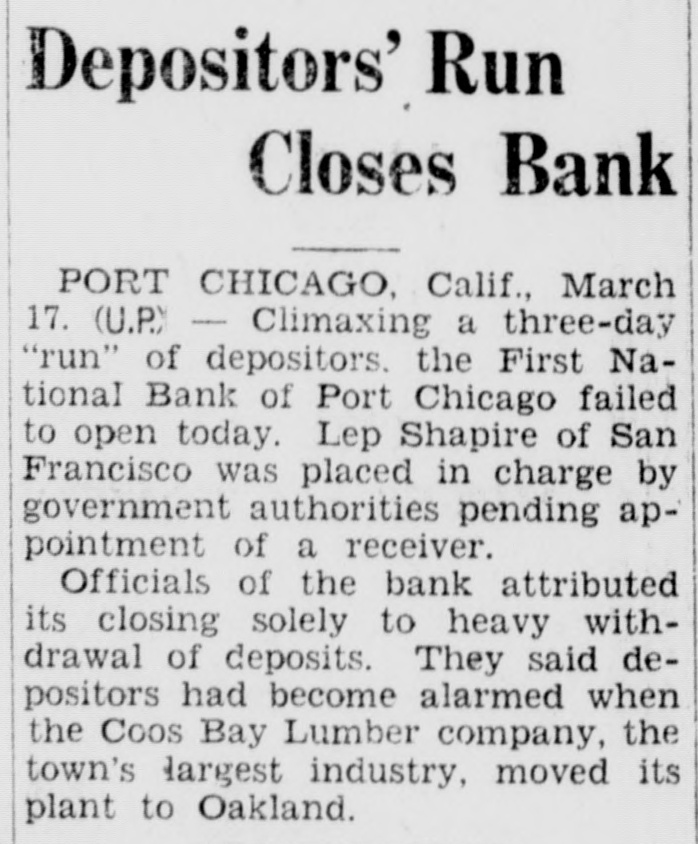
Depositors' Run Closes Bank PORT CHICAGO, Calif., March 17. (U.P.) - Climaxing a three-day "run" of depositors. the First National Bank of Port Chicago failed to open today. Lep Shapire of San Francisco was placed in charge by government authorities pending appointment of a receiver. Officials of the bank attributed its closing solely to heavy withdrawal of deposits. They said depositors had become alarmed when the Coos Bay Lumber company, the town's Hargest industry, moved its plant to Oakland.
2.March 17, 1932The TimesSan Mateo, CA
Click image to open full size in new tab
Article Text
Run Closes Port Chicago Bank
PORT CHICAGO. March of depositors, the First Na tional Bank of Port Chicago failed open today. Leo Shapire of Officials attributed its closing solely to heavy withdrawal of deposits. They suid depositors had become alarmed when the Bay Lumber the town's industry, moved its plant to
3.March 17, 1932The Napa Valley RegisterNapa, CA
Click image to open full size in new tab
Article Text
3-Day "Run" Closes Bank
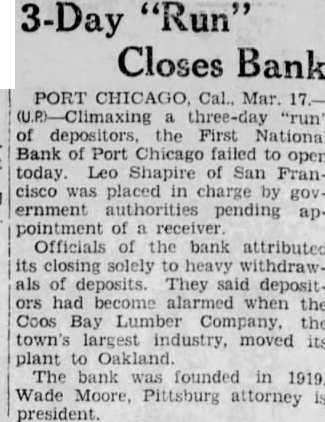
PORT CHICAGO, Cal., Mar. 17. -Climaxing a three-day "run" of depositors, the First National Bank of Port Chicago failed to open today. Leo Shapire of San Francisco was placed in charge by government authorities pending appointment of receiver. Officials of the bank attributed its closing solely to heavy withdrawals of deposits. They said depositors had become alarmed when the Coos Bay Lumber Company, the town's largest industry, moved its plant to Oakland. The bank was founded in 1919. Wade Moore, Pittsburg attorney is president.
4.March 17, 1932Los Angeles Evening Citizen NewsHollywood, CA
Click image to open full size in new tab
Article Text
3 Day Run Closes Port Chicago Bank
PORT CHICAGO, March three day First National Bank Port Chicago failed today. Leo Shapire of San Francisco placed charge government authorities pending pointment of receiver. Officials of the bank attributed its solely heavy withclosing drawal deposits. They said positors had become alarmed when Coos Bay Lumber the town's largest industry, moved plant to Oakland.
ANGELENO KILLED March Johnson Los Angeles killed four others last night an automobile crashed into house outfit. Nelson touring the country to present an illustrated Bible lecture.
5.March 17, 1932Martinez News-GazetteMartinez, CA
Click image to open full size in new tab
Article Text
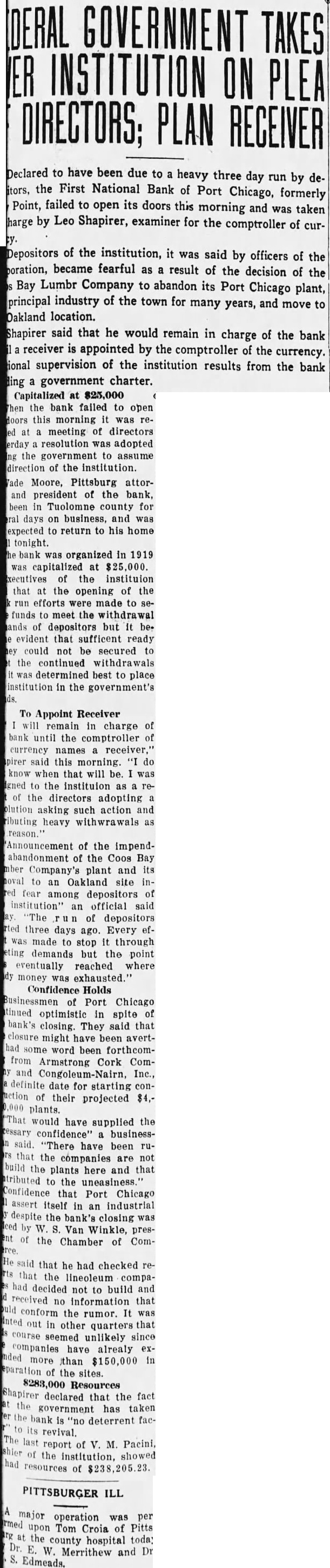
GOVERNMENT TAKES ON PLEA DIRECTORS; PLAN RECEIVER to have been due to a heavy three day run by dethe First National Bank of Port Chicago, formerly Point, failed to open its doors this morning and was taken by Leo Shapirer, examiner for the comptroller of cur-
Depositors of the institution, it was said by officers of the became fearful as a result of the decision of the Bay Lumbr Company to abandon its Port Chicago plant, principal industry of the town for many years, and move to location. said that he would remain in charge of the bank receiver is appointed by the comptroller of the currency. supervision of the institution results from the bank a government charter.
Capitalized at $25,000 the bank failed to open this morning it was remeeting of directors resolution was adopted the government to assume of the institution. Moore, Pittsburg attorpresident of the bank, in Tuolomne county for days on business, and was to return to his home tonight. organized in 1919 capitalized at $25,000. of the instituion at the opening of the efforts were made to seto meet the withdrawal of depositors but it be. evident that sufficent ready could not be secured the continued withdrawals determined best to place institution in the government's
To Appoint Receiver remain in charge of until the comptroller of currency names receiver,' said this morning. do when that will be. was to the instituion as reof the directors adopting asking such action and heavy withwrawals Announcement of the impendabandonment of the Coos Bay Company's plant and its to an Oakland site infear among depositors of an official said of depositors three days ago. Every made to stop it through demands but the point eventually reached where money was exhausted.' Confidence Holds Businessmen of Port Chicago optimistic in spite of closing. They said that might have been avertsome word been forthcomfrom Armstrong Cork Comand Inc. definite date for starting of their projected $4, plants. would have supplied the confidence" business"There have been that the companies are not the plants here and that to the uneasiness. that Port Chicago itself in an industrial the bank's closing Van Winkle, presthe Chamber of Com- that he had checked the lineoleum compadecided not to build and received information that no conform the It was rumor. out in other that quarters seemed unlikely since companies have alrealy more than in of the sites. $283,000 Resources declared that the fact government has taken bank is "no deterrent revival. last report of M. Pacini, of the institution, showed resources of
PITTSBURGER ILL major operation was perupon Tom Croia of Pittsthe today county hospital Merrithew and Edmeads.
6.March 17, 1932Martinez News-GazetteMartinez, CA
Click image to open full size in new tab
Article Text
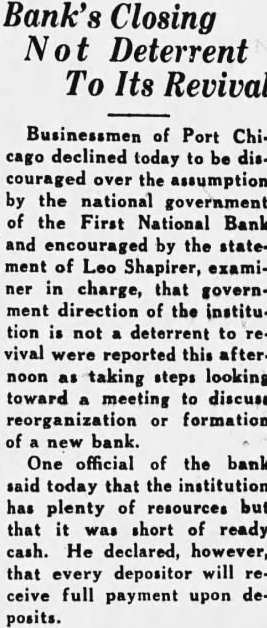
Bank's Closing Not Deterrent To Its Revival
Businessmen of Port Chicago declined today to be discouraged over the assumption the national government of the First National Bank and by the state. ment of Leo Shapirer, examiner in charge, that government direction of the institution is not deterrent to vival reported this after. noon taking steps looking toward meeting discuss reorganization or formation of bank. One official of the bank said today that the institution has plenty of resources but that was short of ready cash. He declared, however, that every depositor will ceive full payment upon deposits.
7.March 17, 1932Imperial Valley PressEl Centro, CA
Click image to open full size in new tab
Article Text
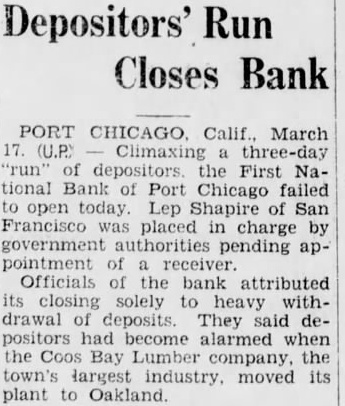
Depositors' Run Closes Bank
PORT CHICAGO. Calif. March 17. (U.P.) Climaxing a three-day "run" of depositors. the First National Bank of Port Chicago failed to open today. Lep Shapire of San Francisco was placed in charge by government authorities pending appointment of a receiver. Officials the bank attributed its closing solely to heavy withdrawal of deposits. They said depositors had become alarmed when the Coos Bay Lumber company the town's Margest industry. moved its plant to Oakland.
8.March 17, 1932The Oakland Post EnquirerOakland, CA
Click image to open full size in new tab
Article Text
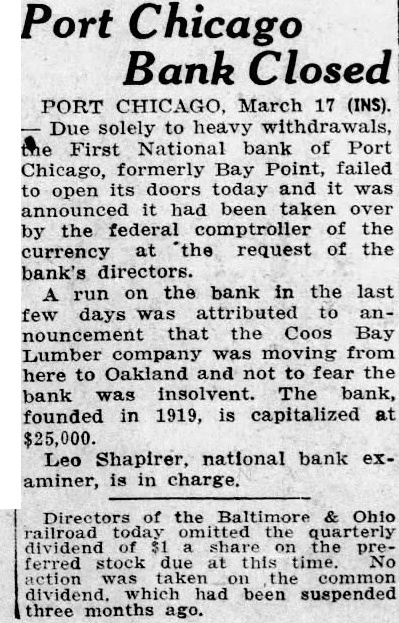
Port Chicago Bank Closed PORT CHICAGO, March 17 (INS). Due solely to heavy withdrawals, the First National bank of Port Chicago, formerly Bay Point, failed to open its doors today and it was announced it had been taken over by the federal comptroller of the currency the request of the bank's directors. A run on the bank in the last few days was attributed to nouncement that Coos Bay Lumber company was moving from here to Oakland and not to fear the bank insolvent. The bank, founded in 1919, is capitalized at $25,000. Leo Shapirer, national bank examiner, is in charge.
Directors of the Baltimore & Ohio today the quarterly dividend the ferred stock due dividend. which had been suspended three months ago.
9.August 13, 1932Martinez News-GazetteMartinez, CA
Click image to open full size in new tab
Article Text
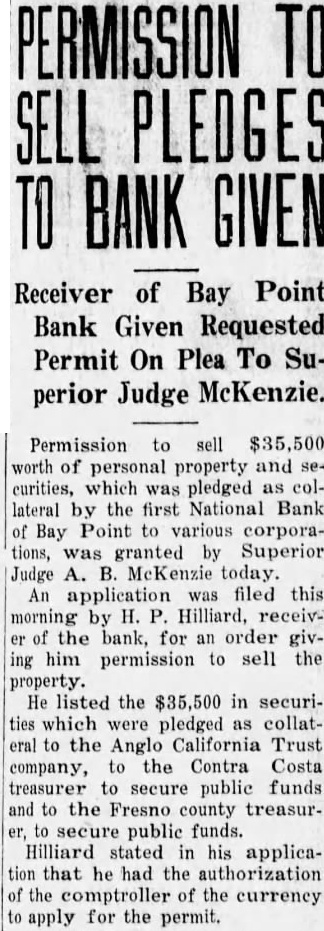
PERMISSION TO SELL PLEDGES BANK GIVEN
Receiver of Bay Point Bank Given Requested Permit On Plea To Superior Judge McKenzie.
Permission to sell $35,500 worth of personal property and securities, which was pledged as collateral by the first National Bank of Bay Point to various corporations, was granted by Superior Judge A. B. McKenzie today. An application was filed this morning by H. P. Hilliard, receivof the bank, for an order giving him permission to sell the property. He listed the $35,500 in securities which were pledged as collateral to the Anglo California Trust company, to the Contra Costa treasurer to secure public funds and to the Fresno county treasurer, to secure public funds. Hilliard stated in his application that he had the authorization of the comptroller of the currency apply for the permit.
10.December 6, 1932Martinez News-GazetteMartinez, CA
Click image to open full size in new tab
Article Text
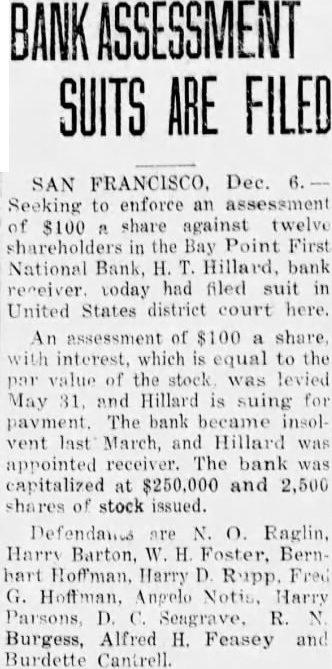
BANK ASSESSMENT SUITS ARE FILED
SAN FRANCISCO, Dec. 6. Seeking to enforce an assessment of $100 a share against twelve shareholders in the Bay Point First National Bank, H. T. Hillard, bank receiver. today had filed suit in United States district court here. An assessment of $100 a share, with interest, which is equal to the par value of the stock was levied May 31. and Hillard is suing for payment. The bank became insolvent last March, and Hillard was appointed receiver. The bank was capitalized at $250,000 and 2,500 shares of stock issued. Defendants are N. O. Raglin, Harry Barton, W. H. Foster, Bernhart Hoffman, Harry D. Rupp. Fred G. Hoffman, Angelo Notis, Harry Parsons, D. C. Sengrave, R. N Burgess, Alfred H. Feasey and Burdette Cantrell.
11.February 23, 1933Petaluma Argus-CourierPetaluma, CA
Click image to open full size in new tab
Article Text
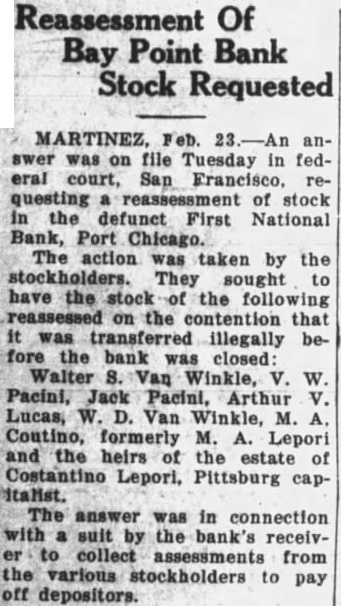
Reassessment Of Bay Point Bank Stock Requested
MARTINEZ, Feb. 23.-An answer was on file Tuesday in federal court, San Francisco. requesting a reassessment of stock in the defunct First National Bank, Port Chicago. The action was taken by the stockholders. They sought to have the stock of the following reassessed on the contention that it was transferred illegally before the bank was closed Walter S. Van Winkle, V. W. Pacini, Jack Pacini, Arthur V. Lucas, W. D. Van Winkle, M. A. Coutino, formerly M. A. Lepori and the heirs of the estate of Costantino Lepori, Pittsburg capitalist. The answer was in connection with a suit by the bank's receiver to collect assessments from the various stockholders to pay off depositors.