7762. banks of New Orleans (New Orleans, LA)

Bank Information

Episode Type
Suspension → Reopening
Bank Type
state
Start Date
September 16, 1861
Location
New Orleans, Louisiana (29.955, -90.075)

Metadata

Model
gpt-5-mini
Short Digest
3d89db62

Response Measures

None

Description

Multiple contemporary articles (Sept–Nov 1861) describe the banks of New Orleans agreeing to suspend specie payments (explicitly by recommendation of Governor T. O. Moore) beginning mid-September 1861. No articles describe a depositor run or permanent closure; later pieces note the suspension was sanctioned and banks continued operations. Cause is government_action (coordinated/state-recommended suspension to substitute Confederate notes).

Events (1)

1. September 16, 1861 Suspension
Cause
Government Action
Cause Details
Banks of New Orleans agreed to suspend specie payment by recommendation of Governor T. O. Moore to facilitate use of Confederate notes and stabilize currency for the Confederacy; suspension began mid-September 1861 (cited Sept. 16).
Newspaper Excerpt
since the suspension of payments on the 16th of September last our banks have made no contraction
Source
newspapers

Newspaper Articles (6)

Article from New Orleans Daily Crescent, December 13, 1860

Click image to open full size in new tab

Article Text

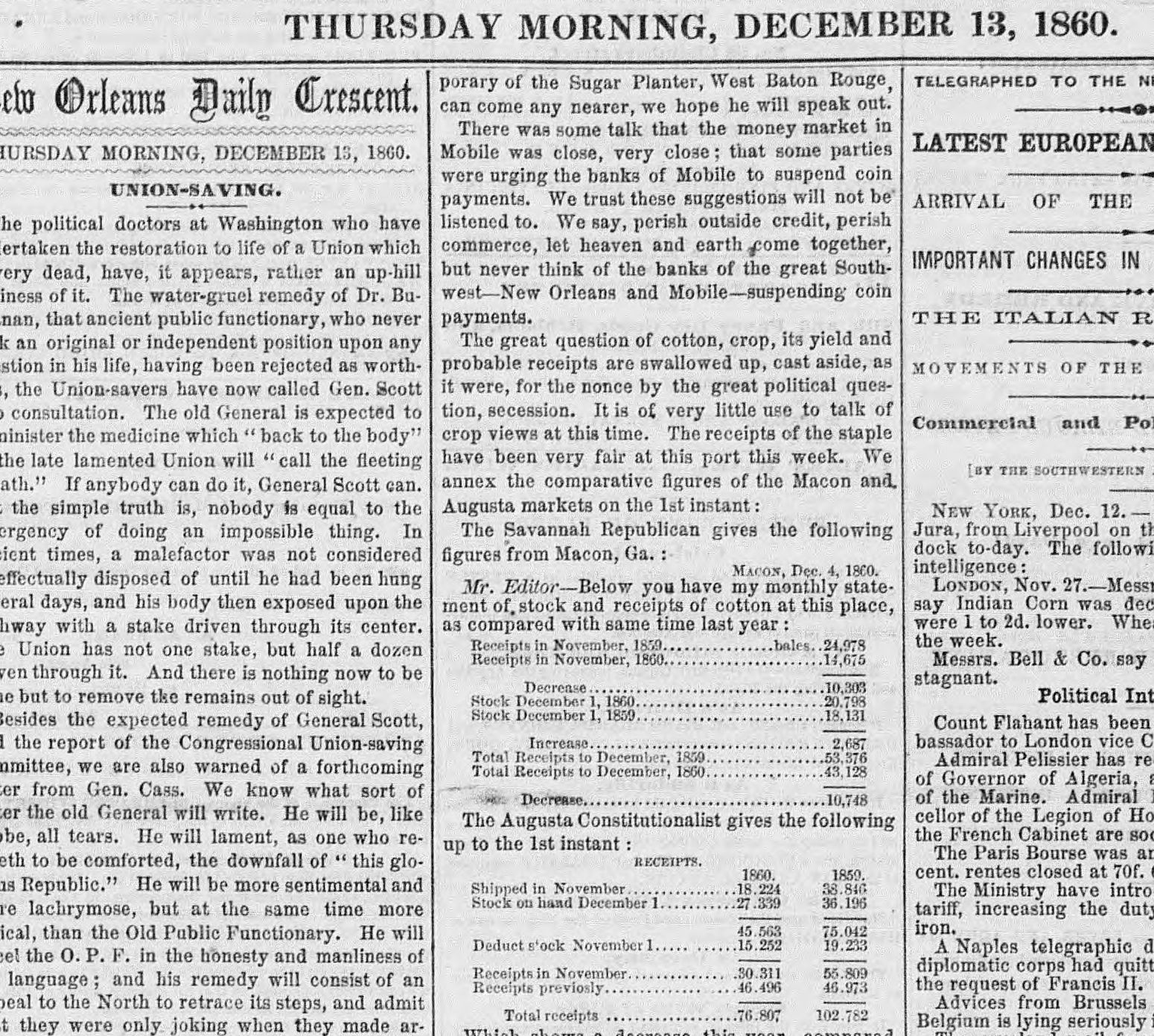
THURSDAY MORNING, DECEMBER 13, 1860. TELEGRAPHED TO THE N porary of the Sugar Planter, West Baton Rouge, can come any nearer, we hope he will speak out. eto Orleans Daily Crescent. There was some talk that the money market in LATEST EUROPEAN HURSDAY MORNING, DECEMBER 13, 1860. Mobile was close, very close ; that some parties were urging the banks of Mobile to suspend coin UNION-SAVING. ARRIVAL OF THE payments. We trust these suggestions will not be listened to. We say, perish outside credit, perish he political doctors at Washington who have ertaken the restoration to life of a Union which commerce, let heaven and earth come together, IMPORTANT CHANGES IN but never think of the banks of the great Southery dead, have, it appears, rather an up-hill west-New Orleans and Mobile-suspending coin iness of it. The water-gruel remedy of Dr. BuTHE ITALIAN R payments. nan, that ancient public functionary, who never The great question of cotton, crop, its yield and k an original or independent position upon any MOVEMENTS OF THE probable receipts are swallowed up, cast aside, as stion in his life, having been rejected as worthit were, for the nonce by the great political ques, the Union-savers have now called Gen. Scott tion, secession. It is of very little use to talk of > consultation. The old General is expected to Commercial and Pol crop views at this time. The receipts of the staple minister the medicine which 'back to the body" have been very fair at this port this week. We the late lamented Union will "call the fleeting [BY THE SOUTHWESTERN annex the comparative figures of the Macon and, ath." If anybody can do it, General Scott can. Augusta markets on the 1st instant: : the simple truth is, nobody is equal to the NEW YORK, Dec. 12. Jura, from Liverpool on th The Savannah Republican gives the following ergency of doing an impossible thing. In dock to-day. The followi ient times, a malefactor was not considered figures from Macon, Ga. intelligence: MACON, Dec. 4, 1860. effectually disposed of until he had been hung LONDON, Nov. 27.-Messi Mr. Editor--Below you have my monthly stateeral days, and his body then exposed upon the say Indian Corn was dec ment of, stock and receipts of cotton at this place, were 1 to 2d. lower. Whe as compared with same time last year hway with a stake driven through its center. the week. bales 24,978 Receipts in November, 1859 e Union has not one stake, but half a dozen 14,675 Receipts in November, 1860 Messrs. Bell & Co. say ven through it. And there is nothing now to be stagnant. Decrease 10,303 Political Int e but to remove the remains out of sight. 20.798 Stock December 1, 1860 18,131 Stock December 1, 1859 Count Flahant has been esides the expected remedy of General Scott, bassador to London vice C Increase 2,687 I the report of the Congressional Union-saving 53,376 Total Receipts to December, 1859 Admiral Pelissier has re nmittee, we are also warned of a forthcoming 43,128 Total Receipts to December, 1860 of Governor of Algeria, a er from Gen. Cass. We know what sort of of the Marine. Admiral I Decrease 10,748 er the old General will write. He will be, like cellor of the Legion of Ho The Augusta Constitutionalist gives the following the French Cabinet are so be, all tears. He will lament, as one who reup to the 1st instant The Paris Bourse was an RECEIPTS. eth to be comforted, the downfall of this glocent. rentes closed at 70f. ( 1859. 1860. 38.846 18.224 18 Republic." He will be more sentimental and Shipped in November The Ministry have intro Stock on hand December 1 36.196 27.339 re lachrymose, but at the same time more tariff, increasing the duty iron. 45.563 75.042 ical, than the Old Public Functionary. He will 15.252 Deduct stock November 1 19.233 A Naples telegraphic d el the O. P. F. in the honesty and manliness of diplomatic corps had quitt 30.311 55.809 Receipts in November language; and his remedy will consist of an 46.496 the request of Francis II. 46.973 Receipts previosly Advices from Brussels beal to the North to retrace its steps, and admit 102.782 76.807 Total receipts Belgium is lying seriously i t they were only joking when they made arWhich chame a deenesse this BOOK commoned
Article from Shreveport Daily News, September 21, 1861

Click image to open full size in new tab

Article Text

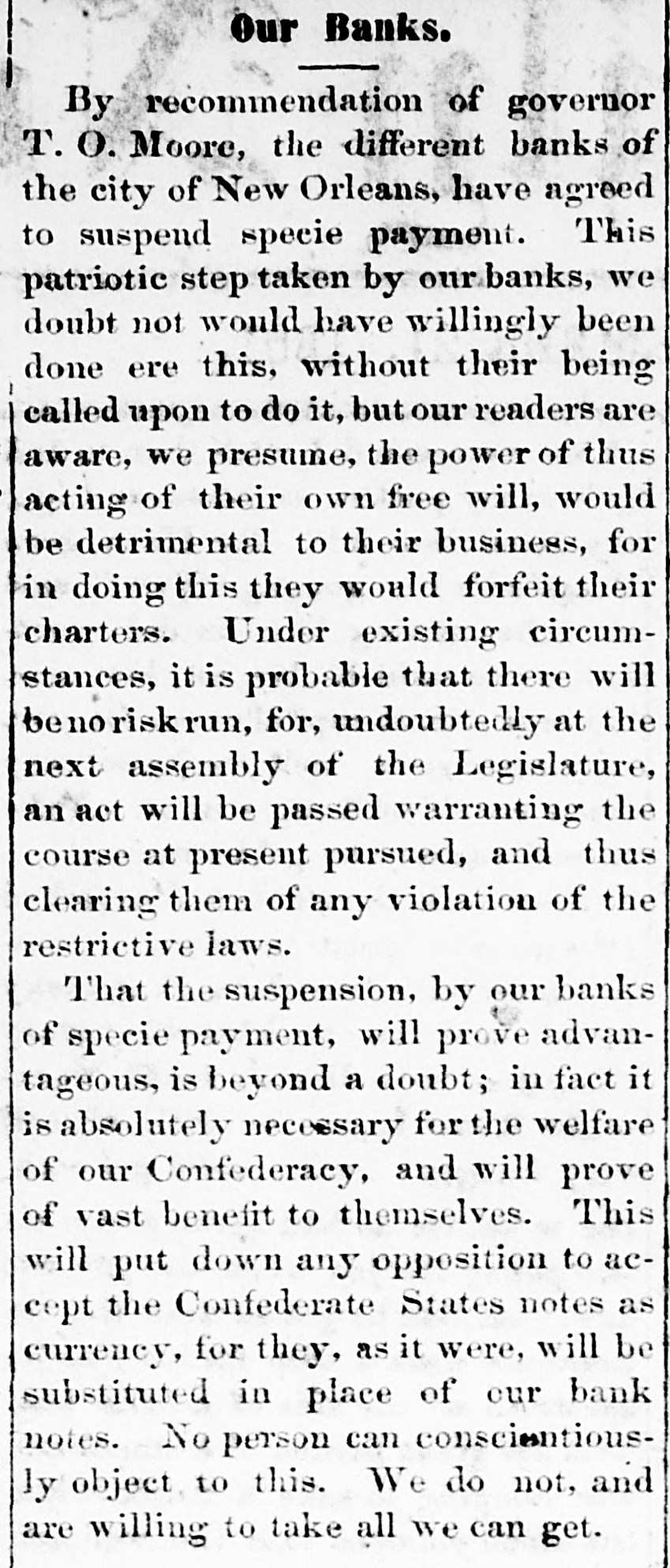
Our Banks. By recommendation of governor T. O. Moore, the different banks of the city of New Orleans, have agreed to suspend specie payment. This patriotic step taken by our banks, we doubt not would have willingly been done ere this, without their being called upon to do it, but our readers are aware, we presume, the power of thus acting of their own free will, would be detrimental to their business, for in doing this they would forfeit their charters. Under existing circumstances, it is probable that there will benoriskrun, for, undoubtedly at the next assembly of the Legislature, an act will be passed warranting the course at present pursued, and thus clearing them of any violation of the restrictive laws. That the suspension, by our banks of specie payment, will prove advantageous, is beyond a doubt; in fact it is absolutely necessary for the welfare of our Confederacy, and will prove of vast benefit to themselves. This will put down any opposition to accept the Confederate States notes as currency, for they, as it were, will be substituted in place of our bank notes. No person can conscientiously object to this. We do not, and are willing to take all we can get.


Article from The Shreveport Weekly News, September 23, 1861

Click image to open full size in new tab

Article Text

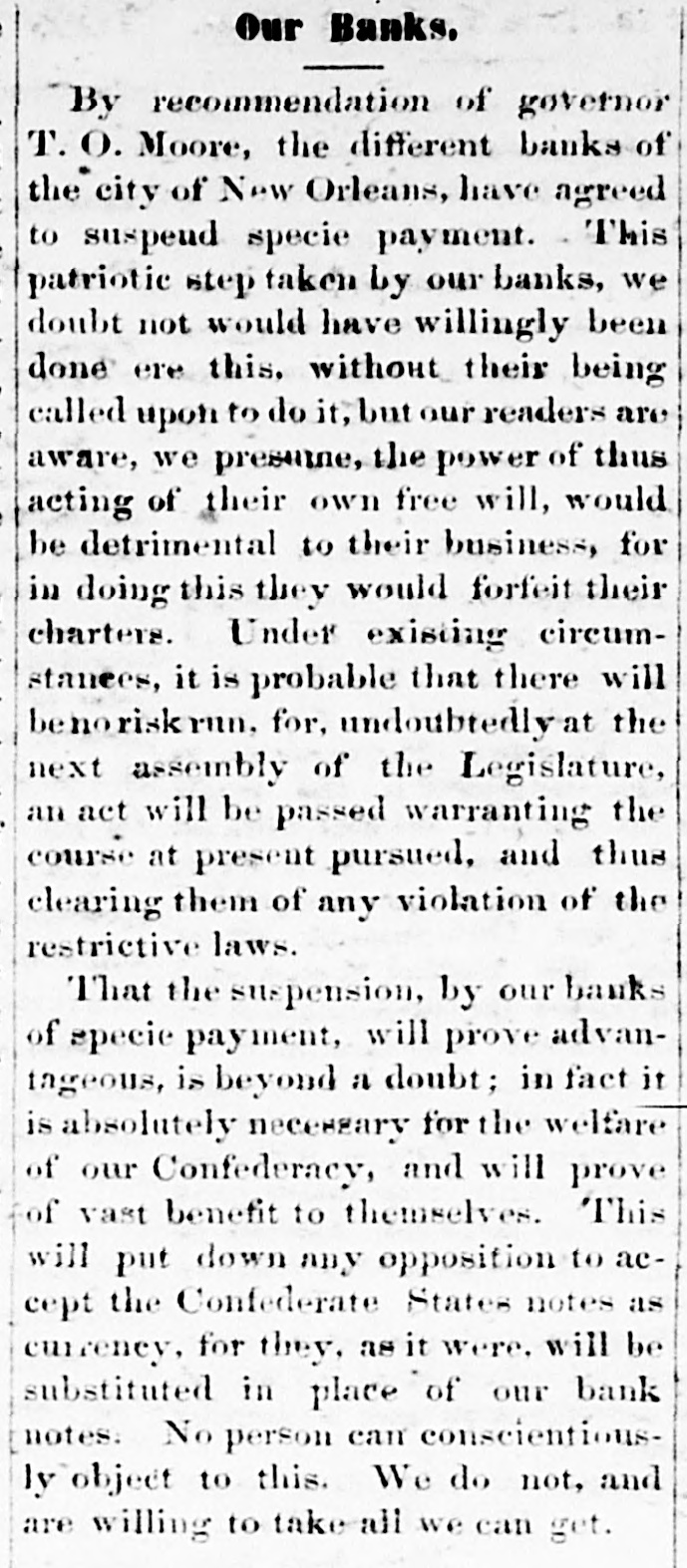
# Our Banks. By recommendation of governor T. O. Moore, the different banks of the city of New Orleans, have agreed to suspend specie payment. This patriotic step taken by our banks, we doubt not would have willingly been done ere this, without their being called upon to do it, but our readers are aware, we presume, the power of thus acting of their own free will, would be detrimental to their business, for in doing this they would forfeit their charters. Under existing circumstances, it is probable that there will be no risk run, for, undoubtedly at the next assembly of the Legislature, an act will be passed warranting the course at present pursued, and thus clearing them of any violation of the restrictive laws. That the suspension, by our banks of specie payment, will prove advantageous, is beyond a doubt; in fact it is absolutely necessary for the welfare of our Confederacy, and will prove of vast benefit to themselves. This will put down any opposition to accept the Confederate States notes as currency, for they, as it were, will be substituted in place of our bank notes. No person can conscientiously object to this. We do not, and are willing to take all we can get.


Article from New Orleans Daily Crescent, September 26, 1861

Click image to open full size in new tab

Article Text

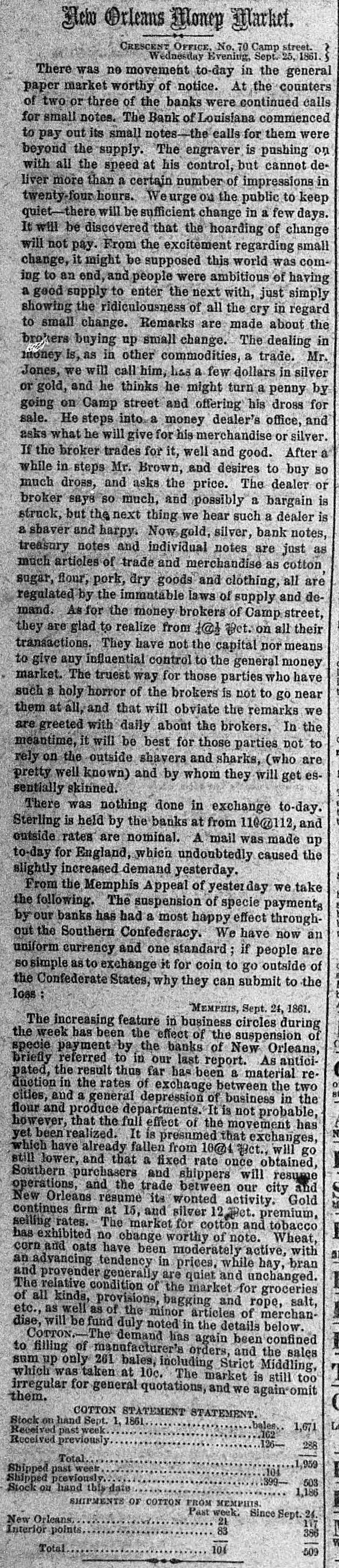
Hew Orleans Money Market. CRESCENT OFFICE. No. 70 Camp street. Wednesday Evening, Sept. 25, 1861. There was no movement to-day in the general paper market worthy of notice. At the counters of two or three of the banks were continued calls for small notes. The Bank of Louisiana commenced to pay out its small notes-the calls for them were beyond the supply. The engraver is pushing on with all the speed at his control, but cannot deliver more than a certain number of impressions in twenty-1 hours. eurge on the public to keep quiet-there will be sufficient change in a few days. It will be discovered that the hoarding of change will not pay. From the excitement regarding small change, it might be supposed this world was coming to an end, and people were ambitious of having a good supply to enter the next with, just simply showing the ridiculousness of all the cry in regard to small change. Remarks are made about the brokers buying up small change. The dealing in money is, as in other commodities, a trade. Mr. Jones, we will call him, has a few dollars in silver or gold, and he thinks he might turn a penny by going on Camp street and offering his dross for sale. He steps into a money dealer's office, and asks what he will give for his merchandise or silver. If the broker trades for it, well and good. After a while in steps Mr. Brown, and desires to buy so much dross, and asks the price. The dealer or broker says so much, and possibly a bargain is struck, but the next thing we hear such a dealer is a shaver and harpy. Now gold, silver, bank notes, treasury notes and individual notes are just as much articles of trade and merchandise as cotton sugar, flour, pork, dry goods and clothing, all are regulated by the immutable laws of supply and demand. As for the money brokers of Camp street, they are glad to realize from @ Oct. on all their transactions. They have not the capital nor means to give any influential control to the general money market. The truest way for those parties who have such a holy horror of the brokers is not to go near them at all, and that will obviate the remarks we are greeted with daily about the brokers. In the meantime, it will be best for those parties not to rely on the outside shavers and sharks, (who are pretty well known) and by whom they will get essentially skinned. There was nothing done in exchange to-day. Sterling is held by the banks at from 110@112, and outside rates are nominal. A mail was made up to-day for England, which undoubtedly caused the slightly increased demand yesterday. From the Memphis Appeal of yester day we take the following. The suspension of specie payment by our banks has had a most happy effect throughout the Southern Confederacy. We have now an uniform currency and one standard; if people are simple as to exchange it for coin to go outside of the Confederate States, why they can submit to the loss MEMPHIS, Sept. 24, 1861. The increasing feature in business circles during the week has been the effect of the suspension of specie payment by the banks of New Orleans, briefly referred to in our last report. As anticipated, the result thus far has been a material reduetion in the rates of exchange between the two cities, and a general depression of business in the flour and produce departments. It is not probable, however, that the full effect of the movement has yet been realized. It is presnmed that exchanges, which have already fallen from 10@4 Oct., will go still lower, and that a fixed rate once obtained, Southern purchasers and shippers will resume operations, and the trade between our city and New Orleans resume its wonted activity. Gold continues firm at 15, and silver 12 Pet. premium, selling rates. The market for cotton and tobacco has exhibited no change worthy of note. Wheat, corn and oats have been moderately active, with an advancing tendency in prices, while hay, bran and provender generally are quiet and unchanged. The relative condition of the market for groceries of all kinda, provisions, bagging and rope, salt, etc., as well as of the minor articles of merchandise, will be fund duly noted in the details below. Corron.-The demand has again been confined to filling of manufacturer's orders, and the sales sum up only 261 bales, including Strict Middling, which was taken at 10c. The market is still too irregular for general quotations, and we again omit them. COTTON STATEMENT STATEMENT. Stock on hand Sept. 1, 1861 bales L 1,671 Received past week 762 Received previously 126288 Total 1,959 Shipped past week I 104 Shipped previously 399 503 Stock on hand this date 1,186 SHIPMENTS OF COTTON FROM MEMPHIS. Past week. Since Sept. 24 New Orleans 21 117 I 83 Interior points 386 W Total 104 509


Article from The South-Western, November 6, 1861

Click image to open full size in new tab

Article Text

# The Legislature-The People-The Banks. Our legislature in a few weeks will assemble at Baton Rouge. Grave and important matters, of course, will be brought before that body, and we hope will receive mature consideration. Unentangled, as we presume they will be, by party shackles, their whole exer-tions, it is natural to suppose, will be directed for the welfare of their constituents. The sad and deplorable condition of our citizens has not been brought upon themselves by their own imprudent conduct, but by designing politicians and office-seekers-they are, therefore, to be pitied, and all the relief within the power of the legislature granted them. By the action of the State government and the recommendation of the cotton-brokers of New Orleans, almost the whole entire crop of cotton has been retained on the plantations. From the promises held out, the planters were induced to believe that either the Confederate government or the commission merchants would make the required advances to enable them to lay in the necessary supplies for the coming winter. In this expectation, they have been sadly disappointed. The secretary of the treasury states that there is no constitutional authority by which the government can make advances upon the cotton. The commission merchants generally, have much difficulty in sustaining their own credit by renewal of notes, consequently unable to render the required aid to the planters and others. We perceive by a notice signed by Mr. Lusher, the Confederate States' tax collector for Louisiana, that he is taking the necessary steps to commence collecting. And now, as our elections are over, we may daily expect to see the deputies presenting their bills, but whether they will get many of them "footed," is quite a different thing. The planters and the people generally, are compelled to have supplies. The banks, by suspending specie payment have withdrawn from circulation all the gold and silver the community had, for every cent has been tied up and stored away. The banks having been instrumental in adding to the distresses of the people, should be compelled to afford relief by advancing to the planters and holders of cotton, $25 on each bale. If they refuse to do this, "wind them up," as general Jackson did the United States bank. The "New Orleans Merchants' and Manufacturers' Journal," (a new, able and very independent paper) says: "Undeniably the whole banking system, as conduct-ed in this country, is a gigantic fraud. The numerous explosions, and consequent financial troubles which afflicted the great mass of the people for more than a generation past under the government of the United States, were traceable to the innate corruption which lies in the head, heart, body and limbs of the paper currency system, confided to the hands of men who never have any other idea of life than to make all they can and keep all they make." "In Louisiana, it was thought that the banking system was superior to that of any other State. Men exult-ingly, exclaimed, "Eureka!" The secret of securing the people against financial fluctuations was at last discovered. We laughed at the shin-plasters of the north and west; we stamped our feet and jubilated over the fact that the framers of our State constitution bad hit upon an expedient which would secure us a circulating medium free from depreciation and all the ills that follow in the wake of suspensions of specie payment." "Suddenly, under the pretence of forcing the Confederate notes up to par value, the banks of New Orleans made an arrangement with the governor to call on them for a suspension of specie payments. The Confederate notes were to be received at their counters, and agreeably to this preconcerted plan, out came the governor's proclamation urging the necessity of immediate action. How much money was made by the speculators who were in the secret, in buying the Confederate notes below par, may be known at the day of judgment. That thousands of dollars were lost to the working classes, by the operation, is beyond question." "Every dollar of gold and silver was instantly taken up in the vaults of the banks. Specie was so scarce that, grocers, market-men, in fact, ordinary dealers in the necessaries and luxuries of life, were reduced to all sorts of expedients to change a dollar for their customers. Bank notes were mutilated to meet the demand for small change, and the cerperation went to work and got out shin-plasters to supply the pressing wants." "The millenium so long looked for by the brokers had at length arrived. Gold and silver were sold at exorbitant rates by all those sharpers who look out for premiums. Placards, announcing "Gold and Silver sold here," were conspicuously paraded before the public eye, and brokers went home with rosy faces and returned to their offices even rosier with smiles than when they sat down over their red fish and beefsteak." the aces of success, that the brokers, were furnished with enormous amounts of hard cash to sell for them on joint speculation. Not even content with this, those institutions were turned into regular brokers' shops, where gold was sold at eight to ten per cent. premium to the unfortunate individual who had immediate need of it!" "Let the banks be taught a salutary lesson, and hereafter the people may not be subject to the unnecessary inconveniences which they have suffered since the suspension of our pet institutions. Speculation may not be so rife in quarters where it should be crushed out with strong hands, and a legitimate business transacted. What care the people if the whole system tumbles to the ground? Who is benefitted by banking institutions? The hard-working citizens of New Orleans, or adventurous speculators? What man who is not hand in glove with a bank president can get good paper discounted, and who that "bends low and in a bondsman's key" ask an accommodation for some speculative purpose, that is not made the recipient of bank favors? If the banks, confining themselves to legitimate business, standing firmly by their charters, would afford all possible facilities to merchants and mechanics, by whose labor the city thrieves, it would be well enough. But the kissing by favor plan has always been in vogue, and so, these institutions have on y served to inake the rich richer, and the poor poorer." "So far as the Confederate notes were concerned, there was no difficulty in putting them in circulation. Every day, before the banks suspended, these notes were gaining in public confidence. The army was paid in Confederate notes, the employeés in our dockyards and on fortifications received them at par value, and of necessity, they would have been taken in a little while by all with whom officers, privates, employeés, eté., traded, and thus be thrown into circulation. But so good an opportunity for speculation was not to be lost by those who ever look to the main chance, and so suspension and its attendant evils were inaugurated." The inability of the people even to pay their taxes, is candidly acknowledged by the Natchitoches Chronicle-in old, staunch, and able democratic paper-one which warmly supported governor Moore. The Chronicle says: "The sheriff has requested us to notice the fuct of his inability to collect taxes without a seizure of property and a sale at a great sacrifice. This he is unwilling to do. At the same time, the law imperatively requires him to collect and pay up in December, at the risk of being otherwise considered a defaulter. This law was made for other and better times. It should be changed, allowing all the sheriff's to sestie up for such collections as they might be able to make, and to turn over the uncollected amounts to their succes-ors; in other words, to postpone the collection of the taxes. What will the parish and State governments do without the money, in case the collections are postponed? They will have to do what individuals do in reference to their private rights and obligations, do without it and get along the best way they can. There are two causes that make money scarce-one, the shortness of the last crop making payments to the planters very


Article from New Orleans Daily Crescent, November 28, 1861

Click image to open full size in new tab

Article Text

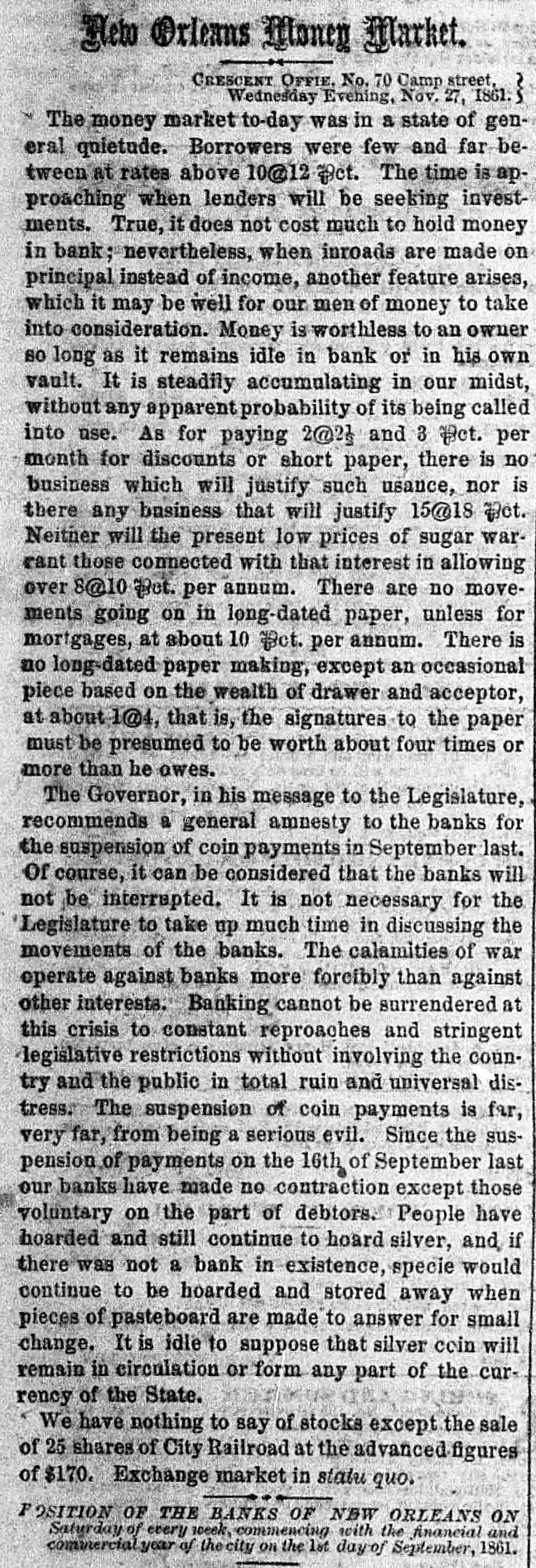
# New Orleans Money Market. CRESCENT OFFIE, No. 70 Camp street, Wednesday Evening, Nov. 27, 1861. The money market to-day was in a state of general quietude. Borrowers were few and far between at rates above 10@12 pct. The time is approaching when lenders will be seeking investments. True, it does not cost much to hold money in bank; nevertheless, when inroads are made on principal instead of income, another feature arises, which it may be well for our men of money to take into consideration. Money is worthless to an owner so long as it remains idle in bank or in his own vault. It is steadily accumulating in our midst, without any apparent probability of its being called into use. As for paying 2@2½ and 3 pct. per month for discounts or short paper, there is no business which will justify such usance, nor is there any business that will justify 15@18 pct. Neither will the present low prices of sugar warrant those connected with that interest in allowing over 8@10 pct. per annum. There are no movements going on in long-dated paper, unless for mortgages, at about 10 pct. per annum. There is no long-dated paper making, except an occasional piece based on the wealth of drawer and acceptor, at about 1@4, that is, the signatures to the paper must be presumed to be worth about four times or more than he owes. The Governor, in his message to the Legislature, recommends a general amnesty to the banks for the suspension of coin payments in September last. Of course, it can be considered that the banks will not be interrupted. It is not necessary for the Legislature to take up much time in discussing the movements of the banks. The calamities of war operate against banks more forcibly than against other interests. Banking cannot be surrendered at this crisis to constant reproaches and stringent legislative restrictions without involving the country and the public in total ruin and universal distress. The suspension of coin payments is far, very far, from being a serious evil. Since the suspension of payments on the 16th of September last our banks have made no contraction except those voluntary on the part of debtors. People have hoarded and still continue to hoard silver, and if there was not a bank in existence, specie would continue to be hoarded and stored away when pieces of pasteboard are made to answer for small change. It is idle to suppose that silver coin will remain in circulation or form any part of the currency of the State. We have nothing to say of stocks except the sale of 25 shares of City Railroad at the advanced figures of $170. Exchange market in statu quo. POSITION OF THE BANKS OF NEW ORLEANS ON Saturday of every week, commencing with the financial and commercial year of the city on the 1st day of September, 1861.