733. Central Bank (Willcox, AZ)

Bank Information

Episode Type
Suspension → Closure
Bank Type
state
Start Date
January 10, 1921
Location
Willcox, Arizona (32.253, -109.832)

Metadata

Model
gpt-5-mini
Short Digest
888d6712

Response Measures

None

Description

Bank (Central Bank of Willcox) was closed by the state auditor on Jan 10, 1921 and placed in receivership as insolvent. Articles detail state examiners ordering closure and appointment of a receiver; subsequent litigation and receiver actions are reported. OCR variations in spelling (Willeox) corrected to Willcox.

Events (2)

1. January 10, 1921 Suspension
Cause
Government Action
Cause Details
State auditor and bank examiner ordered the bank closed after declaring it insolvent following their examination.
Newspaper Excerpt
The Central Bank of Willeox is in the hands of the state auditor...the auditor...ordered the bank closed.
Source
newspapers
2. January 11, 1921 Receivership
Newspaper Excerpt
Appointment this week of a receiver for the Central Bank of Willcox...the institution, which was closed last Saturday...the bank, declared insolvent, was ordered closed the following day. ...a receiver was appointed; that the bank closed January 10, 1921, on order of the state superintendent of banks, and a receiver was appointed; that the state treasurer had on deposit $22.500 (multiple articles).
Source
newspapers

Newspaper Articles (20)

Article from El Paso Herald, January 10, 1921

Click image to open full size in new tab

Article Text

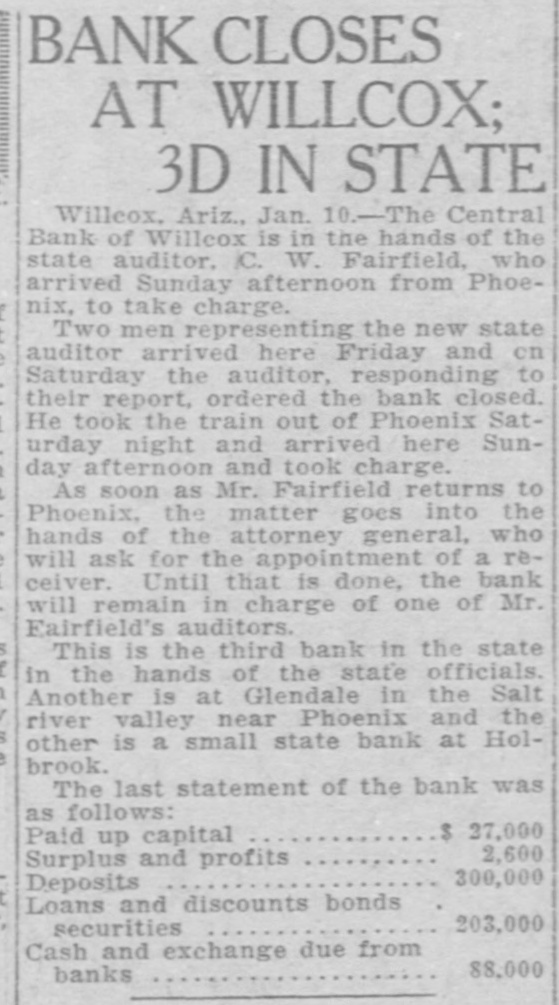
BANK CLOSES AT WILLCOX; 3D IN STATE Willeox. Ariz., Jan. 10.-The Central Bank of Willeox is in the hands of the state auditor. C. W. Fairfield, who arrived Sunday afternoon from Phoenix, to take charge. Two men representing the new state auditor arrived here Friday and en Saturday the auditor, responding to their report, ordered the bank closed. He took the train out of Phoenix Saturday night and arrived here Sunday afternoon and took charge. As soon as Mr. Fairfield returns to Phoenix, the matter goes into the hands of the attorney general, who will ask for the appointment of a receiver. Until that is done, the bank will remain in charge of one of Mr. Fairfield's auditors. This is the third bank in the state in the hands of the state officials. Another is at Glendale in the Salt river valley near Phoenix and the other is a small state bank at Holbrook. The last statement of the bank was as follows: $ 27,000 Paid up capital 2,600 Surplus and profits 300,000 Deposits Loans and discounts bonds 203,000 securities Cash and exchange due from 88,000 banks


Article from Bisbee Daily Review, January 12, 1921

Click image to open full size in new tab

Article Text

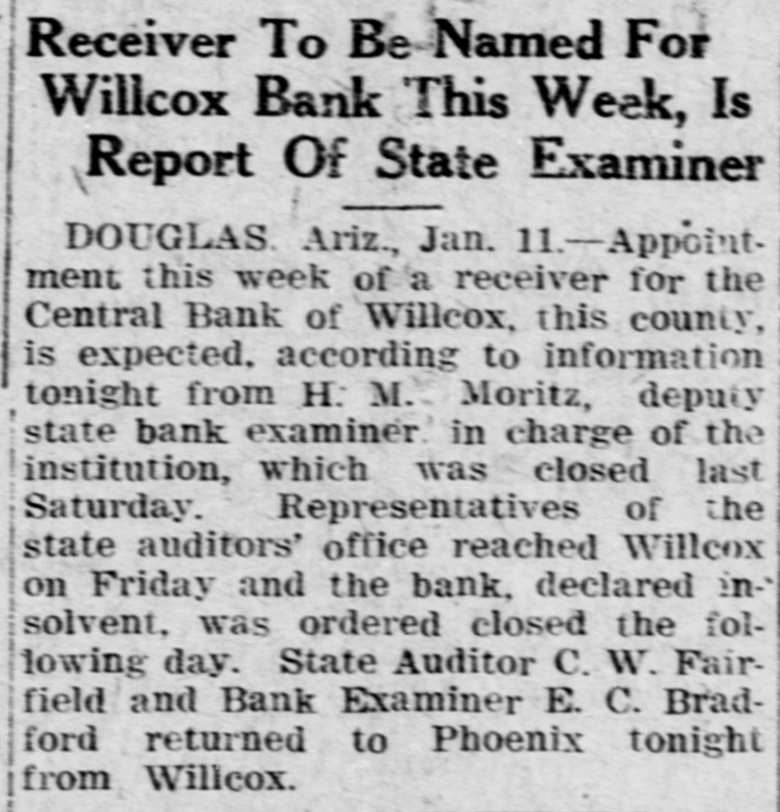
Receiver To Be Named For Willcox Bank This Week, Is Report Of State Examiner DOUGLAS Ariz., Jan. 11.-Appointment this week of a receiver for the Central Bank of Willcox, this county, is expected. according to information tonight from H: M. Moritz, deputy state bank examiner in charge of the institution, which was closed last Saturday. Representatives of the state auditors' office reached Willcox on Friday and the bank. declared insolvent, was ordered closed the foldowing day. State Auditor C. W. Fairfield and Bank Examiner E. C. Bradford returned to Phoenix tonight from Willcox.


Article from Arizona Republican, January 12, 1921

Click image to open full size in new tab

Article Text

LocalBriefs RATES PROTESTED-Protests of rates charged by the Arizona Storage and company and the Chambers Transfer company Distributing have by the led to an investigation and hearing commission corporation for the just pur- and pose of ascertaining what are reasonable rates. While the hearing will not be held until Feb. 4. the companies have been ordered to file a schedule of rates made and complete and collected, rules and charges regulations and classifications adopted for handling and storage of property before Jan. 25. Complaints have been received by the commission that the rules and regulations are unjust and unreasonable and that the rates charged are excessive. ORGAN RECITAL-What is said to be the first series of organ recitals in the history of Phoenix will begin next Monday evening at the First Methodist church when Mrs. Port Runyon will Blanche Episcopal present fol- the initial program, which is to be lowed by others on dates to be announced later. Mrs. Bessie Fox Davis, contraito, will be assistant soloist, The and there will be a silver offering. concert will begin at 8:15 o'clock. INVITED TO TUCSON-The attention of Phoenicians and residents of is the Salt River valley in general called to the farm and home week demonstration to be held in Tucson from January 17 to 22 in a letter aiddressed to the chamber of commerce yesterday by W. M. Cook, director of the co-operative extension work in agriculture and home economics at the college of agriculture, University of Arizona, under the auspices of which the week's program will be carried out. APARTMENTS NEEDED-An urg. ent appeal was issued yesterday by the room bureau of the chamber of commerce to all who have apartments for rent that they should list them with the bureau immediately. There is an insistent demand for apartments because of the opening of the state legislature, which has been followed by an influx of visitors who are having difficulties in finding the right kind of accommodations. Those who have apartments for rent are asked to list them with the room buin reau, chamber of commerce, either person or by telephone GRANTED DIVORCE-On grounds of cruelty, Letah Watkins yesterday was granted a decree of divorce from S. L. Watkins by Judge Stanford. She was awarded the custody of their child. THESE WILL MARRY-Licenses to marry were issued yesterday to Charley Kearley, 19, and Faris Burnum, 18, both of Glendale; Jesus Morris. 24, and Anna Louise Anderson, 25, both of St. Joseph, Mo.; Magdalena Chavez, 26, and Pablo Lopez, 20, both of Mesa; Juan Baellvaria, 23, and Ysabela Mori, 18, both of Chandler; Aurello Viga, 27, and Josephina Martinez del Campo, 19. both of Phoenix; Francisco Hernandez, 22. and Maria Hernandez, 17. both of Phoenix, and Charles A. DePew, 39, and Cleo Spillman, 35. both of Phoenix. ON BUSINESS-D.1 D. Horning, formerly of Phoenix, but now residing at Glendale, Cal., is in Phoenix for a few days on business. Mr. Horning was resident of the valley for 24 years and went to Glendale to make his home last summer. CAPTURE STILL-In a raid made on the E. A. Howard ranch, near Cave creek yesterday afternoon by by Deputy Sheriffs A1 DeWitt and Gilbert Blanco. a copper still, a gallon of peach brandy and a barrel of peach mash was found. The operator of the still escaped before the officers arrived. The still was found set up on a stove already to operate. MANY SUBPOENAS-J P. Dillon United States marshal, has received more than 100 subpoenas for Phoenicians who are wanted as witnesses by the grand jury now sitting in Tucson. WANT A PUPPY?--There is a sixmonths old collie pup at 1600 North Central avenue for which a home is wanted. FUNDS PROTECTED - State and county funds that were in the Central Bank at Wilcox, which closed its doors on Saturday, were fully protected, according to Charles Fairfield, state auditor and superintnedent of banks, who returned yesterday from Wilcox. E. C. Bradford, state bank examiner, who ordered the bank closed, returned with Mr. Fairfield, while his assistin H. M. Moritz, will remain ant, of charge until after the appointment a receiver COMES FOR PRISONER - George
Article from Tombstone Epitaph, January 16, 1921

Click image to open full size in new tab

Article Text

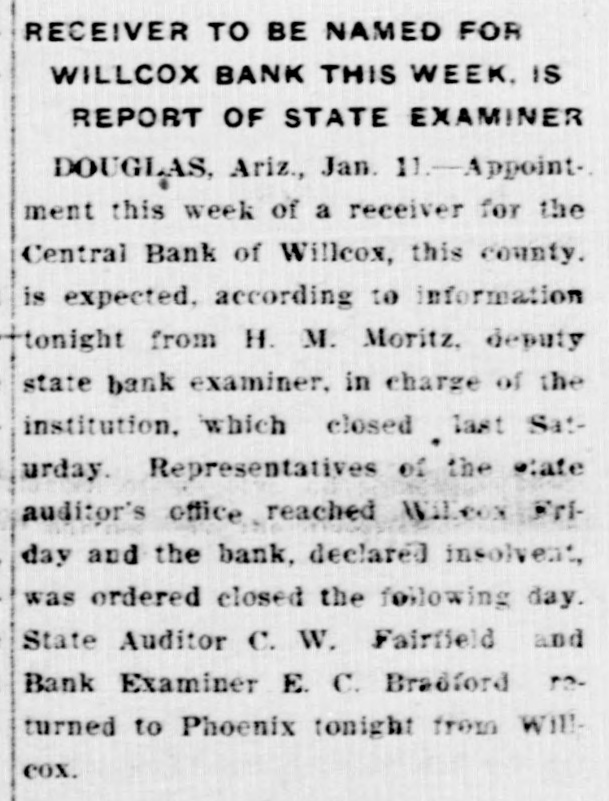
RECEIVER TO BE NAMED FOR WILLCOX BANK THIS WEEK. IS REPORT OF STATE EXAMINER DOUGLAS, Ariz, Jan. 11.-Appointment this week of a receiver for the Central Bank of Willcox, this county. is expected. according to information tonight from H. M. Moritz. deputy state bank examiner. in charge of the institution. which closed last Saturday. Representatives of the state auditor's office reached Willeox Friday and the bank, declared insolvent, was ordered closed the following day. State Auditor C. W. Fairfield and Bank Examiner E. C. Bradford returned to Phoenix tonight from will cox.


Article from Tombstone Epitaph, April 17, 1921

Click image to open full size in new tab

Article Text

# TOMBSTONE TOWN # TOPICS TERSELY TOLD MONDAY IN BISBEE. J. A. Perry and wife spent yesterday in Bisbee visiting friends. IN DOUGLAS. County Attorney J. F. Ross was in Dougias Saturday on official business. RETURNED FROM TUCSON. Dr. C. A. Morris, local dentist returned this morning from Tucson where he spent Sunday on a business visit. FROM WILLCOX. Attorney J. C. Gung and H. C. Lowdermilk, receiver for the defunct Central Bank of Willcox, were visitors in Tombstone today. DOUGLAS PUBLISHER HERE. Editor James Logie, of the Douglas Dispatch, accompanied by Mrs. Logie, were visitors in Tombstone during the day yesterday, the guests of Judge Albert M. Sames. They returned home in the evening. NO ACTION BY C. & A. Up to 4 oclock this afternoon, according to telephone advices from Bisbee, the directors of the C. & A. mining company who were in session in Warren, had made no announcement as to the company's policy regarding closing of their mines or smelter at Douglas.


Article from Bisbee Daily Review, May 18, 1921

Click image to open full size in new tab

Article Text

SUIT FOR DEBT FILED $20,000 IC Our CHARGE Suit has been filed in the superior court at Tombstone by Herbert A. Lowdermilk, receiver of the Central Bank at Willcox, against S. B. Brown for alleged deht in the sum of $20,000. At the same time the suit was filed an attachment was levied in the recorder's office against considerable property belonging to the defendant which was in his name. The property attached is town lots in Willcox and some land in that vicinity. The county has two suits against the bank and the bonding companies for the recovery of $20,000 that was on deposit there. The county money was secured by bonds and the bonds are now in the possession of the coun tv treasurer but the suit was filed in order to collect the amount due the county from the bonding company.


Article from Tombstone Epitaph, May 22, 1921

Click image to open full size in new tab

Article Text

# SUIT FOR DEBT FILED: $20,00 DUE, IS CHARGE Suit has been filed in the superior court in this city, by Herbert A. Low-dermilk, receiver of the Central Bank at Willcox, against S. B. Brown for alleged debt in the sum of $20,000. At the same time the suit was filed an at-tachment was levied in the recorder's office against considerable property belonging to the defendant which was in his name. The property attached is town lots in Willcox and some land in that vicinity. The county has two suits against the bank and the bonding companies for the recovery of $20,000 that was on deposit there. The county money was secured by bonds and the bonds are now in the possession of the coun-ty treasurer but the suit was filed in order to collect the amount due the county from the bonding company.


Article from Bisbee Daily Review, June 29, 1921

Click image to open full size in new tab

Article Text

The National Surety Company has brought suit against the Central Bank of Wilcox to recover the sum of $30,341.57, alleged to be due for recovery bonds. The Central Bank of Wilcox has been in the hands of a receiver for several months.


Article from Bisbee Daily Review, July 12, 1921

Click image to open full size in new tab

Article Text

# Jennie B. Greathouse Jennie B. Greathouse has been awarded judgment in the superior court at Tombstone against C. F. Miller for the sum of $567.93, $100 attorney fees; $19.75 costs and interest at 6 per cent on the judgment. Lillian Haverty was arrested yesterday by the Lowell officers on a charge of vagrancy and will be given a hearing within the next few days. She was recently given a suspended sentence to leave Douglas and came up here. J. Gardner and M. Arnold, who were arrested Saturday night on the Douglas highway by Deputy Sheriff Vern La More, were fined $25 apiece yesterday by Justice Taylor, of Pirtleville, for speeding. Lola Lepoz Gonzales, charged with thefts of two diamonds from Mrs. Josephine Rock of the Tourist Hotel at Tombstone, was given a preliminary hearing before Judge H. P. Merrill yesterday and was held to the action of the Superior cort and bail placed at $1,000. Not being able to make bond she was confined to the woman's cell of the county jail to await trial. Herbert A. Lowdermilk, as receiver for the Central Bank of Willcox, has recivered judgment in the superior court at Tombstone against the Gold Prince Mining and Milling Company of Dos Cabezas for the sum of $1,849.21 and costs of $30.15. The judgment also carried an order for the foreclosure of the attachment lien on the mining claims and property in the Dos Cabezas district. The preliminary examination of Walter Moore, charged with the burglary of the Warren Drug Store, will be held this morning at 10 o'clock before Justice McKenzie, at Lowell. The sheriff's office at Tombstone has sent inquiries to the state penitentiary at Florence to ascertain whether Moore, alias Hamilton, had completed his sentence or was out on parole. Up to yesterday afternoon no reply had been received. Six Mexicans, alleged to have held up Robert Reay, at Hereford, on July 2, and robbed the store, were yesterday held to await the action of the superior court at Tombstone by Justice Craig. They were ordered placed under $500 each. They attempted to prove an alibi by showing that they went to bed that night and were not out of their respective houses. The preliminary hearing was started on Saturday but was not completed then and was again taken up yesterday afternoon with the above result. The Mexicans were taken to Tombstone by Sheriff Joe Hood and Deputy Rafferty after the conclusion of the case. In the contempt proceedings against J. C. Legier and his son Tom Legier, heard before Judge Sames in Department 2 of the superior court yesterday on demand from the defendants' attorneys the court granted a jury, allowed under the law and the case will come up at the next term of court in September. Legier and son are charged with being in contempt of court when they are alleged to


Article from Arizona Republican, October 28, 1921

Click image to open full size in new tab

Article Text

STATE ASKS CLAIM AS DEPOSITOR BE GIVEN PREFERENCE For the first time the question of the state being a referred creditor will be tried out when the state makes application to the superior court of Cochise county in the matter of the Central Bank of Wilcox, which some time ago was placed in the hands of a receiver. Raymond Earhart, state treasurer, has asked that the prior right of the state to that individual be recognized by the bank, and the bank has not conceded the claim., it is said. The treasurer then requested the attorney general to take the matter


Article from Tombstone Epitaph, December 18, 1921

Click image to open full size in new tab

Article Text

# FORMER BANKERS # UNDER $10,000 BOND. Waiving preliminary hearing in the charges filed against them, scheduled to have been held before Judge Albert M. Sames today, S. B. Brown and J. H. Reid, Jr., charged with irregularities in connection with the defunct Central Bank of Willcox were confined to the county jail today until their attorney can arrange for bond of $10000 each. Brown and Reid both waived preliminary hearing on the first charges filed as well as that filed yesterday by County Attorney Ross, charging transactions involving $85,000, the bond of $10,000 applying to the first case, although under agreement between attorneys for the defense, the county attorney and the court, the same bond will be allowed to apply in the last case. W. G. Barcum, attorney of Phoenix, left for the capital city this afternoon to arrange for bond for the release of Brown and Reid, and it will probably be Monday before he can return here. H. A. Lowdermilk, receiver of the defunct Central Bank and Geo. W. Brown, deputy state auditor, are chief witnesses for the state, through whom it is expected by the county attorney to prove the irregularities charged against the defendants.


Article from Tombstone Epitaph, March 19, 1922

Click image to open full size in new tab

Article Text

Herbert Lowdermilk, receiver of the defunct Central Bank of Willcox, and Attorney J. C. Gung'l were in Tombstone today, having a case in the Superior court.


Article from Bisbee Daily Review, April 14, 1922

Click image to open full size in new tab

Article Text

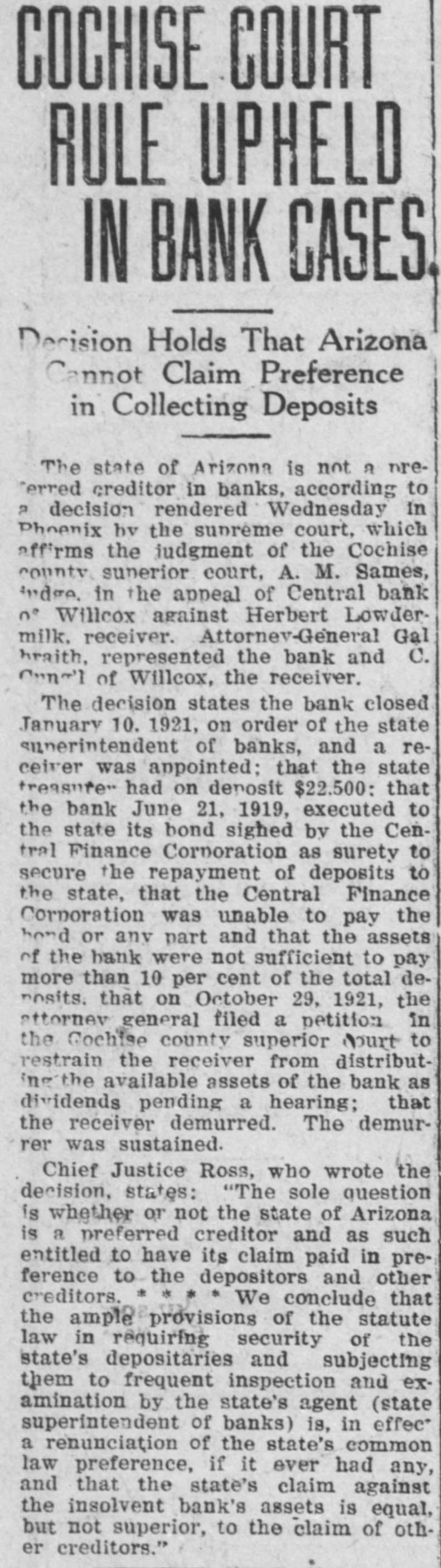
COCHISE COURT RULE UPHELD IN BANK CASES Decision Holds That Arizona Cannot Claim Preference in Collecting Deposits The state of Arizona is not a nreTerred creditor in banks, according to a decision rendered Wednesday in Phoenix by the supreme court, which affirms the judgment of the Cochise county sunerior court, A. M. Sames, india in the appeal of Central bank n° Willcox against Herbert Lowdermilk, receiver. Attorney-General Gal braith, represented the bank and C. Cunn't of Willcox, the receiver. The decision states the bank closed January 10. 1921, on order of the state sunerintendent of banks, and a receiver was appointed; that the state treasure" had on deposit $22.500: that the bank June 21, 1919, executed to the state its bond sighed by the Central Finance Corporation as surety to secure the repayment of deposits to the state, that the Central Finance Corporation was unable to pay the bond or any part and that the assets of the bank were not sufficient to pay more than 10 per cent of the total deposits. that on October 29, 1921, the attorney general filed a petition in the Cochise county superior court to restrain the receiver from distributing the available assets of the bank as dividends pending a hearing; that the receiver demurred. The demurrer was sustained. Chief Justice Ross, who wrote the decision, states: "The sole question is whether or not the state of Arizona is a preferred creditor and as such entitled to have its claim paid in preference to the depositors and other creditors. We conclude that the ample provisions of the statute law in requiring security of the state's depositaries and subjecting them to frequent inspection and examination by the state's agent (state superintendent of banks) is, in effect a renunciation of the state's common law preference, if it ever had any, and that the state's claim against the insolvent bank's assets is equal, but not superior, to the claim of other creditors."


Article from Bisbee Daily Review, April 22, 1922

Click image to open full size in new tab

Article Text

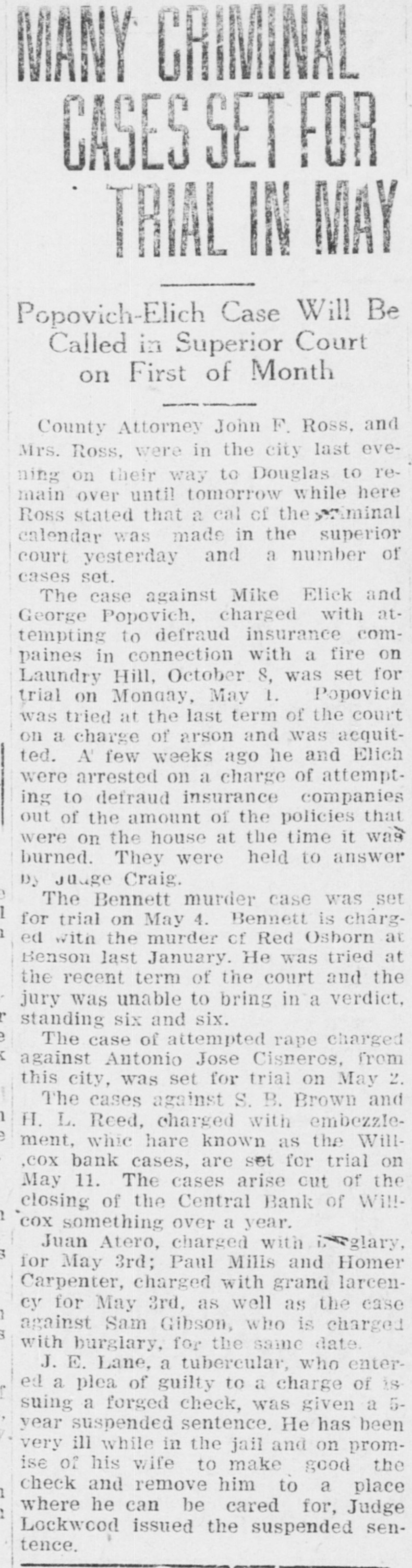
CRIMINAL MANY CASES LASES SET FOR MAY IN TRIAL Popovich-Elich Case Will Be Called in Superior Court on First of Month County Attorney John F. Ross, and Mrs. Ross, were in the city last evening on their way to Douglas to remain over until tomorrow while here Ross stated that a cal of theariminal calendar was made in the superior court yesterday and a number of cases set. The case against Mike Elick and George Popovich, charged with attempting to defraud insurance compaines in connection with a fire on Laundry Hill, October 8, was set for trial on Monday, May 1. Popovich was tried at the last term of the court on a charge of arson and was acquitted. A' few weeks ago he and Elich were arrested on a charge of attempting to defraud insurance companies out of the amount of the policies that were on the house at the time it was burned. They were held to answer Dy Judge Craig. The Bennett murder case was set for trial on May 4. Bennett is charged with the murder of Red Osborn at Benson last January. He was tried at the recent term of the court and the jury was unable to bring in a verdict, standing six and six. The case of attempted rape charged against Antonio Jose Cisneros, from this city, was set for trial on May 2. The cases against S. B. Brown and H. L. Reed, charged with embezzlement, whie hare known as the Will.cox bank cases, are set for trial on May 11. The cases arise cut of the closing of the Central Bank of WillCOX something over a year. Juan Atero, charged with inglary, for May 3rd; Paul Mills and Homer Carpenter, charged with grand larcency for May 3rd, as well as the ease against Sam Gibson, who is charged with burglary, for the same date. J. E. Lane, a tubercular, who entered a plea of guilty to a charge of is suing a forged check, was given a 5year suspended sentence. He has been very ill while in the jail and on promise of his wife to make good the check and remove him to a place where he can be cared for, Judge Lockwood issued the suspended sentence.


Article from Bisbee Daily Review, May 16, 1922

Click image to open full size in new tab

Article Text

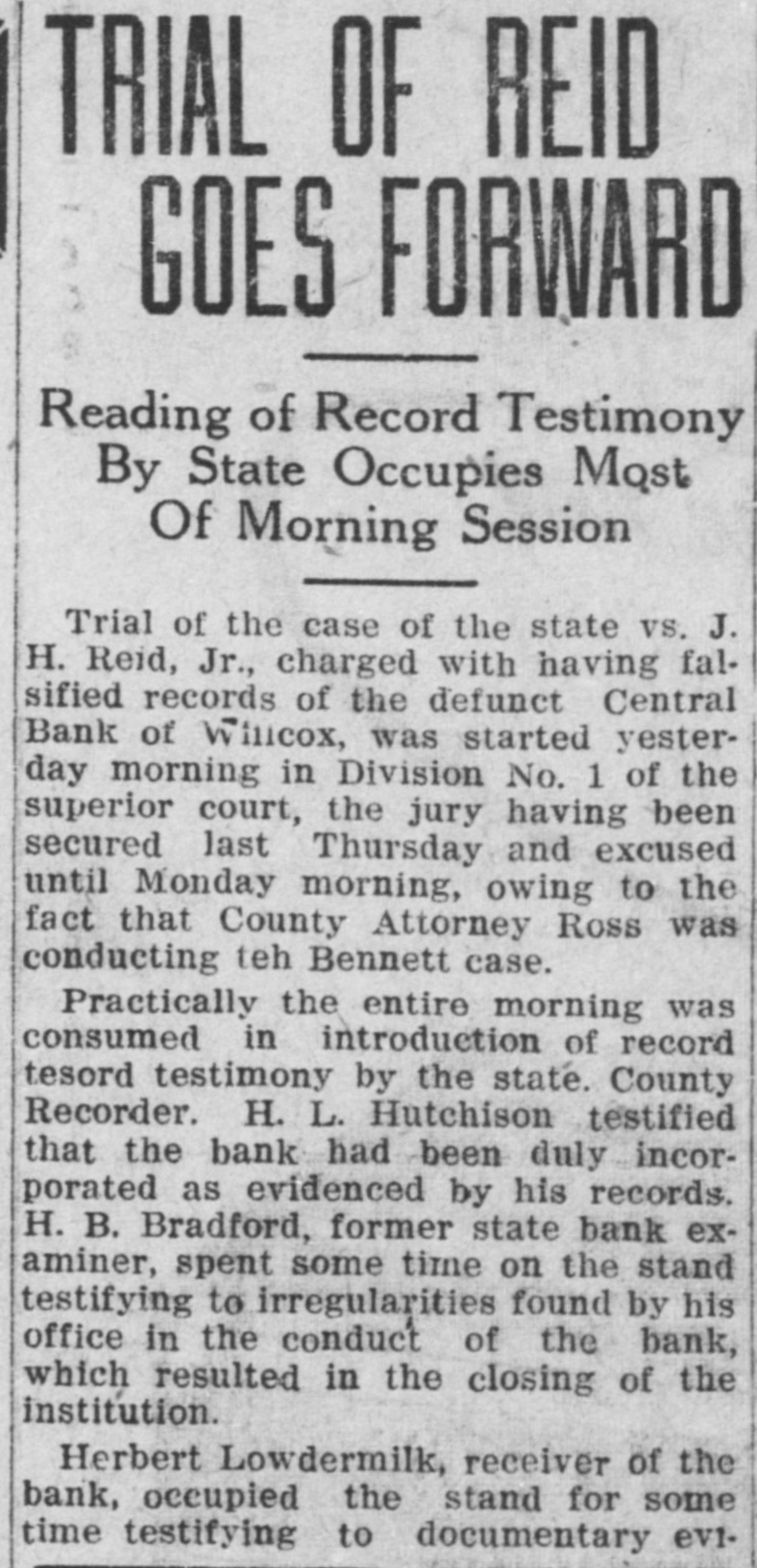
# TRIAL OF REID # GOES FORWARD Reading of Record Testimony By State Occupies Most Of Morning Session Trial of the case of the state vs. J. H. Reid, Jr., charged with having fal- sified records of the defunct Central Bank of Wincox, was started yester- day morning in Division No. 1 of the superior court, the jury having been secured last Thursday and excused until Monday morning, owing to the fact that County Attorney Ross was conducting teh Bennett case. Practically the entire morning was consumed in introduction of record tesord testimony by the state. County Recorder. H. L. Hutchison testified that the bank had been duly incor- porated as evidenced by his records. H. B. Bradford, former state bank ex- aminer, spent some time on the stand testifying to irregularities found by his office in the conduct of the bank, which resulted in the closing of the institution. Herbert Lowdermilk, receiver of the bank, occupied the stand for some time testifying to documentary evi-


Article from Tombstone Epitaph, May 21, 1922

Click image to open full size in new tab

Article Text

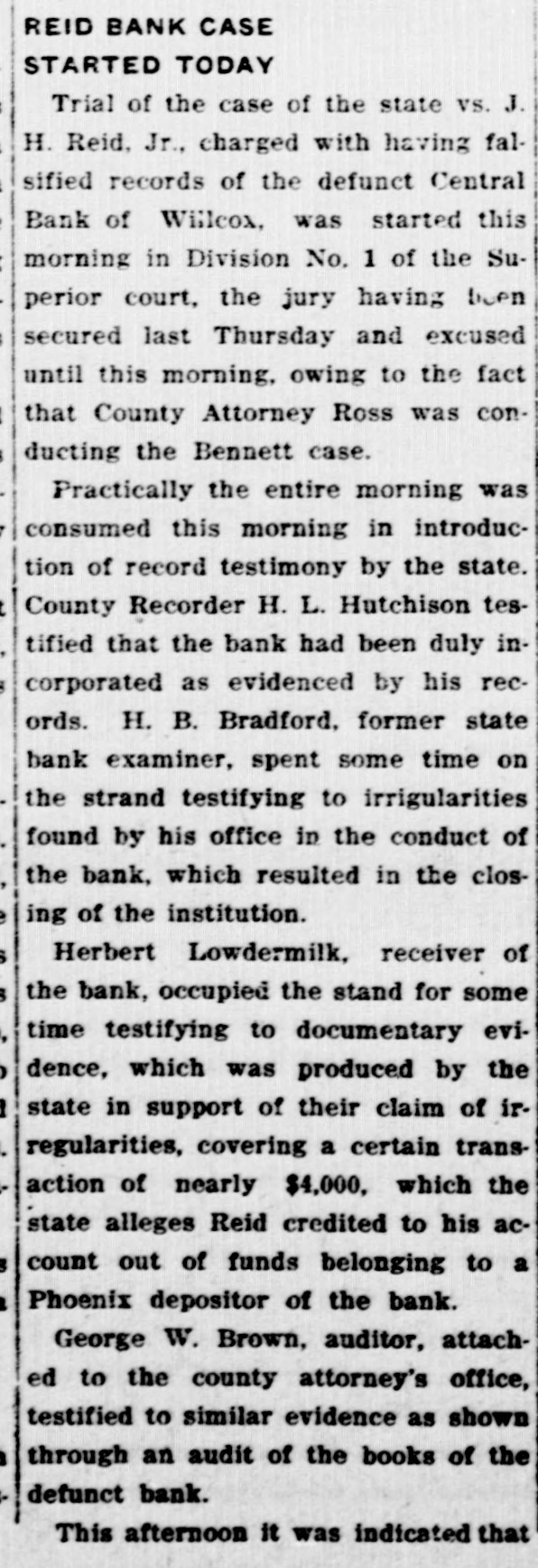
REID BANK CASE STARTED TODAY Trial of the case of the state vs. J. H. Reid, Jr., charged with having falsified records of the defunct Central Bank of Willcox, was started this morning in Division No. 1 of the Superior court, the jury having been secured last Thursday and excused until this morning, owing to the fact that County Attorney Ross was conducting the Bennett case. Practically the entire morning was consumed this morning in introduction of record testimony by the state. County Recorder H. L. Hutchison testified that the bank had been duly incorporated as evidenced by his records. H. B. Bradford, former state bank examiner, spent some time on the strand testifying to irrigularities found by his office in the conduct of the bank, which resulted in the closing of the institution. Herbert Lowdermilk, receiver of the bank, occupied the stand for some time testifying to documentary evidence, which was produced by the state in support of their claim of irregularities, covering a certain transaction of nearly $4,000, which the state alleges Reid credited to his account out of funds belonging to a Phoenix depositor of the bank. George W. Brown, auditor, attached to the county attorney's office, testified to similar evidence as shown through an audit of the books of the defunct bank. This afternoon it was indicated that


Article from Bisbee Daily Review, May 21, 1922

Click image to open full size in new tab

Article Text

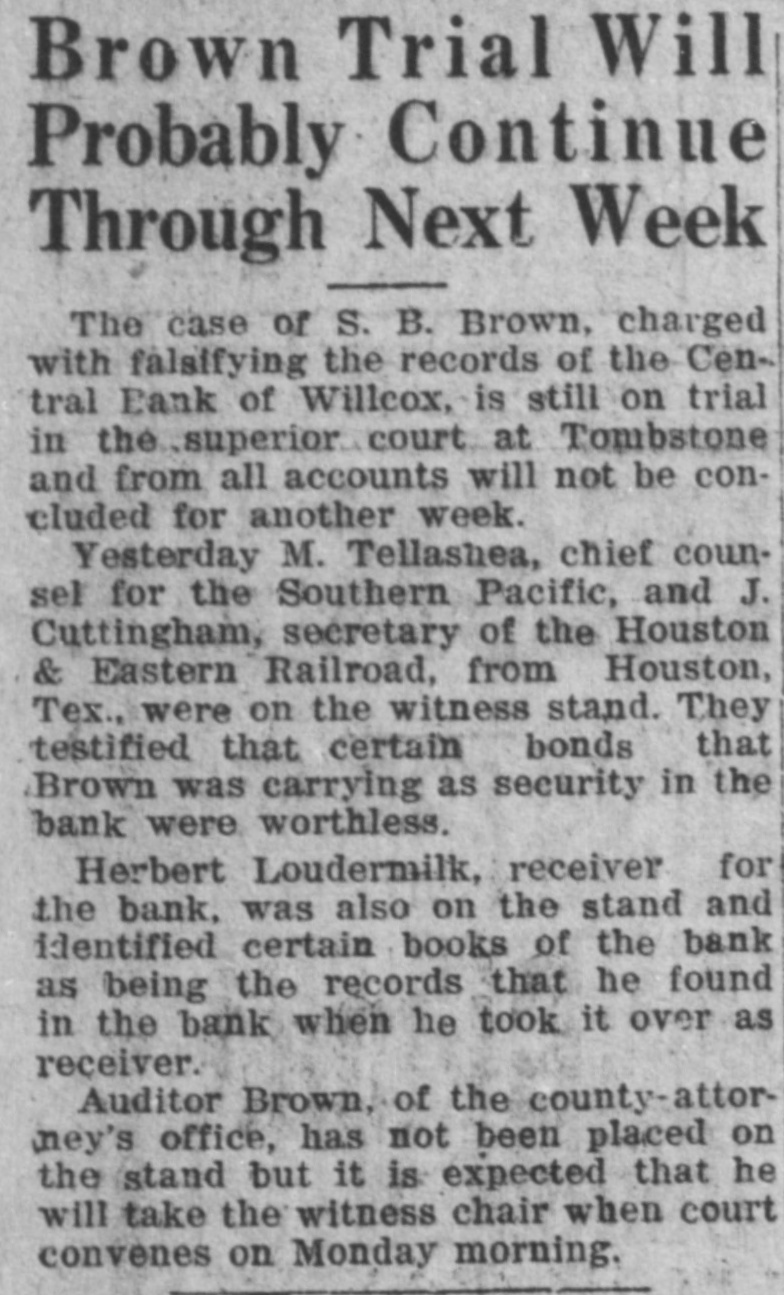
# Brown Trial Will # Probably Continue # Through Next Week The case of S. B. Brown, charged with falsifying the records of the Central Bank of Willcox, is still on trial in the superior court at Tombstone and from all accounts will not be concluded for another week. Yesterday M. Tellashea, chief counsel for the Southern Pacific, and J. Cuttingham, secretary of the Houston & Eastern Railroad, from Houston, Tex., were on the witness stand. They testified that certain bonds that Brown was carrying as security in the bank were worthless. Herbert Loudermilk, receiver for the bank, was also on the stand and identified certain books of the bank as being the records that he found in the bank when he took it over as receiver. Auditor Brown, of the county-attorney's office, has not been placed on the stand but it is expected that he will take the witness chair when court convenes on Monday morning.


Article from Tombstone Epitaph, May 28, 1922

Click image to open full size in new tab

Article Text

INSTRUCTED VERDICT Motion for instructed verdict of not guilty in the case of the state vs. S. B. Brown. charged with receiving deposits in the defunct Central Bank of Willcox when he knew the institution was insolvent, was made late this afternoon by the defense. The motion was considered one of the most important phases of the case since it was started here ten days ago and was raised by Attorney W. L. Barnum for the defense, after the state closed its case shortly after 4 o'clock this afternoon. In involves a uestion of law as to whether the offense charged against Brown was il legal, according to the information filed by the state, and following dismissal of the jury until tomorrow morning at 9:30 by Judge Lockwood, both sides presented authorities on the point raised and the court will rule tomorrow. The point involved covers a particular phase of the case not yet decided in this state based on the Arizona statute and on account of the jury being allowed to go at will during the trial. details of the motion made by the defense are not permitted to be made public through the press owing to the fact that it might be read by members of the jury panel trying the case. Tomorrow the court will rule and on his decision as to whether the contention of the defense motion is supported by law, will decide whether the case will proceed or whether the instructed verdict of acuittal will be given. Practically the entire day today was taken up with George W. Brown, chief expert witness for the state, who was on the stand for the fourth day during the trial. Considerable of his testimony was cross-examination, in which the defense sought to disprove testimony previously introduced by the state. The state's line of testimony today dealt with the final analysis of the larger accounts involved in the case of insolvency, charged against the bank which Brown is alleged to have had knowledge and which the state alleged amounted to over $100,000. Also that the bank had only a book surplus of $1,000 when it closed on July 1. 1921. through which it could have absorbed such losses exclusive of its capital stock account which amounted to $31,000, on which showing the state claimed the condition of the bank was in a sighly insolvent condition. Brief cross-examination of Herbert Lowdermilk, receiver of the defunct bank relative to certain indebtedness of depositors of the bank was conducted by the defense shortly before the state closed. Genevieve Mulkey, who was employed in the bank, was on the stand a short while today and testified to statements alleged to have been made by Brown in the bank at least ten days before it closed, that "it looked like they were going to have to close." She testified also regarding certain deposits received on the day alleged by the state Brown knew


Article from Bisbee Daily Review, June 1, 1922

Click image to open full size in new tab

Article Text

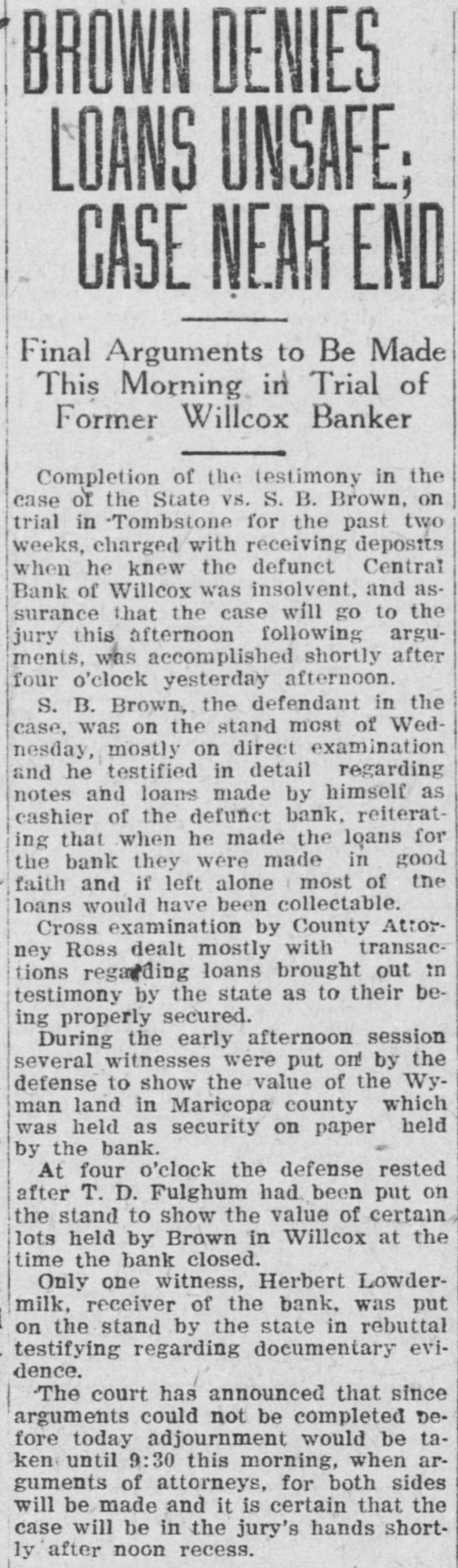
# BROWN DENIES # LOANS UNSAFE; # CASE NEAR END Final Arguments to Be Made This Morning in Trial of Former Willcox Banker Completion of the testimony in the case of the State vs. S. B. Brown, on trial in Tombstone for the past two weeks, charged with receiving deposits when he knew the defunct Central Bank of Willcox was insolvent, and assurance that the case will go to the jury this afternoon following arguments, was accomplished shortly after four o'clock yesterday afternoon. S. B. Brown, the defendant in the case, was on the stand most of Wednesday, mostly on direct examination and he testified in detail regarding notes and loans made by himself as cashier of the defunct bank, reiterating that when he made the loans for the bank they were made in good faith and if left alone most of the loans would have been collectable. Cross examination by County Attorney Ross dealt mostly with transactions regarding loans brought out in testimony by the state as to their being properly secured. During the early afternoon session several witnesses were put on by the defense to show the value of the Wyman land in Maricopa county which was held as security on paper held by the bank. At four o'clock the defense rested after T. D. Fulghum had been put on the stand to show the value of certain lots held by Brown in Willcox at the time the bank closed. Only one witness, Herbert Lowdermilk, receiver of the bank, was put on the stand by the state in rebuttal testifying regarding documentary evidence. The court has announced that since arguments could not be completed before today adjournment would be taken until 9:30 this morning, when arguments of attorneys, for both sides will be made and it is certain that the case will be in the jury's hands shortly after noon recess.


Article from Tombstone Epitaph, November 5, 1922

Click image to open full size in new tab

Article Text

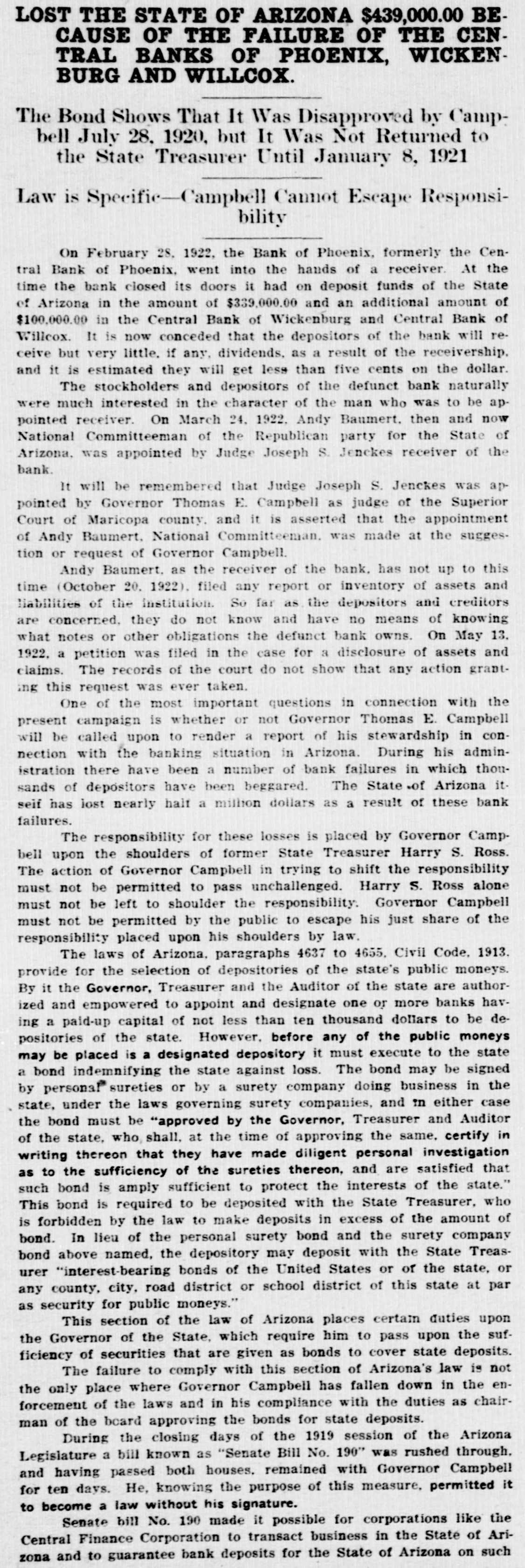
LOST THE STATE OF ARIZONA $439,000.00 BECAUSE OF THE FAILURE OF THE CENTRAL BANKS OF PHOENIX, WICKENBURG AND WILLCOX. The Bond Shows That It Was Disapproved by Campbell July 28, 1920, but It Was Not Returned to the State Treasurer Until January 8, 1921 Law is Specific-Campbell Cannot Escape Responsibility On February 28, 1922, the Bank of Phoenix, formerly the Central Bank of Phoenix, went into the hands of a receiver. At the time the bank closed its doors it had on deposit funds of the State of Arizona in the amount of $339,000.00 and an additional amount of $100,000.00 in the Central Bank of Wickenburg and Central Bank of Willcox. It is now conceded that the depositors of the bank will receive but very little. if any, dividends, as a result of the receivership. and it is estimated they will get less than five cents on the dollar. The stockholders and depositors of the defunct bank naturally were much interested in the character of the man who was to be appointed receiver. On March 24, 1922. Andy Baumert. then and now National Committeeman of the Republican party for the State of Arizona. was appointed by Judge Joseph S. Jenckes receiver of the bank. It will be remembered that Judge Joseph S. Jenckes was appointed by Governor Thomas E. Campbell as judge of the Superior Court of Maricopa county. and it is asserted that the appointment of Andy Baumert, National Committeeman. was made at the suggestion or request of Governor Campbell. Andy Baumert, as the receiver of the bank. has not up to this time (October 20. 1922). filed any report or inventory of assets and liabilities of the institution. So far as the depositors and creditors are concerned. they do not know and have no means of knowing what notes or other obligations the defunct bank owns. On May 13. 1922. a petition was filed in the case for a disclosure of assets and claims. The records of the court do not show that any action granting this request was ever taken. One of the most important questions in connection with the present campaign is whether or not Governor Thomas E. Campbell will be called upon to render a report of his stewardship in connection with the banking situation in Arizona. During his administration there have been a number of bank failures in which thousands of depositors have been beggared. The State of Arizona it. seif has lost nearly half a million dollars as a result of these bank failures. The responsibility for these losses is placed by Governor Campbell upon the shoulders of former State Treasurer Harry S. Ross. The action of Governor Campbell in trying to shift the responsibility must not be permitted to pass unchallenged. Harry S. Ross alone must not be left to shoulder the responsibility. Governor Campbell must not be permitted by the public to escape his just share of the responsibility placed upon his shoulders by law. The laws of Arizona, paragraphs 4637 to 4655. Civil Code, 1913. provide for the selection of depositories of the state's public moneys. By it the Governor, Treasurer and the Auditor of the state are authorized and empowered to appoint and designate one or more banks having a paid-up capital of not less than ten thousand dollars to be depositories of the state. However, before any of the public moneys may be placed is a designated depository it must execute to the state a bond indemnifying the state against loss. The bond may be signed by personal* sureties or by a surety company doing business in the state, under the laws governing surety companies, and in either case the bond must be "approved by the Governor, Treasurer and Auditor of the state, who shall, at the time of approving the same, certify in writing thereon that they have made diligent personal investigation as to the sufficiency of the sureties thereon, and are satisfied that such bond is amply sufficient to protect the interests of the state." This bond is required to be deposited with the State Treasurer, who is forbidden by the law to make deposits in excess of the amount of bond. In lieu of the personal surety bond and the surety company bond above named, the depository may deposit with the State Treasurer "interest-bearing bonds of the United States or of the state, or any county, city, road district or school district of this state at par as security for public moneys." This section of the law of Arizona places certain duties upon the Governor of the State, which require him to pass upon the sufficiency of securities that are given as bonds to cover state deposits. The failure to comply with this section of Arizona's law is not the only place where Governor Campbell has fallen down in the enforcement of the laws and in his compliance with the duties as chairman of the board approving the bonds for state deposits. During the closing days of the 1919 session of the Arizona Legislature a bill known as "Senate Bill No. 190" was rushed through. and having passed both houses. remained with Governor Campbell for ten days. He, knowing the purpose of this measure, permitted it to become a law without his signature. Senate bill No. 190 made it possible for corporations like the Central Finance Corporation to transact business in the State of Arizona and to guarantee bank deposits for the State of Arizona on such