Article Text
URBANA, ILL., WAS CLOSED UP BY MAYOR TO FIGHT OFF PANIC
BOOMING LEARNING D LESSON
When Urbana, Ill., began to get a hard-times headache and runs started on two sound and staunch banks, Mayor Reginald C. Harmon, shown in inset upper left, shut up the town until citizens calmed down. Depositors were pledged to leave money in the banks, and gossips were hunted down in a sizzling confidence campaign that followed. Excerpts from posters used are shown, together with sketch at lower right to show result—everybody prosperous.
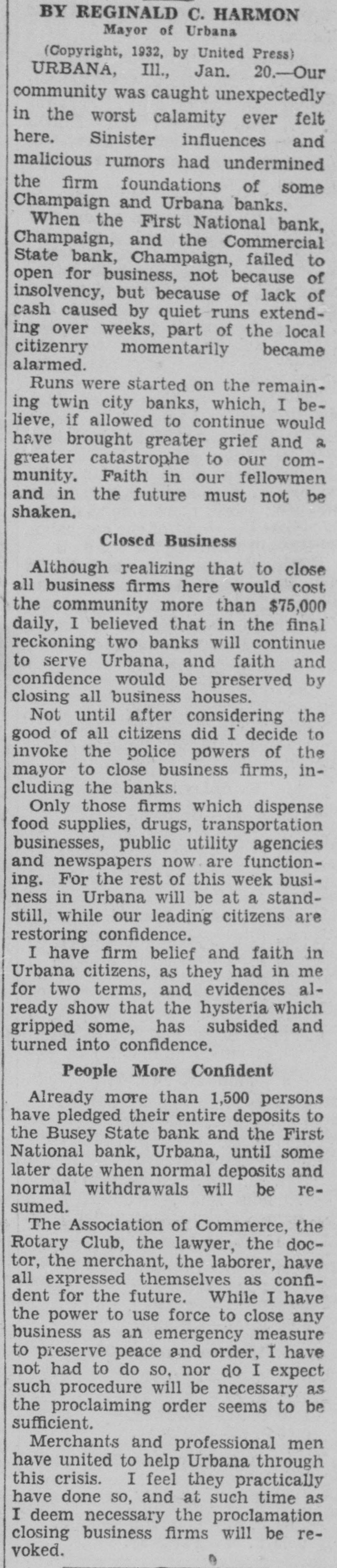
BY R. C. HARMON Mayor of Urbana, Ill.
I venture the assertion that fully half of our bank "runs" in this country today are due to hysteria on the part of people who have heard a lot of wild false and baseless rumors.
That was certainly the case in Urbana.
Few banks close as the result of dishonesty behind the counter. Sometimes, unwise investments cause them to fail. But in most cases a "run" is caused by sheer hysteria.
Any city can do what Urbana has done, if the said city is loyal and community spirited. But if the citizens are not loyal and willing to co-operate there is not much a mayor can do.
A mayor can enforce martial law. If he tried to do so, he might have to put hundreds of persons into jail and that would cause a riot. That's where loyalty and public spirit comes in.
Urbana had the loyalty and co-operation of its citizens in this crisis. Of the 6,000 depositors of our two banks those who refused to join us could be counted on the fingers of one hand.
The veteran banker was followed by Douglas R. Fay, 32, president of the First National Bank of Urbana, said to be the youngest national bank president in the country. Fay declared that there was also no question about the solvency of the First National bank.
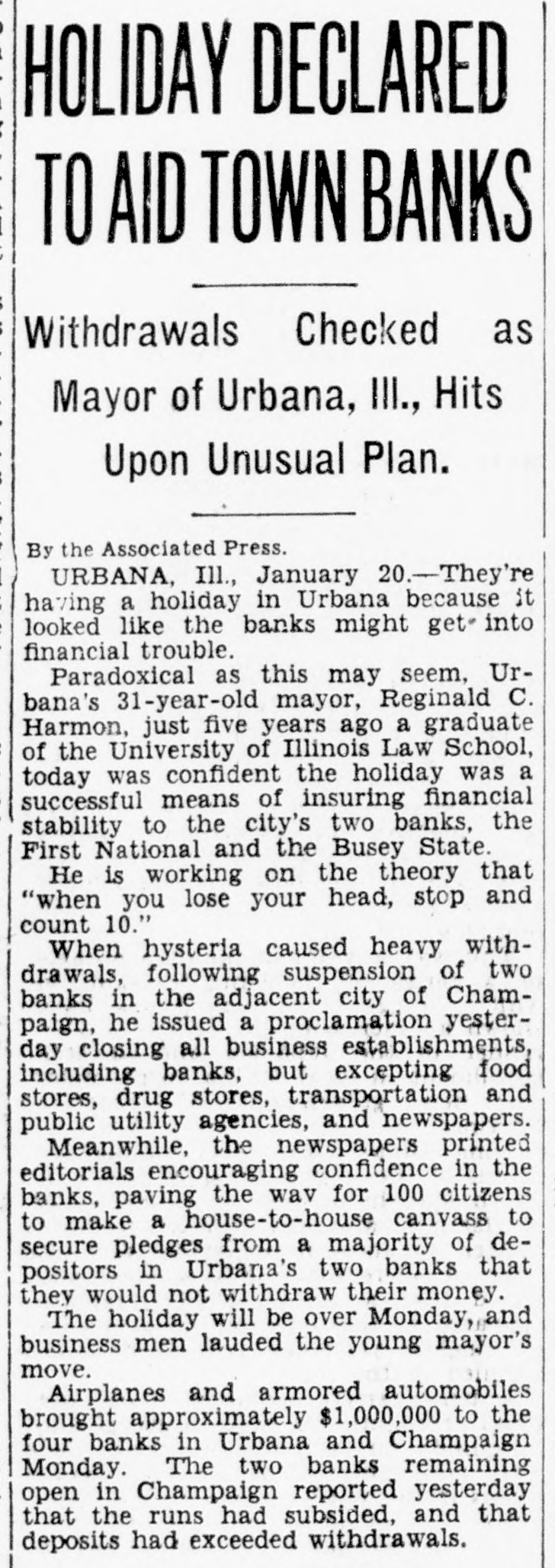
At 8 a.m., Mayor Harmon was called into a conference of bankers and their legal advisors. He signed the "martial law" proclamation, closing Urbana for five days, effective immediately.
At 9 a.m., President T. B. Webber of the Association of Commerce, called Urbana's merchants together. After the situation had been explained by Mayor Harmon they voted unanimously to back his "martial law" proclamation to the limit.
All so, Tuesday morning, Urbana closed up tight. The mayor's proclamation for a five-day "holiday" gave both banks a legal reason for remaining closed. Thus the "run" was halted.
By 3 p.m. Wednesday, the tireless solicitors had obtained the signatures of practically every depositor. This accomplished, Mayor Harmon terminated his five-day closing order immediately and that afternoon the stores reopened.
An amount of trade estimated at $75,000 had been lost in the 36 hours, but the merchants were happy. The banks, whose failure would have dragged many of them down, had been saved.
When the banks reopened Thursday morning, depositors did not cycle back with their money. That day, deposits received at the First National bank amounted to thirty-one times the amount of withdrawals, and in the Busey bank the deposits were twenty-five times greater than withdrawals.
Placards advertising the confidence Urbana had in these banks appeared in store windows all over town. There were also many somewhat similar placards declaring "The Gossip Mongers Must Go!" and calling upon good citizens to report destructive and doubtful gossip to the Association of Commerce. Both also appeared in newspaper advertisements, while local newspaper editorial support of the move was hearty and complete.
Money in Banks
But the plan had worked too well; people were putting all their money in the banks, instead of spending it at the stores. Business dropped. So the Association of Commerce put out more placards and newspaper advertisements, urging the public to "Get Back to Normal—Business as Usual!"
This movement was successful, too, as evidenced by the fact that a city-wide "Dollar Day" sale a few days later brought one of the best business days in Urbana's history. Ever since then, business has progressed nicely.
Following up the work, the Association of Commerce converted its committee of solicitors into committees to investigate and run down destructive gossip about the city's banks, to prevent any repetition of hysteria.