Article Text
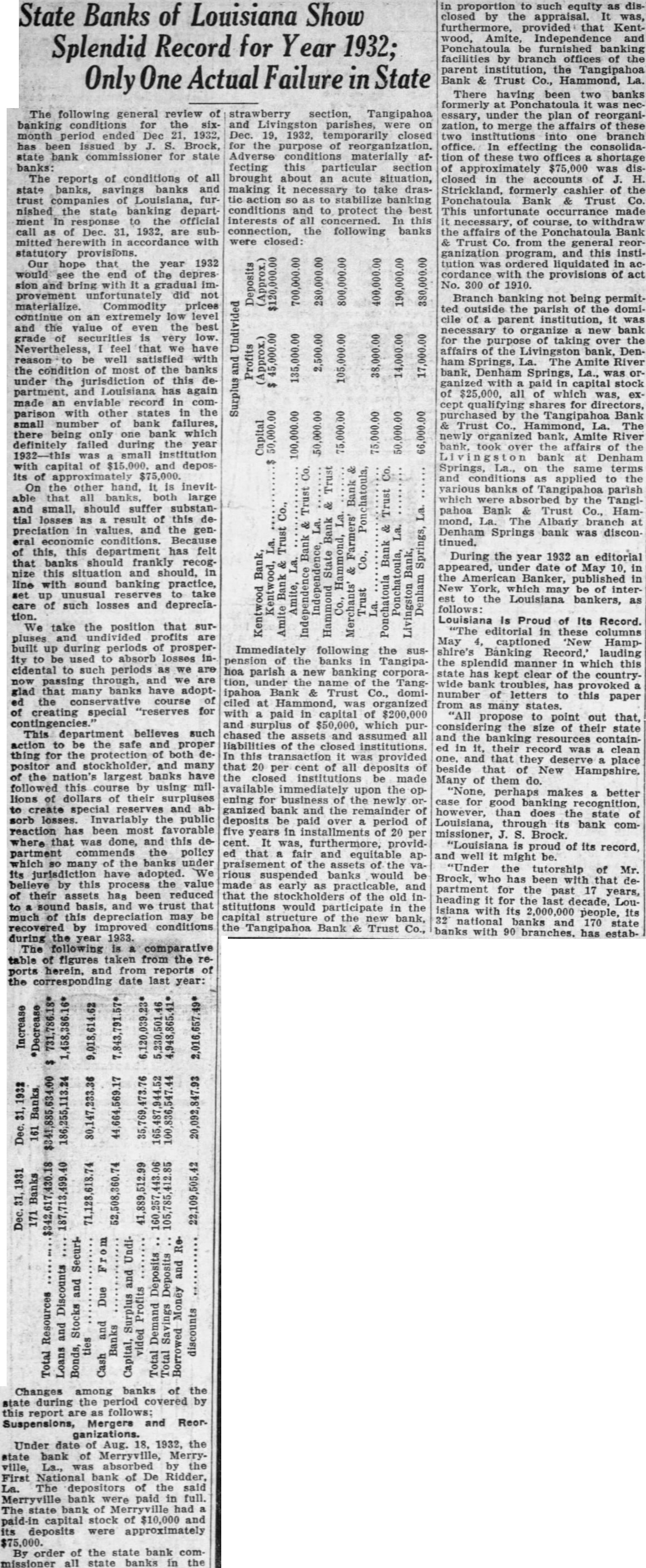
State Banks of Louisiana Show Splendid Record for Year 1932; Only One Actual Failure in State The following general review of banking conditions for the sixmonth period ended Dec 21, 1932, has been issued by J. S. Brock, state bank commissioner for state banks: The reports of conditions of all state banks, savings banks and trust companies of Louisiana, furnished the state banking department in response to the official call as of Dec. 31, 1932, are submitted herewith in accordance with statutory provisions. Our hope that the year 1932 would see the end of the depres sion and bring with it a gradual improvement unfortunately did not materialize. Commodity prices continue on an extremely low level and the value of even the best grade of securities is very low. Nevertheless, I feel that have reason be well satisfied with the condition of most of the banks under the jurisdiction of this department, and Louisiana has again made an enviable record in comparison with other states in the small number of bank failures, there being only one bank which definitely failed during the year 1932-this was small institution with capital of $15,000. and deposits of approximately $75,000. On the other hand, it is inevitable that banks, both large and small, should suffer substantial losses as a result of this depreciation in values. and the general economic conditions. Because of this, this department has felt that banks should frankly recognize this situation and should, in line with sound banking practice, set up unusual reserves to take care of such losses and depreciation. We take the position that surpluses and undivided profits are built up during periods of prosperity to be used to absorb losses incidental to such periods as we are now passing through, and we are glad that many banks have adopted the conservative course of of creating special "reserves for contingencies.' This department believes such action to be the safe and proper thing for the protection of both de. positor and stockholder and many of the nation's largest banks have followed this course by using millions of dollars of their surpluses to create special reserves and absorb losses. Invariably the public reaction has been most favorable where that was done, and this department commends the policy which many of the banks under its jurisdiction have adopted. We believe by this process the value of their assets has been reduced to sound basis, and we trust that much of this depreciation may be recovered by improved conditions during the year 1933. The following is comparative table of figures taken from the reports herein. and from reports of the corresponding date last year: Changes banks of the among state during the period covered by this report are as follows: Suspensions, Mergers and Reorganizations. Under date of Aug. 18, 1932, the state bank of Merryville, Merryville, La., was absorbed by the First National bank of De Ridder, La. The depositors of the said Merryville bank were paid in full. The state bank of Merryville had a paid- capital stock of $10,000 and its deposits were approximately $75,000. By order of the state bank commissioner all state banks in the strawberry section, Tangipahoa essary, under the plan of reorganiand Livingston parishes, were on zation, merge the affairs of these Dec. 19, 1932, temporarily closed two institutions into one branch for the purpose of reorganization. office. In effecting the consolidaAdverse conditions materially af- tion of these two offices a shortage fecting this particular section of approximately $75,000 was disbrought about an acute situation, closed in the accounts of J. H. making it necessary to take dras- Strickland, formerly cashier of the tic action SO as to stabilize banking Ponchatoula Bank & Trust Co. conditions and to protect the best This unfortunate occurrance made interests of all concerned. In this it necessary, of course, to withdraw connection, the following banks the affairs of the Ponchatoula Bank were closed: & Trust Co. from the general reor- Immediately following the suspension of the banks in Tangipahoa parish a new banking corporation, under the name of the Tangipahoa Bank & Trust Co., domiciled at Hammond, was organized with a paid in capital of $200,000 and surplus of $50,000. which purchased the assets and assumed all liabilities of the closed institutions. In this transaction it was provided that 20 per cent of all deposits of the closed institutions be made available immediately upon the opening for business of the newly organized bank and the remainder of deposits be paid over a period of five years in installments of 20 per cent. It was, furthermore, provided that a fair and equitable apof the assets of the various suspended banks would be made as early as practicable, and that the stockholders of the old institutions would participate in the capital structure of the new bank, the Tangipahoa Bank & Trust Co., in proportion to such equity as disclosed by the appraisal. It was, furthermore, provided that Kentwood, Amite, Independence and Ponchatoula be furnished banking facilities by branch offices of the parent institution, the Tangipahoa Bank & Trust Co., Hammond, La. There having been two banks formerly at Ponchatoula it was necganization program, and this institution was ordered liquidated in accordance with the provisions of act No. 300 of 1910. Branch banking not being permitted outside the parish of the domicile of a parent institution, it was necessary to organize a new bank for the purpose of taking over the affairs of the Livingston bank, Denham Springs, La. The Amite River bank, Denham Springs, La., was or ganized with a paid in capital stock of $25,000, all of which was, except qualifying shares for directors, purchased by the Tangipahoa Bank & Trust Co., Hammond, La. The newly organized bank, Amite River bank, took over the affairs of the bank at Denham Springs, La., on the same terms and conditions as applied to the various banks of Tangipahoa parish which were absorbed by the Tangipahoa Bank & Trust Co., Hammond, The Albany branch at Denham Springs bank was discontinued. During the year 1932 an editorial appeared, under date of May 10, in the American Banker, published in New York, which may be of interest to the Louisiana bankers, as follows: Louisiana Is Proud of Its Record. "The editorial in these columns May captioned 'New Hampshire's Banking Record.' lauding the splendid manner in which this state has kept clear of the countrywide bank troubles, has provoked a number of letters to this paper from as many states. "All propose to point out that, considering the size of their state and the banking resources contained in it, their record was a clean one, and that they deserve a place beside that of New Hampshire. Many of them do. "None, perhaps makes a better case for good banking recognition, however, than does the state of Louisiana, through its bank commissioner, J. S. Brock. "Louisiana is proud of its record, and well it might be. "Under the tutorship of Mr. Brock, who has been with that department for the past 17 years, heading it for the last decade, Louisiana with its 2,000,000 people, its 32 national banks and 170 state banks with 90 branches. has estab- Increase 1,458,386.16* 7,843,791.57* *Decrease 9,018,614.62 186,255,113.24 Dec. 71,128,618.74 52,508,360.74 41,889,512.99 187,713,499.40 160,257,443.06 171 Banks Bonds, Stocks and Securi- Cash and Due From Capital, Surplus and Undi- Borrowed Money and ReTotal Demand Deposits Total Savings Deposits Loans and Discounts vided Profits discounts Total Resources Banks ties (Approx.) 700,000.00 280,000.00 800,000.00 400,000.00 190,000.00 380,000.00 Deposits $120,000.00 2,500.00 45,000.00 38,000.00 14,000.00 17,000.00 Surplus and Undivided 135,000.00 105,000.00 Profits (Approx.) 50,000.00 50,000.00 75,000.00 75,000.00 50,000.00 66,000.00 100,000.00 Capital