Marine Bank (New York, NY)

Episode Information

Episode UID
6726817891013
Episode Type
Suspension โ†’ Closure
Bank Type
state
Bank ID
672681789 hash
Start Date
May 7, 1884
Location
New York, New York (40.714, -74.006)

Metadata

Model
gpt-5-mini (chosen from majority vote of a three-model LLM ensemble)
Short Digest
393d277cfb0f30a2

Response Measures

None

Description

Failure tied to heavy dealings with Grant & Ward and large uncertified/overdrawn items; receiver actions follow suspension.

Events (2)

1. May 7, 1884 Suspension
Cause
Bank Specific Adverse Info
Cause Details
Large overexposure and certified checks for the firm Grant & Ward (overdrawn $500,000+); sudden large city withdrawal depleted cash reserves leading to suspension.
Newspaper Excerpt
The bank was designated as a depository for the City of New York...Yesterday the city drew a draft for $300,000...precipitate the failure. . .the Marine bank failure
Source
newspapers
2. May 8, 1884 Receivership
Newspaper Excerpt
A bank examiner is in charge of the suspended bank, and probably the Washington authorities will appoint a receiver at once. ... Manager Camp of the clearing-house states there are no new developments in the Marine bank failure. ...the president and directors of the Marine bank are in secret session, and it is stated that it is more than probable the bank will come out all right, depositors being paid in full.
Source
newspapers

Newspaper Articles (25)

Article from The Democratic Leader, May 7, 1884

Click image to open full size in new tab

Article Text

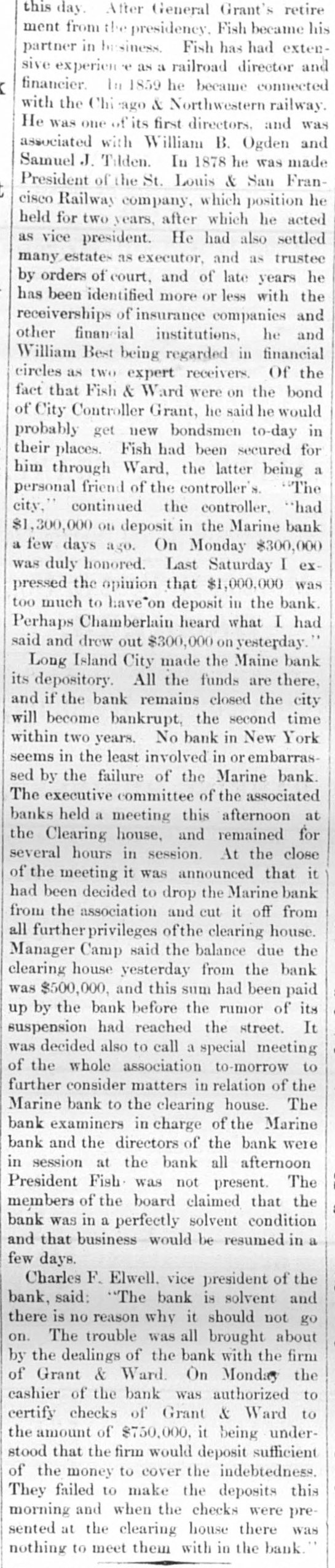
this day. After General Grant's retire ment from the presidency. Fish became his partner in business. Fish has had extensive experien e as a railroad director and financier. In 1859 he became connected with the Chi ago & Northwestern railway. He was one of its first directors, and was associated with William B. Ogden and Samuel J. Tilden. In 1878 he was made President of the St. Louis & San Francisco Railway company, which position he held for two years, after which he acted as vice president. He had also settled many estates as executor, and as trustee by orders of court, and of late years he has been identified more or less with the receiverships of insurance companies and other financial institutions, he and William Best being regarded in financial circles as two expert receivers. Of the fact that Fish & Ward were on the bond of City Controller Grant, he said he would probably get new bondsmen to-day in their places. Fish had been secured for him through Ward, the latter being a personal friend of the controller's. "The city," continued the controller, "had $1,300,000 on deposit in the Marine bank a few days ago. On Monday $300,000 was duly honored. Last Saturday I expressed the opinion that $1,000,000 was too much to have"on deposit in the bank. Perhaps Chamberlain heard what I had said and drow out $300,000 on yesterday.' Long Island City made the Maine bank its depository. All the funds are there, and if the bank remains closed the city will become bankrupt, the second time within two years. No bank in New York seems in the least involved in or embarrassed by the failure of the Marine bank. The executive committee of the associated banks held a meeting this afternoon at the Clearing house, and remained for several hours in session. At the close of the meeting it was announced that it had been decided to drop the Marine bank from the association and cut it off from all further privileges of the clearing house. Manager Camp said the balance due the clearing house yesterday from the bank was $500,000, and this sum had been paid up by the bank before the rumor of its suspension had reached the street. It was decided also to call a special meeting of the whole association to-morrow to further consider matters in relation of the Marine bank to the clearing house. The bank examiners in charge of the Marine bank and the directors of the bank were in session at the bank all afternoon President Fish was not present. The members of the board claimed that the bank was in a perfectly solvent condition and that business would be resumed in a few days. Charles F. Elwell. vice president of the bank, said: "The bank is solvent and there is no reason why it should not go on. The trouble was all brought about by the dealings of the bank with the firm of Grant & Ward. On Monday the cashier of the bank was authorized to certify checks of Grant & Ward to the amount of $750,000, it being understood that the firm would deposit sufficient of the money to cover the indebtedness. They failed to make the deposits this morning and when the checks were presented at the clearing house there was nothing to meet them with in the bank.
Article from New-York Tribune, May 7, 1884

Click image to open full size in new tab

Article Text

by the news of the suspension. He said: "I had no idea whatever that the bank was in financial trouble. I have been very sick for the last three months and was only able to leave my house two weeks ago. I have never known much of the bank's financial affairs. I have never been one of the examining committee. I have attended the meetings of the Board and heard the reports of its condition from time to time. At the last meeting I attended we decided to purchase the property next to the bank in Wall-st. I am not a financier. I was thunder-struck when told of the bank's suspension. I was offered 165 for my stock less than a week ago. On Monday I deposited $20,000 in the bank. I cannot comprehend why the bank should have failed." "I think Mr. Fish got nervous and did not know what to do and so ordered the bank shut," said C. Sierck. of the firm of Moller, Sierck & Co., at No. 90 Wall-st.. and a director of the Marine Bank. "Grant & Ward have overdrawn their account by over $500,000, and I don't know what arrangement will be made about it. The bank will resume in a few days and go on as usual. It is as strong as ever 80 far as I am aware."


Article from Fort Worth Daily Gazette, May 8, 1884

Click image to open full size in new tab

Article Text

A bank examiner is in charge of the suspended bank, and probably the Washington authorities will appoint a receiver at once. The Marine bank was designated as a depository for the City of New York. Yesterday the city drew a draft for $300,000, which was part of the debit balance in the clearing-house this morning, and this did much to precipitate the failure. LATER. NEW YORK, May 7.-Manager Camp of theclearing-house states there are no new developments in the Marine bank failure, but the situation is not nearly so bad as at first supposed. It is now stated on excellent authority that President Fish exhibited undue haste in closing the doors of the bank, and the directors would not have consented to his action had they been made aware of the exact status of affairs. The same is said to be true of the Grant & Ward failure, which it is claimed was brought about by Ward remaining away from business, and practically losing his head. NEW YORK, May 7.-The president and directors of the Marine bank are in secret session, and it is stated that it is more than probable the bank will come out all right, depositors being paid in full.


Article from Daily Los Angeles Herald, May 9, 1884

Click image to open full size in new tab

Article Text

NEW YORK, May 8.-The Marine Bank Directors have adjourned. No statement is likely to be made to-day. Director Siesck says no receiver was appointed and the chances of resumption are good. Fish did not ask to resign, but in case of a reorganization there will be a new president and cashier.


Article from The Daily Cairo Bulletin, May 10, 1884

Click image to open full size in new tab

Article Text

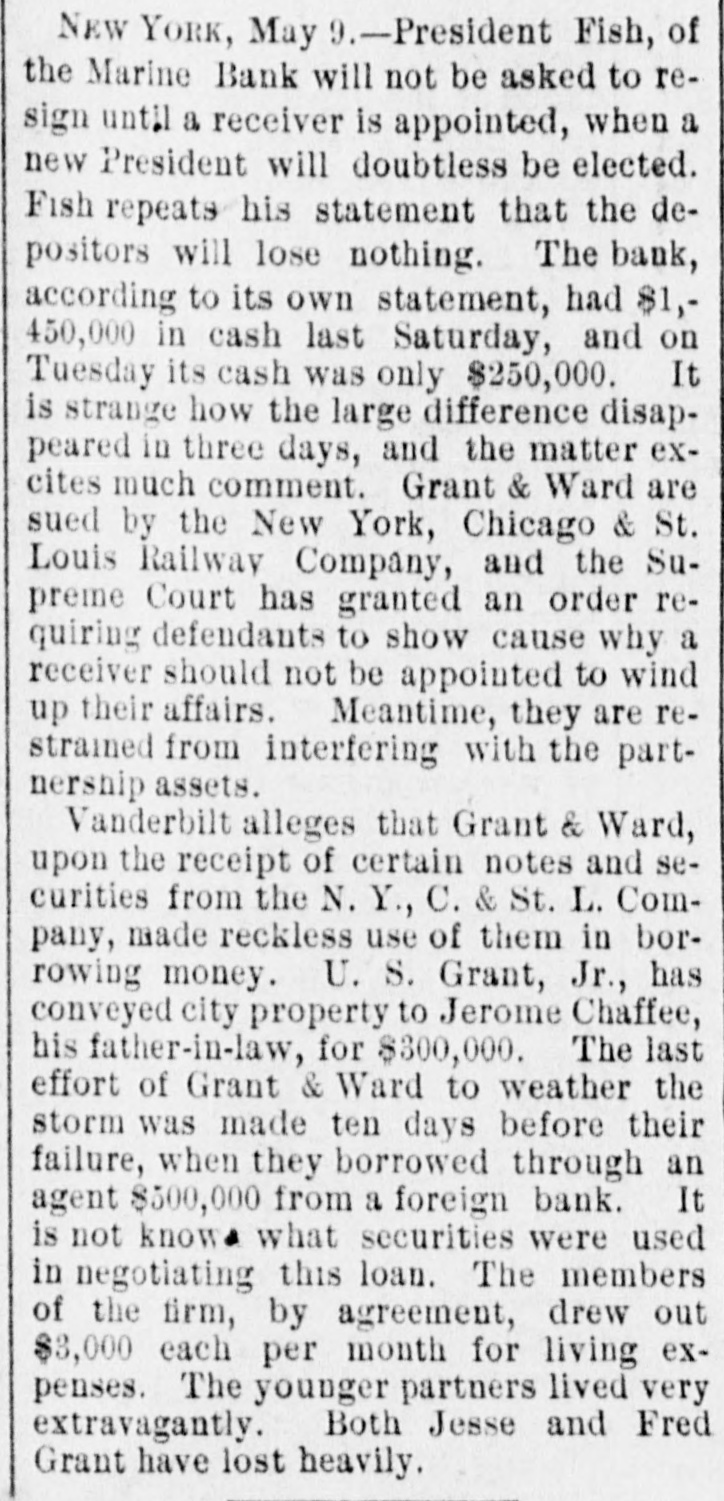
NEW York, May 9.-President Fish, of the Marine Bank will not be asked to resign until a receiver is appointed, when a new President will doubtless be elected. Fish repeats his statement that the depositors will lose nothing. The bank, according to its own statement, had $1,450,000 in cash last Saturday, and on Tuesday its cash was only $250,000. It is strange how the large difference disappeared in three days, and the matter excites much comment. Grant & Ward are sued by the New York, Chicago & St. Louis Railway Company, and the Supreme Court has granted an order requiring defendants to show cause why a receiver should not be appointed to wind up their affairs. Meantime, they are restrained from interfering with the partnership assets. Vanderbilt alleges that Grant & Ward, upon the receipt of certain notes and securities from the N. Y., C. & St. L. Company, made reckless use of them in borrowing money. U. S. Grant, Jr., has conveyed city property to Jerome Chaffee, his father-in-law, for $300,000. The last effort of Grant & Ward to weather the storm was made ten days before their failure, when they borrowed through an agent $500,000 from a foreign bank. It is not know. what securities were used in negotiating this loan. The members of the firm, by agreement, drew out $3,000 each per month for living expenses. The younger partners lived very extravagantly. Both Jesse and Fred Grant have lost heavily.


Article from Arizona Weekly Citizen, May 10, 1884

Click image to open full size in new tab

Article Text

The Marine Bank, NEW York, May 8.-The Marine Bank directors have adjourned. No statement is likely to be made to-day. Director Sieack says no receiver has been appointed and the chances of resumption are good. Fish has been asked to resign. but in case of reorganization there will be a new president and a new cashier.


Article from Morning Journal and Courier, May 13, 1884

Click image to open full size in new tab

Article Text

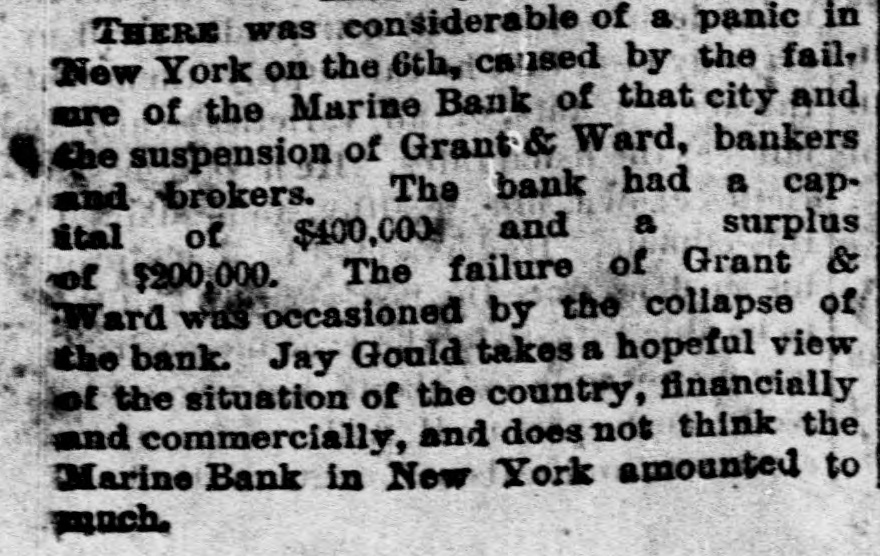
Views of an Experi-Jay Gould Talks About The Situation. NEW YORK, May 12.-Mr. Jay Gould in an interview with a United Press reporter today said that he saw no cause for alarm in the failure of the Marine bank and Grant & Ward. The failure of those concerns could not be attributed to stock speculation and he pointed to the fact that the losses to all members of the exchange on account of the failures were less than $5,000 as the best evidence of the truth of his assertion. "This faet," said he, "appears to be entirely overlooked." Mr. Gould did not anticipate any further suspensions. Speaking of the stock market Mr. Gould was of the opinion that many stocks were very much below their value and that prices must soon take an upward turn. When asked what effect the election would have on business he said that he did not think it would affect stocks and that the selection of any particular candidate would not matter much. He thought the action of the Democratic party showed that they were much divided on the question of protection and that this issue would cause a split. This he viewed as an assurance to the country against any violent changes in the tariff for some time to come. Both parties must, he said, nominate good men, and if this was done it mattered little who was elected. In conclusion Mr. Gould stated that he saw nothing in the business or political situation that should give any pause for alarm. He thought the condition of aff irs generally satisfactory.


Article from The Indianapolis Journal, May 13, 1884

Click image to open full size in new tab

Article Text

THE LATE HEAVY FAILURES. Belief that Grant & Ward's Liabilities Are Not So Great as Reported. Ward Makes an Assignment-Expectation that the Marine Bank Will Pay Depositors-The Suspension of Senator Sabin. THE NEW YORK FAILURES. Belief that the Reported Liabilities of Grant & Ward Have Been Exaggerated. NEW YORK, May 12.-At the office of Grant & Ward receiver Davies is investigating the books but refused to say anything. Mr. Smith says the report that the liabilities are $10,000,000 is exaggerated; he knew of no combination of creditors bringing suit against the firm. Ward was in consultation with counsel. Two detectives continue to shadow him. Examiner Scriba will have his report on the Marine Bank ready in two days. Director Ellwell said to a reporter: "The synopsis of the rough report of Mr. Scriba is founded on guesswork, and is not accurate. It is reported that we have no funds in the bank. We have $400,000 cash, and also $500,000 in real estate, making $900,000 not shown in this state ment. I think depositors will be paid in full." The examiner of the Marine Bank, in a letter to the Comptroller of the Currency, expresses the opinion that depositors will receive from 75 to 80 per cent., and that in case the estates of Fish and Grant & Ward are properly managed, depositors may be paid in full.


Article from Mower County Transcript, May 14, 1884

Click image to open full size in new tab

Article Text

# THE STILLWATER FAILURE. It was with feelings of great surprise that the public learned of the failure of the "Northwestern Car and Manufacturing Company," at Stillwater, May 10th. of which Senator Dwight M. Sabin is President, and one of the largest stockholders to the amount of $750,000. While the liabilities are placed at $1,000,000, the assets are figured at nearly $5,000,000. The explanation offered for this embarrassment is the loss sustained by the recent fires, $300,000, general depression of business, and the low price of wheat in the market, which made collections from farmers indebted to the company in accounts and bills receivable to the amount of $2,000,000, slow. Foreseeing the coming crisis, the Company had partially made arrangements in New York and other cities in the east by which it hoped it could tide over until the fall collections, but the failure of the Marine Bank of New York and others defeated these plans. The Company affairs were then placed in the hands of a receiver. It is thought business will be resumed in a few weeks. Among the preferred stockholders is the name of Hon. Wm. Windom for $25,000.


Article from The Abilene Reflector, May 15, 1884

Click image to open full size in new tab

Article Text

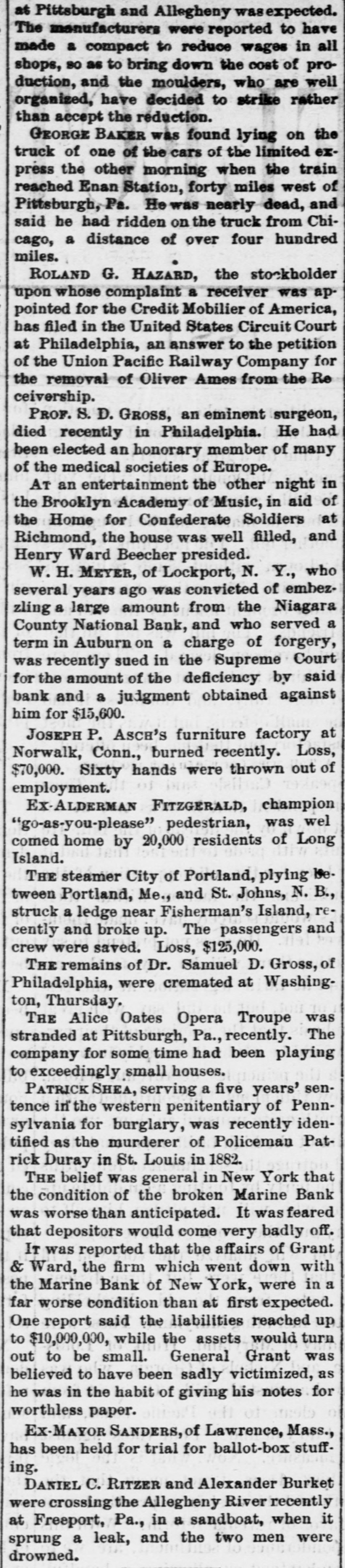
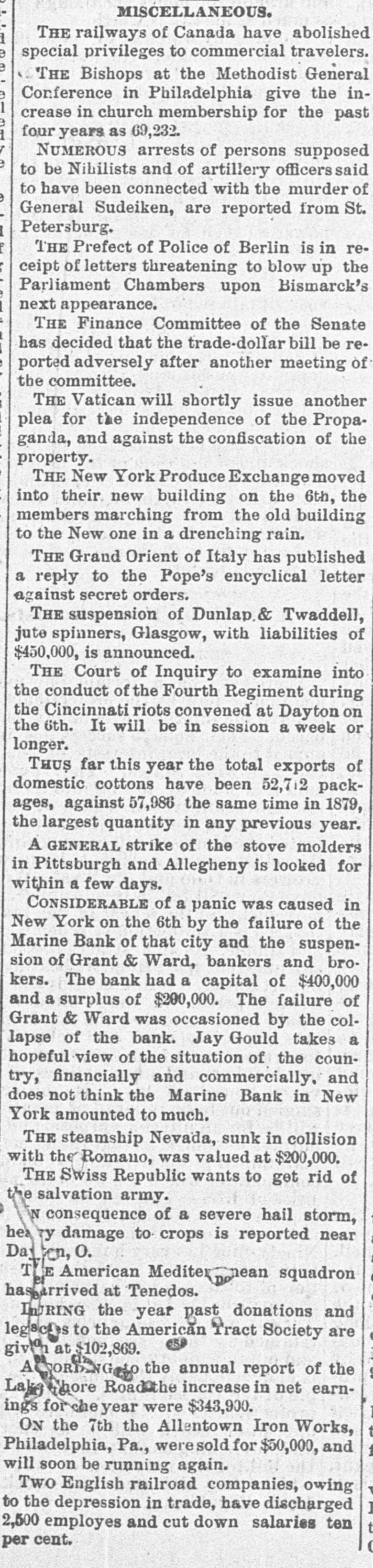
at Pittsburgh and Allegheny was expected. The manufacturers were reported to have made a compact to reduce wages in all shops, so as to bring down the cost of production, and the moulders, who are well organized, have decided to strike rather than accept the reduction. GEORGE BAKER was found lying on the truck of one of the cars of the limited express the other morning when the train reached Enan Station, forty miles west of Pittsburgh, Pa. He was nearly dead, and said he had ridden on the truck from Chicago, a distance of over four hundred miles. ROLAND G. HAZARD, the stockholder upon whose complaint a receiver was appointed for the Credit Mobilier of America, has filed in the United States Circuit Court at Philadelphia, an answer to the petition of the Union Pacific Railway Company for the removal of Oliver Ames from the Re ceivership. PROF. S. D. GROSS, an eminent surgeon, died recently in Philadelphia. He had been elected an honorary member of many of the medical societies of Europe. AT an entertainment the other night in the Brooklyn Academy of Music, in aid of the Home for Confederate Soldiers at Richmond, the house was well filled, and Henry Ward Beecher presided. W. H. MEYER, of Lockport, N. Y., who several years ago was convicted of embezzling a large amount from the Niagara County National Bank, and who served a term in Auburn on a charge of forgery, was recently sued in the Supreme Court for the amount of the deficiency by said bank and a judgment obtained against him for $15,600. JOSEPH P. ASCH'S furniture factory at Norwalk, Conn., burned recently. Loss, $70,000. Sixty hands were thrown out of employment. Ex-ALDERMAN FITZGERALD, champion "go-as-you-please" pedestrian, was wel comed home by 20,000 residents of Long Island. THE steamer City of Portland, plying be. tween Portland, Me., and St. Johns, N. B., struck a ledge near Fisherman's Island, recently and broke up. The passengers and crew were saved. Loss, $125,000. THE remains of Dr. Samuel D. Gross, of Philadelphia, were cremated at Washington, Thursday. THE Alice Oates Opera Troupe was stranded at Pittsburgh, Pa., recently. The company for some time had been playing to exceedingly small houses. PATRICK SHEA, serving a five years' sentence in the western penitentiary of Pennsylvania for burglary, was recently identified as the murderer of Policeman Patrick Duray in St. Louis in 1882. THE belief was general in New York that the condition of the broken Marine Bank was worse than anticipated. It was feared that depositors would come very badly off. Ir was reported that the affairs of Grant & Ward, the firm which went down with the Marine Bank of New York, were in a far worse condition than at first expected. One report said the liabilities reached up to $10,000,000, while the assets would turn out to be small. General Grant was believed to have been sadly victimized, as he was in the habit of giving his notes for worthless paper. Ex-MAYOR SANDERS, of Lawrence, Mass., has been held for trial for ballot-box stuffing. DANIEL C. RITZER and Alexander Burket were crossing the Allegheny River recently at Freeport, Pa., in a sandboat, when it sprung a leak, and the two men were drowned.


Article from The Indianapolis Journal, May 16, 1884

Click image to open full size in new tab

Article Text

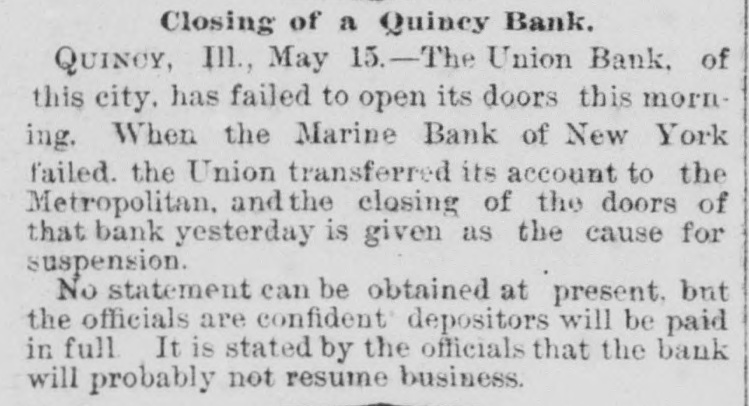
Closing of a Quincy Bank. QUINCY, III., May 15.-The Union Bank, of this city. has failed to open its doors this morning. When the Marine Bank of New York failed. the Union transferred its account to the Metropolitan. and the closing of the doors of that bank yesterday is given as the cause for suspension. No statement can be obtained at present. but the officials are confident depositors will be paid in full It is stated by the officials that the bank will probably not resume business.


Article from New-York Tribune, May 20, 1884

Click image to open full size in new tab

Article Text

MR. MORGAN'S VIEWS OF STOCK GAMBLING-MR. SHERMAN ON THE "PANIC." WASHINGTON, May 19.-When the Chair laid before the Senate, to-day, the resolution offered on Thursday by Mr. Morgan, directing the Committee on Finance to examine the causes of the recent failures of National banks, and whether such failures are due to violations and evasions of law on the part of the officers or directors of the banks, Mr. Morrill moved to amend by substituting for the purposes of the investigation the Controller of the Currency for the Finance Committee. Mr. Morgan said that the very reason why he had moved to devolve the duty on a committee was because the officers who had been appointed to see that the banks complied with the law bad not performed their duty. There was for instance, a law against over-certification of checks which it bad become notorious was utterly disregarded. On the occasion of the passage of the law on the subject in July, 1882, the New-York newspapers had broken out into spasms of merriment and told Congress that the banks laughed at Acts of Congress and were beyond Congressional control. The failure of the Marine Bank had been due to the fact that the bank was connected with a firm of brokers. That bank had supported the firm of Grant & Ward in all the wild schemes in which a young speculator saw proper to engage. A spectacle had been presented to the world that argued a painful condition of commercial honor in the city of New-York. There had been a time when the honor of New-York merchants was a standard for the world and was the syno ym for probity. What has It now become? It has become a by-word, a reproach and a cause of suspicion. It had only to be said of a man that'he was engaged in speeulative transactions in New-York to carry against him the impression that he was a robber and a gamblera man of no honesty or commercial integrity. Mr. Morgan said he did not himself make such accusations; he spoke of It with painful feelings, but he believed that what he had said represented the sentiment of the country. Mr. Morrill modified his motion by moving a reference of the resolution to the Finance Committee. MR. SHERMAN'S OPINIONS. Mr. Sherman supported the reference. The Senate ought. he said, to be most careful in a question of this kind. He had been In New-York on the day when the trouble referred to occurred, and he could assure the Senate that although there might here and there have been an over-certification of checks. yet that had not been the trouble at all. In every case the trouble had been caused by speculative operations of the officers of the banks affected, and in some cases not by certifying checks, but rather by non-certitication. The proper remedy would be to prescribe severe penalties against any dealing in speculative transactions by officers of banks, or the using of the money of the bank in any transactions that such officers might engage m. Mr. Sherman saw no special use in a committee investigation in NewYork. We had Government officers there who could give us all needed information. If a committee were to go there to make a commotion and keep up an agitation in regard to the failures, it might embarrass others. To call the recent trouble a "panie" was applying to it a misnomer. There had been no panic; the people of Now-York had not been alarmed. The securities specially affected had been those involved in the transactions exposed by the failures, but confidence in the standard securities of the country had not suffered. It was like the case of a storm contined to the locality of New-York City, and not extending over any other part of the country. It had resulted in a clearing of the atmosphere, and Mr. Sherman believed the present commercial position to be better than It had been before the recent troable. Mr. Morgan said the fears of the Senator from Ohio were groundless, if he supposes that any injury could come to the proper business of the country by the investigation proposed. The business of the country did not mean the operations of stock gamblers. Mr. Morgan critielsed the action of the Secretary of the Treasury for his interference in the late troubles, and the officers of the Government generally for not seeing that the banking laws were enforced. We might as well, he said, farm out the credit of the United States to the faro dealera on Peunsvlvania-ave. as to allow the National


Article from Western Sentinel, May 22, 1884

Click image to open full size in new tab

Article Text

JIM KEENE'S KERFLUMUX. FAILED FOR THE TRIFLING SUM OF A MILLION OR TWO. Excitement Caused by the Grant & Ward Failure. Reported that they will Pay a Hundred Cents on the Dollar. Special Correspondence of the Sentinel. NEW YORK, May 16.-James R. Keene has failed for a million or two and he will be sent to the rear and forgotten in a few days by the fellowgamblers who beat him at his own A failure in any game. less legitimate business is always more or a public calamity, but the Keene failure is simply one gambler plundered to nakedness by more successful gamblers, and the legitimate channels of industry, trade and commerce are not in any degree affected by it. Mr. Keene acquired a fortune of several millions by lucky ventures on the Pacific coast, and he made the common mistake of supposing that three or five millions could beat fifty or a hundred millions. He came to New York in state in a palace car, and Gould's reputed prophecy that Keene would be sent back in a freight car, now promises to be fulfilled. Keene had conquered in California; he staked all to conquer Wall Street, and he has lost. That is the whole story. The excitement caused by the fail. ures of the Marine Bank and the firm of Grant & Ward, subsided yesterday and the street breathed easier. Men who went home the day before perturbed and fearful came down town with lighter hearts and with more con fidence. As the day progressed and no other banks or firms suspended, and as it became known that the failure of the bank was not so disastrous as at first reported, a buoyant feeling prevailed. On all sides it was said that there was no cause for alarm. The announcement by Clubing-House Manager Camp that other New York t banks were not affected by the failure a and were in a sound condition, the freh quently repeated assertions of the dif rectors that the Marine Bank would I pay 100 cents on the dollar, the return of Mr. Ward to the city and the fact t that the failure of Grant & Ward was e not due 80 much to the financial condition of the company as to peculiar and extravagant methods of doing business all tended to allay the excitement. s The irony of fate can receive no 1, sadder illustration than the sight of a y sister-in-law of John C. Calhoun, the i. great statesman, and a cousin of the s, rich Van Reneselaers, wandering p homeless and penniless, through the streets of New York. The policeman who on a recent afternoon saw an old and feeble lady, whose face was wan d with hunger, and clothes were wet e with the pouring rain, tottering along Greenwitch Street, did not sus;; pect that she was SO closely related to d the distinguished South Carolinian and 1to the family of the old Albany patroon. He watched her until she fell ex hausted to the pavement, when h n hastened to her assistance. When h g asked her where she lived she burs ys into tears and answered that she di is not know. Several times she shook by her head, the hair of which was per r. fectly white, as she tried in vain to re call her last place of residence. Th policeman, suspecting that her min was affected, took her to the Twenty on seventh Precinct Station. At nigh Ice she was taken to Police Headquarter or and remained there all day yesterda in the charge of Matron Webb. ty TARHEEL o-


Article from Wessington Springs Herald, May 30, 1884

Click image to open full size in new tab

Article Text

GRANT & WARD FAILURE, Estimated at Nearly $10,000,Grant and Sons Make PerAssignments for the Benefit of YORK, May 9.-Interest in the failof the Marine Bank and of the firm of & Ward was renewed yesterday by announcement that General Grant, James D. Fish, Grant & Ward, the firm members individually, Colonel lerick Grant and Jesse Grant had made gnments, thereby indicating that the have swept away the fortunes of member of the family of General All that the latter possessed outside he income from the Grant fund was he firm which has been wrecked by of Ferdinand Ward. That ColoGrant and Jesse Grant should have been to make assignments of their propoccasioned general surprise, as they not partners in the firm, and were supto be in excellent circumstances fortune being estimated at $400,000. understood that when the General have had his affairs disentangled from of the firm. substantial assistance will endered to him. W. H. Vatiderbilt does that he loaned General Grant a few days ago which went into broken firm. & Ward, in their assignment, gave erences to eleven persons, but no are affixed. Frederick D. Grant preferences for $243,666, including to Mrs. B. L. Honore, of Chicago, $6,000 to his wife. Henry F. Shoeof this city, is preferred for $125,Jesse Grant gives preferences for President Fish followed with his gnment, omitting amounts. far as Grant & Ward are concerned, best opinions agree that they are beyond all hope of recovery. GenGrant was at the office yesterday afterand Roscoe Conkling joined him imiately, and will act as legal adviser to General in this trouble. W. K. Vanderis haunting the firm with legal proin behalf of the Chicago & St. Louis way Company. In his affidavit Vansays that about April 12, 1884, the Chi& St. Louis Railway Company made its nissory note, bearing date on that day, for value received, it promised to to Grant & Ward the sum of $500,000. note will become due January 1, 1885. 23 the railroad company made anothromissory note dated on that day, payto the order of Grant & Ward, for which note will become January 1, 1885. As collateral for the payment of these notes plaintiff deposited with the firm of & Ward 1,400 negotiable bonds of railway company for $1,000 each, the of which was secured by a second tgage upon its railroad. Vanderbilt declares that Grant & Ward rehyrecated these securities for the purpose procuring loans. The assignees will dethe suit, and Mr. Vanderbilt may not back his securities for months, if at all. were few important developments he affairs of the Marine Bank. United Examiner Scheniba continued his intigation, but reported that owing to coninterruption and new developments statement would be delayed. The Comof Investigation appointed by the were at work all day straightening affairs. Strenuous efforts are making the resumption of the bank. These however, are not entertained and some who are pecuniarily interin the deposits said that they feared there had been unpleasant facts discovThe directors,, so ready to speak bewere strangely reticent this afternoon. assignment of Mr. Fish making a pretto the bank is regarded by some as a picious circumstance, inasmuch as if Mr. relations with the bank had been why should he be in debt to it to amount making an assignment neces The belief that the affairs of the are not in as good condition as was ected is strengthened by the fact that the bank should have had in its vaults eserve of $1,300,000 against its deposits $5,200,000, yet its suspension was caused inability to meet the clearing-house


Article from National Republican, June 2, 1884

Click image to open full size in new tab

Article Text

MR. JAMES D. FISH, in explanation of certain entries in the books of the broken Marine bank, testified before Referee Cole that he was in the habit of selling the notes of the firm of Grant & Ward at 30 per cent. per annum discount. Singularly enough he could find purchasers who were willing to buy paper which the indorser esteemed so lightly. Mr. A. B. Graves, president of the St. Nicholas bank, was one of the purchasers of these notes, and lost $20,000 by his investment. It would seem that a money panic is needed in New York occasionally to clear up the financial atmosphere and weed out the frauds. A bank president who indorses notes and sells them at 30 per cent. discount, can hardly be rated as honest, and certainly the bank president who buys them is not fit to take care of other people's money. Mr. Graves says, however, it was his own and


Article from The Dallas Daily Herald, June 12, 1884

Click image to open full size in new tab

Article Text

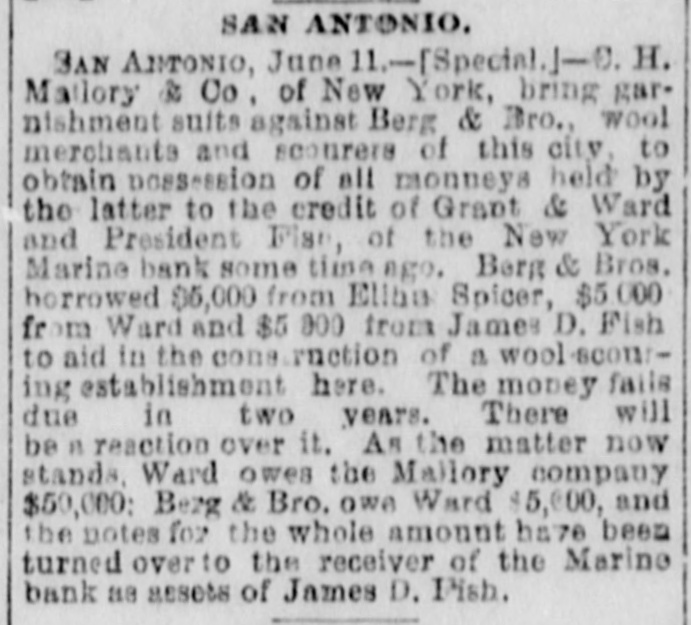
# SAN ANTONIO. SAN ANTONIO, June 11.-[Special.]-C. H. Mallory & Co, of New York, bring garnishment suits against Berg & Bro., wool merchants and scourers of this city, to obtain possession of all rmonneys held by the latter to the credit of Grant & Ward and President Fise, of the New York Marine bank some time ago. Berg & Bros. borrowed $5,000 from Elihu Spicer, $5.000 from Ward and $5 000 from James D. Fish to aid in the construction of a wool-scouring establishment here. The money fails due in two years. There will be a reaction over it. As the matter now stands, Ward owes the Mallory company $50,000: Berg & Bro, owe Ward $5,000, and the notes for the whole amount have been turned over to the receiver of the Marine bank as assets of James D. Pish.


Article from Daily Kennebec Journal, March 18, 1885

Click image to open full size in new tab

Article Text

TRIAL OF JAMES D. FISH, Ex-President of the Suspended Marine Bank, for Embezzlement. NEW YORK, March 17. The trial of James D. Fish, ex-president of the suspended Marine Bank. was continued today. Assistant Cashier Daboll testified that on March 15, 1884, the sum of $8000 was paid in on account of loans made to Grant and Ward "There was a white canvass bag in the vaults of the bank," said the witness, "and one dav Ward e me to me, and pointing to the bag, said, 'would you take it?' I don't kno about that, Ireplied. You don't, said Ward. Then I will see about it. Ward afterward sent for the bag and it was taken away The witness never intentionally made false entries in the books of the bank. Witness further said that the condition of the bank was investigated by Bank Examiner Meigs, in August and September. 1883. Preparations were made for the visit of the bank examiner. and the witness had conversation with Fish, in which the latter told him that Ward would put securities with certain contract loans and thus protect them. Ward did bring a lot of securities and they remained there until after the examination, when Ward took some of the securities away and left others. One of the loans for $40,000 was made to Walter H. Maltroy, and there were two others amounting to $30,000, made to the firm of Grant & Ward. The securities were brought to the bank late in the afternoon. after business hours, and were slipped into an envelope, where they were found the next day by the bank examiner.


Article from Daily Kennebec Journal, May 7, 1885

Click image to open full size in new tab

Article Text

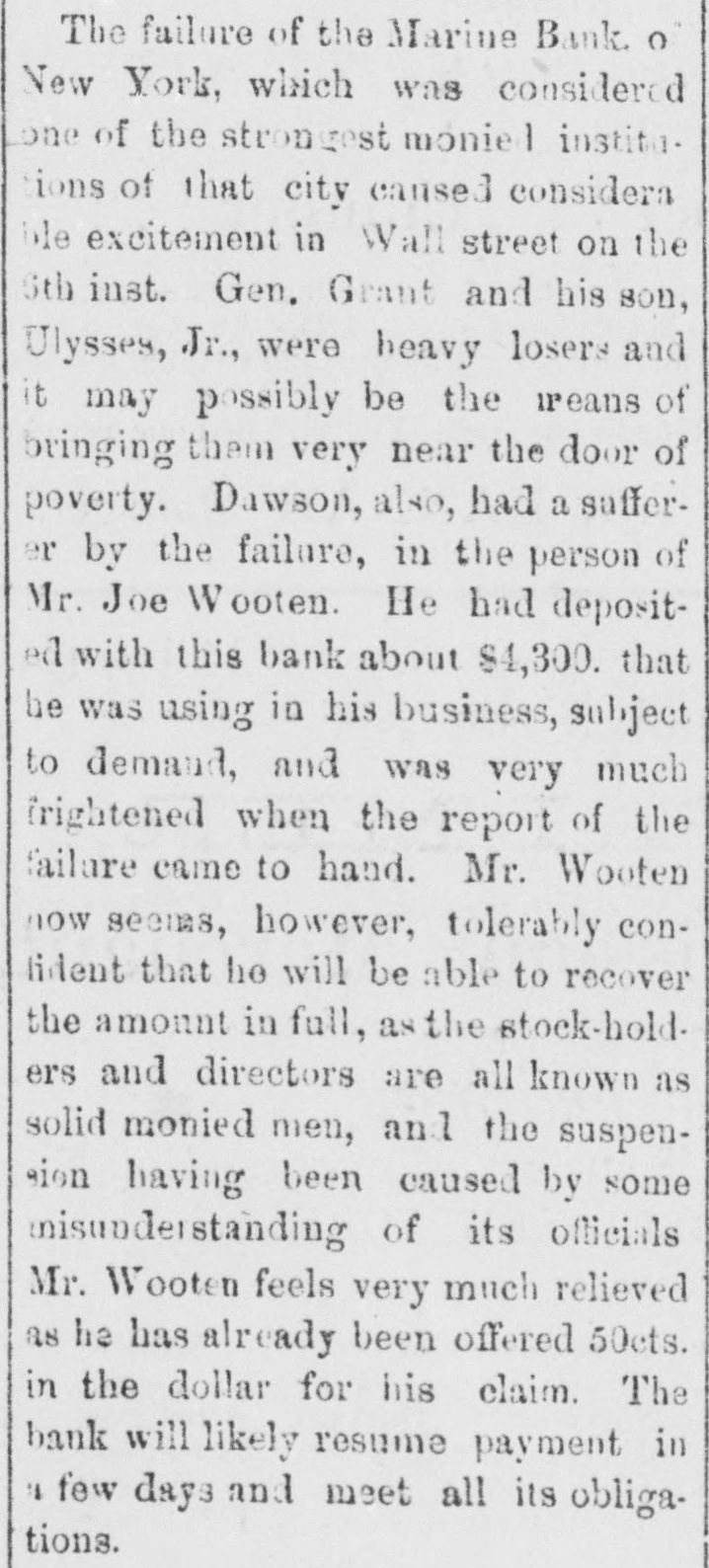
# General News. Two cremations took place at Lancaster, Pa., Tuesday. Now it is proposed to continue the New Orleans Exposition next winter. English manufacturers now turn out 20,000 incandescent lamps per week. Americans projected, built, and now control the street railroads of Moscow, Russia. A Sumpter County, Ga., farmer has a horse that takes its fodder to the water trough and wets it before eating it. The highest mountain in the world is Mt. Kunchainyunga, one of the Himalayas, which is 28,178 feet or 5 5/8 miles in height. A ten years' old New York boy broke into a real estate office in that city, pried open a desk, and stole $25. A large number of employes were discharged from the Portsmouth, N. H.. navy yard, Saturday. Work in all departments is suspended. The Washington correspondent of the Medical Journal says that we may look for cholera, if at all, through Spanish channels, and our outpost of observation should be Havana. Last Autumn the loggers of the Northwest adopted a rule pledging a reduction in the log supply. The result shows a decrease of 873,938,000 feet, the figure for 1884 standing 3,238,000,000 against 2,364,562,000 for 1885. "Paddy" Ryan applied Tuesday, for a license to sell liquor in New York city, but was refused, on account of his having previously violated the laws of his country in arranging several prize fights. The total distance run by the cars on the Brighton (England) Electric Railway during the first six months of its existence was 15,600 miles. Two hundred thousand passengers were carried, at an expense of about five cents per mile. A few days ago a gentleman left Kingston, Ont., in the morning, and arrived at Boston in the evening. When he left Kingston, the ice in the Bay of Quinte was frozen over solidly for fifty miles. But as soon as he reached Vermont he experienced a temperature of 90ยฐ, and began to think he was in the tropics. There is a family living in Harlem whose fortune was swept away in the downfall of the Marine Bank. The family's horses and carriages were sold and all the servants dismissed. One of the daughters, 17 years old, is now earning $4 a week, doing plain sewing for a dressmaker. Ward and Fish pay $15 a week for good board at a special table in Ludlow Street Jail.-N. Y Tribune.


Article from Savannah Morning News, June 13, 1885

Click image to open full size in new tab

Article Text

GRANT AND WARD. The Cashier of the Late Firm Tells How Business Was Conducted. NEW YORK, June 12.-Testimony was taken before Referee Hamilton Cole to. day in another suit growing out of the Grant & Ward failure. John H. Morris, receiver of the Marine Bank, charges that James D. Fish conveyed to six relatives on Dec. 21, 1883, property that should go to the creditors of the bank. 8. E. Spencer, cashier for Grant & Ward, testified that the firm's capital was $400,000. Of the cash contributed U. S. Grant put in $92,000; U. 8. Grant, Jr., $30,000, and Ferdinand Ward $30,000. Fish contributed no cash. The balance of the $400,000 was made up of "flour," notes, bonds and stock by all the members of the firm. Spence said that the loans on securities ofteu ran as high as $1,000,000. It was frequently the case that the firm paid more for the use of money than it received on its loans. The witnesssaid Fish sometimes drew on his private account to pay fictitious earnings to depositors. He stated that Grant & Ward did a losing business after Feb. 28, 1882.


Article from The Louisiana Democrat, June 27, 1885

Click image to open full size in new tab

Article Text

-THE receiver of the New York Marine Bank thinks that Ferdinand Ward has hidden away about $1,000,000.


Article from Evening Star, October 22, 1885

Click image to open full size in new tab

Article Text

# Mr. Warner Arraigned. CHARGED BEFORE A U.S. COMMISSIONER WITH ACTING IN COLLUSION WITH WARD. NEW YORK, October 22.-Wm. S. Warner appeared before a U. S. commissioner to-day to answer a charge of acting in collusion with Ferdinand Ward to defraud the Marine bank. Warner was represented by a large array of counsel, while Assistant District Attor- neys Foster and Tifft represented the govern- ment. Receiver Johnston, of the Marine Bank, was the first witness, The minute book of the directors' meeting showed that on January 11, 1884, Ward was elected a director of the bank. The book was admitted in evidence.


Article from Weekly Commercial Herald, October 23, 1885

Click image to open full size in new tab

Article Text

Relations or City Officials With the Firm of Grant and Ward. NEW YORK, Oct. 15-The senate investigating committee met again today. Comptroller Grant was on the stand. Concerning his connection with Ferdinand Ward, the witness said that he had numerous relations with Ward in a period of ten years, and was indebted for a time covering his firm as comptroller. The witness refused to state the nature of this indebtedness, saying that it was his private business. He said he had business transactions with Grant & Ward in regard to contracts. Ward was a bondsman for him as comptroller, as was also James D. Fish, of the Marine bank. He said that the deposit in the Marine bank might have been an unusual one, still he had nothing to do with it, all the deposits being made by the city chamberlain. His business relations with Ward were still pending. When a large number of city bonds were offered for sale outsiders were not refused the purchase of them, nor were they afterwards secured by Grant & Ward. It was not through the witness' personal influence that Grant & Ward secured these bonds. It was not the custom of the witness to notify the firm of Grant & Ward of the application made by other firms for city bonds. A few days before the failure of the Marine bank witness became alarmed in regard to thesafety of the bank, because Ward had requested him to increase the deposit in that bank. Witness consulted Mayor Grace, and $60,000 was withdrawn. The city chamberlin drew the warrants for this amount and they passed through witness' hands for endorsement. Isaac S. Barret, chief bookkeeper in the comptroller's office, was recalled. He said that on three occasions he called Comptroller Grant's attention to the large amount of money on deposit in the Marine bank. Mr. Grant denied that Barrett spoke to him about deposits. The Governor-Elect of Ohio Tells What Led to the Result in That State. CINCINNATI, Oct. 15-Judge Foraker, governor-elect, being asked what he regarded as the leading motives that lead to the result in Ohio, said: First-The Republicans regarded it important that a decisive expression should be given at the first election after the beginning of a Democratic National administration. Second-A determination to give an expression in favor of a free ballot and a fair count in all our elections. Third-Distrust concerning the free trade tendencies of the Democratic party, coupled with a recognition of the necessity of maintaining the Republican ascendancy in the United States senate. Fourth-Disguest with the Democratic State administration in Ohio, notably the election of the last senator and the extravagance of the last legislature. Fifth-A wish to have the liquor traffic regulated and taxed as a practical method of dealing with the subject, and dissatisfaction with the Democratic portion of license, which is impracticable.


Article from New-York Tribune, June 28, 1891

Click image to open full size in new tab

Article Text

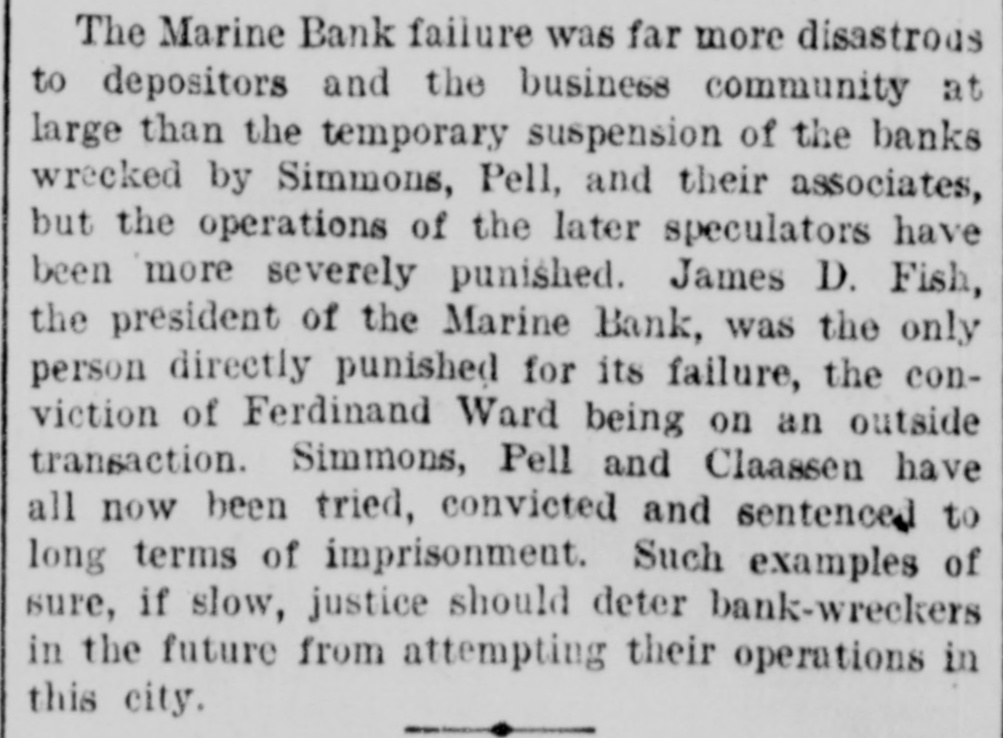
The Marine Bank failure was far more disastrous to depositors and the business community at large than the temporary suspension of the banks wrecked by Simmons, Pell, and their associates, but the operations of the later speculators have been more severely punished. James D. Fish, the president of the Marine Bank, was the only person directly punished for its failure, the conviction of Ferdinand Ward being on an outside transaction. Simmons, Pell and Claassen have all now been tried, convicted and sentenced to long terms of imprisonment. Such examples of sure, if slow, justice should deter bank-wreckers in the future from attempting their operations in this city.


Article from The Morning News, October 15, 1893

Click image to open full size in new tab

Article Text

# DID NOT RUIN GRANT. Now, among the many charges against me was that I had ruined the Grant family when in fact when General U. S. Grant went into the firm he did so with $50,000 borrowed from Commodore Garrison for that purpose. This amount, together with all the other sums he obtained from various sources, would not offset the first item of the foregoing schedule. That General Grant supposed he was speculating in government contracts I most emphatically assert. I can, if necessary will, produce and publish correspondence over autographs that will give undisputed proof of my correctness. Another charge is that my schemes ruined the Marine Bank and caused great suffering among the depositors of that institution, when in fact the receiver has already paid the depositors of that bank over 80 per cent. and is prepared to pay more. That shows that the customers of that concern were not entirely ruined by me. # THE CAUSE OF THE FAILURE. The prime cause of the failure of Grant & Ward was the illness of Nelson J. Tappan, the controller of the city of New York who was interested in the success of some of our speculations. I offered him $5,000 for the use of $100,000 for a certain period, and not having the money he arranged to deposit city funds in the Marine Bank so I could borrow from this institution. This was done, and a few days before the failure of Graut & Ward the Marine Bank had $1,500,000 of the city money. When illness caused the appointment of Mr. Gilly in Mr. Tappan's place, he (Mr. Gilly) began to draw on the bank, which was not according to my agreement with Mr. Tappan. I saw Mr. Tappon at his house, and apprised him of this fact (which he, by the way, already knew) that these unexpected drafts meant the ruin of the bank and the firm of Grant & Ward, but he was powerless to avert the disaster, which, had he been in good health, would never have occurred, as he had provided other means to supply the funds needed by the city until we could get in our time loans, then considered as good as gold itself. I visited several of the directors and did everything possible to avert the crash, but without avail. The second draft,


Article from Kansas Agitator, February 17, 1899

Click image to open full size in new tab

Article Text

# A WALL STREET SCENE ex-president of the United States was the wonder of the nation, sat alone in his office. Banking hours were over. He had received notice from the Marine bank that the account of Grant & Ward had been overdrawn to the extent of from $500,000 to $750,000, and in the solitude of his poor, barren castle he was scheming to discount a cark and forbidding future. "Gentleman to see you, sir," said a boy, peeping in. "Who is he? What his name? What is the nature of his business?" said the doomed Napoleon, still clinging to the formula. "Mr. Alling Johnson," said the boy. Ward smiled. "Show him in, but say that I am very busy." His head was buried among papers and accounts when the farmer entered. "Awfully glad to see you, Mr. Johnson," he said, nodding indifferently as he pretended to be looking for a lost memorandum. "General's just gone-as usual when you are here. What can I do for you? Sorry I have a pressing engagement and can give you but a few minutes. Been a fear-fully active day. You see I am working over hours." "Mr. Ward, I know you are a very busy man, so I won't keep you long. I've just come to town to ask you and the gineral if you could make an exception in my favor about that syndicate business with the government contracts. Can't you let me in for $20,000 less than the limit set?" The farmer was actually pleading. Ward hesitated. "And what more I'd like to know," continued Mr. Johnson, "is if it makes any difference to you and the gineral if I don't put up all the $180,000 myself, but collect it among my friends." Still Ward hesitated, slowly shaking his head. "You've got me in a tight place, Mr. Johnson," he said, finally. "The negotiations are about closed, and there is not a single interest but exceeds $200.000. I dare say the entire business will be wound up before 5 o'clock, and that hour is close at hand. It would require a prompt cash-" "Here it is," interrupted the Cattaraugus man. "Me and the rest of the boys fetched it along." He jerked his thumb in the direction of the door. "They are outside. Can't you let 'em in? All neighbor o' mine, and mighty good boys. They chipped in what they had against my check-the certified one you gave me and we are all on the make." He laughed as his mind conjured up great profits. "Show the gentlemen in," said Ward to the clerk who sprang in to the sudden alarm of the bell. Mr. Johnson began counting out his money. Introductions were briefly made, chairs were brought and the five sat down. Ward became jocular. His wit was a revelation. His eyes had already dwelt upon the comfortable roll of notes, the sight warming the cockles of his heart. "This is what did the business," said Mr. Johnson, holding up his certified check, much worn. "When I showed it to the boys they forked over all they had. Haw, haw, ha, ha, he! Whoones!" He had exhibited it among his neighbors, calling particular attention to the certification, the amount of profits in ten weeks, and, the strongest card of all, the signature of General Ulysses S. Grant. The general's name was like a certificate of eternal salvation. To join a syndicate with him was an indorsement stronger than the safe deposit vaults of the clearing house. With the money actually in hand Ward expeditiously disposed of his visitors. Receipts were given to them individually for each's share of the $180,00, after which they shook hands several times apiece with their "benefactor" and departed with many expressions of good will. "Drop in when you happen to be in town and see how things are going," was Ward's cheerful valediction. Before the farmers reached home the firm of Grant & Ward had failed, the Marine bank had been wrecked and Wall street, the charnel house of hope, was shaken to its foundations with panic.-Gallatin, in New York Press.