Grant & Ward (New York, NY)

Episode Information

Episode Type
Suspension โ†’ Closure
Start Date
May 6, 1884
Location
New York, New York (40.714, -74.006)
Bank Type
savings

Metadata

Notes

Suspension quickly led to assignments and a receiver (Julien/Julian T. Davies) and permanent winding up.

Events (3)

1. May 6, 1884 Suspension
Cause
Local Banks
Cause Details
Immediate suspension triggered by the failure/closing of the Marine National Bank which left Grant & Ward unable to meet clearing-house obligations (large overdrafts/shortage ~ $500,000).
Newspaper Excerpt
In consequence of the closing of the Marine bank in New York yesterday the banking firm of Messrs. Grant & Ward also suspended.
Source
newspapers
2. May 8, 1884 Other
Newspaper Excerpt
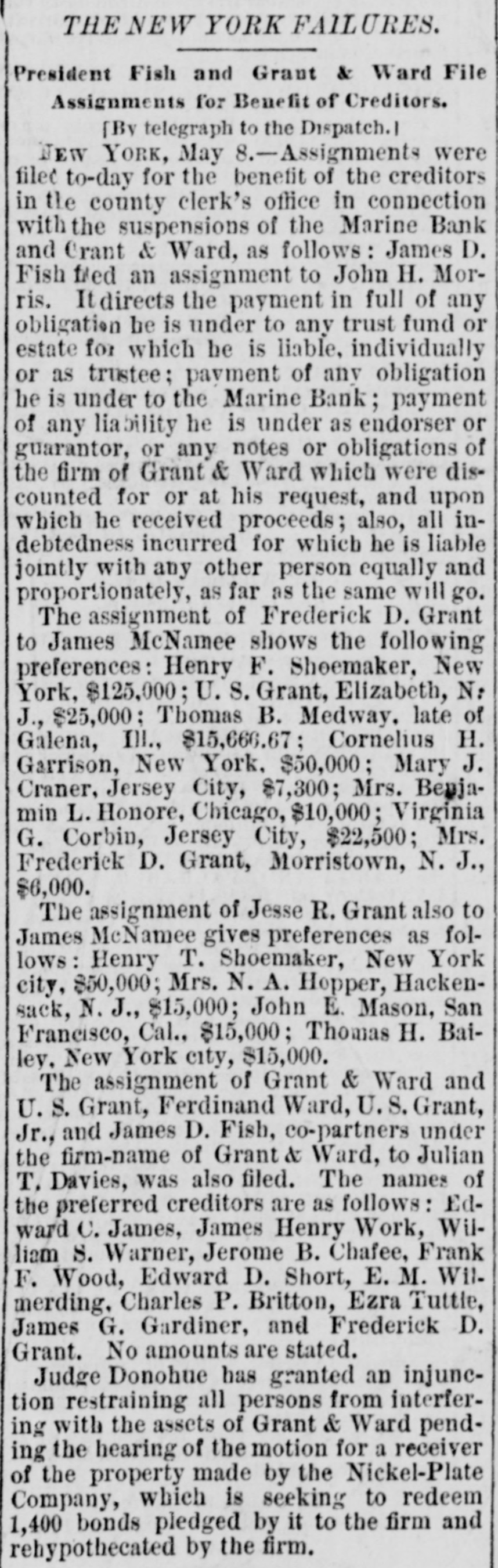
Assignments were filed to-day for the benefit of the creditors in the county clerk's office in connection with the suspensions of the Marine Bank and Grant & Ward... The assignment of Grant & Ward ... to Julian T. Davies, was also filed.
Source
newspapers
3. May 15, 1884 Other
Newspaper Excerpt
Receiver Davies reports the liabilities of Grant & Ward, so far as he has been able to ascertain, at $14,501,521.
Source
newspapers

Newspaper Articles (25)

Article from Lancaster Daily Intelligencer, May 7, 1884

Click image to open full size in new tab

Article Text

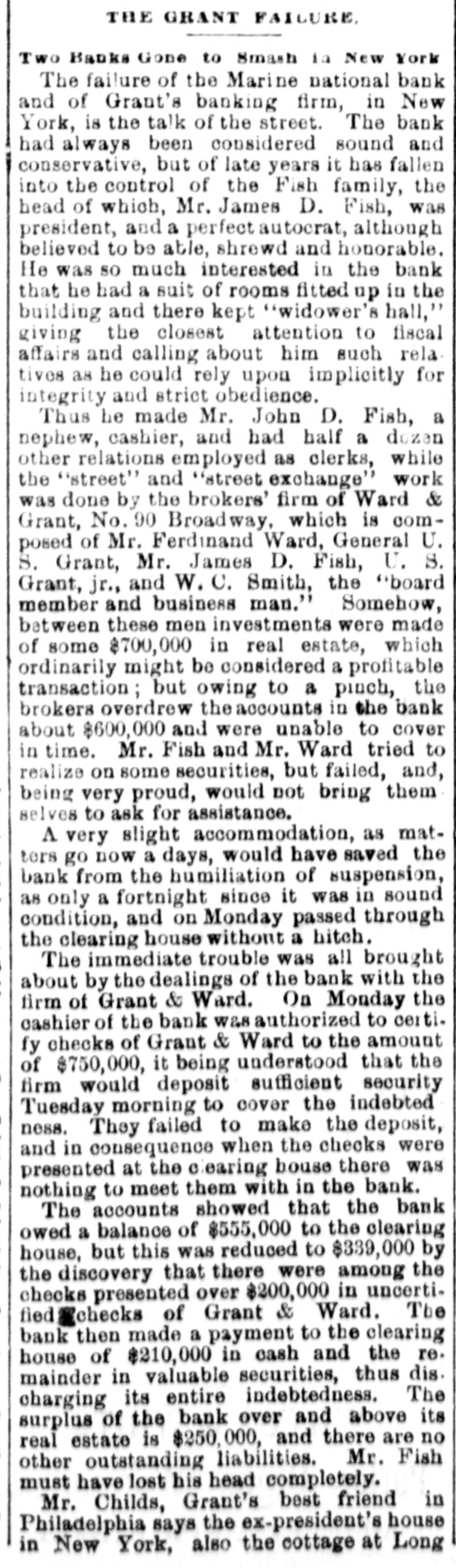
THE GRANT FAILURE Two Banks Gone to Smash 1a New York The failure of the Marine national bank and of Grant's banking firm, in New York, is the talk of the street. The bank had always been considered sound and conservative, but of late years it has fallen into the control of the Fish family, the head of which, Mr. James D. Fish, was president, and a perfect autocrat, although believed to be able, shrewd and honorable. He was so much interested in the bank that he had a suit of rooms fitted up in the building and there kept "widower's hall,' giving the closest attention to fiscal affairs and calling about him such rela tives as he could rely upon implicitly for integrity and strict obedience. Thus he made Mr. John D. Fish, a nephew, cashier, and had half a dozen other relations employed as clerks, while the "street" and "street exchange" work was done by the brokers' firm of Ward & Grant, No. 90 Broadway which is composed of Mr. Ferdinand Ward, General U. S. Grant, Mr. James D. Fish, U. S. Grant, jr., and W. C. Smith, the "board member and business man.' Somehow, between these men investments were made of some $700,000 in real estate, which ordinarily might be considered a profitable transaction; but owing to a pinch, the brokers overdrew the accounts in the bank about $600,000 and were unable to cover in time. Mr. Fish and Mr. Ward tried to realize on some securities, but failed, and, being very proud, would not bring them selves to ask for assistance. A very slight accommodation, as matters go now a days, would have saved the bank from the humiliation of suspension, as only a fortnight since it was in sound condition, and on Monday passed through the clearing house without a hitch. The immediate trouble was all brought about by the dealings of the bank with the firm of Grant & Ward. On Monday the cashier of the bank wasauthorized to certi. fy checks of Grant & Ward to the amount of $750,000, it being understood that the firm would deposit sufficient security Tuesday morning to cover the indebted ness. They failed to make the deposit, and in consequence when the checks were presented at the clearing house there was nothing to meet them with in the bank. The accounts showed that the bank owed a balance of $555,000 to the clearing house, but this was reduced to $339,000 by the discovery that there were among the over Grant made a checks bank fied checks then presented of payment $200,000 & to Ward. the in clearing uncerti- The of $210,000 in cash and the re. valuable its entire house charging mainder in securities, indebtedness. thus The dis. its of the bank over and above are surplus real estate is $250,000, liabilities. and there Mr. Fish no other outstanding must have lost his head completely. Mr. Childs, Grant's best friend in Philadelphia says the ex-president's house in New York, also the cottage at Long


Article from Seattle Daily Post-Intelligencer, May 7, 1884

Click image to open full size in new tab

Article Text

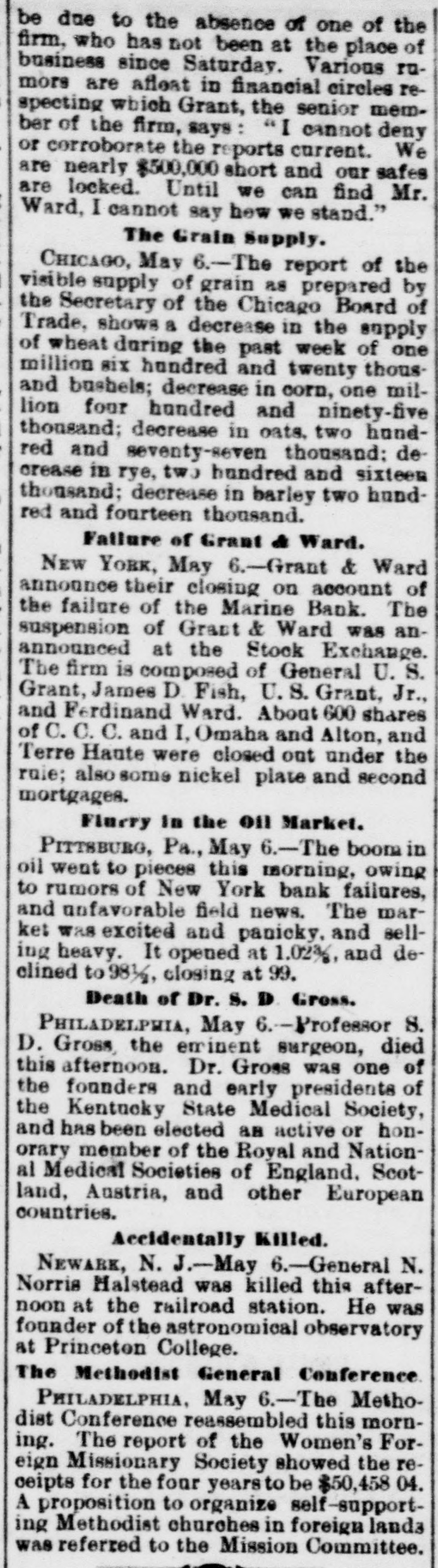
be due to the absence of one of the firm, who has not been at the place of business since Saturday. Various rumore are afloat in financial circles respecting which Grant, the senior member of the firm, says: "I cannot deny or corroborate the reports current. We are nearly $500,000 short and our safes are locked. Until we can find Mr. Ward, I cannot say how we stand." The Grain Supply. CHICAGO, May 6.-The report of the visible supply of grain as prepared by the Secretary of the Chicago Board of Trade, shows a decrease in the supply of wheat during the past week of one million six hundred and twenty thousand bushels; decrease in corn, one million four hundred and ninety-five thousand; decrease in oats, two hundred and seventy-seven thousand: decrease in rye, two hundred and sixteen thousand; decrease in barley two hundred and fourteen thousand. Fatlure of Grant & Ward. NEW YORK, May 6.-Grant & Ward announce their closing on account of the failure of the Marine Bank. The suspension of Grant & Ward was anannounced at the Stock Exchange. The firm is composed of General U. S. Grant, James D. Fish, U.S. Grant, Jr., and Ferdinand Ward. About 600 shares of C. C. C. and I, Omaha and Alton, and Terre Haute were closed out under the rule; also some nickel plate and second mortgages. Flurry In the on Market. PITTSBURG, Pa., May 6.-The boom in oil went to pieces this morning, owing to rumors of New York bank failures, and unfavorable field news. The market was excited and panicky. and selling heavy. It opened at 1.02%, and declined to 98ยฝ, closing at 99. Death of Dr. S. D. Gross. Philadelphia, May 6.-Professor S. D. Gross, the eminent surgeon, died this afternoon. Dr. Gross was one of the founders and early presidents of the Kentucky State Medical Society, and has been elected an active or honorary member of the Royal and National Medical Societies of England. Scotland, Austria, and other European countries. Accidentally Killed. NEWARK, N. J.-May 6.-General N. Norris Halstead was killed this afternoon at the railroad station. He was founder of the astronomical observatory at Princeton College. The Methodist General Conference. Philadelphia, May 6.-The Methodist Conference reassembled this morning. The report of the Women's Foreign Missionary Society showed the receipts for the four years to be $50,458 04. A proposition to organize self-supporting Methodist churches in foreign lands was referred to the Mission Committee.


Article from Evening Star, May 7, 1884

Click image to open full size in new tab

Article Text

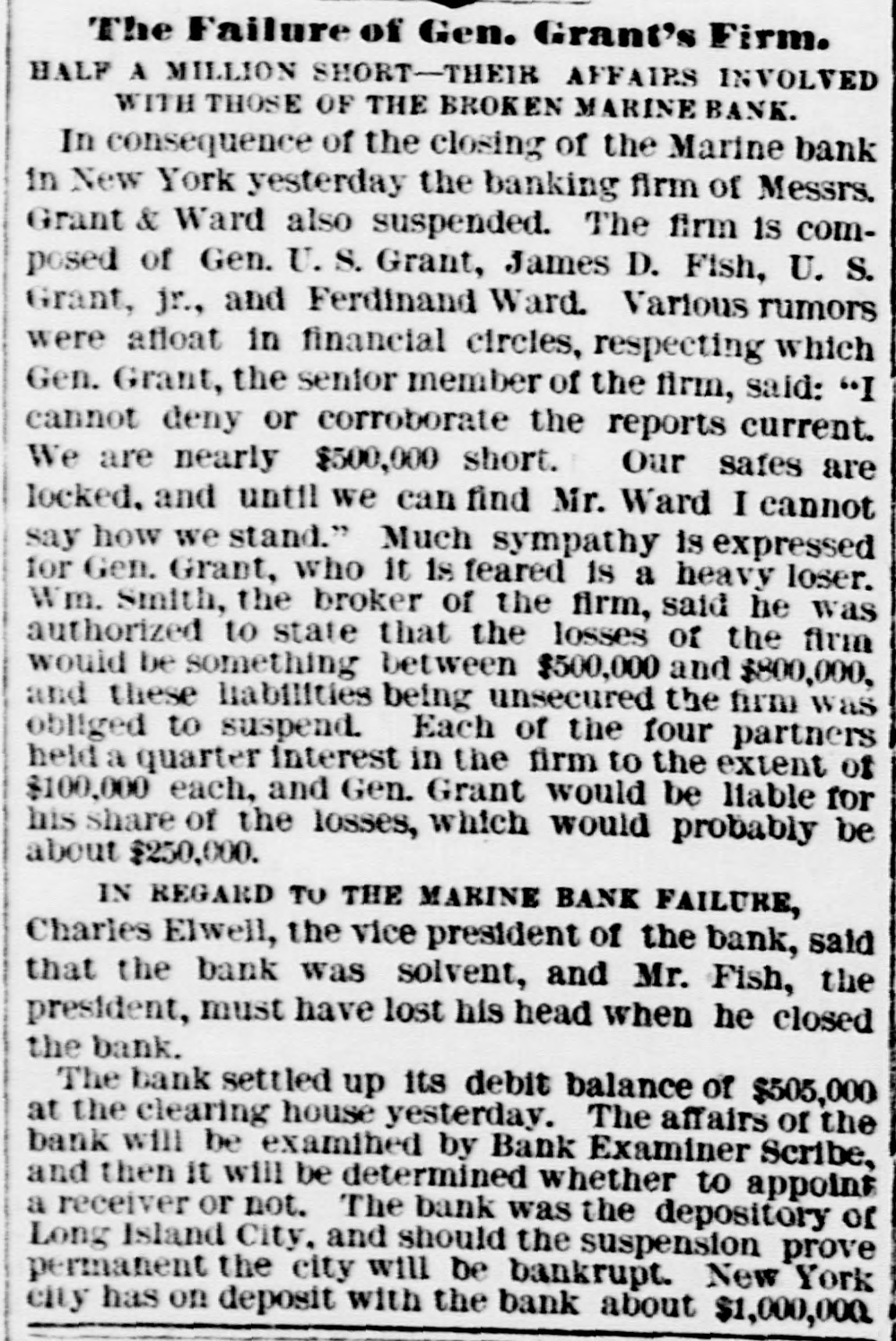
The Failure of Gen

Grant's Firm. HALF A MILLION SHORT-THEIR AFFAIRS INVOLVED WITH THOSE OF THE BROKEN MARINE BANK. In consequence of the closing of the Marine bank in New York yesterday the banking firm of Messrs. Grant & Ward also suspended. The firm is composed of Gen. U.S. Grant, James D. Fish, U. S. Grant, jr., and Ferdinand Ward. Various rumors were afloat in financial circles, respecting which Gen. Grant, the senior member of the firm, said: "I cannot deny or corroborate the reports current. We are nearly $500,000 short. Our safes are locked. and until we can find Mr. Ward I cannot say how we stand." Much sympathy is expressed for Gen. Grant, who it is feared is a heavy loser. Wm. Smith, the broker of the firm, said he was authorized to state that the losses of the firm would be something between $500,000 and $800,000, and these liabilities being unsecured the firm was obliged to suspend. Each of the four partners held a quarter interest in the firm to the extent of $100,000 each, and Gen. Grant would be liable for his share of the losses, which would probably be about $250,000. IN REGARD To THE MARINE BANK FAILURE, Charles Elwell, the vice president of the bank, said that the bank was solvent, and Mr. Fish, the president, must have lost his head when he closed the bank. The bank settled up its debit balance of $505,000 at the clearing house yesterday. The affairs of the bank will be examined by Bank Examiner Scribe, and then It will be determined whether to appoint a receiver or not. The bank was the depository of Long Island City, and should the suspension prove permanent the city will be bankrupt. New York city has on deposit with the bank about $1,000,000.


Article from The Daily Dispatch, May 9, 1884

Click image to open full size in new tab

Article Text

THE NEW YORK FAILURES

President Fish and Grant & Ward File Assignments for Benefit of Creditors. [By telegraph to the Dispatch.] NEW YORK, May 8.-Assignments were filed to-day for the benefit of the creditors in the county clerk's office in connection with the suspensions of the Marine Bank and Crant & Ward, as follows: James D. Fish fred an assignment to John H. Morris. It directs the payment in full of any obligation be is under to any trust fund or estate for which be is liable, individually or as trustee: payment of any obligation he is under to the Marine Bank; payment of any liability he is under as endorser or guarantor, or any notes or obligations of the firm of Grant & Ward which were discounted for or at his request, and upon which he received proceeds; also, all indebtedness incurred for which he is liable jointly with any other person equally and proportionately, as far as the same will go. The assignment of Frederick D. Grant to James McNamee shows the following preferences: Henry F. Shoemaker, New York, $125,000; U.S. Grant, Elizabeth, N: J., $25,000; Thomas B. Medway, late of Galena, Ill., $15,666.67; Cornelius H. Garrison, New York, $50,000; Mary J. Craner, Jersey City, $7,300; Mrs. Benjamin L. Honore, Chicago, $10,000; Virginia G. Corbin, Jersey City, $22,500; Mrs. Frederick D. Grant, Morristown, N. J., $6,000. The assignment of Jesse R. Grant also to James McNamee gives preferences as follows: Henry T. Shoemaker, New York city, $50,000; Mrs. N. A. Hopper, Hackensack, N. J., $15,000; John E. Mason, San Francisco, Cal., $15,000; Thomas H. Bailey, New York city, $15,000. The assignment of Grant & Ward and U. S. Grant, Ferdinand Ward, U.S. Grant, Jr., and James D. Fish, co-partners under the firm-name of Grant & Ward, to Julian T. Davies, was also filed. The names of the preferred creditors are as follows: Edward C. James, James Henry Work, William S. Warner, Jerome B. Chafee, Frank F. Wood, Edward D. Short, E. M. Wilmerding, Charles P. Britton, Ezra Tuttle, James G. Gardiner, and Frederick D. Grant. No amounts are stated. Judge Donohue has granted an injunction restraining all persons from interfering with the assets of Grant & Ward pending the hearing of the motion for a receiver of the property made by the Nickel-Plate Company, which is seeking to redeem 1,400 bonds pledged by it to the firm and rehypothecated by the firm.


Article from The Salt Lake Herald, May 9, 1884

Click image to open full size in new tab

Article Text

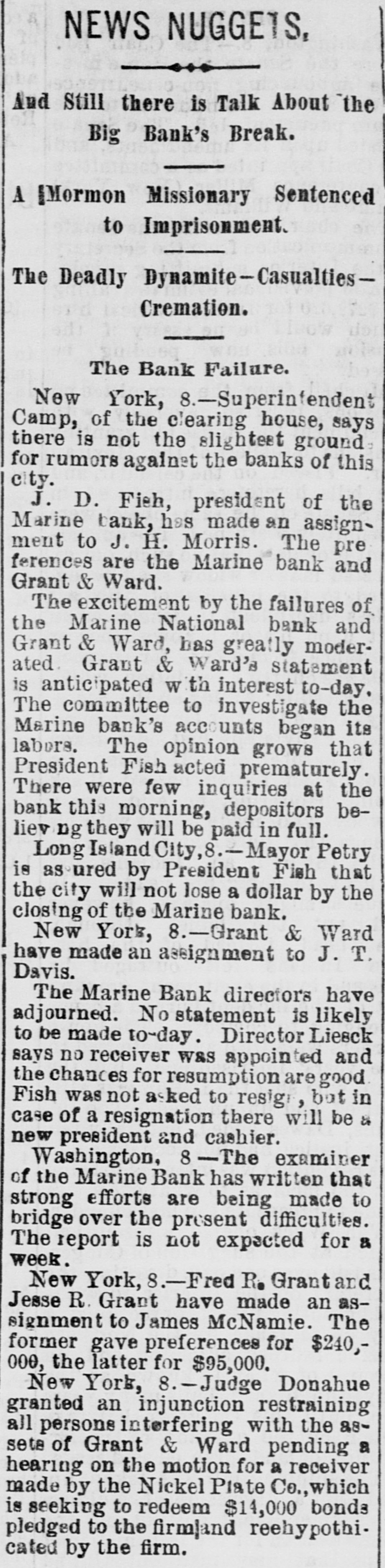
NEWS NUGGETS, And Still there is Talk About the Big Bank's Break. A [Mormon Missionary Sentenced to Imprisonment. The Deadly Dynamite-Casualties Cremation. The Bank Failure. New York, 8.-Superintendent Camp, of the clearing house, says there is not the slightest ground. for rumors against the banks of this city. J. D. Fish, president of the Marine bank, has made an assignment to J. H. Morris. The pre ferences are the Marine bank and Grant & Ward. The excitement by the failures of the Marine National bank and Grant & Ward, has greatly moderated Grant & Ward's statement is anticipated with interest to-day. The committee to investigate the Marine bank's accounts began its labors. The opinion grows that President Fish acted prematurely. There were few inquiries at the bank this morning, depositors believ ng they will be paid in full. Long Island City, .-Mayor Petry is assured by President Fish that the city will not lose a dollar by the closing of the Marine bank. New York, 8.-Grant & Ward have made an assignment to J. T. Davis. The Marine Bank directors have adjourned. No statement is likely to be made to-day. Director Liesck says no receiver W&S appointed and the chances for resumption are good Fish was not asked to resign, but in case of a resignation there will be a new president and cashier. Washington, 8-The examiner of the Marine Bank has written that strong efforts are being made to bridge over the present difficulties. The report is not expacted for a week. New York, 8.-Fred R. Grant and Jesse R. Grant have made an assignment to James McNamie. The former gave preferences for $240,000, the latter for $95,000. New York, 8.-Judge Donahue granted an injunction restraining all persons interfering with the assets of Grant & Ward pending a hearing on the motion for a receiver made by the Nickel Plate Co., which is seeking to redeem $14,000 bonds pledged to the firm|and reehypothicated by the firm.


Article from The Baltimore County Union, May 10, 1884

Click image to open full size in new tab

Article Text

The Marine National Bank of New York, one of the oldest institutions of that city, suspended on Tuesday, causing great excitement. Among those most affected by the suspension is the firm of Grant & Ward, bankers and stock brokers, who also suspended. U. S. Grant, Jr., is an active member of this firm, and his father, Gen. Grant, is supposed to be a very heavy loser by the failure of the bank. Mr. Ward, of the firm of Grant & Ward, was intimately connected with the broken bank, and it is thought he is a defaulter to a very large amount. Speculations in real estate are thought to have gotten him into financial difficulties. Much sympathy is everywhere expressed for Gen. Grant.


Article from Shepherdstown Register, May 10, 1884

Click image to open full size in new tab

Article Text

THE Marine National Bank of New York, an old and prominent institution, failed and closed its doors on Tuesday, and one of the results was the suspension almost immediately afterward of the banking and brokerage firm of Grant and Ward, in which General U.S. Grant and his son are two of the partners. The two failures have eaused great agitation in financial circles. Long Island City had nearly all of its money, about $150,000, in the Marine Bank, and the citizens are very much frightened for fear they will never get any of it back.


Article from The Milan Exchange, May 10, 1884

Click image to open full size in new tab

Article Text

LATE NEWS ITEMS IN the Senate on the 6th Senator Vest reported favorably the bill for the erection of a public building at Detroit. Memorials favoring the suspension of the coinage of the silver dollar were presented by Senator Bayard and others. A bill was introduced by Senator Cockrell to facilitate the negotiation of bills of lading and other commercial instruments. The free bridge bill across the Potomac River was then taken up and a substitute for the original bill offered and passed. Mr. Vance addressed the Senate in support of Vest's amendment providing for free ships In the House the morning hour was dispensed with and the tariff bill taken up in committee of the whole. Speeches were made by Messrs. Brown of Pennsylvania, Townshend, Gibson, Randall, Blackburn, Eaton and others, the debate being closed by Mr. Morrison. There was an excited scene when Mr. Converse moved tostrikeout the enacting clause. Themotion prevailed-159 to 155. THERE was considerable of a panic in New York on the 6th, caused by the failure of the Marine Bank of that city and the suspension of Grant & Ward, bankers and brokers. The bank had a capital of $400,000 and a surplus of $200,000. The failure of Grant & Ward was occasioned by the collapse of the bank. Jay Gould takes a hopeful view of the situation of the country, financially and commercially, and does not think the Marine Bank in New York amounted to much. CHARLEY FORD, who was a participant in the killng of Jesse James, and who, wi h his brother Bob, has been playing throughout the country in variety halls, sho: himself through the heart on the morning of the 6th at his father's home near Richmond, Mo. Various causes are assigned in explanation of the act. THE American Medical Association commenced its session in Washington on the 6th. A REPLY to the Pope's encyclical letter has been published by the Grand Orient of Italy. THE Corean Embassy paid their respects to the President on the 6th. DUNLAP & TWADDELL, jute spinners, Glasgow, have suspended, with liabilities of $450,000. ADAMS & Co.'s glass factory, Pittsburgh, Pa., burned on the 6th. Loss $20,000. CASEY, another Invincible, was arrested on the 6th on the testimony of Moran, the informer. JAMES A. CONNELLY, confirmed by the Senate as Solicitor of the Treasury, has declined. THE Berlin Prefect of Police is in receipt of letters threatening to blow up the Parliament Chambers upon Bismarck's next appearance.


Article from The Delaware Ledger, May 10, 1884

Click image to open full size in new tab

Article Text

THE banking house of Grant & Ward in New York suspended this week. The failure was severely felt. A great General does not always make a great financier.


Article from Centre Democrat, May 15, 1884

Click image to open full size in new tab

Article Text

LAST week excitement ran high in financial circles in New York, by the failure of the Marine National Bank. This created a distrust that soon brought its fruits, and the firm of Grant & Ward, bankers, were forced to suspend, and have since assigned. Gen. Grant is the head of the firm, and is greatly worried over the affair, for which he is probably not personally responstble, his partner being the business manager. The shortage of their accounts, it is said, will reach $6,000,000.


Article from The Manchester Journal, May 15, 1884

Click image to open full size in new tab

Article Text

The Grant Failure

There will be hearty sympathy for the failure of Gen. Grant and sons which occurred at New York last week. All the members of the family bad every dollar they could control invested in the bank. rupt firm of Grant & Ward. Not only this but the Grant boys" borrowed money of their personal friends to put into the concern and there is no doubt they did it in good faith, believing it not only solvent but supposed they were making mosby very fuet. Instead of this the "wicked partner" of the coneern who had almost the exclusive management of affairs had run things in a reckless and eriminal way, and now the firm and the Grants do not have money enough to pay their obliga. tions. The Grants are not to blame, only they ought to have attended to matters themselves and not have allowed such foolish and crimiual speculations. Gen. Grant will not be left penniless since several wealthy gestlemes a few years age made up a large purse for him which money was so invested that he can not spend the principal and he receives only the income. As it has turned out this was a wise precantion, and Gen. Grant can be set down as much of a business failure as he was before the war and before he was President. He is not, never was and never will be a thorough business man. competent to cope with the sharks of Wall street. Senator Edmunds bas'introduced a bill in the U.S. Senate to place Grant on the retired list of the army, which would give him a fair sulury for life. and the country ought to de a much as this. In regard to the family the N. Y. Herold says: "The "Graut boym," WE the sons of the general arefamiliarly called in Wall street, have been the subject of so much talk since the failure of Grant & Ward that it will be of interest to the general reader to know who and what they are. They are Col. Frederick Grant. Ulysses S Grant, Jr. and Jessel Grant. Col. Frederick Grant is the eld.st son. He is about thirty-five years of age. He graduated from West Point in 1870, and married Miss Honore of Chieago, a thoroughly accomplished young lady, conversant to a far greater extent than the average of educated ladies with the languages, and a charming musician. She is also possessed of grout per. sonal beauty. Her sister married Mr. 1 Poter Palmer of the Palmer house Chicago. Frederick Grant, bis wife and their two i children, a boy and a girl, are at present t residing is Morriston, N.J. After leaving 8 West Point, Col. Grant went upon the . staff of General Sheridas, from which, in 1877, he secured a leave of absence to ac$ company bis father in his tour around the t world. When be returned from his trip he went back for awhile to his position upon the staff of General Sheridan, when, f resigning, be became vise president of the a Texas Larrew gauge railroad, spending his time between Texas and New York. t He resigned his position as vice president 1 of the railreed company to become consected with the firm BOW defunct. Aside a from this, however. he was engaged in other business. He is regarded as eentions h and conservative in his basiness transact. . iens and was thought to be very 'well-to-de' . up to the day when Grant & Ward failed. "Ulyness S. Grant, Jr., Gen. Grant's o second son, is a graduate of Harvard cel1 lege, most of bis education there having b been received during his father's first presidential term While et college be e


Article from Iron County Register, May 15, 1884

Click image to open full size in new tab

Article Text

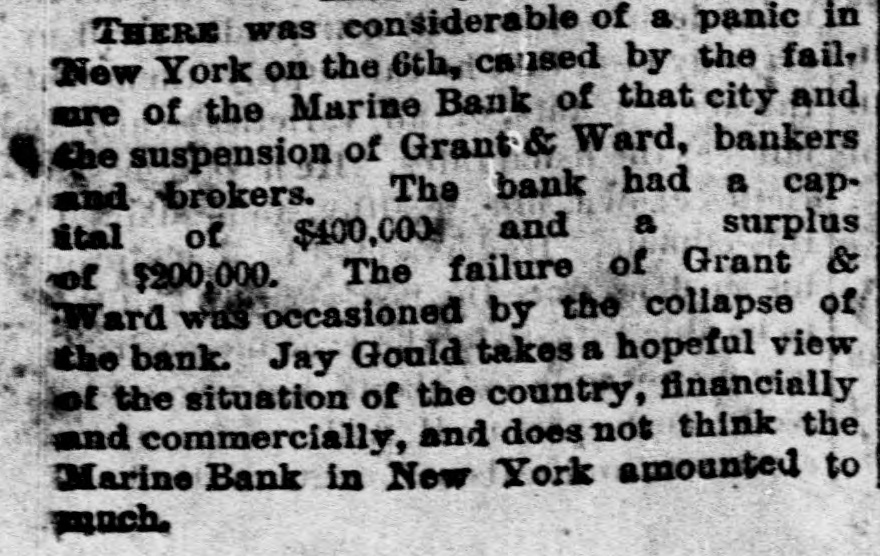
THERE was considerable of a panic in New York on the 6th, caused by the fail, are of the Marine Bank of that city and the suspension of Grant & Ward, bankers and brokers. The bank had a captital of $400,000 and a surplus of $200,000. The failure of Grant & Ward was occasioned by the collapse of the bank. Jay Gould takes a hopeful view of the situation of the country, financially and commercially, and does not think the Marine Bank in New York amounted to much.


Article from The Austin Weekly Statesman, May 15, 1884

Click image to open full size in new tab

Article Text

Trade Troubles

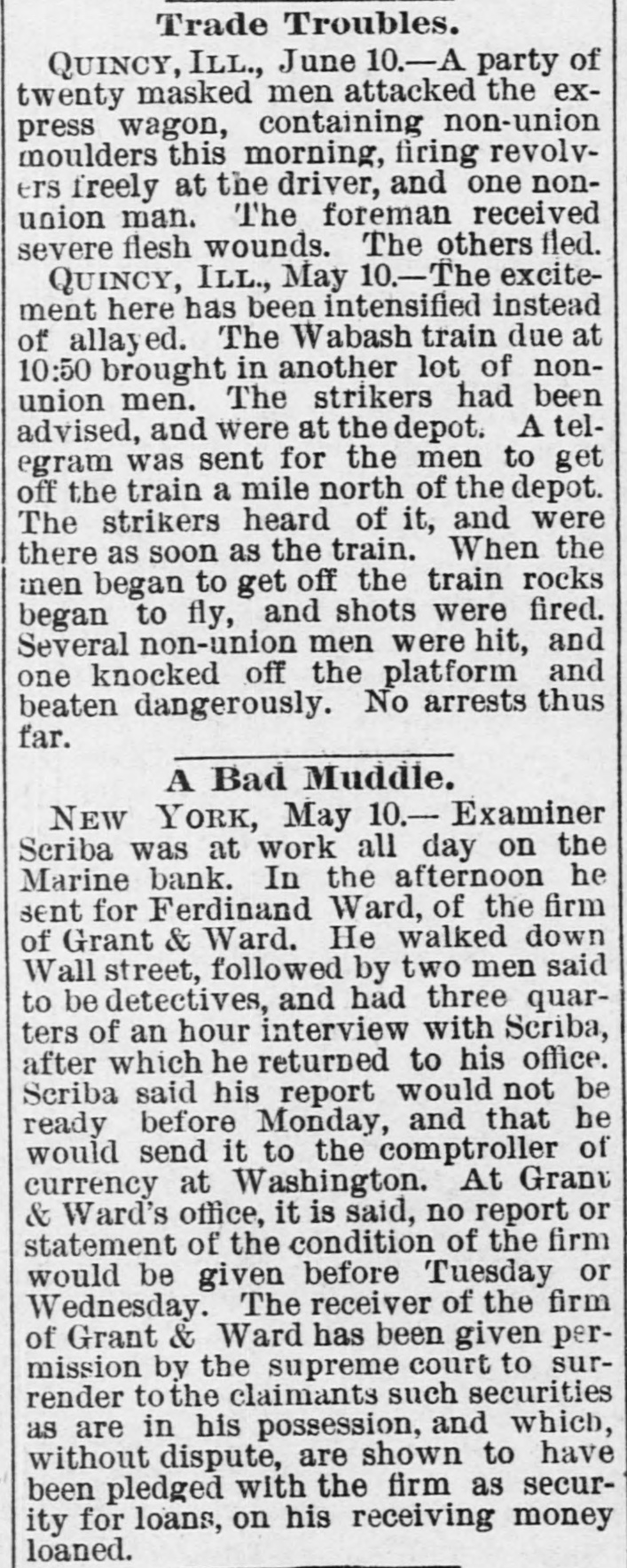
QUINCY, ILL., June 10.-A party of twenty masked men attacked the express wagon, containing non-union moulders this morning, firing revolvers freely at the driver, and one nonunion man. The foreman received severe flesh wounds. The others fled. QUINCY, ILL., May 10.-The excitement here has been intensified instead of allayed. The Wabash train due at 10:50 brought in another lot of nonunion men. The strikers had been advised, and were at the depot. A telegram was sent for the men to get off the train a mile north of the depot. The strikers heard of it, and were there as soon as the train. When the men began to get off the train rocks began to fly, and shots were fired. Several non-union men were hit, and one knocked off the platform and beaten dangerously. No arrests thus far. A Bad Muddle. NEW YORK, May 10.- Examiner Scriba was at work all day on the Marine bank. In the afternoon he sent for Ferdinand Ward, of the firm of Grant & Ward. He walked down Wall street, followed by two men said to be detectives, and had three quarters of an hour interview with Scriba, after which he returned to his office. Scriba said his report would not be ready before Monday, and that he would send it to the comptroller of currency at Washington. At Grant & Ward's office, it is said, no report or statement of the condition of the firm would be given before Tuesday or Wednesday. The receiver of the firm of Grant & Ward has been given permission by the supreme court to surrender to the claimants such securities as are in his possession, and which, without dispute, are shown to have been pledged with the firm as security for loans, on his receiving money loaned.


Article from Mineral Point Tribune, May 15, 1884

Click image to open full size in new tab

Article Text

THE MARINE BANK

Gen. Grant's Failure More Serious than was at First Supposed. A Reckless Young Partner the Cause of His Ruin. Gen. Grant's Firm Fails. NEW YORK, May 7.-Captain Ambrose Snow, director of the Marine bank, says: This afternoon an informal meeting of the directors of the bank was held, to day, in the private office of President Fish, over the bank. to talk over the situation. At the request of the board Fish was present and made a statement of the causes which induced him to close the bank. Fish stated that he had come to the conclusion that Ferdinand a 750,000. He had decided that the best thing was to close the bank and save it from utter failure. He also stated that he and other members of his family owned three-quarters of the stock of the bank. Capt. Snow said the directors had always had the greatest confidence in President Fish's honesty and integrity, and they still held the same opinion. They only regretted that Fish had not called a meeting of the board and submitted matters to them before he SO hastily decided to close the doors of the bank. They thought he lacked good judgment in taking such hasty action. It is stated, also, that the bank would probably soon be able to resume business and that none of the c depositors would lose a cent. SO U. S. Grant, Jr., sold some property a on Third avenue, to-day, for $50,000, to and borrowed $18,200 on his house p and lot on East 63d street. a A lease is also recorded to-day of stores 70 and 72 West 23d street k (Booth's theatre), by James D. a a & Fish and Ferdinand Chivis, Ward at as an to annual Conklin rental of $16,000. Ala though Ward was in his office to day th he refused to make a statement in regard to his alleged defalcation. What has become of the large sums he bor9 rowed is still a mystery. It is supT posed they were sunk in real estate pa speculations. It is stated by a well known merchant of the clearing house association that he has for a long time regarded the Marine bank with sus picion on account of the well known ph real estate operations of its president and was ready to use the slightest pretext for expelling it from the association. The bank examiners are still in charge of the books of the bank. The joint executive commitof the passenger department began its session to-day in Commissioner Hink's office to consider a renewal of the passenger pool contract. Twentyfive lines are represented, including the West Shore, D L. & W and Pittsburg, Lake Erie and West which were not members of the old pool. The terms proposed in the new agreement were discussed in detail. It will probably be several days before the terms of the new agreement will be fully determined upon and be ready for signature. ag NEW YORK, May 6. long after the announcement of the failure of the Marise bank the stock exchange Mr. firm of Grant & Ward also failed. It Ha learned from friends that Ward, of Hut Grant & Ward, left his house this Sus morning at 7 o'clock and cannot be mu found: that he locked his own safe, Pur and it is discovered his account isoverSeo drawn at the Marine bank $700,000. non Ste The failure of the Marine bank was Ste what dragged down Grant & Ward. We A partner of the firm said just before the collapse: "I cannot see how we can save ourselves. We are now waitFle to see Fish. We will doubtless publish a statement notifying the stock exchange of our inability to proceed as soon as the partners hold a conference." The firm of Grant & Ward comprised U. S. Grant, James D Fish, S. Grant, Jr., Ferdinand Ward. and William S Smith. General U. per Grant and J. D. Fish were general partners, and are liable for the debts the of the concern. Fish having failed, was great share of the loss will fall upDoi the ex president. Gen. Grant was fro at the office of Grant, Ward & Co. ano when the failure of the firm was angra nounced. H. appeared to be in ill to health, and was completely prostrated sav at the firm's unfortunate speculation. por IS reported that $500,0000 is missing Mo from Grant & Ward, and that there M has been a defalcation. Ward is issu missing. The vault doors cannot be whi to opened. Kiernan's Wall Street agency furstre nishes the following: 'Rumors of a trea defalcation of $50,000 have accompathe nied the suspension of the Marine rece bank. The party in question said he Mor had close relations with the bank. how We have investigated the report acco the and get the following state- of The embarrassment thos Grant ment: & Ward, bankers, ticu due to the absence of one of the T firm, who has not been at his place of bro business since Saturday Various Jar An rumors are afloat in financial circles,


Article from The Indianapolis Journal, May 16, 1884

Click image to open full size in new tab

Article Text

GRANT AND WARD

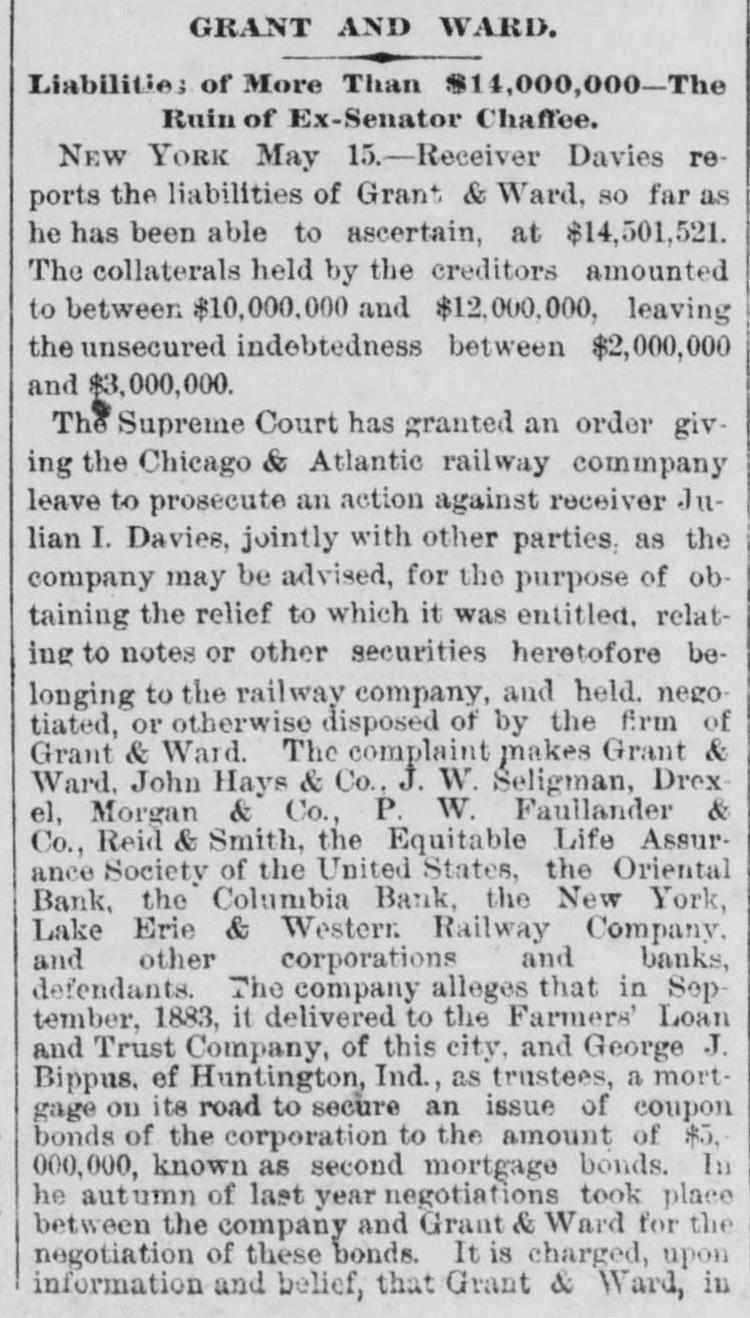
Liabilities of More Than $14,000,000-The Ruin of Ex-Senator Chaffee. NEW YORK May 15.-Receiver Davies reports the liabilities of Grant & Ward, so far as he has been able to ascertain, at $14,501,521. The collaterals held by the creditors amounted to between $10,000,000 and $12,000,000, leaving the unsecured indebtedness between $2,000,000 and $3,000,000. The Supreme Court has granted an order giving the Chicago & Atlantic railway commpany leave to prosecute an action against receiver Julian I. Davies, jointly with other parties, as the company may be advised, for the purpose of obtaining the relief to which it was entitled. relating to notes or other securities heretofore belonging to the railway company, and held. negotiated, or otherwise disposed of by the firm of Grant & Ward. The complaint makes Grant & Ward, John Hays & Co., J. W. Seligman, Drexel, Morgan & Co., P. W. Faullander & Co., Reid & Smith, the Equitable Life Assurance Society of the United States, the Oriental Bank, the Columbia Bank, the New York, Lake Erie & Western Railway Company, and other corporations and banks, defendants. The company alleges that in September, 1883, it delivered to the Farmers' Loan and Trust Company, of this city, and George J. Bippus, ef Huntington, Ind., as trustees, a mortgage on its road to secure an issue of coupon bonds of the corporation to the amount of $5. 000,000, known as second mortgage bonds. In he autumn of last year negotiations took place between the company and Grant & Ward for the negotiation of these bonds. It is charged, upon information and belief, that Grant & Ward, in


Article from Weekly Graphic, May 16, 1884

Click image to open full size in new tab

Article Text

BANK PANIC

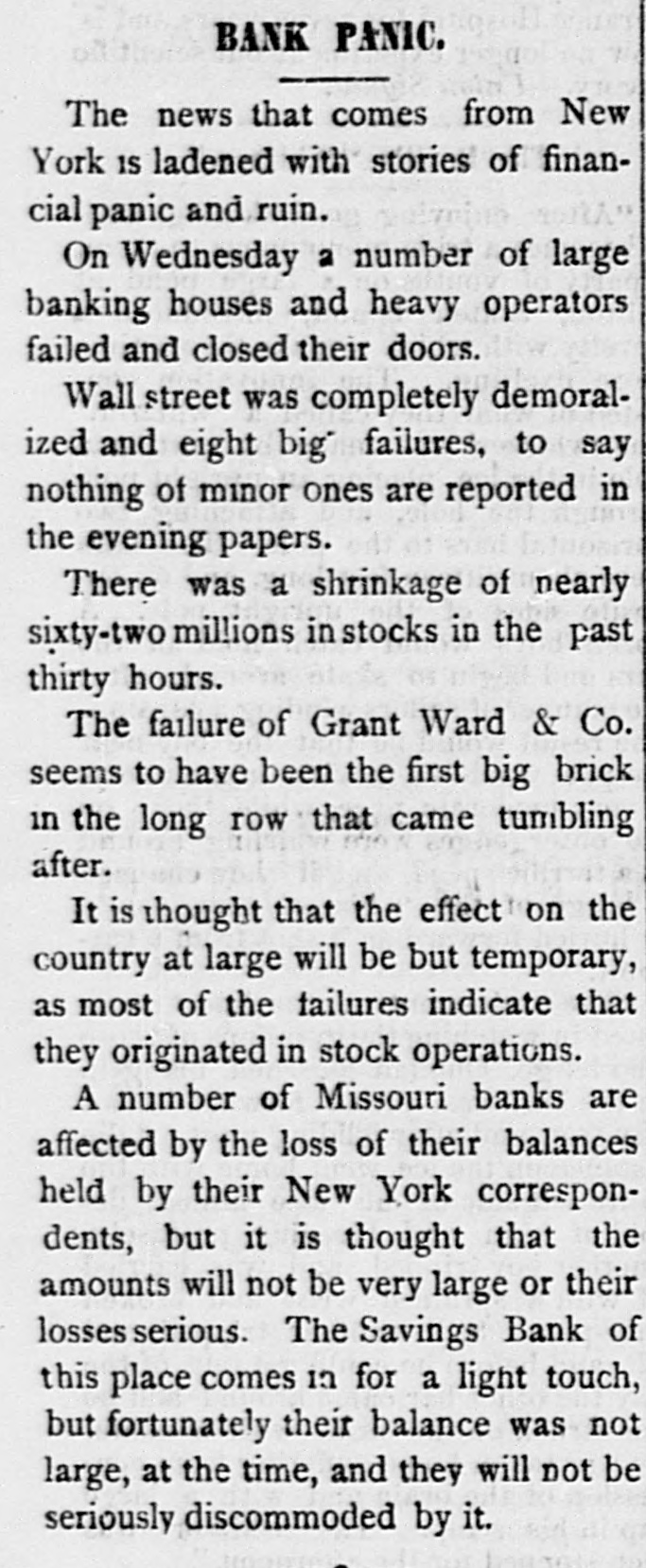
The news that comes from New York IS ladened with stories of financial panic and ruin. On Wednesday a number of large banking houses and heavy operators failed and closed their doors. Wall street was completely demoralized and eight big failures, to say nothing of minor ones are reported in the evening papers. There was a shrinkage of nearly sixty-two millions in stocks in the past thirty hours. The failure of Grant Ward & Co. seems to have been the first big brick in the long row that came tumbling after. It is thought that the effect on the country at large will be but temporary, as most of the failures indicate that they originated in stock operations. A number of Missouri banks are affected by the loss of their balances held by their New York correspondents, but it is thought that the amounts will not be very large or their losses serious. The Savings Bank of this place comes 13 for a light touch, but fortunately their balance was not large, at the time, and they will not be seriously discommoded by it.


Article from Daily Republican, May 16, 1884

Click image to open full size in new tab

Article Text

Grant & Ward's Failure

The failure of the New York bankers has caused con-iderable excitement and uneasiness among the people, but Stansbury Murray's Wales rigars have not been affected by the panic and are as popular as ever They never fail, but can always be found ab 104 East Front street.


Article from Arizona Silver Belt, May 17, 1884

Click image to open full size in new tab

Article Text

A COMPLICATED COLLAPSE

"The tallest pine feels most the power of wintry blast, and comes heaviest to the ground," which has an exemplification in the financial disaster which has overtaken Gen. Ulysses S. Grant, the senior member of the firm of Grant & Ward, bankers, in the city of New York, who have failed for $10,000,000. On the 7th inst. the supreme court of that state granted several attachments against Ferdinand Ward, U.S. Grant, U. S. Grant. Jr., and Wm. C. Smith. The first attachment was for the sum of $4,225 upon a check, in the hands of the plaintiff, drawn by the firm upon the Marine National Bank, in which they had no money and consequently payment of same was refused. Other attachments then quickly followed, and soon the wreck was regarded as complete. The firm's manner of doing business for some time is said to have been questionable, if not dishonest, they having hypothecated securities in their hands not their own, which are now beyond their reach, and for the recovery of which owners will be forced to seek redress through the courts. The railroads winged by Grant & Ward, as far as known on the 7th, were the New ork, Chicago and St. Louis, the New York, Lake Erie and Western, the St. Louis and San Francisco, and a number of other roads. Notices of reclamation were sent by all these companies to the banks and firms that held the re-hypothecated securities, as far as they were known. The loss of the "Silver Plated" railroad is stated at $400,000. Vanderbilt "accommodated the general" by exchanging checks with him the day previous to the suspension. Grant did not respond, but promises that Vanderbilt shall be reimbursed from his wife's property. The desire for the general's autograph has sensibly abated since his credit has fallen below zero. A New York dispatch announces that it is in contemplation by Roscoe Conkling and others, to circulate a begging petition, with a view of relieving the old gentleman who once circumnavigated the globe, "by particular request of friends," at government expense, with a view of having him in trim as a candidate for a third term president.


Article from Arizona Silver Belt, May 17, 1884

Click image to open full size in new tab

Article Text

A CORPLICATED COLLAPSE

"The tallest pine feels most the power of wintry blast, and comes heaviest to the ground," which has an exemplification in the financial disaster which has overtaken Gen. Ulysses 8. Grant, the senior member of the firm of Grant & Ward, bankers, in the city of New York, who have failed for $10,000,000. On the 7th inst. the supreme court of that state granted several attachments against Ferdinand Ward, D. S. Grant, U. S. Grant. Jr., and Wm. C. Smith. The first attachment was for the sum of $1,225 upon a check, in the hands of the plaintiff, drawn by the firm upon the Marine National Bank, in which they had no money and consequently payment of same was refused. Other attachments then quickly followed, and soon the wreck was regarded as complete. The firm's manner of doing business for some time is said to have been questionable, if not dishonest, they having hypothecated securities in their hands not their own, which are now beyond their reach, and for the recovery of which owners will be forced to seek redress through the courts. The railroads winged by Grant & Ward, as far as known on the 7th, were the New York, Chicago and St. Louis, the New York, Lake Erie and Western, the St. Louis and San Francisco, and a number of other roads. Notices of reclamation were sent by all these companies to the banks and firms that held the re-hypothecated securities, as far as they were known. The loss of the "Silver Plated" railroad is stated at $400,000. Vanderbilt faccommodated the general" by exchanging checks with him the day previous to the suspension. Grant did not respond, but promises that Vanderbilt shall be reimbursed from his wife's property. The desire for the general's autograph has sensibly abated since his credit has fallen below zero. A New York dispatch announces that it is in contemplation by Roscoe Conkling and others, to circulate a begging petition, with a view of relieving the old gentleman who once circumnavigated the globe, "by particular request of friends," at government expense, with a view of having him in trim as a candidate for a third term president.


Article from Yorkville Enquirer, May 22, 1884

Click image to open full size in new tab

Article Text

Scraps and facts

- It is rumored that there will be four candidates for Governor in Georgia, the Whigs Republicans, Greenbackersand Democrats, each having a candidate in the fleld. The bones of Carl Bechtler, who committed suicide near Rutherfordton, N. C., forty years ago, Chris. Bechtler and August Bechtler, three men of prominence in their day, were disinterred recently and placed in boxes for shipment to Germany. The National Anti-monopoly Convention met in Chicago on the 14th and nominated Benjamin F. Butler for President. There will be five other national conventions for the nomination of candidates for the Presidency, viz.: The Greenback-I Labor, in Indianapolis, May 28; the Republican, in Chicago, June 19; the Democratic, in Chicago July 8, and the prohibition in Pittsburg, July 23, the date of the last having been postponed from May, 21. Thomas L. Shields, the slayer of James G. Sitton, superintendent of a gold mine in Mecklenburg, N. C., about twelve months ago, and who was convicted and sentenced to be hanged on the 12th day of October, 1883, but who appealed to the Supreme Court, been granted hasbeengranted a new trial. Shields made a remarkable escape from the Mecklenburg jail a few weeks ago, but was recaptured on the following day and returned to prison. A young German, Henry Hulsner, of Savannah, sent a barrel of Georgia potatoes to his father, residing in the town of Hanover, Prussia. A letter from Mr. Hulsner states that the German officials siezed the potatoes and searched his father's house and put him under police surveilance, the innocent Georgia roots being magnified into a Socialist plot to introduce the Colorado potato bug into the empire. The German consul at Savannah has been called upon to set the matter straight. About ninety delegates from South Carolina attended the Southern Baptist Convention at Baltimore. The Home Mission Board reported that the total contributions for the year were $56,414; from South Carolina, $2,988. The Foreign Mission Board reported the total contributions, $89,625. Of this amount, South Carolina contributed $7 $7,690. There is reported a balance on hand for the first named Board of f$3,442, and a balof Missions for hand $9,566. on Foreign ance The next meeting of the Convention will be held at Augusta, Ga., in May, 1885. -General Grant concluded his letter expressing regret at his inability to attend the opening of the fair in Richmond, Va., in aid of the proposed Confederate Home, as follows: "I hope the fair may prove a success, and that the object contemplated may receive a support which will give to all the brave men who need it, a home and rest from cares. The men who faced each other in deadly conflct can well afford to be the best of friends now, and only strive for the rivalry in seeing which can be the best citizens of the grandest country on earth. - Anything like a general financial crash, in consequence of the failure of Grant & Ward of the Marine bank, in New York, has been averted, though several important failures followed the closing up of the business of Grant & Ward, who seem to have been the most reckless of stock gamblers. With them nearly all the family connections of the Grants claim to have lost their entire property. It is alleged that Chaffee, the wealthy father-in-law of young U. S. Grant, is left almost penniless by the collapse of the young operator's banking house. Charges of fraud and swindling have been preferred against Ward, and his business transactions are being judicially investigated. Hon. Wm. H. Barnum, Chairman of the Democratic National committee, was in Washington on Thursday. In an interview, he said his first choice for Democratic standard bearers in the coming campaign were Tilden and Hendricks. The old ticket, he thinks the strongest the party can nominate. Should Mr. Tilden decline, Mr. Flower, of New York, in the opinion of Mr. Barnum, is the strongest man and can carry New York by 60,000 majority, and New Jersey, Connecticut and Indiana, and probably Ohio. After Mr. Flower, Mr. Barnum thinks Mr. Randall the next best man, "by all odds." While expressing this individual opinion as to the relative strength of individuals, Mr. Barnum, when asked whom he favored, replied, The nominee.' - About 11 o'clock on the morning of the 14th, a collision on the Baltimore and Ohio Railroad, one mile east of Connellsville, between a freight train west and a construction train east, resuted in a terrible loss of life. The construction train consisted of six camp cars containing fifty laborers on the way to the Ohio Pyle Falls to work. It was telescoped and many men were crushed to death. Many of those who escaped death are terribly injured. There was a sharp curve where the accident occurred, and the trains came together with a crash. The cars took fire and the bodies were burned. The number killed outright is stated at fourteen, several of whom were burned and otherwise disfigured beyond recognition. It is true that Ben, an educated negro belonging to Gen. Jeff Davis, did buy the Davis plantations for $200,000, but it was a flat failure, and Ben was released from his bargain. The Washington correspondent of the Augusta Chronicle writes of him "He is now in the West engaged in commercial pursuits and doing reasonably well. He is a remarkable, phenomenal exceptional and most worthy black man, but he does not own Hon. Jeff. Davis' plantation. His children have relapsed into the ordinary intellectual dullness of the race. Dr. Cartwright, the celebrated ethnologist, took Ben's eldest son and had him educated at Paris for the practice of medicine. Every advantage was given the young man, but after five years of trial he was dismissed without a diploma." - One night last week a train of the Richmond and Danville Railroad was drawn from Richmond as far as Danville by a locomotive that was supplied with the newly patented electric headlight. The President of the road was on the engine to satisfy himself as to the working of the light. It was pronounced a success. For four hundred yards ahead the engineer could distinguish the smallest pebbles on the track and could readily see a man one mile distant from his engine on a straight track
Article from St. Paul Daily Globe, July 23, 1884

Click image to open full size in new tab

Article Text

Some Shrinkage

[New York Correspondence Detroit Free Press.] There's no doubt that Grant and Ward owed nearly $17,000,000 when their boom burst and filled the air with ruin. The assets would seem to be alright, too-at the first glance. Lawyer Davies makes them foot up the handsome total of $27,000,000. But a second glance shows a sad biatus or something so to speak. The $17,000,000 are "nominal," that is to say, wholly fanciful. Under the second glance they melt away at the rate of a thousand miles a minute till nothing remains but a beggardly $57,000. What will remain of the $57,000 when the receiver and his associates get through this deponent is not prepared to say. But it would not be surprising if Lawyer Davies, after absorbing the $57,000, turned round and sued the victims of Grant & Ward for finding out that all they could posssibly hope for in any case would be a cent or so on the dollar. Mr. Davies has the name of looking out pretty sharply for number one, and he certainly won't give his time for nothing in trying to square up the affairs of Grant & Ward. He is said to be somewhat disgusted at the discovery that a failure for seventeen millions, placed in his hands for settlement, pans out altogether only a shabby $57,000. There were other assets-some $12,000,000 when the failure took place. but they were held by banks and banking houses as collateral for loans, and the banks and banking houses turned them into cash before the receiver knew where to look for them. Ferdinand Ward and James D. Fish are not upset in any way by the result of the receiver's labor's. as they knew very well what it would be. Ward has settled down quite comfortably in Ludlow street jail and Fish is still in quiet occupation of his flat near the Casino, which he continues to visit quiet often. The Grants have dropped out of sight altogether. Nobody now talks about them at all. I believe General Grant and Mrs. Grant are at Long Branch; but the old prestige seems to be gone for good. and their comings and goings are no longer noted.


Article from The Kimball Graphic, August 1, 1884

Click image to open full size in new tab

Article Text

wares, of Boston, have assighed. Liabilities, $100,000; assets nominally the same. Judge Van Brunt, in New York, has given Receiver Davis permission to sue all parties who borrowed money from Grant & Ward. About 2,000 bricklayers, 3,000 laborers and 2,000 hod-hoisting engineers struck in New York for nine hours a day and the bosses acceded. At Elmira, N. Y., the private banking house of F. G. Hall closed its doors. Inability to realize on real estate. and securities is given as the cause. Henry Stevens, paper box dealer, of Chicago, has assigned. His attorney states the assets will approximate $100,000 and his liabilities one-half the sum. The Boston police are searching for Charles Elliott, aged twenty-seven, who while drunk in Lowell informed a friend that he had choked his wife to death at her residence in Boston. The police went to the place and found the woman dead as her husband stated. Only cheering words are heard from the wheat fields. North Dakota is extravagant in her praises of the condition of wheat, her favorite crop. The earliest sown in South Dakota was generally better stooled than seeded later, and gives a larger yield. The cost of the United States buildings is interesting. A site on Chestnut street, Philadel phia, cost $1,491,201; Boston, $1,329,096,and Chicago, $1,259,386. The cost per foot was; In Philadelphia, $17.53; in Boston, $27.96; in Chicago $9.90; in Cincinnati, $9.96, and in St. Louis, $5.98


Article from New-York Tribune, April 2, 1886

Click image to open full size in new tab

Article Text

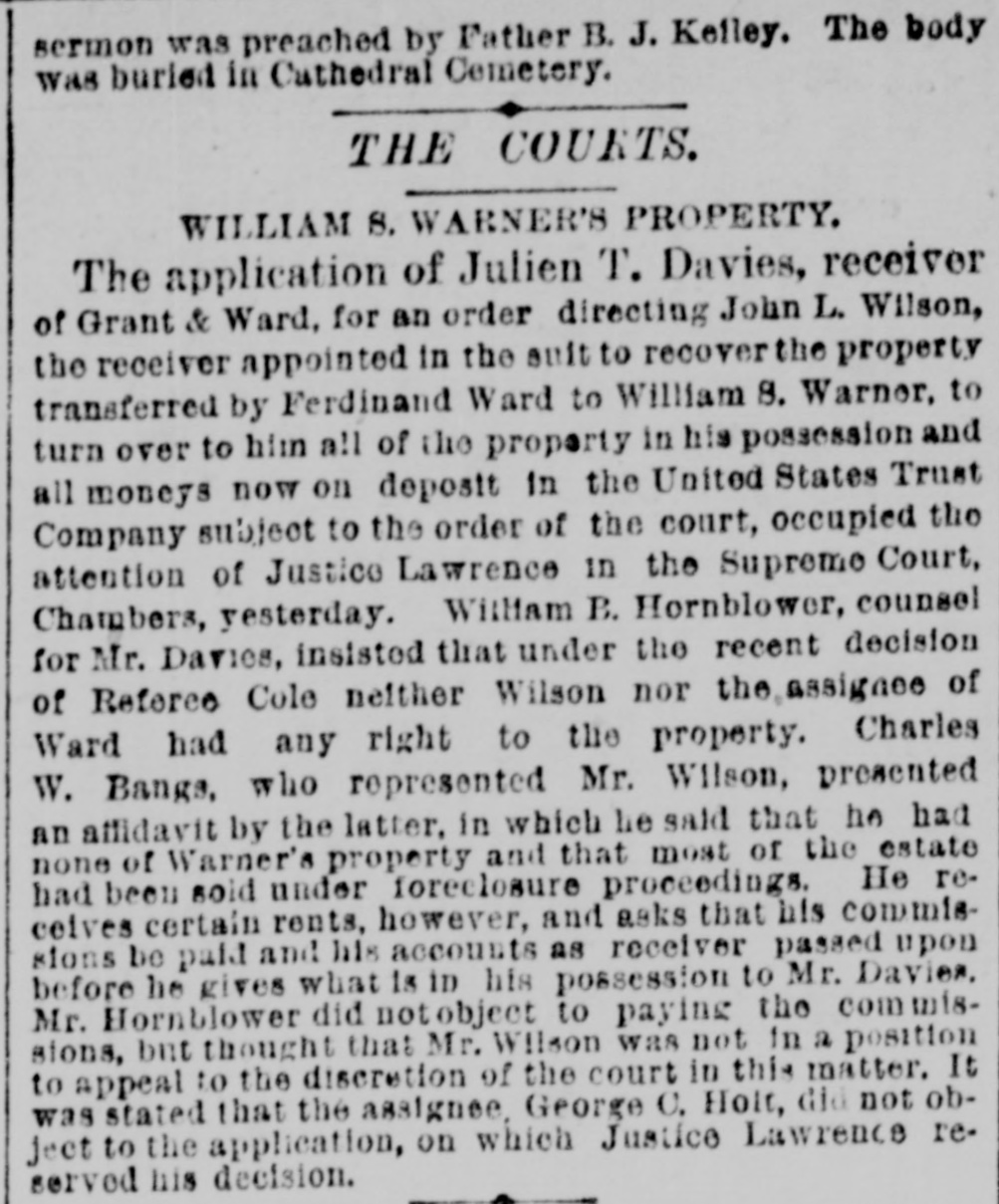
sermon was preached by Father B. J. Keiley. The body was burled in Cathedral Cemetery. THE COURTS. WILLIAM 8. WARNER'S PROPERTY. The application of Julien T. Davies, receiver of Grant & Ward, for an order directing John L. Wilson, the receiver appointed in the suit to recover the property transferred by Ferdinand Ward to William 8. Warner, to turn over to him all of the property in his possession and all moneys now on deposit in the United States Trust Company subject to the order of the court, occupied the attention of Justice Lawrence in the Supreme Court, Chambers, yesterday. WitHam B. Hornblower, counsel for Mr. Davies, insisted that under the recent decision of Referee Cole neither Wilson nor the, assignee of Ward had any right to the property. Charles W. Bangs, who represented Mr. Wilson, presented an affidavit by the latter. in which he said that he had none of Warner's property and that most of the estate had been sold under foreclosure proceedings. He recelves certain rents, however, and asks that his commisstons be paid and his accounts as receiver passed upon before he gives what is in his possession to Mr. Davies. Mr. Hornblower did notobject to paying the commissions, but thought that Mr. Wilson was not in a position to appeal to the discretion of the court in this matter. It was stated that the assignee, George C. Holt, did not objeet to the application, on which Justice Lawrence reserved his decision.


Article from New-York Tribune, July 13, 1886

Click image to open full size in new tab

Article Text

FERDINAND WARD'S CHARGES

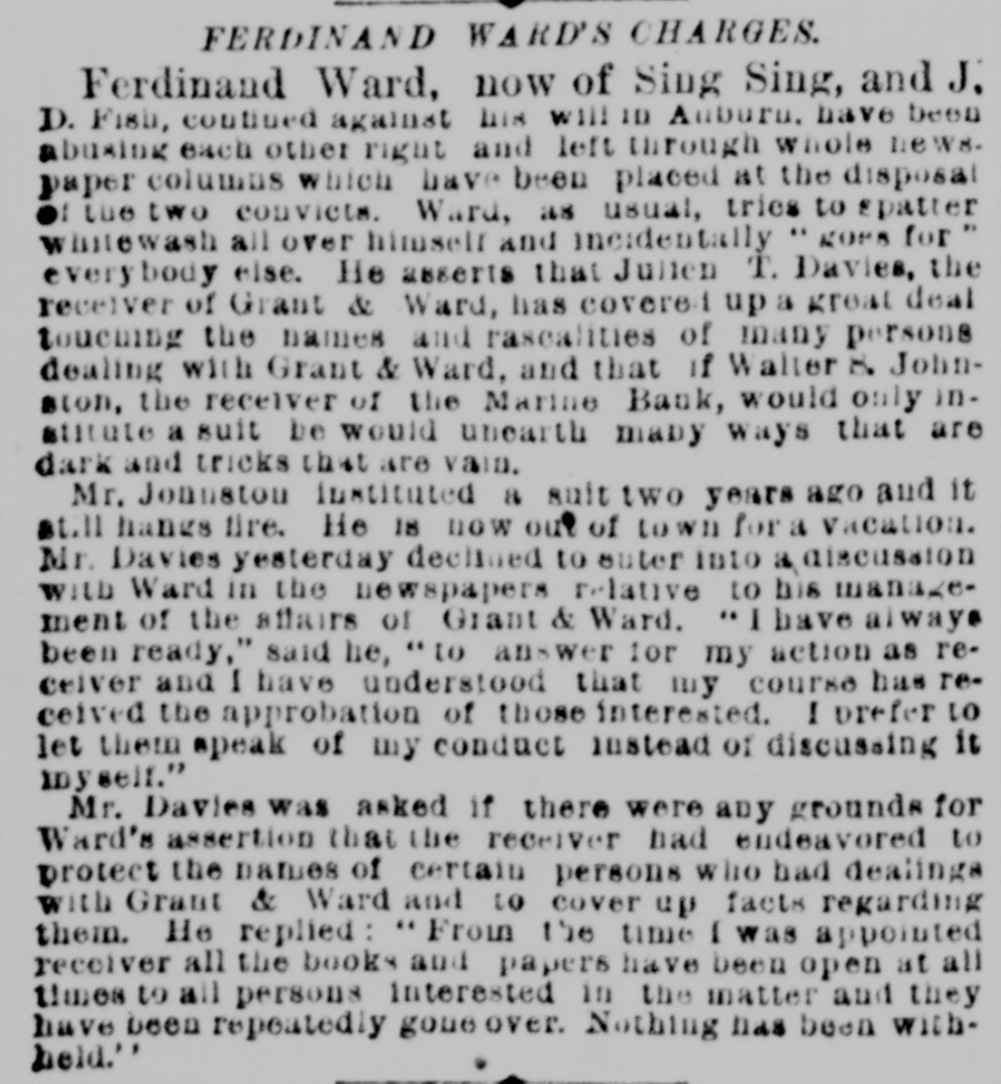
Ferdinand Ward, now of Sing Sing, and J. D. Fish, contined against his will ID Auburn. have been abusing each other right and left through whole news. paper columns which have been placed at the disposal I tue two convicts. Ward, as usual, tries to spatter whitewash all over himself and incidentally .. KOMS for" everybody else. He asserts that Julien T. Davies, the receiver of Grant & Ward, has covered up a great deal touching the names and rascalities of many persons dealing with Grant & Ward, and that if Walter & Johnston, the receiver of the Marine Bank, would only institute a suit be would unearth many ways that are dark and tricks that are vain. Mr. Jonnstou instituted a suit two years ago and it still hangs fire. He IS now out of town for: a vacation. Mr. Davies yesterday declined to enter into a discussion with Ward in the newspapers relative to his management of the affairs of Grant & Ward. I have always been ready," said he, " to answer for my action as receiver and I have understood that my course has received the approbation of those interested. I prefer to let them speak of my conduct instead of discussing it myself." Mr. Davies was asked if there were any grounds for Ward's assertion that the receiver had endeavored to protect the names of certain persons who had dealings with Grant & Ward and to cover up facts regarding them. He replied: From the time I was appointed receiver all the books and papers have been open at all times to all persons interested in the matter and they have been repeatedly gone over. Nothing has been withheld.'


Article from The Bridgeport Evening Farmer, September 23, 1916

Click image to open full size in new tab

Article Text

THE MECHANISM OF PANICS OMER S

CUMMINGS, in his address accepting the nomH ination for United States Senator, contributed an interesting picture of panics, that came before the passage of the Currency Law. "So unstable was our system, as built up by the great financiers of the Republican party (Who know all about business) that it was a prolific breeder of panics." "In 1873, in the midst of great prosperity, a panic followed the failure of Cook & Company." "In 1884 it was found that the president of the Second National bank had stolen three millions in securities. This brought on the run on the banks in New York, the failure of Grant & Ward, and a nation wide panic." "In 1893, Baring Bros. of England failed. The Philadelphia & Reading Company attempted to corner certain ore land and went into insolvency. A nation wide panic followed." "In 1907, Henize, president of the Mercantile National bank, used that institution in copper speculation. Other banks became involved. I There were plenty of assets, but a panic came. Right here in Connecticut wages were paid in token/money." Thus, briefly, does Mr. Cummings, with wide knowledge, portray the mechanism of panics, and the instability of a financial system which toppled like a house of cards under any abnormal strain, and which was blown over at the will of an element of the financial world whenever the purpose of exploitation would be thereby served. Mr. Cummings shows with equal brevity and certainty the extraordinary strain to which the country was submitted when the war came. In one year trade with Germany fell from five hundred million to fourteen millions of dollars, and in the month of August, 1914, trade with Europe fell off seventy-five millions. Securities were dumped upรณn the American market amounting to three billion five hundred millions. Ten days after the war began forty-eight millions of gold had been withdrawn by Europe. Previously the mere failure of a single banking house, the peculations of a single banker, the conspiracy of a few financiers had been sufficient to destroy confidence and precipitate business disaster. But now the Currency bill had been passed. Credit had been democratized. The foundation of confidence was placed fairly upon the abundant assets, the solid real and usable values of the wealthiest country on the globe. Instead of the overwhelming and disastrous panic which would have followed under the old system, the country scarcely trembled. For a moment, and a moment only, it paused, and then moved forward to the greatest prosperity in the history of the land, a prosperity enormous in quantity and broad in distribution. There have been other periods of prosperity, but none that has so generously touched all the strata of the nation. This prosperity gives the common laborer not merely an abundance of employment, as previous high tides of prosperity have done, but it actually moved his wages to a point where they outpassed the rising cost of living. The wages of unskilled labor in America are at this moment higher in money and higher in purchasing power than they have ever been before. This is the sort of prosperity that makes everybody prosperous. If even unskilled labor can buy liberally, the market is great, the demand vast, and all the mechanisms of industry move at a faster pace to meet the demand. Mr. Cummings is no little American. He takes no pettifogging view of the country in which he lives. He sees and speaks the future of a great people. He does not, like Governor Holcomb, proclaim that the flag of the Americans is the laughing stock of the world. He does not, like Senator McLean declare with ridiculous energy, that foreign goods are more to be feared than foreign bullets. A clean, strong, intelligent man is the Democratic candidate for United States Senator, with training for the work he is to do, and true Americans ideals to back his training. CONTAGIOUS IMMORALITY