Marine National Bank (New York, NY)

Episode Information

Episode UID
121501013
Episode Type
Suspension โ†’ Closure
Bank Type
national
Bank ID
12150 national
Charter Number
1215
Start Date
May 6, 1884
Location
New York, New York (40.714, -74.006)

Metadata

Model
gpt-5-mini (chosen from majority vote of a three-model LLM ensemble)
Short Digest
59d42b4e8064cce0

Response Measures

None

Receivership Details

Depositor recovery rate
83.5%
Date receivership started
1884-05-13
Date receivership terminated
1899-09-30
OCC cause of failure
Fraud
Share of assets assessed as good
59.4%
Share of assets assessed as doubtful
13.9%
Share of assets assessed as worthless
26.7%

Description

Failure tied to large overdrafts to Grant & Ward and heavy real-estate advances by President James D. Fish.

Events (4)

1. June 3, 1865 Chartered
Source
historical_nic
2. May 6, 1884 Suspension
Cause
Bank Specific Adverse Info
Cause Details
Unable to meet ~ $500,000 clearing house debt after overdrafts tied to the firm Grant & Ward and heavy real-estate advances by President James D. Fish.
Newspaper Excerpt
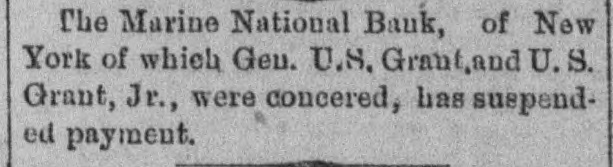
The suspension of the Marine National Bank was announced a little after 11 this morning; the immediate cause was the bank's inability to meet its debt of about $500,000 at the clearing house.
Source
newspapers
3. May 13, 1884 Receivership
Source
historical_nic
4. May 13, 1884 Receivership
Newspaper Excerpt
The Comptroller of the Currency has appointed Walter S. Johnston receiver of the Marine National Bank of New York.
Source
newspapers

Newspaper Articles (22)

Article from Evening Star, May 6, 1884

Click image to open full size in new tab

Article Text

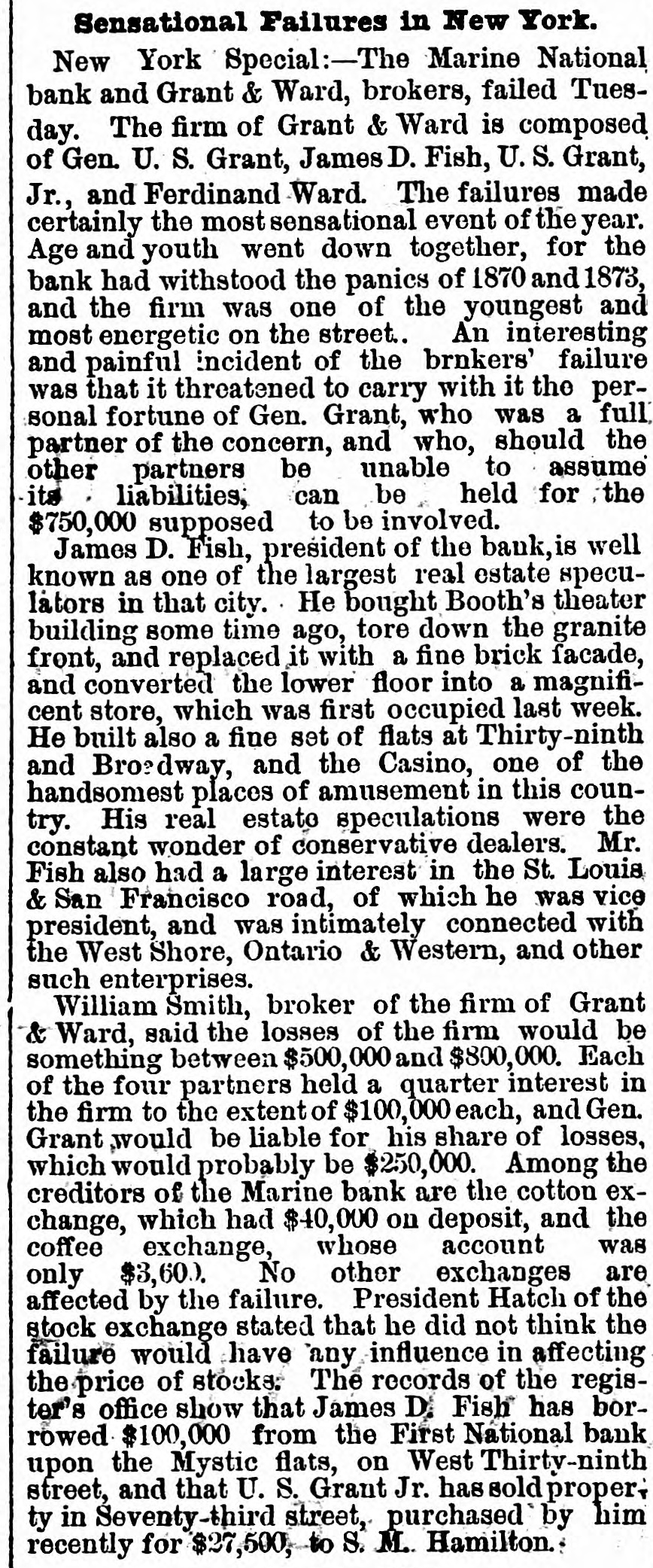
A Panic in Wall Street, THE EFFECT OF THE MARINE NATIONAL BANK FAILURE. NEW YORK, May 6.-The Post says: The stock market, after opening irregularly lower than last night, continued weak and feverish until about 11:15, when It began to weaken, and large amounts of the active stocks were thrown upon the market. It is presumable that this was at first mistaken a ruse of the bears, as the market was tolerab well supported up to that time. But immediately afterwards It was announced that the Marine National Bank, 78 Wall st., had closed its doors, being unable to raise the money to pay its debt of about $500,000 at the clearing house to-day. From 11:18 the market ran down rapidly, and just after when It was reported that Messrs. Grant & Ward would be obliged to suspend in consequence of the suspension of the Mo. rine National Bank, the market becam panicky. Stocks weretumbled out in all sorts of lot from the ordinary lot of 100 shares up to blocks of 6,000 shares in a lump, and the general decline in the hour to 11:45 ranged from X to SX per cent, the latter on Union Pacific, which sold down to Missouri Pacific declined 2% to 79%; Northern citic preferred, 2 to 52%; Erie, 2 per cent to W 9735; Western, 1% to 59%: St. Paul, 1% to 88%; Northwestern, 1% to 111k; Oregon and Transcontinental, 1% to 17%, Reading 1% to 41%, Lackawanna 1% to 117%, Louisville & Nashville ยฅ to M.K. m the 15 minutes before 12 o'clock there was a temporary and partial recovery from the panic, and prices recovered 36 to 1% per cent, the latter on Missouri Pacific to 80%. But immediately after 12 the selling was renewed, and though the market was.not SO panicky there was a continuance of the decline to lower prices than those above mentioned


Article from Lancaster Daily Intelligencer, May 7, 1884

Click image to open full size in new tab

Article Text

THE GRANT FAILURE Two Banks Gone to Smash 1a New York The failure of the Marine national bank and of Grant's banking firm, in New York, is the talk of the street. The bank had always been considered sound and conservative, but of late years it has fallen into the control of the Fish family, the head of which, Mr. James D. Fish, was president, and a perfect autocrat, although believed to be able, shrewd and honorable. He was so much interested in the bank that he had a suit of rooms fitted up in the building and there kept "widower's hall,' giving the closest attention to fiscal affairs and calling about him such rela tives as he could rely upon implicitly for integrity and strict obedience. Thus he made Mr. John D. Fish, a nephew, cashier, and had half a dozen other relations employed as clerks, while the "street" and "street exchange" work was done by the brokers' firm of Ward & Grant, No. 90 Broadway which is composed of Mr. Ferdinand Ward, General U. S. Grant, Mr. James D. Fish, U. S. Grant, jr., and W. C. Smith, the "board member and business man.' Somehow, between these men investments were made of some $700,000 in real estate, which ordinarily might be considered a profitable transaction; but owing to a pinch, the brokers overdrew the accounts in the bank about $600,000 and were unable to cover in time. Mr. Fish and Mr. Ward tried to realize on some securities, but failed, and, being very proud, would not bring them selves to ask for assistance. A very slight accommodation, as matters go now a days, would have saved the bank from the humiliation of suspension, as only a fortnight since it was in sound condition, and on Monday passed through the clearing house without a hitch. The immediate trouble was all brought about by the dealings of the bank with the firm of Grant & Ward. On Monday the cashier of the bank wasauthorized to certi. fy checks of Grant & Ward to the amount of $750,000, it being understood that the firm would deposit sufficient security Tuesday morning to cover the indebted ness. They failed to make the deposit, and in consequence when the checks were presented at the clearing house there was nothing to meet them with in the bank. The accounts showed that the bank owed a balance of $555,000 to the clearing house, but this was reduced to $339,000 by the discovery that there were among the over Grant made a checks bank fied checks then presented of payment $200,000 & to Ward. the in clearing uncerti- The of $210,000 in cash and the re. valuable its entire house charging mainder in securities, indebtedness. thus The dis. its of the bank over and above are surplus real estate is $250,000, liabilities. and there Mr. Fish no other outstanding must have lost his head completely. Mr. Childs, Grant's best friend in Philadelphia says the ex-president's house in New York, also the cottage at Long


Article from The Wheeling Daily Intelligencer, May 7, 1884

Click image to open full size in new tab

Article Text

d18. BIG BANK FAILURE THATDISTURBEDFINANCIAL CIRCLES m In New York Yeaterday-The Marine Bank Com. to pelled to Close Its Doore-The House of Grant and Ward Follows Sult, Belog Involved with the Crash-The Cause of the Failure. d NEW YORK, May 0.-The Marine Na. tional Bank is closed. J. D. Fish is cashier of the bank. A year ago the bank purchased Booth's theatre. The clearing house is considering the suspension. It is thought the failure is a bad one. The capital of the bank was $400,000. Its state ment September last showed a surplus of $130,000, undivided profit $62,345. A visit to the Bank discovered some fifty disconsolate depositors standing in the pouring rain around the closed doors. No admittance was given to reporters and no notice was posted on the door. The Bank was open at the usual time this morning but before noon closed abruptly without assigning a cause. The stock market was very active and there seemed to be some between the failure and the The appearconnection condition depositore, of affairs judging on the from stock the exchange. ance of those about the building, were a well-to-do class. An explanation is promised. The Associated Press reporter visited the clearing house endeavoring to obtain in formation from Major Camp. That official would only BAY the clearing house committee was in session. Nothing will be given public until the examination of ac. counts of bank are concluded. It is said on the street that the bank's downfall is due to real estate transactions of President Fish. Some time ago he bought Booth's theatre and is now converting it into stores. He is also interested in apartment houses. operations Officials of the had bank caused asked the whether suspension, Fish's whether the bank had been doing businees with brokers and HO lost money, refueed to answer. It is believed the failure is due to a little of both. GRANT & WARD'S FAILURE. Grant & Ward announce their closing in on account of the failure of the Marine bank. The firm of Grant & Ward, Wall street, comprise General U. S. Grant, Jes. B. Fish, S. Grant, Jr., Ferdinand Ward aud Win. C. Smith. James D. Fish was President of the suspended Marine bank. The direct cause of the failure of the Ma rine bank is now attributed to the overdrawing the account of the firm of Gr int, CO Ward & Co., who, it is said, haae been persistent bullson the market sinca the commencement of the shrinkage in 1882. Genof eral Grant was at the office of Grant, Ward Co. when the failure of the firm was announced. The General appeared to be in ill health and completely prostrated at the firm's unfortnnato speculations. It is re ported that $500,000 is missing from Grant & Ward, and that there has been a defaication. Ward is missing, and the vault doors cannot be opened, pe WILL PROBABLY NOT DO MUCH DAMAGE. CO The Mail and Expressarys of the Marine bank failure Inquiries elicited the fact that James D. Fish, President, had apart. Ca ments in the bank building, but did not ho occupy them last night, and had not been down town to day. Ambrose Snow, of the firm of Snow & Burgees, is Vice President of the Marine bank, but left the office of the firm immediately after the announcement of the failure, therefore no statement has been obtained from him. Among the banks opinions vary greatly as to the probable influence the Marine bank suspension will have upon the situation, but the majority are inclined to believe it will not do much damage, The faot that the bank had paid balance of $555,000 at the clearing house this morning tended to allay the fears of 8 great many, and it is conjectured the suspension will only be temporary. George R. Read, connected with Ludiow & Co., real estate dealers, said the troubles of the bank were not due to any unfortunate speculations in real estate of Fish, for howard abrewd speculate rand bought nothing but valuable property. The bank examiner in charge suspended the Marine bank. It is probable the Washington authorities will appoint a receiver. The Marine Bank was the designated de pository for the city of New York. Yesterday the city drew a draft of $300,000, which of & to was house part this morning, debit balance and It this in did the much clearing that precipitate the failure. is reported stock firm overdrew their account at the bank yesterday $500,000.


Article from The Semi-Weekly Miner, May 7, 1884

Click image to open full size in new tab

Article Text

The depositors, judging from the appearance of those about the building, are of the well-to-do class. An explanation is promised this afternoon. The Post says the suspension of the Marine National Bank was announced a little after 11 this morning. The immediate cause of the failure was the bank's inability to meet its debt of about $500,000 at the clearing house this morning, but the cause behind this is supposed to be the real estate operations of President James D. Fish during the last year or two. Within that time he bought Booth's theatre and the Casino and has also recently purchased a large apartment building. The reconstruction of Booth's theatre and building of the "Mystic," have taken a great deal of ready money which he is presumed to have borrowed from the bank. Fish is second vice president of the St. Louis & San Francisco railroad, and the Marine Bank is the registration office of that stock. It is presumed this connection had nothing to do with the embarrassment of the bank, though it is understood that some connection with either Ontario & Western and West Shore stock manipulations may have had some influence, though something only secondary to the real estate operations of the president. A few minutes after 10 o'clock a gentleman made a deposit at the Marine National Bank and as he went out was followed to the door by the bank porter who began rolling down the iron shutters. The depositor ran back but the receiving clerk had shut his window and gone out of business for an indefinite period. The paying teller was still more conspicuous by his absence and the depositor had the consolation of standing on the steps of the bank the next hour telling his experience to a crowd of excited depositors who gathered at the corner of Wall street and Pearl within an incredibly short time. Unless the failure was the result of worse than too heavy real estate speculations, the failure will not prove disastrous. One depositor said Wall street generally objected to the Marine tank because of its family character. James D. Fish is president, and John D. Fish, his nephew, cashier, and half a dozen other relatives of the president* were in positions of trust.


Article from The Democratic Leader, May 7, 1884

Click image to open full size in new tab

Article Text

to The Substantial Marine Bank Throws up the Sponge. is A Very Heavy Failure That May Be Redeemed. n General Grant's Firm Badly at is Involved in the Ruin. A Bad Failure. NEW YORK. May 6.-The Marine National Bank has closed. J. D. Fish is President of the bank. The capital of the bank was $400,000. Its statement of September 22, last, showed a surplus of $120,000; undivided profits, $62,345. A visit to the bank discovered some fifty disconsolate depositors standing in the pouring rain around the closed doors. No notice was posted on the door. The bank opened at the usual hour this morning. but before noon closed abruptly, without assigning a cause. The stock market is very active and there seemed to besome connection between the failure and the condition of affairs on the Stock Exchange. The depositors, judging from the appearance of those about the building, are a well to do class. The Post says: "The suspension of the Marine National bank was announced a little after 11 o'clock this morning. The immediate cause of the failure was the bank's inability to meet its debt. about $500,000, 0 at the clearing house this morning. But the causes lying behind this is presumed to be the real estate operations of President James D. Fish, during the last year or two. Within that time he bought Booth's theatre and the Casino and has also recently been building a large apartment building, "The Mystic, on West Thirty-ninth street. The reconstruction of Booth's theater and the building of "The Mystic" have taken a great deal of ready money which he is presumed to have borrowed from the bank. Fish is second vice president of the St. Louis & San Francisco railroad. It is not presumed this connection had I anything to do with the bank's embarrassment though it is understood some b connection with either Ontario & Western a and West Shore may have had some influence, though probably only secondary to the real estate operations. A few minutes after 10 o'clock a gentleman t made a deposit at the Marine National bank and as he went out he was followed to the door by the bank porter who began rolling down the iron shutters The depositor ran back to the receiving teller. but he had shut his window and gone out t of business for an indefinite period. The paying teller was still more conspicuous by his absence, and the depositor had the consolation of standing on the steps of the bank for the next hour and telling his S experience to a crowd of excited depositors who gathered at the corner of Wall street and Pearl within an incredibly short time. Unless the failure was the result of worse than too heavy real estate speculation. it will not prove disastrous. One depositor says that Wall street generally objected to the Marine bank, because of its family character. James D. Fish is President. John D. Fish, his nephew, cashier, and half a dozen other relatives of the President were in positions of trust. The capital of the bank was $400,000. NEW YORK, May 6.-The suspension of Grant & Ward was announced on Stock f Exchange. The firm was composed of General U. S. Grant, James D. Fish, U. S. Grant, Jr., and Ferdinand Ward. About 600 shares of C., C., C. & I., Omaha & Alton and Terre Haute were closed out under the rule; also some Nickel Plate second mortgage. Wall

Article from The Dallas Daily Herald, May 7, 1884

Click image to open full size in new tab

Article Text

CO may nounce closing on account of the failur Marine bank. A visit to the bank discovered some fi disconsolate depositors standing in pouding rain around the closed doors. admittance was given reporters. No not was posted on thedeor. The bank was o the usual hour this morning, but bet noon closed abruptly without assigning , cause. The stock market was very act and seemed to be some connection betw the failure and condition of affairs of tock exchange. Depositors, judging fr the appearance of those about the buildi of the well-to-do class. Explanation promised for the afternoon. NEW YORK, May Associated P reporter visited the clearing house ende bring to obtain information from Mana Camp, but that official would only say clearing house committee was in sess and nothing would be given to the pu until it has concluded the examination the accounts of the bank. It is said on streets that the bank's downfall is due to real estate transaction of President F Sometime ago he bought Booth's the and is now converting it into stores. also interested in apartment hou Officials of the bank asked whether Fis operations had caused the suspension : whether the bank Was doing business w brokers and SO lost money. He retused answer. It is believed that the failure ine to a little of both. The P st save: The suspension of the ! ne National bank was announced a 11 after 11 o'clock this morning. The im diate cause of the failure was the bar inability to meet its debt, about $600,00 the clearing house this morning, the cause lying behind this presumed to be the real est operations of President James D. F during the last year or two, within that time he bou Booth's theatre and the Cas and has also recently been building la spartment building, "The Mys West Thirty-ninth street. reconstruction of Booth's the and building of The Mystic" have ts great deal of money which he is pres to have borrowed from the ha Fish is second vice-presid of the St. Lonis & San Franc railway and the Marine bank is the re tration office of that stock. It is not pres this connection had anything to do , the bank's embarrassments, though i understood to have some connection . either the Ontario & Western or V Shore bonds; manipulation may have some influence, though probably second to the real estate operations of the p dent. A few minutes after 1 o'c a gentleman made a deposit the Marine National bank, and as he v out was followed to the door by the b porter, who began rolling down the shutters. The depositor ran back to find the receiving teller had shut window and gone out of business for at definite period. The paying teller was more conspicuous by his abse The depositor had the consolation of ats ing on the steps of the bank for the 1 hour and telling his experience to cro of excited depositors who gathe the corner of Wall and Pearl str within an incredibly short time after failure of the bank was announced information WAS denied reporters. Go among the crowd of depositors attribt the failure chiefly to the miscarri of large real estate speculat by James D. Fish. The business d was not considered large the neighborhood, and the fee mong the depositors was hep that while some delay might be caused ressity of selling a large amount but unless the fai se than too heavy real es on, the failure would not pi Trous one to the depositors, disposed to make the best of it, said Wall street generally objected to Marine bank because of its fan


Article from The Emporia Weekly News, May 8, 1884

Click image to open full size in new tab

Article Text

Bad Bank Failure, A New YORK, May 6.-The Marine Na. tional bank, J. D. Fish, president, has closed. A year ago the bank purchased Booth's theatre. The clearing house is considering the suspension. The failure is & bad one. A visit to the bank discovered some fifty disconsolate depositors standing in the pouring rain around the closed doors. No admittance was given to reporters and no notice was posted on the door. The bank opened at the usual time this morning but before noon closed abruptly without assigning any cause. The stock market was very active and there seemed to be some connection between the failure and the condition of affairs on the stock exchange. The depositors, judging from the appearance of those about the building, are a well-to-do class. An explanation is promised this afternoon. An Associated Press reporter visited the clearing house for the purpose of endeayoring to obtain information from Manager Camp. That official would only ssy that the clearing house committee was in session. Nothing will be given to the public until they conclude their examination of the accounts of the bank. It is said on the street that the bank's downfall was due to the real estate transactions of President Fish. Some time ago he bought Booth's theatre and was converting it into stores. He is also interested in spartment houses. An official of the bank was asked whether Fiske's operations had caused the suspension, and whether their bank was doing business with the brokers and 80 lost money. He refused to answer. It is believed the failure is due to & little of both.


Article from The Portland Daily Press, May 9, 1884

Click image to open full size in new tab

Article Text

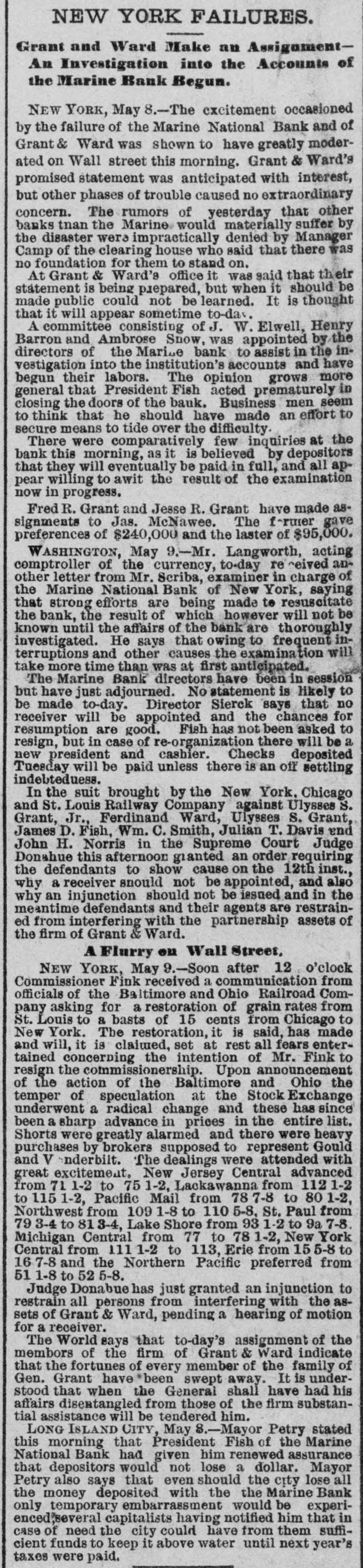
NEW YORK FAILURES. Grant and Ward Make an AssignmentAn Investigation into the Accounts of the Marine Bank Begun. NEW YORK, May 8.-The excitement occasioned by the failure of the Marine National Bank and of Grant & Ward was shown to have greatly moderated on Wall street this morning. Grant & Ward's promised statement was anticipated with interest, but other phases of trouble caused no extraordinary concern. The rumors of yesterday that other banks tnan the Marine would materially suffer by the disaster were impractically denied by Manager Camp of the clearing house who said that there was no foundation for them to stand on. At Grant & Ward's office it was said that their statement is being prepared, but when it should be made public could not be learned. It is thought that it will appear sometime to-dav. A committee consisting of J. W. Elwell, Henry Barron and Ambrose Snow, was appointed by the directors of the Maribe bank to assist in the investigation into the institution's accounts and have begun their labors. The opinion grows more general that President Fish acted prematurely in closing the doors of the bank. Business men seem to think that he should have made an effort to secure means to tide over the difficulty. There were comparatively few inquiries at the bank this morning, as it is believed by depositors that they will eventually be paid in full, and all appear willing to awit the result of the examination now in progress. Fred R. Grant and Jesse R. Grant have made assignments to Jas. McNawee. The f-ruier gave preferences of $240,000 and the laster of $95,000. WASHINGTON, May 9.-Mr. Langworth, acting comptroller of the currency, to-day re reived another letter from Mr. Scriba, examiner in charge of the Marine National Bank of New York, saying that strong efforts are being made to resuscitate the bank, the result of which however will not be known until the affairs of the bank are thoroughly investigated. He says that owing to frequent interruptions and other causes the examination will take more time than was at first anticipated. The Marine Bank directors have been in session but have just adjourned. No statement is likely to be made to-day. Director Sierck says that no receiver will be appointed and the chances for resumption are good. Fish has not been asked to resign, but in case of re-organization there will be a new president and cashier. Checks deposited Tuesday will be paid unless there is an off settling indebteduess. In the suit brought by the New York. Chicago and St. Louis Railway Company against Ulysses S. Grant, Jr., Ferdinand Ward, Ulysses S. Grant, James D. Fish, Wm. C. Smith, Julian T. Davis end John H. Norris in the Supreme Court Judge Donahue this afternoon gianted an order requiring the defendants to show cause on the 12th inst., why a receiver snould not be appointed, and also why an injunction should not be issued and in the meantime defendants and their agents are restrained from interfering with the partnership assets of the firm of Grant & Ward. A Flurry on Wall Street, NEW YORK, May 9.-Soon after 12 o'clock Commissioner Fink received a communication from officials of the Baltimore and Ohio Railroad Company asking for a restoration of grain rates from St. Louis to a basts of 15 cents from Chicago to New York. The restoration, it is said, has made and will, it is claimed, set at rest all fears entertained concerning the intention of Mr. Fink to resign the commissionership. Upon announcement of the action of the Baltimore and Ohio the temper of speculation at the Stock Exchange underwent a radical change and these has since been a sharp advance in prices in the entire list. Shorts were greatly alarmed and there were heavy purchases by brokers supposed to represent Gould and V nderbilt. The dealings were attended with great excitemeat. New Jersey Central advanced from 71 1-2 to 75 1-2, Lackawanna from 1121-2 to 115 1-2, Pacific Mail from 78 7-8 to 80 1-2, Northwest from 109 1-8 to 110 5-8, St. Paul from 79 3-4 to 81 3-4, Lake Shore from 93 1-2 to 9a 7-8. Michigan Central from 77 to 78 1-2, New York Central from 111 1-2 to 113, Erie from 15 5-8 to 16 7-8 and the Northern Pacific preferred from 51 1-8 to 52 5-8. Judge Donabue has just granted an injunction to restrain all persons from interfering with the assets of Grant & Ward, pending a hearing of motion for a receiver. The World says that to-day's assignment of the membors of the firm of Grant & Ward indicate that the fortunes of every member of the family of Gen. Grant have been swept away. It is understood that when the General shall have had his affairs disentangled from those of the firm substantial assistance will be tendered him. LONG ISLAND CITY, May 8.-Mayor Petry stated this morning that President Fish of the Marine National Bank had given him renewed assurance that depositors would not lose a dollar. Mayor Petry also says that even should the city lose all the money deposited with the the Marine Bank only temporary embarrassment would be experienced,several capitalists having notified him that in case of need the city could have from them sufficient funds to keep it above water until next year's taxes were paid.


Article from The Dallas Daily Herald, May 9, 1884

Click image to open full size in new tab

Article Text

the Camp, for grounds this YORK May 8 & War made assignment to J. Davis. NEW YORK, May -Fred R Grant and Jesse R Grant made assignmental to James McName. The former gave preference of 000: the latter NEW YORK May excitement by the failure of the Marine National benk and Grant Ward. has greatly moderated Grant & Ward's statement is anticipated interest. The committee to investithe Marine bank accounts has begun labors. The opinion grows that President Fish acted prematurely There were a few bank this morning, deposi tora they would be paid in ful LONG ISLAND CITY, May Mayor Pety assured by president Fish of that city that he will not lose a dollar by the closing of the Marine bank the suit brought by the New York Chicago St. Louis Railway company FerS Grant, against Ulysea D James Grant, S Ward, dipand Fish. William C. Smith Julian T. Davies John H. the supreme court Judge afternoon granted an order requiring the defendant o show cause on the 12th inst. why coiver should not be appointed, and also why an injunction should not be issused and in the meantime and until further order of court. defendants and their agents are from terfering with the partnersh assets of the firm of Grant Ward, from the same or appropriate ing the same to payment of any debts of the leave without firm the of and The order court injunction were granted upon complaint Vando of H. affidavit and dent of the New York, Chicago Lonis Railroad company In his that about B&VS Vanderbilt April 12th, 1884, the railroad company made promissory note bearing date that day whereby, for value received it ,promised to pay Grant & Ward $500,00 will become due January lat, 1885. On the 20th of April the railroad made another promissory note, payable the same firm. for $200 000 note 1885 becomes payable January As collateral security for the pay of these notes. plaintiff deposited with Grant $140,000 in negotiable bonds of the railroad company for $1,000 each payment of which was secured second mortgage upon its railroad. Vanderbill alleges on the information and belief that Grant and Ward upon the ceipt of these notes and securities united these bonds indiscriminateto ly with securities belonging other parties for the purpose of borrowing money. and plaintiff's propertv has become distributed among a great numbe of persons and corporations who have or claim of some lien thereon as lenders & money on security to Grant Ward. By this mingling up the securities become liable to be sold for debts for which they were not the pledged firm by originally and their indentity is likely to be lost. The defendants in the suit, J. L. Davies and John H. Morris are the signees. Plaintiff's company desires to redeem its property from unlawini liens and claims. In the pending suit plaintiff asks for the appointment of receiver for the firm of Grant Ward. to take charge of its property NEW YORK, May 8.-The Marine bank directors have adjourned. No statement likely to be made o-day. Director Lierck says no receiver will be appointed and the chances of resumption good. President Fish has not been naked to resign. but in case of reorganization there will be a new president and cashier Checks deposited Tuesday will be paid unless there 18 offsetting indebtedness. A Sable Scandal. BALTIMORE, MD. May An appeal from the Rev. A. R. Carson, of the Northeast Texas conference, was brought before the African Methodist Episcopal General con. ference to-day to have righted certain wrongs, which he claimed were inflicted upon him by the annual conference of his district at Waco, Texas, in 1882. The charges are insubordination, immorality and intemperance. The appeal was made on the grounds that here were only verbal charges, were no specifications to the time or place of the offense and that he was not brought face to face with his accusers; that Bishop R H. Cain, presiding over the district conference, was the accuser of Car son and influenced the finding of the verdiet of guilty and suspension of one year against Carson; that eighteen voted for conviction and twelve for acquittal and of those who voted conviction, ten were not members of the conference that there was a refusal to take the vote by veas and nays, and the vote was unduly influenced by Bishop Cain, who violently demanded that every one vote against Carson, because Carson wasnot present when the case was called for trial. and the Texas conference had sent in no record of the proceedings, the verdict of the northeast Texas conference was revised and Carson reinstated in all his privileges. The Ocean Horror. TORONTO, May 8.-Bennett stated tha t e fore the boat was lowered some one cut the falls too soon and the boat emptied all the passengers into the sea. He, with five others, climbed on the keeliano sat there all night. Under the boat were a number of former companions, all of whom were found dead next morning. The emal number of passengers saved he attributed to the rapidity with which the Fiorida and to down the went fact that the captain, who apparently did of not realize the position irs, made no ende to get them into the bost Though the surviving officere very reticent the responsibility to he accident the seems to be the steamship blame. The men on the keel of boat picked off next morning former companions in other up boats. boats. The which kept Saturday morning but not hail the were picked next up bound Theresa, by Two the Quebec Quebec. yesterday survivors the such duration that there chance of observation. ANOTHER DISASTER PORTLAND


Article from Lancaster Daily Intelligencer, May 9, 1884

Click image to open full size in new tab

Article Text

THE BIG SMASH OF THE GRANTS Liabilities From six to Tea millions-The Entire Fortunes of the Family Good -Cookling their Legal Acviser. The facts which are gradually leaking regarding the operations and business out athods of the suspended firm of Graut Ward, whose collapse was coincident & with the Marinet national bank ou Tuesday. exhibit the condition of the house in even im worse light than has been generally a agined. Not only are they known to have rehypothecated the securities lodged with but their on loans by railroad companies, have obtained larger advances ou they some of these collaterals than the amounts they had advanced. The best information now puts their liabilities at not far from $10, of gross 000.000 No estimate can be made assets exclusive of the loans they retheir made on the securities they have pledged s tatement is yet obtainable respect the condition of the Maribe back. and the ing prospect of the final payment to de positors will be a mere matter of guess his work until the bank exaniner finishes report. An epormous amount of unsecured lis bilities of the firm exists, comprising notes and simple receipts for money received for Confidence speculati in the house. however, caus lie many persons to let their money unclaimed ed for a long time It is stated good authority that there are outstand nearly $2 000 of these unsecured ing firm held between obligation that the abilities am unt will in this about 85,000,000. The Assignments The deeds of assignment furnish the defl. rather the most nite admissions made by Grant Ward Fish as to the nature of their of the financial firm relations transactions with the back and of the if the bank with the members of the firm. ident Fish. in his assignment directs the and satisfaction in full of under any obligation payment and ability which be is trust fund estate, individually as trustee, any to the Marine National bank and as indorse or guarantor upon any notes or obligations of the firm Grant & Ward which were counted for or at his req and 11 on which he received the I whomsoever the obligations ceeds held, other by that the Marine National bank. num The firm of Grant it Ward prefer a of creditors, but do not state for amounts. Preference is given to t full by reason of their holding the guarantee of the performance of contracts or the firm's promissory notes. have Creditors are next preferred who made loans to the firm or deposited money securities with the firm and who are or secured by collaterals. The of her not creditors will div le whatever may be !eft after paying the references. The provis ions regarding the preferences confirm what has already been said in reference practice of the firm in obtaining the upon representations that it was money interested in large government, railroad other contracts. Methods From persons cognizant of the affairs three of concern it is learned that about the the firm of Grant & Ward, in which years age General Grant and Mr. Fish were then special partners, became embarrassed The two general partners U. S Grant jr., Ferdinand Ward, had been in business and together only about a year and had used olved the $200,000 special capital provided by General Grant and Mr. Fish well as the capital furnished by them. selves. In order to keep the firm upon the its feet the special partners ind orsed in firm's notes and other wise ded them procuring The assumption $300,000 appeared to be that the could get the supposed contract firm to because of the relations of its senior terred partner with the federal government of and with politicians. What the nature or the contracts were, if there were any, in what way the firm was interested can be learned. or late it is said the firm has not given only receipts for the moneys received in connection with the contract scheme. To what extent they bave issued receipts and their notes for a similar pur cannot be accurately stated. Persons pose position to know say that the amount 10 a cannot short of $5,000,000. It is known that one capitalist has invested nearly $1,000,000 and another $750,000 in this plausible enterprise. It was possibly to give plausibility to their operations and to advance their financial reputation the firm recently began to advance large sums of money to railroad and other corporations generally presumed that it was owing It is the ease with which the young men to raised this sum that either the firm as a whole, or Ward acting in their name, not entered upon the practices that have only ruined them but impaired the fortunes of many others. The way Money was Got. a For two years or more the active mem bers of the firm, that is, all the members in except General Grant, and persons various occupations and professions whom they have employed, have laid before capi y talists and investors a scheme for making In quick, sure and handsome profits. some cases it was represented that the firm was interested in extensive govern ment contracts, in others that it was on the inside in some railroad enterprise and in others it was simply stated that the enterprise was one the exact nature of which could not be divulged, but in no in stance yet beard of was the precise chare acter of the undertaking stated to the , person approached. The firm desired money to carry on or fulfill the contracts enterprises in question, and moreover wished their friends to share in the profits. As security for the amounts advanced y upon these schemes the firm gave either Gen. its notes, some of them indorsed by Grant, some by Mr. Fish,or, in very many instances, simply the firm's receipt. Enormous Interests Paid. I Upon these advances the firm agreed to and did pay interest, or what purpor- rate pay ted to be a share of the profits, at the of from two to five per cent. for the use of the money thirty days. The higher rate was, according to all accounts. most


Article from The Carbon Advocate, May 10, 1884

Click image to open full size in new tab

Article Text

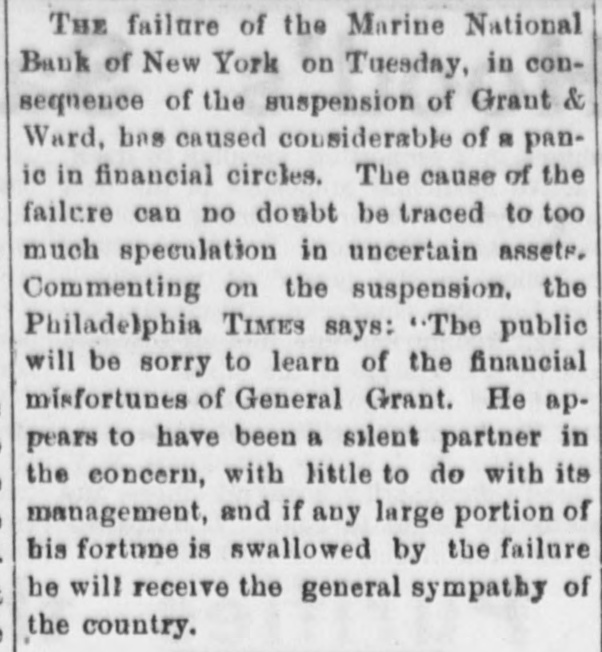
THE failure of the Marine National Bank of New York on Tuesday, in consequence of the suspension of Grant & Ward, bas caused considerable of a panic in financial circles. The cause of the failcre can no doubt be traced to too much speculation in uncertain assets. Commenting on the suspension. the Philadelphia TIMES says: "The public will be sorry to learn of the financial misfortunes of General Grant. He appears to have been a silent partner in the concern, with little to do with its management, and if any large portion of bis fortune is swallowed by the failure he will receive the general sympathy of the country.


Article from Savannah Morning News, May 12, 1884

Click image to open full size in new tab

Article Text

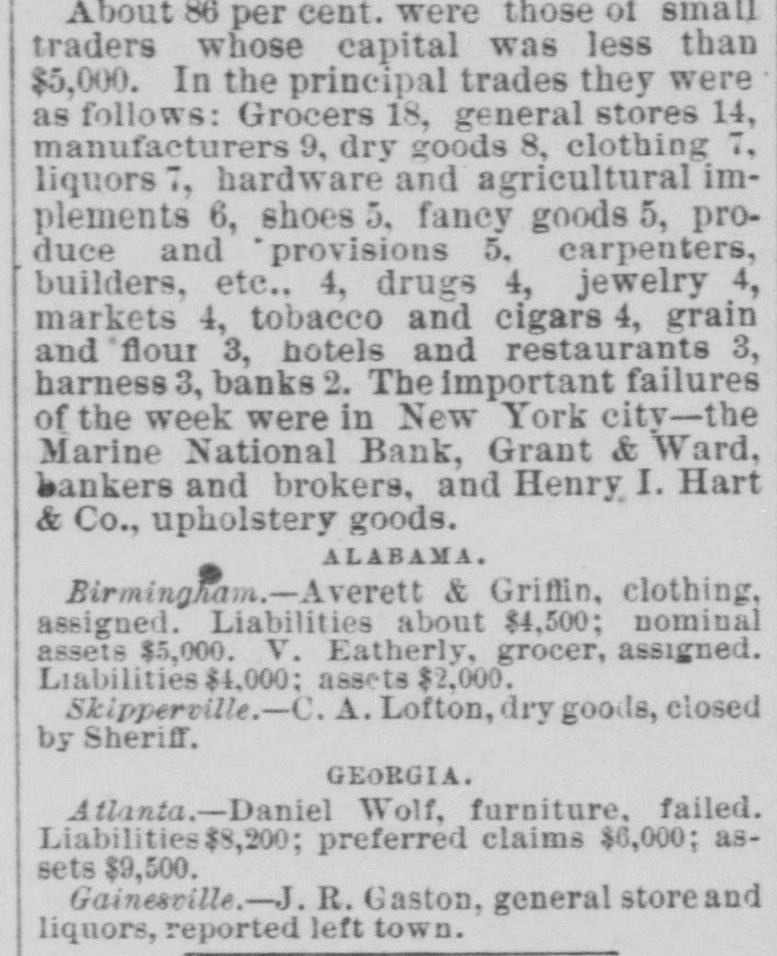
About 86 per cent. were those of small traders whose capital was less than $5,000. In the principal trades they were as follows: Grocers 18, general stores 14, manufacturers 9, dry goods 8, clothing 7, liquors 7, hardware and agricultural implements 6, shoes 5, fancy goods 5, produce and "provisions 5. carpenters, builders, etc., 4, drugs 4, jewelry 4, markets 4, tobacco and cigars 4, grain and "flour 3, hotels and restaurants 3, harness 3, banks 2. The important failures of the week were in New York city-the Marine National Bank, Grant & Ward, bankers and brokers, and Henry I. Hart & Co., upholstery goods. ALABAMA. Birmingham.-Averett & Griffin, clothing, assigned. Liabilities about $4,500; nominal assets $5,000. V. Eatherly, grocer, assigned. Liabilities $4,000; assets $2,000. Skipperville.-C. A. Lofton, dry goods, closed by Sheriff. GEORGIA. Atlanta.-Daniel Wolf, furniture, failed. Liabilities $8,200; preferred claims $6,000; assets $9,500. Gainesville.-J. R. Gaston, general store and liquors, reported left town.


Article from Evening Star, May 14, 1884

Click image to open full size in new tab

Article Text

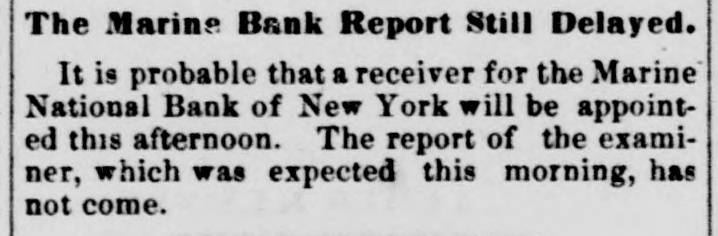
RECEIVER FOR THE MARINE NATIONAL BANK.Mr. Cannon, controller of the currency, has appointed Mr. Walter S. Johnston receiver of the Marine National bank of New York, Mayor Edson and Controller Grant, of New York, the largest depositors of the broken bank, recommended the appointment of Mr. Johnston.


Article from The Democratic Leader, May 14, 1884

Click image to open full size in new tab

Article Text

TELEGRAPHIC BREVITIES. President Arthur arrived in Washington from New York yesterday. The estimate of the Mexican Government expenses for the next fiscal year, as sent to Congress is $25,700,000. Willard's hotel at Washington caught fire yesterday. After much excitement it was extinguished without much loss. Secretary Lincoln and Lieutenant-General Sheridan left Washington last night for Sandusky, Ohio, on a fishing tour. The Comptroller of the Currency has appointed Walter S. Johnston receiver of the Marine National Bank, New York. The remains of Charles O'Conor arrived in New York last night and were taken to-St. Patrick's Cathedral and placed in a vault. The Governor of Massachussets has signed the bill to prevent life insurance companies from discriminating against colored people. The American Pisticultural association began its thirteenth annual session at the National Museum building, in Washington, yesterday. As passed by the Senate there is added to the Indian appropriation bill about $85,000 more than the amount reported by the senate committee on appropriations. Further consideration of the trade dollar bill was postponed in the Senate yesterday until the third Tuesday in June. The object is to avoid currency agitation for the present. Postmaster General Gresham has returned to Washington from Boston, where he perfected arrangements for eastern connections with the fast mail trains for the West and South.


Article from The Dallas Daily Herald, May 14, 1884

Click image to open full size in new tab

Article Text

RECEIVER APPOINTED, WASHINGTON, May 13.-[Press.]-Th D comptroller of currency has appointed Wal* ter T. Johnston receiver of the Marine National bank of New York. Johnston was receiver of the National bank of the state of Missouri at St. Louis.


Article from The Times, May 16, 1884

Click image to open full size in new tab

Article Text

ground that Chicago speculative operations in the past years had made wheatfields in India, causing us to export gold and accumulate debts. Grant & Ward, stock brokers in New York, suspended payment Tuesday, on account of the failure of the Marine National bank. The partners are Gen. U. S. Grant, James D. Fish, U. S. Grant, Jr., and Ferdinand Ward. Gen. Grant states that the firm is nearly $500,000 short, but no accurate figures can be given, as Mr. Ward has disappeared and the safes are locked. It appears that the $22,000,000 of firstmortgage bonds which the Fort Wayne road proposes to issue are to run one thousand years, to be guaranteed by the Pennsylvania road, and to be exchanged for the original stock certificates, giving the Pennsylvania road the actual ownership of the property. The annual meeting of the Fort Wayne company has been postponed to May 21. The forest fire at Elkton, Md., is still consuming valuable timber. Nearly five thousand acres have been devastated at Matawan, N. J., from the careless burning of brush by a farmer. Rains extinguished the flames on the mountains along the Lehigh Valley road, in Pennsylvania, and in Orange and the adjacent counties in New York. The losses in the latter region are estimated at $2,000,000. In the Methodist general conference at Philadelphia, the address of the bishops asked for more stringent regulations with regard to the marriage of divorced persons. Rev. Dr. Hatfield gave some life to the gathering by a characteristic outburst against wirepulling in the election of bishops, and positively refused to be silent until he had declared that a delegate could not get out of a car before being buttonholed by a candidate. The Chicago Times says: Careful inquiry as to the preferences or instructions of the delegates chosen to the republican convention shows 329 votes for Blaine, 295 for Arthur, 73 for Edmunds, 51 for Logan, 23 for Sherman, 12 for Hawley, and 37 doubtful. The Tribune estimate is Blaine 363, Arthur 273, Edmunds 71, Logan 56, Sherman 26, Hawley 12, scattering 15. The Inter Ocean claims for Arthur 420-or nine more than necessary for a nomination -Blaine 253, Edmunds 75, Logan 40, Sherman 22. The iron steamer State of Florida, en route from New York to Glasgow, was wrecked about April 23. She had thirty-five cabin passengers, among whom were Thomas Taylor, wife, and four children, of Chicago. A sailing vessel picked up the shipwrecked crew, and the steamer Devon found two of the Florida's lifeboats. London dispatches represent that there were dynamiters on board with plenty of the explosive, but advices from Toronto show that a fur thief named Bryson was the man for whom the Glasgow detectives were watching.


Article from New-York Tribune, May 22, 1884

Click image to open full size in new tab

Article Text

FAILURE OF J. L. BROWNELL & CO. THE CAUSE A THEFT OF SECURITIES BY A CUSTOMER-OTHER SUSPENDED FIRMS. The failure of J. L. Brownell & Co., No. 58 Broadway, which was announced at the Stock Exchange yesterday morning, was not important, be cause the firm has done only a small business recently. According to the statement of the head of the firm, the failure was caused by the theft of securities by George H. Stover, a customer, who had promised to secure a loan on them. Mr. Stover was arrested yesterday on a warrant granted by Judge Donohue, and was put under $25,000 bonds. Mr. Brownell's sureties on the indemnity bond of $5,000 were S. Y. White and H. B. Claflin. The firm of J. L. Brownell & Co. consists of Mr. Brownell and H. H. Walker. On February I William Butler Duncan withdrew his special capital and the remaining partners continued the business. Mr Brownell said of the failure: Mr. Stover had been a customer of ours for about year and a half. We were carrying for him some International and Great Northern, Texas Pacitle income and other railroad bonds, and in the last week he had urged us not to sacrifice his property. because he could borrow money on the bonds for us. On Monday he told me that be had arranged a loan of $20,000, with exMayor Wickham, and he took the bonds from the office with a promise to bring back the check in a few minutes. He returned in about an hour, and said that there was some difficulty with the loan. Afterward I demanded the securities from him, but couldnut regata possession(of them. The suspension of the firm followed to-day. - Onr total liabilities, if Mr. Stover should return the bonds, would not exceed $25,000 or $30,000. If we had sold the bonds at the price which he had fixed on them we should probably owe him about $12,000. To pay for those which we were carrying for him, he owes us about $32,000. But in addition to them he carried away $10,000 Mobile and Ohio second debentures, belonging to another customer. I call the transaction downright robbery. Mr. Brownell was formerly a school teacher in Brooklyn. He engaged in the brokerage business in Wall Street in 1863. He failed in the panic of 1873, and for two or three years was not an active member of the Stock Exchange. He was largely interested at that time in real estate at Tarrytown and Nyack. Since he recovered from his former failure he bas done a small and conservative business. There was no change in the situation of most of the suspended Stock Exchange firms yesterday. Donnell. Lawson & Sumpson are preparing circulars to be issued to creditors offering a settlement, based on notes of the firm at 6 per cent interest to run twelve and twenty-four months. If the firm can redeem its notes earlier it will do so. Assent to the proposition is not to be binding unless given by nine-tenths of the creditors. At the office of A. W. Dimock & Co. it was stated that the suit of Alfred Sully, contesting the validity of the firm's assignmeut to Charles Putnam Smith, was simply a law matter which would have to be settled in the courts. With regard to Mr. Sully's securities alleged to have been rehypothecated, the firm claimed to have had authority from Mr. Sully to use them for his benefit as its judgment dictated. This was done, and Mr. Suily had no claim beyond that of any other creditor. The Marine National Bank opened its doors yesterday to receive the pass books of depositors for the purpose of comparing them with the books in the making of the statement of the bank's condition.


Article from The Rock Island Argus, May 22, 1884

Click image to open full size in new tab

Article Text

Financial Matters in New York. NEW YORK, May 22.-J. L. Brownell & Co. have failed. No statement of their assets and liabilities is forthcoming, but the collapse is not thought to be of a serious nature, nor likely to have any effect. NEW YORK, May 22.-It is stated at the office of Brownell & Co., that one of their customers fraudulently carried away a block of securities. The liabilities, they say, will be light. NEW YORK, May 22.-There was no improvement on the stock exchange and there is a growing feeling of uneasiness. The sharp decline of Wednesday seems to have blighted the hopes of an immediate boom. The opening was weak and feverish, with more sellers than buyers. Rumors were circulated of further trouble in some broker firm, which accelerated the pressure to sell. A good many commission houses refusing orders to buy or sell, open margins. Vanderbilt brokers say they have heard from him, but all they will state is that he is hot selling stocks; it is apparent on the board that he is not buying. The market was better during the last half hour. There were no additional failures up to the close. and brokers express a feeling of relief. There is an opinion yet that the worst is not over. The market was feverish and active all day. It was expected that supporting orders would appear from Vanderbilt, and the failure to get them caused the weakness. The bears raided Missouri Pacific down 31/4 per cent., St. Paul and Northern Pacific preferred 28/4 Lake Shore 2, coal stocks, 21/@5 per cent. on a report that Lackawanna will pay employes in scrip instead of cash. Union Pacific was the weakest feature at the close. Money was quoted easy at 3@5 per cent. per annum. Oil broke 6 cents on the news of the Pittsburg bank failure. Simpson, of Donnell, Lawson & Simpson, stated to an Associated Press reporter that they could pay one-half of their indebtedness in twelve months, and the remainder in two years, if their terms were accepted by ninetenths of both amounts and members. President Rogers, of the Louisville & Nashville company, says the bond interest for June 1 is fully provided for. It amounts to $750,000, and will be paid as usual. The July interest is but $350,000, which will be provided for out of the net earnings. 9 Ex-President Baldwin, of the Louisville & Nashville road, says that the allegations that be obtained loans and hypothecated the securities of the Louisville & Nashville road, are untrue; it is also untrue that he used 1 the Henderson bridge bonds to procure bonds for his own use. He did endeavor 7 to uphold the credit of the company by sustaining the price of the stock, but the directors did not agree with him, and he made good the difference of $206,000. The floating debt of the company is more than covered by the present values of the securities held by the road. This is the whole story. The directors of the road corroborate Mr. S Baldwin's statement. a The Marine National bank has opened for e the purpose of balancing its accounts, but is is not paying out money. e Russell Sage has accepted all notices of "puts" presented, and those who denounced if Sage as "an old fraud" are now loudest in e declaring him a "bully old fellow." At the offices of all the suspended firms it was said I that the situation was practically unchanged. Receiver Davies, of the failed firm of Grant & Ward, has made an application for re permission to redeem ypothecated securities out of the general funds coming into his hands. The matter was postponed for a a later day. Judge Donahue granted an in a junction restraining William S. Warner from transferring, disposing or impairing re the value of property transferred to him by I Ferdinand Ward. st


Article from The Iowa Plain Dealer, May 29, 1884

Click image to open full size in new tab

Article Text

Washington Correspondence. WASHINGTON, D. C., May 24, 1884. EDITOR PLAIN DEALER: One of the stalwart sheets of the republican party-the Chicago Inter Ocean-prints the following in its issue of May 10th: CALAMITY WELLER'S MISCHIEF. "There has been a bill before the house for some time to appropriate a fund ($10,000) for their entertain ment (meaning the Siamese embassy), but under the rules one objection is sufficient to prevent its consideration, and "Calamity" Weller, of Iowa, has taken it. upon himself to make that objection. "No appeals, no inducements, will persuade him to let the bill go through." Good for Weller! Then again: "He is called Calamity Weller, because in his speeches he invariably predicts that a great calamity will overtake the country if his theories of government are not followed." The same day the news flashed over the wires that Senator Sabin, of Minnesota the present chairman of the national republican committee had failed with liabilities amounting to $1,750,000. This failure of the head of the republican party, had been preceded by the breaking of one of their pet institution-the Marine National Bank of N. Y. City-and the failure of the "would like to be president for lifeU.S. Grant"-who lost nearly a million dollars in speculating with other peoples money. Immediately after these failures had occurred, the cry went up from the dens of Wall street-"Stop the panic! Prevent contraction of the currency! Pass the McPherson and the Dingley bill! Help the banks!" Both in the senate and the house, the agents of that monster known as the National Banking System, argued that to prevent a contraction of the currency, and a general panic, congress must allow the national banks to inflate their credit. The same arguments that have been made by currency reformers during the past ten years, are now taken up by the advocates of the banks on the floor of congress, namely: "A contraction of the volume of money will lower prices and produce a panic. A proper inflation of the currency, in proportion to the increase of population and business, will prevent a fall in prices and consequently prevent a panic." The difference between currency reformers and national bank advocates, has come down to this: "The former demand that the general government shall use its constitutional power to issue all moneyand make the same a legal tender for all debts, public and privateand regulate the volume of money for the general welfare of the whole people." The latter demand: "That the government shall have power to make gold and silver-some say only gold-legal tender for the payment of debts, and allow the national banks to issue all the paper currency of the county-and say how much or how little the people of the United States shall have to transact the business of the country." All political parties now agree "that a contraction of the volume of money always produces a panie." Congressman Weller, and all who know anything of financial economy, said so years ago. "There will be a panic if no provision is made to prevent a relative contraction of the volume of money," says Dingley, of Maine, in the house, and McPherson, of New Jersey, in the senate. "That's true," says Congressman Weller, and every other currency reformer. "Allow the national banks $40,000,000 more on their bords; increase their credit-so they may aid? the paralyzed business interests of the country????" says the advocate of the national banks. "Pay the bonded debt, issue treasury notes in place of bank notes, save the interest on the bonds, issue sufficient money (treasury notes) to supply the demands of the country, make every kind of money equal before the law, a legal tender for all debts, public and private, issued directly by the government, as provided by the constitution of the U. S.!" says Congressman Weller, and every other auti-monopolist, and lover of liberty, in, and outside of


Article from Phillipsburg Herald, July 24, 1884

Click image to open full size in new tab

Article Text

NEWS SUMMARY. MISCELLANEOUS. A new industry to manufacture shot has been started in Cincinnati. The Anti-Slavery society had its semicentennial celebration in New York. Jos. Brown, a well-known farmer, was killed by a Wabash train at Decatur, III. The banking house of Fletcher & Sharpe, Indianapolis, has closed its doors. David Laupheimer, a wholesale druggist of Baltimore, killed himself with a revolver, Wm. T. Kailey, postmaster at Camden, N. J., was arrested on a charge of embezzlement. B. D. Buford & Co., plow manufacturers of Rock Island, III., assigned. Liabiliites, $200,000. Well-borers at Wabash, Indiana, developed a gas vein which bids fair to illuminate the city. In a railroad accident on the Baltimore & Ohio road at Washington, D. C., several persons were killed. A circular relative to collecting the tax on fruit brandy has been sent collectors by the Treasury department. In an accident on the Brooklyn and Coney Island railroad, a number of passengers were badly bruised. In New York eight veterans of the war of 1812 celebrated Independence Day by having a parade and dinner. The anniversary of the fall of the Bastile, was celebrated by the French-American citizens all over the country. Three thousand teachers were at Madison, Wis., to attend the National Educational Association Convention. A decided change for the better in the army uniforms for enlisted men will be made, according to reports at Washington. By the caving in of an embankment on Clarion river, Pennsylvania, two men were killed and two others seriously injured. Minister Foster discussed with the Spanish ministers the proposed new treaty of commerce between America and Cuba. The State department will issue a report on the condition of labor in all countries, together with wages, cost of living, etc. The Comptroller of the Currency has ordered an assessment of 100 per cent. on the stockholders of the Marine National Bank of New York. The cigar-packers of Cincinnati were ordered out on account of the lockout of cigar-makers, which is now in its nineteenth week. San Jose, Cal., was almost destroyed by fire. Water being exhausted, claret was used to prevent the destruction of the old Mission Church. Newton Carpenter and Ned Macks, Negroes of Stailesville, Miss., were arrested for poisoning two boys in 1882. While on the way to jail they were hanged by a mob. While masked men were hanging Dick May at Owensboro, Ky., Jailer Lucas fired on them, killing one and wounding another. The crowd fired on the jailer and killed him. Gertie Phillips, of Salineville, Ohio, who was missing since June 27th, was found in the woods with a pistol ball hole in her head. A party who was with her that day has been arrested. Receivers of the Wabash announce in New York that Col. A. A. Talmage has severed his connection with the Missouri Pacific and will become general manager of the entire Wabash system. Miss Kate Shelley, of Ogden, Iowa, was presented with the medal of honor awarded by the legislature of that State for her heroism in saving a passenger train from being wrecked on a broken trestle-work. Four farmers from Macedonia appeared in Council Bluffs, recently, with search warrants issued by a Justice of the Peace, and demanded bottles of liquor, enforcing it with drawn revolvers. They were soon arrested for carrying concealed weapons, and were threatened with tar and feathers. Official California crop reports, received at San Francisco, show a loss by the June rains, to wheat of a hundred and thirty. five thousand tons. The loss on wheat is equivalent to seven and a half per cent. The gross yield was estimated in May at eighteen hundred thousand dollars. Barley is about twelve per cent. off the May estimate of SIX hundred thousand tons. The Mayor of New York city has investigated the charges preferred in a morning newspaper against several keepers of intelligence offices, of procuring girls for disreputable houses. The newspaper articles were written and the charges made by Mrs. Eliza Archer Conner, of the Cincinnati Commercial-Gazette. The lady testified to the truth of the statement in the newspaper article. The keepers ot several intelligence offices denied that the charges were true.


Article from New-York Tribune, July 25, 1884

Click image to open full size in new tab

Article Text

WASHINGTON NOTES. WASHINGTON, July 24. 1884. DIVIDEND FOR CREDITORS OF THE MARINE BANK.The Controller of the Currency has declared a dividend of 15 percentin favor of the creditors of the Marine National Bank, of New. York. The checks in payment of the dividend will be mailed to-moitow. The Controller says be expects to be able to make a second dividend in a short time. A. D. Lynch has been appointed receiver of the Richmond National Bank, of Richmond, Ind. THE ABSENT BROKER RETURNS.-Robert Bruce, the broker. of this city, returned to-day, and in a card to The Evening Star says he will publish shortly a statement of his affairs, which will show the baseless character of the reports in circulation about him. He says that be does not owe $500 in all, and that there is due him from his customers ten times that amount. SILVER PURCHASES.-The Treasury Department to-day purchased 315,000 ounces of silver for delivery at the New-Orleans and Philadelphia mints. No MORE STAMPS FOR COLLECTORS.-The PostmasterGeneral has discentinued the practice of supplying specimen postage stamps to collectors, as it has been found unprofitable and a source of annoyance, DUTIES OF THE Commissioner OF NAVIGATION.-The Secretary of the Treasury has issued a circular in regard to the organization of the new Bureau of Navigation, in which the duties and powers of the Commissioner are defined.


Article from New-York Tribune, April 19, 1885

Click image to open full size in new tab

Article Text

# JAMES D. FISH TO TESTIFY. Justice Barrett yesterday granted a writ of habeas corpus directing United States Marshal Erhardt to produce James D. Fish as a witness in a case in which Walter S. Johnston, receiver of the Marine National Bank, is defendant. In his petition for the writ Mr. Johnston set forth that he had been sued by Samuel Bingham and Mrs. Caroline F. Moulton, executor and executrix of the will of George S. Moulton, who seek to recover from him as receiver of the bank on a certificate of deposit for $50,952.22; that Mr. Fish, as ex-president of the bank, is an important witness; and that the suit will be tried before Justice Peckham to-morrow. Mr. Fish has been a week in Ludlow Street Jail and still retains the ruddy face and hale appearance with which he entered the place. His spirits seem unimpaired. He was apparently unaffected at the prospect of appearing in the Supreme Court to-morrow. The principal strain on Mr. Fish for the week has been the freezing temperature existing between him and Ferdinand Ward.