6636. Garland State Bank (Garland, KS)

Bank Information

Episode Type
Suspension → Closure
Bank Type
state
Start Date
October 28, 1907
Location
Garland, Kansas (37.732, -94.622)

Metadata

Model
gpt-5-mini
Short Digest
064cae21

Response Measures

None

Description

Multiple contemporary reports state the Garland State Bank was forced to close after the failure of the Bankers' Trust Company (its Kansas City correspondent). Receivers were to be appointed. No run on the Garland bank is described in the articles; the closure is attributed to losses tied up with its correspondent.

Events (1)

1. October 28, 1907 Suspension
Cause
Correspondent
Cause Details
Failure of the Bankers' Trust Company (Kansas City), which was the Garland bank's correspondent; heavy deposits and commercial paper tied up there made the Garland bank insolvent and forced closure and appointment of receivers.
Newspaper Excerpt
Three banks ... the Garland State bank, Garland ... had heavy deposits with the Bankers' Trust company ... and because of the losses which they must sustain by reason of the failure of the Bankers' Trust company, these three banks have been forced to close their doors and are now in the hands of this department. Application will be made at once for receivers in these banks.
Source
newspapers

Newspaper Articles (7)

Article from The Topeka State Journal, November 4, 1907

Click image to open full size in new tab

Article Text

FROM MR. ROYCE. Only Three Banks Affected by New York Flurry. These Had Connection With Bankers' Trust Co. Bank Commissioner John Q. Royce this afternoon gave out a brief interview in which he touched on the barking situation in the state as affected by the failure of the Bankers' Trust company in Kansas City which closed its doors on the 26th of last month after having been refused assistance by the clearing house association. "The situation is a delicate one," said Mr. Royce, "but it seems to be entirely proper that something should be said by this department bearing on the facts in the case and the conditions as they exist at this time. "The condition of the Kansas banks remains much the same as it was before the financial trouble in New York, with the exception that three of our state banks have been forced to close their doors as a result of the failure cf the Bankers' Trust company, of Kansas City, Mo. On October 26. the Bankers' Trust company, of Kansas City, Mo., made application to the clearing house association, of that city, for assistance and was refused and being unable to carry their load alone, the doors of that institution were closed Monday morning, October 28, after being open only 30 minutes that day and LOW that institution is in the hands of a receiver "Three banks under this department, to-wit: The Coyville State bank, Coyville, the Garland State bank, Garland and the Citizens' State bank, Mulberry, had heavy deposits with the Bankers' Trust company, which was their Kansas City correspondent. These banks also were carrying in their assets considerable commercial paper furnished them by the Bankers' Trust company, much of which, under the circumstances, is doubtful, if not absolutely bad, and because of the losses which they must sustain by reason of the failure of the Bankers' Trust company, these three banks have been forced to close their doors and are now in the hands of this department. Application will be made at once for receivers in these banks, which is done through the district court of the county in which the bank is located. These three banks were in a perfectly solvent condition and would be today only for the losses which they sustained in the Bankers' Trust company, so that their failure has not been occasioned by the general financial condition of the country, but only because of the tying up of their funds in the Kansas City failure."
Article from The Marion Daily Mirror, November 5, 1907

Click image to open full size in new tab

Article Text

Three Kansas Banks Fail. Topeka, Kan., Nov. 5.-Bank Commissioner Royce announced Monday that three Kansas banks had been forced to close their doors owing to the failure of the Bankers' Trust Co., of Kansas City, Mo., on October 28. The banks are the Coyville state bank, of Coyville; the Garland state bank, of Garland, and the Citizens' state bank, of Mulberry, all small institutions, They had deposits with the Bankers' Trust Co. Receivers will be appointed. The Coyville bank had deposits of $10,000, the Garland bank $50,000 and the Mulberry bank $85,000.


Article from New-York Tribune, November 5, 1907

Click image to open full size in new tab

Article Text

FIVE BANKS CLOSED. Failure of Trust Company Forces Three Kansas Suspensions. Topeka, Kan., Nov. 4.-J. W. Royce, Bank Commissioner, announced to-day that three Kansas banks had been forced to close their doors owing to the failure of the Bankers' Trust Company, of Kansas City, Mo., on October 28. The banks are the Coyville State Bank, Coyville; the Garland State Bank, Garland, and the Citizens' State Bank of Mulberry, all small institutions. They had deposits with the Bankers' Trust Company. Receivers will be appointed at once. The Coyville State Bank had deposits of $10,000. the Garland State Bank, $50,000. and the Citizens State Bank of Mulberry, $85,000. The National Bank of Commerce of St. Louis was the foreign correspondent of the Mulberry bank and the Mercantile Trust Company of New York was the correspondent of the Garland institution. The banks have been organized only a few years. Leetonía, Ohio, Nov. 4.-The First National Bank here failed to open to-day. A notice posted on the door states that the concern will liquidate its liabilities. C. N. Schmick, of Cleveland, is president of the bank, which has been in business twenty-two years. It was organized with a paid up capital of $100,000. Aurora, Ind., Nov. 4.-Owing to the money stringency the Aurora National Bank failed to open to-day. The bank was organized in 1883 with a capital of $50,000 and its deposits aggregated $165,000. No statement of the liabilities has been made.


Article from The Salt Lake Herald, November 5, 1907

Click image to open full size in new tab

Article Text

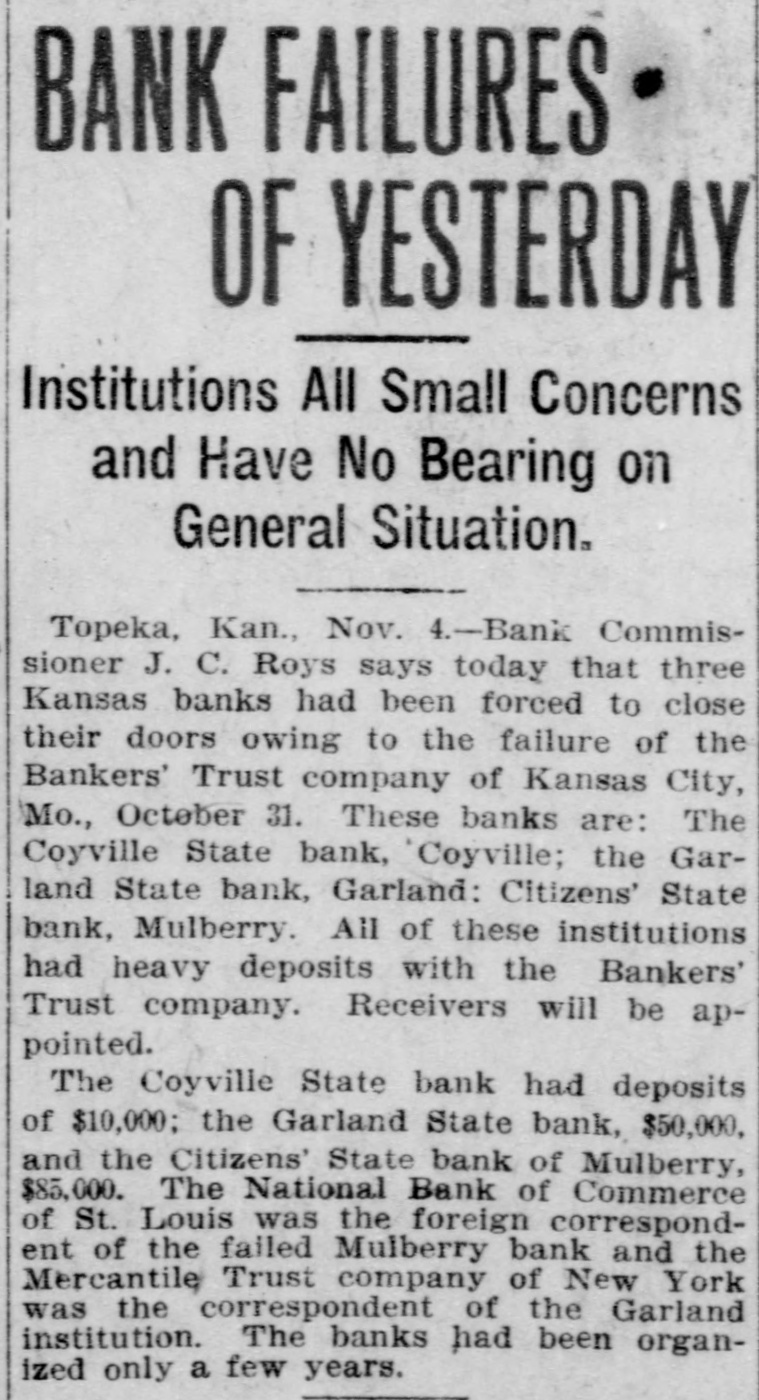
BANK FAILURES OF YESTERDAY Institutions All Small Concerns and Have No Bearing on General Situation. Topeka, Kan., Nov. 4.-Bank Commissioner J. C. Roys says today that three Kansas banks had been forced to close their doors owing to the failure of the Bankers' Trust company of Kansas City, Mo., October 31. These banks are: The Coyville State bank, Coyville; the Garland State bank, Garland: Citizens' State bank, Mulberry. All of these institutions had heavy deposits with the Bankers' Trust company. Receivers will be appointed. The Coyville State bank had deposits of $10,000; the Garland State bank, $50,000, and the Citizens' State bank of Mulberry, $85,000. The National Bank of Commerce of St. Louis was the foreign correspondent of the failed Mulberry bank and the Mercantile Trust company of New York was the correspondent of the Garland institution. The banks had been organized only a few years.


Article from The Free Lance, November 7, 1907

Click image to open full size in new tab

Article Text

Three Kansas Banks Close Topeka, Kan., Nov. 5.-Bank Com. missioner J. W. Royce announced that three Kansas banks had been forced to close their doors owing to the failure of the Bankers' Trust company, of Kansas City, Mo., on October 28. The banks are the Coyville State bank, Coyville; the Garland State bank, Garland, and the Citizens' State bank of Mulberry, all small institutions. They had deposits with the Bankers' Trust company. Receivers will be appointed at once,


Article from The Ely Miner, November 8, 1907

Click image to open full size in new tab

Article Text

TRUST COMPANIES TO BE SUPPORTED MORGAN AND OTHERS DECIDE TO AID TWO INSTITUTIONS OF NEW YORK. Stocks Moving Upward Turn in Financial Crisis Seems to Be Reached-Three Small Banks in Kansas Are Compelled to Close. New York, Nov. 5.-The buoyancy of the stock market Monday reflected the ultimate decision of large bankers to support the two institutions-the Trust Company of America and the Lincoln Trust company-which have been subjected to the most severe runs during the last two weeks. The day was one of doubt and conflicting rumors, and the fact that it passed without an adverse development is evidence that the worst of the situation is probably over. At a late hour in the morning an agreement was reached, largely through the influence of Mr. Morgan, by which the trust companies will cooperate in future for their mutual protection and the directors will lend the assistance of their personal fortunes to meet immediate necessities. Turn in the Crisis Reached. The achievement of these results, with the steady upward movement of the stock market till near the close, is believed to mark the turn of the crisis. The loss of $30,000,000 in cash by the clearing house banks, according to their Saturday showing, in spite of $30,000,000 which had been poured into their tills during the week from the treasury, was expected to have a disturbing effect. It was a worse showing than will be possible again in the face of the heavy arrivals of gold. Gold engagements since the beginning of the present movement now amount to $32,000,000, which would more than bridge the loss in surplus reserve last week. The disturbances which are sweeping over the exchange market and arousing concern in foreign markets were indicated by the rise of foreign exchange in New York considerably above the point at which gold could be imported profitably. The fact that it is still coming this way indicates the determination of New York bankers to strengthen their position even at a loss. The high rate for bills was caused by the demand for exchange to cover the arrivals of gold. The executive committee of the Merchants' association Monday passed formal resolutions in which confidence in the financial institutions of the city was expressed. Three Kansas Banks Close. Topeka, Kan., Nov. 5.-Bank Commissioner J. W. Royce announced Monday that three Kansas banks had been forced to close their doors, owing to the failure of the Bankers' Trust company of Kansas City, Mo., on October 28. The banks are the Coyville State bank, Coyville; the Garland State bank, Garland, and the Citizens State bank, of Mulberry, all small institutions. They had deposits with the Bankers' Trust company. Receivers will be appointed at once.


Article from The Topeka State Journal, November 22, 1907

Click image to open full size in new tab

Article Text

JACKSON TO HELP Attorney General Will Try to Rescue Three Little Banks. Ones Affected by Bankers' Trust Crash. ROYCE A BUSY MAN. Having a Time to Straighten Out Tangles. Situation in Financial Circles Apparently Brightening Up. Attorney General F. S. Jackson has taken a hand in the effort to save the three little Kansas banks which went to the wall as a result of the collapse of the Bankers' Trust company in Kansas City. These three banks are located at Mulberry, Coyville and Garland. Mr. Jackson was in Kansas City Wednesday, and the purpose of his visit was to investigate some of the matters connected with the Mulberry bank, which is now. in the hands of a receiver. There are rumors that the appearance of the attorney general in the case means that criminal prosecutions may be started against some parties who were instrumental in loading up the Mulberry bank with worthless paper. This worthless paper was placed in the bank, and cash was drawn out in its stead, and now the receiver is trying to compel the parties responsible to make good. Bank Commissioner John Q. Royce is also devoting his whole time at pres" ent to his efforts to help the three little banks out of their trouble. The banks at Coyville and Garland are in better shape than the one at Mulberry, and no receivers have been appointed for them. The citizens of the towns are willing to buy the stock of the two banks, and continue the operation of the banks, but the receiver of the Bankers' Trust, who holds the stock, wants too high a price. The Mulberry bank was largely the private enterprise of a man named Brady who was prominent in Bankers' Trust affairs. There are about twenty other banks in Kansas which were tied up more or less with the Bankers' Trust, but these have all secured possession of their stock by purchase from the receiver, and are in as good condition as ever. It was announced today at the state banking department that all reports received from Kansas banks are of an encouraging nature. There are no other banks aside from those involved in the Bankers' Trust affair which have shown signs of distress. "Conditions are steadily improving" said the state banking officials. "The reserve of the Kansas banks is larger today than it ever has been in the history of the state. There is also more cash on hand today than ever before. This is because bankers have limited withdrawals, and have been gradually getting in more and more money from their correspondent banks in the east. The only thing to be guarded against is the panicky withdrawals which might follow a removal of the lid. Money withdrawn in that way is out of circulation and becomes a menace. As long as it stays in the bank it is a safeguard." Bank Commissioner John Q. Royce said: "If I should issue a call for a statement of the condition of Kansas banks today, I am confident that it would show that the reserve is larger than at the time of the last call, when all previous records were broken. The Kansas banks are also gradually accumulating more currency, and business will gradually resume normal conditions. Before people know it, they will find that the 'lid' has been lifted, and that money is circulating as freely as ever." Mr. Royce yesterday received a long distance telephone communication from the southern part of the state from an indignant bank patron. "I have $2,600 in the bank here," he said. "and I am all packed up ready to move to Texas. I want my money and they won't give it to me." "Won't they give you a draft?" asked Mr. Royce. "Oh, yes, they'll give me a draft." "Is it on a good bank?" "Yes, the bank's all right." "Well, then," said Mr. Royce, "if I were you, I'd take the draft." "But I want the cash," said the man. "Why won't they give it to you?" inquired Mr. Royce, innocently. "They haven't got it," was the frank reply. "Well, do you want me to come down and close up the bank?" said Mr. Royce. "Oh, no, I don't want you to do that," said the man hastily. "Well, how can I make the bank pay you your $2,600 in cash if they haven't got it?" inquired Mr. Royce. "Well, I don't know, admitted the man. "But I think they ought to give me three or four hundred dollars in cash, anyway." sold Mr. Poyce