5836. Bank of Greensburg (Greensburg, KS)

Bank Information

Episode Type
Suspension โ†’ Closure
Bank Type
state
Start Date
December 1, 1893*
Location
Greensburg, Kansas (37.603, -99.293)

Metadata

Model
gpt-5-mini
Short Digest
0eb647346ac096a8

Response Measures

None

Description

The bank was closed by the state bank commissioner in December 1893 and placed in receivership (government action). Articles from 1898 describe the receiver selling assets; a 1900 item notes the 'Banks of Greensburg' settled with creditors and gone out of liquidation. There is no mention of a depositor run prior to suspension or of a later reopening as an operating bank.

Events (4)

1. December 1, 1893* Receivership
Newspaper Excerpt
Mr. C. F. Mingenback of Greensburg, Kan., receiver of the defunct Bank of Greensburg, came to this city today. to report the recent sale of the assets of the bank to Bank Commissioner Breidenthal.
Source
newspapers
2. December 1, 1893* Suspension
Cause
Government Action
Cause Details
Closed by State Bank Commissioner Breidenthal under the banking law (December 1893)
Newspaper Excerpt
when Commissioner Breidenthal closed the bank in December, 1893, he narrowly escaped mobbing
Source
newspapers
3. April 12, 1898 Other
Newspaper Excerpt
Of the assets of the bank $107,000 was represented by notes, and all that was received for the entire lot was something over $600. ... Mr. C. F. Mingenback, of Greensburg, Kan., reported the recent sale ot the assets of the Bank of Greensburg, defunct, of which he is the receiver, to Bank Commissioner Breidenthal.
Source
newspapers
4. February 19, 1900 Other
Newspaper Excerpt
Among the banks that have settled with the creditors and gone out of liquidation are: The Banks of Greensburg
Source
newspapers

Newspaper Articles (3)

Article from The Topeka State Journal, April 12, 1898

Click image to open full size in new tab

Article Text

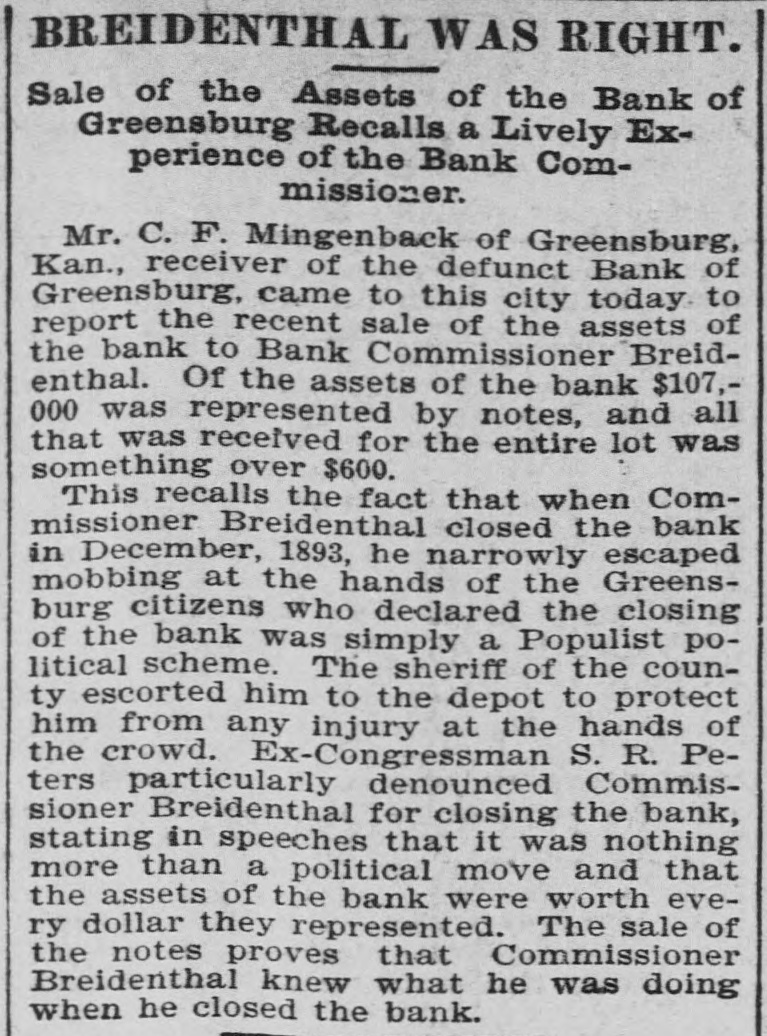
BREIDENTHAL WAS RIGHT. Sale of the Assets of the Bank of Greensburg Recalls a Lively Experience of the Bank Commissioner. Mr. C. F. Mingenback of Greensburg, Kan., receiver of the defunct Bank of Greensburg, came to this city today. to report the recent sale of the assets of the bank to Bank Commissioner Breidenthal. Of the assets of the bank $107,000 was represented by notes, and all that was received for the entire lot was something over $600. This recalls the fact that when Commissioner Breidenthal closed the bank in December, 1893, he narrowly escaped mobbing at the hands of the Greensburg citizens who declared the closing of the bank was simply a Populist political scheme. The sheriff of the county escorted him to the depot to protect him from any injury at the hands of the crowd. Ex-Congressman S. R. Peters particularly denounced Commissioner Breidenthal for closing the bank, stating in speeches that it was nothing more than a political move and that the assets of the bank were worth every dollar they represented. The sale of the notes proves that Commissioner Breidenthal knew what he was doing when he closed the bank.
Article from The Kinsley Graphic, April 15, 1898

Click image to open full size in new tab

Article Text

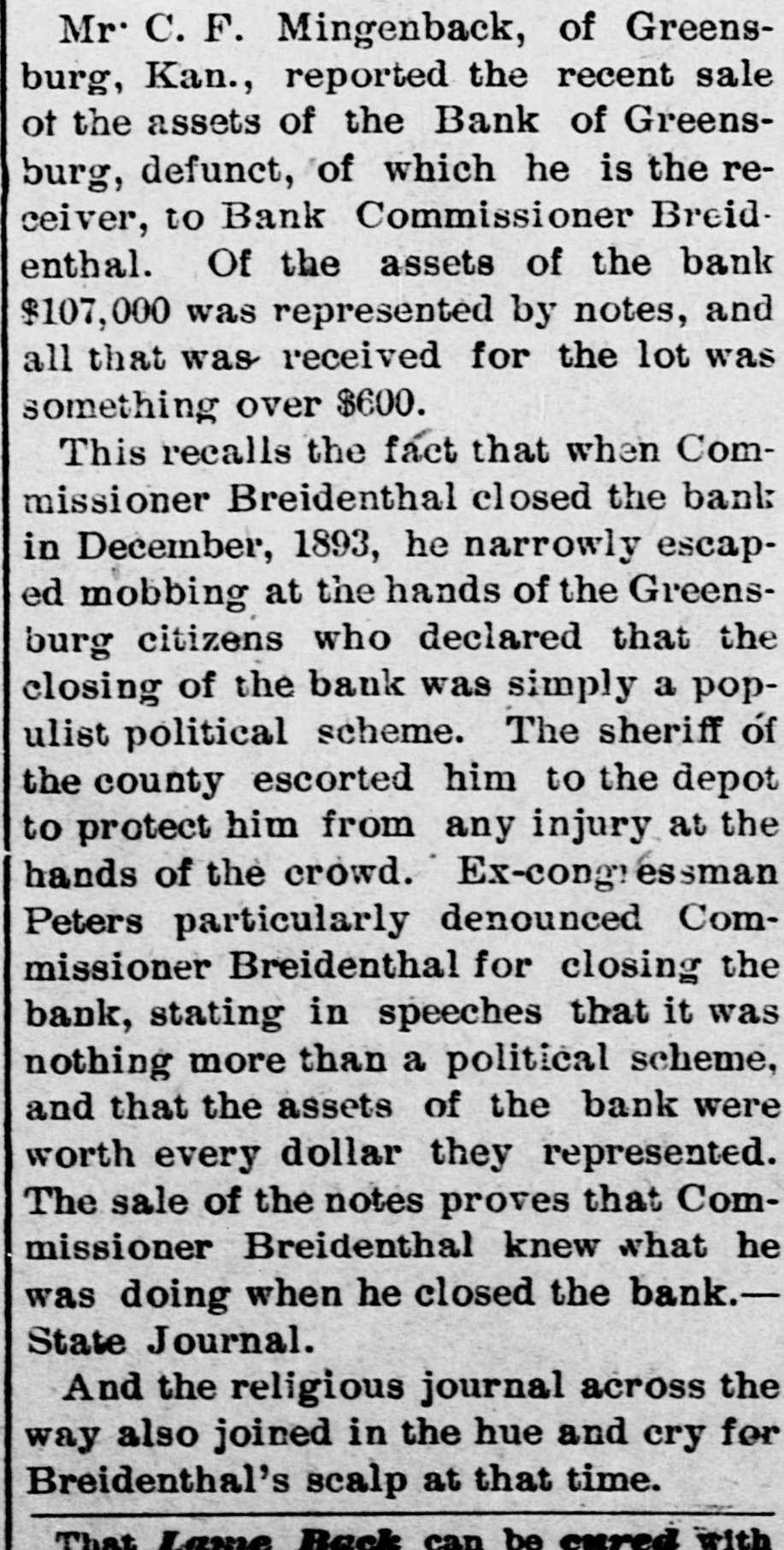
Mr. C. F. Mingenback, of Greensburg, Kan., reported the recent sale ot the assets of the Bank of Greensburg, defunct, of which he is the receiver, to Bank Commissioner Breidenthal. Of the assets of the bank $107,000 was represented by notes, and all that was received for the lot was something over $600. This recalls the fact that when Commissioner Breidenthal closed the bank in December, 1893, he narrowly escaped mobbing at the hands of the Greensburg citizens who declared that the closing of the bank was simply a populist political scheme. The sheriff of the county escorted him to the depot to protect him from any injury at the hands of the crowd. Ex-cong! essman Peters particularly denounced Commissioner Breidenthal for closing the bank, stating in speeches that it was nothing more than a political scheme, and that the assets of the bank were worth every dollar they represented. The sale of the notes proves that Commissioner Breidenthal knew what he was doing when he closed the bank.State Journal. And the religious journal across the way also joined in the hue and cry for Breidenthal's scalp at that time. be That Lame can


Article from The Topeka State Journal, February 19, 1900

Click image to open full size in new tab

Article Text

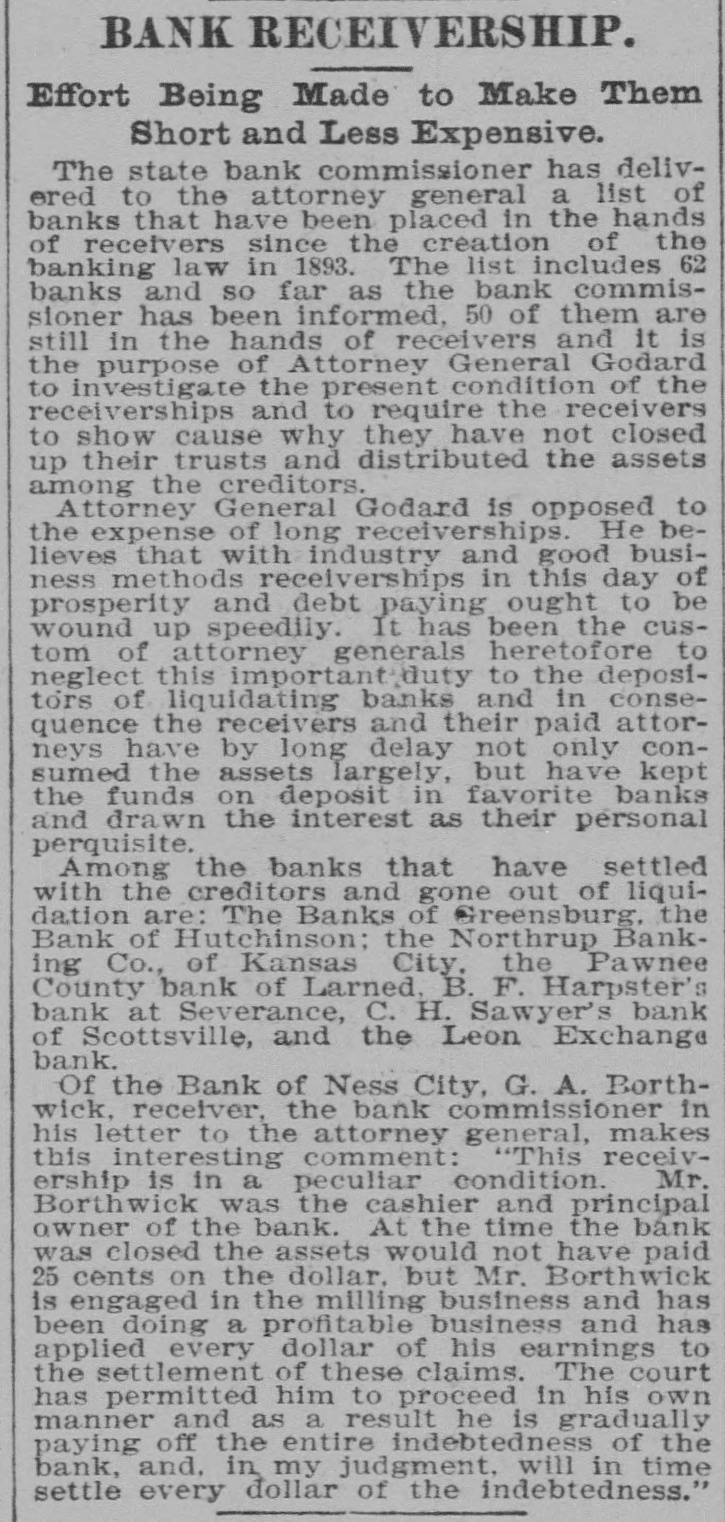
# BANK RECEIVERSHIP. Effort Being Made to Make Them Short and Less Expensive. The state bank commissioner has delivered to the attorney general a list of banks that have been placed in the hands of receivers since the creation of the banking law in 1893. The list includes 62 banks and so far as the bank commissioner has been informed, 50 of them are still in the hands of receivers and it is the purpose of Attorney General Godard to investigate the present condition of the receiverships and to require the receivers to show cause why they have not closed up their trusts and distributed the assets among the creditors. Attorney General Godard is opposed to the expense of long receiverships. He believes that with industry and good business methods receiverships in this day of prosperity and debt paying ought to be wound up speedily. It has been the custom of attorney generals heretofore to neglect this important duty to the depositors of liquidating banks and in consequence the receivers and their paid attorneys have by long delay not only consumed the assets largely, but have kept the funds on deposit in favorite banks and drawn the interest as their personal perquisite. Among the banks that have settled with the creditors and gone out of liquidation are: The Banks of Greensburg, the Bank of Hutchinson; the Northrup Banking Co., of Kansas City, the Pawnee County bank of Larned, B. F. Harpster's bank at Severance, C. H. Sawyer's bank of Scottsville, and the Leon Exchange bank. Of the Bank of Ness City, G. A. Borthwick, receiver, the bank commissioner in his letter to the attorney general, makes this interesting comment: "This receivership is in a peculiar condition. Mr. Borthwick was the cashier and principal owner of the bank. At the time the bank was closed the assets would not have paid 25 cents on the dollar, but Mr. Borthwick is engaged in the milling business and has been doing a profitable business and has applied every dollar of his earnings to the settlement of these claims. The court has permitted him to proceed in his own manner and as a result he is gradually paying off the entire indebtedness of the bank, and, in my judgment, will in time settle every dollar of the indebtedness."