Closed by comptroller/examiner with receiver appointed; failure attributed to excessive loans to officers/directors.
Events (4)
1.October 14, 1864Chartered
Source
historical_nic
+42 years
2.August 17, 1906Suspension
Cause
Government Action
Cause Details
Comptroller/examiner ordered closure after finding excessive loans to officers and directors and liquidity problems from large withdrawals and real-estate loans.
Newspaper Excerpt
FIRST NATIONAL BANK OF CHELSEA CLOSED ... orders having been issued by the comptroller of the currency to close the institution.
Source
newspapers
same day
3.August 17, 1906Receivership
Source
historical_nic
+4 days
4.August 21, 1906Receivership
Newspaper Excerpt
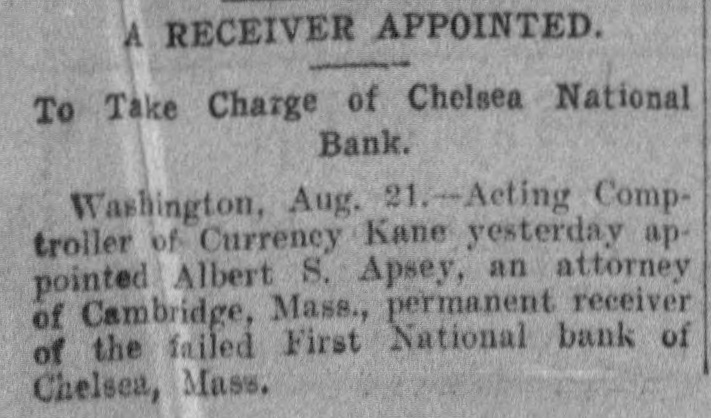
Acting Comptroller of Currency Kane yesterday appointed Albert S. Apsey ... permanent receiver of the failed First National bank of Chelsea, Mass.
Source
newspapers
Newspaper Articles (24)
1.August 17, 1906The Daily Morning Journal and CourierNew Haven, CT
Click image to open full size in new tab
Article Text
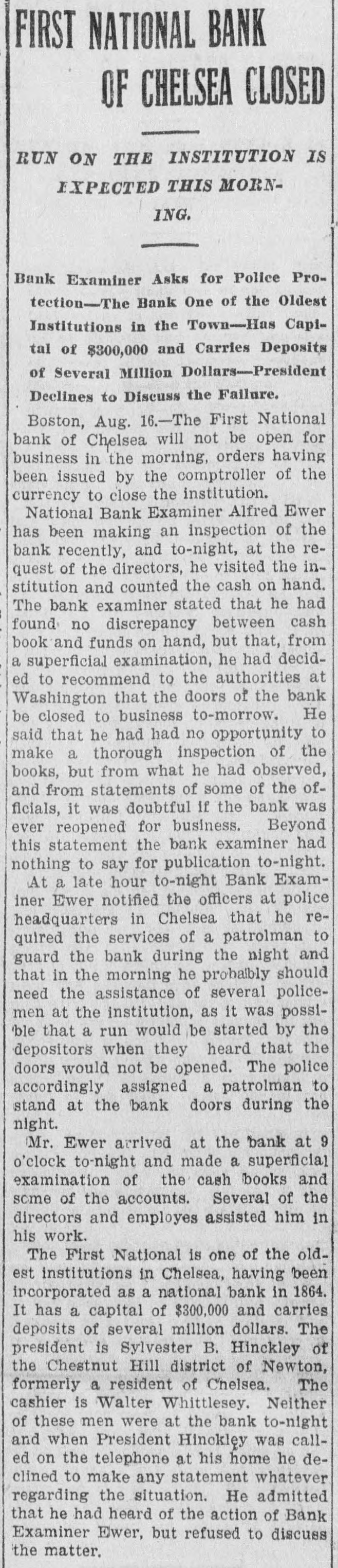
FIRST NATIONAL BANK OF CHELSEA CLOSED RUN ON THE INSTITUTION IS IXPECTED THIS MORNING. Bank Examiner Asks for Police Protection-The Bank One of the Oldest Institutions in the Town-Has Capital of $300,000 and Carries Deposits of Several Million Dollars-President Declines to Discuss the Failure. Boston, Aug. 16.-The First National bank of Chelsea will not be open for business in the morning, orders having been issued by the comptroller of the currency to close the institution. National Bank Examiner Alfred Ewer has been making an inspection of the bank recently, and to-night, at the request of the directors, he visited the institution and counted the cash on hand. The bank examiner stated that he had found no discrepancy between cash book and funds on hand, but that, from a superficial examination, he had decided to recommend to the authorities at Washington that the doors of the bank be closed to business to-morrow. He said that he had had no opportunity to make a thorough inspection of the books, but from what he had observed, and from statements of some of the officials, it was doubtful if the bank was ever reopened for business. Beyond this statement the bank examiner had nothing to say for publication to-night. At a late hour to-night Bank Examiner Ewer notified the officers at police headquarters in Chelsea that he required the services of a patrolman to guard the bank during the night and that in the morning he probably should need the assistance of several policemen at the institution, as it was possible that a run would be started by the depositors when they heard that the doors would not be opened. The police accordingly assigned a patrolman to stand at the bank doors during the night. Mr. Ewer arrived at the bank at 9 o'clock night and made a superficial examination of the cash books and some of the accounts. Several of the directors and employes assisted him in his work. The First National is one of the oldest institutions in Chelsea, having been incorporated as a national bank in 1864. It has a capital of $300,000 and carries deposits of several million dollars. The president is Sylvester B. Hinckley of the Chestnut Hill district of Newton, formerly a resident of Chelsea. The cashier is Walter Whittlesey. Neither of these men were at the bank to-night and when President Hinokley was called on the telephone at his home he declined to make any statement whatever regarding the situation. He admitted that he had heard of the action of Bank Examiner Ewer, but refused to discuss the matter.
2.August 17, 1906The Evening TimesGrand Forks, ND
Click image to open full size in new tab
Article Text
EXAMINER IN CHARGE
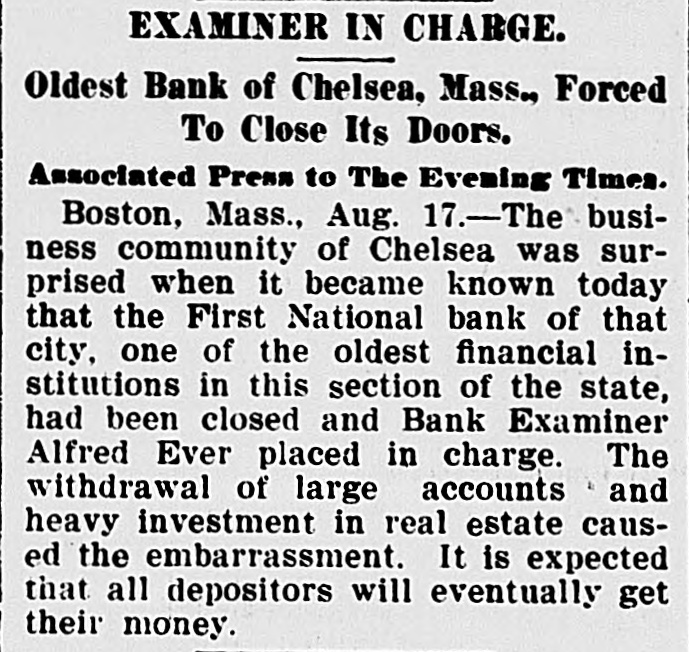
Oldest Bank of Chelsea. Mass., Forced To Close Its Doors. Associated Press to The Evening Times. Boston, Mass., Aug. 17.-The business community of Chelsea was surprised when it became known today that the First National bank of that city, one of the oldest financial institutions in this section of the state, had been closed and Bank Examiner Alfred Ever placed in charge. The withdrawal of large accounts and heavy investment in real estate caused the embarrassment. It is expected that all depositors will eventually get their money.
3.August 17, 1906The Barre Daily TimesBarre, VT
Click image to open full size in new tab
Article Text
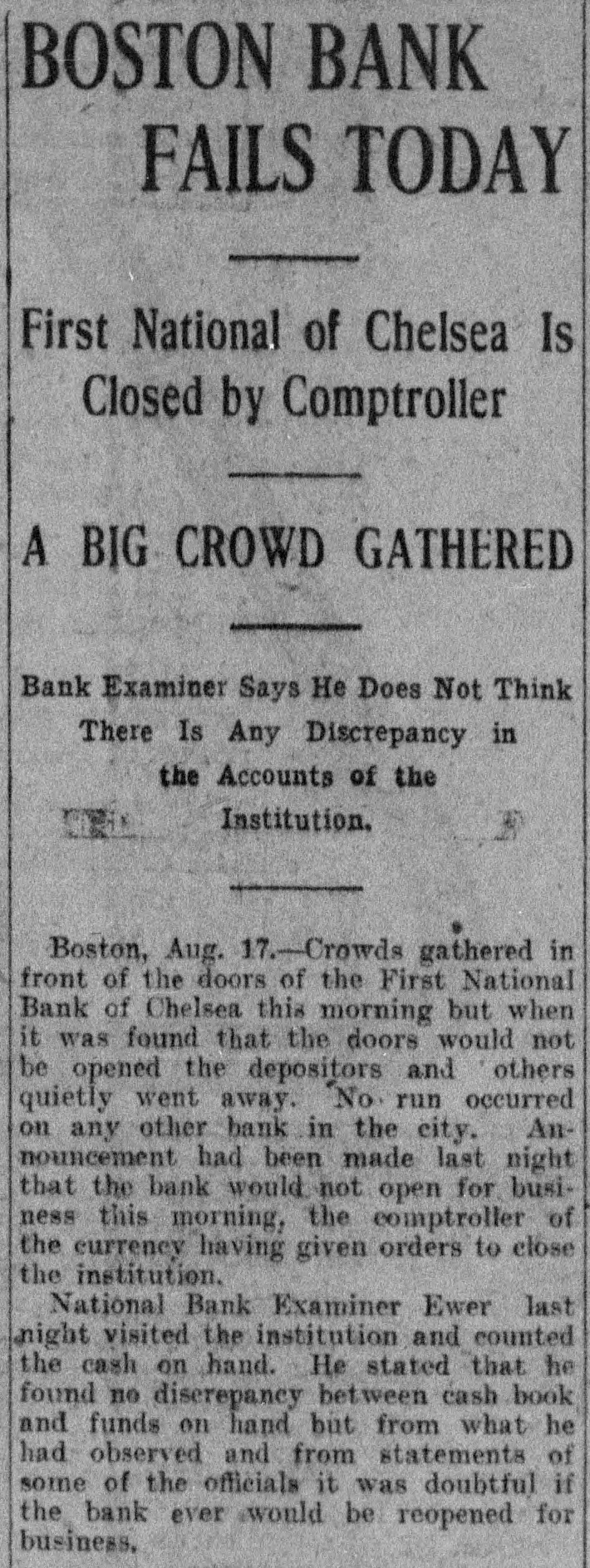
BOSTON BANK FAILS TODAY First National of Chelsea Is Closed by Comptroller A BIG CROWD GATHERED Bank Examiner Says He Does Not Think There Is Any Discrepancy in the Accounts of the Institution. This Boston, Aug. 17.-Crowds gathered in front of the doors of the First National Bank of Chelsea this morning but when it was found that the doors would not be opened the depositors and others quietly went away. No run occurred on any other bank in the city. Announcement had been made last night that the bank would not open for business this morning, the comptroller of the currency having given orders to close the institution. National Bank Examiner Ewer last night visited the institution and counted the cash on hand. He stated that he found no discrepancy between cash book and funds on hand but from what he had observed and from statements of some of the officials it was doubtful if the bank ever would be reopened for business.
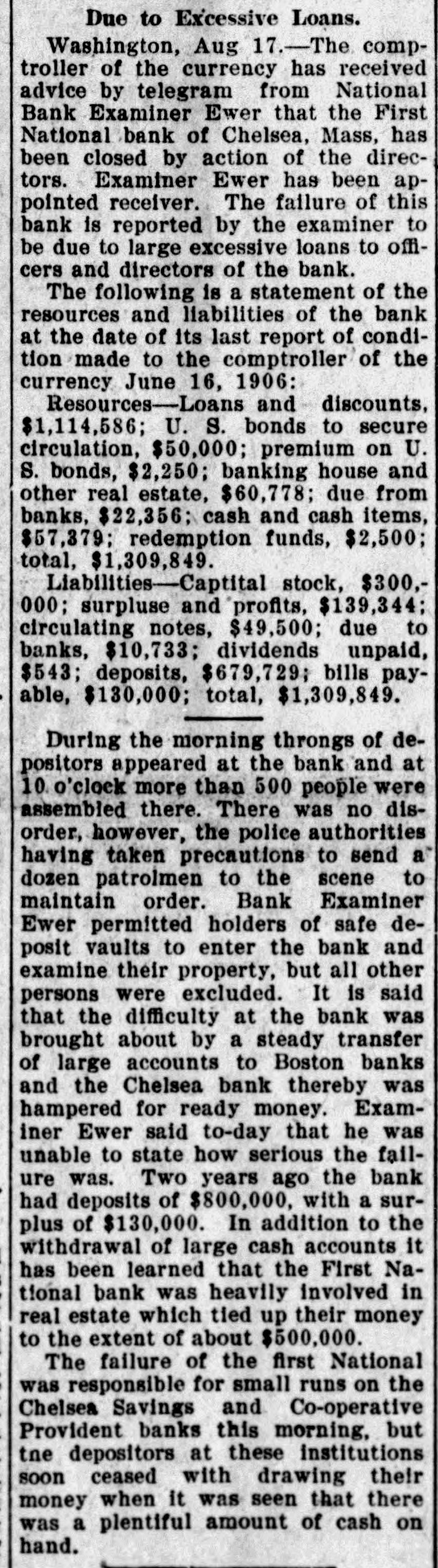
Washington, Aug 17.-The comptroller of the currency has received advice by telegram from National Bank Examiner Ewer that the First National bank of Chelsea, Mass, has been closed by action of the directors. Examiner Ewer has been appointed receiver. The failure of this bank is reported by the examiner to be due to large excessive loans to officers and directors of the bank. The following is a statement of the resources and liabilities of the bank at the date of its last report of condition made to the comptroller of the currency June 16, 1906: Resources-Loans and discounts, $1,114,586; U. S. bonds to secure circulation, $50,000; premium on U. S. bonds, $2,250; banking house and other real estate, $60,778; due from banks, $22,356; cash and cash items, $57,379; redemption funds, $2,500; total, $1,309,849. Liabilities-Captital stock, $300,000; surpluse and profits, $139,344; circulating notes, $49,500; due to banks, $10,733; dividends unpaid, $543; deposits, $679,729; bills payable, $130,000; total, $1,309,849. During the morning throngs of depositors appeared at the bank and at 10 o'clock more than 500 people were assembled there. There was no disorder, however, the police authorities having taken precautions to send a dozen patrolmen to the scene to maintain order. Bank Examiner Ewer permitted holders of safe deposit vaults to enter the bank and examine their property, but all other persons were excluded. It is said that the difficulty at the bank was brought about by a steady transfer of large accounts to Boston banks and the Chelsea bank thereby was hampered for ready money. Examiner Ewer said to-day that he was unable to state how serious the failure was. Two years ago the bank had deposits of $800,000, with a surplus of $130,000. In addition to the withdrawal of large cash accounts it has been learned that the First National bank was heavily involved in real estate which tied up their money to the extent of about $500,000. The failure of the first National was responsible for small runs on the Chelsea Savings and Co-operative Provident banks this morning, but tne depositors at these institutions soon ceased with drawing their money when it was seen that there was a plentiful amount of cash on hand.
5.August 18, 1906The Montgomery AdvertiserMontgomery, AL
Click image to open full size in new tab
Article Text
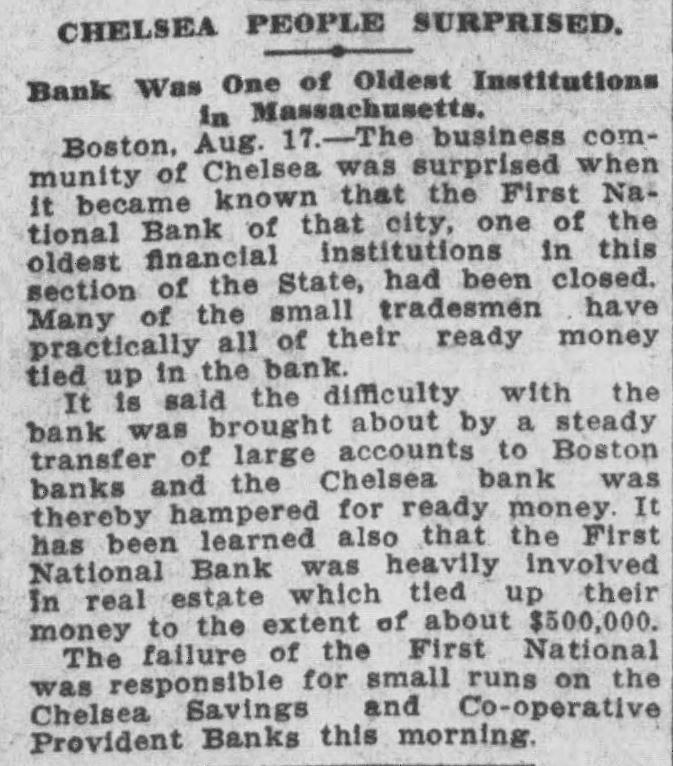
CHELSEA PEOPLE SURPRISED
Bank Was One of Oldest Institutions in Massachusetts. Boston, Aug. 17.-The business community of Chelsea was surprised when it became known that the First National Bank of that city, one of the oldest financial institutions in this section of the State, had been closed. Many of the small tradesmen have practically all of their ready money tied up in the bank. It is said the difficulty with the bank was brought about by a steady transfer of large accounts to Boston banks and the Chelsea bank was thereby hampered for ready money. It has been learned also that the First National Bank was heavily involved In real estate which tied up their money to the extent of about $500,000. The failure of the First National was responsible for small runs on the Chelsea Savings and Co-operative Provident Banks this morning.
6.August 18, 1906The Jersey City NewsJersey City, NJ
Click image to open full size in new tab
Article Text
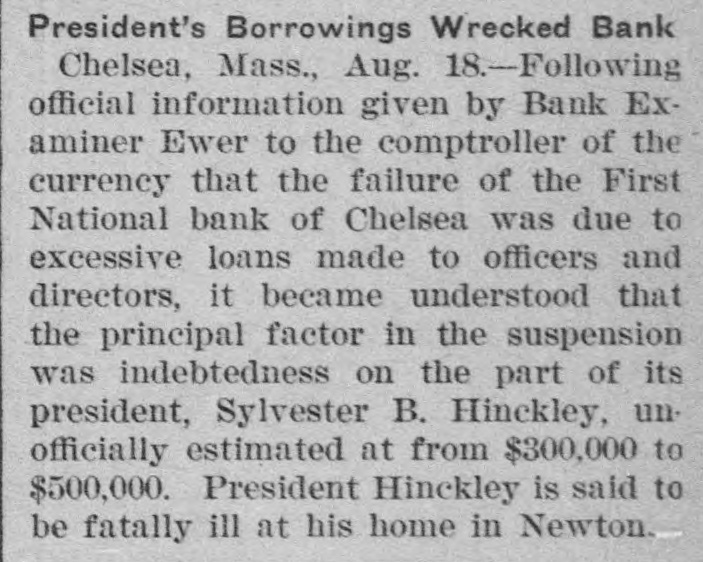
President's Borrowings Wrecked Bank Chelsea, Mass., Aug. 18.-Following official information given by Bank Examiner Ewer to the comptroller of the currency that the failure of the First National bank of Chelsea was due to excessive loans made to officers and directors, it became understood that the principal factor in the suspension was indebtedness on the part of its president, Sylvester B. Hinckley, unofficially estimated at from $300,000 to $500,000. President Hinckley is said to be fatally ill at his home in Newton.
7.August 18, 1906The Cairo BulletinCairo, IL
Click image to open full size in new tab
Article Text
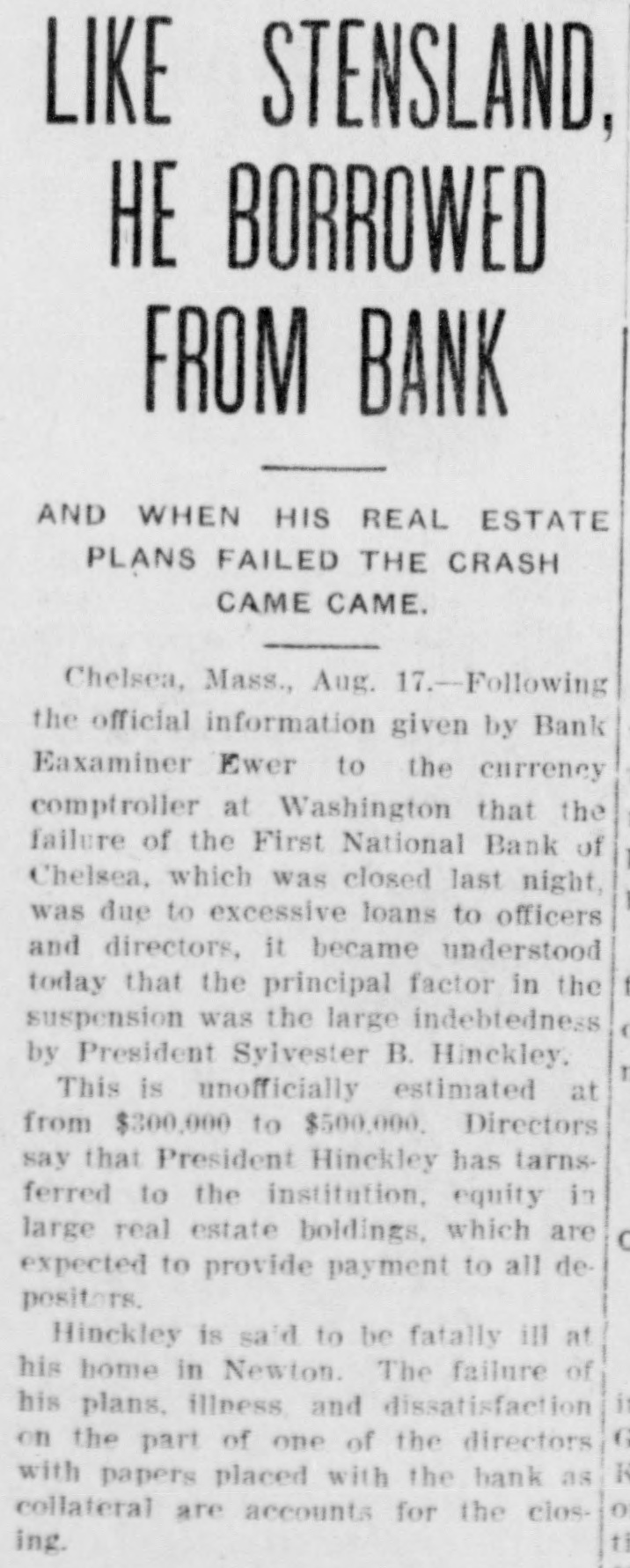
LIKE STENSLAND, HE BORROWED FROM BANK AND WHEN HIS REAL ESTATE PLANS FAILED THE CRASH CAME CAME. Chelsea, Mass., Aug. 17.-Following the official information given by Bank Eaxaminer Ewer to the currency comptroller at Washington that the failure of the First National Bank of Chelsea, which was closed last night, was due to excessive loans to officers and directors, it became understood today that the principal factor in the suspension was the large indebtedness by President Sylvester B. Hinckley. This is unofficially estimated at from $300,000 to $500,000. Directors say that President Hinckley has tarnsferred to the institution, equity in large real estate boldings, which are expected to provide payment to all depositors. Hinckley is said to be fatally ill at his home in Newton The failure of his plans. illness and dissatisfaction on the part of one of the directors with papers placed with the hank as collateral are accounts for the ciosing.
8.August 18, 1906The Cairo BulletinCairo, IL
Click image to open full size in new tab
Article Text
LIKE STENSLAND, HE BORROWED FROM BANK AND WHEN HIS REAL ESTATE PLANS FAILED THE CRASH CAME CAME. Chelsea, Mass., Aug. 17.-Following the official information given by Bank Eaxaminer Ewer to the currency comptroller at Washington that the failure of the First National Bank of Chelsea, which was closed last night, was due to excessive loans to officers and directors, it became understood today that the principal factor in the suspension was the large indebtedness by President Sylvester B. Hinckley, This is unofficially estimated at from $300,000 to $500,000. Directors say that President Hinckley has tarnsferred to the institution, equity in large real estate boldings, which are expected to provide payment to all depositors. Hinckley is said to be fatally ill at his home in Newton The failure of his plans. illness and dissatisfaction on the part of one of the directors with papers placed with the bank as collateral are accounts for the closing.
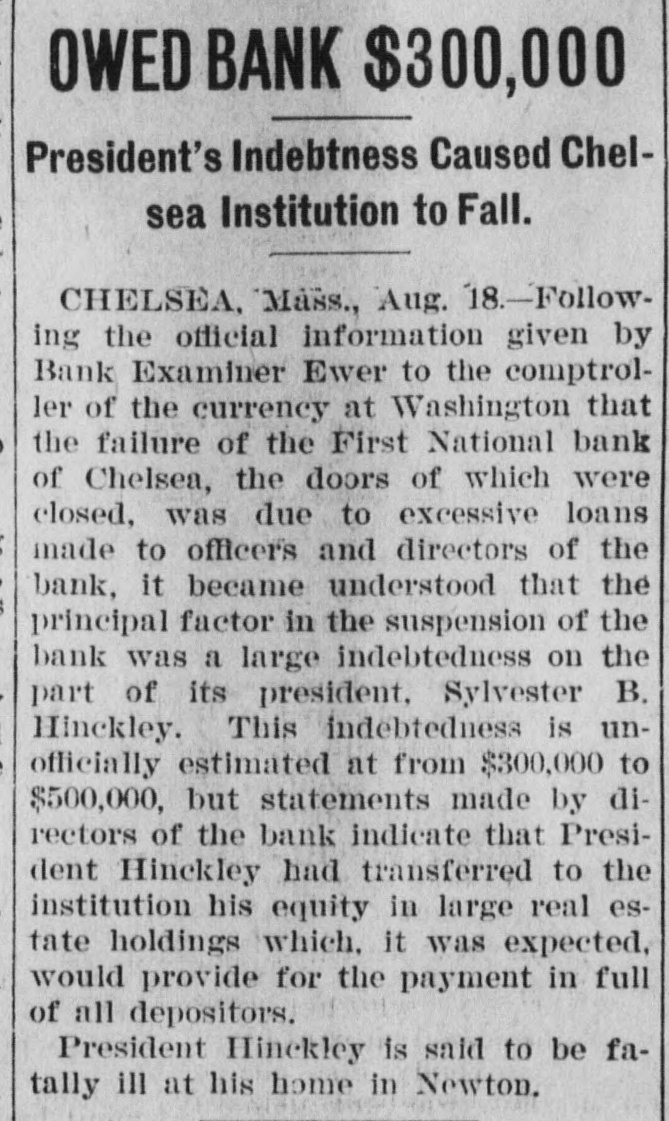
OWED BANK $300,000 President's Indebtness Caused Chelsea Institution to Fall. CHELSEA, Mass., Aug. 18.-Following the official information given by Bank Examiner Ewer to the comptroller of the currency at Washington that the failure of the First National bank of Chelsea, the doors of which were closed, was due to excessive loans made to officers and directors of the bank, it became understood that the principal factor in the suspension of the bank was a large indebtedness on the part of its president, Sylvester B. Hinckley. This indebtedness is unofficially estimated at from $300,000 to $500,000, but statements made by directors of the bank indicate that President Hinckley had transferred to the institution his equity in large real estate holdings which. it was expected, would provide for the payment in full of all depositors. President Hinckley is said to be fatally ill at his home in Newton.
10.August 18, 1906The Salt Lake HeraldSalt Lake City, UT
Click image to open full size in new tab
Article Text
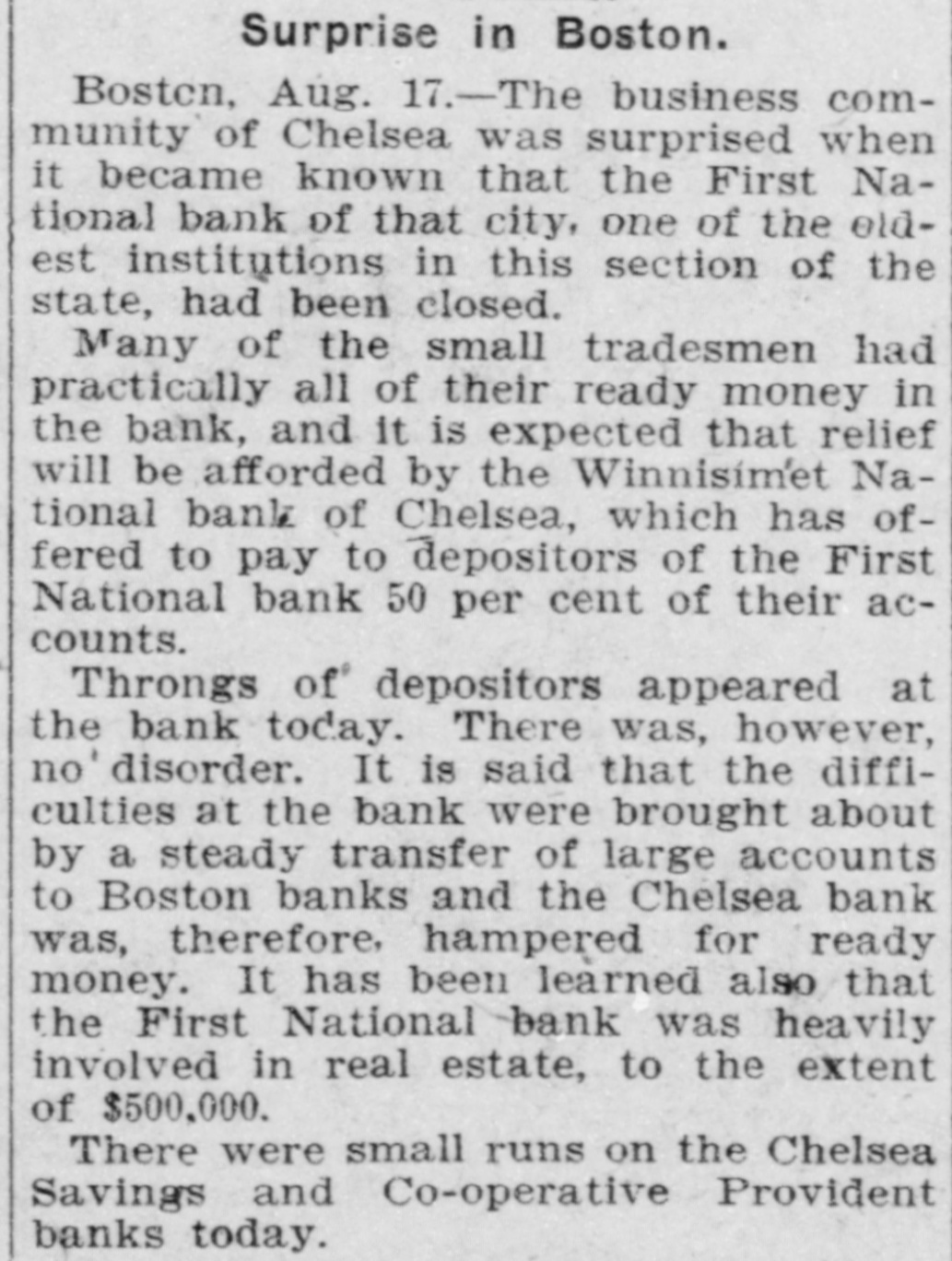
Surprise in Boston
Bosten, Aug. 17.-The business community of Chelsea was surprised when it became known that the First National bank of that city, one of the eldest institutions in this section of the state, had been closed. Many of the small tradesmen had practically all of their ready money in the bank, and it is expected that relief will be afforded by the Winnisimet National bank of Chelsea, which has offered to pay to depositors of the First National bank 50 per cent of their accounts. Throngs of depositors appeared at the bank today. There was, however, no' disorder. It is said that the difficulties at the bank were brought about by a steady transfer of large accounts to Boston banks and the Chelsea bank was, therefore, hampered for ready money. It has been learned also that the First National bank was heavily involved in real estate, to the extent of $500,000. There were small runs on the Chelsea Savings and Co-operative Provident banks today.
11.August 18, 1906The Lake County TimesHammond, IN
Click image to open full size in new tab
Article Text
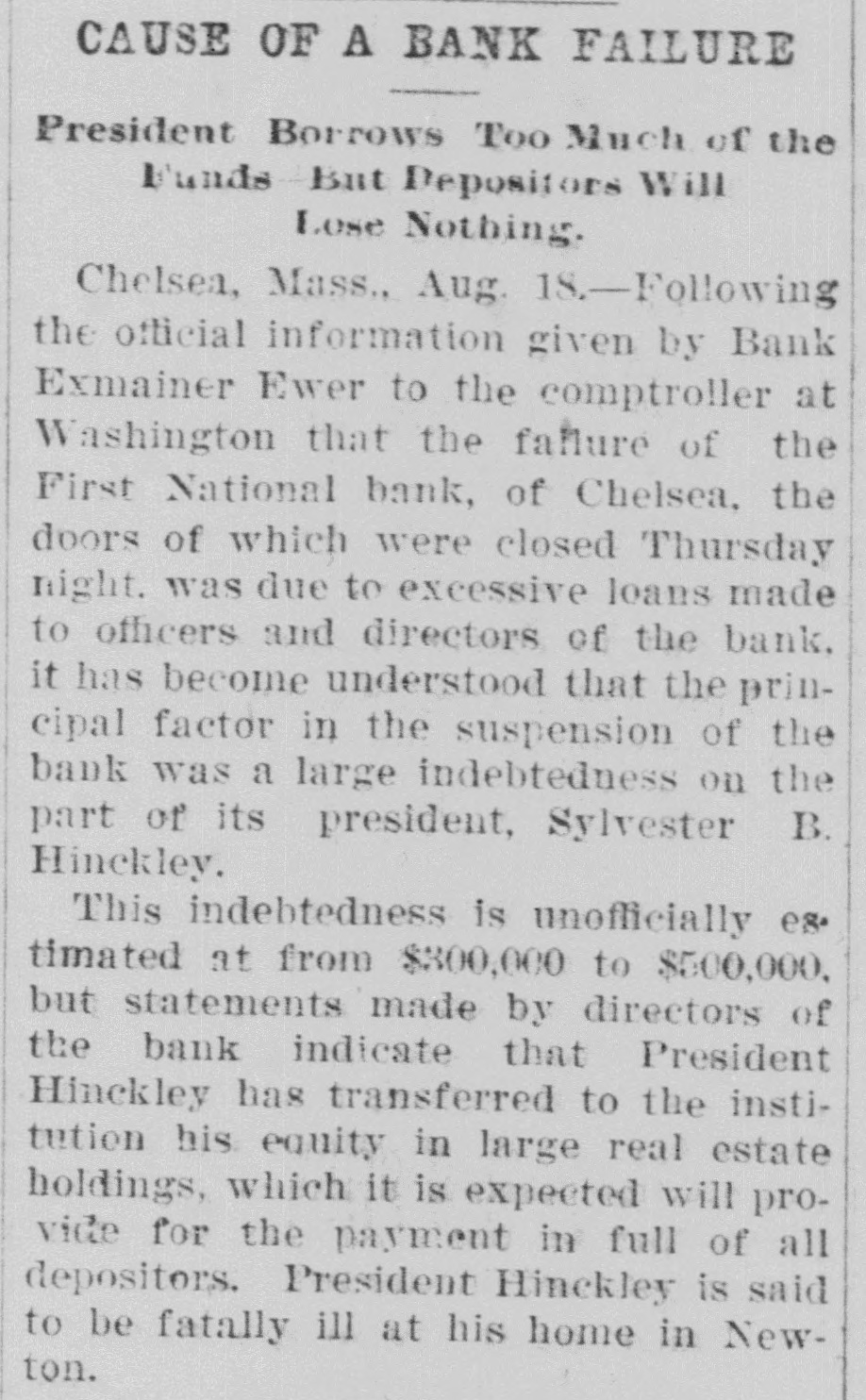
CAUSE OF A BANK FAILURE President Borrows Too Much of the Funds But Depositors Will Lose Nothing. Chelsea, Mass., Aug. 18.-Following the official information given by Bank Exmainer Ewer to the comptroller at Washington that the failure of the First National bank, of Chelsea, the doors of which were closed Thursday night. was due to excessive loans made to officers and directors of the bank. it has become understood that the principal factor in the suspension of the bank was a large indebtedness on the part of its president, Sylvester B. Hinckley. This indebtedness is unofficially eg. timated at from $300,000 to $500,000, but statements made by directors of the bank indicate that President Hinckley has transferred to the institution his equity in large real estate holdings, which it is expected will provide for the payment in full of all depositors. President Hinckley is said to be fatally ill at his home in Newton.
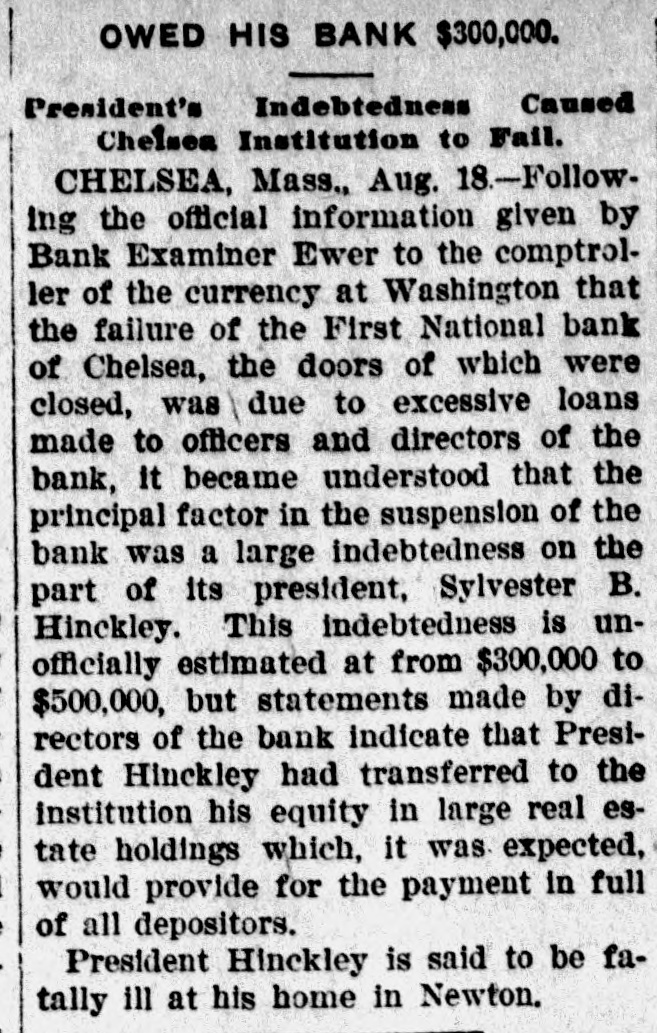
OWED HIS BANK $300,000. President's Indebtedness Caused Chelsea Institution to Fail. CHELSEA, Mass., Aug. 18.-Following the official information given by Bank Examiner Ewer to the comptroller of the currency at Washington that the failure of the First National bank of Chelsea, the doors of which were closed, was \ due to excessive loans made to officers and directors of the bank, it became understood that the principal factor in the suspension of the bank was a large indebtedness on the part of its president, Sylvester B. Hinckley. This indebtedness is unofficially estimated at from $300,000 to $500,000, but statements made by directors of the bank indicate that President Hinckley had transferred to the institution his equity in large real estate holdings which, it was expected, would provide for the payment in full of all depositors. President Hinckley is said to be fatally ill at his home in Newton.
13.August 21, 1906The Barre Daily TimesBarre, VT
Click image to open full size in new tab
Article Text
A RECEIVER APPOINTED
To Take Charge of Chelsea National Bank. Washington, Aug. 21.-Acting Comptroller of Currency Kane yesterday appointed Albert S. Apsey, an attorney of Cambridge, Mass., permanent receiver of the failed First National bank of Chelsea, Mass.
14.August 21, 1906Daily Kennebec JournalAugusta, ME
Click image to open full size in new tab
Article Text
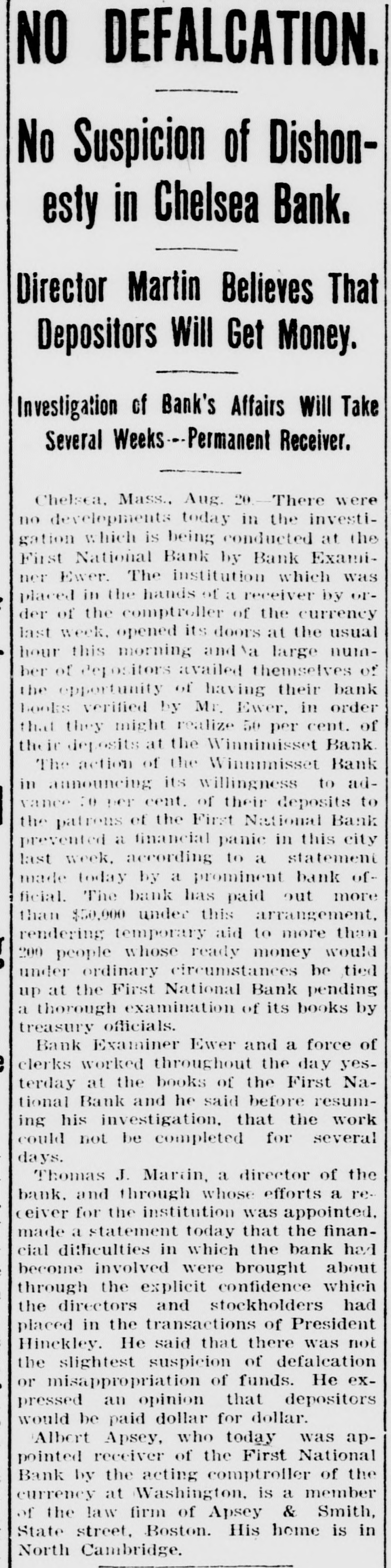
NU DEPALGATION
No Suspicion of Dishonesty in Chelsea Bank. Director Martin Believes That Depositors Will Get Money. Investigation of Bank's Affairs Will Take Several Weeks---Permanent Receiver. Chelsea, Mass., Aug. 20.-There were no developments today in the investigation which is being conducted at the First National Bank by Bank Examiner Ewer. The institution which was placed in the hands of it receiver by order of the comptroller of the currency last week. opened its doors at the usual hour this morning and \a large number of depositors availed themselves of the opportunity of having their bank books verified by Mr. Ewer, in order that they might realize 50 per cent. of their deposits at the Winnimisset Bank The action of the Winnmisset Bank in announcing its willingness to advance :0 per cent. of their deposits to the patrons et the First National Bank prevented a financial panic in this city last week. according to a statement made today by a prominent bank official. The bank has paid out more than $50,000 under this arrangement, rendering temporary aid to more than 200 people whose ready money would under ordinary circumstances be tied up at the First National Bank pending a thorough examination of its books by treasury officials. Bank Examiner Ewer and a force of e clerks worked throughout the day yesterday at the books of the First National Bank and he said before resuming his investigation, that the work could not be completed for several days. Thomas J. Martin, a director of the bank. and through whose efforts a receiver for the institution was appointed. made a statement today that the financial difficulties in which the bank had become involved were brought about through the explicit confidence which the directors and stockholders had placed in the transactions of President Hinckley. He said that there was not the slightest suspicion of defalcation or misappropriation of funds. He expressed an opinion that depositors would be paid dollar for dollar. Albert Apsey, who today was appointed receiver of the First National Bank by the acting comptroller of the currency at Washington. is a member of the law firm of Apsey & Smith, State street, Boston. His home is in North Cambridge,
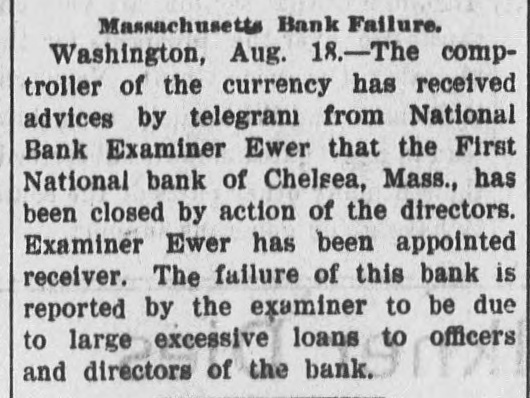
Washington, Aug. 18.-The comptroller of the currency has received advices by telegrani from National Bank Examiner Ewer that the First National bank of Chelsea, Mass., has been closed by action of the directors. Examiner Ewer has been appointed receiver. The failure of this bank is reported by the examiner to be due to large excessive loans to officers and directors of the bank.
16.August 23, 1906The Spanish Fork PressSpanish Fork, UT
Click image to open full size in new tab
Article Text
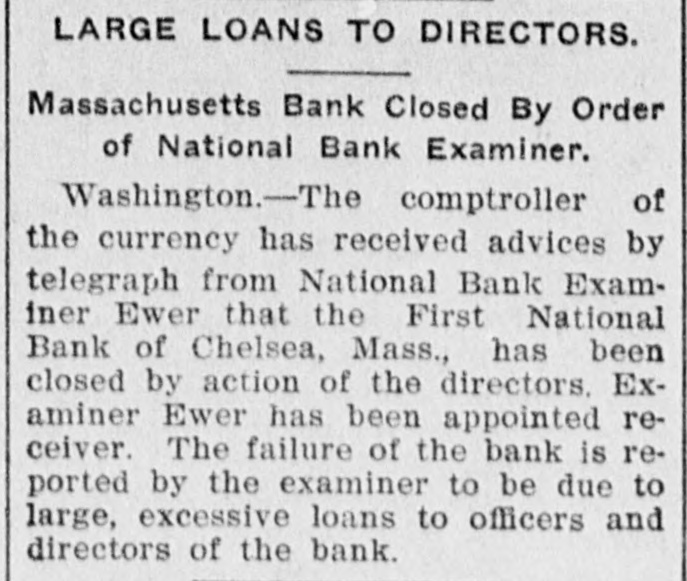
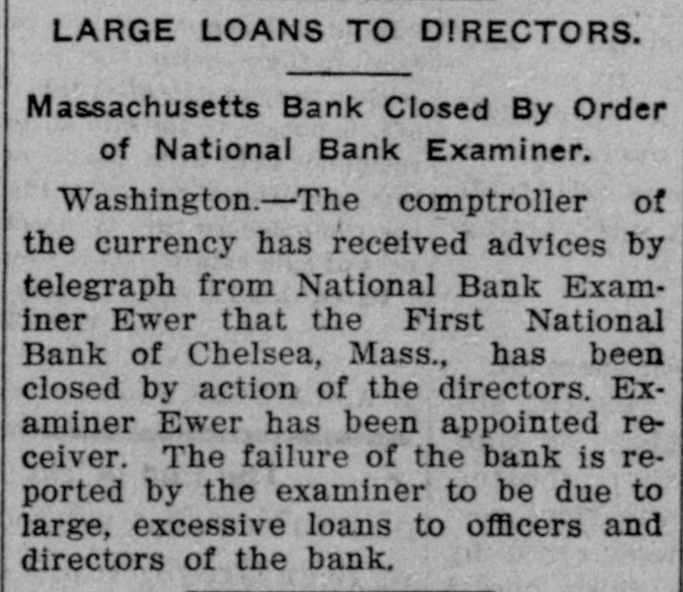
LARGE LOANS TO DIRECTORS
Massachusetts Bank Closed By Order of National Bank Examiner. Washington.-The comptroller of the currency has received advices by telegraph from National Bank Examiner Ewer that the First National Bank of Chelsea, Mass., has been closed by action of the directors, Examiner Ewer has been appointed receiver. The failure of the bank is reported by the examiner to be due to large, excessive loans to officers and directors of the bank.
17.August 24, 1906Watertown Weekly LeaderWatertown, WI
Click image to open full size in new tab
Article Text
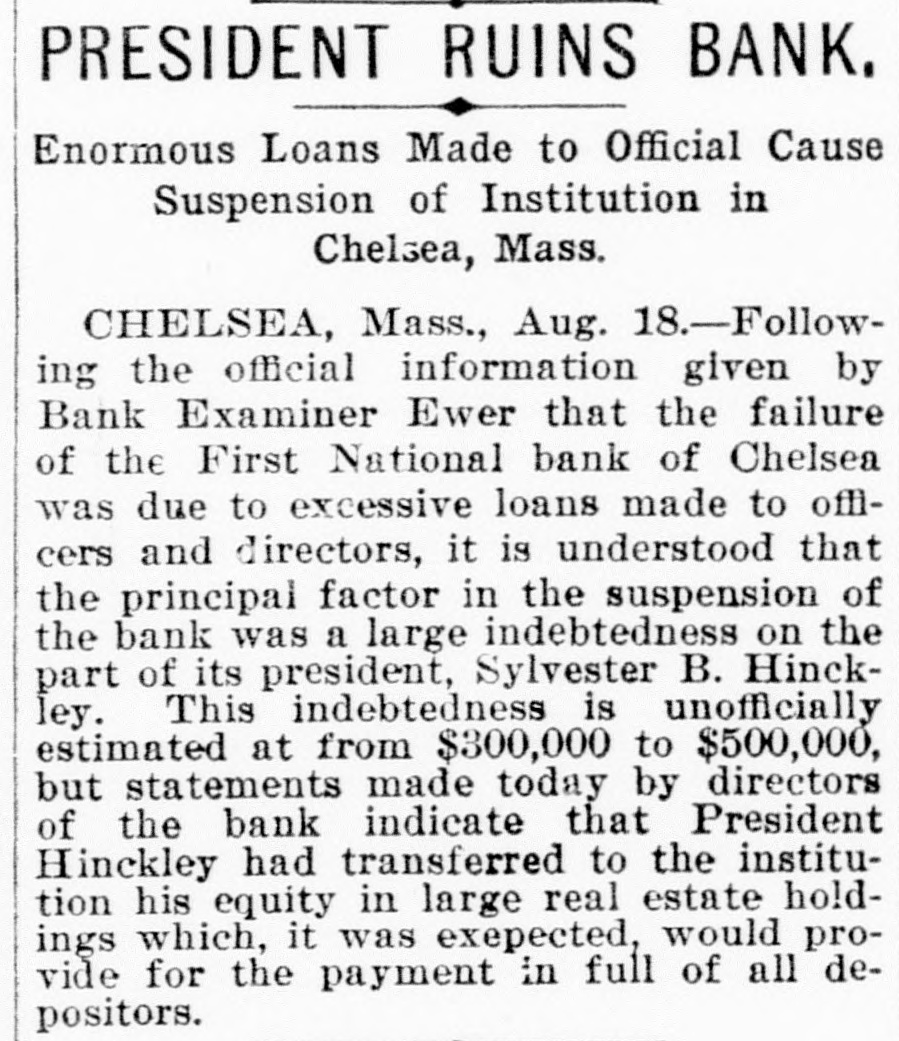
PRESIDENT RUINS BANK
Enormous Loans Made to Official Cause Suspension of Institution in Chelsea, Mass. CHELSEA, Mass., Aug. 18.-Following the official information given by Bank Examiner Ewer that the failure of the First National bank of Chelsea was due to excessive loans made to officers and directors, it is understood that the principal factor in the suspension of the bank was a large indebtedness on the part of its president, Sylvester B. Hinckley. This indebtedness is unofficially estimated at from $300,000 to $500,000, but statements made today by directors of the bank indicate that President Hinckley had transferred to the institution his equity in large real estate holdings which, it was exepected, would provide for the payment in full of all depositors.
18.August 24, 1906Shoshone JournalShoshone, ID
Click image to open full size in new tab
Article Text
LARGE LOANS TO DIRECTORS
Massachusetts Bank Closed By Order of National Bank Examiner. Washington.-The comptroller of the currency has received advices by telegraph from National Bank Examiner Ewer that the First National Bank of Chelsea, Mass., has been closed by action of the directors. Examiner Ewer has been appointed receiver. The failure of the bank is reported by the examiner to be due to large, excessive loans to officers and directors of the bank.
19.August 25, 1906Spirit of the AgeWoodstock, VT
Click image to open full size in new tab
Article Text
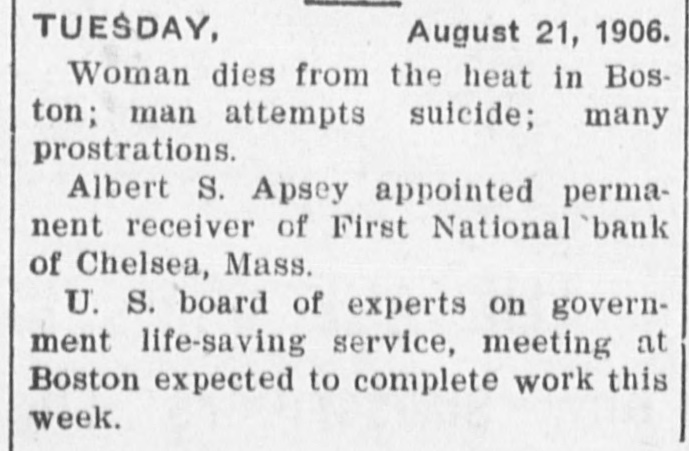
TUESDAY, August 21, 1906. Woman dies from the heat in Boston; man attempts suicide; many prostrations. Albert S. Apsey appointed permanent receiver of First National `bank of Chelsea, Mass. U. S. board of experts on government life-saving service, meeting at Boston expected to complete work this week.
20.September 18, 1906The News-DemocratProvidence, RI
Click image to open full size in new tab
Article Text
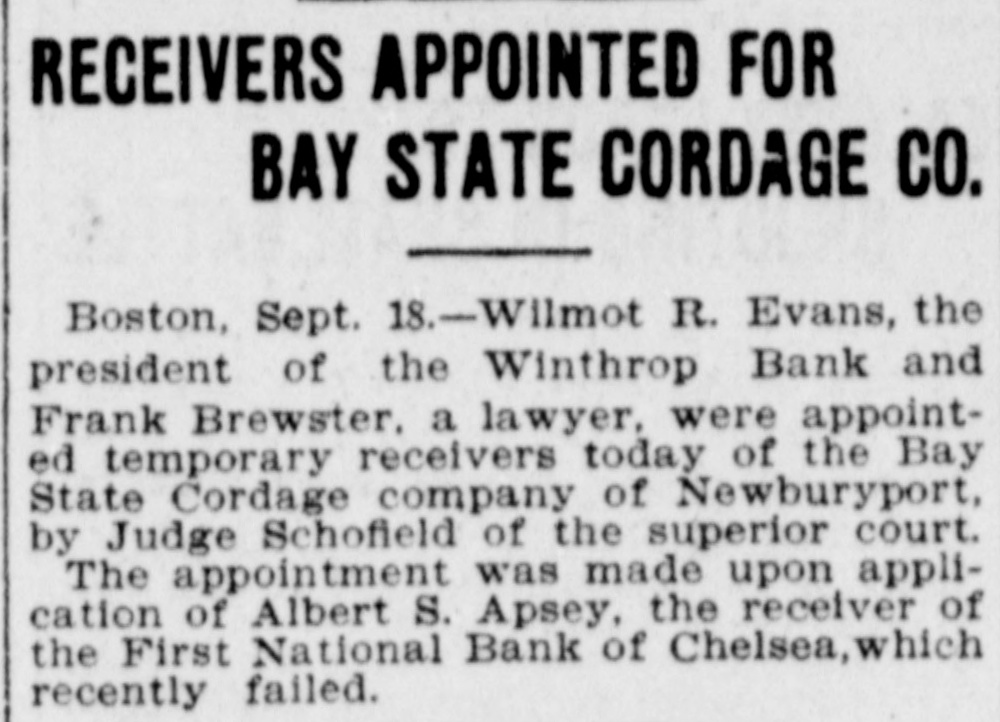
RECEIVERS APPOINTED FOR BAY STATE CORDAGE CO. Boston, Sept. 18.-Wilmot R. Evans, the president of the Winthrop Bank and Frank Brewster, a lawyer, were appointed temporary receivers today of the Bay State Cordage company of Newburyport, by Judge Schofield of the superior court. The appointment was made upon application of Albert S. Apsey, the receiver of the First National Bank of Chelsea, which recently failed.
21.October 2, 1906The News-DemocratProvidence, RI
Click image to open full size in new tab
Article Text
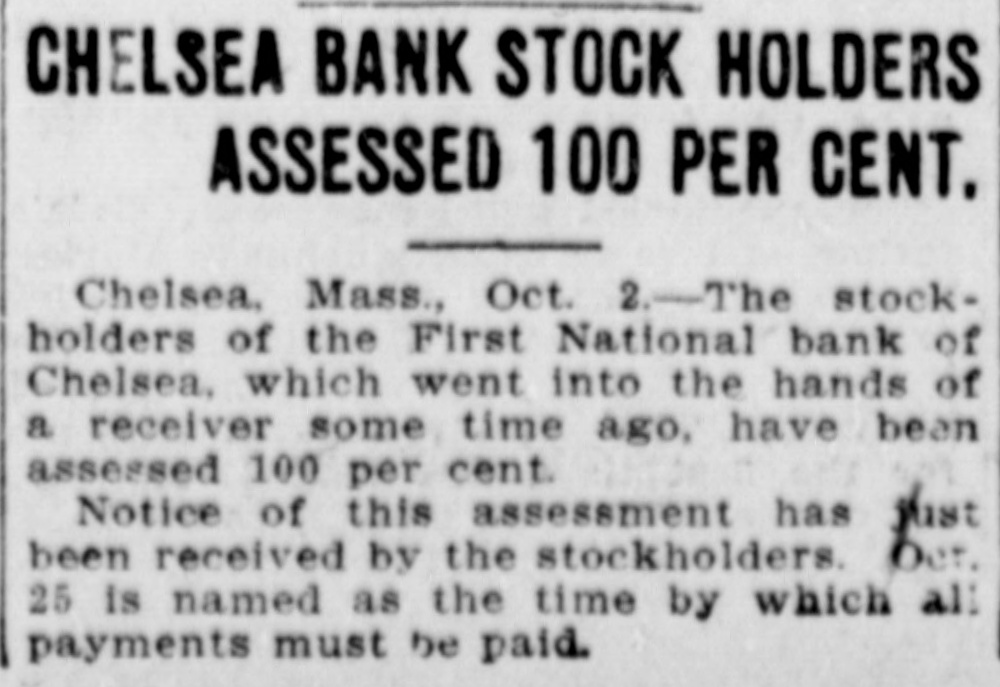
CHELSEA BANK STOCK HOLDERS
ASSESSED 100 PER CENT.
Chelsea, Mass., Oct. 2. The stock- holders of the First National bank of Chelsea, which went into the hands of a receiver some time ago, have been assessed 100 per cent.
Notice of this assessment has just been received by the stockholders. Oct. 25 is named as the time by which all payments must be paid.
22.October 3, 1906The News-DemocratProvidence, RI
Click image to open full size in new tab
Article Text
CHELSEA BANK STOCK HOLDERS ASSESSED 100 PER CENT. Chelsea, Mass., Oct. 3.-The stockholders of the First National bank of Chelsea, which went into the hands of a receiver some time ago, have been assessed 100 per cent. Notice of this assessment has just been received by the stockholders. Oct. 25 is named as the time by which all payments must be paid.
23.October 8, 1906Evening Times-RepublicanMarshalltown, IA
Click image to open full size in new tab
Article Text
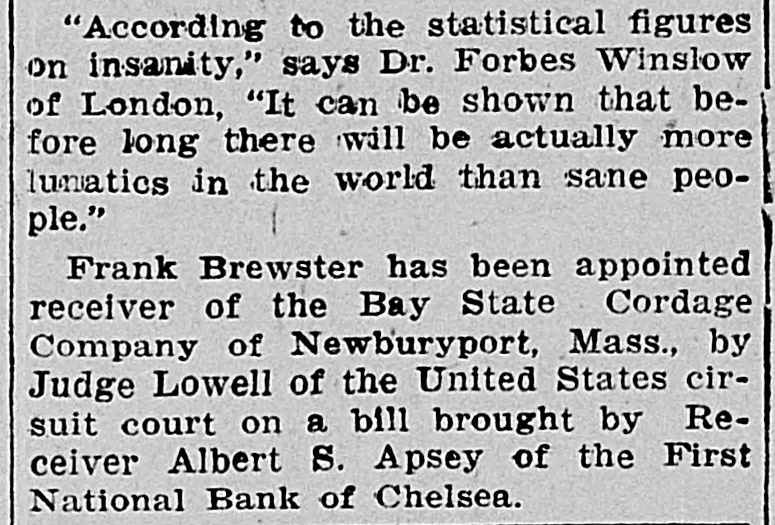
"According to the statistical figures on insanity," says Dr. Forbes Winslow of London, "It can be shown that before long there will be actually more lunatics in the world than sane people."
Frank Brewster has been appointed receiver of the Bay State Cordage Company of Newburyport, Mass., by Judge Lowell of the United States circuit court on a bill brought by Receiver Albert S. Apsey of the First National Bank of Chelsea.
24.November 29, 1906The Daily Morning Journal and CourierNew Haven, CT
Click image to open full size in new tab
Article Text
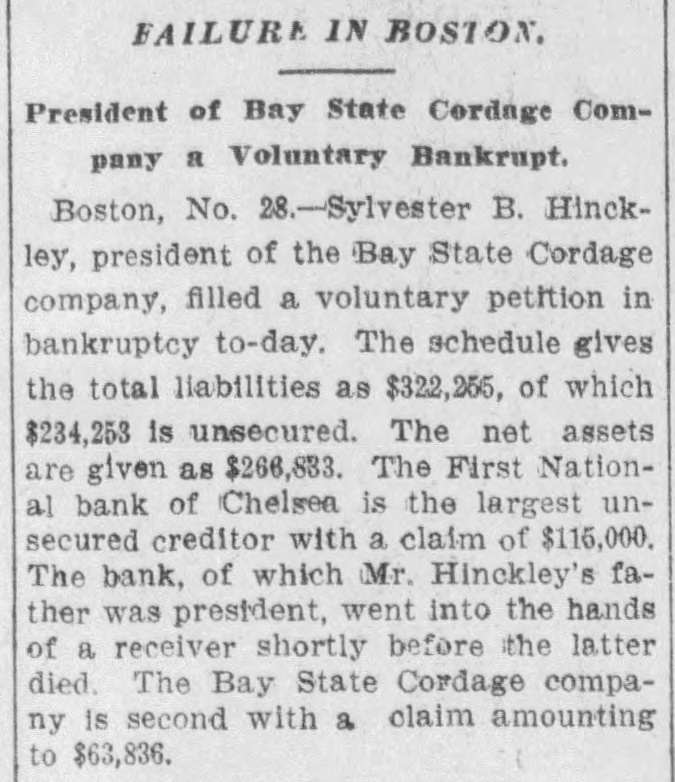
FAILURE IN BOSTON.
President of Bay State Cordage Company a Voluntary Bankrupt.
Boston, No. 28.-Sylvester B. Hinckley, president of the Bay State Cordage company, filled a voluntary petition in bankruptcy to-day. The schedule gives the total liabilities as $322,255, of which $234,253 is unsecured. The net assets are given as $266,833. The First National bank of Chelsea is the largest unsecured creditor with a claim of $115,000. The bank, of which Mr. Hinckley's father was president, went into the hands of a receiver shortly before the latter died. The Bay State Cordage company is second with a claim amounting to $63,836.
Bank runs are almost always and everywhere a deterioration of bank fundamentals.
But not for you.
You are the measure-zero exception: great fundamentals, solid bank, and yet the Diamond Dybvig fairy spread its rumor. Depositors woke up. Your collateral was not prepositioned. The Clearinghouse had it for you.
Do not pass Go. Do not collect $200. Go directly to jail… or worse.