Real Estate Trust Company (Philadelphia, PA)

Episode Information

Episode UID
2439269091280
Episode Type
Suspension β†’ Reopening
Bank Type
trust
Bank ID
243926909 hash
Start Date
August 29, 1906
Location
Philadelphia, Pennsylvania (39.952, -75.164)

Metadata

Model
gpt-5-mini (chosen from majority vote of a three-model LLM ensemble)
Short Digest
d01f7d9575a3da57

Response Measures

None

Description

Coroner reportedly suppressed news of the president's suicide initially to avoid further agitation.

Events (4)

1. August 29, 1906 Receivership
Newspaper Excerpt
Receiver Earle this afternoon appeared in court and qualified as receiver.. He filed a bond of $1,000,000 and went to the company's offices, where he took charge and called the directors into conference.
Source
newspapers
2. August 29, 1906 Suspension
Cause
Bank Specific Adverse Info
Cause Details
Bank closed after discovery of large embezzlements and insolvency tied to President Frank K. Hipple and promoter Adolph Segal.
Newspaper Excerpt
the sign on the doors notifying them that the bank had closed.
Source
newspapers
3. August 30, 1906 Other
Newspaper Excerpt
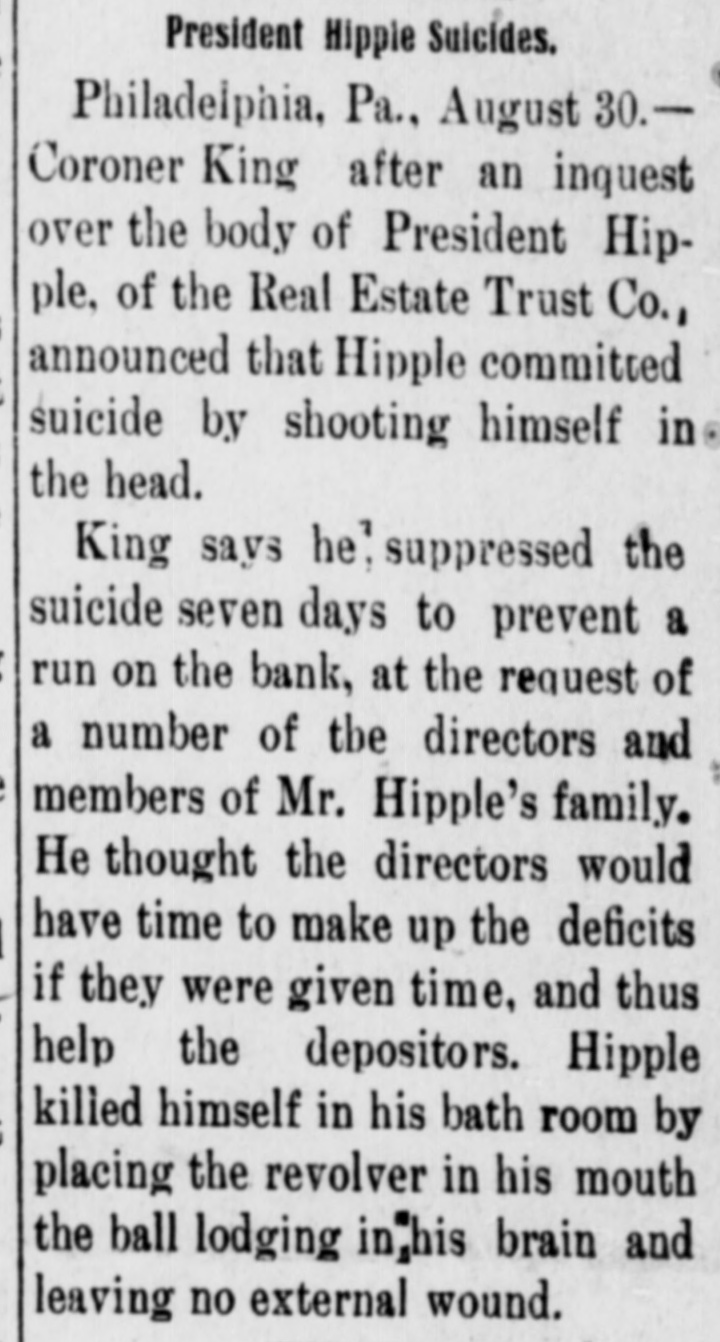
President Hipple killed himself ... Coroner King after an inquest ... announced that Hipple committed suicide by shooting himself in the head.
Source
newspapers
4. November 1, 1906 Reopening
Newspaper Excerpt
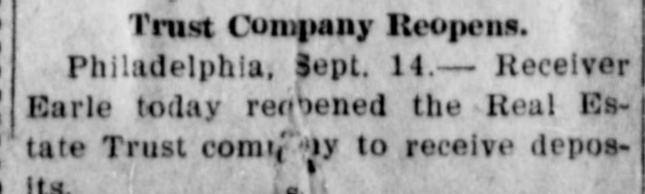
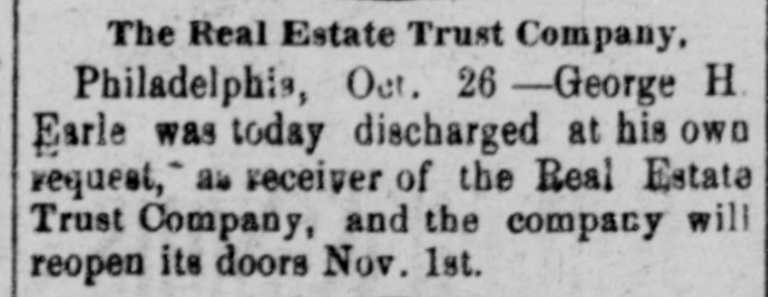
It is officially announced that the trust company would reopen on November 1, with Earle as president.
Source
newspapers

Newspaper Articles (25)

Article from The Laramie Republican, August 29, 1906

Click image to open full size in new tab

Article Text

BANK DIRECTORS IN SESSION DISCUSSING AFFAIRS OF THE FAILED REAL ESTATE TRUST COMPANY. Two of the Officers Drain Institution of Ten Million Dollars, President Lending Half Million Dollars to Float Wildcat Real Estate Scheme -Depositors Threaten Lives of Of ficers of the Trust Company. Philadelphia, Pa., Aug. 29.-At 2 o'clock this afternoon the meeting of the principal bank directors was still in session. The purpose of the gathering is to devise means to re-open the doors of the Real Estate Trust company tomorrow, in order to avert the general disaster or panic in the city. It is understood that the money is pledged. Floated Wild Cat Schemes. The court will be petitioned to dismiss the temporary receiver. It turns out that two men drained the great organization of its $10,000,000 capital and deposits. President Hipple lent over $250,000 to float the wild cat real estate schemes, and then committed suicide. From Soap to Swelldom. Adolph Segal, got the most of the money. His rise has been meteorc. From a humble laborer in soap cauldron, he rose to place and power as a town builder. In the crash of the trust company the noted author and physician, S. Weir Mitchel, is involved. Depositors Clamorous. A large disorderly crowd of depositors composed of men and women congregated in front of the door of the collapsed Real Estate Trust company this morning. Street cars were blocked and the police were called out to subdue the crowd, which threatened to wreck the bank. Bank Officials Threatened. Several threatened the lives of the bank officials. Many depositors burst into tears when the ysaw the sign on the doors notifying them that the bank had closed.


Article from The Montgomery Advertiser, August 30, 1906

Click image to open full size in new tab

Article Text

THE BANK MAY BE RE-OPENED Receivership Will Be Only Temporary. CHURCH FUNDS ARE INTACT Not Believed That They Have Been Tampered With. Directors Have Not Abandoned Hope Of Raising $3,500,000 Needed To Supplement Amount Offered \ by the Clearing House. Philadelphia, Aug. 29.-At the conclusion of a protracted conference with the directors of the embarassed Real Estate Trust Company this afternoon, Receiver Earle said that in his estimation the receivership will be only temporary and that the bank will be able to resume business at an early day. He said it would take several days before he will be able to make 2 definite statement. He spoke opIcally and said he did not think ilure would prove to be as bad as it at first looked. Regarding the condition of trusts Mr. in the custody of the company. Earle said: "While I have not had an opportunity to examine the books, I have every reason to believe that all trust funds are intact." Thus far there has been no hint that securities deposited as collateral for loans were tampered with or that trust funds were misapplied. shared The hopeful view of Mr. Earle is by financial interests generaly. It was reported that an effort was being made to help out the bank with the view to reopening it within fortyeight hours, but it was denied by the heads of larger banks. Some directors, however, have not abandoned hope of accomplishing this object and have been using their personal influence with the object of raising the required $3,500,000. to meet a similar amount subscribed by the clearing house association and thus make up e deficiency of $7000,000 in the bank's funds. One prominent banker sub scribed $500,000 today and others are willing to advance large sums. JoJhn H. Converse, one of the heads of the Presbyterian church and a d1rector of the fafted company, is confident the church funds and investments are intact. Mr. Hipple was treasurer and custodian of these funds. The bank's failure continues to be the sensation of the hour and is the general topic of discussion everywhere A large out orderly crowd surrounds the building, and except for an occasional outbreak from some excited individual, is eastily kept in check by the police. Receiver Earle this afternoon appeared in court and qualified as receiver.. He filed a bond of $1,000,000 and went to the company's offices, where he took charge and called the directors into conference. Inquiry today among prominent authorities of the Presbyterian Church and directors of the Real Estate Trust Company as to the amount of church money involved in the failure showed that the sum will be small. John H. Converse, Chairman of the Trustees of the General Assembly and stockholder in the Real Estate Trust Company, said today that trustees had on deposit in the Trust Company about $4,000 which is involved in the failure. The remainder of the trustee's money, amounting to $963,869, is invested in mortgages, bonds and other securities. An examination of these securities as late as last Sunday showed that they are all intact. On this point Mr. Converse said: The way the matter stands now only about $4,000 of the General Assembly's funds are involved and will have to take the same chance as the money of other depositors feel sure that none of the securities of the General Assembly have been tampered with. They are all in the name of the Trustees of the General Assembly, of which Mr. Hipple was treasurer and not member Two of the three boards in this city used the Real Estate Trust Company as a depositary They are the Board of Ministerial Relief which had $48,000 on deposit when the company closed its doors and the Board of Publication. At the offices of the Board of Ministerial Relief it was announced today that the beneficiaries of the Board would not lose a cent nor would their payments be delayed a day. The Women's Foreign Missionary Society has an account of several thousand dollars with the Trust Company. The will of the late President. Frank K. Hipple, was filed today. The document was executed July'1 1906. and is brief, be It ing in Mr. Hipple's handwriting reads "I. Frank K Hipple, do hereby give, bequeath and devise an my estate, real, personal and mixed, unto my son, Frank Wharton Hipple, his heirs and assigns. knowing that he will give one-half thereof unto his Aunt Sallie, if she be living and I hereby appoint my son to be executor of this will." The son had a rough experience today when he emerged from the bank building A man in the crowd saw him and shouted There goes the son of the rogue who said he had no faith in men who smoke elgars and chew tobacco.' Immediately a mob took up the cry and made a rush for young Hipple. For a few moments it looked as though he would be roughly handled. but the police succeeded In beating the mob back and rescuing the frightened man from its wrath He was hustled into a carriage and taken away PRESBYTERLANS


Article from The Madison Daily Leader, August 30, 1906

Click image to open full size in new tab

Article Text

REAL ESTATE TRUST COMPANY OF PHILADELPHIA MAY REOPEN ITS DOORS. NO HINT AT CROOKED DEALING RECEIVER EARLE TAKES HOLD AND BELIEVES CONCERN IS IN GOOD SHAPE. Philadelphia, Aug. 30.-At the conclusion of a protracted conference with the directors of the embarrassed Real Estate Trust company Receiver Earle said that in his estimation the receivership will be only temporary and that the bank will be able to resume business at an early day. He said It would take several days before he will be able to make a definite statement. He spoke optimistically and said he did not think the failure would prove to be as bad as it at first looked. Regarding the condition of trusts in the custody of the company Mr. Earle said: "While I have not had an opportunity to examine the books I have every reason to believe that all trust funds are Intact." Thus far there has been no hint that securities deposited as collateral for loans were tempered with by the late President Hipple or that trust funds were misapplied. The hopeful view of Mr. Earle is shared by financial Interests general.y. It was reported that an effort was being made to help out the bank with the view to reopening it within fortyeight hours, but it was denied by the heads of the larger banks. Some directors, however, have not abandoned hope for accomplishing this object and have been using their personal infiuence with the object of raising the required $3,500,000 to meet a similar amount subscribed by the Clearinghouse association and thus make up the deficiency of $7,000,000 in the bank's funds. One prominent banker subscribed $500,000 and others are willing to advance large sums. John H. Converse, one of the heads of the Presbyterian church and a director of the failed company, is confident the church funds and investments are intact. Mr. Hipple was treasurer and custodian of these funds. The bank's failure continues to be the sensation of the hour and is the general topic of conversation everywhere. A large but orderly crowd surrounds the building and except for an occastonal outbreak from an excited individual the crowd is kept in check by the police.


Article from Barton County Democrat, August 31, 1906

Click image to open full size in new tab

Article Text

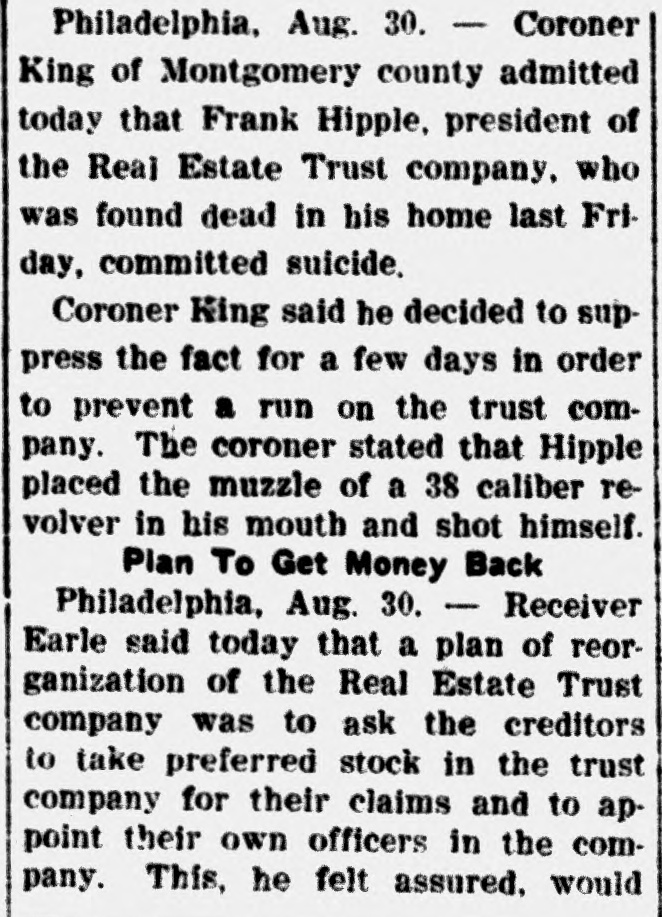
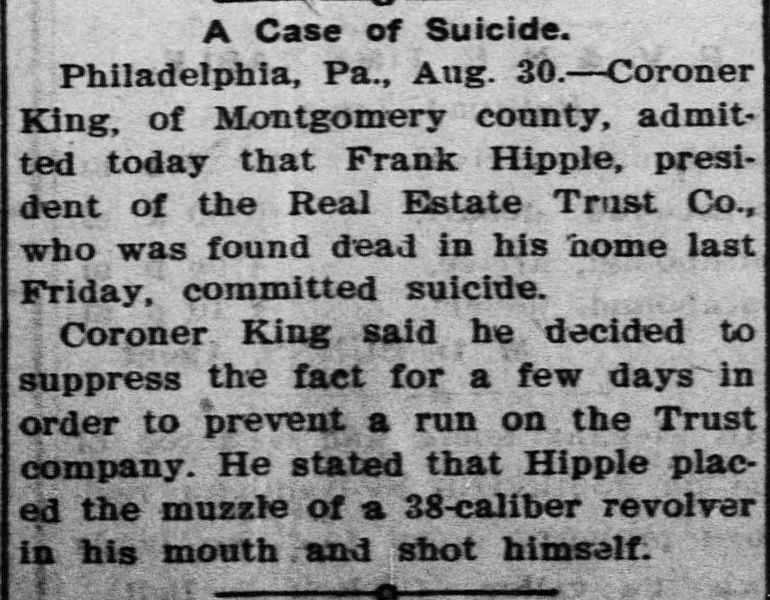
President Hipple Suicides. Philadelphia, Pa., August 30.Coroner King after an inquest over the body of President Hipple, of the Real Estate Trust Co., announced that Hipple committed suicide by shooting himself in the head. King says he, suppressed the suicide seven days to prevent a run on the bank, at the request of a number of the directors and members of Mr. Hipple's family. He thought the directors would have time to make up the deficits if they were given time, and thus help the depositors. Hipple killed himself in his bath room by placing the revolver in his mouth the ball lodging in"his brain and leaving no external wound.


Article from The Stark County Democrat, August 31, 1906

Click image to open full size in new tab

Article Text

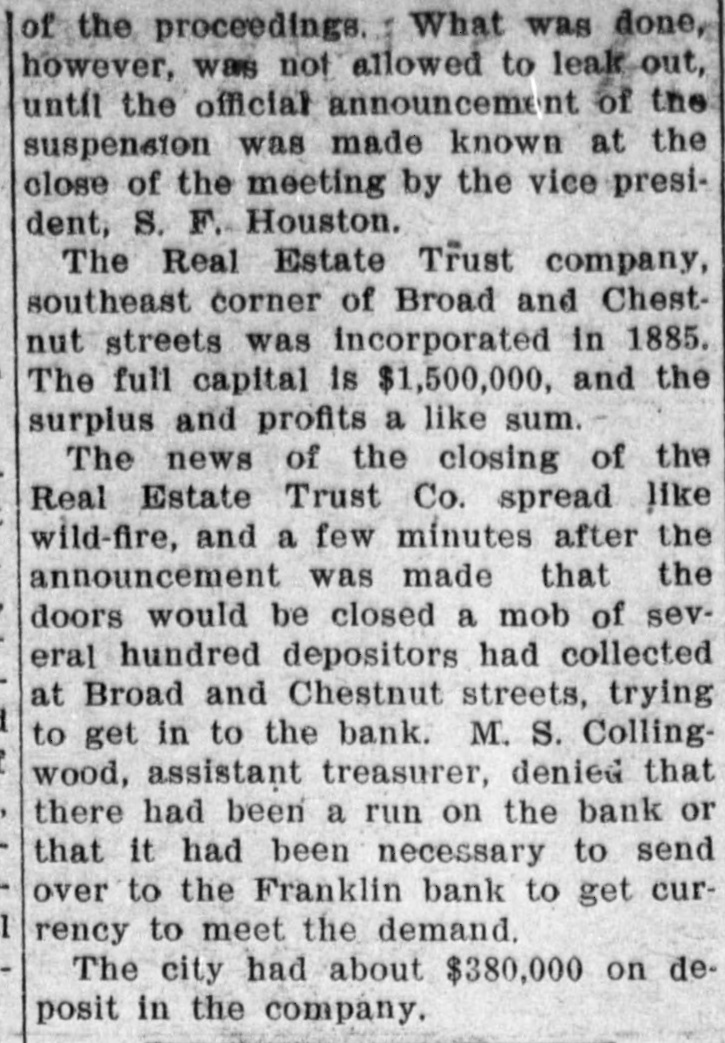
lof the proceedings. What was done, however, was not allowed to leak out, until the official announcement of the suspension was made known at the close of the meeting by the vice president, S. F. Houston. The Real Estate Trust company, southeast corner of Broad and Chestnut streets was incorporated in 1885. The full capital is $1,500,000, and the surplus and profits a like sum. The news of the closing of the Real Estate Trust Co. spread like wild-fire, and a few minutes after the announcement was made that the doors would be closed a mob of several hundred depositors had collected at Broad and Chestnut streets, trying to get in to the bank. M. S. Colling-wood, assistant treasurer, denied that there had been a run on the bank or that it had been necessary to send over to the Franklin bank to get currency to meet the demand, The city had about $380,000 on deposit in the company.


Article from The Jersey City News, September 1, 1906

Click image to open full size in new tab

Article Text

HIPPLE'S FREE HAND Permitted by Directors of Failed Trust Company to Run Its Affairs. NO EXAMINATION IN YEARS. Clearing House Member Explains Why No Aid Was Rendered to Wrecked Institution - Hipple's Defalcations ShockAssociates-Failure May Lead to Revision of Banking Laws. Philadelphia, Sept. 1.-Additional desensational continue out in velopments, to crop connection in character, with of the It has become company. the failure Real been Estate known meeting Trust publicly that there had not a of the directors of the failed bank for three years, every detail having been left to the late nearly Hipple, president who of the company, Frank K. comIt was this caused the fairs mitted which suicide. Clearing state House of af- to association to hesitate about coming the aid of the trust company. the meeting of the clearing bankers house During Joseph D. Junkin, counsel for the Real Estate Trust company, was asked: "When did the directors of the trust company last examine its affairs?" Examined Years Ago. His answer, "Not for more than two and caused men the affairs of guide a half years," Philadelphia's the who financial institutions to gasp. Criticism of the members of the House association was refor the sponsible Clearing information. Several of the directors of the trust company had since the crash comsaid saved that the had the pany could have been local bankers advanced $7,000,000. A member of the Clearing House association who was present at Tuesday's meeting said: directors of the Real Estate Trust knew as "The affairs company little about of the of the company as any the apto know whether pear bankers present. They the did shortage not and was $5,000,000 or $10,000,000, it been folly for us would have affairs to have advanced the cash when the of the bank were in such a deplorable condition. Had No Security to Offer. "The three directors of the company who came before us with outstretched hands for $7,000,000 had absolutely to offer in return but Dead had not even in their company's dence nothing Sea fruit. They future to confi- of for when they were their fer, would pledge fortunes asked banks to if might make they losses that the allied it blind' sustain good by 'going their answer was a painful silence." of Receiver President had stolen The statement Hipple Earle securities that and that lending to Adolph on valued of $5,000,000 at $65,000 Segal the to theft in sufficient security amounted created a profound sensation through out the city. was an cruel to his many The blow revelation intimate especially friends, whom are prominent in the church, as most Presbyterian of either elergy men or laymen. So high was their estimation of the man who abhorred tobacco and liquor and refrained from reading Sunday newspapers that not only the various in the Presbyterian the trust company church organizations made of members their but hundreds of money depository, that denomination placed number their of pas in his company. The tors who used the bank to care for their savings was exceptionally large. Hipple a Political Reformer. In addition to his church work, Mr. took an active interest in re form and is said to been a contributor to Hipple heavy politics the have reformers' campaign fund in last year's contest In this city. The failure of the Real Estate Trust company is likely to lead to a revision of the state laws governing trust com Under the present in this state are companies panies. laws permitted trust to do a surety business, and a move ment is now on foot to separate the two.


Article from Albuquerque Weekly Citizen, September 1, 1906

Click image to open full size in new tab

Article Text

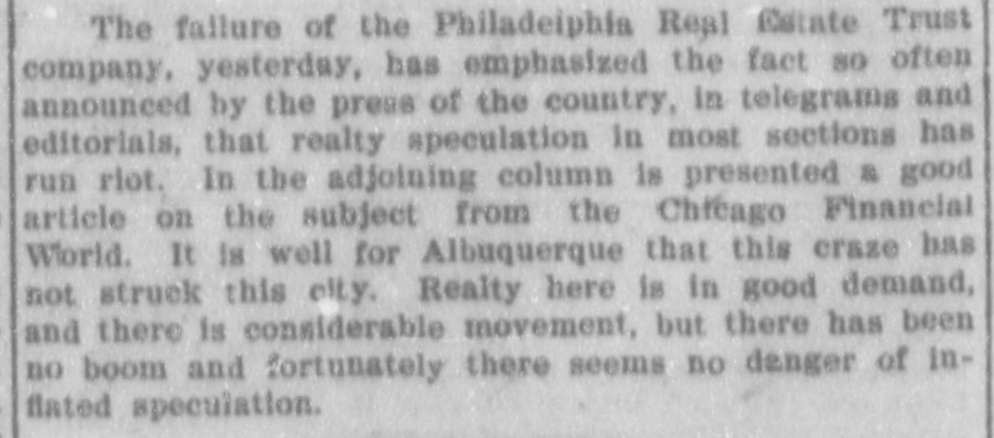
The failure of the Philadeiphia Real Datate Trust company, yesterday, has emphasized the fact so often announced by the press of the country, in telegrams and editorials, that realty speculation in most sections has run riot. In the adjoining column is presented a good article on the subject from the Chicago Financial World. It is well for Albuquerque that this craze has not struck this city. Realty here is in good demand, and there is considerable movement, but there has been no boom and fortunately there seems no danger of inflated speculation.


Article from Arizona Republican, September 4, 1906

Click image to open full size in new tab

Article Text

therefor. All indebtedness will be fully met on call from the receiver." Discussing the liabilities of the directors. John H. Converse, head of the Baldwin Lecomotive works and one of the board of directors, said today: "That which was done in the case of the Real Estate Trust company would be possible, under existing laws and regulations, in the affairs of any other trust company in Philadelphia. The directors went through the forms that are observed by other boards of directors. The fault is with the present system, which must be radically changed before it may safely be said that another real estate trust crash is out of the question." Mr. Converse denied a statement that the directors had held but one meeting in two years.


Article from The Forest Republican, September 5, 1906

Click image to open full size in new tab

Article Text

Saturday. Investigation into the Paterson Canoe club scandal showed that about 25 girls have been attacked on Laurel island. President Roosevelt has asked that the Roosevelt Home club of New York city be probed by the postoffice department. Rear Admiral Thomas in a letter to the mayor of Newport indignantly resents discrimination against bluejackets because of their uniforms. Frank Hipple, president of the wrecked Real Estate Trust company of Philadelphia, was an embezzler, the receiver declared, and killed himself to escape punishment. George J. Gould and D-Cady Herrick retired as directors of the Equitable Life Assurance society, Mr. Gould ending all connection between Wall street and the society.


Article from Pullman Herald, September 8, 1906

Click image to open full size in new tab

Article Text

# LATE NEWS NOTES. A conspiracy has been suppressed in the province of Ilcocos Norte, on the Island of Luzon, by the prompt action of Governor Florey in arresting 15 of the Filipines said to be implicated. The public power house of the Kansas City & Leavenworth Railway company at Walcott, Kan., 15 miles west of Kansas City, was burned recently, with all its valuable machinery. Loss, $300,000. It is announced in Goldfield that the films for the moving pictures became exhausted after the 38th round. As a result the concluding rounds of the great fight will not be shown in these pictures. President Rickard states that the receipts for the fight amounted approximately to $780,00, and that the number of spectators at the ringside aggregated 7000. This is the greatest amount of money taken in for a prize fight in the history of the ring. He says he does not make any charges against Siler, but I know that Nelson did not foul Gans. I don't care who says that he did. A thousand strong, the second contingent of Farley strikebreakers have landed in San Francisco. The report is confirmed from Honlulu that the transport Sehridan practically will be a total loss. Conditions existing at this time call for an increase in the pay of the army, says Brigadier General Constant Williams, commanding the department of Columbia, in his annual report. Receiver Earl of the Real Estate Trust company of Philadelphia says that the farthed he probes into the affairs of the defunct company the worse he finds them. He thinks the trust department intact, but the bank department is hopelessly involved. Indications are that Hipple's stealing exceeds $1,000,000.


Article from The Sun, September 9, 1906

Click image to open full size in new tab

Article Text

ious financier" of Philadelphia among the business men with whom he dealt in Virginia. He was also trustee for the Washington, Alexandria and Mount Vernon Electric Company, and this gave him the opportunity to work his swindle with the paid bonds. In the stated case found to-day Hipple made a loan of $65,000 to himself and as security gave the trust company 6 per cent. bonds of the Electric Company of a par value of $48,000. But the whole issue had been paid off and was worth less than confederate money. Just who passed on these old bonds District Attorney Bell is trying to find out, and as a result of his discovery a number of officers of other banks who had dealings with Hipple will spend Sunday looking through their securities. The next issue of bonds of the Electric Company, the 5s, are still running and selling at par. None of these is among the collateral. As for Hipple's system of forgery, it could readily have been continued for a long time without discovery. He had taken copies of the signatures of a number of the most prominent business men of Philadelphia while their checks were passing through the bank, but in every instance he avoided the use of the name of a depositor of the Real Estate Trust Company. When pinched for money Hipple would draw up a note, forge the signature, take it to the cashier or paying teller, inform him that he had personally made the loan, and to put in the account as a discounted paper. With this amount to his credit he would satisfy the claim that was pressing him at the time. For this branch of the business Hipple kepta private book. in which he entered the amounts of the forged notes and when they became due, and at no time did he allow one of these spurious papers to get away from him. He always explained to the employee of the bank who cashed the note that it was a private matter between the maker of the note and himself and that he desired it to be entered as such. When the bogus note became due Hipple invaria bly either met it with some of the Segal paper, or if this was not expedient he would make out another note with the forged signature of some ot her business man. Incidentally Hipple had been so consciencious in looting the trust company that when a balance of $11,000 remained out of a loan sunk into one of Segal's enterprises he carefully placed that amount in the bank to his own account. The trustees of the General Assembly of t he Presbyterian Church have issued an authoritative statement giving the loss in the crash of the Real Estate Trust Company as $49,000. The $49,000 does not. of course, include the total loss to Presbyterian institutions. It represents only the actual loss to the executive body of the church. When the total loss to Presbyterian organizations, boards. churches, pastors. &c., is computed it will reach nearly $400,000. Depositors to-day refused the directors' plan of reorganization, which provided for an issue of preferred stock to depositors in the place of their deposits and a morton gage it - Broad the and Real Chestnut Estate streets Trust's and property the profits for ten years from the trust accounts. By this plan the depositors figured that


Article from The Fulton County News, September 13, 1906

Click image to open full size in new tab

Article Text

# THE NEWS OF THE WEEK. Domestic. On warrants charging embezzlement and making false returns, sworn out by a depositor of the wrecked Real Estate Trust Company, Adolph Segal, promoter; William F. North, treasurer, and M. S. Collingwood, assistant treasurer of the wrecked institution, were arrested and arraigned before Magistrate Kochersperger at Central Police Court. They were released on bond. Former friends of Herman Oelrichs said after the funeral that his entire estate, amounting to more than $2,000,000, would revert to his 15-year-old son Hermann, who would come into full possession of the property upon attaining his majority. The value of Adolph Segal's bonds and stocks was shown in Philadelphia when "$25,000 worth of Pennsylvania Sugar Refining Company first mortgage 5 per cent. gold coupons, due in 1931, brought $2,500 at auction. Miss Anne Morgan, aged 37 years, died suddenly of heart trouble, the attack following a dream that a colored man entered her room. The trial of Harry K. Thaw for the murder of Stanford White will not take place in New York until after the election. The striking street car men of San Francisco have agreed to return to work upon the condition that differences be arbitrated. A junta is said to be collecting funds and supplies in New Orleans for a revolution in the Central American republics. In the Irrigation Congress at Boise, Idaho, Senator Heyburn made an attack upon the President's forestry policy. The court review has set October 19 as the date of the hearing of the appeal of Rev. Dr. Crapsey, of Rochester, who was found guilty of charges of heresy. Collins Humbert and Lenardo Vilareal were arrested in Tucson, Ariz., on the charge of attempting to organize a revolutionary movement against Mexico. Robert Cotton, colored, who last year murdered his wife, literally cutting her body into pieces, was executed in Vinita, I. T. He confessed. Robbers bound and gagged Cashier P. W. Vanancher and leisurely looted the State Bank of Ranier, Ore. Miss Frances Wadsworth, of Newark, N. J., was drowned while bathing at Bradley Beach. A Mexican gunboat seized the American fishing smack Aloha and put her crew in prison. Rev. Dr. Francis R. Beattie died in Louisville, Ky. Joseph DeF. Junkin, a director and solicitor of the Real Estate Trust Company, admitted that the Arling-Brook Real Estate Company, of Baltimore, of which he was the head, had borrowed $250,000 from the trust company. In a letter to Charles A. Stillings, public printer, President Roosevelt wrote that if the changes in spelling advocated by the Simplified Spelling Board meet popular approval they will be made permanent. Mrs. Anna Edelhartz was killed and Miss Anna Robinson seriously injured in a street car panic in Chicago, caused by a short circuit in the controller box. After a two-hour search bloodhounds found John Dowd, a boy who had wandered from his home, in Sandersfield, New York, several days ago. A statement of the Department of Commerce says that cotton was king, according to the export record of the past fiscal year. In a fight with state police at Punxsutawney, Pa., Italians killed two officers, fatally wounded another and shot three more. In a fire at Louisville, Ky., Henry Taylor was suffocated and three other persons overcome. The property loss is $5,000. Mrs. Jane Austin, "the washerwoman heiress," is dying at her home, in McKeesport, Pa., of blood-poisoning.


Article from Mrs. Grundy, September 13, 1906

Click image to open full size in new tab

Article Text

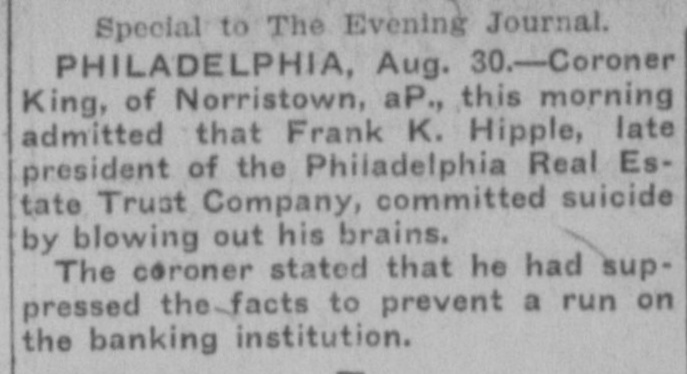
The coroner in Philadelphia now says that Frank D. Hipple, late president of the Real Estate Trust company, that failed, committed suicide by blowing out his brains. It was reported at the time that Hipple died from heart failure. The coroner says he suppressed the truth for fear of a run on the banking institutions.


Article from Evening Star, September 14, 1906

Click image to open full size in new tab

Article Text

BULLS AND BEARS Special Dispatch to The Star. NEW YORK, September 14.-It was 8 erally admitted today that money would continue to be the chief factor in the stock market throughout the fall, but there was a rather wide difference of opinion as to the course of the money market between now and October 10. Some interests were of the opinion yesterday afternoon, when they learned of the sharp advance in foreign exchange, that our money market was likely to become uncomfortably tight again. Other interests asserted that there should not be special anxiety with respect to monetary conditions. They acknowledged that they did not expect further imports of gold in the immediate future and claimed that the $25,000,000 or $30,000,000 gold which they say had been engaged and partly shipped would, with the further relief which Secretary Shaw is expected to furnish, put out money market in pretty fair shape. They seemed to become confident that the Secretary of the Treasury would take further action to relieve the monetary situation. Attention was called to the fact that since it became known that the Real Estate Trust Company of Philadelphia was in trouble, and particularly since that institution suspended business, large New York banks have shipped funds to Philadelphia on an extensive scale. These funds were asked for by Philadelphia banks and trust companies in order that they might be prepared to meet any sudden or extensive withdrawal of funds that might follow the announcement of the Real Estate Trust Company's condition. It is understood that the Philadelphia institutions to which New York banks have S hipped funds during these weeks have been carefully examined and found to be in a thoroughly satisfactory condition. The requests for New York assistance were simply a precautionary measure. It was learned that confidence with respect to the Philadelphia financial Institutions has been fully restored and that as a consequence the New York funds temporarily loaned in Philadelphia will now be returned. The latter fact should be a factor of importance, both in forthcoming bank statements and in the actual supply of money here. It is learned that one large New York bank has shipped $2,000,000 to Philadelphia, another $1,000,000, and it is understood that the aggregate amount was large. * Private advices from San Francisco and other western cities where there has been some uneasiness, whether warranted or otherwise, with respect to certain banking institutions, say that confidence has been largely restored and the withdrawals of funds stopped. It is believed that the promptness with which the Real Estate Trust Company of Philadelphia was reorganized will have a very beneficial influence throughout the country and that it will tend to restore confidence. In connection with this attention is called to the fact that whatever may be said adversely against Wall street. whenever financial institutions throughout the United States get into trouble, they realize that New York is the great financial center and the one place where assistance of a substantial character can always be secured. * * There seems to be greater confidence than at any time since the agitation was begun that the dividend to be declared on Atchison common stock next month will be at the rate of 6 per cent. In fact. It is understood that one of the most powerful interests in the Atchison property has absolutely assured friends that they may expect the rate to be at the figure just mentioned. * * It is learned from railroad men that one of the greatest problems with which they have to contend at the present time is a shortage of cars. The Rock Island is just receiving the last installment of an order placed some time ago for 10,000 freight cars. It is understood that the last few days an additional order for 6,000 freight cars has been placed and that the earliest delivery will be in February. The securities of the companies embraced by the Rock Island system will undoubtedly improve marketwise on the basis of the excellent management of the properties and large showing of earnings. In connection with the higher rate of dividend promised for Atchison common, it is intimated that the company will issue a considerable amount of new stock to pay for the increased facilities which are absolutely imperative to handle the rapidly increasing traffic. If the present stock sells at the price predicted for it, rights on the new issue would be attractive.


Article from Omaha Daily Bee, September 14, 1906

Click image to open full size in new tab

Article Text

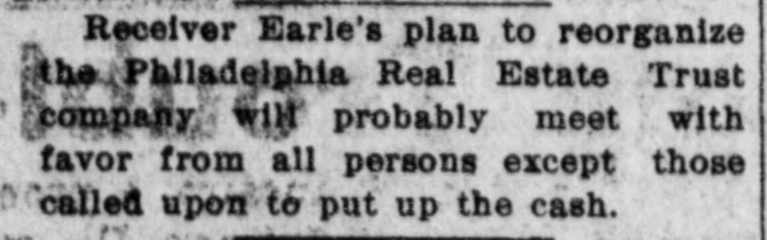
Receiver Earle's plan to reorganize the Philadelphia Real Estate Trust company will probably meet with favor from all persons except those called upon to put up the cash.


Article from The Sun, September 29, 1906

Click image to open full size in new tab

Article Text

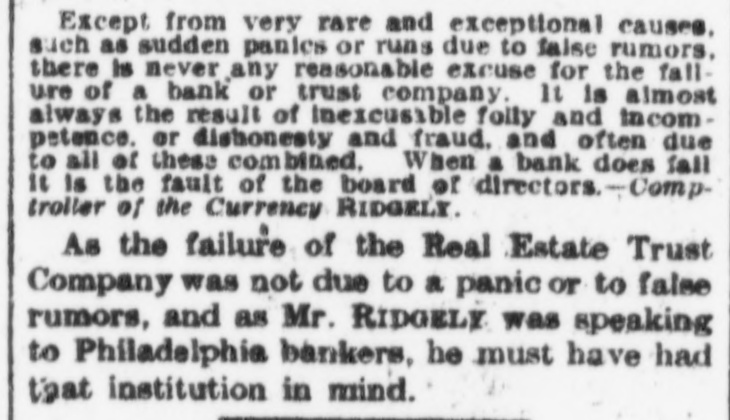
Except from very rare and exceptional causes, such as sudden panics or runs due to false rumors, there is never any reasonable excuse for the failure of a bank or trust company. It is almost always the result of inexcusable folly and incompetence, or dishonesty and fraud, and often due to all of these combined. When a bank does fail it is the fault of the board of directors. - Comptroller of the Currency RIDGELY. As the failure of the Real Estate Trust Company was not due to a panic or to false rumors, and as Mr. RIDGELY was speaking to Philadelphia bankers, he must have had that institution in mind.


Article from The Washington Herald, October 26, 1906

Click image to open full size in new tab

Article Text

SUGAR TRUST PROSECUTION. President Confers with Receiver Earle, of Philadelphia. President Roosevelt yesterday summoned George Earle, receiver of the Real Estate Trust Company, of Philadelphia, to Washington to confer with Attorney General Moody and himself upon the plans for prosecution of the sugar trust which suggested themselves to Mr. Earle from the Giscoveries he made in connection with the wrecking of the Real Estate Trust Company. Mr. Earle came to Washington at once upon receipt of the letter from the President. He brought with him W. W. Porter, who is counsel for the Real Estate Trust Company, and they were received by the President and Attorney General during the afternoon. It was explained by Receiver Earle that he found the sugar trust had obtained control of the stock of the Shackamaxon Sugar Refinery, and by virtue et the control of 51 per cent of the stock was keeping the factory closed and seemingly preventing its use in any way in apparent restraint of trade. Just prior to leaving Philadelphia, Receiver Earle filed in Common Pleas Court there a petition, which Judge Wilson granted. to borrow $60,000 upon the refinery stock held by the Real Estate Trust Company and to issue certificates for the amount bearing 6 per cent. It is officially announced that the trust company would reopen on November 1, with Earle as president.


Article from New-York Tribune, December 21, 1906

Click image to open full size in new tab

Article Text

WOULD SUE THE SUGAR TRUST. Pennsylvania Company Alleges Its Operation as Refinery Was Illegally Prevented. Philadelphia, Dec. 20.-George H. Earle, jr., receiver for the Pennsylvania Sugar Refinery, presented a petition in the Common Pleas Court here to-day asking permission to bring suit for damages against the American Sugar Refining Compary for illegal exercise of its control of a majority of the stock of the Pennsylvania company in preventing the operation of the refinery of the company. Mr. Earle was appointed receiver of the Pennsylvania Sugar Refinery Company after the collapse of the Real Estate Trust Company, when it was found that stock of the refining company had been given to the trust company as security by Adolph Segal. Mr. Earle asks authority to have the trust company, as trustee under the mortgage securing $3,000,000 of bonds of the sugar company, to foreclose. The receiver says: My investigations show that Gustav E. Kissel, of New York, surreptitiously acting as agent for the Sugar Trust, made a loan to Adolph Segal and got trust securities and bonds of the Pennsylvania Refinery Company and, with John E. Parsons, held a controlling interest in the board of managers of the company and voted to make the refinery inoperative. The conduct of the alleged trust, Mr. Earle says, has not only been illegal, but criminal, and he seeks authority to bring action. Its conduct, he alleges, contributed to the failure of the Real Estate Trust Company.


Article from The Laramie Republican, December 21, 1906

Click image to open full size in new tab

Article Text

Philadelphia, Pa., Dec. 21.-Their desire to thwart the threatening ambitions of Adolph Segal, the wizard promoter who inspired the Sugar trust and certain of its New York agents to form a conspiracy that led to the ruin of Frank K. Hipple and the looting and wrecking of the Real Estate Trust company, was the sensational charge made today in behalf of George H. Earle, receiver of the Pennsylvania Sugar Refining company and president of the reorganized trust company. Net Spun by Sugar Trust. In direct terms, the entire net of crime that caused the suicide of Hipple and the downfall of the big financial institution is alleged to have been spun by the Sugar trust, its officers or agents. The men connected with the trust directly named as the active conspirators are Gustave Kissel, John E. Parsons and Theodore A. Havemeyer, all of New York city. Leave to Proceed. Mr. Earle was granted leave to proceed at once, civilly or criminally, against the big trust and the men named. Not only will millions in damages be asked, but action will be taken to force the dissolution of the corporation that has a monopoly on the sugar products of the United States.


Article from Evening Bulletin, January 19, 1907

Click image to open full size in new tab

Article Text

# GOVERNMENT WILL ATTACK # SUGAR TRUST Washington, Dec. 22. -The Federal authorities will in the near future institute proceedings to dissolve the American Sugar Refining Company, better known as the sugar trust. The chief evidence upon which the Government will rely to sustain its case will be that conveyed to it by William R. Hearst and the New York "American." Supplemental to this will be the evidence submitted by George H. Earle, receiver of the Real Estate Trust Company of Philadelphia, the looting of which by its president, Frank K. Hipple, is a matter of record. Within the


Article from The Princeton Union, July 1, 1909

Click image to open full size in new tab

Article Text

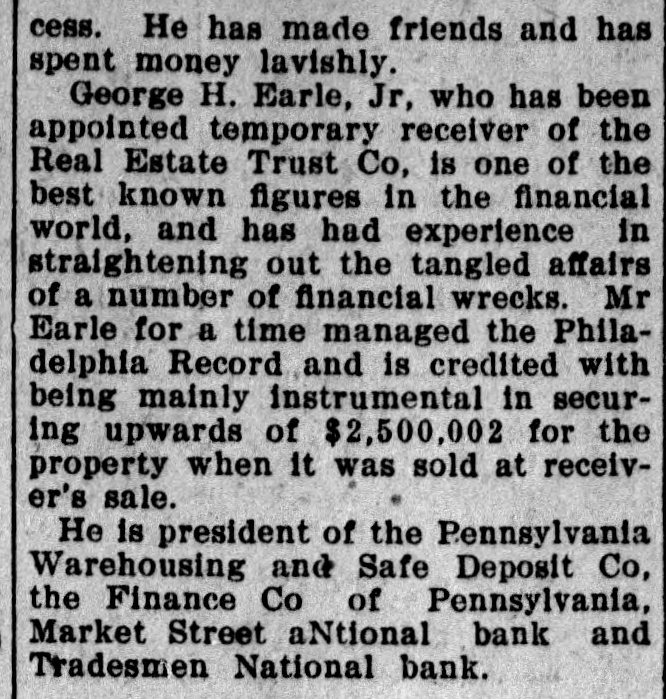
ence the conduct of an honorable man or the suspicions of one of like character. # H. W. Taft Appears In New York. Lawyers and financial men in New York who have followed the sugar trust matter are recalling this corre- spondence with not a little interest. The firm of attorneys "with Washing- ton connections" was Strong & Cad- walader, of which, at the time Mr. Earle wrote, 'both Henry W. Taft, a leading counsel for the sugar trust in all the litigation growing out of the Segal loan, and George W. Wicker- sham, the present attorney general, were members. The fact that Henry W. Taft is an attorney of the sugar trust in this identical Segal case, thus involving the law firm of which Attorney General Wickersham was a member, raises an interesting question as to what the present administration will do toward prosecuting the trust. Judging by the vigor with which Collector Loeb pro- ceeded against the same trust in the matter of the short weight frauds, the law business of Henry W. Taft and of the firm of Strong & Cadwalader will have little or no influence on President Taft, and the prosecution will go for- ward with the same vim that marked Receiver Earle's case. If a private in- dividual could accomplish what he did, what could not the United States gov- ernment accomplish if it proceeded against the trust with all its great power? One of the most remarkable interviews that have appeared in years grew out of this identical suit. It was from no less a man than Sam- ☐☐uel Untermyer, the famous corporation lawyer of New York, who was re- tained by Segal. Mr. Untermyer stated in effect that the government, if it were in earnest, could not only suc- cessfully prosecute the sugar trust, but many other gigantic corporations that pursue the same methods. That inter- view took the lid off. Whatever the government does, how- β– ever, George H. Earle has given the sugar trust a staggering blow. He has not alone wrested from it many mil- lions of dollars, but has shown the country what can be done in curbing criminal combinations by any man who means business. That perhaps is the greatest service of all. Moreover, he has put the Real Estate Trust Com- pany of Philadelphia on its feet, thus saving the money of thousands of in- nocent depositors, and has made it possible for the Pennsylvania Sugar Refining company to open its Camden plant and resume business. For his services to the trust company he was unanimously elected its president. # Other Concerns Saved by Earle. This is but one of a long series of tottering or wrecked institutions that George H. Earle, Jr., has successfully reorganized. Among the others are the Pennsylvania Warehousing and Safe Deposit company, which he took when its stock was down to $5 per share and by cutting out the dead wood, ju- dicious buying of wharfs and busi- ness principles brought it up until its stock is in the neighborhood of $100 per share; the Finance Company of Pennsylvania, which needed a strong bracing and in Earle's hands got it; the Tradesman's National bank, which got into deep water with its stock down to 50, called on Earle, a was set on its feet and now is above par; the Market Street National bank, which was floundering, sent out a hail for Earle and is now selling at a pre- mium of 60; the Reading railroad, which the last time it failed was put back on its feet by Earle and Freder- ick P. Olcott of New York; the Choc- taw, Oklahoma and Gulf railroad, which struck a slump and went under, but with Earle as chairman of its com- mittee of reorganization has been made a paying property, and the Chestnut Street National Bank and Trust company, involving the owner- ship of the great newspaper, the Phila- delphia Record, all three of which Mr. Earle, with the help of one other re- ceiver, put back into flourishing con- dition, although the bank and trust company had actually failed and the paper was heavily involved. This noteworthy triple success was perhaps Earle's greatest achievement up to the time that he reinstated the Real Estate Trust company and the Pennsylvania Sugar Refining company and forced the sugar trust to disgorge several millions of money, credits, stocks and bonds. And now, after the famous street car strike in Philadel- phia, Mr. Earle has been asked by the mayor and councils to take charge of this situation and in a letter that boldly outlines his views and cuts to the heart of the question has consent- ed to do so. The regard with which he is held in Philadelphia is shown by the fact that since his appointment public confidence that the traction question is at last in the hands of a -man who will solve it has been gener- ally expressed. The same trust in his ability and integrity was displayed several years ago when he took charge


Article from Rock Island Argus, July 7, 1909

Click image to open full size in new tab

Article Text

# H. W. Taft Appears In New York. Lawyers and financial men in New York who have followed the sugar trust matter are recalling this correspondence with not a little interest. The firm of attorneys "with Washington connections" was Strong & Cadwalader, of which, at the time Mr. Earle wrote, both Henry W. Taft, a leading counsel for the sugar trust in all the litigation growing out of the Segal loan, and George W. Wickersham, the present attorney general, were members. The fact that Henry W. Taft is an attorney of the sugar trust in this identical Segal case, thus involving the law firm of which Attorney General Wickersham was a member, raises an interesting question as to what the present administration will do toward prosecuting the trust. Judging by the vigor with which Collector Loeb proceeded against the same trust in the matter of the short weight frauds, the law business of Henry W. Taft and of the firm of Strong & Cadwalader will have little or no influence on President Taft, and the prosecution will go forward with the same vim that marked Receiver Earle's case. If a private individual could accomplish what he did, what could not the United States government accomplish if it proceeded against the trust with all its great power? One of the most remarkable interviews that have appeared in years grew out of this identical suit. It was from no less a man than Samuel Untermyer, the famous corporation lawyer of New York, who was retained by Segal. Mr. Untermyer stated in effect that the government, if it were in earnest, could not only successfully prosecute the sugar trust, but many other gigantic corporations that pursue the same methods. That interview took the lid off. Whatever the government does, however, George H. Earle has given the sugar trust a staggering blow. He has not alone wrested from it many millions of dollars, but has shown the country what can be done in curbing criminal combinations by any man who means business. That perhaps is the greatest service of all. Moreover, he has put the Real Estate Trust Company of Philadelphia on its feet, thus saving the money of thousands of innocent depositors, and has made it possible for the Pennsylvania Sugar Refining company to open its Camden plant and resume business. For his services to the trust company he was unanimously elected its president. # Other Concerns Saved by Earle. This is but one of a long series of tottering or wrecked institutions that George H. Earle, Jr., has successfully reorganized. Among the others are the Pennsylvania Warehousing and Safe Deposit company, which he took when its stock was down to $5 per share and by cutting out the dead wood, judicious buying of wharfs and business principles brought it up until its stock is in the neighborhood of $100 per share; the Finance Company of Pennsylvania, which needed a strong bracing and in Earle's hands got it; the Tradesman's National bank, which got into deep water with its stock down to 50, called on Earle, was set on its feet and now is above par; the Market Street National bank, which was floundering, sent out a hail for Earle and is now selling at a premium of 60; the Reading railroad, which the last time it failed was put back on its feet by Earle and Frederick P. Olcott of New York; the Choctaw, Oklahoma and Gulf railroad, which struck a slump and went under, but with Earle as chairman of its committee of reorganization has been made a paying property, and the Chestnut Street National Bank and Trust company, involving the ownership of the great newspaper, the Philadelphia Record, all three of which Mr. Earle, with the help of one other receiver, put back into flourishing condition, although the bank and trust company had actually failed and the paper was heavily involved. This noteworthy triple success was perhaps Earle's greatest achievement up to the time that he reinstated the Real Estate Trust company and the Pennsylvania Sugar Refining company and forced the sugar trust to disgorge several millions of money, credits, stocks and bonds. And now, after the famous street car strike in Philadelphia, Mr. Earle has been asked by the mayor and councils to take charge of this situation and in a letter that boldly outlines his views and cuts to the heart of the question has consented to do so. The regard with which he is held in Philadelphia is shown by the fact that since his appointment public confidence that the traction question is at last in the hands of a man who will solve it has been generally expressed. The same trust in his ability and integrity was displayed several years ago when he took charge of a failed trust company. The manner in which this particular failure had been brought about had enraged the depositors, large numbers of whom entered suit. On Mr. Earle's mere appeal these suits were all withdrawn, he was given complete voting power


Article from Yellowstone Monitor, July 8, 1909

Click image to open full size in new tab

Article Text

pany. The new controlling interest in the Pennsylvania Sugar Refining company forthwith elected a new board of directors, and this board soon afterward adopted a resolution that the Segal refinery should not be operated at that time. Segal also borrowed heavily from the Real Estate Trust company of Philadelphia, with which he deposited the securities of the sold sugar trust loan. President Hipple, of the Real Estate Trust company, had been made custodian of these securities. The trust company became involved hopelessly and suspended. President Hipple committed suicide. Capt. Schultz of Kansas City, chief engineer of rivers and harbors improvements from Kansas City to Helena, was here Tuesday in consultation with Messrs. Hagan, Mead and Hollecker in reference to the improvement of the Yellowstone, and the placing of a lock in the government dam at the Head Gates. Messrs. Mead and Hollecker made a trip down to the Head Gates with Capt. Schultz in an auto and had dinner with the captain on the U. S. boat, Mandan. Prospects seem bright for the improvements mentioned.


Article from The Emmett Index, August 5, 1909

Click image to open full size in new tab

Article Text

ence the conduct of an honorable man or the suspicions of one of like character. # H. W. Taft Appears In New York. Lawyers and financial men in New York who have followed the sugar trust matter are recalling this corre- spondence with not a little interest. The firm of attorneys "with Washing- ton connections" was Strong & Cad- walader, of which, at the time Mr. Earle wrote, both Henry W. Tart, a leading counsel for the sugar trust in all the litigation growing out of the Segal loan, and George W. Wicker- sham, the present attorney general, were members. The fact that Henry W. Taft is an attorney of the sugar trust in this identical Segal case, thus involving the law firm of which Attorney General Wickersham was a member, raises an interesting question as to what the present administration will do toward prosecuting the trust. Judging by the vigor with which Collector Loeb pro- ceeded against the same trust in the matter of the short weight frauds, the law business of Henry W. Taft and of the firm of Strong & Cadwalader will have little or no influence on President Taft, and the prosecution will go for- ward with the same vim that marked a Receiver Earle's case. If a private in- dividual could accomplish what he did, what could not the United States gov- ernment accomplish if it proceeded against the trust with all its great power? One of the most remarkable interviews that have appeared in years grew out of this identical suit. It was from no less a man than Sam- uel Untermyer, the famous corporation lawyer of New York, who was re- tained by Segal. Mr. Untermyer stated in effect that the government, if it were in earnest, could not only suc- cessfully prosecute the sugar trust, but many other gigantic corporations that pursue the same methods. That inter- view took the lid off. Whatever the government does, how- ever, George H. Earle has given the sugar trust a staggering blow. He has not alone wrested from it many mil- lions of dollars, but has shown the country what can be done in curbing criminal combinations by any man who means business. That perhaps is the greatest service of all. Moreover, he has put the Real Estate Trust Com- pany of Philadelphia on its feet, thus saving the money of thousands of in- nocent depositors, and has made it possible for the Pennsylvania Sugar Refining company to open its Camden plant and resume business. For his services to the trust company he was unanimously elected Its president. # Other Concerns Saved by Earle. This is but one of a long series of tottering or wrecked institutions that George H. Earle, Jr., has successfully reorganized. Among the others are the Pennsylvania Warehousing and Safe Deposit company, which he took when its stock was down to $5 per share and by cutting out the dead wood, ju- dicious buying of wharfs and busi- ness principles brought it up until its stock is in the neighborhood of $100 per share; the Finance Company as of Pennsylvania, which needed a strong bracing and in Earle's hands got it; the Tradesman's National bank, which got into deep water with its stock down to 50, called on Earle, was set on its feet and now is above par; the Market Street National bank, which was floundering, sent out a hail for Earle and is now selling at a pre- mium of 60: the Reading railroad, which the last time it failed was put back on its feet by Earle and Freder- ick P. Olcott of New York; the Choc- taw, Oklahoma and Gulf railroad, which struck a slump and went under, but with Earle as chairman of its com- mittee of reorganization has been made a paying property, and the Chestnut Street National Bank and Trust company, involving the owner- ship of the great newspaper, the Phila- lelphia Record, all three of which Mr. Earle, with the help of one other re- ceiver, put back into flourishing con- dition, although the bank and trust company had actually falled and the paper was heavily involved. This noteworthy triple success was perhaps Earle's greatest achievement up to the time that he reinstated the Real Estate Trust company and the Pennsylvania Sugar Refining company and forced the sugar trust to disgorge several millions of money, credits, stocks and bonds. And now, after the famous street car strike in Philadel- phia, Mr. Earle has been asked by the mayor and councils to take charge of this situation and in a letter that boldly outlines his views and cuts to the heart of the question has consent- ed to do so. The regard with which he is held in Philadelphia is shown by the fact that since his appointment public confidence that the traction question is at last in the hands of a man who will solve it has been gener- lly expressed. The same trust in his ability and integrity was displayed several years ago when he took charge of a failed trust company. The man- ner in which this particular failure had been brought about had enraged the depositors, large numbers of whom entered suit. On Mr. Earle's mere ap- peal these suits were all withdrawn. He was given complete voting power for the depositors, and he finally paid them every cent with interest.


Article from The Emmett Index, August 5, 1909

Click image to open full size in new tab

Article Text

# One Man Driven to Suicide. There is more of the story, though that is the nub of it. The Real Estate Trust Company of Philadelphia was involved with Segal, and when the sugar trust pressed for payment of its loan the Real Estate Trust company went to the wall and its president, Frank Hipple, committed suicide. It was here that Earle came into the game. He had already straightened out the affairs of a number of failed banks and had a reputation as a financial doctor and life saver. He was therefore made receiver of the Real Estate Trust, and from that hour the benevolent sugar octopus did not have things so much its own way. Earle found plenty of in-