
4734. Woodlawn Trust & Savings Bank (Chicago, IL)

Bank Information

Episode Type
Suspension → Closure
Bank Type
savings bank
Start Date
June 1, 1932*
Location
Chicago, Illinois (41.850, -87.650)

Metadata

Model
gpt-5-mini
Short Digest
796f19dc

Response Measures

None

Description

The articles state the Woodlawn Trust & Savings Bank was taken over by the Illinois auditor in June 1932 and placed in the hands of a receiver; no run is described in the provided clippings. Classification: suspension leading to permanent closure/receivership (government action).

Events (2)

1. June 1, 1932* Receivership
Newspaper Excerpt
This was refused by Mr. Vernon who stated that it would be turned over to a bondholders protective committee composed of himself ... the full amount of interest due ... was on deposit in the Woodlawn Trust and Savings bank ready for payment when that institution closed. ... receiver of the Woodlawn Trust and Savings bank, ... H. C. Vernon, receiver of the Woodlawn Trust and Savings bank, ... The Woodlawn bank was taken over by the Illinois auditor of public accounts in June, 1932, and placed in the hands of a receiver.
Source
newspapers
2. June 1, 1932* Suspension
Cause
Government Action
Cause Details
Taken over by Illinois auditor of public accounts and placed in receivership in June 1932.
Newspaper Excerpt
The Woodlawn bank was taken over by the Illinois auditor of public accounts in June, 1932, and placed in the hands of a receiver.
Source
newspapers

Newspaper Articles (2)

Article from Chicago Tribune, August 8, 1932

Click image to open full size in new tab

Article Text

CO-OP OWNERS REFUSED LIST OF BONDHOLDERS Bank Receiver Smiles at Court Ruling. BY AL CHASE. Citing a recent decision of Circuit Court Judge Philip J. Finnegan that an equity owner has a right to know whom he owes, the twenty-one tenant owners of the Essex cooperative apartment building at the northeast corner of 76th street and Essex ave. nue, asked H. C. Vernon, receiver of the Woodlawn Trust and Savings bank, for list of bondholders. This was refused by Mr. Vernon who stated that it would be turned over to a bondholders protective committee composed of himself, the forfer president and two former directors of the closed bank. None of these, It is claimed, own any Essex bonds. The full amount of interest due on June 20 on the outstanding bonds, or $2,748. was on deposit in the Woodlawn Trust and Savings bank ready for payment when that institution closed. Wishing to preserve its equity, the tenant owners, organized as the Essex Building corporation, whose stockholders are the tenant owners, raised additional funds to meet interest payments. Cash Ready for Interest. Burke F. Ward, one of the tenant owners and secretary of the Essex corporation, announces that funds are now on deposit at the Northern Trust company and bondholders may obtain payment by application at his office at 2602 East 75th street. Mr. Ward, when asking Mr. Vernon, as receiver, for the bondholders' list in order to notify the owners of the bonds that cash was on hand for interest payments, told of the Judge Finnegan decision which ordered the receiver of the Depositors State bank to turn over list of bondholders to the equity owner. Mr. Vernon said that was ridieulous no such decision had been made or would be made," said Mr. Ward. His comment was: We've beaten a number of such cases.' I persisted that my information was based on fact. Dares Him to Try. His anewsr was: If you're so sure. why don't you get an attorney and try and get the list explained that was just what I was trying to avoid, expense, so that we might continue to pay our inter est, taxes and other running expenses: that had no desire to run up needless bills that in the end would only force us into foreclosure Mr. Ward stated that since the building was built the corporation has paid $6,400 annually on the principal: also interest, taxes, repairs, and all current expenses. The original mort gage of $130,000 has been reduced to $31,600. This was due in June, 1932 We fully expect to be able to re finance the building on favorable terms and we're anxious to save possible $7,000 or $8,000 expense on a bondholders' committee so that such an amount could be used for further amortization of the bonds and pay ment of taxes," said Mr. Ward. Taxes All Paid. Following is financial statement of the Essex for twelve months ending Jan. 1, 1932: INCOME From assessments Jan. 1931. to Jan. $21,051 Interest paid Taxes, paid full. coal decorating and all other expenses 4.470 Total expenses $13.791 Prepayments made on loan 6,400 Total Cash on hand Jan. 1. 1932 860 feel that the directors of the corporation. all responsible business and professional men, are entirely capable of being an officto bond. holders' committee to work out the present difficulties which were in no way the fault of the company," said Mr. The Essex was financed originally by the Woodlawn Trust and Savings bank. The directors of the Essex Building corporation are: Cecil W. Judd, president: Andrew Todd, treasurer; Burke F. Ward, secretary; James Fox and Herbert Miller.

Article from Evening Star, March 31, 1938

Click image to open full size in new tab

Article Text

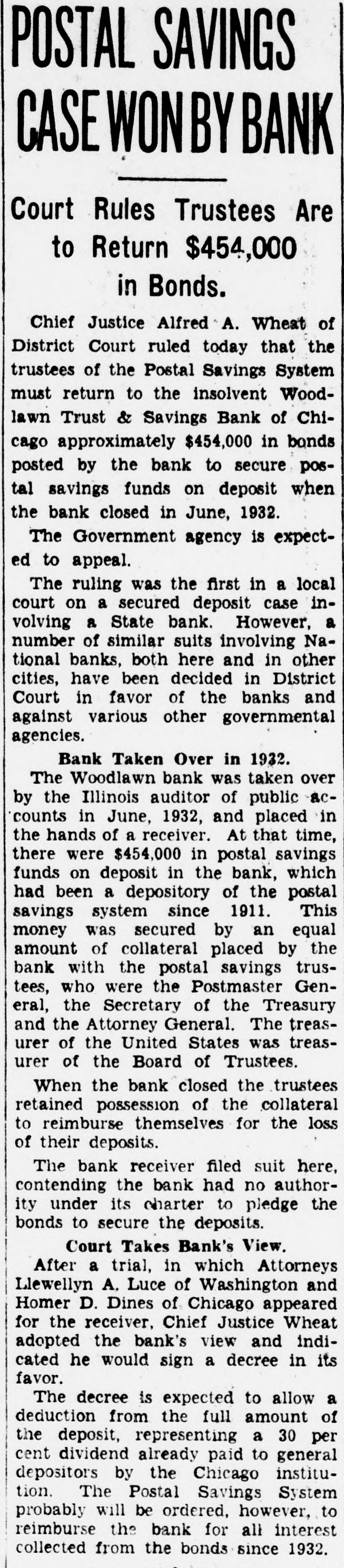
POSTAL SAVINGS CASE WONBY BANK Court Rules Trustees Are to Return $454,000 in Bonds. Chief Justice Alfred A. Wheat of District Court ruled today that the trustees of the Postal Savings System must return to the insolvent Woodlawn Trust & Savings Bank of Chicago approximately $454,000 in bonds posted by the bank to secure postal savings funds on deposit when the bank closed in June, 1932. The Government agency is expected to appeal. The ruling was the first in a local court on a secured deposit case involving a State bank. However, a number of similar suits involving National banks, both here and in other cities, have been decided in District Court in favor of the banks and against various other governmental agencies. Bank Taken Over in 1932. The Woodlawn bank was taken over by the Illinois auditor of public accounts in June, 1932, and placed in the hands of a receiver. At that time, there were $454,000 in postal savings funds on deposit in the bank, which had been a depository of the postal savings system since 1911. This money was secured by an equal amount of collateral placed by the bank with the postal savings trustees, who were the Postmaster General, the Secretary of the Treasury and the Attorney General. The treasurer of the United States was treasurer of the Board of Trustees. When the bank closed the trustees retained possession of the collateral to reimburse themselves for the loss of their deposits. The bank receiver filed suit here, contending the bank had no authority under its charter to pledge the bonds to secure the deposits. Court Takes Bank's View. After a trial, in which Attorneys Llewellyn A. Luce of Washington and Homer D. Dines of Chicago appeared for the receiver. Chief Justice Wheat adopted the bank's view and indicated he would sign a decree in its favor. The decree is expected to allow a deduction from the full amount of the deposit, representing a 30 per cent dividend already paid to general depositors by the Chicago institution. The Postal Savings System probably will be ordered, however, to reimburse the bank for all interest collected from the bonds since 1932.