Jay Cooke & Company (New York, NY)

Episode Information

Episode Type
Run → Suspension → Closure
Start Date
September 18, 1873
Location
New York, New York (40.714, -74.006)
Bank Type
private

Metadata

Notes

Suspension announced Sept. 18, 1873; receivership/legal proceedings referenced in Oct 1873–Jan 1875.

Events (3)

1. September 18, 1873 Run
Cause
Bank Specific Adverse Info
Cause Details
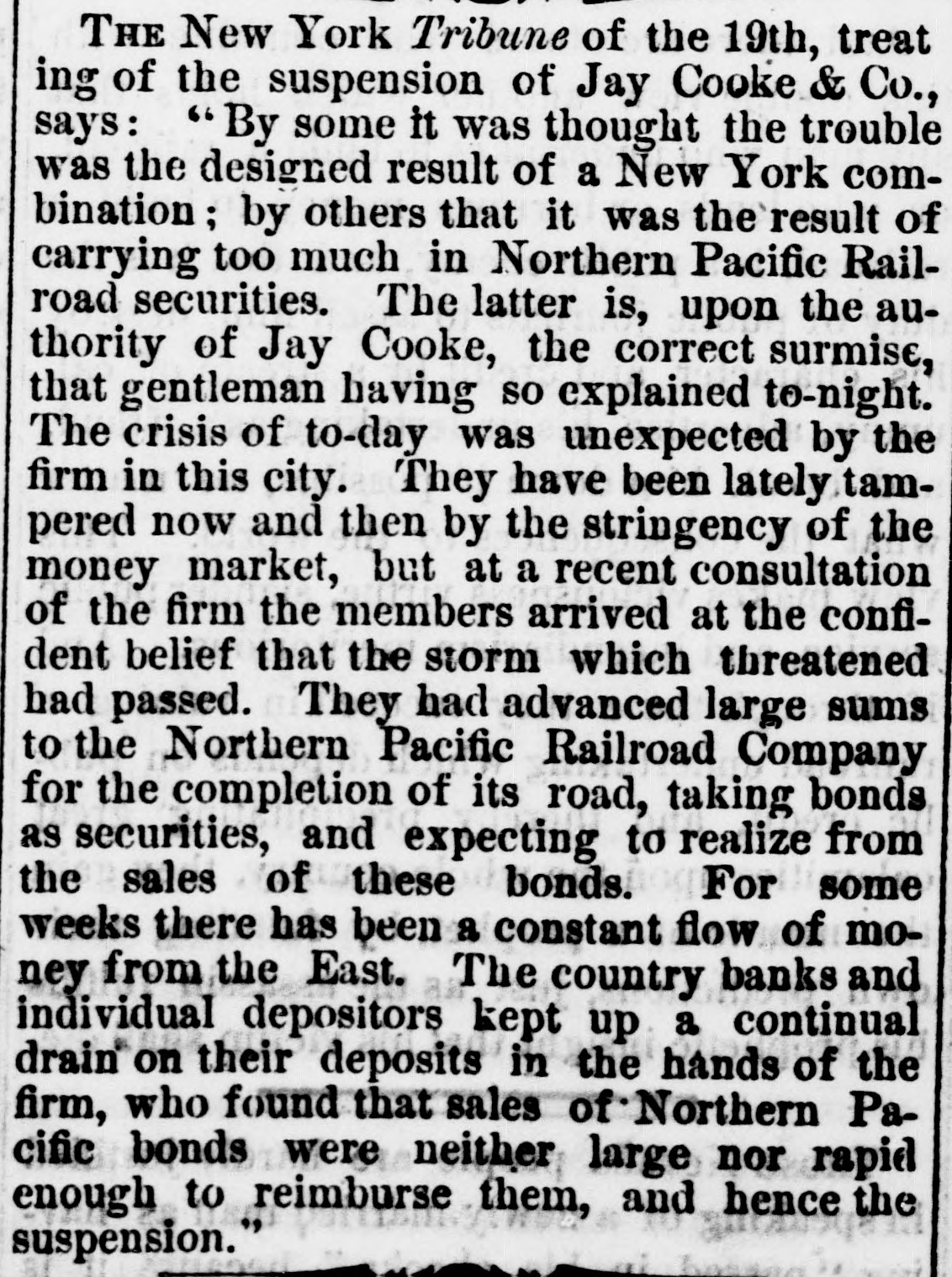
Large advances to Northern Pacific Railroad and heavy drain on deposits from associated Philadelphia house led to loss of liquidity and depositor withdrawals.
Measures
Firm issued a statement calling the suspension temporary; clearing-house and banking community actions (certificates) supported liquidity more broadly.
Newspaper Excerpt
The report of the suspension of Jay Cooke & Co. caused an excitement which soon became a panic...the run on the house has ceased.
Source
newspapers
2. September 18, 1873 Suspension
Cause
Bank Specific Adverse Info
Cause Details
Suspension attributed to large advances to sustain their Philadelphia house and heavy withdrawals by depositors; overexposure to Northern Pacific securities.
Newspaper Excerpt
Early in the day...it was officially announced that Jay Cooke & Co. had suspended.
Source
newspapers
3. October 2, 1873 Receivership
Newspaper Excerpt
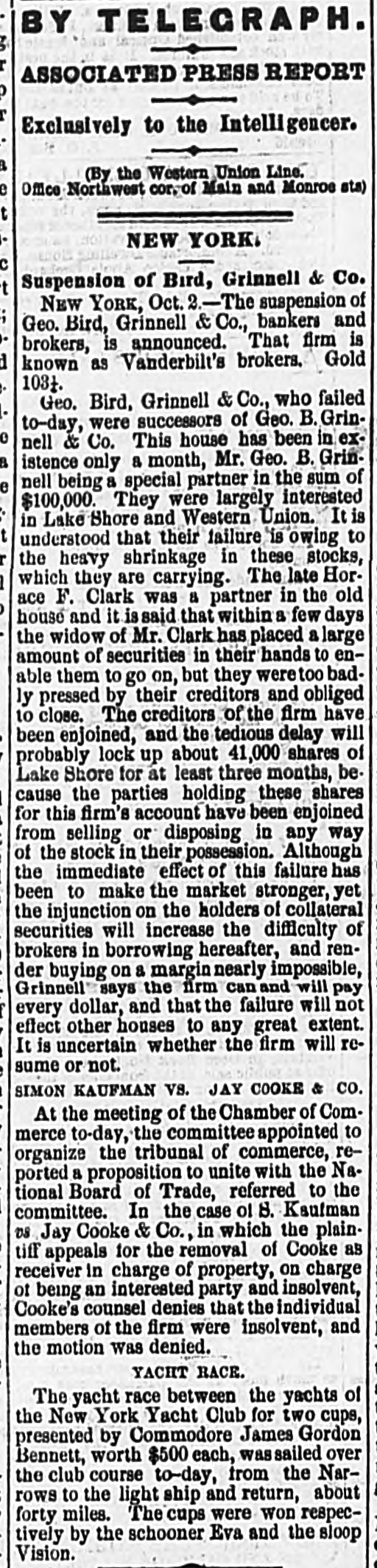
In the case of S. Kaufman vs Jay Cooke & Co....the motion was denied (Cooke's counsel denies that the individual members of the firm were insolvent). SIMON KAUFMAN VS. JAY COOKE & CO. ... the plaintiff appeals for the removal of Cooke as receiver in charge of property, on charge of being an interested party and insolvent, Cooke's counsel denies ... the motion was denied.
Source
newspapers

Newspaper Articles (24)

Article from The Critic and Record, September 18, 1873

Click image to open full size in new tab

Article Text

A Panic in New York. American Press Association.

NEW YORK, Sept. 18.—The report of the suspension of Jay Cooke & Co. caused an excitement which soon became a panic, and holders of stocks threw overboard their ventures with the wild recklessness observed only in periods when panic rules the hour. Western Union went down to 78 1/2; Central 97 1/8; Lake Shore 87 1/4; but the market has since improved.

ONLY TEMPORARY.

Jay Cooke & Co. say that their suspension is only temporary, and has been caused by large advances made to sustain their Philadelphia house, and a heavy drain on their own deposits.

Rumors are rife of other failures. The market is better, but still excited and unsettled at 1:30 p. m., but unless other failures are announced, it is probable that the lowest prices have been reached.

THE EFFECT IN THIS CITY.

The news of the suspension caused a slight run on the banks in this city, as the condition of money was very feverish. The most notable was on the Savings Bank at the corner of Seventh street and Louisiana avenue, but Mr. Ruff paid out as fast as asked for. Soon, however, a large crowd formed outside, and his clerks were kept busy paying out.

[For later news See Third Edition.]


Article from New-York Tribune, September 19, 1873

Click image to open full size in new tab

Article Text

FAILURE OF JAY COOKE & CO

THE BOLT THAT STARTLED WALL-ST.-THE SUSPENSION CAUSED BY THEIR ADVANCES TO THE NORTHERN PACIFIC RAILROAD-THEIR LIABILITIES SAID TO BE BETWEEN THREE AND FIVE MILLIONS. Early in the day, the rumors which form such an important part of Wall-st. operations were revived with increased emphasis. The names of houses which even the most unscrupulous stock jobber had heretofore spared, passed mercilessly from mouth to mouth. First came renewed rumors of the embarrassments of the New-York and Oswego Midland Railway Company, and their financial agents, George Opdyke & Co. Statements that some banking institutions were on the brink of failure were also made with depressing effect. These rumors, false as they were, made the rounds, growing in evil influence as they became more and more distorted. The crowning rumor of the day was this time unfortunately too true. Jay Cooke & Co., the Government fiscal agents, who had stood 80 high in financial circles throughout the world, were impaired by reason of their connection with the Northern Pacific Railroad, and would probably be obliged to suspend. This rumor, which was in the air early in the morning, spread like wildfire, but although dealers were disposed to believe almost anything, it was still rather difficult to convince 'the street" that the foremost American banking-house in this country was not able to meet its obligations. Of course, measures were immediately taken to verify the statement, and at noon it was officially announced that Jay Cooke & Co. had suspended. This news was immediately flashed over the wires of the stock and gold indicators around which groups had been hovering all the forenoon, and the dispatch was read to all who were within hearing. The effect was electric and Jay Cooke & Co.'s offices were soon crowded with an anxious and curious throug. JAY COOKE & CO.'S-WITHOUT. At about 1 p. m., when the news became generally known, the sidewalks on Wall. Nassau, and Broadsts. were thronged with a mixed assemblage of people. Few of these had any pecuniary interests involved; but, having nothing else to do, concluded that they could as well afford to spend their time there as elsewhere. These formed a awaying, agitated, and excited mass which it was difficult to penetrate. The crowd stretched over the sidewalks into the center of the street, and even filled the basements of contiguous buildings. It was a rude, impertinent crowd, for it peered insultingly into the faces of those who had occasion to enter or leave the offices of the unfortunate bankers. Not content with their places, they clambered over the railings, filled the basement, peered through the windows, and even invaded the offices. So intolerable became the nuisance that the bankers were obliged to have a detachment of police and detectives, the former to disperse the crowd. and the latter to nullify the operations of pickpockets and sneak thieves, who were on hand to avail themselves of any opportunity for plunder. The officers were then permanently stationed around the entrances, with orders to disperse all loungers and keep the sidewalks clear. JAY COOKE & CO.'S-WITHIN. Inside the scenes were even more interesting. The interests or sympathies of those who congregated there being more directly affected, there was a better opportunity to study character. Those who had money on deposit, of course, wished to draw it out and were exceedingly disconsolate when they were informed that the firm had suspended payment. A large number of drafts which fell due were returned unpaid to those who presented them, and were then protested. Although somewhat agitated, it was not a clamorous throng. Finding that nothing could be done, all appeared disposed to make a virtue of necessity and to hope for the best. The clerks within were nervous, and very busy in straightening out the details of their departments 80 that a general statement of the condition of the firm could be made. The members of the firm were closeted together early in the day devising means for the relief of the house. They would not see any one. They sent out a statement. however, that the trouble was owing to the demand upon them for money by their Philadelphia house and the withdrawal of deposits from their New-York house. The general bookkeeper stated that the suspension was only temporary, being caused by a lack of available funds to meet the heavy withdrawale of deposite particularly from


Article from New York Times, September 20, 1873

Click image to open full size in new tab

Article Text

coincidence that the gold corner of September, 1869, when so many persons were ruined, and the culmination of the panic of 1873, when the finances of the entire country have been placed in the most dangerous condition, happened upon the same day of the week and in the same month. Many men who appeared prominently in the first of these disturbances have also figured extensively in the last. Houses identified with the interests of the Government have been forced to succumb to the tremendous pressure brought to bear from damaging rumors and an unparalleled tightness of money. Jay Gould, too, who bulled gold in 1869 until it touched 162, is engaged in the present trouble. There have been two Black Fridays in the history of the country, and the sixth day of the week will hereafter be looked upon with suspicion in Wall street.

Commercial men, bankers, brokers, and the financial public generally, gathered in Wall street long before 10 o'clock yesterday morning. There was reason for it too. The rumors which had gained currency were not at all reassuring to people who had money to invest, or who wished to borrow it. Many persons had long lines of stocks which they were carrying; a panic would swallow up their margins, and leave them—wealthy the day before—in a state of penury. Some had money deposited in banks; a panic might force these institutions to suspend. Others were in a state of indecision, and did not know what to do.

The consequence was that thousands of people who are seldom seen down-town thought it worth their while to arrive on the scene of action early in the morning, so as to be on hand for anything which might turn up. It was a universal case of looking out for "number one," and so everybody who had anything to lose, or aught to gain, was on hand.

When the hour of 10 arrived, the time for the opening of the Stock Exchange, one of the most turbulent crowds of humanity ever seen in Wall street surged about the doors eager to obtain entrance. As soon as admittance was accorded there was a general rush to reach the floor of the Long Room, and in a moment afterward quotations for stocks were in order. No one knew what to offer, and everybody was undecided as to selling prices. It was at least a minute before quotations could be made, owing to the general uncertainty regarding the situation. The adherents of the bear clique thought that Western Union ought to sell at 70, and graded their bids accordingly. The few believers in a bull movement thought it was cheap at 80, and accordingly stood at that figure. When an average was reached, it appeared that the bears were the strongest, and so prices began to decline. Western Union, as on the day before, was the bone of contention, and the bears subjected it to their fiercest attacks.

The failure of Jay Cooke & Co. on the previous day had inspired such a distrust in wealthy banking-firms and in financial institutions of every class, that it soon became evident that the street was completely demoralized, and that there was not the slightest chance for the bulls to resist the onset. The Vanderbilt stocks, which are held at high prices, and which in ordinary times are regarded as among the safest of all investments, gave way shortly, and a tumble of a remarkable nature ensued.

While prices were falling off rapidly, the news came of the suspension of Fisk & Hatch, supposed to be one of the strongest and most careful banking-houses in Wall street.

Up to this time, everything had been going in favor of the bears. As soon as the failure was announced on the Exchange, a tremendous panic ensued, and what appeared to be a sort of retreat on the part of the bulls and holders of stocks was turned into a frightful rout. There were no quotable prices for stocks for several minutes. Then a kind of "bottom" was found, when Western Union, New-York Central, Lake Shore, Harlem, and Rock Island, sold from five to twenty-five per cent. below the quotations of Thursday. Money, too, grew stringent, every one being afraid to loan upon any kind of stocks.

In addition to the failure of Fisk & Hatch, it was learned that the Fourth National Bank and the Union Trust Company were besieged by depositors, who were anxious to get their money. This was supplemented by a report that the Manhattan Company had refused to certify the checks of the Union Trust Company, in consequence of a dearth in deposits. This rumor proved to be correct, and had anything but a cheering influence upon the stock market and the rates for money.

Then the failures of different banking and brokerage houses were announced on the Exchange and news of these came so rapidly that each dealer was afraid to trust his neighbor, and so there was a difference in the cash and regular quotations of stocks of from one to five per cent. As fast as the failures were announced the news was carried out into the street by brokers, and in spite of a cold, drenching rain, hundreds of people gathered about the offices of fallen reputation and gazed curiously through the windows, trying to form some conception of the way in which the broken brokers were behaving.

Merchants up-town took a trip to Wall street and swelled the crowds who stood about inspired by their aimless curiosity to gaze upon the distress of neighbors, and nearly every house of deposit in the street was thronged by nervous customers who didn't care to draw out their money if they could have it, but who were terribly anxious to grasp the greenbacks if there were no funds on hand.

A long line of depositors extended outside of the Union Trust Company's building far into the street, waiting for money which had been put in, but which might remain longer than had been calculated upon. At the Fourth National Bank there was a like scene. Umbrellas were called into requisition, and the financial arena of the country resembled a stony pavement covered with black mushrooms.

The peculiar position of the steps of the Sub-Treasury, which affords a commanding view of both Wall and Broad streets, caused them to be used for convenient points of observation, and they were thronged with people for the entire day. The rain seemed to have no effect whatever upon the crowds, which, financially interested, cared nothing whatever for bodily discomfort.

Some time in the afternoon a rumor was prevalent that Secretary Richardson would deposit $10,000,000 in the various banks as a means of relief from the pressing monetary stringency, and in a few minutes the stock market began to show signs of strength.


Article from The Cairo Bulletin, September 21, 1873

Click image to open full size in new tab

Article Text

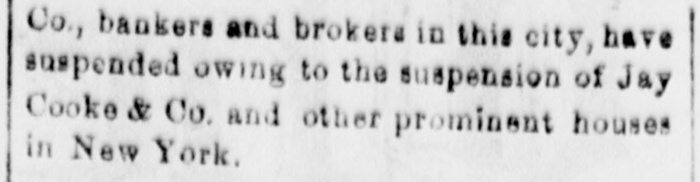
Co., bankers and brokers in this city, have suspended owing to the suspension of Jay Cooke & Co. and other prominent houses in New York.


Article from Evening Star, September 22, 1873

Click image to open full size in new tab

Article Text

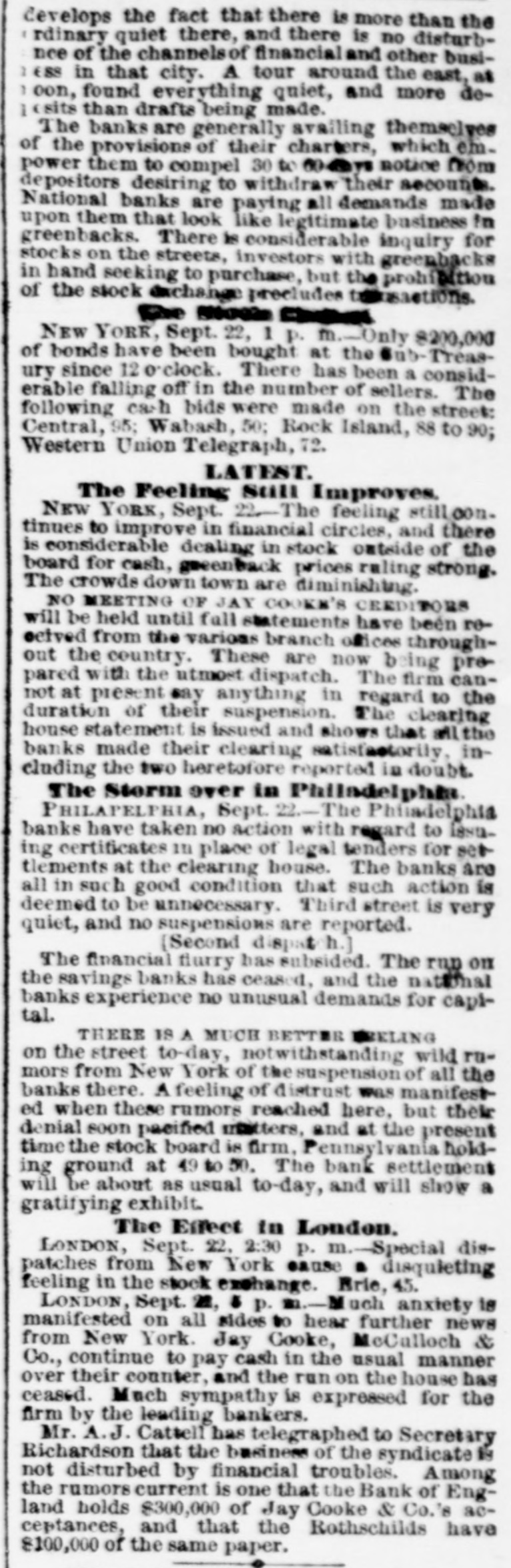
develops the fact that there is more than the rdinary quiet there, and there is no disturbnee of the channels of financial and other busiE88 in that city. A tour around the east, at oon, found everything quiet, and more de(sits than drafts being made. The banks are generally availing themselves of the provisions of their charters, which empower them to compel 30 to - notice from depositors desiring to withdraw their accounts. National banks are paying all demands made upon them that look like legitimate business in greenbacks. There is considerable inquiry for stocks on the streets, investors with greenbacks in hand seeking to purchase, but the prohibition of the stock dichange precludes transactions. the - / NEW YORK, Sept. 22, Only 8200,000 of bonds have been bought at the Sub-Treasury since 12 r clock. There has been a considerable falling off in the number of sellers. The following cash bids were made on the street: Central, 95; Wabash, 50: Rock Island, 88 to 90; Western Union Telegraph, 72. LATEST. The Feeling Still Improves. NEW YORK, Sept. 22. The feeling still.com. tinues to improve in financial circles, and there is considerable dealing in stock outside of the board for cash, greenback prices raling strong. The crowds down town are diminishing. NO MEETING OF JAY COOKE'S CREDITORS will be held until fall statements have been reocived from the varios branch offices throughout the country. These are now being prepared with the utmost dispatch. The firm cannot at present say anything in regard to the duration of their suspension. The clearing house statement is issued and shows that al the banks made their clearing satisfactorily, including the two heretofore reported in doubt. The Storm over in Philadelphia. PHILAPELPHIA, Sept. 22. The Phiadelphia banks have taken no action with regard to Issuing certificates in place of legal tenders for set tlements at the clearing house. The banks are all in such good condition that such action is deemed to be unnecessary. Third street is very quiet, and no suspensions are reported. (Second dispat h.] The financial flurry has subsided. The run on the savings banks has ceased, and the national banks experience no unusual demands for capital. THERE 18 A MUCH BETTER BEELING on the street to-day, notwithstanding wild rumors from New York of the suspension of all the banks there. A feeling of distrust was manifested when these rumors reached here, but their denial soon pacified matters, and at the present time the stock board is firm. Pennsylvania holding ground at 49 to 50. The bank settlement will be about as usual to-day, and will show a gratifying exhibit. The Effect in London. LONDON, Sept. 22. 2:30 p. m. Special dispatches from New York cause a disquieting feeling in the stock exchange. Brie, 45. LONDON, Sept. 22, 5 p. in M uch anxiety is manifested on all sides to hear further news from New York. Jay Gooke, McCalloch & Co., continue to pay cash in the usual manner over their counter, and the run on the house has ceased. Much sympathy is expressed for the firm by the leading bankers. Mr. .J. Cattelf has telegraphed to Secretary Richardson that the business of the syndicate is not disturbed by financial troubles. Among the rumors current is one that the Bank of England holds $300,000 of Jay Cooke & Co.'s acceptances, and that the Rothschilds have 8100,000 of the same paper.


Article from The Wheeling Daily Register, September 22, 1873

Click image to open full size in new tab

Article Text

CANADA

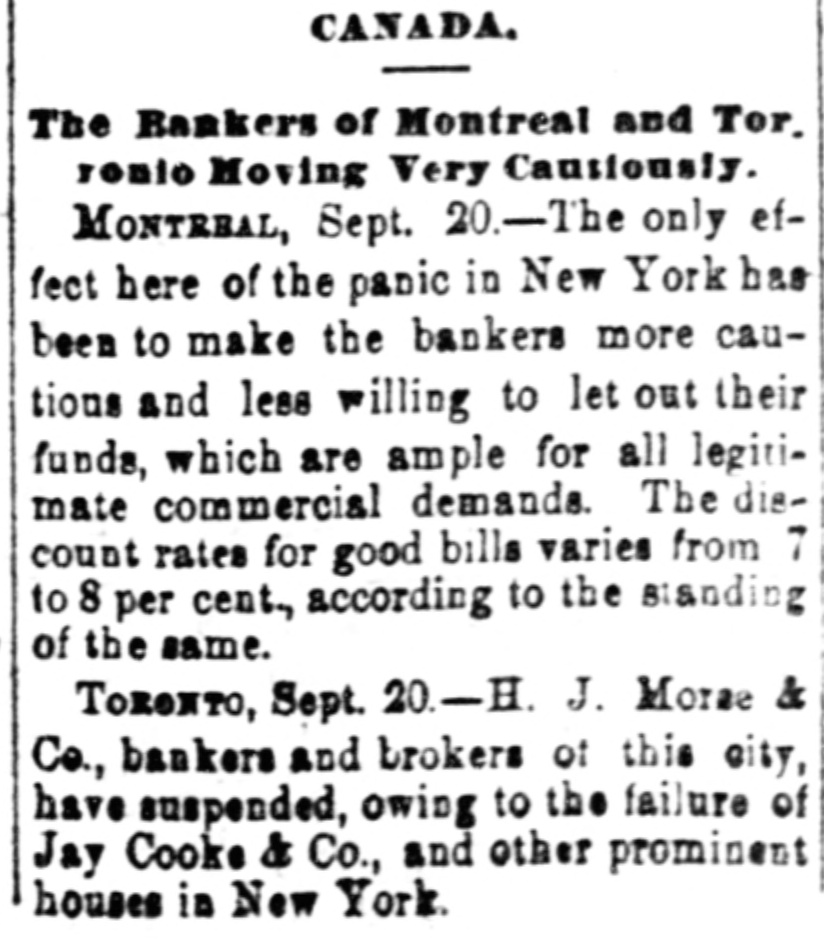
The Bankers of Montreal and Tor. ronio Moving Very Causiously. MONTERAL, Sept. 20.-The only effect here of the panic in New York has been to make the bankers more cautions and less willing to let out their funds, which are ample for all legitimate commercial demands. The diecount rates for good bills varies from 7 to 8 per cent., according to the standing of the same. TOKONTO, Sept. 20.-H. J. More & Co., bankers and brokers of this city, have suspended, owing to the failure of Jay Cooke & Co., and other prominent houses in New York


Article from Pioche Daily Record, September 23, 1873

Click image to open full size in new tab

Article Text

1 Foreign News

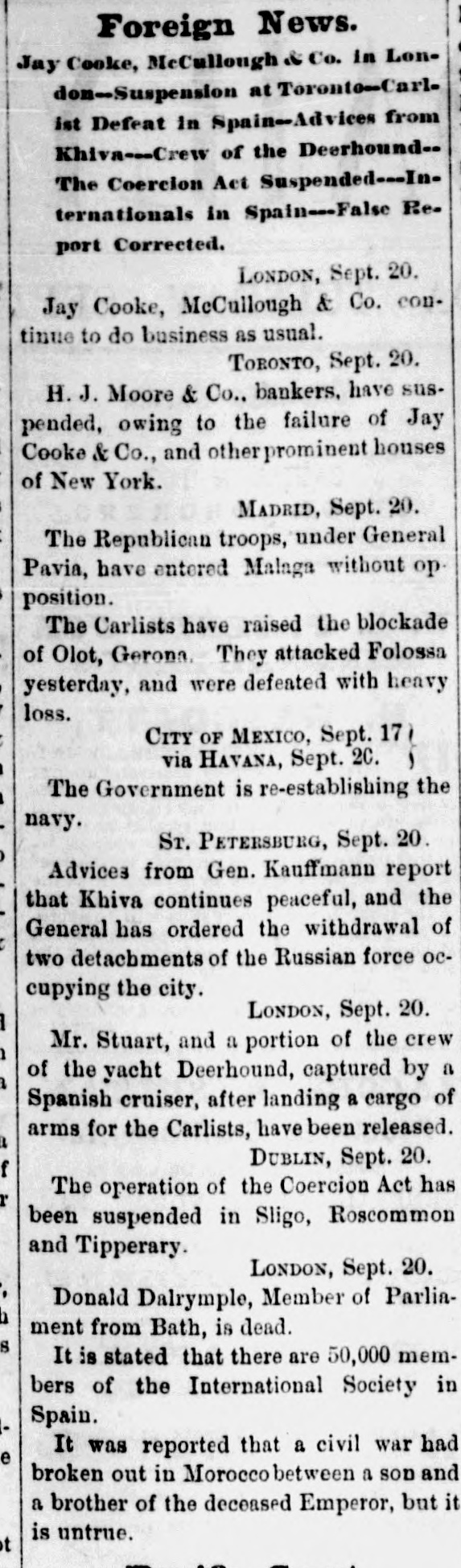
( Jay Cooke, McCullough & Co. in Lon1 don-Suspension at Toronto-Carlist Defeat in Spain-Advices from Khiva---Crew of the Deerhound-The Coercion Act Suspended---Internationals in Spain---False Re. port Corrected. LONDON, Sept. 20. Jay Cooke, McCullough & Co. continue to do business as usual. TORONTO, Sept. 20. H. J. Moore & Co., bankers. have suspended, owing to the failure of Jay Cooke & Co., and otherprominent houses of New York. MADRID, Sept. 20. The Republican troops, under General Pavia, have entered Malaga without op position. The Carlists have raised the blockade of Olot, Gerona. They attacked Folossa yesterday, and were defeated with heavy loss. CITY OF MEXICO, Sept. 17 via HAVANA, Sept. 20. I The Government is re-establishing the navy. Sr. PETERSBURG, Sept. 20. Advices from Gen. Kauffmann report that Khiva continues peaceful, and the General has ordered the withdrawal of two detachments of the Russian force occupying the city. LONDON, Sept. 20. 1 Mr. Stuart, and a portion of the crew 1 of the yacht Deerhound, captured by a 1 Spanish cruiser, after landing a cargo of arms for the Carlists, have been released. DUBLIN, Sept. 20. f The operation of the Coercion Act has r been suspended in Sligo, Roscommon and Tipperary. LONDON, Sept. 20. . Donald Dalrymple, Member of Parlia: ment from Bath, is dead. S It is stated that there are 50,000 members of the International Society in Spain. It was reported that a civil war had e broken out in Morocco between a SOD and a brother of the deceased Emperor, but it is untrue. t


Article from The Spirit of Democracy, September 23, 1873

Click image to open full size in new tab

Article Text

A telegram from New York, 19th inst., announced the failure of the bankers, JAY COOKE & Co.,and a large number of bankers, brokers and business men in New York and Philadelphia.The panic in Wall street is represented as being unequaled in the history of bull and bear movements.


Article from New-York Tribune, September 23, 1873

Click image to open full size in new tab

Article Text

THE CRISIS ELSEWHERE

ANXIETY IN LONDON-AMERICAN SECURITIES DEPRESSED. LONDON, Sept. 22-5 p. m.-Much anxiety is manifested on all sides to hear further news from NewYork. Jay Cooke, McCulloch & Co. continue to pay cash in the usual manner over their counter, and the run on their house has ceased. Much sympathy is expressed for the firm by the leading bankers. A. G: Cattell has telegraphed to Secretary Richardson that the business of the Syndicate is not distorbed by the financial troubles. Among the rumors current in the Stock Exchange is one that the Bank of England holds $800,000 of Jay Cooke & Co.'s acceptances. and that the Rothsschilds have $100,000 of the same paper. 5-30 p. m.-A dispatch announcing the closing of the New-York Gold Exchange has just been bulletined. This news is accepted as an indication of the gravity of the financial situation, and the market for American securities is again depressed. TWO BANK SUSPENSIONS IN PHILADELPHIA. PHILADELPHIA, Sept. 22.-The NN. Citizens' Bauk, a State institution. corner of Second and Racests., suspended payment this morning. On Saturday they passed over the counter $100,000. The Keystone Bank, a State institution. at Nos. 1,826 and 1,328 Chestnut-


Article from Knoxville Weekly Chronicle, September 24, 1873

Click image to open full size in new tab

Article Text

JAY COOKE & CO

THE GREAT FINANCIAL FAILURE. Great Excitement in Consequence of the Suspension. Suspension of Jay Cooke & Company. NEW YORK, Sept. 18.-Jay Cooke & Co. have suspended. Their suspension is in consequence of large advances made to sustain their Philadelphia house and a heavy draw upon their own deposits. PHILADELPHIA, Sept. 18.-Jay Cooke & Co. have closed. A great crowd assembled in front of their banking house when the fact of their suspension was known. WASHINGTON, Sept. 18-. Jay Cooke & Co. have closed. The First National Bank, Henry D. Cooke President, has suspended. WASHINGTON, Sept. 18.-There are assurances that the Freedman's Savings Bank had only eight hundred dollars in the First National Bank, and no balance with Jay Cooke & Co. The Bank holds only four hundred dollars of Northern Pacific bands collateral for a small loan. Excitement in New York. NEW YORK, Sept. 18.-Great excitement prevails in consequence of the Cooke failgre. The question is, who next? Business men attribute the failures to operaIt tors in the Northern Pacific Railroad. is feared the National Life Insurance Company will go under with Cooke. It is said that Jay Cooke lost largely in gold. Members of the firm say they are unable to make any further statement, save that they expect to resume business in a short time. The London Firm Stands by Jay Cooke a Co. LONDON, September 18.-The firm of Jay Cooke, McCulloch & Co. responds to his suspension by stating that all drafts and letters of credit on them, issued by Jay Cooke & Co., will be duly honored. PHIDADELPHIA, September 18.-E. W. Clarke & Co., bankers, have suspended. Statement of the Suspended Firm. Jay Cooke & Co. make the following statement: "The immediate cause of the suspension of Jay Cooke & Co. was the large drawings upon them by their Philadelphia house and their own depositors during the last fortnight. Both houses have suffered a large drain upon their deposits in consequence of the uneasy feeling which has recently prevailed and which has effected more or less all houses closely identified with the new railroad enterprises. The Philadelphia house had previously been weakened by large cash advances to the Northern Pacific Railroad Company, of which they are the financial agents. Jay Cooke, McCulloch & Co., are Solvent, The business of Jay Cooke, McCulloch & Co., London, is entirely distinct, and that house is perfectly solvent, so that it will meet all its outstanding drafts and letters of credit without inconvenience to travellers, and have a large cash surplus to apply to the American house. The firm of Jay Cooke & Co., and its members have a large amount of real and personal property upon which however they cannot immediately realize. They are confident depositors will be paid in full. No Firm of Prominence will Probarly Succumb. NEW YOBK, September 18.-All the reports about the suspension of firms, excepting Jay Cooke & Co., Richard Shell and the small firm of Robinson, Snydall & Co., upon investigation, proved to be without foundation. This fact was made known on the street and confidence was again restored, and at the close of business a stronger feeling prevailed. It is not thought that any other firm of prominence will succumb,


Article from Mineral Point Tribune, September 25, 1873

Click image to open full size in new tab

Article Text

THE most important matter of the past week is the failure of about 20 prominent bankers and brokers in New York, among them Jay Cooke & Co., Fisk & Hatch, and other houses of the highest standing. A general panic in the financial affairs of the country was at first thought to be inevitable, but by the Government promptly coming to the rescue and buying several millions of bonds, such a calamity was happily averted, and the indications now are that there will be no serious disarrangement of the monetary end commercial affairs of the country.


Article from Helena Semi-Weekly Herald, September 25, 1873

Click image to open full size in new tab

Article Text

TELEGRAMS

REPORTED SPECIALLY FOR THE HERALD BY WESTERN UNION TELEGRAPH COMPANY.

UNITED STATES.

The Conference at the Fifth Avenue Hotel.

NEW YORK, September 21.—The conference at the Fifth Avenue Hotel to-day with President Grant and Secretary Richardson, in relation to the best means of averting financial disasters in Wall street, has absorbed the public interest. At the conference, and conspicuous, were Commodore Vanderbilt, H. Clews, Isaac Bailey, Seligman Bros., George H. Opdyke, Wm. Orton, President of W. U. T. Co., Prospect H. Sharpe, Jas. H. Burke, Wm. L. Scott, of the Erie (Pa.) Bank, Robt. Lenox Kennedy, Horace B. Claflin, General E. S. Sanford, President of Adams Express Company, Mr. Vail, of the Bank of Commerce, Senator West, and John Hoey, Vice President of Adams Express Company. A committee was appointed to agree upon some proposition to be submitted to the President and Secretary Richardson. After the committee had retired, Vanderbilt entered the parlor in which the President and Secretary were. The rooms and corridors adjoining the audience chamber were quickly thronged with crowds awaiting impatiently the exit of the railroad king, and nervously anxious to glean even the faintest idea of the result of his visit to the President. Commodore Vanderbilt made the proposition, that the President authorize the Secretary of the Treasury to place $30,000,000 of the legal reserve in the banks of this city, and on that condition he (Vanderbilt) would add $10,000,000. President Grant replied that he was anxious to do all in his power to relieve the present financial embarrassment and to prevent disaster, but that he must, however, conform to the Constitution. Mr. Opdyke and others represented to President Grant and Secretary Richardson the necessity for immediate action, but they were informed that the Constitution could not be violated.

The bank Presidents and capitalists were endeavoring to agree upon a proposition to be submitted, but, although they had been conferring up to six o'clock they could not arrive at any conclusion, and no paper was presented to the President.

The President and Secretary were not diverse in sentiment, it appears, for it was agreed between them to instruct the Assistant Treasurer to buy all government bonds offered for sale to any amount. The savings banks hold many millions of government bonds, and it is probable that they will sell them and deposit the proceeds in the National banks, which will give them relief.

The Action of the Stock Exchange.

NEW YORK, September 20.—Shortly before noon, in the midst of the panic, the governing committee of the Stock Exchange determined to close the Exchange. Immediately afterward a committee of the associated banks met at the New York Clearing House and it was voted by all the Associated Banks that they would issue certificates pledging the Association as a whole. These certificates are to be issued by the manager of the Clearing House to any Associated bank against the deposit of the bank's securities or assets. The effect of this action is to enable all the solvent part of the financial community to convert their assets into money, apparently, and without any sacrifice to themselves. The Stock Exchange ordinarily is simply a medium for converting securities into cash in a prevailing panic. The scarcity of money prevented this from being accomplished, securities being constantly offered for sale at constantly decreasing prices without finding buyers unless at an enormous loss to the sellers. By the issue of the bank certificates any bank can realize money upon its assets, and be able to extend to its customers all the accommodation for which they can find security, without compelling the sale or sacrifice of the assets offered. The whole machinery, therefore, of conversion is once more set in operation and is likely to run smoothly, and all concerns which have assets will find no difficulty in converting them into money. This action of the banks at the Clearing House meeting gave rise to a feeling of confidence on the street that no additional failures were likely to occur, and the impression obtained was that the panic was over.

Exciting Scene on Closing the New York Stock Exchange.

NEW YORK, September 20.—The excitement and panic which followed the announcement in the Stock Exchange of the suspension of the Union Trust Company and the Bank of the Commonwealth were beyond description. The Stock Exchange resembled a mad house, and the streets were blocked with people, all laboring under great excitement and frenzy. Prices tumbled from 2 to 16 per cent., and stocks were slaughtered without any apparent regard to values. Amid the surging of the excited crowd in the Stock Exchange and the continued destruction of values, there were few cool and level heads. These men conceived the idea of imitating the Vienna plan of closing the Exchange, and immediately the governing committee was convened to take action thereon. In a few moments the Board was called to order and the announcement was made that the Exchange would be closed until further orders from the President. This was received with great joy, the Exchange resounded with cheers, the gong sounded, and in less time than it takes to record the fact the wild excitement was over, the surging crowd of frantic brokers disappeared, and the Stock Exchange was closed.

Additional Failures Announced.

NEW YORK, September 20.—The following failures have been announced:

The Union Trust Company; Bank of Commonwealth; Ketchum & Belknap; E. C. Brodhead; Saxe & Rogers; Edward Haight & Co.; Brown, Wadsworth & Co.; C. G. White.

CHICAGO, September 21.—The Franklin Savings Bank, a small concern, was unable to meet the demands at the clearing house to-day, and closed its doors. As the concern has no connection, so far as known, with any of the suspended New York banks or bankers, it is supposed that it will soon resume business.

ST. LOUIS, September 20.—Toussing, Gemp & Co., of this city, closed its doors this afternoon, after the announcement of the failure of their New York house, Toussing, Fischer & Co. They are confident of being able to resume in a few days, and state that no one will lose a dollar by them. The house dealt pretty extensively in railroad securities on their own account.

TORONTO, Canada, September 20.—H. J. Morse & Co., bankers and brokers in this city, have suspended, in consequence of the failure of Jay Cooke & Co., and other prominent houses in New York.

ALBANY, N. Y., September 20.—T. C. Squire & Co., bankers, announce their suspension until further advices from New York.

PHILADELPHIA, September 20.—The Union Banking Company has failed. This bank has a State charter.

BURLINGTON, Iowa, September 20.—The Orchard City Savings Bank closed its doors to-day.

BUFFALO, September 22.—H. W. Bart & Co., private bankers and brokers, closed this afternoon.

ST. CATHARINES, Ontario, September 22.—Owing to the financial crisis in New York the Canada Southern Railroad Company have been obliged to cancel all their contracts for the present, and have ordered the discharge of all their workmen not employed. No regular train is running over the road. The cause of this is reported to be owing to complications in Daniel Drew's affairs, he being a large stockholder in the company.

New York News.

NEW YORK, September 20.—Two million eight hundred and sixty-three thousand dollars in bonds were accepted to-day at from 9 to 11 1/4. All offers of bonds under 11 1/4 are accepted by the government.

There were thirteen proposals to sell bonds to the government at the Sub-Treasury to-day aggregating $3,672,650, at from 10-9 to 11-2.

Five hundred Mormons, who arrived in this city yesterday, left to-day for Utah. Two hundred of them are Scandinavians and the remainder English, Irish and Welch.

NEW YORK, September 21.—Jay Cooke & Co. say there is no truth whatever in the story published here to-day that the London house of Jay Cooke, McCulloch & Co. failed. They say their London business continues uninterrupted.

The Effect in Chicago.

CHICAGO, September 21.—While the panic in New York has had the effect to temporarily unsettle values and grain and caused dullness on 'Change, it has caused comparatively little excitement. It appears to be the general opinion of the merchants and grain dealers that thus far the trouble has been outside of the commercial interests, and that unless it should spread it is not likely to involve those interests. The banks, however, are taking the usual precautions at a time of monetary excitement, in order to be prepared should the storm reach them.

Financial Condition in Philadelphia.

PHILADELPHIA, September 22.—The financial flurry has subsided. The run on the savings banks has ceased, and the National banks experience no unusual demand for capital.

The Situation.

NEW YORK, September 22.—The day has closed quiet, and it is believed the panic is now over. The Clearing House statement shows that all the banks here made their clearings satisfactorily, and the general feeling is decidedly better.

There is considerable inquiry in a quiet way for stocks. The following cash bids for stocks were made on the street: Central, 95; Wabash, 50; Rock Island, 88; Toledo, 90; Western Union Telegraph, 72.

All the foreign markets are strong, with a better feeling.

The announcement of the Commercial Advertiser that the certificates of the Continental Bank were thrown out of the Clearing House on Saturday was a mistake. The Continental is paying all liabilities on demand.

The Fourth National Bank had certified to $6,000,000 on Saturday, about six times as much as they ordinarily do.

Isaac H. Bailey has been appointed Receiver of the Bank of the Commonwealth.

Hugh McCulloch and Pitt Cooke, of Jay Cooke & Co., arrived from Europe to-day, and learned for the first time of the suspension of their United States firm.

The Clearing House Transactions.

NEW YORK, September 22.—The banks of discount were all open, some certifying to checks good through the Clearing House, and others paying in greenbacks. The Clearing House to-day issued about $5,000,000 of loan certificates in settlement of balances. This was a great assistance to the banks.

The Gold Exchange.

NEW YORK, September 22.—There was, of course, no regular business in either stocks or gold, and brokers were doing nothing beyond trying to effect a settlement of old transactions. The bankers who had not suspended were transacting no business beyond paying such depositors as called for their money. Those engaged in foreign exchange were entirely idle, as the closing of the Gold Room stopped business in exchange on London and the continent. The gold brokers to-day cleared all the business of Friday and Saturday through the Gold Exchange Bank by united action, which, under the circumstances, was certainly a great result. Every man settled promptly by certified checks, and the Gold Room is now perfectly clear of all unfinished business. This is important in view of the situation, and will greatly facilitate matters when the room is again opened for business. The gold clearings were $92,000,000. There is no price for money and very little is said about it. This afternoon $100,000 of 1881 bonds were sold 115 cash, and the brokers had orders for 5-20's at prices above the government standard.

The Union Trust Company.

NEW YORK, September 22.—The suspension of the Union Trust Company is generally attributed to the defalcating Secretary and the neglect to call in the $3,000,000 in loans, as ordered on Thursday. According to general reports he completely lost his mental balance, and showed no disposition to submit the affairs of the company to inspection. His whereabouts are still unknown. It is currently reported that the company will be ready to resume business in a few days. It is a little remarkable that only one trustee of the Union Co. has any money on deposit in the institution, and with the exception of two or three own but little stock. This may account for the bad management of the concern.

The Savings Banks.

NEW YORK, 22.—There was a moderate run on the Seamens' Savings Bank, corner of Wall and Pearl streets. The Trustees held a meeting and resolved to pay all sums under $100, but on larger sums to demand the thirty days' notice granted in the charter. This action is in accordance with an agreement made among the savings bank managers last evening. Some few of the banks can delay payment for ninety days, and all for thirty and on to sixty. Thus it will be seen that no

Article from Montgomery County Sentinel, September 26, 1873

Click image to open full size in new tab

Article Text

THE FINANCIAL CRISIS

The suspension of the great banking-houses of Jay Cooke & Co., in Washington, Philadelphia and New York—a simple announcement of which was made last week—spread consternation throughout the country, and up to Tuesday last was the source of most intense excitement, causing depositors to withdraw their monies, until many banks closed their doors. The scenes in Wall street, New York, were of the most exciting character. Business-house after business-house in the great commercial metropolis, succumbed to the pressure, twenty-nine closing their doors, and four city banks. In the extremity Government was appealed to to let out the Forty-four Million reserve fund. This proposition was refused—and very properly—by the President and Secretary Richardson, but ten millions of the 5-20 loan was thrown upon the market, which soon raised a fund sufficient to impart confidence and quiet the panic—and this added to the fact of the banks resolving to sustain each other, brought a feeling of relief, and this feeling was beginning to exert its healthful influence, and confidence being rapidly restored, when suddenly on Tuesday evening last, the banking-house of Henry Clews & Co., closed its doors, thus destroying the returning confidence. The house of Clews & Co. ranked next to that of Jay Cooke & Co., and the announcement of its failure created wild excitement. What the end will be none can tell. A general suspension of all the banks is predicted by some.

The cause of the failure of Jay Cooke & Co. is said to be overdealing in stocks of the Northern Central Pacific Railroad.


Article from Bellows Falls Times, September 26, 1873

Click image to open full size in new tab

Article Text

Great Financial Panic

NUMEROUS FAILURES IN NEW YORK. On Thursday of last week a great financial panic commenced by the announcement of the failure of Jay Cooke & Co., a house 80 celebrated as to be household words in almost every portion of this country and in Europe. This was followed by the announcement that Fisk & Hatch, another firm almost equally celebrated had also suspended ; and other houses, many of which had long been regarded as of great financial strength, besides numerous others less known. Nearly all the failures thus far are banks, brokers and trust companies, and at first it was hoped it would be confined to them and not materially affect the country but as the details come out, it is probable that the effect will be felt in other departments of trade and business before it is over. On Tues day Henry Clews & Co., suspended, and the excitement which had somewhat subsided was renewed again creating much gloom in financial circles. Most of this excitement has prevailed in New York, though considerable existed in Philadelphia. Jay Cooke & Co. haa banking houses in Philadelphia, New York, Washington and London. Their house in London is said to be independent of those in this country and up to this writing, (Wednesday,) its suspension had not been announced. The cause of these failures is said to be an overload of railroad stocks, more especially of Northern Pacific. In other words payments failed at the beginning and then failure followed the whole length of the line, while in many cases it was simply the old story of speculation in stocks. The excitement in New York is greater than the "black Friday" of 1869. The stock and gold room was closed on Monday till further orders. The money market has been tight for more than a year, and when, the present crash is over, a better state of things may exist.


Article from Northern Ohio Journal, September 27, 1873

Click image to open full size in new tab

Article Text

FINANCIAL.

MONETARY.

September 26, 1873.

The past week has witnessed one of the most critical crisis in the history of our finances. On Friday the famous banking house of Jay Cooke & Co., of New York, suspended, and a financial panic at that great center was an immediate result. At the present date scarcely any bank in New York, exclusive of nationals, has avoided suspension, and the calamity has extended to Philadelphia, Washington and miner cities throughout the country, in some cases resulting in failures, in others bringing into use those practices, which no necessity can warrant, except such as prevails n times of extroardinary danger. rn the midst of all this disorder our banks have remained unaffected, and aside from the sensations produced by the tidings of panic in the East, affairs have been quiet and steady. At an early stage of the excitement before the force of the shock upon the country could be measured, the policy of withholding currency from loans and discounts was adopted; and with the means of relieving any pressure which might be brought to bear, daily increasing, a corresponding sense of security and confidence was imparted to the public mind and all undue excitement prevented. The trouble is subsiding, New York affairs are begining to assume a normal position, and it may be confidently hoped, that unless some unforseen phaze shall suddenly arise, our market will soon emerge from the brief period of anxiety and caution, to a condition of greater ease and more ample resourees in the form currency than we have enjoyed for several months. We quote gold nominal at 111 buying, 112 selling.


Article from Chicago Daily Tribune, September 29, 1873

Click image to open full size in new tab

Article Text

NEW YORK

Special Disvatch to The Chicago Tribune, NEW YORK, Sept 28.-The bright prospects with which the wook closed for Wall street continuo to-day, and there is visible nothing of the intense excitement which characterized last Sunday. The street yesterday, and the hotels today, have been dull in fact, business on tho street le 80 far suspended that the excitement thore, on Saturday, was less than on ordinary days at this time of the year. The prospects for tho week are that BUSINESS WILL RESUME WITHOUT DELAY or much excitement, unless in the Stock Exchango. Tho difficulty in selling foreign exchange Becms to have been overcomo in a large measure, and heavy shipments of allsorts of grain were made yesterday. The demand for freight room WAS unusually heavy at generally advanced rates. The suspended firms are rapidly reorganizing, and promise a resumption of business before the end of the week. Howes & Macy have practically resumed already. Clows & Co. say they will bo ready to begin anow before the statement of their affairs is ready for publication. Fisko & Hatch, more conservativo, declino to begin again until all their past indebtedness is cleared off. Jay Cooke & Co. promise n favorable showing soon, but it is believed they will be kept down by the Northorn Paciflo Railroad. The Union Trust Company will get on italegengain. It is naturally a strong concern, each sharoholder being hold liablo for the amount of his stock; but the Bank of the Commonwoulth is probably a hopeless wreck. The opening of the Stock Exchange on Tuesday, BB resolved on, creates great unoasinoss, both in stock and commercial circles, particularly in the latter, whose members anticipate renowal of excitement, which may again extend to the commoreial exchanges and produce great distross to morcantilo houses. The Produce and Gold Exchanges RESUMED WITHOUT DISARTROUS RESULTA, and this fact encourages the hope that 110 bad effects will follow the roopening of stock gambling. The announcement that business will be resumed at the Stock Exchange implies that the conflicting and confused nocounts of the brokers have boon straightened out and settled. Otherwise, the opening would be only a signal for & renewal of the pauio, and of a fierce light between bulls and boars. Now, it is hold, there is little cause for controversy on the Bourne, and EVERYTHING PROMISES PEACE and quietness, at loast until the futuro shall divido the members into distinct parties again. It in claimod by dealers that business, for some time, at least, will be conducted with more modoration than formerly. Dr. Thomas Carlton. on being asked if he


Article from The Wheeling Daily Intelligencer, October 3, 1873

Click image to open full size in new tab

Article Text

BY TELEGRAPH

ASSOCIATED PRESS REPORT Exclusively to the Intelli gencer. a (By the Western Union Line. e Office Northwest cor. of Main and Monroe ats) NEW YORK. Suspension of Bird, Grinnell & Co. t NEW YORK, Oct. 2.-The suspension of ; Geo. Bird, Grinnell & Co., bankers and brokers, is announced. That firm is d known as Vanderbilt's brokers. Gold 103+. Geo. Bird, Grinnell & Co., who failed to-day, were successors of Geo. B. Grine nell & Co. This house has been in exa istence only a month, Mr. Geo. B. Grinnell being a special partner in the sum of e $100,000. They were largely interested in Lake Shore and Western Union. It is understood that their failure is owing to the heavy shrinkage in these stocks, which they are carrying. The late Horace F. Clark was a partner in the old a the a house widow and it of is Mr. said Clark that has within placed few large days amount of securities in their hands to enable them to go on, but they weretoo badly pressed by their creditors and obliged to close. The creditors of the firm have been enjoined, and the tedious delay will probably lock up about 41,000 shares of Lake Shore for at least three months, be. cause the parties holding these shares for this firm's account have been enjoined from selling or disposing in any way of the stock in their possession. Although the immediate effect of this failure has been to make the market stronger, yet the injunction on the holders of collateral securities will increase the difficulty of brokers in borrowing hereafter, and render buying on a margin nearly impossible, Grinnell says the firm can and will pay every dollar, and that the failure will not effect other houses to any great extent. It is uncertain whether the firm will resome or not. SIMON KAUFMAN VS. JAY COOKE & CO. At the meeting of the Chamber of Commerce to-day, the committee appointed to organize the tribunal of commerce, reported a proposition to unite with the National Board of Trade, referred to the committee. In the case of S. Kaufman vs Jay Cooke & Co., in which the plaintiff appeals for the removal of Cooke as receiver in charge of property, on charge of being an interested party and insolvent, Cooke's counsel denies that the individual members of the firm were insolvent, and the motion was denied. YACHT RACE. The yacht race between the yachts of the New York Yacht Club for two cups, presented by Commodore James Gordon Bennett, worth $500 each, was sailed over the club course to-day, from the Narrows to the light ship and return, about forty miles. The cups were won respectively by the schooner Eva and the sloop Vision.


Article from Helena Weekly Herald, October 9, 1873

Click image to open full size in new tab

Article Text

THE New York Tribune of the 19th, treat ing of the suspension of Jay Cooke & Co., says "By some it was thought the trouble was the designed result of a New York combination by others that it was the result of carrying too much in Northern Pacific Railroad securities. The latter is, upon the authority of Jay Cooke, the correct surmise, that gentleman having so explained to-night. The crisis of to-day was unexpected by the firm in this city. They have been lately tampered now and then by the stringency of the money market, but at a recent consultation of the firm the members arrived at the confident belief that the storm which threatened had passed. They had advanced large sums to the Northern Pacific Railroad Company for the completion of its road, taking bonds as securities, and expecting to realize from the sales of these bonds. For some weeks there has been a constant flow of money from the East. The country banks and individual depositors kept up a continual drain on their deposits in the hands of the firm, who found that sales of Northern Pacific bonds were neither large nor rapid enough to reimburse them, and hence the suspension."


Article from Marshall County Republican, October 9, 1873

Click image to open full size in new tab

Article Text

The Financial Crash

NEW YORK, Oct. 1.-Wall street is as quiet as usual, and matters are beginning to assume their normal condition. The crisis is over, although the scarcity of currency is seriously felt, and will be for some time to come. The feasibility of resuming specie payment is exciting attention among our leading financiers and business men, and especially those bankers who issue bills of foreign exchange. An argument heretofore set forth, that to resume specie payment would depreciate values, can hardly be advanced, now that stocks and securities are flat. The suspended firms are rapidly reorganizing, and promise a resumption of business before the end of the week. Howes & Macy have practically resumed already. Clews & Co. and Fisk & Hatch will resume within a few days. The following table shows the prices current for leading stocks on Wednesday, Sept. 17, the day before Jay Cooke & Co. failed, and those current on the street to-day


Article from The Indiana State Sentinel, January 13, 1874

Click image to open full size in new tab

Article Text

AN INDIANA BANKER

HUGE M'CULLOCH IN LONDON-HIS HOUSE RE-ESTARLISHED. A London letter says: The news of Mr. McCulloch's return, and his determination to remain and reorganize his banking house, gratified a great number of friends, both English and American. The Times in its financial columns, welcomed him back in this fashion: "The announcement made yesterday that the Lodon correspondents of Mr. Jay Cooke & Co., of New York, are now entirely dissociated with that firm, and that their business will henceforth be carried on under the style of McCulloch & Co., has been received with much satisfaction. On the 18th of September last, the news was telegraphed of the failure of Jay Cooke & Co., with liabilities estimated at nearly £2,000,000 sterling, and the first impression was that the London house of Jay Cooke, McCulloch & Co. must inevitably be 80 tar compromised as to be forced, even in the best, to a temporary suspension. It was ascertained, however. that their immense business had been conducted with such safety and precision that they wereable not only to meet all the acceptances which the failure of Jay Cooke & Co., at New York, would leave them for the time to provide for, but likewise every other liability. Such a result, with totals of the magnitude involved, is almost, if not entirely, without precedent, and constitutes a most creditable feature in mercantile history. If the house had stopped, even but for a short period, the indirect consequence might have been most serious in the then state of the London stock and money markets. That this diaster was avoided is due to the self-posession displayed by the partners, acting as they did under the best legal and other advice, and the gratification felt here at the future prospects preserved for the house must be experienced in an equal degree in America, Mr. McCullouch having been Finance Minister at Washington through four most trying years, and the firm holding the most important position of agents in London for the Navy Department of the United States.


Article from Mineral Point Tribune, January 15, 1874

Click image to open full size in new tab

Article Text

many lives lost

9-Destruction by fire of the Alexandria Palace, near London; loss, $3,000,000. 20-Death of Horace F. Clark, President of the Union Pacific and Lake Shore Railways. 21-Abolishment of the pass system by the Illinois railways. 29-Earthquake in the north of Italy, and thirty-eight persons killed by the falling of a church. Death of Jesse R. Grant, the father of President Grant, at Covington, Ky. JULY. 1-Great strike of weavers at Berlin. 5-Great destruction of property by storm and flood in Iowa, Wisconsin, Illinois and Ohio. 7-Steamer City of Washington lost off the coast of Nova Scotia. 8-News of the finding of the dead bodies of twenty-eight members of the German Arctic Company on one of the Spitzbergen Islands. 14-Sailing of the Tigress for the relief of the crew of the Polaris in the Arctic regions. 25-Great fire in Baltimore; ten blocks burned over, with a loss of $1,000,000. Treaty signed between Russia and Khiva. AUGUST. 2-Great fire in Portland, Oregon. Loss $1,500,000. 8-Burning of the steamer Wawasset on the Potomac River; seventy women and children lost. Great fire in London, England: loss, $5,000,000. 15-Great inundation of Eastern cities, including New York, Philadelphia, Baltimore, etc. 23-Sentence of death against the Mo. doc Indians approved by the President. 30-Terrific hail-storm in Northern Iowa, destroying the growing crops. SEPTEMBER. 2-Six hundred pilgrims left London for the shrine of Paray le Monial. 5-Final payment of debt of $3,000,000,000 franes to Prussia by the French. Final payment by Great Britain of the amount awarded on the Alabama Claims by the Geneva Arbitrators. 6-Castelar elected President of the Spanish Republic. 7-Evacuation of France by the German army of occupation commenced. 10-Return of the U.S. Steamer Juniata from the search for the Polaris. 11-Bursting of the Graphic balloon at New York and abandonment of the ocean voyage. 16-Business in Memphis stopped by the yellow fever. Great fire in Havana, Cuba: loss $5,000,000. The evacuation of France by the German army completed at 9:30 a. m. 18-Financial panic. Failure of the banking houses of Jay Cooke& Co. in Philadelphia and New York, followed by great monetary distress and business depression throughout the country. 25-Opening of the Inter-State Indus. trial Exposition at Chicago; 50,000 persons present. 29-Pere Hyacinthe formally abandons the Church of Rome. 30-New York Stock Exchange re-opened. OCTOBER. 2-Capt. Jack and five other Modocs hanged at Fort Klamath, Oregon, for the murder of Gen. Canby. 6-Trial of Marshal Bazaine commenc. ed at Versailles, France. The Graphic baloon starts for Europe, but comes down near New Haven, Conn. 10-Famine in Northern Iowa and Southern Minnesota from failure of crops. 11-The yacht Enchantress wins the cup in the Cape May race, making the fastest time on record-90 miles in ten hours. 17-Abatement of the yellow fever in Memphis. 24-The Secretary of the United States Treasury decides to begin paying out silver dollar for dollar. 29-Death of King John of Saxony. 30-Suspension of Hoyt, Sprague & Co., extensive manufacturers of Providence, R.I. NOVEMBER.


Article from The Portland Daily Press, January 6, 1875

Click image to open full size in new tab

Article Text

NEW YORK

Pacific Mail Investigation. Rumored Flight of Schnmacker-Irwin Inclined to Reveal Rverything. NEW YORK, Jan. 5.-A Washington despatch says that the receiver of Jay Cooke & Co., has been summoned before the Pacific Mail committee, as it is believed he will show where one of Schumacker's $50,000 checks went to. Schumaker was paid the cash at Riggs & Co's. banking house for the other $50,000 check. He has not been seen by any one yet, and the report is current that instead of waiting on the committee at the Fifth Avenue Hotel last Sunday, as represented by his partner, be took a steamship for Europe, where his family have been living for some time. [Another despatch says. Schumaker was in his seat in the House to-day, and is ready to answer ail questions.] The Scandal Suit-Drawing of the Jury Commenced. The City court in Brooklyn was filled with jurors, witnesses, journalists and spectators, to hear the commencement of the proceedings in the suit brought by Theodore Tilton against the Rev. Henry Ward Beecher, for the seduction of his wife. Eleven o'clock was the hour at which the court was to open, but it was long after this before the judge took his seat upon the bench. In the meantime the idle crowd amused themselves as best they could, reading the morning papers and engaging in general discussion on the issues of the case.


Article from The Cincinnati Daily Star, August 17, 1875

Click image to open full size in new tab

Article Text

The stringency which had occurred in fall of 1871 and 1872 was significant of approaçning absorption by expandcredit of the legally limited amount paper currency. In the summer of 873 the Granger agitation at the West rightened investors from railroad bonds, nd crippled the enterprises which deended on the continuance of these inestments for funds. The rebuilding of bicago and Boston had also caused a absorption of circulating capital. eptember 8 the New York Warehouse Security Company failed, followed one or two firms involved in railroad onstruction. Confidence in persons known to be urdened in this way was impåired, and run on them for deposits began. Sepember 18th Jay Cooke & Co. succumbed this demand, and a panie followed. 'he country depositors began to run on heir banks, though without panic. The ountry banks called for their balances, nd the city banks called their funds in rom the brokers. On the 20th the Union Trust Company suspended, followed by wo or three other banks and trust ompanies. The panic on the Exhange was 80 great that the Exchange was closed, and remained losed for ten days. The Gold Exchange losed on Monday, the 22d, gold at 3½ premium. Ou the 20th the Associated Banks ormed an alliance by which seven per ent. certificates were issued for seveny-tive per cent. of the value of securities leposited by any bank, which certifiates were good for Clearing-house bâinces; $22,000,000 of them were issued beore the tide turned. The President and Secretary were in New York on the 21st, ut refused to draw on the $44,000,000. The Secretary ordered bonds to be ought as a measure of relief, and $12. 00,000 were bought. This depleted the asn on hand, and before January 1 he vas obliged to issue over $26,000,000 of he $44,000,000 for current expenses. This carried the greenbacks up to $382,00,000. The suspension of paper paynents by the banks lasted until Novem22. Meanwhile the crisis was affectindustry in all forms. It produced a general doubt of the status and of the uture. Hours of labor and wagés were reduced and workmen discharged. The ack of reviving courage and enterprise been marked, and is due to nothing lse tuan the general feeling that there be no permanent cure until the inancial problem is solved. The failires in 1878 were 5,183, liabilities, $228,100,000; those in 1874, 5,830, liabilities, $155,200,000. The act of January 14, 1875, specified January 1, 1879, as the day for resuming specie payments. The people of a new country are not ikely to be very careful financiers. They have no traditions to carry down the warning of the past. They are not trained LO look back or to look forward. They do not look back, because the great achievements of yesterday only provoke a smile to-day. Tuey do not ook torward, because they trust their power to deal with whatever may come. must not expect what is inconsistwith the conditions. If we look to be past, there has been great progress. Tue theories on which the colonists based their paper "banks" obtain attenon from no sober men to-day. The banks, whatever their faults, are not like those of 1846, nor yet not ike those ot 1836. On the other hand we still struggling with the problem of


Article from Evening Star, August 7, 1880

Click image to open full size in new tab

Article Text

Jay Cooke, McCulloch & Co. LITIGATION ARISING OUT OF THE FAILURE IN 1873. A somewhat complicated but important litigation. growing out of the failure of Jay Cooke & Co., the bankers, was decided yesterday by Judge Daniels, of the supreme court. It will be remembered that the New York house of Jay Cooke & Co., had also a branch firm in London known as Jay Cooke, McCulloch & Co. The suit in question is brought by one of the members of that firm, John Henry Puleston, against his associates, Hugh McCulloch and Frank H. Evans, as also Edwin M. Lewis, as trustee of the estate of Jay Cooke & Co., in bankruptcy, and Francis D. French. By the complaint it appeared that subsequent to their failure the London firm borrowed considerable money from Williams, Deacon & Co., bankers, of London, and as security for the same pledged various railroad bonds and other collaterals belonging to the firm of Jay Cooke, McCulloch & Co. From time to time Williams, Deacon & Co., sent certain portions of these collaterals to French, the agent of Jay Cooke & Co. in this country for sale in the market. The London firm of Cooke & Co., went into liquidation, and French represented them for this purpose. No settlement, however, has yet been had, and the plaintiff charges that Evans has commenced suits in England to gain possession of the surplus assets of his late firm. It is stated that, as a rerult of the sales for Williams, Deacon & Co., French has now in his hands proceeds amounting to $200,000, leaving in the hands of Williams, Deacon & Co. securities, together with what French now has, amounting to $100,000 over and above the debt due them. The platatiff asserts that French intends to remit all sums held by him to Williams, Deacon & Co., which, if he is allowed to do, will work irreparable injury to the partners. He accordingly asks for an injunction restraining the withdrawal of this money, petitions for an accounting and asks that the surplus in the hands of French be distributed to the various partners according to their interest. In deciding the case Judge Daniels. after reciting the facts, goes on to say that the motion should be allowed so far to prevall as to continue the injunction in the form in which it had already been issued. He did not think the appointment of a receiver necessary, and therefore denied the motion of Lewis for that purpose.-N. Y. Herald, 6th.