Jay Cooke & Company (Philadelphia, PA)

Episode Information

Episode Type
Run → Suspension → Closure
Start Date
September 18, 1873
Location
Philadelphia, Pennsylvania (39.952, -75.164)
Bank Type
private

Metadata

Notes

Although there were short-lived statements of resumption, the house was later adjudged bankrupt and placed in receivership.

Events (3)

1. September 18, 1873 Run
Cause
Bank Specific Adverse Info
Cause Details
Heavy advances to sustain their Philadelphia house and large drain on deposits tied to Northern Pacific railroad exposures; loss of confidence and heavy withdrawals
Measures
Posted notice promising statement; clerks preparing statement; sought forbearance from creditors
Newspaper Excerpt
For a time the matter was left in doubt...the banking-house of the firm was crowded this morning by friends and others in search of information
Source
newspapers
2. September 18, 1873 Suspension
Cause
Bank Specific Adverse Info
Cause Details
Unexpected demands and heavy advances related to railroad securities (Northern Pacific) forced the firm to suspend payments
Newspaper Excerpt
they were compelled to suspend.
Source
newspapers
3. November 27, 1873 Receivership
Newspaper Excerpt
The United Statos Court, sitting at Philadelphia, has adjudged Jay Cook & Co. to be bankrupts, and made an order for the appointment of a Receiver, etc.
Source
newspapers

Newspaper Articles (24)

Article from Evening Star, September 18, 1873

Click image to open full size in new tab

Article Text

Wall Street To-day

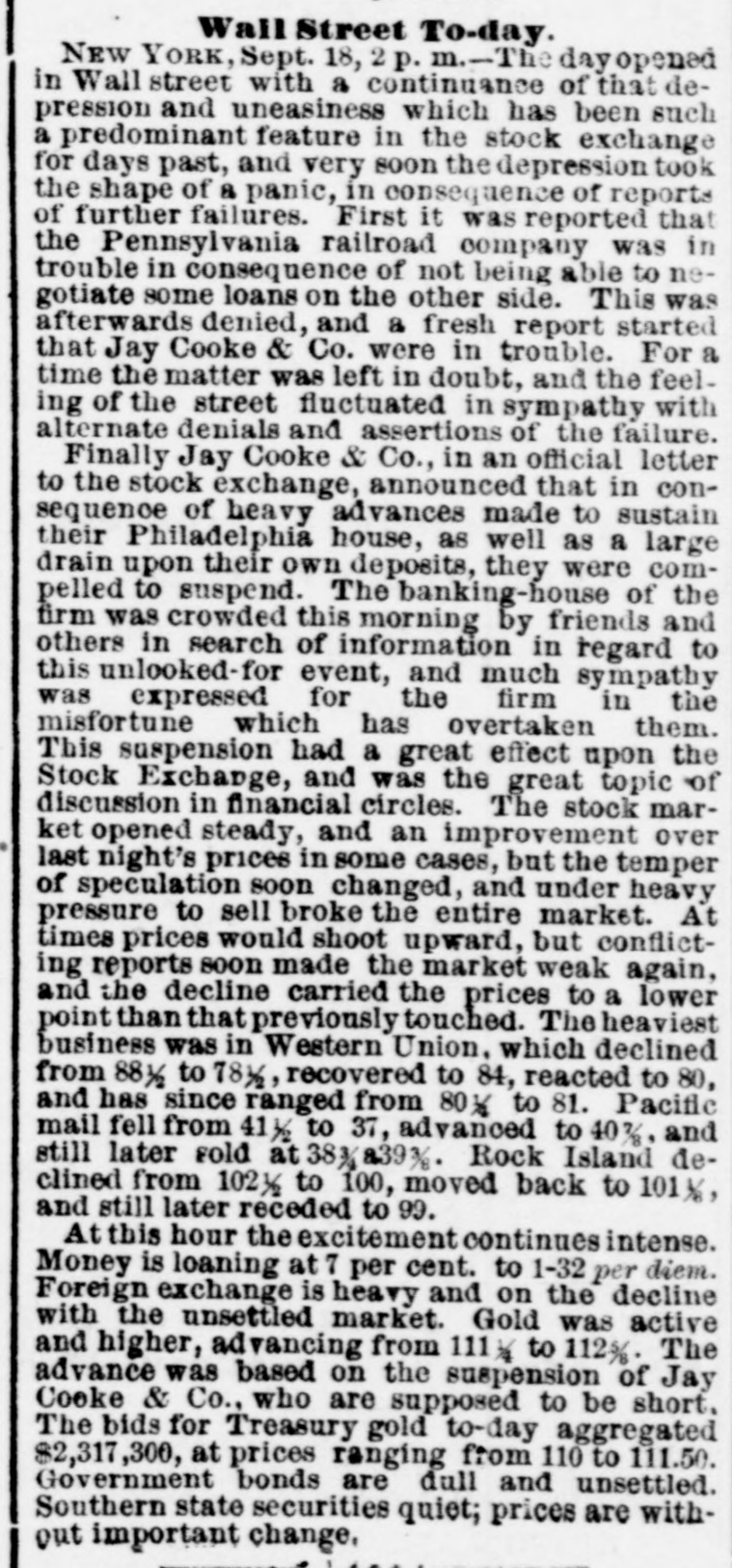
NEW YORK, Sept. 18, 2 p. m.-The day opened in Wall street with a continuance of that depression and uneasiness which has been such a predominant feature in the stock exchange for days past, and very soon the depression took the shape of a panic, in consequence of reports of further failures. First it was reported that the Pennsylvania railroad company was in trouble in consequence of not being able to negotiate some loans on the other side. This was afterwards denied, and a fresh report started that Jay Cooke & Co. were in trouble. For a time the matter was left in doubt, and the feeling of the street fluctuated in sympathy with alternate denials and assertions of the failure. Finally Jay Cooke & Co., in an official letter to the stock exchange, announced that in consequence of heavy advances made to sustain their Philadelphia house, as well as a large drain upon their own deposits, they were compelled to suspend. The banking-house of the firm was crowded this morning by friends and others in search of information in regard to this unlooked-for event, and much sympathy was expressed for the firm in the misfortune which has overtaken them. This suspension had a great effect upon the Stock Exchange, and was the great topic of discussion in financial circles. The stock market opened steady, and an improvement over last night's prices in some cases, but the temper of speculation soon changed, and under heavy pressure to sell broke the entire market. At times prices would shoot upward, but conflicting reports soon made the market weak again, and the decline carried the prices to a lower point than that previously touched. The heaviest business was in Western Union. which declined from 88 1/2 to 781/2, recovered to 84, reacted to 80, and has since ranged from 80 1/4 to 81. Pacific mail fell from 41 1/2 to 37, advanced to 40%, and still later sold at 38 a39%. Rock Island declined from 1021/2 to 100, moved back to 101%, and still later receded to 99. At this hour the excitement continues intense. Money is loaning at 7 per cent. to 1-32 per diem. Foreign exchange is heavy and on the decline with the unsettled market. Gold was active and higher, advancing from 111 to 112%. The advance was based on the suspension of Jay Cooke & Co., who are supposed to be short. The bids for Treasury gold to-day aggregated $2,317,300, at prices ranging from 110 to 111.50. Government bonds are dull and unsettled. Southern state securities quiet; prices are without important change,


Article from Evening Star, September 19, 1873

Click image to open full size in new tab

Article Text

of others, for that institution was more or less complicated by the banking business of Jay Cooke & Co., and the Pacific railroad bonds, with which they are heavily loaded. The other banks of this city invested mostly within this District or in government securities, and are not involved in outside operations. Mr. Davis then stated their deposits to-day had about balanced that of the withdrawals made, and he antictpated no run on their house. Should it come they are abundantly able and ready to meet all demands. He thought depositors would return their money with Mr. Ruff in a few days again, as he could see no cause for alarm. He expressed his belief that the Freedmen's Savings Bank would not suffer much inconvenience, as they had plenty of currency to meet demands. ACTION OF GOV. SHEPHERD. At an early hour to-day Gov. Shepherd, with commendable forethought, anticipating, perhaps, that some of the banks might be run, and cramped for currency. called upon Secretary Richardson and made an arrangement both with him and Treasurer Spinner, to the effect that any bank of the District depositing at the sub-Treasury in New York, and that fact being telegrap hed to Treasurer Spinner, could procure all the currency desired, direct from the Treasury here. This will enable any bank to convert by telegraph any collateral securities they may hold into currency, and furnish abundant means to meet any emergency. AN ADDITIONAL NOTICE. At half-past one o'clock the following was placarded on the doors of the First National bank: Paper maturing this day in the hands of the First National bank may be found at the Metropolitan bank, (next door.") INTERVIEW WITH MR. TENNEY. At two o'clock, THE STAR reporter was admitted to the banking house of Jay Cooke & Co., and was received by Mr. Tenney, when the following conversation ensued: Reporter.-"Mr. Tenney, THE STAR is anxions to inform the public of the latest news concerning the unfortunate suspension of the banks you represent?" Mr. Tenney.-"You may state that all the clerical force of the office is busily engaged in preparing a statement for the public, and that it will be submitted to them as soon as practicable. You may also state that the firm expect in a few days to open their doors and resume business." THE EXCITEMENT OVER. At o'clock 15th street was virtually deserted, and did not present as animated an appearance as usual. There seems to be a growing contidence that all is well, and that the business of the bank will resume at an early period. The run on the Freedmen's Bank, however, continues to some extent, but hourly grows more languid. FIRM AS A ROCK. At half-past two o'clock the reporter of THE STAR called upon Mr. Stickney, of the Freedman's Savings bank. The rush at that hour still continued. He was informed that the bank would keep open until its usual honr-4 p. m.and that up to that hour he (Mr. S.) did not think that thirty thousand dollars would have been drawn. This is owing to the small individual deposits carried by the bank. There 18 a general feeling that the run will subside tomorrow, although the officers are preparing for any contingency. A RECEIVER APPOINTED At half-1 last two o'clock, Edwin L. Stanton, Secretary of the District of Columbia, called upon Controller Knox and accepted the position as receiver of the First National Bank. He will take charge at once.


Article from The Rock Island Daily Argus, September 19, 1873

Click image to open full size in new tab

Article Text

Great the Railroad Gamblerstone Swindlers

Abatement Fever. of the Yellow Illinois Crop Reports. The the for and the front The suspended the occupies and Secretary Comptroller were Knox afternoon to the here. reference will receiver take charge The by officers eposits government sion, the does of not the Bank. in the First fully secured that deposits Treasur Syndicat tional the the erations they by ernment overpaid Late settlement W of the something Bank City Savings have been the Jay Cooke following statement the of Cooke Jay ing upon Both fortnight. drain upon large of quence cently or identi more The fied with Philadelphia weakened Company Northern which The & MeCullough Co. disencumbered that drafts are They paid Suydam suspended. A W Clark CHICA of failure Gold Company. is office city nounce office. until creditors, patient for their our our liabilities. COOKE (Signed) Mr and mentseedily of dollars the publicisfaction Sept. the LONDON Cooke ro"that stating them issued the of with Pacific hen fauroad and amply the there the parts ceived the be the sufficient curred 8.of. Natehe the guarantine against the letter table vol. there Reports lows dition the cent. below below cent. e below in below ED below below se.) Five eswill cent 25 du GE year, Y nature. extreme counties, ABLE being shop. some of central scattering rains utterly Pastures the western have and northe counties


Article from New-York Tribune, September 20, 1873

Click image to open full size in new tab

Article Text

QUIET RESTORED IN PHILADELPHIA

NO FURTHER FEAR OF A PANIC-STATEMENT OF JAY COOKE & CO.-A RUN ON TWO BANKING HOUSES-SUSPENSION OF SEVERAL BROKERSTHE STREET QUIET. PHILADELPHIA, Sept. 19.-All danger of a panic havingpassed, Third-st. 18 comparatively quiet to day. The feeling that the worst is over prevails in moneyed circles, and under its influence stocks have steadied so that the Brokers' Exchange presents no signs of remarkableexcitement Jay Cooke remained at his office last night until after midnight. and in response to all inquiries repeatedly declared that not a depositor should lose a dollar of the money intrusted to the firm. This morning the following card was posted on the door of the office: TO OUR DEPOBITORS. Some little time is required to adjust our accounts, and to hear from our different offices. when a statement will


Article from Evening Star, September 20, 1873

Click image to open full size in new tab

Article Text

THE SYNDICATE ALL RIGHT.

All rumors circulated with reference to losses by the syndicate, through the suspensions will be set at rest by the following cipher dispatch received this morning at the Treasury department:

LONDON, Sept. 19, 1873, Evening. Hen. W. A. Richardson, Secretary of Treasury. The syndicate accounts are all in perfect order. There is a universal feeling of sympathy towards Jay Cooke, McCulloch & Co.'s house here, which continues transacting business as usual.

A. G. CATTELL.

THE FREEDMEN'S BANK.

The run on the bank was continued this morning, but in comparison with yesterday's rush it was quite light. Much time is necessarily expended on each depositor, as nine out of ten are unable to write, and the checks are prepared by the paying teller, who witnesses the mark made by each. It is expected that by the time of closing the bank this afternoon that all making demands will have been satisfied. The usual droll scenes were to be witnessed to-day. The check-books are sometimes wrapped in bandanas, towels, brown paper, &c. The hat seems to be a favorite receptacle with many; the older dames carry "dat book" in their bosoms; but one old "Aunt Dinah," when her turn arrived to receive her cash, grinned all over with evident satisfaction, and produced the evidence of the bank's indebtedness from within a black stocking, which encased a leg of attenuated dimensions. Upon receiving the "cash money," it was substituted in the place vacated by the check-book, and she skipped out, as light-hearted as a school-girl at recess. Many who fall in at the rear end of the line, drag slowly about half way, take a look ahead, and reason perhaps that the bank is all right, and drop out and go their way. The officers of the bank are in no wise nervous, and are emphatic in their statement that they have abundant available resources on hand to meet any contingency. At half-past 12 o'clock to-day there had been drawn out of the Freedman's Bank sixty-five thousand dollars since the run began. About fifty persons were then in line awaiting payment. The officers continue their emphatic assurances that they are amply fortified for any emergency.

ADDITIONAL PRECAUTIONS OF THE GOVERNMENT.

A conference of Treasury officials was held late last night, at which it was decided to advertise for the purchase of ten million dollars of bonds to-day, and that in the event of this action failing to allay the excitement, it was further determined to draw on the forty-four million reserve to any extent necessary to restore confidence and stop the panic. A rumor is current at this writing (12 o'clock) that the stock exchange of New York has been closed, and that it will only be re-opened upon the order of its president, and that all who deal in stocks at any other place, or on the street, will be promptly expelled.

THE LEGAL TENDER RESERVES.

In connection with the drawing on the legal tender reserves to help Wall street, it will be remembered that Secretary Richardson has always claimed the right to issue any part or all of this reserve fund, in which opinion he is sustained by several decisions of the Supreme Court, delivered by the late Chief Justice Chase, who was Secretary of the Treasury at the time the law was passed which Secretary Richardson claims gives him the right to use the fund.

JAY COOKE & CO.'S BANK.

About double the usual clerical force are engaged in the bank setting accounts and preparing a statement for the public. Assistant Secretary Sawyer was some time in consultation with ex-Governor Cooke this morning. It still seems to be the general impression that the bank will resume business early next week.

THE FIRST NATIONAL BANK.

E. L. Stanton, designated by Secretary Richardson as receiver of his bank, took formal possession to-day, and began at once an investigation into its accounts. Under the law providing for a receiver, he is entitled to choose his own assistants, but as yet he has made no change in the clerical force of the bank, retaining them for the present as helomates. The bank was visited during the day by Controller Fox and Deputy Controller Langworthy.

ANXIETY INCREASING.

Towards noon, when the news of the suspensions in New York city and the closing of the New York stock exchange had become well noised throughout the city, callers and loungers around the bank increased in number, anxious to hear the latest intelligence from Wall street. While the feeling among many was unsettled, there seemed to be still evidences of confidence. Dispatches were received every few minutes by both the First National and Jay Cooke & Co.'s banks, and those inclined to be of a speculative turn of mind imagined and circulated many ill-founded rumors.

INTERVIEW WITH TREASURER SPINNER.

A little before two o'clock the reporter of THE STAR called on Gen. Spinner with reference to a subject which the following short conversation will explain:

Reporter.—"General, the New York Tribune of yesterday publishes a statement to the effect that two days before the First National Bank of this city suspended, that Secretary Richardson loaned that bank, without any collateral security, one hundred thousand dollars, which is a—"

General.—"Damned lie. The Tribune is getting quite reckless lately. There is not a word of truth in the publication. Had such a loan been made, I certainly would have known of it. A blonde representative of that paper called upon me, but I am sure I gave him no information which would inspire on his part such a groundless dispatch."

HOW MANY BONDS WERE OFFERED.

In response to the call of the Treasury department for the purchase of ten million of bonds, only two million have been offered in New York for sale. This is caused, it is said, by two reasons: first, the closing of the Stock Exchange in New York, and second from the fact that all the available securities of this nature were 'hypothecated in trust to weather yesterday's storm. It seems now to be the general impression that Secretary Richardson will draw on the forty-four million bank reserves.

AN ASSISTANT RECEIVER.

It is said that E. M. Nourse, of the firm of Nourse & Middleton, has been appointed by Mr. Stanton assistant receiver of the First National Bank.

NEARLY SUBSIDED.

At half-past two o'clock there were not over thirty in line at the Freedman's Bank, and but few were coming in. It may be said that the run on this institution is virtually over. Order have been issued by the bank officers to pay every one off, and close the press of the depositors by the time the bank closes, at 4 p. m. Every clerk in the bank has been put at work in the payment of depositors. There is no run anticipated on Monday.

THE WASHINGTON CITY SAVINGS BANK.

The run on the Washington City Savings bank has dwindled down to a mere nothing; this morning some dozen persons were at the door when the bank opened, and it was observed that the same familiar faces seen in the line yesterday and who failed to reach the counter in season, made up a greater part of the crowd present to-day. A new line has been formed to-day on the other side of the door, where those who desire to make deposits are admitted, and the deposits have been quite heavy to-day.

MR. RUFF'S OPINION.

Article from The Cairo Bulletin, September 23, 1873

Click image to open full size in new tab

Article Text

FOREIGN

LONDON, September 22.Much anxiety is manifested on all sides to hear further news from New York. JAY COOKE, M'CULLOUGH & CO., continue to pay cash in the usual manner and the run on their house has ceased, Much sympathy is expressed for the firm by leading bankers. THE SYNDICATE. A. G. Cattell has telegraphed to Secretary Richardson, that the business of syndicate is not disturbed by the finan. cial troubles. RUMORS. Among the rumors current in the stock exchange, is one that the bank of England holds $300,000 of Jay Cooke & Co's. acceptance, and that the Rothchilds have $100,000 of their paper. DEPRESSED. The dispatch announcing the closing of the New York gold exchange has just been bulletined, This news is accepted as an indication of the gravity of the financial situation, and the market for American securities is again depresed A desperate conflict took place in Burg St. Edmonds yeaterday, between large mobs of Irishmen and R body of police. men. The officers were compelled to use their clubs vigorously, and did not succeed in dispersing the rioters until many of them had received severe injuries. There is great excitement in the town, and a renewal of disturbances is apprehended. While rioting was in progress several houses were attacked by mobs and wrecked.


Article from Chicago Daily Tribune, September 23, 1873

Click image to open full size in new tab

Article Text

ABROAD

LONDON. Sopt. 22-5 p. m.-Much anxiety is manifested on all sides to hear further news from Now York. Jay Cooke, McCulloch & Co. continue to pay cash in the usual manner over their counter, and the run on their house has ceased. Much sympathy is expressed for the firm by leading bankers. A. G. Cattell has tolegraphed the Secretary Richardson that the business of the Syndicato is not disturbed by the financial troubles, Among the rumors current in the Stock Exchange is one that the Bank of England holds $300,000 of Jay Cooke & Co.'s acceptances, and that the Rothschilde have 8100,000 of the same paper. LONDON, Sopt. 22-5:30 p. m.-The dispatch announcing the closing of the New York Gold Exchange has been bullotined. This nows is accepted as an indication of the gravity of the financial situation, and the market for American securities is again depressed.


Article from The Bismarck Tribune, September 24, 1873

Click image to open full size in new tab

Article Text

JAY COOKE

Particulars of the Failure of the Great Banking House. The Effect on the Gold and Stock Market. The Effect on the North Pacific-Newspaper Comments. New YORK, Sept. 18.-Wall Street has scon few more eventful days than the one just closed. The Sailure of the Warehouse security Company first gave rise to symptoms of financial uneasiness. Then came the failure of the Southern Canada, which was quickly followed by that of the Midland & Oswego. This morning brought rumors from Philadelphia that the Pennsylvania Railroad was in trouble. Financial timidity soon turned to deadly fear and then Wall Street lost her reason entirely, and without a moments warning, creditors and depositors rushed in droves for every banking house which was known to be In any way connected with railroad enterprises THE RUSH ON JAY COOKE The house of Jay Cooke & Co. was the principal object of their attack. Mr. Moorhead, who had gone "down town in the morning supposing his firm as easy and sound as ever, at once saw the danger and called in the Presidents of six leading banks with which his house had dealings and asked their advice. They replied that they would stand by and help him fight the battle if desired. Jay Cooke telegraphed from Philadelphia that he a million, but in the meantime the streets wild and frantic, at one grew would more send and half past Moorhead decided to close the doors and 80 telegraphed to Philadelphia. The effect of this suspension drove Wall Street mad with excitement, and to-morrow's review of the field will disclose the number of the dead and wounded. Many have failed to day of which no announce ment has been made. THE NORTHERN PACIFIC. The effect of the Jay Cooke failure upon the Northern Pacfic cannot yet be ascertained, but not one dollar of the securities or paper of the Railroad Company has been used by Jay Cooke & Co. The of the Railroad floating debt Company believed Is less that its than half a million, and it is confidently credit will be maintained and every obligation be promptly met. THE ANNOENCEMENT PHILADELPHIA, Pa., Sept. 18.-The following card has been posted on the office door of Jay Cooke & Co., in this city: "We regret to be obliged to announce that, owing to unexpected demands upon us, our office has been obliged to suspend for a few days. We will soon be able to present a statement of our affairs to our cred-


Article from The Stark County Democrat, September 25, 1873

Click image to open full size in new tab

Article Text

JAY COOKE & Co

, bankers in Philadelphia, New York, Washington, London, and other places failed last week on Thursday creating a great panie in financial circles and causing many other failures A few years ago Jay Choke was an Ohio citizen. He got into the banking business at Columbus was a favorite with Mr. Chase who became Secretary of the Treasury, who made Cooke & Co's banking house at Philadelphia the agent of the government. Jay Cooke's wealth became fabulous. He-bought & built on an island in Lake Erie. He built a million palace at Philadelphia. Things went swimmingly, but Northern Pacific and other ventures have caused the sudden collapse of this Jay Cooke balloon.


Article from Montgomery County Sentinel, September 26, 1873

Click image to open full size in new tab

Article Text

THE FINANCIAL CRISIS

The suspension of the great banking-houses of Jay Cooke & Co., in Washington, Philadelphia and New York—a simple announcement of which was made last week—spread consternation throughout the country, and up to Tuesday last was the source of most intense excitement, causing depositors to withdraw their monies, until many banks closed their doors. The scenes in Wall street, New York, were of the most exciting character. Business-house after business-house in the great commercial metropolis, succumbed to the pressure, twenty-nine closing their doors, and four city banks. In the extremity Government was appealed to to let out the Forty-four Million reserve fund. This proposition was refused—and very properly—by the President and Secretary Richardson, but ten millions of the 5-20 loan was thrown upon the market, which soon raised a fund sufficient to impart confidence and quiet the panic—and this added to the fact of the banks resolving to sustain each other, brought a feeling of relief, and this feeling was beginning to exert its healthful influence, and confidence being rapidly restored, when suddenly on Tuesday evening last, the banking-house of Henry Clews & Co., closed its doors, thus destroying the returning confidence. The house of Clews & Co. ranked next to that of Jay Cooke & Co., and the announcement of its failure created wild excitement. What the end will be none can tell. A general suspension of all the banks is predicted by some.

The cause of the failure of Jay Cooke & Co. is said to be overdealing in stocks of the Northern Central Pacific Railroad.


Article from The Iowa Plain Dealer, September 26, 1873

Click image to open full size in new tab

Article Text

The Guancini crisis.

One week ago the telegraph heralded to the world the suspension of the banking house of Jay Cooke & Co. of Philadelphia. In rapid succession there followed E. W. Clarke & Co. Fisk & Hatch, and some ten or fifteen other banking institutions throughout various eastern cities but chiefly in Philadelphia and New York.

The first apprehension was that a general financial panic was about to prostrate the business of the country. The first spasm of excitement over leaves people free to look at the causes that threatened such universal calamity, when the fact is disclosed that they all resulted from the same causes; entangling alliance with railways that have shoved out onto the frontier beyond the reach of people or business. No banking institution private or incorporated under the laws of congress, or of any state, that confined itself to the legitmate business of banking is in any way affected.

The country at large is fuller of wealth that it has been for years past, and these failures have not diminished one dollar of the amount. It is further true that the men who control the money that handles the merchandise and the crops of the country have not invested in these railroad securities and are consequently unharmed by the disasters tint have overtaken Jay Cooke and others. Beyond perhaps a temporary depression in prices no injury will result to the business of the west from the financial troubles of the railroad giants of the east.


Article from The Cambria Freeman, September 26, 1873

Click image to open full size in new tab

Article Text

THE FINANCIAL CRISIS

-The failure of Jay Cooke & Co., which occurred on Thursday of last week, has been followed by some twenty odd others in New York, aud ten or fifteen in Philadelphia, and quite a number in various other parts of the country. The Cookes failed because they were carrying the bonds of the Northever Pacific railroad, which was paying them nothing on the capital invested, and which bonds could not be negotiated. The general business interests of the country will not suffer as in the panic of 1857, when the State banks were in an unsound condition. It is even thought that these failures will result in good to the country, as it will sweep out of existence the leaky and doubtful houses and enterprises, and leave the healthy ones in operation. It is also believed that the crisis has passed, and that the worst has been realized. The following is a full list of reported suspensions as far as can be ascertained: INDIVIDUAL BANKERS AND BROKERS IN NEW YORK. George B. Alley & Co., Beers & Edwards, Brown, Wadsworth & Co., Theodore Berdell, W. E. Connor, Jay Cooke & Co. Day & Morse, Fisk & Hatch, Fitch & Co., Fearing & Dellinger, Greenleaf, Norris & Co., Hay & Warner, Edward Haight & Co., Eugene J. Jackson, Lawrence Joseph, Amos M. Kidder. Kenyon, Cox & Co., Ketchum & Belknap, Jacob Little & Co., W. G. Moorehead & Co., Miller & Walsh, Peter M. Myers & Co., Marvin & Brothers, Thomas Reed & Co., E. D. Randolph & Co., S. H. Smith & Seaver, Saxton & Rogers, Tausig, Fisher & Co., Vernam & Hoyt, W. H. Warren, White, Defreitas & Rathborne, Whittemore & Anderson, Chase G. White & Co., Williams & Bostwick. CORPORATIONS IN NEW YORK. Bank of the Commonwealth, National Trust Company, Union Trust Company. FAILURES IN PHILADELPHIA. Charles P. Bayard, H. H. Bull. E. W. Clark & Co., DeHaven & Bro., Henry M. Douglass, Henry L. Fell, Gelbough, Boud & Co., T. C. Knight, John P. Lloyd, Geo. H. North, J. S. & H. E. Yerkes, Union Banking Co. MISCELLANEOUS. Thomas Squires & Son, Albany, N. Y.; Horace Conn, Woburn, Mass.; Franklin Banking Co., Chicago, Ill.; Taussig, Fisher & Co., St. Louis, Mo.; Powell & Co., Williamsport, Pai; H. J. Morse & Co., Toronto, Canada; City Savings Bank, Burlington, Iowa. -There was a heavy gale in South Carolina and Georgia on the night of the 19th. The storm along the Gulf railroad was fearful. At Thomasville much damage


Article from New-York Tribune, September 30, 1873

Click image to open full size in new tab

Article Text

HOWES & MACY

It is not the intention of this firm to make any public detailed statement of their affairs. They consider it unnecessary in view of the fact that they are adjusting matters as rapidly as possible, with the purpose of continuing business at as early a date as practicable. They are in daily receipt of letters from their customers, acceding to the proposition contained in their circular, and with the many satisfactory assu* rances thus received they are determined to resume operations on the plan proposed, in the hope that the experiment will eventually prove successful. Mr. Macy says the whole financial difficulty assumes a very peculiar phase. If a person has "money any where else than town in his own control he cannot get it. People out of who make collections for his house write that such and such an amount is deposited to their credit in such and such a bank. But that does not do them any good; that is not what they need; all the exchanges are so bad that certified checks are next to useless if one cannot get the money on them. Mr. Macy had been visited by a country correspondent who had come to New-York to draw a large amount of money which had been deposited in his bank in small amounts, and which the country banker had sent to the city for investment. But be could not procure the funds in) available shape, and remarked that unless he could get his deposits in bills of staall denominations, they were of no more use to him than 80 much brown paper. Mr Macy would have been glad if the Government relief had been proffered through another channel, whereby it would have brought money into the country and distributed it among the people. He thought $10,000,000 in the hands of the merchants at this time would do more good than if distributed among the banks. The present outlook was not very clear, yet they were cheerful and hopeful. Biugham Bros. & Brace of Mount Morris, N. Y., and E. B. Hale & Co. of Cleveland, Ohio, deny that they are correspondents of Howes & Macy. HENRY CLEWS & CO. This firm is still engaged in the preparation of its statement, but the time of completion is uncertain. It will be exclusively for the information of the creditors of the house, publicity probably being given to nothing beyond a report of assets and liabilities. Mr. Clews believes the effect of the panic will be felt for years. He says everybody in the street has virtually suspended that is,they cannot pay their loans or meet their obligations, and if they were applied to for the money they would be obliged to suspend, the same as the rest of us." He thought the outlook was horrible-frightful. With 6 per cent for greenbacks as against certified checks, who could stand I" JAY COOKE & CO. These gentlemen believe the prospect is brighter and that the good or iil of the future is dependent largely on the exercise or lack of caution and a spirit of accommo dation on the part of creditors as against their debtors. They are rather afraid, however, of the effect of the reopening of the Stock Exchange this morning. The fact is, they say, our banks are poor. They hold large quantities of stocks as security for loans. If they press their claims for the money upon which these collaterals are held the result will be disastrous, and will be felt all over the country. But if the banks are inclined to be lenient toward their customers the trouble will be tided over, and we may before long discern the tokens of better times. Messrs. Jay Cooke & Co. have presented, in their report of assets and liabilities, all they intend to make public. They will, however, issue a statement of their condition and accounts for the information of their customers, together with a circular containing plan of resumption, which will be submitted to their patrons, and to the propositions in which the latter will be asked to accede or dissent therefrom. FISK & HATCH. The members of this firm, while not shrinking from reasonable publicity, feel that a detailed statement of their accounts is a matter strictly between themselves and their creditors. The public is entitled to understand their general condition and prospects, and to cover this obligation it is stated that Fisk & Hatch have an abundance of assets and a surplus sufficient to pay everybody and resume business with a large margin. They are now working with a definite object in view, of which, if accomplished, the public will DO fully informed.; THE UNION TRUST COMPANY. Mr. Wesley, the receiver of the Union Trust Company, yesterday morning denied the report that Commodore Vanderbilt had returned to the Company their loan to the Lake Shore Railroad. FAILURE OF THE GLENHAM MANUFACTURING COMPANY The Glenham Manufacturing Company, a corporation in existence for more than fifty years, having extensive woolen mills at Glenham, N.Y., and its office at No. 293 Broadway, suspended yesterday morning. The President, Russel Dart, said that to give in detail the causes of the suspension would involve a long statement, which he was not disposed and had not the time to make. In general terms, it was due to the depression of business, and resulted directly from the financial panic, which had prevented merchants from going on as they otherwise would. Previous to the disturbance in Wall-st., the outlook for business was good. He was not prepared to make even an approximate estimate of the assets liabilities, and could not tell whetner the suspension would be final or only temporary before learning the disposition of the creditors. He was also unable to say whether the creditors where chiefly individuals or corporations. as it is impossible at present to tell where the paper of the Company 18 placed. The Company was organized in 1820 by Peter H. Schenck, the grandfather of President Dart. James Dart, a brother of the latter, is Treasurer, and the organization is wholly a family affair. The original capital was $140,000, and it has always been maintained at that figure, but Mr. Dart said that at least $1,000,000 had been expended on the Company's property, which could not be replaced for that sum. The Company owns 200 acres of land at Glenham. with large factories for the manufacture of woolen goods, and dwelling-houses for all of the 500 operatives. Mr. Dart was unable to say whether the suspension would result in throwing all these operatives out of work, as this would largely depend upon the action of the creditors. Up to the present time the Company had never been involved in any difficulty. A dispatch from Philadelphia announces the suspension of Benjamin Bullock's Sons. extensive wool dealers, in consequence of the suspension of the Glenham Company, which Company owes the firm about $600,000. FINANCIAL PECULIARTIES.


Article from Alexandria Gazette, October 2, 1873

Click image to open full size in new tab

Article Text

ALEXANDRIA, VA. THURSDAY, OCTOBER 2, 1873. FINANCIAL AFFAIRS.-The Baltimore Sun says:--"The general feeling in financial circles continues to improve, but money stringency is still severe. Here and there a weak spot is developed in some banking or commercial suspension, and such may be expected for some time. It is a favorable indication for Baltimore that SO far no commercial house and no chartered bank has gone down here. Two suspensions, one an old dry goods house (Paton & Co.) and the other a banking and stock firm (Northrup & Chick) took plack at New York yesterday-the latter, however, unimportant. Stocks were variable and not maintained. Gold declined, which is a favorable sign as is also the sharp advance in foreign exchange to 1071, showing the revived demand for it under a renewed shipment of produce. The drain of currency from New York city to the country is about at an end, and some is returned by banks from the interior." There have been filed in the office of the recorder of deeds in Washing. ton several instruments of writing, by ex-Governor Henry D. Cooke, conveying to Jay Cooke, trustee, his real estate in Georgetown, in three pieces, known as the Cooke property. A widow in Georgetown has entered suit against Jay Cooke & Co., on a cerificate of deposit for $4,500. No statement of the condition of the banking house has been made public. A dispatch from Louisville, Ky., says:-"Today the Planters' Bank, the Peoples' Bank, and the Louisville City National Bank, withdrew from the Clearing House Association. These bank have been doing business as usual through the panic, paying all the checks presented, and they will continue to do so. They withdrew from the Association on the ground that there was no necessity for the combination. At a meeting of the Clearing House Association last-night the Association was dissolved by common consent. The dissolution was caused by lack of co-operation. The Merchants' Bank of Kentucky announces that it will pay all checks on demand as heretofore." In the U. S. Circuit Court, in Philadelphia, before Judge Cadwalader, the order granted last week upon petition of Edward Wilson against Jay Cooke & Co., to show why they should not be adjudicated bankrupts, which was to have been returned yesterday, was continued until next week, at the request of the debtors and by consent of the petitioner.


Article from The Albany Register, October 4, 1873

Click image to open full size in new tab

Article Text

Latest News

The financial outlook at the East is gradually assuming a more reassuring character, and it is believed that business will soon resume its old channels. Immense sums in gold have been withdrawn from the Bank of England for shipment to the United States. A financial crisis is threatened in Germany. From Spain comes the news that the Carlists have suffered a series of defeate in the north, and discontent and disertions are spreading in their ranks. The police had closed all gambling houses in Madrid on the 29th ult. Several serious accidents have occurred on British railroads recently. Benicia, it is reported, is to be made a permanent military depot. $60,000 are being spent in erecting officer's quarters; also, an artesian well is being sunk, it having already reached several hundred feet. Notwithstanding the fact that the revenues have been comparatively light, it is asserted the Treasury Department will show a fair reduction of the puulie debt for September. In Philadelphia wool is quoted at 28 to 35c; coarse, 23 to 39c. The missing schooner, Three Brothers, was picked up and towed into Little River, Newfoundland. on the 22d ult. Seven bodies were found in the cabin-the remainder, fourteen. are supposed to have been washed overboard. They have been experiencing earthquakes in Gautemala. All religious communities have been suppressed and their property dedicated to beneficence and instruction, at San Juan del Norte. At the request, of debtors, and by consent of petitioners, orders requiring Jay Cooke & Co. to show cause why they should not be adjudicated bankrupts, have been continued for one week. The Washington Second National Bank has resumed currency payments. The public debt statement shows a reduction of $901,469 during the month. Northrup & Chick, bankers in Wall street, have suspended. Heavy calls from Western depositors was the cause. They have had no dealings with the Stock Exchange. The Grant Locomotive Works, Paterson, N. J., on account of scarcity of greenbacks, discharged an additional 175 men. The work on the Delaware, Lackawanna and Western Railroad Tunnel, through Bergen Hill, has been suspended. throwing 400 men out of ema (if ployment. The death of Hon. J. B. Baldwin is announced. He died at Stantou, Va., on the 30th ultimo.


Article from Nashville Union and American, October 11, 1873

Click image to open full size in new tab

Article Text

When the telegraph first flashed the news that a panic had been inaugurated by the failure of Jay Cooke & Co.'s Philadelphia house, we asked in a head-line "Where are the State Funds of Pennsylvania?" From the Philadelphia Age of the 8th, we see the people are still asking that question. According to the official report of the Radical Treasurer, Mr. Mackey, there is an unexpended balance of over a million dollars somewhere. But the Soldiers' Orphan Fund due Sept. 1, amounting to $125,000, is not yet paid, and the State officials at Harrisburg have been paid only a portion of their salaries for last month. Where then is the State's money? The Lancaster Intelligencer explains that the yearly balances are loaned to various banking institutions in the State, and the interest is divided between the State Treasurer and the Radical "Ring" of Pennsylvania. So the most favorable view of the case, is that the State funds are locked up in some of the semi-suspended banks, and are utterly beyond the control of the Radical Treasurer.


Article from The Ottawa Free Trader, November 8, 1873

Click image to open full size in new tab

Article Text

THE PANIC

While the west seems to bear up manfully against the panic, and the Chicago and St. Louis banks have not only fully resumed, but the former, at least, are able to extend pretty liberal accommodations to their customers and assist in moving our enormous crops, the outlook at the east continues gloomy and discouraging. In New York the shrinkage of values continues, and on Thursday gold went down to 614, the lowest point it has reached since 1862. The slight buoyancy that had shown itself at the close of last week was rudely dashed by the announcement that the great manufacturing firm of A. & W. Sprague, of Rhode Island, had suspended. The firm has for three generations occupied a leading position among the manufacturers of the east, and of late years the business has been extended vastly, SO that at the present time the Sprague influence permeates almost every branch of trade and finance in Rhode Island, as well as extending into Maine and other contiguous states. They control not only all the cotton manufacturies of the state, the national and savings banks, run several immense dry goods and general supply stores, but may, in fact, be said to run the entire state of Rhode Island, commercially, socially and politically. The assets of the firm are estimated at from sixteen to twenty-five millions, and their debts at $8,000,000. Their complete suspension would involve the discharge of 10,000 factory operatives. Negotiations are on foot to put their affairs in such a shape as not to close the factories, On the heels of the Sprague suspension followed on Tuesday another disaster-no less than the suspension of Tom Scott, the great Pennsylvania railroad king. His case is very much like that of Jay Cooke. He was carrying the Texas Pacific as Cooke was the North ern Pacific railroad. Scott had gone to Europe and negotiated a loan of $10,000,000 to continue work on his road, meantime endorsing vast amounts of the road's paper in anticipation of receiving the $10,000,000 loan. But just as the loan was being consummated, the news of the Jay Cooke explosion reached Europe, and the Scott loan collapsed. As a consequence, his Texas Pacific paper has gone to protest, and Tom Scott is floored The greatest fear is, that the Pennsylvania Central will, in consequence, fail to pay its usual semi-annual dividend of five per cent., which would greatly add to the embarrass. ment of things. To add still further to the gloom, a rumor was current on the 4th that the great mercantile house of H. Claflin & Co. was about to suspend, but this proved groundless. The firm not only show that they are abundantly solvent, but even refused to accept assistance tendered them by the New York banks. As a bit of sunshine amid the gloom, the announcement is made of the speedy resumption of the Philadelphia house of Jay Cooke & Co. A member of the firm is reported as saying, on Tuesday: "The agreements are rapidly being signed by our creditors, and are coming in with gratifying promptitude. We have every reason to be encouraged. We have merely asked forbearance of our creditors and we shall avoid bankruptcy with perfect certainty. The house will be able to resume within a few weeks, at any rate just as soon as the confidence of a great majority of our creditors is assured to us."


Article from The Wheeling Daily Intelligencer, November 18, 1873

Click image to open full size in new tab

Article Text

NEW YORK CITY

NEW YORK, Nov. 17.-The recruiting of seamen and marines for the United States Navy Yards is in progress at the usual offices. The fine Spanish iron clad Arapeles still occupies the dry dock, with a red and yellow flag floating at her peak. The work on this vessel has not been suspended, as reported. Admiral Rowan contradicts the published report that orders have been given to confine the crew of the Arapeles to the limits of the Navy Yard. John E. Fox & Co., of Philadelphia, have begun involuntary proceedings in bankruptcy in the U.S. District Court in this city, against Jay Cooke & Co., and the defendants have been enjoined from parting with any of their assets until the question of adjudication from involuntary bankrupts has been passed upon Lewis Posenthine, one of the negroes who murdered Abraham Beahm, near Middletown, Friday night, was arrested here this morning. Hugh McCulloch, of Jay Cooke, McCulloch & Co., of London, sailed for England Saturday. The firm will be dissolved at the end of the present year, when McCulloch and his English juniors will continue business under new and strong combinations. Judge Larremore has decided that the new Police Justice act is Constitutional. Mrs. Templeton, who was shot by her husband, Saturday, was still alive this morning. The physicians say they have little or no hope of her recovery. At the navy yard to-day the same activity was manifested as for the past few days, and 250 men were added to the force. The Juniata is now ready for RPA, and will anchor off the Battery to await orders. It is stated by employes of the navy yard that work upon the Spanish iron clad Arpeles was suspended this afternoon. The steamship Cleopatra, which arrived to-day brought the newspaper mails she took on her outward bound trip to Havana. The Spanish authorities refused to allow them to be landed.


Article from Chicago Daily Tribune, November 27, 1873

Click image to open full size in new tab

Article Text

The United Statos Court, sitting at Philadelphia, has adjudged Jay Cook & Co. to be bankrupts, and made an order for the appointment of a Receiver, etc.


Article from Evening Star, January 14, 1874

Click image to open full size in new tab

Article Text

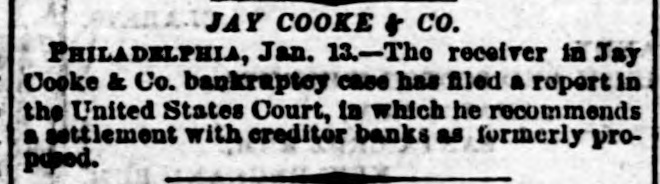
JAY Cooks & Co

-The receiver in Jay Cooke & Co. bankruptcy case has filed n report in the United States court at Philadelphia, in which be recommends a settlement with credwith itor banks as formerly promised.


Article from National Republican, January 14, 1874

Click image to open full size in new tab

Article Text

jay COOKE t CO

Philadelphia, Jan. 13.-The receiver in Jay Cooke & Co. bankraptcy case has filed a report in the United States Court, in which he recommends a settlement with creditor banks as formerly proposed.


Article from Wilmington Daily Commercial, January 6, 1875

Click image to open full size in new tab

Article Text

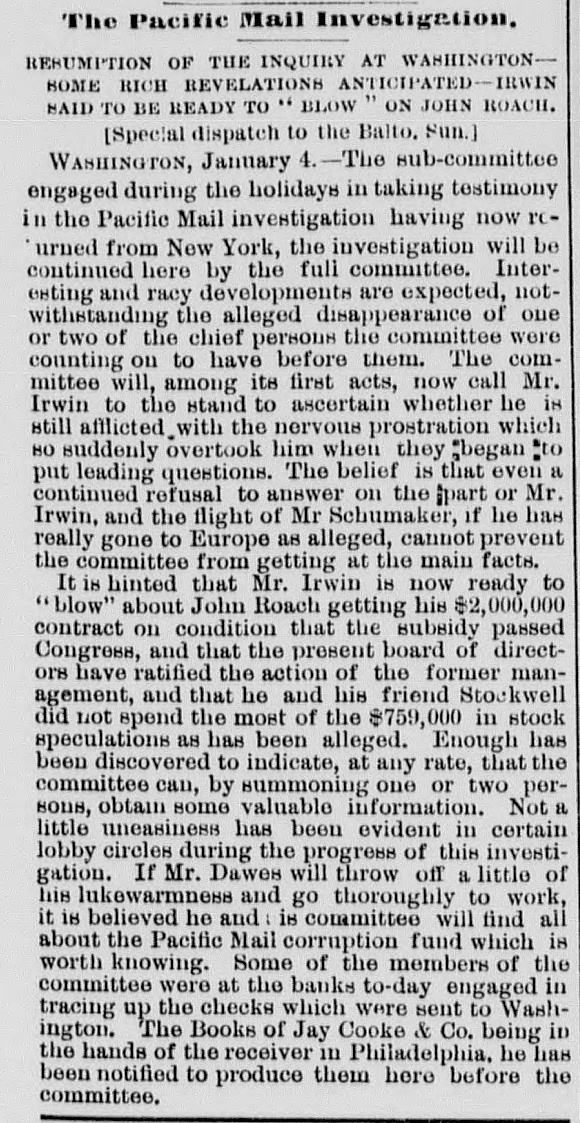
The Pacific Mail Investigation, RESUMPTION OF THE INQUIRY AT WASHINGTONHOME RICH REVELATIONS ANTICIPATED-IRWIN HAID TO BE READY TO .. BLOW ON JOHN ROACH. [Special dispatch to the Balto, Sun.] WASHINGTON, January 4.-The sub-committee engaged during the holidays in taking testimony in the Pacific Mail investigation having now rc'urned from New York, the investigation will be continued here by the full committee. Interesting and racy developments are expected, notwithstanding the alleged disappearance of one or two of the chief persons the committee were counting on to have before them. The committee will, among its first acts, now call Mr. Irwin to the stand to ascertain whether he is still afflicted with the nervous prostration which 80 suddenly overtook him when they "began to put leading questions. The belief is that even a continued refusal to answer on the part or Mr. Irwin, and the flight of Mr Schumaker, if he has really gone to Europe as alleged, cannot prevent the committee from getting at the main facts. It is hinted that Mr. Irwin is now ready to "blow" about John Roach getting his $2,000,000 contract on condition that the subsidy passed Congress, and that the present board of directors have ratified the action of the former management, and that he and his friend Stockwell did not spend the most of the $759,000 in stock speculations as has been alleged. Enough has been discovered to indicate, at any rate, that the committee can, by summoning one or two persons, obtain some valuable information. Not a little uneasiness has been evident in certain lobby circles during the progress of this investigation. If Mr. Dawes will throw off a little of his lukewarmness and go thoroughly to work, it is believed he and : is committee will find all about the Pacific Mail corruption fund which is worth knowing. Some of the members of the committee were at the banks to-day engaged in tracing up the checks which were sent to Washington. The Books of Jay Cooke & Co. being in the hands of the receiver in Philadelphia, he has been notified to produce them here before the committee.


Article from Bozeman Avant Courier, September 12, 1878

Click image to open full size in new tab

Article Text

Odds and Ends.

Banning, the great army reducer, has been ingloriously slaughtered in the house of his friends. The Democratic Congressional Convention, which convened at Cincinnati Saturday, put Banning is his little bed by beating him for renomination. Another striking illustration of the ingratitude of republics.

The Nursery publishes a charming little story of an army mule at Fort Ripley which, witched to a cart, was used every day by fatigue parties to haul off rubbish. The mule learned the bugle calls so that whenever the recall sounded, no matter what he was doing or where he was, whether at work or play, hitched to his cart or not, he would make a break for the stable at a full gallop. He knew that his work was then ended and it was time to rest.

Our readers will act wisely and sensibly by patronizing only such establishments as advertise and make known to the world what they have. The men who decline to sustain a local paper, that strives earnestly to bring the resources of its section to the favorable notice of capitalists and others, are wholly undeserving of patronage from any source.

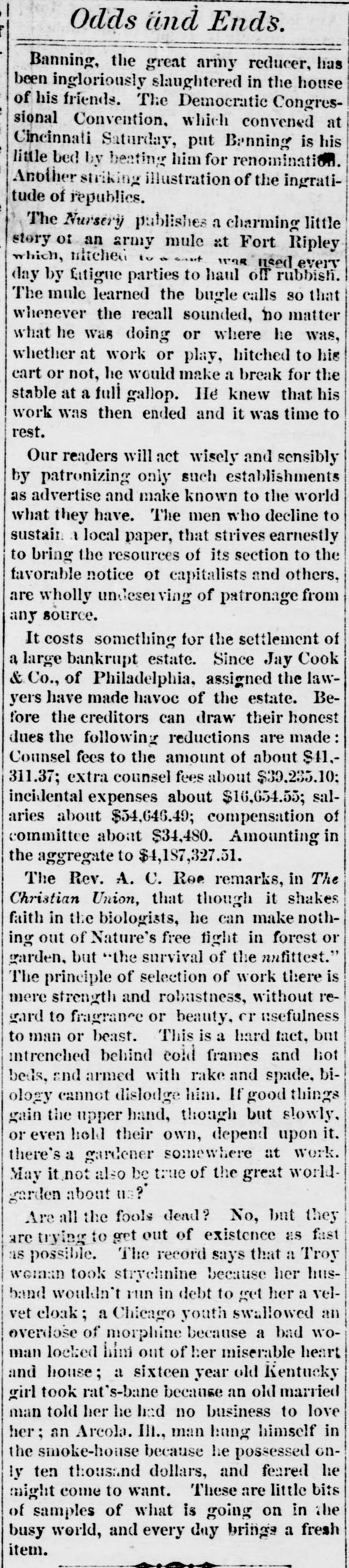
It costs something for the settlement of a large bankrupt estate. Since Jay Cook & Co., of Philadelphia, assigned the lawyers have made havoc of the estate. Before the creditors can draw their honest dues the following reductions are made: Counsel fees to the amount of about $41,311.37; extra counsel fees about $39.235.10; incidental expenses about $16,654.55; salaries about $54,646.49; compensation of committee about $34,480. Amounting in the aggregate to $4,187,327.51.

The Rev. A. C. Roe remarks, in The Christian Union, that though it shakes faith in the biologists, he can make nothing out of Nature's free fight in forest or garden, but "the survival of the unfittest." The principle of selection of work there is mere strength and robustness, without regard to fragrance or beauty, or usefulness to man or beast. This is a hard tact, but intrenched behind cold frames and hot beds, and armed with rake and spade, biology cannot dislodge him. If good things gain the upper hand, though but slowly, or even hold their own, depend upon it, there's a gardener somewhere at work. May it not also be true of the great world-garden about us?

Are all the fools dead? No, but they are trying to get out of existence as fast as possible. The record says that a Troy woman took strychnine because her husband wouldn't run in debt to get her a velvet cloak; a Chicago youth swallowed an overdose of morphine because a bad woman locked him out of her miserable heart and house; a sixteen year old Kentucky girl took rat's-bane because an old married man told her he had no business to love her; an Arcola, Ill., man hung himself in the smoke-house because he possessed only ten thousand dollars, and feared he might come to want. These are little bits of samples of what is going on in the busy world, and every day brings a fresh item.


Article from The Midland Journal, December 18, 1896

Click image to open full size in new tab

Article Text

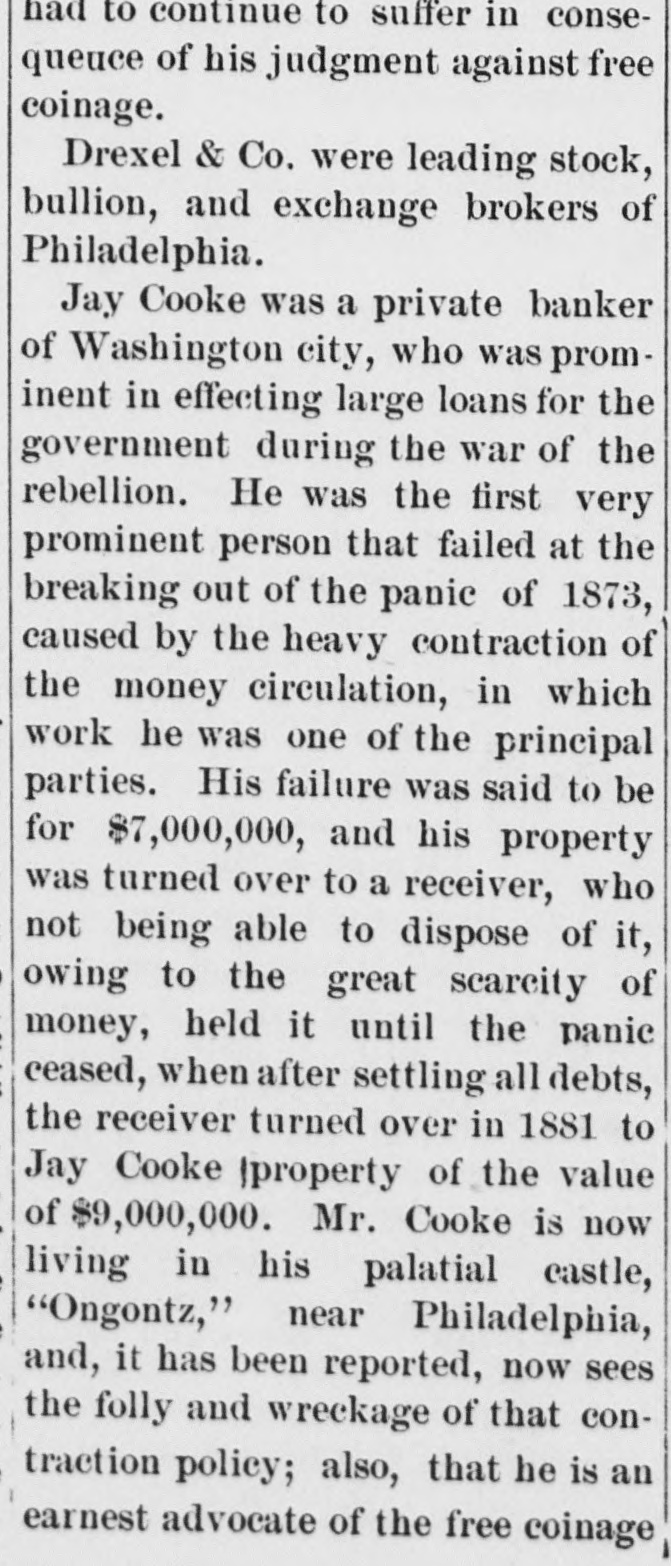
had to continue to suffer in consequeuce of his judgment against free coinage. Drexel & Co. were leading stock, bullion, and exchange brokers of Philadelphia. Jay Cooke was a private banker of Washington city, who was prominent in effecting large loans for the government during the war of the rebellion. He was the first very prominent person that failed at the breaking out of the panic of 1873, caused by the heavy contraction of the money circulation, in which work he was one of the principal parties. His failure was said to be for $7,000,000, and his property was turned over to a receiver, who not being able to dispose of it, owing to the great scarcity of money, held it until the panic ceased, when after settling all debts, the receiver turned over in 1881 to Jay Cooke property of the value of $9,000,000. Mr. Cooke is now living in his palatial castle, "Ongontz," near Philadelphia, and, it has been reported, now sees the folly and wreckage of that contraction policy; also, that he is an earnest advocate of the free coinage