First National Bank (Washington, DC)

Episode Information

Episode Type
Run → Suspension → Closure
Start Date
September 18, 1873
Location
Washington, District of Columbia (38.895, -77.036)
Bank Type
national
Charter Number
26

Metadata

Response Measures

Full suspension, Books examined

Other: Receiver (Edwin L. Stanton) was appointed and took charge; bank suspended (closed) during the panic; under receivership the receiver prepared statements and later paid dividends/partial payments to depositors. The federal government also arranged emergency currency facilities for District banks via the Treasury (telegraphed conversions of collateral), which aided the crisis response.

Receivership Details

Depositor recovery rate
100.0%
Date receivership started
1873-09-19
Date receivership terminated
1876-07-24
OCC cause of failure
Excessive lending
Share of assets assessed as good
43.9%
Share of assets assessed as doubtful
56.1%

Notes

Receiver Edwin L. Stanton appointed Sept. 19; later dividends paid under receivership but bank did not resume normal independent operations.

Events (5)

1. July 16, 1863 Chartered
Source
historical_nic
2. September 18, 1873 Run
Cause
Correspondent
Cause Details
Panic triggered by the failure of Jay Cooke & Co., a correspondent/associated house, which precipitated heavy withdrawals.
Measures
Placarded suspension and later invoked 30-day rule; cashier closed doors to stem withdrawals.
Newspaper Excerpt
Soon the First National Bank followed suit, and put on the following: 'The First National Bank has found it necessary to suspend business to-day.' H. C. SWAIN, Cashier.
Source
newspapers
3. September 18, 1873 Suspension
Cause
Correspondent
Cause Details
Suspension followed directly from the shock and runs after Jay Cooke & Co.'s failure.
Newspaper Excerpt
The First National Bank has found it necessary to suspend business to-day. H. C. SWAIN, Cashier.
Source
newspapers
4. September 19, 1873 Receivership
Newspaper Excerpt
A RECEIVER APPOINTED ... Edwin L. Stanton ... called upon Controller Knox and accepted the position as receiver of the First National Bank.
Source
newspapers
5. September 19, 1873 Receivership
Source
historical_nic

Newspaper Articles (25)

Article from The Critic and Record, September 18, 1873

Click image to open full size in new tab

Article Text

Eight Millions Short.

The Failure of Jay Cooke & Co.

A Bull Panic in Gold and a Bear Panic in Stocks.

The Closing of the Banks in this City.

Great excitement was caused in financial and business circles in this city by the announcement that the firm of Jay Cooke & Co., in Philadelphia and New York, had failed.

As soon as the Cashier of the Banking-house of Jay Cooke & Co., in this city, was satisfied that the information was true, he ordered the doors of the bank to be closed, and put the following on a card outside:

"In consequence of the suspension of Jay Cooke & Co., New York and Philadelphia, we have concluded to close our doors until we hear further from them."

Soon the First National Bank followed suit, and put on the following: "The First National Bank has found it necessary to suspend business to-day. H. C. SWAIN, Cashier.

Soon a large crowd of persons congregated about the banks on Fifteenth street, and excitedly discussed the suspension. We have received the following telegrams from New York:

NEW YORK, Sept. 18.—The failure of Jay Cooke & Co. was announced at noon to-day in the Stock Exchange.

[SECOND DISPATCH.] NEW YORK, Sept. 18.—Jay Cooke & Co. have failed. They are said to be short six to eight millions of gold, which is now being covered, and the other shorts are also covering, so that there is a bull panic in gold and a bear panic in stocks. There is no truth in the report of the failure of the Pennsylvania Coal Company. Drexel, Morgan & Co., their agents, offer to buy one million of their paper at ½ per cent. per month.

WALL ST., 1 P. M.—Money demoralized by panic in stocks, and loans at one time were made only on New York Central Exchange. Heavy lower rates reduced ⅛ from yesterday's quotations. Gold opened at 111¼ and steadily advanced with slight fluctuations. At 1 p. m. it was 112⅜. The highest point reached was 112⅞. On attempts of shorts to cover, there's a bull panic in gold.

Stocks opened steady, but soon became feverish. About 10:30 there was nothing to indicate the impending panic. At this juncture the report of the failure of Jay Cooke & Co. was first announced.

THE IMPRESSION IN THIS CITY. There seems to be an impression that depositors are secured; that is, that the bank in this city will open in a few days, and pay their depositors.

The District government has all of their money in the First National Bank, which is known to be deeply interested in the house of Jay Cooke & Co.

It is rumored on the streets that Jay Cooke & Co. carried eighty millions in Northern Pacific railroad stock, and that they have of late been required to borrow gold at a high rate to pay the interest due, and that Daniel Drew was instrumental in bringing the suspension about.

The officials of both of the banks in this city shut themselves up, and refused to give reporters any information in regard to the suspension.
Article from Evening Star, September 19, 1873

Click image to open full size in new tab

Article Text

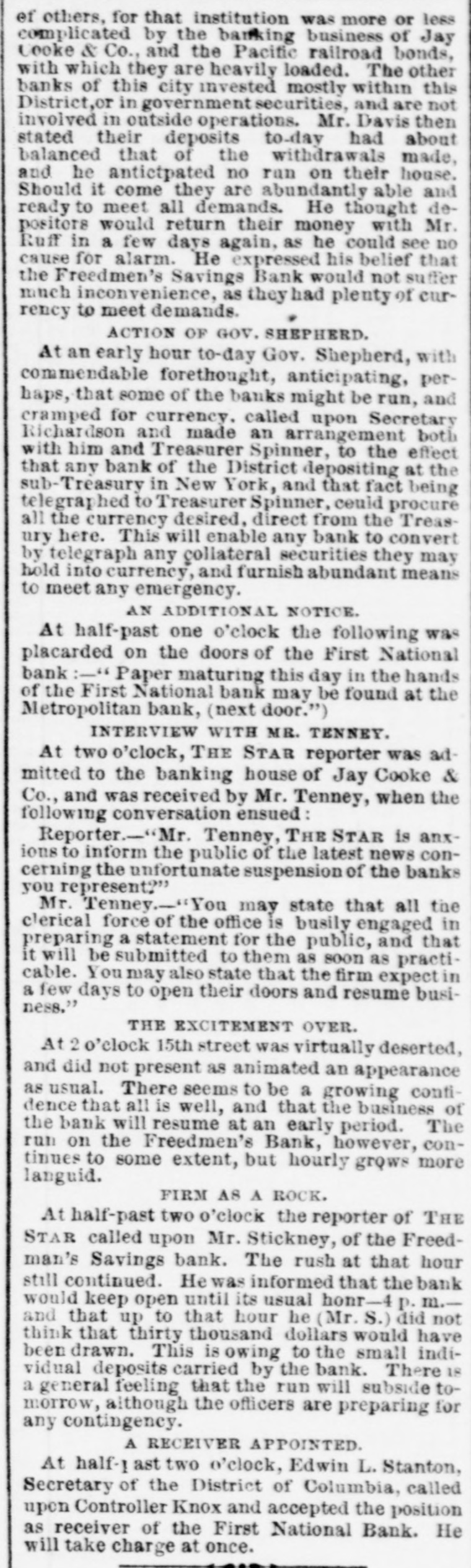
of others, for that institution was more or less complicated by the banking business of Jay Cooke & Co., and the Pacific railroad bonds, with which they are heavily loaded. The other banks of this city invested mostly within this District or in government securities, and are not involved in outside operations. Mr. Davis then stated their deposits to-day had about balanced that of the withdrawals made, and he antictpated no run on their house. Should it come they are abundantly able and ready to meet all demands. He thought depositors would return their money with Mr. Ruff in a few days again, as he could see no cause for alarm. He expressed his belief that the Freedmen's Savings Bank would not suffer much inconvenience, as they had plenty of currency to meet demands. ACTION OF GOV. SHEPHERD. At an early hour to-day Gov. Shepherd, with commendable forethought, anticipating, perhaps, that some of the banks might be run, and cramped for currency. called upon Secretary Richardson and made an arrangement both with him and Treasurer Spinner, to the effect that any bank of the District depositing at the sub-Treasury in New York, and that fact being telegrap hed to Treasurer Spinner, could procure all the currency desired, direct from the Treasury here. This will enable any bank to convert by telegraph any collateral securities they may hold into currency, and furnish abundant means to meet any emergency. AN ADDITIONAL NOTICE. At half-past one o'clock the following was placarded on the doors of the First National bank: Paper maturing this day in the hands of the First National bank may be found at the Metropolitan bank, (next door.") INTERVIEW WITH MR. TENNEY. At two o'clock, THE STAR reporter was admitted to the banking house of Jay Cooke & Co., and was received by Mr. Tenney, when the following conversation ensued: Reporter.-"Mr. Tenney, THE STAR is anxions to inform the public of the latest news concerning the unfortunate suspension of the banks you represent?" Mr. Tenney.-"You may state that all the clerical force of the office is busily engaged in preparing a statement for the public, and that it will be submitted to them as soon as practicable. You may also state that the firm expect in a few days to open their doors and resume business." THE EXCITEMENT OVER. At o'clock 15th street was virtually deserted, and did not present as animated an appearance as usual. There seems to be a growing contidence that all is well, and that the business of the bank will resume at an early period. The run on the Freedmen's Bank, however, continues to some extent, but hourly grows more languid. FIRM AS A ROCK. At half-past two o'clock the reporter of THE STAR called upon Mr. Stickney, of the Freedman's Savings bank. The rush at that hour still continued. He was informed that the bank would keep open until its usual honr-4 p. m.and that up to that hour he (Mr. S.) did not think that thirty thousand dollars would have been drawn. This is owing to the small individual deposits carried by the bank. There 18 a general feeling that the run will subside tomorrow, although the officers are preparing for any contingency. A RECEIVER APPOINTED At half-1 last two o'clock, Edwin L. Stanton, Secretary of the District of Columbia, called upon Controller Knox and accepted the position as receiver of the First National Bank. He will take charge at once.


Article from National Republican, September 19, 1873

Click image to open full size in new tab

Article Text

JAY COOKE & CO

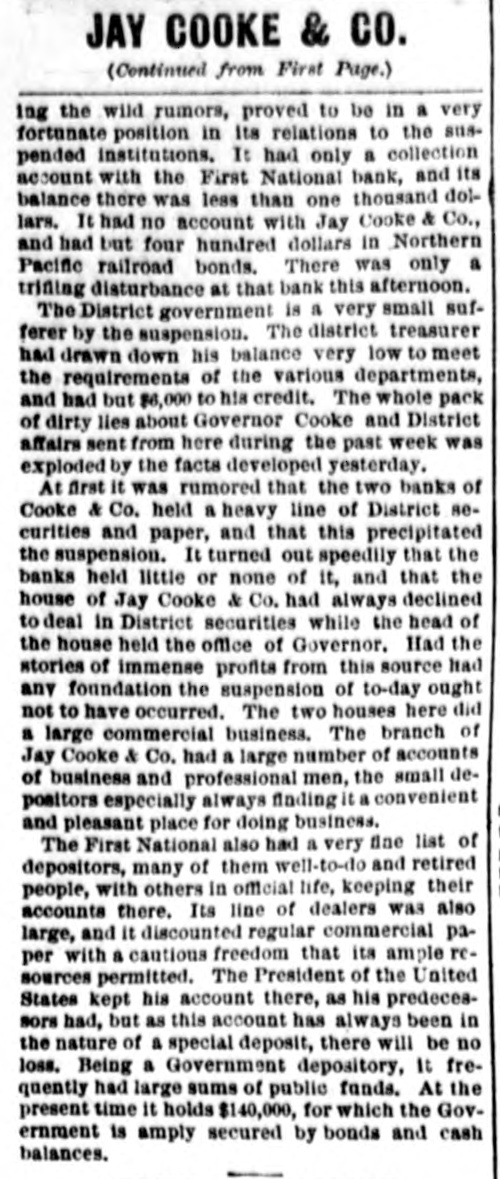
(Continued from First Page.) ing the wild rumors, proved to be in a very fortunate position in Its relations to the suspended institutions. It had only a collection account with the First National bank, and its balance there was less than one thousand dollars. It had no account with Jay Cooke & Co., and had but four hundred dollars in Northern Pacific railroad bonds. There was only a trining disturbance at that bank this afternoon. The District government is a very small sufferer by the suspension. The district treasurer had drawn down his balance very low to meet the requirements of the various departments, and had but $6,000 to his credit. The whole pack of dirty lies about Governor Cooke and District affairs sent from here during the past week was exploded by the facts developed yesterday. At first it was rumored that the two banks of Cooke & Co. held a heavy line of District securities and paper, and that this precipitated the suspension. It turned out speedily that the banks held little or none of it, and that the house of Jay Cooke & Co. had always declined to deal in District securities while the head of the house held the office of Governor. Had the stories of immense profits from this source had any foundation the suspension of to-day ought not to have occurred. The two houses here did a large commercial business. The branch of Jay Cooke & Co. had a large number of accounts of business and professional men, the small depositors especially always finding it a convenient and pleasant place for doing business. The First National also had a very fine list of depositors, many of them well-to-do and retired people, with others in official life, keeping their accounts there. Its line of dealers was also large, and it discounted regular commercial paper with a cautious freedom that its ample resources permitted. The President of the United States kept his account there, as his predecessors had, but as this account has always been in the nature of a special deposit, there will be no loss. Being a Government depository, It frequently had large sums of public funds. At the present time It holds $140,000, for which the Government is amply secured by bonds and cash balances.

Article from Evening Star, September 22, 1873

Click image to open full size in new tab

Article Text

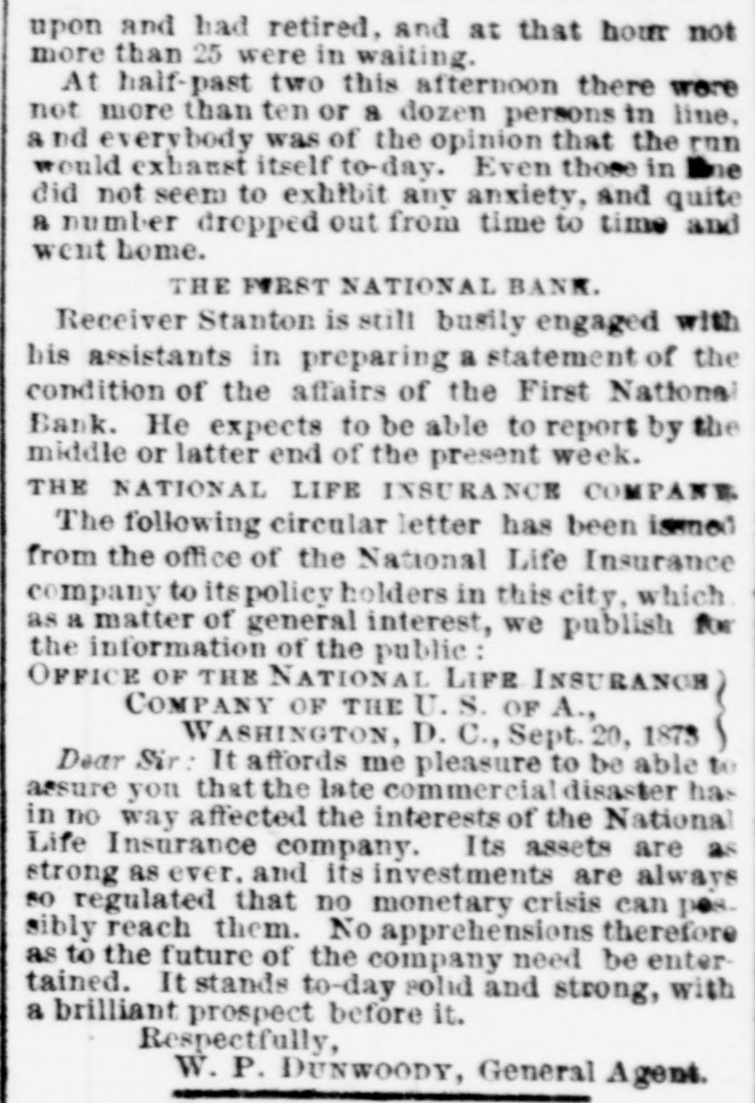
upon and had retired, and at that hour not more than 25 were in waiting. At half-past two this afternoon there were not more than ten or a dozen persons in line. a nd everybody was of the opinion that the run would exhaust itself to-day. Even those in line did not seem to exhibit any anxiety, and quite a number dropped out from time to time and went home. THE FIRST NATIONAL BANK. Receiver Stanton is still busily engaged with his assistants in preparing a statement of the condition of the affairs of the First National Bank. He expects to be able to report by the middle or latter end of the present week. THE NATIONAL LIFE INSURANCE COMPANE The following circular letter has been ismed from the office of the National Life Insurance company to its policy holders in this city, which as a matter of general interest, we publish for the information of the public: OFFICE OF THE NATIONAL LIFE INSURANCE COMPANY OF THE U. S. OF A., WASHINGTON, D. C., Sept. 20, 1873 Dear Sir: It affords me pleasure to be able to assure you that the late commercial disaster has in no way affected the interests of the National Life Insurance company. Its assets are as strong as ever. and its investments are always so regulated that no monetary crisis can pos. sibly reach them. No apprehensions therefore as to the future of the company need be entertained. It stands to-day solid and strong, with a brilliant prospect before it. Respectfully, W. P. DUNWOODY, General Agent.


Article from The Toledo Chronicle, September 25, 1873

Click image to open full size in new tab

Article Text

Panic in Wall Street

The financial world was shocked last Thursday by the announcement that the heavy firm of Jay Cook & Co,, of New York, had suspended payment This firm, as is well known was one of the heaviest banking houses in the world, having advanced immense sums of money w the gov erument during the war when the national credit was gone, and being now one of the leading members o! the syndicate, besides having advance ed millions of dollars to Railroad companies. Th bank suffere a run on Thursday morning. an was com pelled quate early 1a the day to clust The phuosophy of this future, which led to many other suspensions, must be sought in the fact that, instead of attending to a. legitim t banking bu-mess, speculative enterprises were entered into. Immense loads of railroad bonds, in which capitalists are now slow to invest, were taken and the result we see in a financial crisis, whose extent will never 1, known, because of the heavy loss on tailed upon holders of railroad stock responded of at a she " after 1. panic occurred. Among the new vailures we notice the following: Fish & Hatch, N " Y ik; the Fax National Bank of Washington, the New Your Unen Trust Company; he National Bank of in Common wealth, N.W York the National Trust Company. New York; the Bank of America, Non York; the Union Banking Company. 01 Philadelphia. These froms," of them at least. were intimatey associated with Couke & Co 111 their business trans actions, and the financial distress will be more of less wile-spread in proportion to the permanency of the failures. If the alone soff l' ed from the panic, the financial dis turbance would excite little sympto thy, but as it entailed losses upon many who had their all invested in radroal securities, which they sold at he ay loss, the panic is J. plorable. The effect produced upon the floor 01 the Stock Exchange may be intere red from the fact that last Saturday the extreme factuations on some clocks were as follows: Harlem 30 per cam; Panama, 18; Rook Island 91; Western Union. 9; Hammbal & St. Joseph, 9, with other stocks flue tuating from 2 to 8 points. The government came to the relief of the money market by purchasing U. Bonds. By this meaus, togeth. er with the action of Bank Presi dems, through the Clearing House loan certificates, many millions of greerbacks were released, with III touching any portion of the $44,000. 000 reserve now In the National Treasury.


Article from The Emporia News, September 26, 1873

Click image to open full size in new tab

Article Text

during the past few days

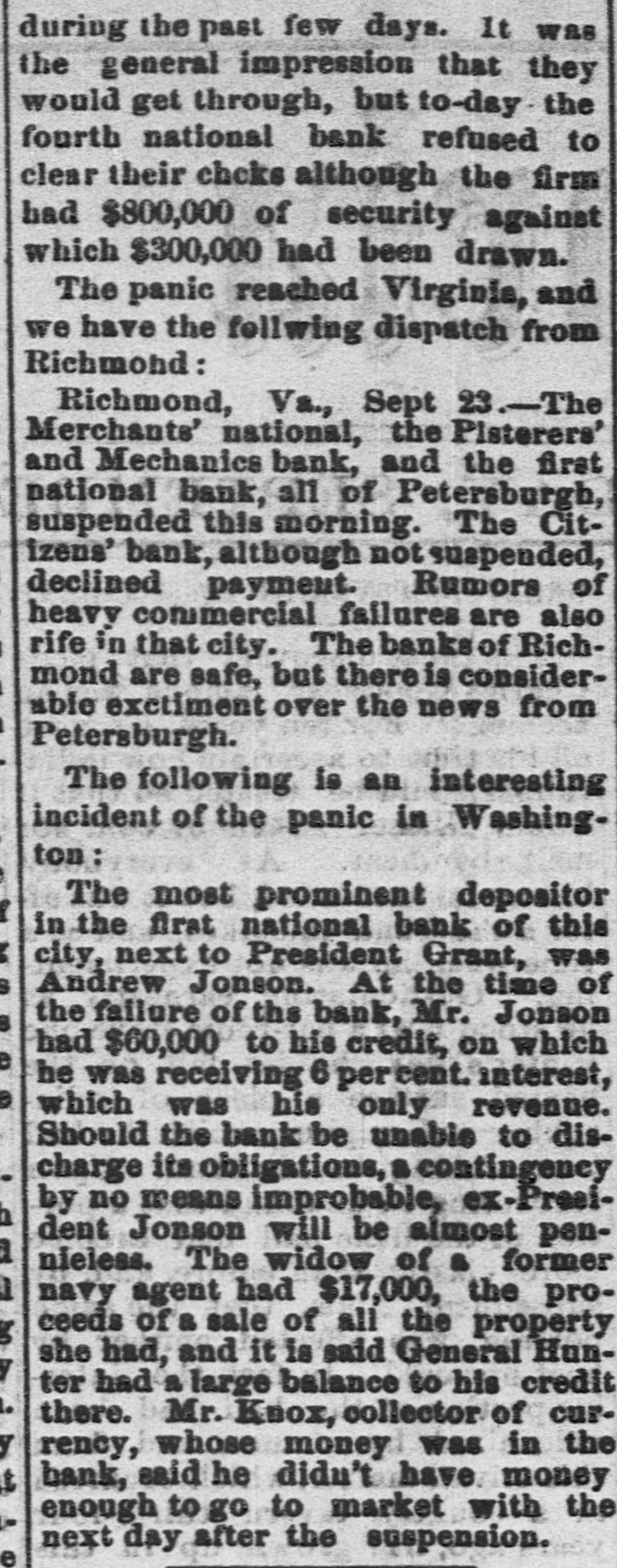
It was the general impression that they would get through, but to-day - the fourth national bank refused to clear their chcks although the firm had $800,000 of security against which $300,000 had been drawn. The panic reached Virginia, and we have the follwing dispatch from Richmond: Richmond, Va., Sept 23.-The Merchants' national, the Pisterers' and Mechanics bank, and the first national bank, all of Petersburgh, suspended this morning. The Citizens' bank, although not suspended, declined payment. Rumors of heavy commercial failures are also rife in that city. The banks of Richmond are safe, but there is considerable excliment over the news from Petersburgh. The following is an interesting incident of the panic in Washington : The most prominent depositor in the first national bank of this city, next to President Grant, was Andrew Jonson. At the time of the failure of ths bank, Mr. Jonson had $60,000 to his credit, on which he was receiving 6 percent. interest, which was his only revenue. Should the bank be unable to discharge its obligations, a contingency by no means improbable, ex-Preeident Jonson will be almost pennieless. The widow of a former navy agent had $17,000, the proceeds of a sale of all the property she had, and it is said General Hunter had a large balance to his credit there. Mr. Knox, collector of currency, whose money was in the bank, said he didn't have money enough to go to market with the next day after the suspension.


Article from Nashville Union and American, September 28, 1873

Click image to open full size in new tab

Article Text

WASHINGTON

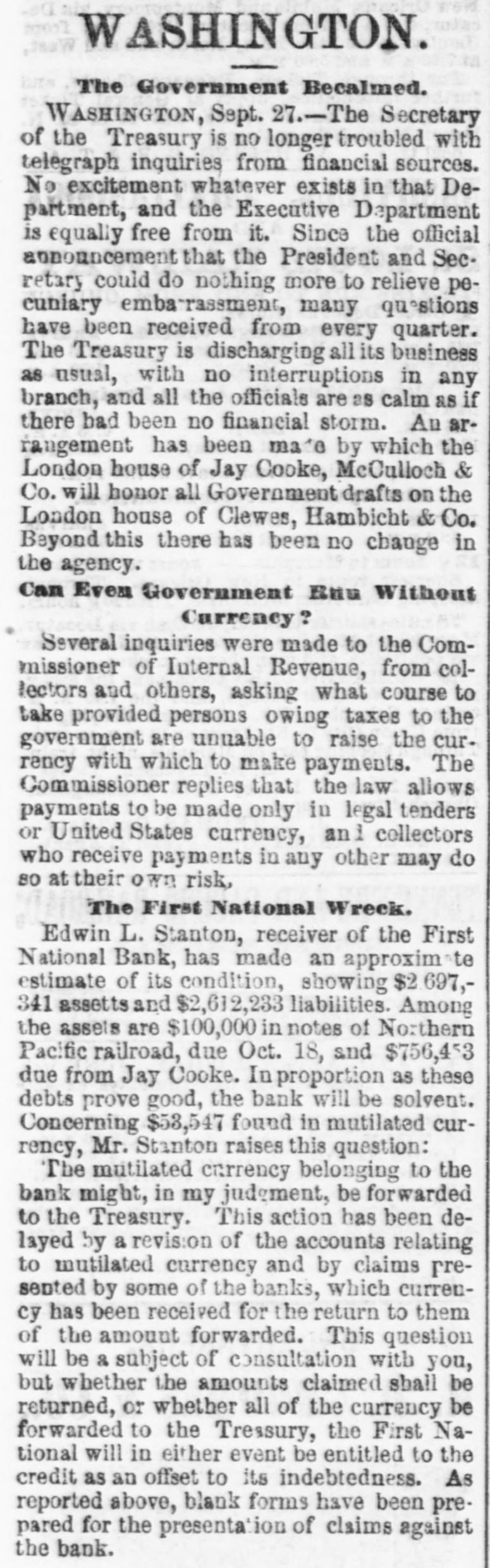
The Government Becalmed. WASHINGTON, Sept. 27.-The Secretary of the Treasury is no longer troubled with telegraph inquiries from financial sources. No excitement whatever exists in that Department, and the Executive Department is equally free from it. Since the official announcement that the President and Sec. retary could do nothing more to relieve pecuniary embarrassment, many questions have been received from every quarter. The Treasury is discharging all its business as usual, with no interruptions in any branch, and all the officials are as calm as if there bad been no financial storm. Au arrangement has been ma'e by which the London house of Jay Cooke, McCulloch & Co. will honor all Government drafts on the London house of Clewes, Hambicht & Co. Beyond this there has been no change in the agency. Can Even Government Rau Without Currency? Several inquiries were made to the Commissioner of Internal Revenue, from collectors and others, asking what course to take provided persons owing taxes to the government are unuable to raise the currency with which to make payments. The Commissioner replies that the law allows payments to be made only in legsl tenders or United States currency, and collectors who receive payments in any other may do so at their own risk, The First National Wreck. Edwin L. Stanton, receiver of the First National Bank, has made an approxim te estimate of its condition, showing $2.697,341 assetts and $2,612,233 liabilities. Among the assets are $100,000 in notes of Northern Pacific railroad, due Oct. 18, and $756,453 due from Jay Cooke. In proportion as these debts prove good, the bank will be solvent. Concerning $53,547 found in mutilated currency, Mr. Stanton raises this question: The mutilated currency belonging to the bank might, in my judgment, be forwarded to the Treasury. This action has been delayed by a revision of the accounts relating to mutilated currency and by claims presented by some of the banks, which currency has been received for the return to them of the amount forwarded. This question will be & subject of consultation with you, but whether the amounts claimed shall be returned, or whether all of the currency be forwarded to the Treasury, the First National will in either event be entitled to the credit as an offset to its indebtedness. As reported above, blank forms have been prepared for the presentation of claims against the bank.


Article from Chicago Daily Tribune, October 5, 1873

Click image to open full size in new tab

Article Text

WASHINGTON.

Special Dispatch to The Chicago Tribune. JAY COOKE & CO.

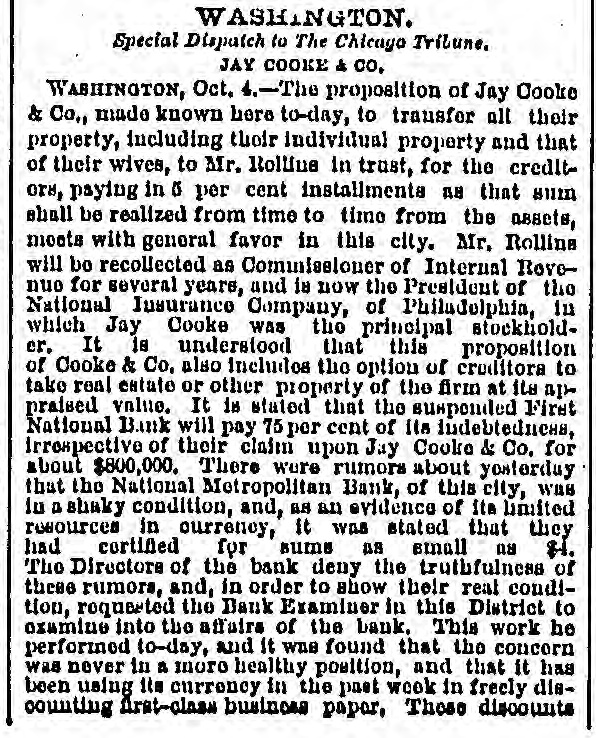
WASHINGTON, Oct. 4.-The proposition of Jay Cooke & Co., made known here to-day, to transfer all their property, including their individual property and that of their wives, to Mr. Rollins in trust, for the creditors, paying in 5 per cent installments as that sum shall be realized from time to time from the assets, meets with general favor in this city. Mr. Rollins will be recollected as Commissioner of Internal Revenue for several years, and is now the President of the National Insurance Company, of Philadelphia, in which Jay Cooke was the principal stockholder. It is understood that this proposition of Cooke & Co, also includes the option of creditors to take real estate or other property of the firm at its appraised value. It is stated that the suspended First National Bank will pay 75 per cent of its indebtedness, irrespective of their claim upon Jay Cooke & Co. for about $800,000. There were rumors about yesterday that the National Metropolitan Bank, of this city, was in a shaky condition, and, as an evidence of its limited resources in currency, it was stated that they had certified for sums as small as $1. The Directors of the bank deny the truthfulness of these rumors, and, in order to show their real condition, requested the Bank Examiner in this District to examine into the affairs of the bank. This work he performed to-day, and it was found that the concern was never in a more healthy position, and that it has been using its currency in the past week in freely discounting first-class business paper, Those discounts


Article from Chicago Daily Tribune, October 6, 1873

Click image to open full size in new tab

Article Text

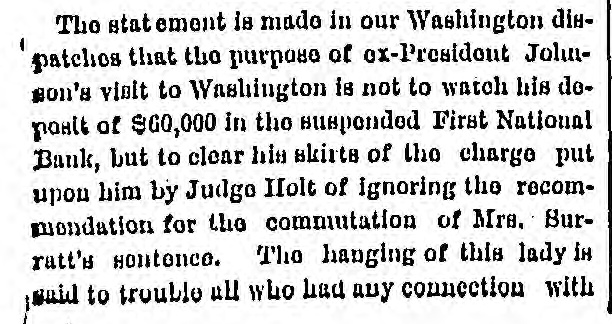
The statement is made in our Washington dispatches that the purpose of ex-President Johnson's visit to Washington is not to watch his deposit of $60,000 in the suspended First National Bank, but to clear his skirts of the charge put upon him by Judge Holt of ignoring the recommendation for the commutation of Mrs. Surratt's sentence. The hanging of this lady is said to trouble all who had any connection with


Article from Wilmington Daily Commercial, October 14, 1873

Click image to open full size in new tab

Article Text

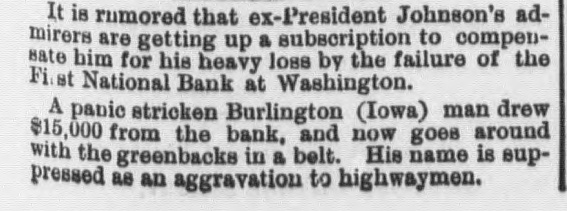
It is rumored that ex-President Johnson's admirers are getting up a subscription to compensate him for his heavy loss by the failure of the First National Bank at Washington. A panic stricken Burlington (Iowa) man drew $15,000 from the bank, and now goes around with the greenbacks in a belt. His name is suppressed as an aggravation to highwaymen.


Article from The Wheeling Daily Intelligencer, October 16, 1873

Click image to open full size in new tab

Article Text

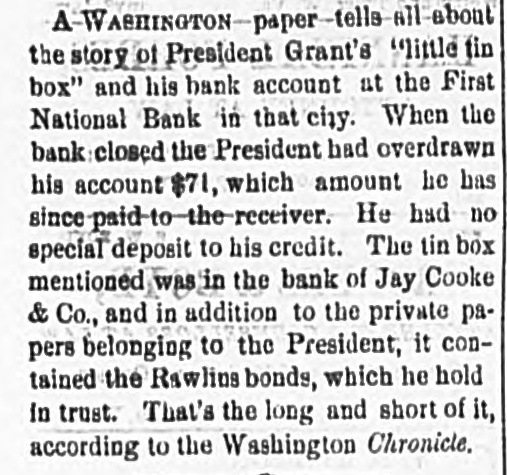
A-WASHINGTON paper tells all about the story of President Grant's "little tin box" and his bank account at the First National Bank in that city. When the bank closed the President had overdrawn his account $71, which amount he has since paid to the receiver. He had no special deposit to his credit. The tin box mentioned was in the bank of Jay Cooke & Co., and in addition to the private papers belonging to the President, it contained the Rawlins bonds, which he hold in trust. That's the long and short of it, according to the Washington Chronicle.


Article from Gold Hill Daily News, October 20, 1873

Click image to open full size in new tab

Article Text

A WASHINGTON paper tells all about the story of President Grant's "little tin box" and his bank account at the First National Bank in that city.

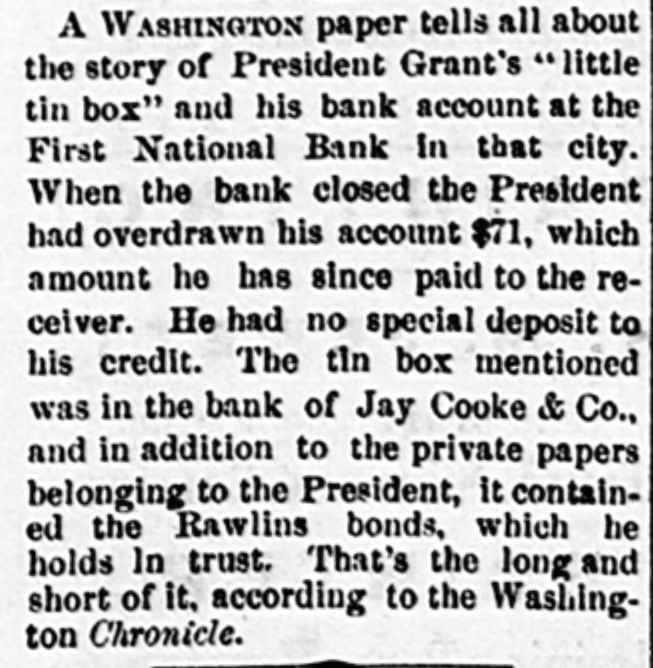
When the bank closed the President had overdrawn his account $71, which amount he has since paid to the receiver. He had no special deposit to his credit. The tin box mentioned was in the bank of Jay Cooke & Co., and in addition to the private papers belonging to the President, it contained the Rawlins bonds, which he holds in trust. That's the long and short of it, according to the Washington Chronicle.


Article from The Wheeling Daily Register, October 30, 1873

Click image to open full size in new tab

Article Text

BY TELEGRAPH

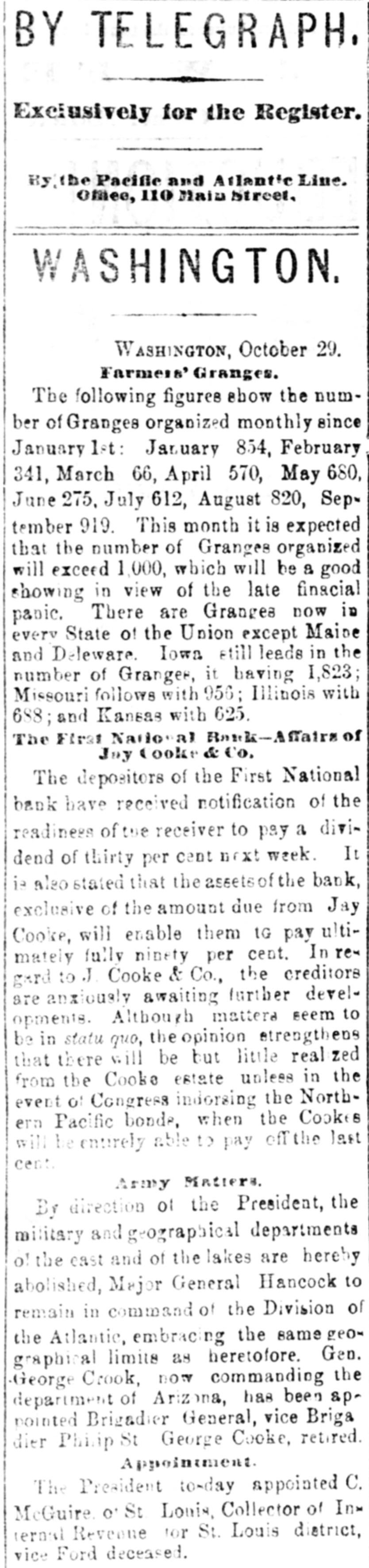
Exclusively for the Register. By, the Pacific and Atlantic Line. Office, 110 Main Street, WASHINGTON. WASHINGTON, October 29. Farmers' Granges. The following figures above the number of Granges organized monthly since January 1st: January 854, February 341, March 66, April 570, May 680, June 275, July 612, August 820, September 919. This month it is expected that the number of Granges organized will exceed 1,000, which will be a good showing in view of the late financial panic. There are Granges now in every State of the Union except Maine and Deleware. Iowa still leads in the number of Grangee, it having 1,823; Missouri follows with 956; Illinois with 688; and Kansas with 625. The First National Bank-Affairs of Joy Cookr & Co. The depositors of the First National bank have received notification of the readiness of the receiver to pay a dividend of thirty per cent next week. It is also stated that the assets of the bank, exclusive of the amount due from Jay Cooke, will enable them 1G pay ultimately fully ninety per cent. In regard to J Cooke & Co., the creditors are anxiously awaiting further developments. Although mattera seem to be in statu quo, the opinion etrengthens that there will be but little real zed from the Cooke estate unless in the event of Congress indorsing the Northern Pacific bonde, when the Cookes will be entirely able to pay off the last cent Army Matters. By direction of the President, the military and geographical departments o the east and of the lakes are hereby abolished, Major General Hancock to remain in command of the Division of the Atlantic, embracing the same geographical limits as heretofore. Gen. George Crook, now commanding the department of Arizona, has been sppointed Brigadier General, vice Briga dier Philip St George Cooke, retired Appointment The President to-day appointed C. McGuire o St Louis, Collector of In= termin Revenue for St. Louis district, vice Ford deceased.


Article from The Leavenworth Weekly Times, November 6, 1873

Click image to open full size in new tab

Article Text

TO RESUME

The Chronicle states that it is now generally understood at Washington that the First National Bank of that city, which was one of the first institutions to succumb to the panic, will be able to pay up in full, and adds: "We name this'matter that depositore and other creditors may not be induced by shystere to dispose of their interests at less than their real value. Governor H. D. Cooke has amerted from the first, and all along since the suspension, both the ability and disposition of the stockholders to pay the liabilities of this bank to the last dollar." As this was one of the lagest banking instisetions among those suspended, and had doposite from all sections of the country, the seport of its probable resumption will be bailed as good mome


Article from The Rock Island Daily Argus, November 11, 1873

Click image to open full size in new tab

Article Text

TELEGRAPHIC A National Bank Pays 30 cents. Jay Cooke 15 Proposes to Pay cents on Northern Pacific Bonds. Financial Troubles. Laborers out of Work. They Say They Will Not Starve. Frands U.S. by the Republicans Com'r in New York. Death of one of the Ill's R. R.& Warehouse Commission. Accidents, Fires, Suicides. Murders, etc. tional W ASHINGTON, Bank Nov. 10.-The First cent. and paying depositors Na per cent. they all will probably receive thirty fifty ceived Among thirty the depositors. who to-day from the First per National cent. of their deposits $22,000. President Johnson. who received Bank. nearly that It is rumored fifteen been made per by Jay Cooke proposition Co. has Northern Pacific cent. bonds. money balance on Rickley made banker COLUMBUS, Nov. his His lia the benefit of assignment this at are $125,000 bilities estimated $75,000. Nov. from the -Reports BOSTON. of New England manufacturing are There this morning cheering of business news of the and manufactor places, running 10. Nov. NEW YORK, Battershall to-day failed Co.'s teahouse year aggregated Bank, referred the with propriated and child man, leaving The seamen parade the shipping creating repeal for mission Ship masters petition preparing of the repeal the day. James connected Hodgskin the Erie finance offered estern Railroads. that utility and of under the thorities. the men also Hodgskin plenty. the banks, of drawal to gained payments this tender hear the will which hopeful prevails Morris addition to firms sumption and banking paring of but the name trade public the The House report the will mittee payment the certificat interest money Stock greenbacks gold ST. Merchant LOUIS, committee appointed the securing aid the souri valley cities the ask valley. SALT Nov_ Utah of ern Railway the from Guage dif to ham City and will probably nb completed ght NEW The YORK, Hall of Commission the the election frauds. of the spectors tearing ith tickets changing ing the were altered their returns The llid hard bears quarters. and Commissi Charlick ce, missioner ok 10 Nov. Two fever MEMHPIS. ack the hours. Three ra The streets ed. at H. Sr. LOUIS. Louis, wealthiest It of effect He ago years F left property ted millions ita D H CHICAGO. is of Railw Illinois Board President rugdied and stoners, Warehouse at III. try residence yesterday. 10. Nov -Rev. Father PITTSBURG, zil He here came up four died yesterday. between pro quarrel the OMAHA, Nov. years ago. of Sleep Union the otoformer buildi their ways sold, but only berth reet, Guill m drew the Saturday leaving town, his About er hundred English. this ing. through this city, Welch bound and Mormons. Scotch, princip A dispatch. morning Kansas. dded the robbed Island in are arrested have been jail at Kansas. lington, es. 10.Nov. CHICAGO. known German by a scarf to a laborer was The body of an suici Mass. supposed the city, this morning tree in the ather found par


Article from Watertown Republican, November 12, 1873

Click image to open full size in new tab

Article Text

Carl Schurz denies that he intends to locate in Chicago. Lorraine, which gave birth to great Marshal Ney, who was executed for alleged treason, is also the birthplace of Marshal Bazaine. The suspended First National Bank of Washington, D. C., commenced last Monday Daving its depositors an inof ta cent on the dollar.


Article from Dodgeville Chronicle, November 14, 1873

Click image to open full size in new tab

Article Text

Genera of the of the giving to his ted by with Spain, but detervery unfav official circles. of the same to Virthe date of ginius in The Spanish in good on by the faith and regrets in its not before the The took Cudificulty of that Governin as well this enas was as to the the Virginius until ortained. the CuThere The New York bans Cuban had possible to to set for the out on the the from being Amercorps formed had been 2,000 names old, of wellthem of tried Cubans were was for calling made to the dition means island. for City York The of 100,756, of which Tammany his and McCool, 29, jority, of the York dispatches feeling and the from Reports and telethe cable less diemal, grams as desired. daily almost all manuthat from or rentirely factories Laand wages. ducing be bor sections of cause of The session of of the HusIowa 9. to The has been bandry at be in the State held House Des the of IlliCook, President and Comnois on in the Normal 9th. most morning He sudden Board of died Railway home His death was was fifty -six 8th of says dispatch Indians the mitting the Indians except Satanta. the Chiefs, released of the is head said them. of Lee, Mary Mrs. The Custis E. took the Lee, late widow Robert General 8th. the Her place Virginia, Lexington, S. F. W. and Lee, Lee, Custis three a E. large were present, besides Robert dewere Her remains friends. of in the her the husband, posited Lee seven sixty of years the on 10th, adoption of Conthe the national of the abolition stitution, of the and Church State. on in the 10th New York days few that in Cuba, which the losing beaten, The twenty eighty prisoners. all report caused Spanish to of be the battle. the on 5th, dated Havana, the of tion the gives execut account following de of the Santiago Virginius prisoners four made "The place the revious to close house wall. the Cuba: prisone the Blaug firmne was quite famous before manner marched Ryan showeightly down fear and the were Bambe the the died killed at on in gton Washington the the 10th, notifying of the that State GovernSpanish Secretary to the had ment Captain General to the telegraphed t all stay against captives custody in has been al in into session testilegal frauds. to up fied tearing inspectors then A Tammany in New York Hall City, Several changing and also, had that police tickets; two inspecnaturalized intimidated or the tors after false swore altered were votes counted. of First The Bank National Washington on on the thirty cents 10th, paying commenced the to who their dellar proved depositors would thought accounts. fifty about receive A of the 10th says reports of the EnNew from sections of news was were more gland There cheering of in and several places, resumption of on the increased renunning of the The manufactories time. many be that was daily statements coming more apparent. of the The Boston great of on the fire review of 365 work buildings had been burnt district, were which 115 of on of the streets The Memphis crowded and they 10th, same the did out. broke fever before Nearlya the In had the four twenty returned. absentees ten but there two were and hours ending five at new cases. in was held An Cuban meeting of the The Surveyo officials Federal conNew Port Orleans and Oth Regolutions on prominent were adopted participated.


Article from Orleans County Monitor, November 17, 1873

Click image to open full size in new tab

Article Text

IN WASHINGTON--AND OUT.

EDITOR MONITOR. When the news of Jay Cooke & Co.'s failure went over the wires to you in northern Vermont, it probably caused only a passing comment, and you hardly expected to see house after house go down in the crash, and business interests all over the country prostrated as they now are; but so it has proved, and the end is not yet.

I was in Washington the third day after their suspension, when the excitement ran the highest it has probably done at all in that city. It was my first introduction to a panic-stricken community, and I soon found that the excitement was as contagious as small pox. Locked up in two of the banks of that city were the earnings of three years, and I was bent on securing them if such a thing were possible; so I hurried to the doors of one bank, pushed my way along with the crowd, presented a sight check for "balance due," and was politely informed it would be cashed in thirty days. I protested, and was told it was a rule they had decided to adopt, and could not be violated. Thirty days looked like a long while to live in doubt, but what was my voice compared to the powers behind the counter! As I turned away my eye met pale faces and tear-stained cheeks; women with care-worn looks, and old men with white hairs, the drops of perspiration standing on their anxious faces. I almost forgot my own anxiety in sympathy for them. But I had other work to do, and so, with a lawyer to aid me, (for I knew the odds were against me,) I went to a place known as the Safe Deposit Company, where, for a compensation, they take valuables of any kind and keep them in safety till called for by the person depositing them. Just those last four words were the trouble. This company held for my family a small tin trunk that contained certificates of deposit on a bank in the city for over three thousand dollars. If I could unlock the trunk and get them I could at once secure the money, but without them I could accomplish nothing at all; but I did not deposit the trunk and had no power of attorney from the person who did, notwithstanding I urged that a large portion of the contents were my own, I could not be permitted to open it. My lawyer offered to give bond in any amount for the security of the company, but all with no effect,—"it was put there for safe-keeping" and evidently they wanted to keep it safe, and verily I went away sorrowing. Going down the steps I met and aged and decrepid woman, her face full of anguish, and as I stopped to let her pass she lifted her eyes to mine, and, seeing the look of interest I could but manifest, exclaimed, "Is it true that the First National Bank won't pay me my money?" "Too true, I fear," I answered. Tears fell from her faded eyes, and clasping her hands, in agonized tones she said: "Oh, what shall I do! My all was there, and I am all alone in this "pitiless world."

Out on the streets men and women were hurrying to and fro, only stopping now and then to ask if there was anything new from financial quarters. Everything was done quietly, but with a manner that betrayed intense feeling. Going into the Treasury building, I sat down where I could command a view of the bank on which I held certificates—or rather the Safety Deposit Company held them for me—and it wasn't at all re-assuring to see people flocking in as fast as admittance could be had, for who could tell how long it could stand the run? Some say people should not withdraw their funds on deposit if they do not desire to hurry on a panic. Granted; but suppose you have worked hard a number of years, and all you have saved is in that bank across the way; wouldn't our philosophical adviser be very likely to conclude he had a little rather not run too great risk? When one's balance at the bank is only a small amount compared with the whole of his property, he can practice magnanimity without so much mental anxiety as that man whose all is imperiled, and who knows that wife and little ones must suffer if it is lost.

In nearly every room I entered in the Treasury there was some one or more who had lost heavily. All seemed to work as if thoughts were on anything but the work in hand, and at the merest allusion to the troubles, every pen stopped and every head turned to listen. "Heads of Department" forgot their "official dignity" in common anxiety, and even Secretary Richardson was ready with information and sympathy, notwithstanding, a reporter said of him, "it was none his funeral." So I found it everywhere. General Creswell, always quick, brusque and in a hurry, had plenty of time that day, and was as interested as any one. News had just arrived of the suspension of the Union and Trust Co., of N. Y., and the fear of a universal panic increased. I saw one man, a prominent young lawyer of Washington, presented with bill for the invitations to his wedding.


Article from Wood County Reporter, November 20, 1873

Click image to open full size in new tab

Article Text

PERSONAL

The time for holding the annual session of the Iowa State Grange of Patrons of Husbandry has been changed to December 9. The meetings will be held in the State House at Des Moines. Colonel H. D. Cook, President of the Illinois Board of Railway and Warehouse Commissioners, died at his home in Normal, on the morning of the 9th. His death was most sudden and unexpected. He was fifty-six old. The obsequies of Mrs. Mary Custis Lee, widow of the late General Robert E. Lee, took place in Lexington, Virginia, on the 8th. Her three sons, W. S. F. Lee, Custis Lee, and Robert E. Lee, were present, besides a large concourse of friends. Her remains were deposited by the side of her husband, in the memorial room. Mrs. Lee was sixty-seven years of age. The First National Bank of Washington, on the 10th, commenced paying thirty cents on the dollar to depositors who have proved their accounts. It was thought depositors would receive in all about fifty per cent. The first anniversary of the great Boston fire occurred on the 10th. A review of the work of rebuilding shows that 365 buildings had been commenced within the burnt district, 115 of which were completed. The streets of Memphis were crowded on the 10th, and presented the same appearance they did before the fever broke out. Nearly all the absentees had returned. In the twentyfour hours ending at ten p. m., there were but two deaths and five new cases. Joseph Arch left this country a few days ago for England; also, Mark Twain, who only arrived from there two days before. The Inter-State Industrial Exposition held in Chicago, and which was recently brought to a close, was a success in every respect. The net receipts over expenses, exclusive of the building, were $62,000. The structure cost $267,000. The Duquesne and the Mechanics' Savings Banks, and the banking house of Millar & Sons, of Pittsburgh, and the Savings Deposit Bank, of East Liberty, Pa., have suspended. The assets are said to be ample to secure creditors. Hon. S. S. Mailory, formerly United States Senator from Florida, and Secretary of the Navy in the Cabinet of the Confederacy, died at Pensacola on the 9th. There were no new yellow fever cases nor deaths in Memphis on the 12th. Ex-Acting Mayor Cicalla, charged with appropriating to his own use supplies that he drew ostensibly for a widow and her children, was expelled from the Board of Alderman by a unanimous vote. Granges of the Patrons of Husbandry have been recently formed at Harvard and Danvers Mass., and a State Grange is to be formed on the 1st of December. On the 12th there were thirteen Granges in Massachusetts, including the Boston Grange, whose charter is in dispute, and the Order is rapidly extending throughout the State. The annual meeting of the Illinois State Grange of the Patrons of Husbandry is to be held at Bloomington on Tuesday, December 9, commencing at ten o'clock a. m. The mother and sister of General Ryan, one of the victims of the recent butchery in Cuba, are residents of Chicago. At an Anti-Chinese Convention recently in session in San Francisco resoluitons were adopted in favor of the abrogation of the Chinese treaty and against Chinese immigration and labor.


Article from The Daily State Journal, February 11, 1874

Click image to open full size in new tab

Article Text

THE FIRST NATIONAL BANK TO BE INVESTIGATED.

Mr. Beck (Ky.) offered a resolution, which was agreed to, directing the committee on banking and currency to investigate the affairs of the First National bank of Washington before its suspension, and to ascertain if its directors had in any respect violated the national banking act.

The House then, in committee of the whole, resumed consideration of the army appropriation bill.


Article from Daily Kennebec Journal, April 8, 1874

Click image to open full size in new tab

Article Text

tection. GENERAL NEWS. Boss Tweed's prison apartments are elaborately fitted up, and efforts are being made to place him on a level with other thieves in that institution. Charles Ernest Beale, the distinguished French classical scholar and a member of the Assembly, is dead. Jenny Lind's eldest son is at Corpus Christi College, at Oxford, and she has a daughter just coming into womanhood. The visit of Ex-President Andrew Johnson to Washington is with reference to the drawing of another dividend on the funds he deposited in the First National Bank of that city before its failure during the late panic The Japan Mail has published a violent attack upon the United States minister, based upon a brief paragraph in a Washington paper purporting to give the substance of a private letter from Bingham. That gentleman is understood to disclaim any knowledge of the extract in question. A cat which stuck its head too far into a tin can, in a New Jersey town one night last week. was the innocent cause of a lively excitement. The family supposed a burglar must be in the kitchen, and while the ladies very properly fainted, the gentlemen armed themselves and began firing wildly out of the windows, to let the supposed marauders know there were fire-arms in the house. The police and members of the fire department were anything but complimentary in their remarks as they journeyed homeward.


Article from Nashville Union and American, April 9, 1874

Click image to open full size in new tab

Article Text

THE visit of ex-President Andrew Johnson to Washington is with reference to the drawing of another dividend on the funds he deposited in the First National Bank of that city before its failure during the late panic. The present dividend is twenty per cent., which will make fifty per cent. of his deposit of about $70,000.


Article from Montgomery County Sentinel, June 12, 1874

Click image to open full size in new tab

Article Text

ORDER OF PUBLICATION.

SUSAN S. HALL AND THOMAS L. HUME, PARTNERS, TRADING, &c., AS HALL & HUME.

vs.

CHARLES A. ECCLESTON, MARTHA A. ECCLESTON, HIS WIFE, THOMAS J. BROWN, CARRIE BROWN, HIS WIFE, WM. B. WEBB, RICHARD J. BOWIE, RICHARD M. WILLIAMS, EDWIN L. STANTON, receiver of the FIRST NATION-AL BANK OF WASHINGTON, D. C., THOS. ANDERSON & WM. V. BOUIC, Jr.


Article from Evening Star, July 29, 1874

Click image to open full size in new tab

Article Text

LOCAL NEWS, Condensed Locals. The United Stone Outters have agreed to contribute $500 for the Washington Monument. In the Equity Court, Judge Wylle, to-day a number of orders were made, and the court adjourned to Thursday, August 6th. Attention is called to the excursion of Phoenix Tent of Rechabites. Advertisement in another column. Anderson Scott was taken from this city to Maryland yesterday, on a requsition from the Governor to answer a charge of robbery. The Fairfax M. E. camp meeting, near Thornton station, Washington and Ohio railroad, under the supervision of Revs. E. P. Phelps and Henry Clement, commences tomorrow. Lieut. Hoxie has requested Col. Amos Webster, adjutant general of the District, to furnish & correct inventory of all the public property, arms, accoutrements, &c., in the possession of the District. E. L. Stanton, Esq., receiver of the First Na. tional Bank, has rented the lower floor of the building, formerly occupied by Jay Cooke & Co., to the Citizens' National Bank of Washington. The 2d floor, formerly occupied by the First National Bank, will be reserved, in contemplation of the reopening of that bank. The game of base ball yesterday on the Olympic ground between the Philadelphia Club, professionals, and our Nationals, amateurs. was won by the former by a score of 11 to 3. The game in Baltimore yesterday tetween the Creighton Club. of this city, and the Peabody Club, of Baltimore, both amateur organizations, was won by the Washingtonians by a score of 21 to 7.


Article from National Republican, January 25, 1875

Click image to open full size in new tab

Article Text

LEGAL

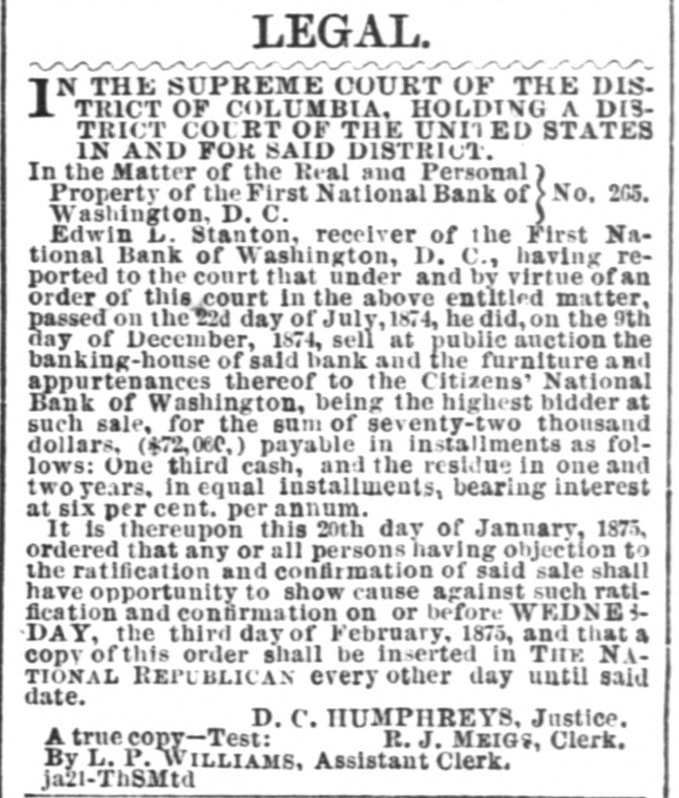
I N THE SUPREME COURT OF THE DISTRICT OF COLUMBIA, HOLDING A DISTRICT COURT OF THE UNIT ED STATES IN AND FOR SAID DISTRICT. In the Matter of the Real and Personal No. 265. Property of the First National Bank of Washington, D. C. Edwin L. Stanton, receiver of the First National Bank of Washington, D. c., having reported to the court that under and by virtue of an order of this court in the above entitled matter, passed on the 22d day of July, 1874, he did, on the 9th day of December, 1874, sell at public auction the banking-house of said bank and the furniture and appurtenances thereof to the Citizens' National Bank of Washington, being the highest bidder at such sale, for the sum of seventy-two thousand dollars, ($72,000,) payable in installments as follows: One third cash, and the residue in one and two years, in equal installments, bearing interest at six per cent. per annum. It is thereupon this 20th day of January, 1875, ordered that any or all persons having objection to the ratification and confirmation of said sale shall have opportunity to show cause against such ratification and confirmation on or before WEDNESDAY, the third day of February, 1875, and that a copy of this order shall be inserted in THE NATIONAL REPUBLICAN every other day until said date. D. C. HUMPHREYS, Justice. A true copy-Test: R. J. MEIGS, Clerk. By L. P. WILLIAMS, Assistant Clerk. ja21-ThSMtd