3812. Equitable Trust Company (Chicago, IL)

Bank Information

Episode Type
Suspension β†’ Closure
Bank Type
trust
Start Date
December 18, 1905
Location
Chicago, Illinois (41.850, -87.650)

Metadata

Model
gpt-5-mini
Short Digest
efb7bb95f77dd126

Response Measures

None

Description

Contemporary articles (Dec 18–19, 1905) report the Equitable Trust Company (Chicago) suspended operations with clearing-house banks declaring the three Walsh-controlled institutions insolvent, pledging to pay depositors and arranging liquidation/winding up. Cause was heavy lending/investments in John R. Walsh's coal/railway enterprises. There is mention of depositors forming lines and receiving payments, but the primary event is suspension and winding up (closure) rather than a standalone run or later reopening.

Events (1)

1. December 18, 1905 Suspension
Cause
Bank Specific Adverse Info
Cause Details
Large loans/investments in John R. Walsh's railway, coal, quarry and related private enterprises left assets illiquid or impaired and precipitated the suspension and wind-up of the company.
Newspaper Excerpt
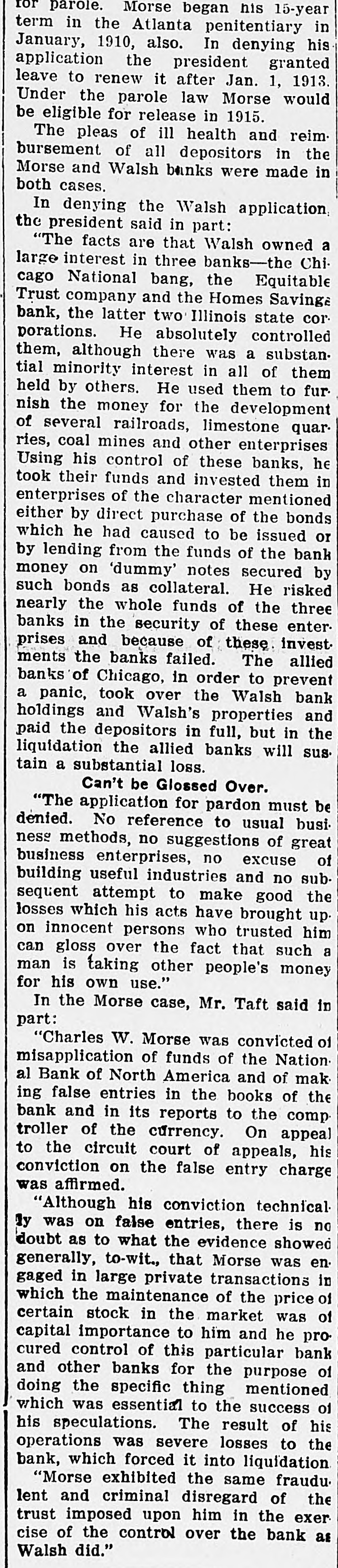
The Chicago National bank, the Home Savings bank and the Equitable Trust company ... did not open for business today ... the clearing house ... announced that these institutions were bankrupt ... the depositors will be paid in full.
Source
newspapers

Newspaper Articles (24)

Article from The Roswell Daily Record, February 12, 1904

Click image to open full size in new tab

Article Text

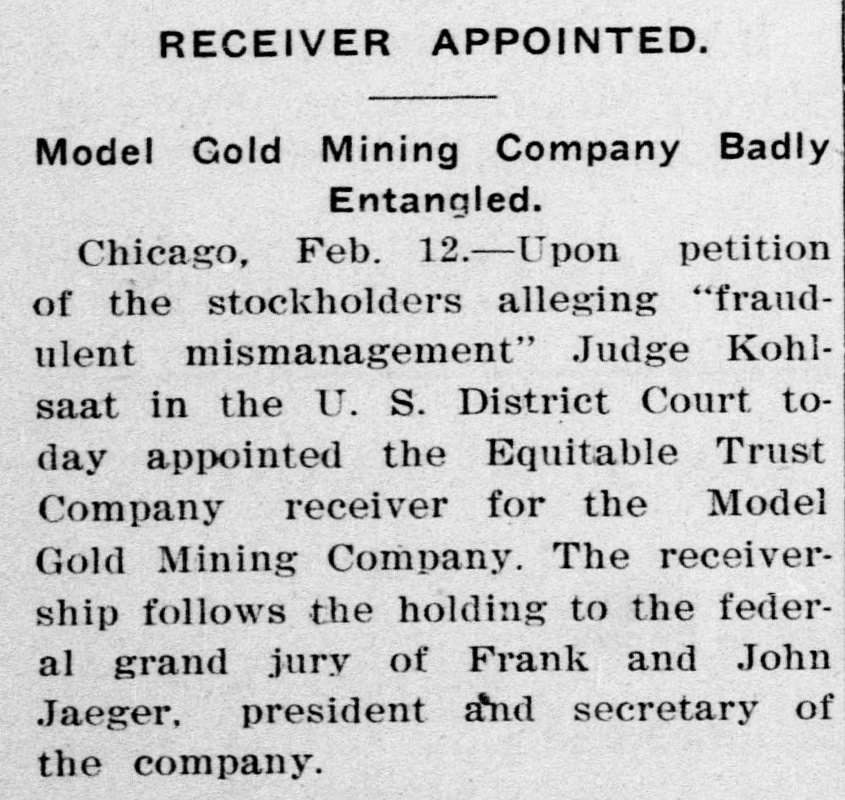
RECEIVER APPOINTED. Model Gold Mining Company Badly Entangled. Chicago, Feb. 12.-Upon petition of the stockholders alleging "fraudulent mismanagement" Judge Kohlsaat in the U. S. District Court today appointed the Equitable Trust Company receiver for the Model Gold Mining Company. The receivership follows the holding to the federal grand jury of Frank and John Jaeger, president and secretary of the company.


Article from New-York Tribune, January 15, 1905

Click image to open full size in new tab

Article Text

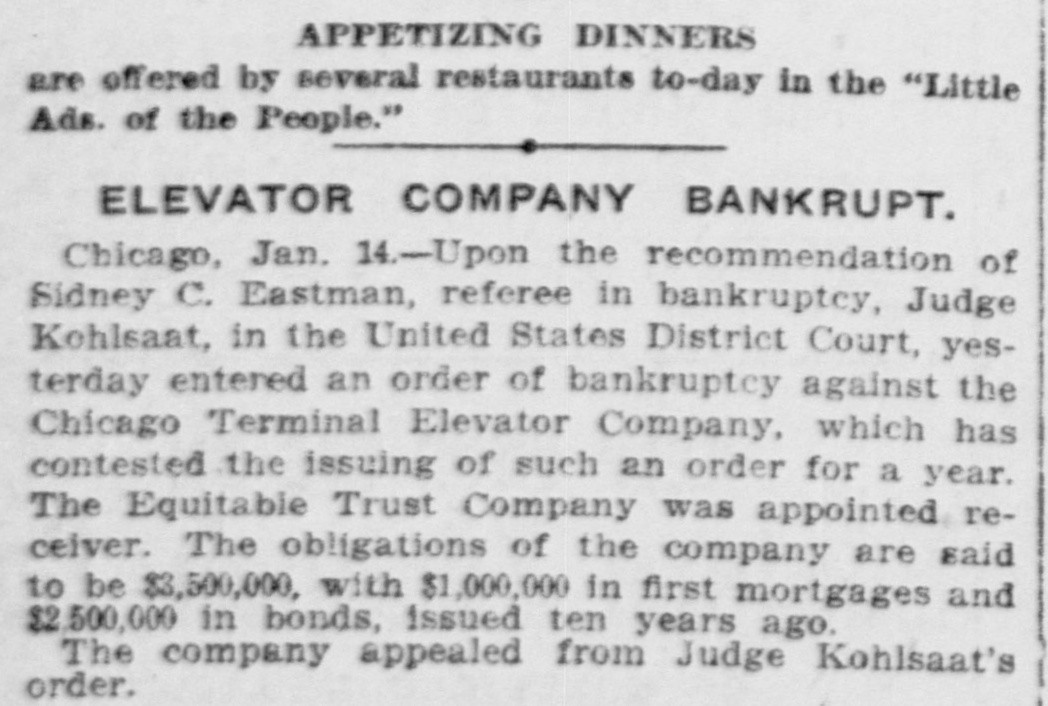
APPETIZING DINNERS are offered by several restaurants to-day in the "Little Ads. of the People." ELEVATOR COMPANY BANKRUPT. Chicago, Jan. 14.-Upon the recommendation of Sidney C. Eastman, referee in bankruptcy, Judge Kohlsaat, in the United States District Court, yesterday entered an order of bankruptcy against the Chicago Terminal Elevator Company, which has contested the issuing of such an order for a year. The Equitable Trust Company was appointed receiver. The obligations of the company are said to be $3,500,000, with $1,000,000 in first mortgages and $2,500,000 in bonds, issued ten years ago. The company appealed from Judge Kohlsaat's order.


Article from The Topeka State Journal, December 18, 1905

Click image to open full size in new tab

Article Text

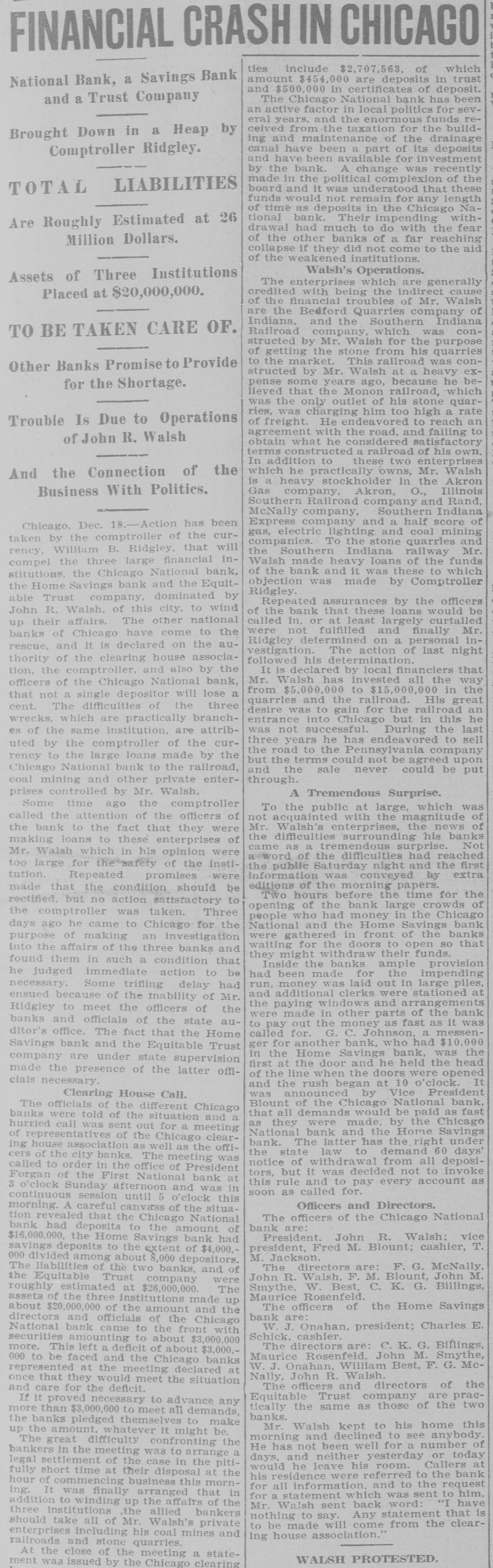
FINANCIAL CRASH CHICAGO ties include $2,707,563. of which amount $454,000 are deposits in trust National Bank, a Savings Bank and $500,000 in certificates of deposit. and a Trust Company The Chicago National bank has been an active factor in local politics for several years, and the enormous funds received from the taxation for the buildBrought Down in a Heap by ing and maintenance of the drainage canal have been a part of its deposits Comptroller Ridgley. and have been available for investment by the bank. A change was recently made in the political complexion of the LIABILITIES board and it was understood that these TOTAL funds would not remain for any length of time as deposits in the Chicago National bank. Their impending withAre Roughly Estimated at 26 drawal had much to do with the fear of the other banks of a far reaching Million Dollars. collapse if they did not come to the aid of the weakened institutions. Walsh's Operations. Assets of Three Institutions The enterprises which are generally credited with being the indirect cause Placed at $20,000,000. of the financial troubles of Mr. Walsh are the Bedford Quarries company of Indiana, and the Southern Indiana Railroad company, which was conTO BE TAKEN CARE OF. structed by Mr. Walsh for the purpose of getting the stone from his quarries to the market. This railroad was conOther Banks Promise to Provide structed by Mr. Walsh at a heavy expense some years ago, because he befor the Shortage. lieved that the Monon railroad, which was the only outlet of his stone quarries, was charging him too high a rate Trouble Is Due to Operations of freight. He endeavored to reach an agreement with the road, and failing to of John R. Walsh obtain what he considered satisfactory terms constructed a railroad of his own In addition to these two enterprises which he practically owns, Mr. Walsh And the Connection of the is a heavy stockholder in the Akron Business With Politics. Gas company, Akron, O., Illinois Southern Railroad company and Rand, McNally company, Southern Indiana Express company and a half score of Chicago, Dec. 18.-Action has been gas, electric lighting and coal mining taken by the comptroller of the curcompanies. To the stone quarries and rency, William B. Ridgley, that will the Southern Indiana railway Mr. Walsh made heavy loans of the funds compel the three large financial inof the bank and it was these to which stitutions, the Chicago National bank, objection was made by Comptroller the Home Savings bank and the EquitRidgley. able Trust company, dominated by Repeated assurances by the officers John R. Walsh, of this city, to wind of the bank that these loans would be called in, or at least largely curtailed up their affairs. The other national were not fulfilled and finally Mr. banks of Chicago have come to the Ridgley determined on a personal inrescue, and it is declared on the auvestigation. The action of last night thority of the clearing house associafollowed his determination. It is declared by local financiers that tion, the comptroller, and also by the Mr. Walsh has invested all the way officers of the Chicago National bank. from $5,000,000 to $15,000,000 in the that not a single depositor will lose a quarries and the railroad. His great cent. The difficulties of the three desire was to gain for the railroad an wrecks. which are practically branchentrance into Chicago but in this he was not successful. During the last es of the same institution, are attribthree years he has endeavored to sell uted by the comptroller of the curthe road to the Pennsylvania company rency to the large loans made by the but the terms could not be agreed upon Chicago National bank to the railroad, and the sale never could be put through. coal mining and other private enterprises controlled by Mr. Walsh. A Tremendous Surprise. Some time ago the comptroller To the public at large, which was called the attention of the officers of not acquainted with the magnitude of Mr. Walsh's enterprises, the news of the bank to the fact that they were the difficulties surrounding his banks making loans to these enterprises of came as a tremendous surprise. Not Mr. Walsh which in his opinion were a word of the difficulties had reached too large for the safety of the instithe public Saturday night and the first information was conveyed by extra tution. Repeated promises were editions of the morning papers. made that the condition should be Two hours before the time for the rectified, but no action satisfactory to opening of the bank large crowds of the comptroller was taken. Three people who had money in the Chicago days ago he came to Chicago for the National and the Home Savings bank were gathered in front of the banks purpose of making an investigation waiting for the doors to open so that into the affairs of the three banks and they might withdraw their funds. found them in such a condition that Inside the banks ample provision he judged immediate action to be had been made for the impending run, money was laid out in large piles, necessary. Some trifling delay had and additional clerks were stationed at ensued because of the inability of Mr. the paying windows and arrangements Ridgley to meet the officers of the were made in other parts of the bank banks and officials of the state auto pay out the money as fast as it was called for. G. C. Johnson, a messenditor's office. The fact that the Home ger for another bank, who had $10,000 Savings bank and the Equitable Trust in the Home Savings bank. was the company are under state supervision first at the door and he held the head made the presence of the latter offiof the line when the doors were opened cials necessary and the rush began at 10 'clock. It was announced by Vice President Clearing House Call. Blount of the Chicago National bank, The officials of the different Chicago that all demands would be paid as fast banks were told of the situation and a as they were made, by the Chicago hurried call was sent out for a meeting National bank and the Home Savings of representatives of the Chicago clearbank. The latter has the right under association as well the state law to demand 60 days' cers ing house of the city banks. as the offiThe meeting was notice of withdrawal from all deposicalled to order in the office of President tors, but it was decided not to invoke First National this rule and to pay every account as Forgan o'clock of the bank at 3 Sunday afternoon and was in soon as called for continuous session until 5 o'clock this Officers and Directors. morning. A careful canvass of the situaThe officers of the Chicago National tion revealed that the Chicago National bank are: bank had deposits to the amount of President. John R. Walsh: vice $16,000,000. the Home Savings bank had president, Fred M. Blount; cashier, T. savings deposits to the extent of $4,000,M. Jackson 000 divided among about 8,000 depositors. The directors are: F. G. McNally, The liabilities of the two banks, and of John R. Walsh, F. M. Blount, John M. the Equitable Trust company were Smythe, W. Best, C. K. G. Billings, roughly estimated at $26,000,000. The Maurice Rosenfeld. assets of the three institutions made up The officers of the Home Savings about $20,000,000 of the amount and the bank are: directors and officials of the Chicago W. J. Onahan, president; Charles E. came to the Schick, cashier. to about securities National bank amounting front $3,000,000 with The directors are: C. K. G. Billings, more. This left a deficit of about $3,000.Maurice Rosenfeld. John M. Smythe, 000 to be faced and the Chicago W.J Onahan, William Best, F. G. Mcat the represented meeting declared banks at Nally, John R. Walsh. once that they would meet the situation The officers and directors of the and care for the deficit. Equitable Trust company are pracIf it proved necessary to advance any tically the same as those of the two more than $3,000,000 to meet all demands, banks. the banks pledged themselves to make Mr. Walsh kept to his home this up the amount, whatever it might be. morning and declined to see anybody The great difficulty confronting the He has not been well for a number of bankers in the meeting was to arrange a days. and neither yesterday or today legal settlement of the case in the pitiwould he leave his room Callers at fully short time at their disposal at the his residence were referred to the bank hour of commencing business this mornfor all information, and to the request was finally for a statement which was sent to him, ing. addition It to winding arranged that in up the affairs of the Mr. Walsh sent back word: "I have three institutions ,the allied bankers nothing to say. Any statement that is should take all of Mr. Walsh's private to be made will come from the clearenterprises including his coal mines and ing house association.' railroads and stone quarries. At the close of the meeting a stateWALSH PROTESTED. ment was issued by the Chicago clearing
Article from The Laramie Republican, December 18, 1905

Click image to open full size in new tab

Article Text

Chicago, Ill., Dec. 18.-The Chicago National bank, the Home Savings bank and the Equitable Trust company, institutions controlled largely by John R. Walsh, did not open for business today. The Chicago clearing house, after a twelve hours' session, early this morning made the announcement that these institutions were bankrupt, but that the Chicago associated banks had guaranteed every liability and would pay every claim. Hundreds of people gathered about the building sheltering the defunct institutions. Walsh has been rated as one of the wealthiest men of Chicago. Private speculations and operations in railroads, coal lands, quarries and other side lines caused his financial collapse. The Chicago National bank will be placed in the hands of a receiver. The savings and trustee companies will go into the state's hands. The former bank had about $15,000,000 on deposit when the ist statement was made and the Home Savings nearly $1,000,000. Walsh resigned as president of the Chicago National today. The total liabillties of the three institutions are $26,000,000. Wash and his associates have turned over $3,000,000, and local bankers will make up the deficit between the assets and liabilities, if any. J. C. Cooper, speaking for Walsh, said the depositors will be paid in full, and that the loss, if any, will fall on the stockholders. Depositors formed long lines and were paid in checks on other banks. Comptroller Ridgely, who has been here three days, said the trouble was caused by Walsh making large loans on industrial and railway enterprises. Walsh once owned the Evening Times and Evening Post. He sold both and acquired the Chicago Chronicle, which he still controls. The promotion of the Southern Indiana railroad is blamed largely for the collapse. The Chicago National bank has been a factor in local politics for many years. At noon the line of depositors extended a block away from the banks.


Article from The Minneapolis Journal, December 18, 1905

Click image to open full size in new tab

Article Text

John R. Walsh, head of t tions which have been decl vent, was not at themeeting. ing were the members at the meeting: J. B. Forgan, cha J. Mitchell, J. H. Eckels, Smith and Ernest A. Hamill Payments Pledged. In addition to the formal of the failure and the ann that the banks involved woul their doors this morning the announcement was made, sig clearinghouse committee of t Associated banks: To the public: Deposit Chicago National bank, the ings bank and the Equit company are respectfully ad their deposits will be paid in " demand. Statement by Ridge The following statement out today by Controller of th William M. Ridgely: "The action of the Chicag house banks in coming to the Chicago National bank, the ings bank and the Equitable pany, has relieved a most c: ation, which, if it had not promptly in hand, might h very serious consequences, I Chicago, but elsewhere. Th the clearinghouse banks mal lutely certain that all the o the three institutions will re money immediately and shou lieve any apprehension on the public in regard to financ in Chicago. Cause of the Break "The critical situation these three concerns / placed has been due to loans made to the rail mining and other enterpri and controlled by John R. V again emphasized the dan managing officers of banks ested in outside institution e large amounts of money. The controller's office h time been criticising the o tional bank and calling upon and directors to reduce the these loans and the investm bonds of Mr. Walsh's corp Promises Not Kep "In spite of repeated pr this should be done these been continued in the bank 8 to prevent further encroachr necessary for the controller t cal action. The controller's office h time been endeavoring to I amination of the Chicago Na simultaneously with the exa the state institutions by the examiner, but was not able t e about until a few days ago. IS of these examinations reve d serious condition that it wa to take immediate action. ] n er telephoned from Washing k ing Bank Examiner Boswor : the matter at once to the the clearinghouse committee Chicago on the first train to d to personally take whatever al necessary. r The Long Confere p "On the arrival of the ( Chicago a conference was e held with the state authori of clearinghouse committee, W it ned from 10 o'clock Sund until 5 o'clock Monday n addition to the clearing ho S. tee, representatives of all Id ing-house banks were calle or ference at about 7 o'clock controller feels that great ( not only to the clearing tee, but to all the other cl banks, for the prompt, vig and the broad-minded spir to meeting this emergency. The Failed Bank The Chicago National b: th ganized in November, 188 authorized capital of $3 creased to $500,000 in 1887 W. 000 in 1901. Its resources, according t th latest reports made to th we of the currency, are $21 e, which nearly $11,000,000 a discounts, with $4,000,000 c The liabilities include nea 000 in individual deposits to 000 due to other banks. the The Home Savings bank the ized originally in 1867, wit zation of $100,000. A late the resources shows an a $4,232,271, of which $3,78 ported as being held in mu road and other bonds. The 1 posits aggregate $3,982,65 The Equitable Trust co i chartered by the state of 0 29, 1887, to act as execu trator, trustee, guardian, B receiver, and to receive trusts of every character. O stock is $500,000. Its r II $4,612,381. The liabilit $2,707,563; of deposits in 323; certificates of depos thru various trusts. i Bank in Politic n The Chicago National ba an active factor in' local several years, and the eng


Article from Alexandria Gazette, December 18, 1905

Click image to open full size in new tab

Article Text

Lansburgh & Bro., 420 to 426 Seventh Street, WASHINGTON, D. C. Bank Failures. Chicago, Dec. 18.-The failure of the Chicago National Bank, the Home Savings Bank, and the Equitable Trust Company was announced early this morning by the representatives of the Chicago Clearing House Association, after a long session of 18 hours. The depositors of the three institutions will be paid in tull, the Chicago Clearing House banks pledging themselves to this purpose. John R. Walsh is head of the three institutions involved, and the trouble was brought about by investments in coal and railway enterprises of Mr. Walsh. The deposits of the Chicago National Bank are estimated at more than $16,000,000, and the Home Savings Bank has depos ts of more than $5. 000,000, belonging to more than 8,000 persons. The deposits of the Equitable Trust Company amount to more than $4,000,000. In addition to the formal statement of suspension and the announcement that the banks involved would not open their doors this morning, an announcement was made, signed by the clearing house committee of the Chicago Associated Banks, to the effect that deposits will be paid in full upon public monies on deposit in the Chicago demand. As earlyas 8 o'clock a a crowd began to gather in front of the banks waiting for the doors to open. John A. R. Walsh has resigned as president of the Chicago National Bank, and was succeeded by Charles H. Bosworth, National Bank examiner, whose investigations brought about the crash.


Article from The Providence News, December 18, 1905

Click image to open full size in new tab

Article Text

8 CHICAGO BANKS FAIL. DEPOSITORS WILL BE PAID (Continued from Page One.) the conference about 7 o'clock Sunday evening. The comptroller feels that great credit is due not only to the clearing house committee, but to all the other clearing house banks, for the prompt. vigorous action and the broadminded spirit shown in meeting this emergency. MR. WALSH VERY BUSY. J. R. Walsh, president of the failed institution. was very busy at his residence this morning and declined to be disturbed when called up over the telephone. His daughter, however, quoted Mr. Walsh as saying that all information concerning the failures, for the present at least, would be given out by the Clearing House assoclation. CAPITAL AND RESOURCES. The Chicago National bank was organized in November, 1881, with an authorized capital of $300,000, increased to $500,000 in 1887, and to $1,000,000, in 1901. Its resources, according to one of the latest reports made to the comptroller of the currency, are $21,000,000 of which nearly $11,000,000 are loans and discounts with $4,000,000 cash on hand. The liabilities include nearly $14,000,000 in idividual deposits $4,700,000 due to other banks. The Home Savings bank, was organized originally in 1867, with a capitalization of $100,000. A recent statement of the resources shows an aggregate of $4,232,271, of which $3,782,000 is reported as being held in municipal, railroad and other bonds. The savings deposits aggregates $3,982,653. The Equitable Trust company was chartered by the state of Illinois Aug. 27. 1889, to act as executor, administrator, trustee, guardian, assignee or receiver. and to receive and to execute trusts of every character. The capital stock is $500,000. Its resources are $4,612,351. The liabilities include $2,707,568. of deposits in trust: $454,324 certificates of deposit: $491,574 through various trusts. YESTERDAY'S MEETING. The meeting was called to order in the office of President Forgan of the First National bank at 3 o'clock yesterday afternoon and was in continuous session until 5 o'clock this morning, A careful canvass of the situation revealed that the Chicago National bank had deposits to the amount of $16,000,000, the Home Savings bank had savings deposits to the extent of $4,000,000, divided among about 8000 depositors. The Habilities of the two banks and of the Equitable Trust company were roughly estimated at $26,000,000. The assets of the three Institutions made up about $20,000.000 of this amount and the directors and officers of the Chicago National bank came to the front with securities amounting to about $3,000.000 more. This left a deficit of about $3.000,000, and the Chicago banks represented at the meeting declared at once that they would meet the situation and care for the deficit. If it is proved necessary toadvance any more than $5,000,000 to meet all demands. the banks pledged themselves to make up the same. The great difficulty confronting the bankers In the meeting was to arrange a legal settlement of the case in the very short time at their disposal before the hour of commencing business for this morning. It was finally arranged that


Article from New-York Tribune, December 19, 1905

Click image to open full size in new tab

Article Text

THREE BANKS SUSPEND J. R. WALSH IN CRASH. Chicago Financiers Guarantee Payment of $26,000,000. [By Telegraph to The Tribune.] Chicago, Dec. 18.-Following the announcement made jointly by the clearing house committee of the Chicago Associated Banks and W. B. Ridgely, the Controller of the Currency in the morning papers to-day- that the three banks here controlled by John R. Walsh-the Chicago National Bank, the Home Savings Bank and the Equitable Trust Company-were financially embarrassed, developments were quick and numerous. The most important fact in the announcement of the bankers, made after a mnineteen-hour meeting, was that the Associated Banks would guarantee that every depositor would be paid in full. This coming upon the heels of the failure of Mr. Walsh's banks was reassuring, not only to the banking fraternity of Chicago, but to the public generally. At no time to-day was there any sign of a panic. Promptly at 10 o'clock this morning long lines of depositors formed at the Chicago National Bank-the home of three Walsh institutionsand with a strong police detail on hand to preserve order the bank's employes began passing out money to depositors and kept it up until the closing hour this afternoon. In this time nearly $6,000,000 of the $26,000,000 deposited in the three institutions had been paid out, and the unpaid depositors outdoors were told to be on hand to-morrow morning, when payments would be resumed. Ample funds had been provided by the other banks of the city, in addition to the available funds of the Walsh banks. Shortly before noon John R. Walsh, president; Fred M. Blount, vice-president, and all the directors of the Chicago National Bank, except C. K. G. Billings, who is in New-York, resigned. They were succeeded by a new orgarization of all the members of the Clearing House Committee of the Chicago Associated Banks, viz.: James B. Forgan, John J. Mitchell, Orson Smith, James H. Eckels. Byron L. Smith, C. K. G. Billings and Charles H. Bosworth. The last named, the national bank examiner who examined the Walsh banks, was elected president of the new organization, whose mission it will be to pay depositors and liquidate the bank's indebtedness. This syndicate has taken over all the assets and liabilities of the Walsh institutions and will try to realize all that is possible from the securities turned over by Mr. Walsh and his associates. These are all valuable, but the col-


Article from Daily Press, December 19, 1905

Click image to open full size in new tab

Article Text

Three of the City's Largest Institutions Are Forced to Close Their Doors. DEPOSITORS TO BE PAID IN FULL John R. Walsh, Who Controlled Them, Borrowed Millions on Security Said to Be Worth Only Half of Its Face Value-Panic Averted by Action of Clearing House. (By Associated Press.) CHICAGO, Dec. 18.-Three of the largest financial institutions in the West, the Chicago National Bank, the Home Savings Bank and the Equitable Trust Company, all of them controlled by John R. Walsh, of Chicago, and in great measure owned by him. suspended operations today. Their affairs will be Hquidated as rapidly as possible and they will go out of business. Mr. Walsh, who was the president of the Chicago National Bank, and of the Equitable Trust Company, and all the other officers and all the directors of the Chicago National Bank have re. signed. Bank Examiner in Charge. National Bank Examiner C. H. Bosworth has succeeded Mr. Walsh at the head of the Chicago National Bank, and the places of the directors have been filled by men appointed by the Chicago clearing house. Back of the new management stand the allied banks of Chicago, which have pledged their resources that every depositor shall be paid to the last cent, and that no customer of any one of the three Institutions shall lose anything by reason of the suspension. This action prevented a disastrous fl. nancial panic. As it was, the only effect on the financial world of Chicago was the de. cline in the stock exchange of 2 1-2 In the price of National Biscuit common stock. The National Biscoit Company has employed the Equitable Trust as transfer agent, and had, besides dealings with the Chicago National Bank. but It is not affected by the failure. The closing of the two bankshad the effect also of shutting off all demand on the local exchange for bank. stocks, none of them being purchased. Walsh Enterprises Has the Money. The immediate cause of the collapse of the Institutions controlled by Mr. Waish Is said to be the large amount of money which they have lent to various private enterprises of his. notably


Article from The Morning Astorian, December 19, 1905

Click image to open full size in new tab

Article Text

James B. Forgan, president of the First National bank, as head of the clearing house committee of the Chicago Associated banks, gave forth the statement. The assets of these institutions, it was asserted, were involved in coal and railway properties of John R. Walsh, the president of the Chicago National bank. John R. Walsh, head of the institutions which have been declared insolvent, was not at the meeting. The following were the members of the committee at the meeting. James B. Forgan, chairman; John J. Mitchell, James H. Eckles, Orson B. Smith, Ernest A. Hamill. The statement was issued at the offices of the First National bank. It is as follows: "The Chicago National bank, the Home Savings bank, and Equitable Trust Company, which have been controlled and managed by John R. Walsh and his associates have concluded to wind up their affairs and quit business in this city. After a thorough and careful examination of their affairs by the Chicago clearing house banks, it is stated that all of the depositors of these institutions will be paid in full upon demand, the Chicago Clearing House banks having pledged themselves to this result, thus putting all the resources of the Chicago banks behinb the depositers of these three institutions. The difficulty with the institutions has been that investments have been made in assets connected with the railway and coal enterprises of John R. Walsh. "These assets were not immediately available to meet deposits and have been taken over on terms which will enable the three institutions to pay their dem positors in full. Mr. Ridgly, comptroller of the currency, and Charles Eubank, of the auditor's department at Springfield, were seem and expressed themselves as greatly pleased with the action of the Chicago banks, and stated that it rekected great credit upon the associated banks of Chicago which have again indicated their ability to meet and emergency in a manner entirely satisfactory to the public." The meeting of the Chicago clearing house association began at noon Sunday. Notices were sent to the members of the board by Mr. Forgan after it 00 had been learned of the condition of the banks and the trust company. t Clerks were notified and fifty or more with ten stenographers hurried to the First-National Bank. Behind closed doors the Clearing House Association be gan its work of finding a way that might enable them to ride the financial sea in safety. That a panic would be likely to follow was the first thought of the committee. Resolutions were adopted and heads of other banks. pledged themselves to give assistance. The amount involved in the failure would not be stated by 8 the committee members. it All informatin concerning the meetW ing of the committee was kept secret W until three o'clock this morning and half


Article from Americus Times-Recorder, December 19, 1905

Click image to open full size in new tab

Article Text

BIG BANK FAILURE IN THE WINDY CITY Assets Involved In Properties of President, DEPOSITORS TO BE FULLY PAID Chicago Clearing House Banks Have Taken Matter in Hand and Have Pledged Themselves to Pay All De. positors Upon Demand. Chicago, Dec. 18.-Failure of the Chicago National bank, the Home Savings bank and the Equitable Trust company, all of Chicago, was announced at 3:30 o'clock this morning by representatives of the Chicago Clearing House associa. tion after a session lasting 48 hours. James B. Forgan, president of the First National bank, as head of the clearing house committee of the Chi cago associated banks, gave forth the statement. The assets of these insti tutions, it was asserted, were involved in coal and railway properties of John R. Walsh, president of the Chicago Na. tional bank. John R. Walsh, head of the institutions which have been declared insolvent, was not at the meeting. The statement was issued at the of fices of the First National bank as follows: "The Chicago National bank, the Home Savings bank and the Equitable Trust company, which have been controlled, officered and managed by Jno. R. Walsh, and his associates, have concluded to wind up their affairs and quit business in the city of Chicago. After a thorough examination of their affairs by the Chicago Clearing House banks it is stated that all of the depositors of these institutions will be paid in full upon demand, the Chicago clearing house banks having pledged themselves to this result." The difficulty with the institutions has been that these investments have been made in assets connected with the railway and coal enterprises of John R. Walsh. Those assets were not immediately available to meet deposits and have been taken over on terms which will enable the three institutions to pay their depositors in full. Mr. Ridgeley, comptroller of the currency, and captain Eubank, of the edi. tors' department at Springfield, were seen and expressed themselves as being agreeably pleased at the action of the Chicago banks and stated that it reflected great credit upon the associated banks of Chicago, as it indicated their ability to meet any emergency in a manner entirely satisfactory to the public. John R. Walsh, president of the fail. ed institutions, was very busy at his residence this morning and declined to be disturbed when called up over the telephane. His daughter, however. quoted from Walsh stating that all information concerning the failures, for the present at least, will be given out by the Clearing House association. The meeting at the Chicago Clearing House association was begun Saturday at noon. Clerks were notified and 50 or more with ten stenographers, hurried to the First National bank. Behind closed doors the Clearing House assoclation began its work of finding a way that might enable them to ride the financial sea in safety. That a panic would be likely to follow was the first thought of the committee. Resolutions were adopted and heads of other banks pledged themselves to give assistance. All information concerning the meeting of the committee was kept secret until 3 o'clock this morning, and a half hour later the association gave out the statement to the press. Directors of different banks were in attendance, as were other bank officials from nearby cities. In addition to the formal statement of the failure and announcement that the banks involved would not open their doors this morning, the following announcement was made and signed, the Clearing House being in effect that "the depositors of the Chicago National bank, Home Savings bank and the Equitable Trust company are respectfully advised that their depositors will be fully paid on demand." The Chicago National bank was or ganized in November, 1881, with a cap. ital stock of $300,000. increased to $500,000 in 1887 and to $1,000,000 in 1901. Its resources, according to reports made to the comptroller of the currency, are $21,000,000. of which \nearly $11,000,000 are loans, and discounts of $4,000,000 cash on hand. Liabilities include nearly $14,000,000 of individual deposits and $4,700,000 due to other banks.

Article from Gainesville Daily Sun, December 20, 1905

Click image to open full size in new tab

Article Text

BIG BANK FAILURE IN THE WINDY CITY Assets Involved In Properties of President. DEPOSITORS TO BE FULLY PAID Chicago Clearing House Banks Have Taken Matter in Hand and Have Pledged Themselves to Pay All De. positors Upon Demand. Chicago, Dec. 19-Failure of the Chi. cago National bank, the Home Savings bank and the Equitable Trust company, all of Chicago, was announced at 3:30 --o'clock this morning by representatives of the Chicago Clearing House associa. tion after a session lasting 48 hours. James B. Forgan, president of the First National bank, as head of the clearing house committee of the Chicago associated banks, gave forth the statement. The assets of these institutions, it was asserted, were involved in coal and railway properties of John R. Walsh, president of the Chicago Na. tional bank. John R. Walsh, head of the institu-tions which have been declared insolvent, was not at the meeting. The statement was issued at the of vices of the First National bank as follows: "The Chicago National bank, the Home Savings bank and the Equitable Trust company, which have been controlled, officered and managed by Jno. R. Walsh, and his associates, have concluded to wind up their affairs and quit business in the city of Chicago. After a thorough examination of their affairs by the Chicago Clearing House banks itis stated that all of the depositors of these institutions will be paid in full upon demand, the Chicago clearing house banks having pledged themselves to this result." The difficulty with the institutions has been that these Investments have been made in assets connected with the railway and coal enterprises of John R. Walsh. Those assets were not immediately available to meet deposits and have been taken over on terms which will enable the three in stitutions to pay their depositors in full. Mr. Ridgeley, comptroller of the currency, and captain Eubank, of the edi. tors' department at Springfield. were seen and expressed themselves as bedng agreeably pleased at the action of the Chicago banks and stated that It Proflected great credit upon the associbanks of Chicago, as it indicated ability to meet any emergency a manner entirely satisfactory to public. John R. Walsh, president of the fail. institutions. was very busy at his sidence this morning and declined to disturbed when called up over the Jophane. His daughter. however, sted from Walsh stating that all in domation concerning the failures, for present at least, will be given out the Clearing House association. The meeting at the Chicago Clearing cause association was begun Saturday noon. Clerks were notified and 50 more with ten stenographers, hurto the First National bank. Behind leed doors the Clearing House asso(ion began Its work of finding a that might enable them to ride the Assetal sea in safety. That a panie build be likely to follow was the first rught of the committee Resolutions adopted and heads of other banks used themse ves to give assistance information concerning the meet. of the committee was kept secret 3 d'elock this morning. and a half later the If sociation gave out the Coment to the press. Proctors of different banks were in Indance, S:M were other bank officials mearby cities. Caddition to the formal statement failure and ammouncement that Banks involved would not open doors this morning. the following invocement was made and signed, Clearing House being la effect that depositions of the Chirago Nation / Home Sevings bank and the Trust company are respect-

Article from Durango Semi-Weekly Herald, December 21, 1905

Click image to open full size in new tab

Article Text

will be secured. general impression is that a conviche Chicago ed tion CHICAGO, Dec. 18.-The Savings bank gh bank. Home int, National Equitable Trust company. by John d and the controlled largely business in stitutions R. Walsh, did not open for a 1. today. Chicago clearing house, this after morn g twelve-hours that these The session early institutions o, ing announced that the Chicago e bankrupt, but every liaassociated are banks guaranteed claim. bility and would pay every gathered about 8 Hundreds of people the defunct 1 buildings sheltering been rated n the Walsh had of Chiinstitutions. of the wealthiest men operations as one Private speculation, and 1. cago. railroads, coal lands, quarries financial d in side lines caused the bank other The Chicago National of a recollapse. placed in the hands comwill be Savings and Trust is ceiver. The into state hands. There panies go have been $18,000,000 institutions. in public d said to deposited in the three inmoneys total liabilities of the and $3. stitutions The are $26,000,000. Walsh over associates have turned will his the local bankers 000.000, between C make up and the deficit any, liabili- J. and assets if there are said the ties speaking for Walsh, full. The Cooper. would be paid in the stock depositors loss, if any, will fall on holders. depositors formed in long other lines The paid in checks on the and were Comptroller Ridgelick says making banks. caused by Walsh trouble large loans was on industrial and railway enterprises. once owned the Evening sold Walsh and the Evening Post, but ChronTimes and acquired the Chicago The proboth which be still controls. rail fa icle, of the Southern Indiana the cola motion blamed largely for bank road was The Chicago National for in years. has lapse. been a factor in local politics h many advices show that the $15,000. Chican Later National bank had about state a go deposit when the last Savings 000 on made. The Home rement had was nearly $4,000,000. Walsh intoday. signed bank as president of the former stitution noon the depositors extended a At away from the banks. in The block WASHINGTON. Dec. 18. made of the currency has action of p comptroller statement saying: "The banks in a Chicago clearing house Na the to the aid of the Chicago bank coming bank. the Chicago Savings has tional the Equitable Trust company, If a and a most critical situation. in h relieved not been taken promptly seriit had it might have led to very Chicago c hand consequences, not only in will in ous but elsewhere. All the creditors now be paid.' a a comptroller's officers had an been exfo The for some time to make National to trying of the Chicago was h amination hearing that Mr. Walsh enterprises, g bank, loans to private promises making always safe. Repeated should not made that the situation satisfactory were rectified, but no action so Mr. v be comptroller was taken, yester b to the went to Chicago and bete Ridgely brought the matter strongly the ren day associated banks, with this fore sult that the drastic action was taken to tl morning. YORK, Dec. 18. The banks result NEW failures of the Chicago street in a a of the morning put Wall that c this notwithstanding the report Chicago panic, house banks of dism the clearing together to avert a national all to is stood The stock market went was aster. and liquigation of stocks were pieces The bigest breaks U II general. copper. Amalgamated dropped fell t made in to 93, Union Pacific Transit c from 100 to 141 and Brooklyn all the from 144 to 83. The losses in was h from 88 were noticed. The market the day enormously stocks active. Later in Copper enormous losses stopped. and the the running back to 99, one to rallied, moved up from the other points. stocks It was found late due entire- in two the flurries were there the stock after the house day ly was to that no reason for gamblers the panic had and come to Chicago clearing of the defunct institutions. the he rescue Dec. 19. When CHICAGO. houses opened today the Chicago runs banking began yesterday at the banks which and Home Savings of deNational continued and long lines crowd were formed. A large positors were of the Savings bank in front despergathered opened and shoved the door before to it gain entrance when call to the ately unlocked. A hurry detail of of was station brought a into line. police who forced the men now ficers about 500 depositors work of There are it is believed the the in line and will continue until topaying them paid off. probably District by e last man night. is United States Attors morrow Morrison and State's morning 's Attorney Healey both said this the affairs of le that ney nothing concerning called to their ate had been been lifted the banks finger. has n tention and no Walsh into custody, in take John R. that excessive loans to although to it is own admitted enterprises are his


Article from Wausau Pilot, December 26, 1905

Click image to open full size in new tab

Article Text

THREE BANKS QUIT CHICAGO INSTITUTIONS OF JOH R. WALSH GO OUT. Chicago National, Equitable Tru Company and Home Savings Ban Close Business-Two Banks Alon Carry $22,500,000 of Deposits. Liquidation of the Chicago Nation: Bank, the Home Savings Bank, an the Equitable Trust Company, all ( Chicago, was announced at 3:3 o'clock Monday morning by represen atives of the Chicago Clearing Hous Association, after a session lastin eighteen hours. James B. Forga President of the First National Banl as head of the clearing house commi tee of the Chicago Associated bank gave forth the statement. The asset of these institutions, it was asserte were involved in coal and railwa properties of John R. Walsh, Pres dent of the Chicago National Banl The statement was issued in the offic of the First National Bank. It is a follows: "The citizens of Chicago will un doubtedly be surprised to learn tha the Chicago National Bank, the Hom Savings Bank, and the Equitab Trust Company, which have been co trolled, managed, and officered b John R. Walsh and his associate have concluded to wind up their a fairs and quit business in the city Chicago, but they will be gratified 1 learn that after a thorough and car ful examination of their affairs by tl Chicago Clearing House banks th all of the depositors of these instit tions will be pand in full upon d mand, the Chicago clearing hous banks having pledged themselves this result, thus putting all the r sources of the Chicago banks behir the depositors of these three instit tions. The difficulty with the instit tions has been that their investmen have been made in assets connect with the railway and coal enterpris of John R. Walsh. These assets we not immediately available to meet d posits in full." The meeting of the Chicago Cleari House Association began at noon Su day. Notices were sent members of ti board by Mr. Forgan after the condition of the banks and the trust company h: been learned. Clerks were notified a fifty or more with their stenographe hurried to the First National bank. B hind closed doors the Clearing Hou Association began its work of finding way that might enable them to ride t financial sea in safety. That a panic would be likely to f low was the first thought of the con mittee. Resolutions were adopted a heads of other banks pledged themselv to give assistance. The amount invol ed in the fa.lure would not be discuss by the committee members. In addition to the formal stateme of the failure, the following annound ment was made, signed by the cleari house committee of the Chicago asso iated banks: "To the Public: Depositors of the Cl cago National bank, the Home Savin bank, and the Equitable Trust Compar are respectfully advised that their di posits will be paid in full upon demand Syndicate Takes Control. A syndicate was formed during t day to take over the business of t three embarrassed financial institution As the first step all the old directors the Chicago National bank retired, M Walsh resigning as president, and complete reorganization was effecte The bank will be conducted by Nation Bank Examiner C. H. Bosworth, w was elected president in place of M


Article from The Miller Sun, December 27, 1905

Click image to open full size in new tab

Article Text

HREE BANKS QUIT. ICAGO INSTITUTIONS OF JOHN R. WALSH GO OUT. icago National, Equitable Trust Company and Home Savings Bank Close Business-Two Banks Alone Carry $22,500,000 of Deposits. Liquidation of the Chicago National nk, the Home Savings Bank, and , Equitable Trust Company, all of icago, was announced at 3:30 lock Monday morning by representves of the Chicago Clearing House sociation, after a session lasting thteen hours. James B. Forgan, esident of the First National Bank, head of the clearing house commit: of the Chicago Associated banks, ve forth the statement. The assets these institutions. it was asserted, re involved in coal* and railway perties of John R. Walsh, Presiit of the Chicago National Bank. el statement was issued in the office the First National Bank. It is as lows: "The citizens of Chicago will unibtedly be surprised to learn that : Chicago National Bank, the Home vings Bank, and the Equitable Company, which have been conlled, managed, and officered by in R. Walsh and his associates e concluded to wind up their afrs and quit business in the city of icago, but they will be gratified to rn that after a thorough and careexamination of their affairs by the icago Clearing House banks that of the depositors of these instituas will be pand in full upon dend, the Chicago clearing house ks having pledged themselves to s result, thus putting all the rerees of the Chicago banks behind depositors of these three instituis. The difficulty with the instituhs has been that their investments e been made in assets connected h the railway and coal enterprises John R. Walsh. These assets were immediately available to meet deits in full." The meeting of the Chicago Clearing use Association began at noon Sun. Notices were sent members of the rd by Mr. Forgan after the condition the banks and the trust company had n learned. Clerks were notified and y or more with their stenographers ried to the First National bank. Bed closed doors the Clearing House sociation began its work of finding a y that might enable them to ride the incial sea in safety. That a panic would be likely to fol- was the first thought of the comtee. Resolutions were adopted and ds of other banks pledged themselves give assistance. The amount involvin the failure would not be discussed the committee members. in addition to the formal statement the failure, the following announcent was made, signed by the clearing ise committee of the Chicago assocbanks: pa To the Public: Depositors of the Chio National bank, the Home Savings k. and the Equitable Trust Company

Article from Twice-A-Week Plain Dealer, January 31, 1908

Click image to open full size in new tab

Article Text

which he was president. The penalty is not less than five nor more than ten years' imprisonment. No substitute fine is allowed. The fight for the conviction of Walsh began with the suspension of the Chicago National bank, the Home Savings bank and the Equitable Trust comporr three


Article from The Washington Herald, November 7, 1909

Click image to open full size in new tab

Article Text

names. When it comes to the matter of the law's dealing with them there begins to be a sharp divergence. Charles W. Morse already has tasted of the bitterness of imprisonment. John R. Walsh has not spent an hour in jail, although the crime of which he was convicted and is now under sentence of five years' imprisonment in the Federal penitentiary in Leavenworth, Kans., was committed four years ago, Morse, through the devotion of his wife, regained his liberty, only to be thrust back behind the bars. It was a long and hard task to procure the bond in the first place, It served only as a temporary expedient. Walsh goes to his office in Chicago every day when his seventy-two years will allow him to go, and that is most 01 the time. In spite of his three-score years and twelve. he still has a lot of the energy and fight that made him in former days one of the most conspicuous capitalists and financiers in the West. He has been privileged to be with his devoted family, whose loyalty, in a quieter way, is as beautiful as that of Mrs. Morse toward the Wall street banker He is as welcome as in the old days to the clubs. Those in whose debt he is to the extent of millions are about the last men in Chicago to say for publication anything against the man who weeked the Chicago National Bank and its allied institutions. Similarity of Crimes. Morse and Walsh both were charged with transgressing the banking laws. They used the money of others in a way that the statutes did not sanction, if the charges against them be true. There may have been differences of detail in the alleged wrongful things they did. but the principle involved was the same Compared with Walsh, the Wall street man is still in the prime of life. He might spend a term in prison and come out strong and ready to begin life over again. Recent reports that he added $7,000,000 to his fortune the short time he was out on bond, whether true or not, indicate that the blows that have fallen on him have not put him out of the running as a winner of wealth. For him there is hope after whatever penalty he may pay For Walsh a prison cell probably would mean, sooner or later, a death chamber Mr Walsh is used to hard work, to reckoning with vast detail. Prison life will be no laughing matter for such a man. He has for years been a lord of business over men, brooking no interference with his will He can't be that in Leavenworth. His age renders it unlikely that he will be able to do any physical work His friends feel that once he is restrained behind iron bars the warrant of his death will have been virtually signed. That is the reason they are making with him SO vigorous a fight to ward off the day of reckoning. In the case of this man the mills of the courts are grinding slowly In one month more it will be four years since the three banks, of which Walsh was the executive head, quit doing business and the associated banks of Chicago began to pay the depositors what Walsh owed them The man whose financiering wrecked the banks is still under a big obligation to the Institutions which came to the rescue of the hundreds of depositors. His debt to them is something like $7,000,000 It is the supreme effort of Mr. Walsh just now to raise money to satisfy these creditors, 80 that he will not have to sacrifice many millions of dollars of securities and property History of Walsh's Crime, It was on the morning of December 18. 1905, that the Chicago National Bank, the Home Savings Bank, and the Equitable Trust Company ceased to do business and closed their doors. That was on a Monday morning. Far into the night of Sunday-In fact, till almost the coming of dawn-representatives of the other banks in the Chicago clearing-house had been in conference trying to devise a way to save the banks from wreck and the city from a financial panic. Walsh and his advisers were in that conference. The man who had presided as the financial genius over the trio of banking institutions protested long and loudly that if he were given one more opportunity he would ward off collapse. Over the business of the banks went experts. They scrutinized this account and that. They observed with alarm the long list of menacing obligations, gasped with surprise when informed of the manner in which the funds of the bank-the money of the depositors-were being used to promote private enterprises. They reckoned up the securities for liabilities, figured closely on the conversion possibilities of collateral at hand. They were disposed to be eminently fair, but when they were through canvassing the situation its general aspect was SO forbidding that closing the doors of the institutions was decided on. How Panic Whs Averted. That was the beginning of the end The next morning, which was Monday, there were notices on the Walsh banks which told their tale briefly. The newspapers, which had been purposely let into the secret to help save Chicago from a panic, contained long stories of the fall of the Walsh banks. Every story was quick to say that the associated banks had agreed in conference to guarantee the payment of all deposits, dollar for dollar. All the depositors had to do was to find out what his balance was and write out a check for the amount to another bank chosen for the doing of his future business. He would be given credit for the amount Those who preferred might take their books to the failed banks after they reopened and get their money there. In saving the depositors from losing a cent in the Walsh banks the institutions coming to the rescue were saving themselves the burden of a "scare," which might have far-reaching consequences and precipitate other crashes. On the 5th of October, 1909. nearly four years after that memorable Monday morning, the Circuit Court of Appeals affirmed the sentence of five years running against Mr. Walsh, who had been duly convicted in the lower Federal court for violating the banking laws. Owes Banks $7,000,000. At the time the sentence was affirmed, as already stated. Mr. Walsh owed the banks which stood between his institutions and a local financial panic over $7,000,000. secured by the stock and bond issues of certain corporations in which Walsh was interested. The interest havdefaulted


Article from The Ocala Evening Star, May 26, 1911

Click image to open full size in new tab

Article Text

REASONS AGAINST RELEASE President Taft has proven that wealth and style bear no weight with him in passing judgment on guilt. His refusal to commute the sentences of the two big thieves, Morse and Walsh, must rejoice every good citizen and brighten the hope that the time may come when 'rich and poor" will yet "stand equal in the light of freedom's day." Both Morse and Walsh made strong efforts to have the president exercise elemency. He was besieged by friends and attorneys of both men. Mrs. Morse got up a monster petition. which was signed by scores of members of Congress and other prominent persons, and former Senator Hale of Maine did much in her behalf. The pleas of ill health and reimbursement of all depositors in the Morse and Walsh banks were made in both cases. Both applications were scanned closely at the department of justice by Attorney General Wickershi and his as. sistants and both were read with care by the president himself His action was in accord with the recommendations of Mr. Wickersham In denying the Walsh application the president said in part Used Other People's Money "John R. Walsh was convicted of misapplication of the funds of the Chicago National Bank while its president "His pardon is asked First. because his violations of laws were technical and did not involve moral turpitude and secured him no financial benefit second, because all the depositors of his banks were paid through the sacrifice of his private fortune: third. because he was. in doing what he did, at tempting to upbiuld industries of substantial benefit to the country: fourth because he is an old man, in ill health, not likely to live long, and one who has borne a good reputation and lived life of simplicity and not of indulgence. "The facts are that Walsh owned a large interest in three banks the Chicago National Bank. the Equitable Trust Company and the Home Savings Bank, the latter two Illinois state corporations. He absolutely controlled them, although there was a substantial minority interest in all of them held by others. He used them to furnish money for the development of several railroads, limestone quarries, coal mines and other enterprises. Using his control of these banks, he tapk their funds and invested them in enterprises of the character mentioned. either by direct purchase of the bonds, which he had caused to be Issued. or by lending from the funds of the bank money on 'dummy' notes secured by such bonds as collateral. He risked nearly the whole funds of the three banks in the security of these enterprises, and, because of these investments. the banks failed. The allied banks of Chicago, in order to prevent a panic, took over the Walsh bank holdings and the Walsh properties and paid the depositors in full; but in the liquidation the allied banks will sustain a substantial loss "The application for pardon must be denied. A bank officer who uses such funds to promote enterprises in which he has a private interest. and without the knowledge and consent of \the shareholders for whom he is a trustee involves the whole capital of the bank in.unauthorized speculation. from which he is to derive profit if successful, guilty of moral turpitude and must be punished. "Walsh had acquired great power His the control of three large banks responsibilities were commensurate His guilt is in proportion to the trus and confidence extended to him. O course, he did not intend to steal th money of his depositors or stockhold ers, but he is.none the less guilty or account of this fact. He abused thei trust and confidence and imperiled the money of those who trusted him in enterprises of most speculative ~char \ acter and he thus lost their money. the speculation had been successful. he hoped. they would not have lost, may be, and he would have allowe them the usual interest or dividend The real and great profit would have been his. "Many influential and prominent per sons have petitioned for his pardon They do not fully appreciate, it seem to me. the high importance to societ trus that such criminal breaches of as this be severely punished. Walsh is 73 years old. His healt is not good. but I do not think from the evidence that his condition alarming or requires his release befor the time when his case may be brough before the parole authorities. Morse a Greater Criminal than Wals In the Morse case, Mr. Taft said part: 'Charles W. Morse was convicted misapplication of funds of the National Bank of North America and of makin false entries in the books of the ban and in reports to the controller of th currency." "Although his conviction technical was on false entries there is no dou as to what the evidence showed gen erally, to-wit: that Morse was engage in large private transactions in whic the maintenance of price of a certa stock in the market was of capital portance to him, and he procured con trol of this particular bank and other banks for the purpose of doing the spe cific thing mentioned. which was esse tially the success of his speculation The result of his operations was seve losses to the bank. which forced it in liquidation. Morse exhibited the same fraudule and criminal disregard of the trust t posed upon him in the exercise of control over the bank as Walsh di Indeed. the methods taken by Mor tend to show that more keenly tha Walsh did he realize the evil of wh he was doing and resort to more su tle methods to accomplish and conce them. "One of the chief arguments ma in Morse's behalf is that since the con of his offense he own made his mission estate, good In has, the the out loss inflicted upon the bank fir place. the evidence does not sustain t


Article from The Irish Standard, May 27, 1911

Click image to open full size in new tab

Article Text

for parole. Morse began his 15-year term in the Atlanta penitentiary in January, 1910, also. In denying his application the president granted leave to renew it after Jan. 1, 1913. Under the parole law Morse would be eligible for release in 1915. The pleas of ill health and reim- bursement of all depositors in the Morse and Walsh banks were made in both cases. In denying the Walsh application the president said in part: "The facts are that Walsh owned a large interest in three banks-the Chi- cago National bang, the Equitable Trust company and the Homes Savinge bank, the latter two Illinois state cor- porations. He absolutely controlled them, although there was a substan- tial minority interest in all of them held by others. He used them to fur- nish the money for the development of several railroads, limestone quar- ries, coal mines and other enterprises Using his control of these banks, he took their funds and invested them in enterprises of the character mentioned either by direct purchase of the bonds which he had caused to be issued or by lending from the funds of the bank money on 'dummy' notes secured by such bonds as collateral. He risked nearly the whole funds of the three banks in the security of these enter- prises and because of these invest- ments the banks failed. The allied banks of Chicago, in order to prevent a panic, took over the Walsh bank holdings and Walsh's properties and paid the depositors in full, but in the liquidation the allied banks will sus- tain a substantial loss. ### Can't be Glossed Over. "The application for pardon must be denied. No reference to usual busi- ness methods, no suggestions of great business enterprises, no excuse of building useful industries and no sub- sequent attempt to make good the losses which his acts have brought up- on innocent persons who trusted him can gloss over the fact that such a man is taking other people's money for his own use." In the Morse case, Mr. Taft said in part: "Charles W. Morse was convicted of misapplication of funds of the Nation- al Bank of North America and of mak- ing false entries in the books of the bank and in its reports to the comp- troller of the currency. On appeal to the circuit court of appeals, his conviction on the false entry charge was affirmed. "Although his conviction technical- ly was on false entries, there is no doubt as to what the evidence showed generally, to-wit., that Morse was en- gaged in large private transactions in which the maintenance of the price of certain stock in the market was of capital importance to him and he pro- cured control of this particular bank and other banks for the purpose of doing the specific thing mentioned which was essential to the success of his speculations. The result of his operations was severe losses to the bank, which forced it into liquidation "Morse exhibited the same fraudu- lent and criminal disregard of the trust imposed upon him in the exer- cise of the control over the bank as Walsh did."


Article from The Marion Daily Mirror, October 10, 1911

Click image to open full size in new tab

Article Text

WILL PAROLE Continued from Page One. turpitude and secured him no financial benefit: that all the depositors of his banks were naid through the sacrifice of This private fortune; tha! he was attempting is bulld up indus of benefit to the country that he is an old not likely to liv long and one who has bornΓ© a good reputation and lived a life of sim plicity and not of elf-indulgence. Will Lead Quiet Life. Walsh was convieted of misapplica tion of the funds of the Chicago National bank, of which he was president. He was sentenced to imprisonment for five years and began serving his sentence January 19, 1910. He owned large interest in three banks: the Chicago National: the Equitable Trust company and the Home Savings bank, and used them to furnish money for the development of several railroads, limestone quarries, coal mines, and other enterprises. The banks failed because of the use of their money in the Walsh enterprises and the other banks of Chicago, in order to avoid a panic, took over their holdings and Walsh's properties and paid the depositors in full, It is understood that Walsh's relatives have arranged to take care of him and to take him to some quiet place in Illinois where he will spend the rest of his days, reporting from time to time through the United States district attorney in the district where he intends to reside.


Article from Evening Star, August 17, 1921

Click image to open full size in new tab

Article Text

SUCCEEDS WRECKED BANK Equitable Trust of Chicago to Open Doors Monday. CHICAGO. August 17.-The Equitable Trust Company of Chicago, successor of the wrecked Michigan Avenue Trust Company. will open next Monday, it was announced today. The company's capital will be $250.000 and it will occupy the quarters formerly occupied by the bank of which Warren C. Spurgin, fugitive president. was the head. Permission has been granted for the receiver of the wrecked bank to collect liability from the stockholders to make good the shortage more than a million dollars found when Spurgin fled. Meanwhile, the authorities and private detectives are continuing the hunt for Spurgin in Mexico.


Article from Grand Forks Herald, August 17, 1921

Click image to open full size in new tab

Article Text

NEW TRUST CO. TO OPEN DOORS Is Located on Site Formerly Occupied by Spurgin's Company. Chicago, Aug. 17.-The Equitable Trust company of Chicago, successor to the wrecked- Michigan Avenue Trust company, will open its doors for business next Monday. Its capital will be $250,000 and it will occupy the quarters formerly cupied by the bank of which Warren C. Spurgin, fugitive president, was the head Permission was granted yesterday for the receiver of the wrecked, bank to collect liability for the stockholders to make good the shortage of over a million dollars found when Spurgin fled. Meanwhile the authorities and private detectives are continuing the hunt for Spurgin in Mexico.


Article from Norwich Bulletin, August 19, 1921

Click image to open full size in new tab

Article Text

tation of cotton to Belgium. Berlin Bourse temporarily suspended operations because of enormous EDECUlation, according to report received in New York by international bankers. Crude oil production in California during the month of July averaged 331, 252 barrels daily. compared with 537, 625 barrels in June. Chairman Penrose announced the ate finance committee will determine sennext will week whether tax revision of tariff take precedence for enactment. The Equitable Trust Company Chicago, successor of the wrecked Mich- of igan Avenue Trust Company, will open next Monday. More than 2,000 Chicagoians ducted into the Order of the Ka were Kha in in an initiation ceremony conducted six miles south of Lake Zurich. The United States government lifted the embargo recently imposed has liquor Yukon. shipped through Alaska to the on The Raybestos company of Bridgeport. mnufacturers of automobile brake linings. has increased its capital stock from $3,000,000 to $8,000,000. will Charitable Institutions in Bridgeport receive about $150,000 under will of Frank Miller, the banker, who the died last Saturday. at Billy. a Thoroughbred Airdale, Rockville Center, N. Y.. is under care of a veterinarian as the result the charging a neighbor's pet porcupine biting through most of his fortifications. and Free sites are offered to factories the state of Vera Cruz. that have been in forced to close down because of sociarist profit sharing law, by other Mexican states. Publicity in divorce suits hereafter been approved by the supreme court has tices of the ninth district, comprising the counties of Westchester, Putnam, Duchess, Orange and Rockland, N. The United States Industrial Alcohol company yesterday declared a quarterly dividend of $1 a 'share on comma stock $2. instead of the usual dividend The thief who look "Lincoln's pen," with which he signed the Eman- quin cipation proclamation from the Histori cal society exhibit at the Chicago geant of progress last week. obtained pivalueless duplicate of the original Freight cars temporarily out of vice on Aug. 8 ecause of business ser- depression were 13,137 less than on July 31. The total idle was reporter 513.040, according to report received by American Railway Association. The nomination of Frederick I. COT. of New Jersey, to succeed Chairman Edgar E. Clark, on the interstate commerce commission was ordered favorably reported by the senate interstate commerce committee. President Harding has promised to de liver an address at William and Maiv college. Williamsburg, Va.. October and on the same day probably will tend a centennial celebration at York- at town, Va. Sixteen men arrested by the city S lice at the time the sword fishing sio po. Jennie T.'s cargo of liquor was bein landed at Lighthouse Point. were bound e over to the superior court in $1.000 eaoh. at John Shields of Davenport. Iowa. the foreman of the Walsh Construction Com pany. on work in Syracuse, e drowned in the Erie canal at Olmon was street, when an automobile in which d was riling plunged through an open bridge. m e Secretary Hoover announced appoint ment of Arthur B. Butman to head Shoe and Leather Division, and Alan d G. Goldsmith, of Milwaukee will ilea of Western European Division of the Bu reau of Foreign and Domestic Com merce. 'S od President Harding will plat in firs annual newspaper corespondents han dican golf tournament on the Wash ington municipal links, Aug. 25. He de dined to present the trophy to th th D winner. as he beMeves he will be winner. 11. ce It is believed. according in d. from Berlin, that Grover C. Bergdo" repor o. American draft dodger, has left Eber bach, Baden. When last seen in Eber il. bach he was in a high-powered auto n mobile riding toward the Swiss frontier as he Seven men were arrested In Detro ne charged with operating a steel theft a in four states. They are charged stealing metals and selling them in rs petition with firms from which taey com stolen. he n. During an electrical storm In Kansa oCity lightning struck the mill and grain elevator of Kelley Milling Co., started a fire which destroyed the plant an incurring a loss of $700,000. A lumb Y yard in the city was struck by lightnin which caused a fire. Damage estimate at $3,000. ec. at According to Prohibition ned Sloanaker. of Pennsylvania. bootlegger Agen nt have perfected an espionage system ns the federal building and have employee ndecoy schooners to keep agents as, while shiploads of rum are unloaded another point. Admiral Beatty of the British TS will attend ceremonies to take place nar connection with the burial of known American soldier at an un ck National Cemetery on Nov. 11. Arlingto ng ecing ton to a report received in Washing accord rn A ck J. S. Crowen former owner of a Crowell Publishing company, Spring th field, Ohio. publishers of the "Woman


Article from The Mankato Free Press, August 19, 1921

Click image to open full size in new tab

Article Text

NEW CHICAGO BANK Equitable Trust Co. Replace The Wrecked Institution. [Associated Press Dispatch] Chicago, August 17.-The Equitable Trust company of Chicago, successor to the wrecked Michigan Avenue Trust company will open its door for business next Monday, it was announced today. . Its capital will be $250,000, and it will occupy the quarters formerly occupied by the bank of which Warren C. Spurgin, fugitive president, was the head. Permission was granted yesterday for the receiver of the wrecked bank to collect liability from the stockholders to make good the shortage of over a million dollars found when Spurgin fled. Meanwhile, the authorities and private detectives are continuing the hunt for Spurgin in Mexico.