3722. Chicago National Bank (Chicago, IL)

Bank Information

Episode Type
Run → Suspension → Closure
Bank Type
national
Bank ID
2601
Charter Number
2601
Start Date
December 18, 1905
Location
Chicago, Illinois (41.850, -87.650)

Metadata

Model
gpt-5-mini
Short Digest
90d2c06533ac8887

Response Measures

Accommodated withdrawals, Public signal of financial health, Capital injected, Full suspension, Books examined

Description

Newspapers (Dec 18–22, 1905) report runs on the Chicago National Bank the morning it failed to open, the clearing house/Comptroller announced suspension, other Chicago banks guaranteed payment of depositors, and the institution was placed in hands of receivers / to be liquidated because of large loans to John R. Walsh's private enterprises. Classification: run → suspension → permanent closure/receivership.

Events (5)

1. December 15, 1881 Chartered
Source
historical_nic
2. December 18, 1905 Receivership
Newspaper Excerpt
The Chicago National bank will be placed in the hands of a receiver. ... National Bank Examiner C. H. Bosworth ... was elected president of the new organization, whose mission it will be to pay depositors and liquidate the bank's indebtedness.
Source
newspapers
3. December 18, 1905 Run
Cause
Bank Specific Adverse Info
Cause Details
Heavy withdrawals triggered by discovery that the bank's assets were tied up in large loans/investments in John R. Walsh's railway, coal and other private enterprises.
Measures
Bank staff laid out large piles of money, added clerks at paying windows; other Chicago banks/clearing house provided funds and guaranteed payment of depositors; pay-outs in checks on other banks.
Newspaper Excerpt
Two hours before the time for opening the bank large crowds were gathered in front of the Chicago National ... Run Started.
Source
newspapers
4. December 18, 1905 Suspension
Cause
Bank Specific Adverse Info
Cause Details
Clearing house and Comptroller found bank embarrassed by heavy investments/loans to Walsh's coal and railway enterprises; banks suspended operations and were to be wound up/liquidated.
Newspaper Excerpt
The Chicago National bank ... did not open for business today. The Chicago clearing house ... made the announcement that these institutions were bankrupt
Source
newspapers
5. August 15, 1913 Voluntary Liquidation
Source
historical_nic

Newspaper Articles (25)

Article from Evening Times-Republican, December 18, 1905

Click image to open full size in new tab

Article Text

veyed to the people by extra editions of the morning papers. Two hours before the time for opening the bank large crowds were gathered in front of the Chicago National and Home Savings, waiting for the doors to open so they might withdraw their funds. Run Started. Inside the banks ample provision had been made for the impending run, money was laid out in large piles and additional clerks stationed at the paying windows, and arrangements were made in other parts of the banks to pay out money as fast as it was called for. Vice President Blount, of the Chicago National; announced that all demands would be paid as fast as made at both institutions. The Home Savings had the right, under the state law, to demand sixty days' notice of withdrawal from all depositors, but it was decided not to invoke this rule. John R. Walsh kept to home this morning and declined to see anybody. He has not been well for a number of days. Excitement Subsiding. Excitement over the suspension of the two banks had largely subsided by 11 o'clock. There was no crowd around the Chicago National. The offices of the Home Savings are in the same building as the Chicago National and here a line of depositors formed reaching out to Monroe street, and fifty feet west to the corner of LaSalle. A large detail of policemen was in evidence, and assurances of those who had received their money, that the officials of the bank declared everybody would be paid, allayed all excitement. All claims were paid as quickly as pass books were presented. In the Chicago National there was no outward evidence of a run, altho money was being drawn out with great rapidity. Many business men who called were told checks for the amount of their balances would be accepted as deposits at other banks, and they departed without drawing out the actual currency. Small depositors asked for their money, and in every instance it was paid to them. At other banks there was no apparent excitement and no evidence of a run upon any of them. Charles G Dawes, former comptroller of currency, now president of the Central Trust and Savings Bank, declared there was absolutely no danger of any other Chicago bank being involved, nor is there any bank in financial difficulty. Comptroller Ridgely in a statement issued at noon today, says the Chicago National has not failed or closed its doors The bank is embarrassed by investment of a large amount of its assets in unavailable securities, but other Chicago banks have guaranteed payment of all claims against the Chicago National. He says the latter will meet all obligations and pay every dollar immediately. Chicago, Dec. 18.-Mr. and Mrs. Walsh have turned over to the officials of the clearing house all of their property. Ridgely Explains to Shaw. Washington, Dec. 18.-Secretary Shaw received the following telegraph-
Article from The Roswell Daily Record, December 18, 1905

Click image to open full size in new tab

Article Text

as a tremendous surprise. Two hours before the time for open ing the bank a large crowd gathered in front of the Chicago National and the Home Savings Bank, while inside the banks ample provision had been made for the impending run. Money was laid out in large piles, and additional clerks were stationed at the paying windows and arrangements made in other parts of the bank to pay out money as fast as called for. The savings bank will not nodemand its right of sixty days' tice, but will pay all deposits on demand. The excitement over the failure had largely subsided by eleven this morning. The payment of depositors was made with rapidity, and the crowd around the Chicago National was no larger than on an average business day. At noon it was announced that all the officers and directors of the Chicago National Bank had resigned and their places were taken by men selected by the Clearing House Association. In order to make as secure as possible all claims against the bank, Walsh today turned over to the officials of the Clearing House who are operating the two banks, all his property. Mrs. Walsh also made over all property standing in her name. It is expected that there may be enough of this to make the amount paid out by other banks of the city comparatively small when the accounts are fully balanced. May Affect Another Bank. offiBedford, Ind., Dec. 18.-The cials of the Bedford National Bank, of which John R. Walsh of Chicago is president, received notification at eleven o'clock today of Mr. Walsh's Chicago financial troubles. A meeting of the stockholders and directors of the bank was at once called. The bank's business is being conduoted as usual. Deposits, according to officials of the bank, are $300,000. Caused a Shock in Wall Street. New York, Dec. 18.-The news of 'he insolvency of important Chicago banking institutions came as a great shock to Wall street this morning and a convulsive liquidation of stocks made wild work with early quotations. The actiteness of the effect produced was due to the very large extension of credits known to exist 'n every direction and the comparatively low state of the New York bank reserve. The condition was looked upon with serenity so long is the soundness of credits had no shadow on them. The position being a delicate one, the shock to the stock market was severe. The liquidation movement, however, spent its force during the first hour, and there were some violent reactions.


Article from The Laramie Republican, December 18, 1905

Click image to open full size in new tab

Article Text

Chicago, Ill., Dec. 18.-The Chicago National bank, the Home Savings bank and the Equitable Trust company, institutions controlled largely by John R. Walsh, did not open for business today. The Chicago clearing house, after a twelve hours' session, early this morning made the announcement that these institutions were bankrupt, but that the Chicago associated banks had guaranteed every liability and would pay every claim. Hundreds of people gathered about the building sheltering the defunct institutions. Walsh has been rated as one of the wealthiest men of Chicago. Private speculations and operations in railroads, coal lands, quarries and other side lines caused his financial collapse. The Chicago National bank will be placed in the hands of a receiver. The savings and trustee companies will go into the state's hands. The former bank had about $15,000,000 on deposit when the ist statement was made and the Home Savings nearly $1,000,000. Walsh resigned as president of the Chicago National today. The total liabillties of the three institutions are $26,000,000. Wash and his associates have turned over $3,000,000, and local bankers will make up the deficit between the assets and liabilities, if any. J. C. Cooper, speaking for Walsh, said the depositors will be paid in full, and that the loss, if any, will fall on the stockholders. Depositors formed long lines and were paid in checks on other banks. Comptroller Ridgely, who has been here three days, said the trouble was caused by Walsh making large loans on industrial and railway enterprises. Walsh once owned the Evening Times and Evening Post. He sold both and acquired the Chicago Chronicle, which he still controls. The promotion of the Southern Indiana railroad is blamed largely for the collapse. The Chicago National bank has been a factor in local politics for many years. At noon the line of depositors extended a block away from the banks.


Article from Alexandria Gazette, December 18, 1905

Click image to open full size in new tab

Article Text

Lansburgh & Bro., 420 to 426 Seventh Street, WASHINGTON, D. C. Bank Failures. Chicago, Dec. 18.-The failure of the Chicago National Bank, the Home Savings Bank, and the Equitable Trust Company was announced early this morning by the representatives of the Chicago Clearing House Association, after a long session of 18 hours. The depositors of the three institutions will be paid in tull, the Chicago Clearing House banks pledging themselves to this purpose. John R. Walsh is head of the three institutions involved, and the trouble was brought about by investments in coal and railway enterprises of Mr. Walsh. The deposits of the Chicago National Bank are estimated at more than $16,000,000, and the Home Savings Bank has depos ts of more than $5. 000,000, belonging to more than 8,000 persons. The deposits of the Equitable Trust Company amount to more than $4,000,000. In addition to the formal statement of suspension and the announcement that the banks involved would not open their doors this morning, an announcement was made, signed by the clearing house committee of the Chicago Associated Banks, to the effect that deposits will be paid in full upon public monies on deposit in the Chicago demand. As earlyas 8 o'clock a a crowd began to gather in front of the banks waiting for the doors to open. John A. R. Walsh has resigned as president of the Chicago National Bank, and was succeeded by Charles H. Bosworth, National Bank examiner, whose investigations brought about the crash.


Article from The Providence News, December 18, 1905

Click image to open full size in new tab

Article Text

8 CHICAGO BANKS FAIL. DEPOSITORS WILL BE PAID (Continued from Page One.) the conference about 7 o'clock Sunday evening. The comptroller feels that great credit is due not only to the clearing house committee, but to all the other clearing house banks, for the prompt. vigorous action and the broadminded spirit shown in meeting this emergency. MR. WALSH VERY BUSY. J. R. Walsh, president of the failed institution. was very busy at his residence this morning and declined to be disturbed when called up over the telephone. His daughter, however, quoted Mr. Walsh as saying that all information concerning the failures, for the present at least, would be given out by the Clearing House assoclation. CAPITAL AND RESOURCES. The Chicago National bank was organized in November, 1881, with an authorized capital of $300,000, increased to $500,000 in 1887, and to $1,000,000, in 1901. Its resources, according to one of the latest reports made to the comptroller of the currency, are $21,000,000 of which nearly $11,000,000 are loans and discounts with $4,000,000 cash on hand. The liabilities include nearly $14,000,000 in idividual deposits $4,700,000 due to other banks. The Home Savings bank, was organized originally in 1867, with a capitalization of $100,000. A recent statement of the resources shows an aggregate of $4,232,271, of which $3,782,000 is reported as being held in municipal, railroad and other bonds. The savings deposits aggregates $3,982,653. The Equitable Trust company was chartered by the state of Illinois Aug. 27. 1889, to act as executor, administrator, trustee, guardian, assignee or receiver. and to receive and to execute trusts of every character. The capital stock is $500,000. Its resources are $4,612,351. The liabilities include $2,707,568. of deposits in trust: $454,324 certificates of deposit: $491,574 through various trusts. YESTERDAY'S MEETING. The meeting was called to order in the office of President Forgan of the First National bank at 3 o'clock yesterday afternoon and was in continuous session until 5 o'clock this morning, A careful canvass of the situation revealed that the Chicago National bank had deposits to the amount of $16,000,000, the Home Savings bank had savings deposits to the extent of $4,000,000, divided among about 8000 depositors. The Habilities of the two banks and of the Equitable Trust company were roughly estimated at $26,000,000. The assets of the three Institutions made up about $20,000.000 of this amount and the directors and officers of the Chicago National bank came to the front with securities amounting to about $3,000.000 more. This left a deficit of about $3.000,000, and the Chicago banks represented at the meeting declared at once that they would meet the situation and care for the deficit. If it is proved necessary toadvance any more than $5,000,000 to meet all demands. the banks pledged themselves to make up the same. The great difficulty confronting the bankers In the meeting was to arrange a legal settlement of the case in the very short time at their disposal before the hour of commencing business for this morning. It was finally arranged that


Article from New-York Tribune, December 19, 1905

Click image to open full size in new tab

Article Text

THREE BANKS SUSPEND J. R. WALSH IN CRASH. Chicago Financiers Guarantee Payment of $26,000,000. [By Telegraph to The Tribune.] Chicago, Dec. 18.-Following the announcement made jointly by the clearing house committee of the Chicago Associated Banks and W. B. Ridgely, the Controller of the Currency in the morning papers to-day- that the three banks here controlled by John R. Walsh-the Chicago National Bank, the Home Savings Bank and the Equitable Trust Company-were financially embarrassed, developments were quick and numerous. The most important fact in the announcement of the bankers, made after a mnineteen-hour meeting, was that the Associated Banks would guarantee that every depositor would be paid in full. This coming upon the heels of the failure of Mr. Walsh's banks was reassuring, not only to the banking fraternity of Chicago, but to the public generally. At no time to-day was there any sign of a panic. Promptly at 10 o'clock this morning long lines of depositors formed at the Chicago National Bank-the home of three Walsh institutionsand with a strong police detail on hand to preserve order the bank's employes began passing out money to depositors and kept it up until the closing hour this afternoon. In this time nearly $6,000,000 of the $26,000,000 deposited in the three institutions had been paid out, and the unpaid depositors outdoors were told to be on hand to-morrow morning, when payments would be resumed. Ample funds had been provided by the other banks of the city, in addition to the available funds of the Walsh banks. Shortly before noon John R. Walsh, president; Fred M. Blount, vice-president, and all the directors of the Chicago National Bank, except C. K. G. Billings, who is in New-York, resigned. They were succeeded by a new orgarization of all the members of the Clearing House Committee of the Chicago Associated Banks, viz.: James B. Forgan, John J. Mitchell, Orson Smith, James H. Eckels. Byron L. Smith, C. K. G. Billings and Charles H. Bosworth. The last named, the national bank examiner who examined the Walsh banks, was elected president of the new organization, whose mission it will be to pay depositors and liquidate the bank's indebtedness. This syndicate has taken over all the assets and liabilities of the Walsh institutions and will try to realize all that is possible from the securities turned over by Mr. Walsh and his associates. These are all valuable, but the col-


Article from Albuquerque Evening Citizen, December 19, 1905

Click image to open full size in new tab

Article Text

NONEY NORMAL IN CHICAGO So Far No Illegality Charges in Connection With Banks. SECRETARY ROOT SEEKING Way For Modus Vivendi With the Government of Germany. TARIFF FOR THE FILIPPINES Chicago, Dec. 19.-Practically normal conditions were restored in local banking circles today, and there was not the slightest ripple on the surface to indicate that any trouble was caused yesterday by the suspension of the Walsh banks. Runs continue on the Chicago National and the Home Savings bank, but there is no excitement. United States District Attorney Morrison and States Attorney Healy both stated this morning that nothing in connection with the operation of the bank had been called to their attention.


Article from The Morning Astorian, December 19, 1905

Click image to open full size in new tab

Article Text

James B. Forgan, president of the First National bank, as head of the clearing house committee of the Chicago Associated banks, gave forth the statement. The assets of these institutions, it was asserted, were involved in coal and railway properties of John R. Walsh, the president of the Chicago National bank. John R. Walsh, head of the institutions which have been declared insolvent, was not at the meeting. The following were the members of the committee at the meeting. James B. Forgan, chairman; John J. Mitchell, James H. Eckles, Orson B. Smith, Ernest A. Hamill. The statement was issued at the offices of the First National bank. It is as follows: "The Chicago National bank, the Home Savings bank, and Equitable Trust Company, which have been controlled and managed by John R. Walsh and his associates have concluded to wind up their affairs and quit business in this city. After a thorough and careful examination of their affairs by the Chicago clearing house banks, it is stated that all of the depositors of these institutions will be paid in full upon demand, the Chicago Clearing House banks having pledged themselves to this result, thus putting all the resources of the Chicago banks behinb the depositers of these three institutions. The difficulty with the institutions has been that investments have been made in assets connected with the railway and coal enterprises of John R. Walsh. "These assets were not immediately available to meet deposits and have been taken over on terms which will enable the three institutions to pay their dem positors in full. Mr. Ridgly, comptroller of the currency, and Charles Eubank, of the auditor's department at Springfield, were seem and expressed themselves as greatly pleased with the action of the Chicago banks, and stated that it rekected great credit upon the associated banks of Chicago which have again indicated their ability to meet and emergency in a manner entirely satisfactory to the public." The meeting of the Chicago clearing house association began at noon Sunday. Notices were sent to the members of the board by Mr. Forgan after it 00 had been learned of the condition of the banks and the trust company. t Clerks were notified and fifty or more with ten stenographers hurried to the First-National Bank. Behind closed doors the Clearing House Association be gan its work of finding a way that might enable them to ride the financial sea in safety. That a panic would be likely to follow was the first thought of the committee. Resolutions were adopted and heads of other banks. pledged themselves to give assistance. The amount involved in the failure would not be stated by 8 the committee members. it All informatin concerning the meetW ing of the committee was kept secret W until three o'clock this morning and half


Article from The Laramie Republican, December 19, 1905

Click image to open full size in new tab

Article Text

UNITED STATES ATTORNEY AND STATE'S ATTORNEY AT CHICAGO NOT CALLED UPON FOR WARRANTS. Long Lines of Depositors About Building in Which Was Located Failed Chicago Banks and Many Tried Desperately to Gain Admission When Door Was Opened—Imboden-Hill Case Nearing Close. Chicago, 111., Dec. 19.-When the banking houses opened today the runs which began yesterday at the Chicago National and Home Savings banks were continued and long lines of depositors were formed. A large crowd gathered in front of the Home Savings bank before it opened and tried desperately to gain entrance when the door was unlocked. A hurry call to the police station brought a detail of officers, who forced the men into line. There are about 500 depositors now in the line and it is believed the work of paying them will continue until the last man is paid off, probably by tomorrow night. United States District Attorney Morrison and State's Attorney Healy both said this morning that nothing in connection with the affairs of the banks had been called to their attention and no finger has been lifted to take John R. Walsh into custody, although it is admitted that excessive loans to his own unworthy enterprises are responsible for the failures of the banks,


Article from The Topeka State Journal, December 19, 1905

Click image to open full size in new tab

Article Text

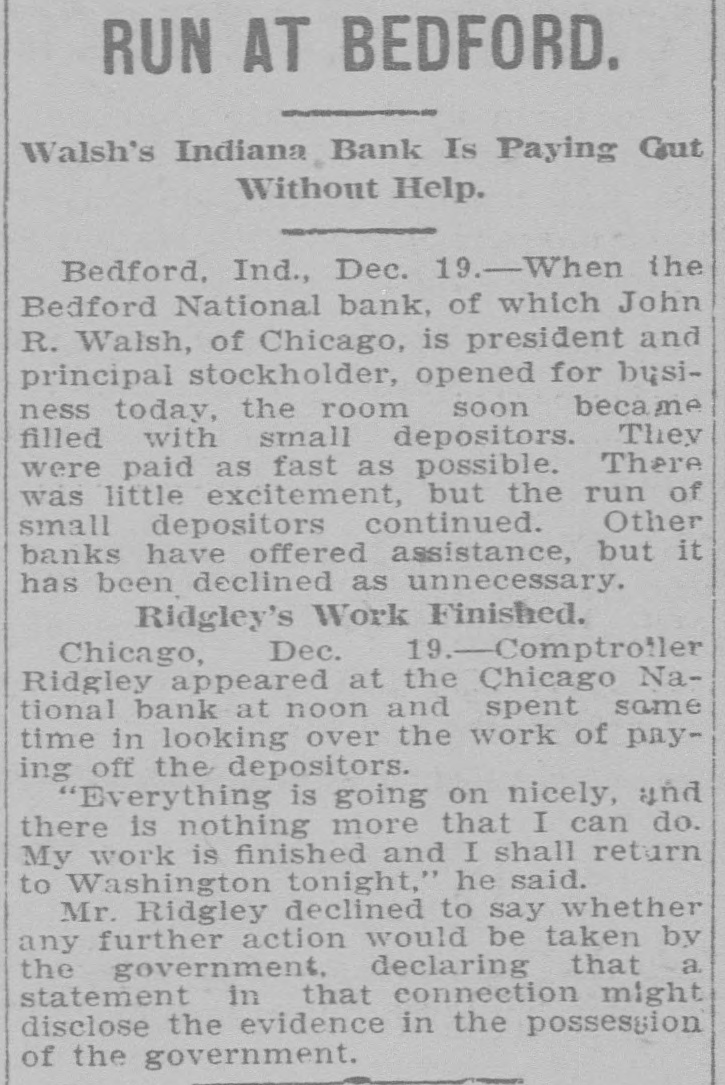
RUN AT BEDFORD. Walsh's Indiana Bank Is Paying Gut Without Help. Bedford, Ind., Dec. 19.-When the Bedford National bank, of which John R. Walsh, of Chicago, is president and principal stockholder, opened for business today, the room soon became filled with small depositors. They were paid as fast as possible. There was little excitement, but the run of small depositors continued. Other banks have offered assistance, but it has been declined as unnecessary. Ridgley's Work Finished. Chicago, Dec. 19.-Comptro!ler Ridgley appeared at the Chicago National bank at noon and spent same time in looking over the work of paying off the depositors. "Everything is going on nicely, and there is nothing more that I can do. My work is finished and I shall return to Washington tonight," he said. Mr. Ridgley declined to say whether any further action would be taken by the government, declaring that a statement in that connection might disclose the evidence in the possession of the government.


Article from Albuquerque Morning Journal, December 20, 1905

Click image to open full size in new tab

Article Text

All Quiet in Chicago. Chicago, Dec. 19.-Practically normal conditions were restored in local banking circles today and there was not the slightest ripple on the surface to indicate that trouble was caused yesterday by the suspension of the Walsh banks. Runs continue on the Chicago National and Home Savings bank, but there is no excitement. United States District Attorney Morrison and State's Attorney Healy both stated this morning that nothing in connection with the operation of the bank had been called to their attention.


Article from Milford Chronicle, December 22, 1905

Click image to open full size in new tab

Article Text

ny THREE CHICAGO to (nBANKS he g siInstitutions Involved in to of John R. Walsh as in e DEPOSITORS LOSE NOT. enChicago, Dec. 19.-Three of th. k Bargest financial institutions in the west, the Chicago National Bank, the is Home Savings Bank and the Equitable eTrust company, all of them controlled 1by John R. Walsh, of Chicago, and in igreat measure owned by him have n suspended operations. Their affairs a will be liquidated as rapidly as possible and they will go out of business. e Mr. Walsh, who was the president f of the Chicago National Bank and of a the Equitable Trust company, and all a the other officers and all the directors S of the Chicago National Bank have resigned. National Bank Eaminer C. H. Boworth has succeeded Mr. Walsh as e the head of the Chicago National Bank, S and the places of the directors have been filled by men appointed by the ' Chicago Clearing House. Back of the new management stand b the allied banks of Chicago, which have pledged their resources that every depositor. shall be paid to the last cent, and that no customer of any one of the three institutions shall lose anything by reason of the suspension. This action prevented a disastrous financial panic. The immediate cause of the collapse of the institutions controlled by Mr. Walsh-is said to be the large amount of money which they have lent to various private enterprises of his, notably the Southern Indiana railway and the Bedford Quarries company, of Indiana. Mr. Walsh says that if he could have had a little more time and been left untrammeled in his operations he could have saved his banks and made enormous profits for himself and his associates. He bases this statement on his estimate of the value of the bonds of the Southern Indiana Railroad company. The liabilities of the three institutions are estimated in the aggregate at $26,000,000. Against this amount the banks and the trust company have resources that are, on a concervative estimate, worth $16,000,000. The bonds of the Southern Indiana Railroad company are estimated by Mr. Walsh at $16,000,000. They are considered by the comptroller, the state auditor and the clearing house committee to be worth a little more than half of that sum. The directors of the two banks. as well as Mr. Walsh, who has turned all of his private property, as well as that standing in the name of Mrs. Walsh, have pledged real estate and securities 0 valued at $5,000,000, making a total in assets of $29,000,000. estimating the railroad bonds at $8,000,000, against A $26,000,000 liabilities. at The deposits in the bank were $14, 483,000 and there is due to other banks PE $2,038,851. The following statement was issued by Comptroller Ridgely: "A misunderstanding seems to exist as to what has happened to the Chicago National Bank. This bank has not failed or closed its doors. It has been embarrassed by the investment of its assets in unavailable securities, but the banks of Chicago have come to its relief. and have guaranteed the payment in full on demand, of all the creditors of the Chicago National Bank. The bank is open for business as usual, with these guarantees behind it that it will meet all its obligations and every dollar at once."


Article from Richmond Planet, December 23, 1905

Click image to open full size in new tab

Article Text

THREE CHICAGO BANKS FAIL Institutions Involved in Operations of John R. Walsh. DEPOSITORS LOSE NOTHING Chicago, Dec. 19.-Three of the largest financial institutions in the west, the Chicago National Bank, the Home Savings Bank and the Equitable Trust company, all of them controlled by John R. Walsh, of Chicago, and in great measure owned by him, have suspended operations. Their affairs will be liquidated as rapidly as possible and they will go out of business. Mr. Watsh, who was the president of the Chicago National Bank and of the Equitable Trust company, and all the other officers and all the directors of the Chicago National Bank have resigned. National Bank Eaminer C. H. Boworth has succeeded Mr. Walsh as the head of the Chicago National Bank, and the places of the directors have been filled by men appointed by the Chicago Clearing House. Back of the new management stand the allted banks of Chicago, which have pledged their resources that every depositor shall be paid to the last cent, and that no customer of any one of the three institutions shall lose anything by reason of the suspension. This action prevented a disastrous financial panic. The immediate cause of the collapse of the institutions controlled by Mr. Walsh is said to be the large amount of money which they have lent to various private enterprises of his, notably the Southern Indiana railway and the Bedford Quarries company, of In diana. Mr. Walsh says that if he could have had a little more time and been left untrammeled in his operations he could have saved his banks and made enormous profits for himself and his associates. He bases this statement on his estimate of the value of the bonds of the Southern Indiana Railroad company. The liabilities of the three institutions are estimated in the aggregate at $26,000,000. Against this amount the banks and the trust company have resources that are, on a concervative estimate, worth $16,000,000. The bonds of the Southern Indiana Railroad company are estimated by Mr. Walsh at $16,000,000. They are considered by the comptroller, the state auditor and the clearing house committee to be worth a little more than half of that sum. The directors of the two banks, as well as Mr. Walsh, who has turned all of his private property, as well as that standing in the name of Mrs. Walsh, have pledged real estate and securities valued at $5,000,000, making a total in assets of $29,000,000. estimating the railroad bonds at $8,000,000, against $26,000,000 liabilities. The deposits in the bank were $14,483,000 and there is due to other banks $2,038,851. The following statement was issued by Comptroller Ridgely: "A misunderstanding seems to ex1st as to what has happened to the Chicago National Bank. This bank has not failed or closed its doors. It has been embarrassed by the investment of its assets in unavailable securities, but the banks of Chicago have come to its relief. and have guaranteed the payment in full on demand, of all the creditors of the Chicago National Bank. The bank is open for business as usual, with these guarantees behind it that it will meet all its obligations and every dollar at once."


Article from Morris Tribune, March 10, 1906

Click image to open full size in new tab

Article Text

creasingly difficult to give the necessary time and attention to the performance of their duties as corporation directors. Pursuant to this policy their resignations had already been sent in. The action is generally interpreted as the result of the insurance investigation, although the firm said it had been decided upon a year ago. Ship Trust Syndicate Ends. The $50,000,000 syndicate organized by J. P. Morgan & Co. four years ago for the purpose of floating the $170,000,000 International Mercantile Marine company known as the ship trust, was closed up, March 1, with a loss to its members aggregating $5,625,000. Walsh to Resume Banking. John R. Walsh, whose banking and railroad business failed through federal interference a few weeks ago, is understood to have come out of the sale of his properties $5,000,000 ahead of the game, and he expects to resume control of the affairs of the Chicago National bank. Cash Buyers' Union Held Up. A postal investigation of the Cash Buyers' Union First International Cooperative Society of Chicago has resulted in the beginning of involuntary bankruptcy proceedings, and a receiver has been appointed. It is alleged that the concern has used the mails to sell $1,000,000 worth of stocks to farmers and workingmen. Fish Out of Mutual. Owing to the refusal of President Peabody of the Mutual Life to furnish the investigating committee with certain information affecting the transactions of trustees Stuyvesant Fish has resigned from the board of trustees. Shaw Aids Money Market. Secretary of the Treasury Shaw announced, March 2, that to meet stringent money conditions he would deposit $10,000,000 in the depository banks of several large cities, "satisfactory bonds" being accepted as security and the funds returnable in July.


Article from The Parma Herald, June 23, 1906

Click image to open full size in new tab

Article Text

# DOINGS OF OUR NATIONAL BODY OF LAWMAKERS Monday, June 18. Washington, June 18.-After another day devoted largely to the Lake Erie & Ohio river canal bill, the senate today passed that measure with only 11 votes in the negative. In addition, several bills to which there was no objection received favorable action. There also was further discussion between Tillman and Hopkins over the resolution of the former for an investigation of the question of national bank contributions to political campaigns, which involved a renewed reference to the failure of the Chicago national bank. The session adjourned upon the official announcement of the death of Lester, of Georgia. Washington, June 18. - A black-draped desk in the hall of the house of representatives today told the story of the passing of Rufus Lester, late a representative in congress from the First Georgia district. Previous to any announcement Wadsworth, of New York, asked unanimous consent, which was granted, that the agricultural bill, with senate amendments, be recommitted to the committee on agriculture. Payne, of New York, by unanimous consent, then fixed Tuesday and Wednesday as suspension days, instead of today, in view of the early adjournment of the house. Bartlett, of Georgia, announced the death of his late colleague, stating that he had been a member of the house for nearly 18 years. He offered the usual resolutions, which were agreed to. As a further mark of respect, the house then adjourned until tomorrow. ed every appearance of a class room. Thursday, June 14. Washington, June 14.-The senate today decided to vote next Thursday on the Panama sea-level canal bill; accepted the conference reports on the diplomatic and naval appropriation bills, the former complete and the latter partial; passed a bill limtiing the liability that may be assumed by individuals to national banks; adopted Morgan's resolution relative to the control of the Panama railroad; admitted A. W. Benson as the successor of Burton, of Kansas; received the credentials of Senator-elect Dupont, of Delaware; listened to a speech by Dryden in support of a lock canal across the Isthmus of Panama, and also passed several semi-private bills. Washington, June 14.-After eliminating the appropriation of $100,000 for the further gauging of the waters of the United States under the direction of the geological survey, the house today grew weary of economy and increased the appropriations for further tests of structural materials, lignites and other coals, although the appropriations committee labored zealously to retain them at their original figure. The conference report on the omnibus lighthouse bill was adopted. The report of the conferees of the agricultural appropriation bill was submitted. Wednesday, June 13. Washington, June 13.-The senate adopted without division the conference report on the statehood bill at 6:20


Article from The Greenville Journal, January 3, 1907

Click image to open full size in new tab

Article Text

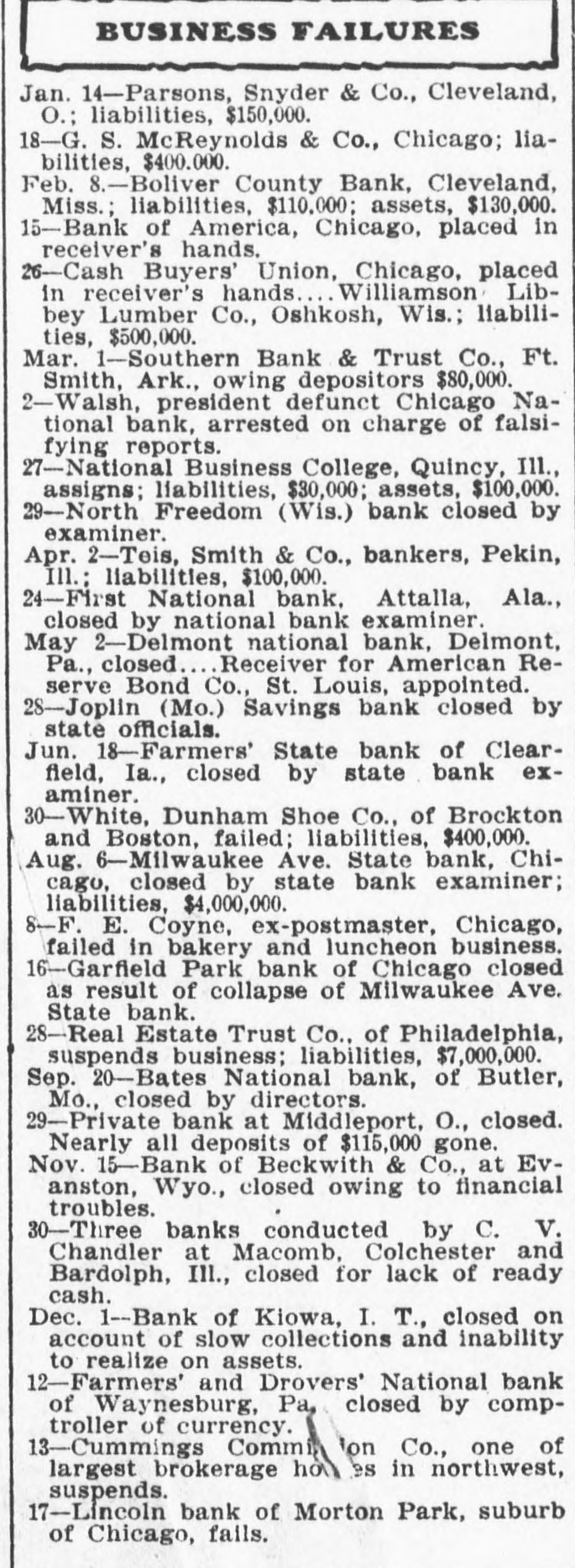
BUSINESS FAILURES Jan. 14-Parsons, Snyder & Co., Cleveland, O.; liabilities, $150,000. 18-G. S. McReynolds & Co., Chicago; liabilities, $400.000. Feb. 8.-Boliver County Bank, Cleveland, Miss.; liabilities, $110,000; assets, $130,000. 15-Bank of America, Chicago, placed in receiver's hands. 26-Cash Buyers' Union, Chicago, placed in receiver's hands Williamson Libbey Lumber Co., Oshkosh, Wis.; liabilities, $500,000. Mar. 1-Southern Bank & Trust Co., Ft. Smith, Ark., owing depositors $80,000. 2-Walsh, president defunct Chicago National bank, arrested on charge of falsifying reports. 27-National Business College, Quincy, Ill., assigns; liabilities, $30,000; assets, $100,000. 29-North Freedom (Wis.) bank closed by examiner. Apr. 2-Teis, Smith & Co., bankers, Pekin, Ill.; liabilities, $100,000. 24-First National bank. Attalla, Ala., closed by national bank examiner. May 2-Delmont national bank, Delmont, Pa., closed Receiver for American Reserve Bond Co., St. Louis, appointed. 28-Joplin (Mo.) Savings bank closed by state officials. Jun. 18-Farmers' State bank of Clearfield, Ia., closed by state bank examiner. 30-White, Dunham Shoe Co., of Brockton and Boston, failed; liabilities, $400,000. Aug. 6-Milwaukee Ave. State bank, Chicago, closed by state bank examiner; liabilities, $4,000,000. 8-F. E. Coyne, ex-postmaster, Chicago, failed in bakery and luncheon business. 16-Garfield Park bank of Chicago closed as result of collapse of Milwaukee Ave. State bank. 28-Real Estate Trust Co., of Philadelphia, suspends business; liabilities, $7,000,000. Sep. 20-Bates National bank, of Butler, Mo., closed by directors. 29-Private bank at Middleport, O., closed. Nearly all deposits of $115,000 gone. Nov. 15-Bank of Beckwith & Co., at Evanston, Wyo., closed owing to financial troubles. 30-Three banks conducted by C. v. Chandler at Macomb, Colchester and Bardolph, III., closed for lack of ready cash. Dec. 1--Bank of Kiowa, I. T., closed on account of slow collections and inability to realize on assets. 12-Farmers' and Drovers' National bank of Waynesburg, Pa, closed by comptroller of currency. 13-Cummings Commi on Co., one of largest brokerage how es in northwest, suspends. 17-Lincoln bank of Morton Park, suburb of Chicago, fails.


Article from River Falls Journal, May 16, 1907

Click image to open full size in new tab

Article Text

Counsel for state and prisoner entered at once in a business-like way upon the examination of prospective jurors, and kept steadily at the task for five hours. No juror was finally accepted, but substantial progress was made and the indications at the close of the session were that a jury would be obtained in ten days. The case was adjourned three days to obtain a new panel. Queen Victoria, of Spain, gave birth to a son and the entire country rejoiced. The baby was formally presented to the court and diplomats by the king, who also proclaimed a public holiday and pardoned thousands of prisoners. The newly-born Spanish prince was named Alfonso Pio Christins Eduardo. Incendiary fires in Paris destroyed a cartridge factory and a metal works, the loss being about $2,000,000. Two masked highwaymen held up a station agent of the Chicago Metropolitan elevated road and escaped with $12. Both the strikers and the street car company in San Francisco refused to arbitrate their trouble. Experimental trips showed the cars could not be run without heavy police guards and that the police force is inadequate to supply protection for a real resumption of the service. Mexico decided not to press to the point of war her demand on Guatemala for the extradition of Gen. Jose Lima, but to show her displeasure by sending her minister to Salvador, leaving the legation in charge of a consul. The heads of the steamship companies in New York included in the International Mercantile Marine company served notice upon the striking longshoremen that unless the latter returned to work within a week their places would be filled. Brig. Gen. Orlando E. Willcox, U. S. A., a retired, former governor of the National Soldiers' home at Washington, died at Coburg, Ont., aged 85. The body of Miss Aurora Wittebort, the artist, who lost her life in the destruction by fire of the University building in Kansas City, was recovered from the ruins. Nine persons were badly injured near Edwardsville, Ill., by a collision on an interurban electric road. Harry Cole, suspected of being one on the North Coast train robbers, was killed by a Butte policeman as he was trying to escape from custody, and a mob tried to lynch another officer who they thought shot Cole. Mrs. Michael Pendergast, of Sterling, Ill., stepped on a match, set fire to her clothing and burned to death. W. R. Fulton shot and dangerously wounded his wife, from whom he had been separated, in Wichita, Kan. Fulton was pursued by a crowd and surrounded in a freight yard. After a battle with revolvers he escaped, but is believed to have committed suicide. Two persons were killed, two fatally injured and ten badly hurt when a train broke through a trestle near Flemingsburg, Ky., and fell 50 feet into a creek. Dr. T. B. Rider was probably fatally stabbed in Hot Springs, Ark., by Dr. A. N. Williams, one of the best known physicians in the city. Thomas S. Marshall, cousin of William J. Bryan, and a member of the Illinois state board of agriculture, filed a petition in bankruptcy in the United States court at East St. Louis, fixing his liabilities at $300,000. The heaviest creditors are the trustees of the Chicago National bank, of which John R. Walsh was president at the time of its failure. Among his creditors is W. J. Bryan, to whom $6,000 is due. The Penn-Wyoming Copper company's smelter, tramway terminal and crushers at Grand Encampment, Wyo., were destroyed by a fire believed to have been of incendiary origin. The loss was over $100,000. Troops and engineers have been sent to Stromboli to render assistance to the islanders, whose exodus, due to the volcanic outbreak, continues, while many of those who remain are destitute. Abraham Hummel, the New York lawyer who was convicted of conspiracy in the Dodge-Morse divorce case, was sentenced to one year in state prison and to pay a fine of $500. The Master Builders' association of Berlin and its suburbs decided to lock out all masons and bricklayers assisting building workmen on May 18. Over 100,000 men are affected by this decision. Capt. A. Krech, of the Hamburg-American line steamer Graf Waldersee, one of the oldest commanders in the transatlantic service died on board his ship while the steamer was in midocean. William Schellhas, a prominent brewer of Winono, Minn., died from pneumonia. The business section of Gibson, Mo., was almost wiped out by fire. Five of the seven stores and two residences were destroyed. Armed bandits are reported to be committing depredations in the Songo district of Santiago and near Manacas, Santa Clara. Excavators on Palatine hill in Rome, uncovered the ruins of a church used by emperors in the fifth century. The University building in Kansas


Article from Audubon Republican, May 16, 1907

Click image to open full size in new tab

Article Text

# BRIEF NEWS NOTES FOR THE BUSY MAN MOST IMPORTANT EVENTS OF THE PAST WEEK TOLD IN THE CONDENSED FORM. # ROUND ABOUT THE WORLD Complete Review of Happenings of Greatest Interest from All Parts of the Globe-Latest Home and Foreign Items. Queen Victoria, of Spain, gave birth to a son and the entire country rejoiced. The baby was formally presented to the court and diplomats by the king, who also proclaimed a public holiday and pardoned thousands of prisoners. Both the strikers and the street car company in San Francisco refused to arbitrate their trouble. Experimental trips showed the cars could not be run without heavy police guards and that the police force is inadequate to supply protection for a real resumption of the service. Mexico decided not to press to the point of war her demand on Guatemala for the extradition of Gen. Jose Lima, but to show her displeasure by sending her minister to Salvador, leaving the legation in charge of a consul. The heads of the steamship companies in New York included in the International Mercantile Marine company served notice upon the striking longshoremen that unless the latter returned to work within a week their places would be filled. Brig. Gen. Orlando B. Willcox, U. S. A., a retired, former governor of the National Soldiers' home at Washington, died at Coburg, Ont., aged 85. The body of Miss Aurora Wittebort, the artist, who lost her life in the destruction by fire of the University building in Kansas City, was recovered from the ruins. Nine persons were badly injured near Edwardsville, Ill., by a collision on an interurban electric road. Harry Cole, suspected of being one on the North Coast train robbers, was killed by a Butte policeman as he was trying to escape from custody, and a mob tried to lynch another officer who they thought shot Cole. Mrs. Michael Pendergast, of Sterling, Ill., stepped on a match, set fire to her clothing and burned to death. W. R. Fulton shot and dangerously wounded his wife, from whom he had been separated, in Wichita, Kan. Fulton was pursued by a crowd and surrounded in a freight yard. After a battle with revolvers he escaped, but is believed to have committed suicide. Two persons were killed, two fatally injured and ten badly hurt when a train broke through a trestle near Flemingsburg, Ky., and fell 50 feet into a creek. Dr. T. B. Rider was probably fatally stabbed in Hot Springs, Ark., by Dr. A. N. Williams, one of the best known physicians in the city. Thomas S. Marshall, cousin of William J. Bryan, and a member of the Illinois state board of agriculture, filed a petition in bankruptcy in the United States court at East St. Louis, fixing his liabilities at $300,000. The heaviest creditors are the trustees of the Chicago National bank, of which John R. Walsh was president at the time of its failure. Among his creditors is W. J. Bryan, to whom $6,000 is due. The Penn-Wyoming Copper company's smelter, tramway terminal and crushers at Grand Encampment, Wyo., were destroyed by a fire believed to have been of incendiary origin. The loss was over $100,000. Troops and engineers have been sent to Stromboli to render assistance to the islanders, whose exodus, due to the volcanic outbreak, continues, while many of those who remain are destitute. Abraham Hummel, the New York lawyer who was convicted of conspiracy in the Dodge-Morse divorce case, was sentenced to one year in state prison and to pay a fine of $500. The Master Builders' association of Berlin and its suburbs decided to lock out all masons and bricklayers assisting building workmen on May 18. Over 100,000 men are affected by this decision. Capt. A. Krech, of the Hamburg-American line steamer Graf Waldersee, one of the oldest commanders in the transatlantic service died on board his ship while the steamer was in midocean. William Schellhas, a prominent brewer of Winono, Minn., died from pneumonia. A pitched battle between strikebreakers in the uniforms of car inspectors and strikers and their sympathizers was fought in San Francisco for more than an hour. Eight men were shot, among them a policeman, and one of the wounded men died in the night. Irvine L. Lenroot, of Superior, Wis., withdrew from the senatorial race without making any requests as to the future course of his followers. The life insurance companies intimate that they will withdraw from Texas when the new insurance law of that state becomes effective June 1. Indictments charging violation of the Elkins anti-rebating law were handed down by a federal grand jury in New York against the Chicago, Rock Island & Pacific railroad, the Ontario & Western railroad, the Chicago, Milwaukee & St. Paul railroad and the Western Transit company. The entire leper colony of D'Arcy Island, B. C., consisting of eight Chinese, has been sent back to China. Eleven of the 13 Italians who had been on trial at Wilkesbarre, Pa., charged with "Blackhand" crimes were declared guilty. The other two defendants were acquitted. Seven battalions of Turkish troops, about 6,500 men, were practically annihilated in a battle with rebels in the province of Yemen, Turkish Arabia.


Article from The Bottineau Courant, May 17, 1907

Click image to open full size in new tab

Article Text

Pierce, head of the Waterson company, St. Louis on the rePierce self n. in Clay surrendered indictment himturned against him in Texas charging perjury. and was released on bonds. Shriners at Los Angeles selected St Paul for the conclave of 1908, the dates being July 13 to 18. Gov. Magoon appointed Cuban delegates to the second peace conference at The Hague as follows: Antonio De Bustamente, Gonzalo De Queseda, the Cuban minister in the United States, and Manuel Sanguily Overtes Ferrera has been made secretary to e legation hen the trial of William D. Hay wood for the murder of former Gov. Steunenberg opened at Boise. Idaho, counsel for state and prisoner entered at once in a business-like way upon the examination of prospective jur- for ors, and kept steadily at the task five hours. No juror was finally accepted, but substantial progress close was made and the indications at the would of the session were that a jury be obtained in ten days. The case was adjourned three days to obtain a new panel. Queen Victoria, of Spain, gave birth rea son and the entire country joiced. to The baby was formally presented to the court and diplomats by the king, who also proclaimed a public holiday and pardoned thousands of prisoners. The newly-born Spanish prince was named Alfonso Pio Christins Eduardo Incendiary fires in Paris destroyed works, a cartridge factory and a metal the loss being about $2,000,000. Two masked highwaymen held up a station agent of the Chicago Metropol- with itan elevated road and escaped $12. Both the strikers and the street car company in San Francisco refused to arbitrate their trouble. Experimental be showed the cars could not heavy police to the police force is that trips run without inadequate guards resump and supply protection for a real tion of the service. Mexico decided not to press to the point of war her demand on Guatemala for the extradition of Gen. Jose Lima, but to show her displeasure by sending her minister to Salvador, of a leaving the legation in charge consul. The heads of the steamship companies in New York inclu ied in the International Mercantile Marine company served notice upon the striking longshoremen that unless the latter returned to work within a week their places would be filled. Brig. Gen. Orlando B. Willcox, U. the a retired, former governor of National A., Soldiers' home at Washington, died at Coburg, Ont., aged 85. The body of Miss Aurora Wittebort, dethe artist, who lost her life in the struction by fire of the University building in Kansas City, was recovered from the ruins. Nine persons were badly injured near Edwardsville, III., by a collision on an interurban electric road. Harry Cole, suspected of being one the North Coast train robbers, was killed on by a Butte policeman as he was trying to escape from custody, and who a mob tried to lynch another officer they thought shot Cole. Mrs. Michael Pendergast, of SterlIII., stepped on a match, set death. fire ing, to her clothing and burned to W. R. Fulton shot and dangerously had wounded his wife, from whom he Fulbeen separated, in Wichita, Kan. ton was pursued by a crowd and sur a rounded in a freight yard. After but battle with revolvers he escaped, is believed to have committed suicide. Two persons were killed, two fatally injured and ten badly hurt when a train broke through a trestle near feet Flemingsburg, Ky., and fell 50 into a creek. Dr. T. B. Rider was probably fatal- by Stabbed in Hot Springs, Ark., best ly Dr. A. N. Williams, one of the known physicians in the city. Thomas S. Marshall, cousin of Wil- the liam J. Bryan, and & member of Illinois state board of agriculture, the filed a petition in bankruptcy in United States court at East St. Louis, fixing his liabilities at $300,000. trusThe heaviest creditors are the of tees of the Chicago National bank, which John R. Walsh was president his the time of its failure. Among at creditors is W. J. Bryan, to whom $6,000 is due. The Penn-Wyoming Copper com- and smelter, tramway terminal crushers pany's at Grand Encampment, Wyo., to were destroyed by a fire believed The have been of incendiary origin. loss was over $100,000. Troops and engineers have been to Stromboli to render assistance to sent the islanders, whose exodus, due to the volcanic outbreak, continues, are while many of those who remain destitute. Abraham Hummel, the New York lawyer who was convicted of conspirin the Dodge-Morse divorce state case, acy was sentenced to one year in of prison and to pay a fine of $500. The Master Builders' association Berlin and its suburbs decided to lock


Article from The Yale Expositor, May 17, 1907

Click image to open full size in new tab

Article Text

# TRIAL OF HAYWOOD wood for the murder of former Gov. Steunenberg opened at Boise, Idaho, counsel for state and prisoner entered at once in a business-like way upon the examination of prospective jurors, and kept steadily at the task for five hours. No juror was finally accepted, but substantial progress was made and the indications at the close of the session were that a jury would be obtained in ten days. The case was adjourned three days to obtain a new panel. Queen Victoria, of Spain, gave birth to a son and the entire country rejoiced. The baby was formally presented to the court and diplomats by the king, who also proclaimed a public holiday and pardoned thousands of prisoners. The newly-born Spanish prince was named Alfonso Pio Christins Eduardo. Incendiary fires in Paris destroyed a cartridge factory and a metal works, the loss being about $2,000,000. Two masked highwaymen held up a station agent of the Chicago Metropolitan elevated road and escaped with $12. Both the strikers and the street car company in San Francisco refused to arbitrate their trouble. Experimental trips showed the cars could not be run without heavy police guards and that the police force is inadequate to supply protection for a real resumption of the service. Mexico decided not to press to the point of war her demand on Guatemala for the extradition of Gen. Jose Lima, but to show her displeasure by sending her minister to Salvador, leaving the legation in charge of a consul. The heads of the steamship companies in New York included in the International Mercantile Marine company served notice upon the striking longshoremen that unless the latter returned to work within a week their places would be filled. Brig. Gen. Orlando E. Willcox, U. S. A., a retired, former governor of the National Soldiers' home at Washington, died at Coburg, Ont., aged 85. The body of Miss Aurora Wittebort, the artist, who lost her life in the destruction by fire of the University building in Kansas City, was recovered from the ruins. Nine persons were badly injured near Edwardsville, Ill., by a collision on an interurban electric road. Harry Cole, suspected of being one on the North Coast train robbers, was killed by a Butte policeman as he was trying to escape from custody, and a mob tried to lynch another officer who they thought shot Cole. Mrs. Michael Pendergast, of Sterling, Ill., stepped on a match, set fire to her clothing and burned to death. W. R. Fulton shot and dangerously wounded his wife, from whom he had been separated, in Wichita, Kan. Fulton was pursued by a crowd and surrounded in a freight yard. After a battle with revolvers he escaped, but is believed to have committed suicide. Two persons were killed, two fatally injured and ten badly hurt when a train broke through a trestle near Flemingsburg, Ky., and fell 50 feet into a creek. Dr. T. B. Rider was probably fatally Stabbed in Hot Springs, Ark., by Dr. A. N. Williams, one of the best known physicians in the city. Thomas S. Marshall, cousin of William J. Bryan, and a member of the Illinois state board of agriculture, filed a petition in bankruptcy in the United States court at East St. Louis, fixing his liabilities at $300,000. The heaviest creditors are the trustees of the Chicago National bank, of which John R. Walsh was president at the time of its failure. Among his creditors is W. J. Bryan, to whom $6,000 is due. The Penn-Wyoming Copper company's smelter, tramway terminal and crushers at Grand Encampment, Wyo., were destroyed by a fire believed to have been of incendiary origin. The loss was over $100,000. Troops and engineers have been sent to Stromboli to render assistance to the islanders, whose exodus, due to the volcanic outbreak, continues, while many of those who remain are destitute. Abraham Hummel, the New York lawyer who was convicted of conspiracy in the Dodge-Morse divorce case, was sentenced to one year in state prison and to pay a fine of $500. The Master Builders' association of Berlin and its suburbs decided to lock-out all masons and bricklayers assisting building workmen on May 18. Over 100,000 men are affected by this decision. Capt. A. Krech, of the Hamburg-American line steamer Graf Waldersee, one of the oldest commanders in the transatlantic service died on board his ship while the steamer was in midocean. William Schellhas, a prominent brewer of Winono, Minn., died from pneumonia.


Article from The Irish Standard, November 30, 1907

Click image to open full size in new tab

Article Text

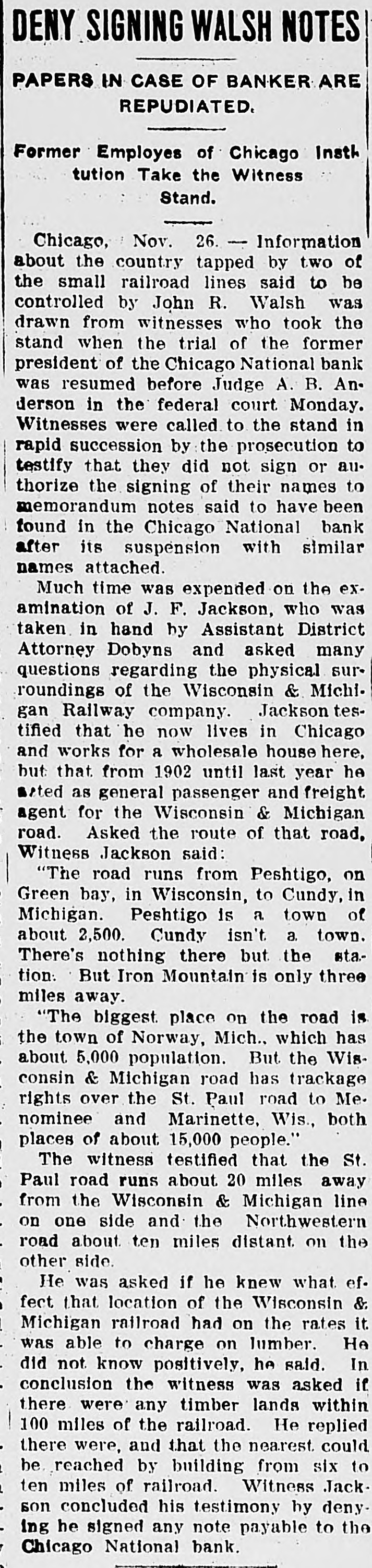
DENY SIGNING WALSH NOTES PAPERS IN CASE OF BANKER ARE REPUDIATED. Former Employes of Chicago Insth tution Take the Witness Stand. Chicago, Nov. 26. - Information about the country tapped by two of the small railroad lines said to be controlled by John R. Walsh was drawn from witnesses who took the stand when the trial of the former president of the Chicago National bank was resumed before Judge A. B. Anderson in the federal court Monday. Witnesses were called to the stand in rapid succession by the prosecution to testify that they did not sign or authorize the signing of their names to memorandum notes said to have been found in the Chicago National bank after its suspension with similar names attached. Much time was expended on the examination of J. F. Jackson, who was taken in hand by Assistant District Attorney Dobyns and asked many questions regarding the physical surroundings of the Wisconsin & Michigan Railway company. Jackson testified that he now lives in Chicago and works for a wholesale house here. but that from 1902 until last year he sted as general passenger and freight agent for the Wisconsin & Michigan road. Asked the route of that road, Witness Jackson said: "The road runs from Peshtigo, on Green bay, in Wisconsin, to Cundy, in Michigan. Peshtigo is a town of about 2,500. Cundy isn't a. town. There's nothing there but the station. But Iron Mountain is only three miles away. "The biggest. place on the road is the town of Norway, Mich., which has about 5,000 population. But the Wisconsin & Michigan road has trackage rights over the St. Paul road to Me. nominee and Marinette, Wis., both places of about 15,000 people." The witness testified that the St. Paul road runs about 20 miles away from the Wisconsin & Michigan line on one side and the Northwestern road about ten miles distant on the other side. He was asked if he knew what effect that location of the Wisconsin & Michigan railroad had on the rates it. was able to charge on lumber. He did not know positively, he said. In conclusion the witness was asked if there were any timber lands within 100 miles of the railroad. He replied there were, and that the nearest could be reached by building from six to ten miles of railroad. Witness Jack son concluded his testimony by denying he signed any note payable to the Chicago National bank.


Article from The Montgomery Advertiser, December 21, 1907

Click image to open full size in new tab

Article Text

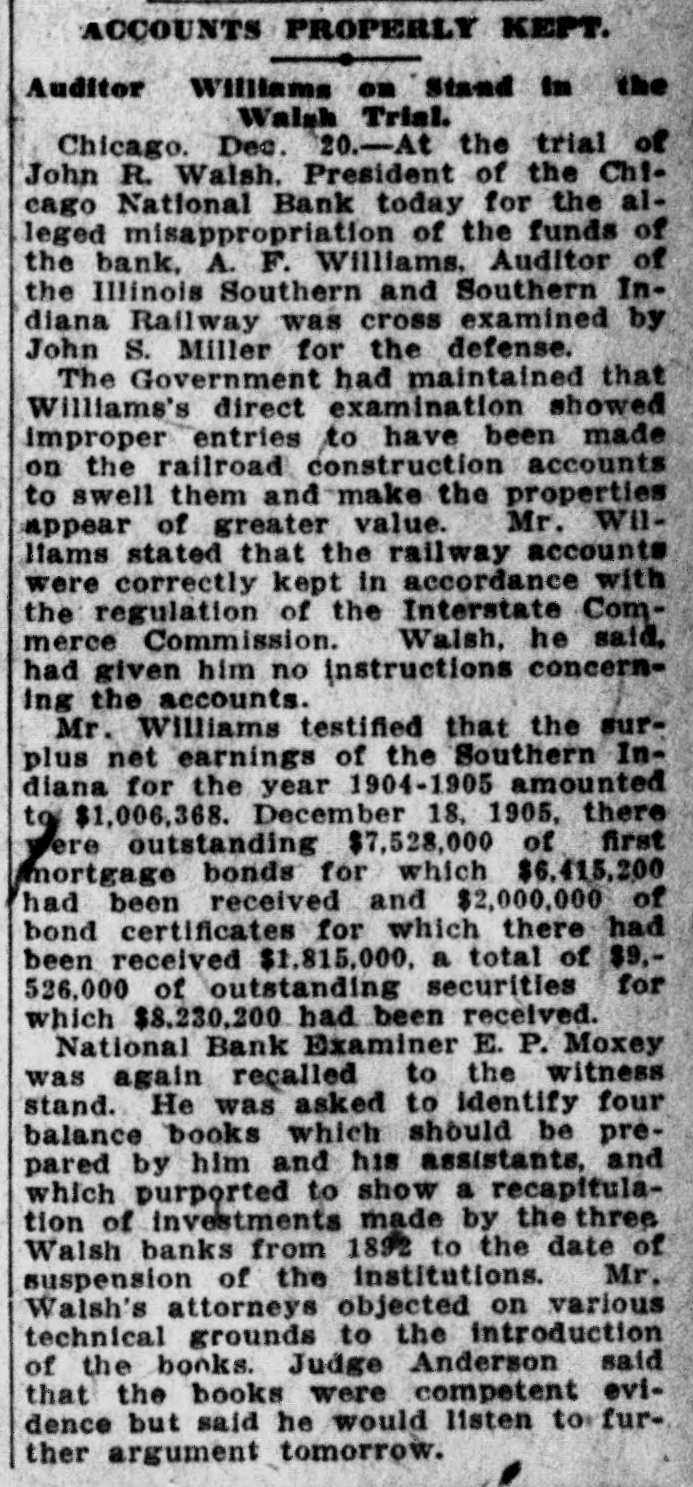
ACCOUNTS PROPERLY KEPT. Auditor Williams on Stand in the Walsh Trial. Chicago. Dec. 20.-At the trial of John R. Walsh. President of the Chlcago National Bank today for the alleged misappropriation of the funds of the bank, A. F. Williams, Auditor of the Illinois Southern and Southern Indiana Railway was cross examined by John S. Miller for the defense. The Government had maintained that Williams's direct examination showed improper entries to have been made on the railroad construction accounts to swell them and make the properties appear of greater value. Mr. WilItams stated that the railway accounts were correctly kept in accordance with the regulation of the Interstate Commerce Commission. Walsh, he said, had given him no instructions concerning the accounts. Mr. Williams testified that the surplus net earnings of the Southern Indiana for the year 1904-1905 amounted to $1,006,368. December 18, 1905, there were outstanding $7,528,000 of first mortgage bonds for which $6,415,200 had been received and $2,000,000 of bond certificates for which there had been received $1,815,000. a total of $9.526,000 of outstanding securities for which $8.230.200 had been received. National Bank Examiner E. P. Moxey was again recalled to the witness stand. He was asked to Identify four balance books which should be prepared by him and his assistants, and which purported to show a recapitulation of investments made by the three Walsh banks from 1892 to the date of suspension of the institutions. Mr. Walsh's attorneys objected on various technical grounds to the introduction of the books. Judge Anderson said that the books were competent evidence but said he would listen to further argument tomorrow.


Article from The Garland Globe, January 11, 1908

Click image to open full size in new tab

Article Text

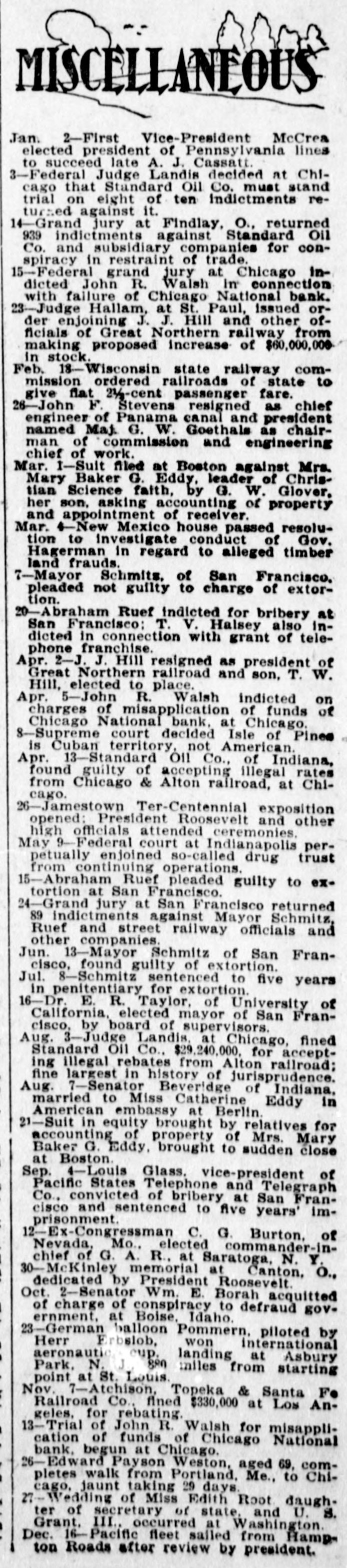
MISCELLANEOUS Jan. 2-First Vice-President McCrea elected president of Pennsylvania lines to succeed late A. J. Cassatt. 3-Federal Judge Landis decided at Chicago that Standard Oil Co. must stand trial on eight of ten indictments returned against it. 14-Grand jury at Findlay, O., returned 939 indictments against Standard Oil Co. and subsidiary companies for conspiracy in restraint of trade. 15-Federal grand jury at Chicago indicted John R. Walsh in connection with failure of Chicago National bank. 23-Judge Hallam, at St. Paul, issued order enjoining J. J. Hill and other officials of Great Northern railway from making proposed increase of $60,000,000 in stock. Feb. 18-Wisconsin state railway commission ordered railroads of state to give flat 21/2-cent passenger fare. 26-John F. Stevens resigned as chief engineer of Panama canal and president named Maj. G. W. Goethals as chairman of commission and engineering chief of work. Mar. I-Suit filed at Boston against Mrs. Mary Baker G. Eddy, leader of Christian Science faith, by G. W. Glover. her son, asking accounting of property and appointment of receiver. Mar. 4-New Mexico house passed resolution to investigate conduct of Gov. Hagerman in regard to alleged timber land frauds. 7-Mayor Schmits, of San Francisco. pleaded not guilty to charge of extortion. 20-Abraham Ruef indicted for bribery at San Francisco: T. V. Halsey also indicted in connection with grant of telephone franchise. Apr. 2-J. J. Hill resigned as president of Great Northern railroad and son, T. W. Hill, elected to place. Apr. 5-John R. Walsh indicted on charges of misapplication of funds of Chicago National bank, at Chicago. -Supreme court decided Isle of Pines is Cuban territory, not American. Apr. 13-Standard Oil Co., of Indiana, found guilty of accepting illegal rates from Chicago & Alton railroad, at Chicago. 26-Jamestown Ter-Centennial exposition opened: President Roosevelt and other high officials attended ceremonies. May 9-Federal court at Indianapolis perpetually enjoined so-called drug trust from continuing operations. 15-Abraham Ruef pleaded guilty to extortion at San Francisco. 24 Grand jury at San Francisco returned 89 indictments against Mayor Schmitz, Ruef and street railway officials and other companies. Jun. 13-Mayor Schmitz of San Francisco, found guilty of extortion. Jul. 8-Schmitz sentenced to five years in penitentiary for extortion. 16-Dr. E. R. Taylor, of University of California, elected mayor of San Francisco, by board of supervisors. Aug. 3-Judge Landis, at Chicago, fined Standard Oil Co., $29,240,000. for accepting illegal rebates from Alton railroad; fine largest in history of jurisprudence. Aug. 7-Senator Beveridge of Indiana, married to Miss Catherine Eddy in American embassy at Berlin. 21-Suit in equity brought by relatives for accounting of property of Mrs. Mary Baker G. Eddy, brought to sudden close at Boston. Sep. 4-Louis Glass. vice-president of Pacific States Telephone and Telegraph Co., convicted of bribery at San Francisco and sentenced to five years' imprisonment. 12-Ex-Congressman C. G. Burton. of Nevada, Mo., elected commander-inchief of G. A. R., at Saratoga, N. Y. 30-McKinley memorial at Canton, O., dedicated by President Roosevelt. Oct. 2-Senator Wm. E. Borah acquitted of charge of conspiracy to defraud government, at Boise, Idaho. 23-German balloon Pommern. piloted by Herr Erbslob, won international aeronauti cup. landing at Asbury Park, N. J 880 miles from starting point at St. Louis. Nov. 7-Atchison, Topeka & Santa Fe Railroad Co., fined $330,000 at Los Angeles, for rebating. 13-Trial of John R. Walsh for misapplication of funds of Chicago National bank, begun at Chicago. 26-Edward Payson Weston, aged 69, completes walk from Portland, Me., to Chicago, jaunt taking 29 days. Wedding of Miss Edith Root daughter of secretary of state, and U. 8. Grant, III., occurred at Washington. Dec. S-Pacific fleet sailed from Hampton Roads after


Article from La Voz Del Pueblo, January 25, 1908

Click image to open full size in new tab

Article Text

El Banquero Walsh Fallado Culpable. El día 18 del corriente toco á fin el juicio de una de las causas más sonadas y que se han combatido con más denuedo y empeño en las cortes de justicia del país. Este es el caso del gobierno federal contra James R. Walsh, rico banquero de Chicago y en un tiempo fl. gura de mucho prestigio y prominencia en la política nacional y propietario del periódico "The Chicago News" y del Chicago National Bank que quebró en tiempo pasado con varios millones de responsabilidades. Se dilucidó en la ave iguación que Walsh habiendo establecido su banco en Chicago millones de pesos de depósitos los cuales usó ilegalmente para adelantar otras empresas particulares y especulaciones las cuales fracasaron teniendo que declararse en bancarrota el banco y cogiendo en el desastre á centenares de víctimas. Con la caida de Walsh y de su banco fracasó también el periódico, que tu. VO que suspender operaciones. El jurado después de oir la evidencia del juicio, que duró como dos meses, retornó, tras debida deliberación, un dictamen, fallando culpable al acusado. Aun no ha sido pronunciada la sentencia de la corte, pero segun la ley aplicable al caso, la sentencia deberá ser nomenos que cinco años de penitenciaría. Lo más notable del caso de Walsh y el motivo principal para que haya sido tan notoria su causa es que este individuo, pretendiendo que su periódico defendía los principios democráticos hizo la más terrible oposición á Mr. Bryan y sostuvo á McKinley, contendiendo en sus incendiarios editoriales que la elección de Bryan significaba el deshonor de la nación, el repudio de las obligaciones del gobierno y de los particulares y asumiendo él mismo la actitud de guardian del honor nacional, y mientras así predicaba estaba haciendo lena con los fondos de las incautas víctinasque, confiando en él, depositaron sus dineros en su banco. Las transacciones de Walsh pasarán á la historia como las más audaces y frenéticas que se han cometido bajo la capa de la hipocresía y el fingimiento del patriotismo, pero como todos los de su clase, ha acabado su historia on desgracia.


Article from The Washington Herald, November 7, 1909

Click image to open full size in new tab

Article Text

names. When it comes to the matter of the law's dealing with them there begins to be a sharp divergence. Charles W. Morse already has tasted of the bitterness of imprisonment. John R. Walsh has not spent an hour in jail, although the crime of which he was convicted and is now under sentence of five years' imprisonment in the Federal penitentiary in Leavenworth, Kans., was committed four years ago, Morse, through the devotion of his wife, regained his liberty, only to be thrust back behind the bars. It was a long and hard task to procure the bond in the first place, It served only as a temporary expedient. Walsh goes to his office in Chicago every day when his seventy-two years will allow him to go, and that is most 01 the time. In spite of his three-score years and twelve. he still has a lot of the energy and fight that made him in former days one of the most conspicuous capitalists and financiers in the West. He has been privileged to be with his devoted family, whose loyalty, in a quieter way, is as beautiful as that of Mrs. Morse toward the Wall street banker He is as welcome as in the old days to the clubs. Those in whose debt he is to the extent of millions are about the last men in Chicago to say for publication anything against the man who weeked the Chicago National Bank and its allied institutions. Similarity of Crimes. Morse and Walsh both were charged with transgressing the banking laws. They used the money of others in a way that the statutes did not sanction, if the charges against them be true. There may have been differences of detail in the alleged wrongful things they did. but the principle involved was the same Compared with Walsh, the Wall street man is still in the prime of life. He might spend a term in prison and come out strong and ready to begin life over again. Recent reports that he added $7,000,000 to his fortune the short time he was out on bond, whether true or not, indicate that the blows that have fallen on him have not put him out of the running as a winner of wealth. For him there is hope after whatever penalty he may pay For Walsh a prison cell probably would mean, sooner or later, a death chamber Mr Walsh is used to hard work, to reckoning with vast detail. Prison life will be no laughing matter for such a man. He has for years been a lord of business over men, brooking no interference with his will He can't be that in Leavenworth. His age renders it unlikely that he will be able to do any physical work His friends feel that once he is restrained behind iron bars the warrant of his death will have been virtually signed. That is the reason they are making with him SO vigorous a fight to ward off the day of reckoning. In the case of this man the mills of the courts are grinding slowly In one month more it will be four years since the three banks, of which Walsh was the executive head, quit doing business and the associated banks of Chicago began to pay the depositors what Walsh owed them The man whose financiering wrecked the banks is still under a big obligation to the Institutions which came to the rescue of the hundreds of depositors. His debt to them is something like $7,000,000 It is the supreme effort of Mr. Walsh just now to raise money to satisfy these creditors, 80 that he will not have to sacrifice many millions of dollars of securities and property History of Walsh's Crime, It was on the morning of December 18. 1905, that the Chicago National Bank, the Home Savings Bank, and the Equitable Trust Company ceased to do business and closed their doors. That was on a Monday morning. Far into the night of Sunday-In fact, till almost the coming of dawn-representatives of the other banks in the Chicago clearing-house had been in conference trying to devise a way to save the banks from wreck and the city from a financial panic. Walsh and his advisers were in that conference. The man who had presided as the financial genius over the trio of banking institutions protested long and loudly that if he were given one more opportunity he would ward off collapse. Over the business of the banks went experts. They scrutinized this account and that. They observed with alarm the long list of menacing obligations, gasped with surprise when informed of the manner in which the funds of the bank-the money of the depositors-were being used to promote private enterprises. They reckoned up the securities for liabilities, figured closely on the conversion possibilities of collateral at hand. They were disposed to be eminently fair, but when they were through canvassing the situation its general aspect was SO forbidding that closing the doors of the institutions was decided on. How Panic Whs Averted. That was the beginning of the end The next morning, which was Monday, there were notices on the Walsh banks which told their tale briefly. The newspapers, which had been purposely let into the secret to help save Chicago from a panic, contained long stories of the fall of the Walsh banks. Every story was quick to say that the associated banks had agreed in conference to guarantee the payment of all deposits, dollar for dollar. All the depositors had to do was to find out what his balance was and write out a check for the amount to another bank chosen for the doing of his future business. He would be given credit for the amount Those who preferred might take their books to the failed banks after they reopened and get their money there. In saving the depositors from losing a cent in the Walsh banks the institutions coming to the rescue were saving themselves the burden of a "scare," which might have far-reaching consequences and precipitate other crashes. On the 5th of October, 1909. nearly four years after that memorable Monday morning, the Circuit Court of Appeals affirmed the sentence of five years running against Mr. Walsh, who had been duly convicted in the lower Federal court for violating the banking laws. Owes Banks $7,000,000. At the time the sentence was affirmed, as already stated. Mr. Walsh owed the banks which stood between his institutions and a local financial panic over $7,000,000. secured by the stock and bond issues of certain corporations in which Walsh was interested. The interest havdefaulted