Article Text
Other Banks Wrecked
INDIANAPOLIS, May 11.-The - Capital National Bank of this city has suspended. CHICAGO, May 11.-The Columbia National Bank has failed.
Full suspension, Books examined
Click image to open full size in new tab
INDIANAPOLIS, May 11.-The - Capital National Bank of this city has suspended. CHICAGO, May 11.-The Columbia National Bank has failed.
Click image to open full size in new tab
NOT PLEASANT READING A HEAVY BANK FAILURE IN WILMINGTON, DEL. The Liabilities are $300,000 With Only $100,000 of Assets in Sight -Another Bank Goes Under in Chicago. WILMINGTON, Del., May 11.-The announcement of the failure of R. R. Robinson & Co., bankers and brokers, this city, today created a profound sensation. Rumors of the failure of this well known firm haye been on the street for several days and business circles have been exriteo. The liabilities of the firm are $600,000, while the assets will not exceed $100,000. The sheriff has seized all the property of the bankrupt firm. INDIANAPOLIS, Ind., May 11.-TheCap ital National bank of this city has suspended. The closing of the bank's doors was made necessary by the failure of the Chemical National Bank of Chicago. CHICAGO, May 11.-The Columbia National bank of this city has failed.

Click image to open full size in new tab
VOL. XXIV (NUMBER 124) — FOURTH EDITION
CAPITAL BANK FAILS
Notice of Its Suspension Posted On Its Doors.
Direct Cause Due to the Failure of the Chemical National Bank of Chicago.
Directors of the Capital at a Meeting Decided Upon the Course — The Statement Made of the Affairs of the Concern — Details.
The Capital National Bank closed its doors this morning. A note was posted on a front window of the bank in the Commercial Club Building, South Meridian street, announcing:
CAPITAL NATIONAL BANK SUSPENDED.
This was posted a few minutes after 9 o'clock. Coming without warning to the public, the announcement was hardly credible, but it was of course official and fell with sickening effect upon the community.
The direct cause of the suspension was the failure of the Chemical National Bank of Chicago. The Capital of Indianapolis had about $80,000 there, and made some of its clearings through that institution. Country banks learning of that, immediately began to draw out their balances from the Capital, and a heavy drain started which could not be stemmed.
THE BANK'S LAST STATEMENT.
The bank's condition was supposed to be good. The official statement, published yesterday, indicated this. It was as follows:
REPORT OF THE CONDITION of the Capital National Bank, at Indianapolis, in the State of Indiana, at the close of business, May 4, 1893:
RESOURCES. Loans and discounts: $1,007,916 85 Overdrafts, secured and unsecured: 334 12 U. S. bonds, to secure circulation: 50,000 00 Stocks, securities, etc.: 39,114 90 Due from approved reserve agents: $106,037 15 Due from other national b'ks: 54,658 54 Due from State banks and bankers: 39,754 61 — 200,450 30 Banking house, furniture and fixtures: 8,774 52 Current expenses and taxes paid: 16,079 59 Premiums on U. S. bonds: 6,000 00 Checks and other cash items: 6,180 82 Exchanges for clearing-house: 17,783 78 Bills of other banks: 72,030 00 Fractional paper currency, nickels and cents: 1,502 41 Specie: 8,040 00 Legal-tender notes: 45,000 00 — 150,517 01 Redemption fund with U. S. Treasurer (5 per cent. of circulation): 2,250 00 Total: $1,541,537 29
LIABILITIES. Capital stock paid in: $300,000 00 Surplus fund: 30,000 00 Undivided profits: 36,865 49 National bank notes outstanding: 45,000 00 Individual deposits subject to check: $407,324 10 Demand certificates of deposit: 139,181 06 Certified checks: 35 00 Due to other national b'ks: 305,734 72 Due to State banks and bankers: 223,406 43 — 1,075,681 31 Notes and bills re-discounted: 53,990 49 Total: $1,541,537 29
State of Indiana, Marion county, ss: I, CHAS. J. DOHERTY, cashier of the above-named bank, do solemnly swear that the above statement is true to the best of my knowledge and belief. CHAS. J. DOHERTY, Cashier. Subscribed and sworn to before me this 10th day of May, 1893. CHARLES MOORES. Correct — Attest: M. B. WILSON, N. S. BYRAM, N. F. DALTON, Directors.
NEWS OF THE SUSPENSION. News of the suspension spread rapidly on the street, and at 10 o'clock there was a small group of people in front of the bank. Before the suspension was officially announced, many depositors had gone into the bank and presented checks for payment. These were taken one by one to the officers in the meeting with the query, "Shall we pay it?" Waiting for an answer, customers accumulated, and the crisis was at hand. The bank either had to pay or suspend. It had in its vaults something over $75,000 in cash, and could have paid all those who were in waiting. Among these was a foreign banker with a claim for $15,000, and another man with $9,000. President Wilson had just come back from Chicago, where he had been inquiring into the future of the suspended Chemical Bank. A report had reached the bank that the Chemical would resume business to-day. If that should prove to be true, the Capital would have the $80,000 tied up in the Chemical, and might be able to continue business. A hurried telegram was sent off to the Chemical, but no answer came. The depositors pressed for an answer. The directors, in consultation with the representatives of other banks in the city, were forced to the conclusion that something had to be done at once, and the only thing that could be done was to suspend. This was the unanimous opinion of all those in authority, and of their advisers, and the bulletin was placed upon the window. The depositors filed out, the curtains were pulled and the doors were closed and locked.
As the news spread the throng about the bank increased. No one was able to see into the interior, except by climbing up on something and looking over the curtains. Within were seen the directors conferring over the books. At noon the News extra told of the failure and knowledge of the suspension became universal down town. One of the first things of which ample assurance was given was that no other bank here was in the least affected.
THE BANK'S CONDITION. The condition of the bank has not materially changed (relatively) since the statement quoted above, of May 4. The totals are alleged to be about as follows: Individual and other deposits: $450,000 Bills receivable and bonds (about): 1,000,000 Total assets: $1,300,000 Of these assets $80,000 is in the Chemical National, reducing the net total and assets to $1,180,000. It is believed that the Chemical will nearly pay out, and it is claimed that nearly all the Capital's paper is "gilt-edged." Of course the shrinkage, if any, will come under the item bills receivable and bonds, but the officers say they are pretty sure of the approval of the discount committee — N. S. Byram and N. F. Dalton, conservative men.
BANK OFFICERS' STATEMENT.
Directors' Meeting and the Official Announcement Agreed To.
The directors of the bank met this morning. After deciding to suspend the Controller of the Currency was notified by wire and the following statement was dictated for publication:
BANK OFFICERS' STATEMENT. "The Capital National Bank was organized in December, 1889, with a paid-up capital stock of $300,000. It has done a profitable business from the beginning until now, and up to Tuesday morning, when the news of the failure of the Chemical National Bank, of Chicago, was received, there was nothing in the conditions of the business of the bank to cause any concern or apprehension for the future. The Capital National Bank, like other banks throughout the country, has pursued a conservative course, endeavoring to keep its discounts within prudent limits, and as the statement on the 4th of May by the controller of the currency shows, we had the reserve on hands that the banks of this city have prudently kept. The condition of the bank is good at this time. We had on deposit with the Chemical National Bank of Chicago, at the time of its failure, $80,000. It was known by the banks throughout the country, as recently ascertained, that the Chemical National Bank was our correspondent, and as the fact of its failure became known and created apprehension and caused heavy drafts to be made upon us. The balances were running against us so large that we felt that it would be impossible without material aid to stem this current any great length of time. There was no place where we could go at this time to secure the amount of assistance which the board of directors felt would be necessary to tide us over. It was, therefore, thought best to suspend before the payment of all the cash we had on hand. In other words to suspend before we were compelled to suspend. The bank has available assets at this time of over $200,000 not including the deposit with the Chemical National Bank. If that were at the disposal of the bank there would be no necessity for the step that has been taken. The loans and discounts of the bank have been conservatively made, and it is believed by the officers of the bank that they are of excellent quality. The assets and liabilities of the bank at the close of yesterday's business were $1,465,162.78. We believe the business is in such shape as to be readily settled up without injury to any of the business interests of the city of Indianapolis. There are enough available funds on hand to pay almost 25 per cent. of all sums to the depositors of the bank, and the paper is of such character as to be readily and easily realized upon, so that there need not be much delay in depositors getting their money."
The controller of the currency was immediately notified of the suspension of the bank and requested to advise the officers as to the course to pursue in all current matters connected with the bank. The bills received for collection will be presented as in the usual course of events, and funds arising from such payments will be held intact for the use of those on whose account they were kept.
THE STOCKHOLDERS.
Names of Persons Owning Stock And Amount of Their Holdings.
Following is a list of the stockholders of the bank, together with the amount of their holdings, as given in the sworn statement on file in the recorder's office: Mrs. Angie Ames, Cleveland, O., fifteen shares. Mrs. Clara Ames, Cleveland, O., five shares. John S. Atkins, Carlisle, Ind., ten shares. Mrs. M. L. Barnhart, Litchfield, Ill., five shares. J. L. Bayard, Vincennes, Ind., thirty-seven shares. P. H. Blue, Sullivan, 205 shares. John A. Butler, Indianapolis, ten shares. N. S. Byram, Indianapolis, fifty shares. B. Brockenbrough, Lafayette, Ind., thirty shares. W. S. Brinton, Tuscola, Ill., twenty shares. A. Burdsall, Indianapolis, ten shares. Wesley Burford, Indianapolis, twenty shares. S. N. Chambers, Indianapolis, thirty-eight shares. E. F. Dalton, Indianapolis, ten shares. J. J. Daniels, Rockville, twenty shares. W. N. Dawes, Vincennes, ten shares. J. W. Dittemore, Indianapolis, ten shares. W. L. Dix, Sullivan, Ind., fifty shares. Chas. J. Doherty, Indianapolis, 100 shares. W. B. Dunlap, Mattoon, Ill., twenty shares. Mrs. Anna Evans, Detroit, Mich., one hundred shares. J. M. Fowler, Lafayette, Ind., twenty shares. Bert L. Feibleman, Indianapolis, two shares. F. S. Albreath, Seymour, Ind., ten shares. John Gaugar, Lafayette, Ind., fifty shares. E. C. Gregory, New Albany, Ind., one hundred shares. W. F. Herron, Crawfordsville, Ind., fifty shares. J. R. Hinkle, Sullivan, Ind., fifty shares. E. S. Hutchinson, Richmond, Ind., ten shares. John J. Harrington, Richmond, Ind., ten shares. John C. Ingram, Indianapolis, Ind., twenty shares. R. B. Jessup, Vincennes, Ind., fifty shares. Mrs. Nellie B. Kensell, Mansfield, Mass., five shares. Mrs. Sophronia Kensell, Waterville, Mass., five shares. Frank Kern, Mattoon, Ill., ten shares. J. A. Lemcke, Evansville, Ind., fifty shares. Abraham Levering, Lafayette, Ind., twenty-five shares. W. J. Lewis, Evansville, Ind., seventy-five shares. I. P. Leyden, New Albany, Ind., fifty shares. H. J. Milligan, Indianapolis, ten shares. James Moorman, Farmland, Ind., fifty shares. Thos. B. Milliken, New Castle, Ind., five shares. W. C. Niblack, Chicago, Ill., twenty shares. Mrs. M. E. Norton, Toledo, O., fifteen shares. S. E. Pickens, Indianapolis, ten shares. F. L. Powell, Madison, Ind., twenty-five shares. W. H. Powell, Madison, Ind., twenty-five shares. A. J. Pellera, Seymour, Ind., ten shares. J. H. Reed, Vincennes, Ind., forty shares. J. H. Rice, Indianapolis, eighty shares. Mrs. Anna A. Roseman, Evansville, Ind., seven shares. Miss L. Roseman, Evansville, Ind., five shares. Emma W. Ryder, Vincennes, Ind., ten shares. L. F. Sheerin, Logansport, Ind., fifty shares. Allen Tindolph, Vincennes, Ind., seventy shares. Mrs. Sarah M. Tindolph, Vincennes, Ind., thirty shares. E. F. Whallen, Cincinnati, O., fifteen shares. E. S. Wilson, Olney, Ill., 230 shares. Luke F. Wilson, Kansas City, Mo., 100 shares. M. B. Wilson, Indianapolis, 420 shares. Mrs. M. B. Wilson, Indianapolis, fifty-four shares. June Wilson, Olney, Ill., twenty shares. Glen Wilson, Indianapolis, twenty shares. Lee Wilson, Olney, Ill., twenty shares. H. A. Wymond, Indianapolis, fifty shares. Total value taxable, as entered at the auditor's office, is $219,182.
MAKING COLLECTIONS.
Cashier Doherty Says Such Were the Orders of the Bank Examiner.
It was reported by Meridian-street business men this morning that collectors for the Capital bank were trying to make collections after the bank had posted its notice of suspension. Cashier Doherty said that it was true that the messengers of the bank were out trying to collect on bank papers and that it was being done by order of the controller of the currency. "We have received from Controller Eckels a telegram stating that Bank Examiner Young, of Pittsburg, had been directed to come here and take charge of affairs. He will arrive here to-night. The controller also instructed the officers of the bank to take care of all bills for collection, as in the usual course of business. That is why our collectors were out this morning, and it is why they are out now. This money is not being collected for us, but will be turned over to the examiner when he arrives."
"How much of the paper of the Premier company does the bank hold?"
"We will not make public anything of that character until after the examiner is in charge."
"Will the failure of the Capital affect the solvency of the banks at Vincennes, Sullivan and Gas City, in which the principal stockholders of the Capital are interested?"
"By no means. The interests of any of the Capital Bank stockholders would not work that way, and the credit interests of these outside banks in the Capital are not large enough to affect them."
AT THE OTHER BANKS.
None of the Officials Feels Any Alarm About the Situation.
At the Bank of Commerce the door was standing wide open, and everything was as quiet as a Sunday. There was not the sign of a run.
"We shall have money enough to pay all that will be demanded of us. There has not been more than the ordinary demand for money. We have paid a few checks, but no large ones. The largest was $5,100 for the Indiana Steel Company, in the regular course of business," said William Mansur, the cashier.
"How much stock of the Premier Steelworks have you?"
"We have not much; and that is indorsed by C. W. DePauw. We have every desire to permit anyone, who so wishes, to come here and examine our condition. No one offers this morning of help, if we wanted it. We do not need help and have declined it. We shall pay all that will be demanded of us. We have no doubt here about our bank. Our balance in outside banks is about $5,200, and we have balances at some of the banks."
"Who owns the stock in this bank?"
"It is all owned by the W. C. DePauw estate, except $10,000. The estate is worth $3,000,000 and is not held liable for the business ventures in which the DePauw's are interested. We have about $100,000 in cash in the bank and less than $200,000 in cash deposits. Our entire capital is intact and we could pay without a cent of incumbrance on it. We have, besides, real estate on Alabama street worth $100,000. The DePauw estate alone have $400,000 bills receivable and it is all in the bank. We are not at all alarmed."
THE INDIANAPOLIS NATIONAL BANK.
Said President Haughey: "Everything is quiet around here. I can see no change, and there is, in my opinion, no occasion for any alarm. I am not at all nervous over the situation. We have drawn no money from the city or from the Capital National. We have been in business for twenty-eight years and have gone through many panics. I believe every bank in this city is in good condition. Our clearing-house is very strong and united, especially at this time."
INDIANA NATIONAL BANK.
William Otto, the cashier, said: "I have no doubt but every dollar will be paid. I think all the banks are safe and sound. Nothing unusual has occurred here, and there is, in my opinion, nothing for the people to be alarmed about."
MERIDIAN NATIONAL BANK.
W. P. Gallup, President — There is no occasion for great alarm over this affair, and I do not believe the failure will create much excitement. The banks of the city, I believe, are all strong, and the Meridian National will pay any check presented.
FLETCHER'S BANK.
A. M. Fletcher — The failure of the Capital National Bank is attributed to methods that do not conduce to safe and sure banking. Difficulties were anticipated when we saw the Capital leaving the clearing-house. This, I assume, the public is thoroughly advised of. The other banks are sound and judge of the present situation in its true light and upon its merits.
THE NEW STATE BANK.
Sterling R. Holt, president of the New State Bank, said this morning that the failure of the Capital was not a surprise to him. He said that the managers had made it a rule to be conservative and had money on hand to meet any demands that might come.
INDIANA TRUST COMPANY.
John P. Frenzel, President — The banks of Indianapolis are unusually strong, none of them having departed from the former rule of Indianapolis banks to keep a large cash reserve. This rule called for 33 per cent., being 8 per cent. more than required in New York city, and yet most of the banks have been running on 40 and 50 per cent. reserves. Beyond a few days' excitement among the timid, there will be no further trouble in my opinion.
WHAT THE DIRECTORS SAY.
Future and Even-Handed Justice — Believe All Will Be Paid.
President Wilson was asked if he could give any assurances additional to those in the official written statement, that the bank would pay out. He said:
"My belief is, that every dollar of deposits will be paid. We could have paid to-day a dividend of 25 per cent. on all claims. We did not wait until all the money had been drawn out before suspending. We wanted to do even justice to all. The stockholders will never be called on because the bank funds are ample without recourse to them."
Director N. S. Byram was at the bank early in the forenoon. He said that the first notice of the present condition of the bank came to him only yesterday. He was confident that no large firms would be seriously damaged by the failure, and he felt that the inconvenience would be only temporary. The local banks that would happen. He believed that the bank would pay out within a comparatively short time.
Smiley N. Chambers, one of the directors of the bank, said:
"We would have to-day $330,000 in available assets if the Chemical National Bank had not failed. But knowledge of the fact that we had $80,000 tied up in that bank spread among our customers; and they began to draw out their money. By to-day we would have had $62,000 of remittances to make, and Cashier Dougherty says that the daily output to-day would have been swelled by current demands to about $100,000. Other large amounts would have been due in a day or two. It was the future, and the desire to do justice to all, that caused us to take this step."
ASSOCIATED BANKS' STATEMENT.
Called in This Morning, They Agree That Suspension was Inevitable.
The associated banks of the city this forenoon, at the call of President Haughey, of the Indianapolis National Bank, and Vice-Presidents, and President John P. Frenzel, of the Merchants' National, was selected to make a statement to the public. He said:
"Representatives from the clearing-house banks and the other banks were called to the office of the Capital National Bank this morning. All the banks of the city but one were represented. A statement was there made by the officers and directors of the bank as to its condition and the cause of its suspension. The conference was necessarily a very hurried one, the time for the opening of the bank being close at hand. Indeed, before much had been said 9 o'clock arrived, and a large number of people had flocked into the bank to draw their deposits. After a careful canvass of the situation it was unanimously resolved that in the interests of all of the creditors and as a matter of justice to all, the bank should suspend. There was no time to examine the assets of the bank with a view of determining if moneyed assistance should be given.
"It was the opinion of the bankers and the conviction of the directors of the suspended bank that all of the depositors would be paid in full in course of time."
The Clearing-House Banks.
Subsequent to the early meeting of the bank presidents at the Capital office, the banks of the clearing-house met in the city to canvass the situation. The Capital National Bank is not a member of the clearing-house, having left the same soon after joining, several years ago, because the other banks insisted that a more liberal policy should be pursued. It was not thought that the clearing-house bank policy is responsible for the suspension. The banks resolved to stand by each other and to do everything possible to maintain the immunity of the city for accommodations in the shape of loans.
ANOTHER FAILURE AT CHICAGO.
The Columbia National Bank Suspends — Liabilities $1,500,000.
CHICAGO, Ill., May 11. — The Columbia National Bank, of this city, suspended to-day. It has its principal offices in the Insurance Exchange. Its deposits were $1,400,000 and the capital $1,000,000. Rumors that the institution was in trouble have been current for nearly a week. It was not a member of the clearing-house banks and was not in esteem with the other banking concerns of the city. Those who are familiar with its business, should know, say that collections on loans have been poor.
Notices announcing the suspension of the Columbia National Bank were posted on the doors, and a few moments later Bank Examiner J. D. Cook arrived and assumed control in the interests of depositors, and under authority of the controller of the currency. The Columbia National was reorganized two years ago out of the old United States National Bank. Those who are familiar with banking affairs make this showing: Assets — Deposits, $1,400,000; capital stock, $1,000,000. Total, $2,400,000. Liabilities, $1,500,000.
A constant run on the bank since the announcement of the Chemical suspension caused the directors to close the doors. A call for help was made, but as the bankers were not notified until this morning, no sufficient time was allowed for an investigation, and the request was refused.
The Columbia was not a member of the clearing-house. The statement is made by the clearing-house that, to the best of his belief, admission to the association was asked about
Click image to open full size in new tab
Total $2,594,881.19 Zimri Dwiggins, the president of the Columbia, assigns as the immediate cause of the failure of his bank the suit which was brought against it by the Sioux City Loan and Trust Company. which failed a few days ago. The Columbia was the Chicago bank with which the Sioux City concern did business, and their deposit in bank at the time of their collapse in Sioux City amounted to $35,000. A draft was drawn on the Columbia for this amount. When the draft was presented by a man from Iowa the bank refused to pay, claiming that it had loans outstanding against the Sicux City company which equaled the amount of their deposit. The company immediately entered suit against the bank. The news of the suit spread and caused a rnn on the bank which it was unable to withstand. A meeting of the officers and directors was held this afternoon and at its conclusion it was announced that the bank would probably resume business in a short time. Cashier Preston, of the Metropolitan National Bank, through which the Columbia National cleared, said to-night that the failure was not a bad one, and that he saw no reason why the suspension should be anything but temporary.
Click image to open full size in new tab
ANOTHER SIOUX CITY FAILURE The Suspension of a Chicago Bank Causes the Trouble. Sioux CITY, Iowa, May 11. The an nouncement of the failure of the Co lumbian National bank of Chicago, re ceived here this morning. sent the Sioux City Engine works to the wall. and this afternoon W. M. Thompson was ap pointed receiver for the company The company held a draft against the Co lumbia National bank for $36,000. As sets, 8265,000; liabilities, $200,000.
Click image to open full size in new tab
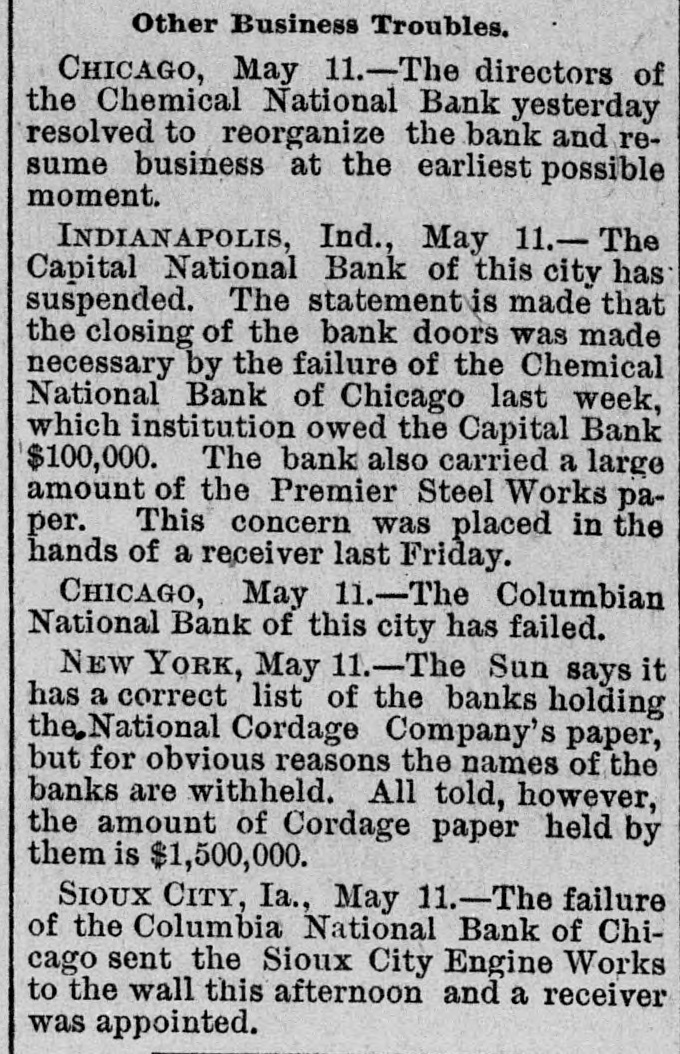
CHICAGO, May 11.-The - directors of the Chemical National Bank yesterday resolved to reorganize the bank and resume business at the earliest possible moment. INDIANAPOLIS, Ind., May 11.- - The Capital National Bank of this city has suspended. The statement is made that the closing of the bank doors was made necessary by the failure of the Chemical National Bank of Chicago last week, which institution owed the Capital Bank $100,000. The bank also carried a large amount of the Premier Steel Works paper. This concern was placed in the hands of a receiver last Friday. CHICAGO, May 11. - The Columbian National Bank of this city has failed. NEW YORK, May 11.-The Sun says it has a correct list of the banks holding the, National Cordage Company's paper, but for obvious reasons the names of the banks are withheld. All told, however, the amount of Cordage paper held by them is $1,500,000. SIOUX CITY, Ia., May 11.-The failure of the Columbia National Bank of Chicago sent the Sioux City Engine Works to the wall this afternoon and a receiver was appointed.
Click image to open full size in new tab
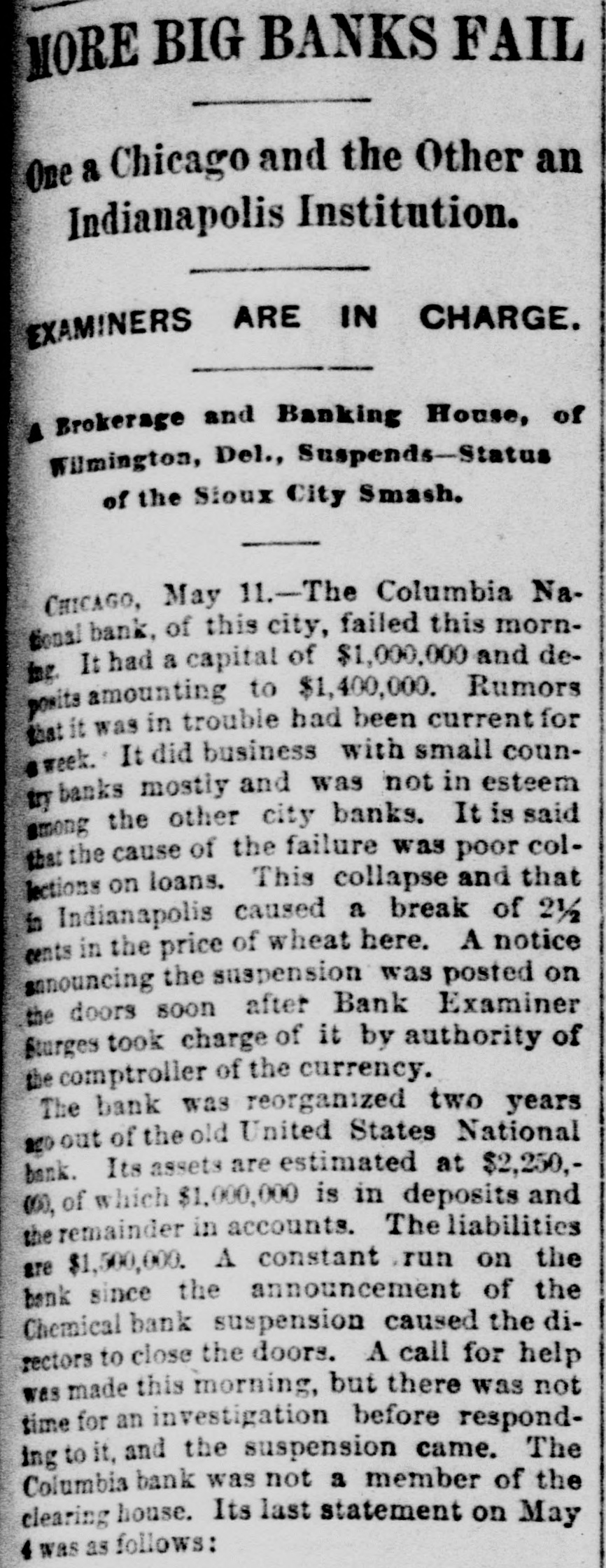
MORE BIG BANKS FAIL One a Chicago and the Other an Indianapolis Institution. EXAMINERS ARE IN CHARGE. Brokerage and Banking House, of Wilmington, Del., Suspends-Status of the Sioux City Smash. CHICAGO, May 11.-The Columbia Namorntonal bank, of this city, failed this It had a poxits it was in current that for amounting It did trouble capital business and to of had $1,400,000. $1,000,000 with been not small in Rumors and esteem coun- de- for banks was the the cause was poor that sweek mong try mostly other of the city failure banks. It is said collections on loans. This collapse and that in Indianapolis caused a break of 21/2 cents in the price of wheat here. A notice announcing the suspension was posted on the doors soon after Bank Examiner Sturges took charge of it by authority of the comptroller of the currency. The bank was reorganized two years ago out of the old United States National bank. Its assets are estimated at $2,250,(60, of which $1,000,000 is in deposits and the remainder in accounts. The liabilities are $1,500,000. A constant run on the bank since the announcement of the Chemical bank suspension caused the directors to close the doors. A call for help was made this morning, but there was not time for an investigation before responding to it, and the suspension came. The Columbia bank was not a member of the clearing house. Its last statement on May 4 was as follows:
Click image to open full size in new tab
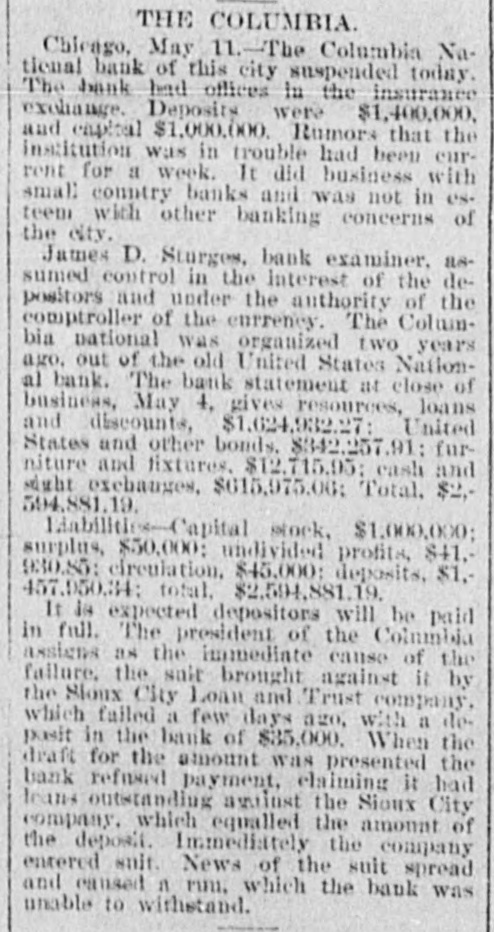
Chicago, May 11. -The - Columbia Na. tienal bank of this city suspended today. The bank had offices in the insurance exchange. Deposits were $1,400,000. and capital $1,000,000. Rumors that the institution was in trouble had been eurrent for a week. It did business with small country banks and was not in esteem with other banking concerns of the city, James D. Sturges. bank examiner. assumed control in the Interest of the depositors and under the authority of the comptroller of the currency. The Columwas ago. bia national out of the old United organized States two Nation- years al bank. The bank statement at close of and business, discounts, May 4, $1,024,932.27 gives resources, United loans States and other bonds. $342,257.91; furniture and fixtures. $12,715.95; cash and stight exchanges. $015,975.00 Total, $2. 594.881.19. Liabilitie Capital stock, $1,000,000; surplus, $50,000; undivided profits, $41. 930.85: circulation. $45,000: deposits. $1. 457.950.34: total, $2,594,881.19 It is expected depositors will be paid in full. The president of the Columbia assigns as the immediate cause of the failure. the suit brought against and Trust a the which Sloux failed City Loan few days ago, with company. it a de- by posit in the bank of $35,000. When the draft for the amount was presented the bank refused payment, claiming it had leans outstanding aguinst the Sioux City company. which equalled the amount of the deposit. Immediately the company entered snit. News of the suit spread and caused n run. which the bank was unable to withstand.
Click image to open full size in new tab
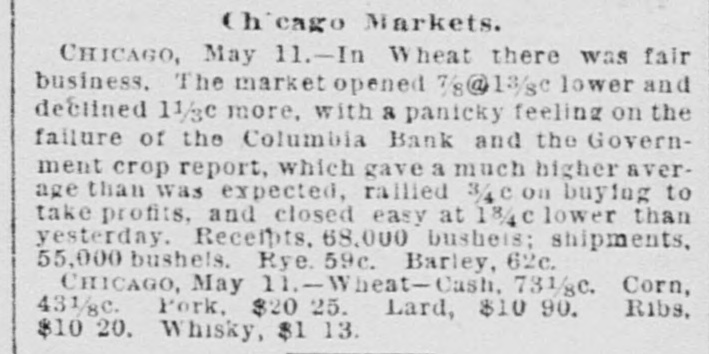
CHICAGO, May 11.—In Wheat there was fair business. The market opened 7/8@1 3/8c lower and declined 1 1/3c more, with a panicky feeling on the failure of the Columbia Bank and the Government crop report, which gave a much higher average than was expected, rallied 3/4c on buying to take profits, and closed easy at 1 3/4c lower than yesterday. Receipts, 68,000 bushels; shipments, 55,000 bushels. Rye, 59c. Barley, 62c.
CHICAGO, May 11.—Wheat—Cash, 73 1/8c. Corn, 43 1/8c. Pork, $20 25. Lard, $10 90. Ribs, $10 20. Whisky, $1 13.

Click image to open full size in new tab
A Number of Dwiggins's Small Banks Forced to Suspend.
MADISON, Wis., May 13.—The Bank of Oregon, established about a year ago by Dwiggins, Starbuck & Co., of Chicago, made an assignment yesterday, and its affairs were placed in the hands of Messrs. J. J. Lindsey and M. W. Terwilliger for settlement. The closing of the bank is due to the collapse of the Columbia National Bank, of Chicago. The assets are figured at $35,000; liabilities, $30,000, of which $25,000 is due depositors, who are nearly all business men of the village of Oregon.
CASEY, Ill., May 13. The Columbia National Bank is the principal stockholder in the Farmers' and Merchants' Bank in this city. The Farmers' and Merchants' made an assignment yesterday. The assets consisting of money, notes and fixtures are probably $16,000. The liabilities are uncertain, but it is thought will reach $25,000 or over.
KALAMAZOO, Mich., May 13.—The Union Bank, of Richmond, this county, did not open its doors yesterday, owing to its connection with the Columbian National Bank, of Chicago. Cashier Watts says he has an ample amount of cash and securities on hand to pay every cent. Zimri Dwiggins, of the banking firm of Dwiggins, Starbuck & Co., of Chicago, was a large holder in this bank.
LAWTON, Mich., May 13.—The village is greatly excited over the failure of the local bank yesterday. The managers have left town. The citizens have deposits amounting to $18,000 and are taking legal steps to realize something.
EDWARDSBURG, Mich., May 13.—The Citizen's Bank of this city has suspended payment. Dwiggins, Starbuck & Co., of the Columbia National Bank of Chicago, held a large share of the stock in it. The citizens of the place are interested to the extent of $25,000. Township school funds are also tied up. It is believed that depositors will be paid in full.
Click image to open full size in new tab
The failure of the Columbia National Bank in Chicago and the ruin thus brought upon the numerous small country banks connected with it are not calculated to encourage those looking for a brighter financial outlook. Nevertheless it is not believed the result presages a general panic. It appears that the greater number of these failures were directly due to the failure of the Columbian Bank.
Click image to open full size in new tab
Embarrassment of a Minneapolis Concern Believed To Be Temporary. MINNEAPOLIS, Minn., May 15.-The Northwestern Guaranty Loan Company is embarrassed owing to the financial stringency. The company's stock is $1,250,000. It owns a two million dollar building in which its offices are located and holds as collateral and in fee simple a large amount of real property here, in Chicago and elsewhere. Its business is the loaning of commercial paper on sufficient collateral and guaranteeing of the paper. It has three millions of this paper. The refusal of its patrons to take up or renew notes precipitated the trouble. If the company suspends it will not do so for several days. It is believed in business circles that ultimately the company will pay in full. Denver Business Man in Trouble. DENVER, May 15.-William S. Mygatt, a well known banker and business man, assigned today. He places his assets at at $591,860; liabilities, $507,889. He says he will pay dollar for dollar, and that the assignment was caused by eastern banks with which he has dealt for a long time, refusing to take securities they previously desired. Fires Embarrassed This Concern. PITTSBURG, Pa., May 15.-Godfrey & Clark, paper manufaturers, announced their failure today. They are the largest paper manufacturers in western Pennsylvania. The firm was unfortunate in having several times been burned out. The manager says they are preparing a statement. The Columbian National. CHICAGO, May 15. - The directors of the Columbian National Bank today resolved to resume business at an early date.
Click image to open full size in new tab
Obituary: At Burlington, Vt., Bishop W. H. A. Bissell; at Galena, Ills., Mrs. Margaret Rubens, aged 99 years; at Nunda, Ills., .C. Mallory, aged 83, the oldest Odd Fellow in the state. The Chinese government is said to have decided to deport all Americans from China in case the Geary law excluding Chinamen from the United States is carried into effect. Two members of the Salvation army arrested at Sioux City have confessed that they belong to a gang of counterfeiters. According to a Washington rumor Baby Ruth may soon have to surrender a portion of the White House nursery to an expected stranger. Before he sailed for home Paderewski sent a check for $500 to the fund for erecting a Polish monument in Chicago. George Lizotte and his wife, the latter a niece of Justice Harlan, have been on a wedding tour ever since their marriage in 1891. They like the life, and say they may continue it as long as they live. Thus far they have traveled 57,000 miles, and have visited almost every town of any size in North America. An explosion of gas in the mine of the Lincoln (Ills.) Coal company fractured the skull of Joseph Page, and injured several others. Went into the mine with naked lamps against the rules. Chief Arthur has filed his answer to the $300,000 damage suit against him by the Ann Arbor railway. He admits nothingexcept that the brotherhood has a boycott rule-and denies every allegation made by the plaintiff. The broad of directors of the Chicago Columbian National bank have resolved to resume business at an early date. President Dwiggins says that the statements published to the effect that the business done by the bank was not regular are false. A narional bank, he says, cannot be run on wind. The United States treasury will this week destroy $152,000,000 of unissued bonds. President and Mrs. Cleveland have taken possession of their summer residence near Washington. Nearly all the saloons at Muscatine, Ia., have been closed by injunctions. No clew to the dynamitards. The bank of North Queensland, Australia, with deposits of over $42,000,000 has suspended. It had a capital paid up of over $35,000,000. The Commercial Banking company, of Sydney, has also suspended. A female Dick Turpin is operating at New York. Her latest attempt was on a man whom she choked nearly to death be. fore he could overpower her.
Click image to open full size in new tab
Bank Suspended." That was the legend affixed to the door of the Columbia National Bank in Chicago, at 10 o'clock Thursday morning. Close by this announcement was another to the effect that, there having been a run on the concern for some time. it was deemed best to close the doors in order to protect the Interested parties A large crowd quickly gathered at the bank entrance of the building, but there was little surprise shown over the announcement. The fact is, according to a dispatch, banking circles have been expecting a suspension for some time past, and even the patrons of the bank have not looked upon it as a safe place for the keep. ing of their money.
Click image to open full size in new tab
The Columbian National Bank of Chicago closed its doors May 12. It is said to be a bad failure and not much surprise was expressed in financial circles at the suspension. Some eighteen or twenty small banks and firms of bankers in Illinois, Ohio, Michigan and Indiana, connected with this Chicago bank have also suspended creating quite a financial flurry in those states. There were about forty banks connected with the Columbian bank combination.
Click image to open full size in new tab
The Grecian cabinet has been com. pleted. The Columbian National bank, Chicago, will resume business. Quimper and Lorient have been officially declared free from cholera. Chilean mine owners are anxious to im port World's fair machinery after the exposition is over. As a result of the lumber shovers' strike, the docks of Buffalo and Tonawanda are crowded with vessels. William B. Mygatt, a broker and business man of Denver, Col., failed for $507,+ 889:35. His assets are placed at $591,806. In a quarrel W. A. Bisbee, city treasurer of Jacksonville, Fla,, cut ands eriously wounded C. F. Warriners, a prominent a to secure citizen, An effort with relaxation is being penknife. of made the quarantine a permanent regulations of the port of New Orleans against British Honduras. Nehr & Carpenter, eastern managers of the Northwestern Guaranty Loan company of Minneapolis, which is somewhat embarrassed, made an assignment. Senator Sherman denounces as an "outrageous lie" the statement of Dwiggins that the senator had examined and indorsed Dwiggins' banking scheme. The Farmers' and Merchants' State bank of Minneapolis suspended payment. It is a small concern, its paid-up capital being $60,000, and its surplus $7,000. The general secretary of the Christian Endeavor societies has notified President Palmer of the World's fair, that 1,500,000 members will oppose the opening of the fair on Sunday. Captain Higginson has been removed from the cruiser Atlanta for dilatoriness in sailing from Greytown to Nicaragua, and has been ordered home. Captain Bartlett succeeds him. The private car in which President Lincoln made many journeys, will be exhibited at the World's fair, having been used for many years as the work car on the Colorado Central railroad. A convention has been signed between Brazil and France for the appointment of 'a mixed commission to settle the dispute between the two republics over the boun dary between Brazil and French Guiena Mrs. J. E. Clogh, wife of the well known Baptist missionary, inet with a in a which closed killed frightful by death folding bed, Chicago. She upon was her, while her daughter stood by powerless to prevent. Members of the Indiana Civil Service Reform association have called the attention of the president and postmaster general to the disregard of civil service reform methods under the new administration of the been city a Consternation Terre of Valencia Haute has postoffice. by dynamite created outrage, in the apparently intended to strike terror into the aristocratic families of that city. The affair is attributed to the anarchists, who are once more becoming active in Snain
Click image to open full size in new tab
SIOUX CITY, Ia., May 12.-The announcement of the failure of the Columbia National bank of Chicago sent the Sioux City engine works to the wall, and W. M. Thompson was appointed receiver for the company. He qualified under a $50,000 bond.
Click image to open full size in new tab
MISERY loves company, so we of Columbia, who have "been through the mill" ourselves are able to bear with equanimity the numerous bank failure+ that have been occurring at other places It makes us feel that it is not in Columbia alone, or in Tennessee alone that there is friction in the financial machinery. But it is worthy of remark all the same, that the other numerous bank suspensions seem to result more from the fact that a general lack of confidence has caused such a withdrawal of funds that a really temporary suspension was advisable, and that they are not permanent. Toe Columbia Bank of Chicago and the bank in Indianapolis are both expected to resume business in a few days. In other words the money does not seem to be all gone, or exchanged for collateral of little or n value.
Click image to open full size in new tab
Public attention has generally been directed to the failure of the Columbian National Bank of Chicago, as well as the closing of a number of small branches of that short lived establishment. Despatches from Chicago inform us, that the failures are attributable to the "inexperience of the officials in the conduct of banking affairs." If there had been no other reasonable explanation of these failures, the public might have understood the case. East as well as West, there are scores of men of varying ages and of very limited experience as financiers, conducting banks, who vainly imagine them selves expert banking men, and with some of whom rascality has supplied the place of experience. They are a speculative class of gentlemen, who establish banks which can be more properly designated "shaving shops" organized upon the get-rich quick principle, of which the Keystone Bank of Philadelphia and other kindred financial (?) institutions are notorious examples. In Chicago the speculative fever, always at the high est, has been wonderfully stimulated by the development of property in the vicinity of the World's Fair grounds, and these "inexperienced" speculative financiers have of course opened banks in that locality, which it hasn't taken the depositors very long to discover were of the truly speculative character. The despatches do not inform I'S in what direction the "inexperience" of the bank managers ran, but it seems that one depositor in the Columbian Bank "scented danger," and suspecting the true character of their inexperience (?) withdrew $100,000 from the bank in a lump, and although its nominal capital exceeded that amount many times, it appeared to have no other resources, and promptly closed its doors. The career of the Columbian Bank emphasizes the fact that in addition to individual honesty in its managers, to be a successful banker in these times, requires as careful an apprenticeship or training as any other avocation or profession. They seem to have imagined that anybody could run a bank, and to have made an experiment in that line, which was at least highly interesting to the depositors.
Click image to open full size in new tab
About a dozen small country banks in Illinois, In diana, Ohio and Michigan, the most of them connected with the failed Columbia National Bank of Chicago, have suspended business.
Click image to open full size in new tab
Last week seven banks in Indiana suspended business, three in Ohio failed, and five in Michigan and one in Illinois closed doors. Their disaster is due to connection with the Columbia National Bank of Chicago, which suspended Thursday.
Click image to open full size in new tab
The Plankinton Bank Opens Again-Several Small Banks Close. Minneapolis, Minn., May 5.-The Northwestern Guaranty Loan Company is now in an embarrassed condition owing to financial stringency. The company is about ten years old and its capital stock is $1,250,000. It owns the $2,000,000 building in which its offices are located and holds as collateral and fee simple a large amount of rael estate here in Chicago and elsewhere. The Farmers' and Merchants' State bank has suspended payments. While the bank is it very small one, its paid up capital being but $60,000 and its surplus about $7,000, it has been looked upon as weak for some time and no surprise is caused by the suspension, which it is believed will prove temporary. It should be noted that this is not the Farmers' and Mechanics' Savings bank, which is perfectly solvent. The Plankinton All Right Again. Milwaukee, Wis., May 15.-The Plankinton bank, upon which there was a run Saturday, opened its doors at 9 o'clock a. in. today, one hour earlier than usual. Great Surprise at Another Suspension. Minneapolis, May 17.-A good deal of surprise was manifested this morning when the Citizens' bank suspended payment. The notice on the door says that depositors will be paid in full. Depositors declare that the bank is perfectly solvent and that the suspension is due simply to the inability to realize promptly on its securities. The Citizens' is one of the smallest state banks of this city. Its books at the close of business, May 14th, shows loans and discounts, $478,844; cash on hand and due from banks, $60,000; deposits, $283,913; surplus and profits, $16,000; rediscounts, $76,000. The capital is $250,000. The suspension is at the worst only temporary. There has been no run on the bank and the action was taken to protect all depositors alike. A Redding special to The Journal says: The bank of Zumbrota, at Zumbrota, Goodhue county, Minnesota, has suspended payment. It had $30,000 in cash on hand at the time of suspension, but its load of $80,000 in paper was too heavy. Its capital stock is $250,000. Depositors, it is said, will be paid in full. Will Resume Business. Chicago, III., May 15.-A meeting of the board of directors of the Columbian National bank was held today, all but one director being present. After a full discussion of the affairs of the bank it was unanimously resolved to resume business at an early day, and committees were appointed to perfect the plan outlined and to immediately carry it into effect.
Click image to open full size in new tab
Wm. C. Niblack has been appointed receiver of the defunct Columbia National bank at Chicago.
Click image to open full size in new tab
He and His Partner Again Have to Answer For Fraud. TOLEDO, March 2.-Zimri Dwiggins, president of the wrecked Columbia bank of Chicago, and his partner, Starbuck, were made the defendants of a second edition of charges in connection with the defunct bank at Elmore, O. Action was brought in the United Niblack, States court here by Wm titution, receiver of the Chicago against S. W. Reed, assignee of the Ottawa bank of Elmore, on a cross bill in
Click image to open full size in new tab
William C. Niblack, receiver for the Columbia National Bank of Chicago, yesterday filed suits in the United States Circuit Court against Conrad H. Zeis and G. K. McComas to collect assessments due the insolvent institution. The defendants live in the northern part of the State. Both were stockholders in the Columbia Bank, and it is alleged that they have refused to settle their share of the assessment. Judgment is asked for $4,000 in each suit.