Chemical National Bank (Chicago, IL)

Episode Information

Episode UID
466601121
Episode Type
Run โ†’ Suspension โ†’ Closure
Bank Type
national
Bank ID
46660 national
Charter Number
4666
Start Date
May 8, 1893
Location
Chicago, Illinois (41.850, -87.650)

Metadata

Model
gpt-5-mini (chosen from majority vote of a three-model LLM ensemble)
Short Digest
bc698748b8d36fb2

Response Measures

Accommodated withdrawals, Public signal of financial health, Capital injected, Full suspension, Books examined

Clearinghouse involved: Yes (loan, examination, or other measures)

Receivership Details

Depositor recovery rate
100.0%
Date receivership started
1893-07-21
Date receivership terminated
1900-05-02
OCC cause of failure
Fraud
Share of assets assessed as good
47.0%
Share of assets assessed as doubtful
30.3%
Share of assets assessed as worthless
22.7%

Events (5)

1. December 15, 1891 Chartered
Source
historical_nic
2. May 8, 1893 Run
Cause
Bank Specific Adverse Info
Cause Details
Extraordinary heavy withdrawals following poor loans/management and adverse suits/news exhausted funds and triggered runs.
Measures
Applied to Clearing House for assistance (refused); bank officers attempted to secure funds; national bank examiner assumed control.
Newspaper Excerpt
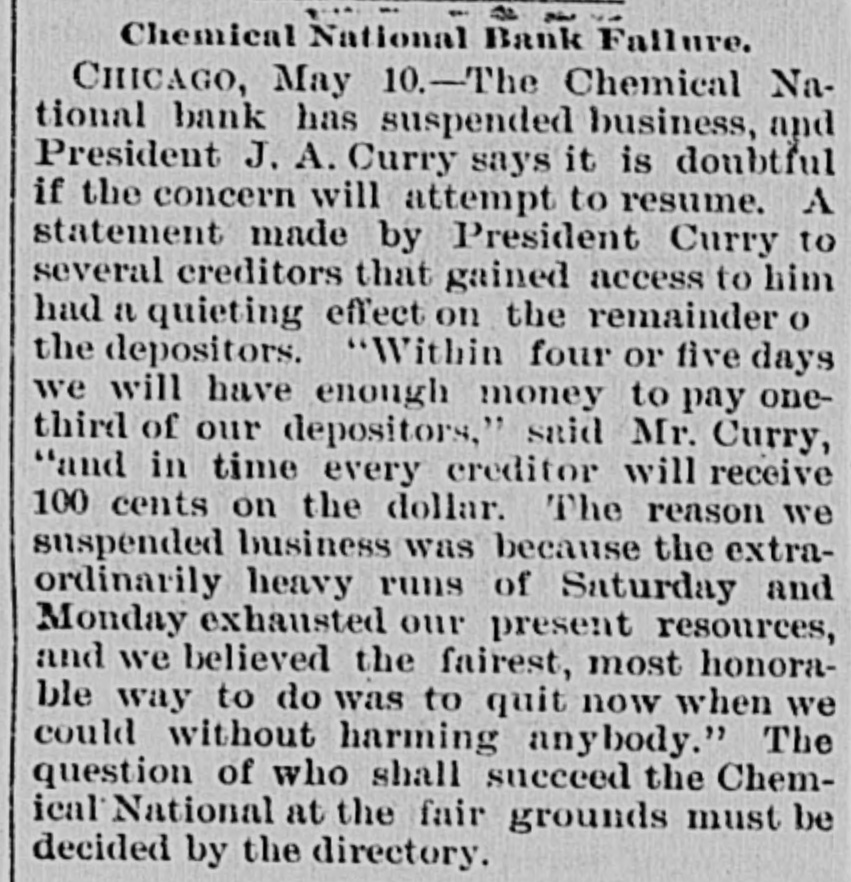
Heavy runs of Saturday and Monday were the cause of suspension; had they had two days more they would have tided over the difficulty.
Source
newspapers
3. May 9, 1893 Suspension
Cause
Bank Specific Adverse Info
Cause Details
Directors suspended after clearing house refused assistance and examiner took charge following runs and asset/liability concerns.
Newspaper Excerpt
The business of the Chemical National bank of Chicago has suspended and I am in possession in the interests of the comptroller of the currency. James D Sturgiss, National bank examiner.
Source
newspapers
4. July 20, 1893 Receivership
Newspaper Excerpt
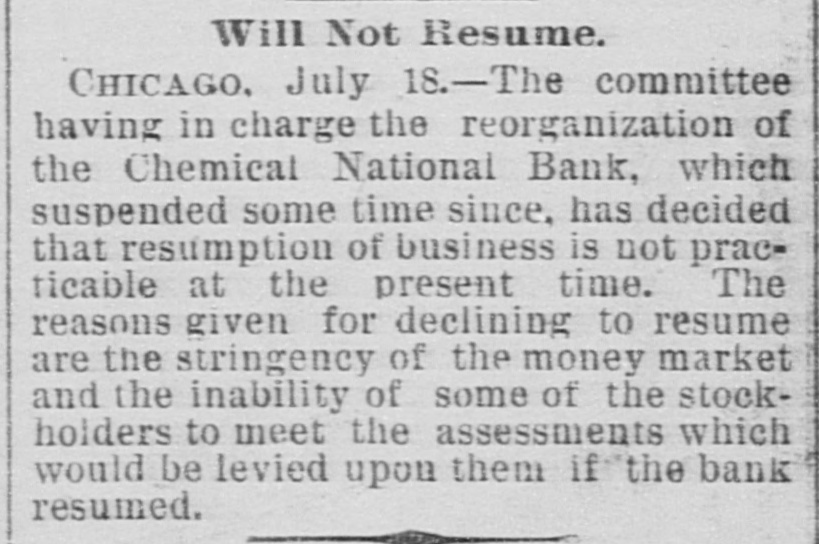
The committee of the stockholders of the Chemical National Bank of Chicago has concluded that resumption is not practicable at this time; Comptroller Eckels's efforts to secure a reopening ... have failed; receiver appointed later by Comptroller Eckels in July.
Source
newspapers
5. July 21, 1893 Receivership
Source
historical_nic

Newspaper Articles (25)

Article from Asheville Daily Citizen, May 9, 1893

Click image to open full size in new tab

Article Text

A TOO COMPLETE FAIR SUYPENDED BANK IN CHICAGO'S GREAT SHOW. , An Aitraction Not Promised. But Chicago Bound to Get Every. thimg-Another Big Failure in E Australla and One in Vienna. e WORLD'S FAIR GROUNDS, CHICAGO, . May 9.-Among the exhibits at the exposition today was a national bank ) under suspension. The exhibit was not a pleasing one in the eyes of foreigners who had money on deposit, but fears of not getting it back are unfounded. The World's Fair branch of the Chemical National bank of Chicago, now in the : hands of Uncle Sam, usually opened its doors on the second floor of pavilion D, Administration building, at 9 o'clock. At 9:25 came a telephone message from Cashier Baden at the down town office of the suspended bank, to close the doors of the exposition branch. This was done and soon there was a line of anxious, complaining depositors, some representing themselves, and others States or concerns. They wanted to get in close touch to the teller's window, but he talked to those who understood English in a reassuring way and some went away. The paying teller said he would have paid checks presented before the doors were closed, but had not the combination to the vault. Treasurer Seaberger of the exposition was an early caller. He said he had a small account with the bank, but was confident every depositor would be paid in full and quickly. The question of a successor to the Chemical National bank at the Fair is one to be decided by the directory at its meeting. The United States government, the national commission, the Missouti board and other states have money in the bank. The Chemical bank paid $10,000 for the privilege of doing business in the World's Fair grounds. It has always done a good business. CHICAGO, May 9.-The doors of the Chemical National bank did not open I for business this morning. This notice 1 was posted on the door of the bank: "The business of the Chemical National 1 bank of Chicago has suspended and I am in possession in the interests of the comptroler of the currency. James D Sturgiss, National bank examiner." E MELBOURNE, May 9 -The bank of Victoria, limited. has suspended. According to the balance sheet last December the deposits amounted to over $35,000,000. The failure is of great importance. The bank had several branches, and its London office at No. 28 Clements Lane, E.C., subscribed to the capital of I the Bank of Victoria, $600,000. The 4 liabilities are about double that amount. VIENNA, May 9.-The firm of Brueder & Wolff. manufacturers of carpets, have failed. The liabilities are stated to be I 1,000,000 florins. o ASHLAND, Ky., May 9.-Thompson 1 Bros, railroad contractors, assigned yess terday with assets $75,000, liabilities $40,000. ROCHESTER, N. Y., May 9.-H. H. o Warner has made an assignment.


Article from New-York Tribune, May 9, 1893

Click image to open full size in new tab

Article Text

A WORLD'S FAIR BANK SUSPENDS. THE CHEMICAL NATIONAL OF CHICAGO CLOSES ITS DOORS-ITS DEPOSITS AMOUNT TO $1,400,000. Chicago, May 8.-The Chemical National Bank of this city, which established a branch at Jackson Park, where the World's Fair concessionatres have been depositing their cash, closed Its doors to-day. It is hoped that the assets will satisfy the liabilities, but nothing definite In this respect could be discovered by National Bank Examiner Sturges to-night. who was asked to take charge of the affairs of the institution. The bank was not a member of the Clearing House, but at a late hour made application to the Clearing House Committee for help. Being unable to satisfy the committee as to its solvency. the committee decided to render no assistance. There was nothing left to do but to suspend. The bank has turned over to the Equitable Trust Company of this city bills receivable to the face value of $147,000 to secure deposits at its World's Fair branch amounting to $104, 000. Beyond repeating that the "breathing spell" needed had not been vouchsafed, President Curry was indisposed to discuss the failure. "One thing is certain," he said, "neither our customers nor any other bank is going to get hurt. Our lcans may be slow, but they are sound." An officer of the National Bank of Illinois, through which the Chemical cleared, said to-night that the deposits in the Chemical up to date would aggregate about #1,400,000. The Chemical National Bank something more than a year ago assumed the business of the Chicago Chemical Bank, which was a State Institution. The Chicago Chemical Bank was established three years ago. with offices at No. 85 Dearborn-st. Adlai T. Ewing was president of the bank. When the Institution was merged in the Chicago National Chemical Bank. J. O. Curry, president of the Merchants' National Bank of Aurora, became president of the new bank. E. C. Veasey was first vice-president. Subsequently Mr. Veasey dropped out and Mr. Ewing took his place as first vice-president. The branch of the bank located at the World's Fair Grounds, which has the exclusive privilege of the banking basiness at the World's Fair, has been thoroughly secured. it is said, by the officers and directors of the main branch. The capital stock of the bank is $1,000,000.


Article from The Herald, May 10, 1893

Click image to open full size in new tab

Article Text

NOT A BAD FAILURE. The Chemical National Bank will Pay Dollar for Dollar. CHICAGO, May 9.-As soon as the news of trouble in the affairs of the Chemical National bank became known at the world's fair grounds, this morning, anxious crowde gathered around the branch of the bank, which is the official bank of the world's fair, and located in the administration building. The bank doors, however, were tightly closed, and nobody could learn anything as to the prospects of getting money, though simultaneously with the notice of the difficulty in which the bank was placed, it was said the depositors in the branch had been fully served. It was a quiet crowd, most of the depositors being Americans, but some foreign depositors animadverted somewhat severely on the exposition management for giving official sanction to the bank which they took for a guarantee. The cashier of the branch had gone to the main bank to consult with the afficials, and till he returned no one at the branch could get any information. It appears that some foreigners deposited in the main bank down town, which complicates matters. As anticipated, the main bank also closed doors. The capital of the bank is $1,000,000. It has deposits something over $900,000. The bank is not a member of the clearing house. The failure had no effect in financial circles. Poor judgment in making loans and the monetary stringency are the cause of the failure. Bank Examiner Sturges said it is not e bad failure, but from what he knows 80 far thinks it is a complete one, to the point that resumption of business is not at all likely, He gave assurance that the depositors would not lose anything. President Curry said the depositors would receive 100 cents on the dollar, and within four or five days could be paid at least one-third of their claims. Heavy runs of Saturday and Monday were the cause of suspension; had they had two days more they would have tided over the difficulty. The general opinion among financial men is that the trouble came through bad management and poor investments. The world's fair directors have made ample provision for the payment of all the foreign commissioners and foreign exhibitors who had deposted funds in the world's fair branch of the bank. They will be paid in full and at once from the assests of the bank. In addie tion to this 30 Chicago men, representy ing as may millions of capital, have pert sonally guaranteed the payment of all President Higinbotham of the local t world's fair directory, and President e Palmer of the national commission de0 clare the management has done nothing to make the world's fair responsible for the debts of the Chemical National bank. WASHINGTON, May 9.-The failure of the Chemical National bank of Chicago was not unexpected here, in view of the recent report of the examiner.


Article from The Wilmington Daily Republican, May 10, 1893

Click image to open full size in new tab

Article Text

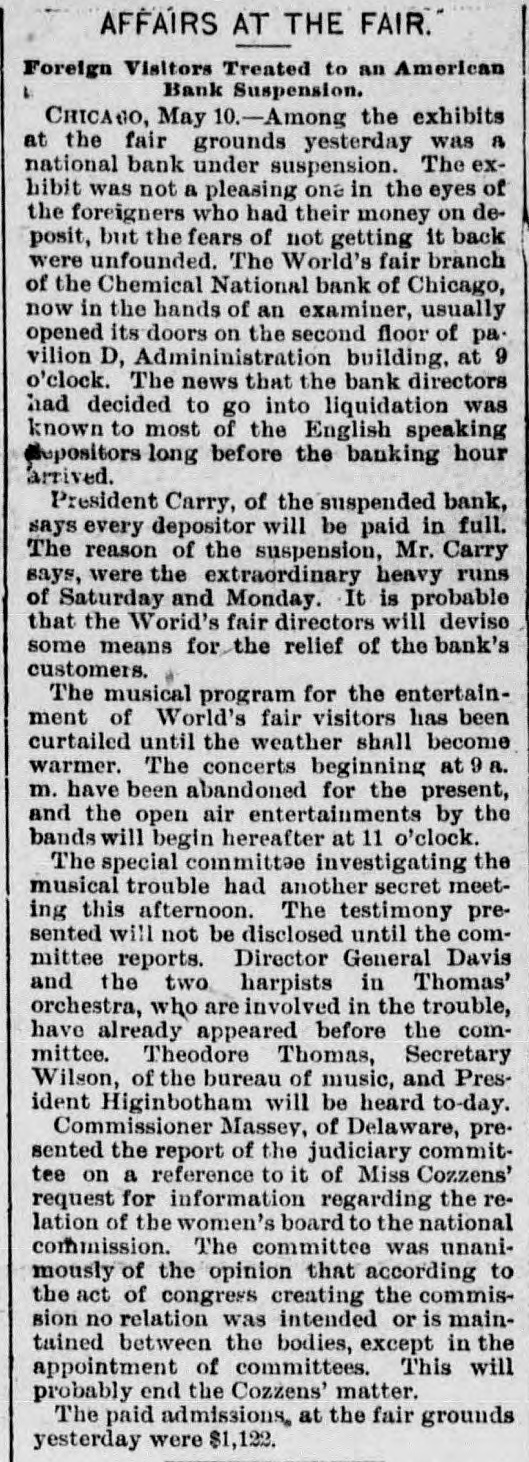
AFFAIRS AT THE FAIR. Foreign Visitors Treated to an American Bank Suspension. CHICAGO, May 10.-Among the exhibits at the fair grounds yesterday was a national bank under suspension. The exhibit was not a pleasing one in the eyes of the foreigners who had their money on deposit, but the fears of not getting it back were unfounded. The World's fair branch of the Chemical National bank of Chicago, now in the hands of an examiner, usually opened its doors on the second floor of pavilion D, Administration building, at 9 o'clock. The news that the bank directors had decided to go into liquidation was known to most of the English speaking depositors long before the banking hour arrived. President Carry, of the suspended bank, says every depositor will be paid in full. The reason of the suspension, Mr. Carry says, were the extraordinary heavy runs of Saturday and Monday. It is probable that the Worid's fair directors will deviso some means for the relief of the bank's customers. The musical program for the entertainment of World's fair visitors has been curtailed until the weather shall become warmer. The concerts beginning at a. m. have been abandoned for the present, and the open air entertainments by the bands will begin hereafter at 11 o'clock. The special committee investigating the musical trouble had another secret meeting this afternoon. The testimony presented will not be disclosed until the committee reports. Director General Davis and the two harpists in Thomas' orchestra, who are involved in the trouble, have already appeared before the committee. Theodore Thomas, Secretary Wilson, of the bureau of music, and President Higinbotham will be heard to-day. Commissioner Massey, of Delaware, presented the report of the judiciary committee on a reference to it of Miss Cozzens' request for information regarding the relation of the women's board to the national commission. The committee was unanimously of the opinion that according to the act of congress creating the commission no relation was intended or is maintained between the bodies, except in the appointment of committees. This will probably end the Cozzens' matter. The paid admissions, at the fair grounds yesterday were $1,122.


Article from The Morning Call, May 10, 1893

Click image to open full size in new tab

Article Text

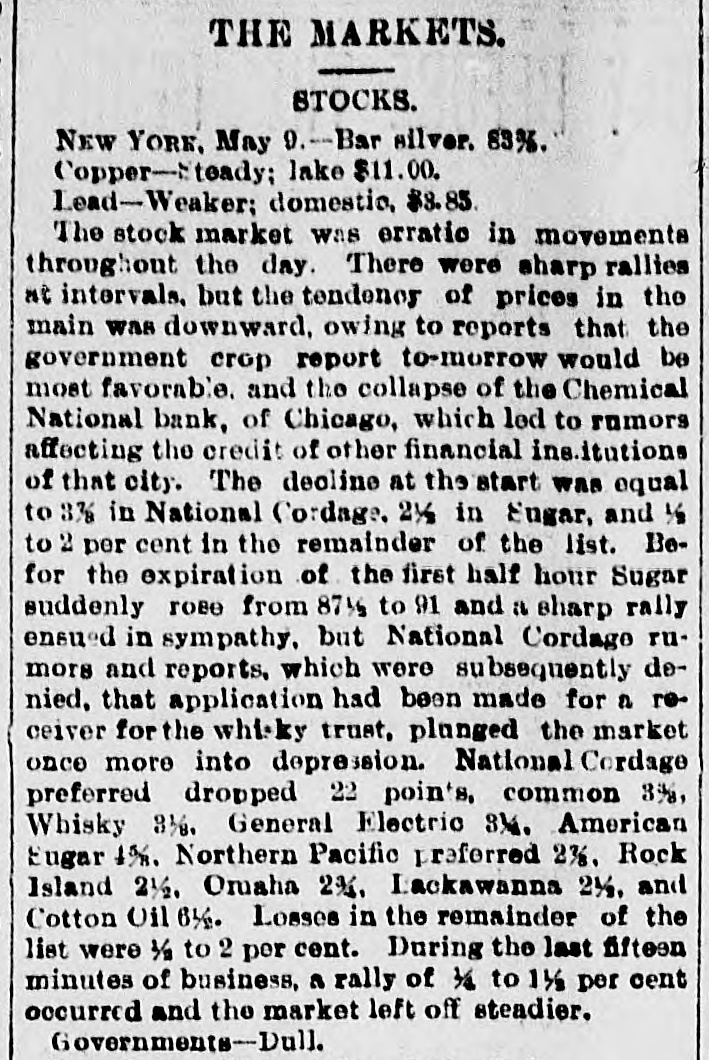
NO FAITH IN GOULD. Wall Street Has Taken One More Slump. Missouri Pacific Was Weak and There Were Damaging Stories About the Whisky Trust. Special to THE MORNING CALL NEW YORK, May 9.-In the face of heavy Gould buying the comparative weakness of Missouri Pacific is not accounted for except on the theory of forced. liquidation and short selling. George Gould is reported to have remarked last week: "If the Missouri Pacific is not worth 40 it is not worth anything." From the course the stock has taken it is evident that the street has not made up its mind on the matter. The stock market was erratic in its movements throughout the day. There were sharp rallies at intervals, but the tendency of prices in the main was downward, owing to reports that the Governnient crop report to-morrow will be most favorable, and to the collapse of the Chemical National Bank of Chicago, which led to rumors effecting the credit of other financial institutions of that city. The decline at the start was equal to 3% in national cordage, 21/2 in sugar and 1/3 percent in the remainder of the list. Before the expiration of the first half hour sugar suddenly rose from 87 1/2 to 91, and a sharp rally ensued in sympathy, but national cordage rumors and reports. which were subsequently denied, that an application had been made for a receiver for the whisky trust plunged the market once more into - depression. National cordage preferred dropped 22 points, common 43/8. whisky 31/8. general electric 31/4. American sugar 45, Northern Pacific preferred 2% Rock Island 2 1/2, Omaha 23/4, Lackawanna 2 1/2 and cotton oil 6 1/2. The losses in the remainder of the list were from 1/2 to 2 per cent. During the last fifteen minutes of business a rally of from 1/4 to 1 1/2 per cent occurred, and the market left off steadier. Government bonds dull; petroleum firm at 583/4 and 59 asked. Charles L. Atterbury, counsel for the National Cordage Company, said to-day that an investigation into the affairs of the company had reached a point which enabled him to sav that reorganization seemed assured. The conferences had with bankers have been confined thus far exclusively to the business of the central company, and the conditions of subsidiary firms and private individuals have not yet been taken up. The plans at present did not contemplate the absorption or inclusion of any other cordage manufacturing company. As to the issue of bonds or the assessment of stock nothing could be said, nor could the names of the proposed reorganization committee be given out. The receivers of the Cordage Company, directors and others interested in its affairs had a number of conferences to-day, and as a result it is understood that Drexel, Morgan & Co. will take steps with view to the reorganization of the company's affairs. Unless a reorganization is determined upon the indications are that cordage will be wiped out of the Stock Exchange. The governors of that institution are not at all pleased with recent developments.


Article from The Madison Daily Leader, May 10, 1893

Click image to open full size in new tab

Article Text

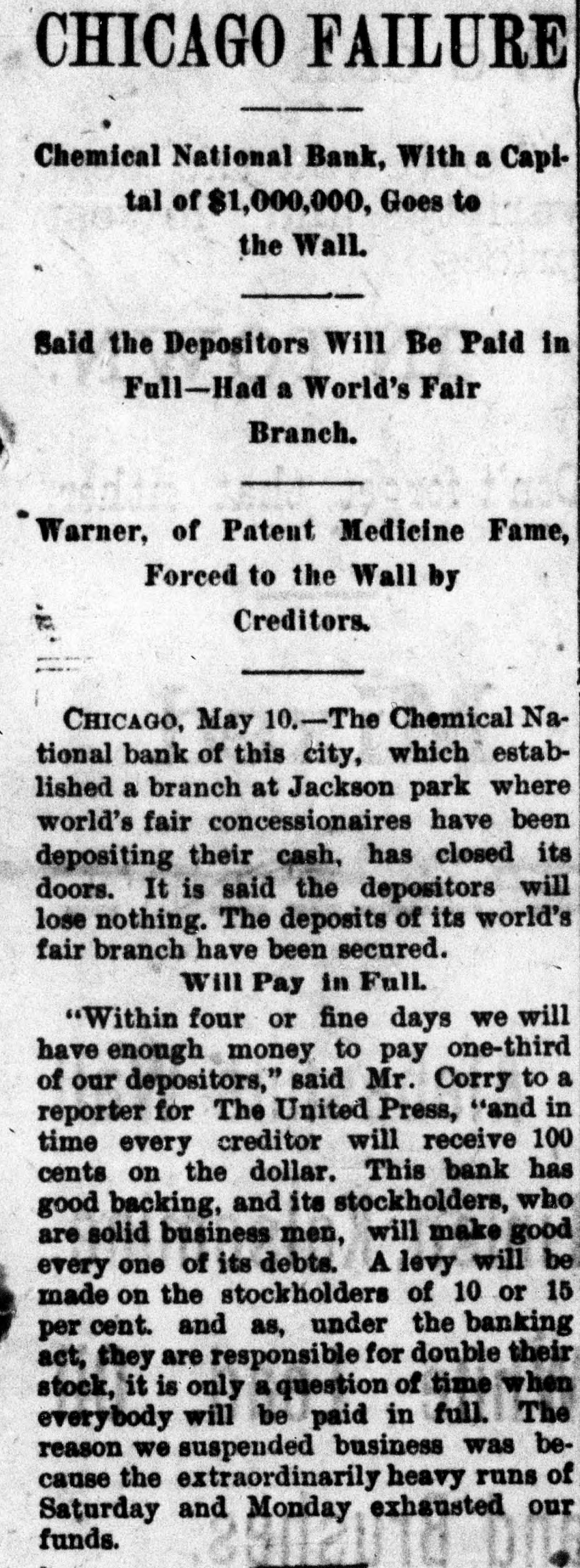
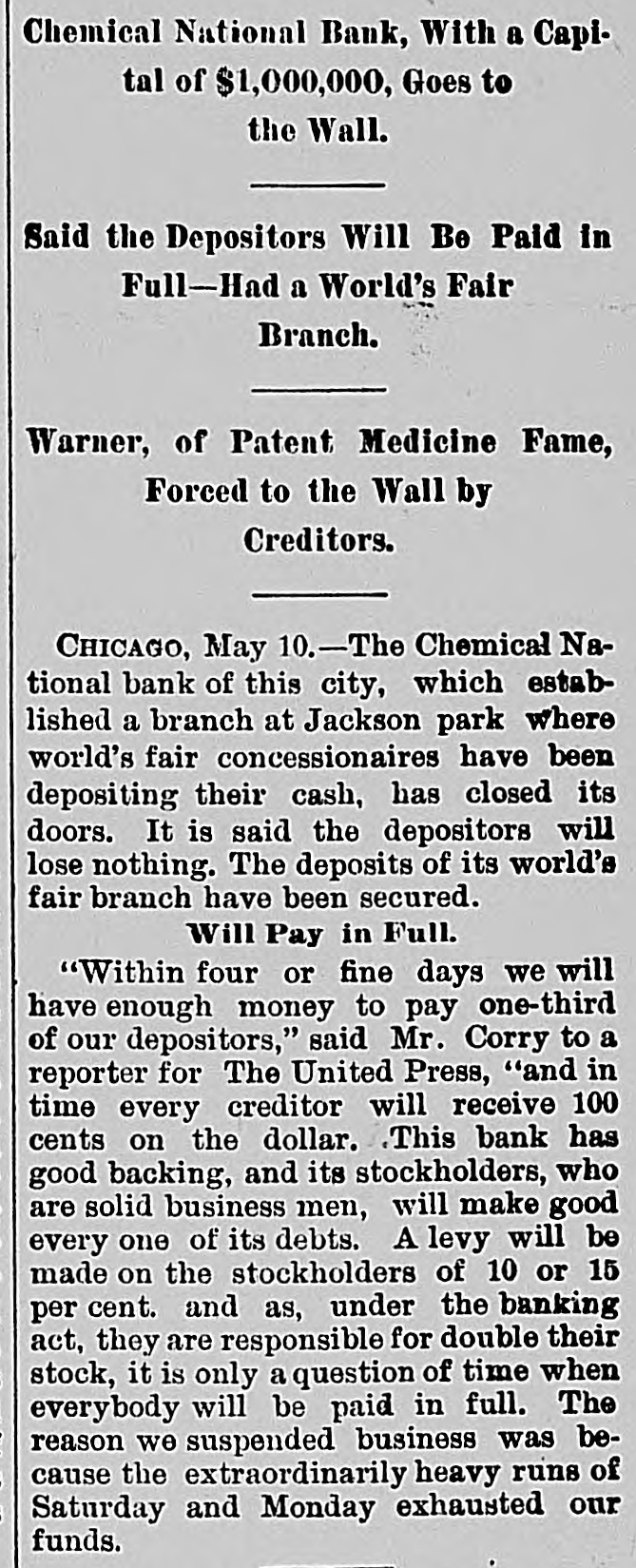
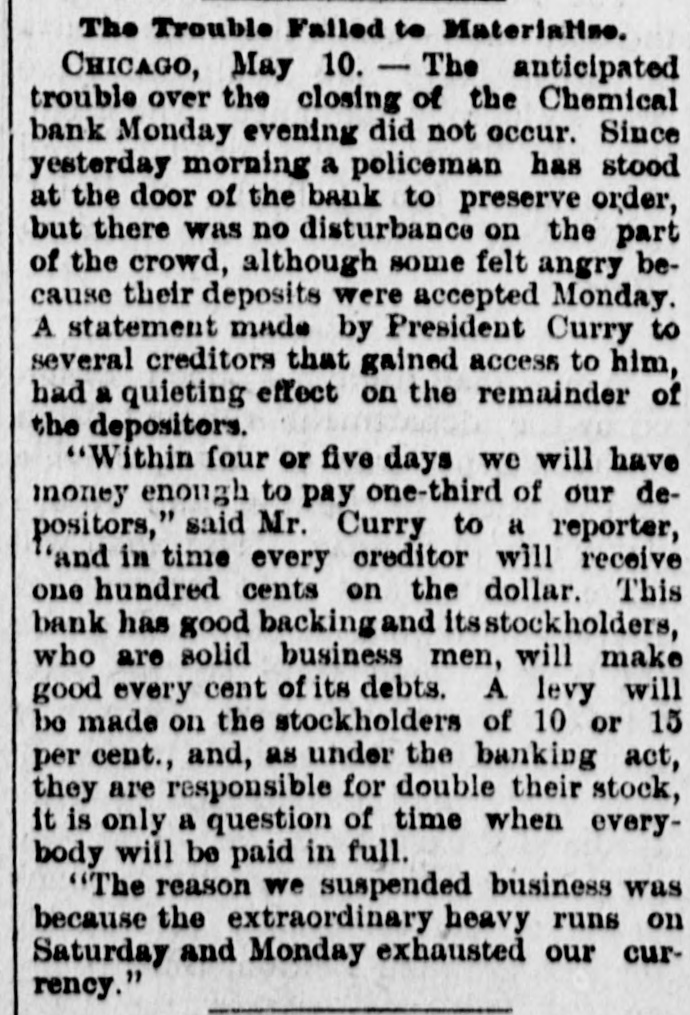
CHICAGO FAILURE Chemical National Bank, With a Capital of $1,000,000, Goes to the Wall. Said the Depositors Will Be Paid in Full-Had a World's Fair Branch. Warner, of Patent Medicine Fame, Forced to the Wall by Creditors. CHICAGO, May 10.-The Chemical National bank of this city, which established a branch at Jackson park where world's fair concessionaires have been depositing their cash, has closed its doors. It is said the depositors will lose nothing. The deposits of its world's fair branch have been secured. Will Pay in Full. "Within four or fine days we will have enough money to pay one-third of our depositors," said Mr. Corry to a reporter for The United Press, "and in time every creditor will receive 100 cents on the dollar. This bank has good backing, and its stockholders, who are solid business men, will make good every one of its debts. A levy will be made on the stockholders of 10 or 15 per cent. and as, under the banking act, they are responsible for double their stock, it is only a question of time when everybody will be paid in full. The reason we suspended business was because the extraordinarily heavy runs of Saturday and Monday exhausted our funds.


Article from St. Paul Daily Globe, May 10, 1893

Click image to open full size in new tab

Article Text

DOORS CLOSED TIGHT. Chemical National of Chicago Did Not Open for Business. CHICAGO, May 9.--As anticipated from the fact that a government bank examiner had practically assumed control, and that an appeal for assistance had been refused by the clearing house association, the Chemical National bank did not open for busit ness. The Chemical has the banking con+ cession at the world's fair grounds, and an office in the administration building. Jackson park. The world's fair branch was also closed this morning and a crowd of anxious exposition depositors stood before the doors. The bank's capital was $1,000,000. Its officers are . C. Currie, president; E. C. Veasey and A. T. Ewing, vice presidents.j Poor judgment in making loans and the stringency of the money market are given as causes of the failure. The ded posits amount to a trifle ever $900,009. It is expected that the depositors will be paid in fuil. The Chemical was not a member of the Clearing House associ ation. SAN FRANCISCO, May 9.-Failure of the State Investment and Insurance company, of this city, which was tele, graphed on May 5, appears to be complete. L. P. Drexler, of this city, has begun suit to recover $10,000 loaned to the company, and this, in view of the company's finances, will throw it into bankruptcy and effectually wind up its affairs. It IS admitted that the company has no funds, and that it owes, as originally stated $100,000 of unpaid losses, and $100,000 more for money borrowed on its stock.] Besides this actual indebtedness, the, company is responsible for unearned premiums admitted to aggregate $268.ยฅ 000. The principal item of assets is $260,000 of outstanding premiums, but it is stated that not to exceed one-fourth of this amount is collectible. Nearly all of the company's remaining assets have been hypothecated to effect loans. NEW YORK, May 9.-H. H. Warner's attorney, Mr. Briggs. says that Mr. Warner's liabilities will amount to several hundred thousand dollars. Busi ness men estimate them at $500,000. His assets consist of his interest in the Hi H. Warner company of London, the H. H. Warner company of Rochester? the Industrial and Mining Guaranยฎ tee company, of New York, and other concerns. He owns 41,000 shares out of a total of 55,000 shares of the Warner company, of London, the capital stock of which is $2,000,000. HIs holdings in other companies are not SO large. War-l ner's homestead and other pieces of real estate are under mortgage of $1,000,000 to the Bank of Monroe County. COLUMBUS, o, May 9.-L. Ritson son-in-law of the late John C. Thomp son, wholesale and retail dealer in boots and shoes, assigned today for $40,000. Assets $35,000 in stock and $10.000 iu book accounts. NEWARK, N. J., May 9.-Fred Ki Day, of Elizabeth, and Herman Clark, of New York, were this morning ap+i pointed permanent receivers of the United Paper company by Vice Chang cellor Van Vleet. The principal credit ors of the company were announced to be E. Lamontague, Jr., E. M. Fulton and Wallace B. Smith, who are all connected with the National Cordage trust


Article from St. Paul Daily Globe, May 10, 1893

Click image to open full size in new tab

Article Text

FINANCIAL New York. NEW YORK, May 9.-The stock market was erratic in its movements throughout the day. There were sharp rallies at intervals, but the tendency of prices in the main was downward, owing to reports that the government crop report to be issued tomorrow will be most unfavorable, and the collapse of the Chemical National bank of Chicago. which led to rumors affecting the credit of other financial institutions of that city. The decline at the start was equal to 37/8 in National Cordage, 21/2 in Sugar, and 1/2 to 2 per cent in the remainder of the list. Before the expiration of the first half-hour, American Sugar suddenly rose from 871/2 to 91, and a sharp rally ensued in sympathy, but the closing of the National Cordage transfer books, the rumors that the amount of the company's paper outstanding was far in excess of recent estimates and reports, which were subsequently denied, that application had been made for a receiver for the Distilling and Cattle Feeding company, plunged the market once more into depression. As compared with the final quotations of yesterday, National"Cordage preferred dropped 22 points to 38, common 43/6 to 121/2; Distilling and Cattle Feeding. 31/6 to 181/2; General Electric, 51/4 to 758/4: American Sugar, 45/8 to 85%; Northern Pacific preferred, 21/9 to 345/; Rock Island, 21/2 to -7034 Omaha, 23/4 to 433/4; Lackawanna, 21/2 to 13014 and America Cotton Oil, 61/2 to 331/2. The losses to the remainder of the list were 1/2 to 2 per cent. The lowest quotations were touched after delivery hour. During the last fifteen minutes of business a rally of 1/4 to 11/2 per cent occurred, and the market left off steadier in tone at the rally. The borrowing demand was unusually active, showing that an extra large short interest exists. Cordage preferred and Burlington & Quincy commanded 1/8 per diem for use, and Western Union, Rock Island, General Electric, St. Paul and Louisville & Nashville lent flat. The Total Sales of Stocks


Article from The Seattle Post-Intelligencer, May 10, 1893

Click image to open full size in new tab

Article Text

MINING STOCKS. Belcher 10 1 30 Caledonia Best & Beicher 35 1 50 Challenge Con Chollar 10 1 10 Con. New York Consolidated Va 35 2 40 Crown Point 10 80 Gould & Curry Exchequer 05 Hale & Norcross 1 00 Grand Prize Peer 05 10 Julia Potosi 15 Justice 2 65 15 Kentuck 2 45 Ophir 15 1 00 Mono Savage Sierra Nevada 70 1 1 85 Mexican Union Con 15 1 15 Occidental 25 Yellow Jacket Overman 1 05 20 10 Alpha Con Seg Belcher Alta 05 10 Scorpion Andes 05 4, Silver Hill 20 Bullion 40 Utah EASTERN MARKETS. NEW YORK STOCK EXCHANGE. NEW YORK, May 9.-The stock market was erratic in its movements throughout the day. There were sharp rallies at intervals, but the teudency of prices was in the main downward, owing to reports that the government grop report tomorrow will be most favorable, and the collapse of the Chemical National bank of Chicago, which led to rumors affecting the credit of other financial institutions of that city. The decline at the start was equal to 33 in National Cordage, 21/2 in Sugar and 1/2 to 2 per cent in the remainder of the list. Before the expiration of the first half hour Sugar suddenly rose from 871/2 to 91, and a sharp rally ensued in sy mpathy, but National Cordage rumors and the reports, which were subsequently denied, that an anplication would be made for a receiver for the whisky trust, plunged the market once more into a depression. National Cordage, preferred, dropped 22 points and common 4%; Whisky, 31/2; General Electric, 31/2; American Sugar, 4%: Northern Pacific, preferred, 21: Rock Island, 21/2: Omaha, 23: Lackawanna, 21/2, and Cotton Oil 61/4 The losses in the remainder of the list were 1/2 to 2 per cent. During the last fifty minutes of business a rally of 1/2 to 11/2 per cent. occurred, and the market leit off steadier. Government bonds-Dull. Petroleum-Firm; 583/@59c asked. FINANCIAL Money on call-Easy: closed, offered at 3 per cent. Prime paper, 61/2@8 per cent Sterling exchange-Firm, with actual business at $4.851/4 for sixty-day bills, and $4.88@4.881/ for demano. BILVER


Article from The Wheeling Daily Intelligencer, May 10, 1893

Click image to open full size in new tab

Article Text

FINANCE AND TRADE. The Features of the Money and Stock Markets. NEW YORK, May 9.-Money ou call easy at 3 to 5 per cent; last loan 3 per cent; closed offered at 8 per cent. Prime mercantile paper 61/n8 per cent. Sterling exchange firm at $4 854 488% Sales 333,922 shares. The stock market was erratic in its movements throughout the day. There were sharp sallies at intervals. but the tendency of prices in the main was downward. owing to reports that the government crop report. to be issued to-morrow. will be most unfavorable, and the collapse of the Chemical National Bank of Chicago, led to rumors affecting the credit of other financial institutions of that city. The decline at the start was equal to 3% per cent in National Cordage. 21/6 in Sugar and 1/2 to 2 per cent in the remainder of the list. Before the expiration of the first half hour Sugar suddenly rose from 871/2 to 97 and a sharp rally ensued in sympathy, but the closing of the National Cordage transfer books, the rumors that the amount of the company's paper outstanding was far in excess of recont estimates, and reports. which were subsequently denied. that an application had been made for n receiver for the Distilling and Cattle Feeding Company, plunged the market once more into depression as compared with the final quotations of yesterday. National Cordage preferred dropped 22 points to 48, common 41/4, Distilling and Cattle Feeding 31/1. General Electric 514. American Sugar 40/8. Northern Pacific preferred 27/15. and Rock Island 21/2 per cent. The losses in the remainder of the list were 1/2 to 2 per cent. The lowest quotations were touched after delivery hour. During the last fifteen minutes of business a rally of 1/4 to 11/2 per cent occurred, and the market left off steadier in tone at the rully. The sales aggregated 333,922 shares. The committee on securities of the stock exchange has decided to prohibit transactions under the rule ill the case of the failure to deliver broken lots of Cordage stocks. Governmentand state bonds dull.


Article from The Mitchell Capital, May 12, 1893

Click image to open full size in new tab

Article Text

Chemical National Bank, With a Capital of $1,000,000, Goes to the Wall. Said the Depositors Will Be Paid in Full-Had a World's Fair Branch. Warner, of Patent Medicine Fame, Forced to the Wall by Creditors. CHICAGO, May 10.-The Chemical National bank of this city, which established a branch at Jackson park where world's fair concessionaires have been depositing their cash, has closed its doors. It is said the depositors will lose nothing. The deposits of its world's fair branch have been secured. Will Pay in Full. "Within four or fine days we will have enough money to pay one-third of our depositors," said Mr. Corry to a reporter for The United Press, "and in time every creditor will receive 100 cents on the dollar. .This bank has good backing, and its stockholders, who are solid business men, will make good every one of its debts. A levy will be made on the stockholders of 10 or 15 per cent. and as, under the banking act, they are responsible for double their stock, it is only a question of time when everybody will be paid in full. The reason we suspended business was because the extraordinarily heavy runs of Saturday and Monday exhausted our funds.


Article from The Wichita Daily Eagle, May 12, 1893

Click image to open full size in new tab

Article Text

CHICAGO, May 11-Tue tional bank of this city suspended today The bank had offices in the Insurance exchange. The deposits are $1,400,000 and the capital $1,000,000. Rumors that the institution was in trouble have been current for the last week. It did business with small country banks, and was not in of esteem with the other banking concerns the city. Bank Examiner Sturgis assumed charge of the bank shortly after total the suspension was announced. The assets of the bank are placed at $2,250,000 the liabilities at $1,500,000. There run on the of the Chemical National, closing been and a constant bank since and close that the is what determined the directors to the doors. The Columbia was not a member of the clearing house. Lyman,J. Gage says that it made application for memberbut. after an examination affairs, it was ship of the a bank's year ago, statement denied. Presi- that dent Wiggins has issued a all the depositers will be paid in full. The president said that the immediate cause of the failure was the bringing of and & suit against it by the Sioux City Loan Trust company, which failed a few days The Sioux City concern at the time ago. of its collapse had $35,000 deposited in this the Columbia bank. When a draft for amount was presented the Columbia people refused payment, claiming that they had loans outstanding against the Sioux City company which equaled the amount the of the latter's deposit. The news of suit caused a run on the Chicago institution, which they were unable to stand. INDIANAPOLIS, Ind., May 11.-The Capital National bank suspended this morn- the inz. The statement is given out that saspension was caused by the suspension of the Chemical National bank of Chicago, which banked owed the Capital National large sum of money. The bank also H carried a large amount of the Premier Steel company's paper. The latter concern Friwent into the hands of a receiver last The bank is the depository for the a of building associations, of the suspension announcement day. number and came as a great shock to the people. A statement issued by the officers of fall- the Capital National bank states that the Chemiis due to the suspension of the cal ure National bank of Chicago, with which it had a deposit of $79,000. The statement liabilities further that the assets and says of the bank at the close of yesterday's business were $1,465,962 each. The officers the of the bank think that the affairs of be bank are in such shape that they can settled up without injury to the business interests of Indianapolis. The bank was not a member of the clearing house. None of the other banks here feel that there is any cause whatever for alarm regarding financial matters. WILMINGTON, Del., May 11.-R. R. Robinson & Co., bankers and brokers, of this city, failed today. The liabilities are at estimated at $300,000 and the assets $100,000. DeHaven and Townsend of Philadelphia the principal creditors. Their claims of amount are to about $60,000. The causes the failure, as explained by the firm, the are follows: The indorsement of notes, decline as in the stock market, carrying the stocks for customers and protecting stocks of customers without being taken protected by them. The sheriff has The charge of all the property of the firm. The failure has been expected for weeks. outstandinclude real property and in assets accounts. The firm was organized and ing and consists of H. C. Robinson his 1848, J. Norris Robinson. It is thought that son, the firm ultimately will be put on foot again. SIOUX CITY, Ia., May 11.-A receiver today appointed for the Sioux stock- City was works. on application of the Engine The assets of the company are at piaced holders. at $231,000 and the liabilities to the The failure is charged Sioux $200,000. City National bank, which failed to give credit for $35,000. Assignee Hubbard of the Union Trust Loan Trust company, the Hedges filed an and and D. Hedges, today schedcompany of the values of the assets Union estimate uled in the three assignments. The at $1,Loan company's assets are placed of $1,against an original estimare at $7,351,574, The liabilities are placed origin468,038. The assets of D. Hedges, down to 000,000. placed at $2,247,000. are cut at ally and the liabilities are placed $307,577, The Hedges Trust company's $1,022,000. estimated at $475,000 originally, discrepanassets, cut down to $183,018. The the are in both the latter cases lie between cies face value of securities and the assignee's estimate of their value.


Article from Macon Beacon, May 13, 1893

Click image to open full size in new tab

Article Text

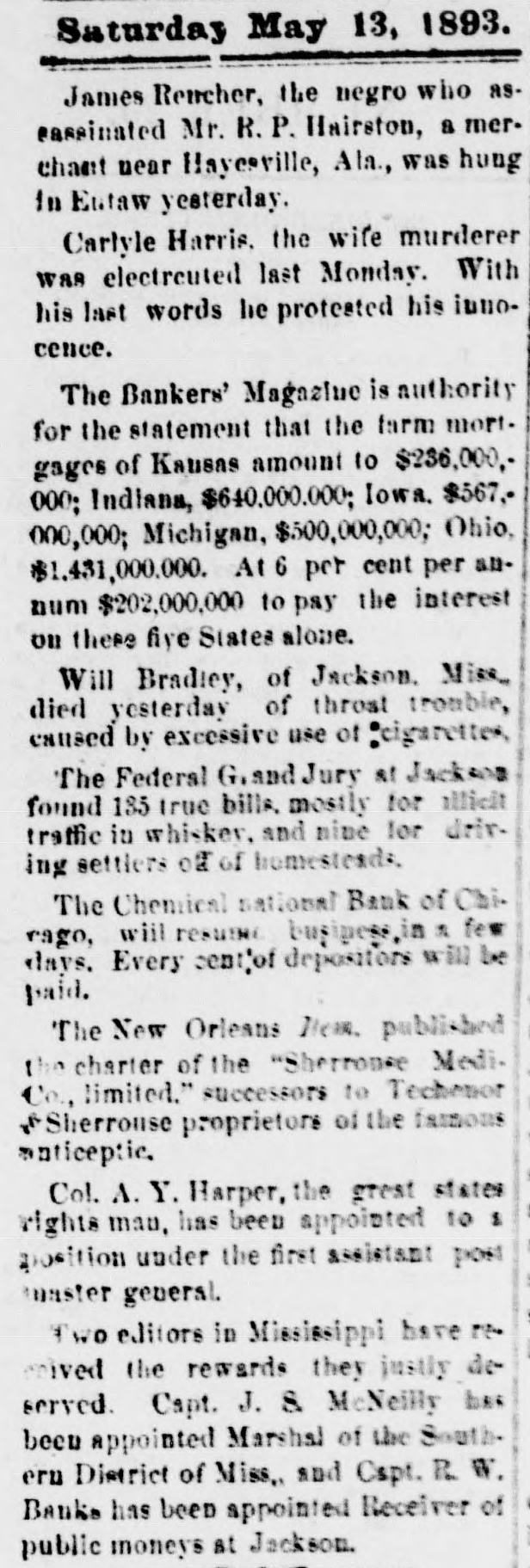
Saturday May 13, 1893. James Rencher, the negro who assassinated Mr. R. P. Hairston, a merchant near Hayesville, Ala., was hung in Eutaw yesterday. Carlyle Harris, the wife murderer was electrcuted last Monday. With his last words he protested his innocence. The Bankers' Magazine is authority for the statement that the farm mortgages of Kausas amount to $236,000,000; Indiana, $640.000.000; Iowa. $567,000,000; Michigan, $500,000,000; Ohio, $1,431,000.000. At 6 per cent per annum $202,000,000 to pay the interest on these fiye States alone. Will Bradley, of Jackson, Miss., died yesterday of throat trouble, caused by excessive use of cigarettes, The Federal Grand Jury at Jackson found 185 true bills, mostly for illicit traffic in whiskey, and nine for driving settlers off of homesteads. The Chemical national Bank of Chicago, wiil resume business in a few days. Every cent of depositors will be paid. The New Orleans Item, published the charter of the "Sherronse Medi-Co., limited," successors to Techenor & Sherrouse proprietors of the famous anticeptic, Col. A. Y. Harper, the great states rights man, has been appointed to a position under the first assistant post master general. Two editors in Mississippi have received the rewards they justly deserved. Capt. J. S. McNeilly has been appointed Marshal of the Southern District of Miss., and Capt. R. W. Bauks has been appointed Receiver of public moneys at Jackson.


Article from The State Chronicle, May 13, 1893

Click image to open full size in new tab

Article Text

MANY BANKS FAIL. Financial Disasters All Over the Country Yesterday. PORTLAND, Ind., May 12.-The Dunkirk National Bank, of Dunkirk, owned and controlled by Dwiggins, Starbach & Co., Chicago, has failed. Their liabilities will be at least seventy-five thousand dollars. The firm owns a number of other banks, and these are reported to have gone to the wall. KOKOMO, Ind., May 12.-The State Bank of Russiaville did not open doors this morning. It was a small institntion controlled by the Columbia National Bank, of Chicago. Some of the stock is held by farmers in the vicinity. Officers claim that neither depositors or stockholders will lose anything. The bank of Greentown, has closed its doors. Suspension is due to the suspension of the Chemical National Bank of Chicago. CHARLEVOIX, Mich, May 12.-W. P. Brown and Company, bankers, r doing business under the name of e the Bank of Charlevoix, have made e an assignment to R W. Kane. No t statement has yet been made as to r the cause of the suspension. 9' RAWPAW, Mich., May 12 -Great IS excitement prevails at Lawton. The S managers of the local bank there of did not open the institution this morning, having left town last night The citizens have some $18,000 de posited in the bank. TOLEDO, O,, May 12.- - -The Ottaws a County Bank, at Elmore, a branch nt of the Chicago Columbia, has close ge its doors and the bank officials ar he not to be found. on INDIANAPOLIS, May 12.-The Ban er of Columbia and the National d th Greenwood are said to have failed on The Farmers' and Merchants' Ban er of Geneva, Ind, closed its doors 8 be noon. It was the oldest institutio of the kind in the town. CONVOY, Ohio, May 12.-Th Bank of Convoy, Ohio. closed i doors today, caused by its relation Co. with the Columbia National Ban he of Chicago. No statement of th ty, bank's condition has been made. ut card on the door states : "Th ks bank has suspended." te


Article from The Hawaiian Star, May 17, 1893

Click image to open full size in new tab

Article Text

TELEGRAPHIC NOTES Joseph Jefferson, the actor, is ill. Mrs. Chauncey M. Depew is dead. Ex-President Gonzales of Mexico is dead. The Chemical Bank of Chicago has failed. The World's Fair was closed on Sunday. Goupil, the famous French engraver, is dead. People in parts of Mexico are suffering from lack of water. Chinese are wanted in South America to gather the coffee crop. Gladstone has offered the post of poet laureate to John Ruskin Admiral Irwin had a great popular send-off when he left Mare Island. Jefferson Davis' remains will be reinterred at Richmond on May 3 1st. Several firms failed in Wall street early in May owing to a panic. A wreck on the Big Four road, near La Fayette, Ind., cost ten lives. The Bank of England has advanced the rate of discount from 2 1/2 per cent. to 3. The Canadian Pacific is about to make connections with the Sound country. Complaint has been made of the high prices at the World's Fair restaurants. The President has issued an order closing the White House to officeseekers.


Article from The Pacific Commercial Advertiser, May 18, 1893

Click image to open full size in new tab

Article Text

American News. Carlyle Harris, the notorious young wife-poisoner, who has had such a sensational career since his arrest, was electrocuted in Sing Sing prison, New York, on May 8th. He faced death nerve, and as he seated himself in the death-chair, with splendid entirely he again innodeclared that he was cent of the crime. The execution was the most successful since the law went into force. Harris was 23 years of age. He murdered his school-girl wife, had deceived by a bogus in February, marriage whom he 1891, avoid in being order to get rid of her, and thus forced to wed her properly. Santa Monica, Cal., has been made a sub port of entry to the port of Los Angeles. Paderewski, the famous pianist, has back to Europe worn out by the silly gone persecution of half-crazy society who were eviden ly unable to themselves in Th- of his Pennoyer, of control women, $182,000. Governor gross receipts his concerts Oregon, presence. of were has the again expressed his opinion Referring to the failure of to register, he says: the president. Chinese the result "The refusal is most undoubtedly of between the president and the minister to the president that law must be been no failure to laws. would collusion Chinese the If enforced disregard had register. insisted there that the a most is have humiliating fact of first from a of the on the walls of citizens proclamation unholy posted "It compact Oregon Six learned Chinese hieroglyphic companies of wash- thus this in Astoria. Cleveland houses whatever has become responsible for trouble may arise. If he had declared his purpose to enforce the law there would have been complete registration. "The Chinese minister has apparently dictated the policy of the administration, and he was probably not aware of the fact that state governors not presidential satraps. Articles of have a president for against are impeachment been less preferred offenses than Cleveland's refusal to strictly enforce the exclusion law." Wall street, New York, has had another shaking up in industrial stocks, and the result was nearly a panic. Several brokers failed, among them the famous "Deacon" White, one of the kings of the exchange. The stocks were the great sufferers; to the fact that watered. was are trust owing so badly Sugar their shares stock hit a drop in preferred to 68, and in common 62. from 90 to from hard with 96 General Electric stock from 06 to 58, and Manhattan, of the started from 142 three days of terror back to a quiet dropped stocks, another 115. market After got actively-manipulated and basis reached and the is all apparently right now. The Chicago Chemical National Bank has closed its doors. It had a branch in the World's Fair grounds, and many foreigners are sufferers. The depositors are assured that they will be paid in full. The gold situation remains about the same, and gives little or no con- decern to the officials of the treasury partment. They feel absolute conin the administration without dle fidence the question alarm the to public to han- the country or detriment to credit. Secretary Carlisle is quoted saying that the situation was enas satisfactory; that he had would assurtirely that the New York banks ances the department if the necessity arose, aid but that he did not believe such would be necessary. The St. Louis banks have come to aid of the United States treasury, the and tomorrow over $2,000,000 in gold in will be handed to. the sub-treasury exchange for treasury and national bank notes. Lizzie Borden of Massachusetts, the alleged murderess of her father and mother, has been arraigned upon three indictments, to which she pleaded not guilty and went back to jail. She will be tried in June. General Rosecrans, registrar of the treasury, who is now in Southern California, has resigned on account of ill health. The Salvation army in Spokane, Washington, is not setting a Chris-


Article from New-York Tribune, May 19, 1893

Click image to open full size in new tab

Article Text

ANOTHER WESTERN BANK GOES DOWN. THE EVANSTON NATIONAL OF ILLINOIS CLOSED -GRAIN DEALER'S IN TROUBLE. Chicago, May 18 (Special).-Some more of the aftermath of the Chemical and Columbia National Bank failures came to the surface 10-day. The Evanston National Bank, of Evanston, which did business with the Chemical, falled to open this morning, the following notice, signed by Henry Wells, the president. being posted on the door: "Owing to heavy drains made upon our deposits and the stringency of the money market this bank suspends payment. Depositors will be paid in full." All the men connected with the bank declare that depositors will be paid in full and that the bank will reopen in three days. The capital stock of the institution is $100,000. The last public statement was made March 6, when the amount of deposits was given รกs $161,023 81 Since that time, however, the bank has been in bad standing. and depositors have gradually drawn out. Since Monday the bank. paper has not been accepted by the Chicago Clearing House. Rumors of the shakiness of the bank have been current for the last week or so. The concern cleared through the Chemical National until that bank falled. Then the officials of the Evanston Bank requested the privilege of clearing through the Metropolitan Bank, which consented to pay their checks as long as they kept enough money at the Metropolitan to cover all claims. Yesterday their deposit became exhausted and the local bank refused to honor any more of the Evanston Bank's checks. Bank Examiner Caldwell was seen In regard to the cause of the suspension and gave the following statement: "I received orders yesterday from Washington to examine the bank and did so. On reporting Its condition to Controller Eckels, I received orders to close the bank at once. The bank was suffering from a run and did not have the money on hand to pay out. As matters stand. there is $60,000 in deposits unpaid. I see no reason, so far, for depositors not being paid In full." N. A. Hill, vice-pre-ident, attributed the sudden run the failure of the Chemical at Chicago. "We did not to lose much by that failure, but It was known here that the Chemical was our correspondent," said he. This scared depositors and they began drawing out money faster than we could realize on our securities." "Was there no other reason for the run ?" Hill was asked. After some hesitation he replied: "Well, I suppose our president's trouble with a number of lumber deals he was in hastened matters. He was a heavy loser by the failure of the Cafro Lumber Company. and was also a loser in several other lumber failures. These matters became noised about and the run began." Among the business men about town the suspension is thought to have been caused by poor financiering methods. This afternoon the Board of Trade firm of N. 11. Warren & Co. closed Its deals. The firm has been on the bull side of corn for a long time-in fact, ever since the market was in the 50s-and the drop since has been rapidly exhausting its ready means. The crowning trouble was the fact that their funds were locked up in the Columbia Bank. As the firm was not in a position to respond to additional calls, those having trades with it deemed it predent to close them out. So at the start there was free selling for this account, and July touched 42 cents. About 600,000 bushels were closed out on the firm's account. The failure-If such it may be calledproduced very little excitement.


Article from The Iola Register, May 26, 1893

Click image to open full size in new tab

Article Text

LIZZIE BOLT, the woman accused of the murder of Detective Lowenstein, at Cincinnati, was acquitted. She was indicted for murder in the first degree, but the court ordered the jury to return a verdict of not guilty. Thus the tragedy goes down as a suicide. Lowenstein was found dead in his room with a bullet-hole in his head. The Bolt woman was his mistress. THE local directory of the world's fair decided to open all portions of the fair on Sundays and return the conditional grant of $2,500,000 to the government A COMPROMISE has been effected between the imprisoned St. Clair county, Mo., judges and the bondholders at 50 cents on the dollar at 4 per cent. interest. This makes the debt $400,000 with $16,000 annual interest. BY the capsizing of a tug and dredge boat on Lake Conneaut, O., five persons were drowned. THE world's fair continues to be short of funds. The running expenses are $45,000 daily. The pay of janitors and helpers has been long overdue. THE First National bank, of Cedar Falls, Ia., has failed. HUGH ADAMS, aged 85, has sued his wife, aged 62, at Martinsville, Ind., for divorce. SCHUREMAN'S private bank at Normal, III., has closed. IT is said that ex-Secretary John W. Noble will soon take up his residence in Oklahoma having in view his elevation to the United States senate when the territory is admitted to statehood. THE government commission has been inspecting the work on the Missouri river in the vicinity of Kansas City. ONE phase of the Sunday opening of the world's fair is that the directors believe that it will entail financial loss rather than gain as is generally supposed. THERE is some talk of the Chemical National Bank of Chicago resuming. THE C., B. & Q. directors have been re-elected WARREN & Co., of the Chicago board of trade, have assigned. FIRE at Starbuck, Wash., destroyed the Union Pacific car and machine shops, nineteen locomotives and all other railroad property except the coal bunkers. Loss, $300,000. Ex-SENATOR VAN WYCK, of Nebraska, suffered a stroke of paralysis which may result fatally. THE Santa Fe wants a return rate of $16.50 to the world's fair from Missouri river points. THE failure of the First National bank at Cedar Falls, Ia.. shows peculiar transactions. THE National bank of Evanston failed, causing great excitement in that suburb of Chicago. LAWSON RUNYON, a prominent Cherokee. was shot and killed by ex-Deputy United States Marshal Creekmoor. CHARLES H. JONES, editor .of the St. Louis Republic, has resigned his office to Charles W. Knapp, president and publisher, though still retaining his interest in the paper. THE Oakland, Cal., ferryboat Bay City ran a containing down and all rowboat drowned. five persons were A DAM restraining the water of Lakes Ida and Milton, in Minnesota, broke and a large area of land was flooded with the escaping water. NINE young men have been arrested for distributing boycotting circulars against the firm of Diel & Bro., gents' furnishings, St. Louis. JAMES E. MURDOCK, the well known tragedian and teacher of elocution, died at Cincinnati on the 19th. He was 83 years of age. R. ELLIOTT, of Kansas City, Mo., captured the Missouri state trophy as the champion wing shot in the state tournament. He killed thirty straight birds. JUDGE RICKS, at Cleveland, O., appointed a receiver for the Clover Leafthe Toledo, Kansas City & St. Louis railway. THERE is great excitement in Normal, III., over the failure of the Exchange bank of that city, and the president has been arrested for receiving deposits after he knew the bank was insolvent.


Article from The Times, June 3, 1893

Click image to open full size in new tab

Article Text

BANKS WANT TO RESUME. Officers of Two Institutions Confer With the New Comptroller. WASHINGTON, June 2.-President Ransom and Attorney Ibeter, representing the failed National Bank of Deposit, of New York, had a conference with Comptroller Eckels this morning as to permitting the bank to resume business. Comptroller Eckels told them that his present information was that the bank would have to be placed in the hands of a receiver, but he would give them reasonable time to make good its impaired capital. A committee, consisting of Messrs. Bennett and Strait, representing the failed Chemical National Bank, of Chicago, also had a conference with Comptroller Eckel, with a view to the bank resuming business. They were assured that if they could present evidence insuring the stability of the bank in the future, they would be permitted to resume.


Article from The Morning News, July 21, 1893

Click image to open full size in new tab

Article Text

ECKELS SENDS GOOD CHEER. The Government to Stand By the Denver Banks. Each of Them to Be Given Every Opportunity to Resume Business-All of Them in Good Condition if the People Would Keep Cool-The City Much More Cheerful on the Receipt of the Good News. Washington, July 20.-James H. Eckels, controller of the currency, immediately on his return from New York, this morning addressed to the national bank examiner at Denver, a dispatch defining the policy of the administration; with reference to insolvent banking institutions generally, as follows: Frank Adams, National Bank Examiner, Denver. Col.: I wish you would announce to the officers of the banks which have failed in Denver that it is my intention to lend them every aid possible, looking towards speedy resumption on their part, and that shall them sufficient them not to collect as are grant only to in such time amounts to together enable speedily collectible, but to get such amounts of money as will enable them to openupon a small basis. It seems to me that such citizens as s have by their foolish course of conduct in withdrawing deposits from banks which so long enjoyed their complete confidence and brought about this condition ought, in view of the damage they have done their city, as quickly as possible to repair it by standing ready to deposit with them. fully appreciate all the circumstances of the situation. and that no unnecessary loss be entailed, you are authorized to emto paper collect the trustworthy may ploy as in assistants, moneys, employes protect most in such competent institutions. and and have also ordered Examiner McHugh, of Iowa. to report at once to assist you. I desire that this telegram be given to the press at Denver, evidencing, as it does, that the controller has faith in the ability of the banks of Denver to resume, and of his desire todend them every assistance consistent with his official duty THE ASSETS ALL RIGHT. When asked to express more fully his views on the condition of affairs, Controller Eckels said the failures in Denver yesterday, like a number of other national bank failures, were caused by no fault of the bank officials, but through foolish and uncalled for lack of confidence on the part of depositors. "It is my intention," he said, "where a bank has been properly conducted and whose assets under ordinary circumstances would have permitted it to remain solvent, to give the institution every opportunity to resume business. All the Denver banks that failed were well conducted, and every opportunity will be given them to reopen. The people who have caused this Denver disaster by foolish runs should do all they can to help the banks to resume." The controller has been notified that the directors of theChomieal-National bank of Chicago have abondoned their attempt to reopen that bank. They were unable to collect the assessments required. A GOOD EFFECT ON DENVER. Denver, Col., July 20.-The cheering news from Washington has had a wonderful effect upon Denver this morning. The dispatch from the controller of the currency to the effect that he would give every possible aid to the banks of this city is applauded on every side. Bank Examiner Adams, to whom the telegram was addressed, is besieged by excited people anxious to hear confirmation of the good report and get an expression from him. Mr. Eckels comments on the foolish course of those Denver citizens who had lost confidence in the banks are looked upon as being most righteous. Newspapers are running off extras announcing the news, and already things begin to wear a brighter aspect. The officers of the closed banks notify the public that they will be able to pay every cent due to customers, but in some cases it will take some time to realize on their securities. It is learned that heavy withdrawals have been made from the banks during the past few months, which would indicate that some of the far-seeing ones anticipated trouble such as has come upon the city in the past few days. It is noticeable that very few of the merchants or business men of the city withdrew their deposits. the run being made principally by the working people and poorer classes of customers. The newspapers feel greatly the distress, every daily excepting one having curtailed expenses by reducing in size or using smaller type. OTHER WESTERN TROUBLES. Washington, July 20. -Western business stroubles are reported as follows: The banking houses of J. B. Wheeler & Co., at Colorado City and Manitou did not open to-day. Their branch at Aspen closed yesterday. The private banking house of T. A. Kent at Cheyenne, Wy., did not open today and is in the hands of an assignee. At Grand Junction, Col., the First National Bank failed to open its doors today. As soon as this became known business men began depositing in the Mesa County Bank in order to made its credit good.


Article from New-York Tribune, July 21, 1893

Click image to open full size in new tab

Article Text

HELP FROM THE CONTROLLER TO GIVE ALL POSSIBLE ASSISTANCE TO THE BANKS OF DENVER. Washington, July 20.-James H. Eckels, the Controller of the Currency, immediately on his return from New-York this morning addressed to Frank Adams, the National Bank examiner at Denver, a dispatch defining the policy of the Administration with reference to insolvent National banking institutions generally, as follows: "I wish you would announce to the officers of the banks which have failed in Denver that it is my intention to lend them every aid possible looking toward speedy resumption on their part, and that I shall grant to them sufficient time to enable them, not only to collect such amounts as are speedily collectible, but to get together such amounts of money as will enable them to open upon a small basis. It seems to me that such citizens as have by a foolish course of conduct in withdrawing deposits from banks which so long enjoyed their complete confidence, and brought about this condition. ought, in view of the damage they have done their city, as quickly as possible to repair it by standing ready to deposit with them. "I fully appreciate all the circumstances of the situation, and that no unnecessary loss may be entalled, you are authorized to employ as assistants, to protect paper and collect moneys. the most competent and trustworthy employes in such institutions. I have also ordered Examiner McHugh, of Iowa, to report at once to assist you. "I desire that this telegram be given to the press at Denver, evidencing as it does that the Controller has faith in the ability of the banks of Denver to resume and of his destre to lend them every assistance consistent with his official duty." When asked to express more fully his views on the condition of affairs, Mr. Eckels said that the failures in Denver yesterday, like a number of other National Bank failures, were caused by no fault of the bank officials, but through a foolish and uncalled-for lack of confidence on the part of depositors. "It is my intention," he said, where a bank has been properly conducted and whose assets under ordinary circumstances would have permitted it to remain solvent, to give the Institution every opportunity to resume business. All the Denver banks that failed were well conducted, and every opportunity will be 645113 titen them to reopen. The people who have caused the Denver disaster by foolish runs' should do all they can to help the banks resume." John I. Mercer. of Helena. Mont., was to-day appointed receiver of the Livingston National Bank of Livingston, Mont. Controller Eckels's efforts to secure a reopening of the insolvent Chemical Bank of Chicago have failed. This piogning Mr. Eckels received the following telegram from the Chemical Bank committee: " After long, patient and earnest efforts, the committee of the stockholders of the Chemical National Bank of Chicago has concluded that resumption is not practicable at this time. At first the problem seemed easy, but the many financial disasters throughout the country have excited the public and produced unusual caution, and made It very difficult to collect outstanding bills or raise money by usual processes. The conditions imposed by the Controller were well received, but the present stringency seems an obstacle too serious to be overcome by the stockholders."


Article from Chicago Eagle, December 30, 1893

Click image to open full size in new tab

Article Text

the strict line of business. His record as receiver of the Chemical National Bank shows him to be a master in the line of finance, and should reassure the tax-payers of Chicago against the forebodings of the prophets of evil.


Article from Bismarck Weekly Tribune, January 5, 1894

Click image to open full size in new tab

Article Text

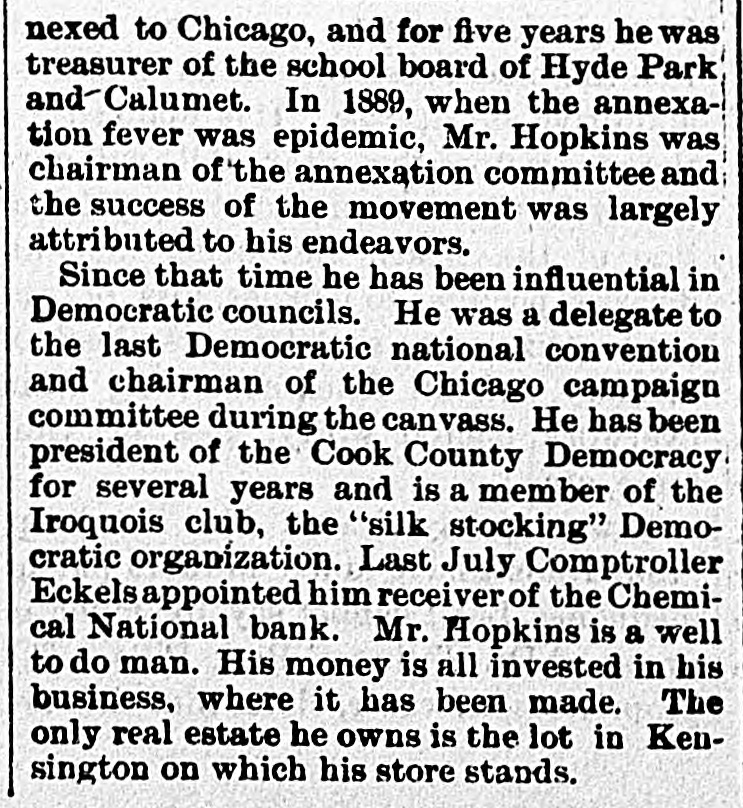
nexed to Chicago, and for five years he was treasurer of the school board of Hyde Park and Calumet. In 1889, when the annexa-tion fever was epidemic, Mr. Hopkins was chairman of the annexation committee and the success of the movement was largely attributed to his endeavors. Since that time he has been influential in Democratic councils. He was a delegate to the last Democratic national convention and chairman of the Chicago campaign committee during the canvass. He has been president of the Cook County Democracy for several years and is a member of the Iroquois club, the "silk stocking" Democratic organization. Last July Comptroller Eckels appointed him receiver of the Chemical National bank. Mr. Hopkins is a well to do man. His money is all invested in his business, where it has been made. The only real estate he owns is the lot in Kensington on which his store stands.


Article from The Pacific Commercial Advertiser, February 8, 1894

Click image to open full size in new tab

Article Text

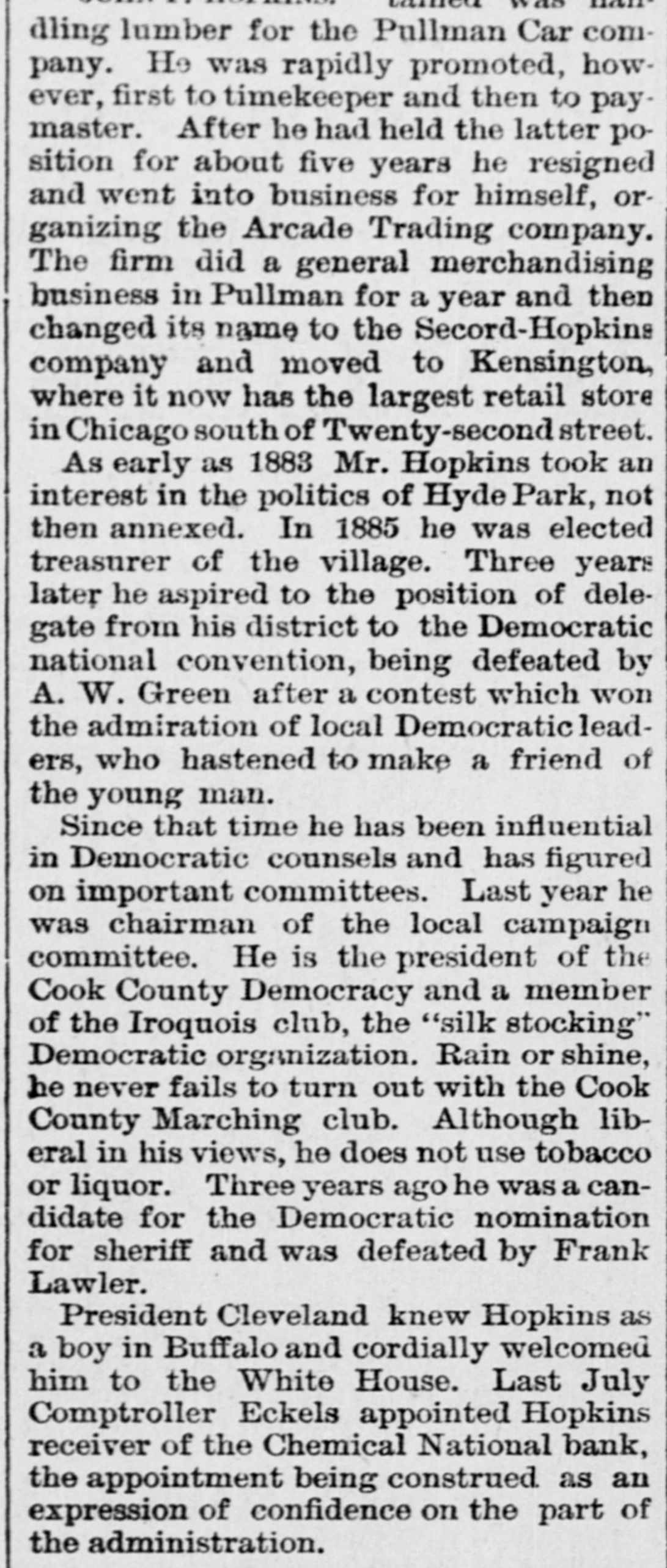
dling lumber for the Pullman Car company. He was rapidly promoted, however, first to timekeeper and then to paymaster. After he had held the latter position for about five years he resigned and went into business for himself, organizing the Arcade Trading company. The firm did a general merchandising business in Pullman for a year and then changed its name to the Secord-Hopkins company and moved to Kensington, where it now has the largest retail store in Chicago south of Twenty-second street. As early as 1883 Mr. Hopkins took an interest in the politics of Hyde Park, not then annexed. In 1885 he was elected treasurer of the village. Three years later he aspired to the position of delegate from his district to the Democratic national convention, being defeated by A. W. Green after a contest which won the admiration of local Democratic leaders, who hastened to make a friend of the young man. Since that time he has been influential in Democratic counsels and has figured on important committees. Last year he was chairman of the local campaign committee. He is the president of the Cook County Democracy and a member of the Iroquois club, the "silk stocking" Democratic organization. Rain or shine, he never fails to turn out with the Cook County Marching club. Although liberal in his views, he does not use tobacco or liquor. Three years ago he was a candidate for the Democratic nomination for sheriff and was defeated by Frank Lawler. President Cleveland knew Hopkins as a boy in Buffalo and cordially welcomed him to the White House. Last July Comptroller Eckels appointed Hopkins receiver of the Chemical National bank, the appointment being construed as an expression of confidence on the part of the administration.


Article from The Wadsworth Dispatch, March 7, 1894

Click image to open full size in new tab

Article Text

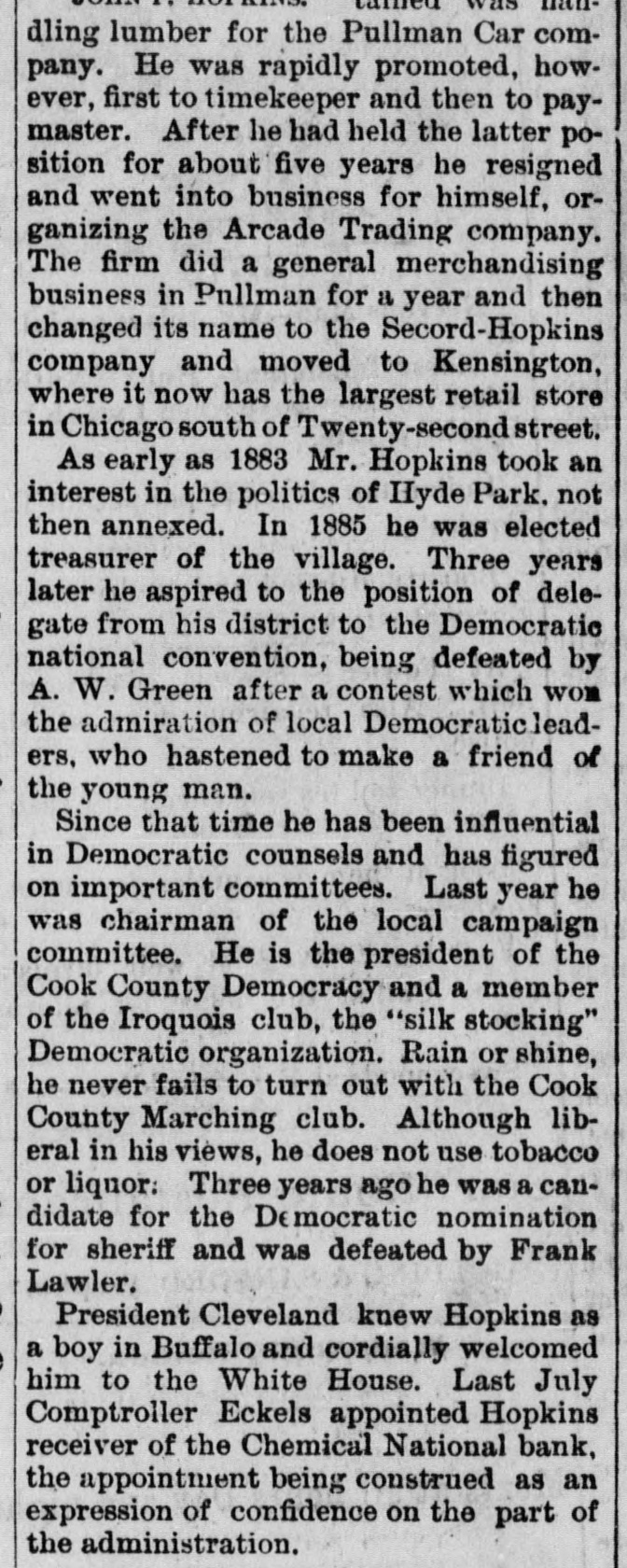
dling lumber for the Pullman Car company. He was rapidly promoted, however, first to timekeeper and then to paymaster. After he had held the latter position for about five years he resigned and went into business for himself, organizing the Arcade Trading company. The firm did a general merchandising business in Pullman for a year and then changed its name to the Secord-Hopkins company and moved to Kensington, where it now has the largest retail store in Chicago south of Twenty-second street. As early as 1883 Mr. Hopkins took an interest in the politics of Hyde Park. not then annexed. In 1885 he was elected treasurer of the village. Three years later he aspired to the position of delegate from his district to the Democratic national convention, being defeated by A. W. Green after a contest which won the admiration of local Democratic leaders, who hastened to make a friend of the young man. Since that time he has been influential in Democratic counsels and has figured on important committees. Last year he was chairman of the local campaign committee. He is the president of the Cook County Democracy and a member of the Iroquois club, the "silk stocking" Democratic organization. Rain or shine, he never fails to turn out with the Cook County Marching club. Although liberal in his views, he does not use tobacco or liquor: Three years ago he was a candidate for the Democratic nomination for sheriff and was defeated by Frank Lawler. President Cleveland knew Hopkins as a boy in Buffalo and cordially welcomed him to the White House. Last July Comptroller Eckels appointed Hopkins receiver of the Chemical National bank, the appointment being construed as an expression of confidence on the part of the administration.