Capital National Bank (Indianapolis, IN)

Episode Information

Episode UID
415801121
Episode Type
Run โ†’ Suspension โ†’ Reopening
Bank Type
national
Bank ID
41580 national
Charter Number
4158
Start Date
May 10, 1893
Location
Indianapolis, Indiana (39.768, -86.158)

Metadata

Model
gemini-3-flash-preview (chosen from majority vote of a three-model LLM ensemble)
Short Digest
982d2a273db5a5e9

Response Measures

Accommodated withdrawals, Public signal of financial health, Capital injected, Full suspension, Books examined

Other: The bank initially withdrew from the clearinghouse due to its rigid rules. Upon reopening, it displayed 'huge heaps of greenbacks and coin' to reassure depositors. It also received a loan from a local capitalist to facilitate resumption.

Clearinghouse involved: Yes (loan, examination, or other measures)

Description

The bank experienced heavy withdrawals (run) triggered by the failure of its Chicago correspondent, leading to a temporary suspension and subsequent successful reopening.

Events (5)

1. November 13, 1889 Chartered
Source
historical_nic
2. May 10, 1893 Run
Cause
Correspondent
Cause Details
Distrust and heavy withdrawals following the failure of its Chicago correspondent, the Chemical National Bank.
Measures
The bank sought assistance from other local bankers, which was denied.
Newspaper Excerpt
The fact of the Capital's relations with that bank was known and caused distrust and heavy drafts.
Source
newspapers
3. May 11, 1893 Suspension
Cause
Correspondent
Cause Details
Failure of the Chemical National Bank of Chicago, which owed the Capital $100,000, combined with heavy withdrawals.
Newspaper Excerpt
The Capital National bank of this city has suspended. The state bank examiner is In charge.
Source
newspapers
4. June 19, 1893 Reopening
Newspaper Excerpt
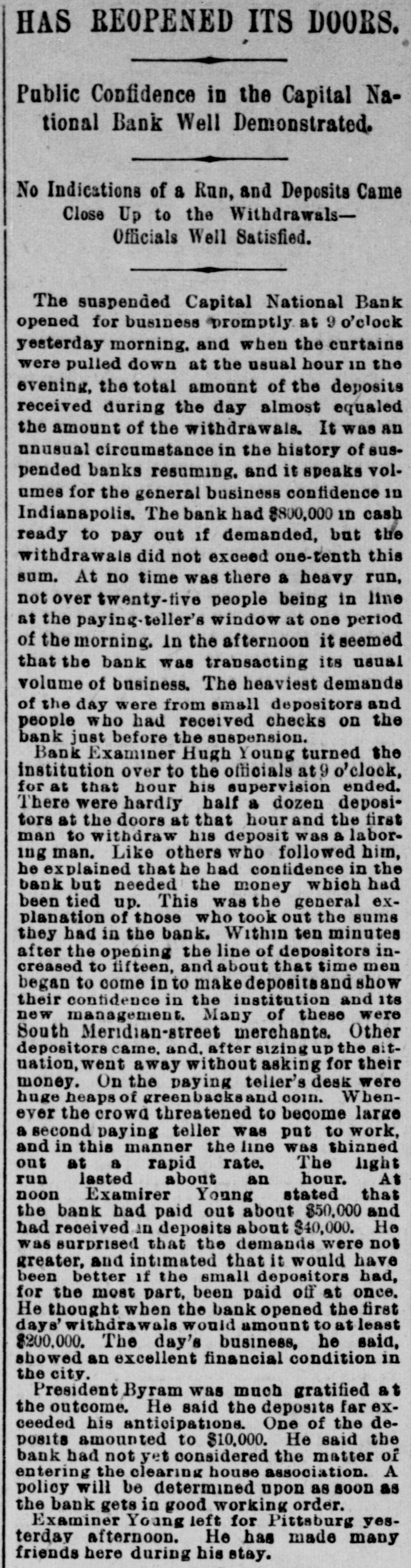
The suspended Capital National Bank opened for business promptly at 9 o'clock yesterday morning. and when the curtains were pulled down at the usual hour in the evening, the total amount of the deposits received during the day almost equaled the amount of the withdrawals. It was an unusual circumstance in the history of suspended banks resuming. and it speaks volumes for the general business confidence in Indianapolis. The bank had $800,000 in cash ready to pay out if demanded, but the withdrawals did not exceed one-tenth this sum. At no time was there a heavy run, not over twenty-tive people being in line at the paying-teller's window at one period of the morning. In the afternoon it seemed that the bank was transacting its usual volume of business. The heaviest demands of the day were from small depositors and people who had received checks on the bank just before the suspension. Bank Examiner Hugh Young turned the institution over to the officials at9 o'clock, for at that hour his supervision ended. There were hardly half a dozen depositors at the doors at that hour and the first man to withdraw his deposit was a laboring man. Like others who followed him, he explained that he had confidence in the bank but needed the money which had been tied up. This was the general explanation of those who took out the sums they had in the bank. Within ten minutes after the opening the line of depositors increased to fifteen, and about that time men began to come in to make deposits and show their confidence in the institution and its new management. Many of these were South Meridian-street merchants. Other depositors came, and, after sizing up the situation, went away without asking for their money. On the Daying teller's desk were huge heaps of greenbacksand coin. Whenever the crowd threatened to become large a second Daying teller was put to work, and in this manner the line was thinned out at a rapid rate. The light run lasted about an hour. At noon Examirer Young stated that the bank had paid out about $50,000 and had received in deposits about $40,000. He was surprised that the demands were not greater, and intimated that it would have been better if the small depositors had, for the most Dart, been paid off at once. He thought when the bank opened the first days' withdrawals would amount to at least $200,000. The day's business, he said, showed an excellent financial condition in the city. President Byram was much gratified at the outcome. He said the deposits far exceeded his anticipations. One of the deposits amounted to $10,000. He said the bank had not yet considered the matter of entering the clearing house association. A policy will be determined upon as soon as the bank gets in good working order. Examiner Young left for Pittsburg yesterday afternoon. He has made many friends here during his stay.
Source
newspapers
5. July 1, 1912 Voluntary Liquidation
Source
historical_nic

Newspaper Articles (25)

Article from The Indianapolis Journal, September 18, 1892

Click image to open full size in new tab

Article Text

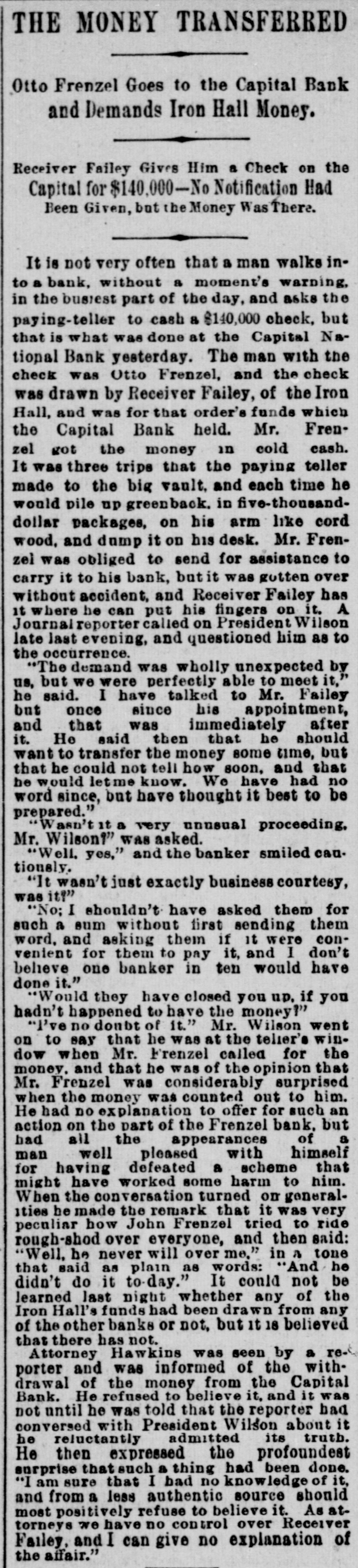
THE MONEY TRANSFERRED Otto Frenzel Goes to the Capital Bank and Demands Iron Hall Money. Receiver Failey Gives Him a Check on the Capital for $140,000-No Notification Had Been Given, but the Money WasThere. It is not very often that a man walks into a bank, without a moment's warning, in the busiest part of the day, and asks the paying-teller to cash a $140,000 check, but that is what was done at the Capital National Bank yesterday. The man with the check was Otto Frenzel, and the check was drawn by Receiver Failey, of the Iron Hall, and was for that order's funds which the Capital Bank held. Mr. Frenzel got the money in cold cash. It was three trips that the paying teller made to the big vault, and each time he would pile up greenback. in five-thousanddollar packages, on his arm like cord wood, and dump it on his desk. Mr. Frenzel was obliged to send for assistance to carry it to his bank, but it was gotten over without accident, and Receiver Failey has it where he can put his fingers on it. A Journal reporter called on President Wilson late last evening, and questioned him as to the occurrence. "The demand was wholly unexpected by us, but we were perfectly able to meet it," he said. I have talked to Mr. Failey but once since his appointment, and that was immediately after it. He said then that he should want to transfer the money some time, but that he could not tell how soon, and that he would letme know. We have had no word since, but have thought it best to be prepared." Wasn't it a very unusual proceeding, Mr. Wilson?" was asked. "Well. yes," and the banker smiled cautionsly. "It wasn't just exactly business courtesy, was it?" "No; I shouldn't have asked them for such a sum without first sending them word. and asking them if it were convenient for them to pay it, and I don't believe one banker in ten would have done it." "Would they have closed you up. if you hadn't happened to have the money?" "I've no doubt of it." Mr. Wilson went on to say that he was at the telier's window when Mr. Frenzel called for the money. and that he was of the opinion that Mr. Frenzel was considerably surprised when the money was counted out to him. He had no explanation to offer for such an action on the part of the Frenzel bank. but had all the appearances of a man well pleased with himself for having defeated a scheme that might have worked some harm to him. When the conversation turned on generalities he made the remark that it was very peculiar how John Frenzel tried to ride rough-shod over everyone, and then said: "Well, he never will over me." in a tone that said as plain as words: "And he didn't do it to-day." It could not be learned last night whether any of the Iron Hall's funds had been drawn from any of the other banks or not, but it 18 believed that there has not. Attorney Hawkins was seen by a reporter and was informed of the withdrawal of the money from the Capital Bank. He refused to believe it, and it was not until he was told that the reporter had conversed with President Wilson about it he reluctantly admitted its truth. He then expressed the profoundest surprise that such a thing had been done. "I am sure that I bad no knowledge of it, and from a less authentic source should most positively refuse to believe it. As attorneys we have no control over Receiver Failey, and I can give no explanation of the affair."


Article from Deseret Evening News, May 11, 1893

Click image to open full size in new tab

Article Text

A Bank Suspends INDIANAPOLIS, Ind., May 11.-The Capital National bank of this city has suspended. The state bank examiner is In charge. The failure was caused by that of the Chemical National bank of Chicago, which owed the Capital $100,000. The National capital also carried a large amount of Premier Steel works paper. The latter went into a receiver's hands last Friday. The bank is the depository for a number of building associations. The officials of the bank made a statement in which they say that the capital stock is $300,000. The bank has done a profilable business, been run on a conservative basis, and there was nothing in the bank's condition to cause uneasiness until Tuesday, when the failure of the Chemical National of Chicago occurred. The Capital National had $79,000 on deposit in that bank. The fact of the Capital's relations with that bank was known and caused distrust and heavy drafts. This made the balances so heavy against the Capital bank, that in the present financial stringency it was notthought best to try to get outside aid to tide the bank over, 80 It was decided to sus. pend. The bank has available assets of over $200,000 in addition to the money V. tied up in the Chemical bank. The assets and liabili. ties of the Capital bank at the close of business yesterday was $4,465,962. The officers had the business in such a shape as to be readily settled up. There are funds on hand to pay 25 per cont to depositors and the paper can be easily realized on, so there need be little delay in getting the balance.


Article from The Indianapolis Journal, May 12, 1893

Click image to open full size in new tab

Article Text

CAPITAL NATIONAL BANK SUSPENDED. The news of the suspension rapidly spread to every business quarter of the city, but the panic and turmoil, the excitement and the expanse of blanched faces of depositors that usually go with the collapse of a big moneyed institution were not conspicuous features of the occasion. Patrons of the bank, as they came up to transact business and found the way barred, gathered in knots of fives and tens and discussed the situation and speculated as to the outcome, but beyond this the city went on about its business, while the force of officials and clerks on the inside went to casting up figures and canvassing assets to find where the bank stood. The failure of the Capital National is ascribed by its officers to the collapse of the Chemical Bank of Chicago, in which the Capital National had about $30,000 on deposit. The Capital National has been conducted on what are termed liberal lines. Soon after its organization it refused to be bound by the rigid rules of the clearing house, the result of which was its withdrawal from that institution. It accepted business which the older and more conservative banking institutions of the city did not consider perfectly safe. The result was that for a time the Capital National flourished, but the reaction came, and an examination of its published statements disclosed that for several months the amount of its deposits has steadily declined. Then came the recent shrinkage of values and the stringency of the money market, and as much as sixty days ago the Capital National felt the necessity of reducing the amount of its credits. The inability of borrowers to secure credit elsewhere made difficult the proposed work of contraction, and loans that became due were renewed. The country banks which had funds on deposit in the Capital National had need of their deposits, and drew them out. The bank still would have weathered the storm but for the unfortunate failure of the Chemical. With the collapse of this concern the board of directors called a meeting and President M. B. Wilson was sent to Chicago to see what could be done toward realizing on the Capital's claim. He returned Wednesday evening. and the report which he made was not encouraging. The meeting of the directors of Wednesday evening adjourned without definite action beyond the determination to continue business if the other banks of the city could be induced to lend their credit to tide the Capital over its emergency. The condition of the Capital was made known at a meeting of bankers held at 8:30 yesterday morning at the bank. When this meeting was called there was but thirty minutes before the opening of business for the other bankers to examine the collaterals of the Capital, and the decision was to withhold the assistance asked. There was nothing left the Capital to do but close its doors, and the notice of suspension was posted. The following figures are given as showing approximately the bank's condition: Resources


Article from The Herald, May 12, 1893

Click image to open full size in new tab

Article Text

BANK EXAMINERS. Officers Detailed to Take Charge of the Suspended Institutions. WASHINGTON, May 11.-Comptroller Eckels has designated D. A. Cook, bank examiner for Illinois outside of Chicago, to take charge of the Columbia national bank of Chicago, which failed this morning, He also telegraphed Hugh Young, bank examiner for Western Pennsylvania, residing at Pittsburg, to proceed at once to Indianapolis, Ind., and take charge of the Capital national bank of that city.


Article from The Morning Call, May 12, 1893

Click image to open full size in new tab

Article Text

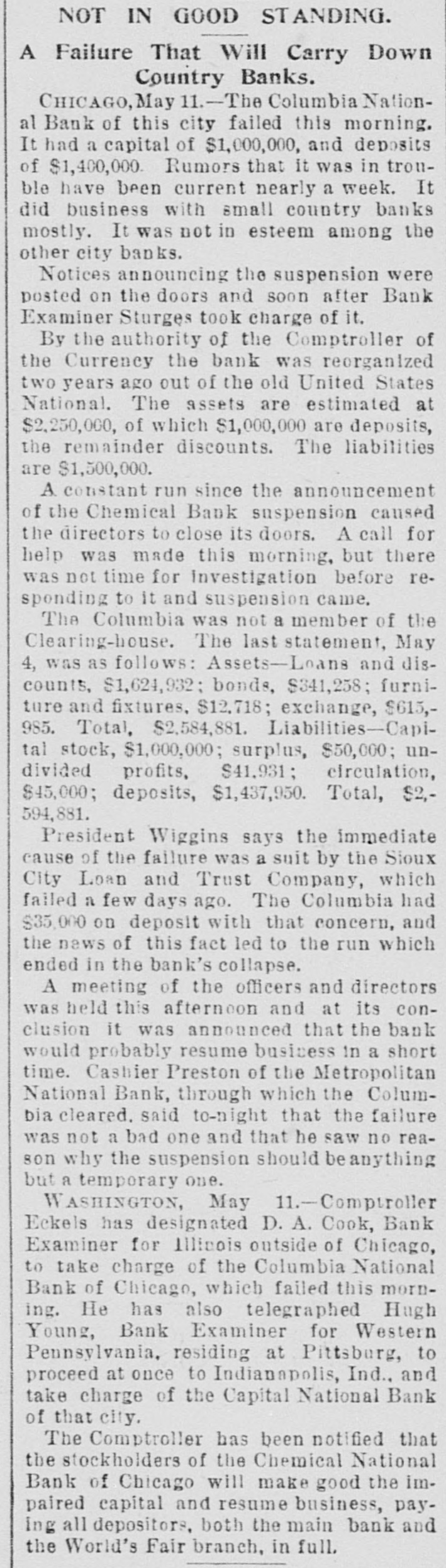
NOT IN GOOD STANDING. A Failure That Will Carry Down Country Banks. CHICAGO, May 11.-The Columbia National Bank of this city failed this morning. It had a capital of $1,000,000, and deposits of $1,400,000. Rumors that it was in tronble have been current nearly a week. It did business with small country banks mostly. It was not in esteem among the other city banks. Notices announcing the suspension were posted on the doors and soon after Bank Examiner Sturges took charge of it. By the authority of the Comptroller of the Currency the bank was reorganized two years ago out of the old United States National. The assets are estimated at $2,250,000, of which $1,000,000 are deposits, the remainder discounts. The liabilities are $1,500,000. A constant run since the announcement of the Chemical Bank snspension caused the directors to close its doors. A call for help was made this morning, but there was not time for investigation before responding to it and suspension came. The Columbia was not a member of the Clearing-house. The last statement, May 4, was as follows: Assets-Loans and discounts, $1,624,932; bonds, $341,258; furniture and fixtures, $12,718; exchange, $615,985. Total, $2,584,881. Liabilities-Capital stock, $1,000,000; surplus, $50,000; undivided profits, $41,931; circulation, $45,000; deposits, $1,437,950. Total, $2,594,881. President Wiggins says the immediate cause of the failure was a suit by the Sioux City Loan and Trust Company, which failed a few days ago. The Columbia had $35,000 on deposit with that concern, and the news of this fact led to the run which ended in the bank's collapse. A meeting of the officers and directors was held this afternoon and at its conclusion it was announced that the bank would probably resume busicess in a short time. Cashier Preston of the Metropolitan National Bank, through which the Columbia cleared. said to-night that the failure was not a bad one and that he saw no reason why the suspension should beanything but a temporary one. WASHINGTON, May 11.-Comptroller Eckels has designated D. A. Cook, Bank Examiner for Illicois outside of Chicago, to take charge of the Columbia National Bank of Chicago, which failed this morning. He has also telegraphed Hugh Young, Bank Examiner for Western Pennsylvania, residing at Pittsburg, to proceed at once to Indianapolis, Ind., and take charge of the Capital National Bank of that city. The Comptroller has been notified that the stockholders of the Chemical National Bank of Chicago will make good the impaired capital and resume business, paying all depositors, both the main bank and the World's Fair branch, in full.


Article from Morning Journal and Courier, May 12, 1893

Click image to open full size in new tab

Article Text

NATIONAL BANKS CLOSED. Suspension of Another Chicago Institution-A Bankin Indianapolis Also Goes Down. CHICAGO, May 11.-The Columbia National bank of this city closed its doors this morning and Mr. Sturgis, the bank examiner, is in charge. Its capital is $1,000,000. The statement of its condition at the close of business on May 4 showed deposits of $1,458,000, loans and discounts $1,625,000, United States and other bonde, $341,000; cash and sight exchange, $616,000. The concern held a lot of local securities, which had been raided to the danger point. It was also carrying a lot of grain for local parties, and was said to be loaded with real estate. The concern had been in business about six years. It was formerly the United States National bank, but changed its name, as it claimed then, in order to put it higher up in the alphabet in the bankers' directories, and thus get considerable business which would not come to it if further down the list. Zimri Dwiggins is the president. L. Everingham was formerly at the head, but retired about the first of the year. A great many board of trade firms carried accounts there, and the line of grain carried by it will now go to other concerns. L. Everingham, the former president, had but a small account with the concern and caused an announcement to be made from the gallery of the board to-day that its embarrassment would not effect his firm in any way. INIMANAPOLIS, May .-The Capital National bank of this city, located on South Meridian street, suspended this morning. The statement is made that the closing of the bank doors was made necessary by the failure of the Chemical National bank of Chicago last week, which institution owed the Capital bank $100,000.


Article from The Salt Lake Herald, May 12, 1893

Click image to open full size in new tab

Article Text

TWO MORE BANK CRASHES. & One at Indianapolis, the Other at Chicago. CAUSE OF THE FAILURE. Downfall of the Chemical National Accounts for the Trouble. Officers of Both Banks Claim That Depositors Will Be Paid in Full at an Early Day - -Examiners Will Take Charge at Once. INDIANAPOLIS, Ind., May 11.-The Capital National bank of this city has suspended. The state bank examiner is in charge. The failure was caused by that of the Chemical National bank of Chicago, which owed the Capital $100,000. The National Capital also carried a large amount of Premier steel works paper. The latter went into a receiver's hands last Friday. The bank is the depository for a number of building associations. The officials of the bank made a statement in which they say that the capital stock 18 $300,000. The bank has done a profitable business, been run on a conservative basis, and there was nothing in the bank's condition to cause uneasiness until Tuesday, when the failure of the Chemical National of Chicago occurred. The Capital National had $79,000 in deposit in that bank. The fact of the Capital's relation with that bank was known and caused distrust and heavy drafts. This made the balance so heavy against the Capital bank that in the present financial stringency it was not thought best to try to get outside aid to tide the bank over it. so it was decided to suspend. The bank has available assets of over $200,000 in addition to the money tied un in the Chemical bank. The assets and liabilities of the Capital bank at the close of business yesterday was $4,465,962. The officers had the business in such a shape as to be readily settled up. There are funds on hand to pay 25 per cent. to depositors and the paper can be easily realized on, so there need be little delay in getting the balance.


Article from St. Paul Daily Globe, May 12, 1893

Click image to open full size in new tab

Article Text

FORCED TO SUSPEND. The Columbia National Bank, at Chicago, Closes Its Doors. CHICAGO, May 11.-The Columbia National bank of this city suspended today. The bank had offices in the Insurance Exchange. The deposits were $1,400,000 and the capital $1 000,000. Rumors that the institution was in trouble have been current for nearly a week. It did business with small country banks and was not in esteem with the other banking concerns of the city. As to the cause of the failure, those who should know say that collections on loans have been poor. The officers of the bank are T. Everingham, president; W. G. Bentley, vice president; Zimri Diggins, cashier; John T. Green, assistant cashier. Notices announcing the suspension of the bank were posted on the doors, and a few moments later James D. Sturges, bank examiner, assumed control in the interest of depositors and under authority of the comptroller of currency. The Columbia National was reorganized two years ago, out of theold United States National bank. Estimates by bankers intimate with its affairs make this showing: Assets, $2,250,000; liabilities, $1,500,000. A constant run on the bank since the announcement of the Chemical suspension decided the directors to close the doors. A call for help was made, but, as the bankers were not notified until this morning, insufficient time was allowed for an investigation and the request was denied. The Colnmbia was not a member of the clearing house. Zimri Dwiggins, the cashier of the Columbia, assigns as the immediate cause of the failure of his bank the suit which was brought against it by the Sioux City Loan and Trust company, which failed a few days ago. The Columbia was the Chicago bank with which the Sioux City concern did business, and their deposit in the bank at the time of their collapse in Sioux City amounted to $35,000. A draft was drawn on the Columbia for this amount. When the draft was presented by a man from Iowa the bank refused payment, claiming that it had loans outstanding against the Sioux City company which equaled the amount of their deposit. Immediately on this refusal of the bank to honor the draft, the company entered suit against the bank. The news of the suit spread and caused a run on the bank, which they were unable to withstand. A meeting of the officers and directors was held this afternoon. and at its con. clusion it was announced that the bank would probably resume business in a short time. Cashier Preston, of the Metropolitan National bank, through which the Columbia National cleared, said tonight that the failure was not a bad one, and that he saw no reason why the suspension should be anything but temporary. WASHINGTON, May 11.-Comptroller Eckels has designated D. A. Cook, bank examiner for Illinois outside of the city of Chicago, to take charge of the Columbia National Bank of Chicago. He has also telegraphed Hugh Young, bank examiner for Western Pennsylvania, residing at Pittsburg, to proceed at once to Indianapolis and take charge of the Capital National bank, of that city. Comptroller Eckels was today advised that the stockholders of the Chemical National Bank of Chicago, whose failure was recently announced, will make good the impaired capital as soon as the exact amount can be ascertained, and the bank will resuine busiit is ness. Every cent, asserted, that the will de- be paid, and it is understood positors at the world's fair branch have already been paid.


Article from The Wilmington Daily Republican, May 13, 1893

Click image to open full size in new tab

Article Text

MANY BANK FAILURES. Panic Stricken Bankers in Indiana Country Towns. DRAGGED DOWN BY THE COLUMBIA. The Panic Spreads to Michigan and Ohio Banks, and Several Suspensions Are Added to the List in These States-Pecullar Methods of the Columbia Bank. May 13.-The failure of the a Columbia CHICAGO, National bank has disclosed of shystering without a parallel and in system American banking. The president to of the Columbia is shown have manager organized about fifty small concerns and insignificant points in Indiana of at all of which were correspondents likely Ohio, broken bank, and it is scarcely the the that of them will survive. But litany were at places where there was be banks business the moral effect is likely to The tle serious than the actual business losses. in Columbia more had very little chiefly Chicago, and such as it had was were with customers who, like the bank, the without commercial standing. Hence business was not felt in reputable other failure and had it occurred at any half circles, time it would have been forgotten in an hour. PORTLAND, Ind., May 13.-A courier the Dunkirk announces the failure of confrom Dunkirk bank, which is owned and by Dwiggins, Starbuck & Co., filed of trolled Chicago. Attachments were at once to and deputy sheriff left immediately The a all the available property. the levy on has failed for at least $75,000, and bank may reach $100,000. The firm con- of trolling amount this bank owns a number and these are reported to havegone enothers, to the wall. The Geneva bank of their terprise also has failed. INDIANAPOLIS, Ind. May 13.-State Audi- ComHenderson was notified that the could tor mercial State bank, of Russiaville, its demands. The Commercial in not meet is one of about twenty banks Indiana bank that are thought to be connected as with the Columbia National. Perhaps to the private banks are also related many Chicago concern to some extent. Reports show other small places in the state banks. that from a panic has seized the smaller county, bank at Brookston, White (o statesuspended The yesterday afternoon. made. It of its condition has been ment controlled by the Columbia National. was banks of the Columbia Nationalstring said to The Moreystown and Greenwood are liabilities at have also failed, the latter with amounting to $60,000. The Moreystown bank is of considerable importance, having a capital addition of $75,000. to the above the following bank, In are reported: Citizens' suspensions Ind. Bank of Spiceland, SpiceHebron, Ind.; Monroeville bank, Monroeville, Ind., land, Commercial bank, Norristown, these Ind.; Citizens' bank, Knox, Ind. All of were and branches of the Columbia National Chicago. INDIANAPOLIS, May B.-The directors that the Capital National bank claim and of has been no loss on discounts, dollar. there not a department has lost a that bank, they say, is more than solvent. The will ask the examiner to permit They resumption after an examination. FORT WAYNE, Ind., May 13, -News Mer- of suspension of the Farmers' and reached chants' the bank at Geneva, Ind., has the here. It was the oldest institution of kind in the town. CINCINNATI, O., May 13. -The private & firm of Dwiggins, Starbuck failed. banking at Williamsburgh, O., has of the Co., failure is due to the failure Mr. The Columbia bank, of Chicago, of which is was cashier. About $8,000 the Dwiggins the Williamsburg bank from will due Columbia, all of which, it is thought, Williamslost. The postmaster at be ordered the arrest, for alleged burgh, embezzlement, of Lawrence G. Good, cusexpert accountant. He was taken in tody. O., May 13.-The Farmers' CONVOY, of this place, has closed its doors, bank caused by its relations with the Columbia National. EDWARDSBURG, Mich., May 13. -The Cit- its bank, of this place, has closed izens' About $25,000 of local deposits, todoors. gether with township and school funds, Chiare re affected. It was a branch of the cago Columbia. RICHLAND, Mich., May 13. -The Union a branch of the Columbia National bank, bank, of Chicago, has closed its doors. Cashier Watts says that the depositors will be paid in full and the bank running again in two or three days. CHARLEVOIX, Mich., May 13.-W. P. & Co., bankers, doing business unBrown the name of the Bank of Charlevoix, Kane. have der made an assignment to R. W. PAW PAW, Mich., May 13. Great excitement prevails at Lawton. The managers the in of a local bank there did not open town stitution yesterday, having left Thursday night. Citizens have about$18,000 deposited in the bank. LAWTON, Mich., May 13.-The American It of this city has closed its doors. bank controlled by the Columbia National business bank is of Chicago. Nearly every in the city is involved, besides depositors. many farmers man and others who were The deposits amount to about $30,000. SAN JOSE, Cal., May -The liabilities to the Santa Clara bank are now stated by of $300,000. Assurances had been given the be officers of the bank that the depositors would be paid in full


Article from St. Paul Daily Globe, May 13, 1893

Click image to open full size in new tab

Article Text

CRIPPLED FIRMS. An Extensive Milwaukee Concern in Financial Straits. MILWAUKEE. Wis., May 12.-The big house-furnishing houses of Frank A. Lappen & Co. and the Lappen Furniture company are in financial straits. Judgments were this morning entered by the Wisconsin National bank for $44,000 and by A. Landauer & Co. for $10,000. The Plankinton bank filed an attachment for $219,000. The sheriff is in possession. The creditors met this afternoon to reorganize. WEST SUPERIOR, Wis., May 12.-The attachment of the Frank A. Lappen stock at Milwaukee will not affect the Frank A. Lappen & Co., wholesale furnishing company at this point. The stockholders of the company include a number of local capitalists, and is a distinct company from the Milwaukee house. It was named after Mr. Lappen, as he was a heavy stockholder. A. W. James, treasurer of the company, says the house has a number of large contracts for furnishings, and is doing a good business, and will not be affected. INDIANAPOLIS, Ind., May 12.-Contidence in the ability of the suspended busiCapital National bank to resume ness has been increased by reports of resuming of the Chemical National, of Chicago, which failed Monday. The Capital bank directors have issued a statement showing that resumption will be feasible. The directors claim that there has been no loss on discounts, and that not a department has lost a dollar. The bank, they say, is more than solvent. They will ask the examiner to permit resumption after an examina tion. WILMINGTON, Del., May 12.-The liabilities of R. R. Robinson & Co., the suspended banking firm, are placed at $326,000 and the assets at $204,000. S. J. Willey, supreme master of the exchequer of the Knights of Pythias. says that he had a large amount of the order's money in the bank. but that it is fully covered by collateral. He does not say what the amount is, but it is placed as high as $70,000. TRENTON, N. J., May 12.-Col. A. R. Kuser, principal stockholder and creditor of the Hygeian Ice company, of Trenton,applied for the appointment of a receiver for that company today, and John Murheid was nained. The total liabilities are said to be $150,000 and the assets about the same. LOUISVILLE, May 12.-The wholesale whisky firm of W. 11. Thomas & Sons suspended payment this morning. The suspension at first caused some excitement, which quickly subsided when it became known that this action was the result of dullness of the whisky trade and the tight money market. The different bankers with which the firm have done business place the excess of assets over liabilities at from $150,000 to $400,000. WILKESBARRE. Pa., May 12.-AsW. H. Stoddard, of signee Rockafella, the defunct has banking house of F. V. filed his first partial account with the court. Four per cent of the $500,000 reported by the depositors will be paid. This is about the limit of the assets. NEW YORK, May 12.-In the United States circuit court today Judge Wallace issued an order of replevin to William Deering & Co., of Chicago, to recover $552,000 worth of goods delivered to the National Cordage company prior to its failure. The goods were delivered between February and April. and the Chicago firm claims that they are still in the posession of the receivers. Judge Lacombe today appointed Charles H. Pearson and James R. Stevens receivers for the Standard Cordage company, the Sewall & Day Cordage company, and the Chelsea Cordage company, in Massachusetts, all of which are subsidiary to the National Cordage company, and involved in its trouble. SALEM, Mass. May 12.-James Dugan, one of the largest leather manufacturers in Salem, today assigned for the benefit of his creditors. The assignment covers a tannery property and real estate here and large tracts of land on Canley's, Elk, Williams and Holly rivers.


Article from Grand Rapids Herald, May 14, 1893

Click image to open full size in new tab

Article Text

Examiner in Charge. INDIANAPOLIS May 13 Bank Exam iner Hugh Young took charge of the suspended Capital National bank this morning. The directors told him they wished to continue, but he gave no as surances. He began the examination at once,


Article from The Salt Lake Herald, May 16, 1893

Click image to open full size in new tab

Article Text

IN THE WORLD OF BUSINESS The Indianapolis Suspended Bank Soon to Resume. A DENVER BANKER ASSIGNS Sioux City Electric Line Goes Into a Receiver's Hands. Several More Anstralian Banks Succumb to the Pressure and Are Compelled to Close Their Doors-Much Uneasiness in London. INDIANAPOLIS, May 15.-United States Bank Examiner Young and State Bank Examiner Packard are going through the affairs of the Capitol National bank. Mr. Packard authorizes the statement that there is considerably more money in cash in the bank than was reported by the bank officers. The Capitol officers furnish a statement which indicates that within thirty days cash amounting to $380,000 will be available. They also claim that of the bank's $1,000,000 worth of paper all is good with the possible exception of $50,000, which may not be convertible at present into money and say that as soon as the Chemical of Chicago resumes they will be able to resume also, provided the bank examiners' report is favorable.


Article from Warren Sheaf, May 18, 1893

Click image to open full size in new tab

Article Text

JOHN MAHIN'S residence and two other houses at Muscatine, Ia., were destroyed by dynamite. Mr. Mahin is editor of the Muscatine Journal, postmaster and an ardent prohibitionist, and the residences destroyed were those of prominent citizens who have been active in prosecuting saloon cases. NEAR Lakeport, Ark., the levee gave way, flooding thousands of acres of cotton land and causing heavy losses to planters. IN Chicago the Columbia national bank suspended with liabilities of over $1,000,000. The principal business of the bank was with country banks and they will be the chief sufferers. THE doors of the Capital national bank at Indianapolis were closed with liabilities of $1,000,000. THE Danube left Portland, Ore., for China with 406 Chinese on board who had been refused admission to the United States. ON the Ohio River railroad a freight train went off the tracks at Walkers, W. Va., falling 35 feet, and three men were killed. CHARLES LUTTRELL and John z. Carlisle were hanged at Sherman, Tex., for the murder of W. T. Sherman at Denison on April 28. 1892. AT Grand Ridge, Ill., R. J. Horinck, conductor of a general store and.private bank, failed for $300,000, and scores of farmers are ruined by the disaster. THE members of the local world's fair directory passed a resolution that the fair should be open Sundays on and after May 21; the admission to the grounds to be twenty-five cents, and the big exhibit buildings to be closed. This action may be annulled by the national commission. AT Charleston, S. c., Joe Brannon, aged 19, was hanged for the murder of Stephen Kearney on the 31st of August last. THE Columbia national bank collapse in Chicago caused the failure of banks at Russiaville, Greentown. Oxford, Morristown, Arcadia, Spiceland, Orleans, Hebron, Brookston, Dunkirk, Geneva, Boswell, Knox, West Lebanon and Gieenwood in Indiana, the Richland, Edwardsburg, Lawton, Rockford and Charlevoix banks in Michigan, the bank of Oregon in Wisconsin, the bank of Casey in Illinois and the bank at Clearmount in Ohio. TWENTY-FIVE ringleaders of the mob that took from jail at Chattanooga, Tenn., Alfred Blount, a negro assaulter, and hanged him, have been indicted for murder. EAST of Pinckney, Mich., several farms were swept by a cyclone and buildings were wrecked and several persons were hurt, but not seriously, though many horses and sheep were killed. OHIO prohibitionists will meet in state convention at Cleveland June 27 and 28. THE firm of Kendall & Smith, the largest millers in Nebraska, failed at Lincoln for $250,000. IN Milwaukee the big department store of Frank A. Lappen & Co. and the furniture store of the Lappen Furniture company failed for $500,000. W. H. THOMAS & SON, the largest dealers in old Kentucky whisky in the world, suspended at Louisville with liabilities of $600,000. IN session at Louisville, Ky., the National Republican College league elected L. E. Hawkins, of Syracuse university, as president.


Article from The Iola Register, May 19, 1893

Click image to open full size in new tab

Article Text

WILLIAM C. RENFROW was inaugurated governor of Oklahoma on the 10th, but he is not governor yet, for President Cleveland has declined to sign his commission until he can incertain convention intervestigate THE biennial charges against of the him. national Y. M. C. A., at Indianapolis, Ind., met on the 10th with a large attendance. THE Vermont building at the world's fair was dedicated on the 10th and the event brought many New Englanders to witness it. THE Bank of Santa Clara County, Cal., closed its doors, having discovered an embezzlement of nearly $200,000. THE village of North Galveston, Ind., was almost totally destroyed by fire and five lives were lost in the flames. THOMAS NELSON PAGE, the southern novelist, will be married June 8at Elmhart. Ill., to the widow of the late Henry Field, of Chicago. A MARRIAGE license was issued at Clinton, Ia., for a boy of 16 and a girl of 13, the parents of each having given their consent. THE boilers in the electric light plant at La Junta exploded destroying the building, wrecking a planing mill near by and killing Charles Sheppard, the engineer. By the burning of the postal car near Goodrich, Cal., the entire eastern edition of the California Magazine for May was destroyed. THE Oklahoma G. A. R. has been in session at El Reno. THE mutilated remains of two men were found in a barrel at Kansas City, Mo. Investigation showed that medical students had been perpetrating an old'and horrible hoax. THE Columbia National bank of Chicago failed on the 11th. THE Capital National bank of Indianapolis, Ind., failed on the 11th. THE fifth annual congress of the Scotch-Irish Society of America met at Springfield, O., with President Robert Bonner, of New York, in the chair and many distinguished men as delegates. FIRE at Spring Lake, Mich., started by a spark from a passing steamboat, caused a conflagration which destroyed half the town. THE committee investigating the misconduct of Theodore Thomas, musical director at the world's fair, recommended that he be dismissed. JESSE JACKSON, Scott Bunner and Edward Newcomb, of the gang that blew up the Santa Fe express car at Wharton, I. T., last November and secured only a basket of grapes for their trouble, pleaded guilty and were sentenced to two years in the penitentiary. Gov. BOIES, of Iowa, has appointed a committee to investigate the report that Dr. Hill and his attendants of the state insane asylum had been guilty of brutal and inhuman treatment to patients, resulting in several mysterious deaths. THE failure of the Bank of Santa Clara, Cal., is now believed to be complete, all the assets having been wiped out. There are well-grounded reports of fraud, involving men of reputed wealth and much prominence. IT has been decided that for the present $1 shall be the price of an Isabella souvenir quarter. At this rate the board of lady managers will realize $40,000 out of the $10,000 appropriated to the woman's department of the world's fair-a bit of financiering unequaled by any act of the men connected with the exposition. THE houses of three prominent citizens who are prosecuting saloon cases at Muscatine, Ia., were blown up by dynamite. No fatalities resulted. AT a meeting of the local directory of the world's fair it was decided to open the world's fair on Sunday, May 21. A TORNADO SWEPT through Livingston county, Mich., doing a great amount of damage to farm property. QUITE a number of bank failures in Indiana resulted from the suspension of the Columbia National of Chicago. TROUBLE with the Navajos has been averted by the intervention of Chief Black Horse, who has succeeded in getting the murderers of Ranchman Welsh delivered up.


Article from Macon Beacon, May 20, 1893

Click image to open full size in new tab

Article Text

MISCELLANEOUS. THE prominent firm of Brueder & Wolf, manufacturers of carpets, Vienna, has failed. The liabilities are 1,000,000 florins. THE Capital National bank of Indianapolis, Ind., failed on the 11th. THE fifth annual congress of the Scotch-Irish Society of America met at Springfield, O., with President Robert Bonner, of New York, in the chair and many distinguished men as delegates. THE Columbia National bank of Chicago failed on the 11th. THE big levee at Lakeport, on the Mississippi, broke the other morning, flooding portions of Arkansas and Mississippi. FIRE at Spring Lake, Mich, started by a spark from a passing steamboat," caused a conflagration which destroyed half the town. THE committee investigating the misconduct of Theodore Thomas,musical director at the world's fair, recommended that he be dismissed. A POLICEMAN and four members of a drunken mob were killed in a collision at Durango, Mex. THE New York Central engine 999, which made a record of 100 miles an hour, beat the record by doing a mile in thirty-two seconds, which is equivalent to 1121/4 miles an hour. THE number of Chinamen complying with the registration law was 3,303about 8 per cent. FRANCIS H. WEEKS, a New York lawyer and defaulter, has fled. He owed margins to brokers and lost trust funds in speculation. NEW YORK banks make a better showing than for over a year. THE United States coast survey steamer was reported aground in the St. Lawrence. THE liabilities of Robinson & Co., the bankers of Wilmington, Del., are at $325,000 and suspended placed assets at had $200,000. The Knights of Pythias a large amount of the order's money in the bank. THE great sewing machine trust has died in its incipienoy. After the general details had been arranged and the combination of five companies had been believed assured the Domestic people suddenly announced that they did not care to consolidate. AT a meeting of the local directory of the world's fair it was decided to open the world's fair on Sunday, May 21. A TORNAI swept through Livingston county, Mich., doing a great amount of damage to farm property. CLEARING house returns for the week inended May 11 showed an average crease of 10.0 compared with the corre- New sponding week of last year. In York the increase was 12.9. QUITE a number of bank failures in Indiana resulted from the suspension of the Columbia National of Chicago. THE Robinson bank at Wilmington, Del., has failed. THE whisky house of W. H. Thomas & Son, an extensive concern at Louis ville, Ky., has failed. Liabilities over $500,000; assets as much TROUBLE with the Navajos has been averted by the intervention of Chief Black Horse, who has succeeded in get ting the murderers of Ranchman Welsh delivered'up Two masked men held up a Mobile Ohio train at Laketon, Ky., but gotvery little. S.T.K. PRIME, of crop report fame, in an interview says the financial condition of the farmers of the west and southwest is of the best.


Article from Arizona Weekly Citizen, May 20, 1893

Click image to open full size in new tab

Article Text

TELEGRAPHIC. 11 of Musdence and catine Journal of two and the city MUSCATINE, Ia., Molin May editor nostmaster of the of those in cases resecuting engaged citizens up were blown saloon keepers against this The early with morning forare wrecked houses no killed. tunately of 11 May The Bank Eng., of the disrate England 3 per from count LONDON today cent. to 31/2. The 11. May NAPOLIS, INDIA has city Bank Capital National The bank State Carended. Ind., of this examiner is in charge. Y. N. 11. The New May made Anday beat cord that 1121/2 valentito Butcentral miles! eng hour mile 10 32 second York of 102 Marday doing miles per hour. 11 Mo. The May head CIEY, KANBAS of men two less bodies and limbless in fl in Blue were ating barrel found last Their night. he and ds had limbs No blunt axe. been or ing cloth other was found. indicate river late that the off with meanes inden itication Iil., The ColumCHICAGO, bia failed Barl National It had capital morningMay of this city of $1, of It is depos SLA00,000. the poor was fulure col CO and This lapse loans. lections of a at that break caused Ind: of in the here. 21/2 wheat cents price the After May by order Presion dent creden their present on early auched touched before the country to the memory tials are The latter of public resol in terest tions James of reJames Blount, every ports. question include dinz of the olored, late from the eneech touching negro he Blaine. made of 8 the Southern recede Alabed neglect not and Grant. resowou Lincoln over lution cot read could and party hoped taken by immigranguage who be denied should A It was mosition declaring discus the that Emission English to olution this killed. the Union ouncing for refusing was country. New York A platform en ut tions, was adopted club of a Hebrew. the doctor Committee- mmittee It by section. by admission League to mended read by and with pride conrecomment then inted ablican a emof law adiday ployes in all clared tion to the during rassage Harrison their of calling pro- defaror of the the tect wage, greas for gance the sa of earners to intere:ts to the capital ermine interest the recomm declared by in the acis faith at for the the the and and labor labor, secret by ballot of backed up tion of supple Vections, ion the and system suppress or in food whether Pinkers on the Tracer De ballot first 404. Yourg's D. C. May of roduct. all was by elected a vote president of 902 to re10.-A from Honolu last came eaterday meet WASHINGTOON week mailed in April and ting. was port during he Gresham the cabinet chara it the is it contents Secretary by to cret, formati but presumed eident that the in time taken Owing to its were ntains kept such termined to cew 1030 to Mr. succeed Stevens minister of The 10. Cal, bank May SAN JOSE, its today closed, Clara Santa county doors. was about This action bythe of that from 3150, shortage discovery.com Hayw existed and last died cashier word manager the frectors informeted in the ties books. 000 to of the bank, president that and regularifiled patiThis Leonard new at of fixing liability and 44,000. the dead and both in for used cashier $190,000 belief is that money stock and estate. real mining Leonard's be hat bad showe borrow schedule of the most the from bank, $138,082 being cotes k 10. D. Fran WAS who stant WASHINGTON pringfield postmas. resigned, 30 ter general, native today of Spring H. Jones approvide of ted H first Clay field, Evans Ill., and the in Yale class up the atuay he bar veare of gradua age. ted from ediately took to the of engaged He was assembly of He '75 and of law. in Since the active Lamber practice from of Illinoia general 18 the presidistrict. Jones of clubs dent the league Democratic to last the and was He national Democratic ive has taken interhe in and and est State national of man 10 deliv been he of dedica at the Mr. inments. Jones on bag the State building instant. World's 10. ing May an oration oral Illinois the 18th reviewin BERLIN, at in field the the Temp tion of the Fair on While mplehofer the the today ordered German Emperor the officers guards imperial principal to and gsed him address gather as them follows: diea "I ly been have of in the late the zaichetage patriotism I will ing the hope if comthe but bill, the adop military to ad pt ing refuse should Reichetag bill the into am op carrytic determined effect despite unpatriptic that am alone tion. and the the with princes at TemThe emperor is excite the plehofeman people people speach causing, of the enor It ap Gazette German Those that eays who with ment forth leaded speak paus in word ing the ination sence a in the double heard the Empere unusual to to convey abide prohis declaration widespread be at every of his de There is that to not hesitate wid would ag Rateb it The the by Emperor and with bostile the to new the in bill. darese tell can you my my didly bill the ben Emp officere necessity to told you ing his felt the decision, as was first pro-


Article from Abilene Weekly Reflector, May 25, 1893

Click image to open full size in new tab

Article Text

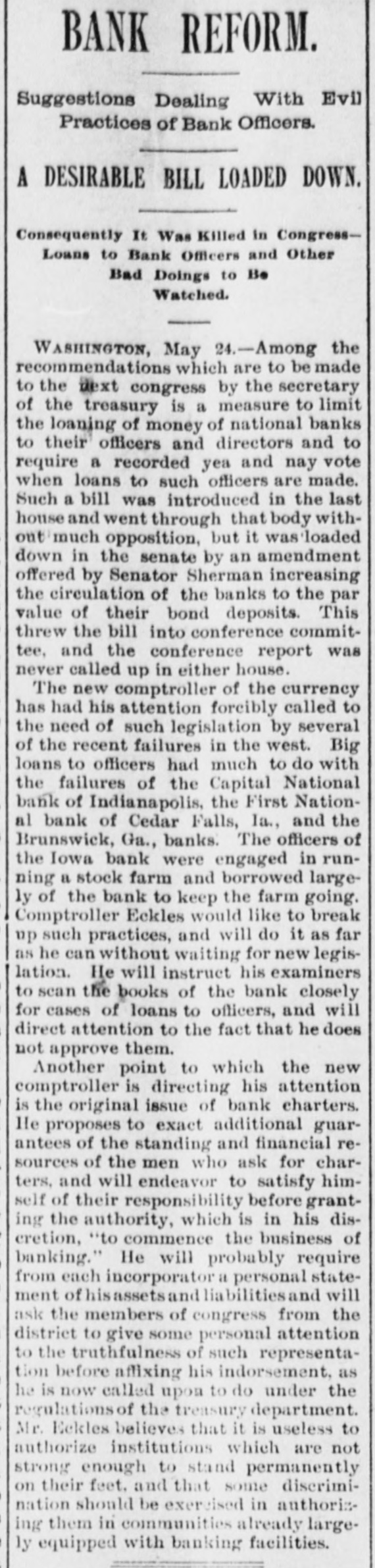
# BANK REFORM. Suggestions Dealing With Evil Practices of Bank Officers. # A DESIRABLE BILL LOADED DOWN. Consequently It Was Killed in Congress- Loans to Bank Officers and Other Bad Doings to Be Watched. WASHINGTON, May 24.-Among the recommendations which are to be made to the next congress by the secretary of the treasury is a measure to limit the loaning of money of national banks to their officers and directors and to require a recorded yea and nay vote when loans to such officers are made. Such a bill was introduced in the last house and went through that body without much opposition, but it was loaded down in the senate by an amendment offered by Senator Sherman increasing the circulation of the banks to the par value of their bond deposits. This threw the bill into conference committee, and the conference report was never called up in either house. The new comptroller of the currency has had his attention forcibly called to the need of such legislation by several of the recent failures in the west. Big loans to officers had much to do with the failures of the Capital National bank of Indianapolis, the First National bank of Cedar Falls, Ia., and the Brunswick, Ga., banks. The officers of the Iowa bank were engaged in running a stock farm and borrowed largely of the bank to keep the farm going. Comptroller Eckles would like to break up such practices, and will do it as far as he can without waiting for new legislation. He will instruct his examiners to scan the books of the bank closely for cases of loans to officers, and will direct attention to the fact that he does not approve them. Another point to which the new comptroller is directing his attention is the original issue of bank charters. He proposes to exact additional guarantees of the standing and financial resources of the men who ask for charters, and will endeavor to satisfy himself of their responsibility before granting the authority, which is in his discretion, "to commence the business of banking." He will probably require from each incorporator a personal statement of his assets and liabilities and will ask the members of congress from the district to give some personal attention to the truthfulness of such representation before affixing his indorsement, as he is now called upon to do under the regulations of the treasury department. Mr. Eckles believes that it is useless to authorize institutions which are not strong enough to stand permanently on their feet, and that some discrimination should be exercised in authorizing them in communities already largely equipped with banking facilities.


Article from The Indianapolis Journal, May 26, 1893

Click image to open full size in new tab

Article Text

A RECEIVER IS NOT NEEDED Examiner Young So Informs the Controiler About the Capital National. His Report Will Go to Washington, To-Day, Showing the Bank Is in Condition to Resume-At Least $500,000 in Sight. The report of Special Bank Examiner Young. who was sent here by the Controller of the Currency to make an examination of the Capital National Bank. will be sent to Washington to-night, and it will show that the bank 18 sound. It will further show that the institution is in a condition to resume business if the stockholders 80 elect. Several days ago Mr. Young sent a letter to the Controller, in which he stated that it would not be necessary to appoint a receiver for the bank. Mr. Young was asked last night about his report and the letter which he sent to Washington a few days ago. He would neither affirm nor deny the report that his examination proved the bank to be in sound condition, explaining that he was forbidden to make any statements whatever about the affairs of the institution. He admitted that his report would go to Washington to-night, but as to its import or contents he would say naught. After a running fire of questions and deft counterings Mr. Youngsaid, when told that brokers might take advantage of any delay in a report to buy up claims against the bank at a low figure: "Well, any man that would sell his claim on that bank for a shave would be a fool." The examiner in his report will show that the bank has $500,000 in available assets, and as the Journal stated several days ago, a local capitalist 18 ready to loan $100,000 if it wishes to resume. Over $150,000in cash has been received on the Dape: held by the bank since the suspension. and a number of borrowers who had deposits in the bank haveexchanged checks against their paper and thus reduced the liabilities. Under the banking laws of the United States a suspended national bank cannot resume without a majority or two-thirds vote of the stockholders. but as the interests represented by President Wilson cover almost two-thirds of the stock, and as most of the directors have proclaimed an intention of resuming, it is only fair to presume that they will do so after Examiner Young's report is formally filed at Washington. The $80,000 tied up in the Chemical National, of Chicago, has been considered by the examiner in informing the Controller that there is no need of a receiver for the bank. Mr. Young will remain in Indianapolis until he receives further instructions from the Controller. A meeting of the stockholders will probably be called for next week.


Article from Baxter Springs News, May 27, 1893

Click image to open full size in new tab

Article Text

REFORM DEMANDED. Evil Practices of Bank Officers to Be Looked Into - The Cause of Late Fallures. WASHINGTON, May 24.-Among the recommendations which are to be made to the next congress by the secretary of the treasury is a measure to limit the loaning of money of national banks to their officers and directors and to require a recorded yea and nay vote when loans to such officers are made. Such a bill was introduced in the last house and went through that body without much opposition, but it was'loaded down in the senate by an amendment offered by Senator Sherman increasing the circulation of the banks to the par value of their bond deposits. This threw the bill into conference committee, and the conference report was never called up in either house. The new comptroller of the currency has had his attention forcibly called to the need of such legislation by several of the recent failures in the west. Big loans to officers had much to do with the failures of the Capital National bank of Indianapolis, the First National bank of Cedar Falls, Ia., and the Brunswick, Ga., banks. The officers of the Iowa bank were engaged in running a stock farm and borrowed largely of the bank to keep the farm going. Comptroller Eckles would like to break up such practices, and will do it as far as he can without waiting for new legislation. He will instruct his examiners to scan the books of the bank closely for cases of loans to officers, and will direct attention to the fact that he does not approve them.


Article from Warren Sheaf, June 8, 1893

Click image to open full size in new tab

Article Text

WEST AND SOUTH. WEAVER, GETZ & Co., one of the largest and most important firms in the coal business in Chicago, suspended with liabilities of $500,000. AT Roanoke, Ind., Christian Haberkus, ag41 72, while temporarily insane killed his wife, aged 70, and then took his own life. WHILE walking on the Central railroad near Milner, Ga., Rev. William Graham and wife were struck by an engine and both were killed. ON the Lake Shore and New York Central roads the fast train service was successfully inaugurated. The "exposition flyer," west bound, reached Chicago in 19 hours and 57 minutes, three minutes ahead of time, while that going east arrived in New York thirty seconds in advance. LOGAN H. ROOTS, a member of the Fortieth and Forty-first congresses, died from congestion of the brain at his home in Little Rock, Ark., aged 52 years. FLAMES destroyed the business por tions of Standish, Mich., and Newton, Miss. A CYCLONE in southwestern Arkansas destroyed a large number of houses and at Hope seven persons were injured, two fatally. IN Tennessee the Big Stone Gap Land company, capitalized at $2,000,000, has been forced into liquidation. THE creditors of ex-Gov. Foster in Cincinnati have ageed to accept fifty cents on the dollar. THE national bank of North Dakota at Fargo and the bank at Beresford, S. D., closed their doors, IN a collision between suburban trains at Austin, Tex., two persons were killed and ten injured. ON the world's fair grounds Montana's statue of Justice, made of silver worth $75,000, and standing on a gold pedestal valued at $200,000, was unveiled. AT South Upatoc, Ga., a cyclone wrecked several houses, destroyed plantations and killed Mrs. George Parker and her daughter. THE Capital national bank at Indianapolis has been given permission to resume business, but the request of the Chemical bank of Chicago to resume has been refused. JAKE GAUDAUR, of Canada, and James Stansbury, of Australia, will row for the championship of the world August 17 at Pullman, III. THE men discharged at Davenport, Ia., from the Rock Island & Pacific railroad for visiting saloons while on duty will not be reinstated. MUTHLEISEN & Co., wholesale lumber dealers at St. Joseph, Mo., failed for $150,000. THE town of Rosedale, Miss., was destroyed by a cyclone and five persons were killed and many hurt. AT Jefferson Springs, Ark., John Wallace (colored) was lynched by a mob of his own race. He had assaulted Ida Warren, a 9-year-old colored girl. A LARGE colony of Mohammedans will settle in Georgia. They have, through an agent, secured 25,000 acres of land in that state and the option upon as much more.


Article from The Indianapolis Journal, June 20, 1893

Click image to open full size in new tab

Article Text

HAS REOPENED ITS DOORS. Public Confidence in the Capital National Bank Well Demonstrated. No Indications of a Run, and Deposits Came Close Up to the WithdrawalsOfficials Well Satisfied. The suspended Capital National Bank opened for business promptly at 9 o'clock yesterday morning. and when the curtains were pulled down at the usual hour in the evening, the total amount of the deposits received during the day almost equaled the amount of the withdrawals. It was an unusual circumstance in the history of suspended banks resuming. and it speaks volumes for the general business confidence in Indianapolis. The bank had $800,000 in cash ready to pay out if demanded, but the withdrawals did not exceed one-tenth this sum. At no time was there a heavy run, not over twenty-tive people being in line at the paying-teller's window at one period of the morning. In the afternoon it seemed that the bank was transacting its usual volume of business. The heaviest demands of the day were from small depositors and people who had received checks on the bank just before the suspension. Bank Examiner Hugh Young turned the institution over to the officials at9 o'clock, for at that hour his supervision ended. There were hardly half a dozen depositors at the doors at that hour and the first man to withdraw his deposit was a laboring man. Like others who followed him, he explained that he had confidence in the bank but needed the money which had been tied up. This was the general explanation of those who took out the sums they had in the bank. Within ten minutes after the opening the line of depositors increased to fifteen, and about that time men began to come in to make deposits and show their confidence in the institution and its new management. Many of these were South Meridian-street merchants. Other depositors came, and, after sizing up the situation, went away without asking for their money. On the Daying teller's desk were huge heaps of greenbacksand coin. Whenever the crowd threatened to become large a second Daying teller was put to work, and in this manner the line was thinned out at a rapid rate. The light run lasted about an hour. At noon Examirer Young stated that the bank had paid out about $50,000 and had received in deposits about $40,000. He was surprised that the demands were not greater, and intimated that it would have been better if the small depositors had, for the most Dart, been paid off at once. He thought when the bank opened the first days' withdrawals would amount to at least $200,000. The day's business, he said, showed an excellent financial condition in the city. President Byram was much gratified at the outcome. He said the deposits far exceeded his anticipations. One of the deposits amounted to $10,000. He said the bank had not yet considered the matter of entering the clearing house association. A policy will be determined upon as soon as the bank gets in good working order. Examiner Young left for Pittsburg yesterday afternoon. He has made many friends here during his stay.


Article from Warren Sheaf, June 29, 1893

Click image to open full size in new tab

Article Text

leaving many partico ver $100,000. BISHOP MERRILL says the general commission of the Methodist denomination will issue a manifesto withdrawing the Methodist exhibits from the world's fair within two weeks on account of Sunday opening and will ask the 5,000,000 members of the church to keep away from the exposition on week days as well as Sundays. A PLAN has been conceived by the committee in Chicago in charge of the Columbian liberty bell whereby on July 4 all the bells in schoolhouses and churches of the land will ring simultaneously at noon. FIRE wiped out the village of Jeffersontown, Kv. FAILURES of banks were reported at Lebanon and Albany in Oregon, at New Hanover, N. C., at Chattanooga, Tenn., and at Plainville, Kan. A MOB which was supposed to have lynched Lee Bennett at Gleason, Tenn., hung Jim Harris, an innocent man, instead. Bennett was in jail at Dresden, heavily guarded. BUSINESS has been resumed by the Capital national bank at Indianapolis, Ind., which suspended one month ago. THE law permitting the sale of vagrants in Missouri has been declared unconstitutional by the state supreme court. IOWA republicans will hold their state convention at Des Moines August 15. IN the state of Washington ten government inspectors were detected in aiding in smuggling in Chinese by means of fraudulent certificates and in permitting opium smuggling either by connivance or otherwise. IN Chicago the American Railway union, a new society to embrace every branch of the service, was organized with Eugene V. Debbs, of Terre Haute, Ind., as president. BURGLARS murdered Thomas Cordway and his sister at their home near Logansport, La. FOUR negroes were killed and many others wounded in a row at an emancipation day celebration at Flat Prairie, Tex. THE West Virginia building on the world's fair grounds was dedicated, the day being the thirtieth anniversary of the birth of the state. AT the Cheyenne agency in Montana enlisted Indians had a fight with other Indians and five of the latter were killed. THROUGHOUT North and South Carolina and Georgia an earthquake shock was felt. AN edict issued by the school commissioners dismissed all married teachers in the public schools in St. Louisr THE doors of the University bank and City savings bank at Los Angeles, Cal., were closed. AT Janesville, Wis., Charles P. Whalen was sentenced to twenty-five years' imprisonment for the murder of Gerald Spaulding. A CIRCUS tent was struck by lightning at River Falls, Wis., and seven persons were killed and thirty injured. SEVERAL exhibiters at the world's fair met and recorded themselves as being unalterably opposed to the opening of the gates on Sunday, not only on moral grounds but from a financial standpoint as well, and decided to enter suit for an injunction to have the gates closed on Sunday. AT a railway crossing near Lima, O., Charles Keller and his wife and John Steinbaugh were killed by the cars. AT his home in Menlo Park Leland Stanford, United States senator from California, died suddenly in his 70th year. Heart disease was the cause. He leaves a wife and property valued at $50.000.000.


Article from New-York Tribune, July 29, 1893

Click image to open full size in new tab

Article Text

It is to be observed that in twenty-one States and Territories there have been no !ailures of National banks, viz: In Alaska, Arizona. Arkansas, Connecticut. Delaware, District of Columbia, Idabo, Indian Territory, Louisiana, Maine, Maryland, Massachusetts, Minnesota, Nevada, New-Jersey, Pennsylvania. Rhode Island, South Carolina, Vermont, Virginia and West Virginia. It is further worthy of note that no National banks have failed in Boston, Brooklyn, Philadelphia, Pittsburg, Baltimore, Washington, Buffalo, Cincinnati. St. Louis, New-Orleans, San Francisco, Minneapolis, St. Pan! and numbers of other great commercial centres: and that but one has closed in New-York, two in Chicago. and one In Milwankee. The cause of the failures in NewYork and Chicago was due largely to mismanagement, as were numbers of others. Local scares have caused many of late to suspend. Nine of the banks failed were robbed by officials who are now under arrest. The following National banks have been authorIzed by the Controller of the Currency to resume business: Gate City National Bank, Atlanta, Ga.: First National Bank. Los Angeles, Cal.: First National Bank, San Diego, Cal.: First National Bank, Santa Ana, Cal.: First National Bank, San Bernardino, Cal.: Southern California National Bank, Los Angeles, Cal.: Merchants' National Bank. Fort Worth, Tex.: Second National Bank, Ashland, Ky.: Capital National Bank, Indianapolis.: First National Bank, Palouse City, Wash.: Washington National Bank, Spokane Falls, Wash.: National Bank of Commerce. Provo City, Utab: First National Bank. Cisco, Texas: Missouri National Bank, Kansas City, Mo. Many more will reopen, as the majority of those recently failed are absolutely solvent, and only closed through an unwarranted lack of confidence in them, causing disastrous runs. Resume: Number now in operation, 3,785: number failed since January 1, 1893. 105; number reopened, 14: number In hands of receivers, 33: number In hands of Bank Examiners, with application to Controller for resumption, 58.


Article from Rock Island Daily Argus, July 29, 1893

Click image to open full size in new tab

Article Text

MUCH OVERSTATED The Effect of the Times on National Banks. ECKELS GIVES THE TRUE FIGURES. Number of Failures Multiplied by Two by the Press-Only 103 in the Hands of the Comptroller and Many Resuming Business, While Others Are Authorized So to Do-Some Late Collapes. WASHINGTON, July 29. - "Recent dis ptches having appeared in the newspapers," said Comptroller of the Currency Mekels to a reporter, "that since Jan. 1, 1893, 200 national banks have failed, I have prepared a statement that the public may be property informed. Instead of 200 having closed their doors but 105 have gone into the hands of the comptroller of the currency. Fourteen of this number have already resumed business under favorable conditions and possessed of the confidence of the communities where they are located, and during the ensuing week its is expected several others will have complied with the requirements of the comptroiler and reopened, while prior to Sept. 1 an equal number will resume. Out the total of 105 closed but thirty-seven have gone into the hands of receivers, the balance either having reopened or are still in the hands of examiners with strong prospects of reopening. Some Further Financial Facts. "Five of the 105 banks are capitalized in the amount of $1,000,000, one at $600,000, six at 85 0,000 thirty-six at $50,000, and the remaining at $300,000, $250,000. $100,000 and less, but more than $50,000; the greater number, however, being from $100,000 to $150,000. By ge graphical sections the failures are distributed as follows: New England states, 2: Eastern states, 2: Middle and Mississippi valleystates, 15: Northwestern states, 6: Western states, 55: Southern states, 25. Twenty-one states and territories have reported no national bank failures, as follows: Alaska, Arkansas, Delaware. Idaho, Louisiana, Maryland, Minnesota, New Jersey, Rhode Island, Vermont, West Virginia, Arizona, Connecticut. District of Columbia, Indian Territory, Maine, Massachusetts, Nevada, Pennsylvania, South Carolina, Virginia, Where Banks Have Stood the Strain. "No national banks have failed in Boston, Brooklyn, Philadelphia, Pittsburg, Baltimore, Washington, Buffalo, Cincinnati. St. Louis, New Orleans, San Fransisco, Minneapolis, St. Paul and numbers of other great commercial centers, and but one has closed in New York, two in Chicago and one in Milwaukee. The causes of the failures in New York and Chicago were due largely to mismanagement, as were numbers of others. Local scares have caused many of late to suspend. Nine of the banks failed were robbed by officials, who are now under arrest." The compt.ollen said that fourteen other national banks have been authorized to resume business, one being the Capital National at Indianapolis and the others located at California, Texas, Utah, Washington, Missouri and Kentucky points. He added: "Many more will reopen, as the majority of those recently failed are absolutely solvent and only closed through an unwarranted lack of confiden e in them, causing disastrous runs. There areat this date 3,752 national banks in operation."


Article from The Helena Independent, January 1, 1894

Click image to open full size in new tab

Article Text

BUSINESS TROUBLES. Some of the Wrecks Caused by the Great Financial Depression. JANUARY. 6. Wickham & Co., wholesale fish dealers of Huron. O., failed for $250,000. FEBRUARY. 2. The First National bank of Little Rock suspended. 8. The banking house of F. V. Rockatellow at Wilkesbarre, Pa., closed its doors. 93. Beaupre, Keogh & Davis, wholesale grocers, assigned in St. Paul: liabilities over $400,000. MARCH. 13. The Atkinson House Furnishing company of Maine assigned in Boston: liabilities, $1,500,000. 14. The Kansas Trust and Banking company, at Kansas City, suspended, with liabilities of $800,000. 23. Dobbins & Dazy, cotton brokers. assigned in Nashville: liabilities, $1,000,000. APRIL. 7. The Northwestern State bank of Sibley, la., closed its doors; liabilities, $150,000. 12. The English, Scottish and Australian Chartered bank failed, with liabilities of ยฃ8,000,000. 20. The Australian Joint Stock bank failed for ยฃ13,000,000. 22. The Barik of Milbank, S. D., assigned, with liabilities of $100,000. 25. The Union Loan and Trust company of Sioux City closed its doors: liabilities, $750.000. 30. The National Bank of Australasia failed for ยฃ7,500,000. MAY. 1. F. H. Weeks, president of the Land and River Improvement company, West Superior, Wis., assigned. 8. H. H. Warner, the patent medicine manufacturer of Rochester, assigned: liabilities estimated at $500,000. 9. The Bank of Victoria, at Melbourne, suspended, with ยฃ2,400,000 liabilities. 11. The Capital National bank, at Indianapoled. lis. 8" R. Jinson & Co., bankers of Wilmington. Del., failed, with liabilities of over $326,000. 12. The Sioux City (Ia.) Engine works suspended; liabilities, $200,000. Thomas & Sons, whisky dealers in Louisville, failed owing from $150,000 to $400,000. 13. Bank failures at Orleans and Rossville, Ind., at Freeport, O., and Rockford, Mich. Steel company at Bellville, Ills., placed in hands of a receiver. Kendall & Smith, grain dealers of Lincoln, Neb., failed for over $250,000. 15. Erastus Wiman, & New York capitalist, made an assignment. 26. Ex-Secretary of the Treasury Charles Foster of Fostoria, O., assigned, with liabilities of nearly $1,000,000. 28. National banks at Fargo and Lakota. N. D., closed by the comptroller. JUNE. 5. The Kansas Grain company, owning 106 elf evators, failed. JULY. 18. Exciting bank panic in Denver. 25. The Erie railway went into the hands of receivers; the floating debt is $6,000,000. AUGUST. 2. The North American Packing and Provision company assigned in Chicago, with $750,000 liabilities. 4. Receivers were appointed for the business of J. H. Walker & Co., dry goods dealers, who succeeded to the Chicago trade of A. T. Stewart & Co.: debts, $2,000,000. 1 N. L. Carte & Co., the old tin plate importers, assigned in New York city: liabilities, $850,000. 9. R. H. Coleman, the "Iron King" of Lebanon, Pa., assigned. S DECEMBER. 1. Abe Stein & Co., heavy importers of goat skins, hides, etc., failed in New York for over $1,000,000. 4. Green B. Raum, Jr., general merchant and Indian trader at Perry, O. T., failed. The Citizens' National bank of Grand Island, n Neb., closed its doors. 5. N.J. Schloss & Co., wholesale clothiers in New York, assigned.