Atlas National Bank (Chicago, IL)

Episode Information

Episode UID
350301164
Episode Type
Run โ†’ Suspension โ†’ Closure
Bank Type
national
Bank ID
35030 national
Charter Number
3503
Start Date
December 23, 1896
Location
Chicago, Illinois (41.850, -87.650)

Metadata

Model
gpt-5-mini (chosen from majority vote of a three-model LLM ensemble)
Short Digest
bfc91a8df4e0fad8

Response Measures

Accommodated withdrawals, Borrowed from banks or large institutions, Clearinghouse loan, Books examined

Clearinghouse involved: Yes (loan, examination, or other measures)

Description

Voluntary liquidation arranged with Clearing House advances; failure linked to runs and ties to other failed institutions.

Events (5)

1. May 15, 1886 Chartered
Source
historical_nic
2. December 23, 1896 Run
Cause
Local Banks
Cause Details
Heavy withdrawals triggered by the recent failure of the National Bank of Illinois and related loss of confidence (plus circulated reports/rumors).
Measures
Paid depositors in cash as presented; refused new deposits; clearing house arranged advances to cover payouts.
Newspaper Excerpt
The Atlas suffered heavily from the run occasioned by the failure of the National Bank of Illinois, deposits aggregating $900,000 having been withdrawn last week.
Source
newspapers
3. December 27, 1896 Suspension
Cause
Voluntary Liquidation
Cause Details
Officers decided to retire from business (citing ill health of president and prolonged shrinkage of deposits); clearing house advanced funds to pay depositors as part of voluntary liquidation.
Newspaper Excerpt
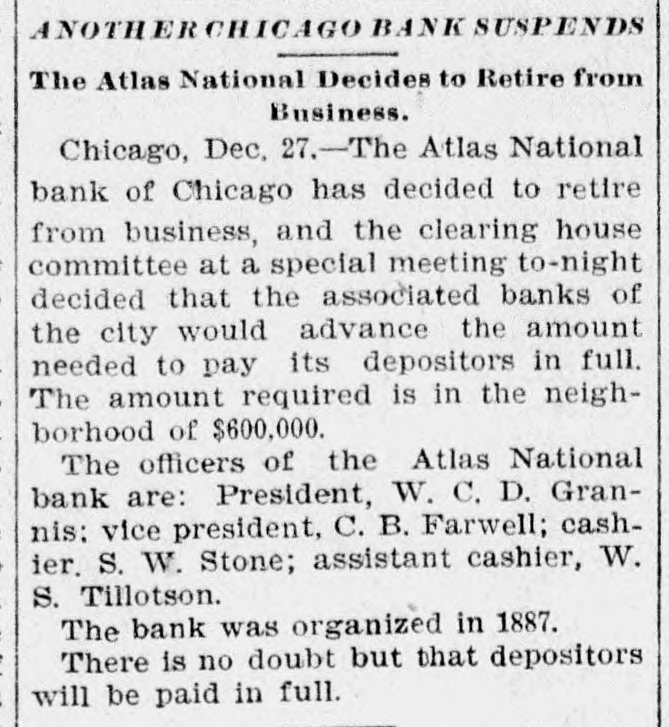
The Atlas National Bank of Chicago has decided to retire from business, and the Clearing House Committee ... decided that the associated banks of the city would advance the amount needed to pay its depositors in full.
Source
newspapers
4. December 28, 1896 Other
Newspaper Excerpt
The collateral securities and other assets of the Atlas Bank will be turned over to Isaac G. Lombard ... as trustee for the associated banks; depositors to be paid as cash equivalent is presented to the banks.
Source
newspapers
5. February 19, 1897 Voluntary Liquidation
Source
historical_nic

Newspaper Articles (22)

Article from New-York Tribune, December 28, 1896

Click image to open full size in new tab

Article Text

ANOTHER CHICAGO BANK CLOSES. THE ATLAS NATIONAL WILL RETIRE FROM BUSINESS-THE CLEARING HOUSE TO PAY DEPOSITORS IN FULL Chicago, Dec. 27.-The Atlas National Bank of Chicago has decided to retire from business, and the Clearing House Committee, at a special meeting to-night, decided that the associated banks of the city would advance the amount needed to pay its depositors in full. The amount required is about $600,000. The meeting was held at the home of Isaac G. Lombard. a member of the committee, about 11 o'clock to-night. The action of the committee is expressed in the following: The Atlas National Bank having decided to re. tire from business, the Clearing House Committee has made an examination of its affairs, and on its report the associated banks of the city have dethe amount needed to pay its dein as shown by its positors cided to advance full, books December into 26, 1896, without waiting to convert its assets cash. The amount required to be advanced will not exceed $600,000 The bank will not receive any deposits from date. Checks on it will be settled through the Clearing House, as usual. ISAAC G. LOMBARD, LYMAN J. GAGE, ORSON SMITH, C. J. BLAIR. E. G. KEITH Clearing House Committee. The officers of the Atlas National are: Prestdent, W. C. D. Grannis: vice-president. C. B. Farwell cashier, B. W. Stone: assistant cashier. W.S. Tillotson. The bank was organized in 1887, many of its incorporators being officers of the Union National Bank. Its capital stock is $700.000. Mr. Grannia has been president from the start. It is given out to-night that during the last few years newer and more pushing institutions have been taking business away from the Atlas, and that as a result of these defections over $2,500,000 in deposits have been withdrawn from the bank, most of it during the last six months. Mr. Grannis is an old man, and decided some time ago to go out of business. The bank is believed to be perfectly solvent. as the action of the Clearing House committee indicates. The report of the condition of the Atlas National at the close of business December 17 is as follows: Resources-Loans and discounts. United $1,941,742.59; overdrafts, $7,620 47; States and other bonds, $59,384; premium on bonds, $3,250; real estate, furniture and fixtures, $57,177 91; redemption fund, $2,250; cash and sight exchange, $820,638.52; a total of $2,892,063.39 Liabilities-Capital stock, $700,000; surplus fund, $140,000; undivided profits. $49,031 23; circulation. $42,620; bills payable, $100,000; deposits, $1,869,412; a total of $2,892,063.39. The director's of the bank are R. C. Clowry, vice-president of the Western Union Telegraph Company: C. B. Farwell, president of the J. V. Farwell Company: W. M. Van Bortwick, banker. Batavia, III.; John L. Norton, of Norton & Co., millers; W. C. D. Grannis, Charles Kern J. C. McMullin, H. L. Martsall, C. J. Connell and E. B. Meyers. Mr. Norton is a partner of Norton & Co., who yesterday assigned in this city.


Article from The Evening Times, December 28, 1896

Click image to open full size in new tab

Article Text

MARKET DULL AND WEAK. Grangers Led the Decline, and Consolidated Gas Lost Also. New York, Dec. 28.-Business was resumed at the stock exchange after the triple holiday with a weak and lower market for securities. Trading was light, and is likely to remain SO until after New Year's Day. The greatest pressure to sell was in Consolidated Gas, which broke 4 1.4 per cent. to 136 3-4 on the revival of the reports of dollar gas. The grangers were weaker than for some days past, Burlington and Quincy falling 1 5-8 to 69 1-8 on selling alleged to Le for Boston account. St. Paul declined 3-4 to 72 3-8 and Rock Island 1 to 65. Other, weak spots were Louisville and Nashville, Delaware and Hudson, Manhattan, Chicago Gas and Sugar. The voluntary liquidation of the Atlas Bank of Chicago was not considered of any importance, and the appointment of a receiver for the Columbus and Hocking Valley Coal and Iron Company was passed by unnoticed. The stock of the last named was unchanged at 5. London houses sold amounts of Louisville and Nashville and St. Paul, while local commission firms were still complaining of a lack of orders. At 11 o'clock speculation was dull and weak. 11 o'clock, and dropped to 68 3-4. Some long stock came out on the way down, owing to the unfavorable character of the November statement of the company. For the period named the decrease in surplus after operating expenses and charges is $202,779. Rock Island and St. Paul were slightly weaker in sympathy. Consolidated Gas recovered from 136 3-4 to 138, and then receded to 137 1-2. Sugar rallied from 109 1-4 to 109 5-8. Considering the reports about a War with the Arbuckles, the stock ruled fairly firm. The general market while quiet was barely steady. At midday the Grangers were weak, and the remainder of the list steady.


Article from Deseret Evening News, December 28, 1896

Click image to open full size in new tab

Article Text

The report was as follows: RESOURCES. Loans and discounts $1,941,742 50 Overdrafts 7,620 49 United States and other bonds 59,884 00 Premium on bonds 3,355 00 75,177 $1 Real estate, furniture and fixtures 22,730 00 Redemption fund 820,634 52 Cash and sight exchange Total $2,892,063 39 LIABILITIES. $ 700,000 00 Capital stock 140,000 CO Suiplus fund 49,031 23 Undivided profits Circulation 42,620 00 100,000 00 Bills payable 1,860,412 16 Deposits Total $2,892,063 39 CAUSE OF THE FAILURE. CHICAGO, Dec. 28.-The Atlas National bank which went out of business was involved in the failure of the Medowcroft Brothers and the Cen. tral trust and Savings bank, which assigned a year ago, cleared through the Atlas. The collateral of the defunct bank had on deposit to secure


Article from Deseret Evening News, December 28, 1896

Click image to open full size in new tab

Article Text

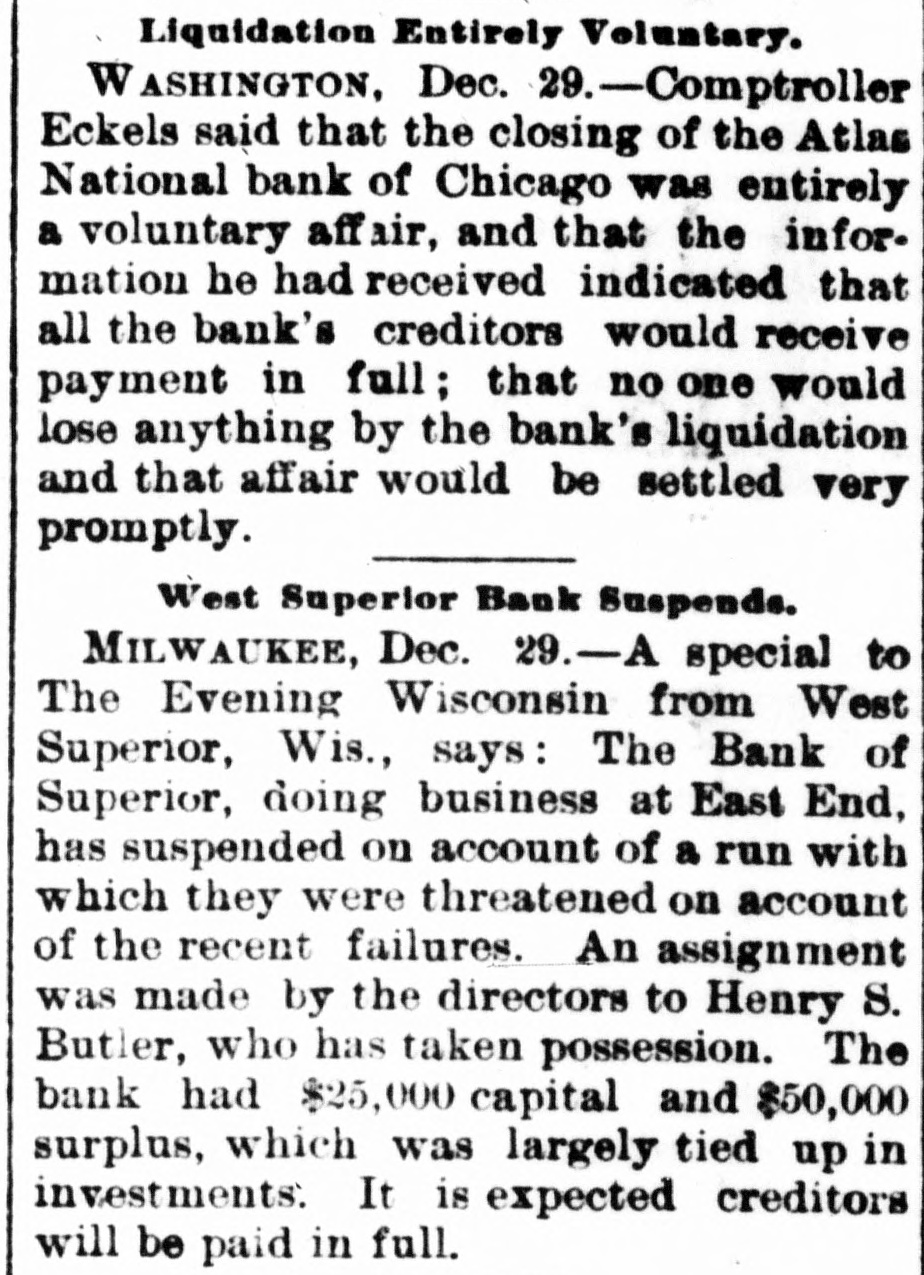
its clearances was said to be ample, and President Grannis at the time said the Atlas National would not lose by the failure. W.A. Paulsen, who was president of the Central Trust and Savings bank, recently brought a suit for $250,000 against the Atlas National bank. W. C. D. Grannis and Charlew B. Farwell. The suit 18 based upon the trouble which Paulsen had with the bank at the time of the failure of the Central Trust and Sav. ings concern, Paulson alleged that, although his bank had deposited in the Atlas National bank collateral sufficient to cover all claims against it, clearing facilities were refused and the bank was forced to assign. The liabilities of the Atlas bank are about $2,800,000, the deposits being $1,800,000, MR. ECKELS'S STATEMENT. WASHINGTON, D. C., Dec. 28.Comptroller 4 Eckets said today the closing of the Atlas National bank (Chicago) was entirely volustary. The information he had received Indicated that all the bank's creditors would recelve payment in full and the affairs be settled promptly. Eckels said the creditors of the bank would be paid in full at once, through advances by the Chicago clearing house, and in his opinion the stock. holders would eventually realize 100 per cent. THE BANK SOLVENT. CHICAGO, Dec. 28.-Partly as a result or the failure of the National Bank of Illinois last week, the Atlas National bank began paying off its depositors today, thus marking the first step in the retirement from business. No deposits were received, and as fast as the accounts were checked up the depositors were paid in full and the books taken up. The Atlas suffered heavily from runs occasioned by the closing of the National Bank of Illinois, deposits aggregating $900,000 having been with. drawn the last week. This brought the resources down to a low figure. The clearing house committee, at the request of the officers of the bank, investigated its accounts, and the bank was found solvent. To expedite liquidation the committee pledged the all or the associated banks of Chlcago. Vice President C. B. Farewell said today: "Alter the depositors have been paid off, I believe the shareholders will receive a large percentage of their interest, It not every dollar."


Article from Omaha Daily Bee, December 28, 1896

Click image to open full size in new tab

Article Text

-It was announced toCHICAGO, Del National bank will go night that the A uidation and reinto voluntary The action is tire from bu a failure in not considered bank's business was any sense, and, comparatively a small one, it is not anticipated that any flurry in the banking circles of Chicago will result. Two statements were made public tonight, one from the officers of the bank, announcing that owing to ill health they would liquidate and go out of business, and the other from the clearing house association, showing that the other banks of the city will furnish the Atlas ample support. Depositors will be paid in full upon presentation of checks. The bank has been for some time gradually reducing its indebtedness, and its liabilities, which a few months ago were about $2,800,000, are now but $1,150,000, and are amply covered by good assets. The bank has about $250,000 in cash on hand, and gilt-edge bills receivable to the amount of $1,200,000 more. As C. B. Farwell is vice president of the Atlas National, it had been popularly supposed that the firm of John V. Farwell & Co. was heavily interested, but none of the firm's paper is involved, and C. B. Farwell has but an insignificant amount on deposit in the institution. The bank has about $300,000 loaned to a paper manufacturer of Batavia, III., and $70,000 to Norton Bros., the millers who failed last week, but its other accounts are all thought to be good. Following are the official announcements which write the epitaph of a financial institution which has lived almost ten years: Owing to the continued ill health of the president of this bank, it has been decided to close its business. No deposits will be received hercafter, but all depositors will be paid in cash upon demand. Depositors and correspondents are requested to present their claims for balances due them before January 1 next, so far as may be possible. ATLAS NATIONAL BANK, W.C. D. GRANNIS, President. S. W. STONE, Cashier. December 27, 1896.-The Atlas National bank, having decided to retire from business, the clearing house committee has made an examination of its affairs, and on their report the associated banks of the city have decided to advance the amount needed to pay its depositors in full as shown by its books December 26, 1896, without waiting to convert its assets into cash. The amount required to be advanced will not exceed $600,000. The bank will not receive any deposits from date. Checks on it will be settled through the clearing house, as usual. ISAAC G. LOMBARD, L. O. GAGE, ORSON C. SMITH, C. J. BLAIR, E. G. KEITH, Clearing House Committee. One year ago the Atlas had in deposits $3,221,400; on December 17 they footed up $1,860,412; at the close of business on Saturday night they were in all probability nearly $1,000,000 less. This briefly tells the story of this voluntary liquidation. One month or six weeks ago the attention of Comptroller of the Currency Eckels was called to the condition of the bank. The report of the bank examiner showed there was loans to directore and officers of the bank exceeding its total capital stock of $700,000. The comptroller sent several pointed messages telling them to "clean up" and reduce this aggregate of loans inside the institution. The bank officials cut the total down to between $350,000 and $300,000 and raised the cash reserve from 25 per cent, the legal minimum, to 40 per cent. Subsequently the constant checking out of deposits reduced this reserve somewhat. The heaviest run came on Tuesday, and resulted largely from a widely circulated story that the bank had on Monday afternoon posted the sign "closed" upon its doors. When the bank closed Tuesday afternoon its was felt that immediate suspension must follow the next day if the run was kept up, but Wednesday brought something of a reaction which followed the collapse of the National Bank of Illinois and the withdrawal of funds slackened. Thursday the officials of the bank were notified by some of the leading bankers of Chicago to call on them if trouble was imminent and they would agree upon a plan of action which would be the best for all concerned. The following day Comptroller Eckels, who was receiving almost daily reports from the institution by telegraph, advised that a plan of liquidation be arranged. He sent this advice both to the officers of the bank and to Bank Examiner McKeon. The clearing house committee was notified and a subcommittee of two appointed to make an examination of the securities held by the Atlas. The examination was ended on Saturday, and the report was satisfactory. The result was the meeting at Banker


Article from Santa Fe Daily New Mexican, December 29, 1896

Click image to open full size in new tab

Article Text

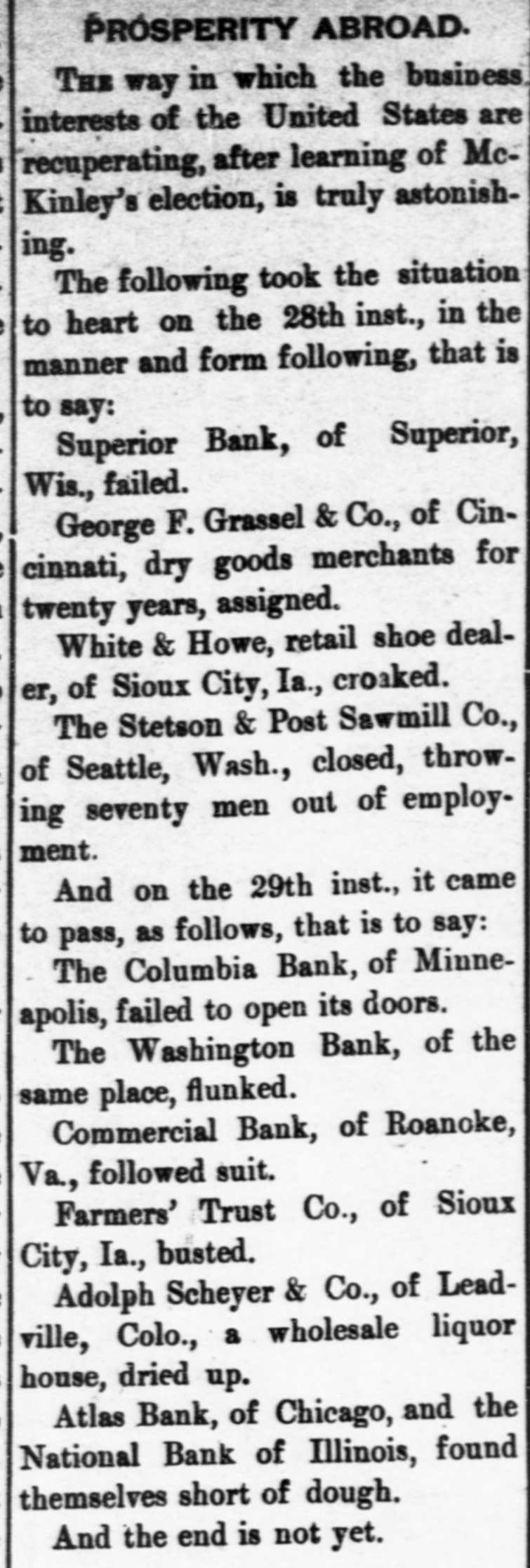
BANKS WITH BROKEN BACKS The Banks Beat Bryan and Gave Victory to Advance Agent of Prosperity. ENJOYING FRUITS OF THEIR *TRIUMPH Serious Bank Disasters in Illinois, Minnesota and Virginia To-day-Of Course Depositors Are Promised Full Payment. Batavia, Ill., Dec. 29.-The liquidation of the Atlas bank at Chicago has precipitated the suspension of the Van Northwick bank at Batavia. An assignment made by W. S. to the Northwick has been Equitable and liabilities Trust J.S. com- Van pany of Chicago. The are said to aggregate $2,000,000. The Van Northvicks interests are largely in paper mills and manufacturing industries valned at $2,500,000. AND STILL ANOTHER. Minneapolis, Minn. - The Columbia an institution of comrecent National paratively bank, establishment its doors having this capital closed and is in the to its examiner. morning $200,000 According hands of last the state- bank ment on December 17, it had loans and discounts amounting to $348,145; bonds to secure circulation $50,000; real estate and mortgages $48,728; due from other banks $42,897; cash reserve $34,872; other cash items $11,852; national bank notes outstanding $45,000; due to other banks $136,679; deposits subject to certificates check $101,507; cashier's of deposit checks $632,934; certified and $3,313; bills payable $15,000. Cashier Joseph Goebletter said: "We could have stood the pressure a little longer, but to protect the majority we closed this morning. We have $33,000 in cash and inside of sixty days we expect to have fully $100,000 more collected. Our total liabilities are only $247,000. There is no doubt that we will be able to pay depositors in full and effect a fair settlement with the stockholders." The officers are: Charles Kettleson, president; H. Thorson, vice-president; Joseph Goebletter. cashier. The bank is the immediate charge of Geo. . Coffin, deputy comptroller of the currency. "I believe," said Mr. Coffin, "that the suspension will not cause any further trouble. The national banks of this city are strong financially." ANOTHER FAILURE AT MINNEAPOLIS. The Washington bank, a state institution, closed its doors this noon. This bank had a capital of $100,000, and by the last statement, at the close of business on December 17, it had $407,104 1 loans and discounts; $14,228 in overdrafts secured; $20,165 in stocks and bonds; $14,475 in real estate, and $88,272 in cash on hand. The deposits are $363,133; certificates of deposit,$112,587;bank deposits, $84,937. A. C. Haugan, city treasurer, was one of the founders of the bank and is one of the directors. O. E. Breecke is cashier. BANK DISASTER IN ILLINOIS. Batavia, Ill.-William and John Van Nortwick's bank did not open this morning. There was no run on the other banks in Batavia and no failures are reThe Van Nortwicks held 464 the Atlas National of the bank here is closing shares ported. in bank due and to the the assignment of the brothers to the Equitable Trust company of Chicago. Cashier Grimes, who was in charge of the Van Nortwick bank, said to-day that he had no intimation that the bank would liquidate until 12 o'clock yesterday noon, when C. C. Wilson, representing the Equitable Trust company, walked into the bank and said that he had been sent down by the company to take charge. "The assignment made by Van Nortwicks," said Grimes, "includes everything they have and it is my belief that the creditors of the bank will e paid in full." IN THE IRON DISTRICT. Washington.-Comptroller of the Currency Eckels received notice to-day that the Commercial National Bank, of Roanoke, Va., had suspended payment. Bank Examiner Sands was sent to take charge. Eckels does not regard the failure as serious. The last report to him, November 17, showed the assets to be $263,504; deposits, $75,000; other libilities, $85,000 The failure is attributed by Eckels in part to speculation.


Article from Deseret Evening News, December 29, 1896

Click image to open full size in new tab

Article Text

night to discuss the outlook and gave it out that the First National would be able to meet all demands today. ASSETS AND LIABILITIES. Batavia, III., Dec. 29-The liquidation of the Atlas Bank, Chicago, precipitated the suspension of the Van Nortwick. The liabilities are said to aggregate two million dollars. The assets, largely in paper mills,aggregate $2,500,000. THE WASHINGTON BANK CLOSED. MINNEAPOLIS, Dec. 29.-The Wash. ington bank, a state institution, closed Its deorathis noon. It had a capital of $100,000 and by its last statement at the close of business, December 17th, had $507,104 loans and discounts; $14,228 overdraits secured; $20,165 in stocks and bonds; $14,475 real estate and $88,272 cash on hand; deposits, $363,132; certified deposits, $112,587; bank deposits, $84,937. A. C. Haugan, city treasurer, was one of the founders of the bank and one of the directors. O. E. Breecke is cashier. A GENERAL RUN CAUSED A FAILURE ROANOKE, Va., Dec 29.-The Commercial National bank of this city closed its doors this morning by order of the board of directors. On December 9th, J. C. Davenport, cashier, resigned and bis successor was elected. The matter was kept quiet until Sunday night when Davemport left the city for his home in Charleston, W. Va,, and it is stated as scon as this became known a general run was made on the bank and it Was compelied to go to the wall. The officials say the depositors willbe paidin rull.


Article from The Seattle Post-Intelligencer, December 29, 1896

Click image to open full size in new tab

Article Text

000, The Van Nortwick interests, aside from Batavia property, are largely in paper mills and manufacturing industries. Their last statement of assets, prepared a year ago, placed their wealth at $2,500.000. They own a business block, residence and two farms in Batayia township, the whole tract valued at $150,000; also the Western Paper Bag factories of Batavia and Kaukauna, the largest concerns of the kind in the world, with a daily output of 2,000,000 bags; also a strawboard mill at Batavia, unused. The paper mills at Appleton, Wis., are valued at $800,000. They own pine lands in Wisconsin, and have stock in the old Second National bank, of Aurora, the Aurora cotton mills and the Kaukauna and Appleton banks. They are the principal owners of the Appleton Manufacturing Company, of Geneva. The brothers own 464 shares in the Atlas National bank, of Chicago. Cashier W. L. Grimes, of the bank, when seen by a reporter declined to give a statement of the bank's assets and liabilfties, simply declaring that the depositors would be paid in full. The Van Nortwicks' assets, the said, were ample to meet all liabilities if the assignees took sufficient time to realize on the property. Suspension at Minneapolis. MINNEAPOLIS, Dec. 28.-The Scandia bank, a small bank of this city, with a capital of $60,000, suspended payment this noon upon advice of Bank Examiner Kenyon. It is officially estimated that the liabilities of the institution will aggregate $800,000. The assets consist largely of real estate, and with a reasonable realization will net, it is thought, about that amount, possibly reaching $350,000. The institution had a share of the state funds, but the amount was only $3,158. The recent failure of the Minnesota bank at St. Paul affected It to the extent of $1,100. President Sunde made the following statement: "The suspension is due entirely to our inability to realize on real estate. In 1892 we were obliged to accept considerable of this in the form of security, and the price has steadily declined. I am in hopes that sufficient will be realized to pay every person concerned, and I may add that we hope that the institution will soon again be placed upon a working basis." Bank Examiner Kenyon said he was quite sure hte loss to depositors would be trifling. He says there is every reason to believe that with ordinary success the assets will exceed all liabilities. The Scandia bank opened in October, 1883. There has been practically little change in the management since its inception. The stockholders include R. Sunde, R. B. Anderson, of Madison, and C. E. Vanderberg, of this city. H. J. Kjessesvig was assistant cashier. General surprise was felt at the suspension, as it was known to be one of the most conservatively managed banks in the city. Other Firms Stranded. WEST SUPERIOR, Wis., Dec. 28.-The Bank of Superior, doing business at the East End, suspended today. An assignment was made by the directors to Henry S. Butler, who has taken possession. The bank has $25,000 capital and $6,000 surplus, which is largely tied up in investments. A slight run Saturday caused the closing. Deposits are mostly small amounts. The officers of the bank expect to liquidate in full, unless there is & continual decline in assets. KANSAS CITY, Dec. 28.-The McCoy Banking Company, of Independence, Mo., went into voluntary liquidation today. The reason given is that Its president, William McCoy, is too advanced in years to manage tts affairs longer. LACONIA, N. H., Dec. 28.-The Laconta Car Company went into voluntary insolvency today. The liabilities are $617,000; assets, $407,000. BATAVIA, Ill., Dec. 28.-William M. & J. S. Van Nortwick, bankers and manufacturers, made an assignment to the Equitable Trust Company. of Chicago. This was brought on by the Atlas National bank closing. Their property interests are heavy. and they will pay out in full. CHICAGO, Dec. 28.-The Excelsior Machine & Bolt Works Company failed today. Liabilities and assets about $40,000. FORT WAYNE. Ind., Dec. 28.-The retall dry goods firm of A. Frank & Co. failed today. The firm's indebtedness to local creditors amounts to $70,000. There is also a heavy indebtedhess to Eastern creditors. CINCINNATI, Dec. 23.-Frank Duhme and Herman Duhme. Jr., trading in jewetry as the Duhme Company, have failed. The concern had issued stock since its organization four years ago amounting to $440,000. The assets and liabilities are not known. but the company's affairs are said to be badly involved.


Article from The Times, December 29, 1896

Click image to open full size in new tab

Article Text

BUSINESS TROUBLES, Banks in Trouble in the Northwestcantile Failures. MINNEAPOLIS, MINN., Dec. The Scandia Bank, of this city, cl its doors this afternoon. The last obtainable statement of condition of the bank was made UU 6th last. It showed loans and disco amounting to $189,288, and deposits at gating $225,337. its business nas pee most wholly with Scans. SUPERIOR, WIS., Dec. 3.-Antic ing a run to-day, the bank of Sup did not open for business this mor Henry S. Butler is assignee, and assumed charge of the DUNK S an The failure is que to poor business heavy withdrawals since recent fai in St. Paul, Chicago, and this city. capital of the bank was $25,000, with plus of $6,000. The deposits were n $100,00, including $13,210 or city I This makes nearly $30,000 of public 1 tied up in a week. Officials of the say they will pay in tull. CHICAGO, Dec. 28.-The Atlas Nat Bank, at Washington and LaSalle st was practically in charge of the Ch Clearing House Association, represe the Associated Financial institution the city, when the doors were open the public at 10 o'clock this mor William C. Oakley, a former na bank examiner, was appointed the or the associated banks to superi the clerical and other details in co tion with the work of voluntary liq tion with the necessary cash assis of other banks. Small accounts were paid in full presented this morning, but, in no did the large depositors press for I diate payment, accepting the signed antee of the banks in the Clearing I that all depositors would get their II in full. Many business men and ba called to express their sympathy wit officers and directors of the bank It is believed the stockholders wi nearly all that is due them at par. The well-known connection betwee Atlas Bank and the Dime Savings a small but old institution, cause circulation of the report that it 1 also be forced to liquidate. Its doors opened for business as usual, but was little business to do. Depo came to draw out their savings, but were presented with a blank noti the bank that they desired to with so much in ninety days from date requested to fill out the paper, Other banks of the city were doing ness under normal conditions this I ing. The general opinion is that the Bank will follow the Atlas into volu liquidation within ninety days. The resources of the Atlas Na Bank are estimated at $2,550,000. wit ligations approximating the same an Owing to inability to realize the : value of the assets on a declining ket, it will be necessary for the I which are members of the Clearing-1 Association. to advance between $5 and $600,000. pro rated according to capital stock, in order to pay all app claims in full at once. This is exp to be done within a week. The at of money needed to complete the lic tion is about $100.000 more than W first expected by the ClearingCommittee. After Chairman Lomard, Clearine- House Committee who is


Article from New-York Tribune, December 29, 1896

Click image to open full size in new tab

Article Text

WESTERN BANK FAILURES. A CHICAGO SAVINGS INSTITUTION PRACTICALLY SUSPENDS BUSINESS. INVOLVED BY THE COLLAPSE OF THE ATLAS NATIONAL-CONDITION OF THE FAILED CONCERNS. Chicago, Dec. 28.-The Atlas National Bank, at Washington and Lasalle sts., was practically in charge of the Chicago Clearing House Association, representing the associated financial institutions of the city, when the doors were opened to the public at 10 o'clock this morning. William C. Oakley, a former National bank examiner. was appointed the agent of the associated banks to superintend the clerical and other details in connection with the work of voluntary liquidation with the necessary cash assistance of the other banks. The collateral securities and other assets of the Atlas Bank will be turned over to Isaac G. Lombard, chairman of the Clearing House Committee, as trustee for the associated banks. As quickly as the cash equivalent is presented to the banks it will be paid to the depositors. There was a steady stream of serious-faced business men and other creditors of the Atlas Bank passing into the building all morning. Their steps were bent toward the desks of Cashier S. W. Stone, his assistant and the paying teller. where anxious inquiries were made as to how and when the money on deposit would be paid by the bank. Most of the callers brought their passbooks, showing the bal-


Article from The Evening Tribune, December 29, 1896

Click image to open full size in new tab

Article Text

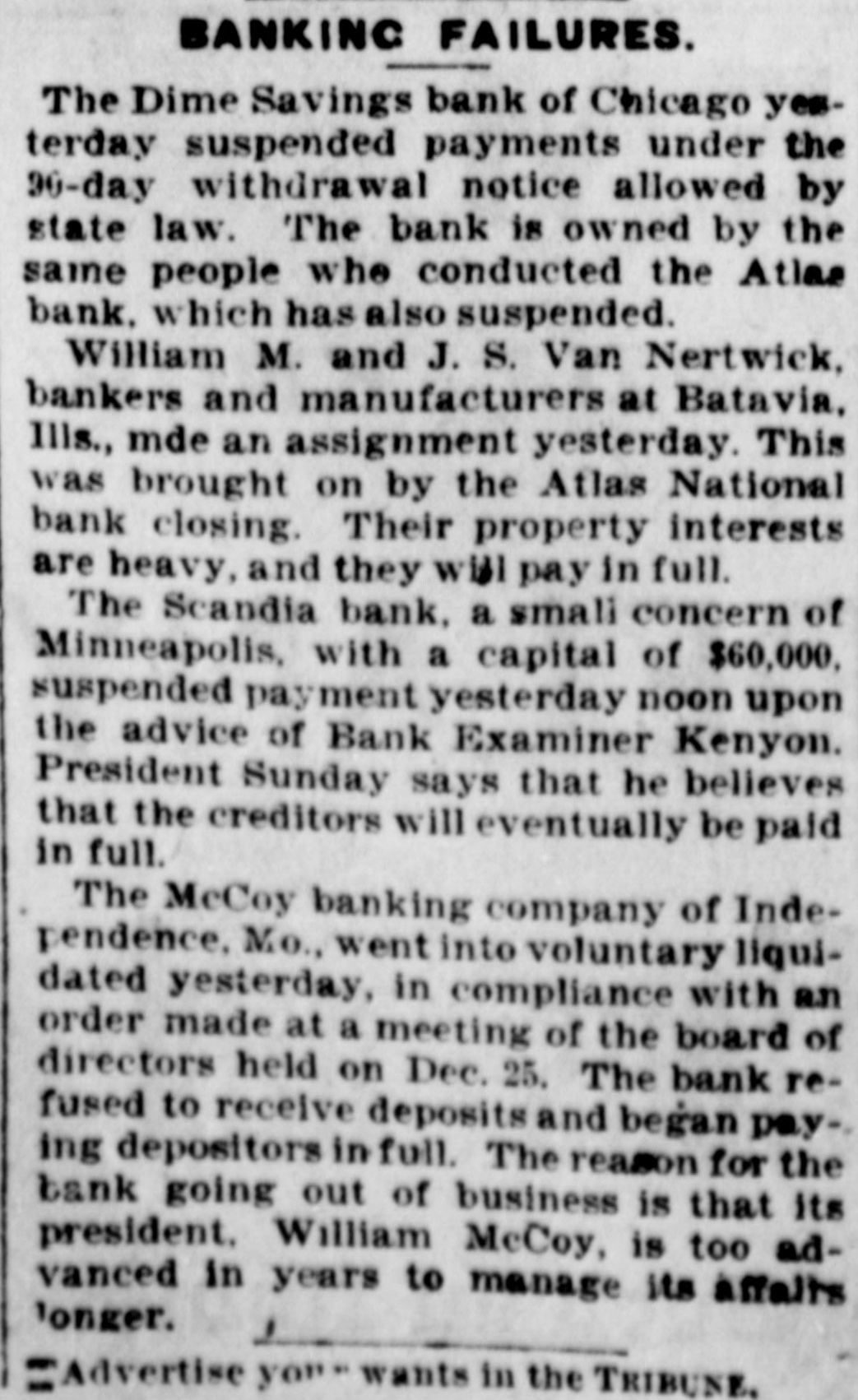
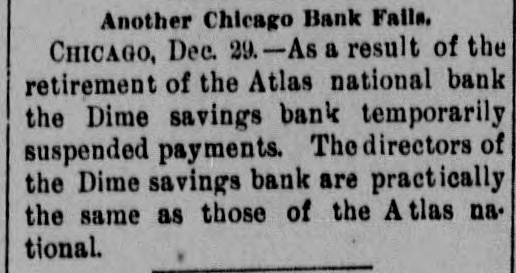
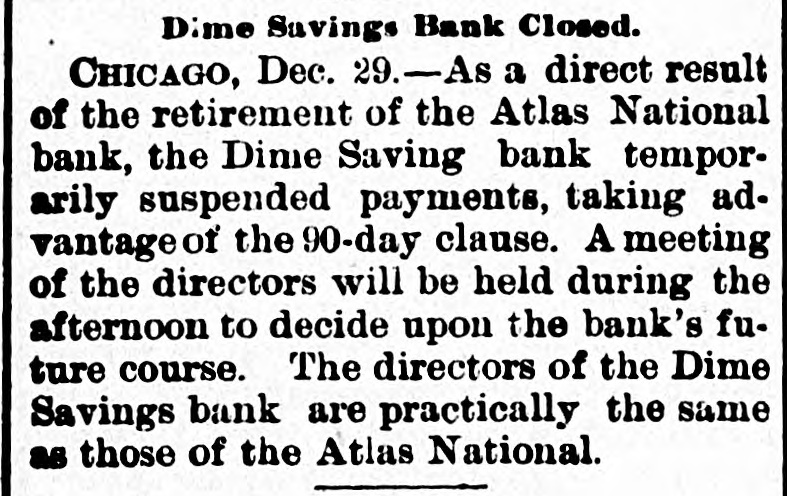
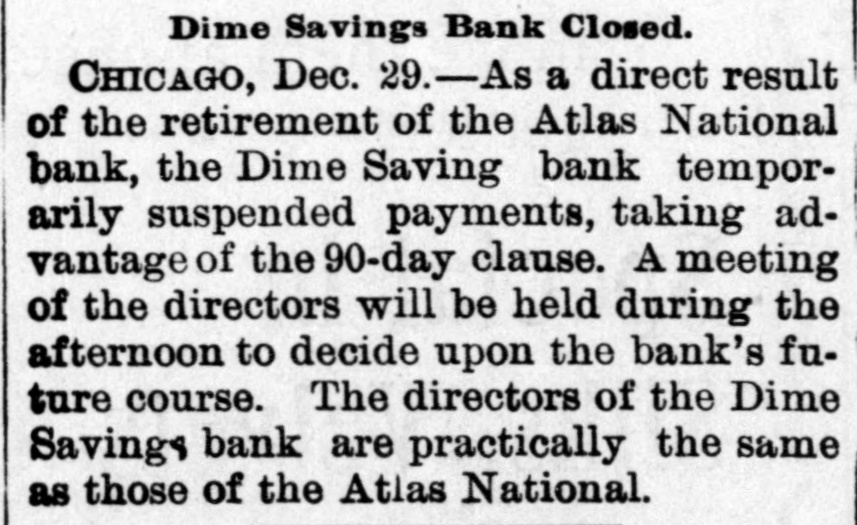
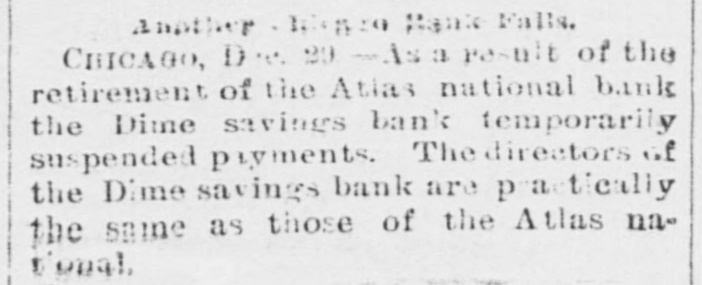
BANKING FAILURES. The Dime Savings bank of Chicago yesterday suspended payments under the 90-day withdrawal notice allowed by state law. The bank is owned by the saine people who conducted the Atlas bank. which has also suspended. William M. and J. S. Van Nertwick, bankers and manufacturers at Batavia, Ills., mde an assignment yesterday. This was brought on by the Atlas National bank closing. Their property interests are heavy, and they will pay in full. The Scandia bank, a small concern of Minneapolis, with a capital of $60,000. suspended payment yesterday noon upon the advice of Bank Examiner Kenyon. President Sunday says that he believes that the creditors will eventually be paid in full. The McCoy banking company of Independence, Mo., went into voluntary liquidated yesterday, in compliance with an order made at a meeting of the board of directors held on Dec. 25. The bank refused to receive deposits and began paying depositors in full. The reason for the bank going out of business is that its president. William McCoy, is too advanced in years to manage its affairs longer. [Advertise you" wants in the TRIBUNE.


Article from The Saint Paul Globe, December 29, 1896

Click image to open full size in new tab

Article Text

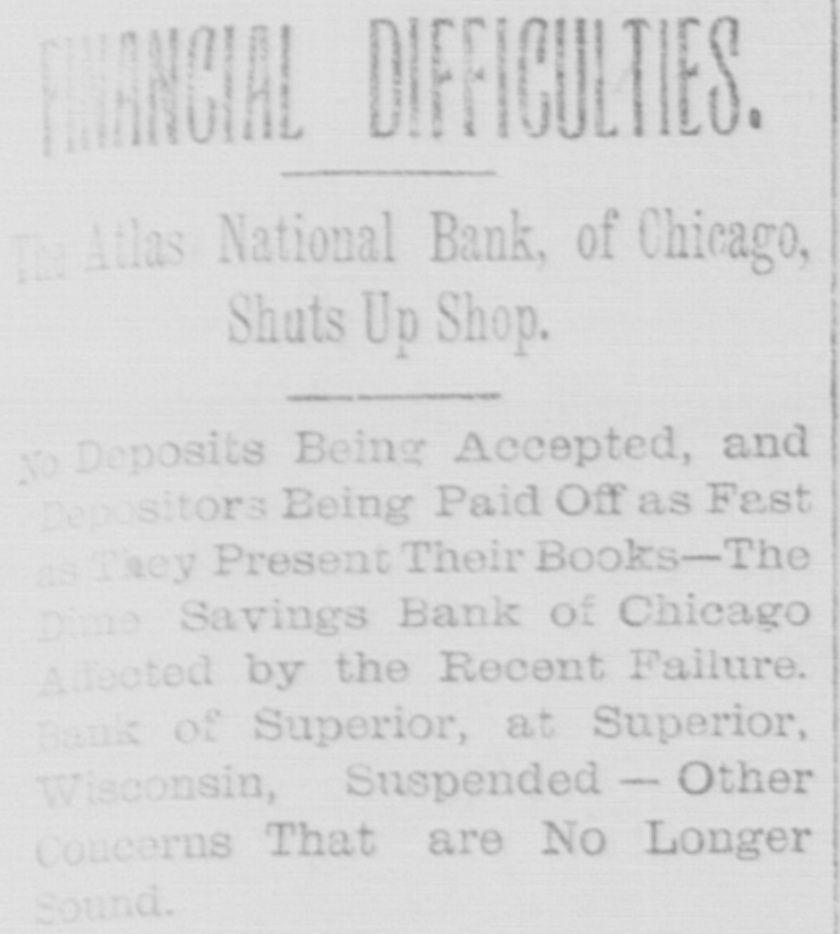
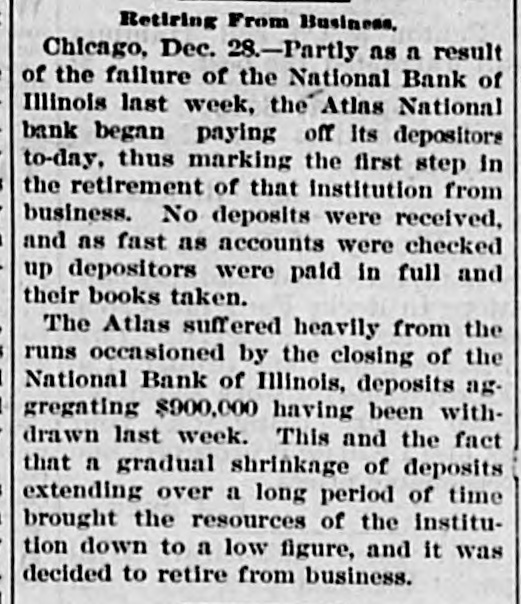
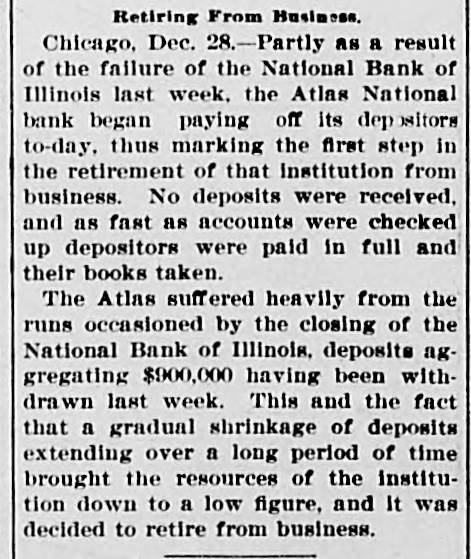
VOLUNTARY LIQUIDATION. Two Banks Decide to Retire From Business. CHICAGO, Dec. 28.-Partly as a result of the failure of the National Bank of Illinois last week, the Atlas National bank began paying off its depositors today, this making the first step in the retirement of that institution from business. No deposits were received, and as fast as accounts were checked up depositors were paid in full and their books taken up. The Atlas suffered heavily from the run occasioned by the failure of the National Bank of Illinois, deposits aggregating $900,000 having been withdrawn last week. This and the fact that a gradual shrinkage of deposits, extending over a long period of time, brought the resources of the institution down to a low figure, and it was decided to retire from business. The clearing house committee, at the request of the officers of the bank, made an investigation of its accounts with a view to allowing the doors to close without loss to the public, and the bank was found to be solvent. To expedite liquidation, so far as the creditors are concerned, the committee pledged the aid of the associated banks of Chicago. The statement of Dec. 17 showed a surplus of $140,000 and undivided profits of $50,000. The statement also showed deposits of $1,860,000, bills payable to the amount of $100,000, loans and discounts of $1,941,000, and cash of $820,000. The deposits six months ago amounted to $3,500,000. Washington, Dec. 28.-Mr. Eckels said today that the creditors of the Atlas bank would be paid in full at onoe through advances by the Chicago clearing house, and, in his opinion, the stockholders eventually would realize 100 per cent, thus losing nothing on what they had put in. Kansas City, Dec. 28.-The McCoy Banking company, of Independence, Mo., went into voluntary liquidation today. The bank refused to receive deposits this morning and began paying its depositors in full. The reason given for the bank going out of business is that its president, William McCoy, is too advanced in years to manage its affairs longer. The capital stock of the bank is $50,000. The bank's deposits amount to about $55,000 and it has outstanding loans of $72,000.


Article from The Saint Paul Globe, December 30, 1896

Click image to open full size in new tab

Article Text

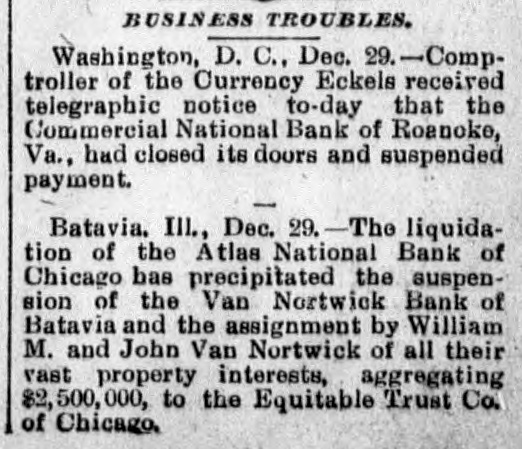
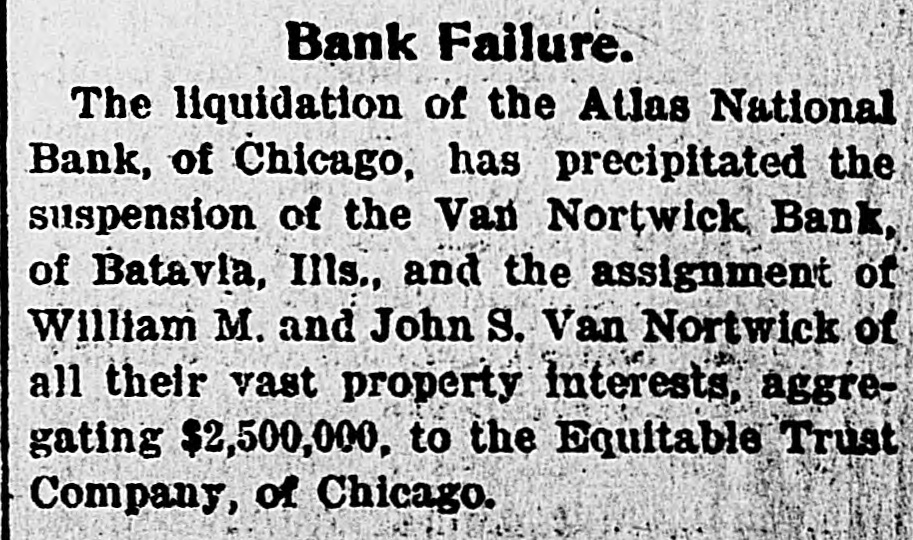
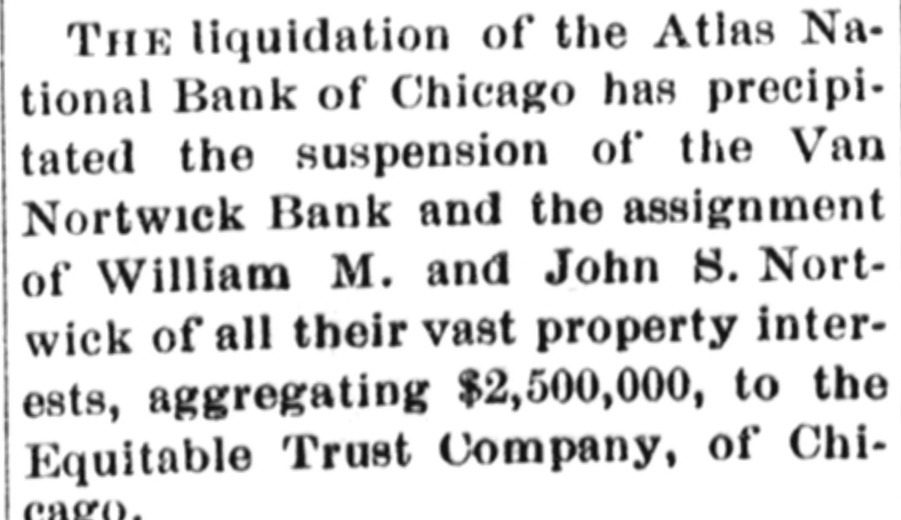
TOO MANY IRONS To Blame for a Heavy Failure in Illinois. BATAVIA, Ill., Dec. 29-The liquidation of the Atlas National bank, of Chicago, has precipitated the suspension of the Van Nortwick bank, of Batavia, and the assignment by William M. and John S. Van Nortwick, of all their vast property interests, aggregating $2,500,000, to the Equitable Trust company, of Chicago. Articles of assignment were filed in the Kane county court at Geneva, and were three in number, William M. and John S. Van Nortwick each assigning as individuals, and the two assigning as a firm. Their schedule of indebtedness was not filed with the articles of assignment, but the liabilities are said to aggregate $2,000,000. The Van Nortwick interests, aside from Batavia property, are largely in paper mills and manufacturing industries. Their last statement of assets, prepared a year ago, placed their wealth at $2,500,000. They own a business block, residences and two farms in Batavia township, the whole valued at $150,000; also the Western paper factories of Batavia and Kaukauna, the largest concerns of the kind in the world, with a daily output of 2,000,000 bags; also a strawboard mill at Batavia, unused. The paper mills at Appleton, Wis., are valued at $800,000. They own valuable pine lands in Wisconsin, and have stock in the old Second National bank, of Aurora; the Aurora cotton mills and the Kaukauna and Appleton banks. They are principal owners of the Appleton Manufacturing company, of Geneva, Ill. The brothers own 464 shares in the Atlas National bank, of Chicago. The Van Nortwick bank in Batavia had a large clientage. The bank has been soliciting deposits for some time past, paying large interest, a fact which with good business men gave evidence of weakness, if not distress. Such was the general confidence of Batavia depositors in the Van Nortwicks, however, that there was no run on the bank, notwithstanding the reports of the trouble of the Atlas bank and the Van Nortwicks' connection with the same. Chicago, Dec. 29.-Attorney A. W. Green, who drew up the assignment papers for the Batavia bank, disclosed the principal causes which led up to the assignment, in an interview today. Aside from the Atlas bank liquidation the most important factor in the Van Nortwick crash, he said, was the recent failure to dispose of $300,000 worth of bonds in the Boston markets, secured by the great combined mills, situated on Fox river, in Wisconsin, and valued at $700,000 in a clear mar ket. Negotiations for the conclusion of the deal had been nearly completed when the National of Illinois failure was announced. This immediately put a stop on the sale of the bonds, and the Van Nortwicks were thrown upon their cash reserve once more. Mr. Green said that if this bond sale had been successful the Batavia bank would have been tided through the present storm. Appleton Wis., Dec. 29.-The failure of Van Nortwick Bros.' bank at Batavia has not yet affected the Fox river valley properties of the brothers, namely, the combined Locks Paper company and the Appleton Paper and Pulp company, of this city, and the Western Paper Bag company's mill at Kaukana. Up to date it is only the Illinois property of the brothers that is affected. And it is believed that the Fox river property will pull through unharmed. The Citizens' National bank. of this city, of which John S. Van Nortwick was president, will not be involved in the failure. John S. has resigned as president and director, and his place has been filled by Lamar Olmsted as president, and John McNaughton as director. No run has begun on the bank.


Article from The Evening Herald, December 30, 1896

Click image to open full size in new tab

Article Text

A Voluntary Assignment. BATAVIA, Ills., Dec. 30.-The liquidation of the Atlas National bank, of Chicago, has precipitated the suspension of the Van Nortwick bank, of Batavia, and the assignment by William M. and John S. Van Nortwick of all their vast property interests, aggregating $2,500,000, to the Equitable Trust company, of Chicago. Their counsel declares that they will meet all claims, and that the assignment is wholly voluntary.


Article from The Bryan Daily Eagle, December 30, 1896

Click image to open full size in new tab

Article Text

COMPELLED TO ASSIGN Atlas Bank Failure Ruins the Van Nortwick Brothers. THEIR FAILURE IS A BIG ONE. They Were Interested In a Number of Enterprises, All of Which Go With the Assignment-A Bank In Virginia and One In Minnesota Fail-Numerous Firms Forced to the Wall. Batavia, Ills., Dec. 29.-The suspension of the Atlas National bank of Chicago has precipitated the suspension of the Van Nortwick bank of Batavia and the assignment of William M. and John S. Van Nortwick of all their vast property in the interests aggregating $2,500,000, to the Equitable Trust company of Chicago. Articles of assignment were filed in the Kane county court at Geneva and were three in number, William M. and John S. Van Nortwick, each assigning as individuals and the two assigning as a firm. Their schedule of indebtedness was not filed with the articles of assignment, but the liabilities are said to aggregate $2,000,000. The Van Nortwick interests, aside from the Batavia prop. erty, is largely in papermills and manufacturing industries. Their last statement of assets, prepared a year ago, placed their wealth at $2,500,000. They own a business block, residences and two farms in Batavia township, the whole valued at $150,000; also the West. ern paper bag factories at Batavia and Kaukauna, with a daily output of 2,000,000 bags; also a strawboard mill at Batavia, unused. The papermills at Appleton, Wis., are valued at $800,000. They own valuable pine lands in Wisconsin and valuable stock in the old Second National Bank of Aurora, the Aurora cottonmills and the Kaukauna and Appleton banks. They are principal owners of the Appleton Manufacturing company of Geneva, Ills. The brothers own 464 shares in the Atlas National bank of Chicago. Such was the general confidence of Batavia depositors in the Van Nortwick, how. ever, that there was no run on the bank, notwithstanding the reports of the trouble of the Atlas bank and the Van Nortwicks' connection with the same. Cashier W. L. Grimes of the bank, when seen by a reporter, declined to give a statement of the bank's assets and the liabilities, simply declaring that the depositors would be paid in full. The Van Nortwicks' assets, he said, were a:aple to meet all liabilities if the assig ees took sufficient time to realize upon the property. Cashier G-imes said the assignment made by the Van Nortwicks includes everything they have even to their homestead. He said they held nothing back. and it was his belief the creditors e would be paid dollar for dollar. Cashier Grimes further stated he knew of no reason why any of the institutions in which the Van Nortwicks were interested should close their doors, as they were all making money. The directors of the First National bank of Batavia held a meeting to dis. o cuss the outlook and reported the bank would be able to meet all demands upon it today.


Article from Omaha Daily Bee, December 30, 1896

Click image to open full size in new tab

Article Text

# RAGGED DOWN BY THE ATLAS Bank Failure in Chicago Injures Many Other Institutions. AN NORTWICKS OF BATAVIA GO TO WALL Large Property Interests Jeopardized by a Succession of Misfortunes - Other Financial Concerns in Difficulties. BATAVIA, Ill., Dec. 29. - The liquidation of the Atlas National bank of Chicago has precipitated the assignment of the Van Nortwick Bank of Batavia and the assignment by William M. and John S. Van Nortwick of all their vast property interests, aggregating $2,500,000, to the Equitable trust company of Chicago. Articles of as- on the Appleton plant, the borrowing director was unable to reduce his obligations to the imperiled bank, of which he was a director. This inability to reduce the loan forced the Atlas National to apply to the clearing house for assistance, and the liquidation of the Atlas compelled the assignment of the Van Nortwicks. "No formal statement of liabilities and assets has as yet been made. Owing to the widely diversified interests of the two brothers any estimate is liable to be wild. Attorney Green ventures the rough estimate that the assets are $1,000,000 and the liabilities $400,000 to $500,000. He also says the brothers will pay dollar for dollar in time. "The general impression in Batavia is that while the bank has not been making money the side ventures of the firm have been successful. The paper bag factory at that place has been running night and day, doing an immense business. The Paper Bag Manufacturing company at Batavia has increased its time to twelve hours a day since the election, and has had orders for all its product. The manufacture of butter plates by the Memphis Woodenware company at Memphis, Tenn., also owned by the Nortwicks is supposed to be highly success- case of Frank K. Atkins, president of the defunct Colorado Savings bank, has been begun in the district court. There are ten indictments against him, and an equal number against his brother, C. O. Atkins, cashier of the bank, whose trial will follow. They are accused of wrecking the institution. The specific charge is that of accepting deposits when they knew the institution was insolvent. The bank failed during the panic of 1893, and its affairs dragged along under the supervision of a receiver until recently, when the depositors demanded an investigation and the matter was brought to the attention of the grand jury. Dr. D. H. Dougan, president of the Carbonate National bank of Leadville, has accepted the office of cashier in the Bank of Commerce of this city. At the January meeting of the Carbonate bank a vote will be taken to reduce the capital stock and the bank will gradually go into liquidation. This change will require a year, but before the close of 1897, in all probability, the Carbonate National will have passed out of existence. Dr. Dougan says that the reason for taking this step is that Leadville is no longer a profitable field for so large an institution as the Carbonate bank.


Article from The Sauk Centre Herald, December 31, 1896

Click image to open full size in new tab

Article Text

THE ATLAS LIQUIDATION. It Causes the Suspension of the Van Nortwick of Batavia. BATAVIA, Ills., Dec. 30.-The liquidation of the Atlas National bank of Chicago has precipitated the suspension of the Van Nortwick bank of Batavia, and the assignment by William M. and John S. Van Nortwick, of all their vast property interests, aggregating $2,500,000, to the Equitable Trust company of Chicago. The Van Nortwick interests, aside from Batavia property are largely in paper mills and manufacturing industries. Their last statement of assets prepared a year ago placed their wealth at $2,500,000. They own a business block, residences and two farms in Batavia township, the whole valued at $150,000; also the Western paper factories of Batavia and Kaukauna, the largest concerns of the kind in the world, with a daily output of 2,000,000 bags; also a strawboard mill at Batavia, unused. The paper mills at Appleton, Wis., are valued at $800,000. They own valuable pine lands in Wisconsin, and have stock in the old Second National bank of Aurora, the Aurora cotton mills and the Kaukauna and Appleton banks. They are principal owners of the Appleton Manufacturing company of Geneva, Ills.


Article from The Portland Daily Press, December 31, 1896

Click image to open full size in new tab

Article Text

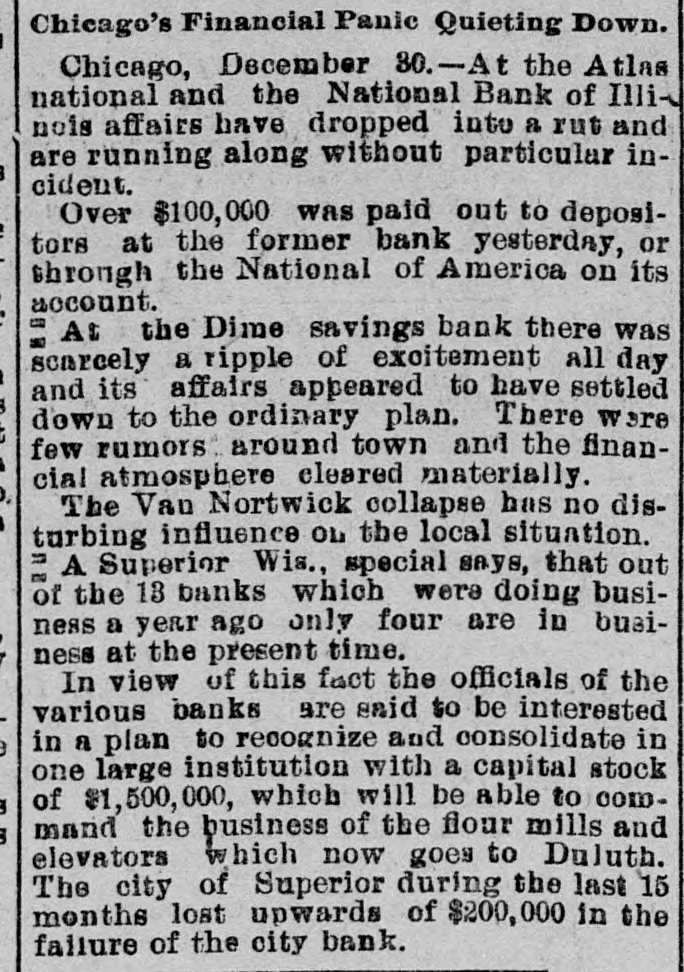
Chicago's Financial Panic Quieting Down. Chicago, December 30.-At the Atlas national and the National Bank of Illinois affairs have dropped into a rut and are running along without particular incident. Over $100,000 was paid out to depositors at the former bank yesterday, or through the National of America on its account. - At the Dime savings bank there was scarcely a ripple of excitement all day and its affairs appeared to have settled down to the ordinary plan. There were few rumors around town and the financial atmosphere cleared materially. The Van Nortwick collapse has no disturbing influence on the local situation. no = A Superior Wis., special says, that out of the 13 banks which were doing business a year ago only four are in business at the present time. In view of this fact the officials of the various banks are said to be interested in a plan to recognize and consolidate in one large institution with a capital stock of $1,500,000, which will be able to command the business of the flour mills and elevators which now goes to Duluth. The city of Superior during the last 15 months lost upwards of $200,000 in the failure of the city bank.


Article from New-York Tribune, December 31, 1896

Click image to open full size in new tab

Article Text

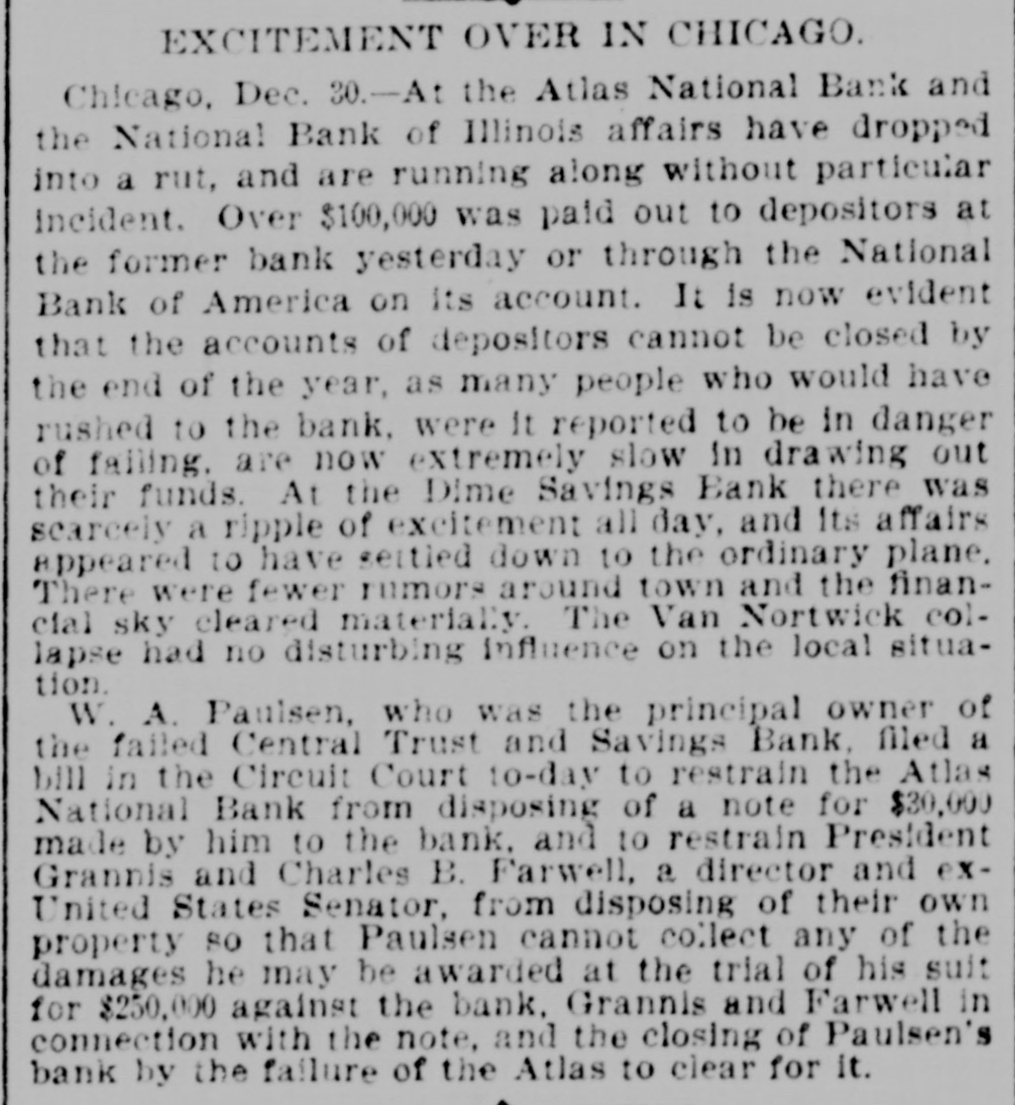
EXCITEMENT OVER IN CHICAGO. Chicago, Dec. 30.-At the Atlas National Bank and the National Bank of Illinois affairs have dropped into a rut, and are running along without particular incident. Over $100,000 was paid out to depositors at the former bank yesterday or through the National Bank of America on its account. It is now evident that the accounts of depositors cannot be closed by the end of the year, as many people who would have rushed to the bank. were it reported to be in danger of failing. are now extremely slow in drawing out their funds. At the Dime Savings Bank there was scarcely a ripple of excitement all day, and Its affairs appeared to have settled down to the ordinary plane. There were fewer rumors around town and the financtal sky cleared materially. The Van Nortwick collapse had no disturbing influence on the local situation. W. A. Paulsen, who was the principal owner of the failed Central Trust and Savings Bank, filed a bill in the Circuit Court 10-day to restrain the Atlas National Bank from disposing of a note for $30,000 made by him to the bank, and to restrain President Grannis and Charles B. Farwell, a director and exUnited States Senator, from disposing of their own property so that Paulsen cannot collect any of the damages he may be awarded at the trial of his suit for $250,000 against the bank. Grannis and Farwell in connection with the note, and the closing of Paulsen's bank by the failure of the Atlas to clear for it.


Article from Chicago Eagle, January 2, 1897

Click image to open full size in new tab

Article Text

broad. and has come out of Its laces at home. The Treasury gaining rapidly. There are me work in the factories than the wo months ago. Hence the sh are doing better. Yet in spite of this marked i in conditions two Chicag closed their doors. One . the second largest in the ei eposits amounting to 12 million Bryanites are delighted with th losures. They point to them ations that there has been no 1 and assent there will be The signs of better times wou more abundant had the held in the spring Instead all. Winter brings with it in 1 limates a cessation of labor , ranches of Industry. The 1 rades, for Instance, are inactive Winter is a hard season even Imes. There are so many me vork then necessarily. that the vays complaint of hard times. not been for the defeat of Br, nee coinage this winter wou the worst one this coun ver known. It would have tarvation. vinter of panie, enforced idlen It was not the aproach of owever, which broke the IIIII lonal and caused the Atlas to : ousiness. Had the last three y een marked by panies and busi ression neither bank woul losed Its doors. Had they be ged more ably and conser ether would have gone out It is well known why the IIII lonal bank failed. It loaned to noney on securities which were not worth the amount lo hem. Forgetful of the fact ssence of good banking is lei who will repay, the bank 1 million epay. to men who were not I The Atlas was not as badly 1 the other bank. but It loa nuch to two or three individual too many of its eggs in one "hat is always unwise and is when times are hard. But vould have kept on and have noney-making concern had it or an unspoken but none the le lack of confidence concernir Depositors gradually begar trawing their money and the I to suffer from anaemia. the deposits were $3 "welve days ago they were . 00,000. The heavy withdra week brought them down $00,000. Evidently the only ti do was to go into voluntary


Article from Mineral Point Tribune, January 7, 1897

Click image to open full size in new tab

Article Text

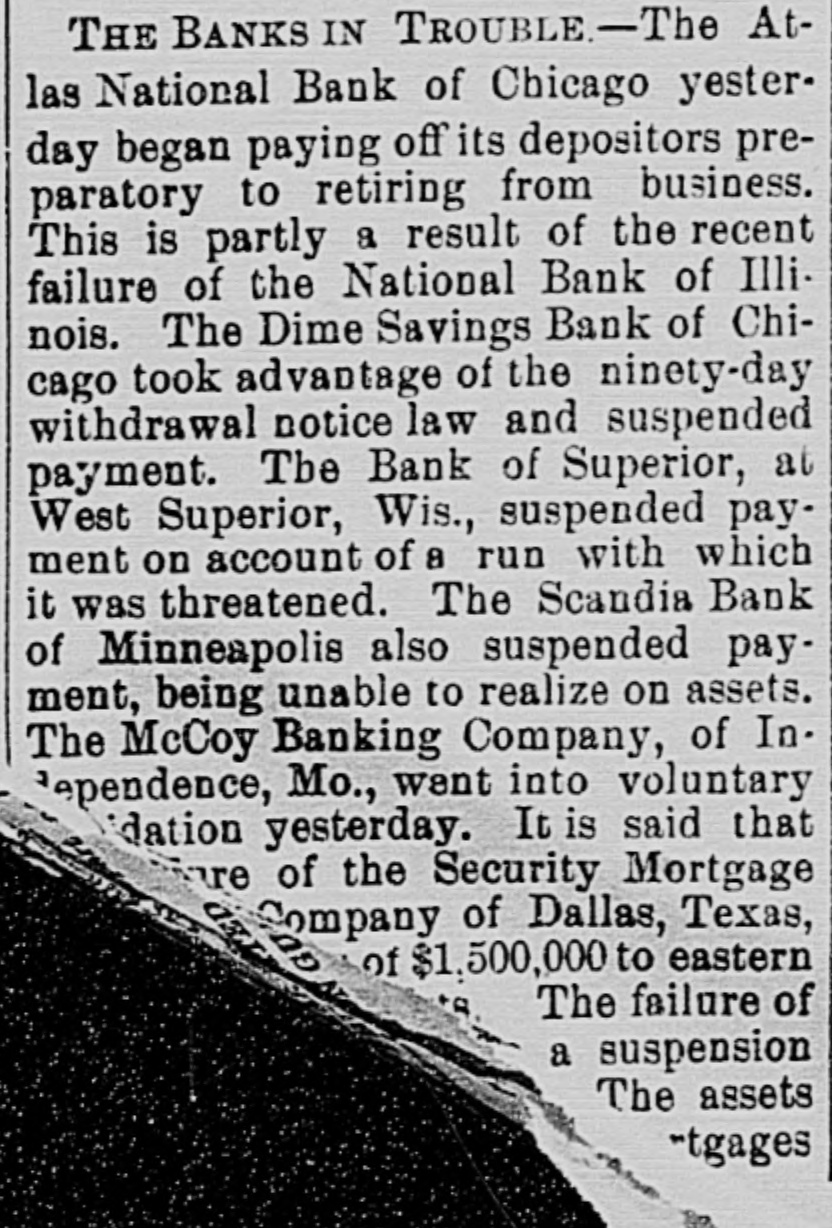
NEWS OF THE WORLD. HOME NEWS. Kingston, N. Y.-The thermometer was 16 below. New York-Isaac Zucker was convicted of arson. Pittsburg-Another armor plate factory will start here. Isaac Ruker was sentenced to thirtysix years in prison in New York for arson. The new cotton mill at Centreville, R. I., was started, giving work to 600 operatives. The commissioners of Lane county, Kan., have declared the county insolvent. Wm. Whaley and his wife were murdered by unknown men at Seviersville, Tenn. Col. Thomas A. Dent, who was connected with the Steelton (Pa.) National bank, died of pneumonia. Archbishop Martinellli, the papal delegate, was given a reception and banquet at Springfield, Mass. Philadelphia-Charles B. Parrish, one of the oldest and wealthiest coal operators in Pennsylvania, is dead. It is said that Judge Simonton will order the sale of the Cape Fear and Yadkin Valley railroad as a whole. Archbishop Corrigan said he had received no announcement that he was to be appointed a cardinal, as reported. The Columbia National Bank and the Washington Bank, a state institution, closed their doors at Minneapolis. New York-Thomas C. Platt in an interview said. "I am satisfied that Mr. Choate will not be the next senator. California orange growers will send a delegation to present the needs of the orange men to the tariff committee. The republican club of New York decided not to indorse the candidacy of Joseph H. Choate for the United States senate. Franklin, Tenn., was nearly wiped out by fire early Sunday morning. The loss runs up into the thousands. The Dime Savings bank of Chicago took advantage of the ninety-day withdrawal notice law and suspended payment. Fire at Nashville, Tenn., early Sunday morning destroyed a number of business block, causing a loss of $500,000. The Commercial National Bank of Roanoke, Virginia, suspended payment. It is said that the depositors will be paid in full. Wm. J. Bryan, in a speeca at Lin coln, Neb., said that business ires have increased since the electice of McKinley. The Bank of Superior, at West Superior, Wis., suspended payment on account of a run with which it was threatened. Tammany will invite all soundmoney as well as silver democrats in New York to participate in the next primary election. The Atlas National bank of Chicago will liquidate and go out of business. The clearing house will pay deposItors in full. New York-Isabelle Evesson, the actress, has brought suit for $8,000 against T. Henry French, the theatrical manager. Edward Avery, who was for several terms chairman of the Massachusetts democratic state committee, died aged 58 years. Frederick, Md.-Charles W. Hoffman, LL. D., Hbrarian of the United States supreme court since 1878, is dead, aged 67. Fire in the building occupied by the Consolidated Stock and Petrofeum exchange, New York, did damage to the extent of $2,000. Charles Boemer was arrested at his wife's grave in Chippewa Falls on complaint of a young girl at Sparta charging him with being the father of her child. Louisville-Governor Bradley declared that it was his purpose to resign the office of governor, saying that it was killing him. At least twenty-one bodies have been taken from the debris of the wrecked train at the Onhaba river bridge, near Blocton, Ala Mount Vernon, Ill-Granville Fyko's sawmill blow up and killed his wife and seriously and perhaps mortally wounded Fyko and one child. The jury at Dayton, Onio, in the case of Albert Franz, tried for the murder of Bessie Little, ga e a verdict of murder in the first degree. James W. Brady, a clerk in the sixth auditor's office at Washington, fell dead in " street car in that city. He lived at Catonsville, Md. A strike instituted at Georgetown Mass., has thrown out of work 150 men and promises to embrace the entire six shoe factories of the town. Bob Breckinridge, a son of the excongressman, has returned home after a three years' tramp all over the world. He worked his own way. Ex-Queen Lil has taken a residence in Boston's fushionable suburb, Brook-


Article from Wood County Reporter, January 7, 1897

Click image to open full size in new tab

Article Text

NEWS OF THE WORLD. HOME NEWS. Kingston, N. Y.-The thermometer was 16 below. New York-Isaac Zucker was convicted of arson. Pittsburg-Another armor plate factory will start here. Isaac Ruker was sentenced to thirtysix years in prison in New York for arson. The new cotton mill at Centreville, R. 1., was started, giving work to 600 operatives. The commissioners of Lane county, Kan., have declared the county insolvent. Wm. Whaley and his wife were murdered by unknown men at Seviersville, Tenn. Col. Thomas A. Dent, who was connected with the Steelton (Pa.) National bank, died of pneumonia. Archbishop Martinellli, the papal delegate, was given a reception and banquet at Springfield, Mass. Philadelphia-Charles B. Parrish, one of the oldest and wealthiest coal operators in Pennsylvania, is dead. It is said that Judge Simonton will order the sale of the Cape Fear and Yadkin Valley railroad as a whole. Archbishop Corrigan said he had received no announcement that he was to be appointed a cardinal, as reported. The Columbia National Bank and the Washington Bank, a state institution, closed their doors at Minneapolis. New York-Thomas C. Platt in an interview said. "I am satisfied that Mr. Choate will not be the next senator. California orange growers will send a delegation to present the needs of the orange men to the tariff committee. The republican club of New York decided not to indorse the candidacy of Joseph H. Choate for the United States senate. Franklin, Tenn., was nearly wiped out by fire early Sunday morning. The loss runs up into the thousands. The Dime Savings bank of Chicago took advantage of the ninety-day withdrawal notice law and suspended payment. Fire at Nashville, Tenn., early Sunday morning destroyed a number of business block, causing a loss of $500,000. The Commercial National Bank of Roanoke, Virginia, suspended payment. It is said that the depositors will be paid in full. Wm. J. Bryan, in a speech at Lin coln, Neb., said that business fatheres have increased since the electic of McKinley. The Bank of Superior, at West Superior, Wis., suspended payment on account of a run with which it was threatened. Tammany will invite all soundmoney as well as silver democrats in New York to participate in the next primary election. The Atlas National bank of Chicago will liquidate and go out of business. The clearing house will pay depositors in full. New York-Isabelle Evesson, the actress, has brought suit for $8,000 against T. Henry French, the theatrical manager. Edward Avery, who was for several terms chairman of the Massachusetts democratic state committee, died aged 58 years. Frederick, Md.-Charles W. Hoffman, LL. D., librarian of the United States supremo court since 1873, IS dead, aged 67. Fire in the building occupied by the Consolidated Stock and Petroleum exchange, New York, did damage to the extent of $2,000. Charles Boemer was arrested at his wife's grave in Chippewa Falls on complaint of a young girl at Sparta charging him with being the father of her child. Louisville-Governor Bradley declared that it was his purpose to resign the office of governor, saying that it was killing him. At least twenty-one bodies have been taken from the debris of the wrecked train at the Cahaba river bridge, near Blocton, Ala. Mount Vernon, Ill.-Granville Fyko's sawmill blew up and killed his wife and seriously and perhaps mortally wounded Fyko and one child. The jury at Dayton, Ohio, in the case of Albert Franz, tried for the murder of Bessie Little, gave a verdict of murder in the first degree. James W. Brady, a clerk in the sixth auditor's office at Washington, fell dead in a street car in that city. He lived at Catonsville, Md. A strike instituted at Georgetown. Mass., has thrown out of work 150 men and promises to embrace the entire six shoe factories of the town. Bob Breckinridge, a son of the excongressman, has returned home after a three years' tramp all over the world. He worked his own way. Ex-Queen Lil has taken a residence in Boston's fashionable suburb, Brookline. She has declined several propositions to go on the lecture platform.