Garden City Banking & Trust Company (Chicago, IL)

Episode Information

Episode UID
2602545891164
Episode Type
Run Only
Bank Type
trust
Bank ID
260254589 hash
Start Date
December 22, 1896
Location
Chicago, Illinois (41.850, -87.650)

Metadata

Model
gpt-5-mini (chosen from majority vote of a three-model LLM ensemble)
Short Digest
57d15d58eff16431

Response Measures

None

Events (1)

1. December 22, 1896 Run
Cause
Local Banks
Cause Details
Small run triggered by the collapse/failure of the National Bank of Illinois and related failures in Chicago.
Measures
Opened doors an hour early, paid depositors' demands; officers ready and declared able to meet withdrawals.
Newspaper Excerpt
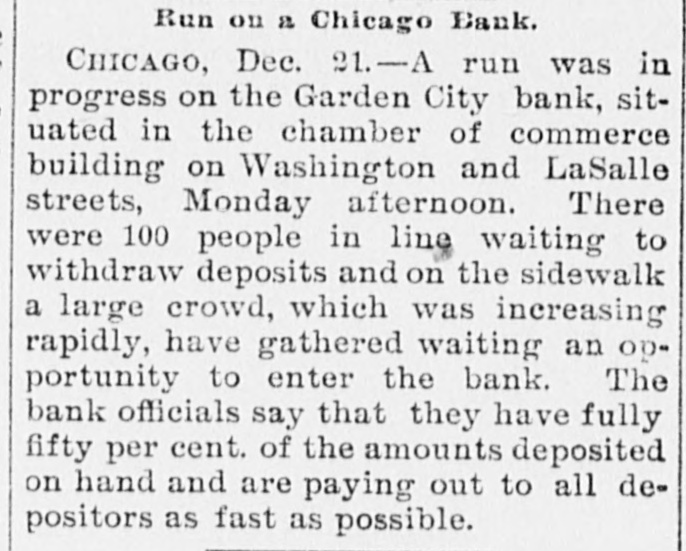
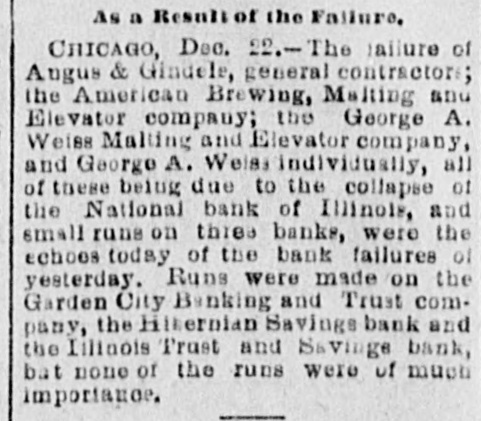
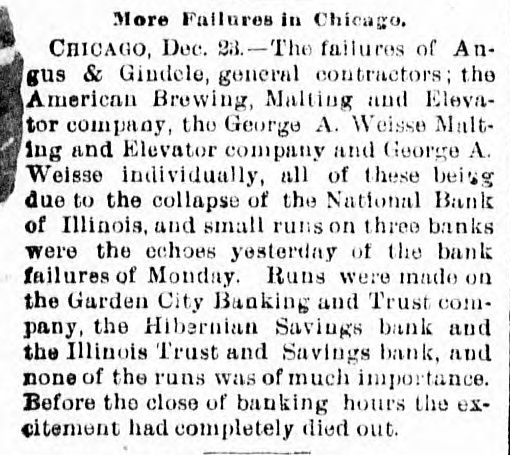
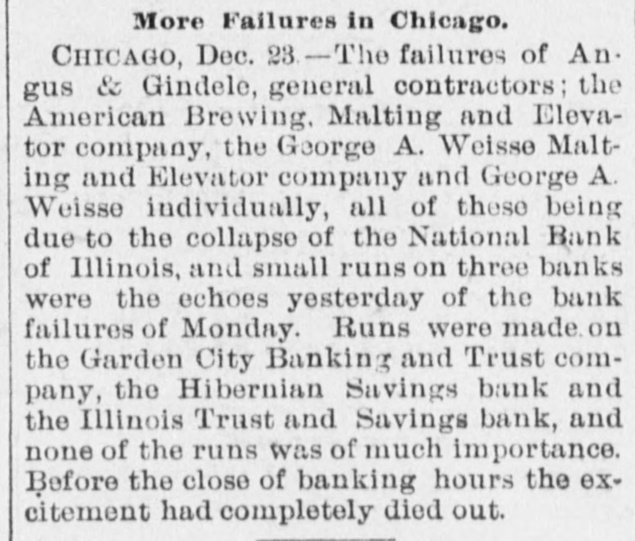
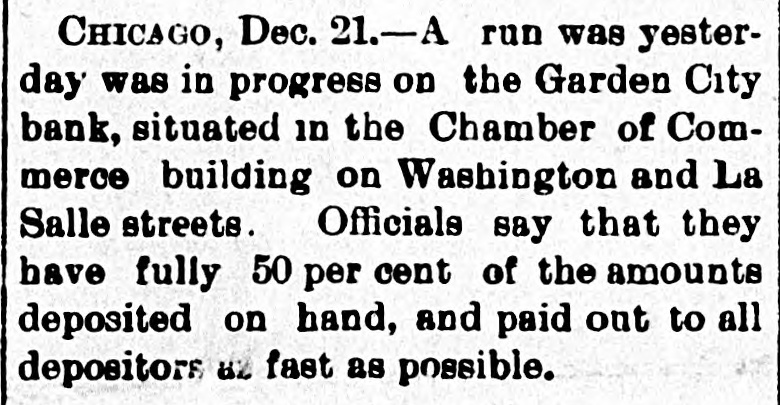
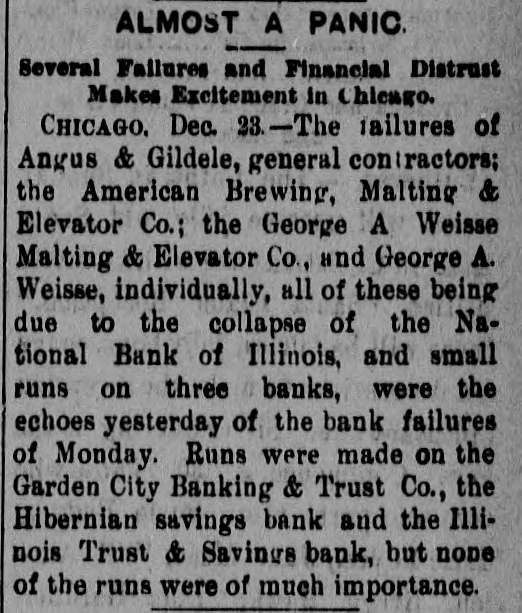
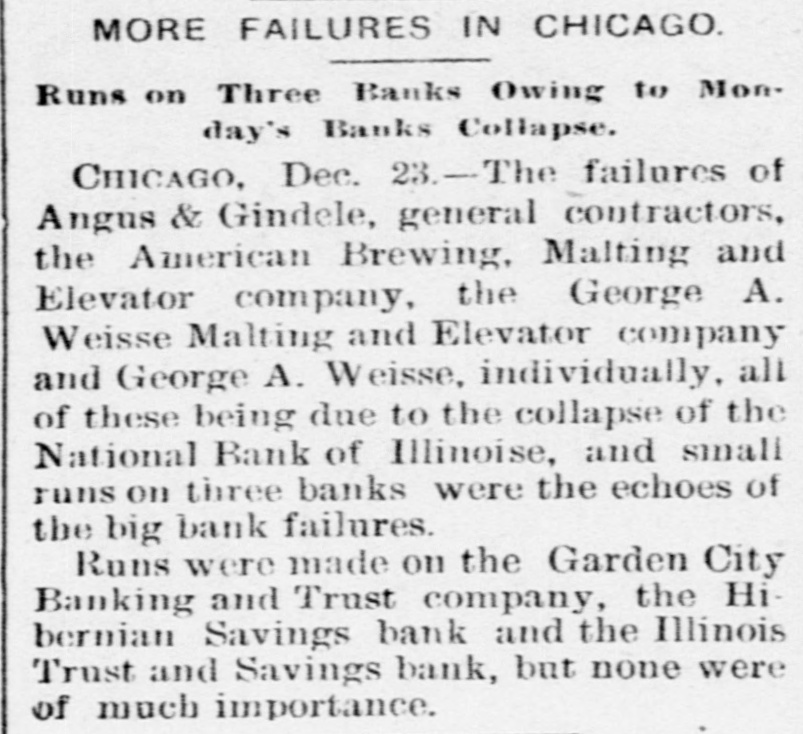
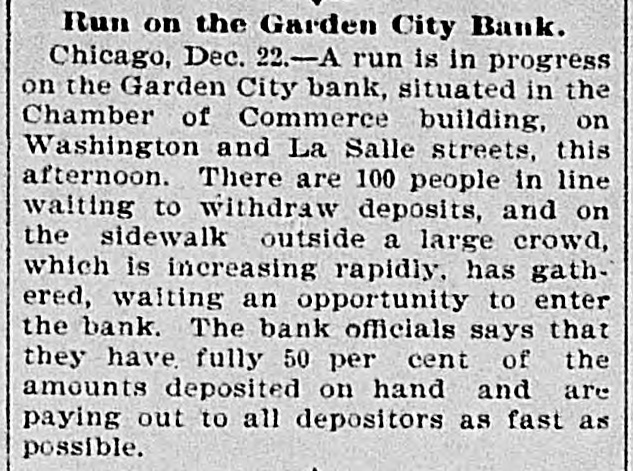
Runs were made on the Garden City Banking and Trust company ... but none of the runs were of much importance.
Source
newspapers

Newspaper Articles (10)

Article from Alexandria Gazette, December 22, 1896

Click image to open full size in new tab

Article Text

TO-DAY'S TELEGRAPHIC NEWS The Chicago Banks. CHICAGO, Dec., 22.-Without any apparant cause, except for the fact that & general lack of confidence had pervaded the timid depositors in the savings department, a heavy run on the Illinois Trust and Savings Bank, in the Rookery Building, began as soon as the doors were open for business this morning both men and women being in line. There is not the slightest connection between the failed National Bank of Illinois and the Illinois Trust Co. The bank anticipated a run to-day and there is such a heavy reserve fund of idle money in the vaults that President Mitchell has no misgivings as to the ability of his bank to pay a few millions if necessary. The bank does the largest trust and savings business in the city and has a capital and surplus of $4,000,000 At the Graden City Banking and Trust Company's bank, the run of yesterday had practically run out its length. The bank officers said they did not expect any more trouble. At the other national, private and State banks there was the ordinary transaction of business with no more people paying their respects to the paying teller than to the receiving teller. In banking circles the general opinion is that yesterday's failures will end the present trouble. Shortly after eleven o'clock a crowd of depositors gathered at the Hibernian Banking Association, to withdraw their savings. This bank is regarded as one of the strongest in the city. President Clark said that the savings bank would take advantage of the law by which demands for $50 or more must be accompanied with a thiry day notice and $100 or more by a sixty-day notice. Demands of less than $50 will be paid on sight.


Article from Deseret Evening News, December 23, 1896

Click image to open full size in new tab

Article Text

As a Result of the Fallure, CHICAGO, Dec. 22.-The Jailure of Augus & Gindele, general contractors; the American Brewing, Malting and Elevator company; the George A. Weiss Malting and Elevator company, and George A. Welss individually, all of these belug due to the collapse of the National bank of Illinois, and small runs on three banks, were the echoos today of the bank failures of yesterday. Runs were made on the Garden City Banking and Trust company, the Hisernian Savings bank and the Illinois Trust and Savings bank, but none of the runs were of much importance.


Article from The Wichita Daily Eagle, December 23, 1896

Click image to open full size in new tab

Article Text

soon after receiving the notice. The Bank of Minnesita was the oldest in the city and one of the best known throughout the west. It had many correspondents, among them the National Bank of Illinois, but it was stated tonight that the failure of the Chicago bank had nothing to do with the closing of this concern. The small bank at the stock yards that closed as a result of the other failure was a branch of the Bank of Minnesota, but no other local banks are at all affected by the failure. CHICAGO'S FAILURES. Washington, Dec. 22.-Comptroller Eckels received a telegram early in the afternoon stating that everything was quiet in Chicago but containing no other news. He said he did not care to talk concerning the situation and that he did not know yet whether or not there would be any criminal proceedings brought on account of the revelations concerning the failure. The first duty of examiners placed in chargeof failed national banks, he said, was to ascertain whether there had been any criminal violations of the law. He had received no report of any as yet but if the examiner did find and report such violations, measures would be taken, of course, to prosecute the parties reported. EXCITEMENT SUBSIDES. Chicago, Dec. 22.-The excitement attendent upon the collapse of the National Bank of Illinois and its three dependent banks, appeared to have died out today. Runs of more or less magnitude were made yesterday on several banking institutions. notably the Garden City Banking and Trust company. The doors of that institution were opened an hour before banking hours today, but by 10:30 a. m. withdrawals had ceased and deposits had trebled the amount taken out. Withdrawals at other banks were few and far between. It is generally expected that Bank Examiner McKeown will be appointed receiver permanently for the National Bank of Illnois. LOANED TO SONS-IN-LAW. Chicago, Ill. Dec, 22.-The assets of the National Bank of Illinois, which closed its doors yesterday, are said to include in addition to the $2,475,000 loaned to Robert Berger, a son-in-law of President George Schneider, $500,000 advanced to G. A. Weiss, another son-in-law, and over $800,000 of doubtful debts. Berger is a partner in the firm of E. S. Dryer & Co., which also went into the hands of a receiver yesterday, and Weiss is a brewer The losses by the failure will fall upon 1,971 individual depositors and 350 private state and national banks. Included among the depositors are the treasurers of the city of Chicago, and of the state of Illinois. The deposits of the treasurers of Chicago and Cook county will aggregate almost $1,000,000. The amount at the present time on deposit by the state treasurer is comparatiely small. Among the depositors were many large corporations and receiers. They include the receivers of the Northern Pacific rail road and the receiver of the whisky trust. The deposits of E. S. Dryer & Co., include the funds of the West Park board. The amount at the time the bank closed was about $310,000. Robert E. Jenkins, one of the directors of the National Bank of Illinois, says: "The directors did not know the size of the loan on the Calumet Electric. The discovery of the condition of the loan was as much of a surprise to me as to the public. The same is true of the loan of Dryer & Co. The directors were unaware of the loans, which appear to have carried the bank down, or were, until the latter part of last week. I do not care to say who I believe was to blame for the directors being kept in the dark as to the mangnitude of these loans." CITY OF CHICAGO'S FUNDS. Washington D. C. Dec. 22.-Mr. Eckles, the comptroller of the currency. received a telegram today from Mr. McKeon. the receiver of the National Bank of Illinois, stating that the books of the bank show that quite large sums of public funds belonging to the city of Chicago were on deposit. In reply the comptroller sent Mr. McKeon the following telegram. "Your telegram relative to public funds received. You may make arrangements with depositors thereof to issue to them at once certificates for such amounts of their deposits as an examination of the books of the bank makes clear is due them. This will enable them to avail themselves of the offer of the clearing house to advance 75 per cent and SO prevent embarrassment in meeting public expenditures." BANK STATEMENT. Chicago. III., Dec. 22.-Under the general call issued by the comptroller of the currency, the national banks of this city have prepared a statement showing their condition at the close of business Dec. 17. The last previous statement was made Oct. 6. The fourteen banks show total loans of $63,639,323, as compared with $63,665,693 Oct. 6. a loss in loans of $25,470. The total deposits are $94,341,352. as compared with $37,361,503, a gain of $10,354,186. The legal requirements in reserve is 25 per cent. or for the fourteen banks. $23,597,863, while there is held $47,896,089 in excess of the legal requirement of $24,-


Article from The Wichita Daily Eagle, December 23, 1896

Click image to open full size in new tab

Article Text

CHICAGO'S SECOND CROP Three Firms and One Individual go Down After the Big Bank, Chicago, Dec. 22.-The failure of Angus & Gindele, general contractors; the American Brewing, Malting and Eelevator company; the George A. Weisse Malting and Elevator company, and George A. Wesse. individually, all of these being due to the collapse of the National Bank of Illinois, and small runs. on three banks, were the echoes today of the bank failures of yesterday. Runs were made on the Garden City Banking and Trust company, the Hibernian Savings bank and the Illinois Trust and Savings bank. but none of the runs were of much importance. The officers of the Garden City Banking and Trust company had expected that a run would be made upon their institution and were ready to meet it. They threw open the doors of the bank an hour earlier than usual, as they said they wanted to get the run out of the way, S0 they could transact their usual business without being disturbed. Quite a crowd of depositors had gathered at the doors before they were opened, and as soon as the bank was ready for business the depositors gave the paying tellers all they cared to do. The run kept up with energy for over an hour and then died away. At the close of banking hours the amount of money taken in was treble that paid out. and the bank was declared in better shape than at the opening of the doors in the morning. The run on the Hibernian Savings bank was of short duration, as the of-


Article from The Copper Country Evening News, December 23, 1896

Click image to open full size in new tab

Article Text

LOANS BY THE MILLION The Way the National Bank of IIlinois Made Them. TRUE CAUSE OF THE SUSPENSION. Directors Claim They Were in Ignorance of What Was Going on and Were Misled by Manipulated Accounts-Rivalry Between Street Car Lines Was the Means of Bringing Matters to a Climax -Run on the Garden City Bank. Chicago, Dec. 23.-There was a feelIng of confidence in banking circles Tuesday morning which was noticeable togthe most casual observers who called at the big institutions. This feeling was not confined alone to the banks, but extended to the mercantile houses. At the sheriff's office, which often acts as a pulse to the heart of trade, the utmost confidence was expressed that with the suspension of the Bank of Illinois, Dreyer & Co., the Roseland institution, and Wasmansdorf & Heinemann the suspensions had ceased and nothing more remained to be done than to straighten out the stangled affairs of those institutions. Probably more interest centered in the Garden City bank Tuesday than in any other of the concerns. As early as 8 o'clock there was a small crowd of depositors waiting to be admitted. Mr. Buehler of the bank was early on hand and the teller paid out all money that was demanded. At no time did the demand amount to a run. Mr. Buehler and President Gilbert, as well as the bank's attorney, declared without reserve that they would pay out every cent asked of them and that there was not the slightest occasion for alarm.


Article from The Daily Morning Astorian, December 23, 1896

Click image to open full size in new tab

Article Text

Chicago, December 22.-The failure of Angus & Gildele, general contractors, the American Brewing, Malting and Elevator Co., the George A. Weisse Malting and Elevator Co., and George A. Weisse, individually, all of these being due to the collapse of the National Bank of Illinois, and small runs on three banks were the echoes today of the bank failures of yesterday. Runs were made on the Garden City Banking and Trust Co., the Hibernian Savings Bank, and the Illinois Trust and Savings Bank, but none of the runs were of much importance. The officers of the Garden City Bank and the Illinois Trust Co. had expected that a run would be made upon their institutions and were ready to meet it. They threw open the doors of the bank an hour earlier than usual and said they wanted to get the run out of the way so they could-transact their usual business without being disturbed. Quite a crowd of depositors had gathered at the doors before they were opened and as soon as the bank was ready for business the depositors gave the paying tellers all they cared to do. The run kept up with energy for over an hour, and then died away. At the close of banking hours the officers of the Institution announced that during the day the amount of money taken in was treble that paid out, and the bank was declared in better shape than at the opening of the doors in the morning. The run on the Hibernian Savings Bank was of short duration, as the officers declined to make any payment on time deposits, unless given sixty days notice. This was not because they were not prepared to pay all depositors in full, but because they wished to avoid embarrassment to the smaller bankers who might not be prepared to pay all their depositors, and who might be placed in an embarrassing position if the stronger banks were paying all demands for time deposits. There was a slight run on the Illinois Trust Savings Bank shortly after it opened this morning. Before the close of banking hours the excitement had completely died out. The giving of notice was sanctioned by the clearing house committee and the object was (the Illinois Trust being the strongest savings bank in the city) to give the smaller ones opportunity to point to its action as an excuse for giving notice themselves, which they did, and thus effectually stopped a run. , The Illinois Trust and Savings Bank is said to have $9,000,000 in cash on hand and was today loaning money instead of, as in 1893, calling loans in to meet the demands of savings depositors.


Article from The Bryan Daily Eagle, December 23, 1896

Click image to open full size in new tab

Article Text

THAT BANK FAILURE. Heavy Depositors Caught For Large Sums. STATE OF ILLINOIS A PATRON. The City of Chicago and the County of Cook Caught For a Cool Million-The Northern Pacific and the Whisky Trust Receivers Also Had Cash There-A DIrector Interviewed. CHICAGO, Dec. 22.-The excitement attendant upon the collapse of the National Bank of Illinois and its three dependent banks is dying out. Runs of more or less magnitude were made yesterday on several banking institutions, notably, the Garden City Banking and Trust company. The doors of that institution opened an hour before banking hours today, but by 10:30 a. m., withdrawals had ceased, and deposits had trebbled the amount taken out. Withdrawals at other banks were few and far between. Robert E. Jenkins, one of the directors of the National Bank of Illinois, says: "The directors did not know the size of the loan on the Calumet Electric railway. The discovery of the condition of the loan was as much a surprise to me as to the public. The same is true of the loan to Dryer & Co. The directors were unaware of the loans which appear to have carried the bank down, or were until the latter part of the week. I do not care to say who I believe was to blame for the directors being kept in the dark as to the magnitude of these loans." The assets of the National Bank of Illinois as said to include, in addition to the $2,475,000 loaned the Calumet Electric railway, $500,000 advanced to Robert Berger. son-in-law of President George Schneider ; $500,000 advanced to G. A. Weiss, another son-in-law, and over $800,000 in doubtful debts. Berger is a partner in the firm of F. S. Dryer & Co., which also went into the hands of a receiver yesterday, and Weiss is a brewer. The losses by the failure will fall upon 1971 individuals, depositors, and 350 national, state and private banks. Included among the depositors are the treasurers of the city of Chicago the county of Cook and state of Illinois. The deposits of the treasurers of the city of Chicago and Cook county will aggregate almost $1,000,000. The sum at the present time on deposit by the state treasurer is comparatively small. Among the depositors are many large corporations and receivers. They include the receivers of the Northern Pacific railroad and the receiver of the Whisky Trust.


Article from The Providence News, December 23, 1896

Click image to open full size in new tab

Article Text

RUNS ON CHICAGO BANKS. Depositors Frightened by the Illinois National Failure. Chicago, Dec. 23.-The failures of Angus & Gindele, general contractors, the American Brewing, Malting and Elevator company, the George A. Weisse Malting and Elevatorcompanyand George A. Weisse individually, all of these being due to the collapse of the National Bank of Illinois and small runs on three banks, were the echoes yesterday of the bank failures. Runs were made on the Garden City Banking and Trust company, the Hibernian Savings bank and the Illinois Trust and Savings bank, and none of the runs was of much consequence. The officers of the Garden City Banking and Trust company had expected that a run would be made upon their institution and were ready to meet it. They threw open the doors of the bank at an hour earlier than usual, as they said they wanted to get the run out of the way so that they could transact their usual business without being disturbed. Quite a crowd of spectators had gathered at the doors before they were opened, and as soon as the bank was ready for business the depositors gave the paying telers all they cared to do. The run kept up with energy for over an hour and then died away. At the close of the banking hours the officers of the institution announced that during the day the amount of money taken in was treble that paid out, and the bank was declared to be in better shape than at the opening of the doors in the morning. The run on the Hibernian Savings bank was of a short duration, as the officers declined to pay any deposits unless given the legal 60 days' notice. They said that this was not because they were not prepared to pay all depositors in full, but because they wished to avoid embarrassment to smaller bankers, who might not be prepared to pay all their depositors at once, and who might be placed in an embarrassing position if the stronger banks were paying all demands for time deposits. There was a slight run on the Illinois Trust and Savings bank shortly after it opended yesterday morning, the similarity of its name and the national bank having led some depositors to believe that the former was embarrassed. During the run in 1893 President John J. Mitchell of the Illinois Trust gave orders to pay all depositors who called for their money and was criticised by other bankers for doing so. Yesterday morning, as soon as it became evident that there was likely to be a crowd in the bank, instructions were given the tellers to serve the customary 60 days' notice, but to pay all depositors who could show that they wanted $100 of their money for a legitimate purpose. The result was that the score or more of people who had lined up at the paying tellers' windows soon dispersed. Before the close of banking hours the excitement had completely died out. The giving of the notice was sanctioned by the clearing house, and the object was (the Illinois Trust being the strongest savings bank in the city) was to give the smaller ones the opportunity to point to its action as an excuse for givng the notice themselves, which they did, and thus effectually stopped a run at any of the savings banks. The Illinois Trust and


Article from Rock Island Argus, December 23, 1896

Click image to open full size in new tab

Article Text

the National Bank of Illinois - Two Brewery Firms Assign-Slight Runs on Savings Banks That Are Met EasilyTwo Bank Failures at St. Paul. Chicago, Dec. 23.-The failures of Angus & Gindele, general contractors; American Brewing. Milling and Elevator company: George A. Weisse Malting and Elevator company, and George A. Weisse individually-all these being due to the collapse of the National Bank of Illinois-and small runs on three banks, were echoes yesterday of the bank failures of Monday. Runs were made on the Garden City Banking and Trust company and Hiberian Savings bank, but none of the runs was of much importance. The officers of the Garden City Banking and Trust company had expected that a run would be made upon their institution, and were ready to meet it. Opened Earlier Than Usual. They threw open the doors of the bank an hour earlier than usual, as they said they wanted to get the run out of the way so that they could transact their usual business without being disturbed. Quite a crowd of depositors gathered at the doors before they opened, and as soon as the bank was ready for business the depositors gave the paying tellers all they cared do to. The run was kept up with energy for over an hour, and then died away. At the close of banking hours the officers of the institution announced that during the day the amount of money taken in was treble that paid out, and the bank was declared to be in better shape than at the opening of the doors in the morning. Run on the Illinois Trust. There was a slight run on the Illinois Trust and Savings bank shortly after it opened yesterday morning, the similarity of its name and that of the National Bank of Illinois having led some depositors to believe that the former was embarrassed. During the run in 1893 President John L. Mitchell, of the Illinois Trust, gave orders to pay all depositors who called for their money and was criticised by other bankers for doing so. Yesterday morning, as soon as it became evident that there was likely to be a crowd in the bank. instructions were given the tellers to serve the customary sixty-day notice, but to pay all depositors who could show that they wanted $100 of their money for a legitimate purpose. The result was that a score or more of people who had lined up at the paying tellers' windows soon dispersed. Before the close of the banking hours the excitement had died completely out.


Article from The Austin Weekly Statesman, December 24, 1896

Click image to open full size in new tab

Article Text

A FLURRY IN CHICAGO. Chicago, Dec. 22.-The failures of Angus & Ginglee, contractors, the American Brewing, Malting and Elevator company, the George A. Weiss Malting and Elevator company and George A. Weiss, individually, all of these being due to the collapse of the National Bank of Illinois, and small runs on three banks, were the echo today of the bank failure of yesterday. Runs were made on the Garden City Banking and Trust company, the Hibernian Savings bank and the Illinois Trust and Savings bank. None of the runs were of much importance. The officers of the Garden City Banking and Trust company had expected that a run would be made on their institution and were ready to meet it. They threw open the doors of the bank an hour earlier than usual, as they said they wanted to get the run out of the way. Quite a crowd of depositors had gathered at the doors before they were opened and as soon as the bank was ready for business the depositors gave the paying tellers all they cared to do. The run kept up with energy for over an hour and then died away. At the close of banking hours the officers of the institution announced that during the day the amount of money taken in was treble that paid out. The run on the Hibernian Savings bank was of short duration, as the officers declined to make any payment on time deposits unless given the legal sixty-day notice. They said this was not because they were not prepared to pay all depositors in full, but because they wished to avoid embarrassments to smaller bankers who migh tnot be prepared to pay all their depositors at once and who might be placed in an embarrassing position if the stronger banks were paying all demands for time deposits. There was a slight run on the Illinois Trust and Savings bank shortly after it opened, the similarity of its name with the National Bank of Illinois having led some depositors to believe that the former was embarrassed. Before the close of banking hours the excitement had completely died out and the giving of notice was sanctioned by the clearing house, and the object was the Illinois Trust being the strongest savings bank in the city-to give the smaller ones the opportunity to point to its action as an excuse for giving the notice themselves, which they did, and thus stopped a run on any of the savings banks. The Illinois Trust and Savings bank is said to have $9,000,000 in cash and securities on hand.