Article Text
Bank Failure In Nashville
NASHVILLE. Tenn., March 25.-The Commercial National Bank of this city has suspended. The cause is the failure. a few days ago. of Dobbins & Dazey. The capital of the bank is $1,000,000.
Accommodated withdrawals, Public signal of financial health, Partial suspension, Full suspension, Books examined
Click image to open full size in new tab
NASHVILLE. Tenn., March 25.-The Commercial National Bank of this city has suspended. The cause is the failure. a few days ago. of Dobbins & Dazey. The capital of the bank is $1,000,000.
Click image to open full size in new tab
William Peterson, a retired merchant of Chicago, shot himself on the grave of his children in Louisville, It is altogether likely that the next superintendent of the United States Naval academy will be Admiral Gherardi. It is said that Governor Northen, of Georgia, will quit politics and devote the rest of his life to preaching the gospel. D. Quackenboss, professor of rhetoric at Columbia college, New York, has resigned. He will probably devote himself to literature. The question of sheathing our naval vessels is one to which Secretary Herbert, it is said, proposes to give some earnest consideration. John F. Corbett, champion ex-amateur arsman of Chicago, will row Ed Clayton, of Wheeling, W. Va., at Pullman, Ills., on May 27, for $500 a side. Mayor Boody, of Brooklyn, has signed a position to Governor Flower, praying for executive clemency in the case of the convicted wife poisoner, Carlyle Harris. Mayor Somers, of Milwaukee, offers a reward of $3,500 for the conviction of the person or persons responsible for the many fires in that city during the past thirty days. The Commercial National bank, of Nashville, has failed, due to the suspension a few days ago of Dobbins & Dasey, the cotton brokers. The capital of the bank is $1,000,000. Inspector Leggett, of police headquarters, left Boston yesterday afternoon for Omaha with requisition papers for the arrest of Frank Adams, the newspaper advertising solicitor, who is wanted for alleged grand larceny. Colonel John B. Weberspent his last day asimmigration commissioner at Ellis Island Saturday and yesterday handed over the papers and funds in his possession to General O'Beirne, assistant commissioner, who will temporarily assume charge at the landing bureau..
Click image to open full size in new tab
Two More Banks Close Their Doors and Other Failures Looked For. NASHVILLE, Tenn., March 27. - This city is in a state of panic and the streets are filled with of hundreds of excited citizens. In addition to the failure of the Commercial National Bank on Saturday two more closed their doors this morning. They are the Mechanics Bank with a capital of $500,000, and the Bank of Commerce, with a capital of $250,000. The greatest uneasiness prevails in financial circles as it is expected two other banks will be compelled to shut down. Over $300,000 are involved in the failure of the three banks mentioned and at least a dozen small banks in djacent town are in tem porary financial straits. The Bank of Commerce made an as. signment this morning, naming John T. Lellyett as assignee. This action was precipitated by the general appre. hersion of a run on the bank which the officers believed would be made. Deposits were not large, aggregating only $50,000, $15,000 of which was small deposits, ranging from $5 upward in the savings department. The president of the bank, J. H. Yarbrough, is not in the city. J. N. Brooks, cashier, said the suspension was due mainly to the failure of certain parties who were largely indebted to the bank to mee: their obligations. Brooks declined to state who the parties were.

Click image to open full size in new tab
S. J. Keith, president of the Fourth National Bank, said that the situation was nothing like as bad as it might appear. Although during the morning one small bank had closed its doors permanently and another availed itself of the sixty days allowed savings banks, yet it was evident that the other banks were amply prepared to take care of themselves, and as for the Fourth National, it was never, in its twenty-seven years of business, better prepared to take care of its customers, and, in fact, had during the day taken over a great many new depositors and the deposits were largely in excess of the checks. He said the business condition of the city was entirely healthy and would not be seriously disturbed because disaster had overtaken the Commercial National.
Pledging Their Fortunes.
Before the doors of the First National bank were opened a large crowd had gathered on the pavement and in the streets. It appeared that a decided run on the bank would be made, but when the doors finally opened there was no general rush, though a steady stream of men flowed into the bank. From that time until noon there was a mild run, but the amount deposited during the same time was vastly in excess of the amount taken out. Only small depositors, such as had amounts in sums ranging under $1,000, presented checks to be cashed, while the state and firms and corporations that are in the habit of dealing with the First National deposited unusually large sums. It was generally said in addition to this that that the bank had received some $800,000 by express today. At no time was there the least excitement. Those depositors who felt panicky simply came up and drew out their money and went quietly away. The space around the railing of this bank was more crowded all morning than that of any other bank.
The following notice was posted above the paying teller's window in the American National bank today:
We, the undersigned, hereby pledge and bind our personal estates to pay and satisfy any obligations of the American National bank.
V. L. Kirkman, W. W. Berry, C. D. Berry, Byrd Douglass, J. E. Harris, Benj. B. Allen, N. Kirkman, Thomas J. Weaver, Richard Cheatham, Joseph W. Allen, W. H. Jackson, R. L. Weakley, A. W. Harris, A. H. Robinson, R. W. Turner, E. H. Fall, Thomas Craighead, James Burns.
About the bank everything was as calm and orderly as at any previous time. The regular business was transacted without the least hitch or excitement. The bank took in more money than it paid out. For the benefit of small depositors the doors were kept open until 4 o'clock this afternoon.
Shortly after 10 o'clock the following notice was posted on the door of the Bank of Commerce:
"Board of directors in meeting considering affairs of bank. No business done today. J. N. BROOKS, Cashier."
Bank of Commerce Assigns.
The Bank of Commerce made an assignment this morning, naming John T. Lellyett as assignee. This action was precipitated by the general apprehension of a run on the bank, which the officers believed would be made.
The deposits were not large, aggregating only about $50,000, $15,000 of which was by small depositors, ranging from $5 upward in the saving department. The bank might have availed itself of the sixty days' notice for the withdrawal of these deposits, which would, however, not have prevented the withdrawal of regular deposits, thus placing the small savings depositors at a disadvantage. To avoid this, and also because the small depositors were laboring people, and would, therefore, perhaps, be at their work and not on hand to claim what was their own with the others during the morning, the directors determined, in the interest of all depositors alike, to close the bank.
The withdrawal of deposits from the bank has been going on gradually for some days—so late Saturday evening it was thought suspension on Monday would become necessary, and in order that the savings deposits put into the bank late Saturday evening by the laboring people might not share the fate of those made on former days, such deposits, although accepted, were not entered upon the regular bank books, but purposely treated as special deposits, and will be at once returned to the depositors upon call.
The president of the bank, J. H. Yarbrough, is not in the city. J. N. Brooks, the cashier, said the suspension was due mainly to the failure of certain parties who are largely in debt to the bank to meet their obligations. Mr. Brooks declined to state who the parties were, but from outside sources it was learned that at the time C. B. Duncan was cashier large sums of money were loaned to W. M. Duncan and Duncan & Gaines, which, owing to their misfortune, they had been unable to pay.
The financial status of the bank is approximately as follows:
ASSETS. Notes discounted $76,000 Real estate and cash 21,700—$97,700
LIABILITIES. Capital stock paid in $27,500 Deposits, savings account 14,000 Deposits, special account 15,000 General deposits 19,000 Profit and loss 22,200—$97,700
Mr. Brooks said to a Banner reporter: "You may say for me that not a single present director or officer of the bank owes a dollar to the bank; on the contrary, some of them are losers as depositors. I don't know what the final outcome will be. If we can collect our debts the stockholders, as well as depositors, will be paid 100 cents on the dollar, and if we collect only one-half of the debts, the depositors ought not to lose a farthing."
There was a great deal of sympathy expressed for Mr. Brooks who has the confidence of the community and feels very deeply depressed because of his inability to stem the current.
John P. White and J. H. Yarbrough are among the largest stockholders, but as they are men of means they can stand the loss even though the stockholders should fail to realize in full their holdings.
E. B. Stahlman, who is one of the directors of the bank, happening to be in the city, was asked to meet with the board, and after hearing a free statement from Mr. Brooks as to the condition of the bank, advised the assignment, making, if possible, preferred creditors of the small depositors who had put their money into the savings department of the bank.
Mr. Stahlman says if those who owe the bank will half way do their duty the depositors will not lose a dollar.
Speaking of his connection with the bank he said: "I have not attended a meeting of the board of directors in three years; continuous absence has kept me from doing so. I will say this, however, if the matter had been taken in hand last Saturday with vigor the bank would not have been compelled to close its doors. I proposed even this morning to help raise money, but no one else responded. The truth is Mr. Brooks has not been properly supported in his effort to keep the bank in good shape. I feel very sorry for Mr. Brooks, who personally made every sacrifice in his power to avert the trouble."
During the attempted run on the Mechanics' Savings Bank and Trust company Joseph G. Branch walked into the bank and announced that he had deposited in the bank $3,500 and he was satisfied to allow it to stand. He was perfectly satisfied that it was safe and he would be paid in full. He approved of the course taken by the directors.
This was the only display of confidence. A depositor from Maury county, who has an equal amount deposited in this bank, called in to say that he had $3,500 more which, if the bank needed, he was ready to transfer to the Mechanics' vaults.
No Cause for Alarm.
Gen. W. H. Jackson, a director of the American National bank, said today in an interview: "No, sir, there is no cause for alarm beyond what has happened to the Commercial Saturday.
"The other banks are solid, even more solid than ever before. This is due to the fact that the officers have been more conservative for the past six months than they have ever been before.
"The strain for popularity is what gives very high tension to any bank. Any popularity in a bank that is not based on conservative management which inspires the confidence of the public is not worth having."
J. H. Fullton, cashier of the Capitol City bank, said when approached: "The situation is all right. Some excitement is the natural consequence of the failure of the Commercial, but there is no need of alarm.
"The savings banks which have temporarily suspended payment were keeping accounts at the Commercial, and this, of course, created uneasiness and caused the attempted runs. The cause of the Commercial's losses was peculiar to that bank alone. Other banks are in as good shape as ever.
"Our bank is doing a good business today. Our deposits are equal to any day, and are in excess of the amounts drawn out. We apprehend no trouble at all."
President Settle, of the City Savings bank, said at noon that his bank had received more deposits by several thousand than had been drawn out, and that the checks drawn on the bank were in the main in the usual order of business.
A. W. Harris, cashier of the American National bank, said this afternoon that the situation was much more favorable than anyone could possibly have expected so soon after the failure of the Commercial National bank, and in view of the magnitude of the failure.
"This community is one which has great confidence in its banks, and this is properly so. As a rule the banks are characterized by the conservative methods of management, and it would be difficult to shake the confidence of the public.
"The apprehension has almost entirely died out, and, as you can see, there is little or no excitement now existing.
"The directors of all the banks have acted nobly in coming to the support of their institutions, pledging their personal estate to the maintenance of their credit, and I take this as the greatest commendation that could be shown the banks."
Business at all of the open banks has been satisfactory today.
At the First National bank it was impossible to give the figures as to the excess of deposits over the amount paid out. But the amount was very large. Two deposits were made aggregating $200,000. No large amounts were drawn out.
At the Fourth National bank the amounts deposited were probably five or six times in the aggregate as large as the amounts drawn out.
At the American National bank the deposits were far in excess of the amounts paid out. Two gentlemen early in the day drew out $8,000 each. One of them presently returned the same $8,000 that he had drawn out and the other $10,000.
The deposits at the Capital City bank were easily in excess of the amounts checked out.
The City Savings bank, which is the youngest institution of its kind, took in $7,000 over amounts paid out. The day was very satisfactory to them.
At the Merchants' bank the deposits were largely in excess of checks. Here, also, the day was very satisfactory.
At the Mechanics' bank the excess of deposits was $671.61.
The deposits at the Union Bank and Trust company exceeded the checks by 50 per cent.
NOW THE LAW.
President Spurr and Cashier Porterfield Are Likely to Be Arrested—Lewis T. Baxter Makes a Personal Assignment. Special to The Chattanooga Times.
Nashville, March 27.—It has been difficult to learn exactly the status of the monetary panic which is at present absorbing the interest of the Nashville public. It is admitted that the condition of the Bank of Commerce is in a state of total collapse, though Mr. Brooks, the cashier, still thinks and states that all depositors will be paid dollar for dollar. The Mechanics' Savings bank is in a comparatively safe condition and their doors will probably be open tomorrow. Lewis T. Baxter, president of the bank, this afternoon made a partial personal assignment. He was indebted to the bank to the extent of about $25,000, but M. T. Bryant, one of the directors in the bank, and its attorney, tonight stated that this would not materially increase the bank's embarrassment, as Mr. Baxter had secured his indebtedness to them. Mr. McKnight, the United States bank examiner, is on the scene and it is rumored tonight that arrests will be made in the case of the Commercial Bank in a few days. Mr. McKnight was questioned upon this subject tonight, but stated that he had ordered no arrests. If arrests are made they will probably be Maj. M. A. Spurr, president of the bank, and Frank Porterfield, the cashier. Mr. Porterfield is at his home in a state of almost mental distraction. Rumors of suicide have been afloat all day in which his name was connected, but they are false. Mr. Baxter's personal assets are about $100,000. Mr. Baxter's assignment was made solely to secure the Mechanics' Savings bank, which is done by surrendering personal property. Leading bankers and citizens are inclined to think that the worst is over and that business will not be further demoralized.
Click image to open full size in new tab
NASHVILLE (Tenn.), March 29.-F. Porterfield, Cashier of the suspended Commercial National Bank, was arrested this afternoon upon warrants sworn out by Bank Examiner McKnight. Porterfield gave a bond in $11,000. The charges are perjury and making false statements to the department.
Click image to open full size in new tab
NASHVILLE, March 29.-F. Porterfield, cashier of the suspended Commercial National bank, was arrested this afternoon upon warrants sworn out by Bank Examiner McKnight. Porterfield gave bond in $10,000. The charges are perjury and making false statements to the department.
Click image to open full size in new tab
NASHVILLE, Tenn., March 29.-F. Porterfield, cashier of the suspended Commercial National Bank, was arrested this afternoon upon warrants sworn out by Bank Examiner McKnight. Porterfield gave bond In $11,000. The charges are perjury and making false statements to the department.
Click image to open full size in new tab
Washington, March 30.-Controller Hepburn said this afternoon that he would appoint a receiver for the Commerical National Bank of Nashville. The failure that at first seemed small has since grown to larger It is not proportions, and will exceed $500,000 thought here that any other National bank in Nashville

Click image to open full size in new tab
The Commercial National, the Bank of Commerce and The Mechanics Saving Bank and Trust Co., of Nashville, all Suspend Payment.
On last Saturday the whole business world of Nashville was thrown into consternation by the suspension of the Commercial National Bank. This was one of the strongest banks in the city, and there had never been the least suspicion of anything wrong with it. This bank has always done a large business with the cotton house of Dobbins & Dazey, and it was their custom to cash the drafts drawn by the firm against cotton shipped to New York. The bank also permitted them to overdraw largely. The assignment of Dobbins & Dazey, owing the bank $263,000, was the cause of the suspension of the latter.
The following card has been published by the President of the bank.
"The failure of the firm of Dobbins & Dazey involved the bank in a heavy loss, the exact amount of which cannot yet be ascertained. The stringency of the money market East rendered it difficult to rediscount, and as rumors detrimental to the interest of the bank were being circulated on the streets of Nashville, and in order that a run on the bank might be avoided, and all creditors be permitted to share alike in its assets, a suspension was regarded as the only course left to the bank.
"Nearly the entire amount of the indebtedness of this firm to this bank was brought about by means of gross misstatements as to shipments of cotton made by Mr. Dazey to the cashier.
"From a careful estimate of the assets of the bank there can be no reasonable doubt but that all creditors will be paid in full just as soon as the assets of the bank can be realized on.
"Should the entire amount involved in the Dobbins & Dazey failure be a total loss and all other doubtful claims be charged off after exhausting the surplus and undivided profits, the impairment of the capital stock cannot be very great.
"The surplus and undivided profits amount to about $190,000." M. A. SPURR, President.
The assets and liabilities of the Bank are as follows:
ASSETS. Loans and discounts $1,600,000 Cash and cash items 144,000 Due from reserve agents.. 200,000 Due from other banks 225,000 Stocks, bonds and other securities: 125,000—$2,294,000.
LIABILITIES. Individual deposits $ 685,000 Certificates of deposit.. 93,000 Bank deposits 550,000 Re-discounts 150,000 Bills payable 200,000—$1,678,000
Capital stock $500,000 Surplus 100,000 Undivided profits 95,000 $695,000
Monday a bank examiner took charge of the Commercial, and announced that it would require several weeks to make an official statement.
The flurry in financial circles caused by the Commercial's failure on Saturday, admonished all the other banks to prepare for emergencies. On Monday morning, therefore, they prepared themselves for a run. When Monday came there was considerable excitement, and a good many checked out their accounts. All the larger banks met the demands upon them without any difficulty, and as confidence was restored, many who had checked out, redeposited their money.
The Bank of Commerce, as well as the Mechanic's Savings Bank, both small concerns, fearing the consequences of a run, both failed to open their doors at regular hours. In the afternoon the Bank of Commerce made an assignment and the Savings Bank gave 60 days notice to depositors, according to the State laws. This was done, not because of any financial weakness, but to prevent a run on it, that might have caused temporary inconvenience.
The capital stock of the Bank of Commerce is only $29,000, and its individual deposits, $50,000. This bank had $11,000 in the Commercial Bank.
ARRESTED.
Frank Porterfield, of the Broken Nashville Bank, in the Law's Clutches.
On last Wednesday, Frank Porterfield, cashier of the Commercial National Bank, of Nashville, which failed last week, was arrested. Since the failure, Mr. Porterfield has been at his home sick in bed with nervous prostration, and rumors have been flying thick to the effect that there was a heavy shortage in his account.
As a result of the partial examination of the bank's affairs which has been made by Bank Examiner McKnight, the arrest of Cashier Porterfield was ordered. He has been so popular in both financial and social circles that his friends could not believe the truth of the charges, but he confessed the shortage himself and said that it had been going on a long time and had been concealed by false entries on the books.
He was placed under bond of $10,000, which he gave immediately, to appear at the next term of the Federal Court.
Click image to open full size in new tab
NASHVILLE, Tenn., 31.-F. Porte: field. cashier of the suspended Comme: cial National bank of this city, has be arrested on a warrant sworn out Bank Examiner McKnight. Porterfie gave bond in the sum of $10,000. In charges are perjury and making fal statements to the department.
Click image to open full size in new tab
Intense Excitement in Nashville, Tenn.Three Banking Institutions Have Failed with a Total Involved of Over $3,000,000-More Failures Anticipated. NASHVILLE, Tenn., March 28.-Monday there was great excitement on the streets where the banks are located. At 9 o'clock, the hour the banks open, quite a crowd had gathered at the corner of College and Union streets, in the vicinity of the banks, and when the doors were opened a small run was made on the First national, but the depositors got their money so rapidly that they became convinced that their fright was an error and in nearly every instance redeposited. Two of the smaller banks, both doing business under state charters, atan early hour took advantage of the privileges given them by the law and required sixty days' notice of the withdrawal of deposits. Both of these banks had savings departments connected with them and upon these two banks the principal runs were made. One of them, the Bank of Commerce, doing a small business with deposits amounting to about $50,000, suspended payments, though it might have availed itself of the sixty days' notice from depositors. It made a general assignment under the state laws for the benefit of all creditors. This failure is a bad one. The Mechanics' bank, another state institution with a savings department and having many small creditors, opened its doors as usual, but soon it was evident that a run was being made upon it, and the directors met and decided to take advantage of the law requiring sixty days' notice from depositors and suspended payments. This bank will in all probability resume in a few days. The liabilities of the Bank of Commorce are $97,000; capital stock, $27, 000. As a result of the suspension of the Mechanics' bank Lewis T. Baxter, the president, made a special assignment Monday for the benefit of the bank and other creditors. The excitement growing out of the failure of the Commercial national bank in this city Saturday night continues to be intense. There are many rumors afloat and it is expected that there will be some startling developments when the affairs of the bank come to be inquired into by the official examiner. Criminal prosecution may follow. Other institutions of the city are thought to be involved in the collapse of the Commercial bank and that of Dobbins & Dazey, which was the primary cause of the troubles. More failures are apt to follow. Over $3,000,000 is involved in the failure of the three banks mentioned above, and at least a dozen small banks in adjacent towns are in temporary financial straits.
Click image to open full size in new tab
WASHINGTON, April 5.-Controller Hep. burn to-day appointed James W. Blackmore of Gallatin, Tenn., receiver of the Commercial National Bank of Nashville. Blackmore is president of the First National Bank of Gallatin.
Click image to open full size in new tab
WASHINGTON, April 6. - Comptroller Hepburn yesterday appointed James W. Blackmore, of Gallatin, Tenn., receiver of the Commercial bank, of Nashville, Tenn. Mr. Blackmore is president of the First National bank, of Gallatin.
Click image to open full size in new tab
F. PORTERFIELD, cashier of the suspended Commercial National Bank of Nashville, Tenn., has been arrested on a warrant sworn out by Bank Examiner McKnight. Porterfield gave bail in the sum of $10,000. The charges are perjury and making false statements to the department.
Click image to open full size in new tab
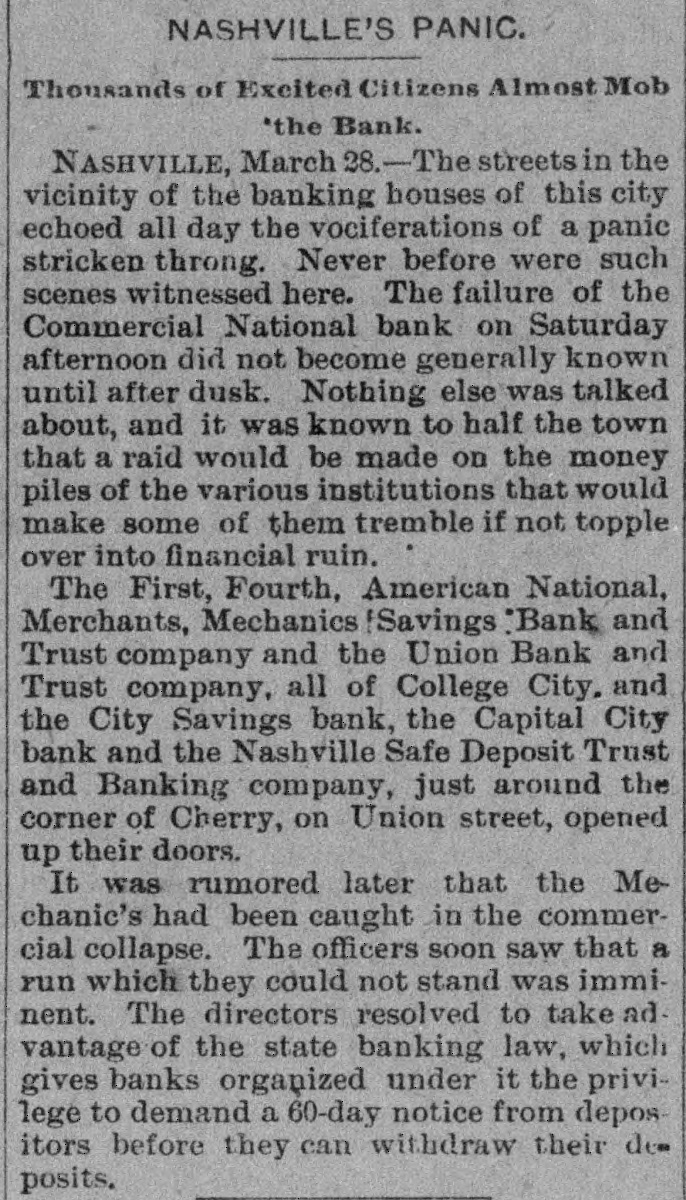
Thousands of Excited Citizens Almost Mob *the Bank. NASHVILLE, March 28. - -The streets in the vicinity of the banking houses of this city echoed all day the vociferations of a panic stricken throng. Never before were such scenes witnessed here. The failure of the Commercial National bank on Saturday afternoon did not become generally known until after dusk. Nothing else was talked about, and it was known to half the town that a raid would be made on the money piles of the various institutions that would make some of them tremble if not topple over into financial ruin. The First, Fourth, American National, Merchants, Mechanics Savings "Bank and Trust company and the Union Bank and Trust company, all of College City. and the City Savings bank, the Capital City bank and the Nashville Safe Deposit Trust and Banking company, just around the corner of Cherry, on Union street, opened up their doors. It was rumored later that the Mechanic's had been caught in the commercial collapse. The officers soon saw that a run which they could not stand was imminent. The directors resolved to take advantage of the state banking law, which gives banks organized under it the privilege to demand a 60-day notice from depositors before they can withdraw their de posits.
Click image to open full size in new tab
WASHINGTON, April 5.-Comptroller Hepburn today appointed James W. Blackmore, of Gallatin, Tenu., receiver of the Commercial National bank of Nashville. Mr. Blackmore is president of the First National bank of Gallatin.
Click image to open full size in new tab
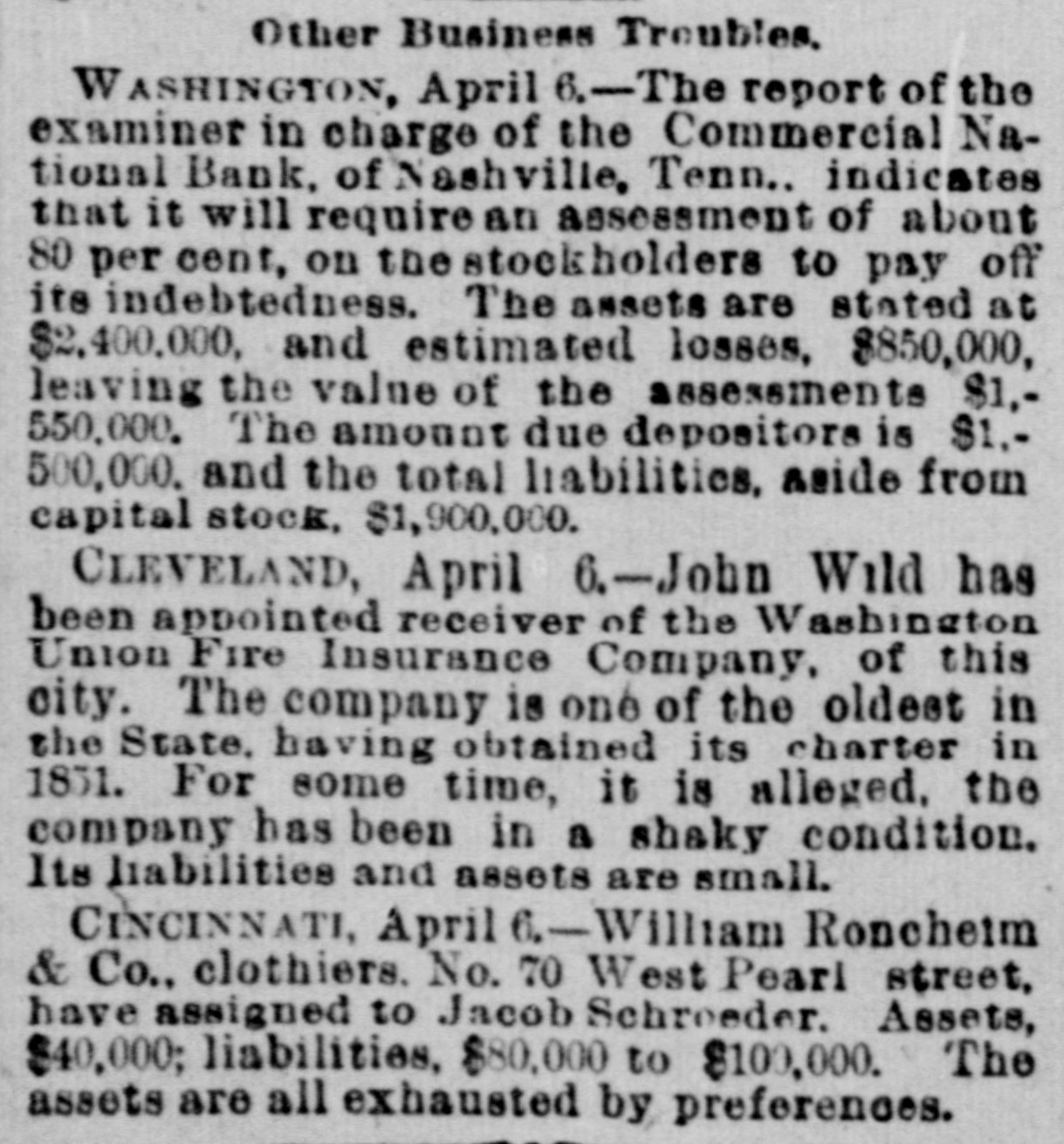
Other Business Troubles, WASHINGTON, April 6.-The report of the examiner in charge of the Commercial National Bank, of Nashville, Tenn.. indicates that it will require an assessment of about 80 per cent, on the stockholders to pay off its indebtedness. The assets are stated at $2,400,000, and estimated losses, 8850,000, leaving the value of the assessments $1,550,000. The amount due depositors is $1.500,000. and the total liabilities, aside from capital stock, $1,900,000. CLEVELAND, April 6.-John Wild has been appointed receiver of the Washington Union Fire Insurance Company, of this city. The company is one of the oldest in the State. having obtained its charter in 1831. For some time, it is alleged, the company has been in a shaky condition. Its liabilities and assets are small. CINCINNATI, April 6.-William Roncheim & Co., clothiers. No. 70 West Pearl street, have assigned to Jacob Schroeder. Assets, $40,000; liabilities, $80,000 to $100,000. The assets are all exhausted by preferences.
Click image to open full size in new tab
WASHINGTON, D. C.-Comptroller Hepburn appointed Janies W. Blackmore, of Gallatin, Tenn., receiver of the Commercial National Bank of Nashville, Tenn. Blackmore is president of the First National Bank of Gallatin.

Click image to open full size in new tab
A Tennessee Savings and Trust Company Driven Into Bankruptcy. The Cashier Uses $65,000 of Its Funds in Playing Bucket Shops. Two Men Killed in a Bloody Battle Between Italians and Hungarians. The Latter Become Dismayed and Flee Precipitately From the Field. NASHVILLE, Tenn., April 16.-This afternoon there was given to the public the fact that John Schardt, cashier of the Mechanics' Savings Bank and Trust Company. was short in his accounts from $40,000 to $80,000. Schardt is sick at his home and not allowed to talk. The directors of the bank have been in session all day and are still in session behind closed doors, and will not talk, From one, however, it is learned that it is believed the shortage is $65,000. Immediatsly after 12 o'clock tonight the bank will make a general assignment, which is now being prepared. It is a case of stealing, and affects none of the other banks of the city. Schardt has been cashier about three months. Before that he had been the teller of the bank, and was thoroughly trusted. It is stated that a discovery of a probable shortage occurred yesterday, when a check for $4,000 was presented and the teller could find no credits for Schardt at his home sick, being the amount. the at president the time and directors were notified, an examination entered upon, and it was discovered that there was a shortage. The plan he worked was this: He would take deenter them upon the pass book and them upon the posits, not put books Schardt of the bank. It is also stated that had confessed to having used $40,000 of the bank's money. He is under bond for $20,000. and carries $80,000 insurance,which, it is alsostated, has been transferred to the bank. Until the ashas been filed signment definite and the direct- be talk. nothing more can the obtained. ors During financial failure of flurry the recently, caused by the National bank. bank for one day an suspended Commercial paying this deposit- the ors. rectors Upon became examination satisfied it was diand resumed business. No is trouble sound anticipated tomorrow have with the other banks, as they through the few weeks. passed past safely Schardt lost ordeal the money of the He he in was speculator, took a heavy speculating bucket and lost shops. old heav- and ily. He is about thirty years has It is a family. which understood made the his company, here bond, Guaranty represented arrested by `Theodore tomorCooley, will have him is current a and believed, row. quite generally There sickness. that report, Schardt will recover from said tonight the A director not his that $50,000 if did not go over the bank pay depositors as holds the bond of stealings the bank would the in Guaran- full, for of North on Schardt, unof $26,000. divided tee $20,000 Company profits and there America Schardt's are have a year, to keep for peculations over been but them going he covered was on was never seen This bank was shops. up, clever and enough organized around with bucket under five or six years ago, a stock of $50,000, It was state $15,000 capital laws deposits. and always had about as until a three or four days ago looked on in safe institution, and the stock sold the market from 130 to 150. Schardt succeeded in pulling the wool over the of the officials when they made an examination eyes at the time of the failure of the Commercial National bank. NASHVILLE, Tenn., April 17.-2a.n is reported that Schardt, the cashier, has committed suicide, but the rumor has not yet been confirmed.
Click image to open full size in new tab
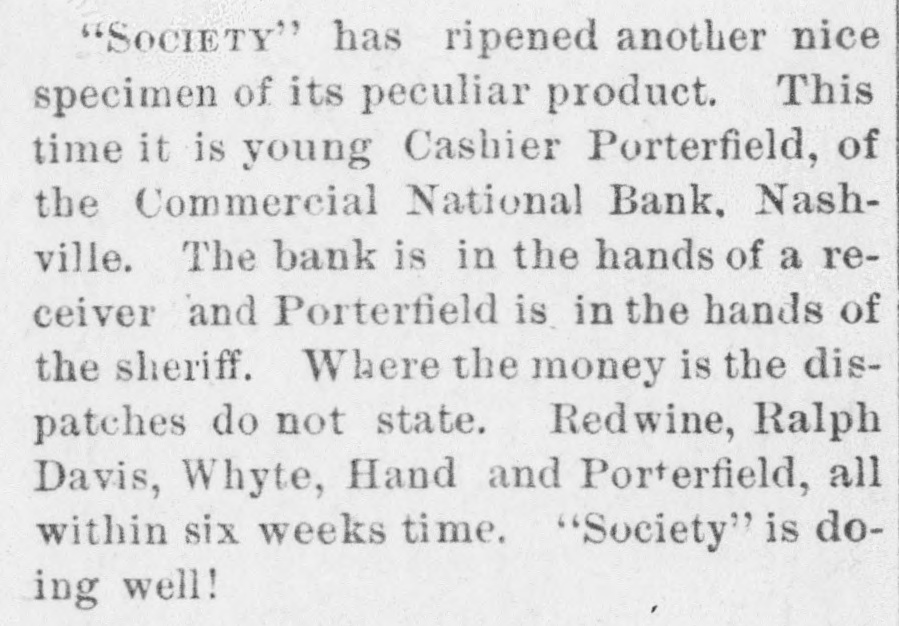
"SOCIETY" has ripened another nice specimen of its peculiar product. This time it is young Cashier Porterfield, of the Commercial National Bank. Nashville. The bank is in the hands of a receiver and Porterfield is in the hands of the sheriff. Where the money is the dispatches do not state. Redwine, Ralph Davis, Whyte, Hand and Porterfield, all within six weeks time. "Society" is doing well!
Click image to open full size in new tab
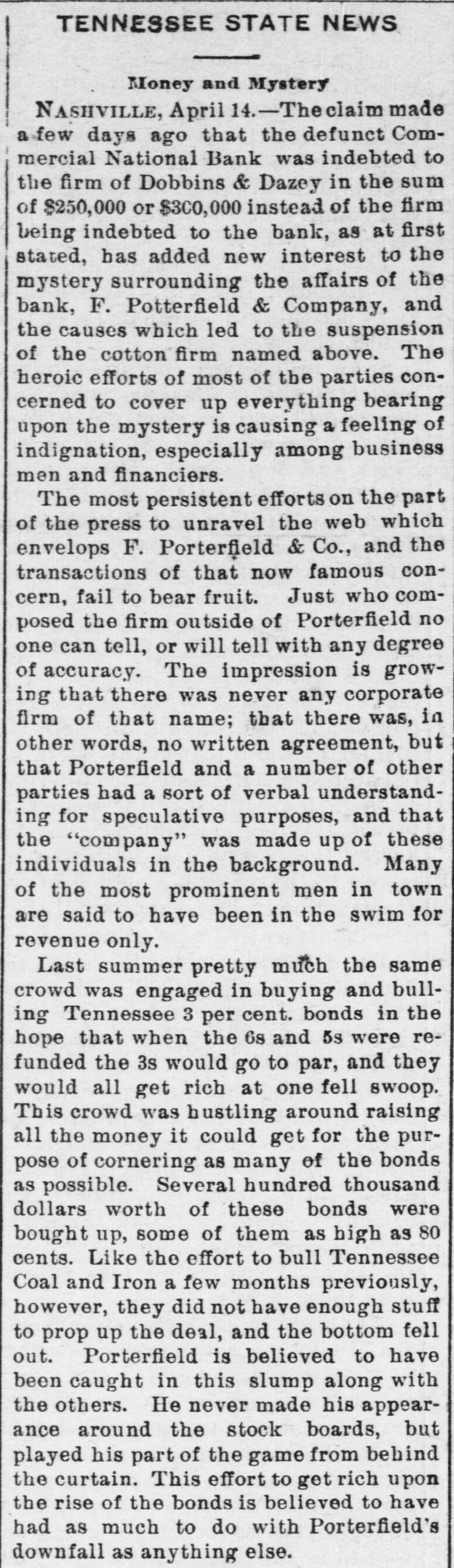
TENNESSEE STATE NEWS Money and Mystery NASHVILLE, April 14.-The claim made a few days ago that the defunct Commercial National Bank was indebted to the firm of Dobbins & Dazey in the sum of $250,000 or $300,000 instead of the firm being indebted to the bank, as at first stated, has added new interest to the mystery surrounding the affairs of the bank, F. Potterfield & Company, and the causes which led to the suspension of the cotton firm named above. The heroic efforts of most of the parties concerned to cover up everything bearing upon the mystery is causing a feeling of indignation, especially among business men and financiers. The most persistent efforts on the part of the press to unravel the web which envelops F. Porterfield & Co., and the transactions of that now famous concern, fail to bear fruit. Just who composed the firm outside of Porterfield no one can tell, or will tell with any degree of accuracy. The impression is growing that there was never any corporate firm of that name; that there was, in other words, no written agreement, but that Porterfield and a number of other parties had a sort of verbal understanding for speculative purposes, and that the "company" was made up of these individuals in the background. Many of the most prominent men in town are said to have been in the swim for revenue only. Last summer pretty much the same crowd was engaged in buying and bulling Tennessee 3 per cent. bonds in the hope that when the 6s and 5s were refunded the 3s would go to par, and they would all get rich at one fell swoop. This crowd was hustling around raising all the money it could get for the purpose of cornering as many of the bonds as possible. Several hundred thousand dollars worth of these bonds were bought up, some of them as high as 80 cents. Like the effort to bull Tennessee Coal and Iron a few months previously, however, they did not have enough stuff to prop up the deal, and the bottom fell out. Porterfield is believed to have been caught in this slump along with the others. He never made his appearance around the stock boards, but played his part of the game from behind the curtain. This effort to get rich upon the rise of the bonds is believed to have had as much to do with Porterfield's downfall as anything else.
Click image to open full size in new tab
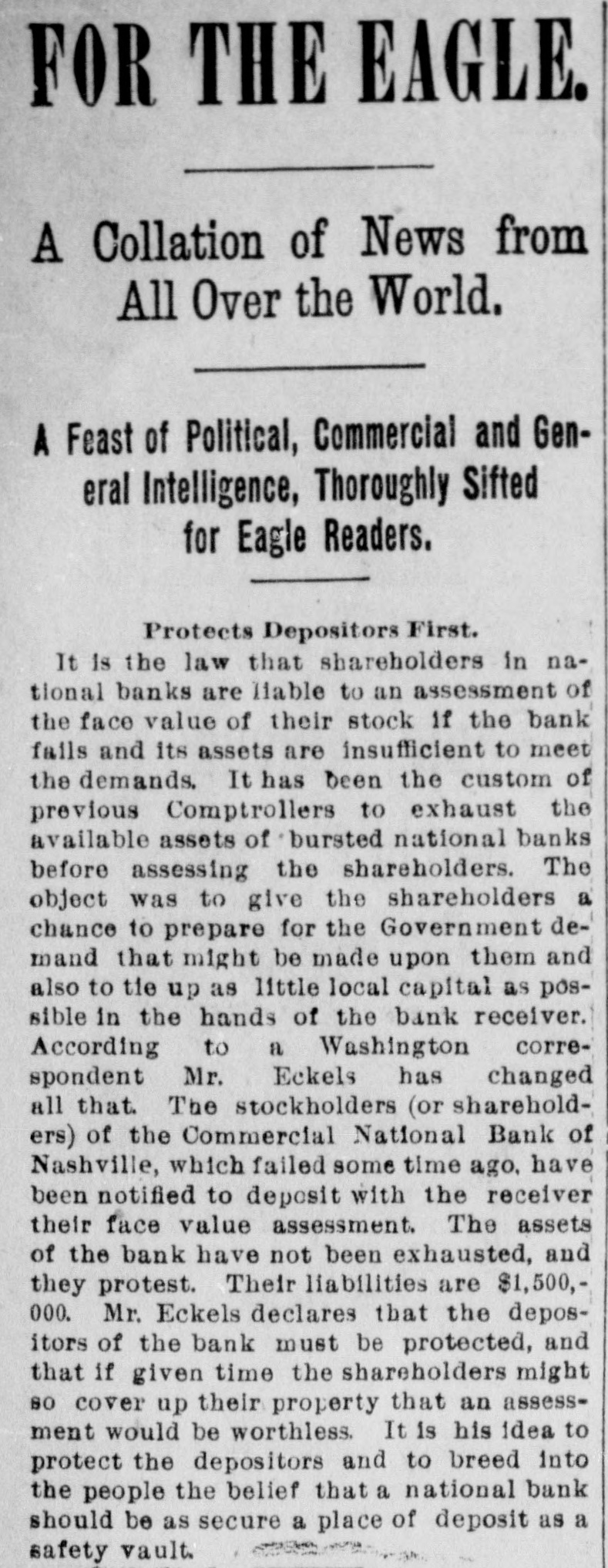
A Collation of News from All Over the World.
A Feast of Political, Commercial and General Intelligence, Thoroughly Sifted for Eagle Readers.
Protects Depositors First. It is the law that shareholders in national banks are liable to an assessment of the face value of their stock if the bank fails and its assets are insufficient to meet the demands. It has been the custom of previous Comptrollers to exhaust the available assets of bursted national banks before assessing the shareholders. The object was to give the shareholders a chance to prepare for the Government demand that might be made upon them and also to tie up as little local capital as possible in the hands of the bank receiver. According to a Washington correspondent Mr. Eckels has changed all that. The stockholders (or shareholders) of the Commercial National Bank of Nashville, which failed some time ago, have been notified to deposit with the receiver their face value assessment. The assets of the bank have not been exhausted, and they protest. Their liabilities are $1,500,000. Mr. Eckels declares that the depositors of the bank must be protected, and that if given time the shareholders might so cover up their property that an assessment would be worthless. It is his idea to protect the depositors and to breed into the people the belief that a national bank should be as secure a place of deposit as a safety vault.

Click image to open full size in new tab
Not Escaped-Concise Review of Current Events. January. 1. New York has 23 new cases of typhus fever. 2. Gigantic strike of coal miners in Saar distriot, Germany; troops summone 8. Crafts chosen Speaker or Illinois lower house. Fire at Memphis, Tenn., $156,000; Fort Wayne, Ind., electric company's plant: $150,000. Niagara frozen over. Henry Duncan lynched at Knoxville, Tenn. At Bakersville, b C., 12 officers and 36 of a lynching m killed: lynchers successful. and string up Calvin Snypes. 4. Natural gas explosion in Chicago: 32 infured, 3 fatally Suicide at Des Moines of Butter, wife murderer. 6. Fierce blizzards from Northwest to Atlantie coast Leed's failure at Sioux City. 8. Break of Cincinnati Ice gorge: $300,000 damage. 10. Democratic inauguration at Springfield. III Senator Kenna, of West Virginia, dies at $1,Washington Blizzard in Northwest 000,000 fire at Boston New York harbor blocked with ice Twenty four miners killed at Como, Colo. 11. Gen. B. F. Butler dies at Washington. 12. Unprecedented ice blockade at New York harbor. $300,000 fire at Kansas City. 14. Southern States visited by unprecedented cold. 15. Many Ohio and Indiana towns without gas or coal for fuel; terrible suffering at Cincinnati. 17. R. B. Hayes, ex-President, dies at Fremont O. 18. Forty-third anniversary of California discovery. gold 19. Coughlin, of Cronin murder notoriety. granted a new trial. 20. Hugh Dempsey convicted of poisoning mon-union Homestead workmen. 21. Oil train explodes at Alton Junction, Ill.; a killed. 60 injure many fatally. 22. Failure of Capital National Bank, Lincoin, Neb., for $1,000,000. 23. Associate Justice L. Q. C. Lamar, of Mississippi, dies at Macon. Ga. Death of ton. Phillips Brooks, the great clergyman, at Bos24. Three killed in collision at Joliet. III. 25. Judge John Martin, of Topeka, Kan., lists. phosen Senator by the Democrats and Popu26. John L. Mitchell, of Milwankee, chosen Senator by Democrats. ton. 27. Death of James G. Blaine at Washing30. Funeral of Blaine Pottstown, Pa., Iron Company fail for $2,000,000. bill. 31. Senate passes Washburn's anti-option February. 1. Severe storms in Northwest Negro ravisher burned at the stake at Paris, Texas, by a mob numbering thousands Minister Stevens establishes a protectorate by United States over Sandwich Islands. Italy. 8. Death of Algernon Sartoris, at Capri, 4. Death of Mrs. W. C. Whitney Pine Ridge Indian murders. Hawaiian Commissioners reach Washington. Ive lives lost on steamer Pomerania by tidal wave. 6. Blizzard through Northwest, mercury dropping 57 degrees in 10 hours in Montana. Senator. Nebraska Populists choose Judge Allen 8. Congress counts the electoral vote. 9. Perished by fire: 44 lunatics at Dover, N. H.: hotel guests at Centerville. Iowa, and 4 at Cincinnati Panama boodlers sentenced at Par 8. 11. Ten quarrymen killed at Rutland, Vt Chicago. Lincoln memorial services in New Nork and 12. Death of Dr. Norvin Green, famous teleSix mingraph manager. at Louisville, Ky ers killed at Villa Grove, Colo. 13. Death of Justice Scholfield of the Illinois Supreme Court. 14. Fight between Kansas Legislators at Topeka. 15. President Harrison's message favors HaTopeka. watian annexation Militia assembled at 17. Populists concede Republicans' claims at Topeka: troops withdrawn. 18. Senate confirms Judge Jackson's nomination to United States Supreme Court Failare of Manufacturer Walker. of Youngstown, O., involving Gov. McKinley $35,000. Orleans 20. Death of Gen. Beauregard at New Dissolution of the Reading combine. 22. Western Indiana switchmen at Chicago strike Observance in all cities of Washington's birthday American flag raised on the steamer New York. 23. Death of Rufus Hatch. Wall street operator, at New York. 25. Death of Alanson Reed. Chicago 8 pioneer fiano dealer Miss Julie Force. temporarily Insane. kills her two sisters, at Atlanta Ga Kansas Supreme Court declares the Republican legislature the legal one. 27. Falling wall at hicago kills ten people. the Fearful Northwest. storm of wind, snow and rain in 28. Battleship Indiana launched at Philadelphis Northwest snowbound. March. 2. Lauchlin & McManus, Philadelphia broAers. grain. fail for half a million Big advance in Washington. Cleveland inaugurated President at 5. Sandgate. England. is wrecked by the subsidence of the earth. 7. Safety Mutual Insurance Company, of Stoux City closes its doors A money scare in New York causes all markets to decline. 10. Many killed and $1,500,000 in property destroyed by fire at Boston. 11. Disastrous floods East and West. 12. Grand River floods in Michigan. 13. Failure of Kansas Trust and Banking 800. Company, Senator Ingalls President. for $800,14. Michigan rivers break all flood records Nine killed in an Anderson (I. T.) mine Four killed by falling walls at Chicago cagoan. Death of Louis Nettelhorst, prominent Chi16. G. A. R. meeting at Springfield. Ill. St. Pa17. Death of Jules Ferry at Paris trick's Day generally observed. 18. Death of Squire Abingdon, pugilistic patron. at New Orleans Big fight in Minnesota Legislature with the coal combine. Four killed, two injured. in saw-mill explosion at Rome Iowa. 19. Tremont Temple, Boston. burned: loss, $4,000,000. 20. Confirmation of news of loss of freight steamer Naronic. with seventy-two souls 21. Litchfield (III.) mill explosion: loss, $1,600,000 Charles de Lesseps, Baihant, and Blondin convicted of Panama bribery. 22. Frazer. a German miner. near Albia. Iowa, murders his wife and sister-in-law, cuts his baby's leg off and is lynched. 23. Kelly, Tenn. wiped out by a cyclone: many other towns in that State, Mis ouri, and Five Mississippi suffer: several fatalities burned to death at Cleveland. Ohio. 25. Failure of Commercial National Bank at Nashville: run upon all the other local banks. Death of Col. Elliott F. Shepard. editor New York Mail and Express. 26. Escape of Murderer Latimer from Jackson. Mich., prison. after poisoning two guards. 28. Capture of Latimer Death of Gen. E. Kirby Smith at Sewanee. Tenn. 30. Thos. F. Bayard appointed minister to England French cabinet resigns. April. 1. Five lives lost in burning hotel at Bradford. Pa Te) miners killed at Shamokin, Pa cona. Iowa. Four killed by boiler explosion at La4. Carter Harrison elected mayor of Chicago by 20,000 majority. Pu5. Reappearance of cholera in Russia gilist Donovan killed at Syracuse. 6. Dedication of the Mormon Temple at Salt Lake Murderers executed