First National Bank (Nashville, TN)

Episode Information

Episode Type
Run → Suspension → Reopening
Start Date
March 27, 1893
Location
Nashville, Tennessee (36.166, -86.784)
Bank Type
national
Charter Number
150

Metadata

Response Measures

Accommodated withdrawals, Public signal of financial health, Partial suspension, Full suspension, Books examined

Other: Directors and prominent bankers publicly pledged their personal estates to support banks; large visible cash deliveries were reported (express shipments) to reassure depositors.

Notes

The March run was small and quickly reversed and appears distinct from the August suspension driven by market stringency.

Events (5)

1. December 11, 1863 Chartered
Source
historical_nic
2. March 27, 1893 Run
Cause
Rumor Or Misinformation
Cause Details
Loungers and street talk predicted failure; panic subsided as depositors rapidly redeposited.
Measures
Depositors redeposited funds; bank continued normal business.
Newspaper Excerpt
a small run was made on the First National, but the depositors got their money so rapidly that they became convinced their fright was an error, and in nearly every instance redeposited.
Source
newspapers
3. August 10, 1893 Suspension
Cause
Macro News
Cause Details
Stringency of the money market and heavy demands for funds (state and railroad interest payments) caused a drain leading to suspension.
Newspaper Excerpt
The First National bank of this city suspended yesterday after banking hours.
Source
newspapers
4. September 11, 1893 Reopening
Newspaper Excerpt
The First National Bank of this city ... gave public notice yesterday that Monday next it would resume business.
Source
newspapers
5. July 8, 1912 Voluntary Liquidation
Source
historical_nic

Newspaper Articles (25)

Article from Daily Kennebec Journal, March 28, 1893

Click image to open full size in new tab

Article Text

y I NASHVILLE BANKS Experience a Little Rough Weather but the Storm Quickly Disappears. NASHVILLE, Tenn March 27.-Today there was some excitement on the streets where the banks are located, chiefly caused by loungers. who predicted the failure of the principal banks of the city. The business portion of the city was not agitated. t A small run was made on the First National, but the depositors got their money I so rapidly that they became convinced that their fright was an error and in nearly every instance re-deposited Two smaller banks, both doing business under state charters. had savings departI ments connected with them and upon the principal runs made. The bank of Commerce, with deposits amounting to about 850,000. suspended payment and made a general assignment. The directors of the Mechanics Bank deel led to take advantage of the law requir! ing 60 days' notice from depositors and sus1 pended payments. This bank will probably resume in . few days as soon as the restleas feeling disappears. The assets are in excess of the liabilities. ) All the other banks transacted busines I as usual and reported the deposits in excess ) of the withdrawals. The liabilities of the Bank of Commerce are 897.000: capital z stock 827,000. All the leading financial I and business men of the city think the , flurry over. As a result of the suspension , of the Mechanics bank, Lewes E. Baxter, president has as-igned. No other assignments are reported and none anticipated.


Article from The Record-Union, March 28, 1893

Click image to open full size in new tab

Article Text

PAYMENT SUSPENDED

A Run on Banks Causes Excitement at Nashville. NASHVILLE (Tenn.), March 27.-To-day there was much excitement on the streets where the banks are located. Considerable uneasiness was felt as the result of Saturday's developments, and when the banks opened a small run was made on the First National, bnt the depositors got their money SO rapidly that they became convinced their fright was an error, and in nearly every instance redeposited. At


Article from The Helena Independent, March 28, 1893

Click image to open full size in new tab

Article Text

NASHVILLE BANKS

Two More of them Go Into LiquidationPanic Over. NASHVILLE, Tenn., March 27. - -To-day there was much excitement on the streets where banks are located. Considerable uneasiness WAS felt as the result of Saturday's developments, and when the banks opened a small run was made on the First national, but depositors got money 60 fast they became convinced their fright was an error, and in nearly every instance redeposited. At other large state and national banks business went on as usual. Two of the smaller banks, both doing business under state charters. took-advantage early of the privileges given them by law and required sixty days notice of withdrawal of deposits. Both these banks had savings departments. and upon these two banks the principal runs were made. One of them, the Bank of Commerce, doing a small business, with deposits amounting to about $50,000, suspended payments, and made a general 818signment to the state laws for the benefit of all creditore. This break is rather a bad one. Another small state institution, with a saving department, and having many creditors, opened its doors as usual, but soon it was evident a run was being made and the directors decided to take advantage of the law requiring sixty days notice from depositors and suspended payments. This bank will, in all probability, resume in a few days, as it has assets in excess of liabilities and only suspended for the benefit of all creditors. The liabilities of the Bank of Commerce are $97,000, capital stock $27,500. Lewis T. Baxter. president, made a special assignment for the benefit of the bank and other creditors. No other assignments are reported and none are anticipated.


Article from The Morning Call, March 28, 1893

Click image to open full size in new tab

Article Text

BANK FAILURES

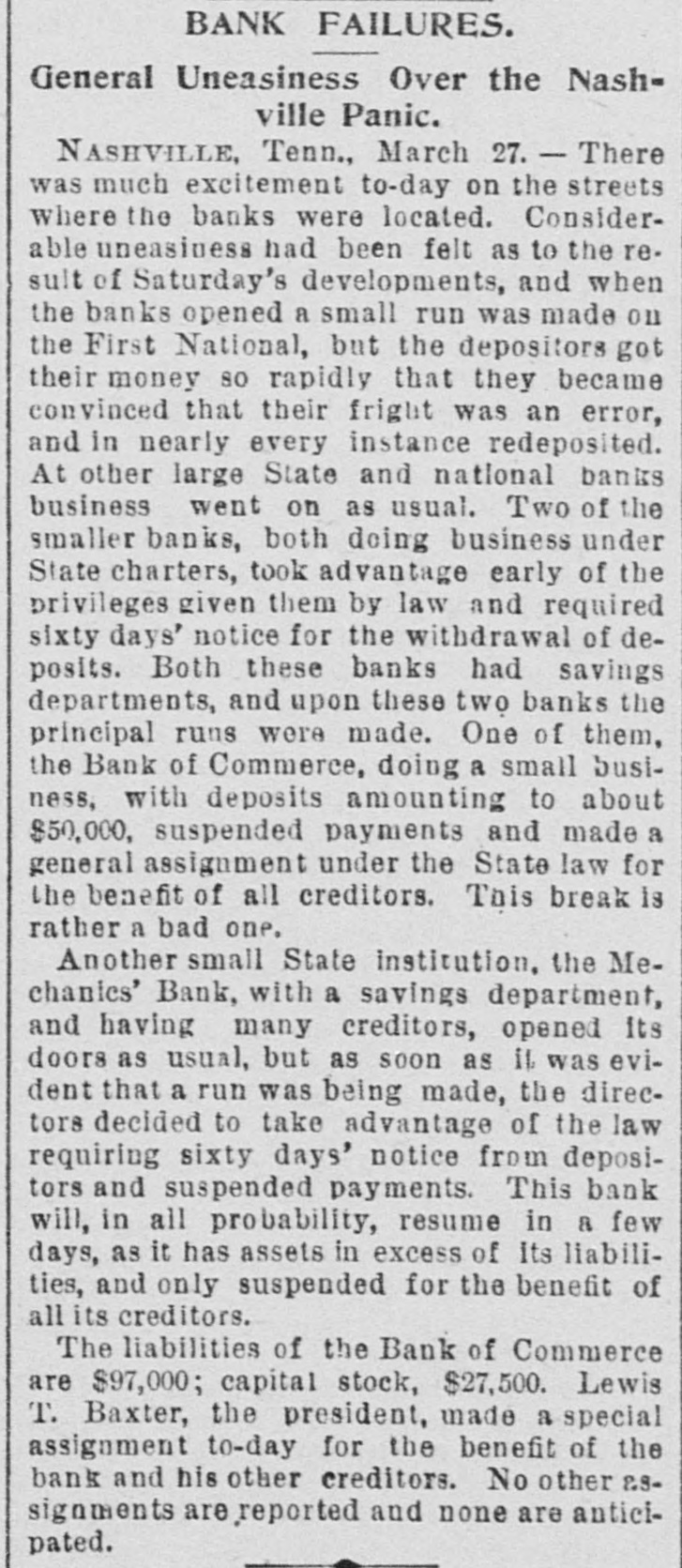
General Uneasiness Over the Nashville Panic. NASHVILLE, Tenn., March 27. - There was much excitement to-day on the streets where the banks were located. Considerable uneasiness had been felt as to the result of Saturday's developments, and when the banks opened a small run was made on the First National, but the depositors got their money so rapidly that they became convinced that their fright was an error, and in nearly every instance redeposited. At other large State and national banks business went on as usual. Two of the smaller banks, both doing business under State charters, took advantage early of the privileges given them by law and required sixty days' notice for the withdrawal of deposits. Both these banks had savings departments, and upon these two banks the principal runs were made. One of them, the Bank of Commerce, doing a small business, with deposits amounting to about $50,000, suspended payments and made a general assignment under the State law for the benefit of all creditors. This break is rather a bad one. Another small State institution, the Mechanics' Bank, with a savings department, and having many creditors, opened its doors as usual, but as soon as il was evident that a run was being made, the directors decided to take advantage of the law requiring sixty days' notice from depositors and suspended payments. This bank will, in all probability, resume in 8 few days, as it has assets in excess of Its liabilities, and only suspended for the benefit of all its creditors. The liabilities of the Bank of Commerce are $97,000; capital stock, $27,500. Lewis T. Baxter, the president, made a special assignment to-day for the benefit of the bank and his other creditors. No other 23signments are reported and none are anticipated.


Article from The Seattle Post-Intelligencer, March 28, 1893

Click image to open full size in new tab

Article Text

NASHVILLE BANKS FAIL

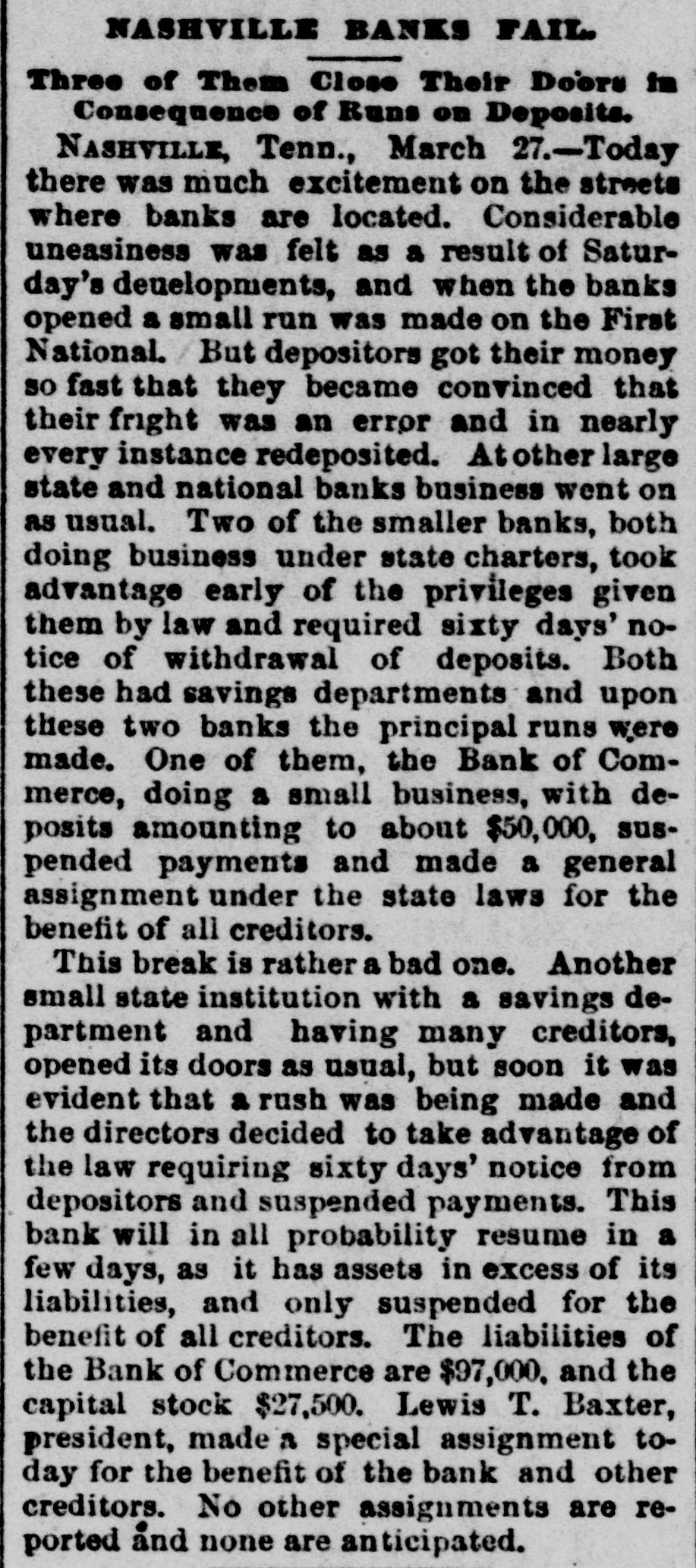
Three of Them Close Their Doors in Consequence of Runs on Deposits. NASHVILLE, Tenn., March 27.-Today there was much excitement on the streets where banks are located. Considerable uneasiness was felt as a result of Saturday's developments, and when the banks opened a small run was made on the First National. But depositors got their money so fast that they became convinced that their fright was an error and in nearly every instance redeposited. Atother large state and national banks business went on as usual. Two of the smaller banks, both doing business under state charters, took advantage early of the privileges given them by law and required sixty days' notice of withdrawal of deposits. Both these had savings departments and upon these two banks the principal runs were made. One of them, the Bank of Commerce, doing a small business, with deposits amounting to about $50,000, suspended payments and made a general assignment under the state laws for the benefit of all creditors. This break is rather a bad one. Another small state institution with a savings department and having many creditors, opened its doors as usual, but soon it was evident that a rush was being made and the directors decided to take advantage of the law requiring sixty days' notice from depositors and suspended payments. This bank will in all probability resume in a few days, as it has assets in excess of its liabilities, and only suspended for the benefit of all creditors. The liabilities of the Bank of Commerce are $97,000. and the capital stock $27,500. Lewis T. Baxter, president, made a special assignment today for the benefit of the bank and other creditors. No other assignments are reported and none are anticipated.


Article from Deseret Evening News, March 28, 1893

Click image to open full size in new tab

Article Text

EXCITEMENT IN NASHVILLE

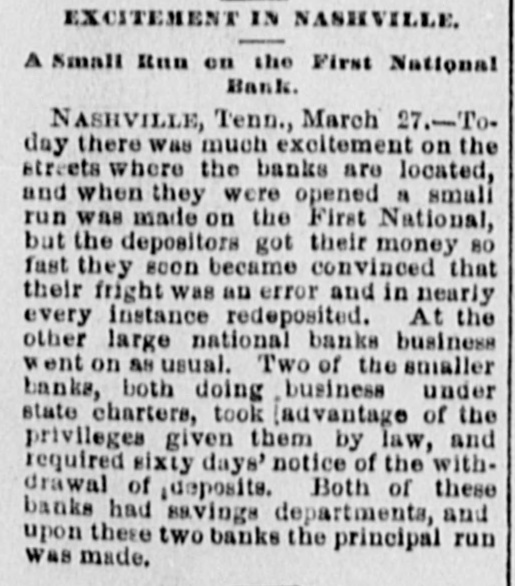
A Small KILL on the First National Bank. NASHVILLE, Tenn., March 27.-Today there was much excitement on the streets where the banks are located, and when they were opened a small run was made on the First National, but the depositors got their money 80 fast they soon became convinced that their fright was an error and in nearly every instance redeposited. At the other large national banks business went on as usual. Two of the smaller banks, both doing business under state chartere, took [advantage of the privileges given them by law, and required sixty days' notice of the withdrawal of deposits. Both of these banks had savings departments, and upon these two banks the principal run was made.


Article from The Salt Lake Herald, March 28, 1893

Click image to open full size in new tab

Article Text

NASHVILLE FINANCIAL TROUBLES

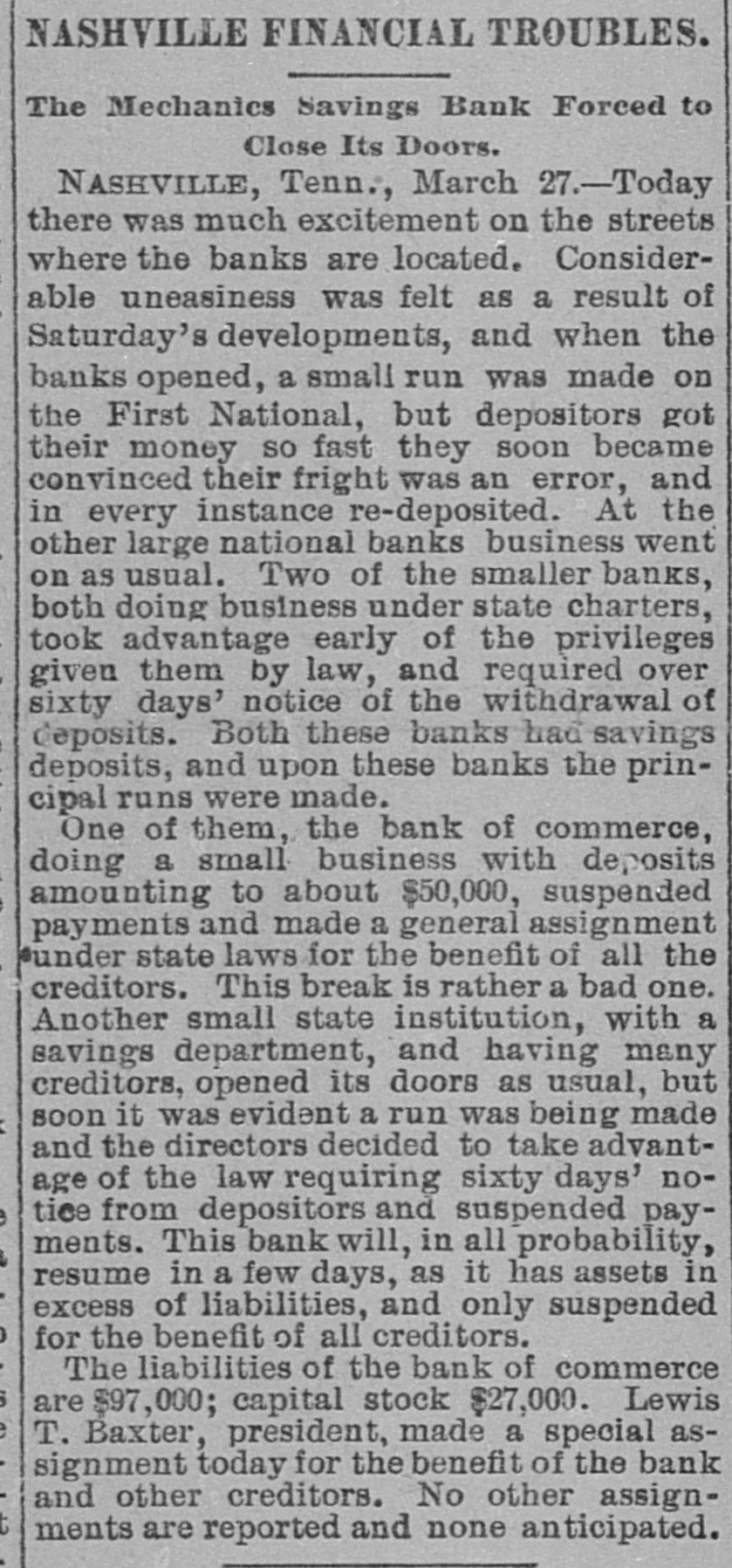
The Mechanics Savings Bank Forced to Close Its Doors. NASHVILLE, Tenn., March 27.-Today there was much excitement on the streets where the banks are located. Considerable uneasiness was felt as a result of Saturday's developments, and when the banks opened, a small run was made on the First National, but depositors got their money so fast they soon became convinced their fright was an error, and in every instance re-deposited. At the other large national banks business went on as usual. Two of the smaller banks, both doing business under state charters, took advantage early of the privileges given them by law, and required over sixty days' notice of the withdrawal of deposits. Both these banks had savings deposits, and upon these banks the principal runs were made. One of them, the bank of commerce, doing a small business with deposits amounting to about $50,000, suspended payments and made a general assignment #under state laws for the benefit of all the creditors. This break is rather a bad one. Another small state institution, with a savings department, and having many creditors, opened its doors as usual, but soon it was evident a run was being made and the directors decided to take advantage of the law requiring sixty days' notice from depositors and suspended payments. This bank will, in all probability, resume in a few days, as it has assets in excess of liabilities, and only suspended for the benefit of all creditors. The liabilities of the bank of commerce are $97,000; capital stock $27,000. Lewis T. Baxter, president, made a special assignment today for the benefit of the bank and other creditors. No other assignments are reported and none anticipated.


Article from Chattanooga Daily Times, March 28, 1893

Click image to open full size in new tab

Article Text

S. J. Keith, president of the Fourth National Bank, said that the situation was nothing like as bad as it might appear. Although during the morning one small bank had closed its doors permanently and another availed itself of the sixty days allowed savings banks, yet it was evident that the other banks were amply prepared to take care of themselves, and as for the Fourth National, it was never, in its twenty-seven years of business, better prepared to take care of its customers, and, in fact, had during the day taken over a great many new depositors and the deposits were largely in excess of the checks. He said the business condition of the city was entirely healthy and would not be seriously disturbed because disaster had overtaken the Commercial National.

Pledging Their Fortunes.

Before the doors of the First National bank were opened a large crowd had gathered on the pavement and in the streets. It appeared that a decided run on the bank would be made, but when the doors finally opened there was no general rush, though a steady stream of men flowed into the bank. From that time until noon there was a mild run, but the amount deposited during the same time was vastly in excess of the amount taken out. Only small depositors, such as had amounts in sums ranging under $1,000, presented checks to be cashed, while the state and firms and corporations that are in the habit of dealing with the First National deposited unusually large sums. It was generally said in addition to this that that the bank had received some $800,000 by express today. At no time was there the least excitement. Those depositors who felt panicky simply came up and drew out their money and went quietly away. The space around the railing of this bank was more crowded all morning than that of any other bank.

The following notice was posted above the paying teller's window in the American National bank today:

We, the undersigned, hereby pledge and bind our personal estates to pay and satisfy any obligations of the American National bank.

V. L. Kirkman, W. W. Berry, C. D. Berry, Byrd Douglass, J. E. Harris, Benj. B. Allen, N. Kirkman, Thomas J. Weaver, Richard Cheatham, Joseph W. Allen, W. H. Jackson, R. L. Weakley, A. W. Harris, A. H. Robinson, R. W. Turner, E. H. Fall, Thomas Craighead, James Burns.

About the bank everything was as calm and orderly as at any previous time. The regular business was transacted without the least hitch or excitement. The bank took in more money than it paid out. For the benefit of small depositors the doors were kept open until 4 o'clock this afternoon.

Shortly after 10 o'clock the following notice was posted on the door of the Bank of Commerce:

"Board of directors in meeting considering affairs of bank. No business done today. J. N. BROOKS, Cashier."

Bank of Commerce Assigns.

The Bank of Commerce made an assignment this morning, naming John T. Lellyett as assignee. This action was precipitated by the general apprehension of a run on the bank, which the officers believed would be made.

The deposits were not large, aggregating only about $50,000, $15,000 of which was by small depositors, ranging from $5 upward in the saving department. The bank might have availed itself of the sixty days' notice for the withdrawal of these deposits, which would, however, not have prevented the withdrawal of regular deposits, thus placing the small savings depositors at a disadvantage. To avoid this, and also because the small depositors were laboring people, and would, therefore, perhaps, be at their work and not on hand to claim what was their own with the others during the morning, the directors determined, in the interest of all depositors alike, to close the bank.

The withdrawal of deposits from the bank has been going on gradually for some days—so late Saturday evening it was thought suspension on Monday would become necessary, and in order that the savings deposits put into the bank late Saturday evening by the laboring people might not share the fate of those made on former days, such deposits, although accepted, were not entered upon the regular bank books, but purposely treated as special deposits, and will be at once returned to the depositors upon call.

The president of the bank, J. H. Yarbrough, is not in the city. J. N. Brooks, the cashier, said the suspension was due mainly to the failure of certain parties who are largely in debt to the bank to meet their obligations. Mr. Brooks declined to state who the parties were, but from outside sources it was learned that at the time C. B. Duncan was cashier large sums of money were loaned to W. M. Duncan and Duncan & Gaines, which, owing to their misfortune, they had been unable to pay.

The financial status of the bank is approximately as follows:

ASSETS. Notes discounted $76,000 Real estate and cash 21,700—$97,700

LIABILITIES. Capital stock paid in $27,500 Deposits, savings account 14,000 Deposits, special account 15,000 General deposits 19,000 Profit and loss 22,200—$97,700

Mr. Brooks said to a Banner reporter: "You may say for me that not a single present director or officer of the bank owes a dollar to the bank; on the contrary, some of them are losers as depositors. I don't know what the final outcome will be. If we can collect our debts the stockholders, as well as depositors, will be paid 100 cents on the dollar, and if we collect only one-half of the debts, the depositors ought not to lose a farthing."

There was a great deal of sympathy expressed for Mr. Brooks who has the confidence of the community and feels very deeply depressed because of his inability to stem the current.

John P. White and J. H. Yarbrough are among the largest stockholders, but as they are men of means they can stand the loss even though the stockholders should fail to realize in full their holdings.

E. B. Stahlman, who is one of the directors of the bank, happening to be in the city, was asked to meet with the board, and after hearing a free statement from Mr. Brooks as to the condition of the bank, advised the assignment, making, if possible, preferred creditors of the small depositors who had put their money into the savings department of the bank.

Mr. Stahlman says if those who owe the bank will half way do their duty the depositors will not lose a dollar.

Speaking of his connection with the bank he said: "I have not attended a meeting of the board of directors in three years; continuous absence has kept me from doing so. I will say this, however, if the matter had been taken in hand last Saturday with vigor the bank would not have been compelled to close its doors. I proposed even this morning to help raise money, but no one else responded. The truth is Mr. Brooks has not been properly supported in his effort to keep the bank in good shape. I feel very sorry for Mr. Brooks, who personally made every sacrifice in his power to avert the trouble."

During the attempted run on the Mechanics' Savings Bank and Trust company Joseph G. Branch walked into the bank and announced that he had deposited in the bank $3,500 and he was satisfied to allow it to stand. He was perfectly satisfied that it was safe and he would be paid in full. He approved of the course taken by the directors.

This was the only display of confidence. A depositor from Maury county, who has an equal amount deposited in this bank, called in to say that he had $3,500 more which, if the bank needed, he was ready to transfer to the Mechanics' vaults.

No Cause for Alarm.

Gen. W. H. Jackson, a director of the American National bank, said today in an interview: "No, sir, there is no cause for alarm beyond what has happened to the Commercial Saturday.

"The other banks are solid, even more solid than ever before. This is due to the fact that the officers have been more conservative for the past six months than they have ever been before.

"The strain for popularity is what gives very high tension to any bank. Any popularity in a bank that is not based on conservative management which inspires the confidence of the public is not worth having."

J. H. Fullton, cashier of the Capitol City bank, said when approached: "The situation is all right. Some excitement is the natural consequence of the failure of the Commercial, but there is no need of alarm.

"The savings banks which have temporarily suspended payment were keeping accounts at the Commercial, and this, of course, created uneasiness and caused the attempted runs. The cause of the Commercial's losses was peculiar to that bank alone. Other banks are in as good shape as ever.

"Our bank is doing a good business today. Our deposits are equal to any day, and are in excess of the amounts drawn out. We apprehend no trouble at all."

President Settle, of the City Savings bank, said at noon that his bank had received more deposits by several thousand than had been drawn out, and that the checks drawn on the bank were in the main in the usual order of business.

A. W. Harris, cashier of the American National bank, said this afternoon that the situation was much more favorable than anyone could possibly have expected so soon after the failure of the Commercial National bank, and in view of the magnitude of the failure.

"This community is one which has great confidence in its banks, and this is properly so. As a rule the banks are characterized by the conservative methods of management, and it would be difficult to shake the confidence of the public.

"The apprehension has almost entirely died out, and, as you can see, there is little or no excitement now existing.

"The directors of all the banks have acted nobly in coming to the support of their institutions, pledging their personal estate to the maintenance of their credit, and I take this as the greatest commendation that could be shown the banks."

Business at all of the open banks has been satisfactory today.

At the First National bank it was impossible to give the figures as to the excess of deposits over the amount paid out. But the amount was very large. Two deposits were made aggregating $200,000. No large amounts were drawn out.

At the Fourth National bank the amounts deposited were probably five or six times in the aggregate as large as the amounts drawn out.

At the American National bank the deposits were far in excess of the amounts paid out. Two gentlemen early in the day drew out $8,000 each. One of them presently returned the same $8,000 that he had drawn out and the other $10,000.

The deposits at the Capital City bank were easily in excess of the amounts checked out.

The City Savings bank, which is the youngest institution of its kind, took in $7,000 over amounts paid out. The day was very satisfactory to them.

At the Merchants' bank the deposits were largely in excess of checks. Here, also, the day was very satisfactory.

At the Mechanics' bank the excess of deposits was $671.61.

The deposits at the Union Bank and Trust company exceeded the checks by 50 per cent.

NOW THE LAW.

President Spurr and Cashier Porterfield Are Likely to Be Arrested—Lewis T. Baxter Makes a Personal Assignment. Special to The Chattanooga Times.

Nashville, March 27.—It has been difficult to learn exactly the status of the monetary panic which is at present absorbing the interest of the Nashville public. It is admitted that the condition of the Bank of Commerce is in a state of total collapse, though Mr. Brooks, the cashier, still thinks and states that all depositors will be paid dollar for dollar. The Mechanics' Savings bank is in a comparatively safe condition and their doors will probably be open tomorrow. Lewis T. Baxter, president of the bank, this afternoon made a partial personal assignment. He was indebted to the bank to the extent of about $25,000, but M. T. Bryant, one of the directors in the bank, and its attorney, tonight stated that this would not materially increase the bank's embarrassment, as Mr. Baxter had secured his indebtedness to them. Mr. McKnight, the United States bank examiner, is on the scene and it is rumored tonight that arrests will be made in the case of the Commercial Bank in a few days. Mr. McKnight was questioned upon this subject tonight, but stated that he had ordered no arrests. If arrests are made they will probably be Maj. M. A. Spurr, president of the bank, and Frank Porterfield, the cashier. Mr. Porterfield is at his home in a state of almost mental distraction. Rumors of suicide have been afloat all day in which his name was connected, but they are false. Mr. Baxter's personal assets are about $100,000. Mr. Baxter's assignment was made solely to secure the Mechanics' Savings bank, which is done by surrendering personal property. Leading bankers and citizens are inclined to think that the worst is over and that business will not be further demoralized.
Article from Asheville Daily Citizen, August 10, 1893

Click image to open full size in new tab

Article Text

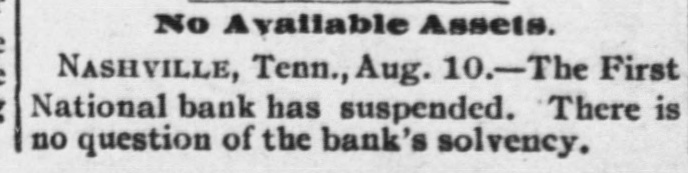
No Available Assets

NASHVILLE, Tenn., Aug. 10.-The First National bank has suspended. There is no question of the bank's solvency.


Article from The Providence News, August 10, 1893

Click image to open full size in new tab

Article Text

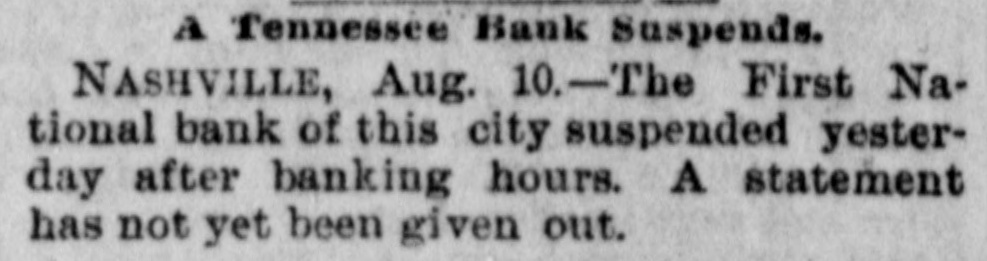
A Tennessee Bank Suspends

NASHVILLE, Aug. 10.-The First National bank of this city suspended yesterday after banking hours. A statement has not yet been given out.


Article from The Camden Chronicle, August 11, 1893

Click image to open full size in new tab

Article Text

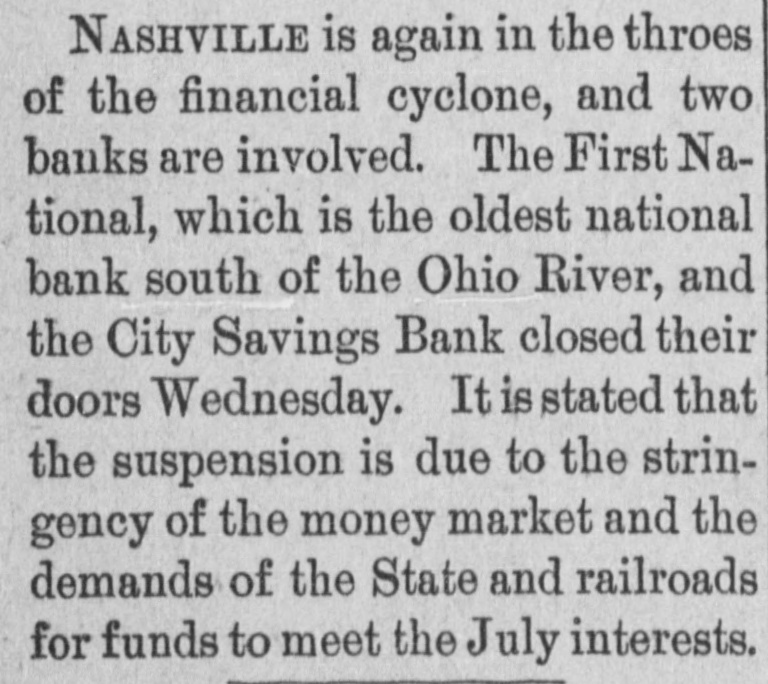
NASHVILLE is again in the throes of the financial cyclone, and two banks are involved. The First National, which is the oldest national bank south of the Ohio River, and the City Savings Bank closed their doors Wednesday. It is stated that the suspension is due to the stringency of the money market and the demands of the State and railroads for funds to meet the July interests.


Article from Daily Kennebec Journal, August 11, 1893

Click image to open full size in new tab

Article Text

Suspended Payment, NASHVILLE, Aug. 10.-The First National bank of the city suspended yesterday after banking hours. A statement has not yet been given out.


Article from The Russellville Democrat, August 17, 1893

Click image to open full size in new tab

Article Text

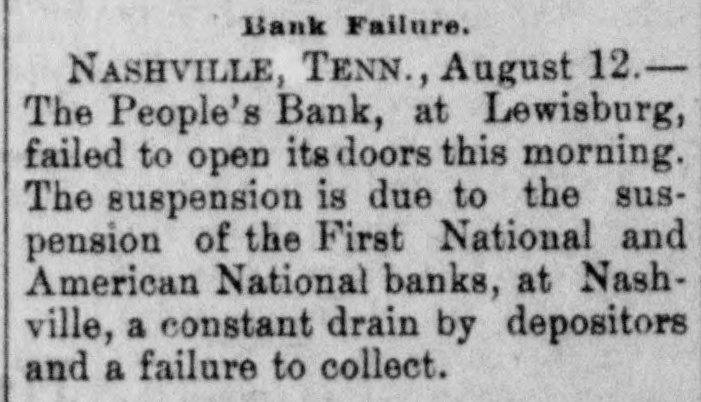
Bank Failure

NASHVILLE, TENN., August 12. The People's Bank, at Lewisburg, failed to open its doors this morning. The suspension is due to the suspension of the First National and American National banks, at Nashville, a constant drain by depositors and a failure to collect.


Article from The Austin Weekly Statesman, August 17, 1893

Click image to open full size in new tab

Article Text

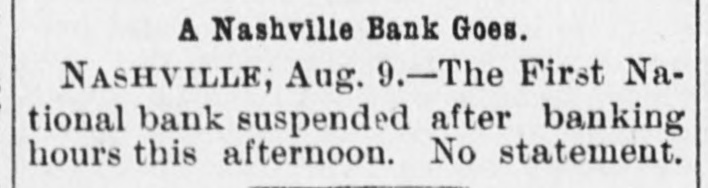
A Nashville Bank Goes

NASHVILLE, Aug. 9.-The First National bank suspended after banking hours this afternoon. No statement.


Article from The Weekly Union Times, August 18, 1893

Click image to open full size in new tab

Article Text

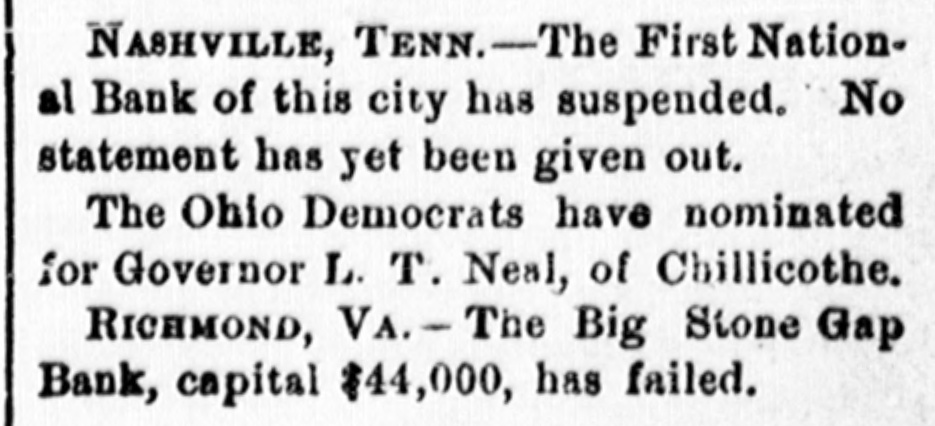
NASHVILLE, TENN.-The First National Bank of this city has suspended. No statement has yet been given out. The Ohio Democrats have nominated for Governor L. T. Neal, of Chillicothe. RICHMOND, VA. - The Big Stone Gap Bank, capital $44,000, has failed.


Article from The Weekly Union Times, August 18, 1893

Click image to open full size in new tab

Article Text

NASHVILLE, TENN.-The First National Bank of this city has suspended. No statement has yet been given out. The Ohio Democrats have nominated for Governor L. T. Neal, of Chillicothe, RICHMOND, VA. - The Big Stone Gap Bank, capital $44,000, has failed.


Article from The Camden Chronicle, September 8, 1893

Click image to open full size in new tab

Article Text

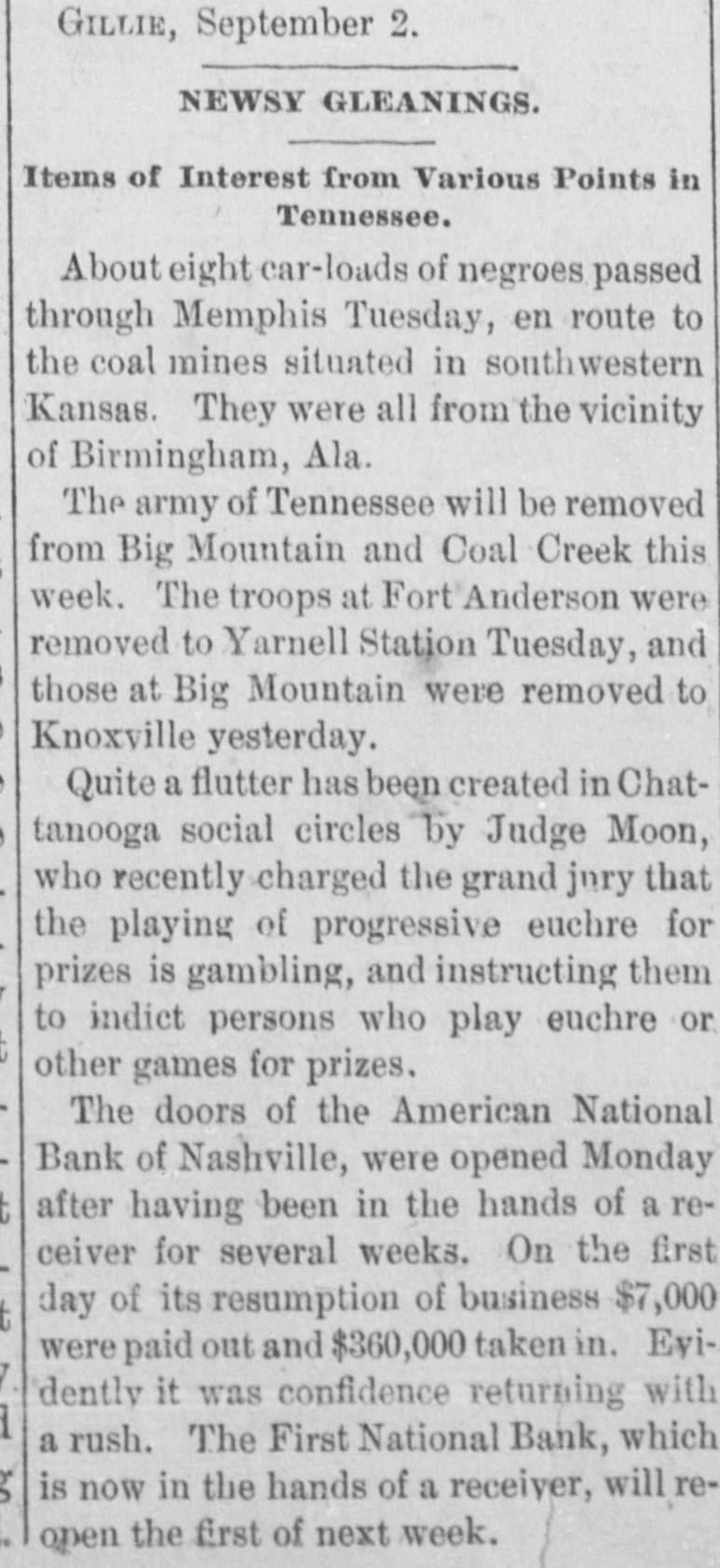
GILLIE, September 2. NEWSY GLEANINGS. Items of Interest from Various Points in Tennessee. About eight car-loads of negroes passed through Memphis Tuesday, en route to the coal mines situated in southwestern Kansas. They were all from the vicinity of Birmingham, Ala. The army of Tennessee will be removed from Big Mountain and Coal Creek this week. The troops at Fort Anderson were removed to Yarnell Station Tuesday, and those at Big Mountain were removed to Knoxville yesterday. Quite a flutter has been created in Chattanooga social circles by Judge Moon, who recently charged the grand jury that the playing of progressive euchre for prizes is gambling, and instructing them to indict persons who play euchre or other games for prizes. The doors of the American National Bank of Nashville, were opened Monday after having been in the hands of a receiver for several weeks. On the first day of its resumption of business $7,000 were paid out and $360,000 taken in. Evidently it was confidence returning with a rush. The First National Bank, which is now in the hands of a receiver, will reopen the first of next week.


Article from The Morning News, September 10, 1893

Click image to open full size in new tab

Article Text

Bank to Resume Monday

Nashville, Sept. 9.-The First National Bank of this city, which suspended Aug., 10, gave public notice yesterday, that, Monday next it would resume business.


Article from The Times, September 10, 1893

Click image to open full size in new tab

Article Text

More Banks Resuming

NASHVILLE. TENN., Sept. 9.-The First National Bank of this city, which suspended Aug. 10th. gave public notice yesterday that Monday next it would resume business.


Article from Richmond Dispatch, September 10, 1893

Click image to open full size in new tab

Article Text

Nashville Bank Resumes

(By telegraph to the Dispatch.) NASHVILLE. TENN.. Sept. 9.-The First National Bank of this city, which suspended August 10th, gave public notice yesterday that Monday next it would resume business.


Article from New-York Tribune, September 10, 1893

Click image to open full size in new tab

Article Text

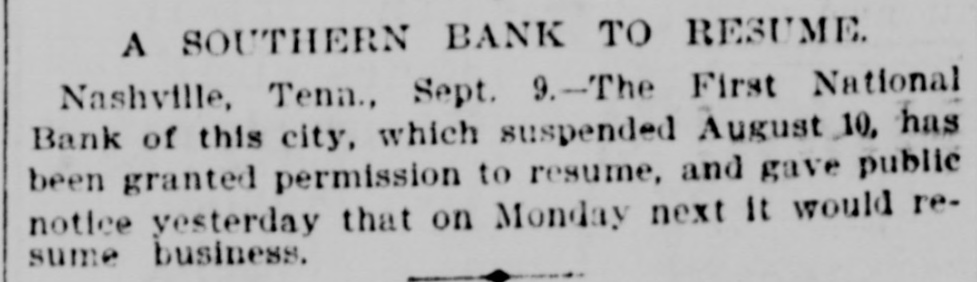
A SOUTHERN BANK TO RESUME

Nashville, Tenn., Sept. 9.-The First National Bank of this city, which suspended August 10, has been granted permission to resume, and gave public notice yesterday that on Monday next It would resume business.


Article from The Guthrie Daily Leader, September 13, 1893

Click image to open full size in new tab

Article Text

National Banks to Reopen

WASHINGTON, Sept. i2.-The following banks which recently suspended, have been permitted to reapen: The First National, Provo, Ore.; First National, Nashville, Tenn, and the First National, Lemars, Iowa.


Article from The Star, September 13, 1893

Click image to open full size in new tab

Article Text

FINANCIAL AND COMMERCIAL

he first national bank of Nashville, Tenn., which suspended August 10, has resumed. The national bank of Sturgis, Mich., has been permitted to reopen its doors.


Article from Abilene Weekly Reflector, September 14, 1893

Click image to open full size in new tab

Article Text

National Banks To Reopen

WASHINGTON, Sept. 12.-The following national banks which recently suspended payment have been permitted to reopen: First national bank of Provo, Utah: Western national of South Pueblo, Col: First national of Nashville, Tenn., and the First national of Lemars, Ia.


Article from The Middleburgh Post, September 14, 1893

Click image to open full size in new tab

Article Text

Financial and Commercial

The first national bank of Nashville Tenn., which suspended August 10, has re sumed. The national bank of Sturgis, Mich., has been permitted to reopen its doors.