Article Text
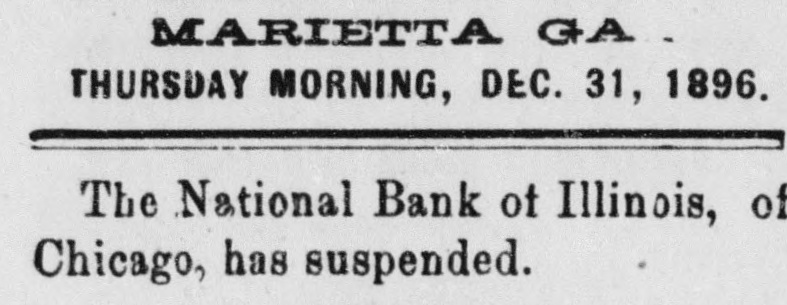
MARIETTA GA THURSDAY MORNING, DEC. 31, 1896. The National Bank of Illinois, of Chicago, has suspended.
Click image to open full size in new tab
MARIETTA GA THURSDAY MORNING, DEC. 31, 1896. The National Bank of Illinois, of Chicago, has suspended.

Click image to open full size in new tab
Dec. 21 considered The National one in of the the of Illinois, the strongest generally financial Its doors institutions today. concerns, failure E. S. West. closed three other Heineman dragging down wasmansdorff, Dreyer & Co. Roseland bank of IIII& Co. and the of the National that bank its entire and The failure due to the and fact $100,000 over loansurplus to capital nois was of $2,000,000. of $300,000. stocks. had been Five hunDreyabove ed on Calumet dollars Electric was their loaned capital out dred thousand had spread were unable to er & Co., who that they save themselves. up so extensives in time to to locking IIIIconcentrate It were due bank of the The other held failures by the not National available when of nois. institution assets which closed were its doors. is expected. agreed as the to No further trouble Association Associde has in the NaClearing House of the at the meet 75 per cent Illinois, and all the tional pay bank clearing of house in good condi- aid that banks reported of them extended it been asked. all the ing tion, of would and the none have themselv been freely banks asked will for the resume Bank had of in It is probable of the National will be paid with Illinois, the exception and all depositors full. Clearing House Dec. to the Comptroller Rescue. an Bank of Illinois asconcerning Eckels has the National clearing on house all has proved says the Chicago 75 per cent. has been It sumed to pay C. McKean Mchetructed to publish claims. receiver John and claims at once of this pointed of ail approved get the benefit issued that list creditors may have bank been as a corres- send action. banks Instruction having the their claims November and 30, pondent all to At prove the last report. of $1,000,000 includ- und the them bank in. had $450,000: a capital total The assets, Liabilities will vided bonds, profit $15,045,992 While it is feared Eckels the ing about $11,000,000.00 Comptrolleve to relieve the on pante. out be rious will results may do all dependent in his power banks and the avert fol. any strain unnecessatien nnecessary comptrones concern: today gave the failure Mc Examinemies dowing The statement advised by Bank Bank of hands for "I am that the and National 18 now currency in his In claims order has Kean comptroller closed Colle of trouble and the to in obtain targest proving for part cred of the to against prevent this early bank date the have receiver, appointed with notice once. ttors mount at an due temporary to them. to publish a The house the the Mr. a McKean raphic instructure invotions all claims of at Chicago the clear- has examery telegra of proof of committee examiner of dvance clearing that the approve advised me will face of reditor# of any the ing cent. house of thus the relles. give the and their prevent business claims. per immed and liate rbance of while character, secur to bank essary direct of the a doubteur caution so business as not in- to ing "I all loans utmost upon with the the bank made and by exercise work any of those it. The advance to be und in full teresising depending upon house for it such mount, claims with ceris but simly collateral not in such securityglikence: tificates as to Gross bank is due methods to by injurious Failure failure Due of the and impru and dent not ttention checked The reckless the though officers their to the same, they probank's followed the directionally indiv tors. withweak atures largest points source had by been their individualy the The holdings nature and overline over to condition the bank's handway the amount discover had in the of failure Electric is of which with that made oldings of the k the full as it is was was not concean larg stoc now of be such the holding books This. but been and other called, offcere was part appearth on account. loans. had specific don of improve the on had in and doubter letter, the and since there made been and directions the surface but November the bank Bankined to the wed ent "In June last ment on found that the loan hooks ar and the had had not of the career the sent be the This fulfill by tion made ful and of the bank iner. demanding from notice of the ring had examion that and they desired off be ing their and obtain Bank and red The maring house the suggest of taking was safe tion afford bank "shown ined the funds that as and the the be from should ahed for and of the that The by the or money and ing of the SEVATE
Click image to open full size in new tab
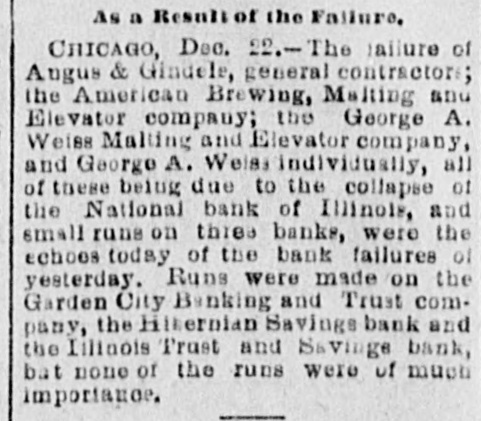
As a Result of the Fallure, CHICAGO, Dec. 22.-The Jailure of Augus & Gindele, general contractors; the American Brewing, Malting and Elevator company; the George A. Weiss Malting and Elevator company, and George A. Welss individually, all of these belug due to the collapse of the National bank of Illinois, and small runs on three banks, were the echoos today of the bank failures of yesterday. Runs were made on the Garden City Banking and Trust company, the Hisernian Savings bank and the Illinois Trust and Savings bank, but none of the runs were of much importance.
Click image to open full size in new tab
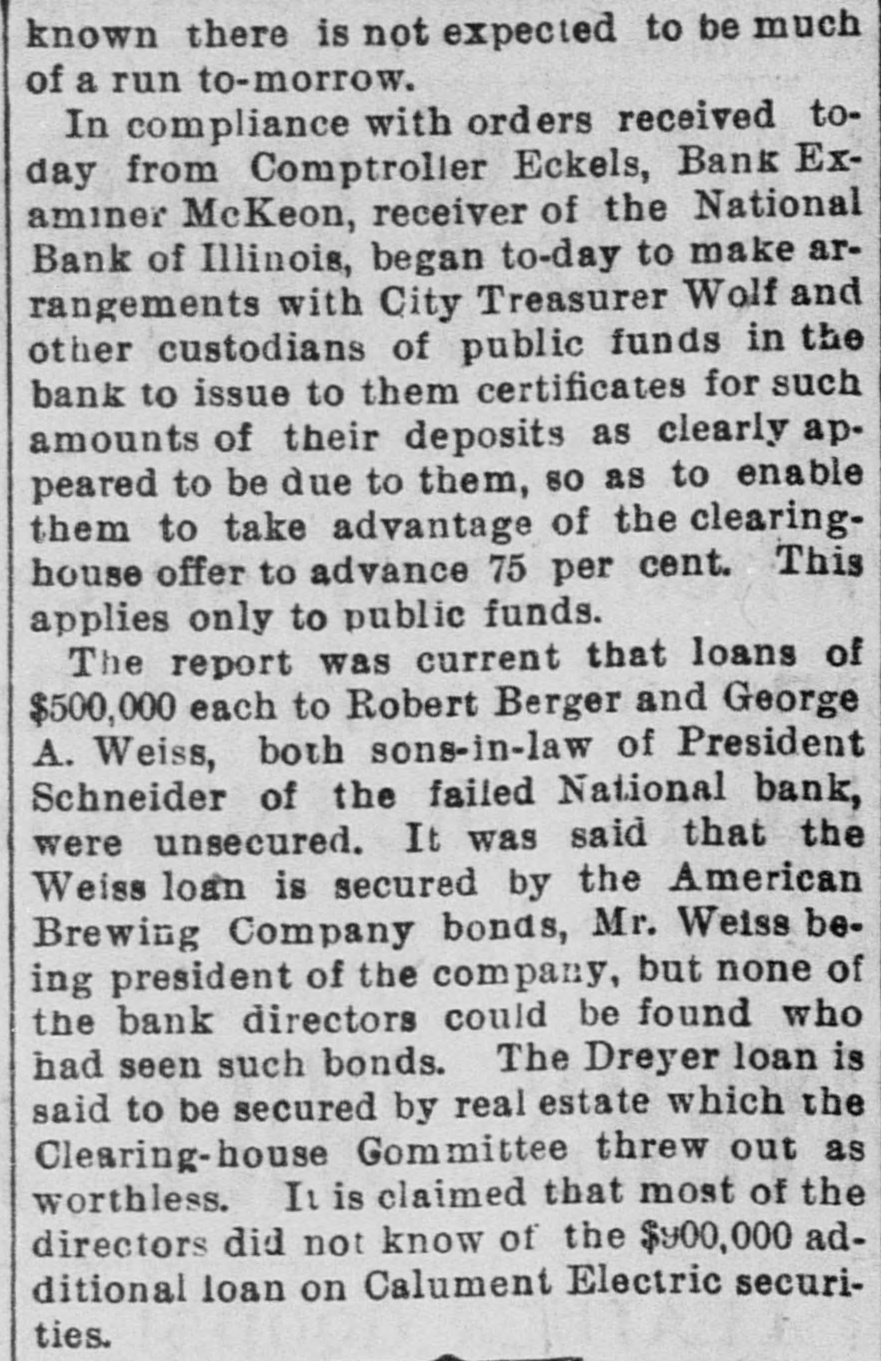
known there is not expected to be much of a run to-morrow.
In compliance with orders received to-day from Comptroller Eckels, Bank Examiner McKeon, receiver of the National Bank of Illinois, began to-day to make arrangements with City Treasurer Wolf and other custodians of public funds in the bank to issue to them certificates for such amounts of their deposits as clearly appeared to be due to them, so as to enable them to take advantage of the clearing-house offer to advance 75 per cent. This applies only to public funds.
The report was current that loans of $500,000 each to Robert Berger and George A. Weiss, both sons-in-law of President Schneider of the failed National bank, were unsecured. It was said that the Weiss loan is secured by the American Brewing Company bonds, Mr. Weiss being president of the company, but none of the bank directors could be found who had seen such bonds. The Dreyer loan is said to be secured by real estate which the Clearing-house Gommittee threw out as worthless. It is claimed that most of the directors did not know of the $900,000 additional loan on Calument Electric securities.

Click image to open full size in new tab
Notwithstanding the stringency of the national banking laws and the severity of the penalties for violating them the number of national banks which are wrecked by bank officials who violate these laws is large. National bank failures would be of very infrequent occurrence if the laws for their control were strictly obeyed. It seems to be impossible in all cases, however, to find men sufficiently honest to discharge faithfully and conscientiously the trust reposed in them.
An account of the suspension of the National Bank of Illinois was given in our dispatches yesterday. It is one of the largest, and was regarded as one of the safest, financial institutions of Chicago. It was ruined by reckless banking. All the facts have not been published yet. When they are known it may appear that the directors and officers have rendered themselves liable to criminal prosecution. If they have, it is to be hoped the law will be enforced against them to the utmost extent.
From the published accounts it appears that they knowingly and deliberately violate the national banking laws. As long ago as last June Mr. Eckeis, the controller of the currency, was made aware of the fact that the bank's condition was perilous, because sums of the bank's deposits had been loaned on insufficient security. At that time he would have ordered the doors of the bank closed, except for the promise of the directors, that they would call in at once the loans that were unsafe and the prospect that the bank could, under safe and conservative management, work its way out of its difficulties. The directors did not fulfill their promise. They continued their reckless policy of loaning money in large amounts on insufficient security. The consequence was what might have been expected and what Controller Eckels foresaw.
As an illustration of the bank's reckless method of doing business it is stated that it loaned $2,400,000 on the bonds of the Calumet street railway. This loan alone exceeded the banks entire capital and surplus. The law does not permit a bank to loan to one person or one corporation a sum larger than a small portion of its capital. There were other large loans, one being for $500,000 to a firm of which a son-in-law of the bank's president was a member.
When the bank attempted to dispose of the street railway bonds, in order to get back the money it had loaned, it found it could not do so. Its efforts to sell the bonds aroused suspicion and brought about the failure.
Just what criminal liability the officials and directors of the bank have incurred is not stated in the dispatches, but it is fair to assume that they are liable to a criminal prosecution, and that they will be prosecuted.
The deposits of the bank amount to $11,000,000. The loss of such an immense sum, or even half of it, would bring trouble into many homes in Chicago and endanger many business interests. In fact, the bank's failure has caused a loss of confidence in banking institutions in Chicago and brought about a run on some of them. Before confidence is restored hundreds, and perhaps, thousands, will be financially injured if not ruined. If the authors of this trouble and ruin are not held to an accountability to as great an extent as the law will permit the government will be negligent of its duty.
Only a little while ago a New Orleans national bank failed, and dragged down other financial institutions. In Denver a national bank was wrecked by a system of "kiting." In both cases the officials of the wrecked banks were guilty of wrong doing, and the government undertook to prosecute them. Our dispatches yesterday stated that the Denver bank officials had that day been convicted. And why shouldn't they be? The bank official who deliberately uses bank funds for advancing his private interests, contrary to the plain letter of the law, is no better than the burglar who blows open a bank's vaults and carries away the bank's money. Each accomplishes the same end—the robbing of depositors and stockholders—but by different methods.
Mr. W. E. D. Stokes of New York has
Click image to open full size in new tab
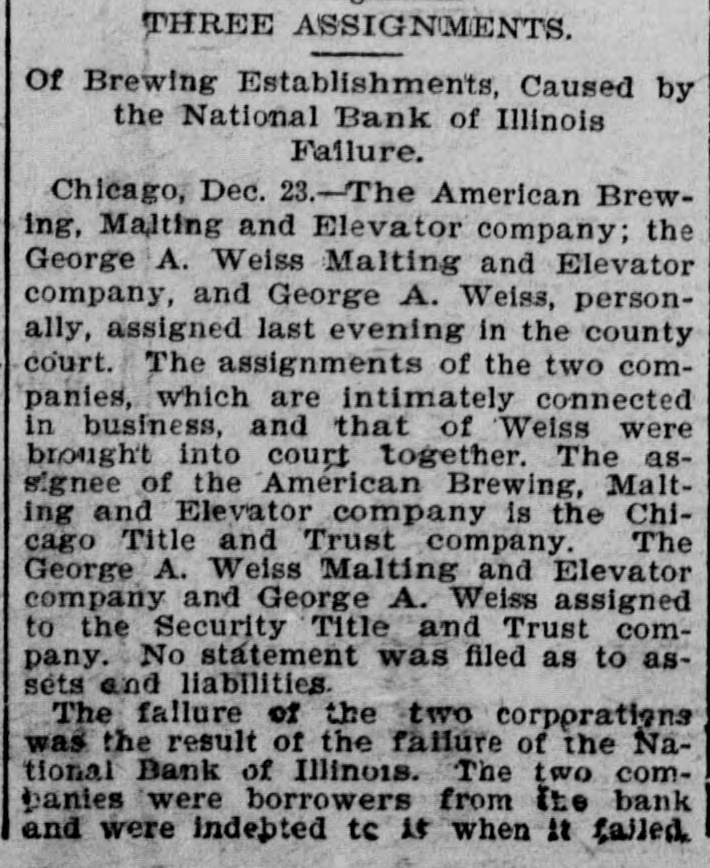
Of Brewing Establishments, Caused by the National Bank of Illinois Failure. Chicago, Dec. 23.-The American Brewing, Malting and Elevator company; the George A. Weiss Malting and Elevator company, and George A. Weiss, personally, assigned last evening in the county court. The assignments of the two companies, which are intimately connected in business, and that of Weiss were brought into court together. The assignee of the American Brewing, Malting and Elevator company is the ChiThe cago Title and Trust company. George A. Weiss Malting and Elevator company and George A. Weiss assigned to the Security Title and Trust company. No statement was filed as to assets and liabilities. The failure of the two corporations was the result of the failure of the National Bank of Illinois. The two combanies were borrowers from ite bank and were indebted tc is when it failed

Click image to open full size in new tab
TO SAID HAVE CAUSED BASE THE PLOT CHICAGO BANK FAILURE. SCHEME TO MAKE MILLIONS. CALOBJECT WAS TO DEPRECIATE STOCK. UMET ELECTRIC Buy Wreckers Intended Consolidate Then With to The Up the Stock, Their Ronds and Line Other Pockets in the Deal. Hammond, Chicago, Dec. 23. of W. the A. National Bank pulling of ond vice who president has been charged of the with defunct Illinois, the wool over the talk eyes to-day when Through seen in bank, would not at Evanston. made palatial home however, he his intimate friend, calculated to inculpate statement an which is well as two or bank. three The Post makes several directors, connected as with the and men who are not the above statement the following: the be made gives A. Hammond of the scapegoat of said the friend. he W. Illinois, thef ailure is to but National "Ham- is Bank of a bryken man to-day, the amount of mond is more to blame for securities than are not any loaned on Calumet finance committee its and meney the members of the directors. It was a conman of the bank to the purposes Chicago of City rail an officer to depreciate necessary neeted and with the South city of one of the best this the way banks of this stocks, and to the known electric road's brought about Illinois. Calumet end these two National men Bank of had been wrec King of the S funds, "securities" 475,000 The of the bank the Calumet brilliant. Cause and an loaned on wrecking was Calumet stock investigation, plan for depreciat this valuable track, propbuy it. Then sixty- combine three miles with of new the combining South equipment erty of and franchise eventually and make of fortune Chicago with the Chicago railway, millions City railway within five or ten the with full years. a loan was increased of the finance to com- the directors knowledge "The of members was made known commitof the deal mittee and Members lateron of the bank finance were given to was tee and and officers the purpose besides of paying the the the bank disell stock. the road and, good round a sum severe for conter the General loan, make There a has been Electric secure and conrectors. between Chicago the City railway the Calumet to and road, it was and stocks road South trol of the which bonds go of with could them. finally be sold the thought that the like $3,000,000 a or man $4,000,mected connected to the at something a brilliant idea Chicago for City who railway had been through are with was the South bank, and the men the bank. It that has backing wreck Calumet and the prohabilities will be sold and to the his succeeded. Calumet Electri City railway man his name the to the Chicago who lent pot out of friend, South scheme the banker, to make a good the matter the deal himself. banker took the in attention of "The safe part one: the He to called the fact somewhere, that Caluwas bank a examiner had disappeared Bank of prob- Iisecurities the National and had a met the intimating that good share of them that the linois all. finding beably officers of the hot on had on "The had examiner them was insactions bank. their they trail, and the to push salo of the Could foot for house became delayed ved thirty matter have Calumet been Electric among the bank's clearing gan bank the the alarmed. securities securities or effected, would sixty the as days. have been would have but without to not the sale found to the bank, been loss sets. The a loss or heavy course at public But this tryto the bank. of persons disturbance stockholders possibly suit of the the Calumet purpose Electric road. alone would not the S. Dreyer to years ago and for to reduce ing "Three control bank $1,000,000 E. trying three when years due the owed Hammond the reduced has been one-half it was to Mr. was closed and this was If that. of It the bank Hammond that for the Dreyer doors Vice President the securities and Weiss SatThat accomplished. to these two men they disappeared come out later. condition loans _have disappeared. point may bank who has been of talking became afternoon. urday One director a great in deal the public since the took $12,000 out the concern bank Saturday for the knew falsifica- the of the was no for occasio the directors loan. You where can't tion of the 1 000.000 loan "There of accounts Calumet in a bank withcover amount directors up do a their Trust duty and Savings notice bank given called to their to-day The Illinois the sixty and days paid all no run who what- also drew Tuesday There was savings banks that depositors money the other the thers anxiety for Some of notice and as the ever. the abated. it will has comptroller in made in gave withdrew among Washington deposito do the Dec likewise following statement Eckels to-day made the statement should have some connection quarters with save that the efforts National Bank was of and been made from to failing: effort possible Illinois legitimate closed the and directors instructe made. Every Before fully it informed The attention proper- of take house by officers to; clearing were immediate bank steps. committee was pursued and the called to the that the course the facts, but be was saf enters of ly the opinion not only justified and proper by thing clearing to was it a wise, When a bank officers and in directors such done. association. its to conduct scandal it to also its house are not only prevent bound loss creditors. and but way as shareholders to which and it associated. has been own banks with such a condition system and been called to the regret that bank in the associal clation has in the But developed in clearing any house such drastic of the that any upon to take end it will prove and country to and every the security benefit to clearing of bank measures all the banks house association depositors. TROUBLE for Suit the Dissolution add LOUIS to COMPANY IN of the South
Click image to open full size in new tab
Several Failures and Financial Distrust Makes Excitement in Chicago. CHICAGO. Dec. 23.-The vailures of Angus & Gildele, general contractors; the American Brewing, Malting & Elevator Co.; the George A Weisse Malting & Elevator Co., and George A. Weisse, individually, all of these being due to the collapse of the National Bank of Illinois, and small runs on three banks, were the echoes yesterday of the bank failures of Monday. Runs were made on the Garden City Banking & Trust Co., the Hibernian savings bank and the Illinois Trust & Savings bank, but none of the runs were of much importance.
Click image to open full size in new tab
Directors of an InsolventInstitution Confer With Mr. Eckels. WASHINGTON, Dec. 26, 1896.-George E. Adams, Wm. H. Page, Wm, D. Kerfoot and Charles H. Corwith, directors of the National Bank of Illinois, had a conference with the Comptroller of the Currency this morning with a view to reopening the bank for business. The conference did not result in any important definite action, but it is probable that a first dividend of fifty per cent. on claims proved will be declared in a very short time. No insolvent national bank has ever been able to do so well by its depositors within so brief a period subsequent to its failure. The four directors represented that they did not know the bank had invested so heavily in Calumet Electric Railway stock, speculation in which caused Comptroller Eckles to warn the Directory in December, 1895, and compelled the Chicago Clearing House Association to euspend the bank. A suggestion in the newspapers yesterday that signatures to letters received by the Comptroller from the Directory were not genuine, was not taken up or discussed when Comptroller Eckels produced the letters for the inspection of the four directors. Mr. Eckels promised to do everything he could in co-operation with the Directory to pull the bank through its difficulties. They will not have another conference. Mr. Adams will issue a statementrabout the talk with the Comptroller later in the day.
Click image to open full size in new tab
Washington, Dec. 26.-George D. Adams, William E. Page, William D. Kerfoot and Charles R. Corwith, directors of the National Bank of Illinois, had a conference with the comptroller of the currency this morning with a view of reopening the bank for business. The conference did not result in any definite action, but it is probable that a first dividend of 50 per cent on claims proved will be declared in a very short time. No insolvent national bank has ever been able to do so well by its depositors within such a brief period, subsequent to its failure. The four directors represented that they did not know the bank had invested SO heavily in Calumet Electric railway stock, speculation in which caused Comptroller Eckels to warn the directors in December, 1895, and compelled the Chicago Clearing House association to suspend the bank. A suggestion in the newspapers of yesterday that signatures to letters received by the comptroller from the directory were not genuine, was not taken up or discussed when Comptroller Eckels produced the letters for the inspection of the four directors. Mr. Eckels promised to do everything he could in co-operation with the directory to pull the bank through its difficulties. They will not have another conference.
Click image to open full size in new tab
The Controller Willing to Aid the Illinois National to Resume. WASHINGTON, D. C., Dec. 26.George S. Adams, William E. Page, William D. Kerfoot and Charles R. Corwith, directors of the National Bank of Illinois, had a conference with the Controller of the Currency this morning with a view to reopening the bank for business. The conference did not result in any definite action, but it is probable that a first dividend of 50 per cent on claims proved will be declared in a very short time. No insolvent National Bank has ever been able to do so well by its depositors within so brief a period subsequent to its failure. The four directors represented that they did not know the bank had invested so heavily in Calumet Electric Railway stock, speculation in which caused Controller Eckels to warn the directors in 1895 and compelled the Chicago clearinghouse association to suspend the bank. A suggestion in the newspapers of yesterday that signatures to letters received by the Controller from the directory were not genuine was not taken up or discussed when Controller Eckels produced the letters for the inspection of the four directors. Mr. Eckels promised to do everything he could in co-operation with the directory to pull the bank through its difficulty. They will not have another conference.
Click image to open full size in new tab
A CONFERENCE OVER AFFAIRS OF THE FAILED NATIONAL BANK OF ILLINOIS. Washington Dec 26.-George E. Adams William E. Page William D. Kerfoot and Charles E. Corwith, directors of the National Bank of Illinois, had a conference with the Controller of the Currency this morning with a view to reopening the bank for business. The conference did not result in any important definite action, but it is probable that a first dividend of 50 per cent on claims proved will be declared in a very short time. No insolvent National bank has ever been able to do so well by its depositors within so brief a period after its failure. The four directors represented that they did not know the bank had invested so heavily in Calumet Electric Railway stock, speculation in which caused Controller Eckels to warn the directors in December, 1895, and compelled the Chicago Clearing House to suspend the bank. A suggestion in the newspapers yesterday that signatures to letters received by the Controller from the directors were not genuine was not taken up or discussed when Controller Eckels produced the letters for the inspection of the four directors. Mr. Eckels promised to Go everything he could in co-operation with the directors to pull the bank through its diffculties They will not have another conference. Mr. Adams gave this statement to the United Assoclated Presses this afternon 'We had a very pleasant Interview with the Controller of the Currency Our purpose was to show what we had tried to do to improve the condition of the bank since the receipt of the Controller's letter a year ago. Our talk was mainly about the Calumet Electric. We feel that the Controller will do all that can be done to realize all that can possibly be realized out of the assets. We feel hopeful about the result. We made no suggestions about the receivership, either for any one or against any one. Controller Eckels late this afternoon appointed John C. McKeon permanent receiver of the Illinois National Bank Mr. McKeon has been National Bank Examiner for Chicago, and the vacancy thus created has been filled by the assignment of Joseph T. Talbert, National Bank Examiner for St. Paul and Minneapolis, to the Chicago district. Chicago, Dec. 26.-Benjamin B. Jones, ex-paying teller of the wrecked National Bank of Illinois, who was arrested Thursday night on the charge of embezzling $20,000 of the bank's funds, was removed today by order of Justice Grosscup to the Du Page County Jall at Wheaton, to remain there until the next Federal Grand Jury passes on his case or he is able to furnish the $10,000 bond required to effect his release Ex-Judge Prendergast, who represented Jones in a settlement with the bank, said his client met all demands made of him, but the bank drove a hard bargain. reducing Jones to a penniless condition His family was forced to go to relatives to live, and Jones is said to have been in and out of Chicago repeatedly, working at anything to get an honest living. He says he never tried to avoid arrest, and is not guilty of any embezzlement, alleging that a dozen employes of the bank had access to the money in the vaults. He was away on a vacation in September. 1895. and on his return to the bank was confronted with a shortage It is understood that Wilson. who is under bond pending sentence for complicity in the embezzlement. accuses Jonez of making him a dupe in the case. and Wilson may be the principal witness against Jones.
Click image to open full size in new tab
Otto Wasmansdorf, one of the bankers who failed in Chicago last week, fired a bullet into his brain on Sunday last. Oswald Frendin a retired farmer, worth $60,000 shot and killed himself at Racine on Sunday last. He had come from Sweden only 8 short time previously. No cause but extreme nervousness is given for the act. The craft Three Friends will be libeled for violating the neutrality laws when she reaches Jacksonville. If her fight with a Spanish vessel can be proved, there is a possibility of the crew being arrested for piracy. This boat has made a fortune in trading with Cubans in contraband of war. The Atlas National Bank of Chicago suspended on Monday last, The failure of the Illinois National Bank caused a steady withdrawal of deposite, until about $1,000,000 were taken out. All the depositors of the bank will be paid in full at once, the Clearing House association agreeing to furnish the funds for this purpose. No excitement has been caused by the suspension. A terrible train wreck occurred near Birmingham, Ala., early on Sunday morning. Some devils in human form had taken out a rail on a trestle and the train fell a distance of 110 feet. Twenty seven persons were killed outright. Only nine of all on board escaped, but some of these are so seriously injured they cannot recover. The engineer had seen the danger and shut off the steam but too late. Deadwood, S. D., is in a terrible state of excitement over reported new discoveries of gold on Ragged Top, a Black Hills mountain. It was a place deemed unfavorable for gold and had naver been explored. A solitary miner went to work there and struck gold rich. Now there is a rush of every one to the place and towns have sprung up like magic. The mines are easily worked and the ore yields from $90 to $300 per ton.
Click image to open full size in new tab
Chicago, Dec. 30.-At the Atlas National Bank and the National Bank of Illinois affairs have dropped into a rut, and are running along without particular incident. Over $100,000 was paid out to depositors at the former bank yesterday or through the National Bank of America on its account. It is now evident that the accounts of depositors cannot be closed by the end of the year, as many people who would have rushed to the bank. were it reported to be in danger of failing. are now extremely slow in drawing out their funds. At the Dime Savings Bank there was scarcely a ripple of excitement all day, and Its affairs appeared to have settled down to the ordinary plane. There were fewer rumors around town and the financtal sky cleared materially. The Van Nortwick collapse had no disturbing influence on the local situation. W. A. Paulsen, who was the principal owner of the failed Central Trust and Savings Bank, filed a bill in the Circuit Court 10-day to restrain the Atlas National Bank from disposing of a note for $30,000 made by him to the bank, and to restrain President Grannis and Charles B. Farwell, a director and exUnited States Senator, from disposing of their own property so that Paulsen cannot collect any of the damages he may be awarded at the trial of his suit for $250,000 against the bank. Grannis and Farwell in connection with the note, and the closing of Paulsen's bank by the failure of the Atlas to clear for it.
Click image to open full size in new tab
Chicago, Dec. 28.-Partly as a result of the failure of the National Bank of Illinois last week. the Atlas National bank began paying off its depositors to-day. thus marking the first step in the retirement of that Institution from business. No deposits were received, and as fast as accounts were checked up depositors were paid in full and their books taken. The Atlas suffered heavily from the runs occasioned by the closing of the National Bank of Illinois. deposits aggregating $900,000 having been withdrawn last week. This and the fact that a gradual shrinkage of deposits extending over a long period of time brought the resources of the institution down to a low figure, and It was decided to retire from business.
Click image to open full size in new tab
CHICAGO, Jan. 2.-The Security Title and Trust company, receiver for E. S. Dreyer & Co., bankers, who were involved in the failure of the National Bank of Illinois, today: made a report, showing resources of $1,595,692, and liabilities of $1,484,433. It is expected, however, that the assets will shrink when an attempt is made to realize.
Click image to open full size in new tab
The explanation of the bank failures in Chicago, and the consequent embarrassment of other institutions there and elsewhere in the West which led to their subsequent failure also, is undoubtedly to be found in the reckless speculation that has been going on, with the encouragement, if not the actual participation of the managers of some of the banks. The great Diamond match speculation was promoted by some very prominent financiers in Chicago, and its collapse hurt a number of the banks there. The particular cause assigned for the failure of the National Illinois Bank was the embarrassment of an electric street railway company, which was an ambitious project to give South Chicago the benefit of sixty miles of new track, run on the storage battery principle, much of which has been this year under construction. It was an attempt to boom property that had not yet demonstrated its ability to yield dividends, and it appears to have got too much encouragement from the bank which paid the penalty of reckless plunging, and in its own downfall it has carried a number of other and more reputable concerns to ruin. This is the true explanation and the only explanation of the recent bank failures which have furnished so much gleeful comment for the Populist press.
Click image to open full size in new tab
immediate payment of the greater part of the bank's capital when the money is most likely invested in such a manner that it cannot be called in at once. To save a bank in this extremity there is a provision in the banking laws by which savings banks may decline to pay depositors in full on demand, but may require a notice of 60 days.
One of the most memorable runs in the history of Chicago was in 1893, when the Illinois Trust and Savings bank tried to bring its panic stricken depositors to their senses by a parade of strength. The depositors gathered by thousands and were formed into long lines running almost around the block. The bank attempted to meet all demands. The force of paying tellers was quadrupled, all rules regarding business hours were cast aside, and the money was shoved out as fast as a big corps of experts could count it. But these tactics did not have the required effect, and, although the bank was kept open nearly all night and until the last man in line had received his cash, more depositors came the next morning, and it was several days before confidence was restored. A run on a savings bank was started not long ago in New York state by the mere fact that a man had dropped dead in front of the bank. A crowd collected, depositors became frightened, and the original cause of the disturbance was forgotten in the mad rush to withdraw money. The result was so serious that the bank was eventually obliged to close its doors.
While people who become so easily frightened are often called harebrained lunatics, there is really little to wonder at in their conduct. Knowing little of financial affairs, they jump at conclusions and do the very thing which will hurt their own interests.
Then there are the tragic features. Connected with the Chicago failure these have been more startling than usual. First came the suicide of Banker Wasmansdorff, whose firm was pulled down in the general smash. Then came the suicide of W. A. Hammond, the second vice president of the institution which he was charged with wrecking. These developments were almost as startling as the initial catastrophe.
And after the smoke has all cleared away comes the long and often tedious readjustment, when the bank examiner, with his corps of experts, spends weary hours over long columns of figures which have been juggled until they are jumbled into an almost inextricable tangle. This part of the work of the affairs of the Illinois National bank is in charge of John C. McKeon, who has been appointed receiver by Comptroller Eckels. He is one of the most expert accountants in the country and will probably be able to unravel the snarl in due time. JOHN F. WILLOUGHBY.
Click image to open full size in new tab
CHICAGO, illinois, January 20 Payment of the first dividend of 50 per cent. to depositors of the National Bank of Illinois, which suspended a few weeks ago, commenced to-day. Comptroller Eckels has been busy for several days signing the necessary checks and there was a long line of depositors in waiting when the doors were opened. The amount to be paid out will be nearly $5,000,000 and 3,000 depositors will share in the distribu. tion.
Click image to open full size in new tab
Ignorance W. Factor.
Attention is called to the fact that the Chicago clearing-house, representing all the leading banks in that city, by its timely interposition and in assuming 75 per cent. of all the claims against the National Bank of Illinois, prevented a serious panic and saved the credit of hundreds of depositors who would have gone to the wall but for this action.
Attention is called to this act chiefly because it was charged during the late campaign that clearing-houses were bankers' trusts, used to corner the money market. No charge could have betrayed greater ignorance on the part of those making it, but ignorance was a large factor in the Bryan campaign
Click image to open full size in new tab
Max Maretzek, one of that famous trio of conductors and managers of Italian opera in earlier days, which included Strakosch and Mapleson, died in his home on Staten Island, aged 76 years.
Kansas Republicans want Warden French removed from the Leavenworth federal penitentiary and B. J. Lynch given the place.
Minister Buck, envoy to Japan, has been ordered to stop a week in Honolulu en route to Tokio.
The decision of the government against the exchanging of the bank bills for silver coin has caused a panic in Havana. Prices of bread, milk and other necessities of life have doubled within the past few days.
E. P. Edgerton, civil service commissioner during President Cleveland's first term, is dead at Cleveland, Ohio.
William Carey, aged 60 years, committed suicide near Chillicothe, Mo. Drink was the cause of the deed.
Judge Gibbons of Chicago decides that the American Tobacco company is a trust under the laws of Illinois, and prohibits its agents from doing business in the state.
Europe is considerably concerned at the strong showing made by Turkey in the war with Greece.
Bankers E. S. Dwyer, Robert Berger, Carl Noll and Adolph Nisson of Chicago were indicted by a special grand jury in connection with the failure of the National Rank of Illinois.
Click image to open full size in new tab
Second Suicide in Connection with a Bank Failure. Chicago. May 27.-Alexander T. Beckett. formerly a clerk in the National Bank of Illinois, shot and killed himself at his home in Riverside. Beckett had charge of the city collection in the National Bank of Illinois before its failure, and while somewhat eccentric and melancholy on account of his poverty, always bore the respect of the officers and his fellow clerks. Since just before the suspension of the National Bank of Illinois Beckett has been employed in the Merchants' National bank as a messenger. He had bought a home for himself and family in Riverside and was paying for it by installments. The suicide of Beckett recalls the sensational death of Vice President William A. Hammond, who jumped into the lake from Dempster street pier last January. Hammond committed suicide on account of several bad deals he had made with the bank's funds.
Click image to open full size in new tab
Chicago, Nov. 4.—President-elect James H. Eckels of the Commercial National bank of Chicago will have associated with him as vice-president John C. McKeon, formely bank examiner of this district and later receiver of the National Bank of Illinois, and James Talbott, the present national bank examiner of this district, as cashier. Mr. Talbott is a Virginian by birth, and well-known in southern and northwestern banking circles.
Click image to open full size in new tab
Joseph T. Talbot Will be Vice-President of Eckels' Bank.
CHICAGO, Nov. 4.--President-elect James H. Eckels, of the Commercial Na-tional Bank, of Chicago, will have asso-ciated with him as vice-president John C. McKeon, formerly bank examiner of this district, and latterly receiver of the National Bank of Illinois, and Joseph T. Talbot, the present bank examiner of this district, as cashier.
Mr. Talbot is a Virginian by birth, and is well known in southern and northwest-ern banking circles.
Click image to open full size in new tab
Will be Ex-Bank Examiner McKeon and Present Bank Examiner Talbot,
Chicago, Nov 4-President-elect James H. Eckels, of the Commercial National bank of Chicago, will have associated with him in the management of that institution at least two men with whom he has been closely associated in the past. John C. McKeon, formerly bank examiner of this district and latterly receiver of the National Bank of Illi- nois, will be vice president of the Com- mercial National and Joseph T. Talbot. the present bank examiner of the dis- trict, will be cashier. Mr. McKeon is one of Comptroller Eckels closest friends. Mr. Talbot is a Virginian by birth and is well known in southern and northwestern banking circles. They will assume their new duties January 1 with Mr. Eckels.