2559. Bank of Savannah (Savannah, GA)

Bank Information

Episode Type
Suspension → Closure
Bank Type
state
Start Date
April 1, 1865*
Location
Savannah, Georgia (32.084, -81.100)

Metadata

Model
gpt-5-mini
Short Digest
1648c6f582563512

Response Measures

None

Description

Articles describe that the Bank of Savannah (a pre-Civil War bank) was compelled to suspend after the collapse of the Confederacy (circa 1865) and appears to have remained suspended (‘suspended a long time ago’ in an 1897 piece). No contemporaneous run is reported. Date of suspension is not explicitly given; inferred from context as following the Confederacy's collapse in 1865.

Events (2)

1. April 1, 1865* Suspension
Cause
Macro News
Cause Details
Compelled to suspend following the collapse of the Confederacy (post–Civil War disruption).
Newspaper Excerpt
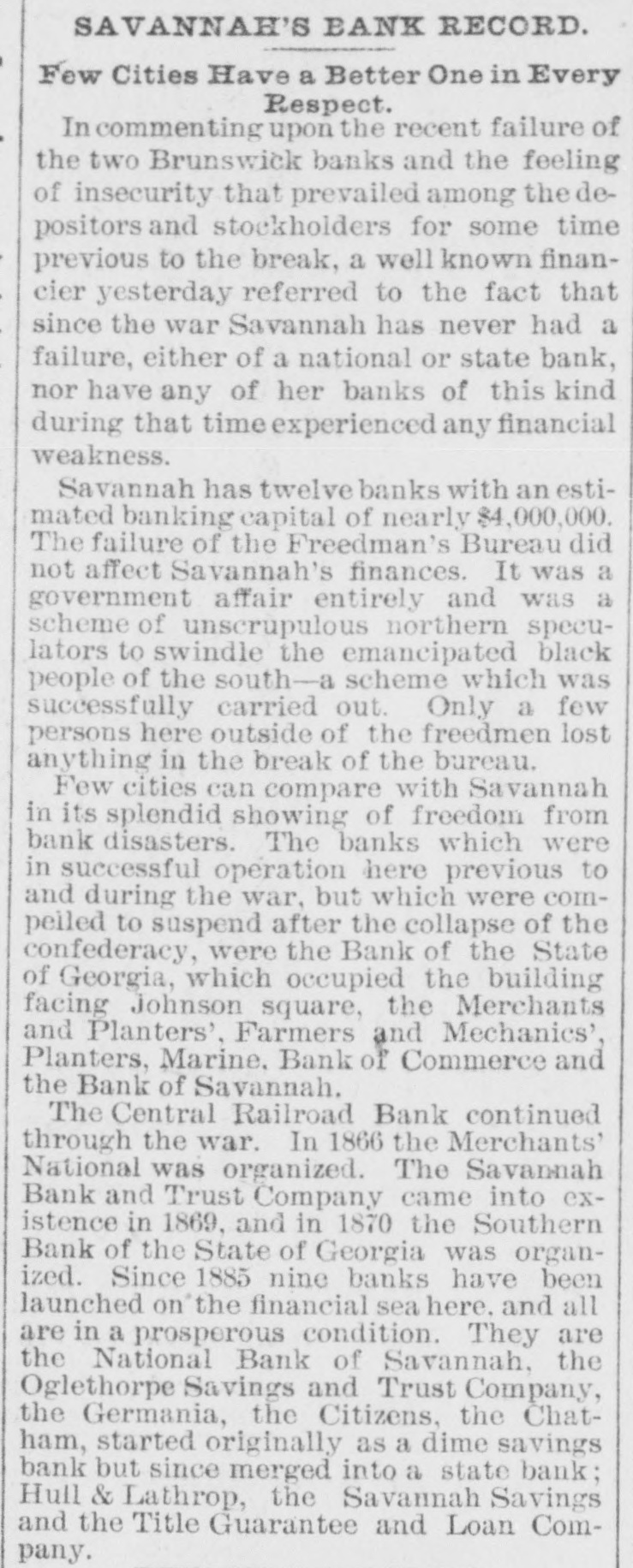
the banks which were in successful operation here previous to and during the war, but which were compelled to suspend after the collapse of the confederacy, were ... the Bank of Savannah.
Source
newspapers
2. January 11, 1897 Other
Newspaper Excerpt
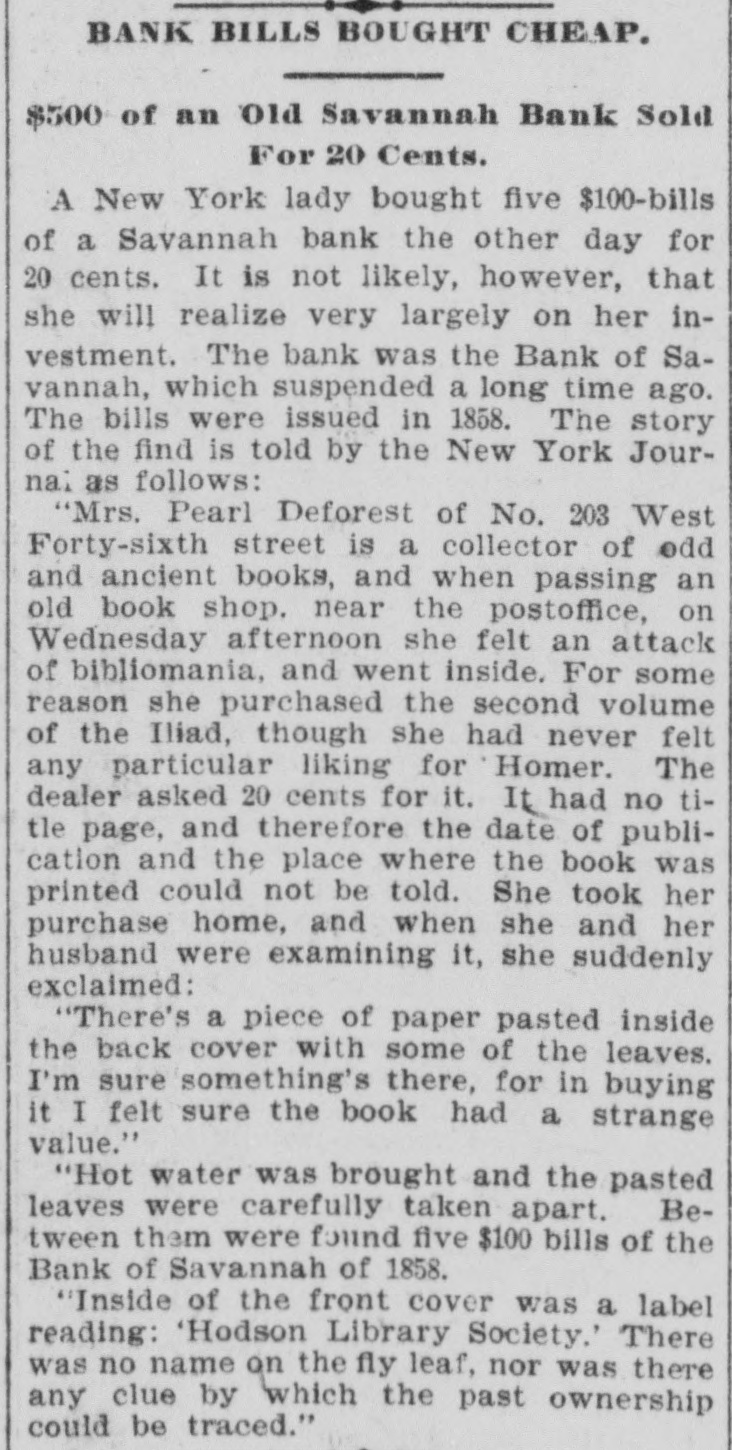
The bank was the Bank of Savannah, which suspended a long time ago. The bills were issued in 1858.
Source
newspapers

Newspaper Articles (2)

Article from The Morning News, May 22, 1893

Click image to open full size in new tab

Article Text

SAVANNAH'S BANK RECORD. Few Cities Have a Better One in Every Respect. In commenting upon the recent failure of the two Brunswick banks and the feeling of insecurity that prevailed among the depositors and stockholders for some time previous to the break, a well known financier yesterday referred to the fact that since the war Savannah has never had a failure, either of a national or state bank, nor have any of her banks of this kind during that time experienced any financial weakness. Savannah has twelve banks with an estimated banking capital of nearly $4,000,000. The failure of the Freedman's Bureau did not affect Savannah's finances. It was a government affair entirely and was a scheme of unscrupulous northern speculators to swindle the emancipated black people of the south-a scheme which was successfully carried out. Only a few persons here outside of the freedmen lost anything in the break of the bureau. Few cities can compare with Savannah in its splendid showing of freedom from bank disasters. The banks which were in successful operation here previous to and during the war, but which were compeiled to suspend after the collapse of the confederacy, were the Bank of the State of Georgia, which occupied the building facing Johnson square, the Merchants and Planters', Farmers and Mechanics' Planters, Marine, Bank of Commerce and the Bank of Savannah. The Central Railroad Bank continued through the war. In 1866 the Merchants' National was organized. The Savannah Bank and Trust Company came into existence in 1869, and in 1870 the Southern Bank of the State of Georgia was organized. Since 1885 nine banks have been launched on the financial sea here. and all are in a prosperous condition. They are the National Bank of Savannah, the Oglethorpe Savings and Trust Company, the Germania, the Citizens, the Chatham, started originally as a dime savings bank but since merged into a state bank; Hull & Lathrop, the Savannah Savings and the Title Guarantee and Loan Company.

Article from The Morning News, January 11, 1897

Click image to open full size in new tab

Article Text

# BANK BILLS BOUGHT CHEAP. $500 of an Old Savannah Bank Sold For 20 Cents. A New York lady bought five $100-bills of a Savannah bank the other day for 20 cents. It is not likely, however, that she will realize very largely on her investment. The bank was the Bank of Savannah, which suspended a long time ago. The bills were issued in 1858. The story of the find is told by the New York Journal as follows: "Mrs. Pearl Deforest of No. 203 West Forty-sixth street is a collector of odd and ancient books, and when passing an old book shop, near the postoffice, on Wednesday afternoon she felt an attack of bibliomania, and went inside. For some reason she purchased the second volume of the Iliad, though she had never felt any particular liking for Homer. The dealer asked 20 cents for it. It had no title page, and therefore the date of publication and the place where the book was printed could not be told. She took her purchase home, and when she and her husband were examining it, she suddenly exclaimed: "There's a piece of paper pasted inside the back cover with some of the leaves. I'm sure something's there, for in buying it I felt sure the book had a strange value." "Hot water was brought and the pasted leaves were carefully taken apart. Between them were found five $100 bills of the Bank of Savannah of 1858. "Inside of the front cover was a label reading: 'Hodson Library Society.' There was no name on the fly leaf, nor was there any clue by which the past ownership could be traced."