Click image to open full size in new tab
Article Text
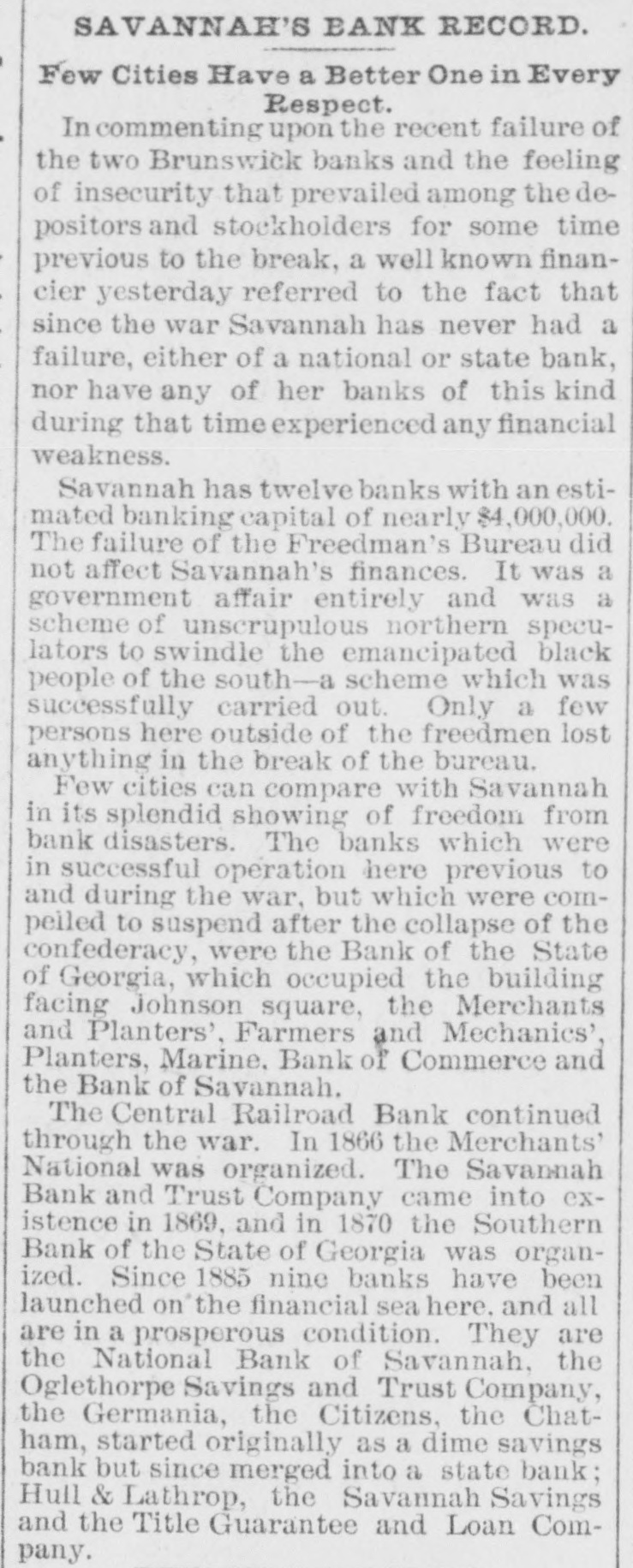
MILLIONS OF MONEY TO BURN. BELFRY ROOMS OF CUSTOM HOUSE LITTERED WITH BANK NOTES. Millions of Currency That Once Passed Everywhere and That Is Not Now Worth the Paper Upon Which It Is Printed-Issued by the State Banks That Went Down in the Collapse of the Confederacy-Clubs Used by United States Deputies in the Days of Reconstruction-Reeords of Famous Cases-All Piled High in the Rubbish Rooms. The prospective removal of the records of the United States Courts and of the department of justice, that have been stored for half a century in the custom house, to the new government building. has involved the turning over of many of the old dust-covered books and manuscripts and a more or less careful investigailon into documents and relies that cast shaft of light upon more than 100 years the history of Savannah and the state. These records are stored in what is known as the "belfry" of the custom house, just why so called tradition is not clear, for there is not now and never has been a bell, swung in that part of the building. The store room is approached a winding stair that leads up to the dome and around and under the dome are ranged apartments that look like the cells a dungeon keep. Many of these rooms piled high with boxes and trunks containing papers and littered with the flotsame and jetsam of a thousand legal and political battles. The records of the courts go back to 1787 and contain the history of many cases that were causes celebres at the time they were heard and that are often referred to the forums of the country even to-day. With many of them, slave cases, time has destroyed their usefulness, as the points of law that they decided were settled once and forever by the civil war. Others, admiralty and prize cases, were brought nto renewed prominence by the capture of Spanish vessels in the late war and vere cited and approved in tribunals where the ownership of vessels seized upon the high seas was thus brought in question. The parties to these suits, the lawyers who argued them and the judges who decided them have passed away, but the decisions themselves are still of interest and importance. The records in the case of the Wanderer, the last slave ship ever brought to an American port, is filed away somewhere the belfry of the custom house. No case ever decided in America, certainly a none that has been adjudicated in Southern state. excited more comment. There are millions of dollars in paper turrency stored in the rooms in the belfry, runks and boxes filled to overflowing and ursting their lids with the pictured vealth. The only trouble about it is that he banks by which this currency was issuspended years ago and it is not worth the paper that it is printed on. The money is everywhere, on the floors ven and piled carelessly on the tops of ables and chairs. The floors of some of he rooms are covered with it, and It would ake an expert to estimate how much this nass of state bank notes was worth when was worth anything at all. Half a dozen or more banks are repreented in the collection, the Merchants and Planters, Farmers and Mechanics, PlantMarine, Bank of Commerce, all of Saannah, the Mechanics' Bank of Augusta. ind many others. live in their notes that liter the floors of the rooms in the belfry the custom house. The notes were once good as gold and are representative of he wealth of the old city of Savannah. All these banks were in successful operaion up to and during the Confederacy, suspended after the collapse of the government with which they had cast in heir lot and whose downfall brought their wn. The affairs of these banks were adminstered in bankruptcy, and thus their notes came into the possession of the United States Courts. They had become valuless, and were heaped in the rubbish oom until they could be disposed of in fome convenient manner. They have laid here since, a third of a century or more, ind with the exception of the officials of he courts and the custom house no one, scarcely, know of their presence. Heaped in a corner are two hundred or nore clubs, that were used by the United States deputy marshals in the time of reconstruction. when these gentry stood guard over the polls and determined the election of a representative in Congress an elector for President. They were worthless even then; they are doubly vorthless now, and fit companions for the nass of old bank notes that represent nothing. About the only man who is really conversant with the history of the documents hat line the