22711. Commercial Bank (Milwaukee, WI)

Bank Information

Episode Type
Suspension → Closure
Bank Type
state
Start Date
August 18, 1898
Location
Milwaukee, Wisconsin (43.039, -87.906)

Metadata

Model
gpt-5-mini
Short Digest
2782babd

Response Measures

None

Description

Articles consistently describe the Commercial Bank of Milwaukee as a defunct/failed institution with a receiver (Frank H. Thompson) pursuing stockholders and settling claims. No contemporaneous run or temporary suspension event is described; the bank is already in receivership/assigneeship and closed permanently. The receiver sued stockholders Dec 3–5, 1898; earlier article (Aug 1898) notes a receiver paying a dividend to creditors. Unknown bank type because name gives no clear charter indicator.

Events (2)

1. August 18, 1898 Other
Newspaper Excerpt
Creditors of the Commerical bank in Milwaukee received notice from the receiver that a dividend of 20 per cent. has been declared and is payable on demand.
Source
newspapers
2. December 3, 1898 Receivership
Newspaper Excerpt
receiver of the Commercial Bank, which failed several years ago, has begun action against twenty-three defendant stockholders of that institution to require them to pay the receiver ... Receiver Frank H. Thompson, of the Commercial bank, which failed several years ago, has begun action against 23 defendant stockholders ... (Dec. 32/Dec. 5, 1898).
Source
newspapers

Newspaper Articles (10)

Article from River Falls Journal, August 18, 1898

Click image to open full size in new tab

Article Text

The News Condensed. The farmersin the vicinity of Pardeeville are losing great numbers of hogs from cholera, some losing as high as 60. The golden jubilee of St. John's Catholic church at Green Bay was celebrated, it being the seventy-fifth anniversary of the founding of the parish. The members of Christ Episcopal church have decided to build a new place of worship in Green Bay, to take the place of the one burned on July 3. An order was issued in Washington granting a discharge to Private Charles Carlson, company D, First Wisconsin volunteer infantry, supposed to be confined in a Wisconsin state asylum. Several hundred persons witnessed the largest blast ever made at a Beloit stone quarry. Six hundred cords of stone was dislodged at Samp's quarry, 500 pounds of powder being discharged. A post office has been established at Dewey, Dunn county, with William H. Johnson as postmaster; also one at Stowell, Monroe county, with Charles T. Claflin as postmaster. The German Veteran society held memorial services in Green Bay in honor of Prince Bismarck. The tobacco harvest began in Vernon county considerably earlier than usual. The erop is exceptionally fine and the acreage large. Tommy Arnold, the four-year-old son of the janitor of the Broadway high school in West Superior, felladistance of 70 feet and was not seriously injured. Dr. and Mrs. Theodore Koch were thrown from their buggy in a runaway in Baraboo and seriously hurt. An incendiary fire damaged Turner hall in Green Bay to the extent of $1,600. Creditors of the Commerical bank in Milwaukee received notice from the receiver that a dividend of 20 per cent. has been declared and is payable on demand. John Fennell, 65 years of age, was sentenced in Racine to prison for one year, having pleaded guilty to being a habitual criminal. The ninth annual convention of the Northern Wisconsin association of the A. O. U. W. lodges will be held in Chippewa Falls August 23. Conrad Schuri. a veteran of the civil war and a resident of Oshkosh for nearly 40 years, died of inflammation of the bowels. Miss Flora Tack, a wealthy business womaninStevens Point, died of dropsy and heart disease, age 39. William Andrews jumped out of a second-story window in Marinett while in a nightmare and suffered severe injuries. Barney Bloch, who was sentenced to Waupun for the burning of the American Bedding company in Kenosha two years ago, has been pardoned by Gov. Scofield. Joseph H. Harrington, a pioneer resident, died in Hudson aged 80 years. He was the first soldier of St. Croix county to enlist in the war of the rebellion and was the oldest odd fellow in northern Wisconsin W. W. Robe, a Mexican war veteran, died in Lancaster, aged 77 years. In 1848 he married Miss Jane Utt, of Whig, and their golden wedding was celebrated last May. Mathias Sohm committed suicide by shooting in Milwaukee. Mrs. John Goliher, of Maple Grove, was nearly killed by the upsetting of a buggy. A young man named Doolittle. of Sharon, while fishing on Delavan lake was drowned. The body was recovered. Herman Schoening, a young German farmer of town was premature the discharge of Polar, of killed by the a gun. E. S. Miner was nominated at Green Bay for a third term in congress by the a Eighth district convention. Not vote was cast against him. The Madison Implement and Transfer company made a voluntary assignment for the benefit of its creditors. The liabilities are over $4,000 and the assets about $3,500.
Article from New-York Tribune, December 4, 1898

Click image to open full size in new tab

Article Text

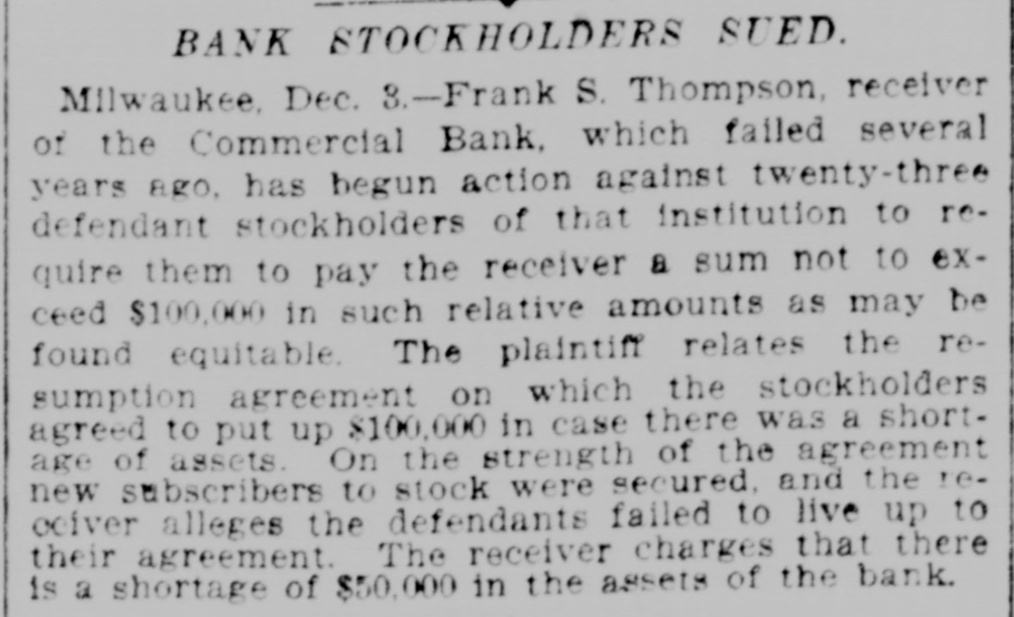
BANK STOCKHOLDERS SUED. Milwaukee Dec. 3.-Frank S. Thompson, receiver of the Commercial Bank, which failed several years ago, has begun action against twenty-three defendant stockholders of that institution to require them to pay the receiver a sum not to exceed $100,000 in such relative amounts as may be found equitable The plaintiff relates the resumption agreement on which the stockholders agreed to put up $100,000 in case there was a shortage of assets. On the strength of the agreement new subscribers to stock were secured and the 10ociver alleges the defendants failed to live up to their agreement. The receiver charges that there is a shortage of $50,000 in the assets of the bank


Article from The Sun, December 4, 1898

Click image to open full size in new tab

Article Text

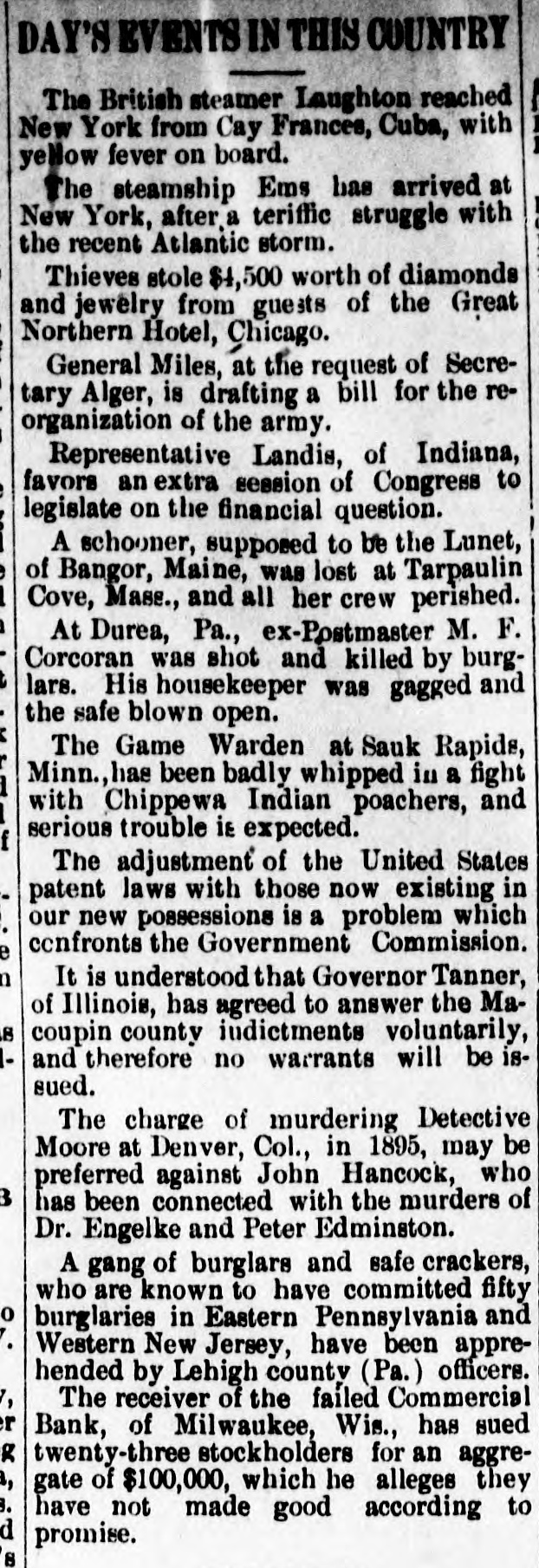
DAY'S EVENTS IN THIS COUNTRY The British steamer Laughton reached New York from Cay Frances, Cuba, with yeNow fever on board. The steamship Ems has arrived at New York, after a teriffic struggle with the recent Atlantic storm. Thieves stole $4,500 worth of diamonds and jewelry from guests of the Great Northern Hotel, Chicago. General Miles, at the request of Secretary Alger, is drafting a bill for the reorganization of the army. Representative Landis, of Indiana, favors an extra session of Congress to legislate on the financial question. A schooner, supposed to be the Lunet, of Bangor, Maine, was lost at Tarpaulin Cove, Mase., and all her crew perished. At Durea, Pa., ex-Postmaster M. F. Corcoran was shot and killed by burglars. His housekeeper was gagged and the safe blown open. The Game Warden at Sauk Rapids, Minn., has been badly whipped in a fight with Chippewa Indian poachers, and serious trouble is expected. The adjustment of the United States patent laws with those now existing in our new possessions is a problem which confronts the Government Commission. It is understood that Governor Tanner, of Illinois, has agreed to answer the Macoupin county indictments voluntarily, and therefore no warrants will be issued. The charge of murdering Detective Moore at Denver, Col., in 1895, may be preferred against John Hancock, who has been connected with the murders of Dr. Engelke and Peter Edminston. A gang of burglars and safe crackers, who are known to have committed fifty burglaries in Eastern Pennsylvania and Western New Jersey, have been apprehended by Lehigh countv (Pa.) officers. The receiver of the failed Commercial Bank, of Milwaukee, Wis., has sued twenty-three stockholders for an aggregate of $100,000, which he alleges they have not made good according to promise.


Article from The Bourbon News, December 6, 1898

Click image to open full size in new tab

Article Text

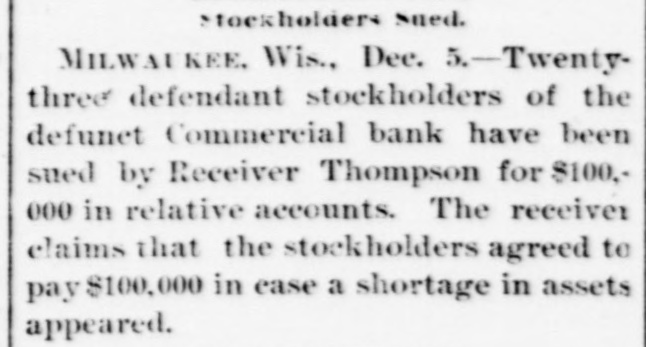
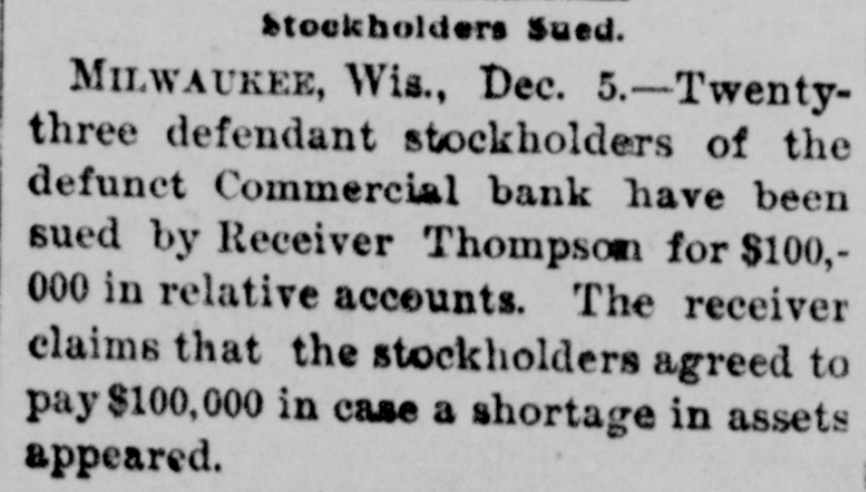
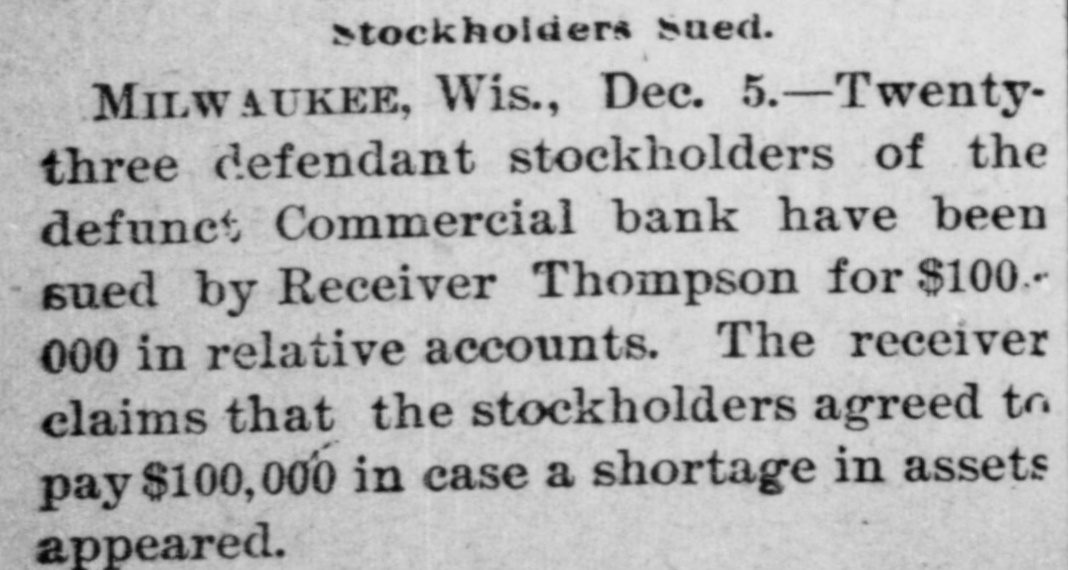
stockholders Sued. MILWAUKEE, Wis., Dec. 5.-Twentythree defendant stockholders of the defunct Commercial bank have been sued by Receiver Thompson for $100.000 in relative accounts. The receiver claims that the stockholders agreed tr. pay $100,000 in case a shortage in assets appeared.


Article from Owingsville Outlook, December 8, 1898

Click image to open full size in new tab

Article Text

stockholders sued. MILWAUKEE. Wis., Dec. 5.-Twentythree defendant stockholders of the defunet Commercial bank have been sued by Receiver Thompson for $100,000 in relative accounts. The receiver claims that the stockholders agreed to pay $100,000 in ease a shortage in assets appeared.


Article from The Big Stone Gap Post, December 8, 1898

Click image to open full size in new tab

Article Text

stockholders Sued. MILWAUKEE, Wis., Dec. 5.-Twentythree defendant stockholders of the defunct Commercial bank have been sued by Receiver Thompson for $100,000 in relative accounts. The receiver claims that the stockholders agreed to pay $100,000 in case a shortage in assets appeared.


Article from The Bourbon News, December 9, 1898

Click image to open full size in new tab

Article Text

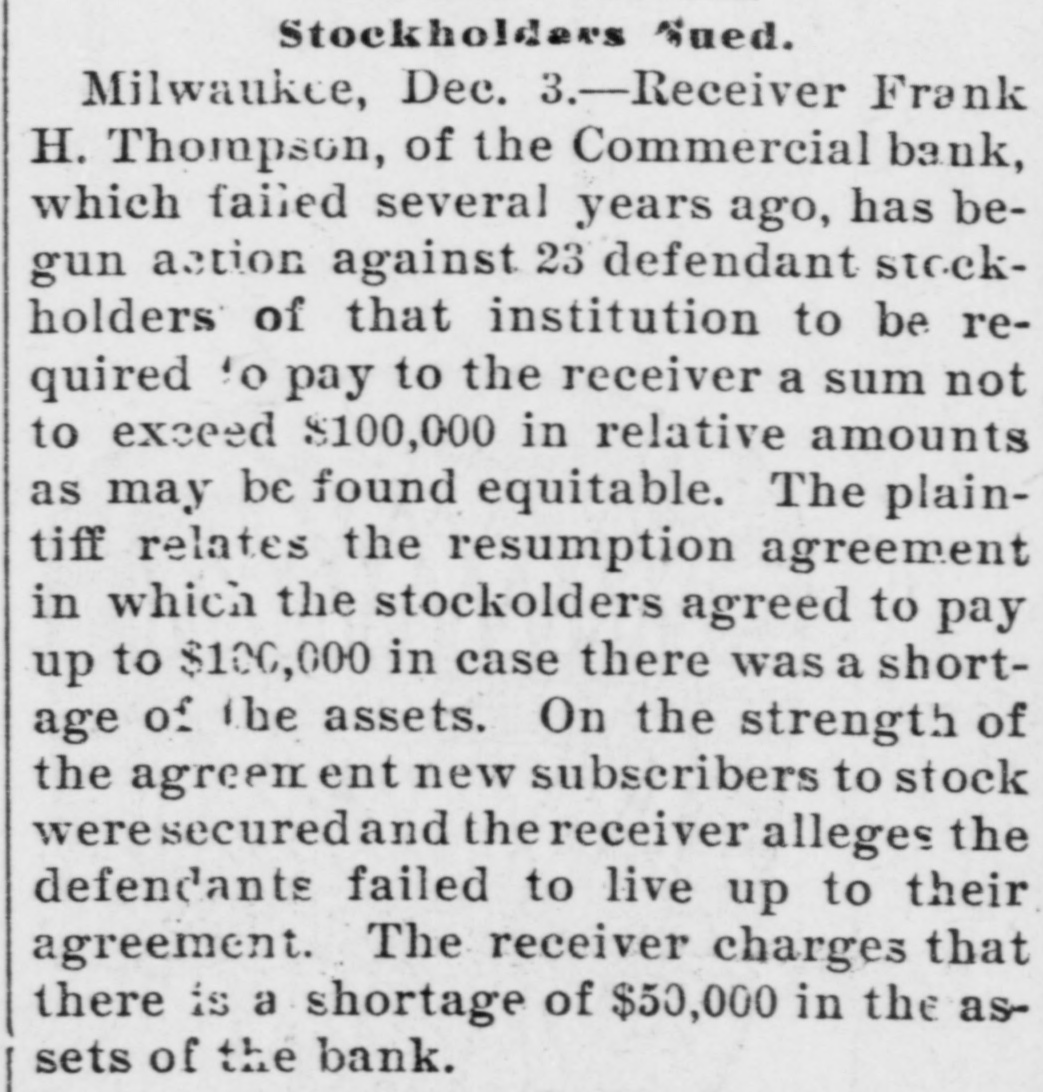
Stockholders ued. Milwaukee, Dec. 3.-Receiver Frank H. Thompson, of the Commercial bank, which failed several years ago, has begun action against 23 defendant stockholders of that institution to be required 10 pay to the receiver a sum not to exceed $100,000 in relative amounts as may be found equitable. The plaintiff relates the resumption agreement in which the stockolders agreed to pay up to $100,000 in case there was a shortage of the assets. On the strength of the agreement new subscribers to stock were secured and the receiver alleges the defendants failed to live up to their agreement. The receiver charges that there is a shortage of $50,000 in the assets of the bank.


Article from The Indianapolis Journal, November 16, 1899

Click image to open full size in new tab

Article Text

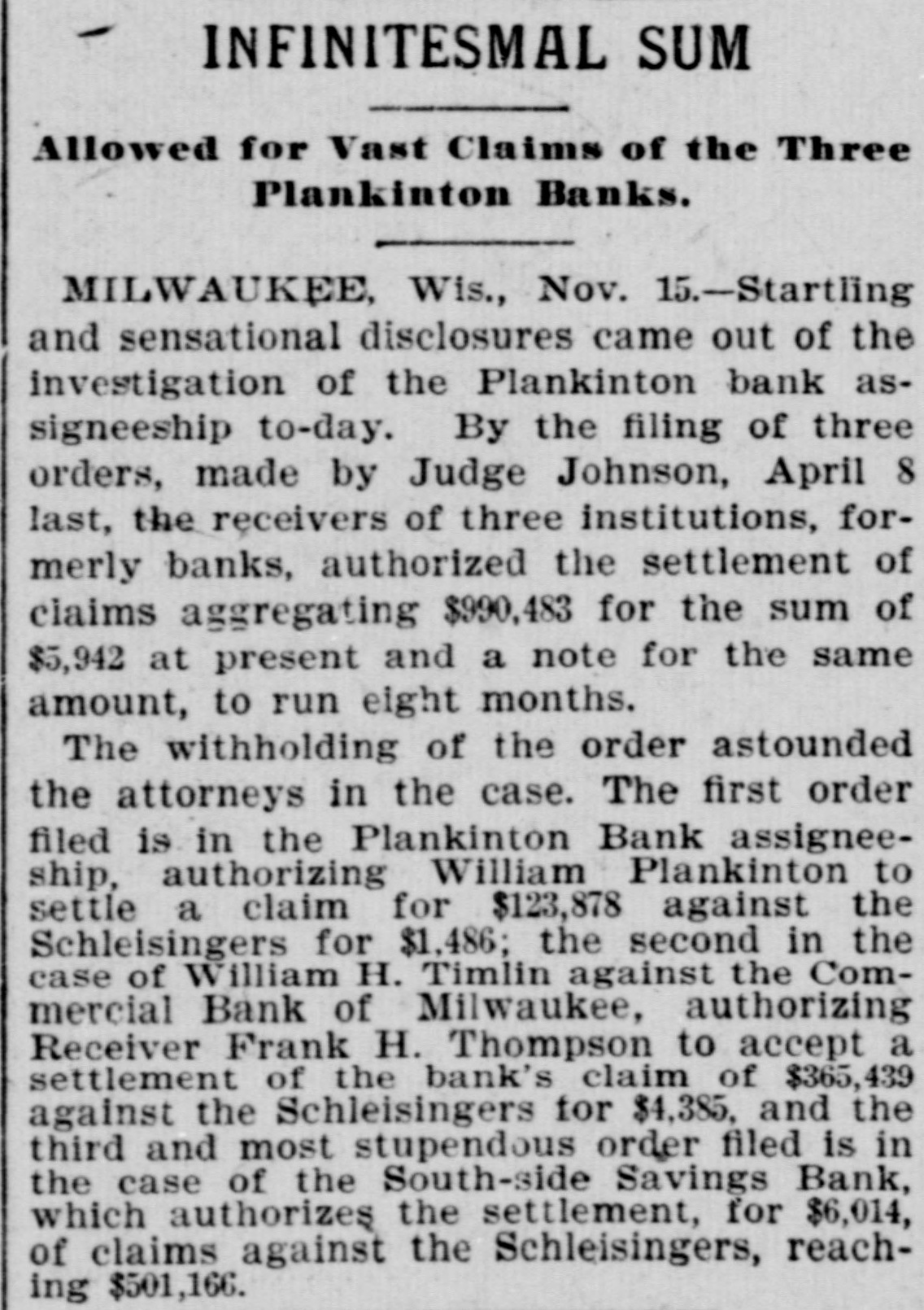
INFINITESMAL SUM Allowed for Vast Claims of the Three Plankinton Banks. MILWAUKEE, Wis., Nov. 15.-Startling and sensational disclosures came out of the investigation of the Plankinton bank assigneeship to-day. By the filing of three orders, made by Judge Johnson, April 8 last, the receivers of three institutions, formerly banks, authorized the settlement of claims aggregating $990,483 for the sum of $5,942 at present and a note for the same amount, to run eight months. The withholding of the order astounded the attorneys in the case. The first order filed is in the Plankinton Bank assigneeship, authorizing William Plankinton to settle a claim for $123,878 against the Schleisingers for $1,486; the second in the case of William H. Timlin against the Commercial Bank of Milwaukee, authorizing Receiver Frank H. Thompson to accept a settlement of the bank's claim of $365,439 against the Schleisingers for $4,385, and the third and most stupendous order filed is in the case of the South-side Savings Bank, which authorizes the settlement, for $6,014, of claims against the Schleisingers, reaching $501,166.


Article from The Princeton Union, November 16, 1899

Click image to open full size in new tab

Article Text

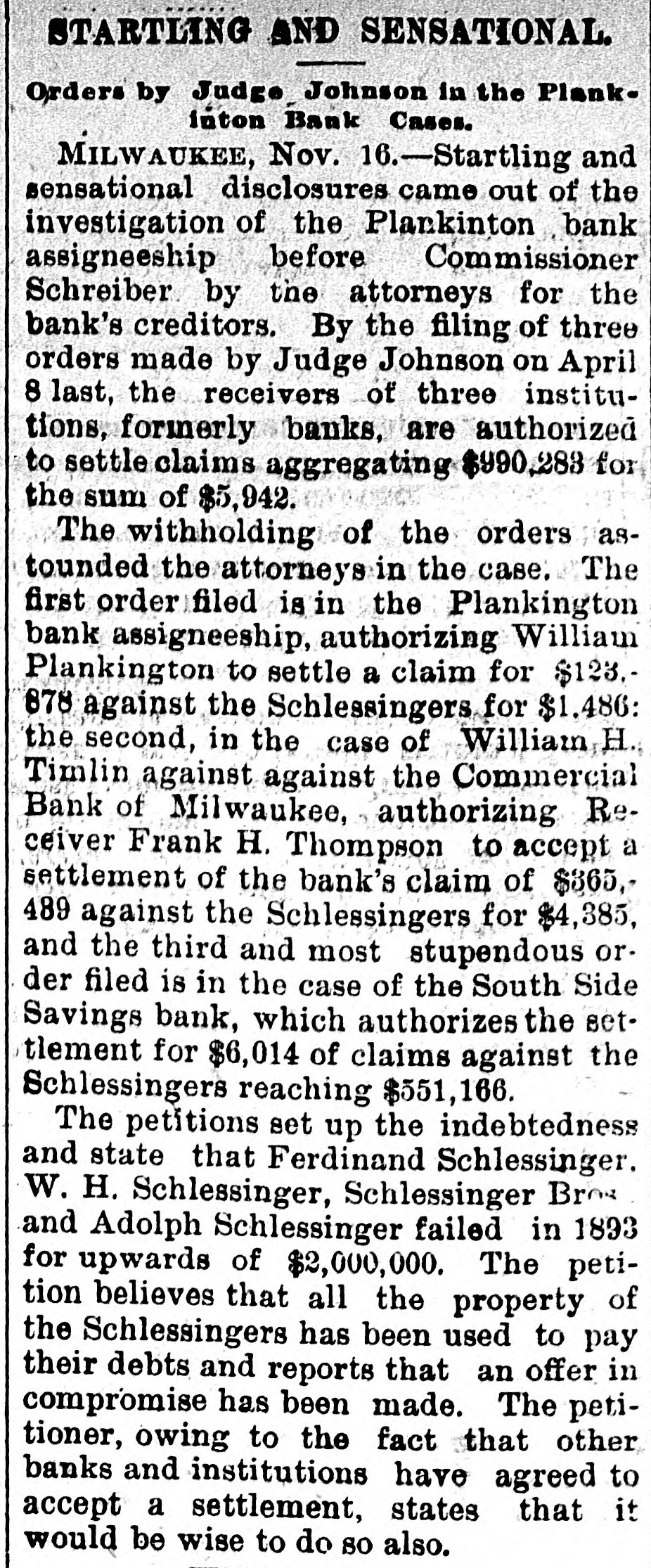
STARTLING AND SENSATIONAL. Orders by Judge Johnson in the Plankinton Bank Cases. MILWAUKEE, Nov. 16.-Startling and sensational disclosures came out of the investigation of the Plankinton bank assigneeship before Commissioner Schreiber by the attorneys for the bank's creditors. By the filing of three orders made by Judge Johnson on April 8 last, the receivers of three institutions, formerly banks, are authorized to settle claims aggregating $990,288 for the sum of $5,942. The withholding of the orders astounded the attorneys in the case. The first order filed is in the Plankington bank assigneeship, authorizing William Plankington to settle a claim for $123.878 against the Schlessingers for $1,486: the second, in the case of William H. Timlin against against the Commercial Bank of Milwaukee, authorizing Receiver Frank H. Thompson to accept a settlement of the bank's claim of $365,489 against the Schlessingers for $4,385, and the third and most stupendous order filed is in the case of the South Side Savings bank, which authorizes the settlement for $6,014 of claims against the Schlessingers reaching $551,166. The petitions set up the indebtedness and state that Ferdinand Schlessinger. W. H. Schlessinger, Schlessinger Bros and Adolph Schlessinger failed in 1893 for upwards of $2,000,000. The petition believes that all the property of the Schlessingers has been used to pay their debts and reports that an offer in compromise has been made. The petitioner, owing to the fact that other banks and institutions have agreed to accept a settlement, states that it would be wise to do so also.


Article from Virginian-Pilot, November 22, 1899

Click image to open full size in new tab

Article Text

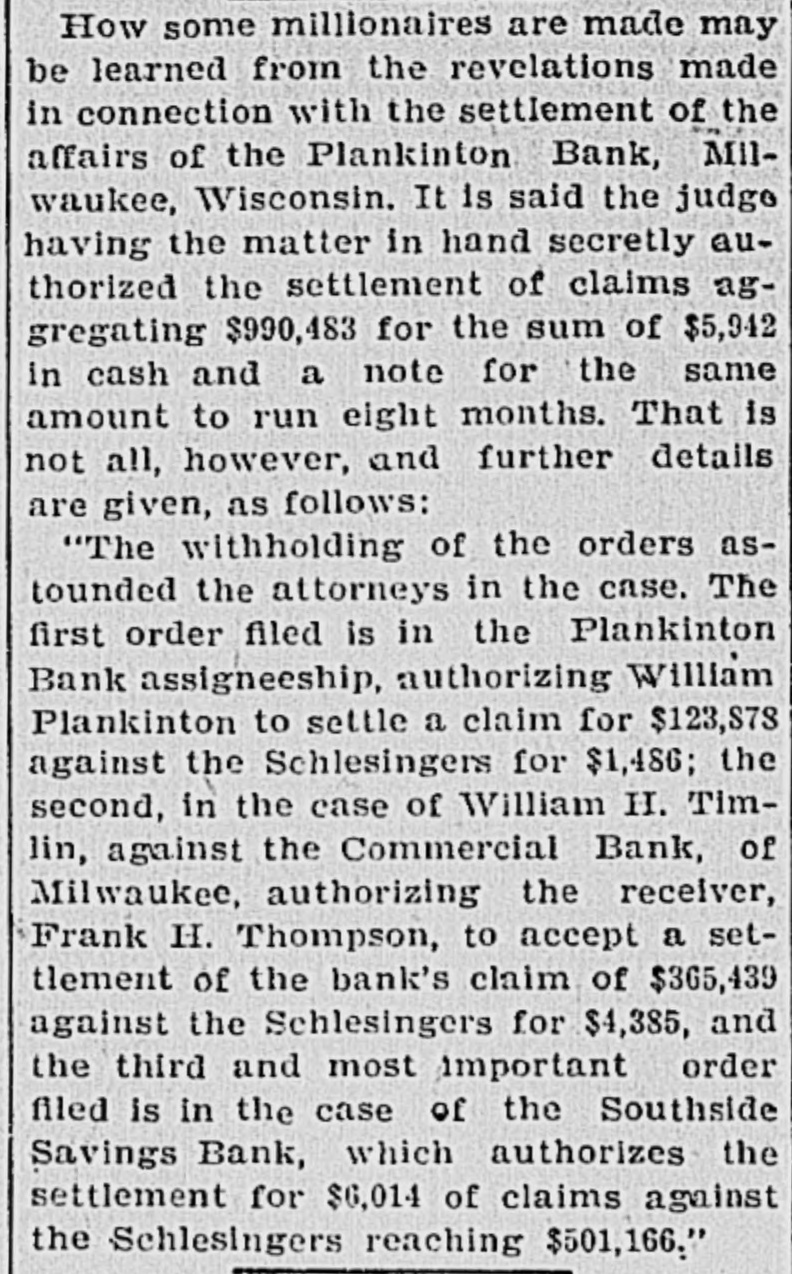
How some millionaires are made may be learned from the revelations made in connection with the settlement of the affairs of the Plankinton Bank, Milwaukee, Wisconsin. It is said the judge having the matter in hand secretly authorized the settlement of claims aggregating $990,483 for the sum of $5,942 in cash and a note for the same amount to run eight months. That is not all, however, and further details are given, as follows: "The withholding of the orders astounded the attorneys in the case. The first order filed is in the Plankinton Bank assigneeship, authorizing William Plankinton to settle a claim for $123,S78 against the Schlesingers for $1,486; the second, in the case of William H. Timlin, against the Commercial Bank, of Milwaukee, authorizing the receiver, Frank H. Thompson, to accept a settlement of the bank's claim of $365,439 against the Schlesingers for $4,385, and the third and most important order filed is in the case of the Southside Savings Bank, which authorizes the settlement for $6,014 of claims against the Schlesingers reaching $501,166."