1983. Fidelity Building & Loan Association (Washington, DC)

Bank Information

Episode Type
Suspension → Reopening
Bank Type
state
Start Date
July 18, 1936
Location
Washington, District of Columbia (38.895, -77.036)

Metadata

Model
gpt-5-mini
Short Digest
5c202d8e

Response Measures

None

Description

The Fidelity Building & Loan Association was closed by the Controller of the Currency on July 18, 1936 and placed in receivership. There is no mention of a depositor run; instead the institution was reorganized under federal supervision and its assets/claims were transferred to a newly chartered First Federal Savings & Loan Association which began operations in early March 1938. I classify this as a suspension (government action) with successful reopening under a new Federal savings & loan charter. Receiver names (James H. Nolan, earlier mentions of M. L. Barnett in article 1 appear as trustee secretary) are noted in articles.

Events (5)

1. July 18, 1936 Receivership
Newspaper Excerpt
the Fidelity Building & Loan Association was closed July 18 by the controller of the currency, whose receiver, James H. Nolan, now is in charge.
Source
newspapers
2. July 18, 1936 Suspension
Cause
Government Action
Cause Details
Closed by the Controller of the Currency; a receiver was appointed and the institution was taken into receivership under federal supervision.
Newspaper Excerpt
the Fidelity Building & Loan Association was closed July 18 by the controller of the currency.
Source
newspapers
3. March 5, 1937 Other
Newspaper Excerpt
conferences between experts of the office of the controller of the currency and the Federal Home Loan Bank Board on proposed reorganization of the Fidelity Building & Loan Association. ... proposal was for reopening the institution under reorganization as a new Federal savings and loan association.
Source
newspapers
4. March 21, 1937 Other
Newspaper Excerpt
Two Government agencies will push forward this week to set up the new First Federal Savings & Loan Association of Washington designed to take over the closed Fidelity Building & Loan Association and make available to the 18,000 Fidelity shareholders 85 per cent of their funds.
Source
newspapers
5. March 1, 1938 Reopening
Newspaper Excerpt
As plans were completed to open the new First Federal Savings and Loan Association next Tuesday morning, cards were dropped into the mail today notifying the first 500 shareholders of Fidelity ... The cards were mailed out by Receiver James H. Nolan to Fidelity shareholders asking them to come in for their 'dividend orders.'
Source
newspapers

Newspaper Articles (9)

Article from Evening Star, August 19, 1936

Click image to open full size in new tab

Article Text

FIDELITY BUILDING EX-TRUSTEES BID TOTALK REOPENING Shareholders Seek Joint Session to Clear Up Questions. FORMER HEADS OFFER REORGANIZATION PLAN Affiliation With Federal Home Loan Bank Board Urged. Loftus Silent. Representatives of the Fidelity Building & Loan Association sharewill holders today invite institution the former trustees of that defunct to a joint meeting to discuss the problem of reopening. Loftus, chairman of the Fidelity Shareholders' said Don A. Committee, sought "to the proposed meeting was clear up, if possible, some of the questions which have arisen" since the house was 18, banking closed, of the Currency July by order of Controller O'Connor. The trustees, through their secreMarcus Borchardt, are sponsoring tary, a reorganization plan the which Federal proposes affiliation with Home Loan Band Board. Loftus Refrains From Comment. Loftus. however, who held a meeting of his committee last night in his Hotel Washington room, refrained from comment on this proposal. He said: "The committee has not indorsed so public will it any print, plan nor appearing until far all in the facts are known." Action on the trustee plan is imuntil O'Connor's examiners have loan possible association's completed their books. digest of the Losses to date are estimated at "in excess of $200,000," with $13.000 allegedly misappropriated by Fred B. Rhodes, former president, who is free in $5,000 bail on a larceny charge. $200.000 insists inLoftus, figure however, and disputed the crashed the stitution is in fair condition. The purpose of last night's Shareto as holders' decide definitely Committee to meeting the first "was functions toward finding the true facts about the institution and its condition, and the reasons why any substantial losses could have been possible." True Facts Must Be Known. Before any conclusions as to further action can be drawn these "true facts" must be known. it is granted by Loftus, Borchardt. O'Connor and Receiver M. L. Barnett, jr. Loftus and his colleagues decided to request to this from committee Barnett "that the he turn over use of some of the unused office space and that he assume the cost of a stenographer or office help and telephone service so as to enable the committee to assist and relieve the receiver from undue requests by depositor-shareholders and borrowing shareholders for information which would require much of his valuable time from his much-needed duties." Present with Loftus at the threehour hotel room discussion were John C. Huntington, Fred M. Thring and G. C. Hanna. The fifth committee member, H. G. Cavanaugh, was absent on a vacation trip. The five were chosen Sunday by 500 of Fidelity's 18,000 shareholders at an afternoon session called by Loftus, who heads a real estate development on the outskirts of Alexandria, Va.

Article from Evening Star, December 31, 1936

Click image to open full size in new tab

Article Text

CLOSED BANKS PAY $2,399,900 IN Next Important Dividend Expected From FederalAmerican National. (By Cambridge Associates.) Six of the 21 closed banks of this city paid to depositors during 1936 a total of about $2,399,900, with prospects that the next important dividend will come some time early next year from the big Federal-American National Bank & Trust Co. No date has been definitely fixed for payment of the Federal-American dividend, nor has it been announced what the size of the dividend will be. The bank, which closed along with 12 other institutions in March, 1933, has paid so far one dividend of 50 per cent to depositors, amounting to $4.177.900. Cary A. Hardee is receiver. What will be forthcoming from any of the other closed banks in the form of dividends in 1937 cannot be estimated. Some others may pay; others no doubt will not pay any more during this new year. The total amount paid so far to depositors of all 21 closed banks of this city, according to a survey by The Star, is about $23,640,000. Fidelity Closed During Year. In addition to the 21 closed banks. which were being liquidated during the last year, the Fidelity Building & Loan Association was closed July 18 by the controller of the currency, whose receiver, James H. Nolan, now is in charge. About 3,000 members of the association have not yet filed their claims with the receiver. Preliminary survey of the institution by the Federal Home Loan Board has been made, but the way has not been cleared as yet for formal examination by the examining division of this board, looking for possible assistance from this quarter. The Fidelity had five branches. Details of the condition of the institution have not been disclosed by the Treasury Department. A decision is yet to be made as to whether it can be reorganized or will have to be liquidated. Among the six closed banks which made payments to depositors here last year the largest amount of money was disbursed by the District National Bank, of which Justus S. Wardell is receiver. This bank paid an additional dividend of 25 per cent, amounting to about $1,000,000. This brings total District National Bank dividends up to 75 per cent, with total payments of about $2,937,100. Bank Pays 100 Per Cent. The Chevy Chase Savings Bank paid during the year its final dividend of 20 per cent to depositors, amounting to about $133,000, bringing the total to 100 per cent, or about $678,388. Paul Sleeman has been elected stockholders' agent, and, as soon as his appointment can be officially approved by the Treasury Department, will take over from Receiver Hardee remaining assets for liquidation for stockholders, who advanced sufficient funds to pay off depositors in full. The Commercial National Bank, Robert C. Baldwin receiver, paid a dividend of 10 per cent this year, amounting to about $500,000, bringing total payments from this institution to 60 per cent, or about $3,364,110. The Franklin National Bank paid two dividends during the past year through the Franklin Liquidating Trust, of which Samuel M. Thrift is secretary The two dividends amounted to 50 per cent of the amount due depositors, which was 17 1/2 per cent of their original deposits, or about $500.000. This brings the total payments to Franklin depositors up to 821/2 per cent, amounting to about $2,500,000. The Northeast Savings Bank paid a dividend of 10 per cent in 1936, through Receiver Wardell, amounting to about $106,000, bringing the total dividends up to 95 per cent, amounting to about $1,010,000. The United States Savings Bank. under Receiver Carter B. Keene, paid last year a dividend of 10 per cent, amounting to $160,900, bringing dividends up to 90 per cent in this institution, with total payments of about $1,448,260. Three Receiverships Combined. The United States Savings Bank receivership has been consolidated with two other banks, the Bank of Brightwood, of which Claude H. Woodward was recever, and the International Exchange Bank, of which Frederick J. Young has been in charge. Young takes over the consolidated receivership and plans to move all the effects of the other banks to the United States Savings location at Fourteenth and U streets, The Bank of Brightwood has paid a total of 55 per cent, amounting to $437,042, and the International Exchange Bank has paid dividends of 31.23 per cent, amounting to $115,187. The Mount Vernon Savings Bank's remaining assets are in the hands of the Mount Vernon Liquidating Trust.


Article from Evening Star, March 5, 1937

Click image to open full size in new tab

Article Text

FIDELITY'S FATE BEING CONSIDERED Experts of Controller's Office and F. H. A. Study Voluminous Report. Conferences got under way today between experts of the office of the controller of the currency and the Federal Home Loan Bank Board on proposed reorganization of the Fidelity Building & Loan Association. The conferees had before them a voluminou report, with recommendations, Survetted yesterday by the Home Loan Board. Details were not disclosed, but it was understood the proposal was for reopening the institution under reorganization as a new Federal savings and loan association. Length of Time Uncertain. There was no indication as to how long it would take the conferences to work out a solution to the problem. In an official statement late yesterday the controller's office said conferences between experts would get under way "for the purpose of working out the many details incident to the development of the suggestions contained in the report of the Federal Home Loan Bank Board. "As soon as a decision is reached as to whether or not a reorganization of the Fidelity Building & Loan Association is feasible," the statement continued, "further announcement will be made by the office of the controller of the currency." Dual Jurisdiction. While the problem is in the hands of both agencies, it rests under a sort of dual jurisdiction. So far, however, authority over the institution is with the controller of the currency, whose receiver is in charge. The controller still has the power of rejection of the plan, under law, because he is charged with examination and supervision of banks and building and loan associations in the District. If it should be decided to reopen the Fidelity, there would be a "writedown" with all members of the association taking a proportionate loss. They could then either get cash or reinvest in the new institution. The proportion of the estimated "writedown" or loss, has not been disclosed.


Article from Evening Star, March 9, 1937

Click image to open full size in new tab

Article Text

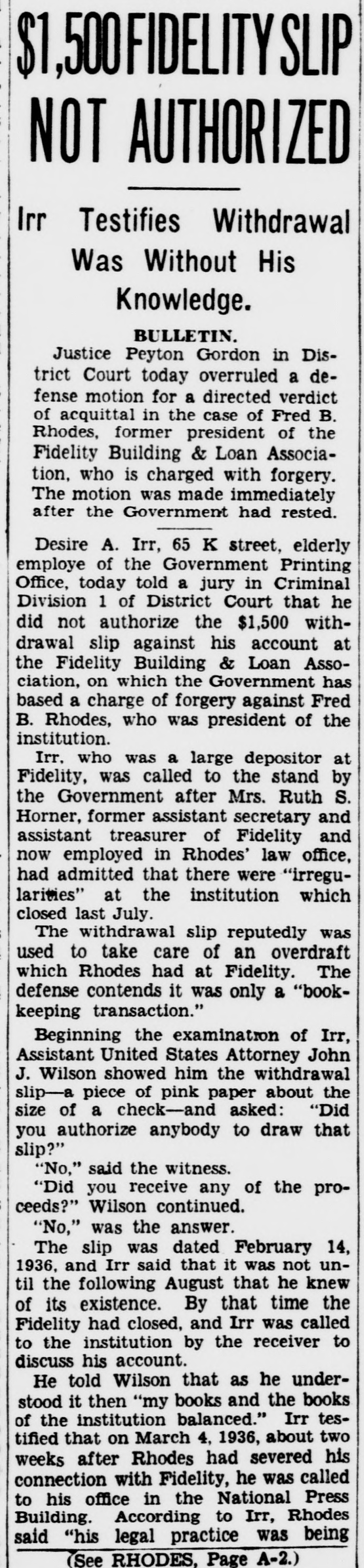
1,500FIDELITY SLIP NOT AUTHORIZED Irr Testifies Withdrawal Was Without His Knowledge. BULLETIN. Justice Peyton Gordon in District Court today overruled a defense motion for a directed verdict of acquittal in the case of Fred B. Rhodes, former president of the Fidelity Building & Loan Association, who is charged with forgery. The motion was made immediately after the Government had rested. Desire A. Irr, 65 K street, elderly employe of the Government Printing Office, today told a jury in Criminal Division 1 of District Court that he did not authorize the $1,500 withdrawal slip against his account at the Fidelity Building & Loan Association, on which the Government has based a charge of forgery against Fred B. Rhodes, who was president of the institution. Irr. who was a large depositor at Fidelity, was called to the stand by the Government after Mrs. Ruth S. Horner, former assistant secretary and assistant treasurer of Fidelity and now employed in Rhodes' law office, had admitted that there were "irregularities" at the institution which closed last July. The withdrawal slip reputedly was used to take care of an overdraft which Rhodes had at Fidelity. The defense contends it was only a "bookkeeping transaction." Beginning the examination of Irr, Assistant United States Attorney John J. Wilson showed him the withdrawal slip-a piece of pink paper about the size of a check-and asked: "Did you authorize anybody to draw that slip?" "No," said the witness. "Did you receive any of the proceeds?" Wilson continued. "No," was the answer. The slip was dated February 14, 1936, and Irr said that it was not until the following August that he knew of its existence. By that time the Fidelity had closed, and Irr was called to the institution by the receiver to discuss his account. He told Wilson that as he understood it then "my books and the books of the institution balanced." Irr testified that on March 4, 1936, about two weeks after Rhodes had severed his connection with Fidelity, he was called to his office in the National Press Building. According to Irr, Rhodes said "his legal practice was being (See RHODES, Page A-2.)


Article from Evening Star, March 21, 1937

Click image to open full size in new tab

Article Text

ORGANIZING WORK ON NEW FIDELITY WILL BE PRESSED Federal Home Loan Bank Board Members and Controller Confer. 3,000 SHAREHOLDERS MUST "PROVE CLAIMS" Rush Expected to Put Group in Position to Receive Expected Benefits. BY HAROLD B. ROGERS Two Government agencies will push forward this week to set up the new First Federal Savings & Loan Association of Washington designed to take over the closed Fidelity Building & Loan Association and make available to the 18,000 Fidelity shareholders 85 per cent of their funds. This developed last night as staff members of the Federal Home Loan Bank Board and the office of the controller of the Treasury conferred on steps to be taken tomorrow. Meantime. it was learned that more than 3,000 of the 18,000 shareholders have not yet "proven their claims with the receiver of the institution, and will have no rights to the prospective 85 per cent until they file such claims Announcement yesterday that the new association is to be set up is expected to result in a rush of these dilatory shareholders tomorrow morning to file their claims and prepare to receive the benefits of the new organization. The proposed plan was explained briefly in an official statement made public by William Prentiss, jr., acting controller of the currency. His assistants are expected to confer tomorrow morning with F. H L. B.B aides on plans for carrying out the proposal. Agreement Explained Prentiss explained that agreement had been reached between his office and the Home Loan Bank Board on plan "by which the affairs of the Fidelity Building and Loan Association will be wound up and a Federal Savings and Loan Association will be organized to take over its assets "The plan.' Prentiss said, "provides for the sale of the assets of the Fidelity Building and Loan Association by the receiver thereof to the Federal Savings and Loan Association, subject to court approval as required by statute. Under the plan. present shareholders of the Fidelity Building and Loan Association will receive share certificates in the Federal Savings and Loan Association on the basis of 85 per cent of their Fidelity holdings "These new shares may be converted into cash, in whole or in part, or they may be left with the new association for investment, at the option of the holder, and if so left the shares will be insured up to $5,000 by the Federal Savings and Loan Insurance Corp. "Some time will be required for completion of the details incident to putting the plan into effect, but the facilities of both the office of the controller of the currency and of the Federal Home Loan Bank Board will be utilized to the utmost to expedite the completion of the plan and the submission of the same to the court for approval at the earliest posaible date Ample Funds to Be Available. While ample funds will be available under the plan for all who desire to withdraw. it is believed by those familiar with setting up such institutions that the majority of the shareholders will leave their investments in the new institution, which is to be set up along entirely different lines from the old one. The new Federal Savings and Loan Association will become a part of the Federal Home Loan Bank Svstem and become a member of the Federal Home Loan Bank of WinstonSalem, N. C., which is of the 12 regional banks of the system. The new association will have a substantial amount of cash with which to start and will be able also to borrow from the Winston-Salem bank on the mortgages it holds. In addition to this, as the need for home financing develops here, the new Federal association will be able to obtain reasonable funds from the Home Owners Loan Corp. by sale of shares in the local The H O.L. C could subscribe for three times as much as is subscribed here, but it could not vote more than 50 shares in the control of the institution. Thus local control is assured. Assets' Liquidating Value. The assets in the hands of the receiver, James H. Nolan. are understood to have a "liquidating" value which would be considerably less than the 85 per cent offered in setting up the new institution. But under the new Federal Savings and Loan Association, a going concern, it is estimated that these assets do have an intrinsic value of 85 per cent of their book value. In estimates as to the size of the new institution in dollars and cents . (See FIDELITY, Page B-3.)


Article from Evening Star, April 15, 1937

Click image to open full size in new tab

Article Text

A jury of nine men and three women today began hearing the second forgery trial to Fred B. Rhodes, former president of the now closed Fidelity Building & Loan Association. Selection of the jurors proceeded slowly, the defense particularly exercising challenges, and nearly an hour and a half was consumed before the 12 finally were chosen and sworn. Rhodes, 61, is charged with forging a $1,500 withdrawal slip against the account of Desire A. Irr, elderly Government Printing Office employe of 65 K street, who was a large depositor at Fidelity. This is one of eight counts alleging forgery on which Rhodes was indicted. He also faces 20 counts alleging larceny. New. Witnesses Named. In opening the case before Justice Peyton Gordon in Criminal Division No. 1 of District Court, Assistant United States Attorney John J. Wilson announced the names of a number of possible witnesses who did not appear at the first trial a month ago, when the jury dealocked. Among these is S. F. Pickering of the Federal Bureau of Investigation. After selection of the jury, Assistant United States Attorney Howard Boyd, who is aiding Wilson in the prosecution, began outlining the case to the jury. After Boyd had gone into the involved series of transactions in which the withdrawal slip figured, William E. Leahy, chief defense counsel, making his opening statement, told the jury: "Mr. Rhodes never got a 5-cent piece out of that transaction." Necessity of Action. Wilson objected as Leahy placed the foundation of Fidelity in 1929 and told of Rhodes' connection with it, declaring this irrelevant. Justice Gordon, however, allowed him to proceed. Leahy then set up the defense contention that whatever was done was necessary to keep the association going in the face of opposition by the controller of the currency. Mrs. Ruth S. Horner, former assistant secretary and assistant treasurer of Fidelity, who is now employed in Rhodes' law office. was called as the first Government witness, and repeated her previous testimony that the withdrawal slip was prepared by Rhodes to cover an overdraft on the company's books. Rhodes was indicted after the Fidelity closed last July 18. In the first trial Rhodes testified that a the Irr withdrawal slip figured in series of involved transactions necessary to keep Fidelity going in the face of a fight by the controller of the Treasury. He felt thta Irr's resources were at his command, he said, because of the latter's offer to aid in the dispute with the controller's office. which was pictured as trying to close the building association. Repudiated on Stand. Irr, on the stand, repudiated any understanding of the sort. Leahy and William J. Hughes, jr., who conducted the defense at the first trial, have been joined by William E. Richardson for the second. The Fidelity now is being reorganised by the Government.


Article from Evening Star, September 14, 1937

Click image to open full size in new tab

Article Text

EXPERTS DESCRIBE NEW FIDELITY PLAN Two Loan Board Aides Explain Association's Operations to Shareholders. Experts of the Federal Home Loan Bank Board have been stationed at the closed Fidelity Building & Loan Association, 610 Thirteenth street, to explain to shareholders the operations of the new First Federal Savings & Loan Association, proposed to succeed Fidelity. Frank Sweigart and Verne Vonesteel, two of the board experts, were taking turns at the Fidelity office yesterday explaining the workings of a savings and loan association to inquiring shareholders. The new First Federal has been chartered by the Federal Home Loan Bank Board to do business in th District and is a member of the Winston-Salem Home Loan Bank, the bank for this area of the Federal Home Loan Bank System. Shareholders of Fidelity are responding in increasing numbers to the proposal to reorganize Fidelity into the new First Federal, according to James H. Nolan, Fidelity receiver. More mail was received yesterday morning from Fidelity shareholders than at any time since the official offer was mailed out by the receiver last week. Shareholders also are coming into the office in person to make inquiries about the operation of a sayings and loan association and to sign for purchase of shares.


Article from Evening Star, February 26, 1938

Click image to open full size in new tab

Article Text

FIDELITY MAILS DIVIDEND ORDERS New Federal Savings and Loan Association to Open Next Tuesday. As plans were completed to open the new. First Federal Savings & Loan Association next Tuesday morning, cards were dropped into the mail today notifying the first 500 shareholders of Fidelity Building & Loan Association to call Tuesday for their "first and final dividend." The cards were mailed out by Receiver James H. Nolan to Fidelity shareholders asking them to come in for their "dividend orders." When the shareholders get their dividend orders, amounting to 85 per cent of their Fidelity holdings, they may present them to the officials of the First Federal Savings & Loan Association, in the same room. To Transfer Holdings. Already a majority of shareholders have made arrangements to transfer their old holdings into shares in the First Federal. For those who wish cash, however, their 85 per cent, or any part of it, will be available. The cards to be sent out by Receiver Nolan will be mailed at the rate of 500 a day until all shareholders have been notified. This is for the purpose of staggering on different the shareholders, days more so than that 15,000 all would Fidelity not attempt to come in at once. This procedure has been used for years in notifying depositors of closed banks to call for their dividends. Executive Manager Ready. Carl H. Ellingson, executive manager of the First Federal, is ready with his staff to open the new institution. The First Federal Building, formerly owned by Fidelity, is at 610 Thirteenth street N.W. Claims against Fidelity amount to about $3,743,000, according to Controller of the Currency J. F. T. O'Connor, who late yesterday made public plans for paying the "first and final dividend."


Article from Evening Star, April 11, 1938

Click image to open full size in new tab

Article Text

LOAN FIRM CLEARS FIDELITY ACCOUNTS First Federal Association Also Reports Lively Home Loan Demand. By EDWARD C. STONE. The new First Federal Savings & Loan Association has closed new loans on homes to the amount of $54,600 within the past few days, Carl H. Ellingson. executive manager, announced today. The new loans were on properties located in the Northwestern district, in and were andria, Chevy Chase, Arlington for home and purchase Alexand and improvement consolidation and of the existing refinancing trusts. Sales of its own real estate by the association last week amounted to $25,750. including two cash transactions totaling $19,750. In its first five weeks of operation, the association completed over twothirds of its task of clearing accounts taken over from the receiver of the closed Fidelity Building & Loan Association, Mr. Ellingson announced. So far over 10,000 of the shareholders' accounts have been transferred, he said. Out-of-town investors in the old organization are receiving at their option cash or share accounts in the new association through the mails. Approximately $3,000,000 in receiver's orders has been cleared since March 1, about 70 per cent being reinvested in the new association. Practically all the proven claims against the closed Fidelity will have been cleared by April 20, the manager predicts. Bank Paying Final Dividend. The United States Savings Bank, at Fourteenth and U streets N.W. had made a fine start today in payment of the final 10 per cent dividend to depositors. The money is going to 8,500 depositors who have already received 90 per cent of the funds due them since the bank closed five years ago. Receiver Frederick J. Young is sending out 500 postal cards a day notifying 10 the cent former payment depositors is awaiting that them the per at the bank. The cards must be presented when the former patrons call at the bank. The disbursement will total $170,000. The original claims totaled $1,619,000. The present payment will place the United States Savings Bank in the 100 per cent class. Depositors are more than pleased that they are to be paid in full after such a long wait. The receiver will continue his work as there are still some further assets to be adjusted. Officials say there is a possibility that later the depositors may be paid 6 per cent interest which the law allows during the period of receivership when their funds were tied up. Such action would be most welcome. March Trade Off 14 Per Cent. Department store sales in March in the fifth Federal Reserve district, which includes Washington, were 14 per cent lower than in March, 1937. the Federal Reserve Board announced today. This was exactly the same as the national decrease. For the first quarter sales were down 6 per cent in this territory against 9 per cent in the whole country. The Reserve governors state that the drop in sales reflects in part the fact that Easter is three weeks later this year than in 1937. It is estimated that an allowance of about 7 per cent from a year ago should be made on this account. That would bring the fifth district figure from 14 down to 7 per cent. The percentage changes in March and the three months in all the Reserve districts follow: 3 Mar mths Strs Cities ULS total 14