Click image to open full size in new tab
Article Text
Jupposed, coupled with the admission by
Albert F. Davis, president of the corpor-
stion, that he does not know whether the
proceeds of the sale of these securities
were turned into the treasury. The other
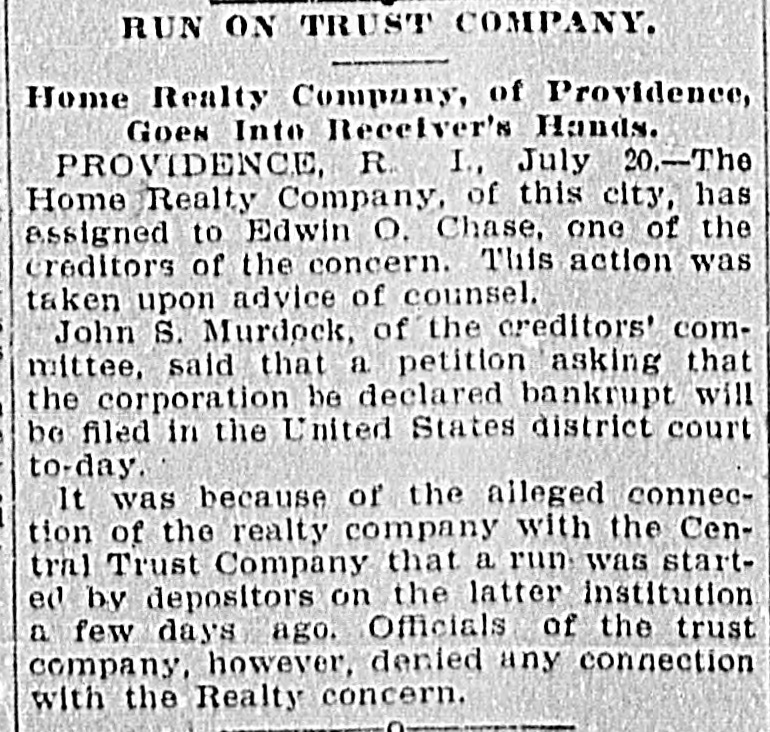
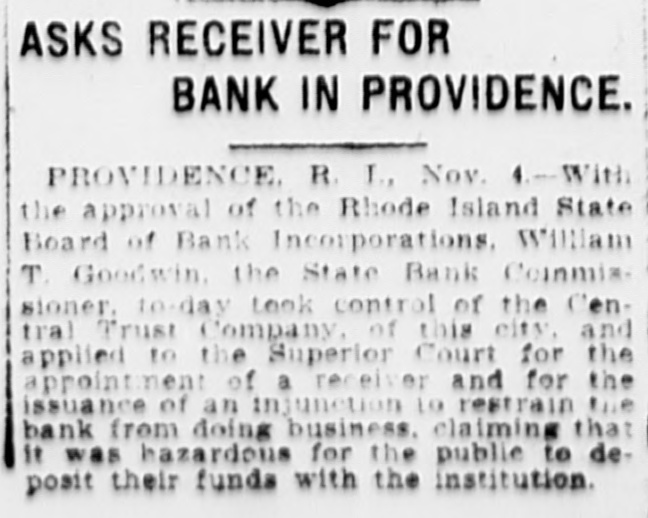
was an Incipient run upon the Central
Frust company, of which Col. Goff was
until recently president, resulting in en-
forcement of the rule which requires a
notice of 90 days before withdrawal of
leposits.
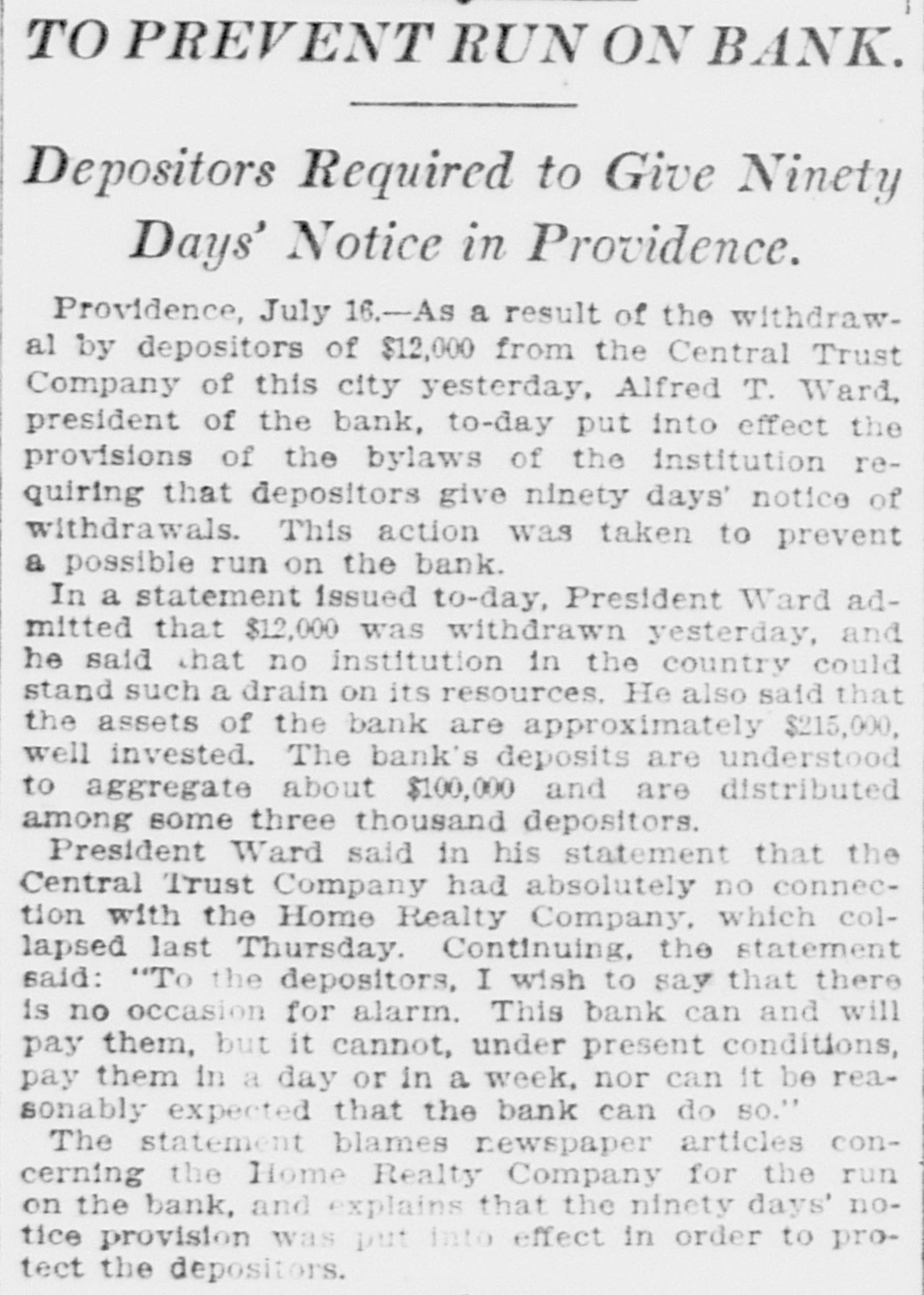
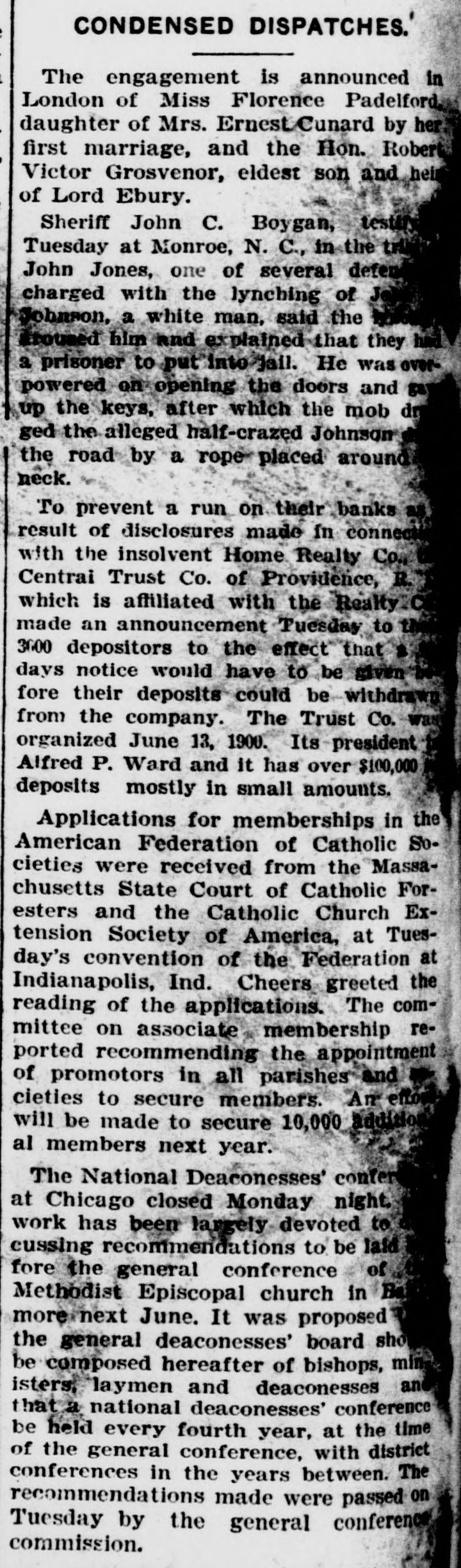
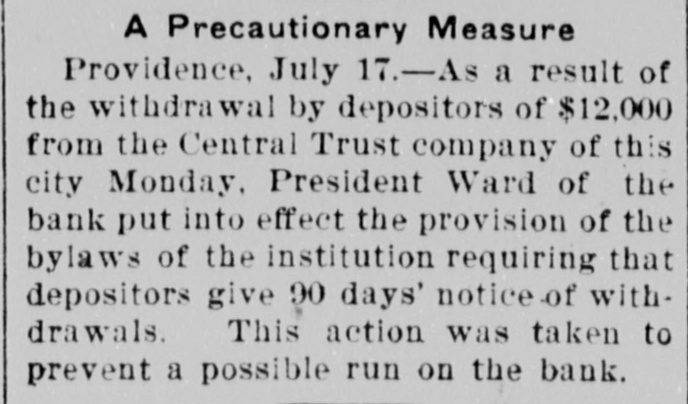
On Monday more than $11,000 was drawn
put by depositors of the Central Trust
company.
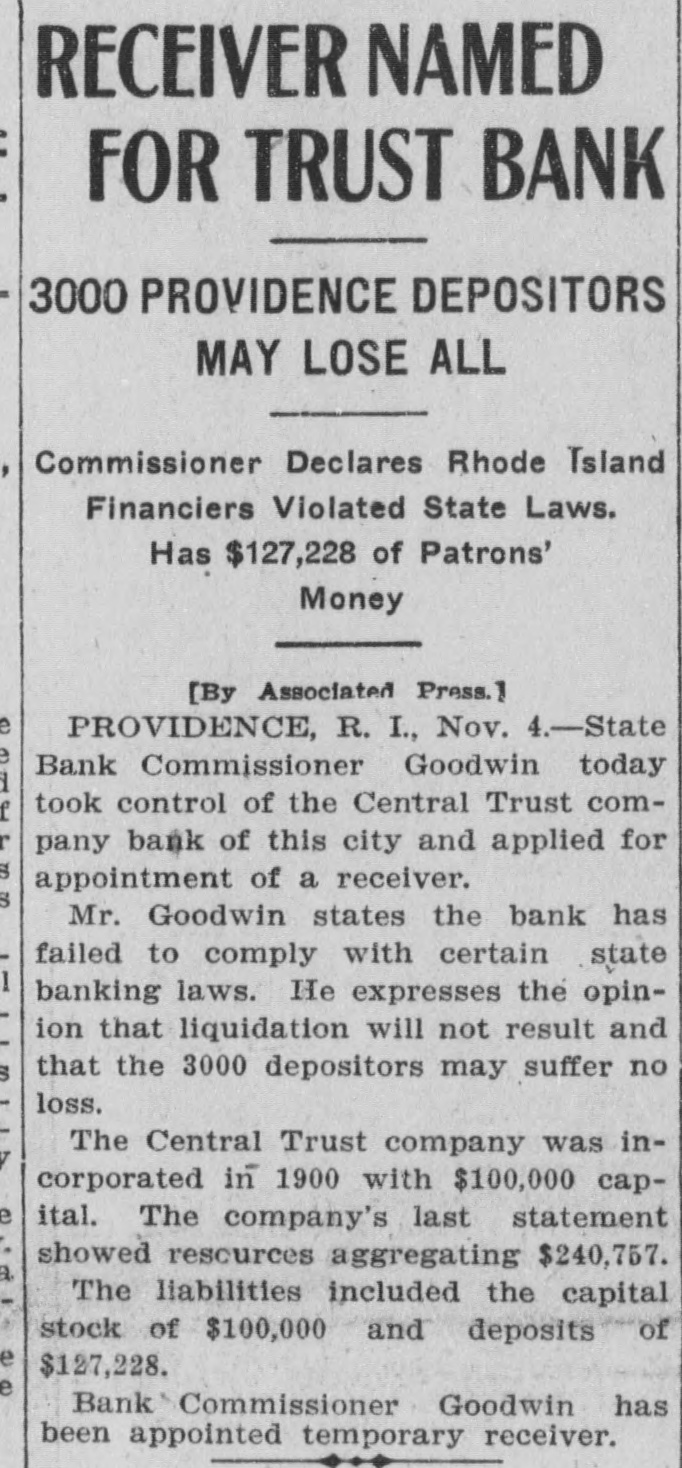
It also was discovered that in its last
statement the Central Trust company had
Included among its assets 2575 shares of
the capital stock of the Commercial Cor-
poration, which is scheduled at $25,750, the
main security of which is said to be
$48,000 worth of the bonds of the Home
Realty company.
### DEVELOPMENTS SUMMARIZED.
Developments of the past few days may
be summarized to date as follows:
That the assertion made by counsel for
the corporation that no incumbrances had
been placed on any of its properties since
the early spring is incorrect. Two tracts
of land have been mortgaged to pay debts
of the company, nearly $10,000 having thus
been realized.
That $32,000, which had been placed in
the hands of Col. Isaac L. Goff for in-
vestment by Harriet P. Gladding, now
deceased, and which was originally placed
on first mortgages, has been converted
Into shares of the Home Realty company,
which are believed to have no value.
The $5000 of insurance realized through
the death of Arthur Marchant, which oc-
curred on April 1. the policy having been
written in the office of Isaac L. Goff &
Co., has been converted into bonds of the
Home Realty company through the ef-
forts of A. A. Normandin from the office
of Isaac L. Goff & Co., and Everett A.
Dunham, who is said to be the president
of the Commercial Corporation, one of
the companies in which Col. Goff is inter-
ested. The bonds are not secured.
That Col. Isaac L. Goff and Everett A.
Dunham induced a French Catholic priest
to purchase $5000 worth of the same
bonds, representing, as the priest asserts,
that the properties of the Home Realty
company were free from incumbrances,
and that funds were needed for immedi-
ate building operations, which would en-
hance the property and bring quick and
large profits to the investor.
That a widow who deposited $500
with the Home Realty company, to be
applied to the payment of her con-
tract for a home, was induced to do
so by Col. Isaac L. Goff and that the
same has not, to her knowledge, been
applied to the reduction of the mort-
gage upon her home, but is, she fears,
to figure in the claim against the
Home Realty company.
### THAT BOND ISSUE.
That instead of $50,000 worth of the
bonds of the Home Realty company
having been issued, there has been
another and a supplemental "special"
issue of $50,000, and the president of
the Home Realty company does not
know that the money realized from the
sale of these bonds went into the
treasury of the Home Realty com-
pany.
That nearly $50,000 worth of these
bonds were or are in the possession of
the Commercial corporation, of which
Everett A. Dunham is said to be the
president.
That Everett A. Dunham has so-
licited purchasers of Home Realty
bonds to convert the same into shares
of stock in the Commercial corpora-
tion, the value of said shares being
speculative.
That various members of the Cath-
olic clergy have been solicited to pur-
chase Home Realty bonds, Col. Isaac L.
Goff personally interviewing the pros-
pective clients.
That because of the unrest осса-
sioned among the depositors in the
Central Trust company, of which Col.
Isaac L. Goff was until recently the
president, and because of the business
relations that corporation had with
the Home Realty company, a run was
begun which caused the Central Trust
company to suspend payments yester-
day and to require a 90-day notice
from those desiring to withdraw ac-
counts.
That among the assets of the Central
Trust company is an item of "loans
and discounts," $21,158.16," which is
made up in part, so President Ward
says, "of the notes which priests have
given, and are therefore good."
That, while President Ward assert-
ed that the depositors of the Central
Trust company should feel no uneasi-
ness about their money, as the only
obligation which the company has of
the Home Realty company was $190,
the balance of a note, which is amply
secured, by its last statement to the
bank examiner of this state is held
2575 shares of the stock of the Com-
mercial company, valued at $25,750,
the latter-named company having at
least $48,000 worth of the "unsecured"
bonds of the Home Realty company,
according to the representation which
Everett A. Dunham made before the
creditors' meeting last Thursday.
### CENTRAL TRUST COMPANY.
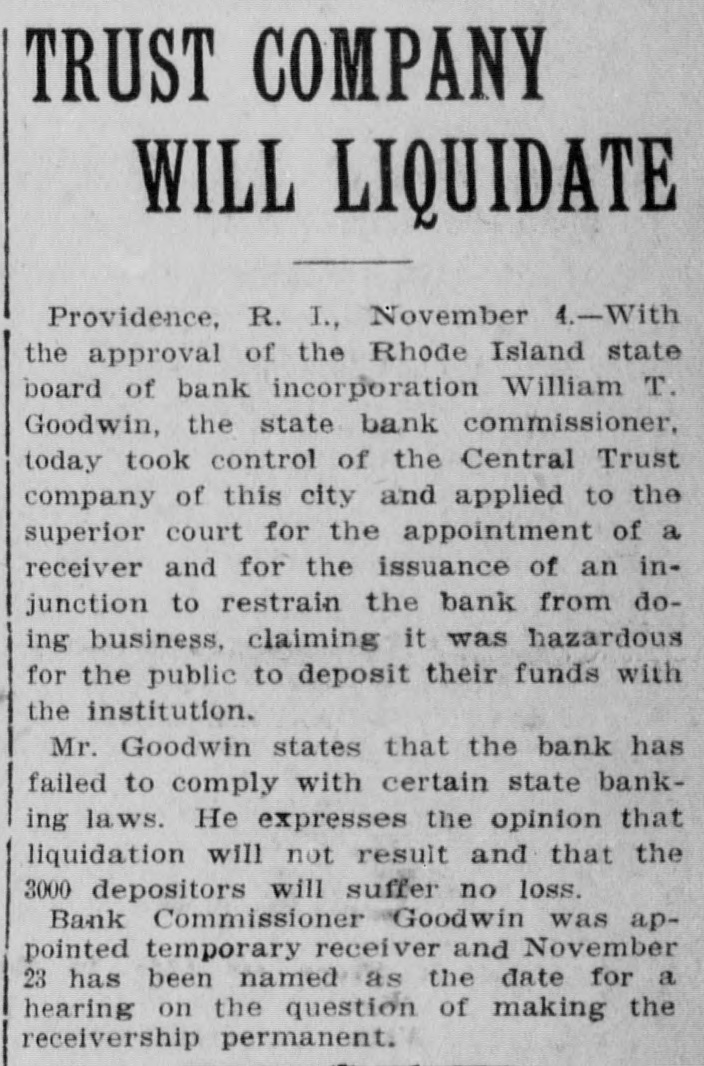
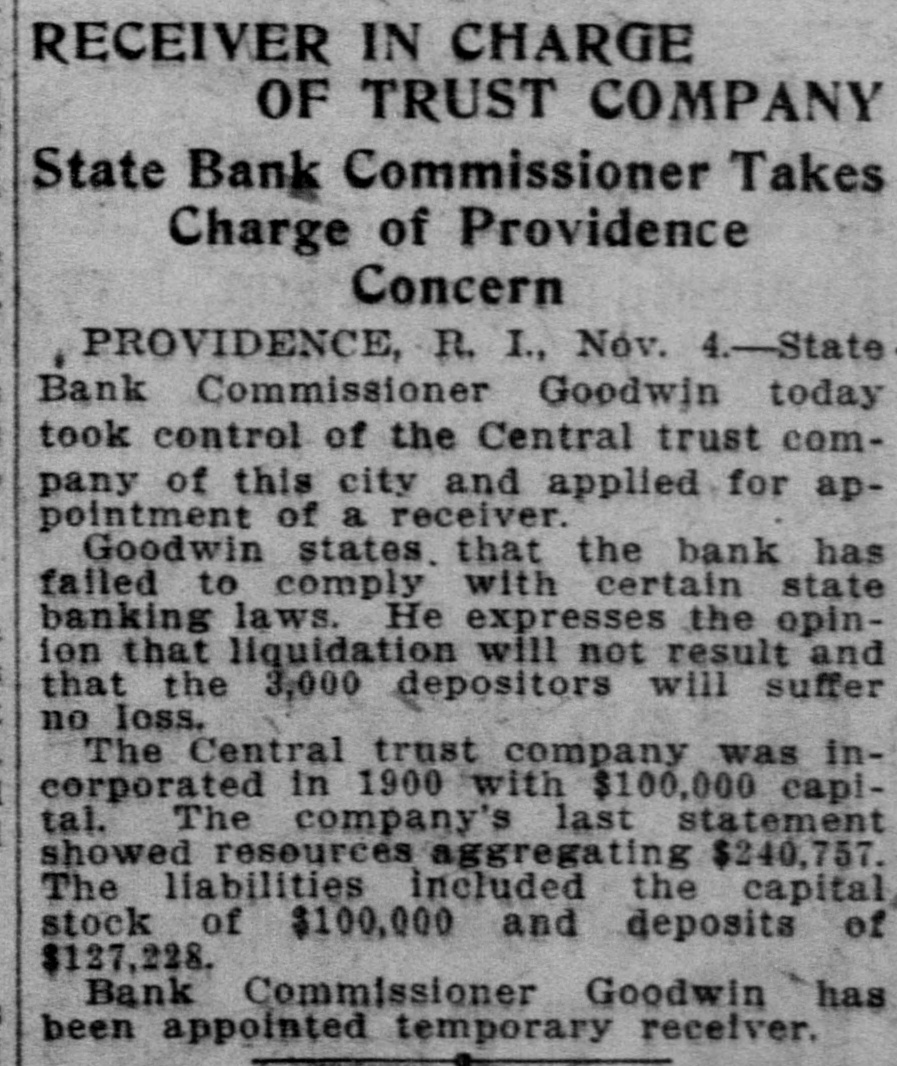
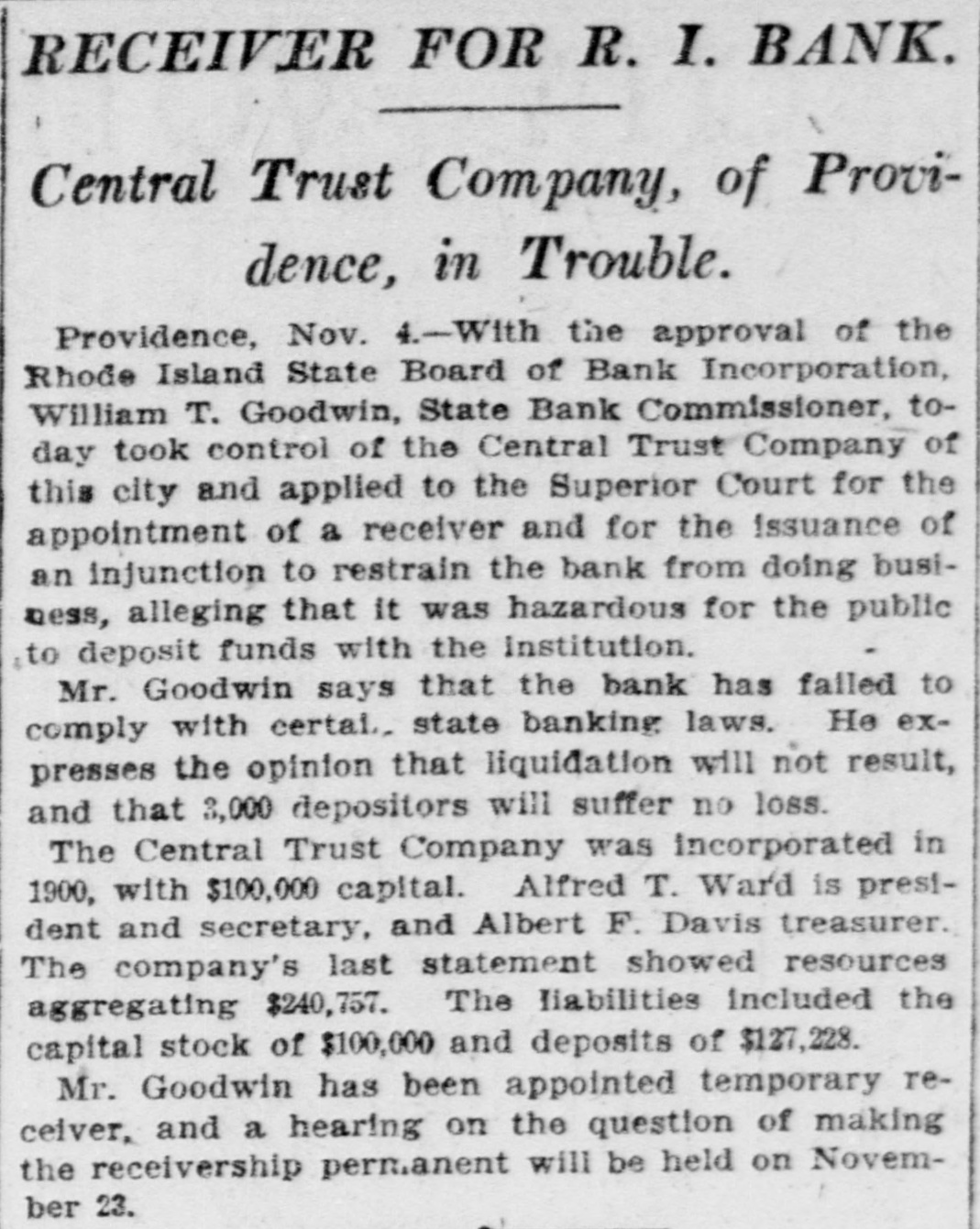
Alfred P. Ward, president and treasurer
of the Central Trust company, declared
that the suspension of payment was sole-
ly in the interest of depositors. He was
emphatic in his declaration that the bank
was perfectly solvent and stated that the
assets were almost double the liabilities.
He said:
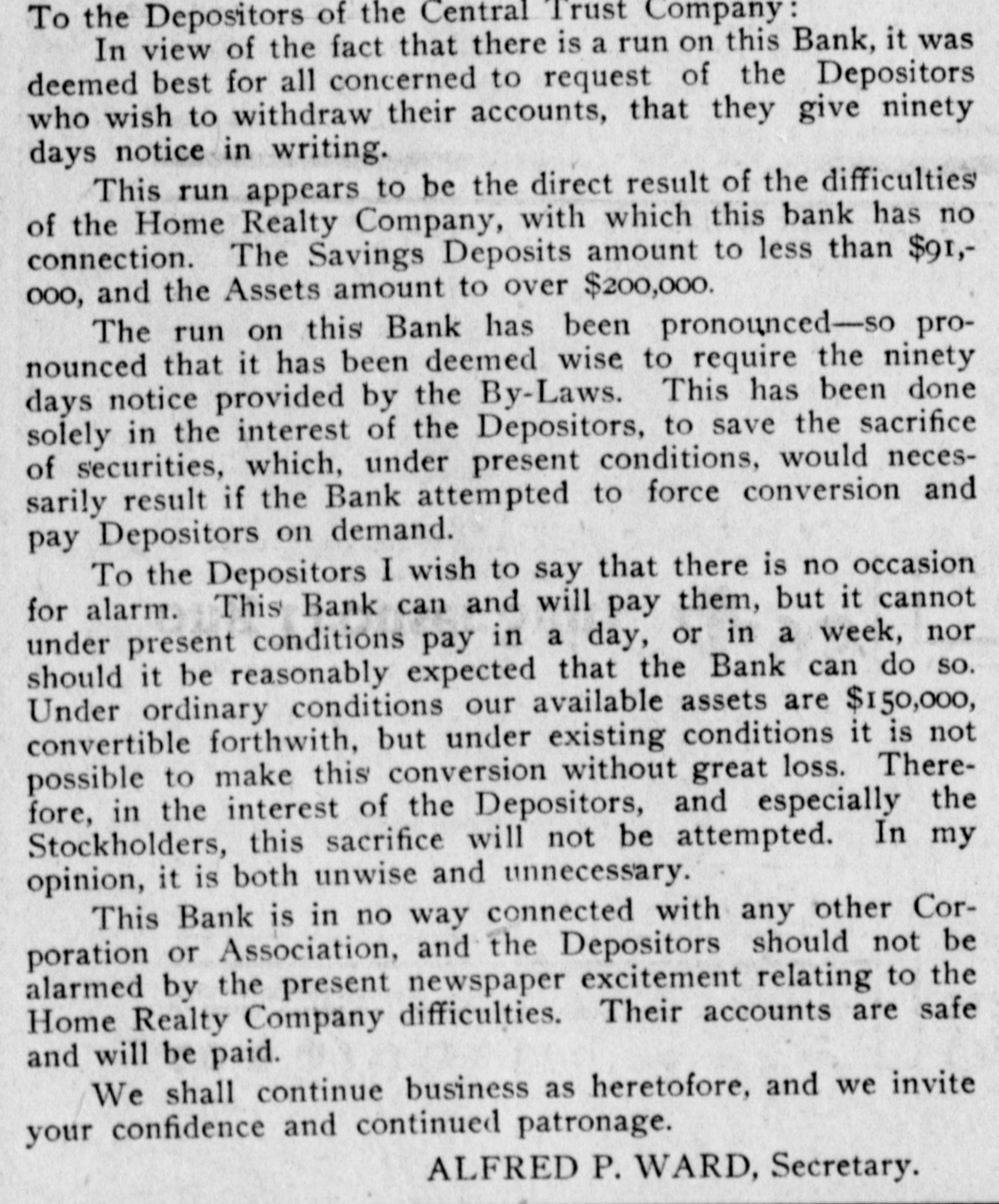
"We have required the 90 days notice
from our depositors because they were
withdrawing their money too fast. There
Is no question as to the solvency of the
company, for all our assets are of the
best character. But the fact that $12,000
was taken out yesterday indicated that
we would be compelled to take advantage
of the reservation which we have made,
and today we have demanded notice be-
fore settling up accounts.
"By the figures made out Monday after
the close of business we hal in cash $8000.
Our deposits in savings aggregate about
$90,000. We have mortgages of first-class
variety to the amount of $123,000 and loans
and accounts of $21,000. These loans are
all of the best class, and the majority of
them are for small amounts. The largest
one, for $2000, is a secured claim. We
hold collateral worth $35,000 and stock
worth $25,750.
"Our assets are, therefore, worth about
$215,000 and our liabilities are not much
more than half that amount. Still we
could not, as no bank could, pay all our
depositors if they all demanded payment
at the same time, and if we tried to real-
ize on our assets immediately there would
naturally be some shrinkage. We, there-
fore concluded that the best thing to do