19428. Pittston Bank (Pittston, PA)

Bank Information

Episode Type
Suspension → Closure
Bank Type
state
Start Date
November 21, 1860
Location
Pittston, Pennsylvania (41.326, -75.789)

Metadata

Model
gpt-5-mini
Short Digest
dc1bdf11

Response Measures

None

Description

Multiple contemporary papers (Nov 21-28, 1860) report the Pittston Bank suspended specie payments as part of widespread bank suspensions amid the monetary panic of late November 1860. The articles do not report a reopening or receivership; because there is no evidence of resumption, I classify as a suspension that appears permanent in the articles (suspension_closure). Cause is systemic (panic/macronews).

Events (1)

1. November 21, 1860 Suspension
Cause
Macro News
Cause Details
Part of the widespread suspension of banks and specie payments amid the monetary panic of late November 1860 (news of Southern and regional bank suspensions, stringency in money markets).
Newspaper Excerpt
Two banks in the interior of this State have suspended specie payments to day, their names and locations are:-Pittston Bank, of Pittston, Pa,
Source
newspapers

Newspaper Articles (5)

Article from The New York Herald, November 22, 1860

Click image to open full size in new tab

Article Text

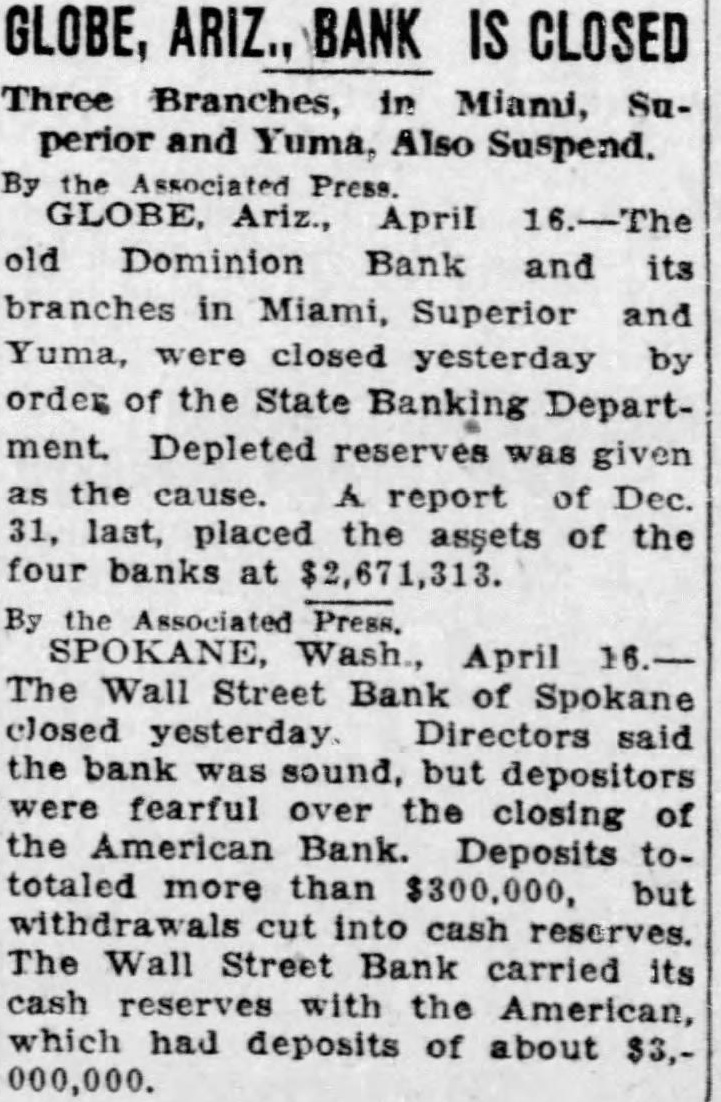
IMPORTANT FINANCIAL NEWS. Suspension of Specie Payments by the Baltimore and Virginia Banks-Condition of Trade at the West, &e., &e. SUSPENSION OF THE BALTIMORE BANKS. BALTIMORE, Md., Nov. 21, 1860. The Bank Presidents of this city held a meeting this afternoon, and resolved to suspend specie payments to. morrow morning SUSPENSION OF THE VIRGINIA BANKS. RICHMOND, Nov. 21, 1860. All the Richmond and Petersburg banks have suspended specie payments. FAILURE OF FLOUR MERCHANTS AT ALBANY. ALBANY, Nov. 21, 1860. Four flour houses tumbled here to day, one long estab. lished. REPORTED SUSPENSIONS AT NEW ORLEANS. NEW ORLEANS, Nov. 21, 1860. It is reported that several produce firms of this city have suspended payment to-day. MONETARY AFFAIRS IN PHILADELPHIA. Philadelphia, Nov. 21-Evening. The market WILS exceedingly stringent to-day. Call loans could not be touched at less than one per cent a month, and the best securities declined an average of one half per cent. It is reported that all the banks in Virginia have sus pended specie payments. Two banks in the interior of this State have suspended specie payments to day, their names and locations are:-Pittston Bank, of Pittston, Pa, and Commerce, at Erie, Pa., and it is thought that many more, if not all, both here and there, will follow suit. STATE OF TRADE IN CINCINNATI. CINCINNATI, Nov. 21, 1860. All kinds of produce is greatly unsettled. There is very little demand for any article, and prices are little better than nominal. Flour is offered at $4 25 for superfine. Wheat has declined 5c. Sales of red at 85c. and hite at 95c. Corn is dull at a decline of 2c. The hog market 18 dull, and there is more disposition to sell on the part of owners, while buyers are holding back, looking to a further decline. For lard there is no demand, and prices are nominal. The money market is more stringent, but the demand is not pressing. First class paper sells at 12a15 per cent. Sight exchange on New York is firmer, and may be quoted at ½ per cent premium. The currency market is very unsettled- The rates of the Bank of Virginia and its branches are thrown out at ten per cent discount, the notes of Illinois and Wisconsin banks at ten per cent discount, and the notes of Iowa and issouri banks at five per cent discount.


Article from New-York Daily Tribune, November 22, 1860

Click image to open full size in new tab

Article Text

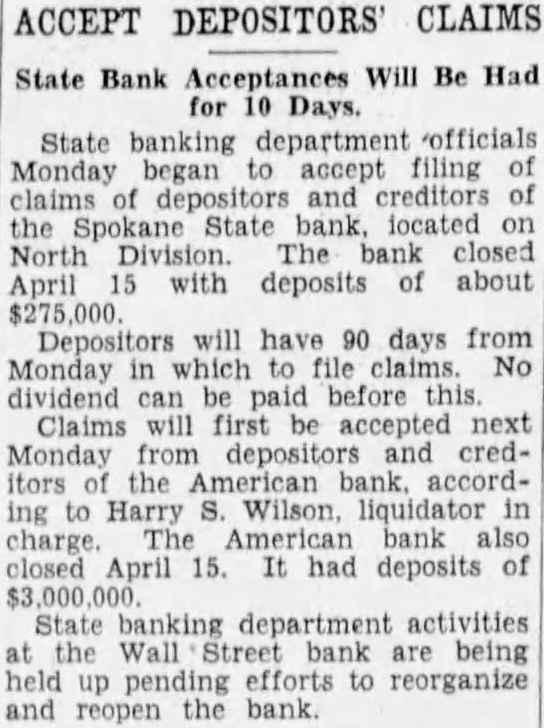
266'601$ Increase $3,542,680 $658,360 $1,685,055 Decrease The suspensions of banks at the South and West, announced within a day or two, brought about almost a panic in uncurrent money, and the brokers' offices were crowded to-day with sellers. The rates rapidly advanced, partly from the inability of buyers to meet the rush, and partly from the uncertainty in regard to the future. At the latest, Messrs. Thompson Brothers quote New-York State and Eastern P cent discount; IIdiscount; Ohio, Indiana, and Kentucky, 5 cent linois, Missouri, Wisconsin, and Iowa, 15 ₽ cent disdiscent count; Maryland and Pennsylvania, 1@2 P count; Virginia, North Carolina, South Carolina, cent discount. Land Georgia, and Alabama, 25 Warrants are unsettled, and nominally 60c. P acre. The rush to sell uncurrent money has been 80 great that the brokers have had no time to assort it. Mobile and New-Orleans, if assorted, could be sold at 10 cent. Telegraph dispatches announce the suspension of all the Richmond Banks, and that at Baltimore uncurrent money cannot be sold. The Bank of Commerce at Erie, and the Pittston Bank, are thrown out at Philadelphia, and the weak banks all over the country are shaking in the wind. State and Eastern currency is coming in very freely at the Metropolitan Bank, and that institution, we understand, now requires the guarantee of brokers depositing uncurrent funds. A scheme was incubated yesterday, to seal up these notes of State and Eastern banks, instead of sending them home for redemption, and issue certificates upon them, as in 1857, to be used between the banks in settlement of balances at the Clearing-House. This scheme, however, was superseded by the action of the banks this afternoon. The Exchange Committee of the Banks have bought about £30,000 at about 102, and have negotiations under way for a much larger amount. The offerings of bills to-day were quite moderate. The difficulty of finding the right description of bills, hampers the operations of the Committee, and they will probably be obliged to resort to the bankers to fill up the amount authorized. The true policy of the Committee would be to buy commercial bills of the bankers, with their indorsement, paying a fair advance for the risk thus assumed by the bankers. The object of the movement, we apprehend, is not to make money for the banks on the import of specie, but to relieve the stagnation in the Exchange market. The bankers know the standing of commercial drawers, while the Committee have to make nun erous inquiries, which cause delay, when in mediate relief is needed. To-morrow is the day of payment for the Government loan awarded last week. The speculative lots will not probably be paid for. In the mean time, Treasury notes are going in rapidly for redemption, and we shall not be surprised to see the Treasury bankrupt by Jan. 15, 1861, unless Congress intervenes to save it. There was little or no relief in the money market today, but a rather easier feeling in anticipation of some relief by a more liberal course on the part of the banks. First-class names go at 12@15 cent, and good at 18@24 cent. There is no currency, even at these rates. Demand loans are 7 P cent, and the supply of money is moderate. The managers of our banks this morning became thoroughly awake to the precarious character of their condition, and held a meeting to consider measures for the relief of the mercantile classes, and to prevent a general suspension of specie payment by themselves. A scheme was proposed and adopted, subject to the approval of an adjourned meeting, to be held in the afternoon. This plan contemplates a general and liberal expansion of loans to meet the full wants of the worldcommercial Committee of five to be appointed, to whom any bank which should be drained of its gold could apply, and by the deposit of bills receivable, stocks, &c., in trust, Clearing-House certificates to the extent of 75 cent of the deposits would be issued, which certificates are to be receivable at the Clearing-House in payment of balances. This practically establishes a community of all the specie in the bank vaults, and no single bank can bebroken 80 long as it has good assets. In the present state of our foreign trade, there being no shipping demand for gold, we can see no danger in this expansion of loans contemplated, and if the step had been taken two weeks ago, much suffering would have been averted. The want of a leading spirit in the banking circle has been painfully evident, and the banks, each one for it self, have gone on scrambling for coin until the merchants and banks have together been brought to the brink of bankruptcy. We trust the action of this afternoon has averted the danger, and that the relief to be afforded will be sufficient to infuse new vitality into all the avenues of trade and commerce. No better proof of the thorough fright and earnestness of the bank officers is needed than the fact, that for the


Article from Daily Nashville Patriot, November 24, 1860

Click image to open full size in new tab

Article Text

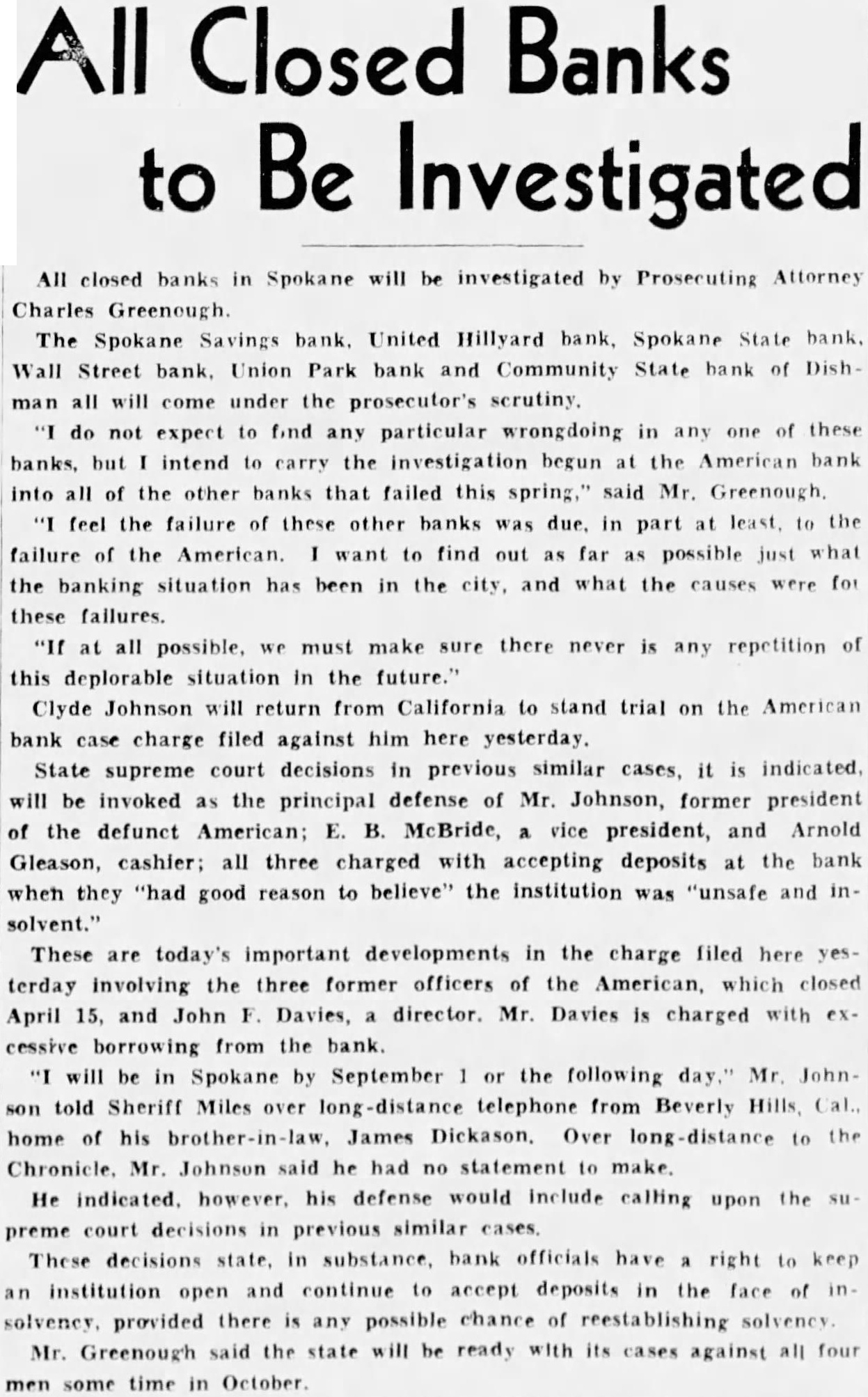
MONESARY. Yesterday was a blue day in more respects than one. It was cold, rainy, sleety and snowy, by turns. The fail season never gave birth to a more unpropitious day, In the business calendar the day will also be marked as a blue, most blue one. Monetary affairs were in the most stringent condition. What shall we do to meet our engagements ?-how put off the day of suspension? was the cry of men with all sorts of means except money. What must the banks do to afford relief? Must they suspend? This would sub. ject them to penalties they could not long endure. What then Shall the Legislature be called together to remove the penalties? This Was thought the proper plan, and a petition was put in circulation for signatures asking the Governor to act. Foreign bank notes continue to go down-that is, the rate of discount increases. For particulars see table. The Cincinnati Quiette, in its Monetary report of the 22d, says it hears of no distress as yet amongst the merchants of that city, and no failures of moment. It adds: The uncurrent money market was more unsettled to-day than Le etofore: The suspension or the Farmers' Bank of Virg nia led to the throwing out of the paper ol all the banks of that State, with the xception of Wueeling and branches. The latter are regarded as sife. This evening we have advices of the suspension of the Richmond and Petersburg bai ks. Rates of discount on uncurre it Virginia ranges from 10 20 per cent. Idinois range fr m 10 to 20 dis. Wiscousin a id Iowa were 10 us; M ssouri 2 to 5, and Tenne see 2 to 5. The Commonwealth Bank of Erie, and the Pitiston Bonk, Pa., have suspended. They were both in poor credit. Our par funds now ar : Onio, Indiana, Ke tucky, Wheeling and ches, Indelphia, Pittsburg, New York State and New England, and L uisiana. The bulk of our cu rency is of the b mks of the three iir t named St tes. Indiana St ck banks S and well, being generally taken at par, though nomina ly they are at a discount of 1/20. The New York Times, of the 20th, says: On the Stock Echang - to-day the early se-sion of the brokers was marked by heavier sacrafices than had at any time occurred during the sent crisis, but this feeling did not obtain to the close of the day, a reac ton on some of the railway shares having manif sted itself in the afternoon, producing at & 1 to hour quite a flurry on the upward turn-New York Ce tral at 74½, after being done as low as 703/4 on the printed list in the morning; Galena 59, after being 55; illinois 57, after 52; Michigan Guaranteed 28½, after 26%; Toledo 26, after 24½, and SO on. Erie shares were fairly st ady through the day, and New York Central was gaiu scarce for immediate delivery, and brought ½ @% per cent. more in this way than on seller 5 or 10 days. The City Bank stock fell from 5 to 10 per cent. The State stocks again suffered; T. nnessees fell off to 74, a decline since Saturday of 1@1/1/2; Virginias 77; Mi souris 681/2. The heaviest relative decline was in United States fives of 1874, which sold down to 95, including current coupon, equal to 93 for the stock, free of interest. The sales were of a forced character. BOSTON, Nov. 17.-P. M. Saturday was a hard day for stocks, and where pressed for sale they were literally slaughtered. This was more particularly the case at Auction, because at the Brokers' Board many lots of stock are held for sale, but as a matter of policy are not even offered when the market is SO much depressed, The money market continues excited, and the past week has been an exceedingly hard one in financial circles. It was in fact the first period of real "stringency" for nearly three years, or since comfortably getting over the commercial revulsion of October, 1857, and people took it unkindly:


Article from Clearfield Republican, November 28, 1860

Click image to open full size in new tab

Article Text

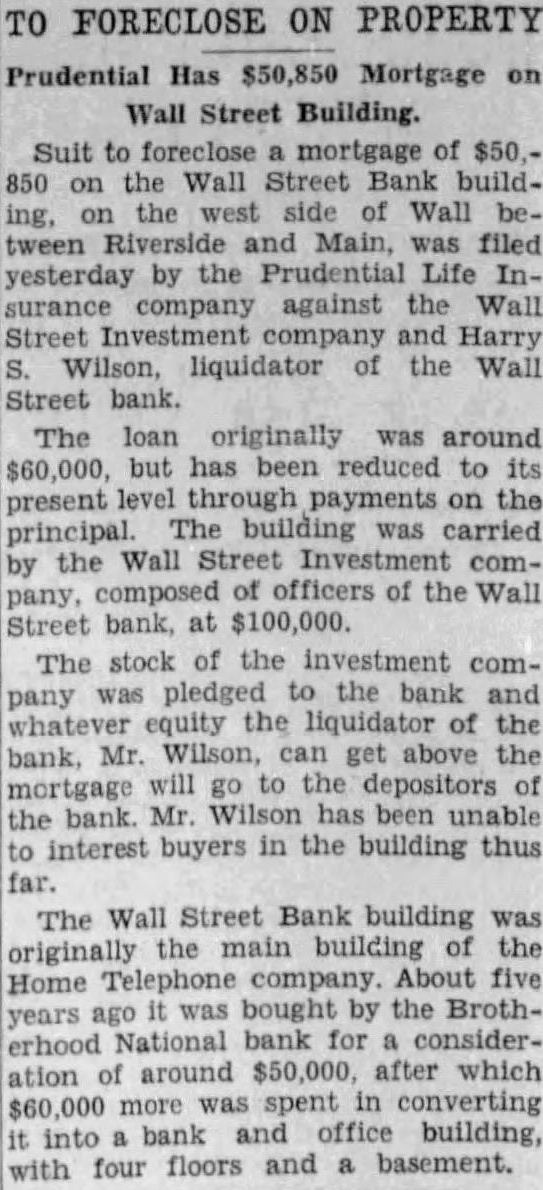
Whether it is caused by ignorance or weakness, or both, We know not; but we have always put a very low estimate upon our abilities as a writer. However, it seems we are bound to" goup, whether we desire it or not. The wise and as tute Demosthenes who presides over that ably (?) conducted sheet, the Raftman's Journal, is bound to bring us into notoriety. Last week he furnished his readers with no less than three articles, includs ing his leader, too, all the result of the Clearfield Republican. He labors upon one whole column, in which he neither asserts, or denies a fact. Like the wind, we hear the sound, but we know not from whence it. came or whither it goes-as it is all wind, and no argument in the end. Whenever his articles contain something more than Murg h, "tho't, " wouldn't, don't we will attempt a reply to some of them It is our opinion the editor of the Journal had better display his great and immaculate literary proportions in stating some facts to his readers which would be more interesting to them than the at tempt to give ns notoriety as we do not intend to accept i from any source of doubtful ability. We would like to have the editor of the Journal state to his readers the cause of the present panic in our country; the suspension of all the banks the dis. charge in the cities of thousands of mechanics and laboring men, upon the advent of winter. Did the election of a Democratic President ever convulse the country in this manner? Give us some thing of this kind from your able per. will you do it, Simon Bolivar SUSPENSION As a general suspension of the Banks has taken place again, we would warn the public against taking money purporting to be issued by any of the following named Banks. Bank of Commerce, Brie. Bank of Crawford County. Bank of New Castle. Bank of Phoenxville. Kittanning Bank. Monongahela Valley Bank North Western Bank, Warren. Pittston Bank. Shamokin Bank. Tioga County Bank. bas The above list of Banks were all chare tered under the administration of Gov Pollock, and may be generally styled as the Pollock Banks." To-day we learn is the time set apart by the officers and Directors of the Clearfield County Bank," to open their doors, for the purpose of commencing bu siness. While the Banks elsewhere are elosing their doors, the Clearfielders are throwing theirs wide open. Such hospitality is not often met with. We have no doubt that this Bank will be one of the safest institutions in the country. The officers and Directors appear before the public with all the necessary qualifications, and plenty of money. During Saturday and Sunday we experienced very cold and stormy weath er in this locality, as much so we think as ever we experienced at this season of the year The Thermome stood at 10 de


Article from Sioux City Register, December 1, 1860

Click image to open full size in new tab

Article Text

New York, Nov. 21. Thompson Bros, state that the currency panic to day has been equal to that of 1857. They quote all bills south of Washington 20 to 25 per cent. discount; Illinois and Wisconsin 15 per cent. Ohio, Louisiana, Kentucky and Canada 3 to 5 discount; Maryland and Pennsylvania 1 to 2 discount; New York State and New England 1 discount. The Post says that the Presidents of the leading banks are discussing a project for releiving the community by issuing scrip based on bills receivable of United States stocks and other approved collaterals, to pass in liquidation of bills to each other. The scrip to bear 7 per cent. interest. The banks thus hope to be soon in a position to meet the wants of their dealers. An expansion in loans of several millions is looked for this week. Norfalk, Va., Nov. 21. The minute men of the city held a meeting to-night and passed strong resolutions in favor of resistance to Northern aggressions. Three cheers were given for the man that hung John Brown. Cockades are plentiful on the streets to dav. Philadelphia, Nov. 21. The Brokers of this city refuse take the notes of the Bank of Commerce, at Erie, and Pittson Bank. Augusta, Ga., Nov. 21. Both branches of the Georgia Legislature have passed unanimously a bill to call a State Convention.