19057. Girard Bank (Philadelphia, PA)

Bank Information

Episode Type
Suspension → Reopening
Bank Type
state
Start Date
May 10, 1837
Location
Philadelphia, Pennsylvania (39.952, -75.164)

Metadata

Model
gpt-5-mini
Short Digest
82809514

Response Measures

None

Description

Contemporary articles (May–June 1837) report the Girard Bank suspended specie payments during the Panic of 1837 (interaction with the Distribution Act and Treasury actions). The pieces describe refusal to redeem notes and a suspension of specie payments but do not describe a depositor run or a permanent closure/receivership; historical context suggests the bank later resumed, and no closure or receiver is reported in these excerpts, so I classify this as a suspension with eventual reopening. OCR errors corrected for dates and phrasing; no explicit reopening date is given.

Events (3)

1. May 10, 1837 Other
Newspaper Excerpt
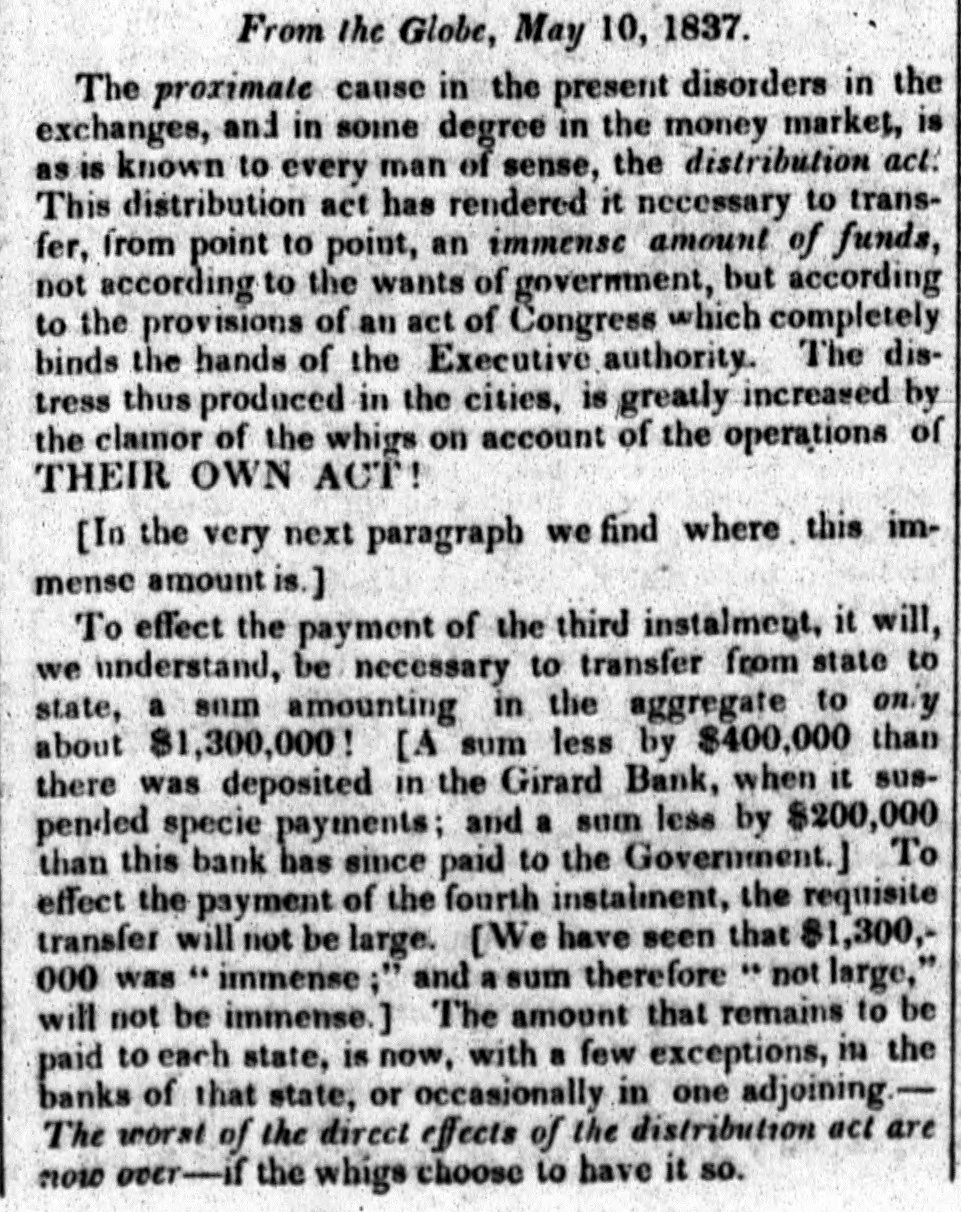
A sum less by $400,000 than there was deposited in the Girard Bank, when it suspended specie payments; and a sum less by $200,000 than this bank has since paid to the Government.
Source
newspapers
2. May 12, 1837 Suspension
Cause
Macro News
Cause Details
Suspension of specie payments in the general panic following the Distribution Act and related Treasury actions; government policy and broader monetary disorder prompted suspension rather than a discrete bank-specific scandal.
Newspaper Excerpt
they were imperatively required to pay the whole amount of duties in gold or silver!... the Girard Bank, when it suspended specie payments
Source
newspapers
3. June 7, 1837 Other
Newspaper Excerpt
John Speakman vs. Girard Bank. Claim $5 note... Judgment entered for plaintiff and satisfied. ... IfTHE PEOPLE pursue this justifiable course, THE BANKS must resume specie payments; No Bank can be considered solvent so long as it violates its charter by refusing to redeem its notes with specie; and where holders of such notes obtain judgments, they cannot be blamed ...
Source
newspapers

Newspaper Articles (4)

Article from Staunton Spectator, and General Advertiser, May 25, 1837

Click image to open full size in new tab

Article Text

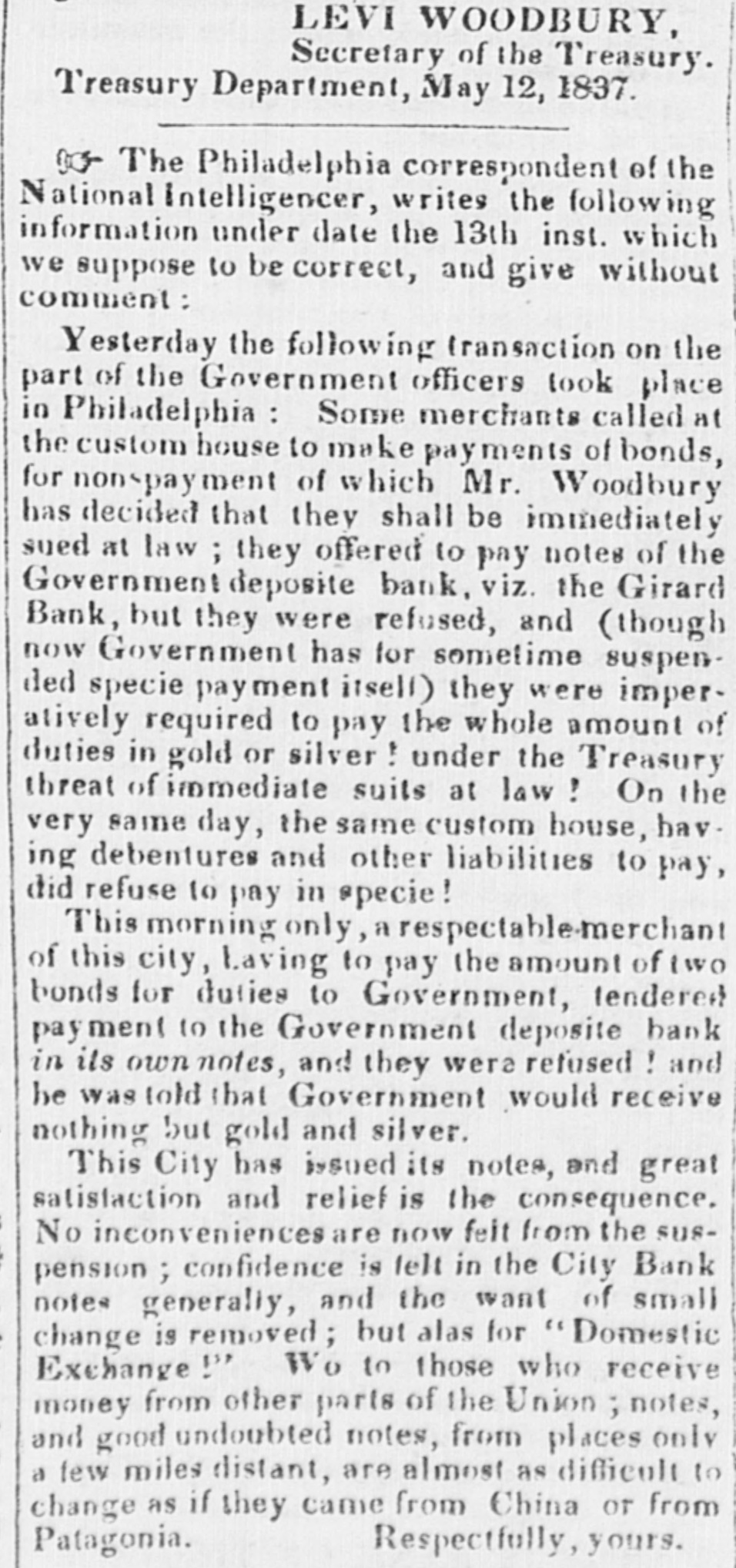
LEVI WOODBURY, Secretary of the Treasury. Treasury Department, May 12, 1837. or The Philadelphia correspondent of the National Intelligencer, writes the following information under date the 13th inst. which we suppose to be correct, and give without comment: Yesterday the following transaction on the part of the Government officers took place in Philadelphia : Some merchants called at the custom house to make payments of bonds, for nonspayment of which Mr. Woodbury has decided that they shall be immediately sued at law ; they offered to pay notes of the Government deposite bank, viz. the Girard Bank, but they were refused, and (though now Government has for sometime suspended specie payment itself) they were imperatively required to pay the whole amount of duties in gold or silver! under the Treasury threat of immediate suits at law ! On the very same day, the same custom house, hav ing debentures and other liabilities to pay, did refuse to pay in specie! This morning only, a respectable-merchant of this city, Laving to pay the amount of two bonds for duties to Government, tendered payment to the Government deposite bank in its own notes, and they were refused ! and be was told that Government would receive nothing but gold and silver. This City has issued its notes, and great satisfaction and relief is the consequence. No inconveniences are now felt from the suspension; confidence is felt in the City Bank notes generally, and the want of small change is removed; but alas for "Domestic Exchange!" Wo to those who receive money from other parts of the Union ; notes, and good undoubted notes, from places only a few miles distant, are almost as difficult to change as if they came from China or from Respectfully, yours. Patagonia.


Article from The Columbia Democrat, June 24, 1837

Click image to open full size in new tab

Article Text

BEFORE ALDERMAN BADGER. John Speakman vs. Girard Bank.Claim $5 note.-June 7th, plaintiff appears. Judgment enfered for plaintiff and satisfied. In Pottsville the same course has been adopted; and as will appear by an article from the "Republican Farmer," similar proceedings have been instituted against the Wilkesbarre Bank. In one case in Philadelphiaagain the United States Bank for a $10 note, the defendants have appealed from the judgment of the alderman; and as no ground can be sustained against it, we think it a very strong evidence of the inability of that institution to meet its liabilities. This course, on the part of the pesple shows how futile every attempt proves, the object of which, on the part of monopolists, is either infliction of wrongs or deprivation of rights; and such a course will very soon bring matters into the proper channel for correct navigation. Why should corporations have privileges, or excite sympathies, when individuals are expressly debarred from either. under similar circumstances? We would, with our neighbor of the "Farmer," advise every one to whom specie is refused at the counter of the Bank, to procure the endorsement of the President or Cashier, and thus not only secure interest on the note, but place himself in readiness to obtain the specie by legal proceeding. IfTHE PEOPLE pursue this justifiable course, THE BANKS must resume specie payments; and the cry of pressure and panic will never again be heard, on this account, during the existence of their charters. No Bank can be considered solvent so long as it violates its charter by refusing to redeem its notes with specie; and where holders of such notes obtain judgments, they cannot be blamed for entering them of record as liens upon the real estate of such institutions; or for issuing execution, and ordering the constable to levy upon the "mint drops" in satisfaction of the debt.Let the people act in this way, and the abundance of specie will at once do away the circulation of shin -plasters. EXCESS Lycoming Gazette and Lycoming Chronicle have been consolidated under the joint titles. The editors promise an enlargement of the paper, We have no doubt but this union will be productive of benefits to the party as well as the editors, and we cordially wish them success. A2E Great Calamity.-A stream running through the city of Baltimore called Jones' Falls, was raised to an unusual height by a heavy rain which fell on Wednesday night of last week. It inundated a number of the streets, sweeping stores, shops, dwellings, bridges, dams, &c., destroying property to an immense amount and occasioning the loss of a number of lives. One family consisting of two grown persons and three children were found drowned in their beds. Twelve bodies have been recovered and it is supposed that several more were swept away and perished. Miraculous Preservation.-The Baltimore Republican of Saturday has the following item connected with the late flood: "On Thursday last, à cradle with a living child in it, was picked up in the basin, floating down the stream. The child is stated to have been quite composed, and entirely unconscious of danger, at the time it was discovered, and rescued from its perilous situation. A balloon has been formed by Messrs. Pike of New York for Mr. Green, an Eng= lishman who at Buffalo


Article from The Madisonian, September 21, 1837

Click image to open full size in new tab

Article Text

From the Globe, May 10, 1837. The proximate cause in the present disorders in the exchanges, and in some degree in the money market, is as is known to every man of sense, the distribution act. This distribution act has rendered it necessary to transfer, from point to point, an immense amount of funds, not according to the wants of government, but according to the provisions of an act of Congress which completely binds the hands of the Executive authority. The distress thus produced in the cities, is greatly increased by the clamor of the whigs on account of the operations of THEIR OWN ACT! [In the very next paragraph we find where this immense amount is.] To effect the payment of the third instalment, it will, we understand, be necessary to transfer from state to state, a sum amounting in the aggregate to only about $1,300,000! [A sum less by $400,000 than there was deposited in the Girard Bank, when it suspended specie payments; and a sum less by $200,000 than this bank has since paid to the Government.] To effect the payment of the fourth instalment, the requisite transfer will not be large. [We have seen that $1,300,000 was "immense;" and a sum therefore "not large," will not be immense.] The amount that remains to be paid to each state, is now, with a few exceptions, in the banks of that state, or occasionally in one adjoining. The worst of the direct effects of the distribution act are now over if the whigs choose to have it so.


Article from Democratic Standard, April 5, 1842

Click image to open full size in new tab

Article Text

Galveston, March 10, 1842. [From Kendalls Expositor.] THE BANKING SYSTEM. No. 1. Experience, that ever safe though severe teacher, is fast opening the eyes of the people in relation to the vices and evils of the Banking System. Never was there a time when the minds of men were in a better condition to give heed to sound argument or more ready to concur in conclusions in reference to a subright which deeply involves the rights, ject interests and morals of the whole community Look at the ruins which lay scattered specie Banks around. payments The in general 1837, suspension when the of had in circulation about two hundred millions of dollars in promises to pay, de preciated the whole mass about ten per a some fifteen cent., and millions was equivalent of dollars to upon tax the of people, the second over more was its instantaneously than half suspension, the Union, laid and extening collected.- within scope a repetition of the same species of tax to the amount of eight or ten mill ions. All this was born patiently by the people; for the banks having most of the presses and political men in their interest or in their power, persuaded the was to the nocessary sufferers the public that good. this step In all d States, the Banks took the government d into their hands, and through the Legislatures granted themselves all the indulwas of threatened, gences they because desired. the Revolution Departments the General Government resisted this Bank usurpation, and insisted upon obedience to the constitution and laws in its pecuniary transactions. This stand, as every observing man now knows, by ar raying against it the army of banks and bankrupts, was the principal cause of the overthrow of the late administration in 1840. Year after year have the banks obtained sometimes indulgencies bargaining from the State for them Legislatures, with raco of Statesmen who dared not attempt to raise by honest means, the funds to meet State liabilities, but more often ex. acting them without pretence of an equiv. alent. To what consequences has this surrender of the government to the banks led? The were 10 susto exscenes swinplude,exhibiting pend Missippi payment Banks and the first of the fraud totally first and dling never before exceeded. Not warned by this example, the other states still to giving quietly fraud acquiesced time in the mature Bank dominion, its plans, and leaving the Banks to blow up at their leisure, when their managers should have swindled to the utmost both the people and the stockholders. Look at that tremendous ruin, fearful to enough United States. be sublime, If widows the lateBank and orphans of the a from they have have not the blackened been been driven left starving wall by of their foreign within dwellings enemy them. Look at the Schuylkill Bank, the Girard Bank and the Bank of Pennsylvania. In addition to the plunder of the people by the depreciation of millions of dollars in circulation, there has been lost to the more stockholders alone, than in the forty city millions of Philadelphia of dollars. scenes are on a In every portion presented of the Union smaller similar scale. It our people fraud cannot and and ce mismanagement, stockholders doubted that of the in banks,through losses Repub- of the have within a few years past, amounted to more than NE HUNDRED MIL. LIONS OF DOLLARS. To this conclusion any man will be led who reflects a moment on upon notes and of but about by bank the suspension in the their losses hands, of breaking the brought people and utter hilation Banks, and of Bank the impairing anniStocks, produced by similar callses. But this is not all They increased the currency of the to about t of dollars in while at we an unusual hundred the same time millions country had paper, quaning the money specie cheap in circulation, and increasing thereby price makof all reasonable at dred Now, property millions they have beyond of withdrawn dollars least bounds. a hunof the cur rency, at same more than half and the Union, the have, time, by paper continued in circulaof this tion suspension, tremendous altogether. banished reduction The specie natural of from effect cy as raised low is the the proper reduction level of prices they so were the much curren- be above, a annihiating the fortunes of men who are somewhat in debt and embarrassing all kinds of business.