Roseland Bank (Chicago, IL)

Episode Information

Episode UID
2011371164
Episode Type
Suspension β†’ Reopening
Bank Type
private
Bank ID
201137 routing
Routing Number
2-0113
Start Date
December 21, 1896
Location
Chicago, Illinois (41.850, -87.650)

Metadata

Model
gpt-5-mini (chosen from majority vote of a three-model LLM ensemble)
Short Digest
24da55bac443eaeb

Response Measures

None

Description

Owner name spelled variously (Wiersema / Weirsma / Weissman) in sources.

Events (2)

1. December 21, 1896 Suspension
Cause
Local Banks
Cause Details
Suspension resulted from the failure/suspension of the National Bank of Illinois and locked-up assets with which Roseland cleared; receiver appointed for owner Frederick Wiersema.
Newspaper Excerpt
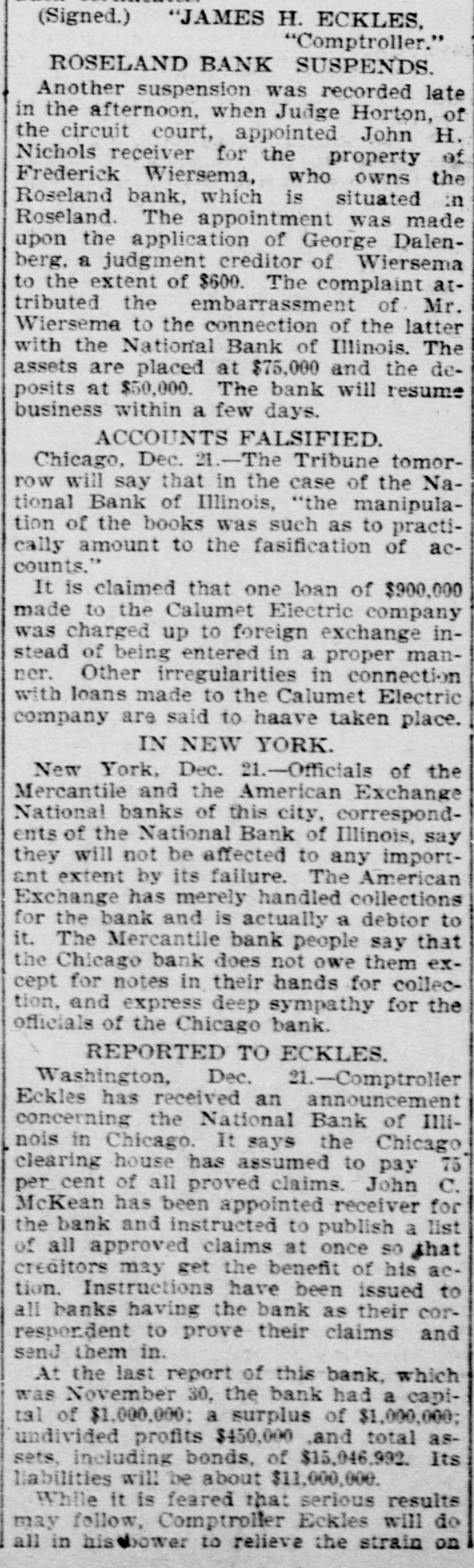
Another suspension was recorded late in the afternoon, when Judge Horton... appointed John H. Nichols receiver for the property of Frederick Wiersema, who owns the Roseland bank
Source
newspapers
2. December 25, 1896 Reopening
Newspaper Excerpt
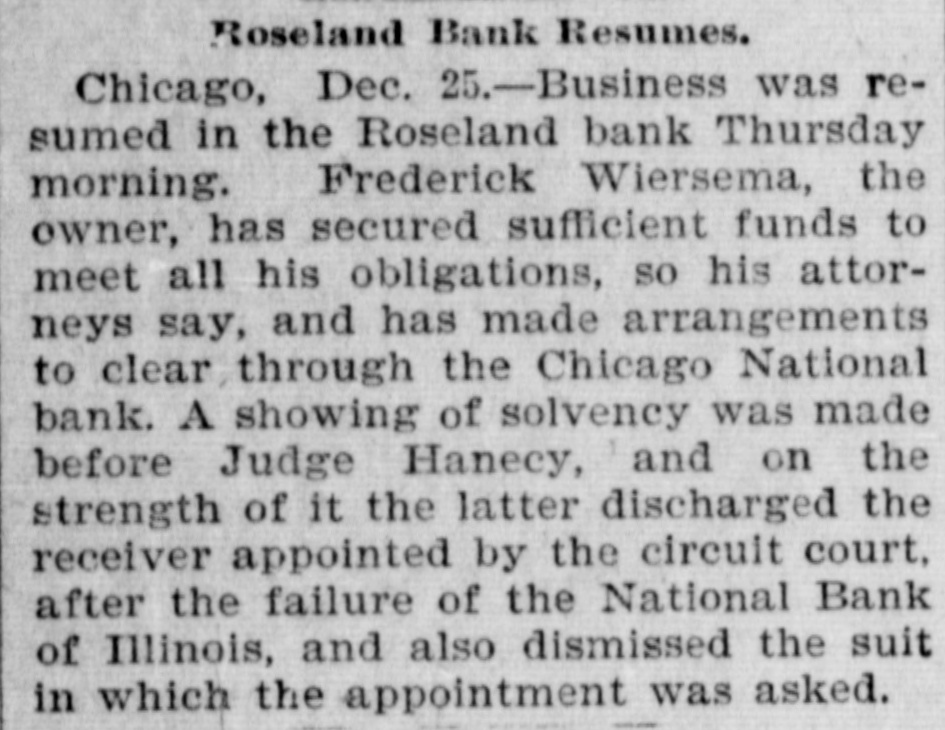
Roseland Bank Resumes. Chicago, Dec. 25.-Business was resumed in the Roseland bank Thursday morning. Frederick Wiersema... has secured sufficient funds to meet all his obligations ... the receiver... was discharged and the suit dismissed.
Source
newspapers

Newspaper Articles (20)

Article from The Wichita Daily Eagle, December 22, 1896

Click image to open full size in new tab

Article Text

(Signed.) "JAMES H. ECKLES, "Comptroller." ROSELAND BANK SUSPENDS. Another suspension was recorded late in the afternoon, when Judge Horton, of the circuit court, appointed John H. Nichols receiver for the property of Frederick Wiersema, who owns the Roseland bank, which is situated in Roseland. The appointment was made upon the application of George Dalenberg, a judgment creditor of Wiersema to the extent of $600. The complaint attributed the embarrassment of Mr. Wiersema to the connection of the latter with the National Bank of Illinois. The assets are placed at $75,000 and the deposits at $50,000. The bank will resume business within a few days. ACCOUNTS FALSIFIED. Chicago, Dec. 21.-The Tribune tomorrow will say that in the case of the National Bank of Illinois, "the manipulation of the books was such as to practically amount to the fasification of accounts." It is claimed that one loan of $900,000 made to the Calumet Electric company was charged up to foreign exchange instead of being entered in a proper manner. Other irregularities in connection with loans made to the Calumet Electric company are said to haave taken place. IN NEW YORK. New York, Dec. 21.-Officials of the Mercantile and the American Exchange National banks of this city, correspondents of the National Bank of Illinois, say they will not be affected to any important extent by its failure. The American Exchange has merely handled collections for the bank and is actually a debtor to it. The Mercantile bank people say that the Chicago bank does not owe them except for notes in their hands for collection, and express deep sympathy for the officials of the Chicago bank. REPORTED TO ECKLES. Washington, Dec. 21.-Comptroller Eckles has received an announcement concerning the National Bank of Illinois in Chicago. It says the Chicago clearing house has assumed to pay 75 per cent of all proved claims. John C. McKean has been appointed receiver for the bank and instructed to publish a list of all approved claims at once SO that creditors may get the benefit of his action. Instructions have been issued to all banks having the bank as their correspondent to prove their claims and send them in. At the last report of this bank, which was November 30, the bank had a capital of $1,000,000; a surplus of $1,000,000; undivided profits $450,000 and total assets, including bonds, of $15,046,992. Its liabilities will be about $11,000,000. While it is feared that serious results may follow, Comptroller Eckles will do all in his bower to relieve the strain on


Article from The Indianapolis Journal, December 22, 1896

Click image to open full size in new tab

Article Text

Three Small Institutions Forced to Suspend Owing to Their Connection with the Big One. ACTION OF CLEARING HOUSE WILL ADVANCE 75 PER CENT. ON ALL CLAIMS AGAINST THE BANK. Depositors Likely to Receive Pay. ment in Full-No Semblance of a Panie-Mr. Eckels's Statement. CHICAGO, Dec. 21 -The National Bank of Illinois, generally considered one of the strongest financial institutions in the West, closed Its doors to-day, and the failure dragged down three other concerns-E. Dreyer & Co., Wasmandorff, Heinemann & Co. and the Roseland Bank. The failure of the National Bank of Illinois was due to the fact that its entire capital of $2,000.000 and $100,00 over and above its surplus of $300,000 had been loaned on Calumet eletric railroad stock. Five hundred thousand was loaned to Dreyer & Co., who had spread their capital out so extensively that they were unable to concentrate in time to save themselves. The other failures were due to the locking up of assets held by the National Bank of Illinois, and which were not available when that institution closed its doors. No further trouble is expected. as the clearing house association has agreed to pay 75 per cent. of the deposits in the National Bank of Illinois, and at the meeting of the clearing-house committee this afternoon all of the banks reported themselves in good condition. and none of them asked for the aid that would have been freely extended had it been asked. It is probable that all of the banks will resume. with the exception of the National Bank of Illinois, and all depositors will be paid in full. The National Bank of Illinois was one the oldest and best-named institutions of in the city and its failure was a surprise to most people, but not to those in select financial circles. The following notice was posted on the doors before the opening of banking hours: "This bank is in the hands of the national bank examiner by order the controller of the treasury." This action of was decided on at a meeting of the directors of the bank last night after the bank had been suspended from the Clearing House Association of Chicago at a meeting of the clearing house committee held earlier in the day. Of the sixteen banks that cleared through the National Bank of Illinois closed their doors as a result of the clos- two ing of that institution. They are E. S. Deyer & Co. and Wasmandorff & Heinemann. These two institutions are mortgage loan banks and saving societies in small way and their failure is not expected to affect any business houses. The assets of E. S. Deyer & Co. are given at $1,600,000. with liabilities of $1,200,000. The figures for Wasmandorff & Heinemann are approximately: Assets, $650,000; liabilities. $400,000. The Security, Title and Trust Company was appointed receiver for both firms. of the sixteen banks have arrangements Six clear through other banks and the rest the sixteen are making similar arrangements as fast as possible. Another suspension was recorded late in the afternoon. when Judge Horton, of the Circuit Court, appointed John H. Nichols receiver for the property of Frederick Wierseman, who owns the Roseland Bank. which is situated in Roseland. The appointment was made on the application George Dalenberg, a judgment creditor of of Wierseman to the extent of $600. The plainant attributed the embarrassmen comMr. Wierseman to the connection of the lat- of ter with the National Bank of Illinois, The assets are placed at $75,000 and the deposits at $50,000. The bank will resume business within a few days. The failure of the National Bank of Illinois, as stated, was a great surprise business circles. The causes of the sus- in pension as given in the resolutions adopted by the clearing-house committee are "Unwarrantable and injudicious loans," through which the "capital and surplus said bank is seriously imperiled, if not absolutely lost ACTION OF THE CLEARING HOUSE. At a meeting of the clearing house banks held after the close of business this after noon, all the banks were represented, upon recommendation of the clearing-house and committee, which had made a thorough amination of the affairs of the closed bank exthe clearing house banks were advised advance 75 per cent. on all claims against to the national bank of Illinois, which shal have been certified to by the receiver being on deposit in that bank. The gen- as eral sentiment of opinion was that the depositors would receive their money in full and the bank has now on hand. in cash means, nearly 40 per cent. of its entire lia. bility. No banks requested any assistance from the clearing house, and the ments published to-day on state currency on controller business of the the 17th instant at the the call show close of very the of There has been strong reserves. this excitement city. to-day in banking very circles littl meeting: at The the following resolutions were adopted mittee, "Resolved, That the clearing house after calling their aid com persons formulate as they may desire. be requested such othe a plan which will avail itors of themselves the National of the Bank of enable Illinois credclation banks to make offer advances of the by of loans to said creditors to the way 75 per cent. upon properly prover extent The chairman of the claims. that the willingness that is not was evident of clearing bankers probable house to do stated this accomplish any formal organization to that object mittee will appointed be necessary. will although the com the tion to the duty imposed give upon prompt them. atten The following dispatch was received day by the president of the house to committee from Con roiler Eckels: clearing Keon have appointed Bank Examiner Bank temporary of the National Me of Illinois and instructed him lish notice for ereditors to prove to pub or He mitttee informs me that the clearing house claims agrees to advance com pub immediately lished evidence at of once, claims. shall and Notice if claims 75 per will are cent. be prover able to pay a very within considerable thirty dividend days


Article from The Wilmington Daily Republican, December 22, 1896

Click image to open full size in new tab

Article Text

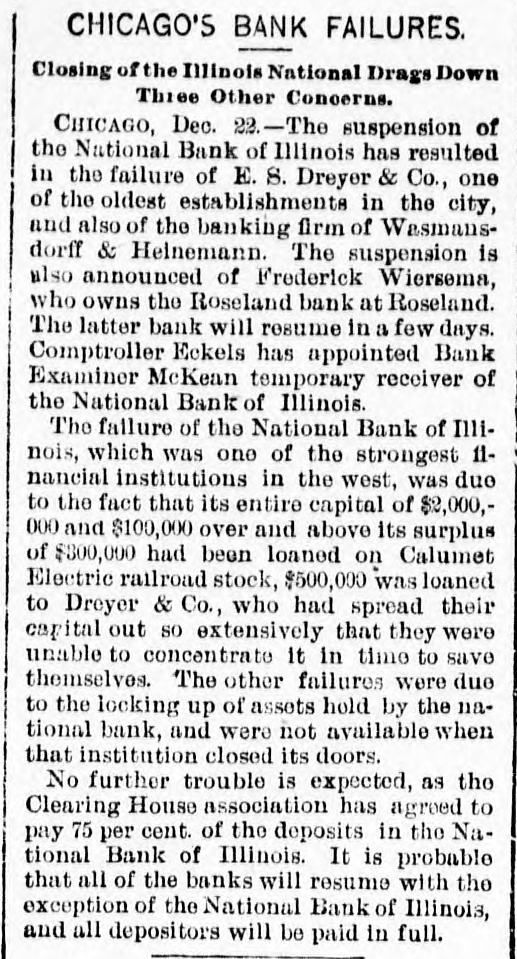
CHICAGO'S BANK FAILURES. Closing of the Illinois National Drags Down Three Other Concerns. CHICAGO, Dec. 22. - The suspension of the National Bank of Illinois has resulted in the failure of E. S. Dreyer & Co., one of the oldest establishments in the city, and also of the banking firm of Wasmansdorff & Heinemann. The suspension is also announced of Frederick Wiersema, who owns the Roseland bank at Roseland. The latter bank will resume in a few days. Comptroller Eckels has appointed Bank Examiner McKean temporary receiver of the National Bank of Illinois. The failure of the National Bank of Illinois, which was one of the strongest 11nancial institutions in the west, was due to the fact that its entire capital of $2,000,000 and $100,000 over and above its surplus of $300,000 had been loaned on Calumet Electric railroad stock, $500,000 was loaned to Dreyer & Co., who had spread their capital out SO extensively that they were unable to concentrate it in time to save themselves. The other failures were due to the locking up of assets hold by the national bank, and were not available when that institution closed its doors. No further trouble is expected, as the Clearing House association has agreed to pay 75 per cent. of the deposits in the National Bank of Illinois. It is probable that all of the banks will resume with the exception of the National Bank of Illinois, and all depositors will be paid in full.


Article from The Portland Daily Press, December 22, 1896

Click image to open full size in new tab

Article Text

LIKE ROW OF BLOCKS. Chicago Banking Institutions Tumbling Down Over Each Other. Chicago, December 21.-S. S. Dreyer & Co., one of the oldest banking establishments of this city, failed at 10 o'clock this morning. The banking firm of Wasmannsdoff & Heimann, 145 and 147 East Randolph street, is announced to be in the hands of the Security Title and Trust Company. The National Bank of Illinois, Incated at 115 Dearborn street, and one of the oldest and best known banking institutions in the city, with assets amounting to nearly $15,000,000, diΓ‘ not open its doors this morning. The causes of the suspension as given in the resolutions adopted by the clearing house committee, 'unwarrantable and injudicious loans, through which "the capital and surplus of said bank is seriously imperilled, if not absolutely lost. At the last statement of the bank its capital was shown to be $1,000,000 with a surplus of $1,000,000 and undivided assets of over $300 000. Both the first named failures were a direct outcome of the National bank of Illinois closing its doors. A run on the Garden City Banking and Trust company bank was caused by the fact becoming generally known among the depositors that the institution cleared through the failed national bank of Illinois. The withdrawals were promptly met until the regular hour for closing the bank. At the Illinois Trust and Savings and American Trust and Savings banks, there were small lines of mon and women who were anxious to get their money. The bank officers were glad to pay it out as the withdrawals in the savings department meant a gain of interest money. Both these banks are regarded financially impregnable. President Schneider of the National bank of Illinois is treasurer of the Chicago Associated Press. In regard to the failure of the National Bank of Illinois, Comptroller Eckles said: "The failure of the bank is due to injudicious, reckless and imprudent methods, followed by the officers. and not checked by the directors though their attention individually was called to the same, and over their individual signatures they promised to remedy the weak points in the bank's condition." a The Roseland bank, situated in the suburbs of Roseland, peopled largely by Hollanders, did not open its doors this morning. The bank is owned by Fred Weirsman. The depositors, who are mostly poor people, were assured that they would get their money as soon as the money was received from the National Bank of Illinois. Linseed Oil Company Fails. Chicago, December 21.-A bill was filed in the circuit court by the National Linseed Oil Company, and the Grove Linseed Oil Company, asking for the appointment of a receiver for the Firemen's Insurance Company, an application based upon the judgments recovered and upon the ground that an effort is being made to throw the company into the hands of a friendly receiver. The insurance company has a capital stock of $500,000, one half of this is said to be have been paid in. The statement is made that the company is totally insolvent.


Article from The Evening Herald, December 22, 1896

Click image to open full size in new tab

Article Text

CHICAGO'S BANK FAILURES. Closing of the Illinois National Drags Down Three Other Concerns. CHICAGO, Dec. 22.-The suspension of the National Bank of Illinois has resulted in the failure of E. S. Dreyer & Co., one of the oldest establishments in the city, and also of the banking firm of Wasman:dorff & Heinemann. The suspension is also announced of Frederick Wiersema, who owns the Roseland bank at Roseland. The latter bank will resume in a few days. Comptroller Eckels has appointed Bank Examiner McKean temporary receiver of the National Bank of Illinois. The failure of the National Bank of Illinois, which was one of the strongest financial institutions in the west, was due to the fact that its entire capital of $2,000,000 and $100,000 over and above its surplus of $300,000 had been loaned on Calumet Electric railroad stock, $500,000 was loaned to Dreyer & Co., who had spread their capital out so extensively that they were unable to concentrate it in time to save themselves. The other failures were due to the locking up of assets held by the national bank, and were not available when that institution closed its doors. No further trouble is expected, as the Clearing House association has agreed to pay 75 per cent. of the deposits in the National Bank of Illinois. It is probable that all of the banks will resume with the exception of the National Bank of Illinois, and all depositors will be paid in full.


Article from The Saint Paul Globe, December 22, 1896

Click image to open full size in new tab

Article Text

the affairs of the National Bank of Illinois, the clearing house banks were advised to advance 75 per cent on all claims against the National Bank of Illinois, which shall have been certified to by the receiver as being on deposit in that bank. The general sentiment of opinion was that the depositors would receive their money in full. The bank has now on hand in cash nearly forty per cent of its entire liability. No banks requested any assistance from the clearing house, and the statements published today, on the call of the comptroller of the currency, at the close of business on the 17th instant, show very strong reserves. There has been very little excitement today in banking circles in this city. The following resolution was adopted at the meeting: Resolved, That the clearing house committee, after calling to their aid such other persons as they may desire, be requested to formulate a plan which will enable creditors of the National Bank of Illinois to avail themselves of the offer of associated banks to make advances by way of loans to said creditors to the extent of 75 per cent, upon properly proven claims. The chairman of the clearing house stated that the willingness of bankers to do this was SO evident that it is not probable that any formal organization to accomplish the object will be necessary, althought the committee appointed will give prompt attention to the duty imposed upon it. The following dispatch was received today by the president of the clearing house committee: I have appointed Bank Examiner McKeon temporary receiver of the National Bank of Illinois and instructed him to publish notice for creditors to prove claims. He informs me that the clearing house committee agrees to advance 75 per cent on evidence of claims. Notice will be published at once and if claims are proven immediately I shall, within thirty days, be able to pay a very considerable dividend. I appreciate the action of the clearing house in offering to advance on such certificates. -Charles H. Eckles, Comptroller. Another suspension was recorded late in the afternoon, when Judge Horton, of the circuit court, appointed John H. Nichols receiver for the property of Frederick Wiersoma, who owns the Roseland bank, which is situated in Roseland, a suburb. The appointment was made upon the application of George Dalenberg, a judgment creditor of Wiersema to the extent of $600. The complainant attributed the embarrassment of Mr. Wiersema to the connection of the latter with the National Bank of Illinois. The assets are placed at $75,000, and the deposits at $50,000. The bank will resume business within a few days.


Article from Omaha Daily Bee, December 22, 1896

Click image to open full size in new tab

Article Text

CHICAGO BANK IS CLOSED UP Illinois National in the Hands of the National Bank Examiner. LOSS TO DEPOSITORS WILL BE SMALL One Big Loan to Street Railway Comvany Considered Grossly Injudiclous by Clearing House, Which Promptiy Closes the Bank. CHICAGO, Dec. 21.-The National Bank of Illinois, generally considered one of the strongest financial institutions in the west, closed its doors today, the failure dragging down three other concerns, E. S. Dreyer & Co.; Wasmansdorff, Heinemann & Co., and the Roseland bank. The failure of the National Bank of Illinois was due to the fact that its entire capital of $2,000,000 and $100,000 over and above its surplus of $300,000, had been loaned on Calumet Electric stock. In addition, $500,000 was loaned to Dreyer & Co., who had spread their capital out so extensively that they were unable to concentrate it in time to same themselves. The other failures were due to the locking up of assets held by the National Bank of Illinois, and which were not available when that institution closed its doors. No further trouble is expected, as the Clearing House association has agreed to pay 75 per cent of the deposits in the National Bank of Illinois, and at the meeting of the clearing house committee this afternoon all of the banks reported themselves in good condition, and none of them asked for the aid that would have been freely extended had It been asked. It is probable all of the banks will resume with the exception of No Dank of Illinois and all de-


Article from Omaha Daily Bee, December 22, 1896

Click image to open full size in new tab

Article Text

National Bank of Illinois was a loan of $2,400,000 to the Calumet Electric Railway company. This. with three or four other loans, threatened such severe losses that the clearing house committee saw no way but to suspend the bank. The loss in Hquidation will be small, If any to depositors. It is not probable that the bank will resume business. A director of the National bank of Illinois stated today that the loan made to the Calumot electric street railway, $2,400,000. was without the knowledge of the directors. The efforts made to dispose of the Calumet stock. which was held as security for the loan. drow attention to It and brought about the investigation, which resulted in the bank's suspension. COMMITTEES PLAN ENDORSED. At the meeting of the clearing house banks, held at the close of business this afternoon. upon recommendation of the clearing house committee, which had made a thorough examination of the affairs of the National Bank of Illinois, the clearing house banks agreed to advance 75 per cent on all claims against the National Bank of Illinois, which shall have been certified to by the receiver 23 being on deposit in that bank. The general sentiment of opinion was that the depositors would receive their money in full The bank now has on hand in cash means, nearly 40 per cent of its entire liabilities. No banks requested any assistance from the clearing house. The bank statements, published today, on the call of the comptroller of the currency at the close of business. on the 17th instant, show very strong reserves. There has been very little excitement today in banking circles in this city. The following resolutions were adopted at the meeting: Resolved. That the clearing house committee. after calling to their aid such other persons as they may desire, be requested to formulate a plan which will enable creditors of the National Bank of Illinois to avail themselves of the offer of the assoclated banks to make advances by way of loans to said creditors to the extent of 75 per cent upon properly proven claims. The chairman of the clearing house stated that the willingness of the bankers to do this was SO evident that it is not probable that any formal organization to accomplish the object will be necessary, although the committee appointed will give prompt attention to the duty imposed upon them. The following dispatch was received today by the president of the clearing house committee: WASHINGTON Dec. 21.-I have appointed Bank Examiner McKeown temporary receiver of the National Bank of Illinois and instructed him to publish notice for creditors to prove claims. He informs me that the clearing house committee agrees to advance 75 per cent on evidence of claims. Notice will be published at once, and if claims are proven immediately, I shall, within thirty days, be able I to pay a very considerable dividend. appreciate the action of the clearing house in offering to advance on such certificates. JAMES H. ECKELS, Comptroller. Another suspension was recorded this evening. when Judge Horton of the circuit court, appointed John H. Nicholls receiver for the property of Frederick Wiersema, who owns the Roseland bank. which is situated in Roseland. The appointment was made upon the application of George Dalenberg, a judgment creditor of Wiersema, to the extent of $600. The complainant attributed the embarrassment of Mr. Wiersema to the connection of the latter with the National Bank of Illinois. The assets are placed at $75,000. and the deposits at $50,000. The bank will resume business within a few days. NEW YORK, Dec. 1.-Officials of the Mercantile and the American Exchange banks of this city, correspondents of the National Bank of Illinois, say they will not be at fected to any important extent by its failure The American Exchange has merely handled collections for the Chicago bank and is actually a debtor to it. The Mercantile National bank people say that the Chicago bank does not owe them, except for notes in their hands for collection, and express deep sympathy for the officials of the Chicago bank. BOSTON, Dec. 21.-The Shawmut National bank of this city has a very handsome balance to the credit of the National Bank of Illinois, but has received telegraphic orders today from the bank examiner at Chicago to pay no more checks upon this account. As far as can be learned none of the Omaha banks are affected by the failure except the Nebraska National, which is concerned to a considerable amount. The National Bank of Illinois has been the Chicago correspondent of the Nebraska National for many years, and at times has carried large amounts of its funds. Pres ident Yates this morning declined to say how deeply the Nebraska National was concerned, but stated that it was not nearly as bad as it might have been. The failure might have caught them for $300,000 or $400,000, but recently they had been carrying heavier balances here and their Chicago deposits had consequently reached a comparatively low point. Mr. Yates added that they were not borrowing any trouble over the matter, as they had entire confi dence that the Illinois institution was in fairly good condition, and no one would lose


Article from The Houston Daily Post, December 22, 1896

Click image to open full size in new tab

Article Text

Another Failure. Chicago, December 21.-Another suspension was recorded late in the afternoon, growing out of the trouble of the National Bank of Illinois. Judge Horton of the circuit court appointed John H. Nichols receiver of the property of Frederick Welersms who owns the Roseland bank, which is situated in Roseland. The assets are placed at $75,000 and the deposits at $50,000. The bank will resume business in a few days.


Article from The Houston Daily Post, December 22, 1896

Click image to open full size in new tab

Article Text

A BIG FAILURE IN CHICAGOThe National Bank of Illinois Suspends Payment. THRE SMALLER BANKS GO DOWN Assets of the Bank of Illinois Bee tween Twelve and Fifteen MIIHons-Injudicions Loans. Chicago, December 21.-The National Bank of Illinois, generally considered one of the strongest financial institutions in the West, closed its doors and the failures dragged down three other concerns: E. S. Dryer & Co., Wasmansdorff, Eineman & Co., and the Roseland bank. The failure of the National Bank of IIIInois was due to the fact that its entire capital is $2,000,000 and $1,000,000 over and above its surplus $300,000 had been loaned on Calumet Electric Railway stock. Five hundred thousand dollars was loaned to Dryer & Co., who had spread their capital out so extensively that they were un. able to concentrate it in time to save themselves. The other failures were due to the locking up of assets held by the National Bank of Illinois and were unavailable when that institution closed its doors. No further trouble is expected. as the clearing house association has agreed to pay 75 per cent of the deposits in the Na. tional Bank of Illniois and at the meeting of clearing house committee this afternoon all of the banks reported themselves in good condition and none of them asked for aid that would have been freely extended had It been asked. It is probable that all of the banks will resume with the exception of the National Bank of Illinois and all depositors will be paid in full. | Chicago, December 21. - The National Bank of Illinois, one of the oldest and best known banking institutions in the city, and with assets of between $12,000,000 and $15,000,000, closed its doors today. The following notice was posted on the doors before the banking hours: "This bank is in the hands of the National bank excha nge, by order of the comptroller of the treasury." This action was decided upon at a meeting of the directors of the bank last night after the bank had been suspended from the Clearing House association of Chicago at a meeting of the clearing house committee held earlier in the day. or the sixteen banks that cleared through the National Bank of Illinois two closed their doors as a result of the closing of that institution. They are E. S. Dryer & Co. and Wasmnasdorff & Heineman. These two institutions are mortgage loan banks


Article from The Providence News, December 22, 1896

Click image to open full size in new tab

Article Text

Chicago Bank Suspensions, Chicago, Dec. 22.-The National bank of Illinois, generally considered one of the stongest financial institutions in the west, closed its doors yesterday, and the failure dragged down three other concerns, E. S. Dreyer & Co., Wasmandorff, Helneman & Co., and the Roseland bank. The failure of the National bank of Illinois was due to the fact that its entire capital of $2,000,000, and $100,000 over and above its surplus of $300,000, had been loaned on Calumet electric railway stock; $500,000 was loaned to Dreyer & Co., who had spread their capital out so extensively that they were unable to concentrate it in time to save themselves. The other failures were due to the locking up of assets held by the National bank of Illinois, and were not available when that institution closed its doors. No further trouble is expected, as the Clearing House association has agreed to pay 75 per cent of the deposits in the National bank of Illinois, and at the meeting of the clearing house committee yesterday afternoon all of the banks reported themselves in good condition, and none of them asked for aid that would have been freely extended had it been asked. It is probable that all of the banks will resume with the exception of the National bank of Illinois, and all depositors will be paid in full.


Article from The Record-Union, December 24, 1896

Click image to open full size in new tab

Article Text

CHICAGO FINANCIAL FLURRY. Public Scare Over the Bank Failure Practically Over. CHICAGO, Dec. 23.-Charges and counter-charges in connection with the management of the National Bank of Illinois were made to-day and engrossed the attention of the financial community to the exclusion of the day's events. The arrest of Bankers Dreyer and Berger, the discharge of the receiver of the Roseland Bank and the continuation of the savings depositors' run on the Illinois Trust and Savings Bank and the Hibenrian Banking Association were the principal developments. The public scare is practically over, and a complete restoration of confidence seems to have been effected. The Roseland Bank of Roseland, which cleared through the National Bank of Illinois, and which went into the hands of a receiver on Monday, was turned back into the hands of its officers, and will open its doors to-morrow morning. The runs on the Illinois Trust and Savings and Hibernian Savings Banks continued to-day in a lesser degree, and when the usual closing hour arrived there was not enough of a line at either bank to dignify the scare as a run. Not a vestige of the excitement is expected after Christmas Day. The officers of the Illinois Trust were so confident that the run on their bank had come to an ignoble end that after paying out under the sixty-day notice rule the deposits of over 100 depositors, decided to remove all restrictions, and began paying in full. At the Hibernian Bank the rule was adhered to.


Article from The Scranton Tribune, December 24, 1896

Click image to open full size in new tab

Article Text

CHICAGO BANK TROUBLES. The Arrest of Dreyer and Berger for Receiving Deposits When Knowing Their Bank Was Insolvent. Chicago, Dec. 23.-Charges and councharges in connection with the man- Illiter of the National bank of the agement were made today and engrossed to nois attention of the financial community surexclusion of the day's events rounding the the National Bank collapse. arrest of Bankers Dreyer and of The the discharge of the receiver Berger, Roseland bank and the continuation the the the savings depositors run on the of Illinois Trust and Savings bank and Hibernian Banking association. were principle developments. The and pub- a the scare is practically over complete lie restoration of confidence seems to be effected. arrangement of the police depart- and By counsel for the defendants acment, of the peace, W. T. Hall. the cused justice private bankers. Edward S. Justice Dreyand Robert Berger, entered o'clock er private court room at 2 who Hall's afternoon. Detective Fay, this the warrants which F. E. Kennedy. held saloon keeper and depositor at Dreyer a Co.'s bank had sworn to. announced The & the men were under arrest. banker that is each case is that the close charge a deposit of $153 at the received business last Saturday. knowing The at of time that they were insolvent. defendants the were accompanied by Adolf H. their lawyer, and Charles Brewing Kraus. of Wacker & Birk bond Wacker. The latter signed the each company. the bankers in the sum of $500 Hall's of their appearance in Justice actfor Jan. 2. Kennedy says he is is court for himself only. but his action advised ing regarded as premature and ill & Co. those who believe the Dreyer this by could not be foreseen. In the connection failure Levy Mayer. counsel for National bank of Illinois. and Dreyer and Berger, said this afternoon: Dreyer & company cleared through the National bank of Illinois. At the of business Saturday afternoon close was not the slightest doubt shadow enterthere tained by the firm or even the not go suggestion that they would Withof a usual Monday morning. on as clearing bank they could not posout a open up. The end of the Nation- as it sibly of Illinois was as sudden al bank amazing. As one of its counsel that I was the slightest intimation the had not was any suspicion against Dreythere until late Saturday night. Sunbank Company did not know until danger. er & that their clearing was in resulted day then took steps which as They receivership. The agitation precipiin the has made some people their present and hasty in their criticism, the extate and their advice. When receiver action has subsided and the into citement a thorough investigation be has made and then only will people the estate to calmly pass judgment. bank of in a position causes for the National will no The failure and its condition the Illinois in due time be placed before bonds, doubt These Calumet Electric dwindled public. have all of a sudden have for which insignificant an asset outinto so been coveted by some bonds some years and the interest on these siders has always been promptly met." The shortest bank receivership on


Article from The Austin Weekly Statesman, December 24, 1896

Click image to open full size in new tab

Article Text

BANK ONE BIG ONE AND TWOSMALLER CONCERNS HAVE SHUT UP SHOP. With Assets of Between $12,000,000 and $15,000,000 Failed to Open Monday Morning-Unwarrantable and Injudicious Loans the Cause. Chicago, Dec. 21.-The Nationa! Bank of Illinois, one of the oldest and best known banking institutions in the city, and with assets of between $12,000,000 and $15,000,000, closed its doors today. The following notice was posted on the door before the banking hours: "This bank is in the hands of the National Bank Exchange by order of the comptroller of the treasury.' This action was decided upon at a meeting of the directors of the bank last night after the bank had been suspended from the Clearing House association of Chicago at a meeting of the clearing house held early in the day. Of the sixteen banks that cleared through the National Bank of Illinois two closed as a result of the failure. They are E. W. Dreyfus & Co., and Wasmandorff & Heineman. These two institutions are mortgage loan banks and savings in a small way and their failure is not expected to affect any business houses. The failure was a great surprise in business circles. The causes, as given by the clearing house committee, are "unwarrantable and injudicious loans,' through which the capital and surplus of said bank is surely imperiled, if not absolutely lost One of the leading bankers and financiers of this city at noon today said to an Associated Press reporter: The failure of the National Bank of Illinois has created no disturbance of consequence in financial circles here. One or two private bankers have failed. But of this is only a natural consequence such banking of real estate values.' The statement was made that a loan of $2,400.00 to the Calumet Street Railway company, of which J. W. Farson of Farson, Leach & Co., is president, had caused the National Bank of Illinois to suspend. Mr. Farson declined to make a statement on that subject but stated that the failure would not affect the Calumet road. Heavy loans on real estate are also said have been made. The last statement of to the bank showed deposits, $12,125 766; loans, 9,199,642; cash securities, $4,983,808. It is thought probable that none of the depositors will suffer from the suspension as the bankers who were present the meeting of the committee recomat mended a proposition to advance 75 per cent on all adjusted claims against the National Bank of Illinois. In addition to this they have agreed to use their influence with all other members of the Clearing House association to accept all such claims as collateral at the same ratio. The National Bank of Illinois was organized in August, 1871, with a capital stock of $300,000, which was subsequent increased to $1,000,000. It was regarded ly as one of the soundest financial institutions in the city Another suspension was recorded late the the afternoon. growing out of in trouble of the National Bank of Illinois. Judge Horton of the circuit court appointed John Nickols receiver for the property of Frederick Weirsma, who the Roseland bank, which is situated owns in Roseland. The assets are placed $75,000, and the deposits at $50,000. at The bank will resume business in a few days. COMPT. ECKELS' STATEMENT. Washington, Dec. 21.-In regard to the statement made today regarding the Illinois, failure of the National Bank of Comptroller Eckels said: "The failure is due to injudicious, reck- by and imprudent methods followed less officers and not checked by the dithe rectors, though their attention had been individually called to the same, and over their individual signature they had prom- the ised to remedy the weak points in of condition. The larger source failure bank's is the bank's holdings in Calumet street railway stock, the full amount disof which can now be stated, for it is that a part of such holdings was made covered to appear on the books, but carnot ried in another account. This and doubt- letloans had been called by special ful the attention of the officers and diter to and specific improvement prom- the rectors since. In June last on ised a year there had been made an improve- Me surface but when Bank Examiner the ment, on November 30, examined Keon, he found that the books showed and bank to the Calumet company n the loans similar loans had been increased dit other and the promises of the officers and t d rectors had not been carried out. addressed Upon this report I prepared a letter which the president and directors, December 14, to to the examiner on B sent read to them. This letter reviewed t to be length the condition of the bank I and emF at failure of the promises made. offithe the position taken by the phasized that a decided and radical change the cers made ana notified A had to be with at once a full and complete anal- the S directors the part of the examiner of m vsis on the bank demanding attenel matters in received notice d On Saturday I of the tion. from the examiner that rumors


Article from Wood County Reporter, December 24, 1896

Click image to open full size in new tab

Article Text

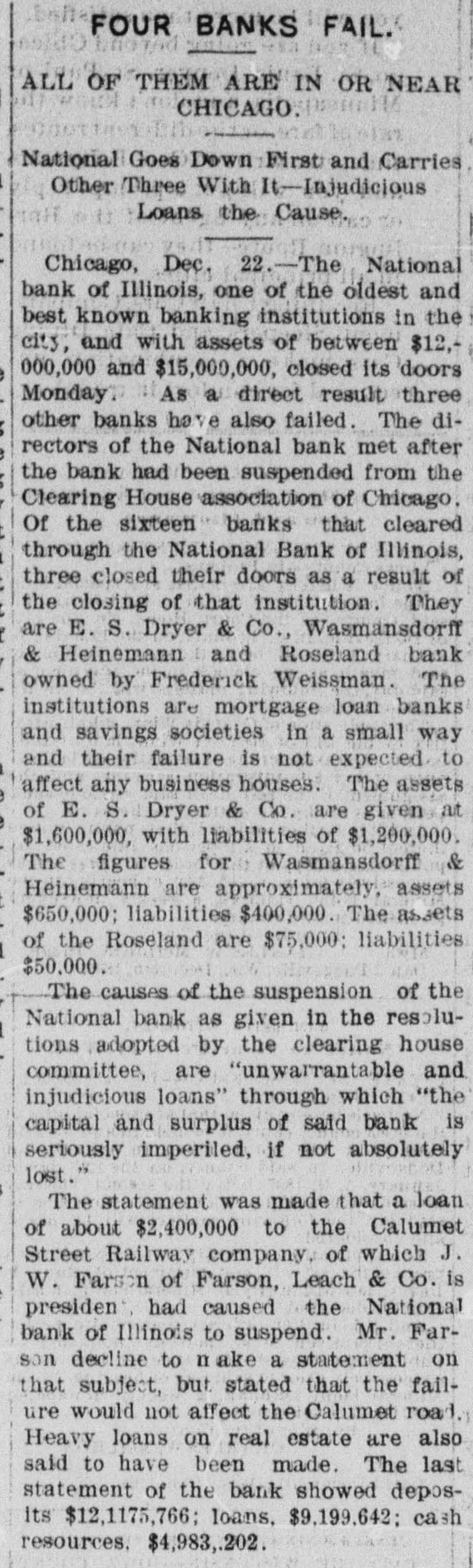
FOUR BANKS FAIL. ALL OF THEM ARE IN OR NEAR CHICAGO. National Goes Down First and Carries Other Three With It-Injudicious Loans the Cause. Chicago, Dec. 22.-The National bank of Illinois, one of the oldest and best known banking institutions in the city, and with assets of between $12,000,000 and $15,000,000, closed its doors Monday. As a direct result three other banks have also failed. The directors of the National bank met after the bank had been suspended from the Clearing House association of Chicago. Of the sixteen banks that cleared through the National Bank of Illinois, three closed their doors as a result of the closing of that institution. They are E. S. Dryer & Co., Wasmansdorff & Heinemann and Roseland bank owned by Frederick Weissman. The institutions are mortgage loan banks and savings societies in a small way and their failure is not expected to affect any business houses. The assets of E. S. Dryer & Co. are given at $1,600,000, with liabilities of $1,200,000. The figures for Wasmansdorff & Heinemann are approximately, assets $650,000; liabilities $400,000. The assets of the Roseland are $75,000; liabilities $50,000. The causes of the suspension of the National bank as given in the resolutions adopted by the clearing house committee, are "unwarrantable and injudicious loans" through which "the capital and surplus of said bank is seriously imperiled, if not absolutely lost." The statement was made that a loan of about $2,400,000 to the Calumet Street Railway company, of which J. W. Farson of Farson, Leach & Co. is president, had caused the National bank of Illinois to suspend. Mr. Farson decline to n ake a statement on that subject, but stated that the failure would not affect the Calumet road. Heavy loans on real estate are also said to have been made. The last statement of the bank showed deposits $12,1175,766; loans, $9,199,642; cash resources. $4,983,.202.


Article from The San Francisco Call, December 24, 1896

Click image to open full size in new tab

Article Text

MONEY BROKERS UNDER ARREST Sequel to the Collapse of the Illinois National Bank. A Concern That Was Squeezed by a Calumet E'ectric Bond Deal. The Public Scare Practically Over and Confidence Seems to Have Been Restored. CHICAGO, ILL., Dec. 23.-Charges and counter charges in connection with the management of the National Bank of Illinois were made to-day and engrossed the attention of the financial community to the exclusion of the day's events surrounding the big National bank collapse. The arrest of Bankers Dreyer and Berger, the discharge of the receiver of the Roseland Bank and the continuation of the savings depositors' run on the Illinois Trust and Savings Bank and the Hibernian Banking Association were the principal developments. The public scare is practically over and a complete restoration of confidence seems to have been effected. By arrangement of the Police Department counsel for the defendants and Justice of the Peace W. T. Hall, the accused private bankers, Edward S. Dryer and Robert Berger, entered Justice Hall's courtroom at 2 o'clock this afternoon. Detective Fay, who held the warrants which F. E. Kennedy, a saloon-keeper and depositor at Dreyer & Co.'s Bank, had sworn to, announced that the men were under arrest. The char. e in each case is that the bankers received a deposit of $153 at the close of business last Saturday, knowing at the time that they were insolvent. The defendants were accompanied by Adolf Kraus, their lawyer, and Charles H. Wacker of the Wacker G Birk Brewing Company. The latter signed the bond of the bankers in the sum of $500 each for their appearance in Justice Hall's court January 2. Kennedy says he is acting for himself only, but his action is regarded as premature and ill advised by those who believe the Dreyer & Co. failure could not be foreseen. In this connection Levy Mayer, counsel for the National Bank of Illinois and Dreyer & Berger, said to a reporter of the United Associated Presses this afternoon: "Dreyer & Co. cleared through the National Bank of Illinois. At the close of business Saturday afternoon there was not the slightest doubt entertained by the firm or even the shadow. of a suggestion that they would not go on as usual Monday morning. Without a clearance bank they could not possibly open up. The end of the National Bank of Illinois was


Article from Mineral Point Tribune, December 24, 1896

Click image to open full size in new tab

Article Text

FOUR BANKS FAIL. ALL OF THEM ARE IN OR NEAR CHICAGO. National Goes Down First and Carries Other Three With It-Injudicious Loans the Cause Chicago, Dec. 22.-The National bank of Illinois, one of the oldest and best known banking institutions in the city; and with assets of between $12,000,000 and $15,000,000, closed its doors Monday. As a direct result three other banks have also failed. The directors of the National bank met after the bank had been suspended from the Clearing House association of Chicago. Of the sixteen banks that cleared through the National Bank of Illinois, three closed their doors as a result of the closing of that institution. They are E. S. Dryer & Co., Wasmansdorff & Heinemann and Roseland bank owned by Frederick Weissman. The institutions are mortgage loan banks and savings societies in a small way and their failure is not expected to affect any business houses. The assets of E. S. Dryer & Co. are given at $1,600,000, with liabilities of $1,200,000. The figures for Wasmansdorff & Heinemann are approximately, assets $650,000; liabilities $400,000 The assets of the Roseland are $75,000: liabilities $50,000. The causes of the suspension of the National bank as given in the resolutions adopted by the clearing house committee, are "unwarrantable and injudicious loans" through which "the capital and surplus of said bank is seriously imperiled, if not absolutely lost." The statement was made that a loan of about $2,400,000 to the Calumet Street Railway company, of which J. W. Farson of Farson, Leach & Co. is presiden had caused the National bank of Illinois to suspend. Mr. Farson decline to n ake a statement on that subject, but stated that the failure would not affect the Calumet road Heavy loans on real estate are also said to have been made. The last statement of the bank showed deposits $12,1175,766; loans, $9,199,642; cash resources. $4,983,.202.


Article from The Daily Herald, December 25, 1896

Click image to open full size in new tab

Article Text

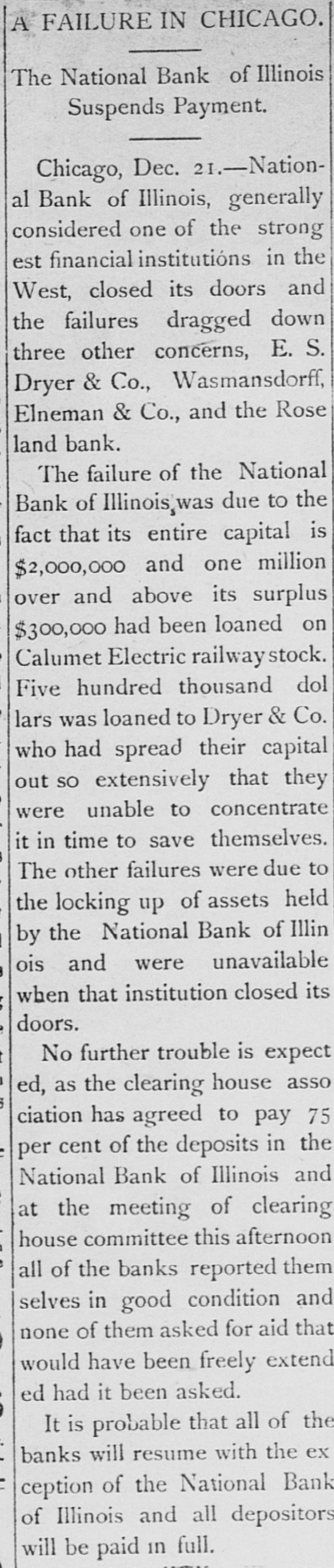
A FAILURE IN CHICAGO. The National Bank of Illinois Suspends Payment. Chicago, Dec. 21.-National Bank of Illinois, generally considered one of the strong est financial institutiΓ³ns in the West, closed its doors and the failures dragged down three other concerns, E. S. Dryer & Co., Wasmansdorff, Elneman & Co., and the Rose land bank. The failure of the National Bank of Illinois was due to the fact that its entire capital is $2,000,000 and one million over and above its surplus $300,000 had been loaned on Calumet Electric railway stock. Five hundred thousand dol lars was loaned to Dryer & Co. who had spread their capital out so extensively that they were unable to concentrate it in time to save themselves. The other failures were due to the locking up of assets held by the National Bank of Illin ois and were unavailable when that institution closed its doors. No further trouble is expect ed, as the clearing house asso ciation has agreed to pay 75 per cent of the deposits in the National Bank of Illinois and at the meeting of clearing house committee this afternoon all of the banks reported them selves in good condition and none of them asked for aid that would have been freely extend ed had it been asked. It is probable that all of the banks will resume with the ex ception of the National Bank of Illinois and all depositors will be paid in full.


Article from The Copper Country Evening News, December 26, 1896

Click image to open full size in new tab

Article Text

Roseland Bank Resumes. Chicago, Dec. 25.-Business was resumed in the Roseland bank Thursday morning. Frederick Wiersema, the owner, has secured sufficient funds to meet all his obligations, so his attorneys say, and has made arrangements to clear through the Chicago National bank. A showing of solvency was made before Judge Hanecy, and on the strength of it the latter discharged the receiver appointed by the circuit court, after the failure of the National Bank of Illinois, and also dismissed the suit in which the appointment was asked.


Article from Barton County Democrat, January 14, 1897

Click image to open full size in new tab

Article Text

idea-that build a house you should first put up the parlors and receptions rooms, and afterwards the foundation, the cellar and the kitchen? Is the gold-standard theory of adopting a system of finances that the bankers and monied men want, regardless of what the PRODUCERS, the LABORERS-the foundation of all national prosperity-needs, thus far proving a good thing for the country? Here is a record of failures for the 15 days ending January 4, 1897: Dec. 21-National Bank of Illinois, Chicago. Dec. 21-Roseland Bank, Chicago. Dec. 21-E.S Dreyer & Co. Chicago. Dec. 21 -Wusmansdorff & Heinemann, Chicago. Dec. 22-Bank of Minnesota. St. Paul. Dec. 22-State Bank of St. Paul. Dec. 22-Union Stock Yards Bank, St. Paul. Dec. 23-Chicago Bank, West Superior, Wis. Dec. 23-Bank of West Superior, West Superior, Wis, Dec. 23-American Banking and Trust Co., Auburn, Me. Dec. 28-Dime Savings Bank, Chicago. Dec. 28--Atlas National Bank, Chicago. Dec. 28-Scandia Bank, Minneapolis. Dec. 28-Bank of Superior, Supe rior, Wis. Dec. 29-Columbia Bank, Minneapolis. Dec. 29--Washington Bank, Min8 neapolis. i Dec.29--Commercial National Bank, D Va. Dec. 30-Northern Trust Company, r Minneapolis. Dec. 30 Bankers' Exchange Bank, 1 Minneapolis. . Dec. 30 Northwestern Loan and e Building Association, Minneapolis. Dec. 30 Commercial Bank, Selma, Al. Dec. 30 Farmers' Trust Company, Sioux City, Iowa, y t Jan. 4 Germania Bank, St. Paul. y Jan, 4 Allemania Bank, St. Paul. r Jan. 4 West Side Bank, St. Paul. it Jan. 4 Minnesota State Savings e Bank, St, Paul. Jan. 4 Citizens' National Bank, r. Fargo, N. D. d Jan. 4 City Bank, Nora Springs, If Iowa, a Total amount reported, $21,354,779 c OTHER HOUSES DRAGGED DOWN BY THE e CRASH, of Dec, 22 Angus & Giudele, contract rors, Chicago. of Dec. 23 American Brewing and Y, Malting Co., Chicago, Dec. 23 George A. Weiss Malting Co., Chicago. Dec. 23 George A. Weiss, Chicago r. Dec. 28 Excelsior Machinery an t, Belting Co., Chicago, st Dec. 29 Western Paper Bag Co. iBatavia, III. a Dec. 29 Appleton Manufacturing be Co., Van Nortwick, III, ch Jan. 4 Snow & Earl Co., druggist ct supplies, Providence, R. I IJan. 4 L. W. Alet & Co., wholesal ojewelers, Chicago, Ill. SUICIDES CAUSED BY THE BANK FAILURES if Otto Wasmandorff, head of th " banking firm of Wasmandorff & Heine of mann, of Chicago, shot himself in tha of city. Suicide due to worry over th I's failure of his firm, which occurred o December 21. ry George A. Wilkins, vice president o the suspended Commercial Bank, o ds Selma, Ala., shot himself on Decembe 31, in front of the altar of St. Paul'