16635. Spring Garden National Bank (Philadelphia, PA)

Bank Information

Episode Type
Run โ†’ Suspension โ†’ Closure
Bank Type
national
Bank ID
3468
Charter Number
3468
Start Date
May 8, 1891
Location
Philadelphia, Pennsylvania (39.952, -75.164)

Metadata

Model
gpt-5-mini
Short Digest
e452171f0d4e4d9a

Response Measures

Borrowed from banks or large institutions, Full suspension, Books examined

Receivership Details

Depositor recovery rate
25.7%
Date receivership started
1891-05-21
Date receivership terminated
1901-12-09
OCC cause of failure
Fraud
Share of assets assessed as good
12.1%
Share of assets assessed as doubtful
23.9%
Share of assets assessed as worthless
64.0%

Description

The Spring Garden National Bank was subject to heavy withdrawals and crowds on May 8, 1891; the Comptroller's examiner closed the bank the same day. A receiver (Fisher) was later appointed and the bank's officers were arrested for falsifying records and embezzlement, indicating permanent failure rather than a temporary suspension.

Events (6)

1. March 13, 1886 Chartered
Source
historical_nic
2. May 8, 1891 Run
Cause
Bank Specific Adverse Info
Cause Details
Large withdrawals during the ongoing financial stringency, weakened reserve and credit; depositors gathered and demanded admittance leading to panic-like conditions.
Measures
President announced placing the bank in the hands of W. P. (W. B.) Drew, National Bank Examiner; doors closed by order of the Comptroller.
Newspaper Excerpt
News of the suspension spread through the city like wildfire, and it was not long before the frightened depositors began to gather around the bank building at Twelfth and Spring Garden streets.
Source
newspapers
3. May 8, 1891 Suspension
Cause
Government Action
Cause Details
Closed by order of the Comptroller of the Currency / national bank examiner amid withdrawals and apparent insolvency.
Newspaper Excerpt
This bank is closed by order of the controller of the currency until further notice. W. B. DREW, National Bank Examiner.
Source
newspapers
4. May 21, 1891 Receivership
Source
historical_nic
5. May 28, 1891 Other
Newspaper Excerpt
Francis W. Kennedy, President, and Henry H. Kennedy, cashier, of the suspended Spring Garden National Bank, were arrested ... charged with making false entries ... and the embezzlement of the bank's funds.
Source
newspapers
6. May 28, 1891 Receivership
Newspaper Excerpt
Receiver Fisher said to-day that the further he examined into its affairs the blacker the outlook became for the depositors. ... The assets are thought to exceed the liabilities.
Source
newspapers

Newspaper Articles (24)

Article from The Morning News, May 9, 1891

Click image to open full size in new tab

Article Text

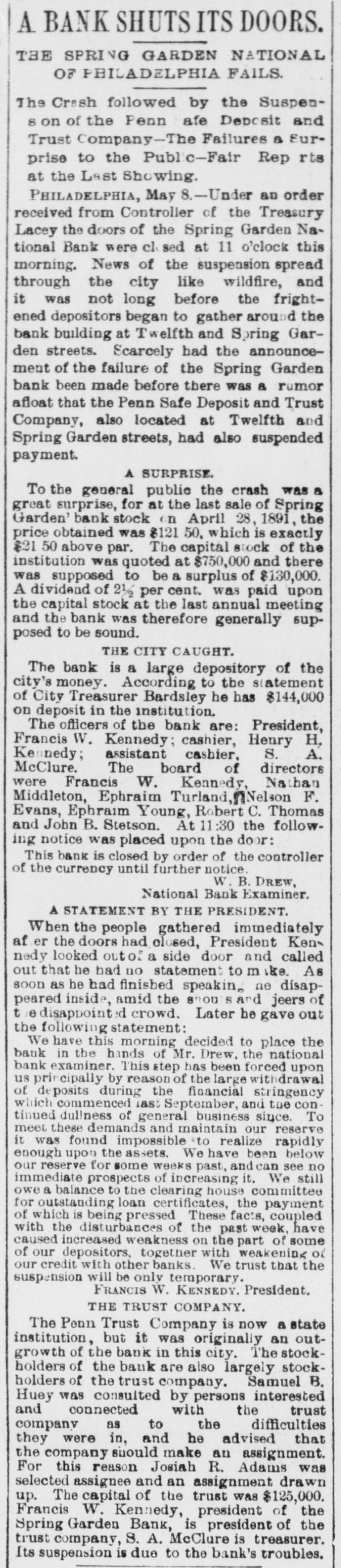
A BANK SHUTSIIS DOORS. THE SPRING GARDEN NATIONAL OF PHILADELPHIA FAILS. The Crash followed by the Suspen8 on of the Penn afe Deposit and Trust Company-The Failures a Eurprise to the Public-Fair Rep rts at the Last Showing. PHILADELPHIA, May 8.-Under an order received from Controller of the Treasury Lacey the doors of the Spring Garden National Bank were cl sed at 11 o'clock this morning. News of the suspension spread through the city like wildfire, and it was not long before the frightened depositors began to gather around the bank building at Twelfth and Spring Garden streets. Scarcely had the announcement of the failure of the Spring Garden bank been made before there was a rumor afloat that the Penn Safe Deposit and Trust Company, also located at Twelfth and Spring Garden streets, had also suspended payment. A SURPRISE. To the general public the crash was a great surprise, for at the last sale of Spring Garden' bank stock on April 28, 1891, the price obtained was $121 50, which is exactly $21 50 above par. The capital stock of the institution was quoted at $750,000 and there was supposed to be a surplus of $130,000. A dividend of 21/2 per cent. was paid upon the capital stock at the last annual meeting and the bank was therefore generally supposed to be sound. THE CITY CAUGHT. The bank is a large depository of the city's money. According to the statement of City Treasurer Bardsley he has $144,000 on deposit in the institution. The officers of the bank are: President, Francis W. Kennedy; cashier, Henry H, Kennedy; assistant cashier, S. A. McClure. The board of directors were Francis W. Kennedy, Nathan Middleton, Ephraim Turland, Nelson F. Evans, Ephraim Young, Robert C. Thomas and John B. Stetson. At 11:30 the following notice was placed upon the door: This bank is closed by order of the controller of the currency until further notice. W. B. DREW, National Bank Examiner. A STATEMENT BY THE PRESIDENT. When the people gathered immediately af er the doors had closed, President Kens nedy looked outof a side door and called out that he had no statement to m ke. As soon as he had finished speaking ne disappeared inside, amid the shou S and jeers of t e disappoint crowd. Later he gave out the following statement: We have this morning decided to place the bank in the hands of Mr. Drew. the national bank examiner. This step has been forced upon us principally by reason of the large withdrawal of deposits during the financial stringency which commenced last September, and the continued dullness of general business since. To meet these demands and maintain our reserve it was found impossible to realize rapidly enough upon the assets. We have been below our reserve for some weeks past, and can see no immediate prospects of increasing it. We still owe a balance to the clearing house committee for outstanding loan certificates, the payment of which is being pressed These facts, coupled with the disturbances of the past week, have caused increased weakness on the part of some of our depositors, together with weakening of our credit with other banks. We trust that the suspension will be only temporary. FRANCIS W. KENNEDY, President. THE TRUST COMPANY. The Penn Trust Company is now a state institution, but it was originally an outgrowth of the bank in this city. The stockholders of the bank are also largely stockholders of the trust company. Samuel B. Huey was consulted by persons interested and connected with the trust company 88 to the di

Article from Pittsburg Dispatch, May 9, 1891

Click image to open full size in new tab

Article Text

ANOTHER BANK GONE. The Spring Garden of Philadelphia Forced to Stop Business. BANK EXAMINER DREW CLOSES IT. Again Philadelphia City Is a Loser to the Extent of $144,000. PENN TRUST COMPANY ALSO ASSIGNS ISPECIAL TELEGRAM TO THE DISPATCH.1 PHILADELPHIA, May 3.-National Bank Examiner Drew, by order of the Controller of the Currency, to-day closed the doors of the Spring Garden National Bank, at Twelfth and Spring Garden streets. The Penn Trust and Safe Depost Company, an institution doing business in the same building and having practically the same set of officials, went into the ha nds of an assignee. While the President and other officers claim that the chances of the bank's resuming business are good and that the suspension would be only temporary, the general impression on the street is that the affairs of the bank are in very bad shape. No detailed statement was made public to-day, and President Kennedy said that it would be impossible to prepare one for-several days. Bank Examiner Drew took charge of the bank at 11:30 o'clock; at 1 o'clook closed the doors and soon afterward a squad of police marched up and took up their stations around the bank. The news of the closing of the bank spread quickly and within half an hour there was a crowd about the building, that steadily increased. Men and women with bank books in their hands thronged about the doors demanding admittance. Philadelphia Caught for 8144,000. To all the same answer was returned: "No one is allowed inside." Meanwhile all sorts o! rumors were set afloat regarding the condition of the bank and the causes which led to its closing. Many indignant depositors claimed that they had deposited money in the bank within a half hour of the time of the closing. Again the city is caught in the ruin, the Spring Garden Bank having been named as one of the depositories of the city's money, and when the doors closed there was $144,000 on deposit there. City Treasurer Bardsley and City Controller Thompson were both at the bank during the afternoon, but both claimed to know nothing of the causes which led to the suspension, and had very little to say about the suspension. Mysterious rumors connecting the defunct Keystone Bank with the suspension are afloat and together with the reports that are current regarding the affairs of the closed bank and its management, have created great excitement, At 12 o'clock the suspension was announced at the Clearing House, and the news: circulated throughout the business centers rapidly. Causes of the Failure. Each car which arrived brought people to swell the crowd, which it required the entire efforts of the police to keep moving. No one was admitted to the bank, and all the satisfaction the public got out of repeated inquiries at the door as to the cause which led to the closing of the bank was the following statement, issued by President Kennedy shortly after 12 o'clock: We have this morning decided to place the bank in the hands of Mr. Drew, the National Bank Examiner. This step has been forced upon us principally by reason of thelarge withdrawal of deposits during the financial stringency which commenced last September, and the continued dullness of general business since. To meet these demands and maintain our reserve. it was found impossible to realize rapidly enough on the assets. We have been below in our reserve for some weeks past, and can see no immediate prospect of increasing it. We still owe a balance to the Clearing House Committee for outstanding loan certificates, the payment of which is being pressed. These facts, coupled.with the disturbances of the past week, have caused increased uneasiness upon the partof some or our depositors, together with the weakening of our credit with the other banks. We trust that the suspension will only be temporary. Finances of the Bank. The bank's stock was quoted two days since at 121, par $100, and on Tuesday last it declared a dividend of 2ยฝ per cent on its capital of $750,000 and carried $2,500 to its surplus fund, making its total surplus $132,500. The last statement of the bank, under the Controller's call showed loans and discounts $2,170,028 18; National bank notes outstanding, $45,000; individual deposits, subject to check, $1,998,830 34; demand certificates of deposit, $8,000; undivided profits, $41,725 04. The officers of the bank are F. W. Kennedy, President; H. H. Kennedy, Cashier; N. Middleton, Vice President. It is supposed that the Kennedy family was largely interested in various real estate operations. Some years ago, when the Spring Garden was a State institution, the Kennedys were heavily interested in real estate at Bradford Hills, near Downington. The Spring Garden Bank was established in 1871 under the State banking law and continued in operation as a State bank for a period of 14 years. In the fall of 1885 the institution was reorganized as a National bank. The Penn Safe Deposit and Trust Company, which was an adjunct of the Spring Garden National Bank, is a State institution, and was incorporated November 8, 1870, with a capital of $125,000, par $100. No dividends have ever been paid.


Article from Fort Worth Gazette, May 9, 1891

Click image to open full size in new tab

Article Text

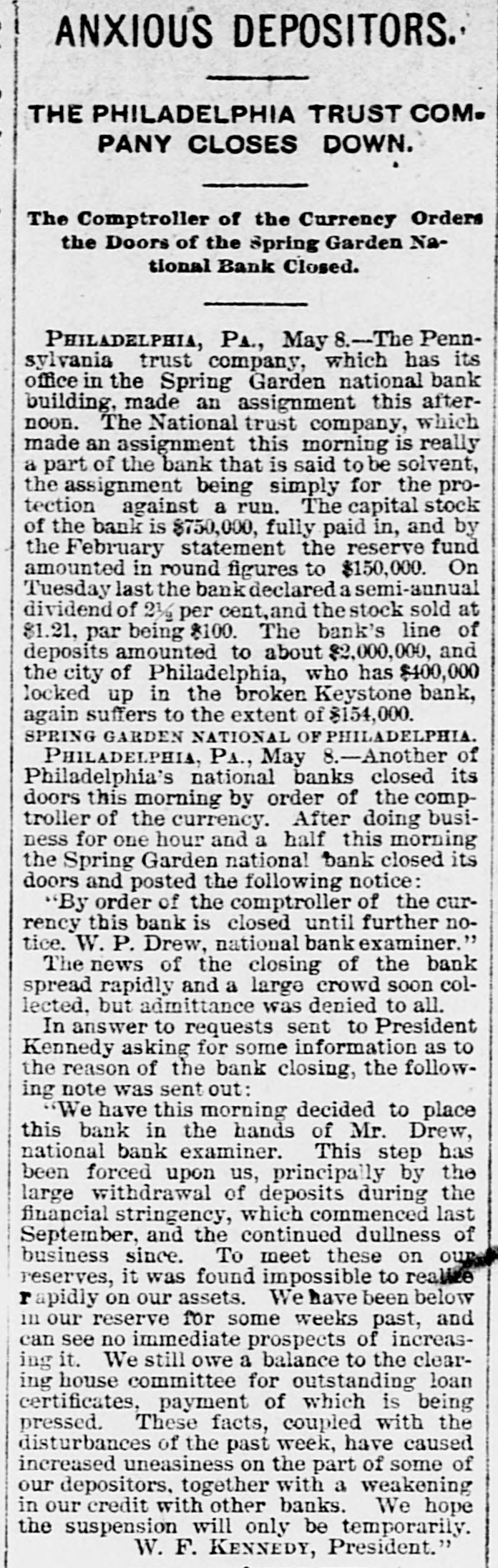
ANXIOUS DEPOSITORS. THE PHILADELPHIA TRUST COMPANY CLOSES DOWN. The Comptroller of the Currency Orders the Doors of the Spring Garden National Bank Closed. PHILADELPHIA, PA., May 8.-The Pennsylvania trust company, which has its office in the Spring Garden national bank building, made an assignment this afternoon. The National trust company, which made an assignment this morning is really a part of the bank that is said to be solvent, the assignment being simply for the protection against a run. The capital stock of the bank is $750,000, fully paid in, and by the February statement the reserve fund amounted in round figures to $150,000. On Tuesday last the bank declared a semi-annual dividend of 21/2 per cent, and the stock sold at $1.21, par being $100. The bank's line of deposits amounted to about $2,000,000, and the city of Philadelphia, who has $400,000 locked up in the broken Keystone bank, again suffers to the extent of $154,000. SPRING GARDEN NATIONAL OF PHILADELPHIA. PHILADELPHIA, Pa., May 8.-Another of Philadelphia's national banks closed its doors this morning by order of the comptroller of the currency. After doing business for one hour and a half this morning the Spring Garden national bank closed its doors and posted the following notice: "By order of the comptroller of the currency this bank is closed until further notice. W. P. Drew, national bank examiner." The news of the closing of the bank spread rapidly and a large crowd soon collected, but admittance was denied to all. In answer to requests sent to President Kennedy asking for some information as to the reason of the bank closing, the following note was sent out: "We have this morning decided to place this bank in the hands of Mr. Drew, national bank examiner. This step has been forced upon us, principally by the large withdrawal of deposits during the financial stringency, which commenced last September, and the continued dullness of business since. To meet these on OUR reserves, it was found impossible to realize apidly on our assets. We have been below 111 our reserve for some weeks past, and can see no immediate prospects of increasing it. We still owe a balance to the clearing house committee for outstanding loan certificates, payment of which is being pressed. These facts, coupled with the disturbances of the past week, have caused increased uneasiness on the part of some of our depositors, together with a weakening in our credit with other banks. We hope the suspension will only be temporarily. W. F. KENNEDY, President."


Article from Los Angeles Herald, May 22, 1891

Click image to open full size in new tab

Article Text

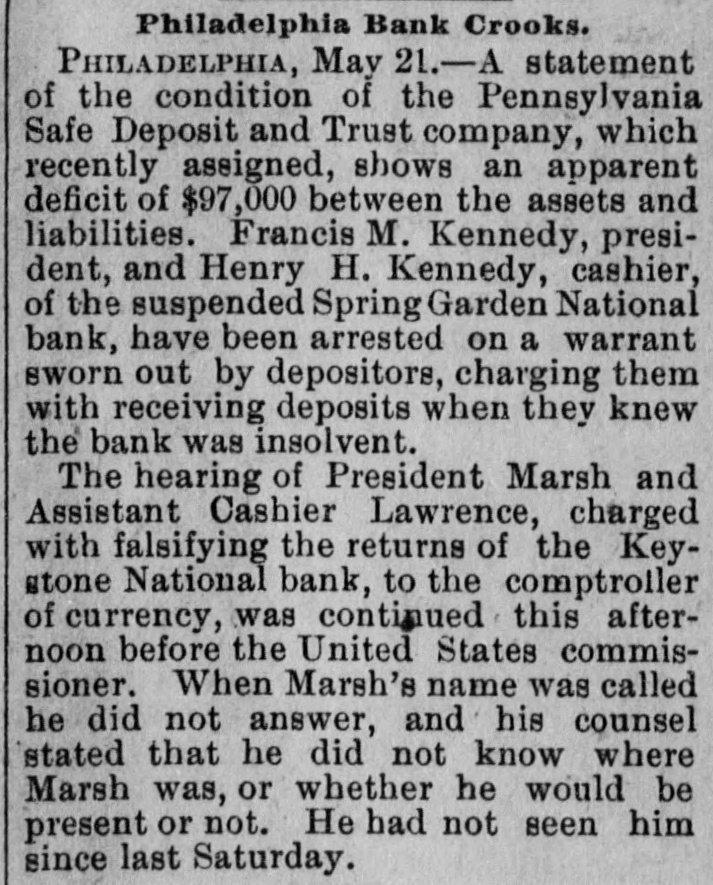
Philadelphia Bank Crooks. PHILADELPHIA, May 21.-A statement of the condition of the Pennsylvania Safe Deposit and Trust company, which recently assigned, shows an apparent deficit of $97,000 between the assets and liabilities. Francis M. Kennedy, president, and Henry H. Kennedy, cashier, of the suspended Spring Garden National bank, have been arrested on a warrant sworn out by depositors, charging them with receiving deposits when they knew the bank was insolvent. The hearing of President Marsh and Assistant Cashier Lawrence, charged with falsifying the returns of the Keygtone National bank, to the comptroller of currency, was continued this afternoon before the United States commissioner. When Marsh's name was called he did not answer, and his counsel stated that he did not know where Marsh was, or whether he would be present or not. He had not seen him since last Saturday.


Article from The Farmers' Union, May 28, 1891

Click image to open full size in new tab

Article Text

# THE CRIMINAL RECORD. -One of the most fiendish crimes ever known in Kentucky is reported from Sandy Hook, the seat of Elliott County. A young school teacher, Miss Maude Eleanor, was thrown from a horse, frightened by two Wilcox brothers, each of whom the girl had refused to marry. With a leg and arm broken she was chained in a deserted cabin, where she had been kept a prisoner since the middle of April, and, slowly dying, was made the victim of her captor's desires. A posse, headed by her brother, found the girl, who died fifteen minutes later. The Wilcox brothers were captured, confessed, and were promptly shot to death. -On Sept. 28 last the stage from Eureka Springs to Harrison, Ark., was robbed. The Postoffice Department is just advised that Inspector Beebe, of the St. Louis division, located the robbers, obtained evidence of their guilt, arrested them and secured confession that they committed the robbery. The names of the robbers are Walter Markley and Mrs. L. B. Rose. The Inspector is now en route to Fort Smith, Ark., with the prisoners. -James Kane was hanged at Belleville, Ont., for the murder of his wife Elizabeth. When the drop fell Kane's neck was not broken, and he slowly strangled to death. His groans were horrib e to listen to. The prisoner mounted the scaffold with a firm step, and was pale but composed until the end. -At Philadelphia, Francis M. Kennedy, President, and Henry H. Kennedy, cashier, of the suspended Spring Garden National Bank, were arrested on the charge of receiving deposits after they knew the bank was insolvent. -Tennis Hampton, colored, charged with the murder of E. H. Webber, in 1889, was lynched by a mob at Beardsley's, La. -Two young men, named Johnston and Coward, became involved in a quarrel, in Jonesboro, Ark., when Johnston's father came to the rescue, separating the yo ng men. Coward then turned on the peace-maker and fatally stabbed him, whereupon young Johnston shot Coward twice. Both will die. -Elbogen, the theatrical agent who was convicted on the charge of sending girls to so-called dives in New Orleans for immoral purposes, was sentenced to State Prison for five years and eleven months. An application has been made for a stay in the Supreme Court pending an appeal for a new trial. At Shreveport, La., Jane A. Ware, a colored girl aged 16, was driven on the railroad track at the point of a pistol by John and William Anderson, colored, and held there until a train was so near that it was impossible for the girl to escape. A posse is in pursuit of the murderers. -The jury in the case of Captain Loar and deputies, charged with murder at the Morewood (Pa.) riots, after deliberating five hours, returned a verdict acquitting all the defendants. At Fergus Falls, Minn., the jury in the Goheen murder case rendered a verdict of guilty of murder in the first degree. -The decomposed body of Frank Lupesky was found hanging to a sapling near Caldwell, Kan., with a bullet hole through his neck. He is supposed to have been murdered for his money.


Article from The Record-Union, May 29, 1891

Click image to open full size in new tab

Article Text

BAD STATE OF AFFAIRS. A Bank President Arrested for Embezzling Funds. PHILADELPHIA, May 28.-Francis W. Kennedy, President of the suspended Spring Garden National Bank, was arrested this morning on a warrant charging him with making false entries in the books, false returns to the Comptroller of Currency, and the embezzlement of the bank's funds. Henry W. Kennedy, cashier of the bank, and brother of the President, was also arrested, charged with conspiracy to commit the same crimes. They were held under heavy bonds to appear for a preliminary hearing next Monday. From the developments that took place in the affairs of the Spring Garden Bank it is evident that when the full story of the bank's management is told it will fairly rival that of the looted Keystone Bank. Receiver Fisher said to-day that the further he examined into its affairs the blacker the outlook became for the depositors. Much of the collateral is of a most dubious character. A member of the Depositors' Investigating Committee investigating the bank's affairs, said to-night that among the collateral of the bank were two notes, one for $50,000 and the other for $20,000, drawn by a person who has no existence. The suspension of the Spring Garden Bank has been far-reaching in its effects, and many business houses have been seriously crippled. Yesterday the American Machine Company was forced to assign by reason of the bank failure, and to-day the Millward Ciff Cracker Company made an assignment from the same cause. The assets are thought to exceed the liabilities.


Article from The Morning Call, May 29, 1891

Click image to open full size in new tab

Article Text

CHARGED WITH FRAUD. Arrest of the President of a Suspended National Bank. PHILADELPHIA, May 28. - Francis W. Kennedy. President of the suspended Spring Garden National Bank, was arrested this morning on a warrant charging him with making false entries in the books, false returns to the Comptroller of the Currency, and the em bezzlement of the bank's funds. H. W. Kennedy, cashier of the bank and brother of the President, was also arrested, charged with conspiracy to commit the same crimes. They were held under heavy bonds to appear for a preliminary hearing next Monday. From a few developments that took place in the affairs of the Spring Garden Bank it is evident that when the full story of the bank's management is told it will fairly rival that of the looted Keystone Bank. Receiver Fisher said to-day that the further he examined into the affairs the blacker the outlook became for depositors. Much of the collateral is of the most dubious character. A member of the depositors' Investigating Committee Investigating the bank's affairs said to-night that among the collateral of the bank were two notes-one for $50,000 and the other for $20,000-drawn by a person who has no existence. The suspension of the Spring Garden Bank has been far-reaching in its effects, and many business houses have been seriously crippled. Yesterday the American Machine Company was forced to assign by reason of the bank's failure, and to-day the Millward Cliff Cracker Company made an assignment from the same cause. The assets are thought to exceed the liabilities.


Article from Daily Kennebec Journal, May 29, 1891

Click image to open full size in new tab

Article Text

CONDENSED DISPATCHES The Pith of the News taken from the Current Events of the Day. The New York attorney general renders an opinion that state forest lands can neither be sold or condemned. The temperance congress at Edinburg, Ill favors a world's temperance congress at Chicago during the World's Fair. Some roughs attacked two men at Hopkinton, Mass., Monday night. They were fired on and one is not expected to live. Sir John McDonald is suffering from an attack of indigestion. The report that he has congestion of the lungs is incorrect. The president and cashier of the wrecked Spring Garden National Bank at Philadelphia have been arrested for causing the failure. The Rhode Island Senate, Thursday, passed an act regulating and restraining the sale of strong malt and spirituous liquors. The Mystic mine owners at Ottumwa, Iowa, have imported negro miners and fear trouble. They have asked for arms and ammunition. The Hamilton Rubber Co. went into the hands of a receiver Thursday. It is in trust with the State Rubber Co. and others. Liabilities $100,000. Joseph Newton, a counterfeiter, was captured Wednesday night near Tick Creek in Union county, III. whereupon he drew & revolver and shot himself dead. Green Wells. & murderer, was lynched by M mob at Columbia, Tenn., Wednesd+v night. The mob overpowered the sheriff and broke into the jail with crowbars. Owing to the illness of Gen. Butler the case of Clarietta Johnson on a petition for release from prison on a writ of habeas corpus, will go over until Monday next. Commander-in-Chief Veazey has issued to the G. A. R. general orders 24. It states that the national encampment of this order will convene at Detroit, Mich., Wednesday, August 5, 1891 A. M. Neal, an overseer in the Naumkeag mills. Salem, Mass, who hired Rosie Doube, the girl who attempted to burn the mills, pleaded guilty Monday to violation of the child labor law and was fined $25. W. & J. M. Bent, boot and shoe manufacturers, Chituste. Mass, will probably settle through insolvency. Their liabilities are estimated at $150,000, of which amount about $100,000 is owed to Potter, White & Bayley. In response to a request from the sheriff, Gov. Ferry has sent arms and ammunition to Walla Walls, Wash, in view of a possible outbreak of soldiers over the arrest Thursday of some of their number who were indicted for complicity in the Hunt lynching. The proceedings. finding and sentence of the general court martial in case of Lieut. Commander George A. Bicknell, U.S. Navy, were approved Thursday by Secretary Tracy, and be is accordingly suepended from rank and duty for one year, retaining during that period his present number in the grade. The body of James McClenaghan, a wealthy Montreal saloon keeper, who on May 8th took a large sum of money from his safe and left his store with two men, said to be American horse buyers, was found in the Lachine canal, Wednesday, divested of all valuables and with a big wound on the back of his head. The reportof the Massachusetts insurance commissioner, Merrill, issued Monday, attacked the bond and investment company business. He says that it is doubtful if since the famous South Sea bubble. such & gambling mania has seized an intelligent people as that developed in the spread of the assessment endowment and its natural and legitimate offepring, the bond investment insanity.


Article from Richmond Dispatch, May 30, 1891

Click image to open full size in new tab

Article Text

PRESIDENT KENNEDY IN JAIL. Philadelphia's Present Financial Situation-Its" Cash in Drawer Exhausted. [By telegraph to the Dispatch.] PHILADELPHIA, PA., May 29.-President Francis W. Kennedy, of the suspended Spring Garden National Bank, who was yesterday committed for a further hearing on charges of embezzlement and conspiracy to defraud, was taken to to the county prison this afternoon in default of bail. Bail had been fixed at $20,000, Mr. Kennedy being detained in custody at & hotel over night. During to-day every attempt to obtain bondsmen has been made, but without success. The sub-committee of the Finance Committee of City Councils, which has been investigating City-Treasurer Bardsley'saccounts and financial dealings, resumed its work this afternoon after a two days' recess. A member of the stock-brokerage firm of Glendinning & Co. appeared with the books containing ex-Treasurer Bardsley's account. Besides heavy purchases of stocks for Bardsley, heretofore described, he stated that Bardsley had lost in his dealings through that firm $96,856. Glendinning & Co. had, in the course of their dealings with Bardsley, borrowed from him $921,000, which they had repaid, and had afterwards loaned Bardsley $250,000. Among stock pledged to Glendinning & Co. for loans was $360,000 worth which had not been purchased for him by the firm, which indicated that Bardsley was dealing in stocks through other brokers. Payment of warrants was stopped at the city treasury this afternoon about 2 o'clock, the "cash in the drawer" being at that time about exhausted. Paying-Teller Gallagher explained to a number of people who presented warrants for payment that the cash balance had been paid out and that Chief-Clerk King, upon the advice of the county controller and in view of the pending change in the office, had decided not to draw any more cash from bank to-day. To-morrow, a legal holiday, City-Treasurer Bardsley's resignation takes effect, and on Monday another treasurer will be in charge.


Article from The Seattle Post-Intelligencer, June 11, 1891

Click image to open full size in new tab

Article Text

THE PHILADELPHIA BANK FRAUDS Additional Warrants Issued-A Texas Land Company Assigns. PHILADELPHIA, June 10.-Mayor Stewart, DI. rector of Public Safety Roney, City Solicitor Warwick, and other city officials conferred tonight on the subject of the shortage in the city treasurer's office and the looting of the Key. stone National bank. The result of the conference was that additional warrants were issued for persons connected with the scandais. The officials are very reticent, and the names of the parties for whom warrants were issued cannot be learned. Late this afternoon Edward Magill, assignee of John Bardsley, entered five suits against alleged debtors of Bardsley, to recover the indebtedness to defendant's assigned estate. The first is against the Keystone bank, to recover $945,000, the amount of due bills held. The other four suits are to recover upon four promissory notes, aggregating $22,733. Ephraim Young, president of the Millward Cliff Cracker Company, and director of the broken Spring Garden National bank, was arraigned today charged with conspiracy with Francis W. Kennedy, president of the bank, to defraud the cracker company. Young waived a hearing, and was bound over in $20,000. DALLAS, Tex, June 10.- The Dallas Land and Loan company assigned last night with liabilities of $300,000 and assets of nearly $1,500,000. In an interview today L. Marsalis, the president, said that the company was forced to an assignment, which would be only temporary, to protect its assets. The company was the principal owner of Oak Cliff,a suburb across the'river from Dallas, and had to carry so much paper that it got caught in a tight place. NEW YORK, June 10.-The liabilities of Charles Haight & Co., flour commission merchants, are reported to be about $300,000, and the nominal assets considerably larger.


Article from The Farmers' Union, June 11, 1891

Click image to open full size in new tab

Article Text

# FINANCIAL AND INDUSTRIAL Christian Van Gunden and E. Young, marble workers, have made an assignment for the benefit of creditors, at Philadelphia. No statement of assets or liabilities can be obtained. Mr. Young was a director of the Spring Garden National Bank and the downfall of that institution caused the failure of his firm. -Incorporation papers were filed at Columbus, Ohio, for the Consolidated Oatmeal Company, with a capital stock of $3,500,000. All the oatmeal mills of the country are thus brought under one management, with headquarters at Akron. The Incorporators say that prices will probably be lowered. -The wholesale dry-goods and shoe firm of Connell, Hall, McLester & Co., of Nashville, Tenn., made an assignment. The liabilities are $473,000; assets, estimated, $725,000. -Representatives of Kentucky jeans manufactories, which operate 3,200 looms in Nashville, Evansville and other Southern cities, met at Louisville and determined to run only two-thirds time for the next fifteen weeks. This will reduce the output 50,000 pieces, valued at $60,000. The unsatisfactory condition of the trade is given as a reason. -The Indiana Midland strike, which tied up the west end of that road for thirty days and was thought to have been settled, is again at fever heat. The Sheriff of Montgomery County has made several successful attempts to restrain the strikers from interfering with the trains. He went with a posse of men to the scene of trouble again, with instructions that if necessary the State militia would be called into service. -R. G. Don's weekly review says: Trade is not very active, but almost everywhere hopeful. Failures at Bo-ton have made hoe manufacturers cautious. Hides are easy, dry goods quiet, and wool sales moderate. The exposures of official and banking misconduct at Philadelphia tend to make business inactive, and no life is seen in iron; wool is dull, though some concessions are made by Western holders. At Pittsburg a rise in iron is prevented by the reopening of some Mahoning and Shenango furnaces, and preparations of others; window glass is fairly active but flint is dull. At Cleveland iron is in more demand; trade is good in dry-goods, hardware and groceries, and dull in shoes. Some activity is noted at Cincinnati in clothing, and at Detroit trade is up to that of last year in volume, though the late season has made the wool movement slower than usual. Throughout the West and South the fine crop prospects give encouragement, almost the only complaint coming from New Orleans of drought in the adjoining region. In the Northeast continuous rains have made the prospects unsurpassed.


Article from The Helena Independent, June 13, 1891

Click image to open full size in new tab

Article Text

NETTLETON DEN IES. He Contradicts the Testimony of Gen. Wagner as to Evans. WASHINGTON, Sune 12.-Assistant Secretary Nettleton's attention was to-night called to the testimony to-day by Gen. Wagner before the council committee of Philadelphia investigating the bank scandal. Nettleton said: "I never backed Nelson F. Evans or any other person as candidate for the receivership of the Keystone bank. After the bank had been closed some days and when the comptroller of currency, who had little acquaintance in Philadelphia, was considering several names for the receivership. [ suggested Evans, and recommended that the comptroller inquire in Philadelphia as to his fitness, which he proceeded to do. 1 had no suspicion of any financial weakness nor complication on the part of Evans or of the Spring Garden National bank until the announcement of the failure of the bank. Evans had no knowledge that his name would be mentioned for the Keystone receivership until some time after it was done. I suggested his name simply because I had known him long and believed him every way fit. I have borrowed no money from the Spring Garden bank, but it is probable that certain accommodation notes for which I am responsible are in that institution. If so, I am simply among the losers by the bank's failure, which T regret."


Article from New-York Tribune, June 13, 1891

Click image to open full size in new tab

Article Text

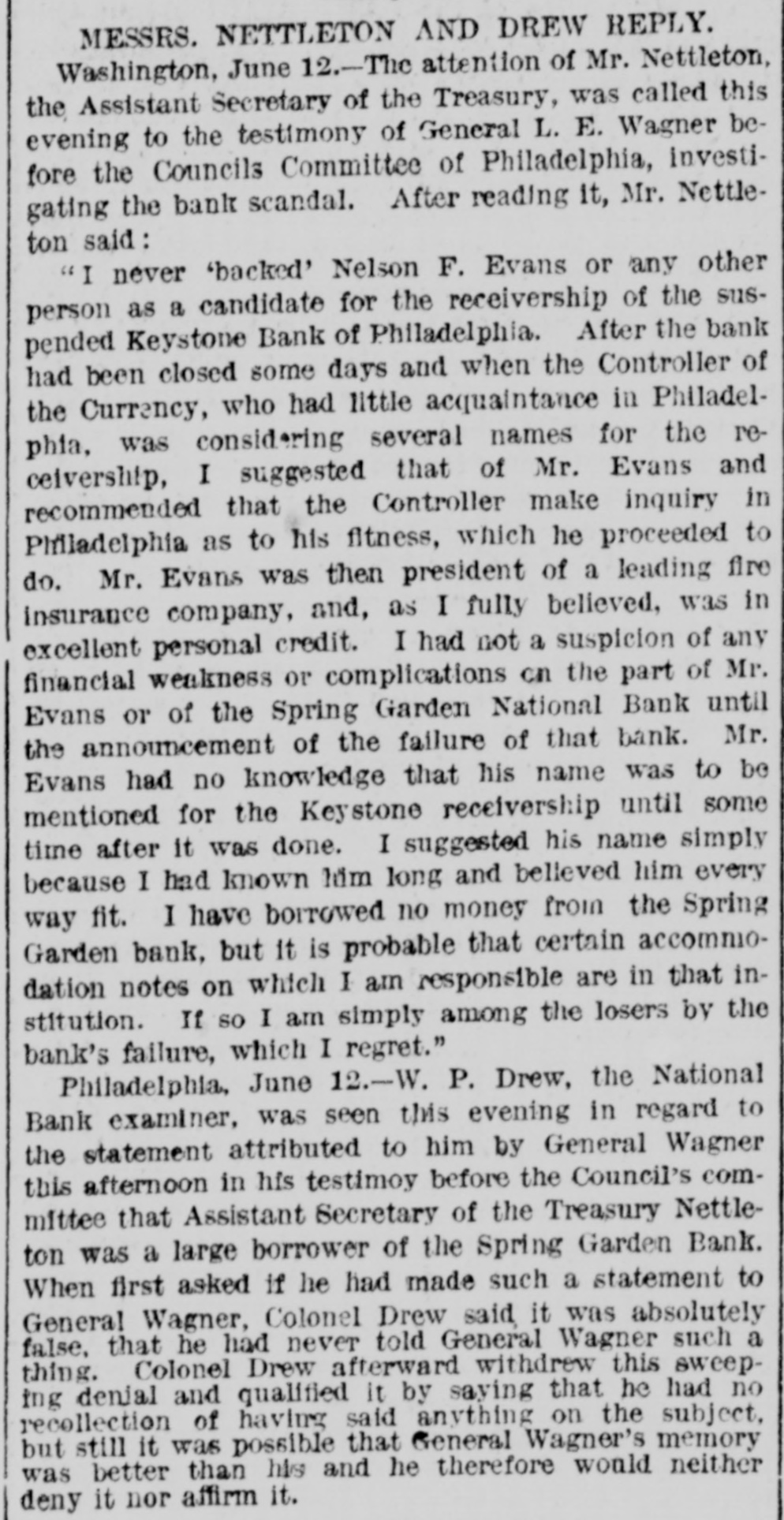
MESSRS. NETTLETON AND DREW REPLY. Washington, June 12.-The attention of Mr. Nettleton, the Assistant Secretary of the Treasury, was called this evening to the testimony of General L. E. Wagner before the Councils Committee of Philadelphia, investigating the bank scandal. After reading it, Mr. Nettleton said : "I never 'backed' Nelson F. Evans or any other person as a candidate for the receivership of the suspended Keystone Bank of Philadelphia. After the bank had been closed some days and when the Controller of the Currency, who had little acquaintance in Philadelphia, was considering several names for the receivership, I suggested that of Mr. Evans and recommended that the Controller make inquiry in Philadelphia as to his fitness, which he proceeded to do. Mr. Evans was then president of a leading fire Insurance company, and, as I fully believed, was in excellent personal credit. I had not a suspicion of any financial weakness or complications on the part of Mr. Evans or of the Spring Garden National Bank until the announcement of the failure of that bank. Mr. Evans had no knowledge that his name was to be mentioned for the Keystone receivership until some time after it was done. I suggested his name simply because I had known 1dm long and believed him every way fit. I have borrowed no money from the Spring Garden bank, but it is probable that certain accommodation notes on which I am responsible are in that institution. If so I am simply among the losers by the bank's failure, which I regret." Philadelphia, June 12.-W. P. Drew, the National Bank examiner, was seen this evening in regard to the statement attributed to him by General Wagner this afternoon in his testimoy before the Council's committee that Assistant Secretary of the Treasury Nettleton was a large borrower of the Spring Garden Bank. When first asked if he had made such a statement to General Wagner, Colonel Drew said it was absolutely false, that he had never told General Wagner such a thing. Colonel Drew afterward withdrew this sweeping denial and qualified it by saying that he had no recollection of havlng said anything on the subject. but still it was possible that General Wagner's memory was better than his and he therefore would neither deny it nor affirm it.


Article from The Portland Daily Press, June 15, 1891

Click image to open full size in new tab

Article Text

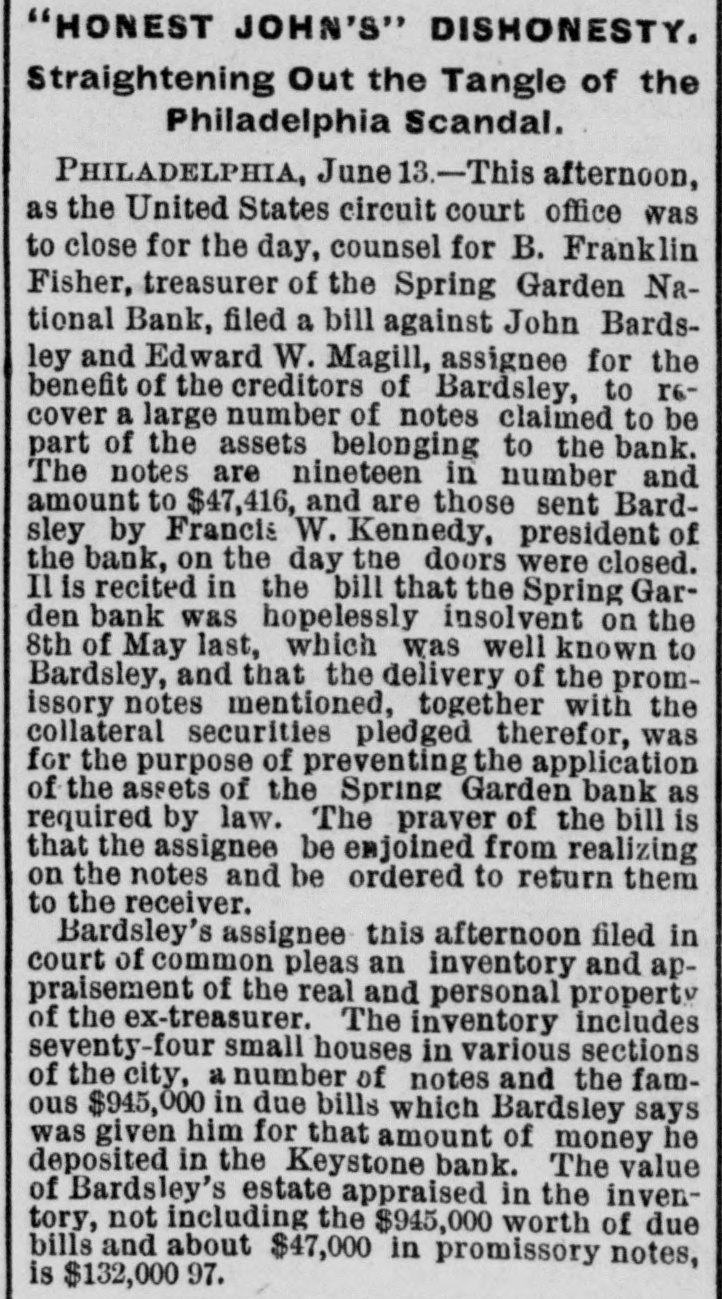
"HONEST JOHN'S" DISHONESTY, Straightening Out the Tangle of the Philadelphia Scandal. PHILADELPHIA, June 13.-This afternoon, as the United States circuit court office was to close for the day, counsel for B. Franklin Fisher, treasurer of the Spring Garden National Bank, filed a bill against John Bardsley and Edward W. Magill, assignee for the benefit of the creditors of Bardsley, to r6cover a large number of notes claimed to be part of the assets belonging to the bank. The notes are nineteen in number and amount to $47,416, and are those sent Bardsley by Francis W. Kennedy, president of the bank, on the day the doors were closed. Il is recited in the bill that the Spring Garden bank was hopelessly insolvent on the 8th of May last, which was well known to Bardsley, and that the delivery of the promissory notes mentioned, together with the collateral securities pledged therefor, was for the purpose of preventing the application of the assets of the Spring Garden bank as required by law. The praver of the bill is that the assignee be enjoined from realizing on the notes and be ordered to return them to the receiver. Bardsley's assignee this afternoon filed in court of common pleas an inventory and appraisement of the real and personal propertv of the ex-treasurer. The inventory includes seventy-four small houses in various sections of the city, a number of notes and the famous $945,000 in due bills which Bardsley says was given him for that amount of money he deposited in the Keystone bank. The value of Bardsley's estate appraised in the inventory, not including the $945,000 worth of due bills and about $47,000 in promissory notes, is $132,000 97.


Article from Waterbury Evening Democrat, July 1, 1891

Click image to open full size in new tab

Article Text

Bank Failures to be Investigated. WASHINGTON, July 1.-Comptroller Lacey has sent a communication to Receiver Yardley, of the Keystone National Bank of Philadelphia, enclosing a communication to Mayor Stuart, which is the first notification that the Government is going to take action in the affairs of the Keystone and Spring Garden National banks. A rigid examination is to be made by the Government.


Article from The Evening Herald, July 1, 1891

Click image to open full size in new tab

Article Text

Bank Failures to be Investigated. WASHINGTON, July 1.-Comptroller Lacey has sent a communication to Receiver Yardley, of the Keystone National Bank of Philadelphia, enclosing a communication to Mayor Stuart, which is the first notification that the Government is going to take action in the affairs of the Keystone and Spring Garden National banks. A rigid examination is to be made by the Government.


Article from The Wheeling Daily Intelligencer, July 2, 1891

Click image to open full size in new tab

Article Text

WAS IT SUPPRESSED? Revival of the Rumor that Bardsley Made a Sensational Confession. PHILADELPHIA, July 1.-It has been rumored for some time past that exCity Treasurer Bardsley really made a confession, which involved the names of such prominent people that its publication was stopped. There seems to be some truth in the story, and it is believed by the investigating committee that the confession is locked up in the safe of one of the leading newspapers of this city. It is charged that there has been a studied effort from the first, from influences unseen, to block the investigation and to shield those who have been mixed up with Bardsley and Marsh. Whether the confession will ever be published is doubtful, but the committee hope to have the use of it to aid them in developing the clews. A local paper published a special from Atlantic City, N. J., this morning, stating that Gideon W. Marsh, ex-President of the Keystone Bank, is hiding in Pleasantville, near Atlantic City, and that his family has been there with him a portion of the time since his flight. The press correspondent at Pleasantville says there is no truth whatever in the statement. General Fisher, the receiver of the Spring Garden National Bank, says that the estimate made by him some time ago, that the assets of the institution would pay upwards of 50 per cent appears to be well founded.


Article from Delaware Gazette and State Journal, July 9, 1891

Click image to open full size in new tab

Article Text

EXAMINER DREW MUST GO. Consuls Asked to Look for Marsh--Yard Will Appeal--Broken Banks Dropped. PHILADELPHIA, July 7.-Correspondence of the comptroller of the currency' and Bank Examiner Drew, in which the latter was taken to task for his failure, in his report of January 29th, after 15 days' investigation, to include among the liabilities of the Keystone National Bank $544,851.46, for which it was then indebted on account of clearing house certificates, is made public. Mr. Drew says the omission was clearly an accident. On July 2d, the comptroller requested the resignation of Mr. Drew as a bank examiner, but at latest accounts he had not received it. The mayor has transmitted to President Harrison the resolutions of city councils expressing the wish that the President inform the several ministers and consuls of the United States of the desire of the government to secure the arrest and extradition Bank. of President Marsh of the Keystone Counsel for H. H. Yard have decided to appeal to the supreme court from the decision of Judge Allison ordering Yard to submit himself to the sub-committee on investigation of city councils' finance committee and to be sworn and to testify. The Clearing House Association yesterday dropped the Keystone and Spring Garden National Banks from membership. The executive committee of the depositors of the Penn Trust and Safe Deposit Company, which is now in the hands of a receiver, have addressed a circular letter to depositors asking them to contribute three per cent of the amount of their deposits, to be used to complete the investigation. Ephraim Young and Frank Benton were indicted by the grand jury yesterday, on the charge of conspiracy to cheat the Millward-Cliff Cracker Company of $52,000, by the issue of certain promissory notes and other false and fraudulent means.


Article from The Wilmington Daily Republican, July 10, 1891

Click image to open full size in new tab

Article Text

At the Opera. No special attempt at decoration was made last night at Albert hall. The audience numbered about 6,000 and the artists included Albani, Nordia Belle, Edward Lloyd and the choral society. The kaiser wore the uniform of a British admiral. The kaiserin had a dress of cardinal silk with a dazzling tiara of diamonds. At the conclusion of the "Kaiser's March" the audience arose and cheered the imperial visitors and the kaiser and kaiserin bowed repeatedly. The queen's box, enlarged for the occasion, was occupied by the imperial royal personages. To Make an Exhaustive Examination WASHINGTON, July 10. - Secretary Foster has instructed Messrs. Brown and Faunce, the experts appointed to examir e the Keystone and Spring Garden banks in Philadelphia, to make a complete and exhaustive examination of those banks, exercising their own discretion as to whether they would work singly or together. They are instructed to submit partial reports every Saturday, showing the progress made and results attained, and at the conclusion of their work they are directed to make a complete report. The comptroller has directed Receivers Yardley and Fisher to furnish Messrs. Brown and Faunce all possible facilities to render their work effective.


Article from The Roanoke Times, August 18, 1891

Click image to open full size in new tab

Article Text

PHILADELPHIA'S BANK SCANDALS. Three of the Wayward Officials Plead Guilty. PHILADELPHIA, Aug. 17.-[Special]Charles Lawrence, cashier of the suspended Keystone National Bank, who was indicted with the bank.-fugitive president and Gideon W. Marsh for conspiracy in misplacing the bank's funds, this evening pleaded guilty in the United States court. Argument on a motion for the stay of pension will be heard to-morrow. Francis W. Kennedy. president of the suspended Spring Garden National Bank, and his brother, Henry H. Kennedy, cashier, were also arraigned this afternoon on the charge of misplacing of funds from that institution, and both entered pleas of guilty. Application for postponement of sentence was made by counsel for both prisoners, and the court's decision on that point will be given to-morrow.


Article from The Roanoke Times, August 19, 1891

Click image to open full size in new tab

Article Text

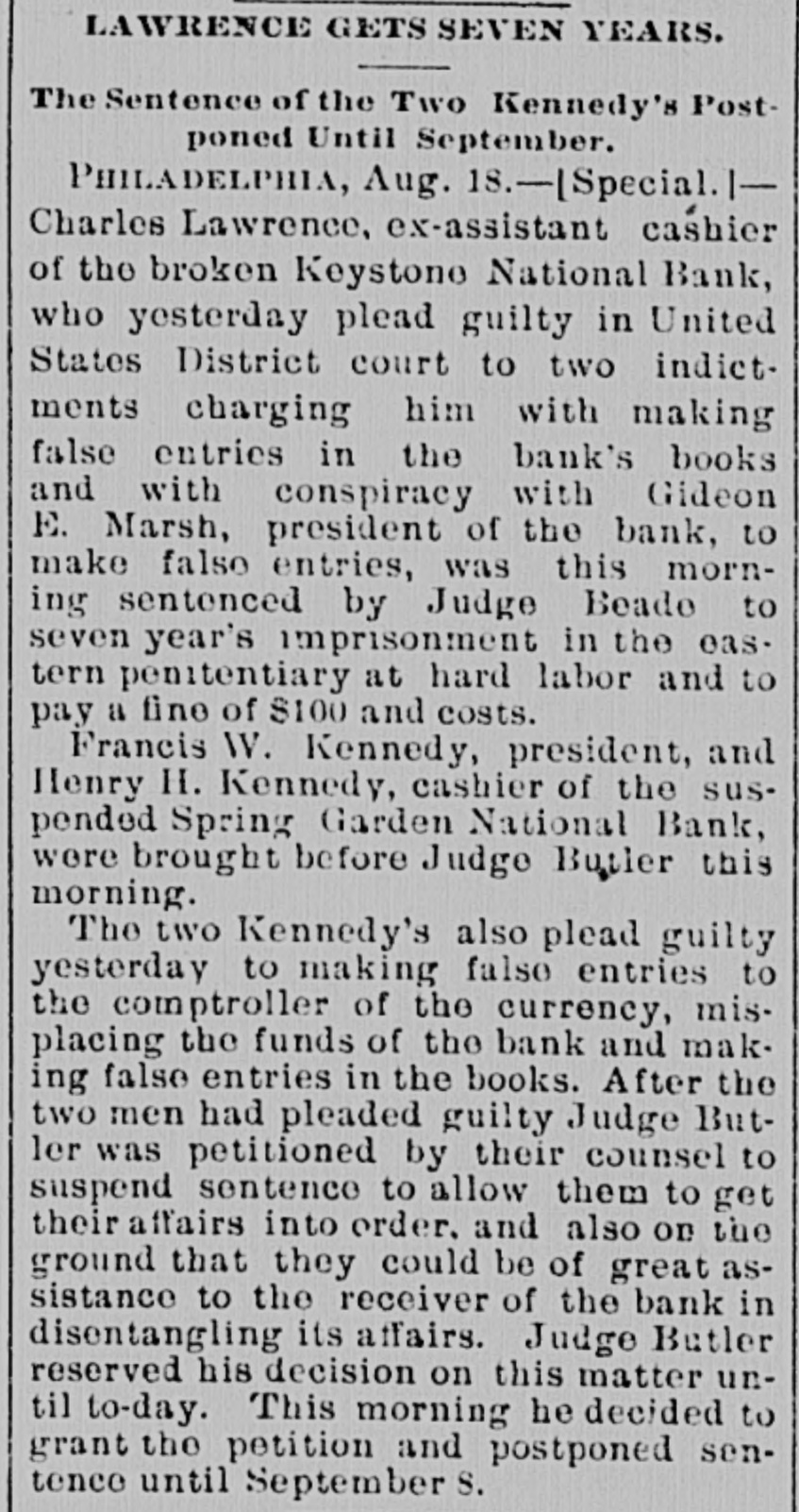
LAWRENCE GETS SEVEN YEARS. The Sentence of the Two Kennedy's Postponed Until September. Philadelphia, Aug. 18.-[Special.]- |Charles Lawrence, ex-assistant cashier of the broken Keystone National Bank, who yesterday plead guilty in United States District court to two indictments charging him with making false entries in the bank's books and with conspiracy with Gideon E. Marsh, president of the bank, to make falso entries, was this morning sentenced by Judge Beade to seven year's imprisonment in the eas. tern penitentiary at hard labor and to pay a fine of $100 and costs. Francis W. Kennedy, president, and Henry H. Kennedy, cashier of the suspended Spring Garden National Bank, were brought before Judge Butler this morning. The two Kennedy's also plead guilty yesterday to making false entries to the comptroller of the currency, misplacing the funds of the bank and making false entries in the books. After the two men had pleaded guilty Judge Butler was petitioned by their counsel to suspend sentence to allow them to get their affairs into order. and also on the ground that they could be of great assistance to the receiver of the bank in disentangling its affairs. Judge Butler reserved his decision on this matter until to-day. This morning he decided to grant the petition and postponed sentence until September S.


Article from Wheeling Register, August 19, 1891

Click image to open full size in new tab

Article Text

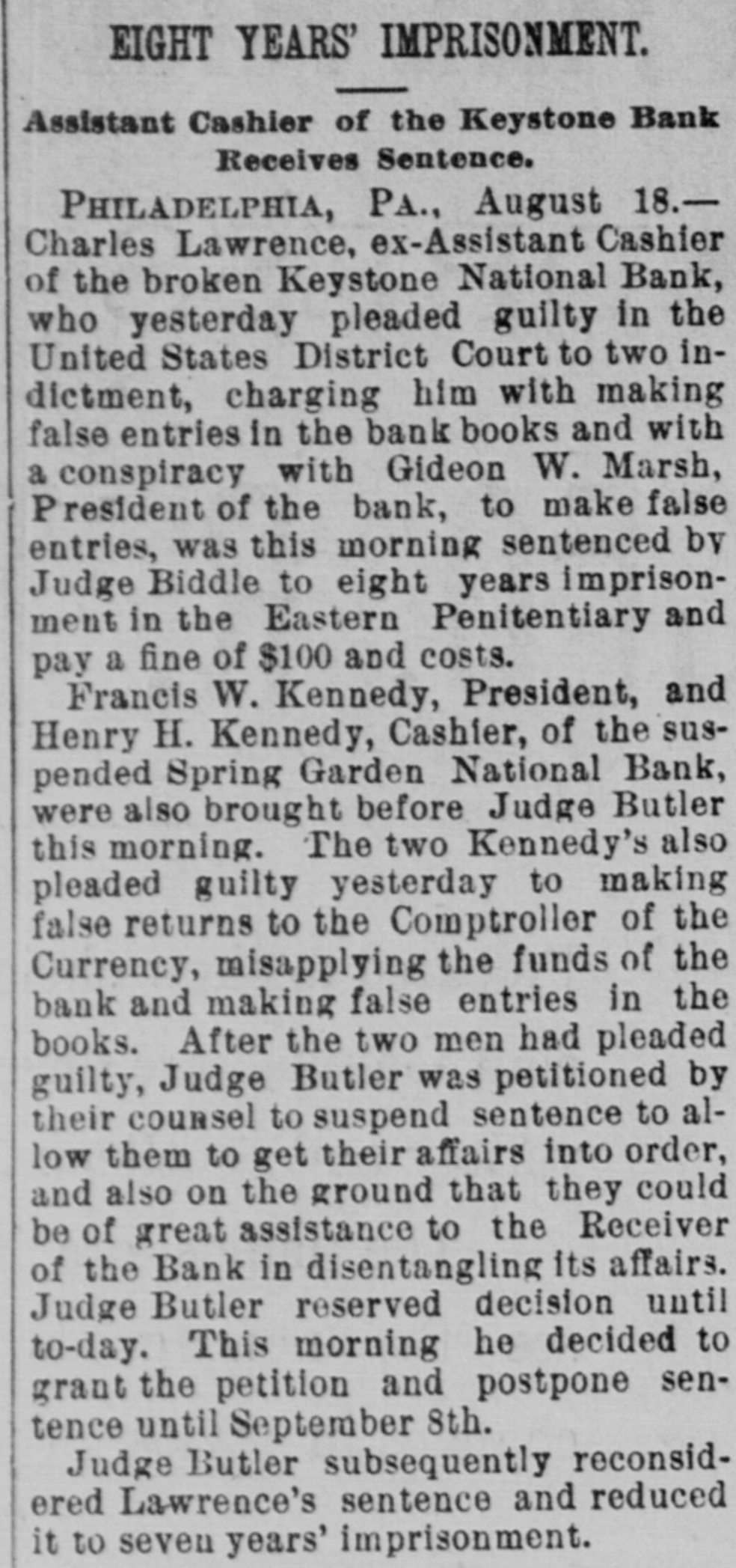
EIGHT YEARS' IMPRISONMENT. Assistant Cashier of the Keystone Bank Receives Sentence. PHILADELPHIA, PA., August 18.Charles Lawrence, ex-Assistant Cashier of the broken Keystone National Bank, who yesterday pleaded guilty in the United States District Court to two indictment, charging him with making false entries in the bank books and with a conspiracy with Gideon W. Marsh, President of the bank, to make false entries, was this morning sentenced by Judge Biddle to eight years imprisonment in the Eastern Penitentiary and pay a fine of $100 and costs. Francis W. Kennedy, President, and Henry H. Kennedy, Cashier, of the suspended Spring Garden National Bank, were also brought before Judge Butler this morning. The two Kennedy's also pleaded guilty yesterday to making false returns to the Comptroller of the Currency, misapplying the funds of the bank and making false entries in the books. After the two men had pleaded guilty, Judge Butler was petitioned by their counsel to suspend sentence to allow them to get their affairs into order, and also on the ground that they could be of great assistance to the Receiver of the Bank in disentangling its affairs. Judge Butler reserved decision until to-day. This morning he decided to grant the petition and postpone sentence until September 8th. Judge Butler subsequently reconsidered Lawrence's sentence and reduced it to seven years' imprisonment.


Article from The Carbon Advocate, December 5, 1891

Click image to open full size in new tab

Article Text

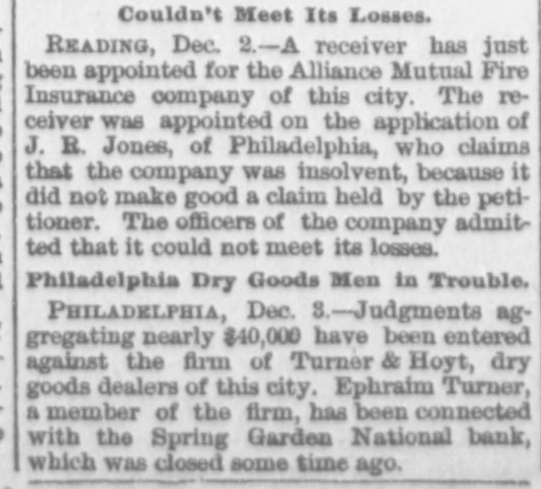
Couldn't Meet Its Losses. READING, Dec. 2.-A receiver has just been appointed for the Alliance Mutual Fire Insurance company of this city. The receiver was appointed on the application of J. R. Jones, of Philadelphia, who claims that the company was insolvent, because it did not make good a claim held by the petitioner. The officers of the company admitted that it could not meet its losses. Philadelphia Dry Goods Men in Trouble. PHILADELPHIA, Dec. 3.-Judgments aggregating nearly $40,000 have been entered against the firm of Turner & Hoyt, dry goods dealers of this city. Ephraim Turner, a member of the firm, has been connected with the Spring Garden National bank, which was closed some time ago.


Article from Pittsburg Dispatch, December 18, 1892

Click image to open full size in new tab

Article Text

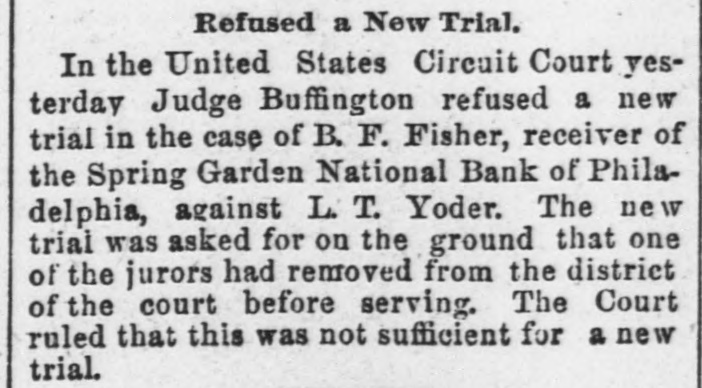
# Refused a New Trial. In the United States Circuit Court yesterday Judge Buffington refused a new trial in the case of B. F. Fisher, receiver of the Spring Garden National Bank of Philadelphia, against L. T. Yoder. The new trial was asked for on the ground that one of the jurors had removed from the district of the court before serving. The Court ruled that this was not sufficient for a new trial.