16590. Penn Safe Deposit & Trust Company (Philadelphia, PA)

Bank Information

Episode Type
Suspension → Closure
Bank Type
trust
Start Date
May 9, 1891
Location
Philadelphia, Pennsylvania (39.952, -75.164)

Metadata

Model
gpt-5-mini
Short Digest
3a109f812ec97584

Response Measures

None

Description

The Penn Safe Deposit & Trust Company (Penn Trust) made an assignment (suspended/closed) on or about May 8–9, 1891, coincident with the failure/suspension of the Spring Garden National Bank with which it was closely affiliated. Statements show an apparent deficit (~$95–97k). A receiver (Josiah R. Adams) later collected funds for depositors, confirming permanent closure/assignment rather than a temporary suspension. No discrete depositor run on the Penn Trust itself is described in the articles.

Events (1)

1. May 9, 1891 Suspension
Cause
Bank Specific Adverse Info
Cause Details
Penn Trust assigned (made an assignment) the same day the Spring Garden National Bank suspended; the trust was closely affiliated with the bank and showed an apparent deficit of about $95–97,000 between assets and liabilities.
Newspaper Excerpt
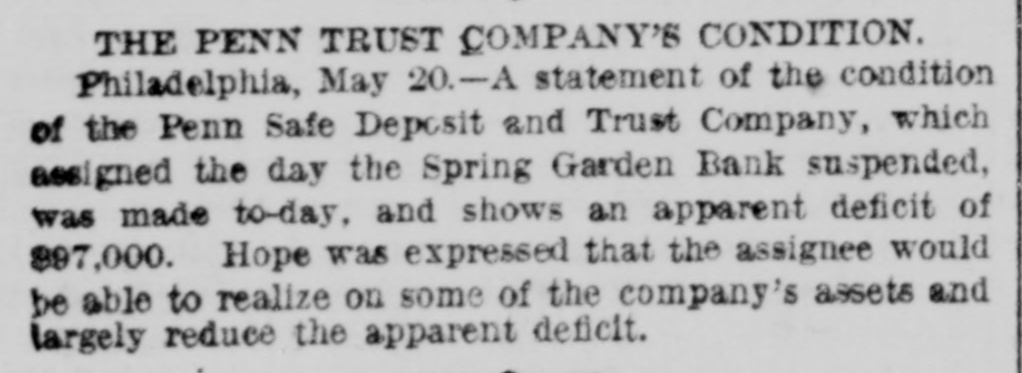
A statement of the condition of the Penn Safe Deposit and Trust Company, which assigned the day the Spring Garden Bank suspended, was made to-day, and shows an apparent deficit of $97,000.
Source
newspapers

Newspaper Articles (14)

Article from New-York Tribune, May 9, 1891

Click image to open full size in new tab

Article Text

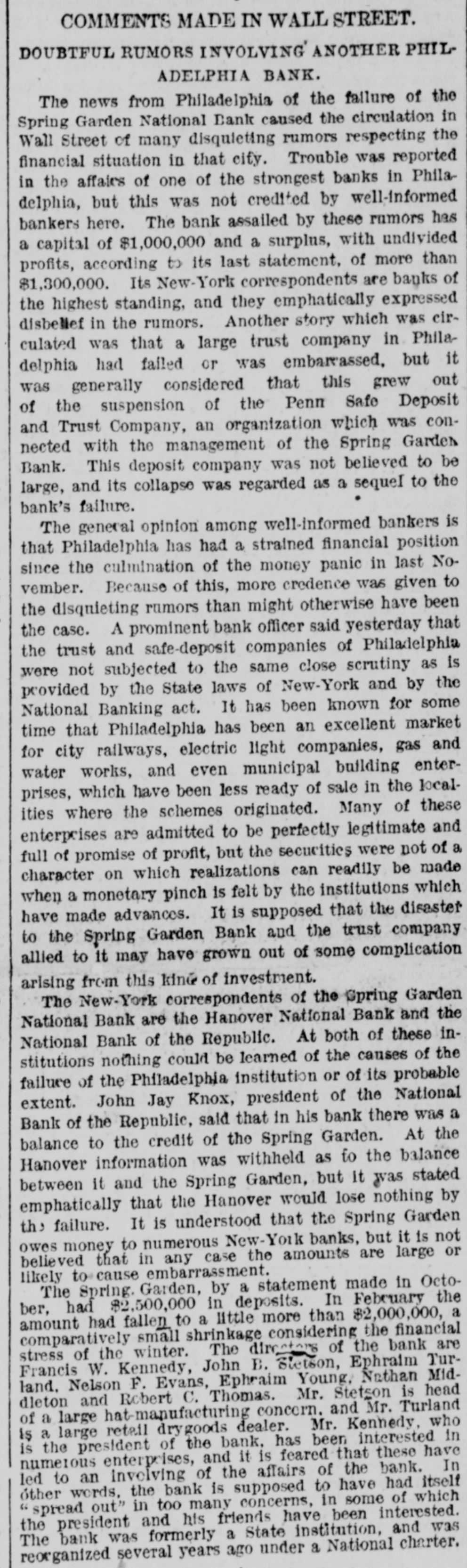
COMMENTS MADE IN WALL STREET. DOUBTFUL RUMORS INVOLVING ANOTHER PHILADELPHIA BANK. The news from Philadelphia of the failure of the Spring Garden National Bank caused the circulation in Wall Street of many disquieting rumors respecting the financial situation in that city. Trouble was reported in the affairs of one of the strongest banks in Philadelphia, but this was not credited by well-informed bankers here. The bank assailed by these rumors has a capital of $1,000,000 and a surplus, with undivided profits, according to its last statement, of more than $1,300,000. Its New-York correspondents are banks of the highest standing, and they emphatically expressed disbelief in the rumors. Another story which was circulated was that a large trust company in Philadelphia had failed or was embarassed, but it was generally considered that this grew out of the suspension of the Penn Safe Deposit and Trust Company, an organization which was connected with the management of the Spring Garden Bank. This deposit company was not believed to be large, and its collapse was regarded as a sequeI to the bank's failure. The general opinion among well-informed bankers is that Philadelphia has had a strained financial position since the culmination of the money panic in last November. Because of this, more credence was given to the disquieting rumors than might otherwise have been the case. A prominent bank officer said yesterday that the trust and safe-deposit companies of Philadelphia were not subjected to the same close scrutiny as is provided by the State laws of New-York and by the National Banking act. It has been known for some time that Philadelphia has been an excellent market for city railways, electric light companies, gas and water works, and even municipal building enterprises, which have been less ready of sale in the localities where the schemes originated. Many of these enterprises are admitted to be perfectly legitimate and full of promise of profit, but the secucities were not of a character on which realizations can readily be made when a monetary pinch is felt by the institutions which have made advances. It is supposed that the disaster to the Spring Garden Bank and the trust company allied to it may have grown out of some complication arising from this kinc of investment. The New-York correspondents of the Gpring Garden National Bank are the Hanover National Bank and the National Bank of the Republic. At both of these institutions nothing could be learned of the causes of the failure of the Philadelphia institution or of its probable extent. John Jay Knox, president of the National Bank of the Republic, said that in his bank there was a balance to the credit of the Spring Garden. At the Hanover information was withheld as to the balance between it and the Spring Garden, but it was stated emphatically that the Hanover would lose nothing by the failure. It is understood that the Spring Garden owes money to numerous New-York banks, but it is not believed that in any case the amounts are large or likely to cause embarrassment. The Spring. Garden, by a statement made in October, had $2,500,000 in deposits. In February the amount had fallen to a little more than $2,000,000, a comparatively small shrinkage considering the financial stress of the winter. The directors of the bank are Francis W. Kennedy, John B. Stetson, Ephraim Turland. Nelson F. Evans, Ephraim Young, Nathan Middleton and Robert C. Thomas. Mr. Stetson is head of a large hat-manufacturing concern. and Mr. Turland is a large retail drygoods dealer. Mr. Kennedy, who is the president of the bank. has been interested in numerous enterprises, and it is feared that these have led to an involving of the affairs of the bank. In other words, the bank is supposed to have had itself spread out" in too many concerns, in some of which the president and his friends have been interested. The bank was formerly a State institution, and was reorganized several years ago under a National charter.
Article from Evening Journal, May 9, 1891

Click image to open full size in new tab

Article Text

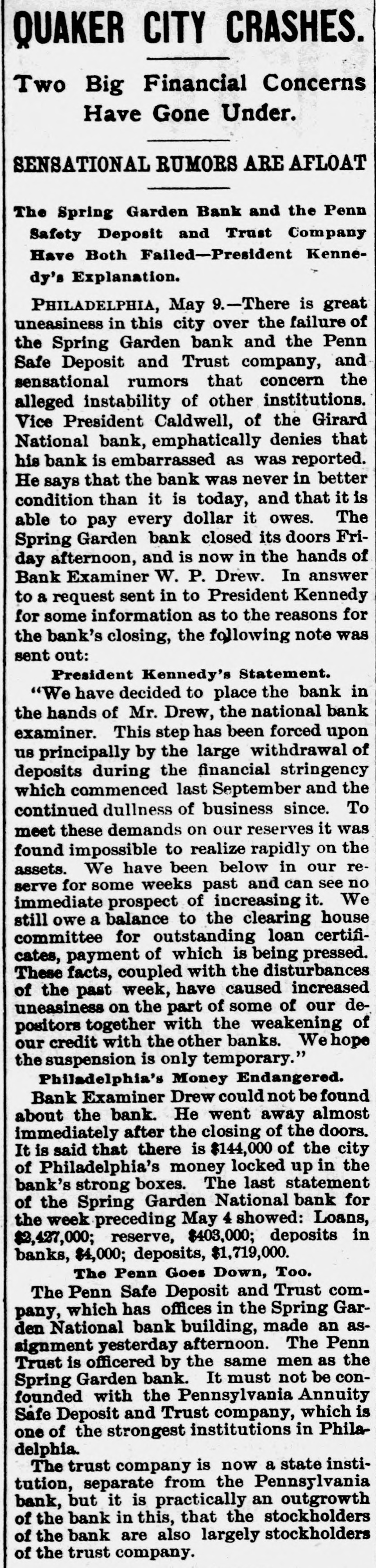
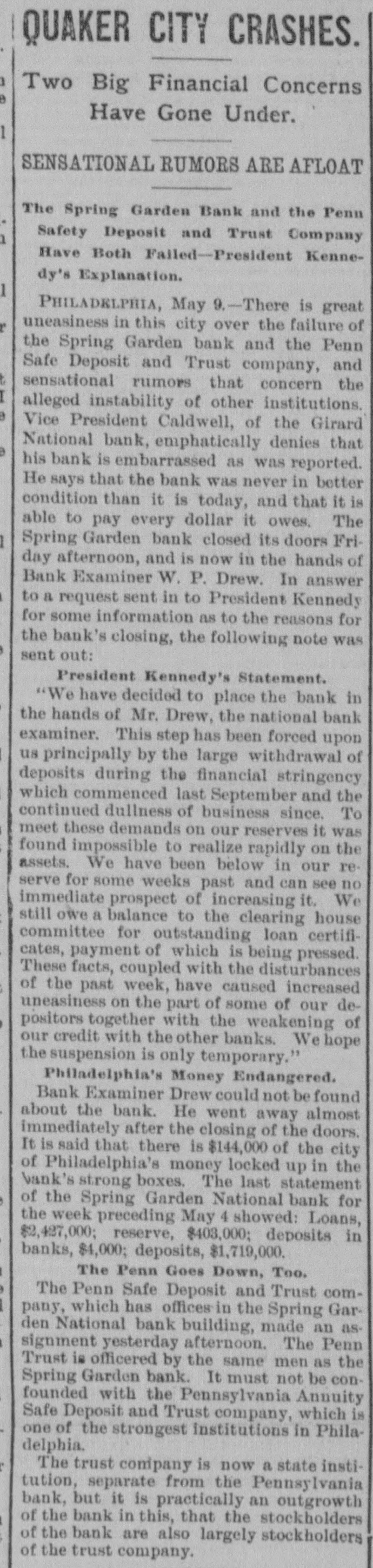
QUAKER CITY CRASHES. Two Big Financial Concerns Have Gone Under. 1 SENSATIONAL RUMORS ARE AFLOAT The Spring Garden Bank and the Penn Safety Deposit and Trust Company Have Both Falled-President Kennedy's Explanation. 1 PHILADELPHIA, May 9. -There is great uneasiness in this city over the failure of the Spring Garden bank and the Penn Safe Deposit and Trust company, and sensational rumors that concern the alleged instability of other institutions. Vice President Caldwell, of the Girard National bank, emphatically denies that e his bank is embarrassed as was reported. He says that the bank was never in better condition than it is today, and that it is able to pay every dollar it owes, The Spring Garden bank closed its doors Fri1 day afternoon, and is now in the hands of Bank Examiner W. P. Drew. In answer to a request sent in to President Kennedy for some information as to the reasons for the bank's closing, the following note was sent out: President Kennedy's Statement. "We have decided to place the bank in the hands of Mr. Drew, the national bank examiner. This step has been forced upon us principally by the large withdrawal of deposits during the financial stringency which commenced last September and the continued dullness of business since. To meet these demands on our reserves it was found impossible to realize rapidly on the assets. We have been below in our reserve for some weeks past and can see no immediate prospect of increasing it. We still owe a balance to the clearing house committee for outstanding loan certificates, payment of which is being pressed. These facts, coupled with the disturbances of the past week, have caused increased uneasiness on the part of some of our depositors together with the weakening of our credit with the other banks. We hope the suspension is only temporary." Philadelphia's Money Endangered. Bank Examiner Drew could not be found about the bank. He went away almost immediately after the closing of the doors. It is said that there is $144,000 of the city of Philadelphia's money locked up in the bank's strong boxes. The last statement of the Spring Garden National bank for the week preceding May 4 showed: Loans, $2,487,000; reserve, $403,000; deposits in banks, $4,000; deposits, $1,719,000. The Penn Goes Down, Too. The Penn Safe Deposit and Trust company, which has offices in the Spring Garden National bank building, made an assignment yesterday afternoon. The Penn Trust is officered by the same men as the Spring Garden bank. It must not be confounded with the Pennsylvania Annuity Safe Deposit and Trust company, which is one of the strongest institutions in Philadelphia. The trust company is now a state institution, separate from the Pennsylvania bank, but it is practically an outgrowth of the bank in this, that the stockholders of the bank are also largely stockholders of the trust company.


Article from The Morning News, May 9, 1891

Click image to open full size in new tab

Article Text

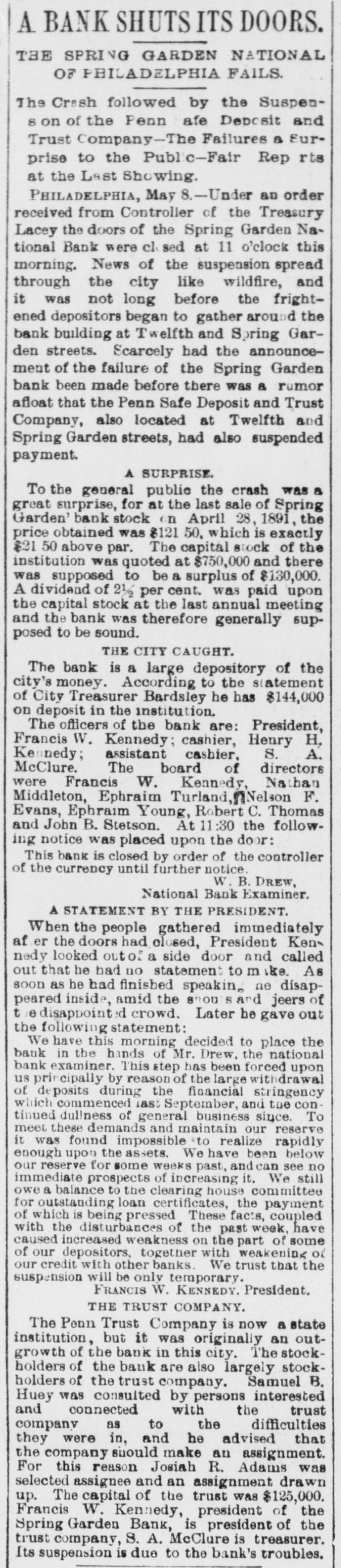
A BANK SHUTSIIS DOORS. THE SPRING GARDEN NATIONAL OF PHILADELPHIA FAILS. The Crash followed by the Suspen8 on of the Penn afe Deposit and Trust Company-The Failures a Eurprise to the Public-Fair Rep rts at the Last Showing. PHILADELPHIA, May 8.-Under an order received from Controller of the Treasury Lacey the doors of the Spring Garden National Bank were cl sed at 11 o'clock this morning. News of the suspension spread through the city like wildfire, and it was not long before the frightened depositors began to gather around the bank building at Twelfth and Spring Garden streets. Scarcely had the announcement of the failure of the Spring Garden bank been made before there was a rumor afloat that the Penn Safe Deposit and Trust Company, also located at Twelfth and Spring Garden streets, had also suspended payment. A SURPRISE. To the general public the crash was a great surprise, for at the last sale of Spring Garden' bank stock on April 28, 1891, the price obtained was $121 50, which is exactly $21 50 above par. The capital stock of the institution was quoted at $750,000 and there was supposed to be a surplus of $130,000. A dividend of 21/2 per cent. was paid upon the capital stock at the last annual meeting and the bank was therefore generally supposed to be sound. THE CITY CAUGHT. The bank is a large depository of the city's money. According to the statement of City Treasurer Bardsley he has $144,000 on deposit in the institution. The officers of the bank are: President, Francis W. Kennedy; cashier, Henry H, Kennedy; assistant cashier, S. A. McClure. The board of directors were Francis W. Kennedy, Nathan Middleton, Ephraim Turland, Nelson F. Evans, Ephraim Young, Robert C. Thomas and John B. Stetson. At 11:30 the following notice was placed upon the door: This bank is closed by order of the controller of the currency until further notice. W. B. DREW, National Bank Examiner. A STATEMENT BY THE PRESIDENT. When the people gathered immediately af er the doors had closed, President Kens nedy looked outof a side door and called out that he had no statement to m ke. As soon as he had finished speaking ne disappeared inside, amid the shou S and jeers of t e disappoint crowd. Later he gave out the following statement: We have this morning decided to place the bank in the hands of Mr. Drew. the national bank examiner. This step has been forced upon us principally by reason of the large withdrawal of deposits during the financial stringency which commenced last September, and the continued dullness of general business since. To meet these demands and maintain our reserve it was found impossible to realize rapidly enough upon the assets. We have been below our reserve for some weeks past, and can see no immediate prospects of increasing it. We still owe a balance to the clearing house committee for outstanding loan certificates, the payment of which is being pressed These facts, coupled with the disturbances of the past week, have caused increased weakness on the part of some of our depositors, together with weakening of our credit with other banks. We trust that the suspension will be only temporary. FRANCIS W. KENNEDY, President. THE TRUST COMPANY. The Penn Trust Company is now a state institution, but it was originally an outgrowth of the bank in this city. The stockholders of the bank are also largely stockholders of the trust company. Samuel B. Huey was consulted by persons interested and connected with the trust company 88 to the di


Article from New-York Tribune, May 9, 1891

Click image to open full size in new tab

Article Text

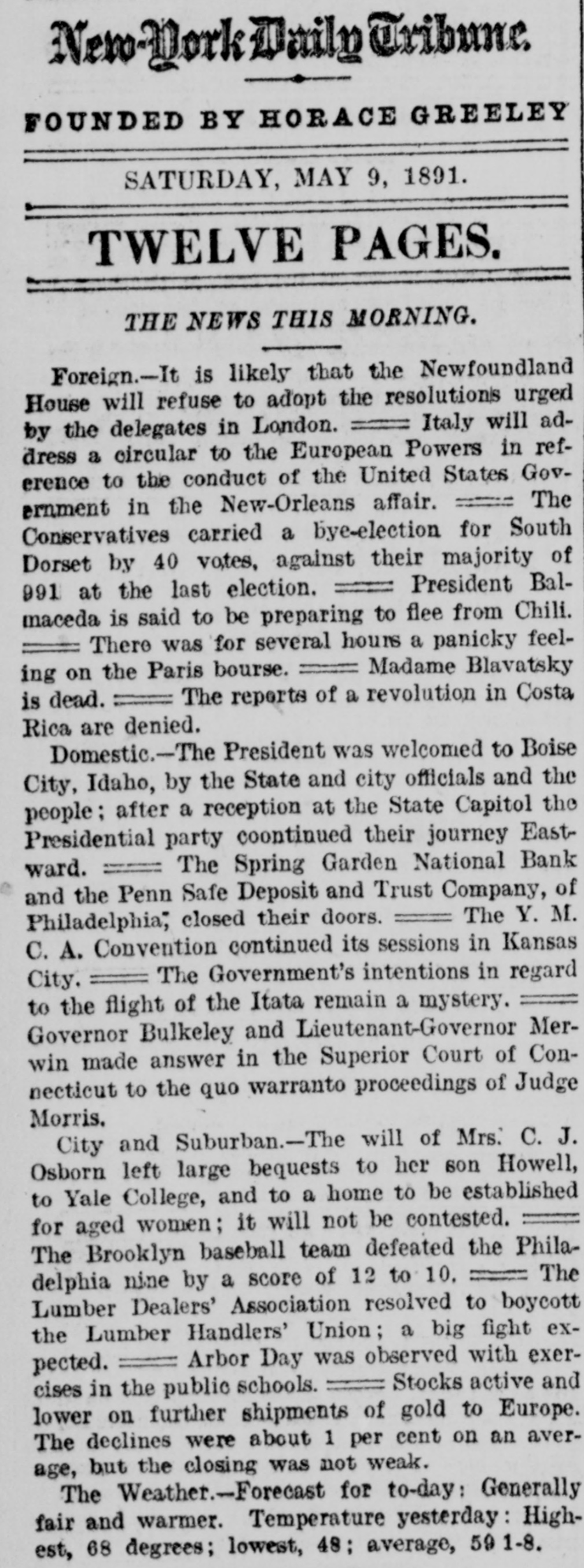
New-York? Daily Uribune FOUNDED BY HORACE GREELEY SATURDAY, MAY 9, 1891. TWELVE PAGES. THE NEWS THIS MORNING. Foreign.-It is likely that the Newfoundland House will refuse to adopt the resolutions urged Italy will adby the delegates in London. dress a circular to the European Powers in reference to the conduct of the United States Government in the New-Orleans affair. = The Conservatives carried a bye-election for South Dorset by 40 votes, against their majority of President Bal991 at the last election. maceda is said to be preparing to flee from Chili. There was for several hours a panicky feelMadame Blavatsky ing on the Paris bourse. The reports of a revolution in Costa is dead. Rica are denied. Domestic.-The President was welcomed to Boise City, Idaho, by the State and city officials and the people; after a reception at the State Capitol the Presidential party coontinued their journey EastThe Spring Garden National Bank ward. and the Penn Safe Deposit and Trust Company, of Philadelphia; closed their doors. The Y. M. C. A. Convention continued its sessions in Kansas The Government's intentions in regard City. to the flight of the Itata remain a mystery. Governor Bulkeley and Lieutenant-Governor Merwin made answer in the Superior Court of Connecticut to the quo warranto proceedings of Judge Morris. City and Suburban.-The will of Mrs. C. J. Osborn left large bequests to her son Howell, to Yale College, and to a home to be established for aged women; it will not be contested. The Brooklyn baseball team defeated the Philadelphia nine by a score of 12 to 10. = The Lumber Dealers' Association resolved to boycott the Lumber Handlers' Union; a big fight ex- Arbor Day was observed with exerpected. Stocks active and cises in the public schools. lower on further shipments of gold to Europe. The declines were about 1 per cent on an average, but the closing was not weak. The Weather.-Forecast for to-day: Generally fair and warmer. Temperature yesterday: Highest, 68 degrees; lowest, 48; average, 59 1-8.


Article from Connecticut Western News, May 13, 1891

Click image to open full size in new tab

Article Text

QUAKER CITY CRASHES. Two Big Financial Concerns Have Gone Under. SENSATIONAL RUMORS ARE AFLOAT The Spring Garden Bank and the Penn Safety Deposit and Trust Company Have Both Failed-President Kennedy's Explanation. PHILADELPHIA, May 9.-There is great uneasiness in this city over the failure of the Spring Garden bank and the Penn Safe Deposit and Trust company, and sensational rumors that concern the alleged instability of other institutions. Vice President Caldwell, of the Girard National bank, emphatically denies that his bank is embarrassed as was reported. He says that the bank was never in better condition than it is today, and that it is able to pay every dollar it owes. The Spring Garden bank closed its doors Friday afternoon, and is now in the hands of Bank Examiner W. P. Drew. In answer to a request sent in to President Kennedy for some information as to the reasons for the bank's closing, the following note was sent out: President Kennedy's Statement. "We have decided to place the bank in the hands of Mr. Drew, the national bank examiner. This step has been forced upon us principally by the large withdrawal of deposits during the financial stringency which commenced last September and the continued dullness of business since. To meet these demands on our reserves it was found impossible to realize rapidly on the assets. We have been below in our reserve for some weeks past and can see no immediate prospect of increasing it. We still owe a balance to the clearing house committee for outstanding loan certificates, payment of which is being pressed. These facts, coupled with the disturbances of the past week, have caused increased uneasiness on the part of some of our depositors together with the weakening of our credit with the other banks. We hope the suspension is only temporary." Philadelphia's Money Endangered. Bank Examiner Drew could not be found about the bank. He went away almost immediately after the closing of the doors. It is said that there is $144,000 of the city of Philadelphia's money locked up in the bank's strong boxes. The last statement of the Spring Garden National bank for the week preceding May 4 showed: Loans, $2,427,000; reserve, $403,000; deposits in banks, $4,000; deposits, $1,719,000. The Penn Goes Down, Too. The Penn Safe Deposit and Trust company, which has offices in the Spring Garden National bank building, made an assignment yesterday afternoon. The Penn Trust is officered by the same men as the Spring Garden bank. It must not be confounded with the Pennsylvania Annuity Safe Deposit and Trust company, which is one of the strongest institutions in Philadelphia. The trust company is now a state institution, separate from the Pennsylvania bank, but it is practically an outgrowth of the bank in this, that the stockholders of the bank are also largely stockholders of the trust company.


Article from The Climax, May 13, 1891

Click image to open full size in new tab

Article Text

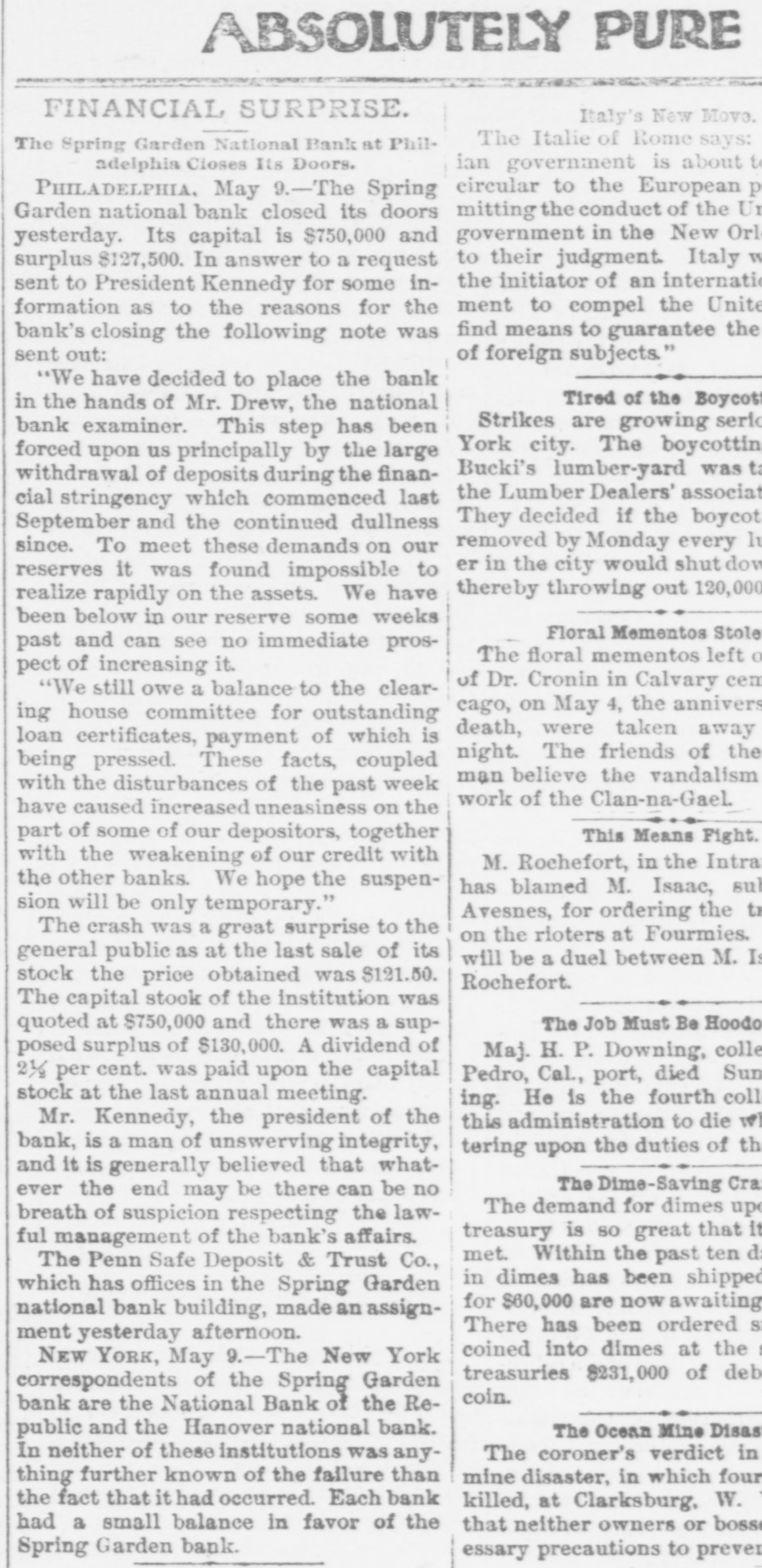
ABSOLUTELY PURE FINANCIAL SURPRISE. Italy's New Movo. The Italie of Rome says: The Spring Garden National Bank at Philadelphia Closes Its Doors. ian government is about to circular to the European p PHILADELPHIA, May 9.-The Spring Garden national bank closed its doors mitting the conduct of the Ur government in the New Orl yesterday. Its capital is $750,000 and to their judgment. Italy w surplus $127,500. In answer to a request the initiator of an internati sent to President Kennedy for some information as to the reasons for the ment to compel the Unite find means to guarantee the bank's closing the following note was sent out: of foreign subjects." "We have decided to place the bank Tired of the Boycot in the hands of Mr. Drew, the national Strikes are growing serio bank examiner. This step has been York city. The boycottin forced upon us principally by the large Bucki's lumber-yard was ti withdrawal of deposits during the finanthe Lumber Dealers' associat cial stringency which commenced last They decided if the boycot September and the continued dullness removed by Monday every lu since. To meet these demands on our er in the city would shut dow reserves it was found impossible to thereby throwing out 120,000 realize rapidly on the assets. We have been below in our reserve some weeks Floral Mementos Stole past and can see no immediate prosThe floral mementos left o pect of increasing it. of Dr. Cronin in Calvary cem "We still owe a balance to the clearcago, on May 4, the annivers ing house committee for outstanding death, were taken away loan certificates, payment of which is night. The friends of the being pressed. These facts, coupled man believe the vandalism with the disturbances of the past week work of the Clan-na-Gael. have caused increased uneasiness on the part of some of our depositors, together This Means Fight. with the weakening of our credit with M. Rochefort, in the Intra the other banks. We hope the suspenhas blamed M. Isaac, sul sion will be only temporary." Avesnes, for ordering the tx The crash was a great surprise to the on the rioters at Fourmies. general public as at the last sale of its will be a duel between M. Is stock the price obtained was $121.50. Rochefort. The capital stock of the institution was The Job Must Be Hoodo quoted at $750,000 and there was a supposed surplus of $130,000. A dividend of Maj. H. P. Downing, colle 2½ per cent. was paid upon the capital Pedro, Cal., port, died Sun stock at the last annual meeting. ing. He is the fourth coll Mr. Kennedy, the president of the this administration to die w bank, is a man of unswerving integrity, tering upon the duties of th and it is generally believed that whatThe Dime-Saving Cra ever the end may be there can be no The demand for dimes upo breath of suspicion respecting the lawtreasury is so great that it ful management of the bank's affairs. met. Within the past ten d The Penn Safe Deposit & Trust Co., in dimes has been shipped which has offices in the Spring Garden for $60,000 are now awaiting national bank building, made an assignThere has been ordered si ment yesterday afternoon. coined into dimes at the : NEW YORK, May 9.-The New York treasuries $231,000 of deb correspondents of the Spring Garden coin. bank are the National Bank of the ReThe Ocean Mine Disas public and the Hanover national bank. The coroner's verdict in In neither of these institutions was anything further known of the failure than mine disaster, in which four the fact that it had occurred. Each bank killed, at Clarksburg, W. had a small balance in favor of the that neither owners or boss Spring Garden bank. essary precautions to prever


Article from Vermont Phœnix, May 15, 1891

Click image to open full size in new tab

Article Text

nres, two men were killed. Forest fires S rounded Woonsocket, R. I., Monday, bu ing over 100 acres of woodland, includ the new city park. The later reports bring news of vast struction of forests in Cumberland, Cent Warren, Columbia and other counties Pennsylvania. In the first named cou 10,000 acres of timber land have been bu ed over, and a number of dwelling hou destroyed. Some idea of the vastness of the burn district in Michigan can be gained from fact that almost any two of the dozen co ties now filled with fire are as large as whole state of Rhode Island. The Tole Ann Arbor and Northern Michigan railr has been obliged to abandon all attempt run cars north of the Clare county line. Thousands of tons of ice harvested d ing the winter of 1889-90 are being dum into Lake Champlain at Plattsburgh, N. Col. Michael Murphy, a well-known N York man, has recovered from a se months' illness, during which time he co not swallow a mouthful of food. He nourished by skillful mechanical mea but wasted away from 198 to 90 pour An ulcer in the stomach caused his illn Under an order from the comptrolle the currency the doors of the Spring G den National bank at Philadelphia w closed last Friday. The news spread wildfire and soon the frightened deposit began to gather around the bank buildi only to learn that the Penn Safe Dep and Trust company had also suspend The Spring Garden bank was capitali for $750,000, and contained a city of P adelphia deposit of $144,000. The susp sion created great surprise and excitem The cause is said to have been the w drawal of deposits during the stringe last fall and the continued dullness of b ness since. Yale college gets another $150,000. ] through the will of Mrs. Charles J. Osb of New York, for a memorial hall to husband. The peach crop in Connecticut will 1 failure on account of last week's fre The loss is estimated at 30,000 baskets, ued at as many dollars. The government will issue a new $2 ver certificate on account of a succes counterfeit of the bill now in circulatic The Russian government 'sdecree for expulsion of the Jews cause d such a turbance of business that a second o has been issued suspending the decre far as to allow a year's grace to Jews


Article from New-York Tribune, May 21, 1891

Click image to open full size in new tab

Article Text

THE PENN TRUST COMPANY'S CONDITION. Philadelphia, May 20.-A statement of the condition of the Penn Safe Deposit and Trust Company, which assigned the day the Spring Garden Bank suspended, was made to-day, and shows an apparent deficit of $97,000. Hope was expressed that the assignee would be able to realize on some of the company's assets and largely reduce the apparent deficit.


Article from The Morning Call, May 22, 1891

Click image to open full size in new tab

Article Text

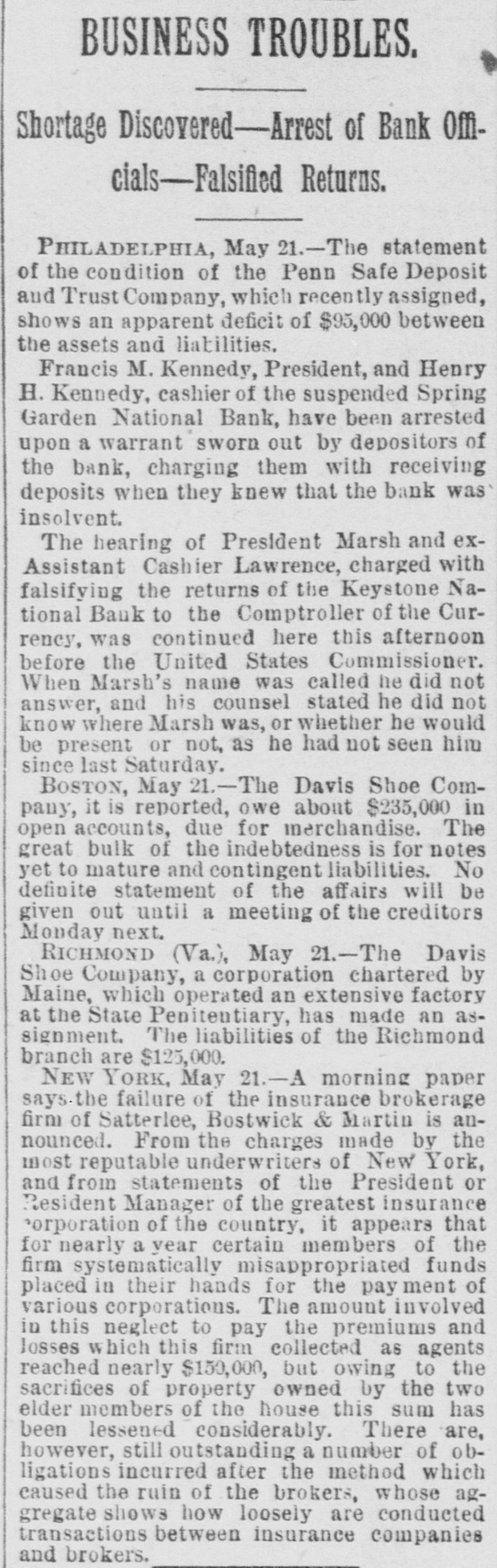
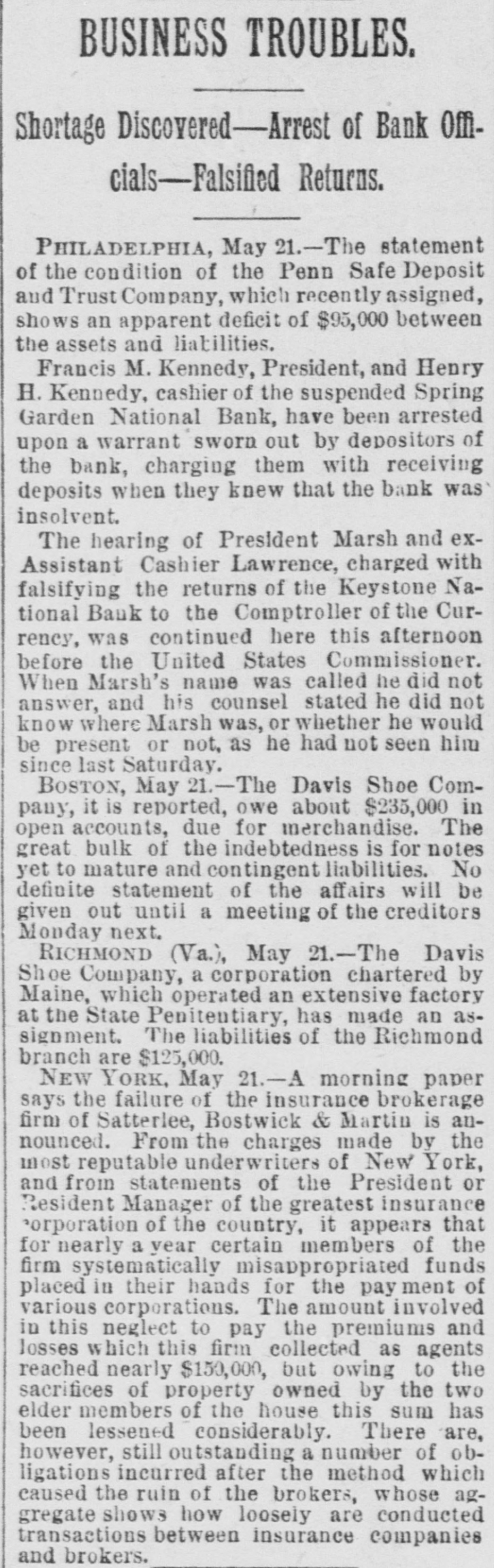
BUSINESS TROUBLES. Shortage Discovered-Arrest of Bank Offcials-Falsified Returns. PHILADELPHIA, May 21.-The statement of the condition of the Penn Safe Deposit and Trust Company, which recently assigned, shows an apparent deficit of $95,000 between the assets and liabilities. Francis M. Kennedy, President, and Henry H. Kennedy, cashier of the suspended Spring Garden National Bank, have been arrested upon a warrant sworn out by depositors of the bank, charging them with receiving deposits when they knew that the bank was insolvent. The hearing of President Marsh and exAssistant Cashier Lawrence, charged with falsifying the returns of the Keystone National Bauk to the Comptroller of the Currency, was continued here this afternoon before the United States Commissioner. When Marsh's name was called he did not answer, and his counsel stated he did not know where Marsh was, or whether he would be present or not, as he had not seen him since last Saturday. BOSTON, May 21.-The Davis Shoe Company, it is reported, owe about $235,000 in open accounts, due for merchandise. The great bulk of the indebtedness is for notes yet to mature and contingent liabilities. No definite statement of the affairs will be given out until a meeting of the creditors Monday next. RICHMOND (Va.), May 21.-The Davis Shoe Company, a corporation chartered by Maine, which operated an extensive factory at the State Penitentiary, has made an assignment. The liabilities of the Richmond branch are $125,000. NEW YORK, May 21.-A morning paper says.the failure of the insurance brokerage firm of Satterlee, Bostwick & Martin is announced. From the charges made by the most reputable underwriters of New York, and from statements of the President or Resident Manager of the greatest insurance corporation of the country, it appears that for nearly a year certain members of the firm systematically misappropriated funds placed in their hands for the pay ment of various corporations. The amount involved in this neglect to pay the premiums and losses which this firm collected as agents reached nearly $150,000, but owing to the sacrifices of property owned by the two elder members of the house this sum has been lessened considerably. There are, however, still outstanding a number of obligations incurred after the method which caused the ruin of the brokers, whose aggregate shows how loosely are conducted transactions between insurance companies and brokers.


Article from The Morning Call, May 22, 1891

Click image to open full size in new tab

Article Text

BUSINESS TROUBLES. Shortage Discovered-Arrest of Bank Officials-Falsified Returns. PHILADELPHIA, May 21.-The statement of the condition of the Penn Safe Deposit and Trust Company, which recently assigned, shows an apparent deficit of $95,000 between the assets and liabilities. Francis M. Kennedy, President, and Henry H. Kennedy, cashier of the suspended Spring Garden National Bank, have been arrested upon a warrant sworn out by depositors of the bank, charging them with receiving deposits when they knew that the bank was insolvent. The hearing of President Marsh and exAssistant Cashier Lawrence, charged with falsifying the returns of the Keystone National Bank to the Comptroller of the Currency, was continued here this afternoon before the United States Commissioner. When Marsh's name was called he did not answer, and his counsel stated he did not know where Marsh was, or whether he would be present or not, as he had not seen him since last Saturday. BOSTON, May 21.-The Davis Shoe Company, it is reported, owe about $235,000 in open accounts, due for merchandise. The great bulk of the indebtedness is for notes yet to mature and contingent liabilities. No definite statement of the affairs will be given out until a meeting of the creditors Monday next. RICHMOND (Va.), May 21.-The Davis Shoe Company, a corporation chartered by Maine, which operated an extensive factory at the State Penitentiary, has made an assignment. The liabilities of the Richmond branch are $125,000. NEW YORK, May 21.-A morning paper says the failure of the insurance brokerage firm of Satterlee, Bostwick & Martin is announced. From the charges made by the most reputable underwriters of New York, and from statements of the President or Resident Manager of the greatest insurance rorporation of the country, it appears that for nearly a year certain members of the firm systematically misappropriated funds placed in their hands for the pay ment of various corporations. The amount involved in this neglect to pay the premiums and losses which this firm collected as agents reached nearly $150,000, but owing to the sacrifices of property owned by the two elder members of the house this sum has been lessened considerably. There are, however, still outstanding a number of obligations incurred after the method which caused the ruin of the brokers, whose aggregate shows how loosely are conducted transactions between insurance companies and brokers.


Article from St. Paul Daily Globe, May 22, 1891

Click image to open full size in new tab

Article Text

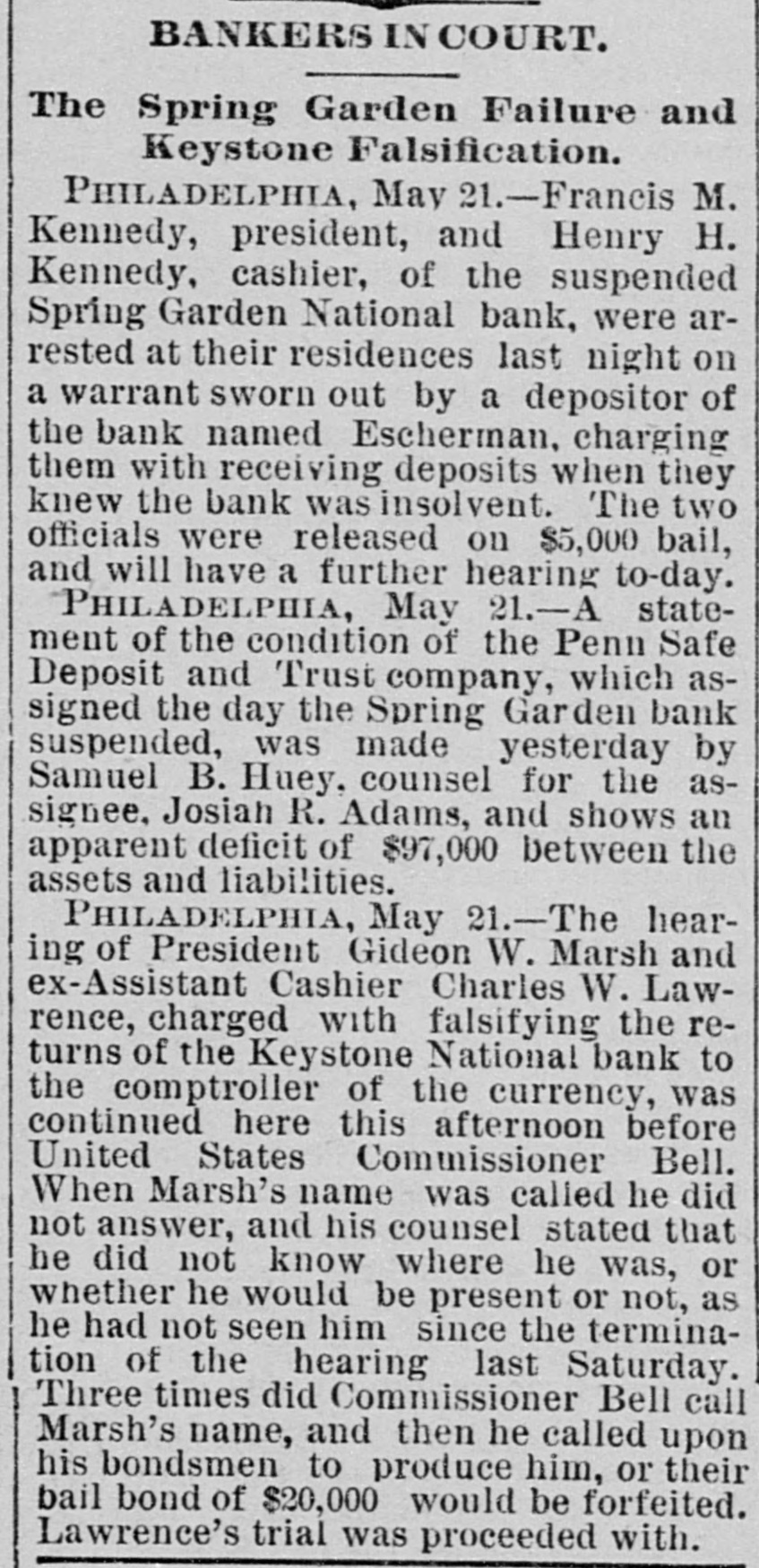
BANKERS IN COURT. The Spring Garden Failure and Keystone Falsification. Philadelphia, May 21.-Francis M. Kennedy, president, and Henry H. Kennedy, cashier, of the suspended Spring Garden National bank, were arrested at their residences last night on a warrant sworn out by a depositor of the bank named Escherman, charging them with receiving deposits when they knew the bank was insolvent. The two officials were released on $5,000 bail, and will have a further hearing to-day. PHILADELPHIA, May 21.-A statement of the condition of the Penn Safe Deposit and Trust company, which assigned the day the Spring Garden bank suspended, was made yesterday by Samuel B. Huey, counsel for the assignee, Josiah R. Adams, and shows an apparent deficit of $97,000 between the assets and liabilities. PHILADELPHIA, May 21.-The hearing of President Gideon W. Marsh and ex-Assistant Cashier Charles W. Lawrence, charged with falsifying the returns of the Keystone National bank to the comptroller of the currency, was continued here this afternoon before United States Commissioner Bell. When Marsh's name was called he did not answer, and his counsel stated that he did not know where he was, or whether he would be present or not, as he had not seen him since the termination of the hearing last Saturday. Three times did Commissioner Bell call Marsh's name, and then he called upon his bondsmen to produce him, or their bail bond of $20,000 would be forfeited. Lawrence's trial was proceeded with.


Article from The Forest Republican, October 18, 1899

Click image to open full size in new tab

Article Text

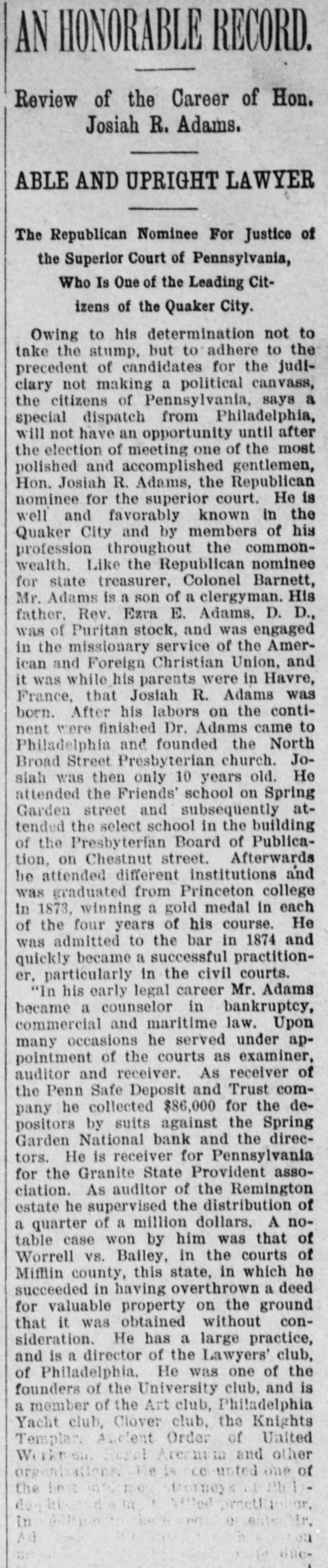
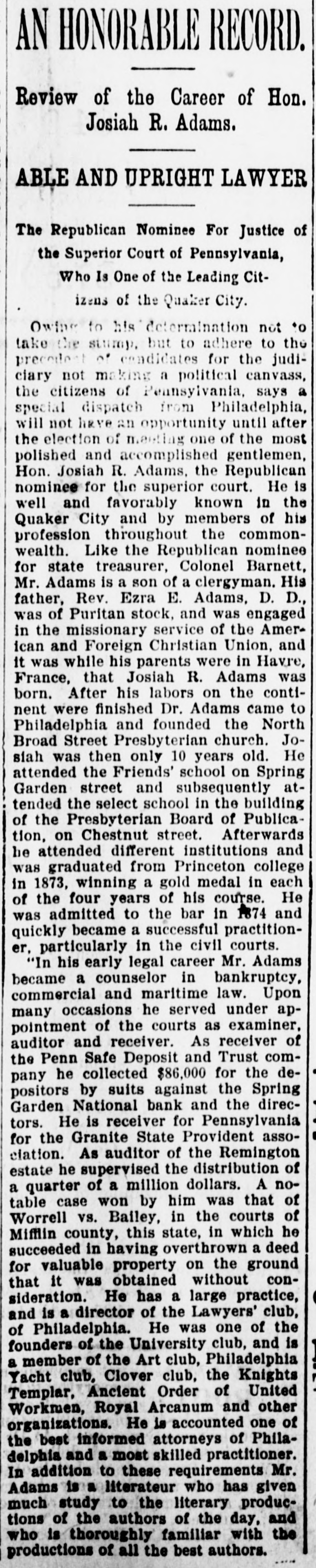
# AN HONORABLE RECORD. Review of the Career of Hon. Josiah R. Adams. # ABLE AND UPRIGHT LAWYER The Republican Nominee For Justice of the Superior Court of Pennsylvania, Who Is One of the Leading Cit- izens of the Quaker City. Owing to his determination not to take the stump, but to adhere to the precedent of candidates for the judi- ciary not making a political canvass, the citizens of Pennsylvania, says a special dispatch from Philadelphia, will not have an opportunity until after the election of meeting one of the most polished and accomplished gentlemen, Hon. Josiah R. Adams, the Republican nominee for the superior court. He is well and favorably known in the Quaker City and by members of his profession throughout the common- wealth. Like the Republican nominee for state treasurer, Colonel Barnett, Mr. Adams is a son of a clergyman. His father, Rev. Ezra E. Adams, D. D., was of Puritan stock, and was engaged in the missionary service of the Amer- ican and Foreign Christian Union, and it was while his parents were in Havre, France, that Josiah R. Adams was born. After his labors on the conti- nent were finished Dr. Adams came to Philadelphia and founded the North Broad Street Presbyterian church. Jo- siah was then only 10 years old. He attended the Friends' school on Spring Garden street and subsequently at- tended the select school in the building of the Presbyterian Board of Publica- tion, on Chestnut street. Afterwards he attended different institutions and was graduated from Princeton college In 1873, winning a gold medal in each of the four years of his course. He was admitted to the bar in 1874 and quickly became a successful practition- er, particularly in the civil courts. "In his early legal career Mr. Adams became a counselor in bankruptcy, commercial and maritime law. Upon many occasions he served under ap- pointment of the courts as examiner, auditor and receiver. As receiver of the Penn Safe Deposit and Trust com- pany he collected $86,000 for the de- positors by suits against the Spring Garden National bank and the direc- tors. He is receiver for Pennsylvania for the Granite State Provident asso- ciation. As auditor of the Remington estate he supervised the distribution of a quarter of a million dollars. A no- table case won by him was that of Worrell vs. Bailey, in the courts of Mifflin county, this state, in which he succeeded in having overthrown a deed for valuable property on the ground that it was obtained without con- sideration. He has a large practice, and is a director of the Lawyers' club, of Philadelphia. He was one of the founders of the University club, and is a member of the Art club, Philadelphia Yacht club, Clover club, the Knights Templar, Ancient Order of United Workmen, Royal Arcanum and other organisations. He is counted one of the best known attorneys in Phil- adelphia and has a successful practice.


Article from Cameron County Press, October 19, 1899

Click image to open full size in new tab

Article Text

AN HONORABLE REC JRD. Review of the Career of Hon Josiah R. Adanns. ABLE AND UPRIGHT LAWYER The Republican Nominee For Justice of the Superior Court of Pennsylvania, Who Is One of the Leading Citizens of the Quaker City. Owing to his determination not to take the stump, but to adhere to the precedent of candidates for the judiciary not making a political canvass, the citizens of Pennsylvania, says a special dispatch from Philadelphia. will not have an opportunity until after the election of meeting one of the most polished and accomplished gentlemen, Hon. Josiah R. Adams, the Republican nominee for the superior court. He is well and favorably known in the Quaker City and by members of his profession throughout the commonwealth. Like the Republican nominee for state treasurer, Colonel Barnett. Mr. Adams is a son of a clergyman. His father, Rev. Ezra E. Adams, D. D., was of Puritan stock, and was engaged in the missionary service of the American and Foreign Christian Union, and it was while his parents were in Havre. France, that Josiah R. Adams was born. After his labors on the continent were finished Dr. Adams came to Philadelphia and founded the North Broad Street Presbyterian church. Josiah was then only 10 years old. He attended the Friends' school on Spring Garden street and subsequently attended the select school in the building of the Presbyterian Board of Publication, on Chestnut street. Afterwards he attended different institutions and was graduated from Princeton college in 1873, winning a gold medal in each of the four years of his course. He was admitted to the bar in 1874 and quickly became a successful practitioner, particularly in the civil courts. "In his early legal career Mr. Adams became a counselor in bankruptey, commercial and maritime law. Upon many occasions he served under appointment of the courts as examiner. auditor and receiver. As receiver of the Penn Safe Deposit and Trust company he collected $86,000 for the depositors by suits against the Spring Garden National bank and the directors. He is receiver for Pennsylvania for the Granite State Provident association. As auditor of the Remington estate he supervised the distribution of a quarter of a million dollars. A notable case won by him was that ot Worrell vs. Bailey, in the courts of Mifflin county, this state, in which succeeded in having overthrown a dee for valuable property on the group without con-


Article from The Middleburgh Post, October 26, 1899

Click image to open full size in new tab

Article Text

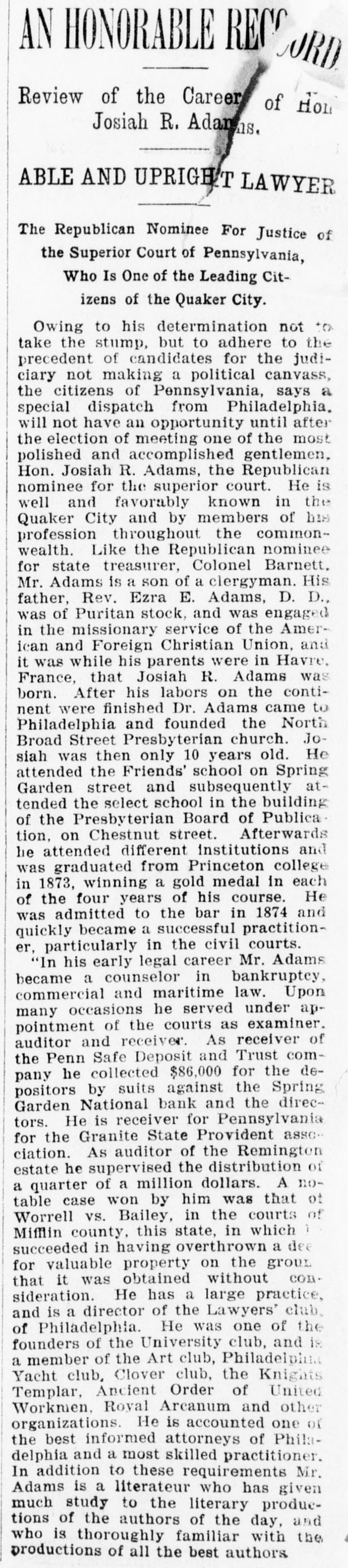
# AN HONORABLE RECORD. Review of the Career of Hon. Josiah R. Adams. # ABLE AND UPRIGHT LAWYER The Republican Nominee For Justice of the Superior Court of Pennsylvania, Who Is One of the Leading Citizens of the Quaker City. Owing to his determination not to take the stump, but to adhere to the precedent of candidates for the judiciary not making a political canvass, the citizens of Pennsylvania, says a special dispatch from Philadelphia, will not have an opportunity until after the election of meeting one of the most polished and accomplished gentlemen, Hon. Josiah R. Adams, the Republican nominee for the superior court. He is well and favorably known in the Quaker City and by members of his profession throughout the commonwealth. Like the Republican nominee for state treasurer, Colonel Barnett, Mr. Adams is a son of a clergyman. His father, Rev. Ezra E. Adams, D. D., was of Puritan stock, and was engaged in the missionary service of the American and Foreign Christian Union, and it was while his parents were in Havre, France, that Josiah R. Adams was born. After his labors on the continent were finished Dr. Adams came to Philadelphia and founded the North Broad Street Presbyterian church. Josiah was then only 10 years old. He attended the Friends' school on Spring Garden street and subsequently attended the select school in the building of the Presbyterian Board of Publication, on Chestnut street. Afterwards he attended different institutions and was graduated from Princeton college in 1873, winning a gold medal in each of the four years of his course. He was admitted to the bar in 1874 and quickly became a successful practitioner, particularly in the civil courts. "In his early legal career Mr. Adams became a counselor in bankruptcy, commercial and maritime law. Upon many occasions he served under appointment of the courts as examiner, auditor and receiver. As receiver of the Penn Safe Deposit and Trust company he collected $86,000 for the depositors by suits against the Spring Garden National bank and the directors. He is receiver for Pennsylvania for the Granite State Provident association. As auditor of the Remington estate he supervised the distribution of a quarter of a million dollars. A notable case won by him was that of Worrell vs. Bailey, in the courts of Mifflin county, this state, in which he succeeded in having overthrown a deed for valuable property on the ground that it was obtained without consideration. He has a large practice, and is a director of the Lawyers' club, of Philadelphia. He was one of the founders of the University club, and is a member of the Art club, Philadelphia Yacht club, Clover club, the Knights Templar, Ancient Order of United Workmen, Royal Arcanum and other organizations. He is accounted one of the best informed attorneys of Philadelphia and a most skilled practitioner. In addition to these requirements Mr. Adams is a literateur who has given much study to the literary productions of the authors of the day, and who is thoroughly familiar with the productions of all the best authors.