16440. Ohio Life and Trust Company (New York, NY)

Bank Information

Episode Type
Suspension → Closure
Bank Type
private
Start Date
August 24, 1857
Location
New York, New York (40.714, -74.006)

Metadata

Model
gpt-5-mini
Short Digest
ab5f5d8a

Response Measures

None

Description

Contemporary reports (Aug 24–29, 1857) announce the Ohio Life and Trust Company suspended on Aug. 24, 1857 amid rumors and losses from large railroad-stock loans; attachments and a court reference for appointment of receivers followed (Aug. 29, 1857). Articles describe no discrete depositor run (crowds/withdrawal lines); the firm was placed into receivership/legal process and did not resume normal operations in the coverage—classified as suspension leading to closure/receivership.

Events (2)

1. August 24, 1857 Suspension
Cause
Bank Specific Adverse Info
Cause Details
Suspension attributed to heavy loans and advances on railroad stock and depreciated securities; alleged losses and mismanagement (large discounts in railroad paper and insufficient collateral).
Newspaper Excerpt
The Ohio Life and Trust Company suspended this afternoon. The street is full of rumors, and great excitement prevails.
Source
newspapers
2. August 29, 1857 Receivership
Newspaper Excerpt
An application was made this morning for the appointment of a receiver of the property of the Ohio Life and Trust Company. ... Ordered, That it be referred to Win. C. Russell ... to ascertain whether Wm A. Booth and Fredh. A. Lane are fit ... to be appointed receivers herein of the estate and effects of the said defendants, and the amount of security which the receiver or receivers to be appointed should be required to give, and to inquire into and approve or disapprove the security offered ... Dated Augnat 29, 1857.
Source
newspapers

Newspaper Articles (19)

Article from Worcester Daily Spy, August 25, 1857

Click image to open full size in new tab

Article Text

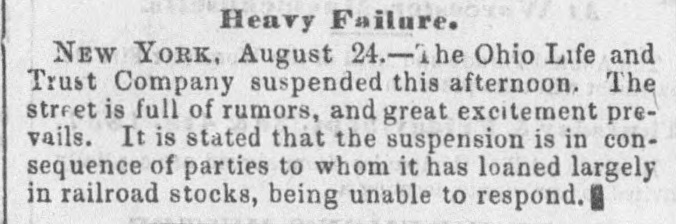
Heavy Failure. NEW YORK, August 24.-The Ohio Life and Trust Company suspended this afternoon. The street is full of rumors, and great excitement prevails. It is stated that the suspension is in consequence of parties to whom it has loaned largely in railroad stocks, being unable to respond.


Article from The Washington Union, August 25, 1857

Click image to open full size in new tab

Article Text

Suspension of a Stock Concern. New YORK, August 24 - The Ohio Life and Trust Compaiy have suspended. Rumors are plentiful, and the excitiment is great.


Article from The Evansville Daily Journal, August 25, 1857

Click image to open full size in new tab

Article Text

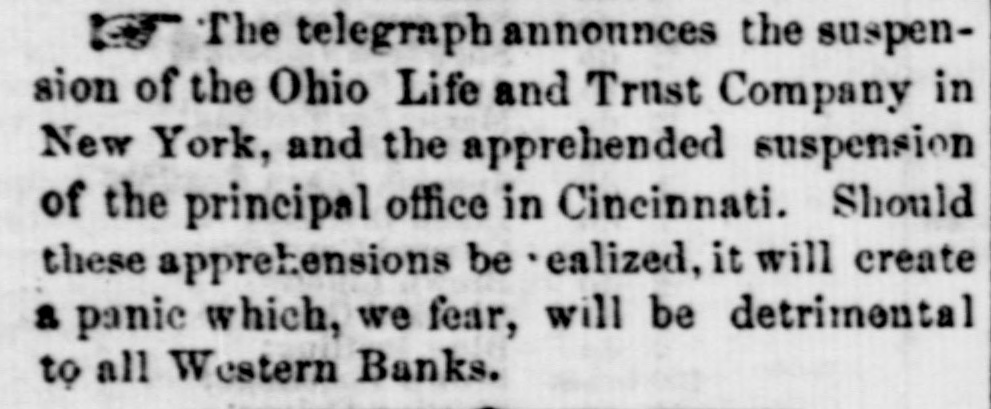
The telegraph announces the suspension of the Ohio Life and Trust Company in New York, and the apprehended suspension of the principal office in Cincinnati. Should these apprehensions be ealized, it will create a panic which, we fear, will be detrimental to all Western Banks.


Article from The Evansville Daily Journal, August 25, 1857

Click image to open full size in new tab

Article Text

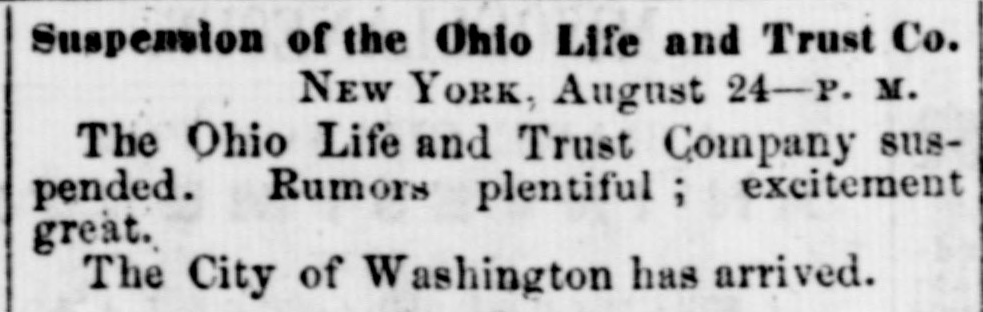
Suspension of the Ohio Life and Trust Co. NEW YORK, August 24-P. M. The Ohio Life and Trust Company suspended. Rumors plentiful ; excitement great. The City of Washington has arrived.


Article from Evening Star, August 25, 1857

Click image to open full size in new tab

Article Text

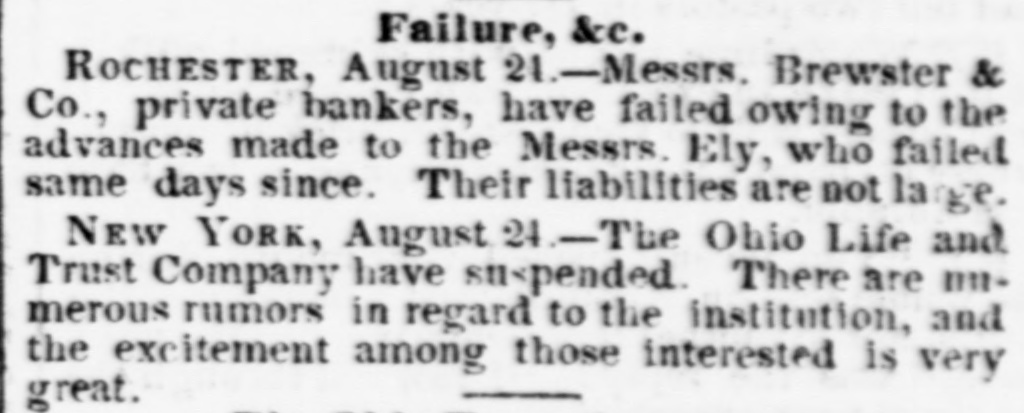
Failure, &c. ROCHESTER, August 21.-Messrs. Brewster & Co., private bankers, have failed owing to the advances made to the Messrs. Ely, who failed same days since. Their liabilities are not large. NEW YORK, August 24.-The Ohio Life and Trust Company have suspended. There are m. merous rumors in regard to the institution, and the excitement among those interested is very | great.


Article from Nashville Union and American, August 25, 1857

Click image to open full size in new tab

Article Text

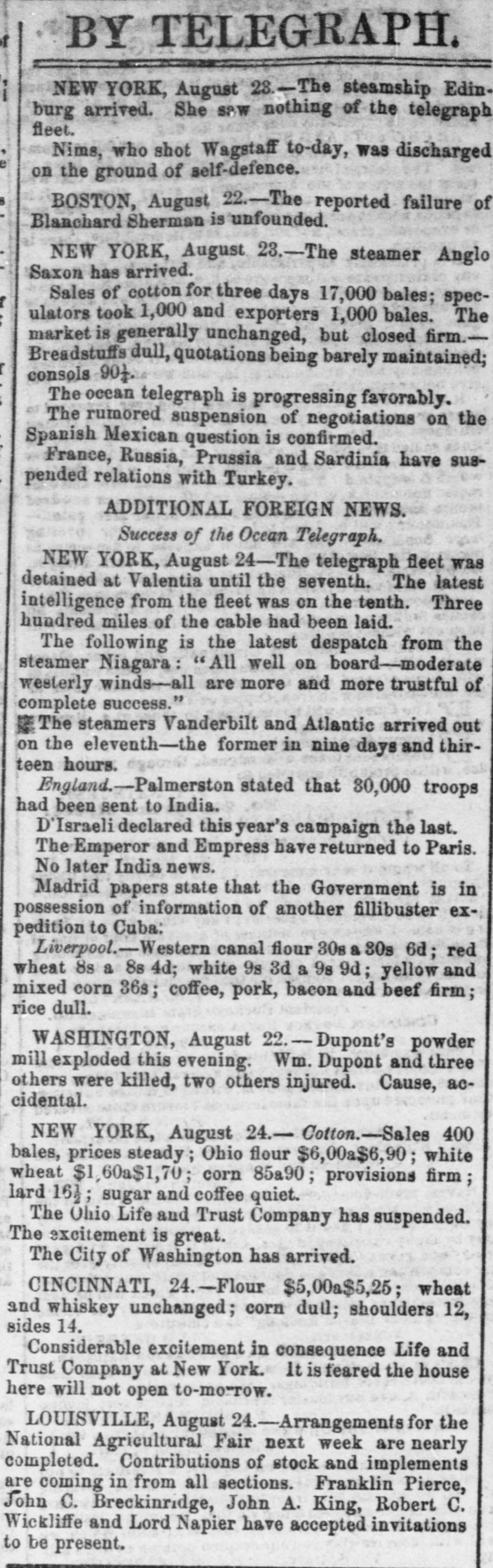
BY TELEGRAPH. NEW YORK, August 28.-The steamship Edinburg arrived. She saw nothing of the telegraph fleet. Nims, who shot Wagstaff to-day, was discharged on the ground of self-defence. BOSTON, August 22.-The reported failure of Blanchard Sherman is unfounded. NEW YORK, August 23.-The steamer Anglo Saxon has arrived. Sales of cotton for three days 17,000 bales; speculators took 1,000 and exporters 1,000 bales. The market is generally unchanged, but closed firm.Breadstuffs dull, quotations being barely maintained; consols 901. The ocean telegraph is progressing favorably. The rumored suspension of negotiations on the Spanish Mexican question is confirmed. France, Russia, Prussia and Sardinia have suspended relations with Turkey. ADDITIONAL FOREIGN NEWS. Success of the Ocean Telegraph. NEW YORK, August 24-The telegraph fleet was detained at Valentia until the seventh. The latest intelligence from the fleet was on the tenth. Three hundred miles of the cable had been laid. The following is the latest despatch from the steamer Niagara: All well on board-moderate westerly winds-all are more and more trustful of complete success." The steamers Vanderbilt and Atlantic arrived out on the eleventh—the former in nine days and thirteen hours. England.-Palmerston stated that 30,000 troops had been sent to India. D'Israeli declared this year's campaign the last. The Emperor and Empress have returned to Paris. No later India news. Madrid papers state that the Government is in possession of information of another fillibuster expedition to Cuba: Liverpool.-Western canal flour 30s a 30s 6d; red wheat 8s a 8s 4d; white 9s 3d a 9s 9d; yellow and mixed corn 36s; coffee, pork, bacon and beef firm; rice dull. WASHINGTON, August .--Dupont's powder mill exploded this evening. Wm. Dupont and three others were killed, two others injured. Cause, accidental. NEW YORK, August 24.- Cotton.-Sales 400 bales, prices steady; Ohio flour $6,00a$6,90; white wheat $1,60a$1,70; corn 85a90; provisions firm; lard 161; sugar and coffee quiet. The Ohio Life and Trust Company has suspended. The excitement is great. The City of Washington has arrived. CINCINNATI, 24.-Flour $5,00a$5,25; wheat and whiskey unchanged; corn dull; shoulders 12, sides 14. Considerable excitement in consequence Life and Trust Company at New York. It is feared the house here will not open to-morrow. LOUISVILLE, August 24.-Arrangements for the National Agricultural Fair next week are nearly completed. Contributions of stock and implements are coming in from all sections. Franklin Pierce, John C. Breckinridge, John A. King, Robert C. Wickliffe and Lord Napier have accepted invitations to be present.


Article from Worcester Daily Spy, August 26, 1857

Click image to open full size in new tab

Article Text

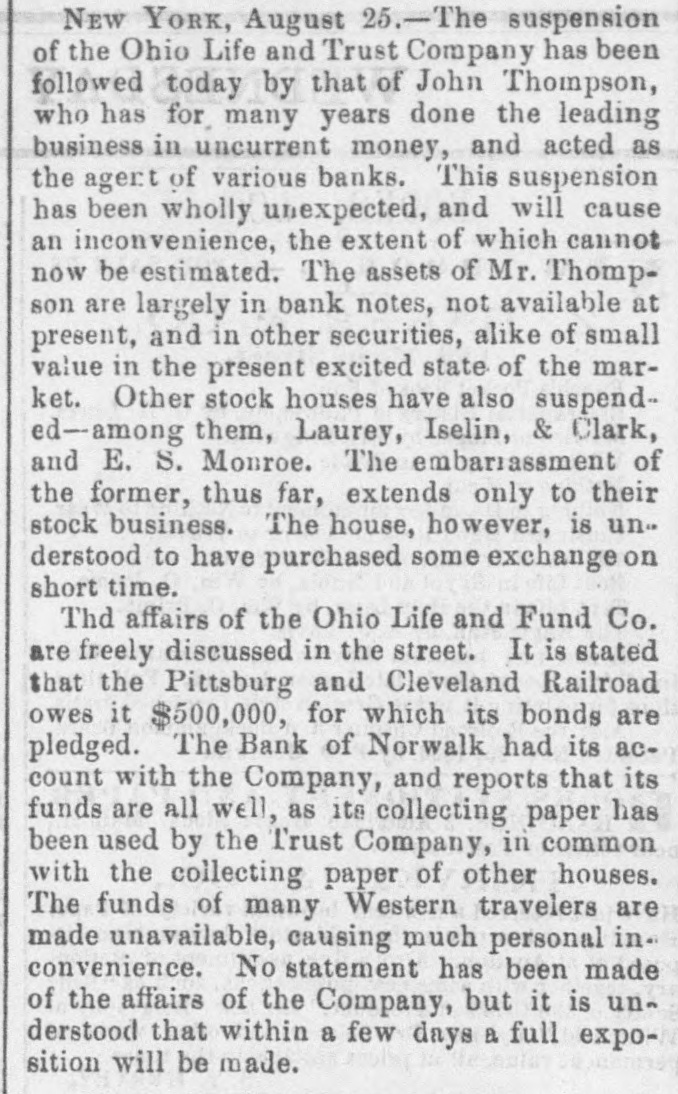
NEW YORK, August 25.-The suspension of the Ohio Life and Trust Company has been followed today by that of John Thompson, who has for many years done the leading business in uncurrent money, and acted as the agert of various banks. This suspension has been wholly unexpected, and will cause an inconvenience, the extent of which cannot now be estimated. The assets of Mr. Thompson are largely in bank notes, not available at present, and in other securities, alike of small value in the present excited state of the market. Other stock houses have also suspended-among them, Laurey, Iselin, & Clark, and E. S. Monroe. The embarrassment of the former, thus far, extends only to their stock business. The house, however, is understood to have purchased some exchange on short time. Thd affairs of the Ohio Life and Fund Co. are freely discussed in the street. It is stated that the Pittsburg and Cleveland Railroad owes it $500,000, for which its bonds are pledged. The Bank of Norwalk had its account with the Company, and reports that its funds are all well, as its collecting paper has been used by the Trust Company, in common with the collecting paper of other houses. The funds of many Western travelers are made unavailable, causing much personal in. convenience. No statement has been made of the affairs of the Company, but it is understood that within a few days a full exposition will be made.


Article from The New York Herald, August 27, 1857

Click image to open full size in new tab

Article Text

well as mpanies- savings and insurance now, an have been for a ear or two. loaning largely on all sorts of securities. realroad and otherwise The Ohio Life Tusu rance and Trust Company bank with out issue, similar in its operations 10 our avings funds, has been doing a large discount isiness in ratiroad paper, which having so much depreciated as to prevent further borrowing, the company bas gene by the board- its whole capital, al. leged, having been swallowed. Such of our own savings funds AF have been dealing in railed paper, at 1% to 2 per cent month. should take warning from the fate of the Trust Company at New York. Borrowing at such rates cannot continue. Neither individuals nor companies stand 1t. Sooner or later It must end, and when 11 doesend, the calamity may not stop with losses to the company the depositors, whose m ney has been aned, unfortunately, stand behind. and may also besefferers. [From the Hartford (Conn Times, August 25 Some excitement was created in the financial circles of this city esterday evening, in consequence of the receipt of despatch from New York to the effect that the Ohio Life and Trust Company had failed. A great deal of the stock is 0" ned in Hartford, and the news of the Company failure was quite unexpected. This anno acement attracted considerable attention here as the a musany was conei iered sound, and is estimated by gentlen en whose facilities give them good OD portuni ty to judge correctly. that something over one hundred thou sand dollars' worth of the stock is held by our citizens. The stock has been selling recently at abo the par value-a trifle over in some instances- and within few days about 3 per cent under. The capital of thein titution is $3,000, 000. It issues no bills for circulation, but is Life Insur. ance Company, combined with bank of deposit. dealing n xchange, drafts, &o, and probably too freely in faucy It stocks and making loans on the best terms possible. has branch bank in New York, where it did good share if its business. It was involved in some difficulty several years ago, but it was supposed that it bad fully vercome that embarrassment, and placed itself on a sale basis. But it suddenly appears as a bankrupt, to the sur. all. of prise From the Buffalo Advertiser. August 25 In commercial incles the week closes with a good demand for money, but without an ability on the part of our banks to meet it, and with this class of this community It is rather close. the banks at New York are contracting their loans and ours are not discounting beyond thirty days, and then only to regular customers. the manufacturing and mercantile classes are not sking for loans to e the usual tent in the street not much paper offering, and the range is 20 36 per cent The fact is the regular town trade are not anxi us borrowers of money Exchange on New York comparatively scarce and Drm at 3/2. The failure of the Ohio Life ani Trust Company excites great deal of remark, and in cl cles supposed to be p sted It is believed that it will mate iaily effect many of the Ohio banks. We bear this morning of the failure of John Thompson, New York. Instead of any inprovement in the general mercantile trade we hear of more complaint of inactivity and du ness The delay in the movement of the new crops, and the con inuance of farmers and western purchasers at home, are no doubt the immediate causes, while the remote or P imary ones are the renewed contraction in money markets and the late harvests The hopeful feel. ing in regard :0 an active fall trade is not. however, in the least dempened It i. certainly to be hoped that there be no will divappointment. The produce markets have generally declined, but there has been & fair demand. COMMERCIAL CRISIS. [From the Philadelphia Pennsy Ivanian, August 24 The New YORK HERALD has, for some time past, pub. lished articles expressing in strong terms its apprehen. sions of an app oaching financial revulsion The reasons which our cotemporary assigns for the position assumed, That our importations of the present year have been heavy be.ond any precedent, while our exports have been less than those of last year; that with double the quantity of warehoused goods, the port of New York has received, since the 1st of July, importations averaging a million of dollars day The journal then endeavors to show that our means to meet these excessive importations will prove inadequate. The growing cotion crops being a month behind time, the first shipments might be delayed till December, and if BR large as last year, they would ill not suffice to balance the account, and the prices of the article being already too high to remuneral turers, it remained doubtful whether it would bear an additional advance The HERALD admits an abundant her vest of breadstuffs, but remarks that neither England, France nor any would wan our surplus, the harvest prospects all over Euro having never been 80 disttering as now And further, that Europe would not accept our railroad bonds any longer, she having not of our stocks and bonds, nor had we made any financial loan of this sort in London since the commencement of the Rus sian war In addition to all this, the HERALD reminds us of the fact that the shipments of California gold fall short of three of last year each from two hundred thousand to four bundred thousand dollars, the defi Mency up to the month of August, 1857, amounting to about four million dollars, which officiency, it predicts, would reach five or Six mi lions before the end of the year. Our cotem porary concludes from all this that the first decided symptoms of a monetary pressure may be felt as early as December next: that drain of specie to Europe will be experienced in the ensuing spring, and that a postponement of the balancing of accounts would only be adding to the burden under bich we now stagger, while the inevitable revulsion must remain, after all, but question of time The HERALD has given us the blackest and gloomiest side of the picture, but there is janother description of papers who present quite a cheerful view of the matter. They assure us that money continues to be easy and that nobody is alarmed. Money continues to be easy If the mere assertion of the fact could but make it FO. these papers would be most invaluable Institutions But, unfortunately, the rates of interest are. on an average more than double of what they were some three years ago, while the demand for capital is equally urgent, if not more 80. Admitting the fact of excessive importstions, they themselves with the thought that most of the losses will fall on foreigners; and while they assure us that they are the last persons 10 favor extravagance, by count PU h importations, they endeavor to palliate them on the ground that a glut in the market, causing a decline of prices, benefits the people, in oon quence of the chempness it creates We do not share these lofiy and comprehensive views, neither from a moral nor commercial po nt of view The adva itages of legitimate inte change he her national or international, are reciprocal The lowes of one of the trading parties may, indeed, temporarily bene fit the other, but except bestowing rtunes upon comparatively very limited number of lucky ape Julators, they cannot result in lasting advantages to the peo pie at large, because very peturbation in commerce produces reactic of the same momentum. Gause and effect are of equal force. This truth is applicable not alone to the science BE chanics, but to all phenom na in nature and transactions of men. The mos regular and eq litable system intercha ge, subject to no violent con ruisio tends to distri bute on both des the greatest bie amount of prosperity The general law of he equilibrum of forces governs the profi in and losses of trade as it governs the relations of prod action and consumption. If foreign im porters should lose this year in consequence of an extraor disary decline of prices, the result of excessi ve importations, whi ch, at er all, ereencouraged by our own sste fulness and extravagance- this decline will surely be foi lowed by a rise adequate to the to ses incurred. so tha for these we shall have to indemnify them hereafter, un less. indeed, which is not probable, we contri Fe mean. while to render ourselves independent of foreign industry We do not agree with the HERALD, because we c waider its comment; upon our comm social and financial pos tion greatly exaggerated; still we hold that there exist power ful reasons urging she press to raise its warning voice, For series of years we have recklewsly induiged in habits of wastefulness and loose apeculations of every descrip sion; we have stretched our credit at home and abroad, to the stmont limi 8 of its strength, and now, when the con sequen bee of this thoughtiess course are brought home to us: when It is felt by almost everybody, that the mone tary resources are greatly inad quate to the business re quirements of the country, we see the drain of prectous metals continue without interruption, and even exceed that of former years Previous to 1851 we never in any one year exported above $9,500,000 of specie bullion, as an excess of exportation over importation but ince 1851 that sum ranged bet ween $24 000 000 as a minimum, and 862 000,000 maximum. In 1856 it amounted to $41,500,000, and now it is reported, that - the Grst seven months of this year we have already shipped $7,000,000 more than for the same period of last year These shipments are the main and Immediate cause of our troubles, and It is high time that Coagress should direct its attention to the subject, since the last tariff act has evidently failed to accomplish its purpose It is by a speedy and prompt application of legislative medies only that the gloomy apprehensions entertained in some quarters can be prevented from becoming sad reality On the other hand, we would remark in contra diction of the exaggerations of the HERALD, that beside: the California gold, probably some OCO or $18,000,000 are added annually to our monetary resources by the im migration and that though Europe may not require as large granuity of grain as in the previous years of war and partial failure of crops, the exportation will remain considerable. The production of Europe 10 never adequate to its consumption The high price of cotton denotes com parative scarcity and warrants a ready sale of the grow Ing which may suffice, if other wise the die tales of prudence be beeded in time, to avert the threat ening calami At all events, the people here will have and bread provisions chemper another


Article from American Union, August 28, 1857

Click image to open full size in new tab

Article Text

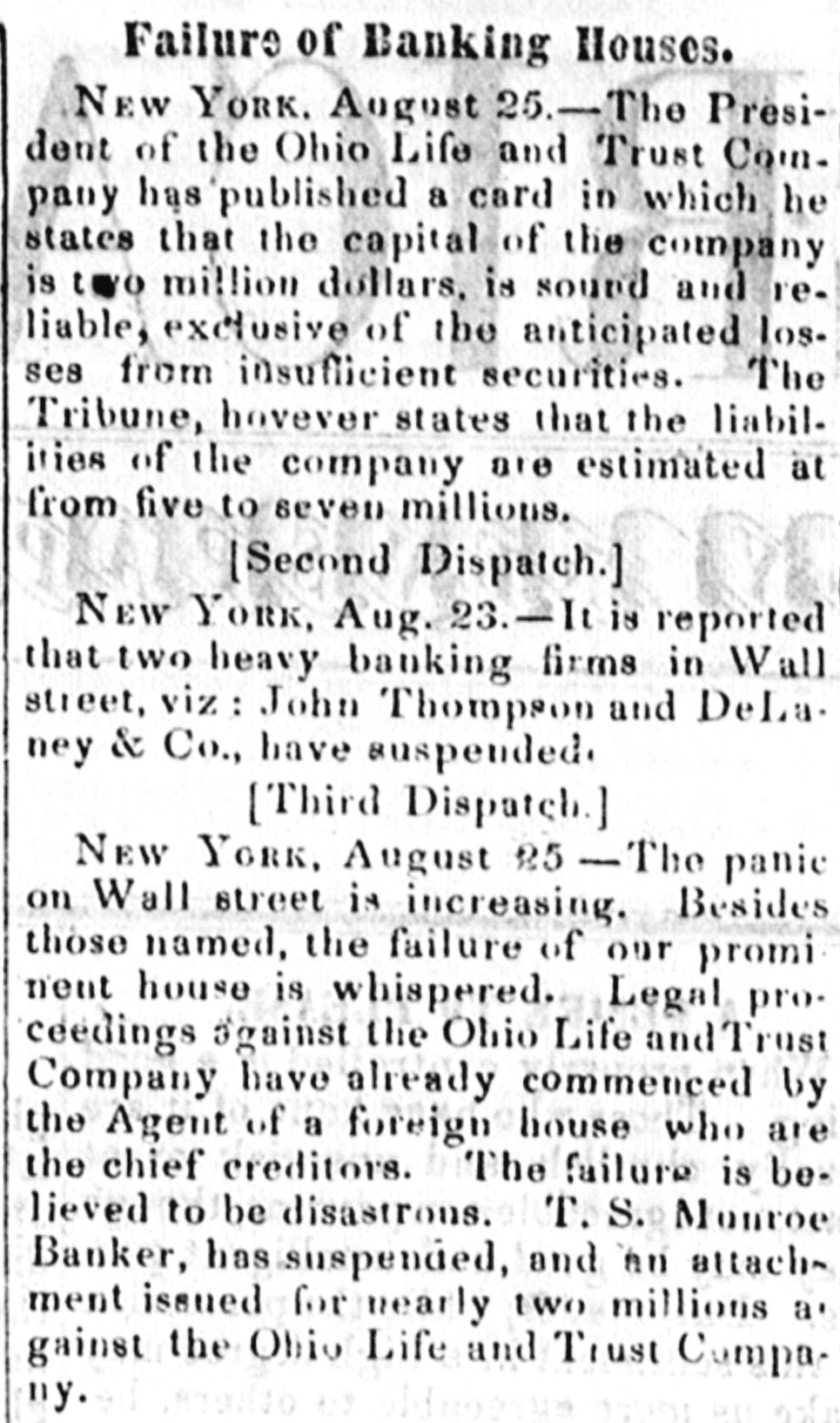
Failure of Banking Houses. NEW YORK. August 25.-The President of the Ohio Life and Trust Company has published a card in which he states that the capital of the company is two million dollars, is sound and reliable, exclusive of the anticipated losses from insufficient securities. The Tribune, hovever states that the liabilities of the company are estimated at from five to seven millions. [Second Dispatch.] New York, Aug. 23.-It is reported that two heavy banking firms in Wall street, viz : John Thompson and DeLaney & Co., have suspended. [Third Dispatch.] NEW YORK, August 25 - -The panie on Wall street is increasing. Besides those named, the failure of our promi nent house is whispered. Legal proceedings against the Ohio Life and Trust Company have already commenced by the Agent of a foreign house who are the chief creditors. The failure is believed to be disastrous. T.S. Monroe Banker, has suspended, and an attachment issued for nearly two millions a' gainst the Ohio Life and Trust Cumpa ny.


Article from Wheeling Daily Intelligencer, August 28, 1857

Click image to open full size in new tab

Article Text

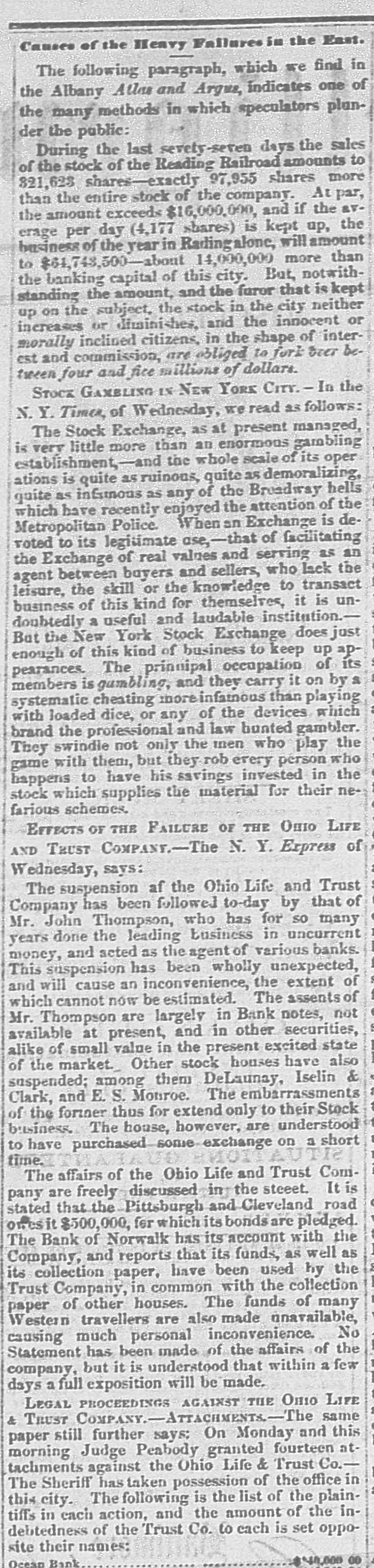
Causes of the Heavy Failures in the East. The following paragraph, which we find in the Albany Allas and Argus, indicates one of the many methods in which speculators plander the public: During the last sevely-seven days the sales of the stock of the Reading Railroad amounts to 321,628 shares-exactly 97,955 shares more than the entire stock of the company. At par, the amount exceeds $16,000,000, and if the average per day (4,177 shares) is kept up, the business of the year in Radingalone, will amount to $61,748,500-about 14,000,000 more than the banking capital of this city. But, notwithstanding the amount, and the furor that is kept up on the subject, the stock in the city neither increases or diminishes, and the innocent or morally inclined citizens, in the shape of interest and commission, are obliged to fork beer between four and fice millions of dollars. STOCK GAMBLING IX NEW YORK Cirr.- In the N. Y. Times, of Wednesday, we read as follows: The Stock Exchange, as at present managed, is very little more than an enormous gambling establishment,-and the whole scale of its oper ations is quite as ruinous, quite as demoralizing, quite as infumous as any of the Bruadway hells which have recently enjoyed the attention of the Metropolitan Police. When on Exchange is devoted to its legitimate ase,-that of facilitating the Exchange of real values and serving as an agent between buyers and sellers, who lack the leisure, the skill or the knowledge to transact business of this kind for themselves, it is undoubtedly a useful and laudable institution.But the New York Stock Exchange does just enough of this kind of business to keep up appearances. The principal occupation of its members is gumbling, and they carry it on by a systematic cheating more infatnous than playing with loaded dice, or any of the devices which brand the professional and law hunted gambler. They swindle not only the men who play the game with them, but they rob every person who happens to have his savings invested in the stock which supplies the material for their nefarious schemes. EFFECTS OF THE FAILURE OF THE Onto LIFE AND TRUST COMPANY.-The N. Y. Express of Wednesday, says: The suspension af the Ohio Life and Trust Company has been followed to-day by that of Mr. John Thompson, who has for so many years done the leading business in uncurrent money, and acted as the agent of various banks. This suspension has been wholly unexpected, and will cause an inconvenience, the extent of which cannot now be estimated. The assents of Mr. Thompson are largely in Bank notes, not TO available at present, and in other securities, alike of small value in the present excited state of the market. Other stock houses have also suspended; among them DeLaunay, Iselin & Clark, and E.S. Monroe. The embarrassments of the former thus for extend only to their Stock business. The house, however, are understood to have purchased some exchange on a short time. The affairs of the Ohio Life and Trust Company are freely discussed in the steeet. It is stated that the Pittsburgh and Cleveland road offes it $500,000, for which its bonds are pledged. The Bank of Norwalk has its account with the Company, and reports that its funds, as well as its collection paper, have been used by the Trust Company, in common with the collection paper of other houses. The funds of many Western travellers are also made unavailable, causing much personal inconvenience. No Statement has been made of the affairs of the company, but it is understood that within a few days a full exposition will be made. LEGAL PROCEEDINGS AGAINST THE Onio LIFE & TRUST COMPANY.-ATTACHMENTS-The same paper still further says: On Monday and this morning Judge Penbody granted fourteen attachments against the Ohio Life & Trust Co.The Sheriff has taken possession of the office in this city. The following is the list of the plaintiffs in each action, and the amount of the indebtedness of the Trust Co. to each is set opposite their names: -$*40,000.00 Ocean Bank


Article from Vermont Watchman and State Journal, August 28, 1857

Click image to open full size in new tab

Article Text

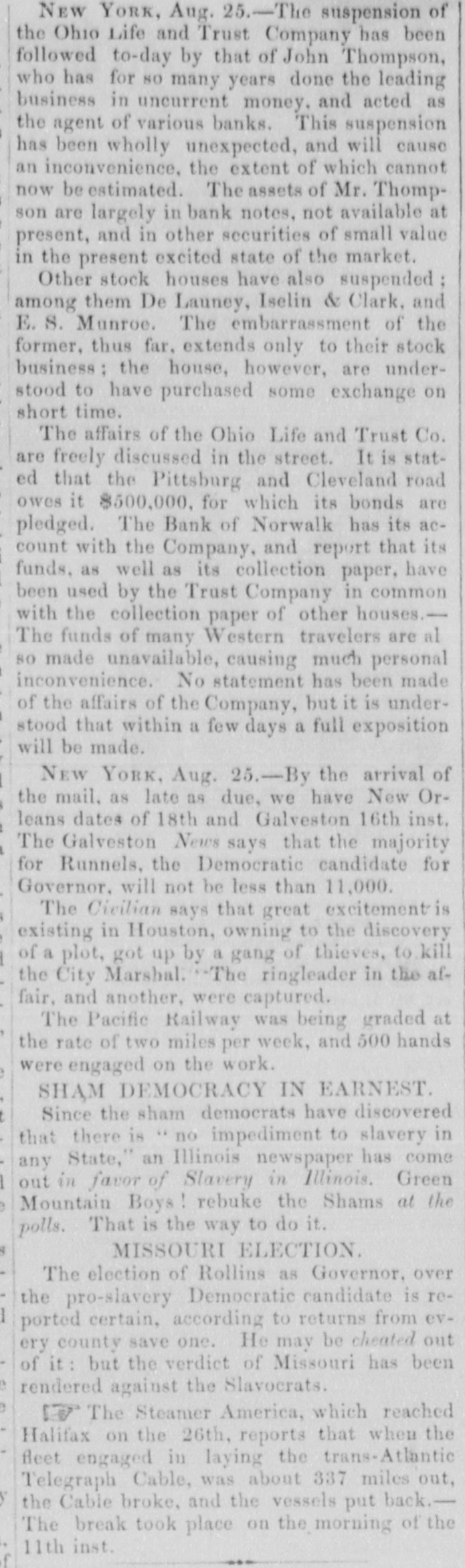
NEW YORK, Aug. 25.-The suspension of the Ohio Life and Trust Company has been followed to-day by that of John Thompson, who has for so many years done the leading business in uncurrent money. and acted as the agent of various banks. This suspension has been wholly unexpected, and will cause an inconvenience, the extent of which cannot now be estimated. The assets of Mr. Thompson are largely in bank notes, not available at present, and in other securities of small value in the present excited state of the market. Other stock houses have also suspended among them De Launey, Iselin & Clark, and E. S. Munroe. The embarrassment of the former, thus far, extends only to their stock business: the house, however, are understood to have purchased some exchange on short time. The affairs of the Ohio Life and Trust Co. are freely discussed in the street. It is stated that the Pittsburg and Cleveland road owes it $500,000. for which its bonds are pledged. The Bank of Norwalk has its account with the Company, and report that its funds, as well as its collection paper, have been used by the Trust Company in common with the collection paper of other houses.The funds of many Western travelers are al so made unavailable, causing much personal inconvenience. No statement has been made of the affairs of the Company, but it is understood that within a few days a full exposition will be made. NEW YORK, Aug. 25.-By the arrival of the mail. as late as due, we have New Orleans dates of 18th and Galveston 16th inst. The Galveston News says that the majority for Runnels, the Democratic candidate for Governor. will not be less than 11,000. The Civilian says that great excitement is existing in Houston, owning to the discovery of a plot, got up by a gang of thieves, to kill the City Marshal. The ringleader in the affair, and another, were captured. The Pacific Railway was being graded at the rate of two miles per week, and 500 hands were engaged on the work. SHAM DEMOCRACY IN EARNEST. Since the sham democrats have discovered that there is no impediment to slavery in any State," an Illinois newspaper has come out in favor of Slavery in Illinois. Green Mountain Boys rebuke the Shams at the polls. That is the way to do it. MISSOURI ELECTION. The election of Rollins as Governor, over the pro-slavery Democratic candidate is reported certain, according to returns from every county save one. He may be cheated out of it: but the verdict of Missouri has been rendered against the Slavocrats. 17 The Steamer America, which reached Halifax on the 26th, reports that when the fleet engaged in laying the trans-Atlantic Telegraph Cable, was about 337 miles out, the Cable broke, and the vessels put back.— The break took place on the morning of the 11th inst.


Article from New-York Daily Tribune, August 31, 1857

Click image to open full size in new tab

Article Text

LAW INTELLIGENCE. SUPREME COURT-SPECIAL TERM AUGUST 29.-Before Judge PEABODY John Haye agt The Ohio Life and Trust Company. An application was made this morning for the ap- pointment of a receiver of the property of the Ohio Life and Trust Company. The motion was made on behalf of the plaintiff, represented by Mr. Charles C. Nott, whe appeared on his behalf, with the consent of the numerous other creditors, who have obtained at- tachments, and of the Ohio Life and Trast Company itself. The Judge referred the whole matter to Mr. Wm. C. Russell. The following is the ORDER OF REFERENCE. At a Special Term, &c On the verified compisint in this ac- tion, and the consent of the defendants that a receiver be ap- pointed, and on bearing Chae. C. Nott, esq, of couusel for the plaintiff. Ordered, That it be referred to Win. C. Russell, esq, a coun- selor of this Court, to ascertain whether Wm A. Booth and Predh. A. Lane are fit and proper persons to be appointed re- esivérs berein of the estate and effects of the said defendante, and the amount of security which the receiver or receivers to be appointed should be required to give, and to inquire into aud approve or disapprove the security offered, both in regard to the sesponsility of the sureties and the form and execution of the bond. THE ALLEGED DEFALCATION AT THE ST. NICHOLAS- MR. TRREADWALL HELD TO BAIL.. Jolm M. Lawler sgt. John P. Treadwell et al. An order of arrest was this morning granted in this eare against Mr. Treadwell upon MR. LAWLER'S AFFIDAVIT. City and County of New York, 63. John M. Lawler, above samed, being daly sworn, says that he was the owner and now is of a certain wardrobe and contents, and other articles of per- sonal property of the value of $1,000 or thereabouts, which were and are now in the possession of the defendaute; that the summons therein was this day duly served, and accompanying the same was an order for the delivery of the same (in the hards of the Sheriff of said city and county), commonly called a writ of replevin; that deponent had previously, and before the action was commenced, duly demanded such property of the defendants, but they refused to deliver the same to him, and still retain the same; and that the defendant Treadwell this day refused to deliver the same to said Sheriff, who had such zequisit on in the plaintiff's behalf and that the same was sued upon the necessary affidavit and undertaking. JOHN M. LAWLER. Sworn Aug. 29, 1857, before me. WM. H. DUSERBURY, Commissioner of Deeds. ORDER OF ARREST. To the Sheriff of the City and County of New York. You are required forthwith to arrest the defendant John P. Treadwell in this action, and hold him to bail in the sum of $15,009, and to return this order to Henry Sacia plaintiff's attorney, at No. 130 Chambers street, on the 3d day of September, 1857. C. A PEABODY, Dated Augnat 29, 1857. Justice of the Supreme Court. John P. Treadweil et al, agt. John W. Lawler. An order requiring the plaintiffs in this case to show enuse upon the papers now before the Court why the attachment previously granted against the defendant should not be set aside was granted this morning. Abont the same time that Mr. Lawler's counsel was seeking to replevy the personal property of Mr. Law ler in the possession of Mr. Treadwell, the counsel of the latter obtained from Judge Peabody an attachment against the same property. DECISIONS. Wm. M. Wilmarth, &c.. agt. Mason A. Perkins.- Motion to discharge defendant from arrest granted, with costs. Robt. W. Lowber agt. John Garvey. Motion for an attachment granted, Before Judge MITCHELL. Cazneau agt. Mali, Crocker agt. Crocker, Haggerty agt. Granger.-Forms of judgment settled in each case. SUPREME COURT-Aug. 29.-Before Judge STRONG The Morris Canal and Banking Company agt Peter Town- send and William H. Towasend. S. B. STRONG, J. The plaintiffs are authorized by the statutes of the State of New Jersey to construct their Canal to the line of this State, bounding the County of Orange. They found it necessary, or at any rate convenient for their operations, to construct a dam across the outlet of Long Pond or Greenwood Lake, which created a reservoir extending into and crossing some of the lands of that county. The Leg- islature of this State, by an act passed on the 11th of April, 1855, (Ch. 296) authorized this Court to appoint Commissioners to ascertain and determine the com- pensation which ought justly to be made to the owners of the lands for the taking of their real estate in case the same shall be taken, or for the injury which may have been or shall be occa- sioned thereto by such reservoir, and provided that on the action and determination of tue Commissioners, and the payment, tender or deposit of the compensation awarded by them, the said Com pany sball be vested with the title to the real estate taken, aud all persons made parties to the proceedings shall be divested and barred of all right in the lande taken during the corporate existence of the Company, and from all claim or demand on ac count of injury or damage to the real estate injuriously affected. Some of the lands to be taken or injuriously affected by estab lishing or constructing the reservoir, belong to the defendants. The Company allege that they have offered to pay to those own- ers a reasonable compensation for their land and damages, which said owners have refused to accept, and therefore the Company have applied to this Court for the appointment of commissioners to ascertain and determine the compensation to be made to the defendants for their lands and damages. This Court, at Sp tal Term, made an order for the appointment of such comr ston- ers, from which the defendants have appealed; and ney now contend that the order should be reversed and an alied on the assumption that the act of our Legislature is Vaconstitutional and void. It is contended that our Legislature cannot authorize a foreign Corporation, located in another State, and subject to no power of visitation or control on the part of or', functionaries, to take the lands in this State belonging to s citizens. There is cer tainly nothing in our Constitution ana restraining the power of exercising the right of eminent de main The objection must be arged on the allegation of ince mpatibility; but incompatibiliy with what? Certainly not, with our ordinar, practice. We have recognized the exister ce of foreign Corporations in various ways, and granted to the im many privileges in this State. We have laws to prevent the forgery of bills of foreign banks. We authorize foreign Insurance Companies to transact business in this State. Foreigr. Corporations may institute, maintain, and defend suits in ou State Courts, and do so. Aad we have au thorized the Rai road Company of another State-the New-York and New-Have a Railroad Company-to extend their road into this State, an to acquire (compulsorily if need be) the title to, or the righ to use, the lands of our citizens in the County of Westchester. So far as I have known, none of the acts con- ferring such privileges, powers and rights have been deemed in- compatible with our Constitution and the rights of our citizes, and therefore void. It might have been well in the present instance to have imposed some conditions which would have enabled our State Legislature to control (of course sudirectly) the general operations of the Company so as effec tually to protect the interests of the people of this State. That was not dons probably from confidence in the the good intentions of the Directors and a consciousness that it would be for their advantage to promote the welfare of all whose interests or ne cessities night prompt them to use the canal. We have nok, of course, parted with the right to legislate as to the use of that part of the property of the Company which shall be within our limits. That the Legislature has not yielded, and could not, without derogation, yield to another State. In legis- lating as to the right to take private property for public pur- poses, it would not vitiate the law oven if it should be remiss in providing fully for the interests of the people. If such con- siderations should be allowed to defeat our statutes, I am ap prehensive that many of them would fail. It is objected that the operations of a corporation in another State, and conducted principally by inhabitants of that State, cannot be productive of public good to our citizens, so as to au thorize the assumption of their lands. But why not? A canal generally improves a country through its whole extent, quite as much as at its terminus-the more remote full as much as at any other point. We can easily see that it may benefit our pe ple near the State line where it terminates. That is enough to feed the power, and to show that it has not been exercised un- der an illusory pretense. Whether our public will be essen- tially benefited was for our Legislature to judge. The Consti tution confides the right to judge in that matter to that depart- ment, and not to the Judiciary. In the case of Heyward agt. The Mayor of New York, 3 Seldon, 325, Mailet, J., in giving the opinion of the Court, says, "Does it" (the right of eminent domain) "imply the right in the sovereign power to determine the time and the occasion, and as to what particular property "it may be exercised? Most certainly it does, from the very essence and nature of the right. To deny it would be to abro gate and destroy it. As to the extent of the interest in the lands to be acquired by the Company, that was solely for the consideration of the Legis lature The right to take property to any extent, whether a full and entire title or only an casement, is implied in the Constitu tional provision. It was inade a question on the argument whether the term property" in the constitutional provision includes a riglit of action for injuries to land proposed to be taken so that it could be included in the assessment by the Commissioners without a violation of the right to a trial by Jury. I am inclined to think that in this case t the trespasses upon the land are so directly connected with the main subject and with the more materia! act of taking it, that they may be included. It is a close ques tion, I admit. But it cannot effect the main question as to the right to acquire the land. That cannot be obtained under the act in question without a full compensation to the owners for their present loss: and if they are also to receive a compensa tion for antecedent injuries without depriving they of their


Article from Nashville Union and American, September 16, 1857

Click image to open full size in new tab

Article Text

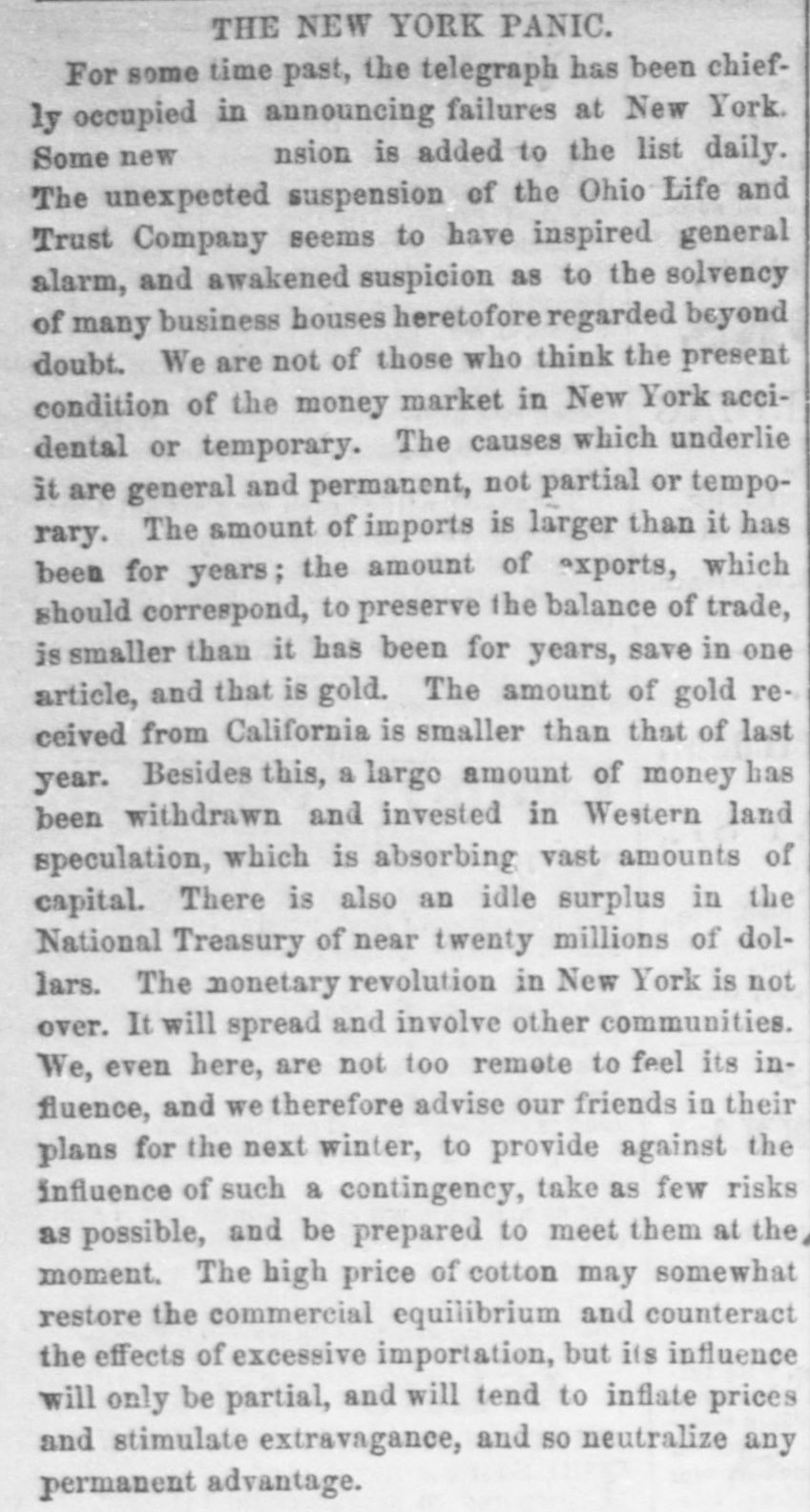
THE NEW YORK PANIC. For some time past, the telegraph has been chiefly occupied in announcing failures at New York. nsion is added to the list daily. Some new The unexpected suspension of the Ohio Life and Trust Company seems to have inspired general alarm, and awakened suspicion as to the solvency of many business houses heretofore regarded beyond doubt. We are not of those who think the present condition of the money market in New York accidental or temporary. The causes which underlie it are general and permanent, not partial or temporary. The amount of imports is larger than it has been for years; the amount of exports, which should correspond, to preserve the balance of trade, is smaller than it has been for years, save in one article, and that is gold. The amount of gold received from California is smaller than that of last year. Besides this, a large amount of money has been withdrawn and invested in Western land speculation, which is absorbing vast amounts of capital. There is also an idle surplus in the National Treasury of near twenty millions of dollars. The monetary revolution in New York is not over. It will spread and involve other communities. We, even here, are not too remote to feel its influence, and we therefore advise our friends in their plans for the next winter, to provide against the influence of such a contingency, take as few risks as possible, and be prepared to meet them at the moment. The high price of cotton may somewhat restore the commercial equilibrium and counteract the effects of excessive importation, but its influence will only be partial, and will tend to inflate prices and stimulate extravagance, and SO neutralize any permanent advantage.


Article from The Nevada Democrat, October 7, 1857

Click image to open full size in new tab

Article Text

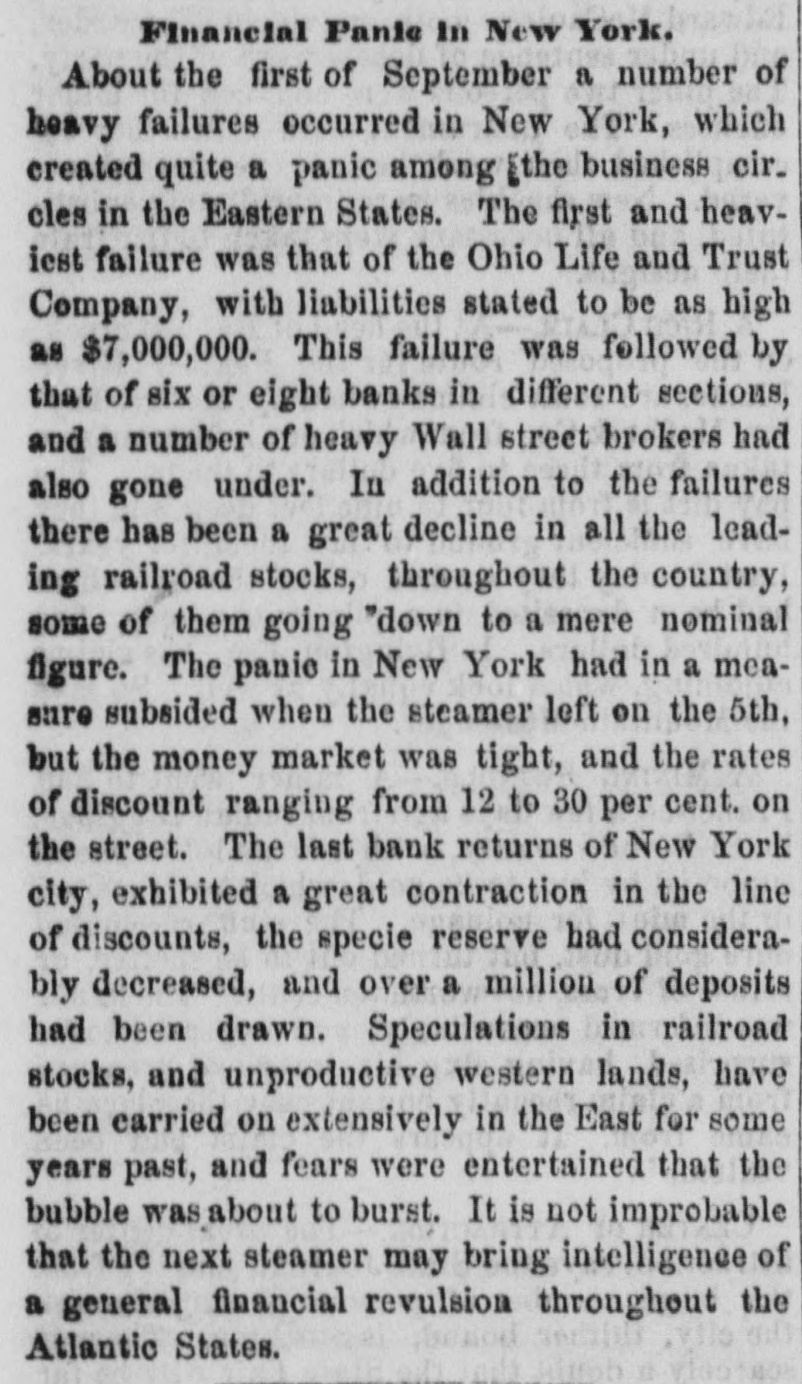
Financial Panic In New York. About the first of September a number of heavy failures occurred in New York, which created quite a panic among [the business cir. cles in the Eastern States. The first and heaviest failure was that of the Ohio Life and Trust Company, with liabilities stated to be as high as $7,000,000. This failure was followed by that of six or eight banks in different sections, and a number of heavy Wall street brokers had also gone under. In addition to the failures there has been a great decline in all the leading railroad stocks, throughout the country, some of them going "down to a mere nominal figure. The panic in New York had in a measure subsided when the steamer left on the 5th, but the money market was tight, and the rates of discount ranging from 12 to 30 per cent. on the street. The last bank returns of New York city, exhibited a great contraction in the line of discounts, the specie reserve had considerably decreased, and over a million of deposits had been drawn. Speculations in railroad stocks, and unproductive western lands, have been carried on extensively in the East for some years past, and fears were entertained that the bubble was about to burst. It is not improbable that the next steamer may bring intelligence of a general financial revulsion throughout the Atlantic States.


Article from San Andreas Independent, October 10, 1857

Click image to open full size in new tab

Article Text

expressed. Shortly after this, the of the cable gained upon frequently speed considerably o'clock the that of the ship, and up to 9 the latter was about three knots by the The cable was ranning out to five and three-quarter per and rate log. a-half of knots from five hour. The steam was then raised to 2,500 and weight, but the wind and sea increasing, the current at the same time carrying the cable at an angle from the direct line of cheek the ship's course, was not found sufficient to the cable. which, at midnight. was making two and a-half knots above the speed of the ship, in and sometimes imperiling the safe uncoiling the hold. The retarding force was therefore increased to about equivalent to 3.000 weight; and then again, in consequence of the speed continuing be than it would have been prudent By this rate, the cable was to a little short of five knots. to to permit. more when it parted- brought miles. the length paid out at that time being 335 Domestic Intelligence. The claim of Mrs. Cunningham to the estate of Dr. has been settled by Burdell, the title Surrogate's decision against her. A clear was decreed to the blood relations of the murdered man, on the ground that Mrs. Cunningham was never married. She remains in the, Tombs, waiting trial for the bogus baby business. It is reported that a proposition has been made by the heads of the Church in Nicaragua for Gen. Walker to return and take the helm of affairs. Handbills are circulated in the interior of and Tennessee, enlisting recruits for Georgia Nicaragua-$25 per month and 250 acres of land are offered to each man. The election returns from Missouri, show Stewart to be elected Governor by 334 maj. The election in Vermont has taken place; of course the republicans were successful. Mortimer Livingston, a very eminent merchant of New York, died at Staten Island. Rev. R. W. Griswold, the author, is also dead. Gens. Scott and Jessup have decided that the Utah military expedition shall proceed to its destination. Dr. Forney, of Penna., has accepted the post of Superintendent of Indian Affairs in Utah. Beverly Tucker has accepted the Liverpook consulate. Ten companies of soldiers have been sent to Kansas to replace those sent to Utah. The Conference Committee of Constitutional Convention of Minnesota, have at last agreed a report which was adopted in the repre- be sentative upon bodies. But one constitution will submitted to the people. 3 The Steamer Illinois, with 600 California the had arrived at New York, on was detained in were landed from a sick 3d, passengers, and persons quarantine. her, left Some portion Aspin- 18 of them having been sick since they since wall, and others having been attacked after the steamer left Havana, where she put in inciher unfortunate grounding. The trials dent to a prolonged passage, and the dangers this have passed through, have produced of these sickness they among her passengers. Some are of a doubtful nature, others present man cases resemblance to yellow fever, and a have and some a woman from among the number died. a financial panic has been in and existence other Quite several days past in New York failfor in consequence of a few stupendous numercities, which have resulted in producing scale. ures, of bankruptcy on a smaller off with ous cases Ohio Life and Trust Company led followed The for some $7,000,000; then mera failure suspension of some heavy banking Bank the &c., and a few country banks. 1st Sepchants, Association failed on the $70 000. tember, Mechanics' being previously robbed York of stocks. holders secured by New Hatch & The Bill deposit and discount bank of There is Langdon, Cineinnati, suspended. a large considerable excitement. as there are bank was involved of small depositors. The Co., of number in the failure of Beebe & New York. of Iowa have nominated Judge The Republicans P. Lowe, of Keokuk, for Governor. democrats, R. Hon. B. Me Samuels. excitement existed at Burlington, of Great consequence of the seduction W. B. a Vt., young in girl of fifteen years, by Rev. Southerland. NICARAGUA TRANSIT ROUTE.- We Costa are Rica, ina gentleman lately representative from of formed that Don by F. Pamayo: Washington, a new has got Nicaragua, for now the transit in route, signed Government, by the charter Directors of the Nicaraguan this subtwo him full powers to treat upon the chargiving Nicaragua will not recognize Costa Riroute at present. ject. ca. ter given No to appearance Harris & of Webster, an opening by of that State 7's, 1875, are selling conse- at 57 California Almost all stocks haveffallen the in week cents. of the large number of failures steamer. Little quence except previous cash to the operations sailing of took the place in Wall street. Erie Railroad Company, maturity, it seems, but The their interest at through Chas. Morgan. subsequently failed to pay succeeded in doing so We are Sept. 2d - P. M.- much better WEDNESDAY, be able to announce the and in circles. state happy of to feeling to-day, in Wall The street, absence of subsithe commercial failures, and the aimost much entire to quiet further rumors, has done yesterday, is dence of feeling. Our change from absence of public very marked, and there was an entire panic. that the worst is over, and the usual that It is hoped of confidence will not present financial disastrous a return effects which accompany a panic. BY THE PRESIDENT.-Hot Rio de APPOINTMENTS Kidder Meade, Minister to Brazil. Richard will leave next month for preJaneiro, instructions, which are now to being the negopared, His are important, commercial and relate treaty, and the tiation of of a new the rates of the high Carolina, Brazilian will reduction Mr. Rayney, of North Legation to probably tariff. be appointed Secretary of The Brazil. President has appointed Beverly Tuck-


Article from The Western Democrat, October 20, 1857

Click image to open full size in new tab

Article Text

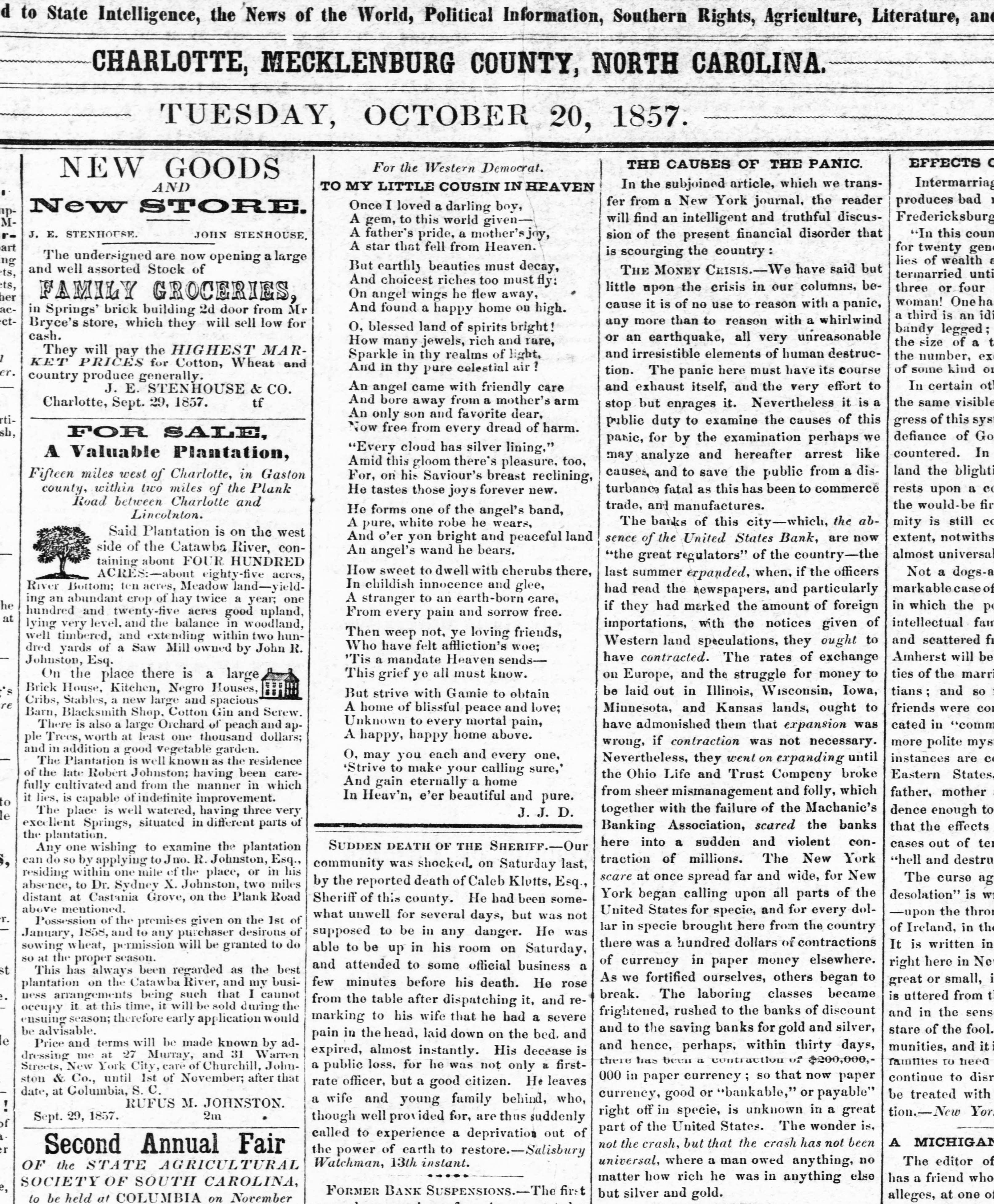
d to State Intelligence, the News of the World, Political Information, Southern Rights, Agriculture, Literature, an CHARLOTTE, MECKLENBURG COUNTY, NORTH CAROLINA. TUESDAY, OCTOBER 20, 1857. EFFECTS C THE CAUSES OF THE PANIC. For the Western Democrat. NEW GOODS Intermarriag In the subjoined article, which we transTO MY LITTLE COUSIN IN HEAVEN AND produces bad 1 fer from a New York journal, the reader Once I loved a darling boy, New STORE. upFredericksburg will find an intelligent and truthful discusA gem, to this world givenMJ. E. STENHOUSE. "In this coun JOHN STENHOUSE, A father's pride, a mother's joy, sion of the present financial disorder that A star that fell from Heaven. art for twenty gen is scourging the country: The undersigned are now opening a large lies of wealth a ng But earthly beauties must decay, and well assorted Stock of THE MONEY CRISIS.-We have said but ts, termarried unti And choicest riches too must fly: ets, three or four little upon the crisis in our columns, beOn angel wings he flew away, her FAMILY GROCERIES, woman! One ha cause it is of no use to reason with a panic, acAnd found a happy home on high. in Springs' brick building 2d door from Mr a third is an idi ctany more than to reason with a whirlwind Bryce's store, which they will sell low for o, blessed land of spirits bright! bandy legged; cash. or an earthquake, all very unreasonable the size of a t How many jewels, rich and rare, They will pay the HIGHEST MARand irresistible elements of human destrucSparkle in thy realms of light, the number, ex 1 KET PRICES for Cotton, Wheat and of some kind or And in thy pure celestial air er. tion. The panic here must have its course country produce generally. In certain ot and exhaust itself, and the very effort to An angel came with friendly care J. E. STENHOUSE & CO. the same visible And bore away from a mother's arm tf Charlotte, Sept. 29, 1857. stop but enrages it. Nevertheless it is a An only son and favorite dear, rtigress of this sys public duty to examine the causes of this Now free from every dread of harm. sh, FOR SALE, defiance of Go paric, for by the examination perhaps we "Every cloud has silver lining," countered. In A Valuable Plantation, may analyze and hereafter arrest like Amid this gloom there's pleasure, too, land the blight causes, and to save the public from a disFifteen miles west of Charlotte, in Gaston For, on his Saviour's breast reclining, turbance fatal as this has been to commerce rests upon a c county, within two miles of the Plank He tastes those joys forever new. Road between Charlotte and the would-be fir trade, and manufactures. He forms one of the angel's band, Lincolnton. mity is still cc The banks of this city-which, the abA pure, white robe he wears, Said Plantation is on the west extent, notwiths And o'er yon bright and peaceful land sence of the United States Bank, are now side of the Catawba River, conAn angel's wand he bears. almost universal "the great regulators" of the country-the taining about FOUR HUNDRED How sweet to dwell with cherubs there, Not a dogs-a last summer expanded, when, if the officers ACRES:-about eighty-five acres, In childish innocence and glee, markable case of River Bottom; ten acres, Meadow land-yieldhad read the newspapers, and particularly A stranger to an earth-born care, ing an abundant crop of hay twice a year; one he if they had marked the amount of foreign in which the p hundred and twenty-five acres good upland, From every pain and sorrow free. at intellectual fair lying very level, and the balance in woodland, importations, with the notices given of Then weep not, ye loving friends, well timbered, and extending within two hunand scattered fi Western land speculations, they ought to Who have felt affliction's woe; dred yards of a Saw Mill owned by John R. Amherst will be have contracted. The rates of exchange 'Tis a mandate Heaven sendsJohnston, Esq. ties of the marri This grief ye all must know. on Europe, and the struggle for money to On the place there is a large Brick House, Kitchen, Negro Houses, is tians; and so be laid out in Illinois, Wisconsin, Iowa, 1 But strive with Gamie to obtain Cribs, Stables, a new large and spacious re friends were co A home of blissful peace and love; Minnesota, and Kansas lands, ought to Barn, Blacksmith Shop. Cotton Gin and Screw. Unknown to every mortal pain, cated in "comm have admonished them that expansion was There is also a large Orchard of peach and apA happy, happy home above. ple Trees, worth at least one thousand dollars; wrong, if contraction was not necessary. more polite mys and in addition a good vegetable garden. o, may you each and every one, instances are c Nevertheless, they went on expanding until The Plantation is well known as the residence Strive to make your calling sure," of the late Robert Johnston; having been careEastern States, the Ohio Life and Trust Company broke And gain eternally a home fully cultivated and from the manner in which father, mother from sheer mismanagement and folly, which In Heav'n, e'er beautiful and pure. it lies, is capable of indefinite improvement. to together with the failure of the Machanic's The place is well watered, having three very dence enough to J. J. D. le excellent Springs, situated in different parts of that the effects Banking Association, scared the banks the plantation. here into a sudden and violent concases out of ter SUDDEN DEATH OF THE SHERIFF.-Our Any one wishing to examine the plantation traction of millions. The New York "hell and destru can do so by applying to Jno. R. Johnston, Esq., $, community was shocked. on Saturday last, residing within one mile of the place, or in his scare at once spread far and wide, for New The curse ag by the reported death of Caleb Klotts, Esq., absence, to Dr. Sydney X. Johnston, two miles desolation" is w York began calling upon all parts of the distant at Castania Grove, on the Plank Road Sheriff of this county. He had been someabove mentioned. United States for specie, and for every dol-upon the thro what unwell for several days, but was not r. Possession of the premises given on the 1st of of Ireland, in the lar in specie brought here from the country supposed to be in any danger. He was January, 1858, and to any purchaser desirous of there was a hundred dollars of contractions It is written in sowing wheat, permission will be granted to do able to be up in his room on Saturday, so at the proper season. of currency in paper money elsewhere. right here in Ne and attended to some official business a st This has always been regarded as the best As we fortified ourselves, others began to great or small, i few minutes before his death. He rose plantation on the Catawba River, and my busiis uttered from t ness arrangements being such that I cannot break. The laboring classes became from the table after dispatching it, and reoccupy it at this time, it will be sold during the and in the sens frightened, rushed to the banks of discount marking to his wife that he had a severe ensuing season; therefore early application would stare of the fool. be advisable. and to the saving banks for gold and silver, pain in the head, laid down on the bed. and le Price and terms will be made known by admunities, and it and hence, perhaps, within thirty days, i expired, almost instantly. His decease is dressing me at 27 Murray, and 31 Warren there has been a contraction OF $200,000,families to need Streets, New York City, care of Churchill, Johna public loss, for he was not only a firstcontinue to disr 000 in paper currency so that now paper ston & Co., until 1st of November; after that rate officer, but a good citizen. He leaves date, at Columbia, C. be treated with currency, good or "bankable," or payable" a wife and young family behind, who, RUFUS M. JOHNSTON. ! tion.-New Yor right off in specie, is unknown in a great 2m Sept. 29, 1857. though well provided for, are thus suddenly of part of the United States. The wonder is. called to experience a deprivation out of A MICHIGAN not the crash, but that the crash has not been r Second Annual Fair the power of earth to restore.-Salisbury The editor of universal, where a man owed anything, no Watchman, 13th instant. OF the STATE AGRICULTURAL has a friend who matter how rich he was in anything elso SOCIETY OF SOUTH CAROLINA, e, FORMER BANK SUSPENSIONS.-Thef but silver and gold. alleges, at one of to be held at COLUMBIA on November

Article from The New York Herald, December 29, 1857

Click image to open full size in new tab

Article Text

7. in Boston, killing four men and wounding a number of others The corner stone of the monument to Henry Clay was Iaid at Lexington, Ky., with imposing ceremonies. SUNDAY, 5.-The riots in the Sixth ward were renewed, and a number of individuals were seriously injured. The military were again called out, who drove the rioters from the ground. 6.-The circulation of the NEW YORK HERALD reached eighty nine thousand and forty copies of the daily, and nine thousand six hundred copies of the California edition. 8.-The funeral of William L. Marcy, who died at Ballston on the 4th July, took place at Albany and was attend ed with great pomp. Ex Presidents Van Buren and Pierce the in ceremonies took part 11.-An attack was made by about one hundred oyster men and other citizens on the new Quarantine buildings at Seguine's Point, and the Metropolitan police stationed there. A great number of shots were fired and some of the attacking party were seriously injured. The rioters were forced to retire. SUNDAY, 12. -A niot occurred in the Seventeenth ward of New York, between the German citizens and the new Metropolitan police, which grew out of some arrests for disorderly conduct and an attempt to rescue the prisoners. During the riot one German was killed and some twelve or fourteen policemen and Germans seriously injured. 13.-The riots in the Seventeenth ward of New York were continued, and the ground was maintained by from eight to ten thousand Germans during the day. The police did not attempt to disperse the mob, and very little fighting was done. The military were ordered under arms, but they were not called into the street. About twelve o'clock at night the rioters retired 21 Policeman Eugene Anderson, of the Fourteenth ward of New York, was murdered by an Italian named Michael Cancemi. The Italian was in the act of committing a burglary and Anderson had arrested him, when he shot the officer with a revolver, killing him instantly. The murderer was arrested, and so great was the feeling exhibited on the part of the friends of the murdered man, that it was with the greatest difficulty the officers could save Cancemi from being hung to a lamp post. SUNDAY, 26 -Policeman Eugene Anderson, who was murdered by an Italian burglar, was buried, and his remains were followed to the grave by nearly as large a procession as ever turned out in New York. 29. Southern Convention was held at Old Point, Va., for the purpose of adopting some scheme for establishing a Southern Transatlantic Steamship Company. AUGUST. 1.-A murder occurred at the Highlands, N. J., which caused considerable excitement in New York. Albert E. Moses, the barkeeper of the Sea View House, was stabbed in the neck by James P. Donnelly, the bookkeeper, and died in about two hours after receiving the wound. The two men had been gambling the night previous, and Moses won about fifty dollars from Donnelly, which the latter took from the safe of the hotel, and he was making an attempt to recover the amount from the barkeeper, when the fatal blow was given. 4.-Mrs. Cunningham, or Burdell, who was tried and acquitted on the charge of murdering Dr. Harvey Burdell, at No. 31 Bond street, New York, was detected in the act of procuring a child with the intention of passing it off as her own and the natural heir of Dr. Burdell, for the purpose of securing the control of the whole of the murdered man's estate. She had reported herself as being enciente by Dr. Burdell, to whom she maintained she was married. and played the principal character in the farce of a mock accouchement, but the authorities were cognizant of the whole proceeding and she was promptly arrested. 10. The great Southern Commercial Convention assembled at Knoxville, Tenn. 15.- The steamer Metropolis ran into the propeller J. N. Harris, on Long Island Sound, and the propeller sank in five minutes. Fifteen persons went down with the vessel and were lost. 18.-The steamship Tennessee arrived at New York with 260 deserters from Walker's Nicaraguan army. They were sent home by the Costa Rican government. During the day and evening meetings were held for the purpose of procuring aid for the filibusters, to send them to their homes. 24.-The Surrogate of the city and county of New York decided against the application of Mrs. Augusta Cunning ham to administer to the estate of Harvey Burdell, de ceased: and also decided that Mrs. Cunningham was not the widow of said Dr. Burdell. The Ohio Life and Trust Company in the city of New York failed, and carried with it number of Wall street brokers. The liabilities of the Trust Company were estimated at eight millions of doliars. This was the beginning of the great ancial revul sion of 1857, which has since spread throughout the world. 25 -A National Emancipation Convention convened in Cleveland for a three days' sitting. Considerable talk was indulged in, but nothing practical was offered. Ja cob Little & Co., John Thompson, Beebe & Co., and other heavy brokers in Wall street, New York, were obliged to suspend. 26.-News was received in New York of the breaking of the Atlantic telegraph cable on the 11th of August, The which created a feeling of regret among all classes banks commenced to contract their loans. SEPTEMBER. 1.-Hon. Benjamin Robbins Curtis, an associate Justice of the Supreme Court of the United States, resigned his seat. He was one of the minority on the bench protesting against the decision of the Court in the Dred Scott case The Mechanics' Banking Association of the city of New York failed in consequence of the discovery of large defalcations. 2.-The Southern Presbyterian Convention, which met at Richmond, Va., adjourned. The resolutions adopted during the session decide upon a withdrawal from the New School General Assembly an affirmation of the principle that the subject of slavery cannot be discussed in a the highest judicatory of the churches; the calling of convention to meet at Knoxville, Tenn., on the first Thurs day in April, to form New School Synod of the United States, and the appointment by that synod of a committee to confer with the Old School upon a union with that body A severe shock of an earthquake was felt in different parts of California. The people of California, by a large majority of votes, decided to pay the unconstitutional part of the State debt. 3.-Several mercantile failures. .-Failures of mercantile and banking houses throughout the country continued to increase, and the depression in financial affairs fast becoming general. 5.-An accident occurred on the Camden and Atlantic Railroad by the collision of two trains, by which three persons were instantly killed and eighteen others seriously injured. 7.-The centennial anniversary of the birthday of Lafayette, which occurred on the 6th, was celebrated in various parts of the country. -The stock market. which had previously felt the financial pressure, received a stunning blow, and all kinds of stocks went down to an extent which tended greatly to increase the alarm. 12.-The steamship Central America, formerly named the George Law, commanded by Lieut. Wm. Lewis Herndon, U.S. N., belonging to the California mail line, while on her passage from Havana, four daysout, bound to New York, with the California mails, passengers and specie, which left San Francisco on the 20th of August, after en countering a storm of three days' duration, foundered and sunk. After the ship became disabled she was fallen in with by the brig Marine, of Boston, Captain Hiram Burt, on board of which vessel were placed one hundred of the passengers, including all the women and children. After the steamer sunk the Norwegian bark Ellen, Captain A. Johnson, passed in the vicinity, and succeeded in rescuing from the water some sixty more of the passengers, some of them having been floating about for more than twelve hours. The Central America had $1,600,000 in treasure on freight, and about the same amount in the hands of the passengers, making an aggregate total loss of over three millions of dollars in specie. She had on board five hun dred and seventy two souls, 423 of whom, including the Captain, were lost. The following is the number which was on board wben the Central America left Panama:LOST. 85 Officers and crew 338 Passengers 423 Total lost SAVED. 9 Officers and crew 140 Passengers 149 572 Total on board. Upwards of afty vessels were lost, or more or less damaged, by a tremendous gale which extended along the Atlantic coast, from Norfolk to the West India islands. SUNDAY, 13 The steamship Norfolk, bound from Philadelphia to Norfolk, sprung leak and was lost in a tre. mendous gale, which for three days had swept the Atlan. tic coast south of Baltimore The passengers and crew of the Norfolk forty in number, took to the boats and were afterwards picked up and safely landed the food A white man


Article from Lewistown Gazette, January 21, 1858

Click image to open full size in new tab

Article Text

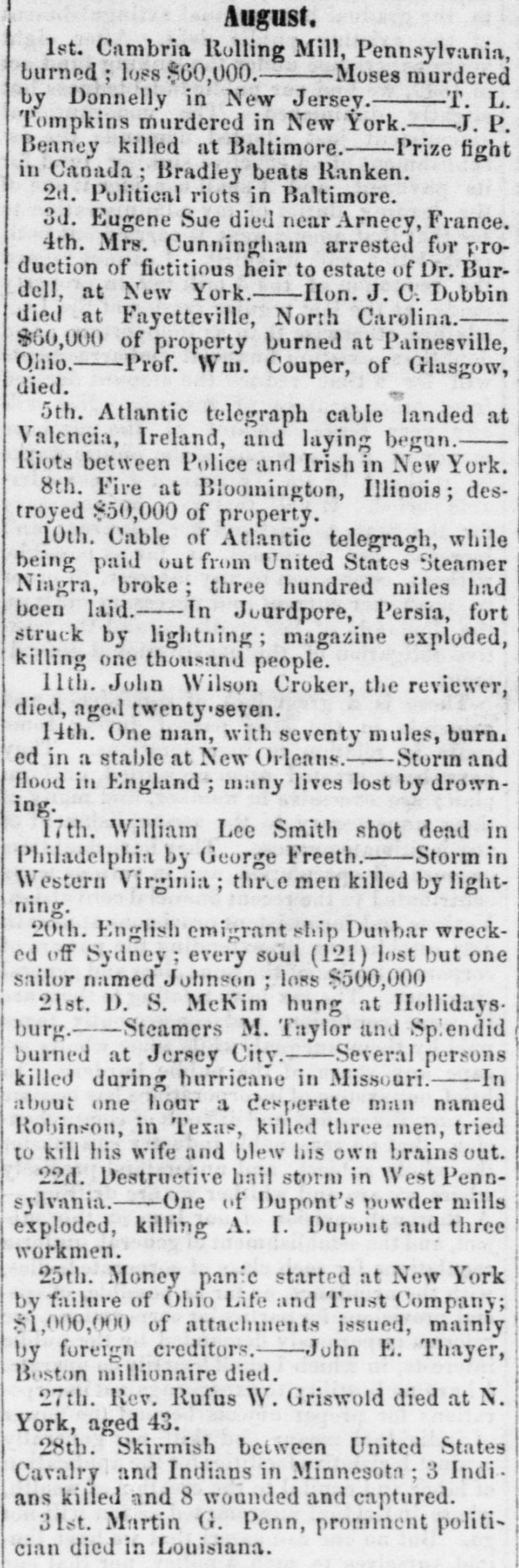
August. 1st. Cambria Rolling Mill, Pennsylvania, Moses murdered burned; loss $60,000. T. L. by Donnelly in New Jersey. P. Tompkins murdered in New York. J. Benney killed at Baltimore.- Prize fight in Canada; Bradley beats Ranken. 2d. Political riots in Baltimore. 3d. Eugene Sue died near Arnecy, France. 4th. Mrs. Cunningham arrested for production of fictitious heir to estate of Dr. Burdell, at New York.--Hon. C. Dobbin died at Fayetteville, North Carolina.$60,000 of property burned at Painesville, Ohio.Prof. Wm. Couper, of Glasgow, died. 5th. Atlantic telegraph cable landed at Valencia, Ireland, and laying begun. Riots between Police and Irish in New York. 8th. Fire at Bloomington, Illinois; destroyed $50,000 of property. 10th. Cable of Atlantic telegragh, while being paid out from United States Steamer Niagra, broke; three hundred miles had been laid.----In Jourdpore, Persia, fort struck by lightning; magazine exploded, killing one thousand people. 11th. John Wilson Croker, the reviewer, died, aged twenty'seven. 14th. One man, with seventy mules, burn, ed in a stable at New Orleans. Storm and flood in England; many lives lost by drowning. 17th. William Lee Smith shot dead in Philadelphia by George Freeth. Storm in Western Virginia ; three men killed by lightning. 20th. English emigrant ship Dunbar wrecked off Sydney; every soul (121) lost but one sailor named Johnson loss $500,000 21st. D. S. McKim hung at Hollidays burg.--Steamers M. Taylor and Splendid burned at Jersey City.-Several persons killed during hurricane in Missouri.about one hour a desperate man named Robinson, in Texas, killed three men, tried to kill his wife and blew his own brains out. 22d. Destructive bail storm in West PennOne of Dupont's powder mills sylvania. exploded, killing A. I. Dupont and three workmen. 25th. Money panic started at New York by failure of Ohio Life and Trust Company; $1,000,000 of attachments issued, mainly by foreign creditors.-Juhn E. Thayer, Boston millionaire died. 27th. Rev. Rufus W. Griswold died at N. York, aged 43. 28th. Skirmish between United States Cavalry and Indians in Minnesota ; 3 Indians killed and 8 wounded and captured. 31st. Martin G. Penn, prominent politician died in Louisiana.


Article from Evening Journal, June 20, 1898

Click image to open full size in new tab

Article Text

ONE OF DELAWARE'S SONS Benjamin B. Comegys, a former Delawarean, has just completed a term of fifty years' service in a single bank. He is president of the National Bank of Philadelphia. Mr. Comegys made a very early start in a ibank. He was born in the Farmers' Bank, Dover, of which his father was president, on May 9, 1819. He went to Philadelphia when he was 18 years old, and for eleven years was connected with dry goods houses. In May, 1848 he entered the Philadelphia bank as a clerk, became its cashier in 1851, and was elected its president in 1879, which office he still holds. There was none of the safeguards thrown around the business in the old days which modern bankers have found essential. It was in the period of state banks, when the notes of country banks were quoted at a d'iscount if they got far from home, and when counterfeit note detectors were consulted on nearly ever cash sale, Country merchants used to take uncurrent notes to Philadelphia to buy goods with or would purchase such notes after their arrival in the city, paying good money for them. Merchants would take them rather than lose a trade, and would lose the discount. The countryman calculated on making their expenses by the transaction. The business of exchange was in its infancy in this country, at least so far as the interior towns were concerned. Mercantile transactions were conducted then much as they now are in the South American republics. Goods were it sold on long-time notes to out-of-town A customers, but to Philadelphia customd ers the term of credit was ninety days 's to four months. It is hard to understand why the distinction was made, unless the margin of profit on the r Western customer was made large enough to cover the interest and risk. The only reason given was that money was made or lost rapidly in the West, and it paid to take the risk. at Daily settlements through a clearing te house had not been thought of fifty to years ago. The first clearing house was established in New York, in 1853, and Mr. Comegys says that the matter was then considered in Philadelphia, but, as the weak banks were shown up is by that system, it met with no favor n there for several years. A committee sh was appointed, however, and an ed arrangement was made and a place se. cured for the cashiers to meet daily and make exchanges, but without set. tlements. This system continued until he March 22, 858, when the Clearing ig House Association was organized. This ner would have been done at an earlier date, he said, but for the opposition of the president of the Bank of Pennsyl vania, which closed its doors finally in the early part of 1858. Since its or ge ganization the Clearing House has five he March 22, 1858, when the Clearing an House certificates to enable banks, 11 on time of panic, to accommodate th on. commercial community by discounting the led paper to a larger amount than thei u/al cash reserve would warrant. Mr. Comegys spoke of several pante which have occurred in the last hal the century. The organization of a Clear ges ing House in New York and the publi recation of the statement of the condi ths, tion of the banks very nearly produce ear, eek a panic at that time. In 1857 a pani was stared by the failure of the Ohi Life and Trust Company, of New York which spread all over the country. Th ver breaking out of the civil war, in 186 for was followed by a panic, and the Ja asCook failure, in 1873, created a grea ade. disturbance in vallues, as did also th assassination of President Garfield, 1881. In 1884 a panic, largely local arwas caused by the failure of importa brabanks in New York, and in 1890 cam this the Barings panic. The conditions e: isting in 1893 and 1896 produced th severest strain on the banks for ou tive rency to which they have ever bee rday subjected. of In recent years the responsibiliti devolving upon bank officials are man