Article Text
# EDITOR'S CORRESPONDENCE.
From our New York Correspondent.
NEW YORK, January 2, 1848.
The Taylor organ here, the Mirror, has got a story that Mr. Clay has written a letter to somebody or other in some place, that he will not run as a candidate against General Taylor for the presidency—a story so absurd and impossible on its face, to any one who knows Mr. Clay at all, as to be unworthy of a moment's attention. What! Henry Clay give up to any man his chances for the high honor which has been the sole and sovereign ambition of his whole life—its stormy struggles, its strong hopes and fears, its plans and passions, all its thoughts and deeds for the last twenty years! Why, he would not give them up to his father or son, to his nearest and dearest friend on earth. The man who thinks otherwise, does not know how completely one absorbing passion has swallowed up every other sentiment in the breast of Henry Clay.
By the wincing and kieking of the Courier and Enquirer, and of the Express, my remarks the other day on the contested seat for our city district in the House of Representatives must have touched exactly the right spot. The Courier fumes and frets, through a whole editorial "leader," about the matter; calls the "Union's" correspondent "Zed" everything naughty; and, after a great flourish about "notorious frauds," convicts voting in several wards of the district, and so on, it has no proof to give except that the grand jury, in a presentment shortly after the election, complained that convicts had been permitted to leave Blackwell's island for the purpose of voting. But who was indicted, tried, or convicted for these frauds?—though the whigs have since had full control of Blackwell's island—ay, of the whole city government. That is the question for the Courier and Enquirer to answer; and its inability to answer it ought to be perfectly conclusive to every fair man. Its remarkable attempt to invalidate my statement that the district is decidedly democratie, displays too muck ignorance of the statistics of the district to require notice. For instance, the assertion that the 12th ward is the ward in the district in which "the democrats mainly rely for their majority;" when, in fact, of the five democratic wards in the district, it usually gives the lowest democratic majority, and (unless my memory greatly deceives me,) did so at the election of Mr. Jackson in '46. The article having been evidently dictated, if not written, by some friend of Col. Monroe, adds another proof that he has really nothing to show for his claim, and that if he is admitted to the seat which rightfully belongs to Mr. Jackson, it will be simply because they cannot do without his vote.
The export of specie last week was about $600,000, as follows:
Azalia, Rio de Janeiro, sovereigns - $13,593
Overman, Madeira, coin - 396
Talbot, Canton, do. - 1,500
Silvie de Grasse, Havre, Mexican dollars, &c., - 26,500
Sir Robert Peel, Liverpool, sovereigns - 60,000
Siddons, Liverpool, sovereigns - 98,666
$197,655
To which add by the steamer yesterday £80,000, or $400,000. Very little of this amount—or, indeed, of any specie going forward at present—comes out of the vaults of the banks. It was mostly in sovereigns, of which they hold very few, and which are now worth $4 90.
By way of increasing the alarm on the subject of ship fever, already unreasonably great, the newspapers have a statement that the wife of the late Mr. Justice Taylor is very low with the disease; in which, I am happy to say, there is not a word of truth.
The steamer Southerner has been laid up until the be-ginning of February next. The staunch and swift North-erner will make her trips as usual.
The packet-ship Louis Philippe has been brought through the Sound by a steam-tug, and now lies at the dock. She is considerably injured.
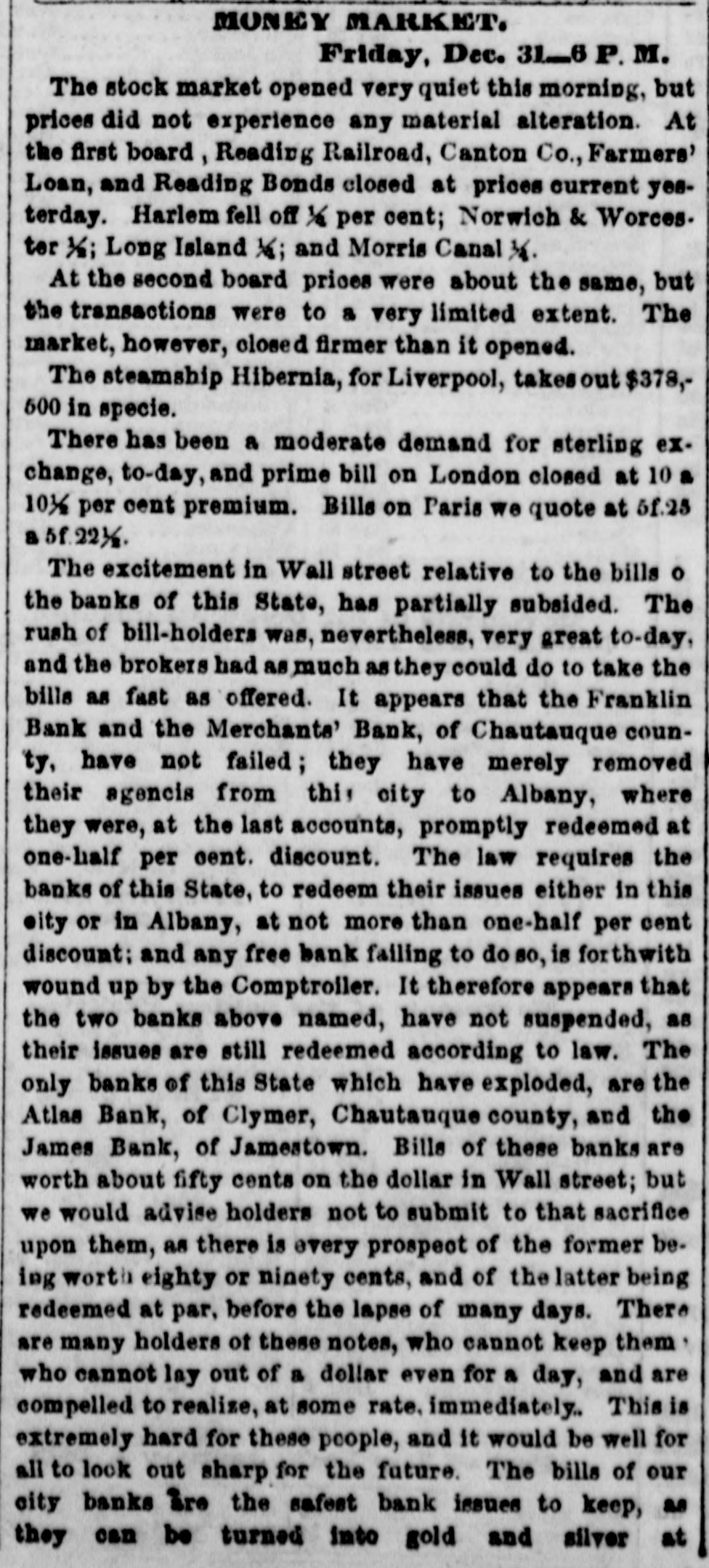
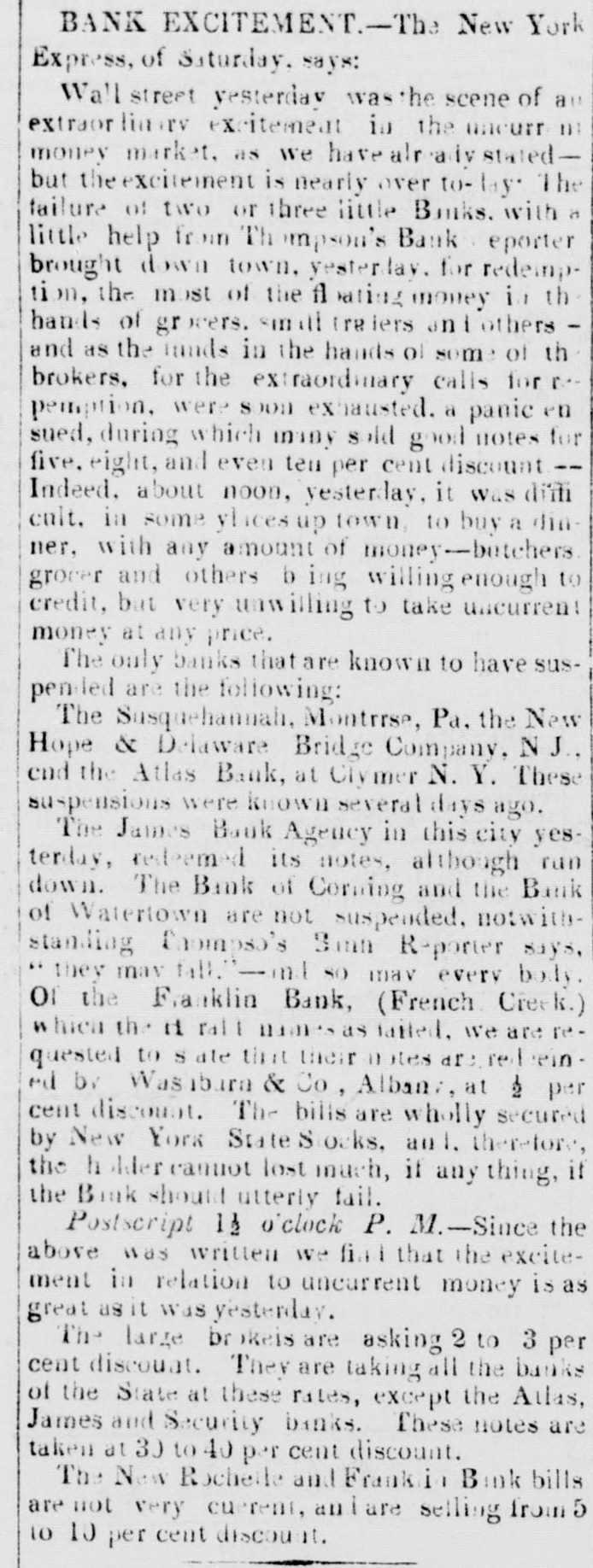
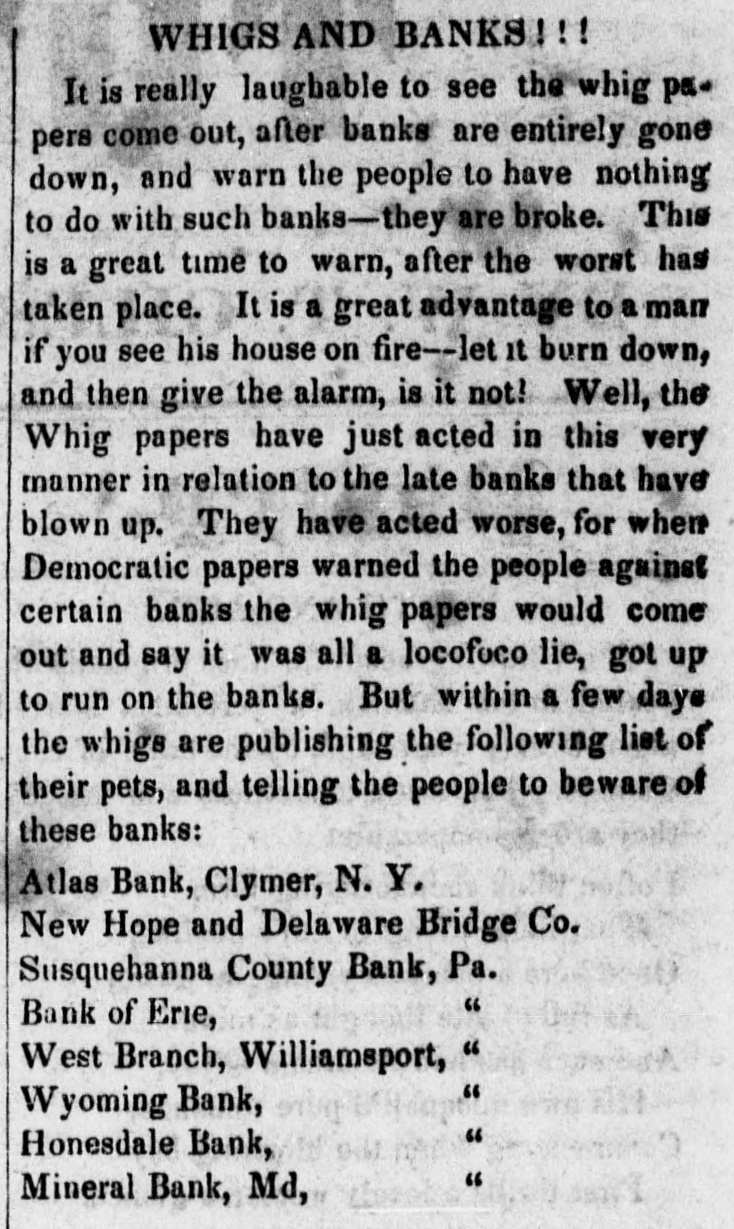
There was quite a panic on Thursday and Friday about the bills of the county banks of this State. The reputed failure of one, "The Atlas Bank," of Clymer, and the precarious condition of some others, brought all into suspicion with our excitable Gothmmites. As these banks have for some time furnished almost the entire paper circulating medium of the city, there was a large amount of their bills afloat, and the way all "up-town" rushed down into Wall street to get them exchanged for city bills was remarkable. Thursday more of the retail grocers and small dealers were "in the street" than ever before.
It was a harvest for the brokers, who, knowing most, if not all of the county banks to be good enough, redeemed as fast as they could at one-half and 1 per cent, while their "current funds" lasted. Then the discount rose; and during the two days was as high as three, five, and even six per cent. on perfectly safe bills. Nearly half a million of dollars must have been found discounted this way during "the panic." One large house in Wall street, which stands at the head of the exchange business, having ample means at command, bought, it is said, $200,000 worth of country paper; on which it must have made quite a nice thing—say $5,000. These bills, thus needlessly sacrificed, will either be returned at once upon the banks through the State, or, if the brokers holding them have the means, will be kept until they can be put into circulation again at a further shave of one-eighth or one-quarter of one per cent. in a few days, when "public confidence"—that uncertain, intangible element—is restored. If the law urged by Mr. Comptroller Flagg had passed, compelling the country banks to redeem their notes at par in this city, where is constantly so large a portion of their circulation, such an excitement, if it could occur, would not have produced such loss to the bill-holders, little able to bear it. Until some such law is passed, there will be no security against the recurrence of the same panic and the same sacrifices.
Yesterday was New Year's Day—and such a day!—the darkest, drizzlingest, dreariest, dismalest, dam-pest (ahem!) day that ever was seen or suffered. With nothing but cloud above and mud below, and the cold, thick, white, creeping fog everywhere around—the weather was more execrable than could have been believed possible for any well-behaved weather to be. Though it would have benumbed Mr. Mark Tapley himself, it could not chill the hospitable observance of the day usual in N. York. Sorry am I to say, that this, one of the very best relics of the old Dutch founders of the colony, is falling into gradual disuse, from various causes, of which the chief is the rapidly increasing size of the city, which renders it physically impossible for a man to extend his new year's "calls" to all his friends. The ladies, however, did none the less receive their visiters with a graciousness and a cordiality which more than made amends for the dreariness without, and even for the miles traversed through the mud of New York—that indescribable compound of blackness and filth—more abundant yesterday than ever before, by virtue of the weather and a whig corporation.
The extraordinary fog for the last two or three days has totally deranged all travelling; and, of course, the mails in this quarter. On Friday in particular, the vapor was so dense, that you could not see one hundred feet from you in any direction. The Sound boats generally did not attempt to go out at either end, and few of them got in until late yesterday afternoon; when the Fall River boat (the Massachusetts) arrived. So utterly was all communication by water cut off, that the ferry boats made their trips with the utmost difficulty and danger; and your correspondent, happening to be at a place on the North river, not 35 miles from town, with a boat three or four times a day was fog-bound in durance vile for two entire days. This morning the weather is somewhat clearer, with symptoms of rain.
ZED.
Philadelphia College of Medicins