14901. Mechanics & Traders Bank (Brooklyn, NY)

Bank Information

Episode Type
Suspension → Reopening
Bank Type
state
Start Date
*
Location
Brooklyn, New York (40.660, -73.951)

Metadata

Model
gpt-5-mini
Short Digest
b528721a

Response Measures

None

Description

Articles describe the closing (suspension) of the Mechanics and Traders' Bank of Brooklyn and its reopening as the Union Bank (which later also failed). There is no mention of a depositor run in the provided excerpts; problems stem from insider lending/possible corruption, so classification is suspension then reopening. The Union Bank later closed, which is noted here but the immediate episode for Mechanics & Traders shows suspension followed by reopening.

Events (3)

1. * Other
Newspaper Excerpt
examination into the failure of the Union Bank of Brooklyn, of which Edward M. Grout was president, and of its predecessor, the Mechanics and Traders' Bank, of which David A. Sullivan ... was president.
Source
newspapers
2. * Reopening
Newspaper Excerpt
the closing of the Mechanics and Traders' Bank of Brooklyn and its reopening as the Union Bank, since closed.
Source
newspapers
3. * Suspension
Cause
Bank Specific Adverse Info
Cause Details
Investigations reveal insider loans, preferential low-rate loans to insiders and alleged misconduct leading to failure/closing.
Newspaper Excerpt
the closing of the Mechanics and Traders' Bank of Brooklyn and its reopening as the Union Bank, since closed.
Source
newspapers

Newspaper Articles (2)

Article from The Evening World, July 31, 1911

Click image to open full size in new tab

Article Text

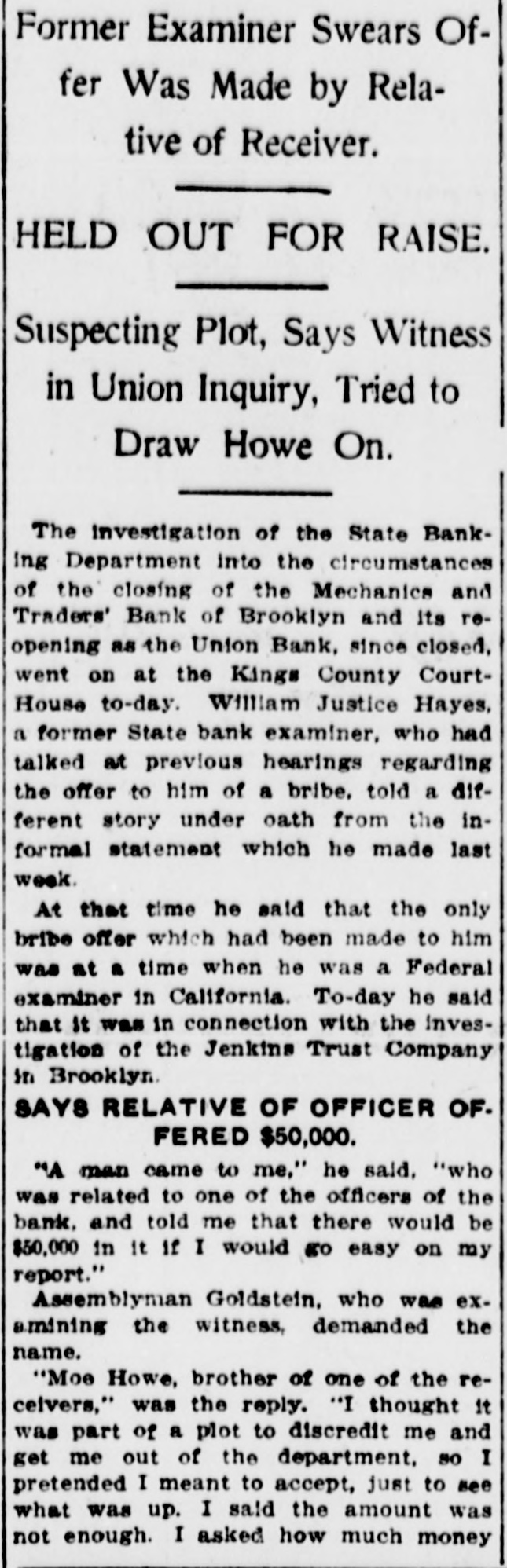
Former Examiner Swears Offer Was Made by Relative of Receiver. HELD OUT FOR RAISE. Suspecting Plot, Says Witness in Union Inquiry, Tried to Draw Howe On. The investigation of the State Banking Department into the circumstances of the closing of the Mechanics and Traders' Bank of Brooklyn and its reopening as the Union Bank, since closed, went on at the Kings County CourtHouse to-day. William Justice Hayes, a former State bank examiner, who had talked at previous hearings regarding the offer to him of a bribe, told a different story under oath from the informal statement which he made last week. At that time he said that the only bribe offer which had been made to him was at a time when he was a Federal examiner in California. To-day he said that it was in connection with the investigation of the Jenkins Trust Company in Brooklyn says RELATIVE OF OFFICER OFFERED $50,000. "A man came to me," he said, "who was related to one of the officers of the bank, and told me that there would be $50,000 in it if I would go easy on my report." Assemblyman Goldstein, who was examining the witness, demanded the name. "Moe Howe, brother of one of the receivers," was the reply. "I thought it was part of a plot to discredit me and get me out of the department, so I pretended I meant to accept, just to see what was up. I said the amount was not enough. I asked how much money

Article from The Evening World, September 6, 1911

Click image to open full size in new tab

Article Text

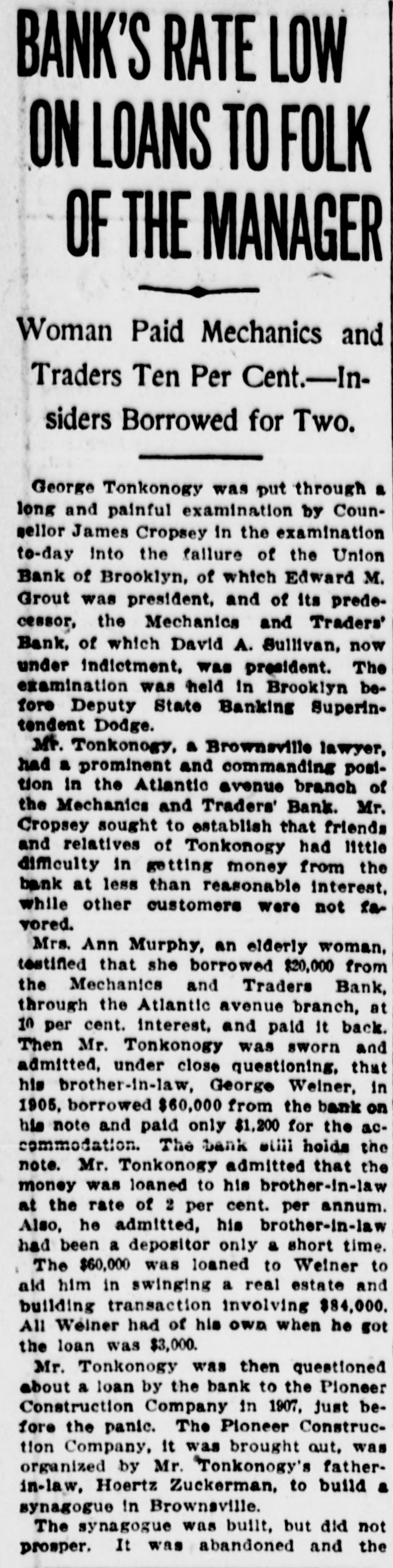
BANK'S RATE LOW ON LOANS TO FOLK OF THE MANAGER Woman Paid Mechanics and Traders Ten Per Cent.-Insiders Borrowed for Two. George Tonkonogy was put through a long and painful examination by Counsellor James Cropsey in the examination to-day into the failure of the Union Bank of Brooklyn, of which Edward M. Grout was president, and of its predecessor, the Mechanics and Traders' Bank, of which David A. Sullivan, now under indictment, was president. The examination was held in Brooklyn before Deputy State Banking Superintendent Dodge. Mr. Tonkonogy, a Brownsville lawyer, had a prominent and commanding position in the Atlantic avenue branch of the Mechanics and Traders' Bank. Mr. Cropsey sought to establish that friends and relatives of Tonkonogy had little difficulty in getting money from the bank at less than reasonable interest, while other customers were not eavored. Mrs. Ann Murphy, an elderly woman, testified that she borrowed $20,000 from the Mechanics and Traders Bank, through the Atlantic avenue branch, at 10 per cent. interest, and paid it back. Then Mr. Tonkonogy was sworn and admitted, under close questioning, that his brother-in-law, George Weiner, in 1905, borrowed $60,000 from the bank on his note and paid only $1,200 for the accommodation. The bank still holds the note. Mr. Tonkonogy admitted that the money was loaned to his brother-in-law at the rate of 2 per cent. per annum. Also, he admitted, his brother-in-law had been a depositor only a short time. The $60,000 was loaned to Weiner to aid him in swinging a real estate and building transaction involving $84,000. All Weiner had of his OWN when he got the loan was $3,000. Mr. Tonkonogy was then questioned about a loan by the bank to the Pioneer Construction Company in 1907, just before the panic. The Pioneer Construction Company, it was brought aut, was organized by Mr. Tonkonogy's fatherin-law, Hoertz Zuckerman, to build a synagogue in Brownsville. The synagogue was built, but did not prosper, It was abandoned and the