14908. Bank of Cincinnati (Cincinnati, OH)

Bank Information

Episode Type
Run β†’ Suspension β†’ Closure
Bank Type
state
Start Date
January 11, 1842
Location
Cincinnati, Ohio (39.103, -84.515)

Metadata

Model
gpt-5-mini
Short Digest
e75795dfbce1b187

Response Measures

None

Description

Multiple contemporaneous newspapers report that after the Miami Exporting Co. failed (Jan 11, 1842) a run developed on the Bank of Cincinnati; officers posted a notice 'suspended for twenty days', the crowd forced entry, looted and broke the vault. Subsequent reporting indicates a receiver existed (books stolen from the receiver later recovered), implying the suspension became permanent/receivership. Cause classified as runs triggered by failures of other local banks.

Events (3)

1. January 11, 1842 Run
Cause
Local Banks
Cause Details
Run followed failure/assignment of the Miami Exporting Company and widespread refusal of related notes; holders gathered and demanded redemption leading to rush and looting.
Measures
Officers posted a placard stating the bank 'suspended for twenty days' and attempted to close doors; no successful defense of premises.
Newspaper Excerpt
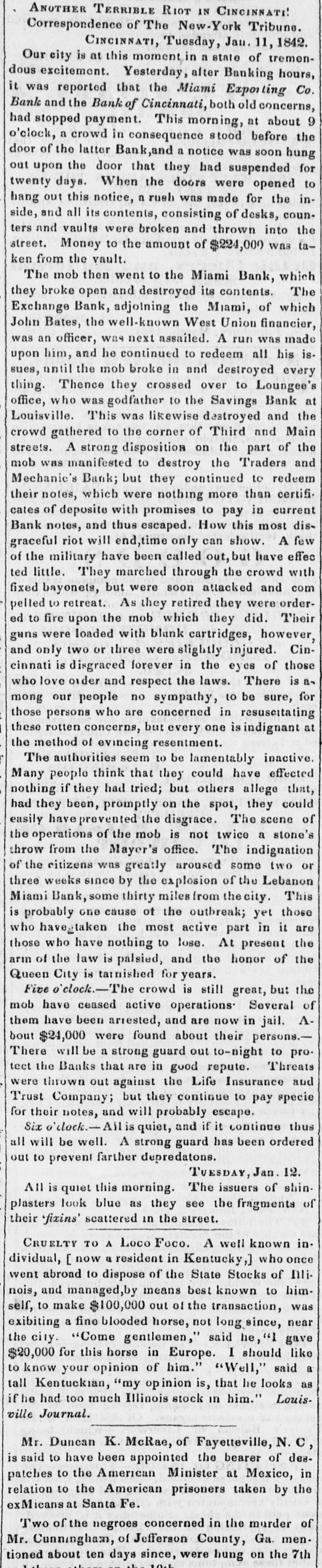
This morning a crowd ... a notice was soon hung out upon the door that they had suspended for twenty days. When the doors were opened ... a rush was made for the inside ... Money to the amount of $224,000 was taken from the vault.
Source
newspapers
2. January 11, 1842 Suspension
Cause
Local Banks
Cause Details
Suspension was posted by officers fearing a run after the Miami Exporting Co.'s assignment/failure and market refusal of notes.
Newspaper Excerpt
a notice was soon hung out upon the door that they had suspended for twenty days.
Source
newspapers
3. * Receivership
Newspaper Excerpt
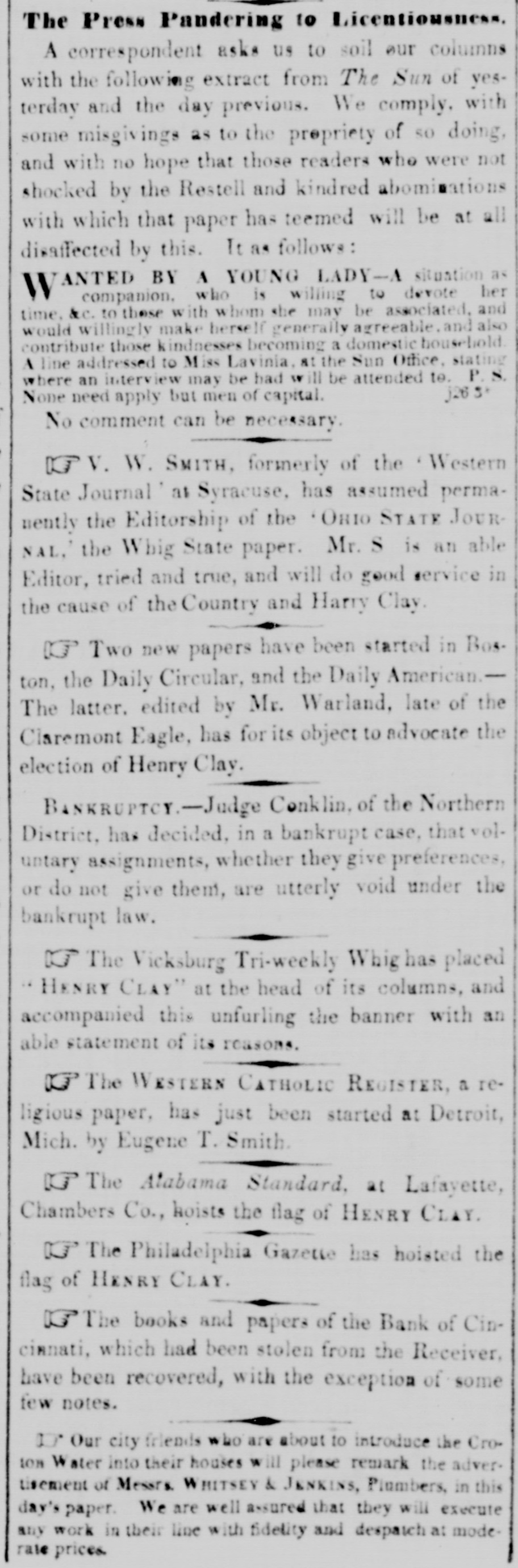
The books and papers of the Bank of Cincinnati, which had been stolen from the Receiver, have been recovered, with the exception of some few notes.
Source
newspapers

Newspaper Articles (18)

Article from New-York Tribune, January 18, 1842

Click image to open full size in new tab

Article Text

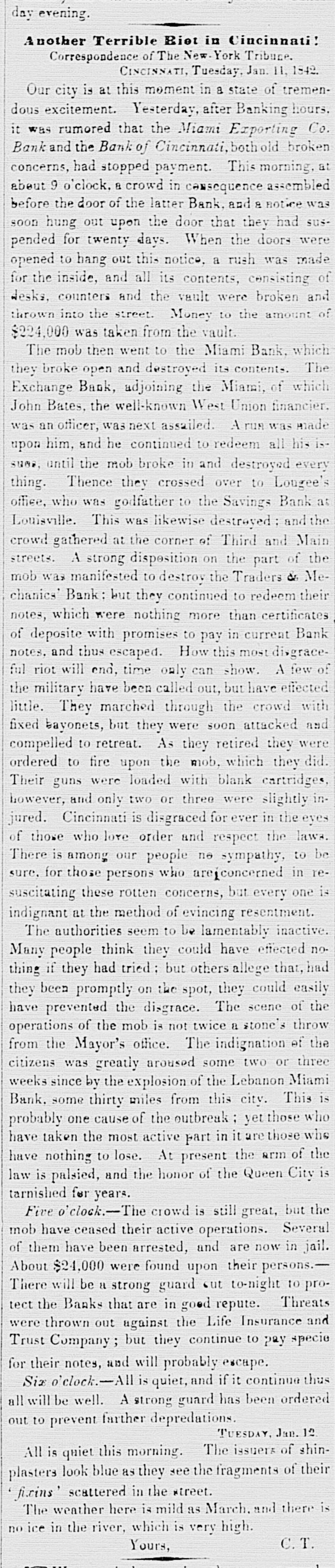
day evening. Another Terrible Biet in Cincinnati: Correspondence of The New-York Tribuce. CINCINNATI, Tuesday, Jan. 11. 1842. Our city is at this moment in a state of tremendous excitement. Yesterday, after Banking hours. it was rumored that the Miami Exporting Co. Bankand the Bank of Cincinnati, bothold broken concerns, had stopped payment. This morning, at about 9 clock. a crowd in consequence assembled before the door of the latter Bank, and a notice was soon hung out upon the door that they had suspended for twenty days. When the doors were opened to hang out this notice. a rush was made for the inside, and all its contents, consisting of Wesks, counters and the vault were broken and thrown into the street. Money to the amount of $224,000 was taken from the vault. The mob then went to the Miami Bank, which they broke open and destroyed its contents. The Exchange Bank, adjoining the Miami, of which John Bates, the well-known West Union financier. was an officer, was next assailed. A run was made upon him, and he continued to redeem all his is sune, until the mob broke in and destroyed every thing. Thence they crossed over to Lougee's office, who was godfather to the Savings Bank at Louisville. This was likewise destroyed and the crowd gathered at the corner of Third and Main streets. A strong disposition on the part of the mob was manifested to destroy the Traders & Mechanics' Bank: but they continued to redeem their notes, which were nothing more than certificates of deposite with promises to pay in current Bank notes. and thus escaped. How this most div graceful riot will end, time only can show. A few of the military have been called out, but have effected little. They marched through the crowd with fixed bayonets, but they were soon attacked and compelled to retreat. As they retired they were ordered to fire upon the mob, which they did. Their guns were loaded with blank cartridges, however, and only two or three were slightly injured. Cincinnati is disgraced for ever in the eyes of those who love order and respect the laws. There is among our people no sympathy, to be sure. for those persons who areiconcerned in resuscitating these rotten concerns, but every one is indignant at the method of evincing resentment. The authorities seem to be lamentably inactive. Many people think they could have effected nothing if they had tried: but others allege that, had they been promptly on the spot, they could easily have prevented the disgrace. The scene of the operations of the mob is not twice a stone's throw from the Mayor's office. The indignation of the citizens was greatly aroused some two or three weeks since by the explosion of the Lebanon Miami Bank. some thirty miles from this city. This is probably one cause of the outbreak: yet those who have taken the most active part in it are those who have nothing to lose. At present the arm of the law is palsied, and the honor of the Queen City is tarnished for years. Five o'clock.-The crowd is still great, but the mob have ceased their active operations. Several of them have been arrested, and are now in jail. About $24,000 were found upon their persons.There will be a strong guard cut to-night to protect the Banks that are in good repute. Threats were thrown out against the Life Insurance and Trust Company; but they continue to pay specie for their notes, and will probably escape. Six o'clock.-All is quiet, and if it continue thus all will be well. A strong guard has been ordered out to prevent farther depredations. TUESDAY, Jan. 12 All is quiet this morning. The issuers of shinplasters look blue as they see the fragments of their firins' scattered in the street. The weather here is mild as March. and there is no ice in the river, which is very high. C.T. Yours,
Article from The New York Herald, January 18, 1842

Click image to open full size in new tab

Article Text

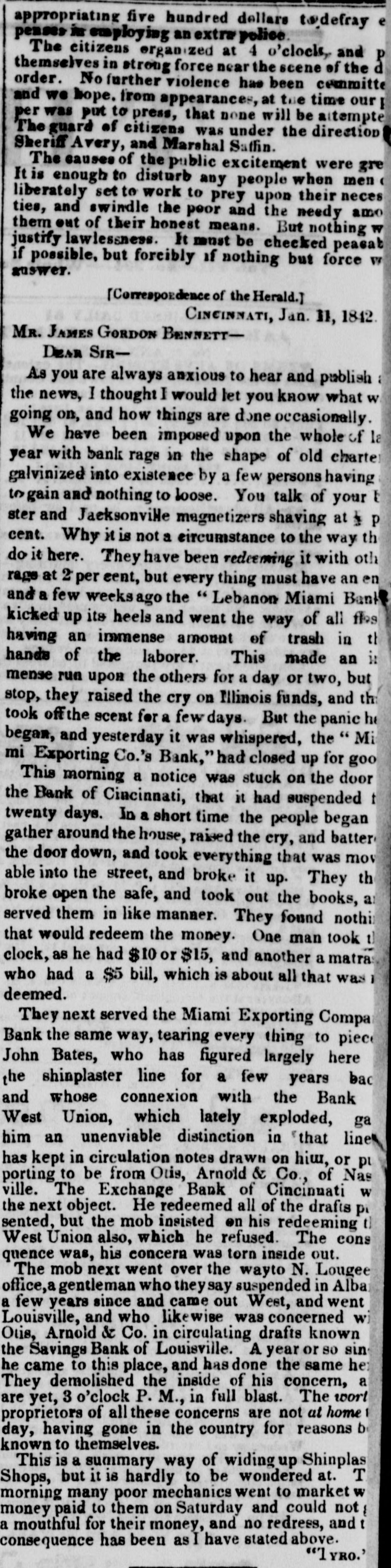
appropriating five hundred dellars todefray penses in employing an extre police. The citizens organized at 4 o'clock, and themselves in strong force near the scene of the a order. No further violence has been committe and we hope. from appearances, at the time our per was put to press, that none will be aitempte The guard of citizens was under the direction Sheriff Avery, and Marshal Saffin. The causes of the public excitement were gre It is enough to disturb any people when men liberately set to work to prey upon their neces ties, and swindle the poor and the needy amo them out of their honest means. But nothing W justify lawlessness. It must be checked peacat if possible, but forcibly if nothing but force W answer. [Correspondence of the Herald.] CINCINNATI, Jan. 11, 1842 MR. JAMES GORDON BENNETTDEAR SIRAs you are always anxious to hear and publish the news, I thought I would let you know what W going on, and how things are done occasionally. We have been imposed upon the whole of la year with bank rags in the shape of old charte galvinized into existence by a few persons having gain and nothing to loose. You talk of your ster and Jaeksonville magnetizers shaving at $ P cent. Why it is not a circumstance to the way th do it here. They have been redeeming it with oth rage at 2 per cent, but every thing must have an en and a few weeksago the "Lebanon Miami Bank kicked up its heels and went the way of all flos having an immense amount of trash in th hands of the laborer. This made an it mense run upon the others for a day or two, but stop, they raised the cry on Illinois funds, and th took off the scent for a few days. But the panic he began, and yesterday it was whispered, the " Mi mi Exporting Co.'s Bank," had closed up for goo This morning a notice was stuck on the door the Bank of Cincinnati, that it had suspended t twenty days. In a short time the people began gather around the house, raised the cry, and batter the door down, and took everything that was mov able into the street, and broke it up. They th broke open the safe, and took out the books, a: served them in like manner. They found nothi that would redeem the money. One man took clock, as he had $10 or $15, and another a matra who had a $5 bill, which is about all that was deemed. They next served the Miami Exporting Compa Bank the same way, tearing every thing to piece John Bates, who has figured largely here the shinplaster line for a few years bac and whose connexion with the Bank West Union, which lately exploded, ga him an unenviable distinction in that line has kept in circulation notes drawn on hiu, or pu porting to be from Otis, Arnold & Co., of Nas ville. The Exchange Bank of Cincinuati W the next object. He redeemed all of the drafts p sented, but the mob insisted on his redeeming t West Union also, which he refused. The cons quence was, his concera was torn inside out. The mob next went over the wayto N. Lougee office,a gentleman who theysa suspended in Alba a few years since and came out West, and went Louisville, and who likewise was concerned wi Otis, Arnold & Co. in circulating drafts known the Savings Bank of Louisville. A year or so sin he came to this place, and has done the same he They demolished the inside of his concern, a are yet, 3 o'clock P. M., in full blast. The wort proprietors of all these concerns are not at home day, having gone in the country for reasons b known to themselves. This is a summary way of widing up Shinplas Shops, but it is hardly to be wondered at. T morning many poor mechanics went to market money paid to them on Saturday and could not a mouthful for their money, and no redress, and consequence has been as have stated above. "TYRO."


Article from The New York Herald, January 18, 1842

Click image to open full size in new tab

Article Text

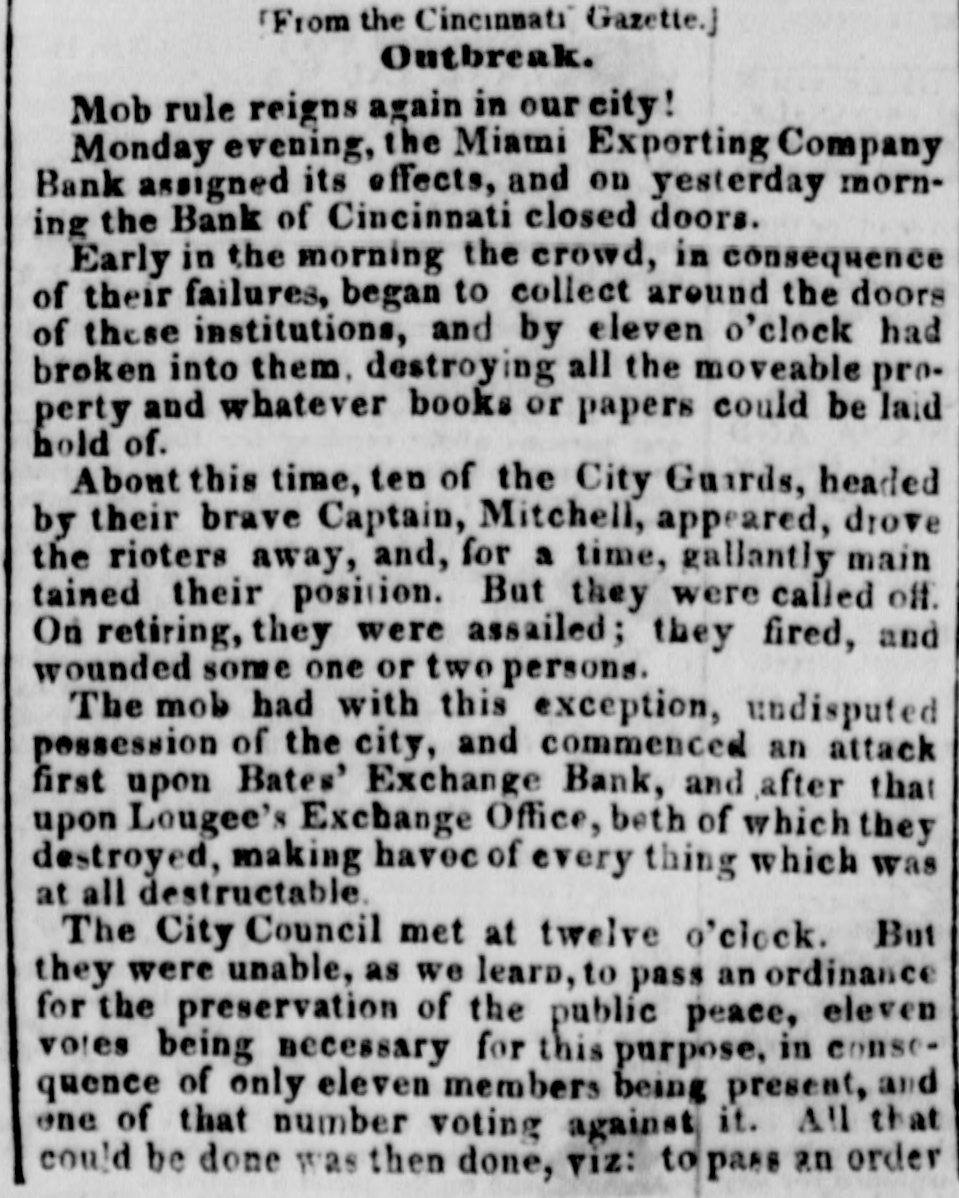
From the Cincinnati Gazette.j Outbreak. Mob rule reigns again in our city! Monday evening, the Miami Exporting Company Bank assigned its effects, and on yesterday morning the Bank of Cincinnati closed doors. Early in the morning the crowd, in consequence of their failures, began to collect around the doors of these institutions, and by eleven o'clock had broken into them. destroying all the moveable property and whatever books or papers could be laid hold of. About this time, ten of the City Guards, headed by their brave Captain, Mitchell, appeared, drove the rioters away, and, for a time, gallantly main tained their position. But they were called off. On retiring, they were assailed; they fired, and wounded some one or two persons. The mob had with this exception, undisputed possession of the city, and commenced an attack first upon Bates' Exchange Bank, and after that upon Lougee's Exchange Office, beth of which they destroyed, making havec of every thing which was at all destructable The City Council met at twelve o'clock. But they were unable, as we learn, to pass an ordinance for the preservation of the public peace, eleven votes being necessary for this purpose, in consequence of only eleven members being present, and one of that number voting against it. All that could be done was then done, viz: to pass an order


Article from Democratic Standard, January 18, 1842

Click image to open full size in new tab

Article Text

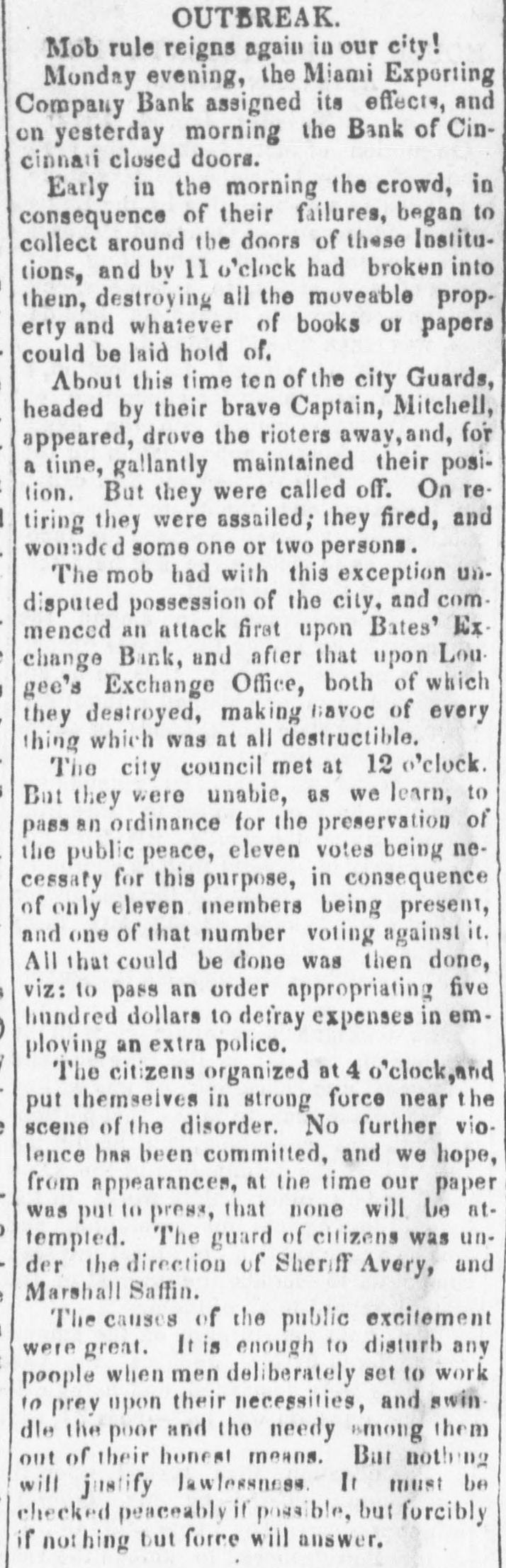
OUTBREAK. Mob rule reigns again in our city! Monday evening, the Miami Experting Company Bank assigned its effects, and on yesterday morning the Bank of Cincinnari closed doors. Early in the morning the crowd, in consequence of their failures, began to collect around the doors of these Institutions, and by 11 o'clock had broken into them, destroying all the moveable property and whatever of books or papers could be laid hold of. About this time ten of the city Guards, headed by their brave Captain, Mitchell, appeared, drove the rioters away, and, for a time, gallantly maintained their posilion. But they were called off. On retiring they were assailed; they fired, and wounded some one or two persons. The mob had with this exception undisputed possession of the city, and com. menced an attack first upon Bates' Ex. change Bank, and after that upon Lou. gee's Exchange Office, both of which they destroyed, making Bavoc of every thing which was at all destructible. The city council met at 12 o'clock. But they were unable, as we learn, to pass an ordinance for the preservation of the public peace, eleven votes being necessary for this purpose, in consequence of only eleven members being present, and one of that number voting against it. All that could be done was then done, viz: to pass an order appropriating five hundred dollars to defray expenses in employing an extra police. The citizens organized at 4 o'clock, and put themselves in strong force near the scene of the disorder. No further violence has been committed, and we hope, from appearances, at the time our paper was put to press, that none will be attempted. The guard of citizens was under the direction of Sheriff Avery, and Marshall Saffin. The causes of the public excitement were great. It is enough to disturb any people when men deliberately set to work 10 prey upon their necessities, and swin. dle the poor and the needy among them out of their honest means. Bar nothing will justify lawlessness It must be checked peaceably if possible, but forcibly if nothing but force will answer.


Article from Herald of the Times, January 20, 1842

Click image to open full size in new tab

Article Text

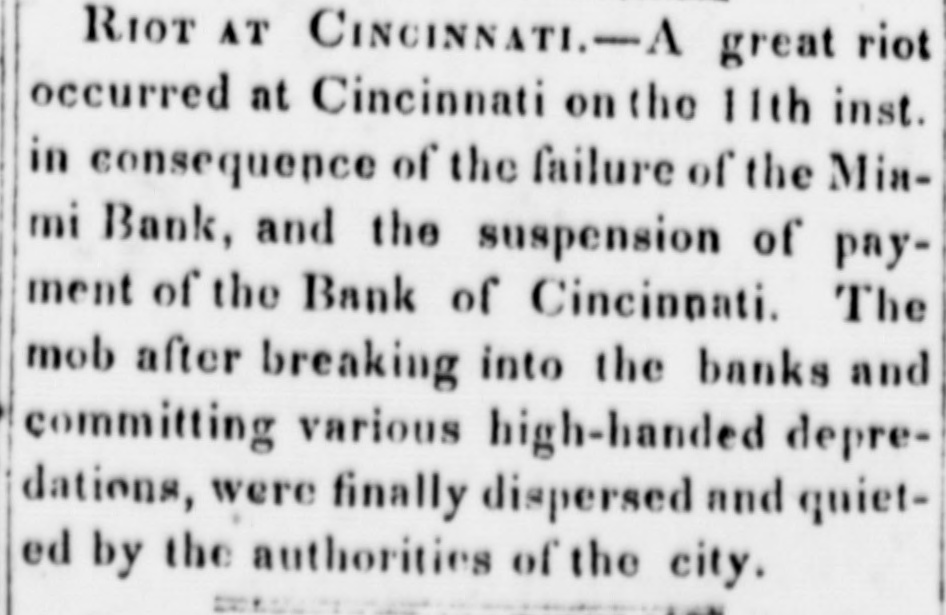
RIOT AT CINCINNATI.-A great riot occurred at Cincinnati on the 11th inst. in consequence of the failure of the Minmi Bank, and the suspension of payment of the Bank of Cincinnati. The mob after breaking into the banks and committing various high-handed depredations, were finally dispersed and quieted by the authorities of the city.


Article from The Ohio Democrat, January 20, 1842

Click image to open full size in new tab

Article Text

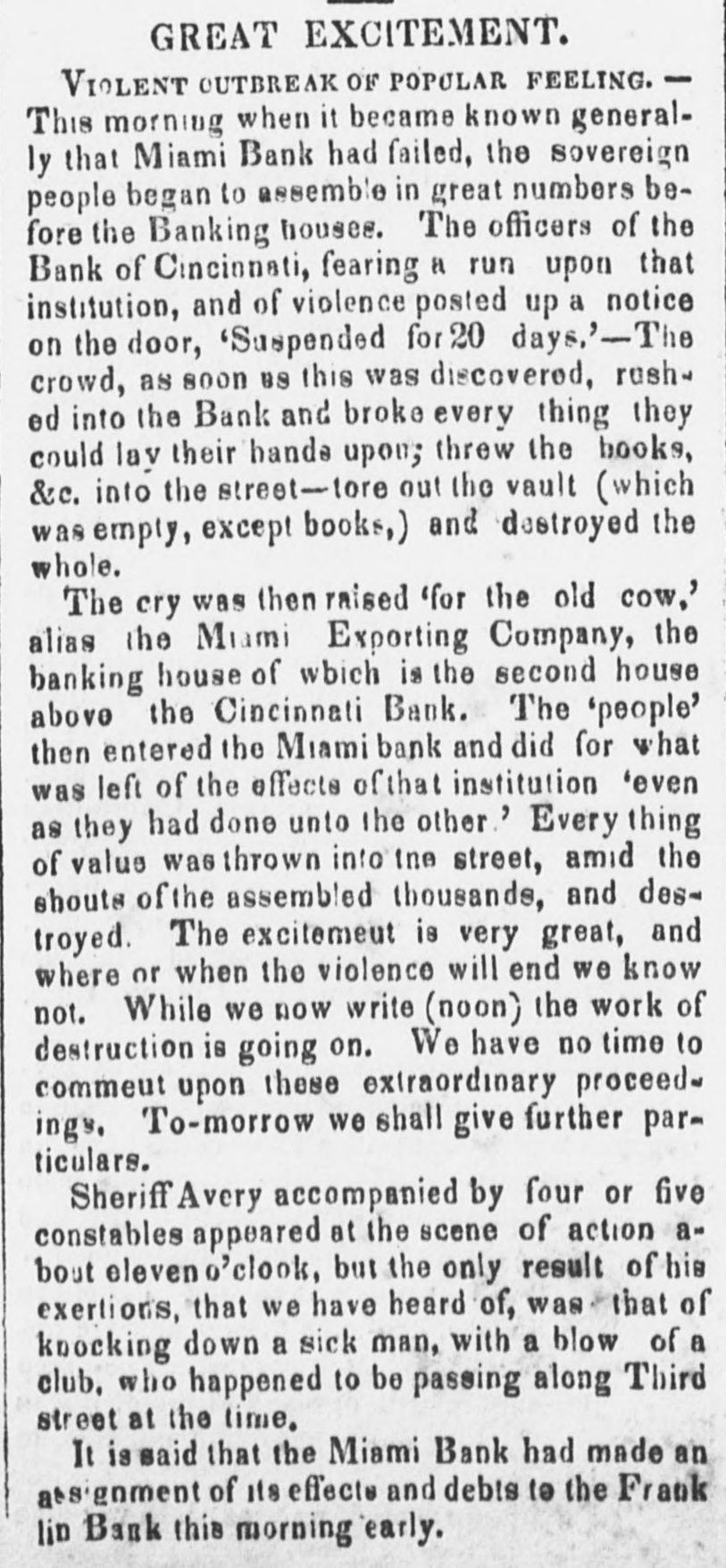
GREAT EXCITEMENT. VIOLENT OUTBREAK OF POPULAR FEELING. This morning when it became known generally that Miami Bank had failed, the sovereign people began to assemble in great numbers before the Banking houses. The officers of the Bank of Cincinnati, fearing a run upon that institution, and of violence posted up a notice on the door, 'Suspended for 20 days.'-The crowd, as soon US this was discovered, rushed into the Bank and broke every thing they could lay their hands upon; threw the books, &c. into the street-lore out the vault (which was emply, except books,) and destroyed the whole. The cry was then raised 'for the old cow,' alias the Miami Exporting Company, the banking house of which is the second house above the Cincinnati Bank. The 'people' then entered the Miami bank and did for what was left of the effects of that institution 'even as they had done unto the other.' Every thing of value was thrown into the street, amid the shouts of the assembled thousands, and destroyed. The excitement is very great, and where or when the violence will end we know not. While we now write (noon) the work of destruction is going on. We have no time to commeut upon these extraordinary proceed= ings. To-morrow we shall give further particulars. Sheriff Avery accompanied by four or five constables appeared at the scene of action about eleven o'clook, but the only result of his exertions, that we have heard of, was that of knocking down a sick man, with a blow of a club, who happened to be passing along Third street at the time. It is said that the Miami Bank had made an assignment of its effects and debts to the Frank lin Bank this morning early.


Article from The Radical, January 22, 1842

Click image to open full size in new tab

Article Text

CINCINNATI RIOT. The correspondence of the Louisville Journal gives the following conclusion of the late excitement and riots in Cincinnati: CINCINNATI, January 12, 1842. My letter yesterday closed with the attack on the Miami Exporting Company. The bank closed on the previous afternoon, iveminutes before the usual time; having redeemed all the paper presented, and was exhausted. In the evening it made an assignment. The next morning, the notes of the Miami and of the Bank of Cincinnati having been refused in market, the holders began to collect at the doors of their offices, and when the Cincincinnati opened a regular run commenced. The officers soon saw that they could not continue to pay, and posted up on the door a placard, with the words :-"This Bank has suspended for twenty days," and attempted to close the doors. This was resisted by the crowd, which thronged in and the officers of the bank retired leaving the whole concern in the hands of the mob, which then commenced the work of destruction, throwing counter, books desk, papers, and money into the street. Having finished the Cincinnati Bank, the mob assailed to Miami, which had not opened, and served it in the same manner. The vault was broke open, and a large amount of bills taken out, together with some specie. Several of the men, having pocketed some thousands of paper, were arrested as they were making off. During all this time, the office of John Bates, the Exchange Bank, was crowded with the holders of that paper, which was promptly redeemed. A number of persons, however, appeared with West Union Bank paper, (a bank which failed some time since, but with which Bates had been connected, and to whose paper he had given currency, )and demanded with threats its redemption. This was uniformly refused, except by one of the clerks, who, for a short period, from intimidation, redeemed some of it. Whilst these things were going on, several at tempts were made to stop them. S.P. Chase, Esq., the owner of the property, assisted by the sheriff and two or three others, placed themselves between the mob and one of the banks, but were compelled after encountering with great firmness the violence of the assailants, to withdraw. The next effort was made by Charles Fox, Esq., who called on the orderly citizens to support him, and proceeded to the very midst of the rioters to read the riot act. He was imediately pulled down, and struck at from around him, but covered by Wm. M. Corry, Esq. and Mr. Buckingham, at much hazard, until borne back from the crowd. The sheriff rode through the throng, commanding them to disperse. There were five thousof them, altogether,but perhaps not more than one hundred active operators. He was answered with threats, which he treated with defiance. The next attempt to suppress the disorder was with military force. A party of the Citizens' Guards, in uniform. headed by Captain Mitchell, advanced with great gallantry with bayonets fixed, and swept the crowd from the pavement on Third street and on Main, and formed in front the places of attack on Main. The mob retreated into the street, and commenced an assault on the troops and a considerable number of the Fiue Guard, which had followed to sustain them with the long staves of that corps, (which is designed for protection in time of fire.) The mob hurled the fragments of the desks and counters, besides brick-bats and stones, at the troops, and were answered with the discharge of one or two muskets. The troops and fire guards were then commanded to retire, and were followed by the mob with missiles, which were again answered with the discharge of a few muskets. One of the mob had his leg broken, and two or three otherwise wounded by the fire, and several were knocked down by the staves of the Fire Guard. The troops were considerably bruised. The confliot between the troops and the mob, in front of Bates' office, compelled the officers of to as a that safety. ing through concern The mob their retire, then windows, commenced the flying endangered missils, regular dash- their destruction of everything within; and having finished, next proceeded to destroy the office of Lou-


Article from The Cecil Whig, January 22, 1842

Click image to open full size in new tab

Article Text

MOB AT CINCINNATI nine o'clock this morning, a About Cincinnati Times of Tuesday last, the gradually gathered at Main and Third streets mob of having broke the work into, cor- of ner demolished the inside cou:room. Desks, papers, the fact every thing was torn up into the streets. was probably originated a and thrown ters, bankΓ€ng mob totally in The action by hanking and no- of the pasted on the door of the tice that the bank had suspenfor twenty days. ded this paragraph; the operators to state blast. It is in with any degree of therefore, writing house, full operations stating impossible certainty, While assets are the end will -whether any known. what are in the house is not learn of value we commenced writing, we Men Since the safe has been attacked. work that withivarious kinds of tools are at in ing on it, and will probably succeed openit. o'clock, A. M. The mob are still the at 10 3 or 4,000 men surrounded make work, The Sheriff has just tried to hear, scene. which the people refused the to ground and a speech the was finally driven off on the safe The without work suffering any commenced bodily violence. we again are left, with what success in the after we All the windows unable to are filled with be for us to will like a circumstantial account neighborhood thing proceedings. impossible say. heads. give to-day, work any It of these o'clock. The mob are still at with 11 safe of the Bank of Cincinnati, The on the we are unable to say. doors what success Exporting Co's. Bank, two has just Miami the Bank of Cincinnati, demoliabove been broken into. The work of tion is going on rapidly. Exchange Bank of John customers. Bates, on The is thronged with The Methe corner, issues are redeemed. run on His own and Trader's Bank is also taken. chanic's the of which are promptly and The issues crowd has greatly increased, now probably 5 or 6,000. number Reams of unsigned bank notes are with hanabout, and we saw one man were tryded which the crowd it lot of specie, a share of; where he got we to get to say. The on and will not cease, in are going ing unable destruction perhaps, Persons till is example is made. the a are continually the of individuals, who have in putting certain notes will gaged When the excitement is lation. names terrible crowd uncertain. shoating into been abate, circu- hav- enof couse o'clock. Charles Fox, Esq., to the 121 venturned to make a speech taking ing when they stopped him, and hundred mob, heels was chased by five House, men to his as far as the Pearl street where he o'clock. took refuge. The military have just 121 out and firing, have taken The fire posses. turned of the ruined building. saluted sion also are out. They are do not guards clubs and missiles, the mob retreat. show with any disposition to of any of 1 oclock. A party on the the Quarter Guards have list fired near the Citizen's person was shot Taylor, crowd-one one in the thigh, Griffin a blow was seriously bells are ringing a crowdar apparently from exasperated. Esq, -the and club. The fire injured getting by Cincinnati more Further particulars from the of Thursday last. Gazette apparent early in the morning might It was slightest concert of action Men that the arrested the whole matter. were ready engaged have in it on felt the uneasy, slightest and show the of resis mob to "break" None was offered until regrew tance. strong in numbers, and became solved to do its of work. Cincinnati was and riddled its The Its Bank vault was broken open, desfirst. books and papers to a great extent It had But its loss was wifling. on hand, and troyed. we its own presume, paper but little was considered money worthless. Miami came next. Its seized books The saved, but its own paper amount was was were officers say, "a large notes are and its though the missing and sound stolen, of 1, 2, and 3's defaced, The loss chiefly notes of larger denominations. their notes cannot notes discounted are they tell until not are all counted. The the loss here will safe. We heavy, presume though we shall know be very what it is in a few days. Next came Bates. He was doing redeemed mob began its attack actly his paper. He had upon steadily and his when the But this did not appease to pieces.- it, office. his office was is literally he does torn not know. What his this loss the moved upon since Lougee.- early in His After shop had been closed money and valuable the day, moved. and all his But the destroyed mob broke his the doors, then vigorously through office effects furniture, and They and were at Shawk's work at- utacked his safe. But friend pon ingenuity it for some was hours. so great, and his work-


Article from Vermont Watchman and State Journal, January 24, 1842

Click image to open full size in new tab

Article Text

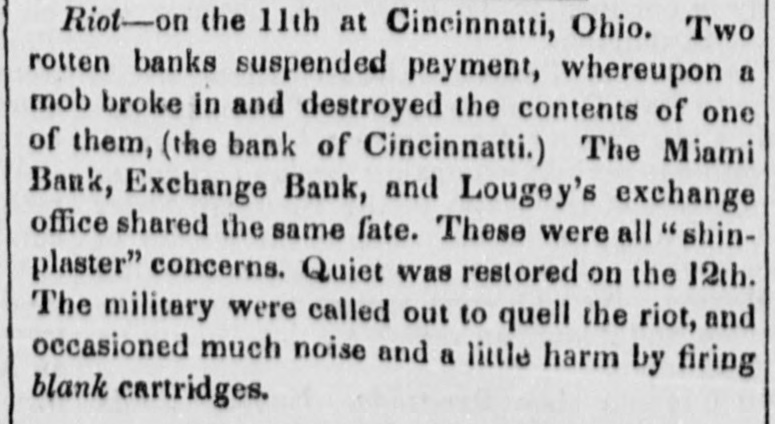
Riot- on the 11th at Cincinnatti, Ohio. Two rotten banks suspended payment, whereupon a mob broke in and destroyed the contents of one of them, (the bank of Cincinnatti.) The Miami Bank, Exchange Bank, and Lougey's exchange office shared the same fate. These were all "shinplaster" concerns. Quiet was restored on the 12th. The military were called out to quell the riot, and occasioned much noise and a little harm by firing blank cartridges.


Article from Rutland Herald, January 25, 1842

Click image to open full size in new tab

Article Text

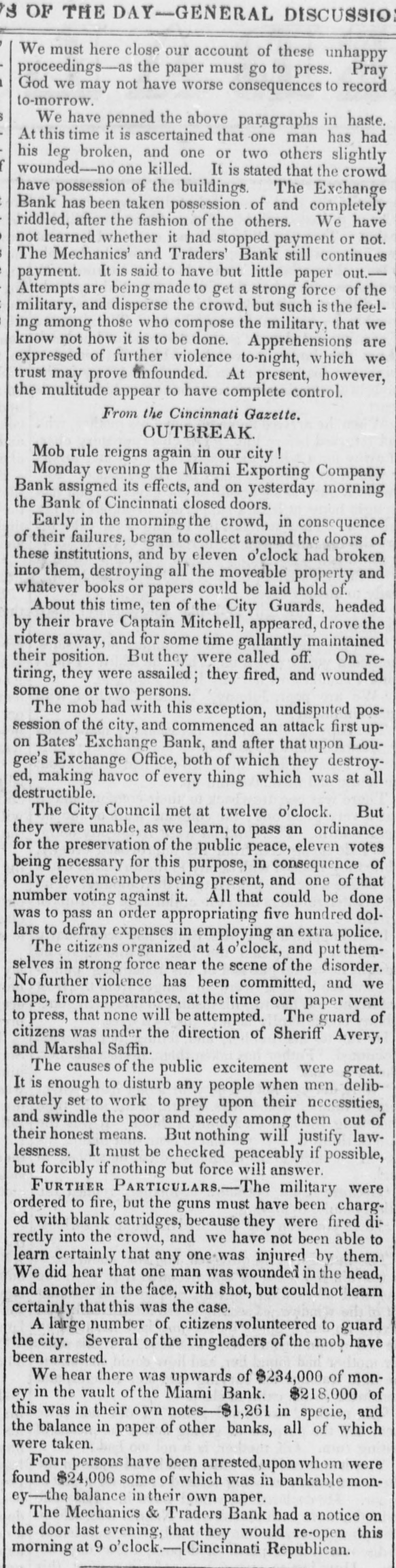
s OF THE DAY-GENERAL DISCUSSIO We must here close our account of these unhappy proceedings-as the paper must go to press. Pray God we may not have worse consequences to record to-morrow. We have penned the above paragraphs in haste. At this time it is ascertained that one man has had his leg broken, and one or two others slightly wounded--no one killed. It is stated that the crowd have possession of the buildings. The Exchange Bank has been taken possession of and completely riddled, after the fashion of the others. We have not learned whether it had stopped payment or not. The Mechanics' and Traders' Bank still continues payment. It is said to have but little paper out.Attempts are being made to get a strong force of the military, and disperse the crowd. but such is the feeling among those who compose the military, that we know not how it is to be done. Apprehensions are expressed of further violence to-night, which we trust may prove unfounded. At present, however, the multitude appear to have complete control. From the Cincinnati Gazette. OUTBREAK. Mob rule reigns again in our city ! Monday evening the Miami Exporting Company Bank assigned its effects, and on yesterday morning the Bank of Cincinnati closed doors. Early in the morning the crowd, in consequence of their failures, began to collect around the doors of these institutions, and by eleven o'clock had broken into them, destroying all the moveable property and whatever books or papers could be laid hold of. About this time, ten of the City Guards, headed by their brave Captain Mitchell, appeared, drove the rioters away, and for some time gallantly maintained their position. But they were called off. On retiring, they were assailed; they fired, and wounded some one or two persons. The mob had with this exception, undisputed possession of the city, and commenced an attack first upon Bates' Exchange Bank, and after that upon Lougee's Exchange Office, both of which they destroyed, making havoc of every thing which was at all destructible. The City Council met at twelve o'clock. But they were unable, as we learn, to pass an ordinance for the preservation of the public peace, eleven votes being necessary for this purpose, in consequence of only eleven members being present, and one of that number voting against it. All that could be done was to pass an order appropriating five hundred dollars to defray expenses in employing an extra police. The citizens organized at 4 o'clock, and put themselves in strong force near the scene of the disorder. No further violence has been committed, and we hope, from appearances. at the time our paper went to press, that none will be attempted. The guard of citizens was under the direction of Sheriff Avery, and Marshal Saffin. The causes of the public excitement were great. It is enough to disturb any people when men deliberately set to work to prey upon their necessities, and swindle the poor and needy among them out of their honest means. But nothing will justify lawlessness. It must be checked peaceably if possible, but forcibly if nothing but force will answer. FURTHER PARTICULARS.-The military were ordered to fire, but the guns must have been charged with blank catridges, because they were fired directly into the crowd, and we have not been able to learn certainly that any one-was injured by them. We did hear that one man was wounded in the head, and another in the face. with shot, but could learn certainly that this was the case. A large number of citizens volunteered to guard the city. Several of the ringleaders of the mob have been arrested. We hear there was upwards of $234,000 of monof ey in the vault of the Miami Bank. $218,000 this was in their own notes-$1,261 in specie, and the balance in paper of other banks, all of which were taken. Four persons have been arrested upon whom were found $24,000 some of which was in bankable money-the balance in their own paper. The Mechanics & Traders Bank had a notice on the door last evening, that they would re-open this morning at 9 o'clock.-[Cincinnati Republican.


Article from The Caledonian, January 25, 1842

Click image to open full size in new tab

Article Text

ANOTHER TERRIBLE RIOT IN CINCINNATI Correspondence of The New-York Tribune. CINCINNATI, Tuesday, Jan. 11, 1842. Our city is at this moment in a state of tremendous excitement. Yesterday, after Banking hours, it was reported that the Miami Exporting Co. Bank and the Bank of Cincinnati, both old concerns, had stopped payment. This morning, at about 9 o'clock, a crowd in consequence stood before the door of the latter Bank,and a notice was soon hung out upon the door that they had suspended for twenty days. When the doors were opened to hang out this notice, a rush was made for the inside, and all its contents, consisting of desks, counters and vaults were broken and thrown into the street. Money to the amount of $224,000 was taken from the vault. The mob then went to the Miami Bank, which they broke open and destroyed its contents. The Exchange Bank, adjoining the Miami, of which John Bates, the well-known West Union financier, was an officer, was next assailed. A run was made upon him, and he continued to redeem all his issues, until the mob broke in and destroyed every thing. Thence they crossed over to Loungee's office, who was godfather to the Savings Bank at Louisville. This was likewise destroyed and the crowd gathered to the corner of Third and Main streets. A strong disposition on the part of the mob was manifested to destroy the Traders and Mechanic's Bank; but they continued to redeem their notes, which were nothing more than certifi. cates of deposite with promises to pay in current Bank notes, and thus escaped. How this most disgraceful riot will end,time only can show. A few of the military have been called out, but have effec ted little. They marched through the crowd with fixed bayonets, but were soon attacked and com pelled to retreat. As they retired they were ordered to fire upon the mob which they did. Their guns were loaded with blank cartridges, however, and only two or three were slightly injured. Cincinnati is disgraced forever in the eyes of those who love order and respect the laws. There is a. mong our people no sympathy, to be sure, for those persons who are concerned in resuscitating these rotten concerns, but every one isindignant at the method of evincing resentment. The authorities seem to be lamentably inactive. Many people think that they could have effected nothing if they had tried; but others allege that, had they been, promptly on the spot, they could easily have prevented the disgrace. The scene of the operations of the mob is not twice a stone's throw from the Mayer's office. The indignation of the citizens was greatly aroused some two or three weeks since by the explosion of the Lebanon Miami Bank, some thirty miles from the city. This is probably one cause of the outbreak; yet those who havegtaken the most active part in it are those who have nothing to lose. At present the arm of the law is palsied, and the honor of the Queen City is tarnished for years. Five o'clock.-The crowd is still great, but the mob have ceased active operations Several of them have been arrested, and are now in jail. About $24,000 were found about their persons.There will be a strong guard out to-night to protect the Banks that are in good repute. Threats were thrown out against the Life Insurance and Trust Company; but they continue to pay specie for their notes, and will probably escape. Six o'clock.-Ail is quiet, and if it continue thus all will be well. A strong guard has been ordered out to prevent farther depredatons. Tuesday,Jan. 12. All is quiet this morning. The issuers of shinplasters look blue as they see the fragments of their 'fixins' scattered in the street. CRUELTY TO A Loco Foco. A well known individual, now a resident in Kentucky,] who once went abroad to dispose of the State Stocks of Illinois, and managed,by means best known to himself, to make $100,000 out of the transaction, was exibiting a blooded horse, not long since, near the city. "Come gentlemen," said he,"I gave $20,000 for this horse in Europe. I should like to know your opinion of him." "Well," said a tall Kentuckian, "my opinion is, that he looks as if he had too much Illinois stock in him." Louisville Journal. Mr. Duncan K. McRae, of Fayetteville, N. C, is said to have been appointed the bearer of despatches to the American Minister at Mexico, in relation to the American prisoners taken by the exMicans at Santa Fe. Two of the negroes concerned in the murder of Mr. Cunningham, of Jefferson County, Ga. men. tioned about ten days since, were hung on the 7th


Article from Lynchburg Virginian, January 27, 1842

Click image to open full size in new tab

Article Text

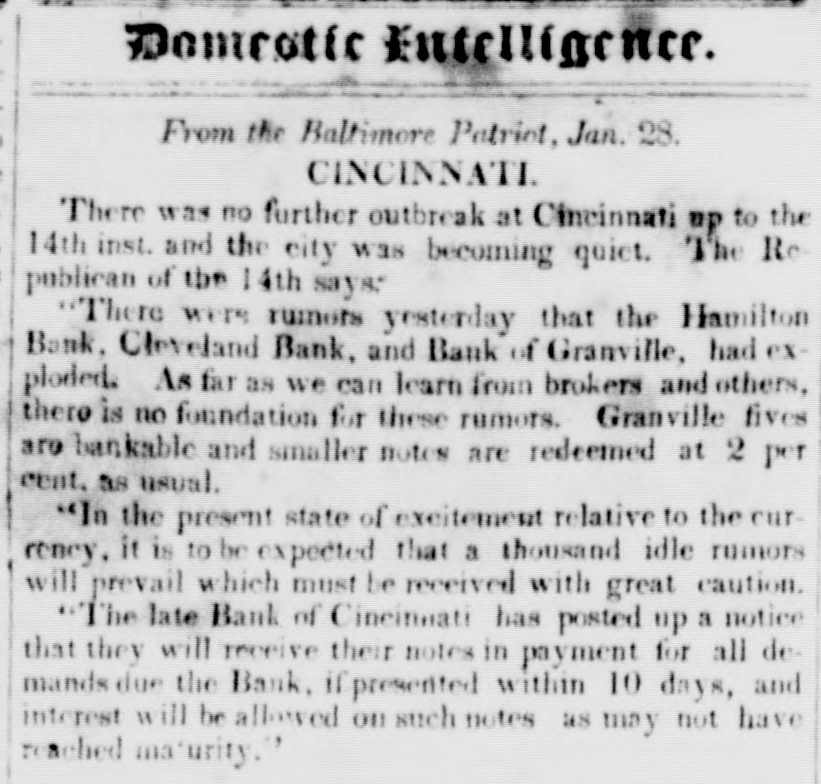
Demeotic Entelligence. From the Baltimore Patriot, Jan. 28. CINCINNATI There was no further outbreak at Cincinnati up to the 14th inst. and the city was becoming quiet. The Re publican of the I 4th says: "There were rumots yesterday that the Hamilton Bank, Cleveland Bank, and Bank of Granville, had exploded. As far as we can learn from brokers and others, there is no foundation for these rumots. Granville fives are bankable and smaller notes are redeemed at 2 per cent. as usual. "In the present state of excitement relative to the currency, it is to be expected that a thousand idle rumors will prevail which must be received with great caution. "The late Bank of Cinemuati has posted up a notice that they will receive their notes in payment for all de mands due the Bank. if presented within 10 days, and interest will be allowed on such notes as may not have reached maturity."


Article from Burlington Free Press, January 28, 1842

Click image to open full size in new tab

Article Text

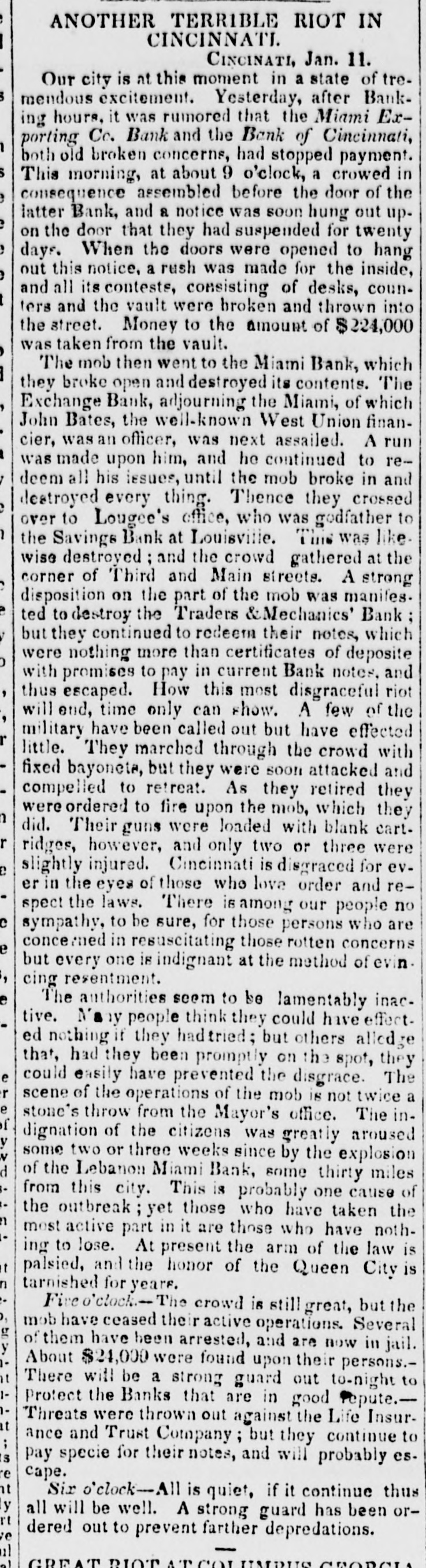
ANOTHER TERRIBLE RIOT IN CINCINNATI. CINCINATI, Jan. 11. Our city is at this moment in a state of tremendous excitement. Yesterday, after Banking hours, it was rumored that the Miami Exporting Co. Bank and the Bank of Cincinnati, both old broken concerns, had stopped payment. $ This morning, at about 9 o'clock, a crowed in consequence assembled before the door of the latter Bank, and a notice was soon hung out up. on the door that they had suspended for twenty days. When the doors were opened to hang out this notice, a rush was made for the inside, and all its contests, consisting of desks, counters and the vault were broken and thrown into the street. Money to the amount of $224,000 was taken from the vault. The mob then went to the Miami Bank, which they broke open and destroyed its contents. The Exchange Bank, adjourning the Miami, of which John Bates, the well-known West Union financier, was an officer, was next assailed. A run was made upon him, and he continued to redeem all his issues, until the mob broke in and destroyed every thing. Thence they crossed over to Lougee's office, who was godfather to ) the Savings Bank at Louisville. This was like. wise destroyed ; and the crowd gathered at the corner of Third and Main streets. A strong disposition on the part of the mob was manifes. ted to destroy the Traders &Mechanics' Bank: but they continued to redeem their notes, which were nothing more than certificates of deposite with promises to pay in current Bank notes, and thus escaped. How this most disgraceful riot will end, time only can show. A few of the military have been called out but have effected little. They marched through the crowd with fixed bayonete, but they were soon attacked and compelled to retreat. As they retired they were ordered to fire upon the mob, which they h did. Their guns were loaded with blank cart. r ridges, however, and only two or three were slightly injured. Cincinnati is disgraced for eve er in the eyes of those who love order and respect the laws. There is among our people no c sympathy, to be sure, for those persons who are concerned in resuscitating those rotten concerns e but every one is indignant at the method of evin cing resentment. e The authorities seem to be lamentably inactive. Na by people think they could have effect. ed nothing if they had tried; but others alled that, had they been promptly on the spot, they e could easily have prevented the disgrace. The r scene of the operations of the mob is not twice a e stone's throw from the Mayor's office. The inof dignation of the citizens was greatly aroused y some two or three weeks since by the explosion d of the Lebanon Miami Bank, some thirty miles from this city. This is probably one cause of the outbreak; yet those who have taken the n most active part in it are those who have nothing to lose. At present the arm of the law is it palsied, and the honor of the Queen City is n tarnished for years. Five o'clock.-The crowd is still great, but the , mob have ceased their active operations. Several g of them have been arrested, and are now in jail. y About $24,000 were found upon their persons.it There will be a strong guard out to-night to 1Protect the Banks that are in good repute.Threats were thrown out against the Life Insurat ance and Trust Company; but they continue to ; s pay specie for their notes, and will probably esre cape. nt Six o'clock-All is quiet, if it continue thus y all will be well. A strong guard has been orrt dered out to prevent farther depredations. e GREAT UNDUS


Article from The Charlotte Journal, February 3, 1842

Click image to open full size in new tab

Article Text

MOB IN CINCINNATI! We are grieved to have to state another instance of that disorganizing spirit which has been exhibiting itself in this country for the last six or eight years. On the 11th ult. a number of persons asembled be. fore the bank of Cincionati for the purpose of having its notes exchanged and in case of refusal to avenge themselves. This institution from the failure of another Bank was compelled to suspend for twenty days as it stated by a notice on the door. This was enough-the crowd entered vi et ar. mis and commenced the destruction of every thing they could lay their hands on -the mob then attacked the vault with crowbars, sledge hammers, &c. &c. The mob also attacked the Miami Bank and al. so destroyed every thing and a considera. ble amount of money abstracted, in notes and specie, which was however recovered and the robbers arrested. The Exchange Bank, owned by a man named Bates was next attacked, they then went to Lougee & Co. Broker's Office every thing was destroyed and the vaults forced but all the property of value had been removed. The Sheriff attempted to arrest the progress of the rioters, but was driven off, the citizens not appearing willing to sustain bim, and the military could not be got out. A lawyer by the name of Charles Fox attempted to read the Riot Act, when the mob dismounted him from his rostrum and made him take to his heels-be was chased by about three hundred men to the Pearl-st. House, where he obtained shelter. Such a For chase, says a Cincinnati paper, and by such hounds, was never before witnessed. The spirit of misrule seems to be creeping eveu into our legislative bodies. We copy the following extract frora the Ohio State Journal, and we would ask the attention of the intelligent and honest men of all parties of the whole country to the language and sentiments expressed. They were uttered by a Mr. McNulty the representative of Knox county and a leading member of his party. A bill being under consideration to repeal the charter of the German Bank of Wooster, Mr. McN. said He did not feel particularly friendly to the bill, but he should vote for it, howevHe could not approve of that part of er. the amendment (offered by Mr. Schenck) which authorized the institution of judical He admired the system of the affairs of Banks in Cincinnali, and thought duced settling proceeding. recently it would intro that prove more effectual than any thing could be done by the Legislature. Noth ha ing short of that would be adequate. He wanted no better light to brighten his way in the path of duty than the CURNING EDIu FICES OF EVERY BANK IN THE STATE.pt And he would add, too, that he should a light to see the natural bodies of those who ti composed those frauds upon the community W SUSPENDED LIKE HAMAN HIGH BETWEEN HEAVEN AND EARTH." m th In reply to some remarks from Mr. Schenck, Mr. McNalty reiterated these jo sentiments: He had no de horror of mobs as was at atrocious profound professed (Mr. such th by the gentleman from Montgomery, in S.) The decision of Judge Lynch were that seldom reversed, and that proved ca they were right. The tea party' at Boswas a mob, and there was no difference the between ton that act and the one in which swindling shops in Cincinnati had been demolished. Mons, in his judgment, CONor STITUTED THE ONLY EFFICIENT SYSTEM OF IT BANK REFORM, AND HE WANTED TO SEE m OUT. Mr. McNuity said he reM a of a w CARRIED presented population 30,000, him in major- these of whom coincided with A so doctrines, ity for he had openly and boldly told of avowed them before the election, and W his counstituents if they did not agree one with him they had better send some vo ou elso to represent them in the Legislature. M He only regretted that he could not say, fu with another distinguished public man a who filled an honorable station in other councils, " Solitary and alone I set this


Article from New-York Daily Tribune, July 28, 1842

Click image to open full size in new tab

Article Text

The Press Pandering to Licentiousness A correspondent asks us to soil our columns with the following extract from The Sun of yesterday and the day previous. We comply. with some misgivings as to the propriety of so doing, and with no hope that those readers who were not shocked by the Restell and kindred abominations with which that paper has teemed will be at all disaffected by this. It as follows: W ANTED BY A YOUNG LADY-A situation as companion. who is willing to devote her time. &c. to these with whom the may be associated, and would willingly make herself generally agreeable. and also contribute those kindnesses becoming a domestic household A line addressed to Miss Lavinia. at the Sun Office. stating where an interview may be had will be attended to. P. S. j26 3* None need apply but men of capital. No comment can be necessary KPV. W. SMITH, formerly of the Western State Journal at Syracuse, has assumed permamently the Editorship of the OHIO STATE JOUR NAL, the Whig State paper. Mr. S is an able Editor, tried and true, and will do good service in the cause of the Country and Harry Clay. ICP Two new papers have been started in Boston, the Daily Circular, and the Daily American.The latter. edited by Mr. Warland, late of the Claremont Eagle, has for its object to advocate the election of Henry Clay. BASKRUPTCY.-Judge Conklin. of the Northern District, has decided. in a bankrupt case, that voluntary assignments, whether they give preferences, or do not give them, are utterly void under the bankrupt law. DJ The Vicksburg Tri-weekly Whig has placed HENRY CLAY" at the head of its columns, and accompanied this unfurling the banner with an able statement of its reasons. The WESTERN CATHOLIC REGISTER a religious paper, has just been started at Detroit, Mich. by Eugene T. Smith. The Atabama Standard, at Lafayette, Chambers Co., hoists the flag of HENRY CLAY. The Philadelphia Gazette has hoisted the flag of HENRY CLAY. The books and papers of the Bank of Cincinnati, which had been stolen from the Receiver, have been recovered, with the exception of some few notes. 17 Our city friends who are about to introduce the Croton Water into their houses ill please remark the advertisement of Messrs. WHITSEY & JENKINS, Plumbers, in this day's paper. We are well assured that they will execute any work in their line with fidelity and despatch a: mode. rate prices.


Article from The Spirit of Democracy, January 24, 1846

Click image to open full size in new tab

Article Text

# FOR GOVERNOR OF OHIO, DAVID TOD, of Trumbull. # THE CONSTITUTIONAL CURRENCY. In our paper of last week, we published the proceedings of the Democratic 8th of January Convention, which put in nomination, as the Democratic candidate for Governor of Ohio, the able advocate of equal rights-DAVID TOD. On the first page of to-day's paper will be found the proceedings of the Democratic Editorial State Convention, for which we bespeak an attentive perusal. The democracy of this county are well aware, that, when the democratic party of Ohio raised the "bank reform" banner, in 1838, they were triumphantly victorious at the ensuing elections. The people were well satisfied, from past experience, that the old villanous banking system needed much reformation, in order to secure them from the almost daily loss of thousands of dollars; a loss resulting as well from the total failure of these rascally shaving shops, as from a partial depreciation in the nominal value of their "promises to pay." In accordance with the views and doctrines, at that time advocated, the democratic members of the General Assembly, at subsequent sessions of the Ohio legislature, passed laws which, it was supposed, would have the effect to make bankers honest men; or, in other words, to prevent the old system of bank swindling of "contractions to-day, and expansions to-morrow"- from ever being again fastened upon the people of this State. Laws were enacted making stockholders liable in their individual capacity for the debts of a bank, in case of failure, as well as other laws equally salutary. When these laws were passed, it was thought that the people would, thereafter, be secured from losses by bank failures, and bank suspensions; and that all banks thereafter chartered would have engrafted in their charters these salutary provisions. But how have the people been disappointed in their hopes and expectations? Would bankers accept of charters with the individual liability clause? No. The determination of the moneyed aristocracy of this State was to grind down the people by enormous taxes, by bank failures, and bank suspensions, until they should be brought to tamely submit to any banking proposition that might be brought forward. The result has been, that by "deception, corruption, and accident," the bank power of the State has once more gained the ascendency in our legislative halls. Immediately, all the salutary measures, demanded by the people, were repealed; and a system of banking enforced upon the people only equalled by the old defunct banks of Gallipolis, West Union, and a host of others. Who does not recollect, and, not only recollect, but, by experience, know the thousands, and we might safely say millions, lost to the people of Ohio, by the explosion of such dens of iniquity as the Bank of Cincinnati, German Bank of Wooster, Bank of Steubenville, Bank of Granville, Bank of Urbana, Bank of Gallipolis, Bank of West Union, Miami Exporting Company, new Bank of Circleville, Lebanon Miami Bank, Bank of Cleveland, Commercial Bank of Lake Erie, Commercial Bank of Scioto, and a long list of others in this State, together with the losses sustained by the failure of the banks of the States of Illinois, Michigan, and others; and we might particularly mention as "last though not least," the Bank of St. Clair, familiarly known as the *Red-dog* bank? Have the people, we ask, forgotten all their losses occasioned by the failure of these institutions? No. They feel that forbearance will soon cease to be a virtue; and will, ere long, speak in tones of thunder to those nabobs of the bank-paper-mills, whose only rule of action seems


Article from Burlington Hawk-Eye, January 31, 1850

Click image to open full size in new tab

Article Text

Just as we expected!!! When our Low Water neighbers turned out Financiers, and made a futile effort to run a tilt gainst Clark's paper, and read puerile lectures on currency to their readers, we knew they must render themselves, and the whig party even, in a measure, ridiculous. The aim of the Whig party should be to establish in our State a banking system, with all checks and safeguards necessary to secure entire solvency and proper management. As the experiments heretofore made seem to indicate, all expedients have failed, and the solvency of banks has seemed to be the result of honest and judicious management, and not legislative restriction. If there be any exception, it is in New York. The State Branch system of Ohio never has and never will have the entire confidence of financiers. Whether the banks of that State are good or not, nobody can tell here or there. If any one personally knows the managers he can form an opinion satisfactory to his own mind, but after all, actually knows nothing. And yet the bulk of the currency of Iowa is Ohio paper. How much tter-would be a currency of our own, under our own control? The Keokuk Register published a statement of the condition of the Ohio Banks-as they said-to "head the advocates of Clark's paper !" This statement shows that the immediate liabilities of those banks exceed their immediate means $7,022,131, and that neither the editors at Keokuk nor the people of Ohio know any thing about the actual value of Ohio Bank paper. They show by their statement that their immediate means are not sufficient to meet their liabilities. But say these astute financiers of the Keokuk Register-we took our statement "from the Cincinnati Gazette-the oldest and most influential Whig paper in the State-the editor of which remarks, 'that the Banks of no State in the Union are stronger and more impregnable.' The fact that their immediate liabilities exceed their immediate means seven millions and more, does not prove to be true, what the Gazette says as to the solvency of these banks; but the fact that the oldest Whig paper in Ohio says so, satisfies the financiers of the Regis. ter, that such is the fact. Now weare pretty much of the same opinion-but for a very different reason. We do not think, with the Register, that the statement proves anything, except the inability of the Ohio Banks to pay; but when the editors of the Cincinnati Gazette assure us that we may have confidence in Ohio Banks-we are disposed to contide in the editors of that paper, because we believe they are honest and well informed. So in regard to Clark's paper. Men, as honest and well informed, assure us, and give us confidence. We cannot descend to the slang of the Register. We desire to reason and be met in the same way.If "billingsgate" suits better the appetites of the readers of the Register, we can forgive it. But in justice to Clark & Co., we must copy one remark of the Register, as follows make no objection whatever to the regular business of Clark & Co., in the Exchange and Broker line; that is entirely legitimate, and had they confined their operations to that, no one would have just cause of complaint." So far as we have been able to ascertain, the business of Clark s Co. in this place, has been, wholly confined to the business of buying and selling, of exchange, and to notes of foreign banks. We do not know of a single loan-nor, do we believe one to have been made. It is regretted by business men that their paper cannot be borrowed. And the reason why it cannot, is owing to the fact that it is worth 1 per cent. more at St Louis, than any paper in circulation in Iowa, (except Missouri Bank,) and will therefore return upon them as fast as issued. Is this the case with Ohio paper ? No! It is usually sent here in greatest abundance just before a failure as all know, who remember the rotten concerns-the bank of Cincinnati-bank of Gallipolis-bank of Norwalk-bank of Sandusky-bank of Steubenville-bank of West Union--bank of Wooster--Farmersbank of Canton--Farmers Bank of New Salem--Farmers and Mechanics bank of Chillionthe-Farmers and Mechanics bank of Cinbank of Wooster-Jefferson bank of New Salem, etc., etc., etc. All of which, Ohio newspapers, called gou. until they were broken, and Iowa footed the bill! In conclusion, we recommend the editors of the Register to abandon the wind-mill operation of one Sancho Panza, and to devote their energies to the Rail Road from Dubuque to Keokuk. Which will be built "if they only have time" !!! Gentlemen, you must tarry in Jericho a little longer I I


Article from Chicago Daily Tribune, October 23, 1875

Click image to open full size in new tab

Article Text

# THE CURRENCY. A PLEA FOR THE GREENBACK. To the Editor of The Chicago Tribune: CHICAGO, Oct. 20. In your page of the 2d instant I demonstrated the "legality of greenbacks during their existence," and showed how the Federal Court, by decrees, had settled the principle of law in reference thereto, that "whatever is necessary is authorized," and I now say that the constituted authorities, backed by Congress and the people, have furnished us a currency for which the entire nation is both liable and responsible, -a security attaching to no other circulating medium previously issued in the United States of America. In illustrating this, let me group the facts bearing on it, within my own time and recollection. The charter of the last United States Bank being about to expire, Congress, in 1832, passed an act of renewal which Gen. Jackson vetoed. It subsequently obtained a charter from Pennsylvania: on the popularity of Nicholas Biddle, its President, flourished on a big scale for a time, but ended in utter ruin and bankruptcy. Soon after the veto the Government deposits were placed in private-stock and State banks throughout the country, which, discounting freely to the public, led to speculation in endless variety. All sorts of operations were fostered, and the entire community ran headlong into debt for wild land, town-lots, timber, mulberry-trees for silk-worms, fancy hogs, etc., etc. This continued without check until 1836, when the Government issued the then-famous "Specie Circular" to the Land-Offices, requiring all payments in gold and silver. During that year, as the first alarm came the failure of the Bank of Maryland, in Baltimore, with an extended circulation and deposit account. It was mobbed by its creditors, the riot lasting several days, and closed by the tearing-down of the elegant brick mansion on Monument Square, worth thousands of dollars, owned by Reverdy Johnson, the great lawyer, he being a stockholder, as was claimed, of said bank. [Let me here note, as a warning to all cities that encourage mobs by a loose system of police-regulations, that the City of Baltimore was sued and compelled to pay Mr. Johnson for his property.] From this date, failures continued to be numerous; and, in May, 1837, there was a general suspension of specie-payments by all the banks throughout the country. This is known in history as the panic of 1837. Business everywhere was in a chaotic state, and so continued, without any apparent mode of relief, until 1839, when the banks, by concerted action, made an effort to resume; but, after a brief period, all again suspended, except the New York and Eastern banks, and those of New Orleans, Charleston, Savannah, and a few other points. Thus a standard of value was established for cotton, naval stores, pork, and produce, at the leading points East, North, and South, but leaving the West, so far as its home transactions in trade, in a terrible condition. Then commenced the wild-cat-currency era,-"red-dog," "blue-pup," "Brandon," and all manner of paper-circulation. In the meantime, the Van Buren Administration, which was nearing its close, was held responsible by the people for good times which never came; and the community, with one accord, swept the country with "hard-cider" and "coon-skins," electing "Tippecanoe and Tyler too," in 1840. This was the first inroad made into the old Democratic ranks, virtually, since the retirement of Washington, except the memorable Adams and Clay bargain in 1825. The new President took charge of affairs, and Congress in 1841, in special session, passed at once the Bankrupt law, following with a United States Bank Charter, which was vetoed by Tyler, Harrison having died shortly after his inauguration. The Ohio and Indiana banks were required by law to resume on the 4th of March, 1842, which was obeyed by the few solvent ones in Cincinnati, Cleveland, Columbus, Dayton, etc., and by the State Bank and branches of Indiana, but the greater number, with their thousands of debtors, closed their affairs in a Bankrupt Court, the Bank of Cincinnati and the Miami Exporting Company's being mobbed by an indignant people, claiming to be swindled creditors. As time passed on, Chicago and the then Far West began to grow into importance, and the Wisconsin Insurance Company, of George Smith and Alexander Mitchell, and like institutions, with some chartered banks of Illinois, -mixed largely with Indiana and other wild-cat stock-banks, -formed the currency in the States bordering on and doing business with Chicago, Toledo, Detroit, Cleveland, and other places, and this state of things continued until the next big warning, in August, 1857, when the "Ohio Life & Trust Company" astounded the country by its proclaimed insolvency; following which closely came the failure again of the banks in New York City and throughout the Union. This last general suspension virtually wound up the attempt at furnishing a circulating medium for the country, so far as there was any united effort to that end by the few solvent banks, scattered as they were wide apart throughout the Union; and the various institutions, wherever situate, limped along through the panic of 1857 to 1862, and this brings us down to the beginning of the greenback and bond era, made necessary by the War. Special attention is called to the fact that, during the past forty years, the longest continuous period that specie-payments have been maintained is eighteen years, -1839 to 1857, -and this only by a few highly-favored institutions in the principal seaports, which from their position dictated to the balance of the country; and yet they yielded like the veriest wild-cats, when their solvency was questioned by a demand for payment by their creditors. Such has been the result of all the currency furnished to this great American people down to 1862, which was based on State, real-estate, and individual security, and in the palmy days of specie-payments, which, in addition, one-third of the amount of circulation was in gold and silver. But we have seen that, when the confidence of the community was gone or temporarily withdrawn from any institution, or, as in the great panics, from all of them, down they went. Our entire Government circulation (greenbacks and National Banks) is called $800,000,000; our population, 45,000,000; making less than $18 to each person, and not to exceed $30 to each voter. Surely, we can all comprehend the safety and convenience of such a system. I have refrained from all dogmas as to the science of banking and the art of maintaining specie-payments without the specie, and confined myself to the history of the various currencies used by this great trading country since 1830, -all within my own personal recollection; and repeat, what I started to demonstrate, that our greenbacks, as a currency, have a backing, legal and substantial, which never attached to any other previously issued in the United States. N. P. I. # "GREENBACKS-ONE HUNDRED." To the Editor of The Chicago Tribune: CHICAGO, Oct. 22. The Inter-Ocean heads the news of the day, in its editorial items, with the information that, "At the Board of Trade (Chicago), greenbacks opened at 100, and closed at 100." Now, let it report that in London, Paris, Vienna, Berlin, St. Petersburg, Constantinople, and in all the commercial cities of the Orient, and at San Francisco, "Gold opened at 100, and closed at 100,"