14900. Mechanics & Traders Bank (Brooklyn, NY)

Bank Information

Episode Type
Run → Suspension → Reopening
Bank Type
state
Start Date
October 26, 1907
Location
Brooklyn, New York (40.660, -73.951)

Metadata

Model
gpt-5-mini
Short Digest
9b0aac82

Response Measures

Borrowed from banks or large institutions, Capital injected, Full suspension, Books examined

Other: Deferred-payment/resumption plan and reorganization into Union Bank of Brooklyn; receivers were temporary and later discharged.

Description

Mechanics & Traders Bank experienced depositor runs during the 1907 panic (Oct 26, 1907 mentions lines at its Union branch), suspended operations at end of January 1908 (articles state Jan 29/30, 1908) amid adverse bank-specific loans and loss of clearing-house support, and was reorganized and reopened Aug 17, 1908 as the Union Bank of Brooklyn under new management. Classified as run -> suspension -> reopening. Dates drawn from newspaper reports; suspension reported as Jan 29/30, 1908 and reopening reported Aug 17, 1908.

Events (3)

1. October 26, 1907 Run
Cause
Macro News
Cause Details
Depositor nervousness and withdrawals during the 1907 New York banking panic; runs on trust companies and Brooklyn banks after broader panic events.
Measures
Paying out withdrawals; staff assured depositors that demands would be met; no special misinformation event described.
Newspaper Excerpt
One line formed outside the Union branch of the Mechanics' and Traders' Pank in the Temple Bar building. This bank has ten branches distributed throughout the borough. The line began to form outside the bank at 8:30 o'clock.
Source
newspapers
2. January 29, 1908 Suspension
Cause
Bank Specific Adverse Info
Cause Details
Closure followed revelations of large, risky loans to directors/associates (e.g., loans to E.R. Thomas and F.A. Heinze), and withdrawal of clearing-house assistance, leading officers to suspend pending examination; State examiners investigated.
Newspaper Excerpt
Whereas, The Mechanics and Traders' Bank was compelled to suspend business on January 30, 1908, on account of the financial situation ...
Source
newspapers
3. August 17, 1908 Reopening
Newspaper Excerpt
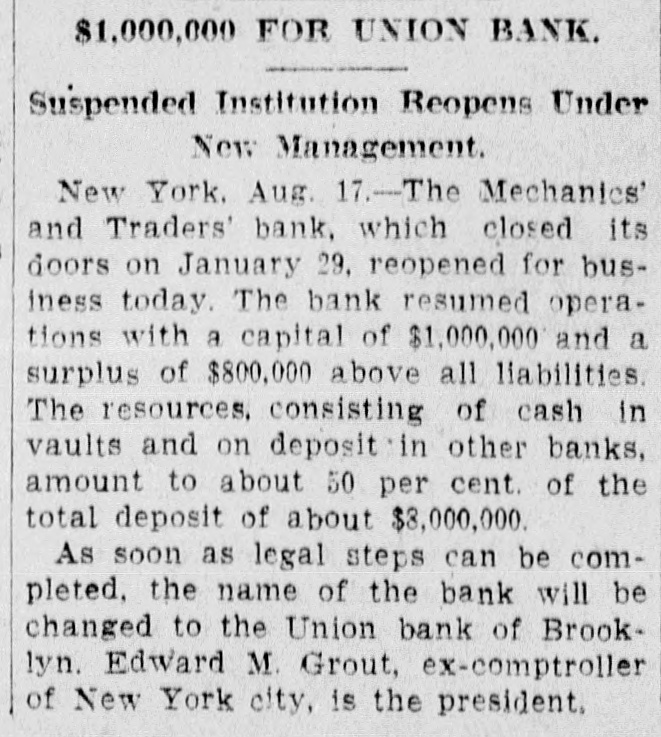
The Mechanics' and Traders bank, which closed its doors on January 29, reopened for business today... As soon as legal steps can be completed, the name of the bank will be changed to the Union bank of Brooklyn. Edward M. Grout... is the president.
Source
newspapers

Newspaper Articles (19)

Article from Evening Star, October 26, 1907

Click image to open full size in new tab

Article Text

NOW UNLI Worst of the New York Bank Run Has Subsided. , WITHDRAWALS DECREASE Some Belated But Timid Ones Still Stand in Line. SAVINGS BANK *PRECAUTIONS Criticism of the Managers Is Tempered With Commendation-Restoring Confidence. Special Dispatch to The Star. NEW YORK October 26 With the marked abatement yesterday in the runs on the trust companies, which have been paying out money to timid depositors since Wednesday morning. the officers of the concerns looked today for a continued diminution that would bring the request for withdrawals down to the normal Of course there were the usual though smaller. crowds awaiting the opening of the doors this morning and the same crowds assurance was given that all demands would be paid. At the offices of the Trust Company of America. where only $2,000,000 wa paid out yesterday, as compared with $12,000,000 on Wed esday and $9,000.000 on Thursday, the officers were confident that the flurry, so far as the run was concerned, was about over. The reformation of the line at the company's offices at 37 Wall street began less than two hours after the close of business yesterday. The first man took his stand in front 0° the door at 4:45 and at 6 o'clock he had nineteen to keep him company. Two young women, numb rs 22 and 24 in the line, went on picket duty at 10 o'clock last night. At the Colonial branch of the trust company. as on Thursday night, the number of all-night vigilants was much smaller than at the company's headquarters. Five stuck it out from last evening and two of these spent the night in the corridor within the revolving doors. Both were said to be bankers' representatives. At 6:20 o'clock this morning there were only fifteen in line. At the Lincoln Trust Company's 5th avenue entrance there were several of those who failed to get admitted when the doors swung shut yesterday afternoon who remained in their places all through the afternoon. being joined late in the evening by a few more, while this mornIng at sunrise the line was considerably lengthened "Deposit Brokers." At the Dollar Savings Bank, 147th street and 3d avenue, where a run started several days ago. a line of some length formed early this morning Several men who called themselves "brokers" went down the line offering to take over the accounts of any anxious ones at 90 cents on the dollar, spot cash. but they found few takers At the Harlem Savings Bank, where the officers announced yesterday that they would take advantage of a thirty days notice, "as a protection to the depositors, there were only a few persons collected Following the suspension of some small Brooklyn banks because of the lack of ready cash in the present financial situation. there were depositors at the doors of some of the trust companies and banks there this morning prepared to withdraw their accounts One line formed outside the Union branch of the Mechanics' and Traders' Pank in the Temple Bar building. This bank has ten branches distributed throughout the borough. The line began to form outside the bank at 8:30 o'clock. when between thirty and thirty-five persons took their places before the doors. Another line formed outside the Nassau Trust Company's building at Fulton street and Red Hook lane As early as 7:45 o'clock there were a few persons in front of the doors. The depositors also gathered outside the Brooklyn Savings Bank, at Pierepont and Clinton streets the second largest bank in Brooklyn, There was a rush of depositors to that bank yesterday afternoon. and this morning at o'clock ther were between fifteen and twenty persons outside its door. The executive committee of the clearing house association this morning issued a call for meeting of the full association to be held at 12 o'clock to decide whether or not to issue clearing house certificates James T. Woodward. chairman of the clearing house committee, said that the situation today depended largely upon developments among the Brooklvn banks. Soon after arriving at the subtreasury this morning Secretary Cortelyou had a conference with George W. Perkins of J. P. Morgan & Co. Mr. Perkins subsequently said "The atmosphere is fast clearing up. as any one can see. Mr. Perkins was asked if he thought this would be the last day of the financial difficulty He replied: "I think it is. James Stillman this morning after the conference at the clearing house. said: "The situation has been saved by the of the heroie Treasury action Secretary of the who has been so ab.y assisted by the whole-hearted co-operation of Mr. Morgan.
Article from The Sun, January 31, 1908

Click image to open full size in new tab

Article Text

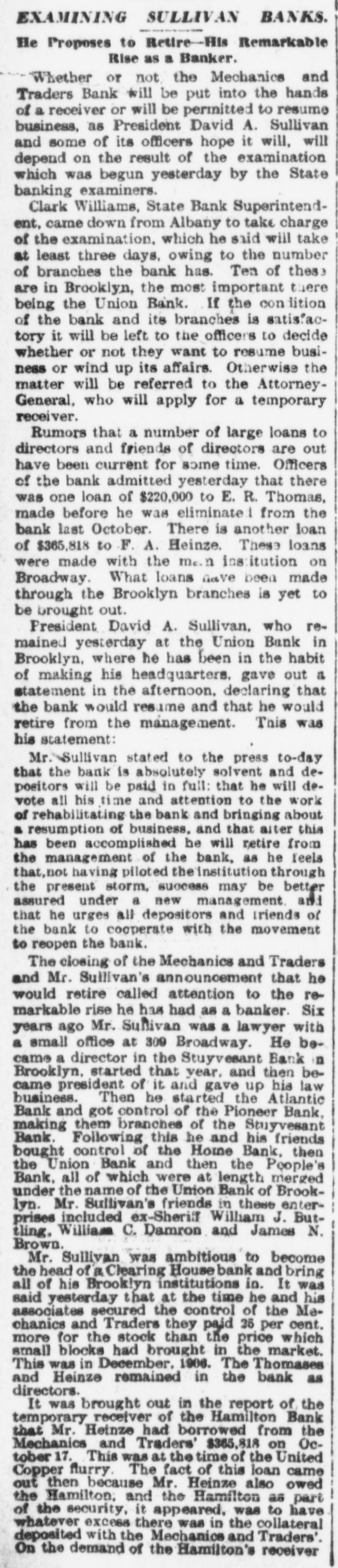
EXAMINING SULLIVAN BANKS. He Proposes to Retire-His Remarkable Rise as a Banker. Whether or not the Mechanics and Traders Bank will be put into the hands of a receiver or will be permitted to resume business, as President David A. Sullivan and some of its officers hope it will, will depend on the result of the examination which was begun yesterday by the State banking examiners. Clark Williams, State Bank Superintendent, came down from Albany to take charge of the examination, which he said will take at least three days, owing to the number of branches the bank has. Ten of these are in Brooklyn, the most important there being the Union Bank. If the con lition of the bank and its branches is satisfactory it will be left to the officers to decide whether or not they want to resume business or wind up its affairs. Otherwise the matter will be referred to the AttorneyGeneral, who will apply for a temporary receiver. Rumors that a number of large loans to directors and friends of directors are out have been current for some time. Officers of the bank admitted yesterday that there was one loan of $220,000 to E. R. Thomas, made before he was eliminated from the bank last October. There is another loan of $365,818 to F. A. Heinze. These loans were made with the me. n institution on Broadway. What loans have been made through the Brooklyn branches is yet to be brought out. President David A. Sullivan, who remained yesterday at the Union Bank in Brooklyn, where he has been in the habit of making his headquarters. gave out a statement in the afternoon, declaring that the bank would resume and that he would retire from the management. This was his statement: Mr.Sullivan stated to the press to-day that the bank is absolutely solvent and depositors will be paid in full: that he will devote all his time and attention to the work of rehabilitating the bank and bringing about a resumption of business, and that alter this has been accomplished he will retire from the management of the bank, as he feels that,not having piloted the institution through the present storm, success may be better assured under a new management. and that he urges all depositors and friends of the bank to cooperate with the movement to reopen the bank. The closing of the Mechanics and Traders and Mr. Sullivan's announcement that he would retire called attention to the remarkable rise he has had as a banker. Six years ago Mr. Sullivan was a lawyer with a small office at 309 Broadway. He became a director in the Stuyvesant Bank n Brooklyn, started that year. and then became president of it and gave up his law business. Then he started the Atlantic Bank and got control of the Pioneer Bank, making them branches of the Stuyvesant Bank. Following this he and his friends bought control of the Home Bank, then the Union Bank and then the People's Bank, all of which were at length merged under the name of the Union Bank of Brooklyn. Mr. Sullivan's friends in these enterprises included ex-Sheriff William J. Buttling, William C. Damron and James N. Brown. Mr. Sullivan was ambitious to become the head of a Clearing House bank and bring all of his Brooklyn institutions in. It was said yesterday that at the time he and his associates secured the control of the Mechanics and Traders they paid 25 per cent. more for the stock than the price which small blocks had brought in the market. This was in December. 1906. The Thomases and Heinze remained in the bank as directors. It was brought out in the report of the temporary receiver of the Hamilton Bank that Mr. Heinze had borrowed from the Mechanics and Traders' $365,818 on October 17. This was at the time of the United Copper flurry. The fact of this loan came out then because Mr. Heinze also owed the Hamilton: and the Hamilton as part of the security, it appeared. was to have whatever excess there was in the collateral deposited with the Mechanics and Traders'. On the demand of the Hamilton's receiver


Article from The Sun, February 2, 1908

Click image to open full size in new tab

Article Text

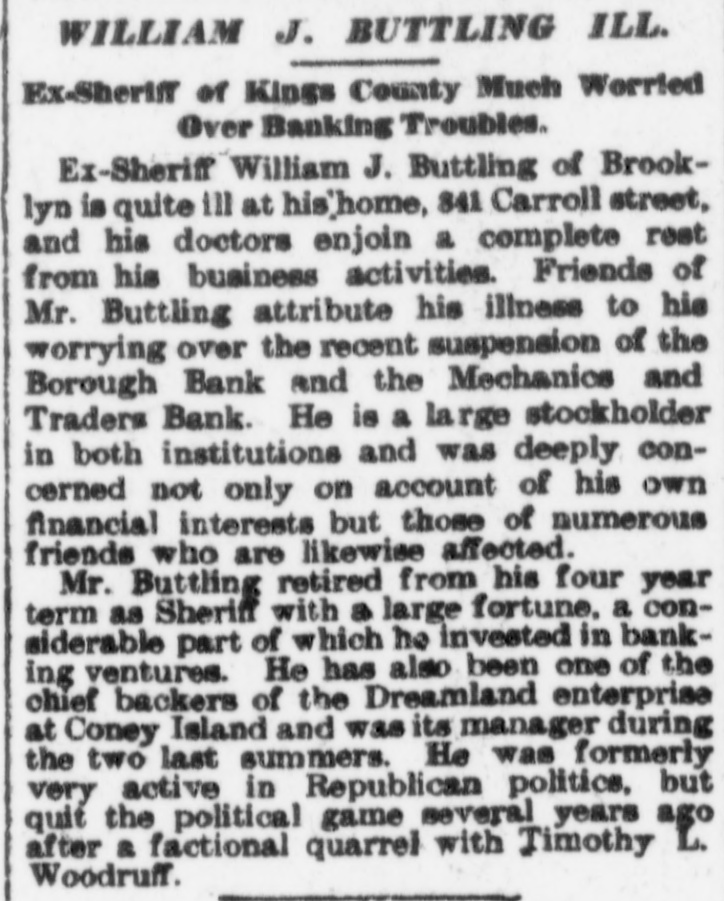
WILLIAM J. BUTTLING ILL. Ex-Sheriff of Kings County Much Worried Over Banking Troubles. Ex-Sheriff William J. Buttling of Brooklyn is quite III at his'home, 841 Carroll street, and his doctors enjoin a complete rest from his business activities. Friends of Mr. Buttling attribute his illness to his worrying over the recent suspension of the Borough Bank and the Mechanics and Traders Bank. He is a large stockholder in both institutions and was deeply concerned not only on account of his own financial interests but those of numerous friends who are likewise affected. Mr. Buttling retired from his four year term as Sheriff with a large fortune, a considerable part of which he invested in banking ventures. He has also been one of the chief backers of the Dreamland enterprise at Coney Island and was its manager during the two last summers. He was formerly very active in Republican politics, but quit the political game several years ago after a factional quarrel with Timothy L. Woodruff.


Article from New-York Tribune, February 5, 1908

Click image to open full size in new tab

Article Text

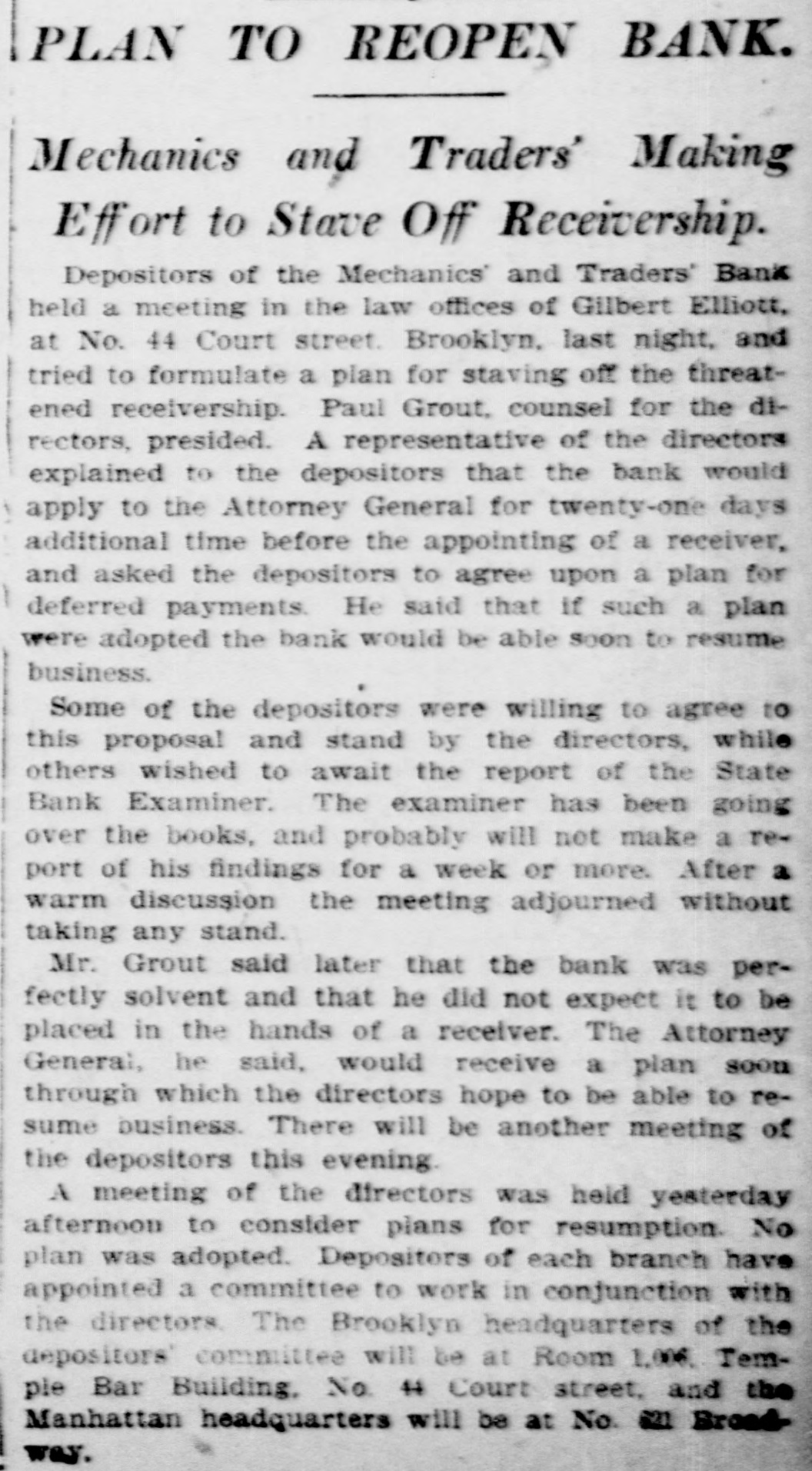
PLAN TO REOPEN BANK. Mechanics and Traders' Making Effort to Stave Off Receivership. Depositors of the Mechanics and Traders' Bank held a meeting in the law offices of Gilbert Elliott, at No. 44 Court street Brooklyn. last night, and tried to formulate a plan for staving off the threatened receivership. Paul Grout, counsel for the directors, presided. A representative of the directors explained to the depositors that the bank would apply to the Attorney General for twenty-one days additional time before the appointing of a receiver, and asked the depositors to agree upon a plan for deferred payments. He said that if such a plan were adopted the bank would be able soon to resume business. Some of the depositors were willing to agree to this proposal and stand by the directors, while others wished to await the report of the State Bank Examiner. The examiner has been going over the books, and probably will not make a report of his findings for a week or more. After a warm discussion the meeting adjourned without taking any stand. Mr. Grout said later that the bank was perfectly solvent and that he did not expect it to be placed in the hands of a receiver. The Attorney General, he said, would receive a plan soon through which the directors hope to be able to resume business. There will be another meeting of the depositors this evening. A meeting of the directors was held yesterday afternoon to consider plans for resumption. No plan was adopted. Depositors of each branch have appointed a committee to work in conjunction with the directors. The Brooklyn headquarters of the depositors committee will be at Room 1,006. Tempie Bar Building, No. 44 Court street, and the Manhattan headquarters will be at No. 621 Broad way.


Article from New-York Tribune, February 7, 1908

Click image to open full size in new tab

Article Text

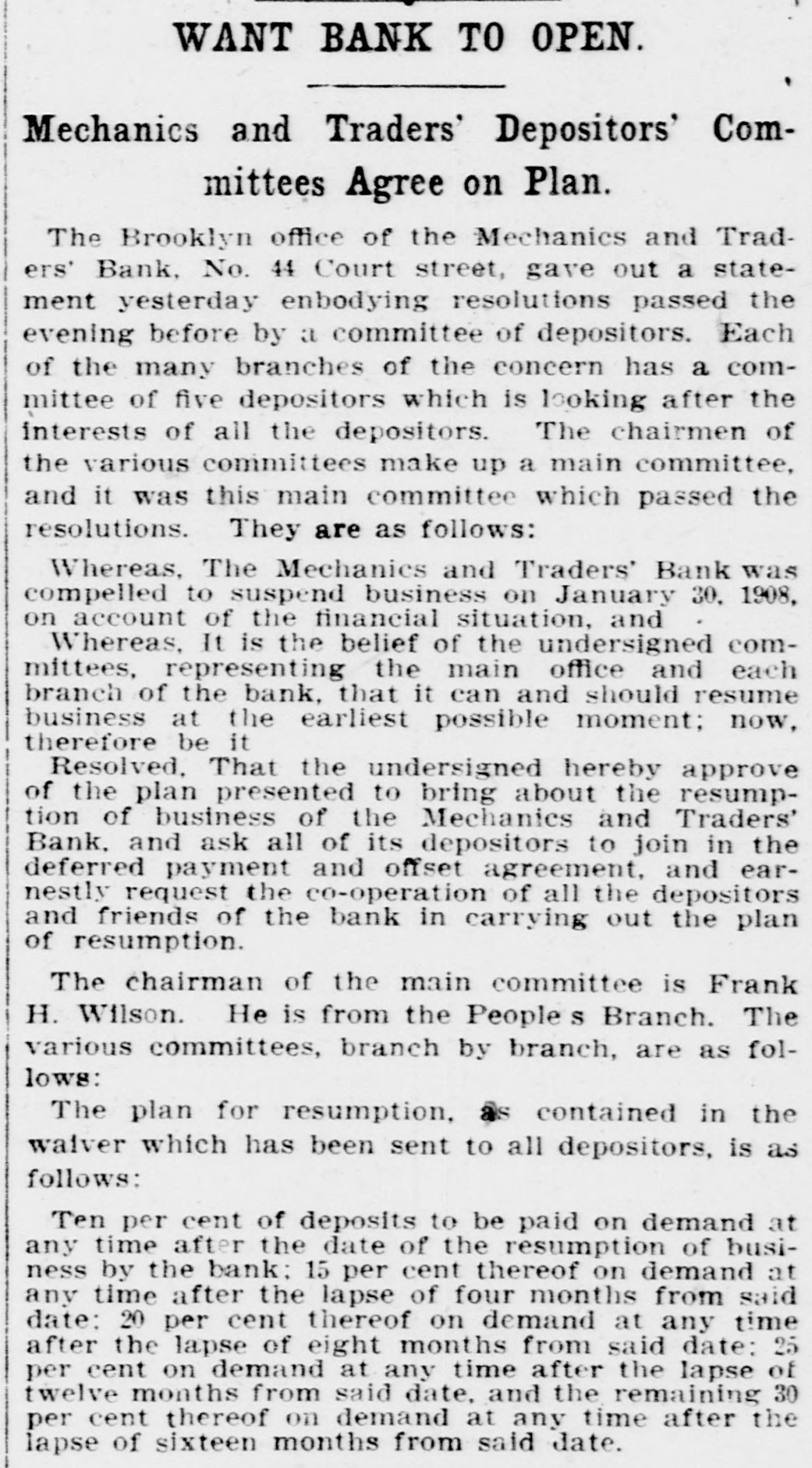
WANT BANK TO OPEN. Mechanics and Traders' Depositors' Committees Agree on Plan. The Brooklyn office of the Mechanics and Traders' Bank, No. 44 Court street, gave out a statement yesterday enbodying resolutions passed the evening before by a committee of depositors. Each of the many branches of the concern has a committee of five depositors which is looking after the interests of all the depositors. The chairmen of the various committees make up a main committee, and it was this main committee which passed the resolutions. They are as follows: Whereas, The Mechanics and Traders' Bank was compelled to suspend business on January 30, 1908, on account of the financial situation, and Whereas, It is the belief of the undersigned committees, representing the main office and each branch of the bank, that it can and should resume business at the earliest possible moment; now, therefore be it Resolved, That the undersigned hereby approve of the plan presented to bring about the resumption of business of the Mechanics and Traders' Bank, and ask all of its depositors to join in the deferred payment and offset agreement, and earnestly request the co-operation of all the depositors and friends of the bank in carrying out the plan of resumption. The chairman of the main committee is Frank H. Wilson. He is from the People's Branch. The various committees, branch by branch, are as follows: contained in the The plan for resumption, waiver which has been sent to all depositors, is as follows: Ten per cent of deposits to be paid on demand at any time after the date of the resumption of business by the bank: 15 per cent thereof on demand at any time after the lapse of four months from said date: 20 per cent thereof on demand at any time after the lapse of eight months from said date: 25 per cent on demand at any time after the lapse of twelve months from said date, and the remaining 30 per cent thereof on demand at any time after the lapse of sixteen months from said date.


Article from New-York Tribune, March 4, 1908

Click image to open full size in new tab

Article Text

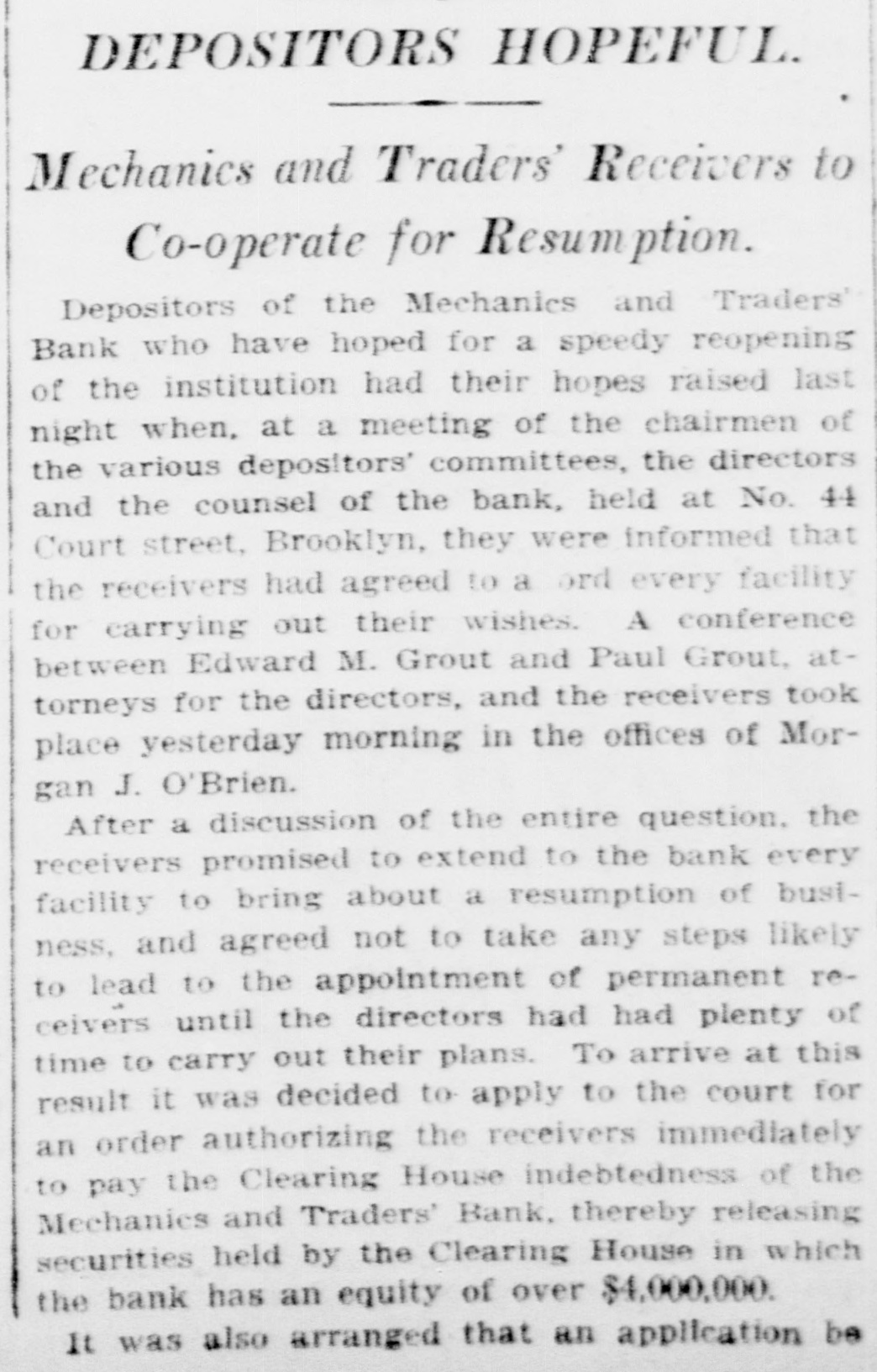
DEPOSITORS HOPEFUL. Mechanics and Traders' Receivers to Co-operate for Resumption. Depositors of the Mechanics and Traders' Bank who have hoped for a speedy reopening of the institution had their hopes raised last night when, at a meeting of the chairmen of the various depositors' committees, the directors and the counsel of the bank, held at No. 44 Court street, Brooklyn, they were informed that the receivers had agreed to a ord every facility for carrying out their wishes. A conference between Edward M. Grout and Paul Grout. attorneys for the directors, and the receivers took place yesterday morning in the offices of Morgan J. O'Brien. After a discussion of the entire question. the receivers promised to extend to the bank every facility to bring about a resumption of business, and agreed not to take any steps likely to lead to the appointment of permanent receivers until the directors had had plenty of time to carry out their plans. To arrive at this result it was decided to apply to the court for an order authorizing the receivers immediately to pay the Clearing House indebtedness of the Mechanics and Traders' Bank, thereby releasing securities held by the Clearing House in which the bank has an equity of over $4,000,000. It was also arranged that an application be


Article from New-York Tribune, August 5, 1908

Click image to open full size in new tab

Article Text

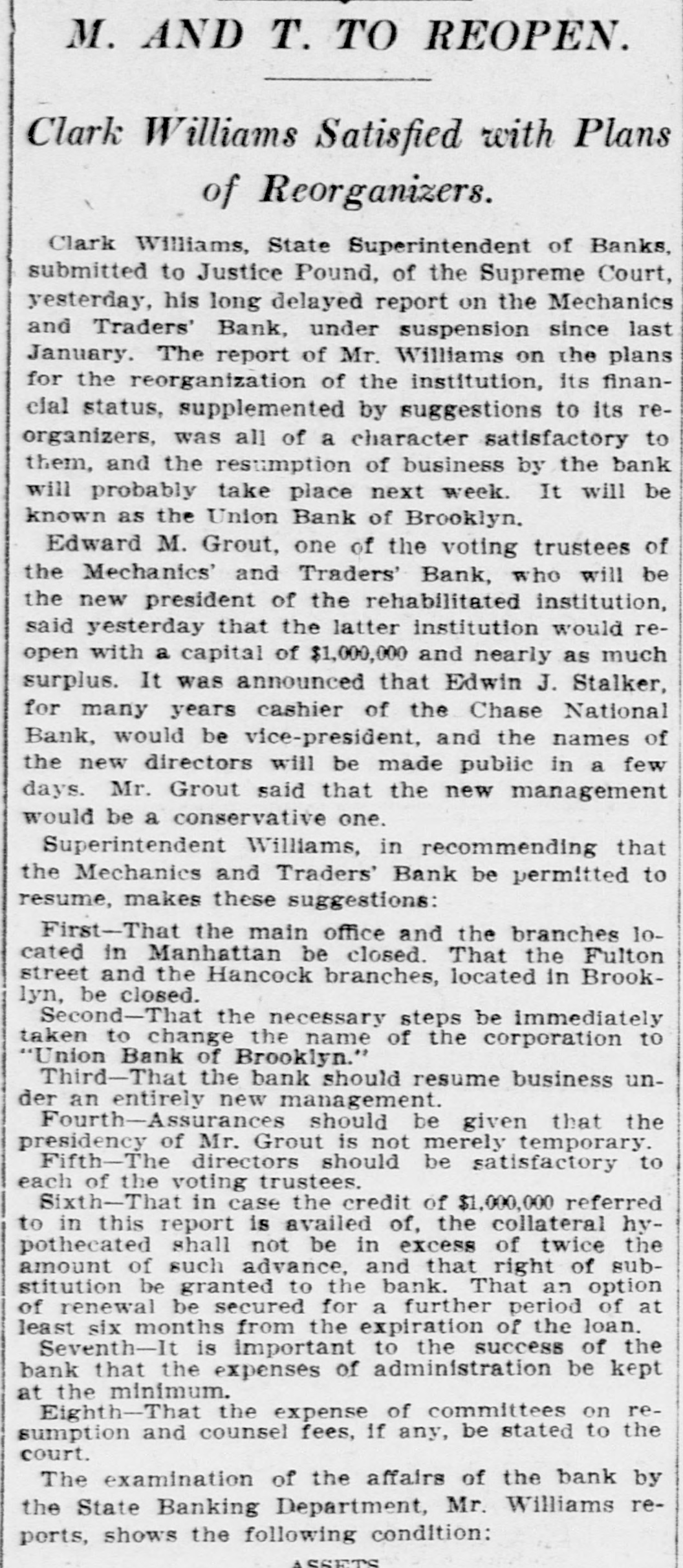
M. AND T. TO REOPEN. Clark Williams Satisfied with Plans of Reorganizers. Clark Williams, State Superintendent of Banks, submitted to Justice Pound, of the Supreme Court, yesterday, his long delayed report on the Mechanics and Traders' Bank, under suspension since last January. The report of Mr. Williams on the plans for the reorganization of the institution, its financial status, supplemented by suggestions to its reorganizers, was all of a character satisfactory to them, and the resumption of business by the bank will probably take place next week. It will be known as the Union Bank of Brooklyn. Edward M. Grout, one of the voting trustees of the Mechanics' and Traders' Bank, who will be the new president of the rehabilitated institution, said yesterday that the latter institution would reopen with a capital of $1,000,000 and nearly as much surplus. It was announced that Edwin J. Stalker, for many years cashier of the Chase National Bank, would be vice-president, and the names of the new directors will be made public in a few days. Mr. Grout said that the new management would be a conservative one. Superintendent Williams, in recommending that the Mechanics and Traders' Bank be permitted to resume, makes these suggestions: First-That the main office and the branches 10cated in Manhattan be closed. That the Fulton street and the Hancock branches, located in Brooklyn, be closed. Second-That the necessary steps be immediately taken to change the name of the corporation to "Union Bank of Brooklyn." Third-That the bank should resume business under an entirely new management. Fourth-Assurances should be given that the presidency of Mr. Grout is not merely temporary. Fifth-The directors should be satisfactory to each of the voting trustees. Sixth-That in case the credit of $1,000,000 referred to in this report is availed of, the collateral hypothecated shall not be in excess of twice the amount of such advance, and that right of substitution be granted to the bank. That an option of renewal be secured for a further period of at least six months from the expiration of the loan. Seventh-It is important to the success of the bank that the expenses of administration be kept at the minimum. Eighth-That the expense of committees on resumption and counsel fees, if any, be stated to the court. The examination of the affairs of the bank by the State Banking Department, Mr. Williams reports, shows the following condition: ASSETS


Article from New-York Tribune, August 5, 1908

Click image to open full size in new tab

Article Text

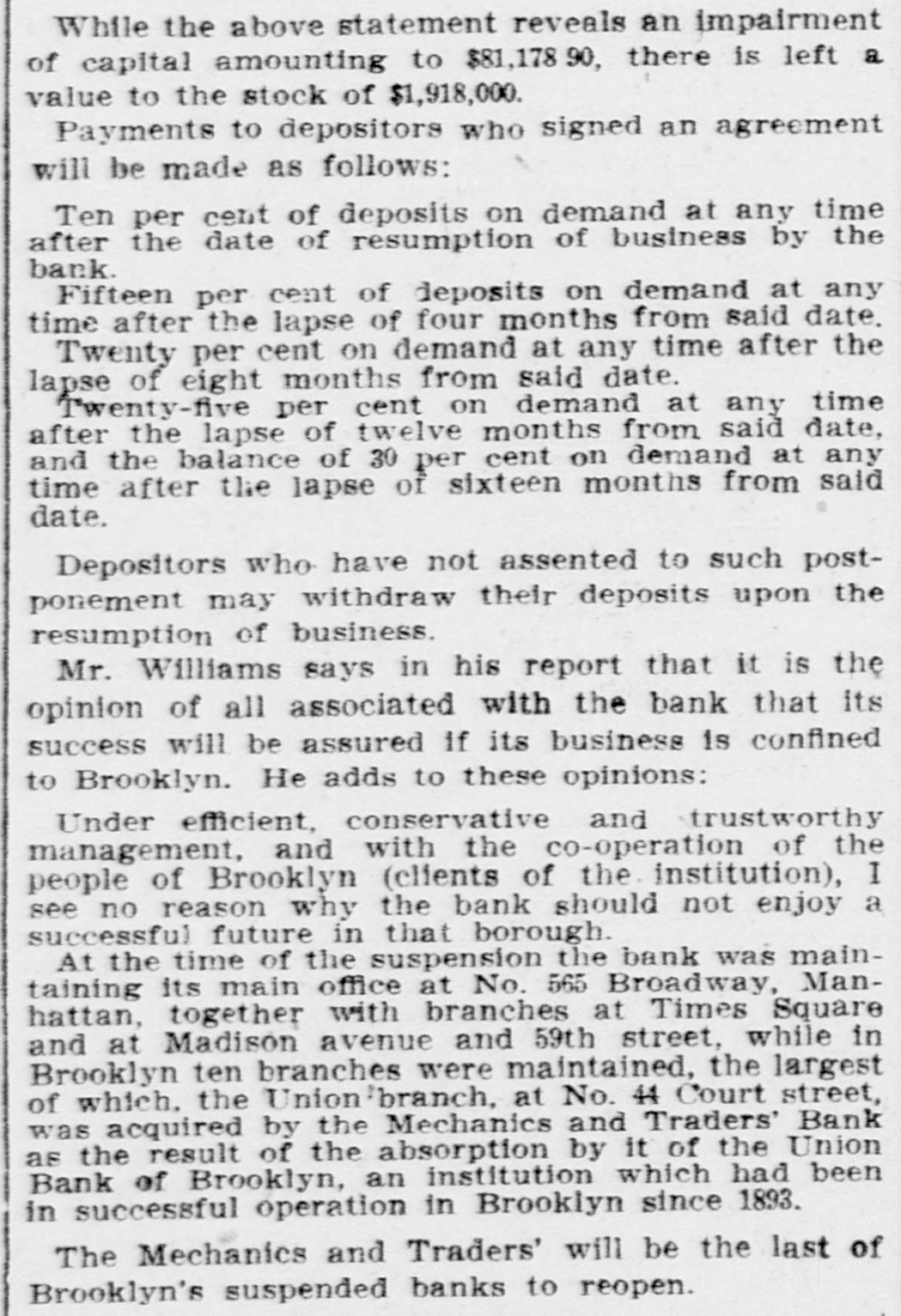
While the above statement reveals an impairment of capital amounting to $81,178 90, there is left a value to the stock of $1,918,000. Payments to depositors who signed an agreement will be made as follows: Ten per cent of deposits on demand at any time after the date of resumption of business by the bank. Fifteen per cent of deposits on demand at any time after the lapse of four months from said date. Twenty per cent on demand at any time after the lapse of eight months from said date. Twenty-five per cent on demand at any time after the lapse of twelve months from said date, and the balance of 30 per cent on demand at any time after the lapse of sixteen months from said date. Depositors who have not assented to such postponement may withdraw their deposits upon the resumption of business. Mr. Williams says in his report that it is the opinion of all associated with the bank that its success will be assured if its business is confined to Brooklyn. He adds to these opinions: Under efficient, conservative and trustworthy management, and with the co-operation of the people of Brooklyn (clients of the institution), I see no reason why the bank should not enjoy a successful future in that borough. At the time of the suspension the bank was maintaining its main office at No. 565 Broadway, Manhattan, together with branches at Times Square and at Madison avenue and 59th street, while in Brooklyn ten branches were maintained, the largest of which. the Union branch, at No. 44 Court street, was acquired by the Mechanics and Traders' Bank as the result of the absorption by it of the Union Bank of Brooklyn, an institution which had been in successful operation in Brooklyn since 1893. The Mechanics and Traders' will be the last of Brooklyn's suspended banks to reopen.


Article from New-York Tribune, August 7, 1908

Click image to open full size in new tab

Article Text

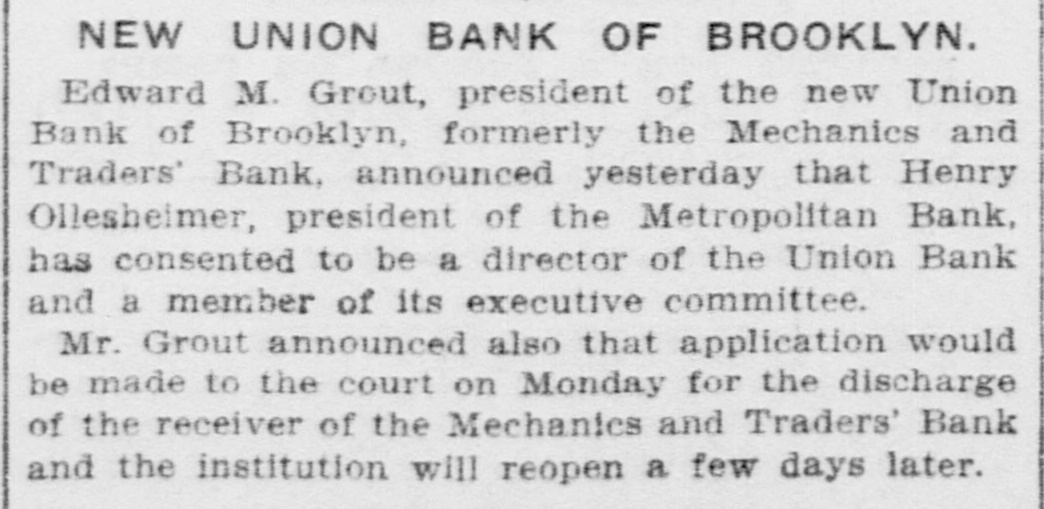
NEW UNION BANK OF BROOKLYN. Edward M. Grout, president of the new Union Bank of Brooklyn, formerly the Mechanics and Traders' Bank, announced yesterday that Henry Ollesheimer, president of the Metropolitan Bank, has consented to be a director of the Union Bank and a member of its executive committee. Mr. Grout announced also that application would be made to the court on Monday for the discharge of the receiver of the Mechanics and Traders' Bank and the institution will reopen a few days later.


Article from New-York Tribune, August 11, 1908

Click image to open full size in new tab

Article Text

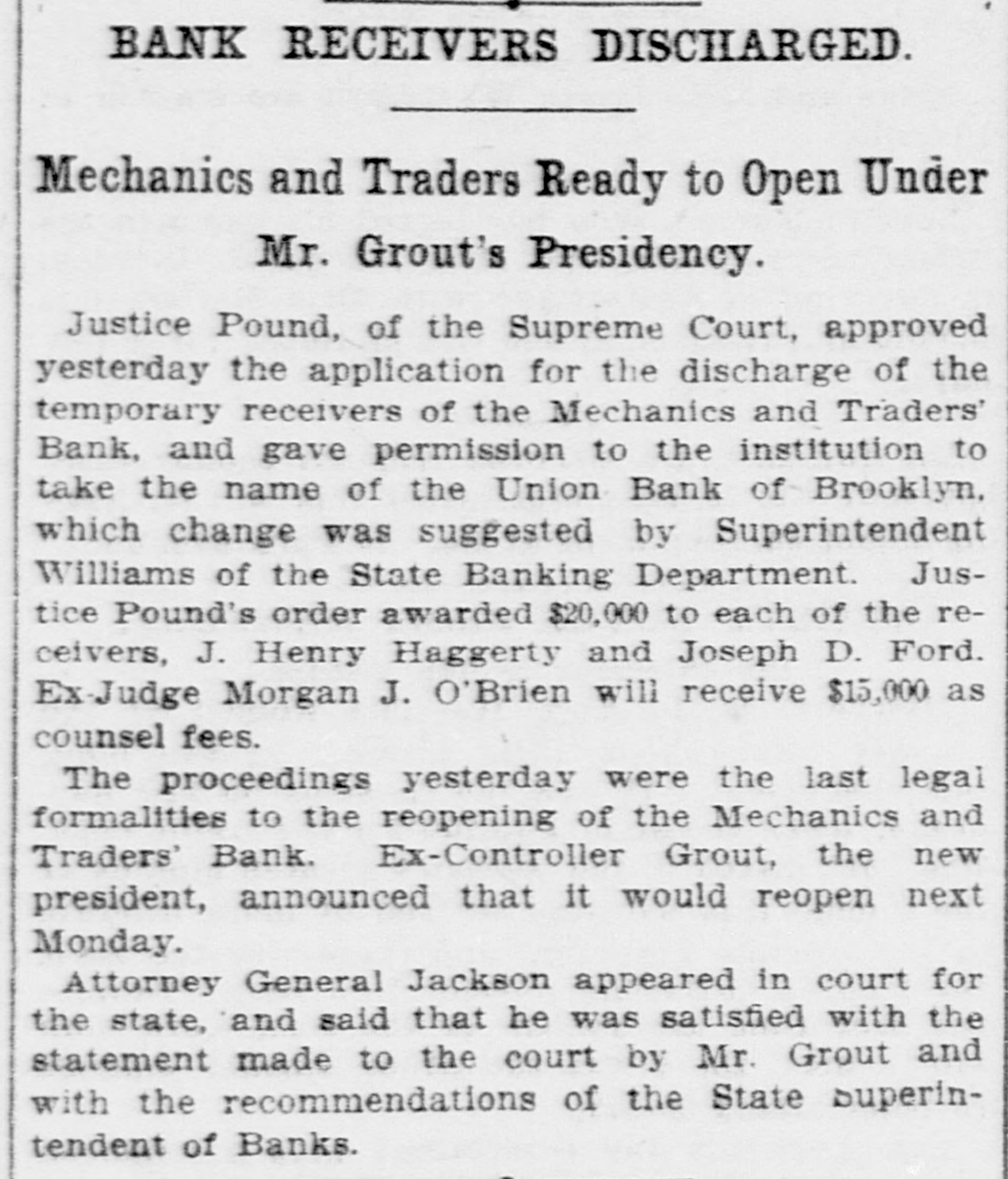
BANK RECEIVERS DISCHARGED. Mechanics and Traders Ready to Open Under Mr. Grout's Presidency. Justice Pound, of the Supreme Court, approved yesterday the application for the discharge of the temporary receivers of the Mechanics and Traders' Bank, and gave permission to the institution to take the name of the Union Bank of Brooklyn. which change was suggested by Superintendent Williams of the State Banking Department. Justice Pound's order awarded $20,000 to each of the receivers, J. Henry Haggerty and Joseph D. Ford. Ex-Judge Morgan J. O'Brien will receive $15,000 as counsel fees. The proceedings yesterday were the last legal formalities to the reopening of the Mechanics and Traders' Bank. Ex-Controller Grout, the new president, announced that it would reopen next Monday. Attorney General Jackson appeared in court for the state, and said that he was satisfied with the statement made to the court by Mr. Grout and with the recommendations of the State Superintendent of Banks.


Article from New-York Tribune, August 12, 1908

Click image to open full size in new tab

Article Text

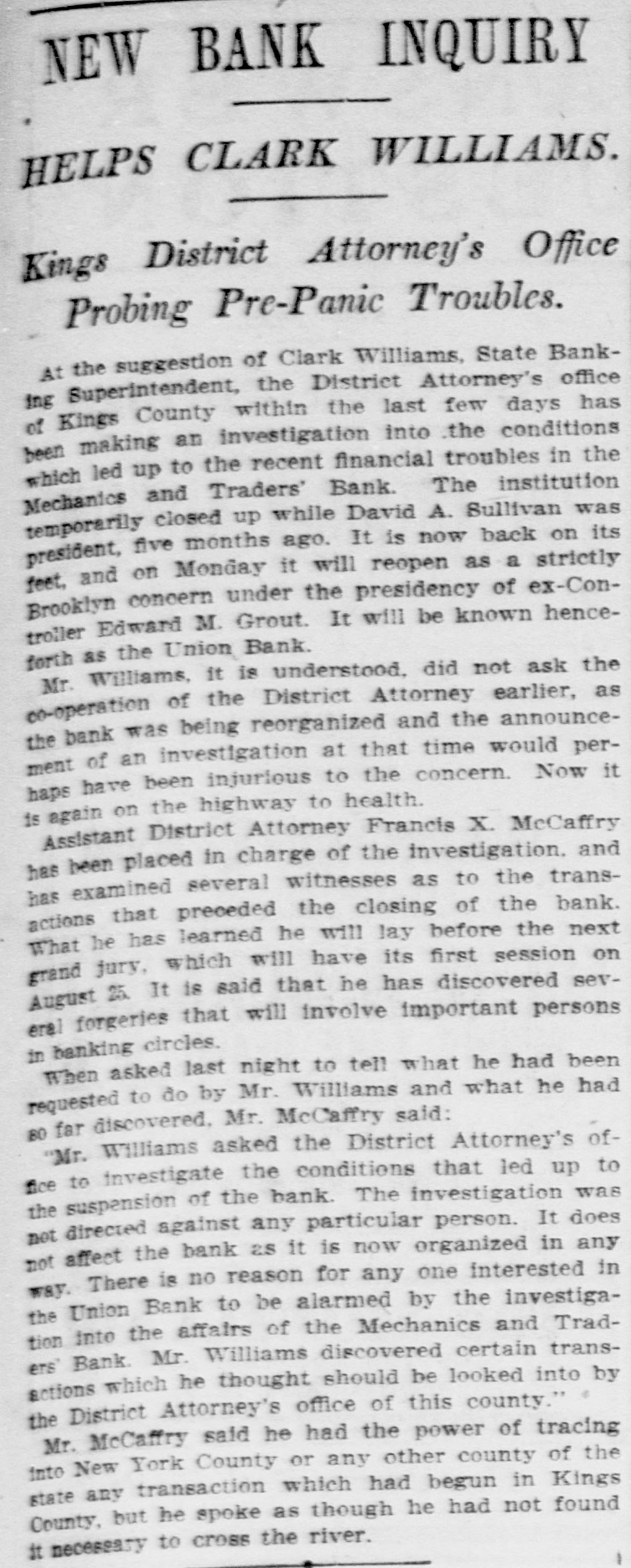
NEW BANK INQUIRY HELPS CLARK WILLIAMS. Kings District Attorney's Office Probing Pre-Panic Troubles. At the suggestion of Clark Williams, State Banking Superintendent, the District Attorney's office of Kings County within the last few days has been making an investigation into the conditions which led up to the recent financial troubles in the Mechanics and Traders' Bank. The institution temporarily closed up while David A. Sullivan was president, five months ago. It is now back on its feet, and on Monday it will reopen as a strictly Brooklyn concern under the presidency of ex-Controller Edward M. Grout. It will be known henceforth as the Union Bank. Mr. Williams, it is understood, did not ask the co-operation of the District Attorney earlier, as the bank was being reorganized and the announcement of an investigation at that time would perhaps have been injurious to the concern. Now it is again on the highway to health. Assistant District Attorney Francis X. McCaffry has been placed in charge of the investigation. and has examined several witnesses as to the transactions that preceded the closing of the bank. What he has learned he will lay before the next grand jury, which will have its first session on August 25. It is said that he has discovered several forgeries that will involve important persons in banking circles. When asked last night to tell what he had been requested to do by Mr. Williams and what he had 80 far discovered, Mr. McCaffry said: "Mr. Williams asked the District Attorney's office to investigate the conditions that led up to the suspension of the bank. The investigation was not directed against any particular person. It does not affect the bank 2S it is now organized in any way. There is no reason for any one interested in the Union Bank to be alarmed by the investigation into the affairs of the Mechanics and Traders Bank Mr. Williams discovered certain transactions which he thought should be looked into by the District Attorney's office of this county." Mr. McCaffry said he had the power of tracing into New York County or any other county of the state any transaction which had begun in Kings County, but he spoke as though he had not found It necessary to cross the river.


Article from The Morning Journal-Courier, August 18, 1908

Click image to open full size in new tab

Article Text

$1,000,000 FOR UNION BANK. Suspended Institution Reopens Under New Management. New York. Aug. 17.-The Mechanics' and Traders' bank, which closed its doors on January 29, reopened for business today. The bank resumed operations with a capital of $1,000,000 and a surplus of $800,000 above all liabilities. The resources, consisting of cash in vaults and on deposit in other banks, amount to about 50 per cent. of the total deposit of about $3,000,000. As soon as legal steps can be completed, the name of the bank will be changed to the Union bank of Brooklyn. Edward M. Grout, ex-comptroller of New York city, is the president.


Article from New-York Tribune, August 26, 1908

Click image to open full size in new tab

Article Text

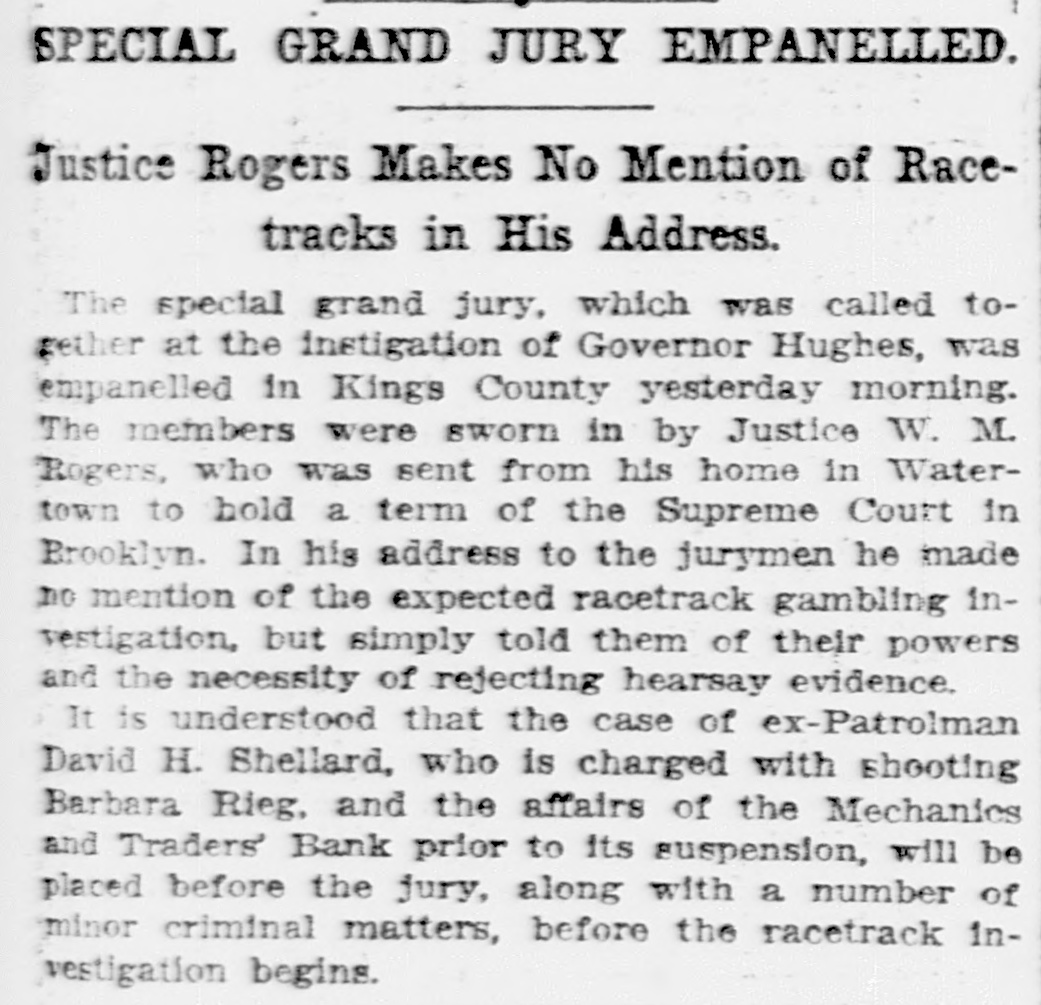
SPECIAL GRAND JURY EMPANELLED. Justice Rogers Makes No Mention of Racetracks in His Address. The special grand jury, which was called together at the instigation of Governor Hughes, was empanelled in Kings County yesterday morning. The members were sworn in by Justice W. M. Rogers, who was sent from his home in Watertown to hold a term of the Supreme Court in Brooklyn. In his address to the jurymen he made no mention of the expected racetrack gambling investigation, but simply told them of their powers and the necessity of rejecting hearsay evidence. It is understood that the case of ex-Patrolman David H. Shellard, who is charged with shooting Barbara Rieg, and the affairs of the Mechanics and Traders' Bank prior to its suspension, will be placed before the jury, along with a number of minor criminal matters, before the racetrack investigation begins.


Article from Bisbee Daily Review, October 24, 1908

Click image to open full size in new tab

Article Text

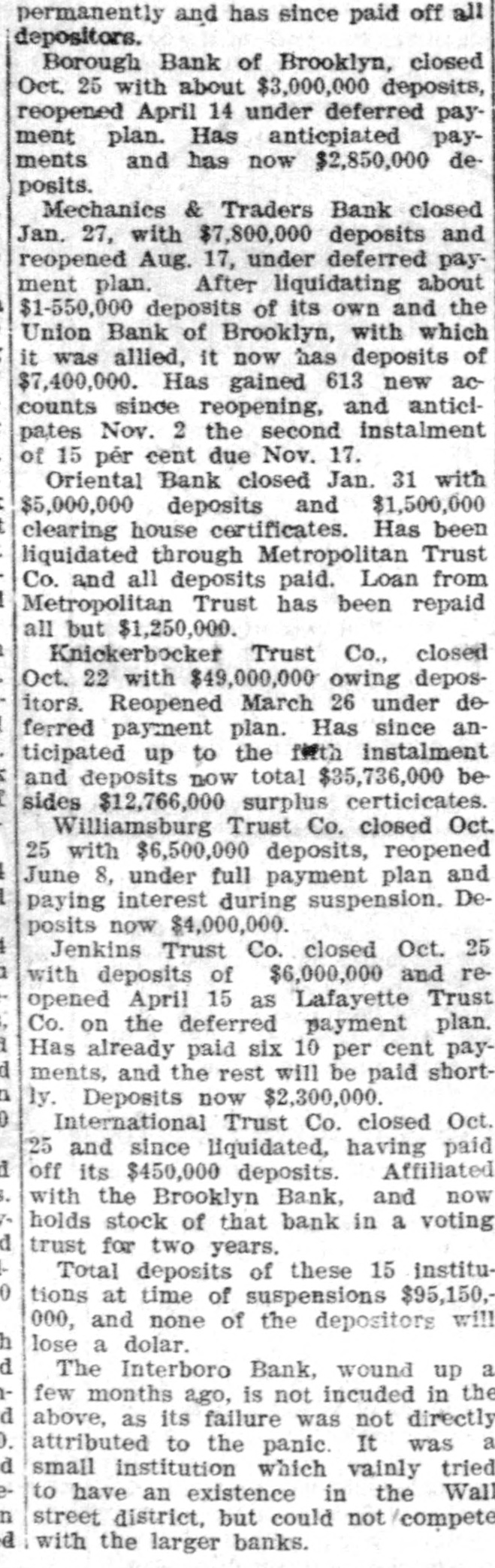
permanently and has since paid off all depositors. Borough Bank of Brooklyn, closed Oct. 25 with about $3,000,000 deposits, reopened April 14 under deferred payment plan. Has anticpiated payments and has now $2,850,000 deposits. Mechanics & Traders Bank closed Jan. 27, with $7,800,000 deposits and reopened Aug. 17, under deferred payment plan. After liquidating about $1-550,000 deposits of its own and the Union Bank of Brooklyn, with which it was allied, it now has deposits of $7,400,000. Has gained 613 new accounts since reopening, and anticlpates Nov. 2 the second instalment of 15 pér cent due Nov. 17. Oriental Bank closed Jan. 31 with $5,000,000 deposits and $1,500,000 clearing house certificates. Has been liquidated through Metropolitan Trust Co. and all deposits paid. Loan from Metropolitan Trust has been repaid all but $1,250,000. Knickerbocker Trust Co., closed Oct. 22 with $49,000,000 owing depositors. Reopened March 26 under deferred payment plan. Has since anticipated up to the fifth instalment and deposits now total $35,736,000 besides $12,766,000 surplus certicicates. Williamsburg Trust Co. closed Oct. 25 with $6,500,000 deposits, reopened June 8, under full payment plan and paying interest during suspension. Deposits now $4,000,000. Jenkins Trust Co. closed Oct. 25 with deposits of $6,000,000 and reopened April 15 as Lafayette Trust Co. on the deferred payment plan. Has already paid six 10 per cent payments, and the rest will be paid shortly. Deposits now $2,300,000. International Trust Co. closed Oct. 25 and since liquidated, having paid off its $450,000 deposits. Affiliated with the Brooklyn Bank, and now holds stock of that bank in a voting d trust for two years. Total deposits of these 15 institutions at time of suspensions $95,150,000, and none of the depositors will lose a dolar. d The Interboro Bank, wound up a few months ago, is not incuded in the d above, as its failure was not directly attributed to the panic. It was a d small institution which vainly tried to have an existence in the Wall n street district, but could not /compete d with the larger banks.


Article from New-York Tribune, April 6, 1910

Click image to open full size in new tab

Article Text

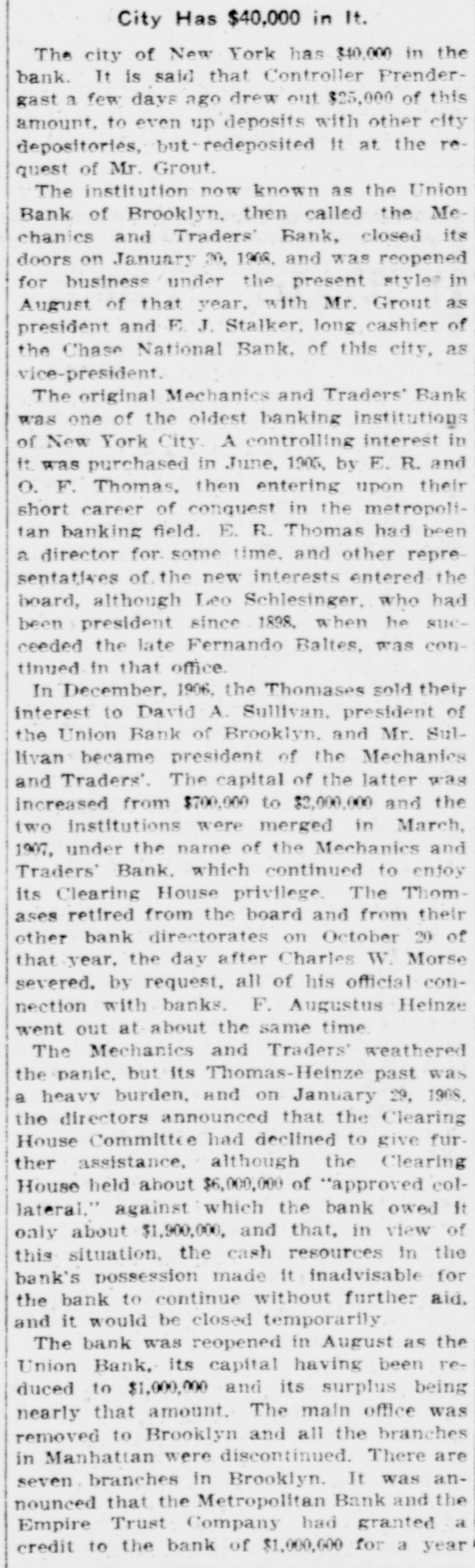
City Has $40,000 in It. The city of New York has $40,000 in the bank. It is said that Controller Prendergast a few days ago drew out $25,000 of this amount, to even up deposits with other city depositories, but-redeposited It at the request of Mr. Grout. The institution now known as the Union Bank of Brooklyn, then called the Mechanics and Traders' Bank, closed its doors on January 20, 1908, and was reopened for business under the present style in August of that year, with Mr. Grout as president and E. J. Stalker. long cashier of the Chase National Bank, of this city, as vice-president. The original Mechanics and Traders' Bank was one of the oldest banking institutions of New York City. A controlling interest in It. was purchased in June, 1905, by E. R. and O. F. Thomas, then entering upon their short career of conquest in the metropolitan banking field. E. R. Thomas had been a director for some time, and other representatives of the new interests entered the board, although Leo Schlesinger. who had been president since 1898, when he succeeded the late Fernando Baltes, was continued in that office. In December, 1906, the Thomases sold their interest to David A. Sullivan, president of the Union Bank of Brooklyn. and Mr. Sullivan became president of the Mechanics and Traders'. The capital of the latter was increased from $700,000 to $2,000,000 and the two Institutions were merged in March, 1907, under the name of the Mechanics and Traders' Bank. which continued to enjoy its Clearing House privilege. The Thomases retired from the board and from their other bank directorates on October 20 of that year, the day after Charles W. Morse severed. by request, all of his official connection with banks. F. Augustus Heinze went out at about the same time. The Mechanics and Traders' weathered the panic, but its Thomas-Heinze past was a heavy burden, and on January 29, 1908, the directors announced that the Clearing House Committee had declined to give further assistance, although the Clearing House held about $6,000,000 of "approved collateral." against which the bank owed It only about $1,900,000, and that, in view of this situation, the cash resources in the bank's possession made it inadvisable for the bank to continue without further aid, and it would be closed temporarily The bank was reopened in August as the Union Bank, its capital having been reduced to $1,000,000 and its surplus being nearly that amount. The main office was removed to Brooklyn and all the branches in Manhattan were discontinued. There are seven branches in Brooklyn. It was announced that the Metropolitan Bank and the Empire Trust Company had granted a credit to the bank of $1,000,000 for a year


Article from The Sun, May 17, 1911

Click image to open full size in new tab

Article Text

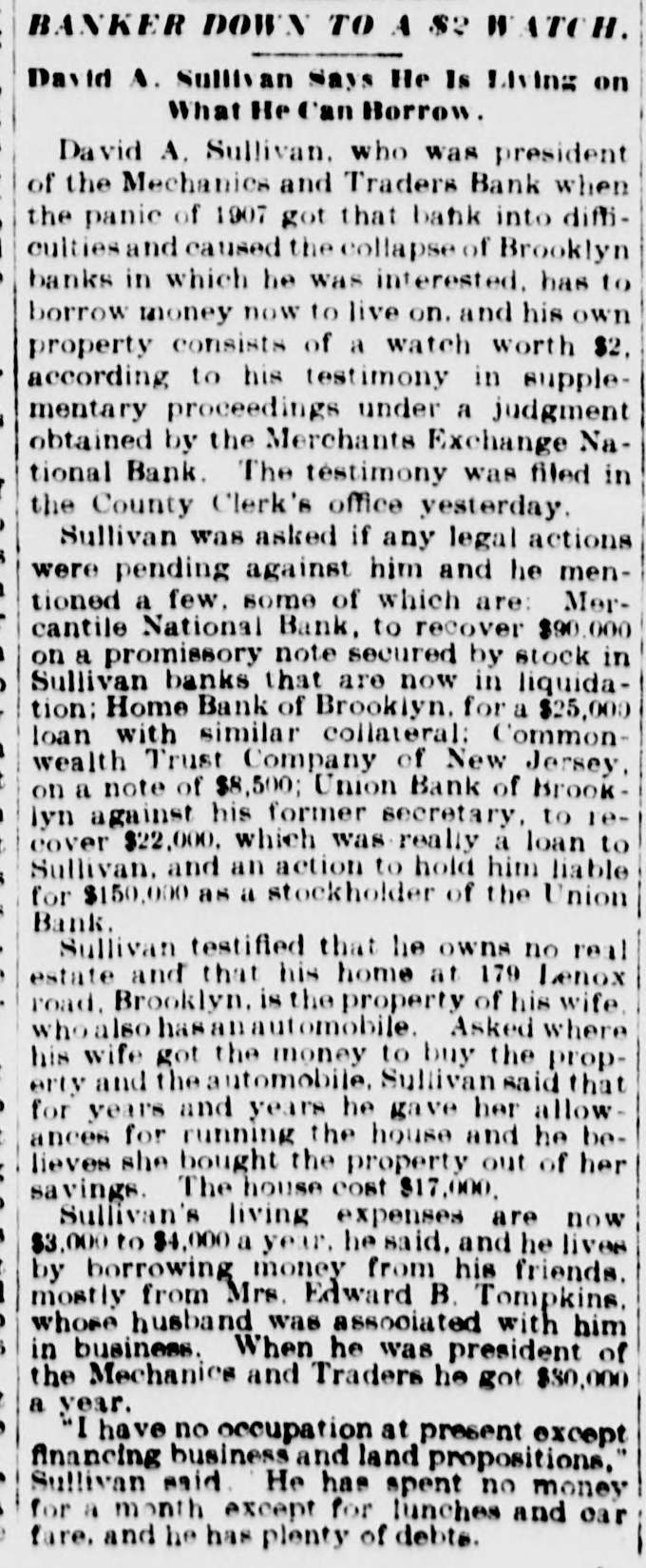
BANKER DOWN TO A $2 " ATCH. David A. Sullivan says He Is Living on What He Can Borrow. David A. Sullivan. who was president of the Mechanics and Traders Bank when the panic of 1907 got that bank into difficuities and caused the collapse of Brooklyn banks in which he was interested, has to borrow money now to live on. and his own property consists of a watch worth $2. according to his testimony in supplementary proceedings under a judgment obtained by the Merchants Exchange National Bank. The testimony was filed in the County Clerk's office yesterday. Sullivan was asked if any legal actions were pending against him and he mentioned a few. some of which are: Mercantile National Bank, to recover $90.000 on a promissory note secured by stock in Sullivan banks that are now in liquidation: Home Bank of Brooklyn. for a $25,000 loan with similar collateral: Commonwealth Trust Company of New Jersey, on a note of $8,500; Union Bank of Brooklyn against his former secretary, to recover $22,000. which was really a loan to Sullivan. and an action to hold him liable for $150,000 as a stockholder of the Union Bank. Sullivan testified that he owns no real estate and that his home at 179 Lenox road. Brooklyn, is the property of his wife. who also hasanautomobile. Asked where his wife got the money to buy the property and the automobile, Sullivan said that for years and years he gave her allowances for running the house and he believes she bought the property out of her savings. The house cost $17,000. Sullivan's living expenses are now $3.000 to $4,000 a year. he said. and he lives by borrowing money from his friends. mostly from Mrs. Edward B. Tompkins. whose husband was associated with him in business. When he was president of the Mechanics and Traders he got $30,000 a year. "I have no occupation at present except financing business and land propositions. Sullivan said. He has spent no money for a month except for lunches and car fare. and he has plenty of debte.


Article from Newark Evening Star and Newark Advertiser, May 17, 1911

Click image to open full size in new tab

Article Text

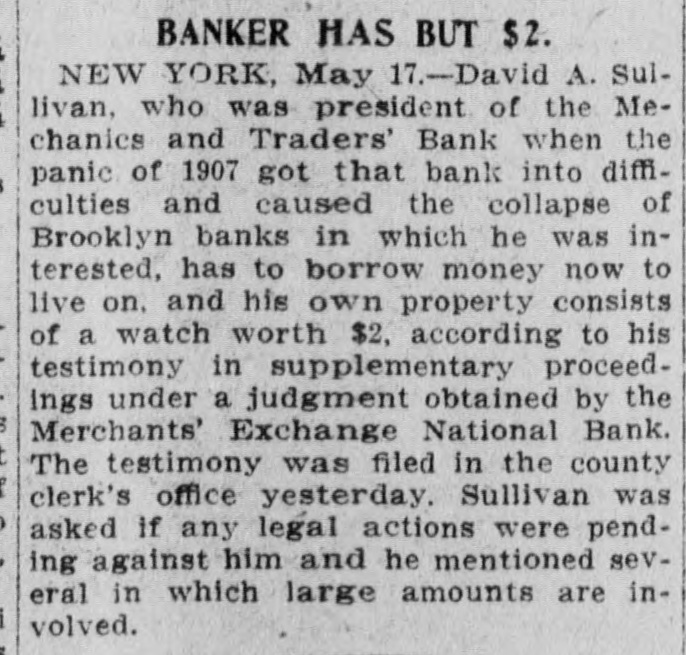
BANKER HAS BUT $2. NEW YORK, May 17.-David A. Sullivan, who was president of the Mechanics and Traders' Bank when the panic of 1907 got that bank into difficulties and caused the collapse of Brooklyn banks in which he was interested, has to borrow money now to live on, and his own property consists of a watch worth $2, according to his testimony in supplementary proceedings under a judgment obtained by the Merchants' Exchange National Bank. The testimony was filed in the county clerk's office yesterday. Sullivan was asked if any legal actions were pending against him and he mentioned several in which large amounts are involved.


Article from New-York Tribune, June 20, 1911

Click image to open full size in new tab

Article Text

RESENTS VAN TUYL 'S PLAN Union Bank Liquidator Doubtful About Dividend for Depositors. WOULD PAY DEBTS FIRST Edward M. Grout Explains Why Own Stock Is Security for Its Some Loans by Institution. the deputy in charge of of the Union Bank for the state Banking DepartRooklyn took it with rather ill grace yesterment, State Superintendent Van Tuyl that it time for the depositors of the dought get a dividend and planned to wak to the stockholders in order to raise for the depositors. me)- bank has not been closed a very This he said, "only fourteen months. time," banks are four or five years in idation lime Of course, I don't know how the depositors can expect a dividend. on depends a great deal on the real estate in Brooklyn. The bills payable acmarket also has nearly $400,000 remaining to settled, munt and we will have to settle that account before the depositors can get any money. Dodge offered an explanation of why Mr. large sums had been paid out by the with bank before any attempt was made to raise dividend for the depositors. When the Union Bank failed." he said. " owed between $2,000,000 and $3,000,000 to banks and trust companies. from which when it had borrowed money. All the wady assets had been given as collateral these loans. They were not preferred tebes, but the banks holding the collateral withe right to sell It to reimburse themelves for their loans. and it was necesany for us to pay the money back in inder to save the collateral. and so save money of the depositors and pay them dividend We have paid off about 1,000,000 of these debts, and have a little than $400,000 still to pay. After they paid we will try to get the money for dividend for the depositors." Grout Ready to Explain. Mr. Dodge refused to comment on the tems on the schedule of assets and liabiliof the bank showing the bank's own will as security for various large loans. ward M. Grout, the president of the uk. however, was glad to explain these ems. The law does not allow a bank to loan money on its own stock." said Mr. Grout, but when it has a loan on its books it say take any security it can lay its hands to make that loan good. That was the 188 with the loans on the books of the Union Bank secured by the stock of the tank. When Clark Williams turned the bank orer me in 1908 he had already called on several of the creditors to put up security for their loans. and in several cases had found It necessary to take stock of the hand itself for the security. When I came Thad to do the same thing The William Strasser loan of $33,000 is € example Strasser was a director of the bank. and the loan appears on the looks under date of March 13. 1909. This in reality a renewal note, and it is seund by stock of the Union Bank because called on him for security, and all he could give was the Union Bank stock. It what you might call salvage. We had take what we could get. This loan. like many others. was a holdin from the Mechanics and Traders' Bank. In some cases the Union Bank nck held as security is simply a reissue of Thanics and Traders' stock. The Menics and Traders Bank took its own as security for loans, and when the ank was reopened as the Union Bank the failure in 1908 the loans were reewed, but the stock held as security was issued as Union Bank stock. Why Stock Was Security. The Thomas D Tompkins loan of $73,000 an example of this. That loan was made the Mechanics and Traders' Bank. When took charge in 1908 the loan was carried long and the security was reissued as Inion Bank stock. "The loan of $33,000 to be estate of E. B. Tompkins in February a renewal loan of one carried over from the Mechanics and Traders' Bank. the same thing is true of the loans to times N Brown. A loan of $3,500 appears him under date of April 4, 1910, one month before the bank closed. That was a newal of an old loan made by the Meinnics and Traders'. The real estate security is practically all therited from the Mechanics and Traders did not make a loan on real estate acurity while I was president of the bank. did take real estate as security for time of the old loans when we could get collateral. It was a case of take what We could get We would call on debtor for security for his loan, and if he 4d nothing else we would have to take fall estate But we did not make a new anon real estate. The Heinze and Thomas loans are inwrited from the Mechanics and Traders' course. The Heinze loans will be paid, Bink. I think the collateral will make M. Thomas put $200,000 in trust when bank closed and agreed to put $100,000 year with it each year until the loans Tere paid. I think his loans will be paid WASS he dies. The trouble with us was what we inbedted from the Mechanics and Traders' Dodge said to me the other day that he sympathize with our troubles, as in wying to liquidate the bank he was runagagainst the same thing that we had to atruggle with in trying to keep the bank


Article from New-York Tribune, August 16, 1911

Click image to open full size in new tab

Article Text

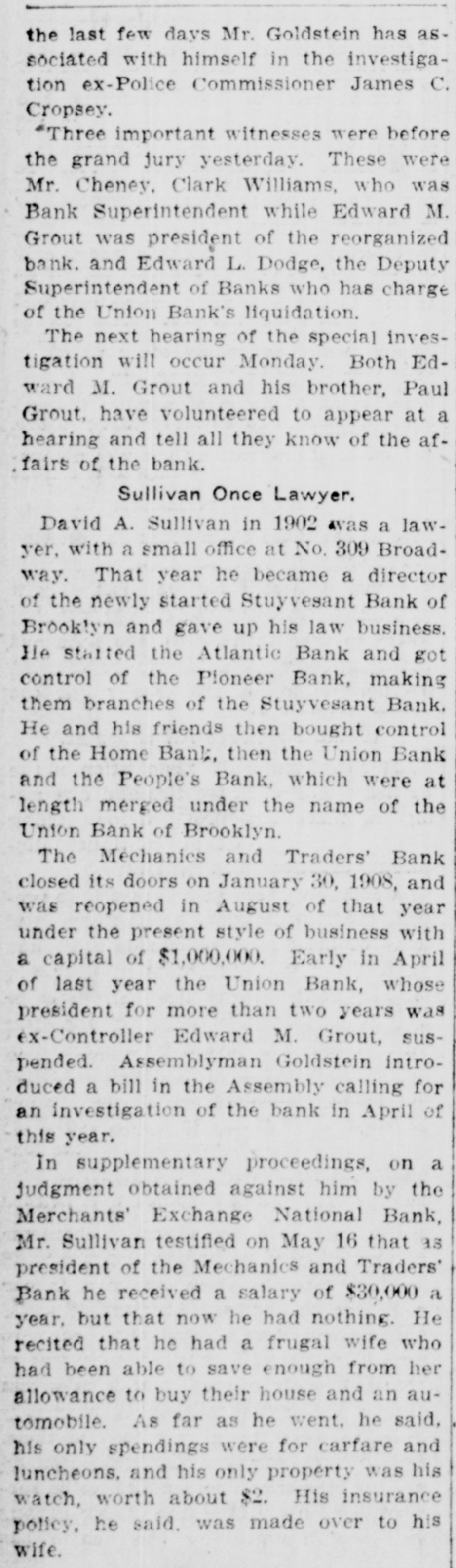
the last few days Mr. Goldstein has associated with himself in the investigation ex-Police Commissioner James C. Cropsey. "Three important witnesses were before the grand jury yesterday. These were Mr. Cheney, Clark Williams, who was Bank Superintendent while Edward M. Grout was president of the reorganized bank. and Edward L. Dodge, the Deputy Superintendent of Banks who has charge of the Union Bank's liquidation. The next hearing of the special investigation will occur Monday. Both Edward M. Grout and his brother, Paul Grout, have volunteered to appear at a hearing and tell all they know of the affairs of the bank. Sullivan Once Lawyer. David A. Sullivan in 1902 was a lawyer, with a small office at No. 309 Broadway. That year he became a director of the newly started Stuyvesant Bank of Brooklyn and gave up his law business. He started the Atlantic Bank and got control of the Pioneer Bank, making them branches of the Stuyvesant Bank. He and his friends then bought control of the Home Bank, then the Union Bank and the People's Bank, which were at length merged under the name of the Union Bank of Brooklyn. The Méchanics and Traders' Bank closed its doors on January 30, 1908, and was reopened in August of that year under the present style of business with a capital of $1,000,000. Early in April of last year the Union Bank, whose president for more than two years was ex-Controller Edward M. Grout, suspended. Assemblyman Goldstein introduced a bill in the Assembly calling for an investigation of the bank in April of this year. In supplementary proceedings, on a judgment obtained against him by the Merchants' Exchange National Bank, Mr. Sullivan testified on May 16 that as president of the Mechanics and Traders' Bank he received a salary of $30,000 a year, but that now he had nothing. He recited that he had a frugal wife who had been able to save enough from her allowance to buy their house and an automobile. As far as he went, he said, his only spendings were for carfare and luncheons, and his only property was his watch, worth about $2. His insurance policy, he said. was made over to his wife.