Article Text
# THE NATIONAL TRIBUNE: WASHINGTON, D. C. THURSDAY, SEPTEMBER 22, 1892.-TWELVE PAGES.
of the stomach, and that this fact has been known to the President's friends for some time, but has not been talked about. The physicians continue to treat her for nervous prostration, but she has continued to gradually decline, and has frequently given evidence of suffering great physical pain. Various diag- noses of her case have been made by those not in attendance upon her, but the attending physicians repudiate all volunteer suggestions and hold fast to the idea of nervous prostration.
Nathan Sprague, a well-known colored man of Washington, who is connected editorially with the Pilot, a paper devoted to the interests of the colored race, and also runs a real estate office, was arrested last week on a charge of embezzlement. The charge was brought by a colored woman of Baltimore, who claims that Sprague failed to invest money sent him, and also failed to make improvements upon her property with money furnished for that pur- pose. Sprague is a son-in-law of Hon. Frederick Douglass, and has been quite prominent as a colored leader in Washington for several years.
John Sheppach, the young man who was mysteriously stabbed on the night of Sept. 3, is dying of his wounds, and the Assistant Dis- trict Attorney went to his room on Saturday, Sept. 17, to take his dying statement of the affair. The man, however, declared he did not remember anything about the matter, and did not know who cut him. Despite the closest questioning Sheppach could throw little, if any, light upon the affair, which is shrouded in mystery. The young man had been drinking heavily, got into an altercation with an un- known man, whom he struck, with the result that he will lose his life.
In a very short time a corps of engineers will be placed on the route of the proposed boulevard between Washington and Baltimore. The company who propose to connect the cities by an electric railway has a right to use the old turnpike between here and Baltimore should it so desire, but it is said the pike route will not be strictly followed in constructing the boulevard, as owing to the heavy grades in this route it may be necessary to diverge at many points. The engineers will select the location for these changes. Some of the work will be done this Winter, it is expected, but opera- tions will not be commenced in full until next Spring.
Director-General Davis, of the World's Co- lumbian Exposition, has submitted to Director of the Mint Leech a set of designs for the sil- ver half-dollar piece that will be coined and issued in commemoration of the World's Fair at Chicago. On Friday, Sept. 16, Director Leech telegraphed Engraver Barber, of the Philadelphia Mint, to come to Washington at once to consult with him respecting the merit of the various designs which have been sub- mitted, as he intends to get to work upon these souvenirs as soon as possible.
A short time ago the house of a wealthy gentleman of Baltimore was entered and robbed. Detectives were placed on the case, and soon learned that the work was done by Washington thieves, and the police force of this city were asked to help. On Friday, Sept. 16, one of the Washington detectives located the man and the goods, and a search warrant was obtained, and the house of a colored woman named Wilson, who lives in Goat Alley, was entered. Silver- ware, silk robes, dresses and shawls, brie-a-brac, two trunks full of valuable evening toilets, and two sachels of men's clothing, silk blankets, fine linen, and even valuable oil paintings and steel engravings were found. It took a large express wagon to remove the plunder. A clock valued at $125, which had been pawned by the thief, a colored man named Diggs, was also found in a pawnshop on New York avenue. The goods were removed to Baltimore, and the burglar turned over to the authorities of that city.
The celebrated case of Howard Schneider, who was convicted of murdering his wife and brother-in-law, Frank Hamlink, was revived last week when the bill of exceptions of the defense was presented to the court. Schnei- der's counsel, Hon. Jere Wilson and Mr. Hoehling, have devoted a great deal of labor during the Summer to the elaboration of their bill of exceptions to Judge Bradley's rulings during the 32 days which the trial lasted last Spring. The document as presented to Judge Bradley, after having been examined by Dis- trict Attorney Cole, made over 200 pages of typewritten manuscript, foolscap size. The main points which the document covers were dealt with in the motion for a new trial which was made by the defense last April. Errors in overruling the motion to quash the indictment, and the motion to postpone the trial on account of public sentiment against the prisoner are urged. The incompetency of Jurors Robert H. Gray, William F. Lewis, and William E. Hayes, on account of prejudice against the prisoner, is asserted. The admission of Mrs. Schneider's dying declaration, and of Dr. Schaeffer's expert testimony in regard to the shooting is objected to. When the bill of ex-
Krag-Jorgensen No. 5 rifle, which is said to arms presented, and is recommended as a suit- able and satisfactory weapon for the United States military service. The report states that "the examination developed the fact that this country was far behind all other Nations in the adoption of a modern type of small-caliber, high-velocity magazine gun, and was suffering in military reputation therefrom." But the War Department will now, as it has always done, receive, examine, and test new inven- tions and new arms, and aid inventors in per- fecting them, and if a better arm should be found than the Krag-Jorgensen gun, which the Board has recommended, it will be submitted to a new Board for trial.
From now on through the Winter the hotels of Washington will be teeming with blushing couples who are stamped "bride and groom" in every fold of the palpably-new clothes, in the very shiny plain gold ring and high hat, and in the air of happiness that lingers over the newly wed like a glorious harvest moon in a Summer sky. There is no use in their trying to appear as though the 10th mile-post in their journey together had been passed, for they can no more help the little glances that reveal so much to outsiders, the surreptitious holding of hands when the elevator boy's back is turned, or the air of solicitude with which they in- quire whether the other will have sugar in the coffee or take just a tiny bit of steak than they require whether the other will have sugar in the coffee or take just a tiny bit of steak than they do. It is a part of every honey- moon, and even though they were to wear old clothes with gloves worn at the fingers or shoes patched on the sole, there would still re- main that lingering tenderness that tells the whole story. Even if a man were to try and order to deceive outsiders, his expression would reveal the fact he so much desired to conceal, for eyes will tell the truth though lips are able to falsify. After all, this display of affection is not a subject for ridicule. It is genuine; it is the truest time, and the honeymoon is a period that lives in memory in the after years when the romance has been superseded by the reality, and the rushing torrent of young love has quieted down into the tideless stream of mature affection.
Mr. Frank Hume, one of the Committee on the Entertainment Fund, published a card in the daily papers last week pro- testing against the lack of patriotism on the part of the city authorities with regard to the lighting of that part of Pennsylvania avenue between Sixth street and the Capitol Grounds. Mr. Hume's protest, we are sorry to say, was well founded. He himself has been one of the most active and efficient members of the Enter- tainment Fund Committee, and is one of our most prominent business men. He visited was the 16th Miss., and he "surrendered his regiment at Appomattox.
The fact that the line of street cars on Penn- sylvania avenue and Fourteenth street have been changed from horses to cable to accommodate the crowds at the Encampment, makes acci- dents frequent because of the newness of the road to the new order of things, and it will be a special dispensation of Divine Providence if some of the veterans who come to the city at this time are not killed or in- jured. On Wednesday, Sept. 14, through the carelessness of the switchman at the junction of New York avenue and Fifteenth street (the place on the line), a passenger was dangerously injured by the lever of the grip striking him on the head, as the grip had hold of the avenue cable while the switchman had the switch turned so that the car ran out. Visitors should remember to always stand on the side of the parallel streets opposite from which the cars are com- ing, as they will not stop to take or let off passengers until they have crossed the parallel streets.
For some days it has been rumored that United States Minister to Italy Porter had tend- ered his resignation. When Secretary of State John W. Foster was asked about the matter last week he said he had not been officially ad- vised of the resignation, that it had not yet reached the Department, but that it might be other than this Secretary Fos- ter had nothing to say on the subject.
Postmaster-General Wanamaker last week opened a number of proposals of inventors or owners of pneumatic tubes, under the act of July 13, 1892, which authorized him "to examine into the subject of a more rapid transit of mail matter between large cities and postoffices, stations, and terminals located in large cities by means of pneumatic tubes or other systems, with the view of ascertaining the cost and advantages of the same." After the bids had been opened and read Postmaster-General Wanamaker an- nounced that he would appoint Second As- sistant Postmaster-General Bell, Third Assist- ant Postmaster-General Hazen, and Mr. May- nard, of the Inspection Division, a committee with authority to employ an expert to exam- ine and report upon the merits of the several systems submitted.
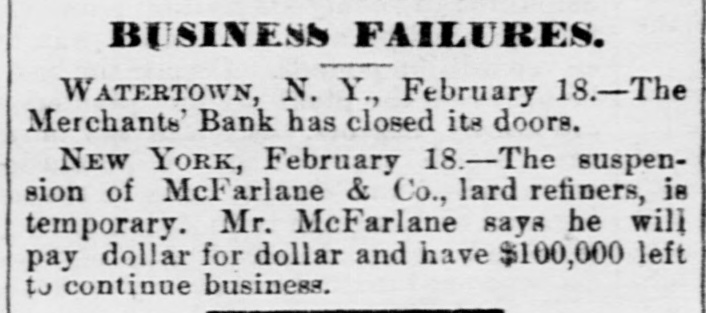
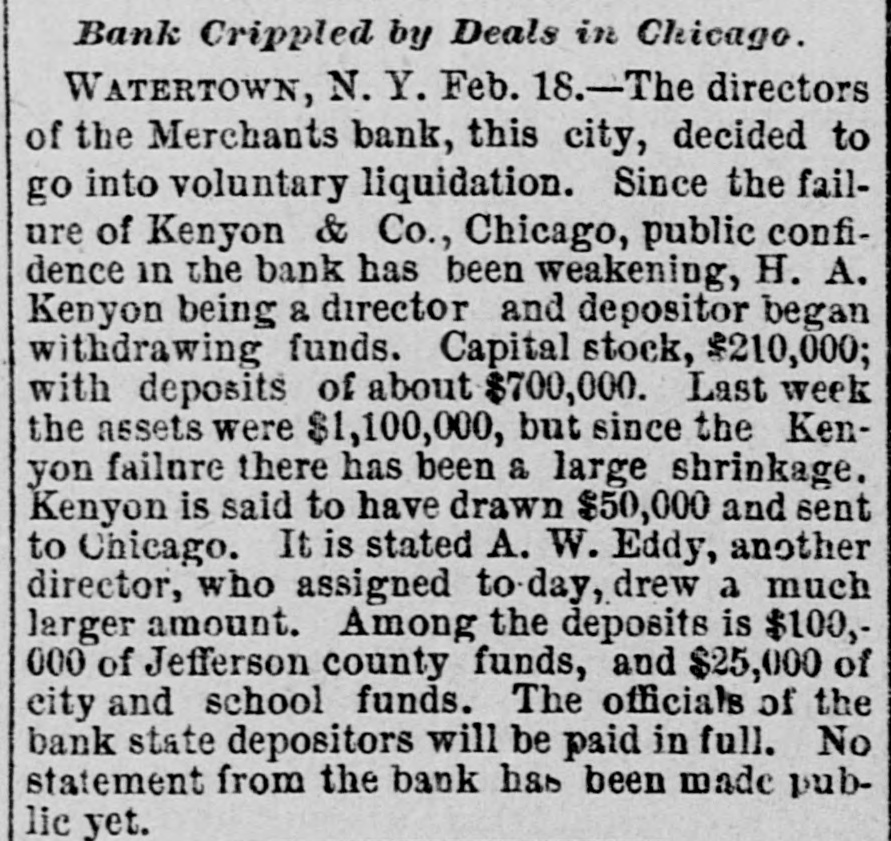
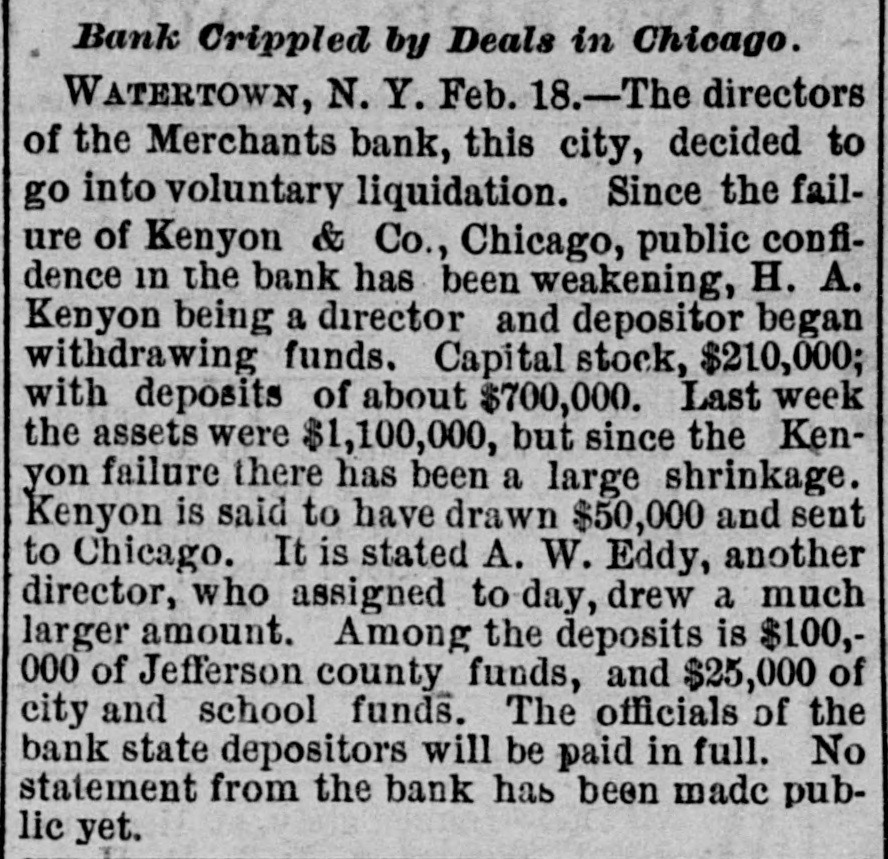
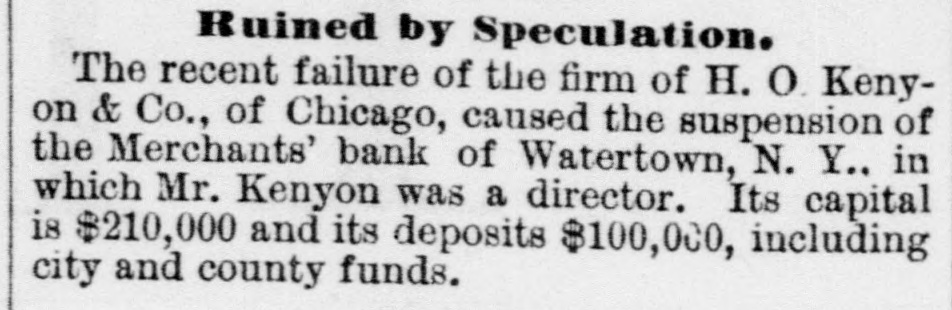
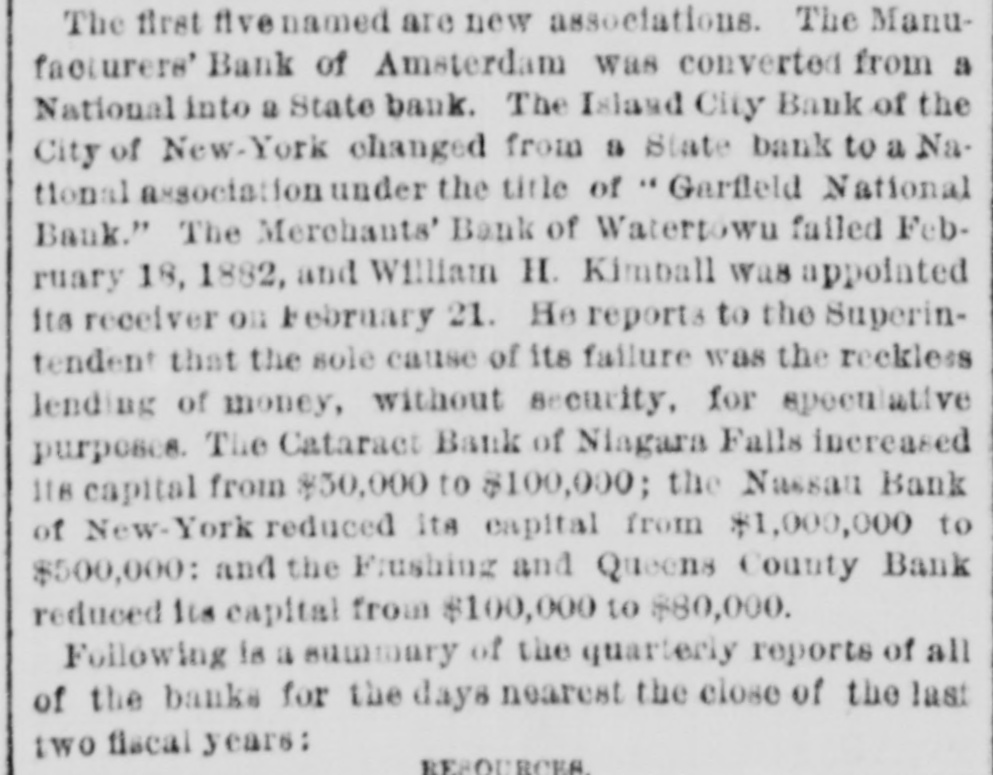
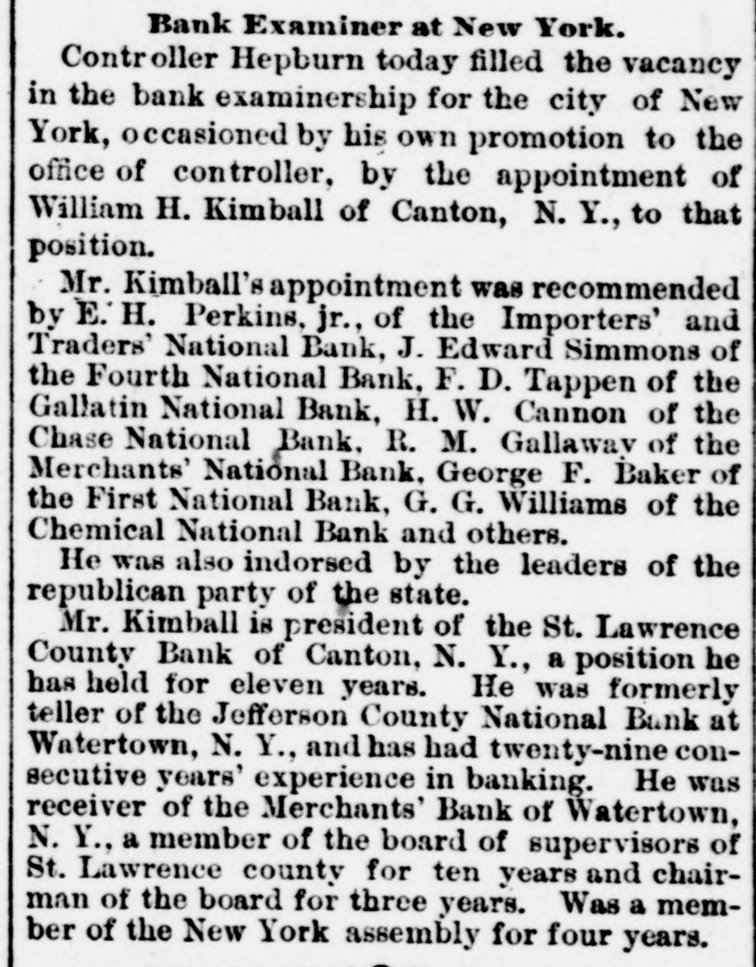
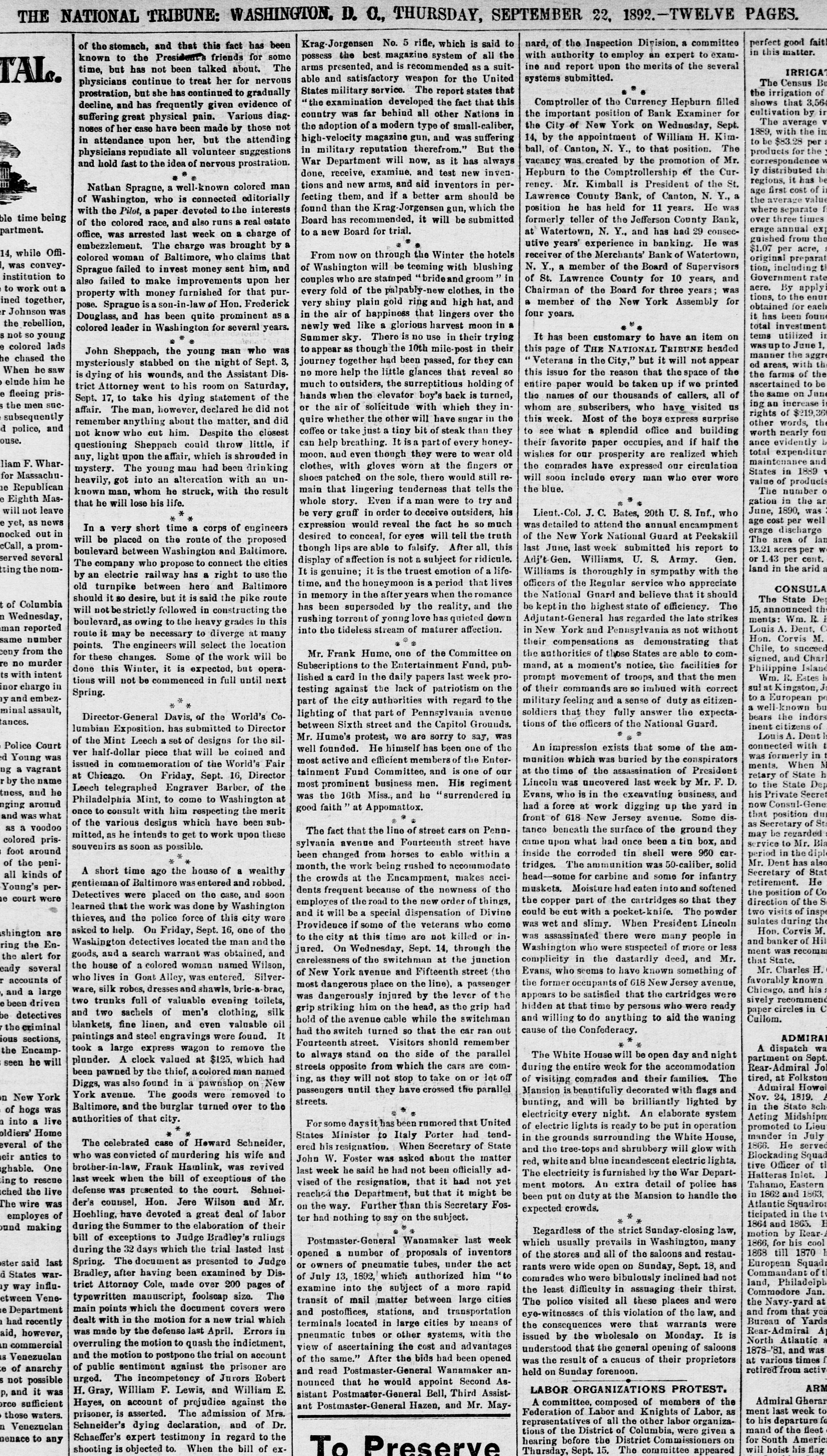
Comptroller of the Currency Hepburn filled the important position of Bank Examiner for the city of New York on Wednesday, Sept. 14, by the appointment of William H. Kimball, of Canton, N. Y., to that position. The vacancy was created by the promotion of Mr. Hepburn to the Comptrollership of the Cur- rency. Mr. Kimball is President of the St. Lawrence County Bank, of Canton, N. Y., a position he has held for 11 years. He was formerly teller of the Jefferson County Bank, at Watertown, N. Y., and has had 29 consec- utive years' experience in banking. He was receiver of the Merchants' Bank of Watertown, N. Y., a member of the Board of Supervisors of St. Lawrence County for 10 years, and Chairman of the Board for three years; was a member of the New York Assembly for four years.
It has been customary to have an item on this page of THE NATIONAL TRIBUNE headed "Veterans in the City," but it will not appear this issue for the reason that the space of the entire paper would be taken up if we printed the names of our thousands of callers, all of whom are subscribers, who have visited us this week. Most of the boys express surprise to see what a splendid office and building their favorite paper occupies, and if half the comrades for our prosperity are realized which will soon include every man who ever wore the blue.
Lieut.-Col. J. C. Bates, 20th U. S. Inf., who was detailed to attend the annual encampment of the New York National Guard at Peekskill last June, last week submitted his report to Adjt.-Gen. Williams, U. S. Army. Gen. Williams is thoroughly in sympathy with the officers of the Regular service who appreciate the National Guard and believe that it should be kept in the highest state of efficiency. The Adjutant-General has regarded the late strikes in New York and Pennsylvania as not without their compensations as demonstrating that the authorities of those States are able to command, at a moment's notice, the facilities for prompt movement of troops, and that the men of their commands are so imbued with correct military feeling and a sense of duty as citizen- soldiers that they fully answer the expecta- tions of the officers of the National Guard.
An impression exists that some of the am- munition which was buried by the conspirators at the time of the assassination of President Lincoln was uncovered last week by Mr. F. D. Evans, who is in the excavating business, and had a force at work digging up the yard in front of 618 New Jersey avenue. Some dis- tance beneath the surface of the ground they came upon what had once been a tin box, and inside the corroded tin shell were 980 car- tridges. The ammunition was .50-caliber, solid head-some for carbine and some for infantry muskets. Moisture had eaten into and softened the copper part of the cartridges so that they could be cut with a pocket-knife. The powder was wet and slimy. When President Lincoln was assassinated there were many people in Washington who were suspected of more or less complicity in the dastardly deed, and Mr. Evans, who seems to have known something of the former occupants of 618 New Jersey avenue, appears to be satisfied that the cartridges were hidden at that time by persons who were ready and willing to do anything to aid the waning cause of the Confederacy.
The White House will be open day and night during the entire week for the accommodation of visiting comrades and their families. The Mansion is beautifully decorated with flags and bunting, and will be brilliantly lighted by electricity every night. An elaborate system of electric lights is ready to be put in operation in the grounds surrounding the White House, and the tree-tops and shrubbery will glow with red, white and blue incandescent electric lights. The electricity is furnished by the War Depart- ment motors. An extra detail of police has been put on duty at the Mansion to handle the expected crowds.
Regardless of the strict Sunday-closing law, which usually prevails in Washington, many of the stores and all of the saloons and restau- rants were wide open on Sunday, Sept. 13, and comrades who were bibulously inclined had not the least difficulty in assuaging their thirst. The police visited all these places and were eye-witnesses of this violation of the law, and the consequences were that warrants were issued by the wholesale on Monday. It is understood that the general opening of saloons was the result of a caucus of their proprietors held on Sunday forenoon.
LABOR ORGANIZATIONS PROTEST. A committee, composed of members of the Federation of Labor and Knights of Labor, as representatives of all the other labor organiza- tions of the District of Columbia, were given a hearing before the District Commissioners on Thursday, Sept. 15. The committee appeared perfect good faith in this matter.
IRRIGATION. The Census Bureau shows that 3,564,000 acres are under cultivation by irrigation. The average value of the land in 1889, with the improvements, was $53.28 per acre, and the value of products for the same year, in correspondence with the arid and semi-arid regions, it has been found that the average first cost of irrigating works is over three times the value of the land where separate from the water right, or 1.43 per cent. of the value of the land in the arid and semi-arid regions.
CONSULAR. The State Department on Sept. 15, announced the following appoint- ments: Wm. R. Estes, of Maine, Consul at Kingston, Jamaica; Louis A. Dent, of Washington, to be Consul at St. Louis, to a European port; Hon. Corvis M. Chile, to succeed Mr. signed, and Charles H. Cullom, of Chicago, and his paper circles in