Click image to open full size in new tab
Article Text
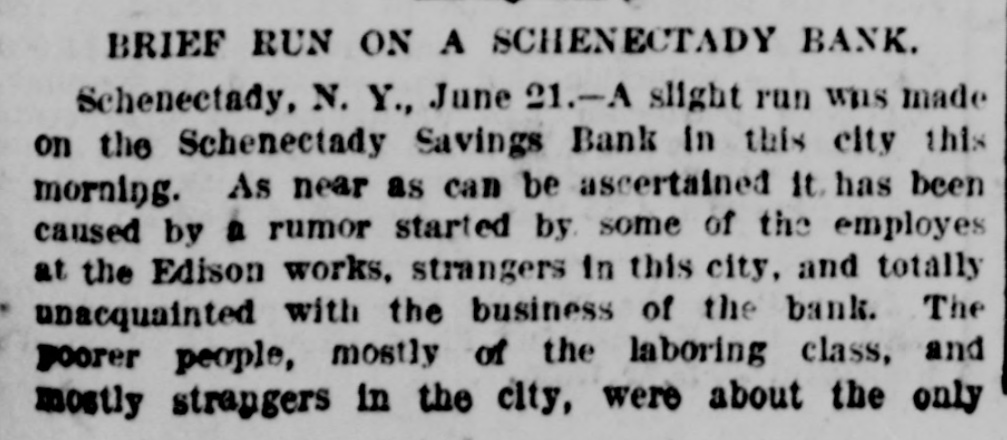
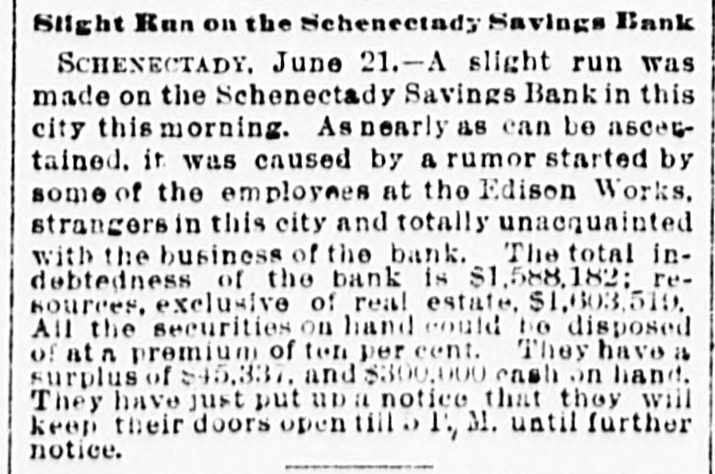
HARD TIMES FORTHE BANKS. SIX MORE OF THEM SUSPEND IN SOUTHERN CALIFORNIA. With their Money Locked Up they Could Not Face n Email Paste San Francisco Banks Expect to See Great Exettement To-day Bad Showing of the Plankintes Bank- A Kent Estate Failure in Chicago LOS ANGELES Cal. June 22 Confidence has been restored among local bank depositors and the exciting seen of yesterday were not repeated. All the closed banks. except the City Bank, will open in A few dave. All have ample assets. but they were paralyzed by the insano panic which infected the people. The influence of these suspensions was seen to-day. when the First National and the Commeretal banks of Santa Ana closed, and were speedily followed by the banks in Orange and Tustin. This leaves the new county of Orange, which was partitioned off from Los Angeles. without a single bank remaining open. These banks are declared solvent. but they could not pay sudden demands of depositors. The People's Bank of Pomona and the Bank of Commerce of San Diego also suspended to day The latter stood a run of two days and then succumbed. The trouble with all the South California banks is that they have a large part of their coin loaned out on farms and city property on which they cannot realize. SAN FRANCISCO June 22. The effect of the bank runs insouthern California was felt in San Francisco to-day for the first time. There was a small run on the German Savings Bank to-day. but it was quickly ended by the prompt payment of all who demanded money. Considerable excitement is expected to morrow. but it is understood that if any bank is singled out for attack the others will aid it. and should this be done the trouble will be ended quickly All the leading savings banks have been adding to their reserve. so they are well prepared for any runs To-morrow will see big financial excitement in San Francisco, as it was decided to-night that the Pacific Bank would not open. The Pacific has long been regarded as the weakest commercial bank in the city Its President is Dr. R. M. McDonald, the Vinegar Bitters millionaire, but it has been managed by his son. The bank has gono into many speculative enterprises. such as the electric railway of Los Angeles. the Brown colony in Madeira and several Arizona irrigation schemes. in which it has sunk large sums. Its suspension will also probably close up the People's Home Savings Bank. an institution which has made a bid for small deposite by giving little safes for the household. The manager of the Clearing House does not think any other city banks are in danger. but the conference of bankers to-day declined tondvance funds to help the Pacific Bank becondition cause of its RIDGWAY June The Ridgway Bank, private institution. this morning posted the following notice on its deors: financial situation on interests doors. full soup on given to the public as soon can be prepared. The notice is signed by D. C. Oyster. President. and cashier. A gentleman was closoconsultation with the officials the bank during the estimates assets $364,000 and the liabilities $216,000. This bank has had the confidence of working people many whom have all their wealth in the bank's care. BIRMINGHAM, Ala. June 22 An unfounded rumor that the First National Bank had refused to pay check for $80,000 precip Itated run on that stitution this morning The bank paid out about $40.000 up to noon. when confidence was restored and the run ceased FLORENCE Ala. June Cashier Carr of the Tuscumbia Banking Company was arrested last night. Carr returned from New York yesterday claimed to have sufficient money to pay depositors of the suspended bank. Instead this he made a proposition to compromise, which was rejected, and his arrest followed. It is now thought the bank will pay only fifteen cents on the dollar. June 22.-The City National Bank of this ity was closed this morning by order of Bank Examiner Caldwell No statement of the condition has been made public. The cause of the suspension was the steady withdrawal of deposits and the stringency of the money market. There is no exeitement. the depositors generally having perfect confidence that the bank will come out Il right MILWAUKEE. June 22.-An analysis of the Plankington bank statement filed by Assignee William ankington shows that President socured in loans from the bank nearly $400,000 instead of $300,000. Of this sum $278 000 was loaned to himself and $100,000 to the Milwaukee Brass and Copper Works, which he was President. statement that fourteen firms owe the bank over $1,000,000. as follows Lappen & Co., $263,128 Lappen Furniture Com $10,210: Frederick Day. $278,000: Benedict & $105,500 Buffalo Mining Company $55,000: Got tenburg and Improvement Company $10,180 A. Hildebrand $10,000; Milwaukee Brass and Copper Works. T.Day President. $100.000; John H. Meyers. $30,000; Meyers and $25,137 Mas Brothers. $10.000; Richter Shubert & Dick $15,232: Swift Co. $10,000; Schlessinger Brothers, $45,000. The only security for the Benedict loans is forty notes made by R dozen people. the face value of which is about $15,000. The Lappen notes have security chattel mortgages, shares intheHidalgoSmithing Company, and an assignment in a tract of land contract to ninety-five acrew in Waukesha county. The Day notes are secured by Dakota lands and local real estate Thirty banks throughout this and other States were caught in the failure for various sums. BOSTON. June was decided -day by the full bench the Supreme Court that a national bank bound by the insolvency law that prohibits debtors from conveyin such a as way property ing to ereate an unjust forence. This ruling WAR made f George Chipman Arthur Tellan. and the Traders National Bank V8 George Chipbank had lent money to Dudley C. Hall. taken note secured by two conveyances Medford. These conveyances when Hall was insolvent although not assign unti five months afterward bank claimed he State Insolven law was in conflict with the United States law giving a national bank right to take and hold propand mortgages upon real perty as security for dehts previously contracted. on June The SCHENECTADY the run Schenectady Savings Bank ended at noon Yesterday 181 depositors ine-tenths of were Poles. Swedes and Italians. drew a littl $44,000. This morning $ 100 was drawn out The Schenectad Savings Bank one of the trongest and most vatively conducted bank n the State The -annual statement, published on June 15, showed bank has an actual surplus, after paying debt of over $40,000, without including the real estate State Bank Examiner after recent examination of the bank declared it to be as sound any bank in the State FAILURE IN THE COFFEE TRADE