Click image to open full size in new tab
Article Text
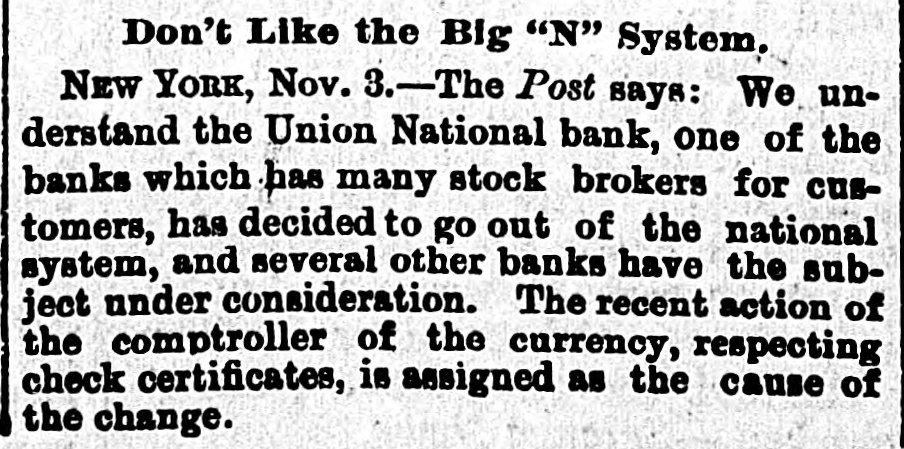
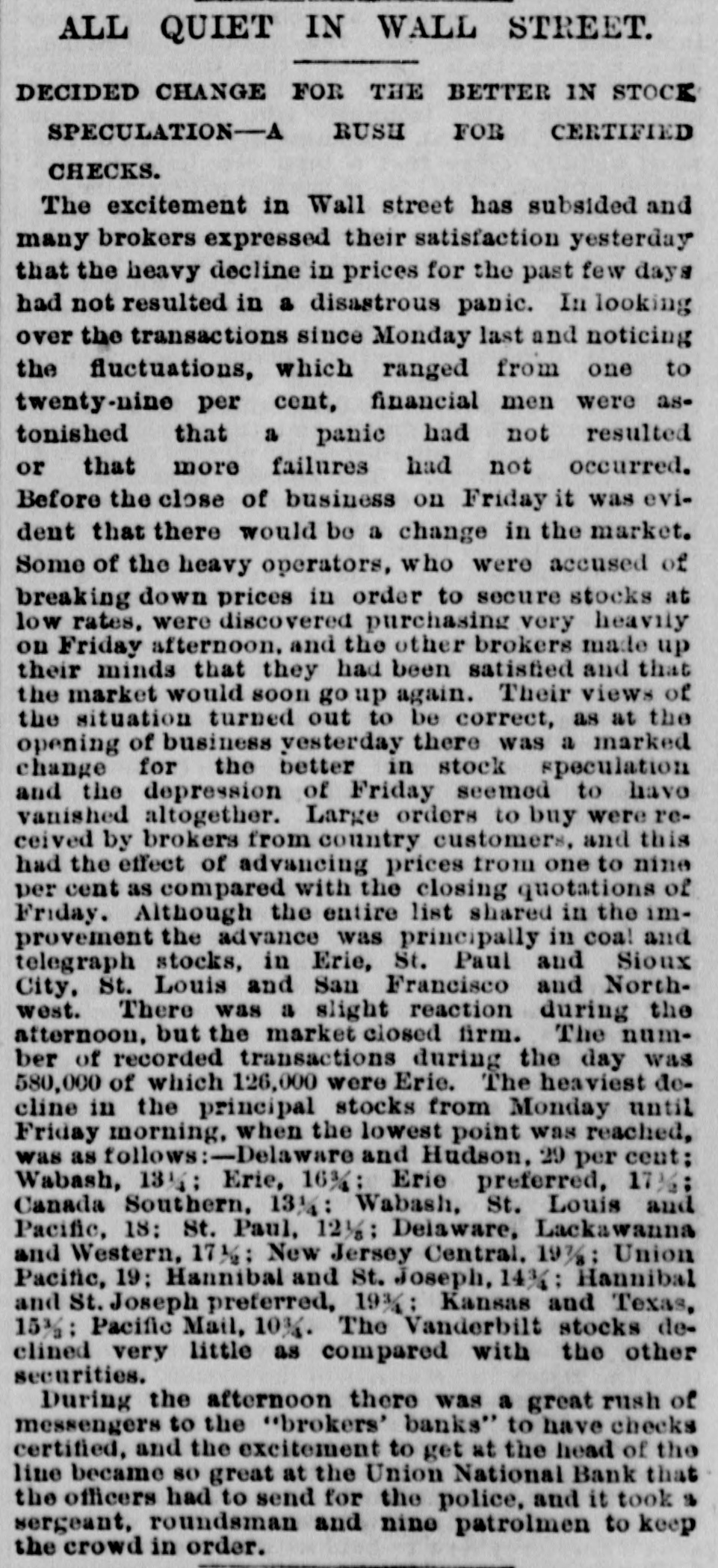
THE WALL STREET PANIC. Some Features of it as Presented by th New York Papers-1 President Georg I. Seney's Career-His Gifts-The Caus of His Failure-Facts About Grant Ward. The Wall street panic appears to b about over and confidence is partially, not wholly, restored. At one tim Wednesday), however, the situation looked very threatening. One of the ugl features of the day was the ruthless man ner in which the names of banks wer bandied about. Scarcely a bank withi a radius of half a mile of the Stock Ex change escaped suspicion, and incipien "runs" were started in half a dozen in stitutions that proved to be perfectly so vent. Depositors, each in a more or les feverish state of anxiety. presented them selves at the tellers' windows of the Phe nix, the Union, the Wall Street and th Gallatin National Banks, but they wer speedily reassured as to the soundness those institutions. Reports were in cin culation about noon that 'runs' were ing made on the Fourth National an United States National Banks, but officer of those two banks laughed the state ments to scorn. President Baldwin, the first -named institution, said that hi bank was not only as firm as a rock, bt that there had not been an excited cust mer inside of it during the day AMONG THE MANY EXCITING RUMORS of the day was one that Jay Gould ha been driven to the wall and had bee obliged to open his famous strong box which he keeps in the vaults of the Me cantile State Deposit Company for purpose of raising money by using all hi securities as collateral. Mr Gould ha been unable-so the story went-to rais as much money as he needed on thes securities Mr. G. Morosini, M Gould's assistant, said that the repor concerning Mr. Gould was not true. "If Mr. Gould has failed, said M Morosini, with a pleasant smile and charming broken English, wish that might fail also, in the same way. He as solid as what you call-rock Mr Washington E. Connor, Mr. Gould broker. said the report was one of th wildest and most absurd of the day has not borrowed a dollar,' added M Connor "The securites were taken of the vault this morning, but they wer taken back this afternoon. That is a every day occurrence, and is done in th usual course of business. IT WAS APPARENT THAT THE RECEN FLURRY in Wall street had trightened the de positors of the Metropolitan Nation: Bank. The deposits have ranged as hig as eleven millions of dollars. The las statement showed that they had run dow to a little over three millions, and withi the past few days there had been heav depletions. The bank had become in volved in the heavy operations of Nelso Robinson & Co., whose checks were large ly certified and not made good on Tue day. Mr. Robinson is son-in- law of Pre ident Seney, and two of Mr. Seney's son are partners in the firm. But the most serious matter presente was the embarrassment of the Presiden George I. Seney. who is largely connecte with many railroad enterprises. La summer Mr. Seney was the holder of about $4,000,000 of East Tennessee, Virginia an Georgia Railroad income bonds, whic cost him and the other members of syndicate about 40 cents on the dolla They are now selling for about 15. T1 bonds have been as high as 73, and M Seney had great confidenc in them. The constitute a large part of the assets of bank When the demands of deposito and other creditors became pressing, was, of course, impossible to realize an thing on such assets without a ruinou sacrifice Some of the Directors, among who were Isaac H. Bailey, were loth to su pend, and up to the last minute urged tl possibility of obtaining aid from other banks MR SENEY AND HIS ENTERPRISES. The bulk of the responsibility for tl failure the bank was sides place with President Seney He was born Astoria, L.I., in 1826, and was the son a Methodist who occupied se eral pulpits in this city including Mulberry street and Allen street His was daughter of Con modore Nicholson. One of his aunts the wife of Albert Gallatin. Mr. Sene was educated at Wesleyan Universit and Columbia College, and was graduate from Columbia in 1847 He W: made paying teller of the Metropo itan Bank in 1847, and cashier years later. On the death of John Williams he was made President, since he reached that position his will been really the law of the bank M Seney negotiated what is known as tl Nickel Plate Railroad enterprise, and said to have realized about a million an a half out of his sale of it to the Vande bilts. GIVING A FORTUNE AWAY. Then he loomed out as one of the m lionaires of the metropolis, and about te years ago astonished even his most in mate friends with his princely gifts various ational and stitutions. He began with a gift of to the Long Island Historical Society at followed up with valuable books manuscripts. He gave 500 to the Your Men's Association and $27 000 to the Wesleyan University Middletown. Conn., where he received early education. He gave sixteen lots Seventh avenue, Brooklyn, and $200,000 cash for the purpose of constructing new hospital, which is not yet finishe His total gifts to the Long Island Histo cal Society amounted $62,000 He $20,000 to the Industrial Home in Butl street, $50,000 to Emory College in 0 ford. Ga., and $100,000 to Wesleyan F male College at Macon, and other benefa tions, most of which were unsolicited. In explanation of these gifts, he said them to the Lord that he found it better to give than that he took pleasure in partir with half a million dollars in this way that he preferred giving in his lifetime waiting until death for a bequest which might be defeated by contest over will. He used to talk of the bad effec upon a man's disposition of hoardin wealth, and took pride in saying h gifts did not go to the idle, the dissipate or the undesery Yet at the time most of these gifts we made, while many who had long know him were surprised at these unexpecte evidences of wealth, others who kne something of his real situation, and tl immense required by his ex sive terprises. remonstrated with hir He was warned that he could not aff it; that he might get his affairs into ous complications. But he replied with great ardor and enthusiasm that he cou well afford it, and that it was his rigl and pleasure to do what he chose with own. He at the same time disclaime any desire for notoriety in the matter, an did not give ostentatiously. but rath quietly He prided himself upon bein governed by business common sense his gifts. MR. SENEY'S HOME AND WAYS. Mr. Seney lives in the splendid mansio built by Rockwell, on the crest of hill opposite Wall street ferry in Broo lyn. His neighbor across the street is A. Low. The house, which was fitted at great expense as model in sanitatio proved fatal to Mr. Rockwell, and aft his death it was discovered that the ma sion was actually ventilating gre sewer. Mr. Seney, since purchasing has added to it an art gallery. containir the choicest collection of paintings Brooklyn. He was a domestic man, ticent in habit and was but little know by sight in Brooklyn. Like Ferdinar Ward, he was an attendant of the Churo of Pilgrims. The persuasiveness of tl Rev. Dr. R.S. Storrs was potent in ope ing his purse strings, especially for ditions book treasures in the Lor Island Historical Library, of which was a most liberal patron, buyir classics, engravings, and rare thing