14351. Oriental Bank (New York, NY)

Bank Information

Episode Type
Run β†’ Suspension β†’ Reopening
Bank Type
state
Start Date
January 29, 1908
Location
New York, New York (40.714, -74.006)

Metadata

Model
gpt-5-mini
Short Digest
5a278e2c6a30277f

Response Measures

None

Description

Contemporary accounts report a run beginning Jan. 29–30, 1908 that led to the bank failing to open Jan. 31 by order of the State Superintendent of Banks. The bank was placed in the hands of state examiners/temporary receivers, negotiations followed for a liquidating agent (Metropolitan Trust Company), legal challenges ensued, and the bank reopened March 24, 1908 with the Metropolitan Trust acting as liquidating agent and paying depositors. Troubles were tied to prior failures (Borough Bank of Brooklyn, International Trust) and clearing-house exposure.

Events (5)

1. January 29, 1908 Run
Cause
Local Banks
Cause Details
Loss of confidence after failures in October (Borough Bank of Brooklyn and International Trust company) and clearing-house exposure; heavy withdrawals followed disclosures of loans to the Borough Bank.
Measures
Directors sought outside assistance; the bank took out clearing house loan certificates; officers requested state superintendent to take charge and the bank did not open.
Newspaper Excerpt
On the request of officers and directors, State Banking Superintendent Williams today took charge of the Oriental Bank ... on which a run was started yesterday
Source
newspapers
2. January 31, 1908 Suspension
Cause
Government Action
Cause Details
Closed by order of the State Superintendent of Banks and a state bank examiner was placed in charge amid the run and heavy withdrawals.
Newspaper Excerpt
The Oriental bank ... did not open for business today. A notice was posted on the door announcing that the bank was closed by order of the state superintendent of banks.
Source
newspapers
3. February 21, 1908 Other
Newspaper Excerpt
The Metropolitan Trust Company ... will probably take over the suspended Oriental Bank ... and liquidate its assets for the benefit of depositors and stockholders; Hugh Kelly ... is making heroic efforts to have the institution taken over and liquidated by some strong bank or trust company.
Source
newspapers
4. February 29, 1908 Receivership
Newspaper Excerpt
The temporary receivers who were appointed yesterday for the Oriental Bank ... must show cause next Monday why the receivership should not be dissolved. Today's order was signed by Justice Platzek upon application of counsel for the directors of the bank.
Source
newspapers
5. March 24, 1908 Reopening
Newspaper Excerpt
The Oriental Bank re-opened yesterday morning and depositors who appeared were asked to leave' books to be balanced. ... The Metropolitan Trust company will commence to pay as many depositors each day as it is physically able to do so.
Source
newspapers

Newspaper Articles (23)

Article from The Topeka State Journal, January 31, 1908

Click image to open full size in new tab

Article Text

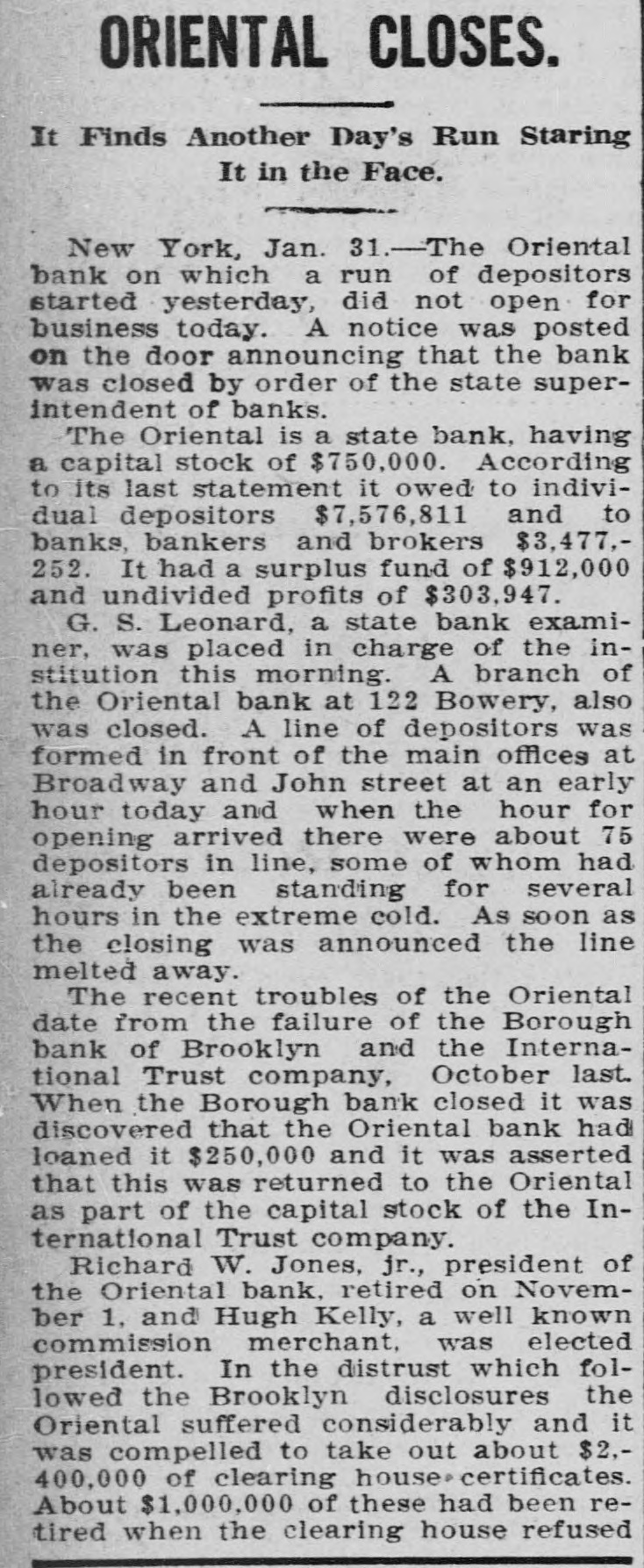
ORIENTAL CLOSES. It Finds Another Day's Run Staring It in the Face. New York, Jan. 31.-The Oriental bank on which a run of depositors started yesterday, did not open for business today. A notice was posted on the door announcing that the bank was closed by order of the state superintendent of banks. The Oriental is a state bank. having a capital stock of $750,000. According to its last statement it owed to individual depositors $7,576,811 and to banks, bankers and brokers $3,477.252. It had a surplus fund of $912,000 and undivided profits of $303,947. G. S. Leonard, a state bank examiner, was placed in charge of the institution this morning. A branch of the Oriental bank at 122 Bowery, also was closed. A line of depositors was formed in front of the main offices at Broadway and John street at an early hour today and when the hour for opening arrived there were about 75 depositors in line, some of whom had already been standing for several hours in the extreme cold. As soon as the closing was announced the line melted away. The recent troubles of the Oriental date from the failure of the Borough bank of Brooklyn and the International Trust company, October last. When the Borough bank closed it was discovered that the Oriental bank had loaned it $250,000 and it was asserted that this was returned to the Oriental as part of the capital stock of the International Trust company. Richard W. Jones, jr., president of the Oriental bank, retired on November 1, and Hugh Kelly, a well known commission merchant, was elected president. In the distrust which followed the Brooklyn disclosures the Oriental suffered considerably and it was compelled to take out about $2,400,000 of clearing house certificates. About $1,000,000 of these had been retired when the clearing house refused
Article from The Washington Times, January 31, 1908

Click image to open full size in new tab

Article Text

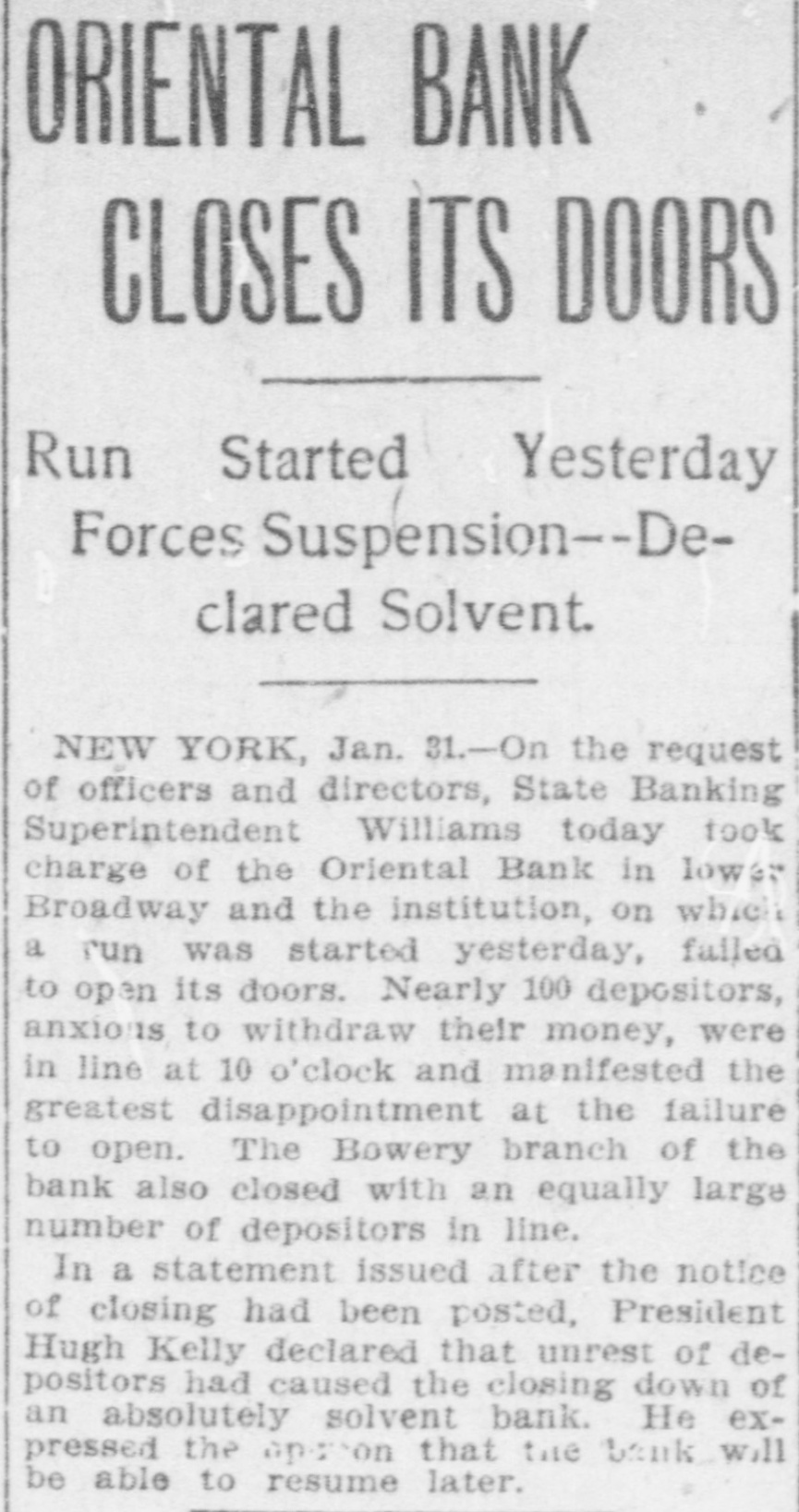
ORIENTAL BANK CLOSES ITS DOORS Run Started Yesterday Forces Suspension--Declared Solvent. NEW YORK, Jan. 31.-On the request of officers and directors, State Banking Superintendent Williams today took charge of the Oriental Bank in lower Broadway and the institution, on which a run was started yesterday, falled to open its doors. Nearly 100 depositors, anxious to withdraw their money, were in line at 10 o'clock and manifested the greatest disappointment at the failure to open. The Bowery branch of the bank also closed with an equally large number of depositors in line. In a statement issued after the notice of closing had been posted, President Hugh Kelly declared that unrest of depositors had caused the closing down of an absolutely solvent bank. He expressed the option that the bank will be able to resume later.


Article from The Roswell Daily Record, January 31, 1908

Click image to open full size in new tab

Article Text

ORIENTAL BANK FAILS TO OPEN TODAY. New York, Jan. 31.-The Oriental Bank, on which a run started yesterday, did not open for business today. A notice was posted announcing that the bank was closed by order of the state superintendent of banks. The Oriental is a state bank having capital stock of $750,000. By its last statement it owed depositors $7,576,811, and to banks and brokers $3,477,212. It had a surplus* of $912,000 and undivided profits of $303,947. A state bank examiner was placed in charge of the bank. When the closing was announced there were 75 depositors waiting, some of whom had been standing several hours in the extreme cold. The troubles of the Oriental date from the failure of the Borough Bank of Brooklyn, to which the Oriental had loaned $250,000. The Oriental was compelled to use about $2,400,000 clearing house certificates, and when the clearing house refused to issue any more certificates to the Oriental the depositors began making heavy witadrawals, taking out about

Article from The Times Dispatch, January 31, 1908

Click image to open full size in new tab

Article Text

BANK MAY OPEN TO-DAY Probable That the Oriental, on Which Run Is Made, will Stem Tide. NEW YORK, January 30.-President Hugh Kelly, of the Oriental Bank, IL State institution, which withstood a run to-day, gave out a statement about midnight that he believed the bank would open to-morrow for business, The announcement was made after a meeting of the president and


Article from The Sun, January 31, 1908

Click image to open full size in new tab

Article Text

first vice-president of the bank. is in charge of the branch. About 400 depositors, startIng at about 11 o'clock, withdrew their money before 3 o'clock. The authorities expect to open the bank again promptly at 9 o'clock this morning. The Oriental Bank is a consolidation of the old Seventh National and the Oriental Bank, or, precisely, a liquidation of the Seventh National under the Oriental. The Seventh National was organized in 1833 as the Seventh Ward Bank, became the Seventh National late in the '60s and in 1901 became crippled as a result of the Henry Marquand & Co. failure. E. R. Thomas's father. the late Gen. Samuel Thomas, was interested in the institution and put his son in it as president. The next day it failed and on its reorganization in 1901 it came out under the name of the Oriental Bank, which had been incorporated in 1853 and was then at the Bowery and Grand street. Both the Bowery and Broadway offices were retained, but the Bowery office was made a branch. Edwin Gould was the first president of the reorganized institution. The bank has the only nickel counting machine in the city and handles most of the small change taken in by the lines of the Interborough-Metropolitan system. The Inter-Met and its subsidiary companies have long been depositors in it. It has been reported that many of the loans of the bank were secured by bonds and other securities of the Inter-Met system. Heavy liquidation of Inter-Met bonds this week has been attributed in some quarters to the calling of these loans. One of the directors of the bank, Alexander McDonald of Cincinnati, was among the men who made fortunes out of the Standard Oil Company. Mr. McDonald and many of his associates were interested in the Mobile, Jackson and Kansas City Railroad, which went into the hands of a receiver about a. year ago. The receivership has since been vacated, but the market for Recurities of the reorganized company has been not at all active. though the plan of reorganization has put the company on a good basis. The securities were characterized by bond men yesterday as good but unmarketable. Hugh Kelly. the president, is president of the Central Ansonia Sugar Company, a director of the Occitania Sugar Company, the Chaparra Sugar Company, the Nipe Bay Company and the United Fruit Company. He is a trustee of the Emigrant Industrial Savings Bank. St. Patrick's Cathedral, the Roman Catholic Orphan Asyium and the Sevilla Home for Children. The name of the Oriental was pulled into the notorious Borough Bank scandals in Brooklyn through a loan of $250,000 which the latter institution obtained from the Oriental in September of last year. William Gow, the former Borough Bank director, is now under indictment for grand larceny in connection with this transaction, and there was a similar charge against Howard Maxwell, the president of the Brooklyn institution. who committed suicide after being released on bail from Raymond street jail The Oriental Bank was made the deposisory for the capital stock and paid in surplus of the International Trust Company when steps were taken toward its organization last fall. The $250,000 which the officials of the Borough Bank obtained from the Oriental went in. so it has been charged, as part of the International Trust Company's $1,000,000 of paid in capital and surplus The note on which this $250,000 was obtained was signed "The Borough Bank, per H. Maxwell." The directors of the Brooklyn institution charged that the loan had never been authorized by them and that they knew nothing of the obligation until the officers of the Oriental Bank called for more collateral. Then they repudiated the loan There was a scramble between the Borough and the Oriental Bank directors in October to see which would get at William Gow's property first. At that time it was said that the Borough Bank had managed to get practically everything Gow had. R. W. Jones was president of the Oriental when this loan was made.


Article from Gainesville Daily Sun, February 2, 1908

Click image to open full size in new tab

Article Text

NK CLOSES DOORS tatal Bank of New York City Suspends Business. CHARGE BANK EXAMINER is a State Institution and Its Foubles Date from the Failure of Other Institutions in October bet Year. ew York, Feb. 1.-The Oriental s, on which a run of depositors started Thursday, did not open business Friday. notice was posted on its doors an neing that the institution was ed by order of the state superinTent of banks. he Oriental bank is a state bank, ing a large capital. According to last statement it owed to individulepositors $7,576,311 and to banks, kers and brokers $3,477,252. It had urplus fund of $912,000 and undividprofits of $803,947. i. Leonard, a state bank examiner, 8 placed in charge of the institua. 1 line of depositors was formed in nt of the main office at Broadway a John street at an early hour and en the hour for opening arrived are were about 75 depositoss in e ,some of whom had already been inding for several hours in the exme coid. As soon as the closing 8 announced this line melted away. The recent troubles of the Oriental te from the failure of the Borough nk of Brooklyn, and the InternationTrust company in October last. The Oriental bank was a depository the capital stock of the Trust comny when It was organized by W. M. 1 W and others last fall. When the rough bank closed It was discoved that the Oriental bank had loanit $250,000, and it was asserted at this was returned to the Oriental part of the capital stock of the InA enational Trust company. 1 Richard W. Janes, Jr., president of e Oriental Bank, retired in Novem05 x, and Hugh Kelly, a well known mission merchant was elected prea. ent. A Twelve of the leading financial inI Itutions of the city volunteered on hursday to assist the distressed inItution to the extent of $1,000,000 o cash. provided the directors would t ecome individually responsible for te loan. The majority of the direcrs agreed to this, but there were n ome among their number who were nable to do so, and the plan failed. the directors at a meeting Friday de. 6 Wed to place the affairs of the bank the hands of the state banking de et artment.


Article from St. Johnsbury Caledonian, February 5, 1908

Click image to open full size in new tab

Article Text

After a descrerate struggle for five hours' duration against intense cold and 1 turbulent sea, lifesavers rescued the crew of the New York brigantine Fredericka Schepp, which was wrecked on Coatue beach, Cape Cod. After Fire Commissioner Wells had refused an opportunity given him by Mayor Hibbard of Boston to resign he was removed from office. Charges of disloyalty and slander, were preferred against Rev. Dr. J. M. Buckley, editor of The Christian Advocate, by Rev. Dr. G. A. Cook of Brandon, Vt. Buckley was vindicated by a clerical commission. The city council of Boston passed a resolut on protesting against me bill of fered to the Massachusetts legislature providing for the government of the city of Boston by commission. The prohibition bill was killed in the South Carolina house of representatives. County local option is now provided for throughout the state. George Hackenschmidt of Russia easily defeated Joe Rogers, American. in the wrestling match at London for the championship of the world. Saturd b. I. President Roosevelt sent to the congress a message reaffirming in vigorous language his well-known views in relation to the regulation of trusts and common carriers. In addition he made a slashing reply to the critics of his policies. The American fleet of sixteen battleships entered the Strait of Magellan and arrived at Punta Arenas. Speaker John N. Cole of the Massachusetts house of representatives was indicted by the Essex county grand jury on a charge of violating the public statutes in requesting a reduced rate of fare on the Boston and Maine railroad for a large number of people. John Burrow. the oldest man in Massachusetts, is dead at the age of 106, at the home of his daughter, Mrs. George Williams of Stockbridge. He was a farmer by occupation. While Henry H. Potter, town clerk and tax collector. was sitting in his office at Scituate. R. I., he was robbed of $1000 by three masked men. The Oriental bank at New York, on which a run of depositors started. has closed. After a season of slight gains, the condition of Empress Alexandra of Russia has again taken a turn for the worse. A credit of $5,000,000 was received at Budapest from New York by the Hungarian Discount and Exchange bank for the account of Count and Countess Laszlo Szechenyi. More than $3,000,000 was paid to Contractor Sanderson for furnishings for the new Pennsylvania state capitol before his bills began to be approved by the board of public grounds and buildings as required by law. The sale of the different properties constituting the old Union Traction company's system to the Chicago Railways company has been confirmed. closing the traction war that has been going on for ten years. b. 2. undav, King Carlos of Portugal and Crown Prince Luiz Philippe were assassinated at Lisbon and the city is in a state of uproar. The king's second son. the Infant Manuel. was slightly wounded. but Queen Amelie, who strove to save the crown prince's life by throwing herself upon him, was unhurt. Prince Manuel has been proclaimed king. Traffic has been opened over the Julfa railway. connecting Russia and Persia. This Ene clinches Russian hold on the north Persian provinces David Barrie, Sir Thomas Lipton's representative in this country when Lipton raced Shamrock I and Shamrock II for the America's cup. was killed at Jersey City by slipping on the Ice and falling in front of a locomotive. Governor Hughes made a trenchant plea for the abolition of race track gam bling in a speech at a mass meeting at New York of the "Citizens' Anti-Race Track Gambling Campaign." 3. O. andav, Adjudged not guilty of the murder of Stanford Wh te by reason of insanity at the time the fatal shots were fired Harry K. Thaw was held by the court to be a dangerous lunatic and was taken to the state hospital for the crim f inal insane at Matteawan. The verdict came after twenty-five hours of waiting The Scituate (R. I.) town council voted to offer a reward of $1000 for the arrest and conviction of three men who robbed Henry H. Potter. town clerk and tax collector. of over $1000. A fine of $9000 was imposed at Boston on the Corporation Trust and In


Article from The Charles Mix New Era, February 7, 1908

Click image to open full size in new tab

Article Text

NEW YORK BANK CLOSES. The Oriental Did Not Open for Business Friday Morning. The Oriental bank at New York, on which a run by depositors was started Thursday. did not open for business Friday. The bank was closed by order of the state superintendent of banks. The Oriental bank is a state Institution, capitalized at $750.000 and previous to the panic last fall, carried Individual deposits of $7,519,000. but this had been largely reduced during and since the pante.


Article from Twice-A-Week Plain Dealer, February 7, 1908

Click image to open full size in new tab

Article Text

America, the New Amsterdam bank and the Mechanics and Traders'. The Morse-Heinze-Thomas connection with these banks had weakened public confidence, and it was feared that runs would be made which the institutions could not meet. Therefore as a safeguard they were placed in the hands of the federal banking authorities. All are said to be solvent, and it was expected that depositors would be paid in full and that the banks would be able to resume business in a short time. After withstanding a run on the previous day and fearing a continuance, the directors of the Oriental bank decided to close its doors and turn the bank over to the state banking officials. The reason for this action was the disclosure at the clearing house of a debit balance of $939,000. # Steel Trust's Big Earnings. Despite the unfavorable showing of the last quarter of the year, the records of the steel trust show that its profits for 1907 were $160,984,477, which is over $6,000,000 in excess of the previous high water mark, reached in 1906. The October earnings, immediately preceding the financial and industrial disturbance, were the largest in the history of the corporation. The directors have declared dividends for the last quarter of the year of 1ΒΌ per cent on the preferred and one-half of 1 per cent on the common stock. The first five years of the profit sharing plan of the trust have nearly closed, and it is reported in Wall street that those of its employees who have continuously held the preferred stock purchased when the plan was first announced in 1903 will receive an extra dividend of 65.4 per cent. # McCurdy Laughs at Suits. Richard A. McCurdy, former president of the Mutual Life Insurance company, who has spent two years in Europe, recently returned to his home in Morristown, N. J. When asked about the suits for the restitution of several million dollars which the management of his old company had brought against him he laughed and said: "I have lawyers, and they will take care of the suits. They are not worth talking about. I am seventy-three years old. The real question is, Which will last the longer, the suits or myself?" # Pittsburg Exchange Opens. The Pittsburg Stock Exchange, closed since Oct. 23 last, opened for business Jan. 27. There was a tendency on the part of the brokers to withhold sales, and only 271Β½ shares changed hands. The reopening of the exchange has already restored confidence to a notable degree. # Morse Lines Ask Receivership. In order to prevent various creditors from applying for a receivership on their own account the controlling interests and the bondholders' committee of the Consolidated Steamship lines, the Charles W. Morse $120,000,000 combine, have applied for a receiver for the Consolidated and the two weakest of its subsidiary lines, the Metropolitan and Eastern Steamship companies. These proceedings do not affect the Mallory, Clyde, New York and Porto Rico and New York and Cuba lines, which are also subsidiaries of the Consolidated. # Morgan Takes More Bonds. The New York city officials have decided to sell $50,000,000 in bonds, having arranged with J. Pierpont Morgan for the underwriting of the issue. It is expected that these bonds will be put on the market in a few days. Their proceeds will be used in carrying out needed public improvements.


Article from The Star and Newark Advertiser, February 14, 1908

Click image to open full size in new tab

Article Text

ARRANGEMENTS TO OFFSET DEPOSITS AGAINST NOTES N. Y. Clearing House Grants Modification of Position to Depositors. NEW YORK, Feb. 14.-The difference of opinion between the loan committee of the Clearing House and the depositors of the Mechanics and Traders' Bank and the Oriental Bank, relating to the liquidation of the collateral held by the Clearing House against loan certificates issued to the banks, was disposed of at a meeting of the Clearing House loan committee yesterday morning by a resolution recognizing the equitable rights claimed by depositors whose notes. the Clearing House holds. These depositors insisted that the deposits standing to their credit at the time the banks closed their doors should be offset against their notes, the total amount being approximately $1,000,000. Strauss & Anderson, with Grout & Grout. acting as counsel for the depositors of the Mechanics and Traders' Bank, had numerous meetings with the representatives of the Clearing House and their counsel, Opdyke, Laud & Bristow, and claimed the right on the part of the depositors to set off the deposits against the amount of the notes when payment was demanded. In round figures the Clearing House holds some $6,000,000 of notes of this kind to secure about $1,500,000 of loan certificates issued, but among these 1 notemakers. while there are many who had deposits in the bank at the time it closed its doors, there are a great many whose deposits were small and who as1 sert no such right. The resolution adopted provides that the Clearing House will accept payment of maturing notes. while grantJ ing to the depositor the right to reserve the amount of the balance standing to i his credit in the bank at the time it 1 1 suspended business, without prejudice to the depositor's right to insist on offt setting his deposit, the Clearing House Association also agreeing to take no i further action to enforce collection 1 of any balance which may be due until I all other available free collateral has been exhausted. 7


Article from New-York Tribune, February 21, 1908

Click image to open full size in new tab

Article Text

MAY TAKE ORIENTAL NEW LIQUIDATING AGENT. Metropolitan Trust Will Probably Save Bank from Receivership. The Metropolitan Trust Company, of which Brayton Ives is president, it was learned last night, will probably take over the suspended Oriental Bank in the near future and liquidate its assets for the benefit of depositors and stockholders. Hugh Kelly, president of the Oriental, is making heroic efforts to have the institution taken over and liquidated by some strong bank or trust company, so that the depositors may be paid off at once and not have to undergo the long and expensive process of a receivership. A week ago Mr. Kelly felt sanguine that the United States Mortgage and Trust Company would take over the Oriental and liquidate its assets. but some slight hitch is understood to have occurred when the negotiations were all but completed, with the result that the deal has been called off, greatly to the disappointment of the Oriental's depositors. Nothing daunted by this failure, however, Mr. Kelly has kept on looking for a liquidating agent, and now it is believed that the Metropolitan Trust Company will take up the task. The draft of a plan is understood to be all prepared and will soon be presented to Clark Williams, State Superintendent of Banks, for his approval. Control of the Mobile, Jackson & Kansas City Railroad, in which several of the Oriental Bank directors were heavily interested, passed a few days ago to the Metropolitan Trust Company. At a special meeting of the directors of the railroad, R. W. Jones, jr., former president of the Oriental Bank, and Charles E. Levy, a director in the Oriental, resigned and were replaced by George R. Sheldon and John W. Simpson, who are directors in the Metropolitan Trust Company. Alexander McDonald, who is a director of the Oriental, is also a member of the railroad's board. Brayton Ives, the president of the Metropolitan Trust Company, was elected chairman of the Mobile, Jackson & Kansas City board several weeks ago. The deposits of the Oriental amounted to $4,465,537.33 when the bank closed its doors. on January 29. Its surplus at this time was $788.81088, and it owed the Clearing House $1.751,351 28 for outstanding loan certificates. Its capital stock is $750,000. At the time the bank suspended President Kelly announced that it was perfectly solvent. and this statement has been borne out by examinations of the assets made since then. The bank is at present in the hands of the State Banking Department. G. S. Leonard. a state bank examiner. is in charge. The Metropolitan Trust Company, at No. 49 Wall street, has a capital of $2,000,000. a surplus of $7,345,150. and deposits of $23,747,753. Its stock is quoted at 540 bid.


Article from Evening Star, March 1, 1908

Click image to open full size in new tab

Article Text

ORIENTAL BANK CASE. Some Division of Opinion Over Attempted Receivership. NEW YORK, February 29.-The temporary receivers who were appointed yesterday for the Oriental Bank and Attorney General Jackson must show cause next Monday why the receivership should not be dissolved. Today's order was signed by Justice Platzek upon application of counsel for the directors of the bank. who filed affidavits setting forth that the Metropolitan Trust Company had agreed February 21 to plan for liquidating the Oriental Bank's assets and paying off its depositors. S. Stanwood Menken of counsel for the directors, in a sworn statement, sets forth that repeated efforts were made to get the ear of the attorney general with regard to plans for resumption after Banking Superintendent Clark Williams had agreed to approve of it if the attorney general should sanction reopening.


Article from New-York Tribune, March 6, 1908

Click image to open full size in new tab

Article Text

THE NEWS THIS MORNING. CONGRESS.-The death of Senator Proctor was announced. and both houses adjourned after the adoption of resolutions of sorrow and the appointment of committees to attend the funeral, which will be held at Proctor, Vt., this afternoon. FOREIGN.-The English committee in charge of "The World's Tribute to Shakespeare" has decided on an architectural monument and statue to cost about $500,000 and to be completed on the 300th anniversary of the poet's death. The terms of the Congo annexation treaty show that the rights of King Leopold are to last his lifetime, and that the concessions to American companies are guarded. King Edward left London for Biarritz for B. month's stay, after which he will make a It yachting cruise in the Mediterranean. is announced from Tokio that Japan, while maintaining the firmest attitude in regard to the seizure of the Tatsu Maru, has no idea of resorting to force for the recovery of the vessel. The Union Bank of Commerce in Rio de Janeiro, one of the smaller institutions of the Brazilian capital, closed its doors. DOMESTIC-Sator Lodge, replying to the statement of Senator Crane, announced his purpose to vote for Secretary Taft if sent as a delegate from Massachusetts to the Chicago Governor Magoon left Washconvention ington to return to his post in Havana, his work in Cuba being warmly commended by Secretary William J. Bryan was indorsed for Taft. the Presidential nomination by the Democratic and Populist state conventions of Nebraska at The revised list of deaths by the Omaha. Collinwood (Ohio) schoolhouse fire numbered 361. Receivers were appointed at Baltimore for the Western Maryland Railroad, a It was said at Albany that Gould line. the Assembly Codes Committee probably would report next week the Hart anti-racetrack gambling bills and that the Assembly would pass them. Assemblyman Palmer introduced a bill-at Albany amending the public service commissions law by providing that the Mayor of New York shall appoint the commissioners in the 1st District. A band of boys and girls and William R. George left Ithaca, N. Y., for San Fernando, Cal., where a juvenile reThe Assembly at public will be formed. Albany passed the Bennett resolution calling on Controller Metz for detailed information concerning the debt of New York City. The receivCITY-Stocks closed weak. ers of the Oriental Bank, in a preliminary report to Attorney General Jackson, made grave charges against the former officers of that institution. The Interborough Rapid Transit Company asked permission to execute a mortgage on its real estate and other interests to secure a proGovposed issue of gold mortgage bonds. ernor Hughes spoke at the dinner of the North Side Board of Trade, at Ebling's Casino, in The Bronx, answering ex-Governor Black on racetrack gambling Mayor McClellan and Controller Metz discovered that the city would have only fifty millions to spend for all purposes during the next eighteen months, and regarded the building of subways as impossible. Willfam Esser was arrested for robbery of parts of torpedoes manufactured for the United States government. Attorney General Jackson and Samuel Untermyer ridiculed statements made in connection with the Vidaver case. THE WEATHER-Indications for to-day: Rain. The temperature yesterday: Highest, 38 degrees; lowest, 24 degrees.


Article from The Sun, March 8, 1908

Click image to open full size in new tab

Article Text

other things. vacates and sets aside the order made and entered herein February 28, 1908. appointing temporary receivers of the defendant in the above entitled action. Immediately upon the filing of such order today I served notice of appeal upon the Clerk of the County of New York and upon Messrs. Philbin, Beekman x Menken, attorneys for the defendant. a copy of which said notice of appeal. with a notice of such service. will be handed to you by the bearer of this letter. I am of the opinion that the service of the notice of appeal perfected the appeal and stays all proceedings under the order appealed from. as provided by section 1,313 of the Code of Civil Procedure. That there may be no question upon this point I intend to immediately apply to the court for an order staying all proceedings until the hearing and decision of the appeal. In my opinion there are several important legal questions involved in these proceedings, and I enclose a memorandum which I have prepared upon the subject, which defines my position. Yours truly. W. S. JACKSON, Attorney-General. The Attornev-General is the legal adviser of the State Superintendent of Banks and Mr. Williams was apparently up against the proposition of being advised not to do what the Court ordered him to do. After the refusal of the Carnegie Trust officer. however, there was nothing more for the State Superintendent to do and he left for Albany. Justice O'Gorman and also Justice FitzGerald remained at the County Court building until about 3 o'clock in the afternoon. In the meantime, however, the bank's lawyers had been conferring and had come to the conclusion to do nothing until the opening of court on Monday. The order signed by Justice O'Gorman besides vacating the receivership authorizes the Oriental Bank to enter into a contract with the Metropolitan Trust Company for the payment in full of its creditors under the terms set forth in the contract. It directs the State Superintendent of Banks to remain in control of the bank's property until the contract is executed and then to deliver the property to the Metropolitan Trust Company the liquidating agent. Mr. Jackson in his formal statement complains that no contract has as yet been entered into: that the proposed agreement as approved by the Court has not even been approved by the board of directors of the Metropolitan Trust Company or of the Oriental Bank. Furthermore, no bond has as yet been executed. "Up to this time." said the AttorneyGeneral "there has only been presented a proposition that it is said will be executed at some time. but which is not binding upon any one. The proposed agreement provides for the payment to the Clearing House of the amount due it by the bank. but no time is specified. The proposed agreement provides for the payment of depositors forthwith 'when the amount due each depositor shall be certified by expert accountants.'' Mr. Jackson said he could find no authority in law authorizing the Court to direct receivers to turn the property of an insolvent moneyed corporation over to the State Superintendent of Banks. The Court directs the State Superintendent upon the execution of the contract to turn over all the assets of the bank to the Metropolitan Trust Company. Mr. Jackson says: "I can find no law authorizing a court to direct the Superintendent of Banks to turn over to a third person the assets of a bank in his hands and which he has reported as unsafe and that it is inexpedient for it to continue in business. The only law I find requires the Superintendent of Banks in possession of the assets of a bank that he deems unsafe and inexpedient for it to continue business to report those facts to the Attorney -General, whose absolute duty it then becomes to bring an action for its dissolution." Mr. Jackson contends that the rights and liabilities of stockholders and others besides creditors are wholly unprotected by the Court's order. "This order," says the Attorney-General, 'establishes an entirely new practice and one wholly unauthorized and in effect it establishes the precedent for permitting insolvent corporations to select their own receivers and to administer their affairs regardless of the provisions of the law reQuiring their dissolution and the distriDution of their assets through officers appointed by the Court." Mr. Jackson promises to get as speedy a determination of the case as possible.


Article from The Evening World, March 9, 1908

Click image to open full size in new tab

Article Text

ORIENTAL BANK DEPOSITORS DON'T GET THEIR MONEY Attorney-General Jackson Gets Receivership Fight Into Appellate Court. Attorney-General Jackson to-day won point in his fight to save the receivers a of the Oriental Bank and to prevent it from re-opening. After a lengthy argument before Justice O'Gorman. the latter refused to resettle his decision of Saturday in which he threw out the receivers and approved the plan of reorganization Justice O'Gorman sent the controversy to the Appellate Division. where it will he heard bv Justice O'Laughlin to-mor row. In the meantime the Oriental Bank's depositors who expected to get their money to-day will have to wait. Directors Make Appeal. Attorney-General Jackson and Deputy Attorney-General De Ford: David MeClure for the depositors and Stanwood Menken for the directors. opened in chambers before Justice O'Gorman. Mr. Menken said they wanted a resettlement of the decision. with a provision setting forth that the Attorney-General consented to the order. and, then filed a notice of appeal. This complicated the matter. said Mr. Menken. "It seems to me utterly unheard of that any lawyer." said Mr. Jackson, "and especially a lawyer for the peop could consent to do away with the legal rights of the people. The sole purpose of this application is to deny the people the right of appeal. What I said was that If Your Honor deemed this agreement. by which the depos tors were to be paid. legal. I consented." "No. I have a distinct recollection that you said you would consent to any plan by which the depositors were paid in full." said Justice O'German. "I asked you If you opposed the ratifleation of the agreement and you said 'no.''' Mr. Menken then informed the Court .. that Mr. Jackson had obtained a stay from the Appellate Division. o "I have nothing to sav about that." 1 said Justice O'Gorman. "I was assured that under this plan all the depositors were to be paid by Friday and that all were to be paid in full. It was my understanding that if this was not done the matter was to be taken up by this court and the Attorney-General." During the argument Justice O'Gor-


Article from New-York Tribune, March 11, 1908

Click image to open full size in new tab

Article Text

JACKSON WINS A POINT. Justice Patterson, of the Appellate Division. yesterday set Friday as the day for a hearing on the order to show cause why arguments should not be heard immediately upon Atterney General Jackson's appeal from Justice O'Gorman's order vacating the order appointing temporary receivers for the Oriental Bank A delay was asked for by Martin L. Stover, who represented the Attorney Generay. E. Stanwood Menken, of counsel for the Oriental Bank, vigorously opposed the granting of any delay, but was overruled.


Article from The Morning Journal-Courier, March 19, 1908

Click image to open full size in new tab

Article Text

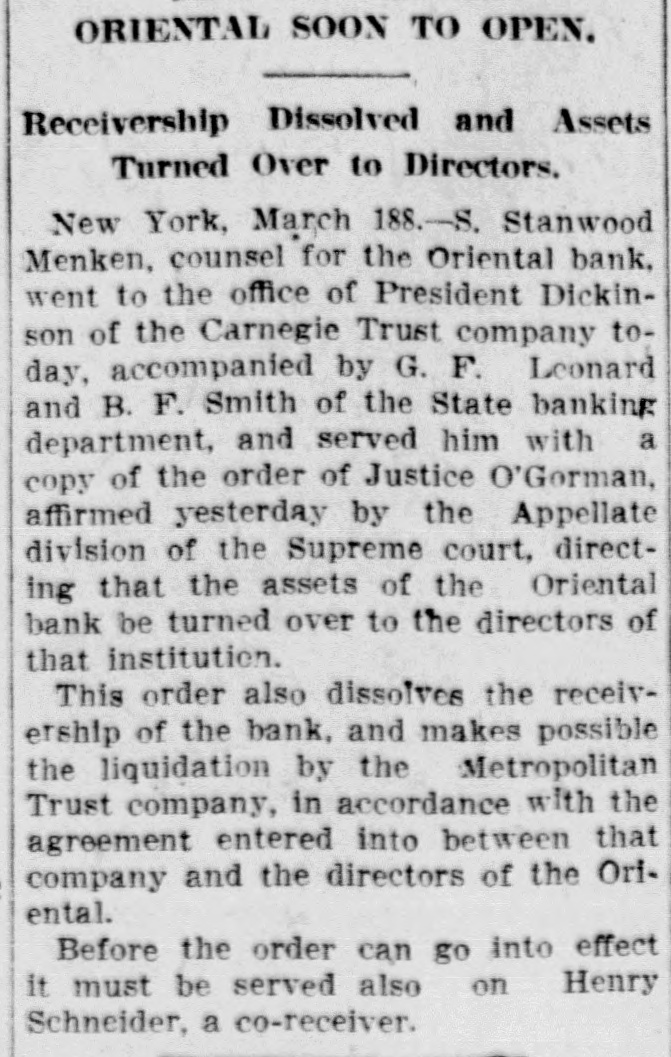
ORIENTAL SOON TO OPEN. Receivership Dissolved and Assets Turned Over to Directors. New York, March 188.-S. Stanwood Menken, counsel for the Oriental bank. went to the office of President Dickinson of the Carnegie Trust company today, accompanied by G. F. Leonard and B. F. Smith of the State banking department, and served him with a copy of the order of Justice O'Gorman, affirmed yesterday by the Appellate division of the Supreme court, directing that the assets of the Oriental bank be turned over to the directors of that institution. This order also dissolves the receivership of the bank, and makes possible the liquidation by the Metropolitan Trust company, in accordance with the agreement entered into between that company and the directors of the Oriental. Before the order can go into effect it must be served also on Henry Schneider, a co-receiver.


Article from The Barre Daily Times, March 24, 1908

Click image to open full size in new tab

Article Text

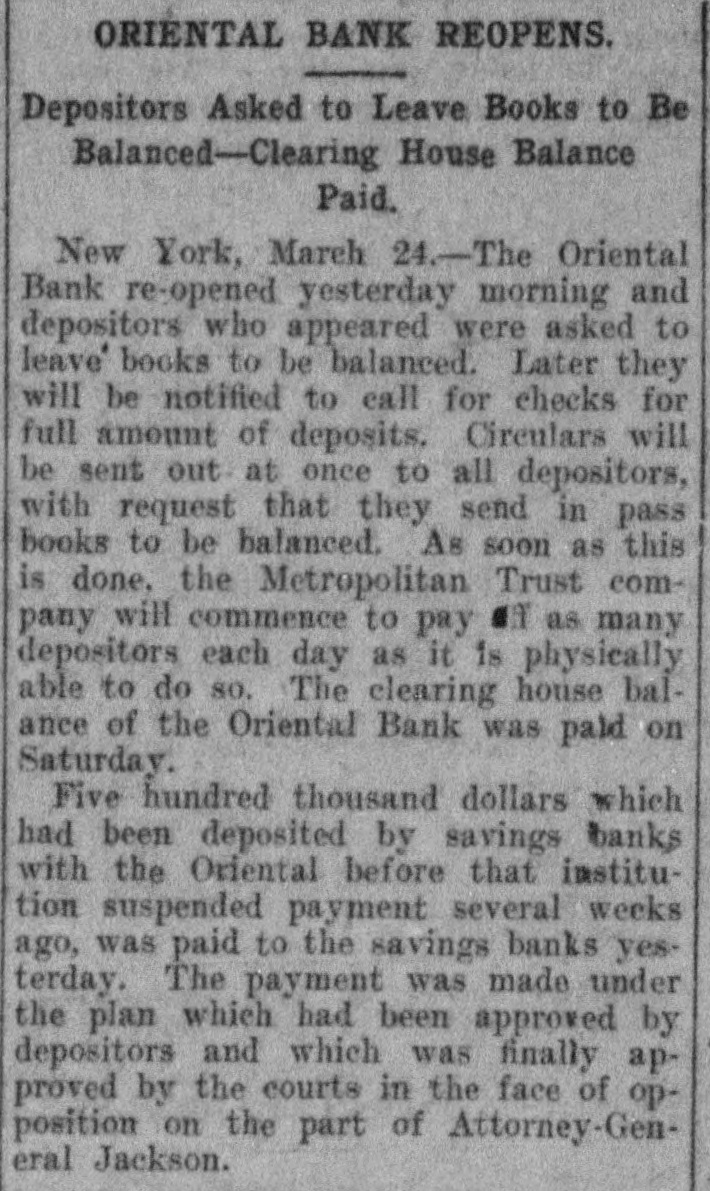
ORIENTAL BANK REOPENS. Depositors Asked to Leave Books to Be Balanced-Clearing House Balance Paid. New York, March 24.-The Oriental Bank re-opened yesterday morning and depositors who appeared were asked to leave' books to be balanced. Later they will be notified to call for checks for full amount of deposits. Circulars will be sent out at once to all depositors, with request that they send in pass books to be balanced. As soon as this is done. the Metropolitan Trust company will commence to pay #1 as many depositors each day as it is physically able to do so. The clearing house balance of the Oriental Bank was paid on Saturday. Five hundred thousand dollars which had been deposited by savings banks with the Oriental before that institution suspended payment several weeks ago, was paid to the savings banks yes. terday. The payment was made under the plan which had been approved by depositors and which was finally approved by the courts in the face of opposition on the part of Attorney-General Jackson.


Article from The Abbeville Press and Banner, April 1, 1908

Click image to open full size in new tab

Article Text

# New York Bank Frauds. New York City. β€”In a statement to the Attorney-General the receivers for the Oriental Bank reported the discovery of many irregularities and crimes among the bank's assets and books.


Article from New-York Tribune, April 15, 1908

Click image to open full size in new tab

Article Text

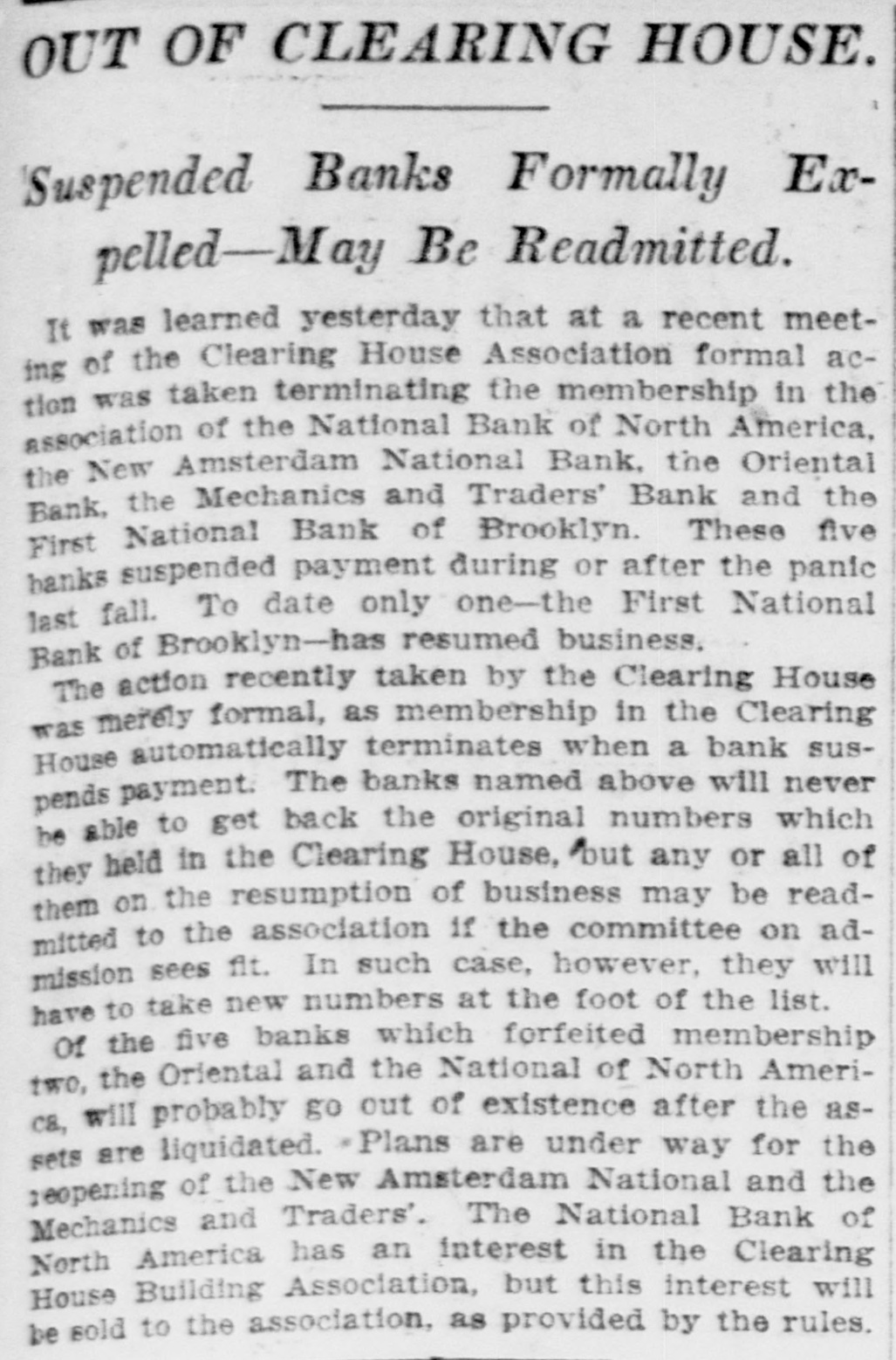
OUT OF CLEARING HOUSE. Suspended Banks Formally Expelled-May Be Readmitted. It was learned yesterday that at a recent meeting of the Clearing House Association formal action was taken terminating the membership in the association of the National Bank of North America, the New Amsterdam National Bank, the Oriental Bank, the Mechanics and Traders' Bank and the First National Bank of Brooklyn. These five hanks suspended payment during or after the panic last fall. To date only one-the First National Bank of Brooklyn-has resumed business. The action recently taken by the Clearing House was merely formal, as membership in the Clearing House automatically terminates when a bank suspends payment. The banks named above will never be able to get back the original numbers which they held in the Clearing House, but any or all of them on the resumption of business may be readmitted to the association if the committee on admission sees ftt. In such case, however, they will have to take new numbers at the foot of the list. of the five banks which forfeited membership two, the Oriental and the National of North AmeriC8, will probably go out of existence after the assets are liquidated. Plans are under way for the reopening of the New Amsterdam National and the Mechanics and Traders'. The National Bank of North America has an interest in the Clearing House Building Association, but this interest will be sold to the association, as provided by the rules.


Article from Perrysburg Journal, January 8, 1909

Click image to open full size in new tab

Article Text

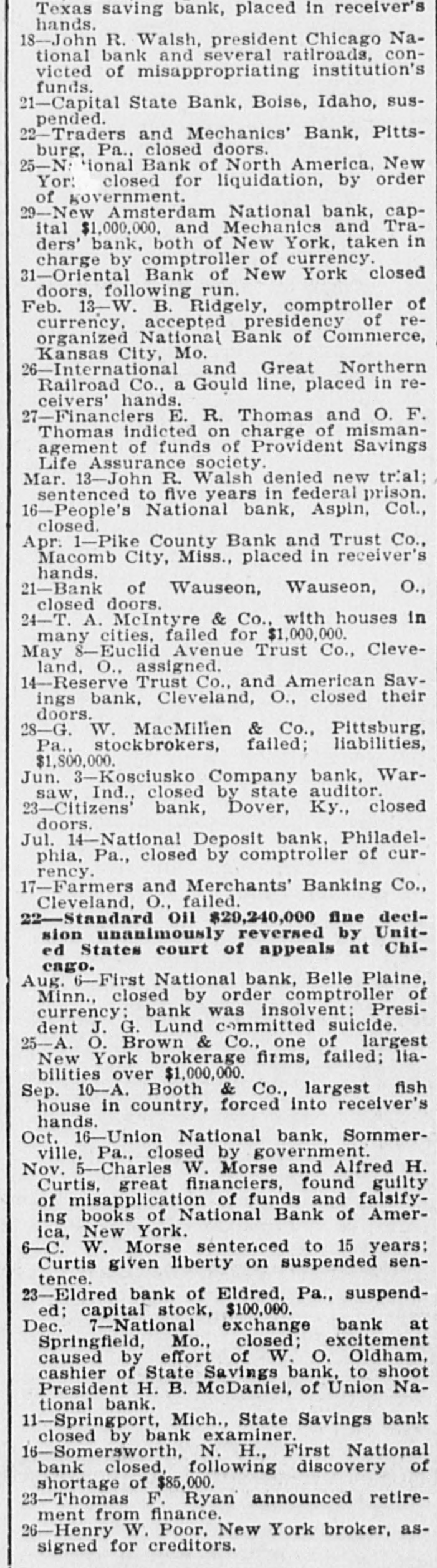
Texas saving bank, placed in receiver's hands. 18-John R. Walsh, president Chicago National bank and several railroads, convicted of misappropriating institution's funds. 21-Capital State Bank, Boise, Idaho, suspended. 22-Traders and Mechanics' Bank, Pittsburg, Pa., closed doors. 25-N: ional Bank of North America, New Yor: closed for liquidation, by order of government. 29-New Amsterdam National bank, capital $1,000,000. and Mechanics and Traders' bank, both of New York, taken in charge by comptroller of currency. 31-Oriental Bank of New York closed doors, following run. Feb. 13-W. B. Ridgely, comptroller of currency, accepted presidency of reorganized National Bank of Commerce, Kansas City, Mo. 26-International and Great Northern Railroad Co., a Gould line, placed in receivers' hands. 27-Financiers E. R. Thomas and O. F. Thomas indicted on charge of mismanagement of funds of Provident Savings Life Assurance society. Mar. 13-John R. Walsh denied new trial; sentenced to five years in federal prison. 16-People's National bank, Aspin, Col., closed. Apr: 1-Pike County Bank and Trust Co., Macomb City, Miss., placed in receiver's hands. 21-Bank of Wauseon, Wauseon, O., closed doors. 24-T. A. McIntyre & Co., with houses in many cities, failed for $1,000,000. May 8-Euclid Avenue Trust Co., Cleveland, O., assigned. 14-Reserve Trust Co., and American Savings bank, Cleveland, O., closed their doors. 28-G. W. MacMillen & Co., Pittsburg, Pa., stockbrokers, failed; liabilities, $1,800,000. Jun. 3-Kosciusko Company bank, Warsaw, Ind., closed by state auditor. 23-Citizens' bank, Dover, Ky., closed doors. Jul. 14-National Deposit bank, Philadelphia, Pa., closed by comptroller of currency. 17-Farmers and Merchants' Banking Co., Cleveland, O., failed. 22-Standard Oil $29,240,000 flue decision unanimously reversed by United States court of appeals at Chicago. Aug. 6-First National bank, Belle Plaine, Minn., closed by order comptroller of currency: bank was insolvent: President J. G. Lund committed suicide. 25-A. O. Brown & Co., one of largest New York brokerage firms, failed; liabilities over $1,000,000. Sep. 10-A. Booth & Co., largest fish house in country, forced into receiver's hands. Oct. 16-Union National bank, Sommerville, Pa., closed by government. Nov. 5-Charles W. Morse and Alfred H. Curtis, great financiers, found guilty of misapplication of funds and falsifying books of National Bank of America, New York. 6-C. W. Morse sentenced to 15 years; Curtis given liberty on suspended sentence. 23-Eldred bank of Eldred, Pa., suspended; capital stock, $100,000. Dec. 7-National exchange bank at Springfield, Mo., closed; excitement caused by effort of W. O. Oldham, cashier of State Savings bank, to shoot President H. B. McDaniel, of Union National bank. 11-Springport, Mich., State Savings bank closed by bank examiner. 16-Somersworth, N. H., First National bank closed, following discovery of shortage of $85,000. 23-Thomas F. Ryan announced retirement from finance. 26-Henry W. Poor, New York broker, assigned for creditors.


Article from New-York Tribune, April 9, 1911

Click image to open full size in new tab

Article Text

JUSTICE INGRAHAM OBJECTS Says There Was No Reason for Appointing Carnegie Trust and Schneider. The bitter controversy in 1908 between the depositors of the Oriental Bank and William Schuyler Jackson, who was then Attorney General of the State of New York, over the latter's action in having temporary receivers appointed was recalled yes. terday by a decision of the Appellate Division of the Supreme Court in passing on the expenses of the receivership which the court considered unnecessary. The majority of the bench decided in favor of cutting down the charges favorably passed on by former Judge D. Cady Herrick as referee. while Presiding Justice Ingraham in his dissenting opinion went on record as opposed to allowing any charges whatsoever. About the time that Attorney General Jackson had the Carnegie Trust Company and Henry Schneider appointed as receivers of the Oriental Bank he also made several applications for the appointment of receivers for other institutions. In the case of the Oriental Bank he explained his action by saying that the plan whereby the Metropolitan Trust Company was to advance the bank sufficient funds to pay off its creditors was an effort to loot the bank and deceive the depositors. Justice Platzek appointed the receivers asked for. and the depositors became aroused over the action of the Attorney General. which they assailed as unnecessary interference in the affairs of the institution just at a time when it was getting of out of its difficulties following the panic 1907. The bank officials also objected. An action was brought to have the receivership vacated. and Justice O'Gorman granted the application. His decision the Appellate Division upheld, saying that Jackson acted too hastily in having the receivers appointed. Justice Ingraham expressed the view yesterday that the receivership was established for the sole purpose of helping the receivers. Then came the claims for the expenses for that brief receiversnip, amounting to Former Judge Herrick was apto pass on the accounts, not all of pointed $10,872. he did approve them. further and the while Appellate Division favored a still cut. Justice Davis approved the report of Judge Herrick. One of the expenditures objected to was that of $3,750 for counsel fees paid to John B. Stanchfield and Professor Charles A. Collin. The latter is the man who recently bore the letter that Governor Dix sent to District Attorney Whitman instructing him to consult with Attorney General Carmody in his investigation into the affairs of the Carnegie Trust Company. It will be remembered that this communication was delivered to the District Attorney by Stephen C. Baldwin, counsel for the officials of the Carnegie Trust Company. This claim for counsel fees was cut to $2,000. The Carnegie Trust Company asked a $3,000 fee as receiver of the Oriental Bank. Only $1,000 was allowed, which amount Schneider will also receive. The referee's fees and expenses amount to $670 more. The presiding justice said that there was no need for the receivers, and all that their appointment could have accomplished was to enable them to appropriate to themselves fees and expenses from the assets belonging to the creditors and stockholders of the Oriental Bank. "No court ad. ministering justice." said Justice Ingraham, "if the facts were known, would even have entertained an application for the appointment of receivers." Justice Ingraham went over some of these facts that he referred to. It appeared. he said, that the Carnegie Trust Company had been negotiating with the Oriental Bank to advance the latter money to pay its indebtedness, but that the creditors were not satisfied with the arrangement, preferring that made with the Metropolitan Trust Company. It appeared further, said the justice, that the president of the Carnegie Trust Company. who at the time was Charles C. Dickinson, who recently died under unusual circumstances, had been in communication with Attorney General Jackson. He had asked, the justice said, to be appointed recelver of the Oriental Bank, which fact the Attorney General did not tell the court in asking for the appointment of the Carnegie Trust Company as one of the Oriental receivers. Justice Ingraham said that he could not see that the receivers were entitled to anything as fees, as there was no service rendered He declared that if they had any claim it should be preferred against the state. as the court had no power to


Article from The Jeffersonian, June 13, 1912

Click image to open full size in new tab

Article Text

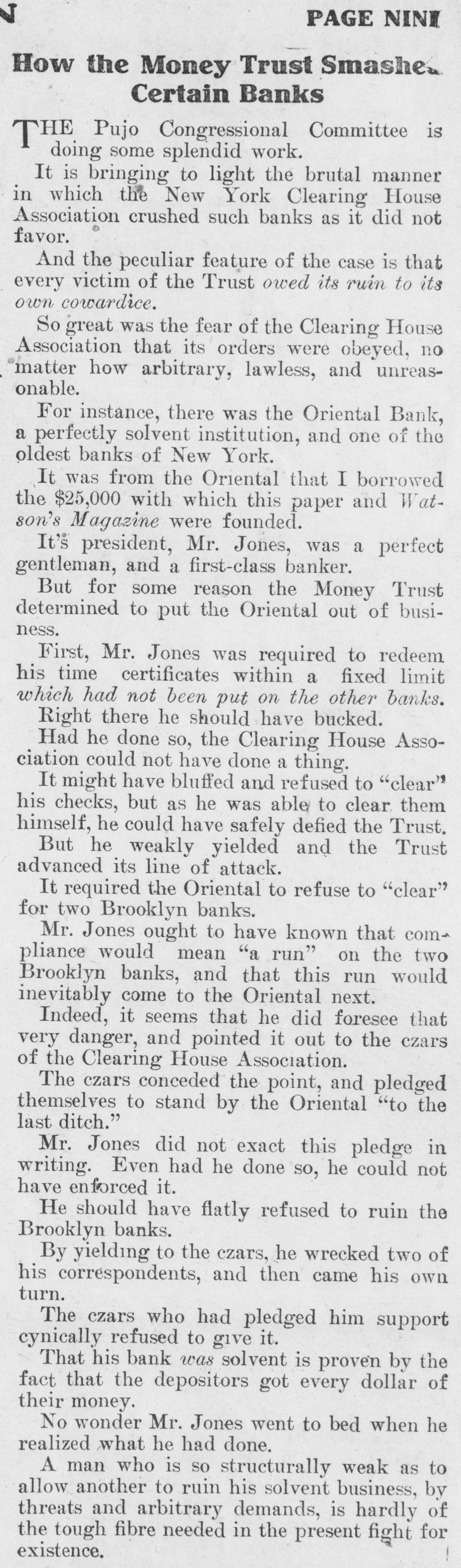
# How the Money Trust Smashes Certain Banks THE Pujo Congressional Committee is doing some splendid work. It is bringing to light the brutal manner in which the New York Clearing House Association crushed such banks as it did not favor. And the peculiar feature of the case is that every victim of the Trust owed its ruin to its own cowardice. So great was the fear of the Clearing House Association that its orders were obeyed, no matter how arbitrary, lawless, and unreasonable. For instance, there was the Oriental Bank, a perfectly solvent institution, and one of the oldest banks of New York. It was from the Oriental that I borrowed the $25,000 with which this paper and Watson's Magazine were founded. It's president, Mr. Jones, was a perfect gentleman, and a first-class banker. But for some reason the Money Trust determined to put the Oriental out of business. First, Mr. Jones was required to redeem his time certificates within a fixed limit which had not been put on the other banks. Right there he should have bucked. Had he done so, the Clearing House Association could not have done a thing. It might have bluffed and refused to "clear" his checks, but as he was able to clear them himself, he could have safely defied the Trust. But he weakly yielded and the Trust advanced its line of attack. It required the Oriental to refuse to "clear" for two Brooklyn banks. Mr. Jones ought to have known that compliance would mean "a run" on the two Brooklyn banks, and that this run would inevitably come to the Oriental next. Indeed, it seems that he did foresee that very danger, and pointed it out to the czars of the Clearing House Association. The czars conceded the point, and pledged themselves to stand by the Oriental "to the last ditch." Mr. Jones did not exact this pledge in writing. Even had he done so, he could not have enforced it. He should have flatly refused to ruin the Brooklyn banks. By yielding to the czars, he wrecked two of his correspondents, and then came his own turn. The czars who had pledged him support cynically refused to give it. That his bank was solvent is proven by the fact that the depositors got every dollar of their money. No wonder Mr. Jones went to bed when he realized what he had done. A man who is so structurally weak as to allow another to ruin his solvent business, by threats and arbitrary demands, is hardly of the tough fibre needed in the present fight for existence.