Bank was closed by the state bank commissioner in late January 1908 for investigation and failure to maintain required reserves; depositors attempted to recapitalize but failed and a receiver was appointed and wound up the bank. No run is reported (article explicitly says there was no run).
Events (2)
1.January 30, 1908Receivership
Newspaper Excerpt
When the commissioners took charge of the bank and closed its doors they appointed a receiver, agreeing to pay him $400 ... the cash on hand at that time was $6,036.02; receiver Fred Eudey later administered and wound up the bank's affairs. Depositors' efforts to recapitalize failed and the receiver wound up the affairs in 1908-1909. Final accounts and successor receivers noted in 1909 filings and hearings were held through 1910 and later litigation followed (embezzlement suits).
Source
newspapers
2.January 30, 1908Suspension
Cause
Government Action
Cause Details
Closed by the state bank commissioner (C. Lynch) for investigation due to insufficient reserve and excessive loans to one concern (Ames Manufacturing Co.).
Newspaper Excerpt
the following morning windows of the Sutter Creek were closed ... bank commissioner C. Lynch ... closed
Source
newspapers
Newspaper Articles (18)
1.January 31, 1908Amador LedgerJackson, CA
Click image to open full size in new tab
Article Text
A BANK FAILURE. Sutter Creek State Bank Forced to Suspend. Monday evening bank commissioner C. Lynch, arrived from Sar ancisco, and the following morning windows of the Sutter Creel were closed, probably for thirty or until the officers can show authorities that certain securities bank holds are of value. Commissioner Lynch stated that first intimation the bank com had that there was anything with this bank was in Decem when that body called for a re from all the banks, showing al liabilities and assets. This repor correct in every detail, but i owed that the bank held too mucl curity of one concern, the Ame anufacturing Company of Niles, : isiness recently formed by Jackson ennis, who is also president of th Creek bank and the one in The bank commission has it a rule that no bank shal more depositors' money invested any one concern than will amoun twenty per cent of the capita and surplus of the bank. Thi has exceeded that amount b: than $15,000. Besides, th is supposed to have a certain ercentage of the depositors' mone hand at all times. But probabl cause of money stringency the fund fallen below this mark, though have been increasing the cash 01 and during the past week. Mr Lynch went to Niles on Wednes to look over the accounts of th there, in which Jackson Denni interestted. He states that practi the same conditions exist ther in Sutter Creek, that they have to of the depositors' money in in one concern. After lookin the books of the Niles bank, h that he will know better jus hat the conditions of this bank is as yet the bank is solvent. Bt the market value of the stocks hel the Sutter bank are below wha sey are stated as being in the repor the affairs of the bank look ver Jackson Dennis telephoned I Lynch Tuesday that he woul sufficient cash here in a few day that the bank could be opene the thirty days were up. The report has been current fo time that everything was no right with the Sutter bank. ] been stated that business men e town would send their persons necks to firms in the city in pay of bills of goods, and the ould be returned to the merchan ecause of the failure of the cit to collect on them. But ther no run on the bank because i thought that the nonpayment o checks was due to the genera arcity of money. The failure o Sutter bank will have no effec
2.February 14, 1908Amador LedgerJackson, CA
Click image to open full size in new tab
Article Text
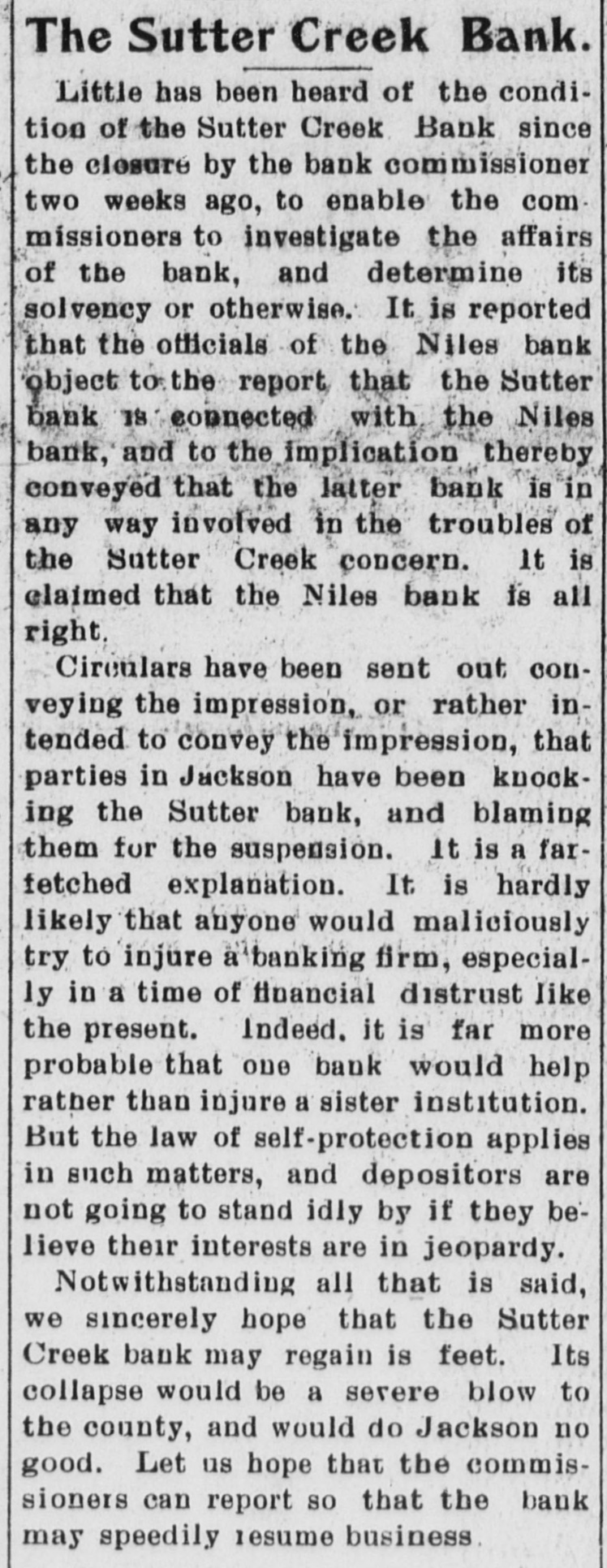
The Sutter Creek Bank. Little has been heard of the condition of the Sutter Creek Bank since the closure by the bank commissioner two weeks ago, to enable the com missioners to investigate the affairs of the bank, and determine its solvency or otherwise. It is reported that the officials of the Niles bank object to:the report that the Sutter bank 18 connected with the Niles bank, and to the implication thereby conveyed that the latter bank is in any way involved in the troubles of the Sutter Creek concern. It is claimed that the Niles bank is all right. Circulars have been sent out conveying the impression, or rather intended to convey the impression, that parties in Jackson have been knocking the Sutter bank, and blaming them for the suspension. it is a farfetched explanation. It is hardly likely that anyone would maliciously try to injure a banking firm, especially in a time of financial distrust like the present. Indeed. it is far more probable that one bank would help rather than injure a sister institution. But the law of self-protection applies in such matters, and depositors are not going to stand idly by if they believe their interests are in jeopardy. Notwithstanding all that is said, we sincerely hope that the Sutter Creek bank may regain is feet. Its collapse would be a severe blow to the county, and would do Jackson no good. Let us hope that the commissioners can report so that the bank may speedily lesume business
3.March 13, 1908Amador LedgerJackson, CA
Click image to open full size in new tab
Article Text
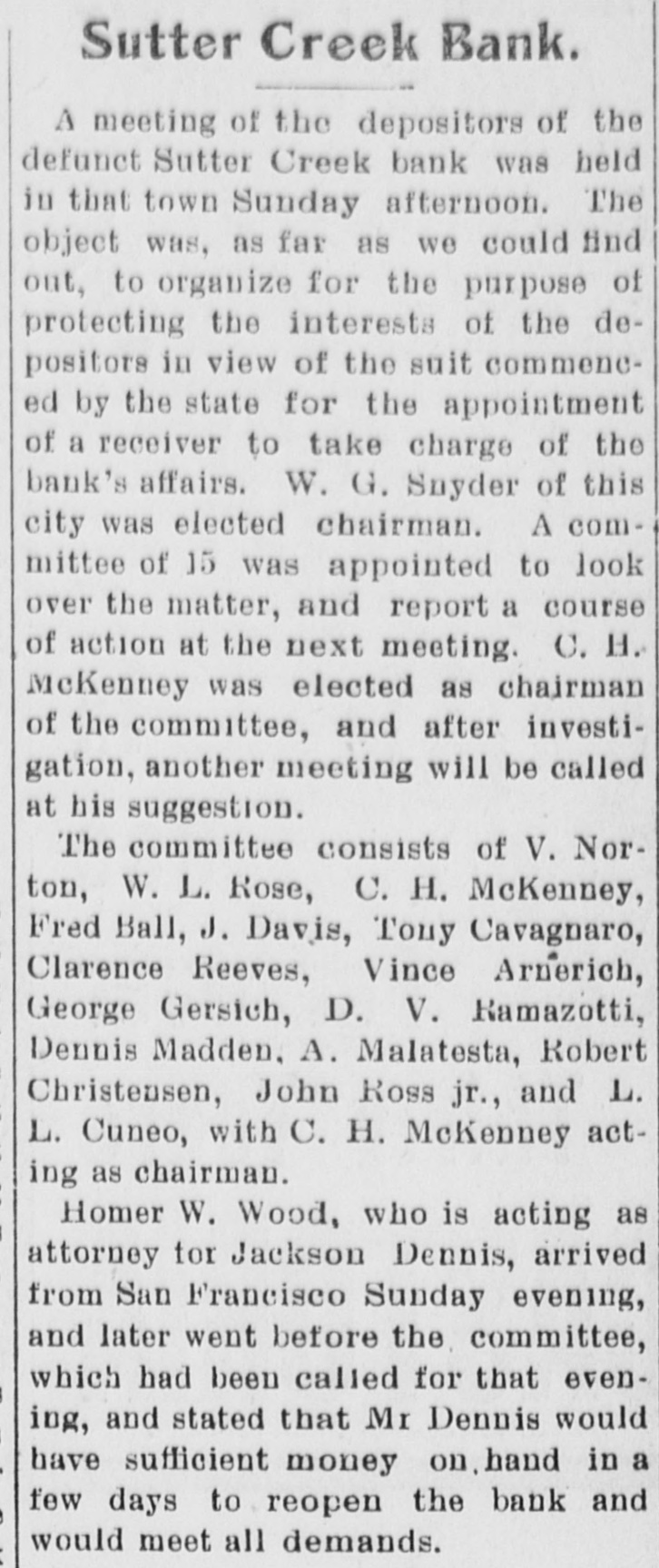
Sutter Creek Bank. A meeting of the depositors of the defunct Sutter Creek bank was held in that town Sunday afternoon. The object was, as far as we could find out, to organize for the purpose of protecting the interests of the depositors in view of the suit commenced by the state for the appointment of a receiver to take charge of the bank's affairs. W. G. Snyder of this city was elected chairman. A committee of 15 was appointed to look over the matter, and report a course of action at the next meeting. C. H. McKenney was elected as chairman of the committee, and after investigation, another meeting will be called at his suggestion. The committee consists of V. Norton, W. L. Rose, C. H. McKenney, Fred Ball, J. Davis, Tony Cavagnaro, Clarence Reeves, Vince Arnerich, George Gersich, D. V. Ramazotti, Dennis Madden. A. Malatesta, Robert Christensen, John Ross jr., and L. L. Cuneo, with C. H. McKenney acting as chairman. Homer W. Wood, who is acting as attorney for Jackson Dennis, arrived from San Francisco Sunday evening, and later went before the committee, which had been called for that evening, and stated that Mr Dennis would have sufficient money on, hand in a few days to reopen the bank and would meet all demands.
4.March 27, 1908Amador LedgerJackson, CA
Click image to open full size in new tab
Article Text
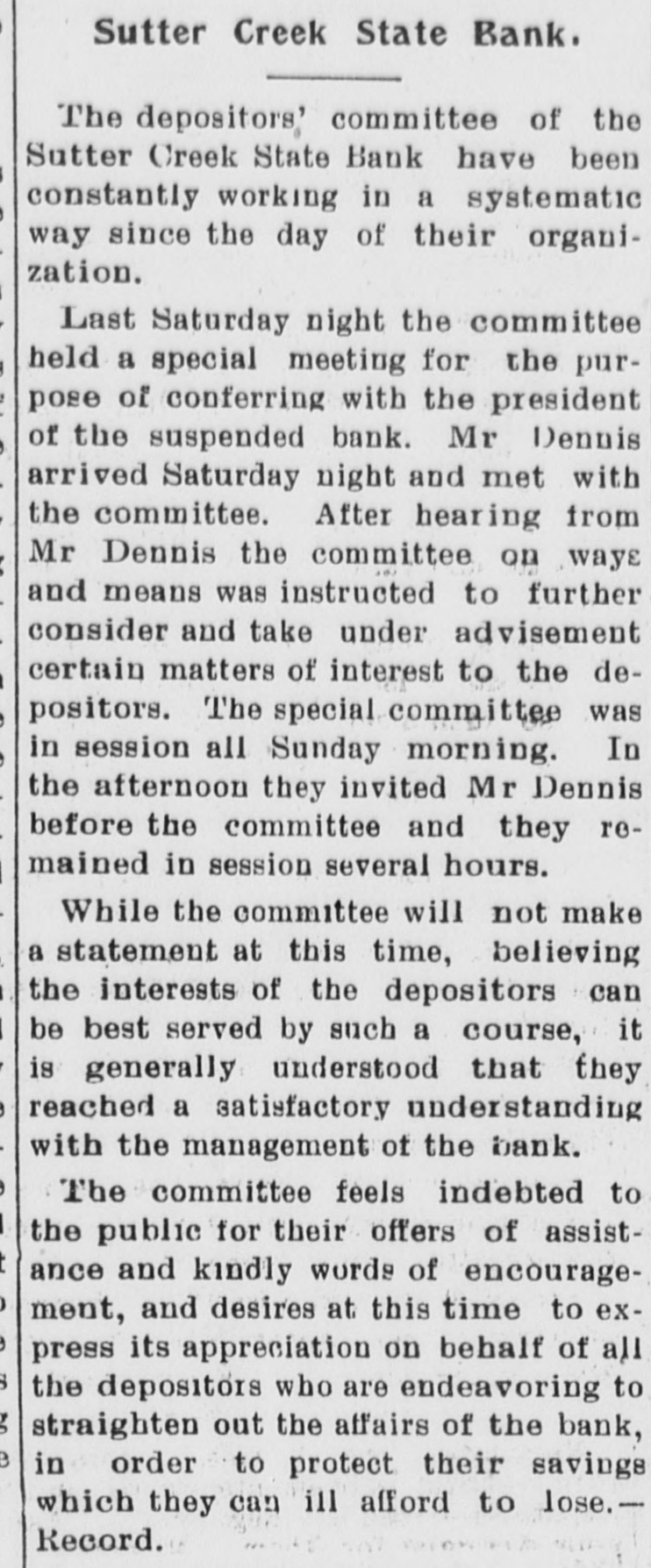
Sutter Creek State Bank. The depositors' committee of the Sutter Creek State Bank have been constantly working in a systematic way since the day of their organization. Last Saturday night the committee held a special meeting for the purpose of conferring with the president of the suspended bank. Mr Dennis arrived Saturday night and met with the committee. After hearing from Mr Dennis the committee on ways and means was instructed to further consider and take under advisement certain matters of interest to the depositors. The special committee was in session all Sunday morning. In the afternoon they invited Mr Dennis before the committee and they remained in session several hours. While the committee will not make a statement at this time, believing the interests of the depositors can be best served by such a course, it is generally understood that they reached a satisfactory understanding with the management of the bank. The committee feels indebted to the public for their offers of assistance and kindly words of encouragement, and desires at this time to express its appreciation on behalf of all the depositors who are endeavoring to straighten out the affairs of the bank, in order to protect their savings which they can ill afford to lose.Record.
5.April 17, 1908Amador LedgerJackson, CA
Click image to open full size in new tab
Article Text
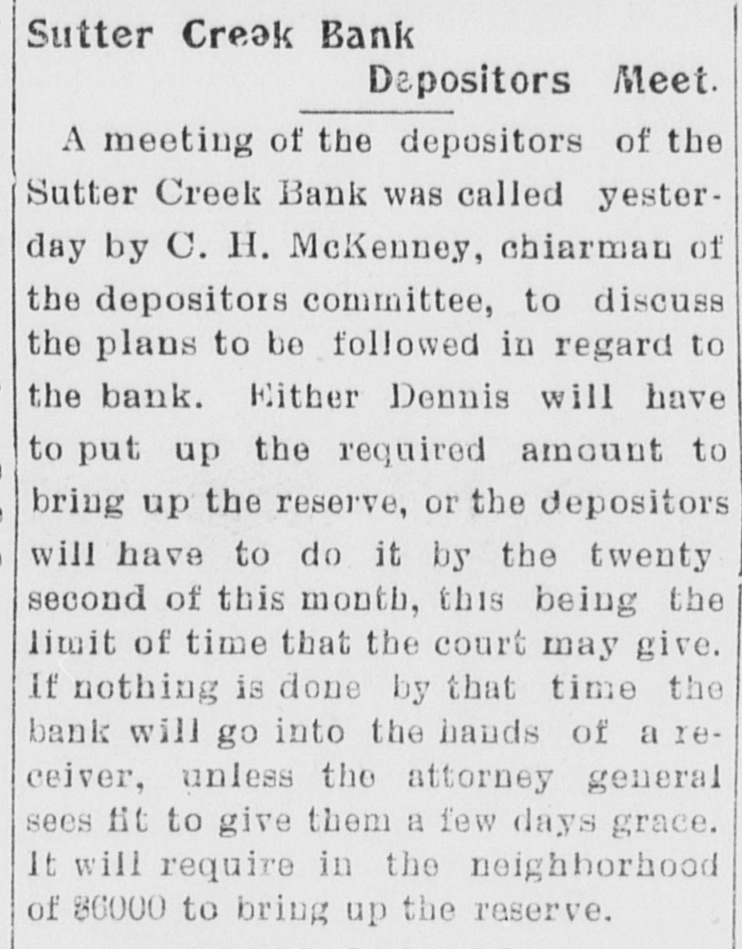
Sutter Creak Bank Depositors Meet. A meeting of the depositors of the Sutter Creek Bank was called yesterday by C. H. McKenney, chiarman of the depositors committee, to discuss the plans to be followed in regard to the bank. Either Dennis will have to put up the required amount to bring up the reserve, or the depositors will have to do it by the twenty second of this month, this being the limit of time that the court may give. If nothing is done by that time the bank will go into the hands of a receiver, unless the attorney general sees fit to give them a few days grace. It will require in the neighhorhood of $6000 to bring up the reserve.
6.April 24, 1908Amador LedgerJackson, CA
Click image to open full size in new tab
Article Text
The Sutter Creek Bank. Last Thursday afternoon a large number of the depositors of the Sutter Creek State Bank met Fin Sutter Creek to discuss the best plans to be followed in regard to the rehabilitation of the bank. The meet ing was called to order by C. H. McKinney, chairman of the committee appointed by the depositors, to look into the attairs of the institution. This committee showed the depositors where most of the securities held by the bank were of value, and that the income from the bonds and the rental of its real estate would pay the running expenses of the bank should they decide to take over the institution. Acting upon their report the depositors unaminously decided that they would assess themselves sufficiently, in the event that Dennis, president of the bank could not raise the required amount, to put the business upon a firm tooting, and that they would run it in the future in their interests. It will require about five or six thousand dollars to bring up the reserve to the percentage set by law. The amount of money on deposit at the time that the bank was closed by the state bank commissioner was about $76,000, and of this amount $73,000 have been signed up by the committee to withhold the drawing of their money as soon as the bank opened, should such be the case. Of the entire amount on deposit this is over 97 per cent, a very good showing for the committee.
7.May 22, 1908Amador LedgerJackson, CA
Click image to open full size in new tab
Article Text
Trial of Case of Sutter Creek Bank. The trial of the case of the People vs. Sutter Creek Bank came up this morning in the superior court. Bank commissioner Lynch was called as a witness and stated that in his opinion the bank was absolutely insolvent. Peter Dabovich, cashier of the bank for the past four years or more, was called and stated that the bank was insolvent. He said that he believed the depositors of the bank would real1Ze between fifty and sixty cents on the dollar. He was asked if he had gone over all the books and traced all the transactions of the insittution, to which he answered that he had done so with the assistance of Fred Eudey. He said they were unable to trace a difference of $10,000 between the book assets and the liabilities. There is also a check of the Ames Manufacturing Company of Niles for $5000, certified to by the bank, which does not appear on the books. The bank premises were reported to the commissioners as being valued at $14,000, but Dabovich stated that they are worth only about $8000, while the stock of the Ames Manufacturing Co. is worth the face value, as are also ail the notes. There is on hand in the bank at the present, or immediately available, about $6,600, besides which between $4000 and $5000 can be raised almost immediately on certain securities. When questioned as to the officers of the bank he gave the name of Jackson Dennis, himself, Geo. Waschter, T. J. Bennets, F. J. Payne, and M. Marks as the directors, leaving out the name of F. N. Soracco, whose name appears in the complaint as one of the directors. He stated that the latter had disposed of his stock in the company about a week before the bank doors were closed, and that the transfer appeared on the books. Soracco tendered his resignation as a director at the time of the transfer, but the board of directors had not met since it was organ:zed into a state bank, so that his name still appeared on the books as a director. Assistant Attorney General Palmer appeared for the people, Wm. J. McGee for the directors, while Attorney Monroe of San Francisco looked after the interests of the depositors. Monroe said that the depositors' committee had done everything in their power to keep the bank out of the hands of a receiver, trying to raise sufficient money to bring the reserve to the amount required by law, but that they had failed ID their efforts. He recommended the appointment of Fred Eudey as receiver on account of his being perfectly acquainted with the banking business, and because he is a disinterested party. The court took the matter under advisement and will probably report its decision this afternoon. Jackson Dennis, president of the bank, was not present at
8.June 19, 1908Amador LedgerJackson, CA
Click image to open full size in new tab
Article Text
SUTTER CREEK BANK ng on Petition to Oust Receiver. hearing on the petition of 1. P. for the removal of the receiver, Eudey, was had in the superior yesterday morning. The peti, 1. P. Allen, was personally it, also Jackson Dennis, the late ent of the defunct concern. R. le appeared as attorney for the oner, and A. Caminetti for the er. A number of Sutter Creek e, interested in the matter as itors or stockholders, were also it during the proceedings. court proceedings were brief. ole read the petition, which set that the petitioner was the of 85 per cent of the liabiliand also 85 per cent of the I stock of the bank. On this ng it was contended the court 1 as a matter of equity dis, the receiver, and allow the oner to assume full charge of Caminetti interposed a der, setting fourth nine or ten ds why the petition was inent to warrant the court in : in the premises. The contenas that there was no authority , to discharge a receiver on the ng made. The bank had been d insolvent, and a receiver had appointed to wind up its affairs, ow a proposition was made to it to resume business simply se 85 per cent of claims and I stock had been gathered into erson's hands. Bole wanted the court to withruling on the demurrer, and he matter on its merits. He sed to show by Mr Allen that than 85 per cent of liabilities ank shares were owned by peti: court interrupted the counsel uire what right the court had hove a receiver under the state ts in this case. The court had possession of the bank, and the er was the officer of the court tect all parties concerned; to . in the assets, and pay out the y to creditors as soon as suttifunds were in his hands to pay dend. A receiver could be re1 for misconduct on a proper ng, but nothing of this kind lleged in this matter. If one ad bought up all the liabilities, act would relieve the receiver much responsibility. But the ng to the court must be made gh the receiver. The court ly intimated that he could not 78 the receiver on any such ds as were presented by the on. The decision on the deer was reserved. to enable the es in interest to get together, ee if some arrangement satisy to all parties could not be of and thereafter presented to the through the receiver. Caminetti stated that as attorney e receiver he was perfectly will) step down and out, if by SO the depositors could be bene. He had no desire to stand in ay of a settlement.
9.July 31, 1908Amador LedgerJackson, CA
Click image to open full size in new tab
Article Text
Sutter Creek Bank. Fred Eudey went below again this week on Sutter Creek bank matters. The depositors have abandoned all hope of straightening out the affairs, and setting the concern on is running feet again. They have reached the conclusion that the attairs must be wound up through the receiver. 1. P. Allen seems to have dropped out of the calculations.
10.August 14, 1908Amador LedgerJackson, CA
Click image to open full size in new tab
Article Text
Sutter Creek State Bank. Frederick Eudey, receiver of the Sutter Creek bank, recently petitioned the court to allow him to return $200 to the bank commissioners, this being an amount which they failed to hold out when they turned over the funds of the bank to the receiver. The cash on hand at that comtime was $6,036.02. When the missioners took charge of the bank and closed its doors they appointed a receiver, agreeing to pay him $400, but through some misunderstanding the commissioners held out only $200, turning over $6,036.20 to the receiver. The court ordered the other $200 paid the commissioners, who in turn will pay it to Soracco. Some time before the closing of the bank V. M. Colt entered into contract with various parties to erect cemetery monuments, the contracts amounting to $1785, the work to be completed at different dates commencing the first of February this year. It is claimed that the bank had a standing agreement with the Vermont Marble Co. of San Francisco, guaranteeing payment of all orders sent in by Colt. Just before the closing of the bank, that institution entered into agreement with Colt whereby they were to furnish the material for completing the monuments, the contracts for the work being turned over to the bank for collection. But before any material was ordered the commissioners closed the bank, so it could not complete the agreement. On account of orders on previous contracts Colt was allowed to overdraw his account $1684.84. Eudey, as receiver, succeeded in making an arrangement with Colt whereby the bank stands less chance of losing the whole amount. He agreed to turn over to Colt the contracts mentioned above, while the latter waives all claims against the bank for the non-completion of its coutract, pays $50 by an accepted order on Carlo Giovannoni payable in thirty days, and also agreed to give Eudey his promissory note for the amount of the overdraft, with interest at seven per cent. On petition of Eudey, the court made an order Wednesday allowing him to complete the agreement. The Vermont Marble Co. has a claim against the Sutter Creek bank for $1062.28 for material furnished Colt on previous orders, the payment of which they claim was guaranteed by P. Dabovich, as cashier of the bank. -mm
11.January 22, 1909Amador LedgerJackson, CA
Click image to open full size in new tab
Article Text
Fred Endey has resigned as receiver of the Sutter Creek Bank in liquidation. His successor will be appointed by the superior court at an early day. Mr Eudey does not feel warranted in devoting his time further to this matter. He has lost one lucrative position already by this business, and he wishes to be free to accept another.
12.February 19, 1909Amador LedgerJackson, CA
Click image to open full size in new tab
Article Text
SUTTER CREEK STATE BANK Receiver's Final Account The final account of Fred Eudey of his administration of the affairs of the Sutter Creek State Bank, shows receipts as follows:
13.February 19, 1909Amador LedgerJackson, CA
Click image to open full size in new tab
Article Text
SUPERIOR COURT PROCEEDINGS HON F. V. WOOD, JUDGE Fred Culbert VS F. A. Orr-Defendant allowed 10 days from Feb. 10, in which to plead to complaint. Estate of Guiseppi Garbarini-Decree establishing notice to creditors. Estate of Margaret Holtz-Continued until February 20. Estate of Patrick McCormick-Decree establishing notice to creditors, Hearing on final account partially had, and further hearing continued until February 20. Estate of D. Podesta-Continued until February 20. Estate of Mary Riek-Order made authorizing the executor to expend a sum not to exceed $500. People VS. Sutter Creek State Bank. - -Fred Eudey files his final account as receiver of said bank; February 26 appointed for hearing same. People vs. Jackson Dennis.-De murrer overruled in the two embezzlement cases, and cases set for trial March 8, to follow the other already set for that date. Estate of Guiseppi A. Garbarini.Final account settled and allowed, decree of distribution granted as follows: One sixth to each of the following: Joseph O., Henry C., and John S. Garbarini, three-sixths : to Joseph G. Garbarini, as executor I of the will of Bianca M. Garbarini, deceased. Estate of P. A. Clute.-Letters of 9 administration granted to John F. I Clute, upon filing bond in the sum of $100; bond filed; notice to creditors I ordered published. Frank S. Oliver, Phil M. Walsh and J. H. Truman all of Alameda county, appointed appraisers. Asa V. Mendenhall VS. U. S. Gregory, as tax collector.-Demurrer - of defendant argued and submitted. New Cases People vs. Jackson Dennis.formation filed Feb. 10 on two charges for embezzlement. People VS P. Dabovich-Information filed on 2 charreges for embezzlement. Estate of David B. Lynch.-Geo. L. Lynch petitions for letters.-Deceased died on the 7th day of February, 1909, in Amador county, leaving personal property in the county of Sonoma, consisting of eleven shares of the capital stock of the Bank of Sonoma county at Petalumna, valued at $160 per share. Hearing set for February 27. The value of the estate does not exceed $1800. Petitioner is a son of deceased, residing at Amador City; and the only other heir is Mary L. Lynch, daughter of deceased, residing at Sutter Creek. Estate of Isaac McClary-Final account filed, hearing set for February 27. F
14.February 26, 1909Amador LedgerJackson, CA
Click image to open full size in new tab
Article Text
$500 attorney fees and cost of suit. and that these be also declared a first lien. People vs. Sutter Creek State Bank. - The hearing on the final report of the present receiver, Fred Eudey, and his resignation as receiver was had this morning. The account was settled as presented, and resignation accepted. C.H. McKinney of Sutter Creek was appointed receiver at the request of the depositors, upon filing a bond in the sum of $50,000.
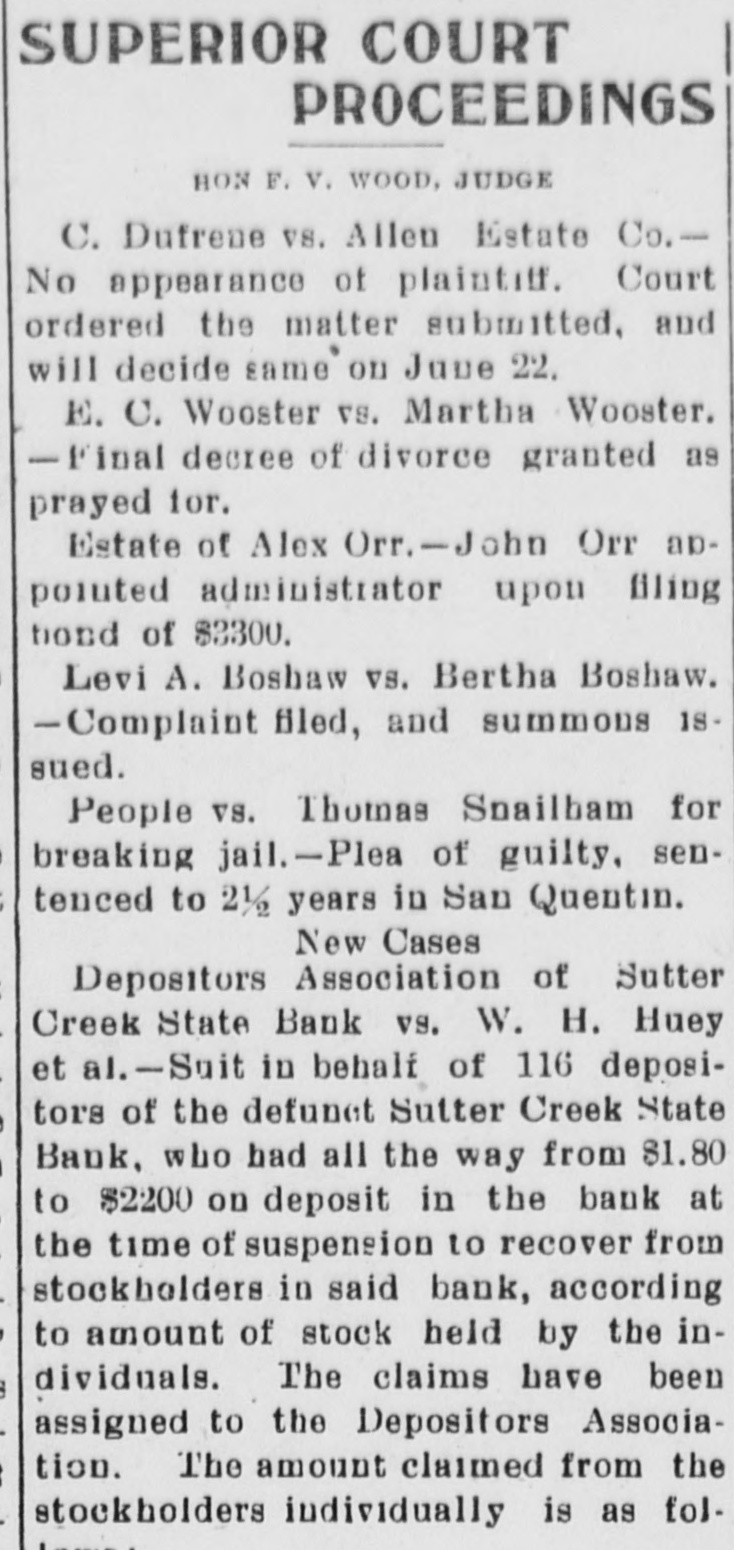
15.June 11, 1909Amador LedgerJackson, CA
Click image to open full size in new tab
Article Text
# SUPERIOR COURT PROCEEDINGS
HON F. V. WOOD, JUDGE
C. Dufrene vs. Allen Estate Co. -
No appearance of plaintiff. Court
ordered the matter submitted, and
will decide same on June 22.
E. C. Wooster vs. Martha Wooster.
-Final decree of divorce granted as
prayed for.
Estate of Alex Orr.-John Orr ap-
pointed administrator upon filing
bond of $2300.
Levi A. Boshaw vs. Bertha Boshaw.
-Complaint filed, and summons is-
sued.
People vs. Thomas Snailham for
breaking jail. -Plea of guilty, sen-
tenced to 2½ years in San Quentin.
New Cases
Depositors Association of Sutter
Creek State Bank vs. W. H. Huey
et al. Suit in behalf of 116 deposi-
tors of the defunct Sutter Creek State
Bank, who had all the way from $1.80
to $2200 on deposit in the bank at
the time of suspension to recover from
stockholders in said bank, according
to amount of stock held by the in-
dividuals. The claims have been
assigned to the Depositors Associa-
tion. The amount claimed from the
stockholders individually is as fol-
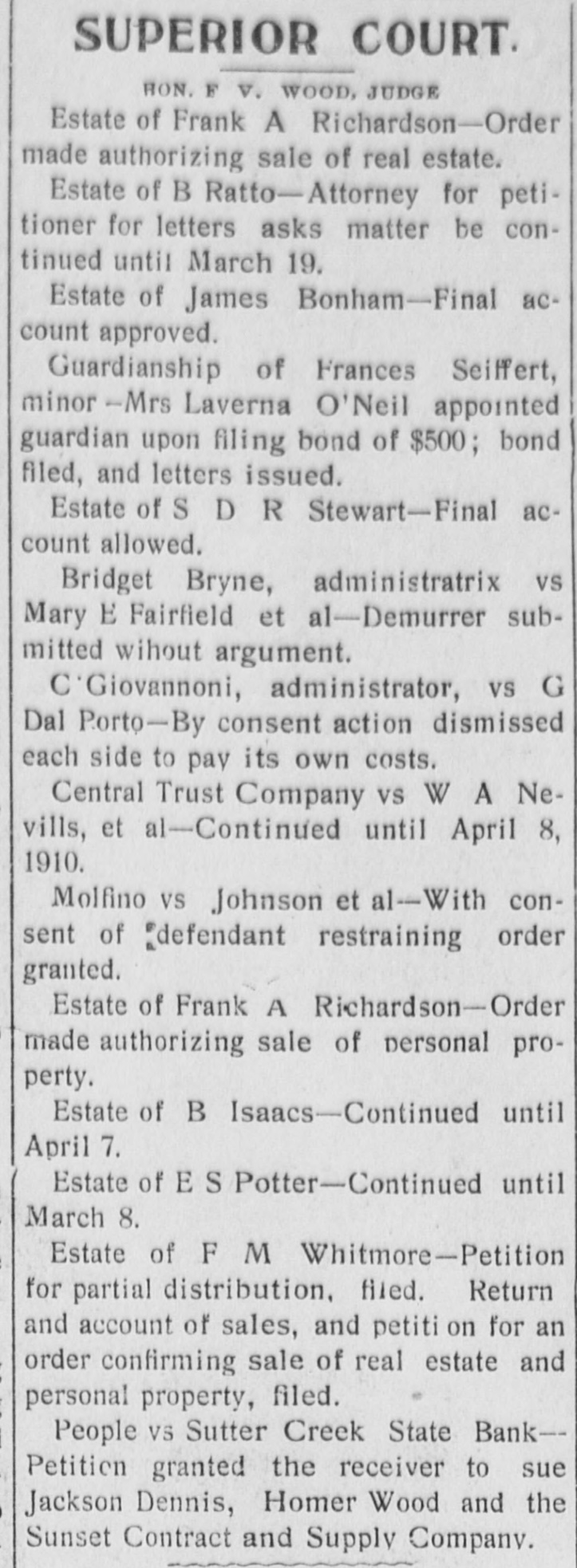
16.March 11, 1910Amador LedgerJackson, CA
Click image to open full size in new tab
Article Text
SUPERIOR COURT. HON. F v. WOOD, JUDGE Estate of Frank A Richardson-Order made authorizing sale of real estate. Estate of B Ratto-Attorney for petitioner for letters asks matter be continued until March 19. Estate of James Bonham-Final account approved. Guardianship of Frances Seiffert, minor-Mrs Laverna O'Neil appointed guardian upon filing bond of $500; bond filed, and letters issued. Estate of S D R Stewart-Final account allowed. Bridget Bryne, administratrix vs Mary E Fairfield et al-Demurrer submitted wihout argument. C'Giovannoni, administrator, vs G Dal Porto-By consent action dismissed each side to pay its own costs. Central Trust Company vs W A Nevills, et al-Continued until April 8, 1910. Molfino vs Johnson et al-With consent of "defendant restraining order granted. Estate of Frank A Richardson-Order made authorizing sale of personal property. Estate of B Isaacs-Continued until April 7. Estate of E S Potter-Continued until March 8. Estate of F M Whitmore-Petition for partial distribution, filed. Return and account of sales, and petiti on for an order confirming sale of real estate and personal property, filed. People vs Sutter Creek State Bank-Petition granted the receiver to sue Jackson Dennis, Homer Wood and the Sunset Contract and Supply Company.
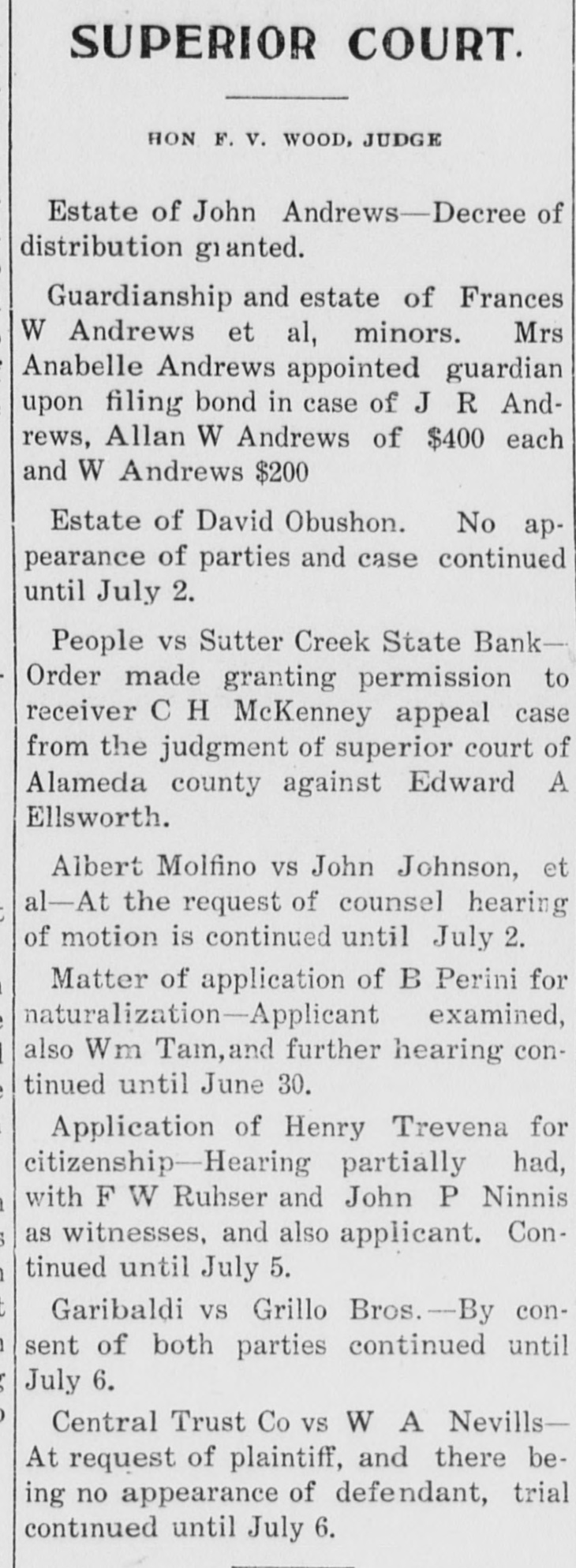
17.July 1, 1910Amador LedgerJackson, CA
Click image to open full size in new tab
Article Text
SUPERIOR COURT. HON F. v. WOOD, JUDGE Estate of John Andrews-Decree of distribution gianted. Guardianship and estate of Frances W Andrews et al, minors. Mrs Anabelle Andrews appointed guardian upon filing bond in case of J R Andrews, Allan W Andrews of $400 each and W Andrews $200 Estate of David Obushon. No appearance of parties and case continued until July 2. People vs Sutter Creek State BankOrder made granting permission to receiver C H McKenney appeal case from the judgment of superior court of Alameda county against Edward A Ellsworth. Albert Molfino vs John Johnson, et al-At the request of counsel hearing of motion is continued until July 2. Matter of application of B Perini for naturalization-Applicant examined, also Wm Tam, and further hearing continued until June 30. Application of Henry Trevena for citizenship-Hearing partially had, with F W Ruhser and John P Ninnis as witnesses, and also applicant. Continued until July 5. Garibaldi vs Grillo Bros.-By consent of both parties continued until July 6. Central Trust Co VS W A NevillsAt request of plaintiff, and there being no appearance of defendant, trial continued until July 6.
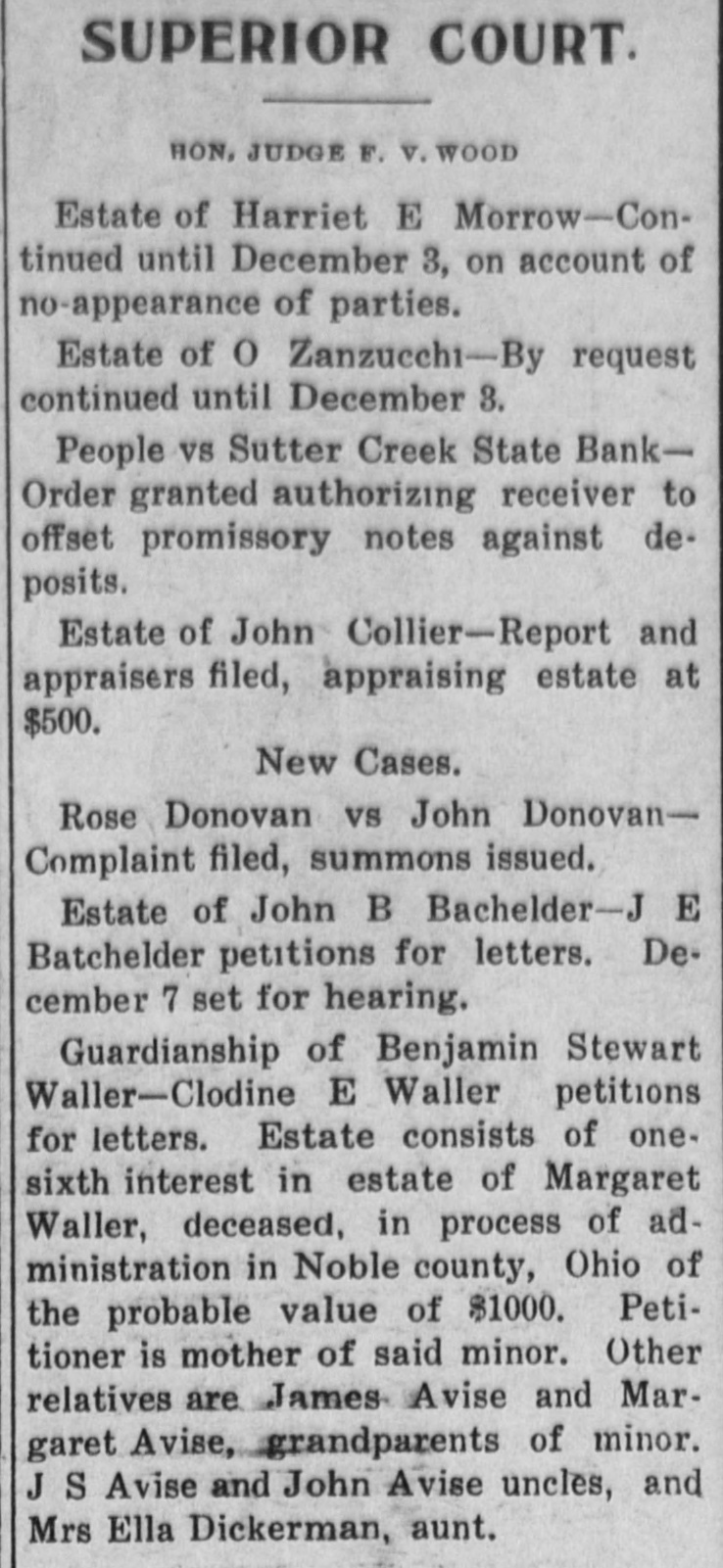
18.November 25, 1910Amador LedgerJackson, CA
Click image to open full size in new tab
Article Text
SUPERIOR COURT. HON, JUDGE F. v. WOOD Estate of Harriet E Morrow-Continued until December 3, on account of no-appearance of parties. Estate of 0 Zanzucchi-By request continued until December 3. People vs Sutter Creek State BankOrder granted authorizing receiver to offset promissory notes against deposits. Estate of John Collier-Report and appraisers filed, appraising estate at $500. New Cases. Rose Donovan vs John DonovanComplaint filed, summons issued. Estate of John B Bachelder-J E Batchelder petitions for letters. December 7 set for hearing. Guardianship of Benjamin Stewart Waller-Clodine E Waller petitions for letters. Estate consists of onesixth interest in estate of Margaret Waller, deceased, in process of administration in Noble county, Ohio of the probable value of $1000. Petitioner is mother of said minor. Other relatives are James Avise and Margaret Avise, grandparents of minor. J S Avise and John Avise uncles, and Mrs Ella Dickerman, aunt.