14146. Mechanics & Traders National Bank (New York, NY)

Bank Information

Episode Type
Run → Suspension → Closure
Bank Type
national
Bank ID
1624
Charter Number
1624
Start Date
January 29, 1908
Location
New York, New York (40.714, -74.006)

Metadata

Model
gpt-5-mini
Short Digest
53b93cb47b93a5b3

Response Measures

Borrowed from banks or large institutions, Full suspension, Books examined

Description

Multiple articles describe runs on the bank during the aftermath of the 1907 panic linked to the Morse-Heinze-Thomas chain and clearing house certificate calls; the bank closed its doors Jan. 30, 1908, and a receiver was later appointed. Cause attributed to clearing house action and association with distressed correspondent/affiliate banks (Morse chain) which led to runs and withdrawal of clearing house support.

Events (5)

1. December 23, 1865 Chartered
Source
historical_nic
2. April 24, 1884 Voluntary Liquidation
Source
historical_nic
3. January 29, 1908 Run
Cause
Correspondent
Cause Details
Runs triggered by association with the Morse-Heinze-Thomas banking chain and prior failure/closing of related Morse banks, and by clearing house actions calling in certificates
Measures
Bank examiners/federal banking authorities later took charge; clearing house advances had been used earlier but were withdrawn
Newspaper Excerpt
after the closing of the National of North America a few days ago, there had been runs upon them
Source
newspapers
4. January 30, 1908 Receivership
Newspaper Excerpt
A receiver was appointed for the Mechanics and Traders, which closed its doors January 30, 1908, leaving $6,300,000 in collateral in the receiver's hands.
Source
newspapers
5. January 30, 1908 Suspension
Cause
Correspondent
Cause Details
Clearing House Committee required return of 'panic' certificates and declined to extend further credit; renewed drain led to inability to meet obligations and forced closure/suspension
Newspaper Excerpt
bank examiners have taken charge of the affairs of the New Amsterdam National and the Mechanics and Traders', a State institution, both of which closed their doors in New York the day before
Source
newspapers

Newspaper Articles (19)

Article from New-York Tribune, April 16, 1879

Click image to open full size in new tab

Article Text

granted; report confirmed and deficiency judgment ordered Middleditch agt. Livingston ; Griggs agt. Norton : Mechan, ics' and Traders' National Bank agt. Miner.- Motions granted and receivers appointed. Starkweather. jr., agt. Bromler.Motion granted without costs. Society for the Reformation of Juvenile Delinquents agt. Allen.-Injunction continued. Fox agt. Willis.-Motion granted. Harris agt, Lisner. Writ of inquiry may issue. In the matter of 155th-st.-Report con. firmed and order granted. Best agt. Staugh.-Report confirmed. Hull agt. the New-York Life Insurance and Trust Company.-Motion denied, In the matter of Robinson.- Report now confirmed and trustee appointed. Palmer agt. Stewars.-Motion granted for the 25th. Morris agt. Pacitic Mail Steamship Company: Conner agt. Corneil: Lewis, jr, agt. Bell : Mahon agt. Chapman.-See memorandams. By Judge Donohue.-Taylor agt. Taylor.-Final decree on accounting granted. Superior Court-Special Term-By Judge Freedman. Beardsley agt. Crowell-Order granted. Broder agt. Lord.Order settled. By Judge Sedgwick.-Gould agt. Kruse et al.-Order of dis. continuance, Grover agt. Buckheisber.-Order granted. Pay, son agt. the Angomar Company et al.-Order discontinuing action. Shethar agt. Reisig.-Order granting motion. Schile agt. Brokhahin.-Undertaking approved. Goldsmith agt. Schloss.-Order filing bond nune pro tune. Bandowine ast, Willis.-Orderof discontinuance. Munsell agt. Flood.-Order of substitution. McKelvey agt. Lewis.-Remittitur filed, Bonyard agt. Le Bess: Lordlard agt. Fleischman.-Orders of discontinuance. Coffe age. Rown; Same agt. Pruneta.-Orders of substitution. Goldschmidt agt. Schloss et al.-Undertaking approved. Van Dyck agt. Jones.-Order opening default. Elumston agt. Ross.-Order denying motion with $10 costs to abide event. Arliton act. Shepard; Davison age, Clarkson Dart agt. Gillis : Kilman art. Bradley: Hesse agt. Briggs: Bennon agt. Herbert; Verplanek agt. Kendall; Collins agt, Jewell: the Continental National Bank ngt. ingate: Assold son agt. Aasoldson; Kruth age. Glinsman; Foiler agt. Lippe. -Orders granted. Common Pleas-Special Term-By Chief-Justice C.P, Daly.-In the matter of the assignment of Parr: Dixon age Sterling: Appleton agt, Hall: Cahill agt, Austin ; Grumm, etc., agt Moehring.-Granted. In the matter of the assign, ment of Deacon to Brewster ; Chamberlain agt. Greenleaf Hart agt. Phelan.-Applications granted. McDonald agt, Bradie and another.-Settled and ordered to be filed. and order signed denying motion. In the matter of the assignment of Levine to Hymes--Application granted. In the matter of the assignment of Rauth & Son to Schiang.-Application denied.
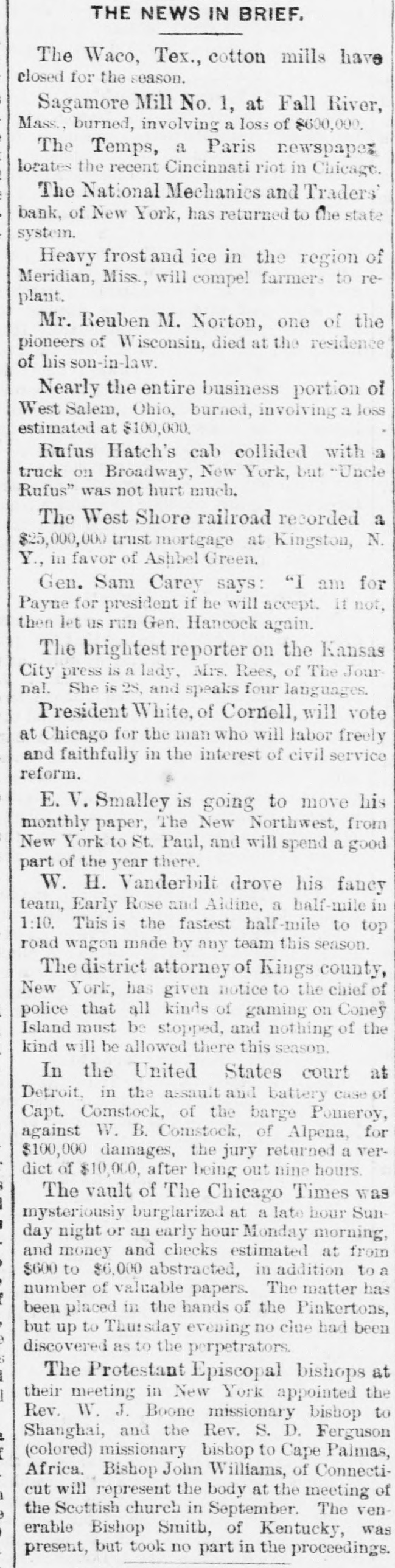


Article from The Rock Island Argus, April 26, 1884

Click image to open full size in new tab

Article Text

THE NEWS IN BRIEF. The Waco, Tex., cotton mills have closed for the season. Sagamore Mill No. 1, at Fall River, Mass., burned, involving a loss of $600,000. The Temps, a Paris newspaper locates the recent Cincinnati riot in Chicage. The National Mechanics and Traders' bank, of New York, has returned to the state system. Heavy frostand ice in the region of Meridian, Miss., will compel farmers to replant. Mr. Reuben M. Norton, one of the pioneers of Wisconsin, died at the residence of his son-in-law. Nearly the entire business portion of West Salem, Ohio, burned, involving a loss estimated at $100,000. Rufus Hatch's cab collided with a truck on Broadway, New York, but "Uncle Rufus" was not hurt much. The West Shore railroad recorded a $25,000,000 trust mortgage at Kingston, N. Y., in favor of Ashbel Green. Gen. Sam Carey says: "I am for Payne for president if he will accept. If not, then let us run Gen. Hancock again. The brightest reporter on the Kansas City press is a lady, Mrs. Rees, of The Journal. She is 28, and speaks four languages. President White, of Cornell, will vote at Chicago for the man who will labor freely and faithfully in the interest of civil service reform. E. V. Smalley is going to move his monthly paper, The New Northwest, from New York to St. Paul, and will spend a good part of the year there. W. H. Vanderbilt drove his fancy team, Early Rose and Aldine, a half-mile in 1:10. This is the fastest half-mile to top road wagon made by any team this season. The district attorney of Kings county, New York, has given notice to the chief of police that all kinds of gaming on Coney Island must be stopped, and nothing of the kind will be allowed there this season. In the United States court at Detroit, in the assault and battery case of Capt. Comstock, of the barge Pomeroy, against W. B. Comstock, of Alpena, for $100,000 damages, the jury returned a verdict of $10,000, after being out nine hours. The vault of The Chicago Times was mysteriously burglarized at a late hour Sunday night or an early hour Monday morning, and money and checks estimated at from $600 to $6,000 abstracted, in addition to a number of valuable papers. The matter has been placed in the hands of the Pinkertons, but up to Thursday evening no clue had been discovered as to the perpetrators. The Protestant Episcopal bishops at their meeting in New York appointed the Rev. W. J. Boone missionary bishop to Shanghai, and the Rev. S. D. Ferguson (colored) missionary bishop to Cape Palmas, Africa. Bishop John Williams, of Connecticut will represent the body at the meeting of the Scottish church in September. The venerable Bishop Smith, of Kentucky, was present, but took no part in the proceedings.


Article from The Times, May 2, 1884

Click image to open full size in new tab

Article Text

VERY LATEST. A FEARFUL CYCLONE IN OHIO. DAYTON, O., April Yesterday afternoon at 4:30 a severe storm, attended with high winds and followed by a heavy fall of hail, passed over this city. A half hour thereafter reports of a cyclone passing south of here in a northwesterly course began arriving, and at this writing the indications are that great destruction has been wrought to property and many people have been killed. Telegraphic communication with the surrounding towns is cut off. the poles being blown down and carried away. The only means at hand to gather facts is by horse and buggy. About eight miles south of here, nearly half a mile of the railroad track of the Toledo, Cincinnati and St. Louis road was torn up and blown away. At Alexanderville and Carrollton, ten miles south of here, houses were raised from the ground and in some instanees entirely torn asunder. In both places about thirty houses were destroyed and damaged. The cyclone was seen to form near these places, and between there and Woodburn, another small town, horses and cattle were killed by the barns falling upon them. Large, stately forests were swept away like blades of grass before a scythe. The trestle-work of the Toledo, Cincinnati and St. Louis road near there, about 500 feet in length, is scattered over the country. At Alexanderville an aged lady named Jackson was badly, and probably fatally, injured. The others are: Ed. Whitley, leg broken; Thos. Harris, head badly cut and arm broken; Robt. Mitchell. badly bruised and internal injuries. Two children are reported fatally injured. From this point the cyclone took a northeastern course, striking Xenia, where the Soldiers' and Sailors' Orphans' home was damaged. All the outhouses were wrecked. Several children were severely injured. Miss Harney, a matron, was seriously injured about the head, and Night Watchman Robinson sustained dangerous injuries. In this part of the county the ruin is appalling. It is impossible to estimate the damage to property and crops. Flouring and saw mills, houses, barns, forests, in fact everything that was in the track of the cyclone were swept away. The track of the storm was over an eighth of a mile in width. Later dispatches state that Jamestown, place of one thousand people,is completely demolished. Not a dozen houses escaped intact, and one hundred of themare razed to the ground. Six persons were killed outright. and about thirty-five persons were injured, nine of them fatally. Numbers took refuge in cellars, and were buried in the debris and had to be dug out. Large brick buildings were blown down, and portions of them carried seven and eight miles distant. One half of the residents of the place are homeless and dependant upon the neighbors for shelter. The street called Xenia avenue,about one mile in length, has not a building left, both sides of the street being stripped. For miles east of Jamestown the roads and fields are strewn with debris from the illfated town. Bed-clothes, furniture, and parts of houses fill the trees. The citizens thereabout and in Xenia have organized relief committees, and are sending out appeals over the state for help. The total loss at Jamestown is between $150,000 and $200,000. Gov. Hoadly has been in the city all day helping the relief fund. The Loretto Convent, at Lindsay, Ont., burned Thursday. Edwin Rice, a leading grain merchant of Paxton, Ills., is dead. The National Mechanics and Traders' Bank of New York has returned to the State system. H. M. Matthews, formerly governor of West Virginia, died at Lynchburg, of erysipelas. The vacant presidency of Bowdoin college has been offered to Professor C. E. Gorman, of Amherst. So severe is the drouth in western Texas that large numbers of cattle are dying for water and grass. Heavy frost and ice in the region of Meridian, Miss., Thursday morning, will compel farmers to replant. E. F. Seaver, postmaster at Reedsburg, Wis., has resigned because of his arrest for embezzlement and forgery. Budger Clawson, a well knownpolygamist of Salt Lake, has been held to the district court on the charge of bigamy. Nearly the entire business portion of West Salem, Ohio, burned Thursday morning, involving a loss estimated at $100,000. Hugh Gaffney, of Baltimore, a noted steeple-chase rider, died of yellow fever in Mexico, where he had gone to train horses. Adulterated tea to the amount of 450 chests was seized at New York on a steamer which arrived from London, Tuesday. George B. Mills has been appointed postmaster at Astoria, Illinois, despite the objections of a prominent politician of Galesburg. D. T. Clover, prosecuting attorney of the common pleas court at Lancaster, Ohio, has been deposed from office for drunkenness. At a charivari at Anoka, Minnesota, someone fired a revolver to increase the din, and accidentally killing a boy named Willie Gray. A cave in the Fullen Colliery, at Maltby, Pa., occurred Thursdav, water flooding the mine and compelling the suspension of work. General Clinton B. Fiske was adjudged guilty of contempt of court at New York Thursday, fined $500, and ordered into custody. The New York assembly, by a vote of 60 to 63, defeated a constitutional amendment to prohibit the manufacture or sale of liquor. James Cunnea, the President of the


Article from Daily Tobacco Leaf-Chronicle, November 13, 1890

Click image to open full size in new tab

Article Text

A MAELSTROM Into Which Several Wealthy Firms Are Drawn. Disastrous Days In the New York Stock Exchange. As Usual Jay Gould is Held Responsible for It. Among Them is C. A. Whitney & Company, Brokers: John T. Walker, Sons & Company, silk Importers, and Decker, Howell & Company, Brokers -Liabilities of the Latter Estimated at $10,000,000. Three Banks Unable to Settle. NEW YORK, Nov. 18.-Monday and Tuesday was two of the most disastrous days in the history of the Stock Exchange. Alarming cablegrains from abroad started the breakup, and as the prices plunged downward numerous firms were forced to assign on account of tight money The banks- the Bank of North America, the North River and the Mechanics' and Traders' at the close of business Tuesday night had difficulty in settling the claims of other banks against them. The first named had a balance of $1,400,000 against it. C.M. Whitney & Company Go Under. One of the most prominent houses on the Exchange went under early in the day, C. M. Whitney & Company, brokers, of 96 Broadway, making an assignment as soon as the county clerk's office opened. The firm was one of the richest in the street. They were known as the Louisiana Whitneys, and represented many southern institutions. including the Whitney National bank. of New Orleans. They were identified heavily and interested in the Toledo and North Michigan railway, and the Hocking Coal and Iron company, and Texas Pacific. The liabilities were given in round numbers at $850,000.* John T. Walker, Sons & Company. A second failure. one for $1,000,000, was announced. Great surprise was expressed when it became known that John T. Walker. Sons & Company, importers of silk at No. 81 Pine street, had made a general assignment to William T. Ryle, of the firm of William Ryle & Company, in the same line of business at No. 54 Howard street. The assignment was drawn up Monday night and filed the first thing Tuesday morning in the county clerk's office. The cause of the failure was the inability of Nightingale Brothers & Knight, of Paterson, N.J., silk manufacturers, to liquidate their liabilities to the firm. The firm is rated by Dun & Company at over $300,000. Deeker, Howell & Company. Just after 2:15 p. m. the failure of Decker, Howell & Company, of No. 44 Broadway, was announced in the Stock Exchange. The firm is one of the largest on the exchange, and was considered very wealthy. It had been identified for years with the movements of the Villard stocks, and were generally considered Villard's special brokers. The failure was considered the cloud that had been hanging over the market. and after it was announced a rally of 1 1 to 2 per cent. occurred. W. Nelson Cromwell, the assignee of the firm, made the following statement concerning its affairs late in the afternoon: The liabilities are about $10,000,000. and the assets, at the present market price, largely exceed that sum.' David Richmond Goes Down. David Richmond, stock broker at 38 New street. made an assignment to Frank L. Requa. Mr. Richmond has been a member of the Stock Exchange since 1870. A number of smaller firms also went down in the crash. Money was exceedingly hard to get at enormously high rates, and confidence was not exhibited in any quarter. Tuesday night it was thought that the worst was over and that things would settle themselves into the usual channel. Rumors were current that the Vanderbilts would come forward and sell $10. 000.000 in bonds to the government and thus ease the market. Jay Could Blamed. The trobule was laid to Jay Gould Wall street has for years looked upon Mr. Gould as its evil genius. Any decline in stocks. any stringency of money. is at once ascribed to his wicked machinations. The method of explaining away disagreeable events is popular in Wall street, because it saves thought. Tuesday his name was on many lips, and was not joined with blessings, but with maledictions. Mr. Gould was quoted as having said that he had 'got what he wanted in Union Pacific. These things seem to give authenticity to reports which have been in circulation of late, that Mr. Gould was trying to depress the market with a view to acquiring stocks.


Article from Wood County Reporter, February 6, 1908

Click image to open full size in new tab

Article Text

NEW YORK BANKS FAIL. New Amsterdam National and the Mechanics and Traders Are Hit. Bank examiners have taken charge of the affairs of the New Amsterdam National and the Mechanics and Traders'. a State institution. both of which closed their doors in New York the day before. These banks were in the Morse-HeinzeThomas chain, and after the closing of the National of North America a few days ago, there had been runs upon them. Both were unable to take up their allotment of the certificates which the clearing house issued during the stringency beginning in October, and when the renewed drain upon their resources began the clearing house authorities declined to extend their credit. Although the closing was expected among the bankers and wellinformed men in the financial world it found many of the depositors unprepared and caused them inconvenience. As a result several other banks not in the important class met with heavy withdrawals of deposits. One of these was the Oriental, where a rush began as soon as the office was opened for business. Depositors were paid promptly.


Article from Twice-A-Week Plain Dealer, February 7, 1908

Click image to open full size in new tab

Article Text

America, the New Amsterdam bank and the Mechanics and Traders'. The Morse-Heinze-Thomas connection with these banks had weakened public confidence, and it was feared that runs would be made which the institutions could not meet. Therefore as a safeguard they were placed in the hands of the federal banking authorities. All are said to be solvent, and it was expected that depositors would be paid in full and that the banks would be able to resume business in a short time. After withstanding a run on the previous day and fearing a continuance, the directors of the Oriental bank decided to close its doors and turn the bank over to the state banking officials. The reason for this action was the disclosure at the clearing house of a debit balance of $939,000. # Steel Trust's Big Earnings. Despite the unfavorable showing of the last quarter of the year, the records of the steel trust show that its profits for 1907 were $160,984,477, which is over $6,000,000 in excess of the previous high water mark, reached in 1906. The October earnings, immediately preceding the financial and industrial disturbance, were the largest in the history of the corporation. The directors have declared dividends for the last quarter of the year of 1¼ per cent on the preferred and one-half of 1 per cent on the common stock. The first five years of the profit sharing plan of the trust have nearly closed, and it is reported in Wall street that those of its employees who have continuously held the preferred stock purchased when the plan was first announced in 1903 will receive an extra dividend of 65.4 per cent. # McCurdy Laughs at Suits. Richard A. McCurdy, former president of the Mutual Life Insurance company, who has spent two years in Europe, recently returned to his home in Morristown, N. J. When asked about the suits for the restitution of several million dollars which the management of his old company had brought against him he laughed and said: "I have lawyers, and they will take care of the suits. They are not worth talking about. I am seventy-three years old. The real question is, Which will last the longer, the suits or myself?" # Pittsburg Exchange Opens. The Pittsburg Stock Exchange, closed since Oct. 23 last, opened for business Jan. 27. There was a tendency on the part of the brokers to withhold sales, and only 271½ shares changed hands. The reopening of the exchange has already restored confidence to a notable degree. # Morse Lines Ask Receivership. In order to prevent various creditors from applying for a receivership on their own account the controlling interests and the bondholders' committee of the Consolidated Steamship lines, the Charles W. Morse $120,000,000 combine, have applied for a receiver for the Consolidated and the two weakest of its subsidiary lines, the Metropolitan and Eastern Steamship companies. These proceedings do not affect the Mallory, Clyde, New York and Porto Rico and New York and Cuba lines, which are also subsidiaries of the Consolidated. # Morgan Takes More Bonds. The New York city officials have decided to sell $50,000,000 in bonds, having arranged with J. Pierpont Morgan for the underwriting of the issue. It is expected that these bonds will be put on the market in a few days. Their proceeds will be used in carrying out needed public improvements.


Article from Wausau Pilot, February 11, 1908

Click image to open full size in new tab

Article Text

NEW YORK BANKS FAIL. New Amsterdam National and the Mechanics and Traders Are Kit. Bank examiners have taken charge of the affairs of the New Amsterdam National and the Mechanics and Traders'. a State, institution, both of which closed their doors in New York the day before. These banks were in the Morse-HeinzeThomas chain, and after the closing of the National of North America a few days ago, there had been runs upon them. Both were unable to take up their allotment of the certificates which the clearing house issued during the stringency beginning in October, and when the renewed drain upon their resources began the clearing house authorities declined to extend their credit. Although the closing was expected among the bankers and wellinformed men in the financial world it found many of the depositors unprepared and caused them inconvenience. As a result several other banks not in the important class met with heavy withdrawals of deposits. One of these was the Oriental, where a rush began as soon as the office was opened for business. Depositors were paid promptly.


Article from The Boise Citizen, February 14, 1908

Click image to open full size in new tab

Article Text

THE RAID ON NEW YORK BANKS. That the panic was caused by the Rockefeller-Morgan combine for the purpose of getting control of numerous New York banks and punishing their enemies is becoming more evident every day. The Clearing House Committee is dominated by these interests and is now arbitrarily refusing aid to one bank after another that the interests cannot control. The ultimate object is a banking trust in New York that will seek to control the financial policy of the nation. These men never cease in their endeavor for special privileges and power and it behooves the American people to become aroused to the true situation. Regarding the closing of three banks last week in New York the Morming Telegraph discloses the conspiracy in the following editorial: "Certain features of the "cleaning up"-such is the expression used by the cleansers themselves-of the New Amsterdam and Mechanics & Traders' and Oriental banks are not exactly plain to the superficial observer. What is there behind the refusal of the Clearing House to accord further privileges to the banks which are members of the association? Also, what does it profit a bank to belong to a Clearing House if it has to be on a continual defensive toward all the other members? Further inquiry is also pertinent. Why are not some eight or ten other banks proceeded against as radically and drastically as were the New Amsterdam and Mechanics & Traders'? There are other institutions enjoying Clearing House privileges today which are no stronger on their financial underpinning than were these two. Both of these were admittedly solvent. Reports thus far show that both will pay out and pay out in full. The Clearing House Committee itself The Morning Telegraph dislikes to hold responsible, esteeming the members to be in the decay of their intelligences or they would not be retired to their present positions. They represent not their own views; not their own financial interests, but are there to represent others and do as they are bidden. The Clearing House Committee, under direction, has caused runs on various banking institutions by asserting the shakiness of these concerns, and then fearing the ultimate result temporarily stayed the progress of the destruction they had organized. It was decided to take them in series. There is no banking institution, probably, however solvent it may be, that could successfully withstand a run if left to its own cash resources. In an interview last week Mr. John D. Rockefeller said: "Mr. Morgan and I have been described by the newspapers as being very wicked men, yet Mr. Morgan and I saved fourteen banks from being wrecked and stood behind seventy others during the late panic. That was a pretty fine thing for two such wicked men to do," smugly concluded Mr. Rockefeller. He did not add that every dollar of Mr. Morgan's money, or money of which he had control, and every dollar of Standard Oil money which went to plug up the holes was returned with interest at anywhere from 20 to 150 per cent when demanded, and was replaced in the original lending by securities of twice its value. Also, currency was at a premium of 3 per cent over night, SO that if a man were young enough and strong enough; arose early in the morning and remained up late at night, with a large bank fromor, let us say, the United States Treasury to refresh his capital-he might turn his money over in the twenty-six working days of the month. Rockefeller and Morgan did a very nice thing, but they were nicely paid. And now the banks are going three at a time instead. That is a side issue, however. What we would like to understand, and we are not solitary in this desire, is why the Clearing House Committee did not earlier shut down on these recently closed banks? If they needed money two months ago and were held up and were furnished with it, why cut off the supply? It looks something like malicious mischief. The Mechanics & Traders, had six million dollars' securities at the Clearing House, as against a debit balance of less than two millions. That left quite a bulwark for advances with securities as they are at the lowest prices. Mr. Sullivan, president of the Mechanics & Traders', said that he was told some time ago if he would resign his bank would be heldup. He declined on the ground that he owned the majority of the stock and did not care to have his property administered upon by the clerk or creature of some other banker, or association of bankers. Mr. Sullivan feared the wolves. Mr. Sullivan's statement is supported by a similar assertion; cold clammy and detailed by a member of the Clearing HouseCommittee. Mr. Sullivan would not submit and his privileges were cut off. Since the pulling down of the curtains in The Mechanics & Traders', one of the oldest financial institutions of the city, Mr. Sullivan has signified a willingness to withdraw from the active management of his bank, if reopened, and reopened it doubtless will be, as there never was any reason for closing it which has not existed for two months and which does not apply with equal force to many other banks. The more the situation is studied the more the conclusion is irresisP tibly fastened that the war is one of aggrandizement by individuals against other individuals. The first attack was SO sudden and so strong that the assailants themselves were frightened. They decided, after several hurried conferences, to go out after the other persons and interests in detail instead of in mass. The enterprise as originally planned was too great. In six months we may have a banking trust to add to the list of "predatory" concerns. For several weeks we have sent in a list of five subscriptions to The Commoner and a few to The Public, Lewis F. Post's journal of fundamental Democracy, and to The Investigator, of Omaha, Tom Tibbles' paper THE CITIZEN is pleased to consider itself in a small de-


Article from The Evening World, June 7, 1912

Click image to open full size in new tab

Article Text

small bank uptown would fit him to say that 60 per cent. of the out of town checks are on the so-called discretionary points? A. Yes; he is a student of banking. Q. Did you make this statement just now because you thought the facts printed In The World would hurt the Clearing House? A. No. I don't think the Clearing House can be hurt. Mr. Untermeyer raised his eyebrows. "You don't think," he asked, "that It is in the power of any one to hurt the Clearing House?" "Not by the statements published," replied Mr. Sherer. Q. But do you say that if this Clearing Mouse is levying an excessive and outrageous tribute upon the American people that the law cannot stop it-that the law cannot forbid such oppression and injustice? A. on, yes, if it is oppressive and unjust. Q. Have you talked with any member of the Clearing House Committee since you testified yesterday? A. With Mr. Vanderlip. Q. He was very much disturbed, was he not, and wanted you to "correct" what he considered a most unfortunate admission? A. No. but he suggested that I have it revised. I had made up my mind to do that anyway. ASKS ABOUT MORAL ASPECT OF THE RULE. Mr. Untermyer wanted to know how Mr. Sherer regarded the legal and moral aspects of the Clearing House banks being bound by the minimum collection charges rule. "What better right have the banks to do this than for manufacturers to get together and fix a price for their products?" asked Mr. Untermyer. "Well," said Mr. Sherer, "the charge is for a service. Carpenters, plumbers, and others have a moral as well as legal right to organize and fix a minimum price for their services. Any class rendering a service has that right." There was a laugh as Mr. Untermyer exclaimed: "Oh, then you want to pass under the labor union rule?" Q. What greater right have the banks to do what they are doing then railroads would have to fix a minimum charge for their services? A. The railroad has the grant of eminent domain -can run right through my home If It sees fit. It lays Its tracks over several States. It has privileges granted to It by the public and owes the public certain duties in return. Q. Are they not under the control of the national Government? A. But in very different ways. 1 Q. Both are engaged in interstate commerce? A. I could not say that. Q. Both are instruments of Interstate commerce? A. Yes. Mr. Sherer was questioned at length about the Clearing House certificates issued during the 1907 panic. He said the total was $101,060,000. In an effort to show how the withdrawal of Clearing House support could close the doors of a bank, Mr. Untermyer displayed a copy of a letter sent to four banks late in January, 1908, requiring them to withdraw their Clearing House "panic" certificates by Feb. 6 following. The four banks were the Oriental, the Mechanics and Traders, the National of North America and the New Amsterdam.


Article from Northern Wisconsin Advertiser, June 14, 1912

Click image to open full size in new tab

Article Text

SOUND BANKS WERE FORCED TO CLOSE Clearing House Denied Help at Critical Times. RESULTED IN KELLY'S DEATH "Money Trust" Investigation Develops Tragedy of "High Finance" and Cause of Failure of Four Big Institutions. New York, June 10.-Testimony on Friday intended to show how the power of the New York clearing house committee was used to force a solvent bank to the wall during the aftermath of the panic of 1907, with the result that the "fair reputation" of its president was "blasted," was presented dramatically before the Pujo committee of the house of representatives which is investigating the so-called money trust. Witnesses told how Hugh Kelly, after being induced by members of the clearing house to assume the presidency of the Oriental bank, was denied help at a critical time, the bank being forced to suspend. This, it is declared by friends, was the direct cause of the death of Mr. Kelly eight months later. R. W. Jones, himself broken in health, produced a letter soon after he had been called to the witness stand by Samuel Untermyer, counsel to the committee. Mr. Jones was president of the Oriental bank when the financial cyclone of 1907 swept over New York. According to his testimony and that of Erskine Hewitt, son of the late Abraham Hewitt, and Charles K. Beekman, both of whom were directors of the ill-fated bank-Mr. Hewitt also being its counsel-the clearing house committee of.the New York Clearing House association, prescribed conditions for the conduct of the Oriental bank which made it impossible for it to survive. And so it was driven to the wall, although as shown by its assets, it was perfectly solvent. Their statements indicate that as soon as President Jones met one requirement made by the clearing house committee that organization would prescribe a new one, until finally it Issued its ultimatum that nothing would be done to aid the Oriental unless Jones resigned the presidency and was succeeded by Hugh Kelly. The Oriental was one of the oldest banks in New York and was a charter member of the clearing house. The two Morse banks-the National of North America and the New Amsterdam-and the Mechanics and Traders went down to ruin with the Oriental. The Brooklyn bank and the Borough bank of Brooklyn had closed previously when the Oriental was ordered to cease clearing for them. Mr. Kelly accepted the presidency under protest and only after he had been solemnly assured, according to the sworn testimony of the witnesses mentioned, that the clearing house would stick to the Oriental "to the last ditch." This stern demand was made by the clearing house committee in the latter part of October, 1907, when President Jones lay unconscious and struggling for his life from an attack of pneumonia at his home. Soon after Mr. Kelly reluctantly assumed the Oriental's presidency he and the board of directors took advantage of the privileges extended to all members of the clearing house in that crisis to borrow clearing house certificates. The amount was $1,750,000 which was secured by quick assets of $3,600,000. On January 25, 1908, according to the testimony of all three witnesses the Oriental bank, as did also the two Morse banks and the Mechanics and Traders, received word from the clearing house committee to return the clearing house certificates not later than February 6. News of the calling of these certificates was published in some of the newspapers the next day. Then the fierce tornado broke afresh over the four financial institutions and they went down three months after Mr. Kelly had assumed control of the Oriental. Mr. Kelly died of a broken heart eight months later.


Article from Rock Island Argus, September 20, 1912

Click image to open full size in new tab

Article Text

MORSE WILL HAVE REVENGE ON J.P. New York Convict Banker Promises to Bare Plot to Ruin Him. New York, Sept. 20.-Charles W. Morse will go before the house committee on banking and currency which is investigating the money trust when its hearings are resumed here in the middle of November and tell for the first time the full story of what he is convinced was a carefully laid plot by a powerful group of financiers to ruin him. He is expected to take revenge on J. Pierpont Morgan. Deputy Sergeant-at-Arms White of the house of representatives is supposed to have served Morse and Morgan today with subpoenas to appear before the committee. The house officer is known to have come to New York with subpoenas for Morgan and Morse, William Rockefeller, James Stillman, Thomas F. Ryan, George F. Baker, president of the First National a bank; Otto T. Bannard, president of d the New York Trust company; William e A. Nash and Walter E. Frew, respec₫ tively, chairman of the board and president of the Corn Exchange bank. Morse is expected to relate a more a sensational story regarding the operad tions of the alleged money trust than has yet been told by witnesses directly examined as to the cause of the l failure of the Oriental and Morse banks in spite of the absolute solvency of all of those institutions. Morse has suffered a term in the penitentiary on d an indictment charging him with criminally mismanaging his banks. y While undergoing in the federal O prison at Atlanta a term of 15 years d he stubbornly maintained that silence which characterized his skyrocket caS. reer as a "high financier." But since S his restoration to freedom and to health it is stated by several of his friends that he is anxious to be placed e on the witness stand before the cond gressional probers to tell the story under oath and in detail, a William A. Nash and Walter A. y Frew. who are to be summoned, are subject to the jurisdiction of the comy mittee by reason of their service on the clearing house committee. Mr. Nash was a member of that all-powd erful organization in 1907 when the committee took charge of the financial situation during the panic and has ty been charged by witnesses heretofore examined in the money trust investirt gation with participating in confer10 ences that preceded the closing of the e old Oriental National bank, which so quickly was followed by the collapse ts of what was known as the Morse banks e --the National of North America, the ed New Amsterdam and the Mechanics' r& Traders'. Mr. Frew is now a member of the clearing house committee. William Rockefeller could not be served with a subpoena when the comds mittee was holding its sessions last he spring. At that time it was charged e that he had suddenly gone to Canada re to evade service. His health then was al not good. It is reported that he has es sufficiently recovered to be able to In stand the ordeal of an examination by re Samuel Untermyer, chief counsel of d. the congressional committee. J. P. Morgan went to Europe before he could be served with a subpoena and returned only a few weeks ago. 0 Major E. H. Farrar, leader of the OX, New Orleans bar and recently presite dent of the American Bar association a is associated with Mr. Untermyer as hicounsel. Major Farrar has been in atNew York for the last two weeks co! gn laborating with Mr. Untermyer in the th work of preparation for the resumption to of the investigation after the election in November


Article from Manchester Democrat, September 25, 1912

Click image to open full size in new tab

Article Text

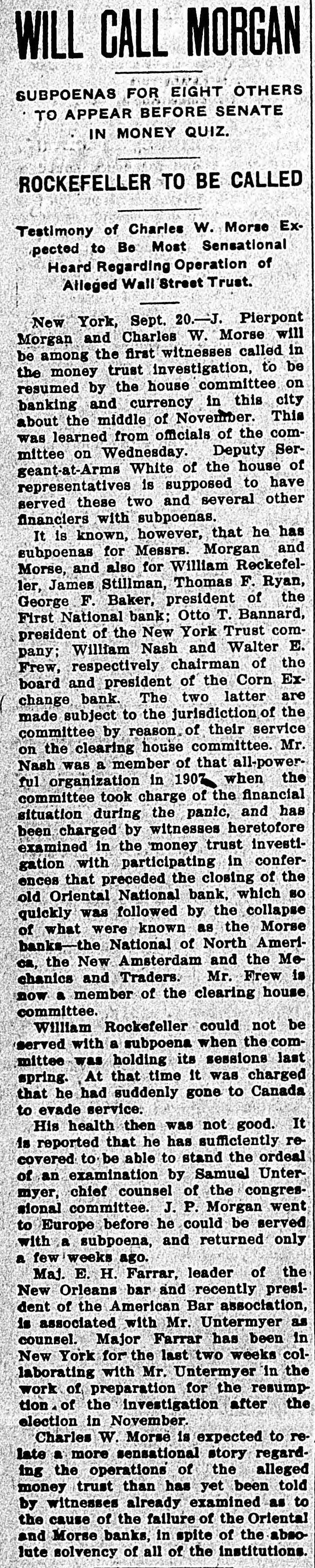
WILL CALL MORGAN SUBPOENAS FOR EIGHT OTHERS TO APPEAR BEFORE SENATE IN MONEY QUIZ. ROCKEFELLER TO BE CALLED Testimony of Charles W. Morse Expected to Be Most Sensational Heard Regarding Operation of Alleged Wall Street Trust. New York, Sept. 20.-J. Pierpont Morgan and Charles W. Morse will be among the first witnesses called in the money trust investigation, to be resumed by the house committee on banking and currency in this city about the middle of November. This was learned from officials of the committee on Wednesday. Deputy Sergeant-at-Arms White of the house of representatives is supposed to have served these two and several other financiers with subpoenas. It is known, however, that he has subpoenas for Messrs. Morgan and Morse, and also for William Reckefeller, James Stillman, Thomas F. Ryan, George F. Baker, president of the First National bank; Otto T. Bannard, president of the New York Trust company; William Nash and Walter E. Frew, respectively chairman of the board and president of the Corn Exchange bank. The two latter are made subject to the jurisdiction of the committee by reason of their service on the clearing house committee. Mr. Nash was a member of that all-powerful organization in 1907, when the committee took charge of the financial situation during the panic, and has been charged by witnesses heretofore examined in the money trust investigation with participating in conferences that preceded the closing of the old Oriental National bank, which so quickly was followed by the collapse of what were known as the Morse banks-the National of North America, the New Amsterdam and the Mechanics and Traders. Mr. Frew is now a member of the clearing house committee. William Rockefeller could not be served with a subpoena when the committee was holding its sessions last spring. At that time it was charged that he had suddenly gone to Canada to evade service. His health then was not good. It is reported that he has sufficiently recovered to be able to stand the ordeal of an examination by Samuel Untermyer, chief counsel of the congressional committee. J. P. Morgan went to Europe before he could be served with a subpoena, and returned only a few weeks ago. Maj. E. H. Farrar, leader of the New Orleans bar and recently president of the American Bar association, is associated with Mr. Untermyer as counsel. Major Farrar has been in New York for the last two weeks collaborating with Mr. Untermyer in the work of preparation for the resumption of the investigation after the election in November. Charles W. Morse is expected to relate a more sensational story regarding the operations of the alleged money trust than has yet been told by witnesses already examined as to the cause of the failure of the Oriental and Morse banks, in spite of the absolute solvency of all of the institutions.


Article from The Greenville Journal, September 26, 1912

Click image to open full size in new tab

Article Text

PROBE MONEY TRUST HOUSE COMMITTEE INVESTIGATION TO BE THOROUGH. Charles W. Morse and J. Pierpont Morgan Among Prominent Men Men to Be Called. New York, Sept. 20.-Among the first witnesses to be called in the money trust investigation, to be resumed by the house committee on banking and currency in this city about the middle of November, will be J. Pierpont Morgan and Charles W. Morse. This was learned from officials of the committee. Deputy Ser geant-at-Arms White of the house of representatives is supposed to have served these two and several other financiers with subpoenas. It is known, however, that he has subpoenas for Messrs. Morgan and Morse, and also for William Rockefeller, James Stillman, Thomas F. Ryan, George F. Baker, president of the First National bank; Otto T. Bannard, president of the New York Trust company; William Nash and Walter R. Frew, respectively chairman of the board and president of the Corn Exchange bank. The two latter are made subject to the jurisdiction of the committee by reason of their service on the clearing house committee. Mr. Nash was a member of that all-powerful organization in 1907, when the committee took charge of the financial situation during the panic, and has been charged by witnesses heretofore examined in the money trust investigation with participating in conférences that preceded the closing of the old Oriental National bank, which so quickly was followed by the collapse of what were known as the Morse banks-the National of North America, the New Amsterdam and the Mechanics and Traders. Mr. Frew is now a member of the clearing house committee.


Article from River Falls Journal, September 26, 1912

Click image to open full size in new tab

Article Text

PROBE MONEY TRUST HOUSE COMMITTEE INVESTIGATION TO BE THOROUGH. Charles W. Morse and J. Pierpont Morgan Among Prominent Men Men to Be Called. New York, Sept. 20.-Among the first witnesses to be called in the money trust investigation, to be resumed by the house committee on banking and currency in this city about the middle of November, will be J. Pierpont Morgan and Charles W. Morse. This was learned from officials of the committee. Deputy Ser geant-at-Arms White of the house of representatives is supposed to have served these two and several other financiers with subpoenas. It is known, however, that he has subpoenas for Messrs. Morgan and Morse, and also for William Rockefeller, James Stillman, Thomas F. Ryan, George F. Baker, president of the First National bank; Otto T. Bannard, president of the New York Trust company; William Nash and Walter R. Frew, respectively chairman of the board and president of the Corn Exchange bank. The two latter are made subject to the jurisdiction of the committee by reason of their service on the clearing house committee. Mr. Nash was a member of that all-powerful organization in 1907, when the committee took charge of the financial situation during the panic, and has been charged by witnesses heretofore examined in the money trust investigation with participating in conferences that preceded the closing of the old Oriental National bank, which so quickly was followed by the collapse of what were known as the Morse banks-the National of North America, the New Amsterdam and the Mechanics and Traders. Mr. Frew is now a member of the clearing house committee.


Article from The Progressive West Virginian, September 26, 1912

Click image to open full size in new tab

Article Text

PROBE MONEY TRUST HOUSE COMMITTEE INVESTIGATION TO BE THOROUGH. Charles W. Morse and J. Pierpont Morgan Among Prominent Men Men to Be Called. New York, Sept. 20.-Among the first witnesses to be called in the money trust investigation, to be resumed by the house committee on banking and currency in this city about the middle of November, will be J. Pierpont Morgan and Charles W. Morse. This was learned from officials of the committee. Deputy Ser geant-at-Arms White of the house of representatives is supposed to have served these two and several other financiers with subpoenas. It is known, however, that he has subpoenas for Messrs. Morgan and Morse, and also for William Rockefeller, James Stillman, Thomas F. Ryan, George F. Baker, president of the First National bank; Otto T. Bannard, president of the New York Trust company; William Nash and Walter R. Frew, respectively chairman of the board and president of the Corn Exchange bank. The two latter are made subject to the jurisdiction of the committee by reason of their service on the clearing house committee. Mr. Nash was a member of that all-powerful organization in 1907, when the committee took charge of the financial situation during the panic, and has been charged by witnesses heretofore examined in the money trust investigation with participating in conferences that preceded the closing of the old Oriental National bank, which so quickly was followed by the collapse of what were known as the Morse banks-the National of North America, the New Amsterdam and the Mechanics and Traders. Mr. Frew is now a member of the clearing house committee.


Article from Dakota Farmers' Leader, September 27, 1912

Click image to open full size in new tab

Article Text

PROBE MONEY TRUST HOUSE COMMITTEE INVESTIGA TION TO BE THOROUGH. Charles W. Morse and J. Pierpont Morgan Among Prominent Men Men to Be Called. New York, Sept. 20.-Among the first witnesses to be called in the money trust investigation, to be resumed by the house committee on banking and currency in this city about the middle of November, will be J. Pierpont Morgan and Charles W. Morse. This was learned from officials of the committee. Deputy Set geant-at-Arms White of the house of representatives is supposed to have served these two and several other financiers with subpoenas. It is known, however, that he has subpoenas for Messrs. Morgan and Morse, and also for William Rockefeller, James Stillman, Thomas F. Ryan, George F. Baker, president of the First National bank; Otto T. Bannard, president of the New York Trust company; William Nash and Walter R. Frew, respectively chairman of the board and president of the Corn Exchange bank. The two latter are made subject to the jurisdiction of the committee by reason of their service on the clearing house committee. Mr. Nash was a member of that all-powerful organization in 1907, when the committee took charge of the financial situation during the panic, and has been charged by witnesses heretofore examined in the money trust investigation with participating in conferences that preceded the closing of the old Oriental National bank, which so quickly was followed by the collapse of what were known as the Morse banks-the National of North America, the New Amsterdam and the Mechanics and Traders. Mr. Frew is now a member of the clearing house committee.


Article from Santa Fe New Mexican, December 10, 1912

Click image to open full size in new tab

Article Text

e ed entirely by the trustees. "The elimination of the Mechanics and Traders removed a competitor for your bank?" "Yes." "Don't you think that is an illustration of the need of some control over the power of the clearing house in such a crisis," said Mr. Untermyer. Mr. Frew objected to any inference that there had been any ulterior motive in the handling of the clearing house loan. Mr. Untermyer disavowed any such imputation. Mr. Untermyer took up the attitude of the New York clearing house committee toward the banks that went to the wall during the 1907 panic. Mr. Frew said the Mechanics & Traders bank was advanced 2,100,000 by the clearing house committee. He was on the loan committee he said and his partner in the Corn Exchange bank was on the special committee of five which handled the matters of the clearing house during the panic. A receiver was appointed for the Mechanics and Traders, which closed its doors January 30, 1908, leaving $6, 300,000 in collateral in the receiver's hands.


Article from The Chronicle=news, December 10, 1912

Click image to open full size in new tab

Article Text

TRACE " "MORGAN INFLUENCE IN MONEY INVESTIGATION 600 by the clearing house committee Washington Dec. The MorHe was on the loan committee himgan influence," in New York bankself and his partner in the Corn Exing formed the basis for most of the change bank was on the special comday's session of the house money mittee of five which handled the trust investigating committee Waltmatters of the clearing house during er E. Frew, a banker and president the panic. A receiver was appointed of the New York Clearing House asfor the Mechanics and Traders which sociation was under fire of questions closed its doors January 30. 1908, by Sanuel Untermeyer, the commitleaving $6,300,000 collateral in the tee's attorney, who sought in vain to receiver's hands. get Mr. Frew to admit that the phe"The elimination of the Mechanics nomenal rise of the bankers' trust and Traders removed a competitor company deposits-from $5,000.000 for your bank? in 1903 to $168,000,000 at the pres"Yea." ent time- due to the influence of J. P. Morgan and company. "Don't you think that Is an Illustration of the need of some control Mr. Frew did not know just what over the power of the clearing house was meant by a "Morgan instituin such a crisis," asked Mr. Untertion. He admitted, however, that meyer. the three men who held a voting Mr Frew objected to any infertrust that rules the bankers' trust ence that there had been any ultercompany were associated with Mr. for motive in the handling of the Morgan. clearing house loan. Mr. Untermeyer Mr. Untemeyer endeavored to disavowed any such imputation. bring out that the merger of the


Article from Albuquerque Evening Herald, December 10, 1912

Click image to open full size in new tab

Article Text

MORGAN INFLUENCE IN NEW YORK CLEARING HOUSE Money Trust Investigation De voted to Inquiry Into ,J. Pierpont's Power Over Banks of Wall Street. was PHENOMENAL RISE IN TRUST CO. DEPOSITS (By Leased Wire to Eventas Horald? Washington, Dec. 10.-""The More influence" in New York banking formed the basis for most of the day's session of the house money trust investigating committee. Waiter E. Frew a banker and president of the New York Clearing House association, was under 11 fire of questions by Samnet Untermyer, the committee's attor. ney, who sought in valia to get Mr. Frew to admit that the phenomonal rise of the Bankers Trust company deposits-from $5,000,000 in 1908 to $168,000,000 at the present time was due to the influence of J. P. Morgan and company. Mr. Frew did not know just what was meant by a "Morgan institution." He admitted, however, that the three men who hold a voting trust that rules the Bankers Trust company. were am sociated with Mr. Morgan. Mr. Untermyer endeavored to bring out that the merger of the Mercantile Trust company which was controlled by tito Equitable Life Amountance company. with the Bankers company and which added materially to the dépos118 of the latter was /brought about through the 'Morgan influence." Mr. Frew, although a director of the Bangers company, said he know noth. ing of the nogotiations, which were conducted entirely by the trusthes. Mr. Untermeyer took up the, attitide of the New York Clearing House committee, toward the banks that went to the wall during the 1907 pante. Mr. Frow said the Mechanics" and Triulera $2,900,000 by the clearing house committee. He was on the loan committee, himself. and his partner in the Corn Exchange bank. was one of the special committee of five which handled the matters of the Hearing house during the panic. A 11 prointed for the Mechantes and Traders which closed its doors, January 30. 1908, leaving $6,300,000 in collateral In the receiver's hands. The elimination of the Mechanics' and Traders' removed a competitor for your bank? Yes. Don't you think that is an illustration of the need or some control over the power of the clearing house such ked Mr. Untermyer Mr. Frow objected to any inference I that there had been any ulterior motive in the handling of the clearing house loan. Mr. Untermeyer disavowed any such imputation.