13844. Dry Dock Savings Institution (New York, NY)

Bank Information

Episode Type
Run Only
Bank Type
savings bank
Start Date
October 26, 1907
Location
New York, New York (40.714, -74.006)

Metadata

Model
gpt-5-mini
Short Digest
811a89c1da57035c

Response Measures

None

Description

Articles (Oct–Dec 1907) describe depositor withdrawals and precautionary enforcement of 30/60-day notice clauses during the 1907 panic. The Dry Dock Savings Institution did not suspend or close in these accounts; instead it required legal notice and later reported deposits returning. Cause is systemic panic/demand for currency (1907 Panic).

Events (1)

1. October 26, 1907 Run
Cause
Macro News
Cause Details
Part of the wider 1907 financial panic: heavy demand for currency, withdrawals and runs on savings banks in New York; concern about draining clearing house banks and trust companies.
Measures
Enforced legal notice (sixty-day/ thirty-day) before withdrawal; presidents of savings banks united to require notice and convened committees to coordinate support.
Newspaper Excerpt
the effect of the enforcement of the legal notice clause was to renew confidence in depositors, who have been draining the banks of cash in the past few days
Source
newspapers

Newspaper Articles (4)

Article from New-York Tribune, October 26, 1907

Click image to open full size in new tab

Article Text

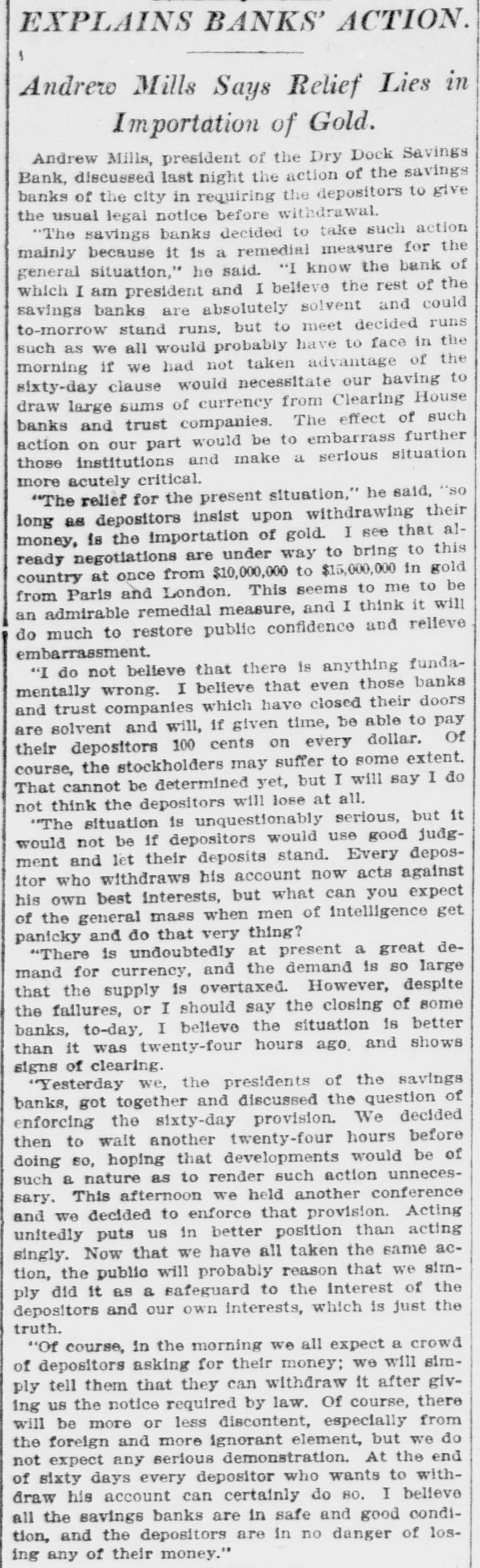
EXPLAINS BANKS' ACTION. I Andrew Mills Says Relief Lies in Importation of Gold. Andrew Mills, president of the Dry Dock Savings Bank, discussed last night the action of the savings banks of the city in requiring the depositors to give the usual legal notice before withdrawal. "The savings banks decided to take such action mainly because it is a remedial measure for the general situation," he said. "I know the bank of which I am president and I believe the rest of the savings banks are absolutely solvent and could to-morrow stand runs, but to meet decided runs such as we all would probably have to face in the morning if we had not taken advantage of the sixty-day clause would necessitate our having to draw large sums of currency from Clearing House banks and trust companies. The effect of such action on our part would be to embarrass further those institutions and make a serious situation more acutely critical. "The relief for the present situation," he said, "so long as depositors insist upon withdrawing their is the importation of gold. I see that alare under way to money, ready negotiations $15,000,000 bring in to gold this country at once from $10,000,000 to from Paris and London. This seems to me to be an admirable remedial measure, and I think it will do much to restore public confidence and relieve embarrassment. "I do not believe that there is anything fundamentally wrong. I believe that even those banks and trust companies which have closed their doors are solvent and will, if given time, be able to pay 100 cents on every the stockholders may suffer to some their course, depositors dollar. extent. Of That cannot be determined yet, but I will say I do not think the depositors will lose at all. "The situation is unquestionably serious, but it would not be if depositors would use good judgment and let their deposits stand. Every depositor who withdraws his account now acts against his own best interests, but what can you expect of the general mass when men of intelligence get panicky and do that very thing? "There is undoubtedly at present a great demand for currency, and the demand is so large that the supply is overtaxed. However, despite the failures, or I should say the closing of some banks, to-day, I believe the situation is better than it was twenty-four hours ago. and shows signs of clearing. "Yesterday we, the presidents of the savings banks, got together and discussed the question of enforcing the sixty-day provision. We decided then to wait another twenty-four hours before doing so, hoping that developments would be of such a nature as to render such action unnecessary. This afternoon we held another conference and we decided to enforce that provision. Acting unitedly puts us in better position than acting singly. Now that we have all taken the same action, the public will probably reason that we simply did it as a safeguard to the interest of the depositors and our own interests, which is just the truth. "Of course, in the morning we all expect a crowd of depositors asking for their money; we will simply tell them that they can withdraw it after giving us the notice required by law. Of course, there will be more or less discontent, especially from the foreign and more ignorant element, but we do not expect any serious demonstration. At the end of sixty days every depositor who wants to withdraw his account can certainly do so. I believe all the savings banks are in safe and good condition, and the depositors are in no danger of losing any of their money."
Article from The Washington Herald, October 27, 1907

Click image to open full size in new tab

Article Text

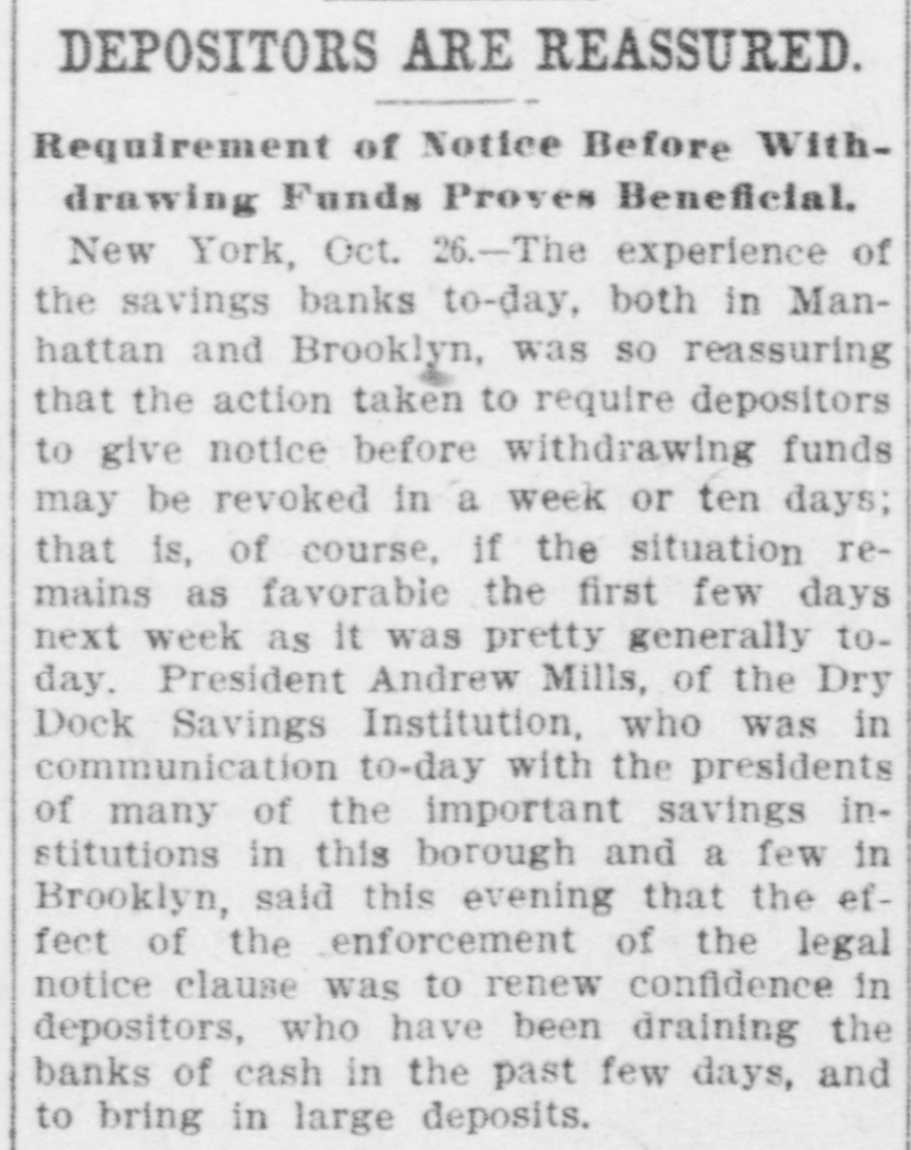
DEPOSITORS ARE REASSURED. Requirement of Notice Before Withdrawing Funds Proves Beneficial. New York, Oct. 26. -The experience of the savings banks to-day, both in Manhattan and Brooklyn, was so reassuring that the action taken to require depositors to give notice before withdrawing funds may be revoked in a week or ten days; that is, of course, if the situation remains as favorable the first few days next week as It was pretty generally today. President Andrew Mills, of the Dry Dock Savings Institution, who was in communication to-day with the presidents of many of the important savings institutions in this borough and a few in Brooklyn, said this evening that the effect of the enforcement of the legal notice clause was to renew confidence in depositors, who have been draining the banks of cash in the past few days, and to bring in large deposits.


Article from New-York Tribune, November 21, 1907

Click image to open full size in new tab

Article Text

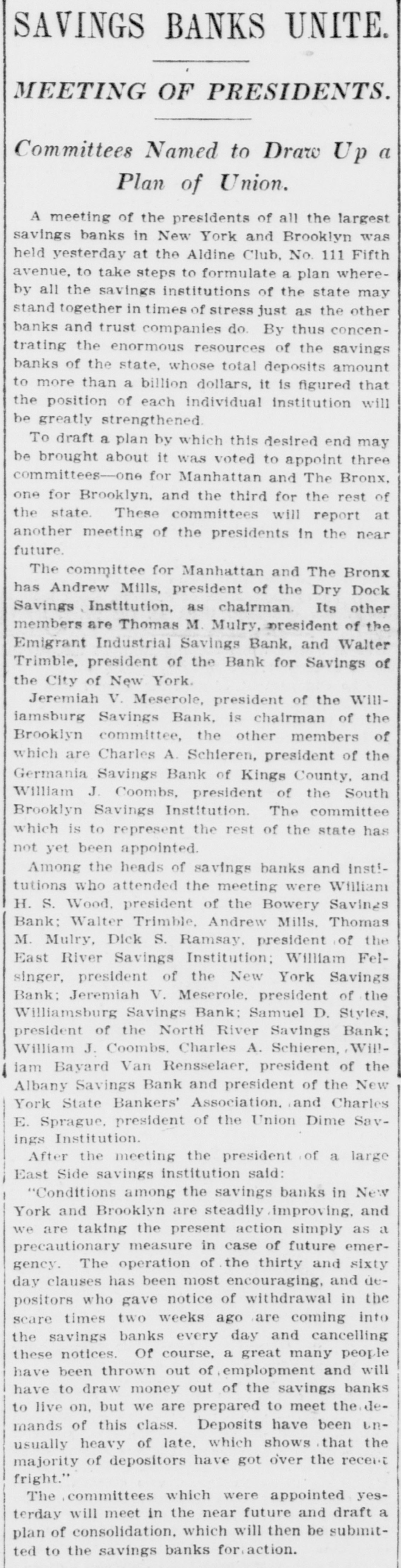
SAVINGS BANKS UNITE. MEETING OF PRESIDENTS. Committees Named to Draw Up a Plan of Union. A meeting of the presidents of all the largest savings banks in New York and Brooklyn was held yesterday at the Aldine Club, No. 111 Fifth avenue, to take steps to formulate a plan whereby all the savings institutions of the state may stand together in times of stress just as the other banks and trust companies do. By thus concentrating the enormous resources of the savings banks of the state, whose total deposits amount to more than a billion dollars, it is figured that the position of each individual institution will be greatly strengthened To draft a plan by which this desired end may be brought about it was voted to appoint three committees-one for Manhattan and The Bronx. one for Brooklyn, and the third for the rest of the state. These committees will report at another meeting of the presidents in the near future. The committee for Manhattan and The Bronx has Andrew Mills, president of the Dry Dock Savings Institution, as chairman. Its other members are Thomas M. Mulry, president of the Emigrant Industrial Savings Bank, and Walter Trimble, president of the Bank for Savings of the City of New York. Jeremiah V. Meserole, president of the Williamsburg Savings Bank, is chairman of the Brooklyn committee, the other members of which are Charles A. Schleren, president of the Germania Savings Bank of Kings County, and William J. Coombs, president of the South Brooklyn Savings Institution. The committee which is to represent the rest of the state has not yet been appointed. Among the heads of savings banks and inst!tutions who attended the meeting were William H. S. Wood. president of the Bowery Savings Bank: Walter Trimble, Andrew Mills, Thomas M. Mulry, Dick S. Ramsay, president of the East River Savings Institution: William Felsinger, president of the New York Savings Bank: Jeremiah V. Meserole, president of the Williamsburg Savings Bank: Samuel D. Styles, president of the North River Savings Bank: William J. Coombs. Charles A. Schieren, William Bayard Van Rensselaer, president of the Albany Savings Bank and president of the New York State Bankers' Association, and Charles E. Sprague, president of the Union Dime Savings Institution. After the meeting the president of a large East Side savings institution said: "Conditions among the savings banks in New York and Brooklyn are steadlly improving. and we are taking the present action simply as a precautionary measure in case of future emergency. The operation of the thirty and sixty day clauses has been most encouraging, and depositors who gave notice of withdrawal in the scare times two weeks ago are coming into the savings banks every day and cancelling these notices. Of course, a great many people have been thrown out of emplopment and will have to draw money out of the savings banks to live on, but we are prepared to meet the demands of this class. Deposits have been inusually heavy of late. which shows that the majority of depositors have got over the recent fright." The committees which were appointed yesterday will meet in the near future and draft a plan of consolidation, which will then be submitted to the savings banks for action.


Article from The News-Democrat, December 23, 1907

Click image to open full size in new tab

Article Text

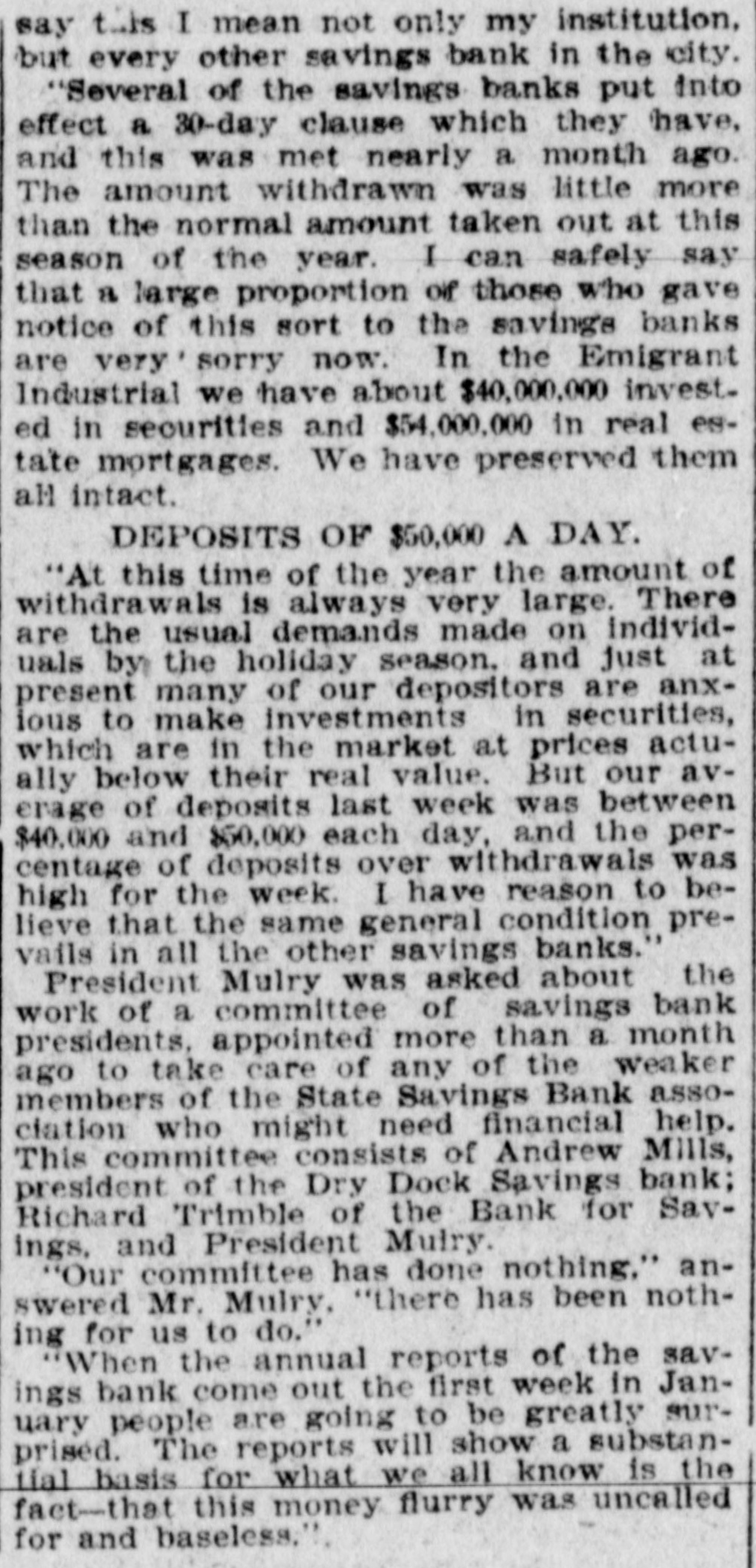
say this I mean not only my institution, but every other savings bank in the city. "Several of the savings banks put into effect a 30-day clause which they have, and this was met nearly a month ago. The amount withdrawn was little more than the normal amount taken out at this season of the year. I can safely say that a large proportion of those who gave notice of this sort to the savings banks are very sorry now. In the Emigrant Industrial we have about $40,000,000 invested in securities and $54,000,000 in real estate mortgages. We have preserved them all intact. # DEPOSITS OF $50,000 A DAY. "At this time of the year the amount of withdrawals is always very large. There are the usual demands made on individuals by the holiday season, and just at present many of our depositors are anxious to make investments in securities, which are in the market at prices actually below their real value. But our average of deposits last week was between $40,000 and $50,000 each day, and the percentage of deposits over withdrawals was high for the week. I have reason to believe that the same general condition prevails in all the other savings banks." President Mulry was asked about the work of a committee of savings bank presidents, appointed more than a month ago to take care of any of the weaker members of the State Savings Bank association who might need financial help. This committee consists of Andrew Mills, president of the Dry Dock Savings bank; Richard Trimble of the Bank for Savings, and President Muiry. "Our committee has done nothing," answered Mr. Mulry, "there has been nothing for us to do." "When the annual reports of the savings bank come out the first week in January people are going to be greatly surprised. The reports will show a substantial basis for what we all know is the fact that this money flurry was uncalled for and baseless."